


Abstract
(1) Background: Aimed at improving school children’s motor, social, emotional, and cognitive competence (CC), the effects of physical activity (PA) have been widely investigated. However, investigations into the effects of PA during Physical Education (PE) on children’s CC have only been subject to growing interest among researchers in recent years. To bring it, the present article aims to systematically summarize the PE intervention programs whose effects on school children’s CC have been evaluated through a randomized controlled trial (RCT) design. (2) Methods: This systematic review follows the PRISMA guidelines and has been registered in PROSPERO: CRD420251083924. A systematic literature search was conducted across four electronic databases: PubMed, SCOPUS, Web of Science, and ProQuest Central. The articles were included based on the following inclusion criteria: (i) primary education children, (ii) children practicing PE, (iii) outcomes related to CC, and (iv) articles providing evaluations through RCTs. The quality assessment of all included articles was performed using the PEDro scale. (3) Results: Out of 219 initially identified studies, 25 met the inclusion criteria and were synthesized qualitatively. (4) Conclusions: The main outcomes highlighted that PE has a positive effect on primary school children’s cognitive ability, including attention, creativity, memory, academic performance, and inhibitory control. Thus, elementary school teachers are encouraged to implement these intervention programs to foster children’s CC. However, different types of interventions should be analyzed to highlight their effects on different variables of CC.
1. Introduction
Physical education (PE) is focused on the importance of physical activity (PA) for health and well-being [1], and there is growing interest in highlighting the role of this subject to foster integral child development (cognitive, emotional, and social competence) [2,3]. In general, PE is aimed at promoting and facilitating a meaningful understanding among students of their bodies and abilities. To that end, it allows them to acquire diverse skills that guide them to develop naturally in their environment, uphold a high quality of life, enjoy leisure, and maintain enriching relationships with others [4]. From this perspective, motor, social, emotional, and cognitive development must be addressed in an integrated way considering children’s continuous and progressive exploration of the environment, their relationships with objects and other children, the environment, and the teacher, which may help to build children’s topological, spatial, and problem-solving skills [5].
Among these competencies, cognitive competence (CC) has recently experienced exponential growth in the scientific literature, maybe because it describes how to manipulate internal information, which is crucial for autonomous learning and metacognition, that is, the ability to reflect on one’s learning process and adjust it as necessary [6]. In detail, cognition refers to the ability to process information through perception, acquired knowledge (experience), and subjective characteristics, which allows children to evaluate the information they perceive from the environment. When talking about CC, different concepts can be found, such as CC, academic achievement, and executive functions. These are connected, but they do not refer to the same concept. Specially, CC means a person’s mental abilities, such as thinking, solving problems, and remembering. Academic achievement refers to the level of success in educational pursuits. CC is an essential skill that can influence academic achievement, among other factors. Finally, executive function refers to the cognitive skills needed to manage daily tasks, plan, and adapt to new situations [7,8,9].
In this area, developing CC from the elementary educational stage is crucial, especially for PE as a subject, which could generate different neurobiological mechanisms during its practice. In fact, all the physical activities that a child performs (i.e., running, jumping, playing) encourage the use of brain energy and promote the development and final configuration of the brain. For example, children’s PA increased blood flow reaches the brain, which improves cerebral oxygenation and means that children receive a greater supply of essential nutrients for the main organ of cognition. In addition, an improvement in oxygenation can boost cognitive function by facilitating greater neural activity and better communication between brain regions [10]. Secondly, PA can increase neurotrophic factors among children [11]. These factors are similar to growth hormones, but they have a specific impact on the brain and are vitally important in promoting the survival and growth of neurons, as well as creating new synaptic connections [12]. Exercise-induced neuroplasticity can significantly improve cognitive function in the short and long term [13]. Third, PA targets the excitation of the nervous system as a result of exercise, which involves the formation and release of essential neurotransmitters, such as dopamine and serotonin. These brain chemicals play a critical role in regulating the mood, motivation, and attention, which can impact children’s development, with an increase in their release during and after exercise immediately improving children’s cognitive performance [13].
In this regard, Bernal [14] highlighted three groups of components that are consequences of practicing sport activities. First, during exercise, an increase in the concentration of neurotransmitters is observed, which facilitates the transmission of information from one neuron to another, promoting the development of memory. Second, the number of neurotrophic factors increases: these are specific proteins that promote the survival of neurons and, thus, contribute to the maintenance of brain health. Third, supramolecular adaptations are initiated and articulated, which increases the number of neurons, blood capillaries, and neuronal connections. This process also develops various parts and tissues of the brain, such as the hippocampus, a brain structure that plays a fundamental role in memory and the ability to navigate in space [14].
However, to the best of the authors’ knowledge, no systematic review has summarized different PE programs, evaluated through a randomized controlled trial (RCT) design, that have tried to influence primary school children’s CC. Therefore, the present article aims to systematically summarize the PE intervention programs whose effects on school children’s CC have been evaluated through an RCT design.
2. Materials and Methods
2.1. Experimental Approach to the Problem
This systematic review was conducted following the PRISMA (Preferred Reporting Items for Systematic Reviews and Meta-Analyses) framework [15] in conjunction with established methodological recommendations for systematic reviews within the field of sport sciences [16]. The systematic review has been registered in PROSPERO (PROSPERO 2025 CRD420251083924).
2.2. Information Sources
To find pertinent papers published up until 18 January 2024, a thorough search approach was applied across four electronic databases: PubMed, ProQuest Central, SCOPUS, and Web of Sciences.
2.3. Search Strategy
To clearly define the research question, the PICOS framework was employed. Whenever feasible, the search was restricted to peer-reviewed scientific articles and specific languages, as detailed in exclusion criterion number six. The screening process was not blinded with respect to journal titles or author identities. The search strategy incorporated the following terms (see Table 1):

Table 1.
Eligibility criteria for the inclusion and exclusion of studies.
(school OR “primary education” OR “elementary education”) AND (“physical education”) AND (“executive function*” OR cogniti* OR “academic performance” OR “academic achievement” OR “academic outcome*” OR “academic readiness” OR concentration OR memory OR attention) AND (“randomized controlled trial*”)
2.4. Eligibility Criteria
One author recorded key data from each article (including title, authorship, publication date, and source database) into a Microsoft Excel spreadsheet. Duplicate entries were subsequently removed. The remaining records were then screened based on the predefined inclusion and exclusion criteria (see Table 1). Additionally, other pertinent studies not initially captured through the database search were assessed following the same procedure and, if eligible, were incorporated under the label included from “external sources”.
2.5. Data Extraction
A Microsoft Excel spreadsheet was used for data extraction, in accordance with the Cochrane Consumers and Communication Review Group’s suggested template. The spreadsheet was used to assess each chosen study’s eligibility in light of the inclusion and exclusion criteria. The full-text articles that were not included in the analysis were listed together with the precise justifications. The spreadsheet was used to systematically archive all of the records.
2.6. Risk of Bias Assessment
Additionally, the second version of the Cochrane risk-of-bias tool for randomized trials was used (RoB 2). The authors assessed different key domains: random sequence generation (1 item), allocation concealment (2 item), blinding of participants and personnel (item 3), blinding of outcome assessment (item 4), incomplete outcome data (item 5), selective reporting (item 6), and other bias (item 7) [17]. Each domain was evaluated and classified using low risk of bias (+), high risk of bias (-), or some concerns or unclear risk of bias (?). Two authors conducted RoB 2.0 assessments (G.B.S. and M.R.-G.), with disagreements resolved through discussion or consultation with a third author (N.M.G.).
3. Results
3.1. Identification and Selection of Studies
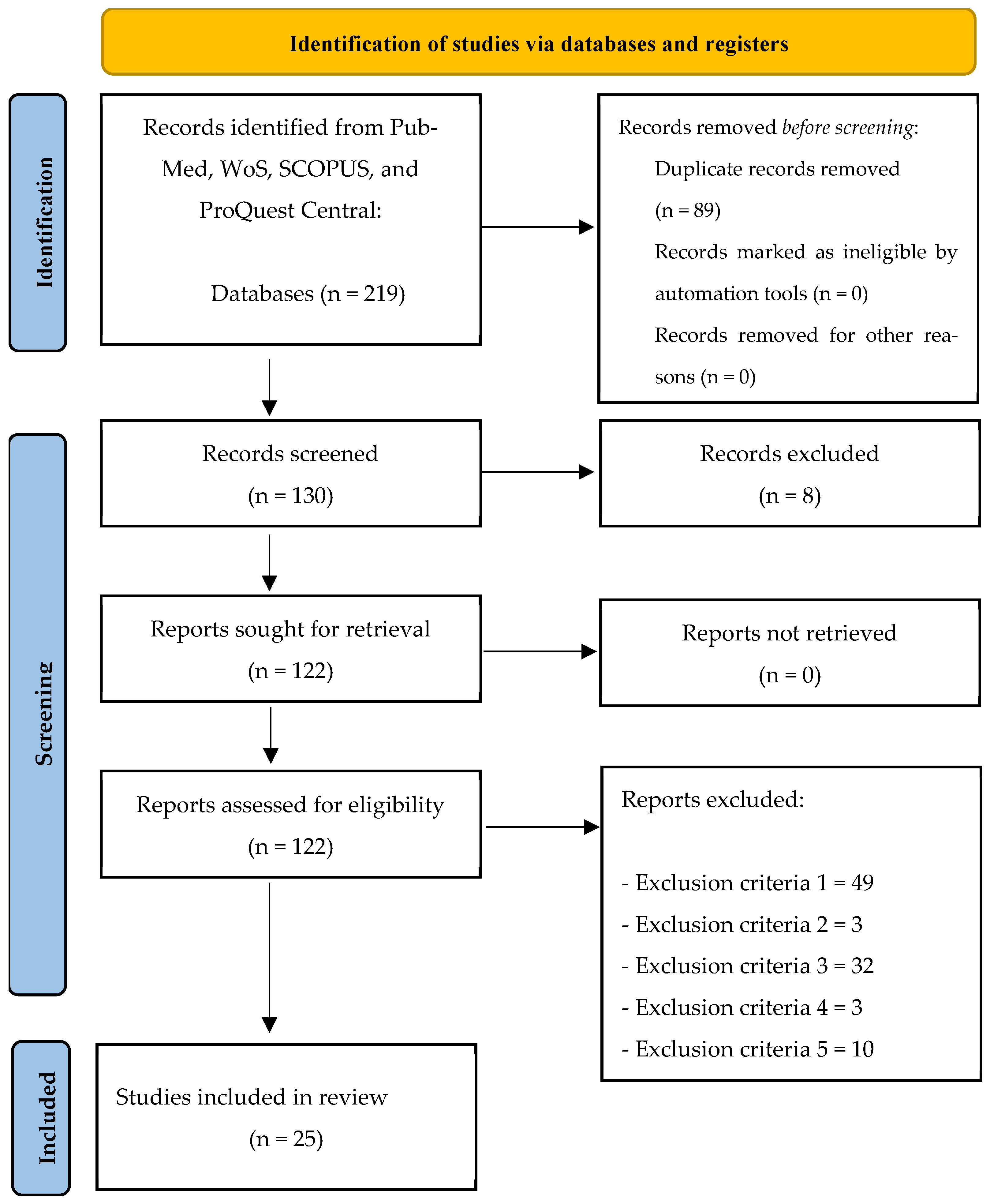
A total of 89 of the 219 original papers (Proquest Central: 20; SCOPUS: 126; Web of Science: 37; PubMed: 36) were duplicates. As a result, 130 distinct articles were found. Eight papers were eliminated after titles and abstracts were reviewed because they did not satisfy the fifth inclusion criterion. The full text of the remaining 122 articles was then examined, and 49, 3, 32, and 3 articles were removed because they did not meet the exclusion criteria numbers 1, 2, 3, and 4. Additionally, 10 articles were not included because the programs were not evaluated through RCT design. The final qualitative synthesis, thus, contained 25 papers that satisfied all inclusion criteria (Figure 1).
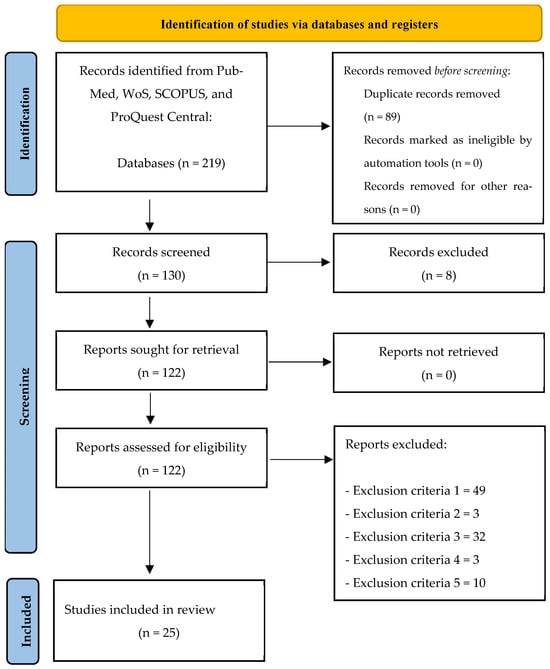
Figure 1.
Flow diagram of the study.
3.2. Quality Assessment
Following the RoB-2 scale, the analysis provides that included studies assume risk of bias in some issue, mainly in allocation concealment and both blinding-related items: blinding of participants and personnel and blinding of outcome assessment. In fact, most of the articles declared that blinding was not performed during the interventions, assuming a high risk of bias due to these items. However, as the only RCTs were included in this systematic review, all studies met the first inclusion criteria. Finally, as different issues could provide risk of bias, all studies were classified as having some concerns in the items related to “other bias”. The results of the evaluated risk of bias are presented in Table 2.
Table 2.
Risk of bias using RoB-2.
3.3. Study Characteristics
The included studies were divided depending on the variables that were analyzed. They were divided into attention, inhibition, memory, cognitive flexibility, academic performance (mathematics, linguistics, and reading and writing), and creativity.
- Attention: Six studies evaluated the effects of a program on schoolchildren’s attention. Among them, four studies reported positive effects of intervention programs on children’s attention. Specifically, the Active-Start program revealed significant improvement in attention and concentration when cardiorespiratory fitness was at least, between 3.05 and 0.70 mL/kg/min, respectively [18]; the Movement Games program (based on MVPA) improves attention ability [19]; the external focus-based program showed more effects on attentional focus than internal focus-based exercises [32]; and a nuanced prediction of individual DMA indices spatial attention ability [33]. However, two studies did not find statistically significant effects of exercises based on aerobic efforts or cognitively demanding tasks when compared to usual PE classes [40] or acute PA on lapses of attention [37].
- Inhibitory control: Six studies evaluated the effects of a program on schoolchildren’s inhibition. Among them, one study demonstrated positive effects of the Movement Games intervention program compared with usual PE classes [19], while three studies demonstrated the effects of PA on children’s inhibition but did not find differences between groups. Specifically, Schmidt et al. [20] did not find more positive effects in different types of exercises (high cognitive engagement + high physical exertion, high cognitive engagement + low physical exertion, or low cognitive engagement + low physical exertion); Oppici et al. [29] did not find differences between high cognitive physical activity, low cognitive physical activity, or usual PE classes; and Kolovelonis & Goudas [31] did not find different effects of PA games highlighting contextual interference, mental control, or discovery. However, two studies did not demonstrate any effects on inhibition function [28,37].
- Memory: Six studies evaluated the effects of a program on schoolchildren’s memory capacity. Among them, three studies showed positive effects, while the other three did not demonstrate between-group differences. Specifically, high cognitive PA intervention improves memory better than low cognitive or habitual PE classes [29]; children performing PACER task intervention achieved better recall of words after a brief delay than children without treatment [26]; and children in physical activity games highlighting both contextual interference and mental control significantly enhanced working memory [31]. Meanwhile, other studies demonstrate how aerobic exercise or cognitively demanding exercises did not demonstrate evidence for effects on visuospatial short-term memory and verbal working memory [21]; external and internal focus instruction-based programs did not find the prediction of learning based on working memory capacity [32]; and integrating juggling with math lessons did not show better results than children performing sedentary math lessons on math memorization performance [35].
- Cognitive flexibility: Eight studies evaluated the effects of a program on schoolchildren’s cognitive flexibility. Among them, three studies found positive effects of evaluated programs. Specifically, the Active Recess program has better positive effects than intervention without physical exercise [23]; the Movi-Kids intervention showed better outcomes than usual PE classes on cognitive changes [34]; and martial-arts-based intervention showed better results than habitual PE classes on children’s cognitive self-regulation [38]. Another two studies found positive effects, although no differences between groups were found. In this case, PA games highlighting contextual interference, mental control, or discovery seem equally effective for improving cognitive flexibility when comparing with the no PE intervention group [31], In addition, Oppici et al. [29] support that high cognitive intervention could enhance cognitive flexibility, but they did not find statistical differences between groups (high cognitive or low cognitive PA). However, ball-skill-based intervention [22] and high-intensity interval training did not show better strategy than usual PE classes [30]; and the Active Smarter Kids program [28] did not show any effects on children’s cognitive flexibility.
- Academic performance: Twelve studies evaluated the effects of a program on schoolchildren’s academic performance. Among them, the Active-Start program showed positive effects on language and mathematics [18]; karate-based intervention improved children’s academic achievement [41]; an intervention program improved mathematics scores and language scores more than children performing habitual PE classes [30]; an enriched PE program improves better fluency and flexibility better than conventional PE classes [33]; karate-based intervention seems particularly effective for children with psychosocial difficulties and low academic performance [41]; PE classes taught by specialists are more effective on children’s numeracy and writing [36]; and a martial-arts-based program improves mental math performance [38]. However, other programs did not report significant effects after conducting their intervention programs. Among them, there are no effects of the ball-skill-based intervention program on learning lags in reading and mathematics [22]; there are no effects of aerobic, cognitive engaging, or habitual PE classes on academic achievement, although children with lower performance in reading at baseline performed better in reading at post-test after performing cognitive engaging intervention program [25]; after SPARK program intervention the authors highlighted that engaging children in more time of physical not necessarily influence academic performance [27]; the Active Smarter Kids intervention did not significantly improve verbal fluency [28]; and activity bursts in the classroom seem no more effective than normal curriculum activities for improving reading and mathematics [39]. However, it is of interest to analyze depending on the areas of the measured variables: general academic achievement, mathematics, speech, and literacy skills.
- Creativity: Three intervention programs were found. All of them supported significant differences in favor of ball skill-based [22], active recess-based [23], and enriched PE-based programs [33].
- Brain activation: One study evaluated the brain activation [21]. The authors found that greater brain activation was greater after both aerobic-based and cognitive-engaging interventions, although no statistical differences were found after them.
The characteristics of studies, as well as the results and conclusion of each article, were extracted and are clustered in Table 3. In addition, the characteristics of evaluated intervention programs are extracted in the Supplementary Material Table S1.
Table 3.
Characteristics of included studies.
4. Discussion
The present article aims to systematically summarize the intervention programs whose effects on school children’s cognitive competence have been evaluated through RCT design. The main findings revealed that PE is clearly related to cognitive ability, including attention, creativity, memory, academic performance, and inhibitory control.
4.1. Effects of EF on Attention in Primary School Students
Attention refers to the mechanism directly involved in the activation and functioning of the processes of selection, distribution, and maintenance of psychological activity [42]. The search for RCTs showed a total of six studies that have evaluated their intervention programs on primary school children’s attention.
A unique study compared only two types of interventions. In this case, Brocken et al. [32] showed how an external focus-based program showed more effects on attentional focus than internal focus-based exercises [32]. However, three out of six studies compared a certain intervention program performed by the experimental group (EXP), while the control group (CON) continued with the usual PE classes [18,19,33]. According to the results of all studies, the Active-Start program [18], the enriched PE program [33], and the Movement Games Intervention program [19] had positive results in serving primary school children compared to conventional schools. Interestingly, the study of García-Hermoso et al. [18] tried to relate cardiorespiratory fitness to attention and concentration, highlighting that these two cognitive variables are improved when cardiorespiratory fitness is at least, between 3.05 and 0.70 mL/kg/min, respectively [18]. However, caution should be taken into account as a wide body of scientific literature has tried to link the effects of Vo2max and CC, but some authors have tried to suggest that the relationship between physical fitness and CC is not necessarily dose–response because other factors (e.g., genetics, nutrition, environmental factors) may also play a role [7,43].
Other studies have compared the effects of cognitive engaging PA [37,40]. First, Meijer et al. [40] divided the students into three groups: aerobic exercise (EXP1), rigorous cognitive exercise (EXP2), and conventional PE classes. The results did not show a significant influence on the participants’ attention processes, which occurred in Van Der Fels et al. [37]. The aerobic and cognitively engaging physical intervention also did not positively influence lapses of attention.
Therefore, the Active-Start, enriched PE, and Movement Games interventions are recommended when compared to usual PE classes for improving schoolchildren’s attention. However, there is no clear result about the effects of cognitively engaging PA on schoolchildren’s attention, at least with the duration of the included interventions (the longer intervention was 14 weeks, four lessons per week).
4.2. Effects of PE on the Inhibitory Control of Primary School Students
Inhibitory control refers to the mental processes responsible for controlling them voluntarily and involuntarily, as well as the ability to prevent the interference of inappropriate information with ongoing responses and eliminate previously relevant information, which may provide a certain short-term stimulus, but that is not useful for the current task to be performed [44]. The search for RCTs showed a total of six studies that analyzed the effects of PE on the inhibitory control of primary school children.
Two out of five studies compared an intervention program assigned to the EXP with regular PE classes assigned to the CON [19,28]. In the study carried out by Chou et al. [19], the “Movement games” program was carried out to move in different situations, respond to the speed, direction, and strength of movements, and control body movements when jumping, throwing, catching, dribbling, kicking, or passing. The results showed an improvement in the EXP in inhibitory control, especially in the tendency to interfere. In the second study, Aadland et al. [28] investigated the consequences of the “Active Smarter Kids” intervention: active lessons for Norwegian, mathematics, and English (3 times a week, 30 min each), breaks from daily PA in the classroom (5 min), and PA tasks to complete at home (10 min a day). The results did not show the effects of EXP on inhibition functions. As in the case of attention, Van Der Fels et al. [37] stated that they found no influence on the inhibitory control of primary school students after an intervention based on aerobic exercises and another based on cognitively rigorous exercises.
On the other hand, three scientific studies compared three groups of children with interventions of different characteristics [20,29,31]. In the intervention carried out by Schmidt et al. [20], they divided the students into EXP1 (team games: high cognitive engagement + high physical exertion), EXP2 (aerobic exercises: low cognitive engagement + high physical exertion), and CON (low physical + cognitive demand program). The conclusion reached in this study is that there are no differences between the three groups and that the level of inhibitory control is the same as with CON. However, the study conducted by Kolovelonis and Goudas [31] showed differences in interventions based on PA games, mental-control-based exercises, and discovery-based exercises, compared to children who did not engage in physical activity. Finally, Oppici et al. [29] compared a high cognitive load intervention (EXP1) and a low cognitive load intervention (EXP2) with a group that continued with ordinary PE classes (CON). This study showed that although EXP1 could improve inhibitory control, more research is needed to study the generalizability of the findings.
In brief, the “Movement Games” program, exercises based on mental control, and exercises based on discovery have shown positive results in inhibitory control, while low physical and cognitive demand programs, sports programs, and the intervention in “Active Smarter Kids” had no positive effects. Exercises with high cognitive demand continue to be the subject of discussion.
4.3. Effects of PE on the Memory of Primary School Students
Memory refers to the psychological process that serves to store encoded information. This information can be recovered, sometimes voluntarily and consciously, and other times involuntarily [45]. The search for RCTs showed a total of six studies that analyzed the effects of PE on primary school children’s memory.
Some RCTs found no improvement in the effects of PE on children’s memory. For example, the “juggling intervention program”, which introduced juggling into mathematical practice, did not show improvements in multiplication memorization performance [35]. Likewise, in the research carried out by Meijer et al. [40], aerobic exercises, highly cognitive exercises, or conventional PE classes were proposed, but improvements in memorization were not found either.
However, there are two studies that do not correspond to the previous results, showing improvements in memory capacity and working memory. In the first of them, Oppici et al. [29] carried out two interventions related to learning dance choreography: EXP1, which carried out an intervention with high cognitive content, and EXP2, which carried out an intervention with low cognitive content. In the second study, Kolovelonis and Goudas [31] compared three types of PA games, cognitively challenging the students’ memory capacity, while CON did not participate in PE. EXP1 played games that highlighted context interference, EXP2 played games that highlighted mental control, and, finally, EXP3 played games that highlighted discovery. In both they found improvements in all EXP. Furthermore, findings from various interventions suggest that rigorous exercise provides benefits to long-term memory [26] and that older children have greater memory capacity than younger children [32].
In summary, the scientific literature shows that exercise can improve memory, but results vary depending on the type of intervention and its cognitive content. In general, interventions with high cognitive content appear to be more effective in improving memory capacity and working memory. However, future studies must corroborate these facts, which, in the absence of further analysis, have adverse effects.
4.4. The Effects of PE on the Cognitive Flexibility of Primary School Students
Cognitive flexibility refers to the ability to adapt functions to environmental conditions when faced with a task or as an integral part of executive functions [46]. The search for RCTs showed eight studies that analyzed the effects of PE on the inhibitory control of primary school children.
The “Active recess program” [23], the “Movi-Kids” [34], and the “LEAD” [38] programs showed notable improvements in cognitive flexibility. These programs compared the intervention to a CON group. In the case of “Movi-Kids” and “LEAD”, the students continued with the usual PE classes, while in the case of the “Active recess program”, the students carried out usual activities in class without physical exercise. Likewise, Kolovelonis and Goudas [31] compared the effects of three different types of PA games that challenge cognitive flexibility with a CON who did not participate in PE. The results of this study also revealed the positive effects of cognitively challenging physical activities, which highlighted context interference and mental control.
However, four studies found no relationship between the interventions carried out and cognitive flexibility [22,28,29,30]. Specifically, Westendorp et al. [22] carried out an intervention to exercise with the ball, while the CON group followed the usual PE classes. Likewise, Aadland et al. [28] performed the Active-Start Kids (ASK) intervention, while CON continued with the usual PE classes. Oppici et al. [29] divided them into two intervention groups: EXP1 (high cognitive load), EXP2 (low cognitive load), and CON, as in the other two studies, followed by the usual PE classes. Finally, Takehara et al. evaluated the effects of high-intensity interval training compared with usual PE classes [30]. As mentioned above, none of these studies had positive results in cognitive flexibility.
Consequently, studies on the impact of PE on cognitive flexibility showed mixed results. While some programs noticeably improved this ability, others found no connection, highlighting the need for more research to better understand these findings.
4.5. Effects of PE on the Academic Performance of Primary School Students
Academic performance corresponds to the level of knowledge demonstrated in an area or subject in comparison to the norm of age and academic level [47]. Academic performance can be divided into several variables (e.g., academic performance in mathematics, speaking, reading, and writing). The search for RCTs showed a total of 12 studies that analyzed the consequences of PE on the academic performance of primary school children. However, within this competency there are numerous variables measured: general academic achievement, mathematics, speech, and literacy skills.
Without specifying the cognitive performance variable, Pinto-Escalona et al. [24,41] conducted two studies. In these studies, the sample of children was distributed in an EXP group that carried out an intervention based on karate-related exercises, while in CON they continued with the usual PE classes. In both studies they found benefits in academic performance in favor of EXP compared to CON. However, the rest of the studies determined the variable they wanted to measure within academic performance.
4.5.1. Academic Performance in Mathematics
Different studies investigated the academic performance variable in mathematics. All these studies proposed the comparison of a program designed for EXP, and the CON group followed the usual PE classes [18,22,27,30,36,38,39]. Active-Start [18], the ball skills program [22], SPARK [27], “Activity Bursts in the Classroom” or ASK [28], exercise intervention [30], GH [36], and LEAD [38], taught by specialists, showed notable improvements in mathematical competence compared to regular classes from EF. Although most studies seem to agree that programs to improve mathematical competence are more appropriate than conventional classes, there are two that oppose this. Specifically, children who participated in the “Activity Bursts in the Classroom” program [39] did not show better results than those who followed the usual PE classes. Likewise, De Bruijn et al. [25] compared three types of children’s groups in three interventions: aerobic exercises (EXP1), the cognitively stimulating program (EXP2), and the program based on low cognitive and physical demand (CON). Therefore, although in the primary school boy and girl mathematical competence seems to be a clear trend towards the positive effects of PE (the Active-Start programs, the ball skills program, SPARK, ASK, exercise intervention, PE, and LEAD provided by specialists), some details must be analyzed, such as the duration and what type of activity has been proposed, as both studies have not found improvements.
4.5.2. Academic Performance in Speaking
The four investigations analyzed the variable academic performance of speaking ability through the execution of various programs [18,28,30,48]. The Active-Start proposal contains physically active educational subjects, brain breaks, and PA obligations [18]. On the other hand, the exercise intervention is an activity based on high-intensity interval training (HIIT) accompanied by music, which is divided into four parts with the aim of improving aerobic fitness and motor skills [30]. Both studies showed beneficial results of PE on language ability. On the contrary, the ASK [28] and the Active Values [48] programs did not show significant differences in verbal fluency, as they compared EXP and CON. Therefore, although some programs appear to show positive results of PE on primary school children’s speech (the Active-Start and the HIIT programs), in general, there is debate over the results shown, suggesting the need for new randomized controlled analyses.
4.5.3. Academic Performance in Reading and Writing
Finally, five studies investigated the variable academic performance in the aspect of literacy [22,25,27,36,39]. The ball training programs [22], SPARK [27], the GH program taught by specialists [36], and “Activity Bursts in the Classroom” [39] compared their program with a CON, and the participating children continued with the previously established programming. For their part, De Bruijn et al. [25] compared the programs carried out by the author with three groups of different characteristics: the aerobic intervention (EXP1), the cognitively rigorous program (EXP2), and the intervention based on low physical and cognitive demand (CON). All studies concluded that the programs carried out have no impact on reading. However, Telford et al. [36] related PE classes taken, taught by specialists, with greater improvements in writing. Therefore, the findings obtained indicate that there is no correlation between PE and academic performance in literacy, although the participation of experts in the subject could show a thread to follow in future research.
4.6. The Effects of PE on the Creativity of Primary School Students
Creativity refers to the ability to create new ideas or concepts, innovate, create, or create new links between known ideas and concepts, which normally lead to new consequences, solve problems, and create original and valuable solutions [49,50]. The search for RCTs showed a total of three studies that examined the effects of PE on elementary school children’s creativity.
Latorre-Roman et al. [23] conducted a study to evaluate the effects of an active leisure program on creativity. In this study, 114 children were divided into two groups: the EXP, which carried out the active play program, and the CON, which followed the usual PE classes. The results showed a greater increase in all creative measures compared to the CON. Likewise, a study was conducted by De Fano et al. [33] to investigate the originality, where 242 children participated. The EXP participated in the enriched PE, while the CON taught regular PE classes. The results showed that EXP can provide short-term benefits for the originality of children’s motor behavior, but additional studies are needed to understand the long-term effects on this variable. These positive results remain in children with special educational needs. In this sense, Westendorp et al. [22] conducted a study to determine the influence of an intervention based on ball skills exercises in problem solving of children with learning disabilities. The EXP received an intervention program to train with the ball, while the CON program received the usual PE classes. A positive relationship was found between improving ball skills and improving EXP problem solving.
Therefore, the scientific studies unanimously show that PE has positive effects on primary school students’ creativity, both in children without special educational needs and in children with a learning disorder. However, additional studies are suggested to corroborate these findings.
5. Limitations
To analyze articles with a lower risk of bias, there were only RCTs included in the present systematic review. However, the RoB-2 scale was used to analyze them, and some issues should be highlighted. Mainly, the extracted results should be taken with caution because items such as allocation concealment and blinding-related items may influence the overall findings. In fact, although blinding participants, assessors, or researchers that will perform the assessment is a common limitation in educational studies that have included young children, the absence of blinding increases the likelihood of performance and detection bias, which may overestimate the reported effects of the interventions.
Additionally, it is important to highlight that due to the wide variety of intervention programs, as well as the different evaluated variables, it is difficult to highlight and generalize what is the most suitable type or intensity of exercise to improve each of the different cognitive-related variables.
6. Conclusions
Overall, PE has positive effects on the cognitive abilities of primary school students, especially with specific programs with high cognitive demand. Although the benefits are based on different areas, PE’s impact on some skills shows mixed results, indicating the need for more research to optimize interventions. In general, PE contributes significantly to the cognitive development of students. However, this competition has been divided into several sections, based on the findings:
For attention, Active-Start, enriched PE, and the Movement Games intervention show improvements in care for school-aged children. However, high cognitive demand programs and aerobic exercises do not seem to positively affect child attention.
Regarding inhibitory control, Movement Game programs, mental control exercises, and discovery-based activities have shown positive results in inhibitory control. On the contrary, programs with low physical and cognitive demand, sports programs, and the “Active Smarter Kids” intervention did not have positive effects. The scientific literature continues not to support those exercises with high cognitive demand for improving CC.
For improving memory, evidence indicates that exercise can improve memory, but that results depend on the type of intervention and its cognitive content. In general, interventions with high cognitive content appear to be more effective in improving memory capacity and working memory. However, more research is necessary to confirm these findings, as the current conclusions are contradictory due to a lack of sufficient studies.
After checking articles that have analyzed cognitive flexibility, a wide variety of results can be found. Some programs showed significant improvements in this skill, while others did not find relationships, underscoring that more research is needed to better understand these results.
However, when checking outcomes related to academic performance, we can extract general conclusions and other specifics by analyzing each sub-variable within it. As a general conclusion, it should be noted that the impact of PE on the academic performance of primary school boys and girls has very varied results. Some interventions have seen notable improvements, but others have had no positive effects. The variability of the results suggests that factors such as the type of program and its specific content may influence the observed benefits. After this general conclusion, a conclusion can be highlighted for mathematical, linguistic, and reading and writing competencies. Mathematical competence: In the mathematical competence of primary school children there is a clear trend towards the positive effects of PE, in which the Active-Start, ball skills, SPARK, ASK, exercise intervention, PE taught by specialists, and LEAD programs stand out. It is essential to analyze some details, such as the duration and the specific type of activity proposed. The reason is that both studies did not observe substantial improvements in this aspect, suggesting that the effectiveness of PE may depend on factors such as the duration of the program and the type of activity included. Linguistic competence: Although some programs such as the Active-Start and the HIIT generate favorable effects of PE on the language of school-aged children, in general, a discussion is observed in the results presented. This underscores the need for new randomized controlled studies to more consistently clarify and validate these findings. Reading and writing: The results obtained suggest that there is no direct relationship between PE and academic activity on schoolchildren’s literacy. However, the involvement of experts could be an important starting point for future research.
Finally, when checking articles that have evaluated the effects of PE on children’s creativity, the scientific studies reviewed show a consensus regarding the positive effects of PE on primary school students’ creativity, including children without special educational needs and those with learning disorders. However, there is a need for additional research to protect and validate these findings more broadly and decisively.
Supplementary Materials
The characteristics of included intervention programs can be downloaded at: https://www.mdpi.com/article/10.3390/sports13080261/s1.
Author Contributions
Conceptualization: G.B.S., M.R.-G. and N.M.G.; Data curation: G.B.S. and M.R.-G.; Formal analysis: G.B.S., M.R.-G. and N.M.G.; Investigation: G.B.S., M.R.-G. and N.M.G.; Methodology: G.B.S. and M.R.-G.; Project administration: M.R.-G. and M.R.-G.; Supervision: M.R.-G. and N.M.G.; Writing—original draft: G.B.S., M.R.-G. and N.M.G.; Writing—review & editing: M.R.-G. and N.M.G. All authors have read and agreed to the published version of the manuscript.
Funding
This research received no external funding.
Institutional Review Board Statement
Not applicable.
Informed Consent Statement
Not applicable.
Conflicts of Interest
The authors declare no conflicts of interest.
References
- Miller, K.R.; McClave, S.A.; Jampolis, M.B.; Hurt, R.T.; Krueger, K.; Landes, S.; Collier, B. The Health Benefits of Exercise and Physical Activity. Curr. Nutr. Rep. 2016, 5, 204–212. [Google Scholar] [CrossRef]
- Zhang, Z.; Chen, W. A Systematic Review of the Relationship Between Physical Activity and Happiness. J. Happiness Stud. 2019, 20, 1305–1322. [Google Scholar] [CrossRef]
- Rico-González, M. The Effect of Primary School-Based Physical Education Programs: A Systematic Review of Randomized Controlled Trials. J. Phys. Act. Health 2023, 20, 317–347. [Google Scholar] [CrossRef]
- Manzano, J. Educación física y desarrollo integral. Isla de Arriarán 2006, 28, 275–294. [Google Scholar]
- Shi, P.; Feng, X. Motor Skills and Cognitive Benefits in Children and Adolescents: Relationship, Mechanism and Perspectives. Front. Psychol. 2022, 13, 1017825. [Google Scholar] [CrossRef] [PubMed]
- Carbonell Ventura, T.; Antoñanzas Laborda, J.L.; Lope Álvarez, Á. La educación física y las relaciones sociales en educación primaria. Int. J. Dev. Educ. Psychol. Rev. INFAD Psicol. 2018, 2, 269–282. [Google Scholar] [CrossRef][Green Version]
- Rico-González, M.; Martín-Moya, R.; Giles-Girela, F.J.; Ardigò, L.P.; González-Fernández, F.T. The Effects of Cardiopulmonary Fitness on Executive Functioning or Academic Performance in Students from Early Childhood to Adolescence? A Systematic Review. J. Funct. Morphol. Kinesiol. 2025, 10, 254. [Google Scholar] [CrossRef]
- Berrios Aguayo, B.; Latorre-Román, P.A.; Salas Sánchez, J.; Pantoja Vallejo, A. Effect of Physical Activity and Fitness on Executive Functions and Academic Performance in Children of Elementary School. A Systematic Review. Cult. Cienc. Deporte 2022. [Google Scholar] [CrossRef]
- Shields, G.S.; Sazma, M.A.; Yonelinas, A.P. The Effects of Acute Stress on Core Executive Functions: A Meta-Analysis and Comparison with Cortisol. Neurosci. Biobehav. Rev. 2016, 68, 651–668. [Google Scholar] [CrossRef]
- Festa, F.; Medori, S.; Macrì, M. Move Your Body, Boost Your Brain: The Positive Impact of Physical Activity on Cognition across All Age Groups. Biomedicines 2023, 11, 1765. [Google Scholar] [CrossRef]
- Rico-González, M.; González-Devesa, D.; Gómez-Carmona, C.D.; Moreno-Villanueva, A. Exercise as Modula-tor of Brain-Derived Neurotrophic Factor (BDNF) in Children: A Systematic Review of Randomized Con-trolled Trials. Life 2025, 15, 1147. [Google Scholar] [CrossRef] [PubMed]
- Latomme, J.; Calders, P.; Van Waelvelde, H.; Mariën, T.; De Craemer, M. The Role of Brain-Derived Neurotrophic Factor (BDNF) in the Relation between Physical Activity and Executive Functioning in Children. Children 2022, 9, 596. [Google Scholar] [CrossRef]
- Bhattacharya, P.; Chatterjee, S.; Roy, D. Impact of Exercise on Brain Neurochemicals: A Comprehensive Review. Sport Sci. Health 2023, 19, 405–452. [Google Scholar] [CrossRef]
- Bernal, D. Educación Física: Una asignatura para mejorar el rendimiento académico, la cognición y los valores. Rev. Infancia Educ. Aprendiz. 2016, 2, 96. [Google Scholar] [CrossRef][Green Version]
- Page, M.J.; McKenzie, J.E.; Bossuyt, P.M.; Boutron, I.; Hoffmann, T.C.; Mulrow, C.D.; Shamseer, L.; Tetzlaff, J.M.; Akl, E.A.; Brennan, S.E.; et al. The PRISMA 2020 Statement: An Updated Guideline for Reporting Systematic Reviews. BMJ 2021, 372, n71. [Google Scholar] [CrossRef]
- Rico-González, M.; Pino-Ortega, J.; Clemente, F.M.; Los Arcos, A. Guidelines for Performing Systematic Reviews in Sports Science. Biol. Sport 2022, 39, 463–471. [Google Scholar] [CrossRef]
- Sterne, J.A.C.; Savović, J.; Page, M.J.; Elbers, R.G.; Blencowe, N.S.; Boutron, I.; Cates, C.J.; Cheng, H.-Y.; Corbett, M.S.; Eldridge, S.M.; et al. RoB 2: A Revised Tool for Assessing Risk of Bias in Randomised Trials. BMJ 2019, 366, l4898. [Google Scholar] [CrossRef] [PubMed]
- García-Hermoso, A.; Hormazábal-Aguayo, I.; Fernández-Vergara, O.; González-Calderón, N.; Russell-Guzmán, J.; Vicencio-Rojas, F.; Chacana-Cañas, C.; Ramírez-Vélez, R. A Before-school Physical Activity Intervention to Improve Cognitive Parameters in Children: The Active-Start Study. Scand. J. Med. Sci. Sports 2020, 30, 108–116. [Google Scholar] [CrossRef]
- Chou, C.-C.; Chen, K.-C.; Huang, M.-Y.; Tu, H.-Y.; Huang, C.-J. Can Movement Games Enhance Executive Function in Overweight Children? A Randomized Controlled Trial. J. Teach. Phys. Educ. 2020, 39, 527–535. [Google Scholar] [CrossRef]
- Schmidt, M.; Jäger, K.; Egger, F.; Roebers, C.M.; Conzelmann, A. Cognitively Engaging Chronic Physical Activity, But Not Aerobic Exercise, Affects Executive Functions in Primary School Children: A Group-Randomized Controlled Trial. J. Sport Exerc. Psychol. 2015, 37, 575–591. [Google Scholar] [CrossRef]
- De Bruijn, A.G.M.; Van Der Fels, I.M.J.; Renken, R.J.; Königs, M.; Meijer, A.; Oosterlaan, J.; Kostons, D.D.N.M.; Visscher, C.; Bosker, R.J.; Smith, J.; et al. Differential Effects of Long-Term Aerobic versus Cognitively-Engaging Physical Activity on Children’s Visuospatial Working Memory Related Brain Activation: A Cluster RCT. Brain Cogn. 2021, 155, 105812. [Google Scholar] [CrossRef]
- Westendorp, M.; Houwen, S.; Hartman, E.; Mombarg, R.; Smith, J.; Visscher, C. Effect of a Ball Skill Intervention on Children’s Ball Skills and Cognitive Functions. Med. Sci. Sports Exerc. 2014, 46, 414–422. [Google Scholar] [CrossRef]
- Latorre-Román, P.; Berrios-Aguayo, B.; Aragón-Vela, J.; Pantoja-Vallejo, A. Effects of a 10-Week Active Recess Program in School Setting on Physical Fitness, School Aptitudes, Creativity and Cognitive Flexibility in Elementary School Children. A Randomised-Controlled Trial. J. Sports Sci. 2021, 39, 1277–1286. [Google Scholar] [CrossRef]
- Pinto-Escalona, T.; Valenzuela, P.L.; Martin-Loeches, M.; Martinez-de-Quel, O. Individual Responsiveness to a School-based Karate Intervention: An Ancillary Analysis of a Randomized Controlled Trial. Scand. J. Med. Sci. Sports 2022, 32, 1249–1257. [Google Scholar] [CrossRef] [PubMed]
- De Bruijn, A.G.M.; Kostons, D.D.N.M.; Van Der Fels, I.M.J.; Visscher, C.; Oosterlaan, J.; Hartman, E.; Bosker, R.J. Effects of Aerobic and Cognitively-Engaging Physical Activity on Academic Skills: A Cluster Randomized Controlled Trial. J. Sports Sci. 2020, 38, 1806–1817. [Google Scholar] [CrossRef] [PubMed]
- Etnier, J.; Labban, J.D.; Piepmeier, A.; Davis, M.E.; Henning, D.A. Effects of an Acute Bout of Exercise on Memory in 6th Grade Children. Pediatr. Exerc. Sci. 2014, 26, 250–258. [Google Scholar] [CrossRef] [PubMed]
- Sallis, J.F.; McKenzie, T.L.; Kolody, B.; Lewis, M.; Marshall, S.; Rosengard, P. Effects of Health-Related Physical Education on Academic Achievement: Project SPARK. Res. Q. Exerc. Sport 1999, 70, 127–134. [Google Scholar] [CrossRef]
- Aadland, K.N.; Ommundsen, Y.; Anderssen, S.A.; Brønnick, K.S.; Moe, V.F.; Resaland, G.K.; Skrede, T.; Stavnsbo, M.; Aadland, E. Effects of the Active Smarter Kids (ASK) Physical Activity School-Based Intervention on Executive Functions: A Cluster-Randomized Controlled Trial. Scand. J. Educ. Res. 2019, 63, 214–228. [Google Scholar] [CrossRef]
- Oppici, L.; Rudd, J.R.; Buszard, T.; Spittle, S. Efficacy of a 7-Week Dance (RCT) PE Curriculum with Different Teaching Pedagogies and Levels of Cognitive Challenge to Improve Working Memory Capacity and Motor Competence in 8–10 Years Old Children. Psychol. Sport Exerc. 2020, 50, 101675. [Google Scholar] [CrossRef]
- Takehara, K.; Togoobaatar, G.; Kikuchi, A.; Lkhagvasuren, G.; Lkhagvasuren, A.; Aoki, A.; Fukuie, T.; Shagdar, B.-E.; Suwabe, K.; Mikami, M.; et al. Exercise Intervention for Academic Achievement Among Children: A Randomized Controlled Trial. Pediatrics 2021, 148, e2021052808. [Google Scholar] [CrossRef]
- Kolovelonis, A.; Goudas, M. Exploring the Effects of Three Different Types of Cognitively Challenging Physical Activity Games on Students’ Executive Functions and Situational Interest in Physical Education. Cogent Educ. 2022, 9, 2148448. [Google Scholar] [CrossRef]
- Brocken, J.E.A.; Kal, E.C.; Van Der Kamp, J. Focus of Attention in Children’s Motor Learning: Examining the Role of Age and Working Memory. J. Mot. Behav. 2016, 48, 527–534. [Google Scholar] [CrossRef]
- De Fano, A.; Benzing, V.; Condello, G.; Ballester, R.; Tocci, N.; Marchetti, R.; Pesce, C.; Schmidt, M. How Divergent Are Children’s Divergent Movements? The Role of Cognition and Expertise in a Class-Randomized Cross-over Trial. Psychol. Sport Exerc. 2023, 65, 102373. [Google Scholar] [CrossRef]
- Sánchez-López, M.; Cavero-Redondo, I.; Álvarez-Bueno, C.; Ruiz-Hermosa, A.; Pozuelo-Carrascosa, D.P.; Díez-Fernández, A.; Gutierrez-Díaz Del Campo, D.; Pardo-Guijarro, M.J.; Martínez-Vizcaíno, V. Impact of a Multicomponent Physical Activity Intervention on Cognitive Performance: The MOVI-KIDS Study. Scand. J. Med. Sci. Sports 2019, 29, 766–775. [Google Scholar] [CrossRef]
- Van Den Berg, V.; Singh, A.S.; Komen, A.; Hazelebach, C.; Van Hilvoorde, I.; Chinapaw, M.J.M. Integrating Juggling with Math Lessons: A Randomized Controlled Trial Assessing Effects of Physically Active Learning on Maths Performance and Enjoyment in Primary School Children. Int. J. Environ. Res. Public Health 2019, 16, 2452. [Google Scholar] [CrossRef]
- Telford, R.D.; Cunningham, R.B.; Fitzgerald, R.; Olive, L.S.; Prosser, L.; Jiang, X.; Telford, R.M. Physical Education, Obesity, and Academic Achievement: A 2-Year Longitudinal Investigation of Australian Elementary School Children. Am. J. Public Health 2012, 102, 368–374. [Google Scholar] [CrossRef] [PubMed]
- Van Der Fels, I.M.J.; Smith, J.; Roel, J.; Königs, M.; Oosterlaan, J.; Visscher, C.; Hartman, E. The Acute Effects of Two Types of Physical Activity in Physical Education on Response Inhibition and Lapses of Attention in Chil-dren Aged 8- 10 Years: A Cluster Randomized Controlled Trial. Int. J. Sport Psychol. 2020, 51, 158–182. [Google Scholar] [CrossRef]
- Lakes, K.D.; Hoyt, W.T. Promoting Self-Regulation through School-Based Martial Arts Training. J. Appl. Dev. Psychol. 2004, 25, 283–302. [Google Scholar] [CrossRef]
- Katz, D.L.; Cushman, D.; Reynolds, J.; Njike, V.; Treu, J.A.; Walker, J.; Smith, E.; Katz, C. Putting Physical Ac-tivity Where It Fits in the School Day: Preliminary Results of the ABC (Activity Bursts in the Classroom) for Fitness Program. Prev. Chronic Dis. 2010, 7, A82. [Google Scholar]
- Meijer, A.; Königs, M.; Pouwels, P.J.W.; Smith, J.; Visscher, C.; Bosker, R.J.; Hartman, E.; Oosterlaan, J. Effects of Aerobic versus Cognitively Demanding Exercise Interventions on Brain Structure and Function in Healthy Children—Results from a Cluster Randomized Controlled Trial. Psychophysiology 2022, 59, e14034. [Google Scholar] [CrossRef]
- Pinto-Escalona, T.; Gobbi, E.; Valenzuela, P.L.; Bennett, S.J.; Aschieri, P.; Martin-Loeches, M.; Paoli, A.; Mar-tinez-de-Quel, O. Effects of a School-Based Karate Intervention on Academic Achievement, Psychosocial Functioning, and Physical Fitness: A Multi-Country Cluster Randomized Controlled Trial. J. Sport Health Sci. 2024, 13, 90–98. [Google Scholar] [CrossRef]
- Jiménez, J.E.; Hernández, S.; García, E.; Díaz, A.; Rodríguez, C.; Martín, R. Test de atención D2: Datos norma-tivos y desarrollo evolutivo de la atención en educación primaria. Eur. J. Educ. Psychol. 2012, 5, 93–106. [Google Scholar] [CrossRef]
- Rico-González, M.; Martín-Moya, R.; Carlos-Vivas, J.; Giles-Girela, F.J.; Ardigò, L.P.; González-Fernández, F.T. Is Cardiopulmonary Fitness Related to Attention, Concentration, and Academic Performance in Different Subjects in Schoolchildren? J. Funct. Morphol. Kinesiol. 2025, 10, 272. [Google Scholar] [CrossRef]
- Rubiales, J.; Bakker, L.; Urquijo, S. Estudio comparativo del control inhibitorio y la flexibilidad cognitiva en niños con TDAH. Cuad. Neuropsicol. Panam. J. Neuropsychol. 2013, 7, 50–69. [Google Scholar]
- Ballesteros, S. Memoria humana: Investigación y teoría. Psicothema 1999, 11, 705–723. [Google Scholar]
- Maddio, S.L.; Greco, C. Flexibilidad Cognitiva para Resolver Problemas entre Pares ¿Difiere esta Capacidad en Escolares de Contextos Urbanos y Urbanomarginales? Rev. Interam. Psicol. J. Psychol. 2010, 44, 98–109. [Google Scholar]
- Navarro, R.E. El rendimiento académico: Concepto, investigación y desarrollo. REICE Rev. Iberoam. Sobre Calid. Efic. Cambio Educ. 2016, 1, 115. [Google Scholar] [CrossRef]
- Jiménez-Parra, J.F.; Belando-Pedreño, N.; Valero-Valenzuela, A. The Effects of the ACTIVE VALUES Program on Psychosocial Aspects and Executive Functions. Int. J. Environ. Res. Public. Health 2022, 20, 595. [Google Scholar] [CrossRef] [PubMed]
- Ruiz-Ariza, A.; Suárez-Manzano, S.; López-Serrano, S.; Martínez-López, E.J. The Effect of Cooperative High-Intensity Interval Training on Creativity and Emotional Intelligence in Secondary School: A Random-ised Controlled Trial. Eur. Phys. Educ. Rev. 2019, 25, 355–373. [Google Scholar] [CrossRef]
- Zachopoulou, E.; Trevlas, E.; Konstadinidou, E. Archimedes Project Research Group The Design and Imple-mentation of a Physical Education Program to Promote Children’s Creativity in the Early Years. Int. J. Early Years Educ. 2006, 14, 279–294. [Google Scholar] [CrossRef]


Disclaimer/Publisher’s Note: The statements, opinions and data contained in all publications are solely those of the individual author(s) and contributor(s) and not of MDPI and/or the editor(s). MDPI and/or the editor(s) disclaim responsibility for any injury to people or property resulting from any ideas, methods, instructions or products referred to in the content. |
© 2025 by the authors. Licensee MDPI, Basel, Switzerland. This article is an open access article distributed under the terms and conditions of the Creative Commons Attribution (CC BY) license (https://creativecommons.org/licenses/by/4.0/).