You are currently on the new version of our website. Access the old version .
InsectsInsects
  • Brief Report
  • Open Access

11 January 2026

Evaluation of Trap Systems for Monitoring of Odontothrips loti and Frankliniella occidentalis: A Pilot Field Trial


,
,
,
,
and
1
College of Grassland Science and Technology, China Agricultural University, Beijing 100193, China
2
State Key Laboratory for Biology of Plant Diseases and Insect Pests, Chinese Academy of Agricultural Sciences, Beijing 100193, China
3
Powerchina Huadong Engineering Corporation Limited, Hangzhou 311100, China
4
Institute of Plant Protection, Chinese Academy of Agricultural Sciences, Beijing 100193, China
Insects2026, 17(1), 84;https://doi.org/10.3390/insects17010084 
(registering DOI)
This article belongs to the Section Insect Pest and Vector Management

Simple Summary

Thrips cause severe damage to alfalfa, leading to substantial production and economic losses. With chemical insecticides resistance escalating due to overuse, sustainable control alternatives are needed. We evaluated a novel trapping system using alfalfa-derived semiochemicals for thrips management. Our results demonstrated that white sticky traps baited with p-Menth-8-en-2-one dispensed through polyethylene vials, positioned at canopy height, captured the highest number of Odontothrips loti and Frankliniella occidentalis. This preliminary field trial offers a science-based approach to support timely decisions for implementing control strategies in the early stage before crop damage becomes significant and to reduce the number of insecticide applications required for control.

Abstract

Plant-derived volatile organic compounds (VOCs) are widely used as insect attractants for population monitoring, offering an efficient and eco-friendly approach to pest management. Since thrips are the dominant pest species in alfalfa fields, this study aimed to identify a suitable attractant trap design that could be employed to monitor Odontothrips loti and Frankliniella occidentalis. The field experiment showed that p-Menth-8-en-2-one, dispensed through PE (Polyethylene) vials positioned at the top of the alfalfa canopy, attracted the most thrips, with the optimal concentrations of 1 µg/µL for O. loti and 50 µg/µL for F. occidentalis, respectively. When both species occur in alfalfa, PVC pipes dispensing p-Menth-8-en-2-one at a concentration of 1 µg/µL provide an effective attractant for both species, offering an indication of presence and relative abundance. Understanding the incidence and abundance of both species in the field provides growers an opportunity to target treatments to protect crops before significant damage occurs, reduce insecticide overuse, and support integrated pest management strategies for these two high-impact pests.

1. Introduction

Medicago sativa L. (alfalfa) is susceptible to infestation by thrips throughout its development. Key species include the genera of Apterothrips, Frankliniella, and Odontothrips [1,2,3]. Odontothrips loti (Haliday, 1852) (Thysanoptera: Thripidae) is an oligophagous insect specialized on legumes, with alfalfa as a primary host, and has an infestation rate exceeding 70% in the northwest of China [4,5]. The western flower thrips Frankliniella occidentalis (Pergande, 1895) (Thysanoptera: Thripidae) present a contrasting threat as a highly polyphagous and invasive pest, now globally distributed partly due to human activity [6,7]. Both species co-occur frequently in alfalfa. Substantial reductions in crop yield and quality accompany high population densities of thrips. Documented effects include elevated concentrations of tannin and lignin, coupled with suppressed plant height and diminished leaf area [8,9]. Annual yield losses directly attributable to thrips often exceed 20%, a consequence not only of direct feeding but also of their role as vectors for plant viruses such as alfalfa mosaic virus [10,11,12,13,14].
Effective thrips management is complicated by several intrinsic biological factors. These include rapid life cycles, high reproductive potential, cryptic habits, and a haplodiploid sex-determination system. These traits collectively promote the swift evolution of insecticide resistance, a problem exacerbated by heavy reliance on chemical controls [15,16]. Integrated pest management (IPM) strategies, which incorporate systematic pest monitoring, offer improved cost-efficiency over sole dependence on insecticides. Sticky traps baited with p-anisaldehyde, eugenol, farnesene, 3-methyl butanal, dodecyl acetate, and tetradecyl acetate have been reported to significantly raise the number of stick tea thrip Dendrothrips minowai caught in tea plantations, respectively [17,18]. The development of precise sampling methodologies remains a critical need, as they enable more targeted pesticide applications and can lead to significant reductions in control expenditures [19,20].
In a laboratory study, we identified the headspace volatiles of alfalfa plants and conducted a series of behavioral experiments, which found that the semiochemical p-Menth-8-en-2 was highly attractive to both O. loti and F. occidentalis [21]. The response of both O. loti and F. occidentalis to p-Menth-8-en-2-one ranged from 2.05 to 3.07 times greater than the control, respectively, with dispenser type and concentration acting as important variables in attraction [21]. Based on these results, a system for monitoring O. loti and F. occidentalis in the field was investigated in relation to dispenser type, placement height, sampling time, and p-Menth-8-en-2 concentration in this study. The aim is to develop a trap system that provides growers with accurate information of thrips occurrence and abundance, allowing them to schedule pest management strategies before significant yield losses occur.

2. Materials and Methods

2.1. Experimental Site

The study was carried out at the Shangzhuang Experimental Station of China Agricultural University (40°1′42″ N, 116°16′43″ E) in Haidian District, Beijing, from August 3 to 20 (summer) 2023. The alfalfa cultivar Zhongmu No.1 was sown in July 2023 and subsequently managed using standard farming practices from its establishment, with no pesticides applied prior to and during the trial. The field site covered an area of 1170 m2 (90 m × 13 m).

2.2. Field Trials

The presence of thrips prior to establishing the experiment was ascertained by gentle shaking of a subsample of alfalfa plants onto a funnel device made from A4 paper and a 50 mL centrifuge tube [22]. These were collected and identified to species under a binocular scope (10× magnification). This showed that the Thrips species occurring in the stand were dominated (90%) by both Odontothrips loti and Frankliniella occidentalis. These two species are easily distinguished by their morphology and color.
The field trials comprised two components which were run concurrently. For Experiment One, the effect of trap height on catch was determined using unbaited sticky traps. Traps were suspended from 1.8 m wooden poles at −20, −10, 0, 10, and 20 cm, measured from the bottom edge of the sticky board relative to the top of alfalfa canopy (0 cm). The sticky traps were double-sided, white, and 25 cm × 20 cm (Pherobio, Beijing, China), affixed to the wooden poles with wire, and distributed approximately 4 m apart.
The second experiment examined the effect of different dispensers and concentrations of p-Menth-8-en-2-one. Three dispensers were evaluated: PE vial (1 mL volume, Pherobio, Beijing, China), rubber plug (green hollow rubber, 20 mm × 9 mm × 6 mm, Pherobio, Beijing, China), and PVC pipe (white, 180 mm length × 5 mm diameter, Pherobio, Beijing, China). Each of the three dispensers were immersed in one of four concentrations of p-Menth-8-en-2-one (1, 10, 50 and 100 μg/μL) for 24 h, with paraffin oil as the control [23], air-dried in the laboratory for 2 h at 26 °C, sealed in a zip lock plastic bag (0.08 mm thick), and stored in a refrigerator at 4 °C until required (within 24 h). For placement in the field, the dispensers were stuck to the middle of the top third of each trap. The sticky traps were placed just above the alfalfa canopy and distributed approximately 4 m apart.
Boards were checked approximately every three days for 17 days from 3 to 20 August for a total of five times (except for day 9, due to prolonged rainfall). At each inspection, the sticky boards were replaced, and the same dispenser reattached (not replaced) to the new board. The boards collected at each inspection were returned to the laboratory and the number of thrips counted and their species identified by observing their morphological characteristics under a stereomicroscope (10× magnification). In summary, there were five trap heights in Experiment One, and three dispenser types × five concentrations in Experiment Two. All treatments were replicated three times, giving a total of 60 traps overall.

2.3. Data Analysis

We used IBM SPSS Statistics V22.0 (IBM, Armonk, NY, USA) to perform Multi-way ANOVA to detect differences in the amount of insects trapped, after clarifying the significance of the main effect and the interaction effect, multiple comparisons were performed by Duncan’s methods. Visualization was constructed by GraphPad Prism 10.1.1 (GraphPad Software, Boston, MA, USA).

3. Results

Overall, as the duration of the trapping setup time increased, the number of thrips also rose, which was largely consistent with population increase in relation to plant growth. In early August, persistent rain led to an apparent decrease in the number of thrips captured at day 6, and the timing of the third survey was postponed for an extra two days, with sampling carried out on day 11 (Table 1 and Table 2).
Table 1. Mean (±SE) catch of both O. loti and F. occidentalis in relation to trap height of sticky boards at 3 to 17 days following deployment of traps.
Table 2. Mean (±SE) catch of both O. loti and F. occidentalis in relation to dispenser type and p-Menth-8-en-2-one concentration at 3 to 17 days following deployment of traps.
We assessed both the effect of trap height and effectiveness of p-Menth-8-en-2-one as an attractant in relation to dispenser type, and the p-Menth-8-en-2-one concentration. Multi-way ANOVA showed that there were significant effects of trap height and sample time for both species (all p < 0.01) (Table 1). There were also significant Thrips species × trap height (p < 0.01), Thrips species × sample time (p < 0.01), and trap height × sample time (p < 0.01) interactions. The interaction between Thrips species × trap height × time was not significant (Table 1).
For Experiment Two, there were significant (p < 0.05) responses by Thrips species, dispenser type, concentration, and sampling time. There were also significant Thrips species × dispenser type (p < 0.01), Thrips species × concentration (p < 0.01), Thrips species × sample time (p < 0.001), dispenser × concentration (p < 0.01), concentration × sample time (p < 0.01), Thrips species × dispenser × concentration (p < 0.01), Thrips species × concentration × sample time (p < 0.01), dispenser × concentration × sample time (p < 0.01), and Thrips species × dispenser × concentration × sample time (p < 0.01) interactions. The interactions between dispenser × sample time and Thrips species × dispenser × sample time was not significant (Table 2).
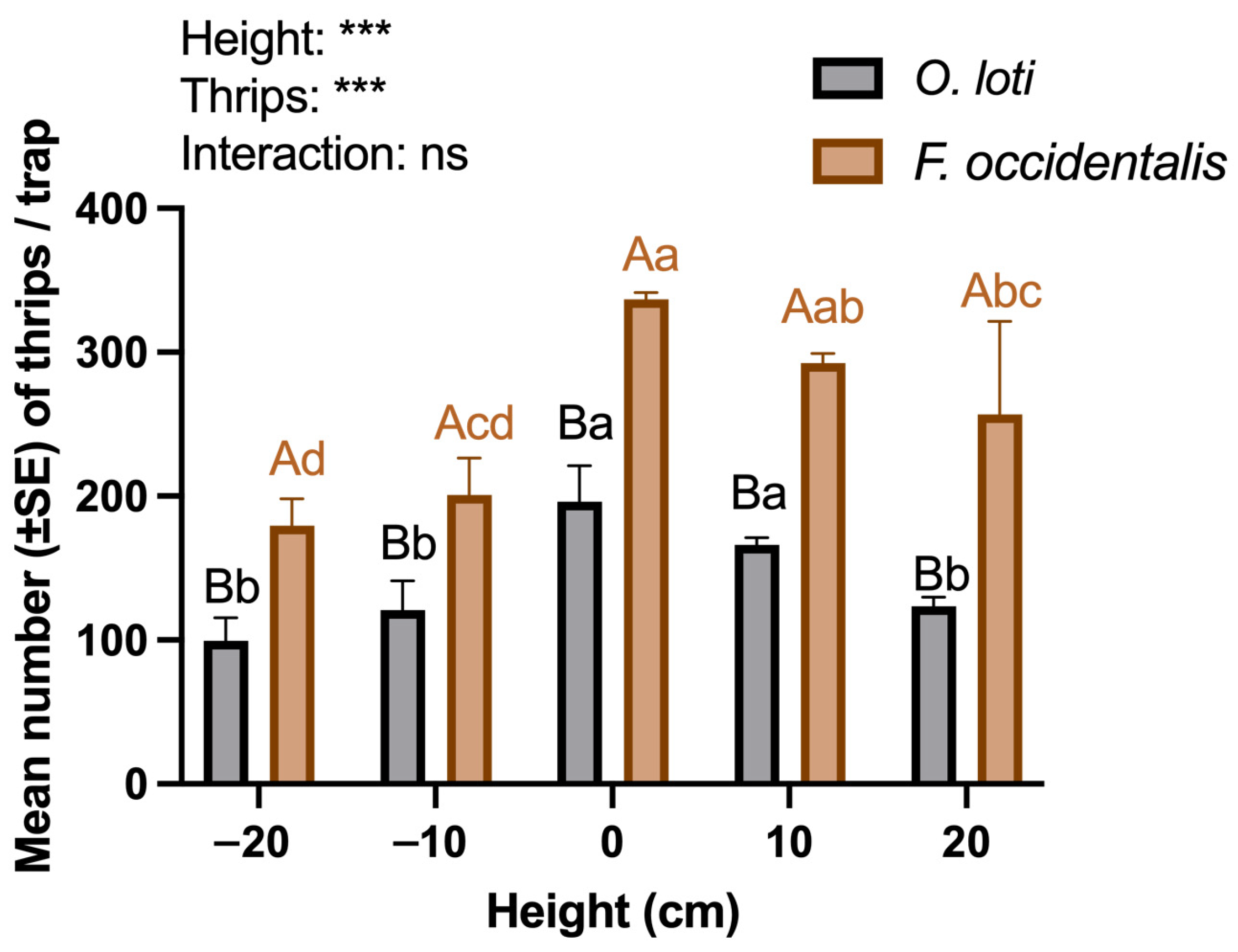
When considering placement heights and thrip species, significant differences in trapping efficiency are also observed (p < 0.001, Figure 1). The highest number of both species were captured on traps suspended just above the alfalfa canopy height, although this was not significantly different from traps placed 10 cm above the canopy. Moreover, it was found that the number of F. occidentalis was consistently higher than that of O. loti across the different heights (p < 0.001, Figure 1).
Figure 1. Mean (±SE) total number of thrips captured in relation to height of sticky boards. Height was measured relative to the bottom edge of the sticky board in relation to the top of alfalfa canopy (0 cm). Data were tested using a two-way ANOVA for factors height and thrip species, with different letters indicating Duncan’s multiple comparison of the differences in the number of thrips trapped under different height (lowercase) or species (uppercase). The overall significances in response to the two thrips and five placement heights are as follows: ns—no significant difference and *** p < 0.001.
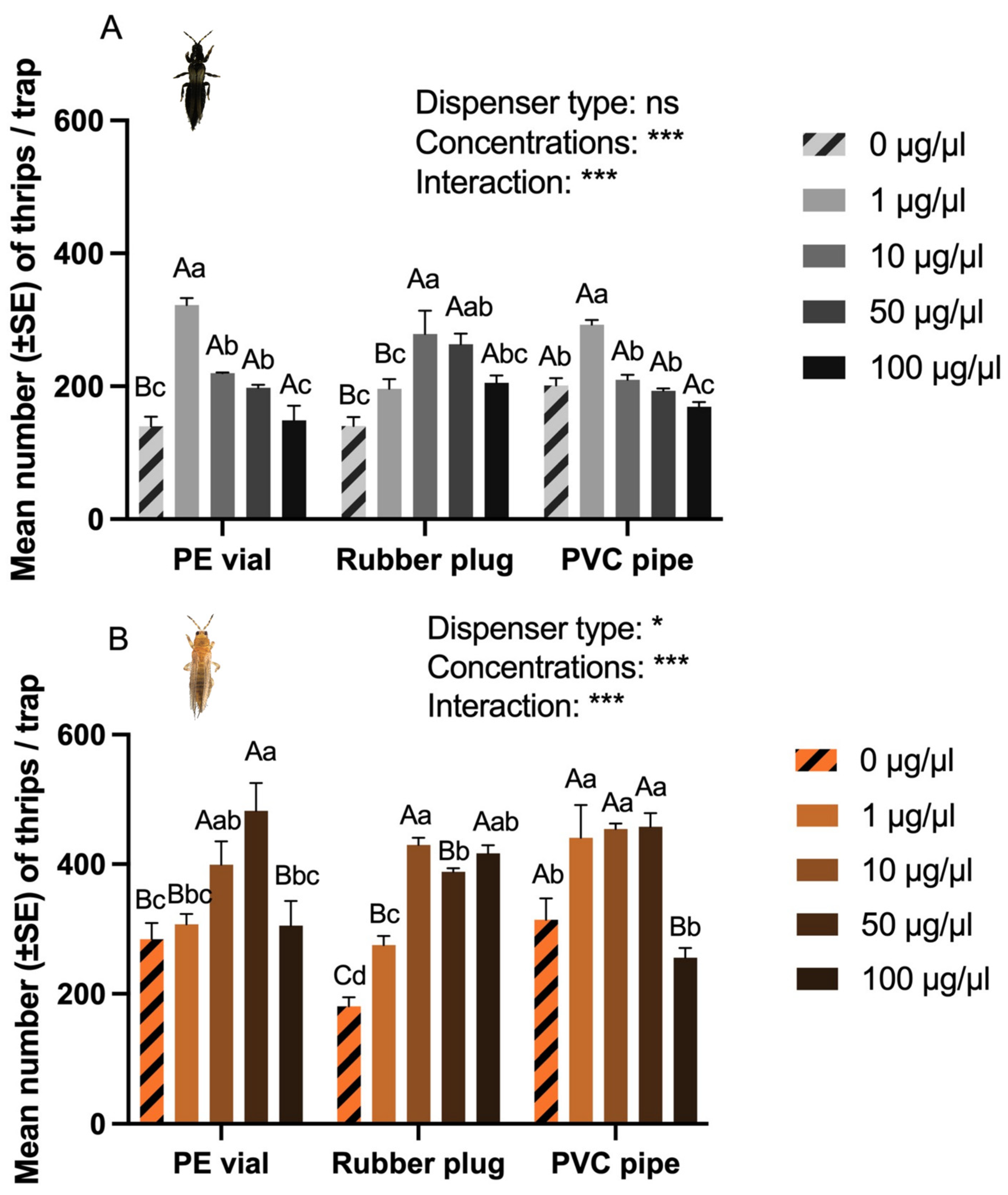
When considering both dispenser type and concentration, it was found that dispenser type did not significantly affect the number of O. loti captured (p = 0.474, Figure 2A), but did significantly influence the number of F. occidentalis captured (p = 0.032, Figure 2B). Concentration significantly impacted the number of both O. loti (F = 28.780, p < 0.001) and F. occidentalis (F = 24.400, p < 0.001) captured, with higher numbers of O. loti caught in traps containing 1 μg/μL p-Menth-8-en-2-one. For F. occidentalis, the highest catches occurred at concentrations from 10 to 50 μg/μL (Figure 2B). There was also a significant dispenser type and concentration interaction for both O. loti (F = 10.920, p < 0.001, Figure 2A), and F. occidentalis (F = 6.992, p < 0.001, Figure 2B), respectively. PE vials dosed with a concentration of 1 µg/µL p-Menth-8-en-2-one were found to attract the highest number of O. loti (Figure 2A). Conversely, PE vials dosed with 50 µg/µL p-Menth-8-en-2-one attracted the highest number of F. occidentalis (Figure 2B).
Figure 2. Effect of dispenser type and concentration (μg/μL) on the mean (±SE) capture of both O. loti and F. occidentalis in the field trial. (A) Number of O. loti captured, and (B) F. occidentalis captured, respectively, at the five concentrations and three dispenser types. Data were tested using a two-way ANOVA for factors dispenser type and concentration, with different letters indicating Duncan’s multiple comparison of the differences in number of thrips trapped under different concentrations (lowercase) or dispenser type (uppercase). The overall significances in response to the two p-Menth-8-en-2-one concentrations and three different dispensers are as follows: ns—no significant difference * p < 0.05 and *** p < 0.001.

4. Discussion

This study found that under field conditions, p-Menth-8-en-2-one was an effective attractant for both O. loti and F. occidentalis. Due to limitations related to the size of the field used in the study, the traps were placed 4 m apart. This would not be standard practice for field evaluations because of potential interference of between treatments in terms of odor flows across the site [24,25,26]. However, despite the close spatial layout of traps, significant differences were found in catches in relation to release rate and placement height, indicating that the results have validity.
Push–pull strategies involve the use of behavior-modifying stimuli to manipulate the distribution and abundance of both pest and beneficial insects, thereby reducing pest populations on the crop [27]. The innovative use of attractants or repellents has been demonstrated as a promising pest management tool for future farming systems. However, challenges such as high volatility and instability of these compounds need to be addressed for their effective application [28]. In this study, we trialed three dispenser types, and found that the PE vial was the most efficient release material. Similar results also observed with PE vial for Apolygus lucorum (Meyer-Dur) [29] and Protaetia brevitarsis Lewis [30]. Trap height also influenced field trapping effectiveness, with the optimal placement found to be at the bottom of the board aligned with the canopy of the alfalfa crop, or within 10 cm above. This is likely because new growth is primarily concentrated at the upper part of the alfalfa plant. This positioning enhances the perception of visual and olfactory stimuli by the thrips. Similarly, it has been found that the maximum number of Thrips alliorum (Priesner) caught was when the bottom of the sticky board was positioned in line with or just above the tops of scallions (Allium fistulosum L.) [31]. The higher number of F. occidentalis caught with the same p-Menth-8-en-2-one concentration compared to O. loti is likely due to the relative abundance of the two populations, consistent with Experiment One and sampling prior to establishing the trial showing that F. occidentalis was the dominant species.
For field application, the density of traps for monitoring needs further evaluation, although it has also been shown that multiple dispensers placed in relatively close to each other (5 m apart) are still less likely to interfere with each other [32]. A working system of traps for monitoring thrips to alert the farmer to their presence in the crop would be helpful; therefore, monitoring and the initiation of management options would be a logical extension of this research. This would include the number of traps required for monitoring, positioned in relation to the crop (i.e., margins of field, in the crop, upwind or downwind) and trap height [24,25,26]. Furthermore, given that the current trial was limited in its temporal scope, future work may benefit from establishing a longer monitoring period based on the release rate and efficacy of the dispensers over time, which can enhance practical utilization for growers. The species being targeted will also determine the p-Menth-8-en-2-one concentration used. For O. loti a concentration of 1 µg/µL was the most effective for monitoring, while for F. occidentalis, the optimal concentration was 50 µg/µL, with either a PE vial or PVC pipe suitable dispensers. If monitoring both species in a crop, either concentration will mean that one species will be under-represented in captures. Selecting a concentration of 1 µg/µL with a PVC pipe dispenser may be a suitable compromise, as while not capturing as many of both species, it will provide an indication of presence and relative abundance.

5. Conclusions

The plant volatile p-Menth-8-en-2-one has been identified in alfalfa and is significantly attractive to both O. loti and F. occidentalis. This proof-of-concept study showed that white sticky traps baited with PE vials containing p-Menth-8-en-2-one, positioned at the top or just above the alfalfa canopy, generally attracted the largest number of both Thrips species. However, dispenser type and release rate could be adjusted depending on species present in the field. We propose that traps using p-Menth-8-en-2-one can be effective in monitoring thrips, providing growers with information that allows them to make timely decisions on implementing control strategies before significant damage occurs. Further research should focus on optimizing trap placement, determining the appropriate number of traps, and establishing action thresholds in relation to crop management. These steps are essential for developing an efficient and ‘fit for purpose’ field monitoring system.

Author Contributions

Conceptualization, L.B.; methodology and supervision, X.Y.; software, formal analysis, visualization and writing—original draft preparation, Y.L.; validation and investigation, C.H.; writing—review and editing, M.R.M.; funding acquisition, L.B. and X.T. All authors have read and agreed to the published version of the manuscript.

Funding

This work was funded by National Natural Science Foundation of China (no. 32573603), State Key Laboratory for Biology of Plant Diseases and Insect Pests (no. SKLOF202516), the Beijing Innovation Consortium of Modern Agricultural Industry Technology System (no. BAIC02-2025), and Key Project of the Ningxia Natural Science Foundation (no. 2024AAC02065).

Data Availability Statement

The data presented in this study are available within the article.

Conflicts of Interest

Author C.H. was employed by the company Powerchina Huadong Engineering Corporation Limited after graduation. All authors declare that the research was conducted in the absence of any commercial or financial relationships that could be construed as a potential conflict of interest. The funders had no role in the design of the study; in the collection, analyses, or interpretation of data; in the writing of the manuscript; or in the decision to publish the results.

References

  1. Badieritakis, E.G.; Thanopoulos, R.C.; Fantinou, A.A.; Emmanouel, N.G.A. Qualitative and Quantitative Study of Thrips (Thysanoptera) on Alfalfa and Records of Thrips Species on Cultivated and Wild Medicago Species of Greece. Biologia 2015, 70, 504–511. [Google Scholar] [CrossRef]
  2. Ábrahám, R. First Investigation of Species Composition of Thysanoptera Inhabiting Alfalfa Based on Their Second Stage Larvae. Acta Phytopathol. Entomol. Hung. 2012, 47, 81–86. [Google Scholar] [CrossRef]
  3. Ripa, R.; Funderburk, J.; Rodriguez, F.; Espinoza, F.; Mound, L. Population Abundance of Frankliniella occidentalis (Thysanoptera: Thripidae) and Natural Enemies on Plant Hosts in Central Chile. Environ. Entomol. 2009, 38, 333–344. [Google Scholar] [CrossRef]
  4. Luo, Y.; Wei, S.; Dai, W.; Miao, M.; Wang, Y.; Zhang, R.; Ban, L. Chromosome-Level Genome Assembly of Odontothrips loti Haliday (Thysanoptera: Thripidae). Sci. Data 2024, 11, 451. [Google Scholar] [CrossRef] [PubMed]
  5. Liu, Y.; Luo, Y.; Du, L.; Ban, L. Antennal Transcriptome Analysis of Olfactory Genes and Characterization of Odorant Binding Proteins in Odontothrips loti (Thysanoptera: Thripidae). Int. J. Mol. Sci. 2023, 24, 5284. [Google Scholar] [CrossRef] [PubMed]
  6. He, Z.; Guo, J.-F.; Reitz, S.R.; Lei, Z.-R.; Wu, S.-Y. A Global Invasion by the Thrip, Frankliniella occidentalis: Current Virus Vector Status and Its Management. Insect Sci. 2020, 27, 626–645. [Google Scholar] [CrossRef]
  7. Reitz, S.R.; Gao, Y.; Kirk, W.D.J.; Hoddle, M.S.; Leiss, K.A.; Funderburk, J.E. Invasion Biology, Ecology, and Management of Western Flower Thrips. Annu. Rev. Entomol. 2020, 65, 17–37. [Google Scholar] [CrossRef]
  8. Li, X.; Cheng, J.; Han, H.; Kirk, W.D.J.; O’Brien, M.; Wang, L.; Chen, L.; Zhang, H.; Zhang, Z.; Ullah, F.; et al. Identification of Aggregation Pheromone as an Attractant for Odontothrips loti, a Serious Thrips Pest on Alfalfa. J. Chem. Ecol. 2024, 50, 894–903. [Google Scholar] [CrossRef]
  9. Wang, X.-S.; Yang, C.-L.; Wang, S.-S.; Hu, G.-X. Changes of Phenols and Lignin Contents in Alfalfa Leaf Damaged by Odontothrips loti. J. Appl. Ecol. 2014, 25, 1688–1692. [Google Scholar]
  10. Steenbergen, M.; Abd-El-Haliem, A.; Bleeker, P.; Dicke, M.; Escobar-Bravo, R.; Cheng, G.; Haring, M.A.; Kant, M.R.; Kappers, I.; Klinkhamer, P.G.L.; et al. Thrips Advisor: Exploiting Thrips-Induced Defences to Combat Pests on Crops. J. Exp. Bot. 2018, 69, 1837–1848. [Google Scholar] [CrossRef] [PubMed]
  11. Li, J.; Shang, Q.; Liu, Y.; Dai, W.; Li, X.; Wei, S.; Hu, G.; McNeill, M.R.; Ban, L. Occurrence, Distribution, and Transmission of Alfalfa Viruses in China. Viruses 2022, 14, 1519. [Google Scholar] [CrossRef]
  12. Li, J.; Shang, Q.; Luo, Y.; Wei, S.; Zhao, C.; Ban, L. Transmission from Seed to Seedling and Elimination of Alfalfa Viruses. Front. Plant Sci. 2024, 15, 1330219. [Google Scholar] [CrossRef]
  13. Zhang, R.; Ma, J.; Wang, J.; Ren, X. The occurrence and control strategy of alfalfa disease and insects in Ningxia. Pratacult. Sci. 2003, 20, 40–44. [Google Scholar] [CrossRef]
  14. Li, J.; Gu, H.; Liu, Y.; Wei, S.; Hu, G.; Wang, X.; McNeill, M.R.; Ban, L. RNA-Seq Reveals Plant Virus Composition and Diversity in Alfalfa, Thrips, and Aphids in Beijing, China. Arch. Virol. 2021, 166, 1711–1722. [Google Scholar] [CrossRef]
  15. Rotenberg, D.; Baumann, A.A.; Ben-Mahmoud, S.; Christiaens, O.; Dermauw, W.; Ioannidis, P.; Jacobs, C.G.C.; Vargas Jentzsch, I.M.; Oliver, J.E.; Poelchau, M.F.; et al. Genome-Enabled Insights into the Biology of Thrips as Crop Pests. BMC Biol. 2020, 18, 142. [Google Scholar] [CrossRef] [PubMed]
  16. Guo, S.; Cao, L.; Song, W.; Shi, P.; Gao, Y.; Gong, Y.; Chen, J.; Hoffmann, A.A.; Wei, S. Chromosome-Level Assembly of the Melon Thrips Genome Yields Insights into Evolution of a Sap-Sucking Lifestyle and Pesticide Resistance. Mol. Ecol. Resour. 2020, 20, 1110–1125. [Google Scholar] [CrossRef]
  17. Xiu, C.; Zhang, F.; Pan, H.; Bian, L.; Luo, Z.; Li, Z.; Fu, N.; Cai, X.; Chen, Z. Evaluation of Selected Plant Volatiles as Attractants for the Stick Tea Thrip Dendrothrips minowai in the Laboratory and Tea Plantation. Insects 2022, 13, 509. [Google Scholar] [CrossRef]
  18. Xiu, C.; Pan, H.; Zhang, F.; Luo, Z.; Bian, L.; Li, Z.; Fu, N.; Zhou, L.; Magsi, F.H.; Cai, X.; et al. Identification of Aggregation Pheromones Released by the Stick Tea Thrips (Dendrothrips minowai) Larvae and Their Application for Controlling Thrips in Tea Plantations. Pest Manag. Sci. 2024, 80, 2528–2538. [Google Scholar] [CrossRef]
  19. Santos, J.L.; Pereira, P.S.; Reis, K.H.B.; Freitas, D.R.; Picanço Filho, M.C.; Peluzio, J.M.; Sarmento, R.A.; Guedes, R.N.C.; Picanço, M.C. Decision-Making for Thrips Control in Soybean Fields Using Precision a Griculture Principles. J. Appl. Entomol. 2024, 148, 140–149. [Google Scholar] [CrossRef]
  20. Findlay, J.R.; Sagers, J. Developing Economic Injury Levels for Thrips (Frankliniella occidentalis) in Idaho Alfalfa under Controlled Pest Populations. J. Ext. 2024, 61, 1. [Google Scholar] [CrossRef]
  21. Luo, Y.; Wei, S.; Tang, F.; McNeill, M.R.; Tu, X.; Liu, Y.; Han, C.; Qu, C.; Yin, X.; Ban, L. Identification and Evaluation of Alfalfa Volatiles for Monitoring and Management of Odontothrips loti and Frankliniella occidentalis. Insects 2025, 16, 1207. [Google Scholar] [CrossRef]
  22. Ban, L.; Li, J.; Li, X.; Shang, Q.; Yan, Z.; Zhu, N.; Fu, J. Sampling and Collection Device for Small Insects in Alfalfa Fields. China Patent CN216147075U, 1 April 2022. [Google Scholar]
  23. Imai, T.; Maekawa, M.; Murai, T. Attractiveness of Methyl Anthranilate and Its Related Compounds to the Flower Thrips, Thrips hawaiiensis (Morgan), T. coloratus Schmutz, T. flavus Schrank and Megalurothrips distalis (Karny) (Thysanoptera: Thripidae). Appl. Entomol. Zool. 2001, 36, 475–478. [Google Scholar] [CrossRef]
  24. Guo, Z.-G.; Wang, M.-X.; Cui, L.; Han, B.-Y. Advance in Insect Phototaxis and the Development and Application of Colored Sticky Boards. J. Appl. Ecol. 2019, 30, 3615–3626. [Google Scholar] [CrossRef]
  25. Friedli, M.; Kirchgessner, N.; Grieder, C.; Liebisch, F.; Mannale, M.; Walter, A. Terrestrial 3D Laser Scanning to Track the Increase in Canopy Height of Both Monocot and Dicot Crop Species under Field Conditions. Plant Methods 2016, 12, 9. [Google Scholar] [CrossRef]
  26. Teulon, D.A.J.; Butler, R.C.; James, D.E.; Davidson, M.M. Odour-Baited Traps Influence Thrips Capture in Proximal Unbaited Traps in the Field. Entomol. Exp. Appl. 2007, 123, 253–262. [Google Scholar] [CrossRef]
  27. Cook, S.M.; Khan, Z.R.; Pickett, J.A. The Use of Push-Pull Strategies in Integrated Pest Management. Annu. Rev. Entomol. 2007, 52, 375–400. [Google Scholar] [CrossRef] [PubMed]
  28. Pickett, J.A.; Woodcock, C.M.; Midega, C.A.; Khan, Z.R. Push-Pull Farming Systems. Curr. Opin. Biotechnol. 2014, 26, 125–132. [Google Scholar] [CrossRef]
  29. Zhang, T.; Mei, X.; Zhang, X.; Lu, Y.; Ning, J.; Wu, K. Identification and Field Evaluation of the Sex Pheromone of Apolygus lucorum (Hemiptera: Miridae) in China. Pest Manag. Sci. 2020, 76, 1847–1855. [Google Scholar] [CrossRef] [PubMed]
  30. Zhang, X.; Wang, L.; Liu, C.; Liu, Y.; Mei, X.; Wang, Z.; Zhang, T. Identification and Field Verification of an Aggregation Pheromone from the White-Spotted Flower Chafer, Protaetia brevitarsis Lewis (Coleoptera: Scarabaeidae). Sci. Rep. 2021, 11, 22362. [Google Scholar] [CrossRef]
  31. Xue, G.; Zhang, X.; Mao, X.; Chen, P.; Zhang, A. Population Dynamics and Trapping Techniques of Main Pests on Open Field Scallion in Shandong Province. Shandong Agric. Sci. 2022, 54, 131–136. [Google Scholar] [CrossRef]
  32. Bell, M.J.; Sedda, L.; Gonzalez, M.A.; De Souza, C.F.; Dilger, E.; Brazil, R.P.; Courtenay, O.; Hamilton, J.G.C. Attraction of Lutzomyia longipalpis to Synthetic Sex-Aggregation Pheromone: Effect of Release Rate and Proximity of Adjacent Pheromone Sources. PLoS Negl. Trop. Dis. 2018, 12, e0007007. [Google Scholar] [CrossRef] [PubMed]
Disclaimer/Publisher’s Note: The statements, opinions and data contained in all publications are solely those of the individual author(s) and contributor(s) and not of MDPI and/or the editor(s). MDPI and/or the editor(s) disclaim responsibility for any injury to people or property resulting from any ideas, methods, instructions or products referred to in the content.

Article Metrics

Citations

Article Access Statistics

Article metric data becomes available approximately 24 hours after publication online.