A Compound Fungicide Impairs Cognitive Performance in Honey Bees (Apis mellifera)


Simple Summary
Abstract
1. Introduction
2. Materials and Methods
2.1. Tested Bee Colonies
2.2. Reagents for Experiment
2.3. Treatment of Bees
2.4. Sucrose Sensitivity Test
2.5. Odor-Associative Learning and Memory Test
2.6. Data Analysis
3. Results
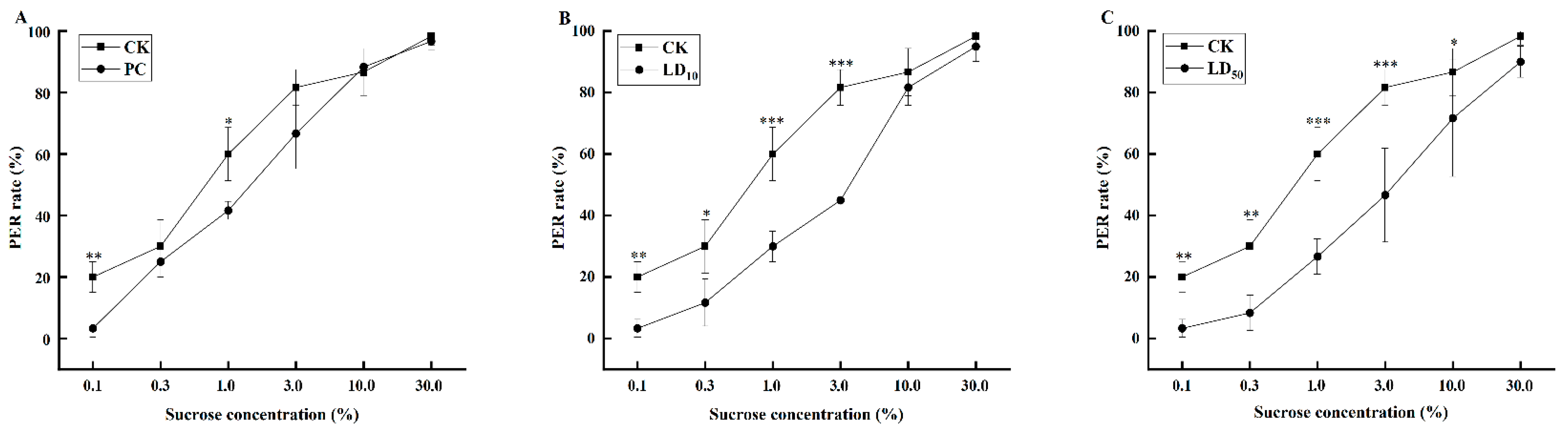
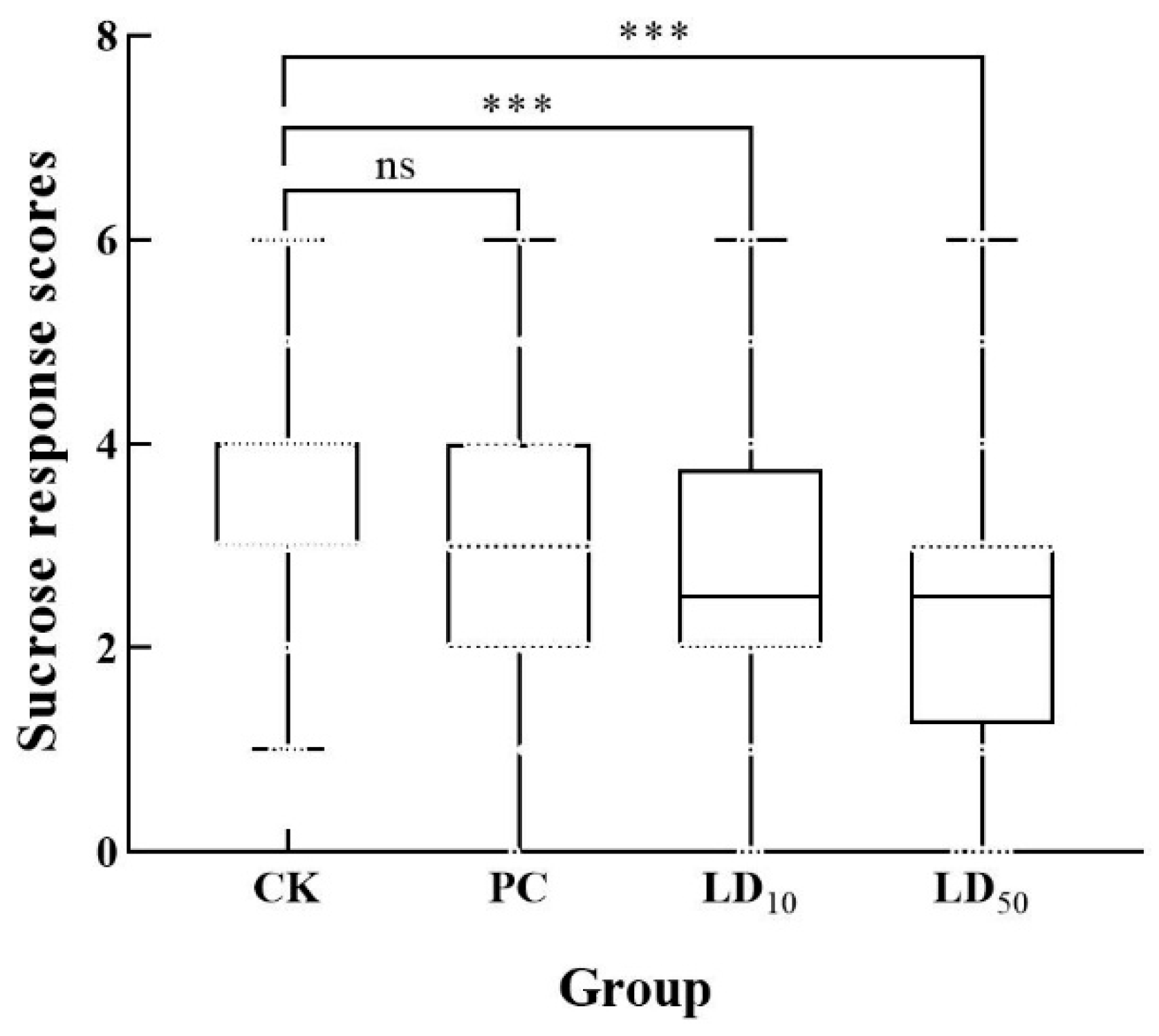
3.1. Compound Fungicides Affect the Response of Bees to Sucrose
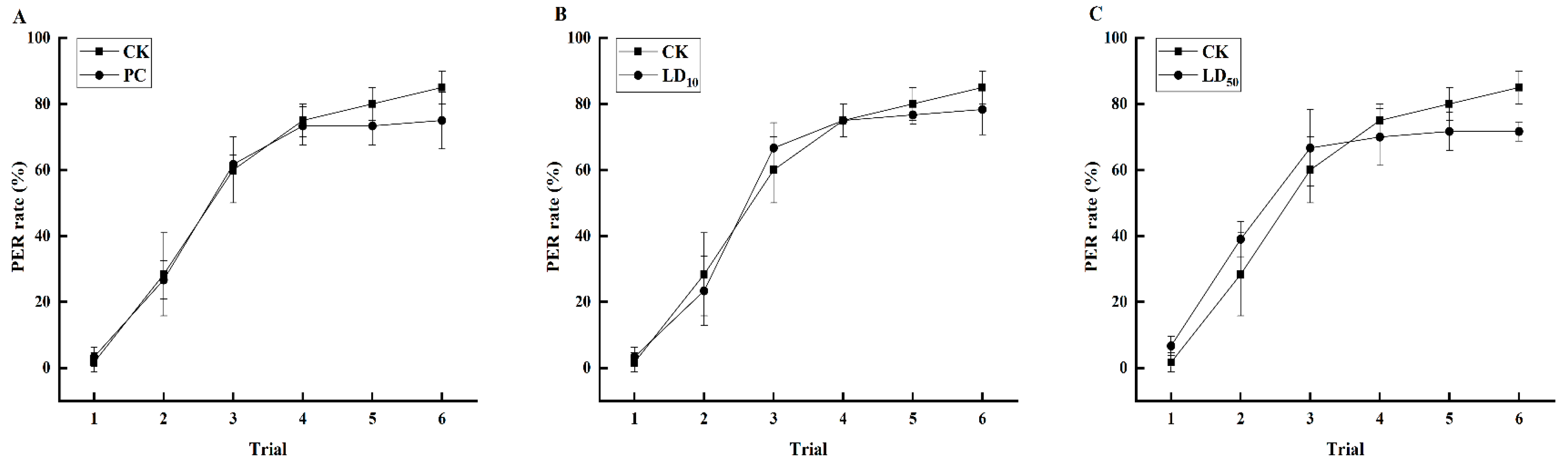
3.2. Effects of Chunmanchun® on the Learning Behavior of Bees
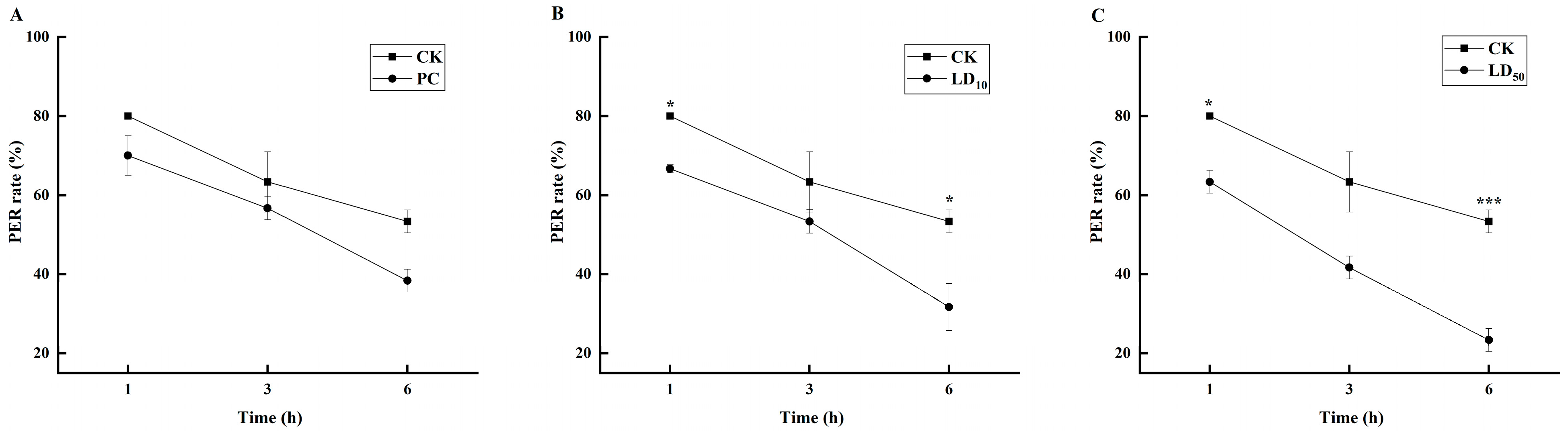
3.3. Effects of Chunmanchun® on the Memory Behavior of Bees
4. Discussion
Supplementary Materials
Author Contributions
Funding
Data Availability Statement
Acknowledgments
Conflicts of Interest
Abbreviations
| PER | Proboscis extension reflex |
| SRS | Sucrose response score |
References
- Klein, A.-M.; Vaissière, B.E.; Cane, J.H.; Steffan-Dewenter, I.; Cunningham, S.A.; Kremen, C.; Tscharntke, T. Importance of pollinators in changing landscapes for world crops. Proc. R. Soc. B Biol. Sci. 2007, 274, 303–313. [Google Scholar] [CrossRef]
- Potts, S.G.; Imperatriz-Fonseca, V.; Ngo, H.T.; Aizen, M.A.; Biesmeijer, J.C.; Breeze, T.D.; Dicks, L.V.; Garibaldi, L.A.; Hill, R.; Settele, J.; et al. Safeguarding pollinators and their values to human well-being. Nature 2016, 540, 220–229. [Google Scholar] [CrossRef]
- Dicks, L.V.; Breeze, T.D.; Ngo, H.T.; Senapathi, D.; An, J.; Aizen, M.A.; Basu, P.; Buchori, D.; Galetto, L.; Garibaldi, L.A.; et al. A global-scale expert assessment of drivers and risks associated with pollinator decline. Nat. Ecol. Evol. 2021, 5, 1453–1461. [Google Scholar] [CrossRef]
- Goulson, D.; Nicholls, E.; Botías, C.; Rotheray, E.L. Bee declines driven by combined stress from parasites, pesticides, and lack of flowers. Science 2015, 347, 1255957. [Google Scholar] [CrossRef]
- Vanbergen, A.J.; Initiative, I.P. Threats to an ecosystem service: Pressures on pollinators. Front. Ecol. Environ. 2013, 11, 251–259. [Google Scholar] [CrossRef]
- Sánchez-Bayo, F.; Goulson, D.; Pennacchio, F.; Nazzi, F.; Goka, K.; Desneux, N. Are bee diseases linked to pesticides?—A brief review. Environ. Int. 2016, 89, 7–11. [Google Scholar] [CrossRef] [PubMed]
- Goulson, D.; Lye, G.C.; Darvill, B. Decline and conservation of bumble bees. Annu. Rev. Entomol. 2008, 53, 191–208. [Google Scholar] [CrossRef]
- Belzunces, L.P.; Tchamitchian, S.; Brunet, J.L. Neural effects of insecticides in the honey bee. Apidologie 2012, 43, 348–370. [Google Scholar] [CrossRef]
- Cabirol, A.; Haase, A. The Neurophysiological bases of the impact of neonicotinoid pesticides on the behaviour of honeybees. Insects 2019, 10, 344. [Google Scholar] [CrossRef] [PubMed]
- Mengoni Gonalons, C.; Farina, W.M. Impaired associative learning after chronic exposure to pesticides in young adult honey bees. J. Exp. Biol. 2018, 221, jeb176644. [Google Scholar] [CrossRef]
- Collison, E.; Hird, H.; Cresswell, J.; Tyler, C. Interactive effects of pesticide exposure and pathogen infection on bee health—A critical analysis. Biol. Rev. 2016, 91, 1006–1019. [Google Scholar] [CrossRef]
- Grassl, J.; Holt, S.; Cremen, N.; Peso, M.; Hahne, D.; Baer, B. Synergistic effects of pathogen and pesticide exposure on honey bee (Apis mellifera) survival and immunity. J. Invertebr. Pathol. 2018, 159, 78–86. [Google Scholar] [CrossRef]
- Pettis, J.S.; vanEngelsdorp, D.; Johnson, J.; Dively, G. Pesticide exposure in honey bees results in increased levels of the gut pathogen Nosema. Naturwissenschaften 2012, 99, 153–158. [Google Scholar] [CrossRef]
- Straw, E.A.; Brown, M.J. Co-formulant in a commercial fungicide product causes lethal and sub-lethal effects in bumble bees. Sci. Rep. 2021, 11, 21653. [Google Scholar] [CrossRef]
- Alarcon, R., Jr.; Hoffman, G.; Wardell, G. Fungicides Can Reduce Pollination Potential; Western Farm Press: Fresno, CA, USA, 2009; p. 17. [Google Scholar]
- Favaro, R.; Bauer, L.M.; Rossi, M.; D’Ambrosio, L.; Bucher, E.; Angeli, S. Botanical origin of pesticide residues in pollen loads collected by honeybees during and after apple bloom. Front Physiol. 2019, 10, 01069. [Google Scholar] [CrossRef]
- Zubrod, J.P.; Bundschuh, M.; Arts, G.; Brühl, C.A.; Imfeld, G.; Knäbel, A.; Payraudeau, S.; Rasmussen, J.J.; Rohr, J.; Scharmüller, A.; et al. Fungicides: An overlooked pesticide class? Environ. Sci. Technol. 2019, 53, 3347–3365. [Google Scholar] [CrossRef] [PubMed]
- Yin, Y.; Miao, J.; Shao, W.; Liu, X.; Zhao, Y.; Ma, Z. Fungicide resistance: Progress in understanding mechanism, monitoring, and management. Phytopathology 2023, 113, 707–718. [Google Scholar] [CrossRef] [PubMed]
- Dong, J.; Huang, M.; Guo, H.; Zhang, J.; Tan, X.; Wang, D. Ternary mixture of azoxystrobin, boscalid and pyraclostrobin disrupts the gut microbiota and metabolic balance of honeybees (Apis cerana cerana). Int. J. Mol. Sci. 2023, 24, 5354. [Google Scholar] [CrossRef] [PubMed]
- Liao, L.H.; Wu, W.Y.; Berenbaum, M.R. Behavioral responses of honey bees (Apis mellifera) to natural and synthetic xenobiotics in food. Sci. Rep. 2017, 7, 15924. [Google Scholar] [CrossRef]
- Rutkowski, D.; Litsey, E.; Maalouf, I.; Vannette, R.L. Bee-associated fungi mediate effects of fungicides on bumble bees. Ecol. Entomol. 2022, 47, 411–422. [Google Scholar] [CrossRef]
- Bart, S.; Short, S.; Jager, T.; Eagles, E.J.; Robinson, A.; Badder, C.; Lahive, E.; Spurgeon, D.J.; Ashauer, R. How to analyse and account for interactions in mixture toxicity with toxicokinetic-toxicodynamic models. Sci. Total Environ. 2022, 843, 157048. [Google Scholar] [CrossRef] [PubMed]
- Traynor, K.S.; Lamas, Z.S. Social disruption: Sublethal pesticides in pollen lead to Apis mellifera queen events and brood loss. Ecotoxicol. Environ. Saf. 2021, 214, 112105. [Google Scholar] [CrossRef]
- Drummond, F.A. Honey bee exposure to the fungicide propiconazole in lowbush blueberry fields. Agronomy 2022, 12, 3081. [Google Scholar] [CrossRef]
- Tong, Z.; Wu, Y.C.; Liu, Q.Q.; Shi, Y.H.; Zhou, L.J.; Liu, Z.Y.; Yu, L.S.; Cao, H.Q. Multi-residue analysis of pesticide residues in crude pollens by UPLC-MS/MS. Molecules 2016, 21, 1652. [Google Scholar] [CrossRef]
- Ye, M.L.; Nie, J.Y.; Xu, G.F.; Yan, Z.; Zheng, L.J. Residue and dietary exposure risk assessment of four pesticides in apple. Sci. Agric. Sin. 2016, 49, 1289–1302. [Google Scholar]
- Shi, T.; Burton, S.; Zhu, Y.; Wang, Y.; Xu, S.; Yu, L. Effects of field-realistic concentrations of carbendazim on survival and physiology in forager honey bees (Hymenoptera: Apidae). J. Insect Sci. 2018, 18, 6. [Google Scholar] [CrossRef] [PubMed]
- Wang, K.; Fan, R.L.; Ji, W.N.; Zhang, W.W.; Chen, X.M.; Wang, S.; Yin, L.; Gao, F.C.; Chen, G.H.; Ji, T. Transcriptome analysis of newly emerged honeybees exposure to sublethal carbendazim during larval stage. Front. Genet. 2018, 9, 426. [Google Scholar] [CrossRef]
- Fisher, A.; DeGrandi-Hoffman, G.; Smith, B.H.; Johnson, M.; Kaftanoglu, O.; Cogley, T.; Fewell, J.H.; Harrison, J.F. Colony field test reveals dramatically higher toxicity of a widely-used mito-toxic fungicide on honey bees (Apis mellifera). Environ. Pollut. 2021, 269, 115964. [Google Scholar] [CrossRef]
- Fisher, A.; DeGrandi-Hoffman, G.; Smith, B.H.; Ozturk, C.; Kaftanoglu, O.; Fewell, J.H.; Harrison, J.F. Field cross-fostering and in vitro rearing demonstrate negative effects of both larval and adult exposure to a widely used fungicide in honey bees (Apis mellifera). Ecotoxicol. Environ. Saf. 2021, 217, 112251. [Google Scholar] [CrossRef]
- Wang, K.; Chen, H.; Fan, R.-L.; Lin, Z.-G.; Niu, Q.-S.; Wang, Z.; Ji, T. Effect of carbendazim on honey bee health: Assessment of survival, pollen consumption, and gut microbiome composition. Ecotoxicol. Environ. Saf. 2022, 239, 113648. [Google Scholar] [CrossRef]
- DesJardins, N.S.; Fisher, A.; Ozturk, C.; Fewell, J.H.; DeGrandi-Hoffman, G.; Harrison, J.F.; Smith, B.H. A common fungicide, Pristine®, impairs olfactory associative learning performance in honey bees (Apis mellifera). Environ. Pollut. 2021, 288, 117720. [Google Scholar] [CrossRef]
- Glass, J.R.; Fisher, A.; Fewell, J.H.; DeGrandi-Hoffman, G.; Ozturk, C.; Harrison, J.F. Consumption of field-realistic doses of a widely used mito-toxic fungicide reduces thorax mass but does not negatively impact flight capacities of the honey bee (Apis mellifera). Environ. Pollut. 2021, 274, 116533. [Google Scholar] [CrossRef]
- Kaur, G.; Singh, A.; Sharma, R.; Thakur, A.; Tuteja, S.; Shyamli; Singh, R. Effect of fungicidal contamination on survival, morphology, and cellular immunity of Apis mellifera (Hymenoptera: Apidae). Front. Physiol. 2023, 14, 1099806. [Google Scholar] [CrossRef] [PubMed]
- Porras, M.F.; Raygoza Garay, J.A.; Brought, M.; López–Londoño, T.; Chautá, A.; Crone, M.; Rajotte, E.G.; Phan, N.; Joshi, N.K.; Peter, K.; et al. Fungicide ingestion reduces net energy gain and microbiome diversity of the solitary mason bee. Sci. Rep. 2024, 14, 3229. [Google Scholar] [CrossRef]
- Wang, K.; Pang, Q.; Zhang, W.W.; Ji, T. Effects of sublethal doses of carbendazim on the growth and detoxifying enzyme activities of honeybee (Apis mellifera) larvae. Acta Entomol. Sin. 2017, 60, 642–649. [Google Scholar]
- DeGrandi-Hoffman, G.; Corby-Harris, V.; DeJong, E.W.; Chambers, M.; Hidalgo, G. Honey bee gut microbial communities are robust to the fungicide Pristine® consumed in pollen. Apidologie 2017, 48, 340–352. [Google Scholar] [CrossRef]
- Huang, M.J.; Dong, J.; Yang, S.Y.; Xiao, M.H.; Guo, H.K.; Zhang, J.W.; Wang, D.Q. Ecotoxicological effects of common fungicides on the eastern honeybee Apis cerana cerana (Hymenoptera). Sci. Total Environ. 2023, 868, 161637. [Google Scholar] [CrossRef] [PubMed]
- Xiong, M.Q.; Qin, G.; Wang, L.Z.; Wang, R.Y.; Zhou, R.Q.; Luo, X.T.; Lou, Q.; Huang, S.K.; Li, J.H.; Duan, X.L. Field recommended concentrations of pyraclostrobin exposure disturb the development and immune response of worker bees (Apis mellifera L.) larvae and pupae. Front. Physiol. 2023, 14, 1137624. [Google Scholar] [CrossRef] [PubMed]
- Zhang, X.; Cao, Q.; Wang, F.; Du, Y.; Zhao, W.; Guo, Y.; Rueppell, O. Diverse Sublethal Effects of a Common Fungicide Impact the Behavior and Physiology of Honey Bees. Insects 2025, 16, 603. [Google Scholar] [CrossRef]
- Matsumoto, Y.; Menzel, R.; Sandoz, J.C.; Giurfa, M. Revisiting olfactory classical conditioning of the proboscis extension response in honey bees: A step toward standardized procedures. J. Neurosci. Methods 2012, 211, 159–167. [Google Scholar] [CrossRef]
- Baracchi, D.; Devaud, J.-M.; d’Ettorre, P.; Giurfa, M. Pheromones modulate reward responsiveness and non-associative learning in honey bees. Sci. Rep. 2017, 7, 9875. [Google Scholar] [CrossRef]
- Jess, S.; Matthews, D.I.; Murchie, A.K.; Lavery, M.K. Pesticide use in northern Ireland’s Arable Crops from 1992–2016 and Implications for future policy development. Agriculture 2018, 8, 123. [Google Scholar] [CrossRef]
- El-Baky, N.A.; Amara, A.A.A.F. Recent approaches towards control of fungal diseases in plants: An updated review. J. Fungi 2021, 7, 900. [Google Scholar] [CrossRef]
- Thind, T.S. Role of fungicides in crop health management: Prospects and challenges. In Developments in Fungal Biology and Applied Mycology; Satyanarayana, T., Deshmukh, S.K., Johri, B.N., Eds.; Springer: Singapore, 2017; pp. 433–447. [Google Scholar]
- Pang, H.Y.; Zhu, Y.; Wang, X.L.; Lai, F.; Du, N.; Cai, T. Application status of carbendazim in plant derived food and research progress of risk assessment in agricultural products. J. Agric. Catastrophol. 2023, 13, 4–6. [Google Scholar]
- Shang, D.L.; Zang, H.; Ren, N.P.; Li, G.L.; Liu, X.P. Main diseases, pests and weeds on turf and current status of pesticide registration in China. Agrochemicals 2024, 63, 391–395. [Google Scholar] [CrossRef]
- Srinivasan, M.V. Honeybees as a model for the study of visually guided flight, navigation, and biologically inspired robotics. Physiol. Rev. 2011, 91, 413–460. [Google Scholar] [CrossRef] [PubMed]
- Desneux, N.; Artz, D.R.; Pitts-Singer, T.L. Effects of fungicide and adjuvant sprays on nesting behavior in two managed solitary bees, Osmia lignaria and Megachile rotundata. PLoS ONE 2015, 10, e0135688. [Google Scholar] [CrossRef]
- Ladurner, E.; Bosch, J.; Kemp, W.P.; Maini, S. Assessing delayed and acute toxicity of five formulated fungicides to osmia lignaria Say and Apis mellifera. Apidologie 2005, 36, 449–460. [Google Scholar] [CrossRef]
- Knapp, J.L.; Nicholson, C.C.; Jonsson, O.; de Miranda, J.R.; Rundlöf, M. Ecological traits interact with landscape context to determine bees’ pesticide risk. Nat. Ecol. Evol. 2023, 7, 547–556. [Google Scholar] [CrossRef] [PubMed]
- Nicholson, C.C.; Knapp, J.; Kiljanek, T.; Albrecht, M.; Chauzat, M.-P.; Costa, C.; De la Rúa, P.; Klein, A.-M.; Mänd, M.; Potts, S.G.; et al. Pesticide use negatively affects bumble bees across European landscapes. Nature 2023, 628, 355–358. [Google Scholar] [CrossRef]
- Ward, L.T.; Hladik, M.L.; Guzman, A.; Winsemius, S.; Bautista, A.; Kremen, C.; Mills, N.J. Pesticide exposure of wild bees and honey bees foraging from field border flowers in intensively managed agriculture areas. Sci. Total Environ. 2022, 831, 154697. [Google Scholar] [CrossRef]
- Sgolastra, F.; Arnan, X.; Cabbri, R.; Isani, G.; Medrzycki, P.; Teper, D.; Bosch, J. Combined exposure to sublethal concentrations of an insecticide and a fungicide affect feeding, ovary development and longevity in a solitary bee. Proc. R. Soc. B Biol. Sci. 2018, 285, 20180887. [Google Scholar] [CrossRef]
- Sgolastra, F.; Medrzycki, P.; Bortolotti, L.; Renzi, M.T.; Tosi, S.; Bogo, G.; Teper, D.; Porrini, C.; Molowny-Horas, R.; Bosch, J. Synergistic mortality between a neonicotinoid insecticide and an ergosterol-biosynthesis-inhibiting fungicide in three bee species. Pest Manag. Sci. 2016, 73, 1236–1243. [Google Scholar] [CrossRef] [PubMed]
- Thompson, H.M.; Fryday, S.L.; Harkin, S.; Milner, S. Potential impacts of synergism in honeybees (Apis mellifera) of exposure to neonicotinoids and sprayed fungicides in crops. Apidologie 2014, 45, 545–553. [Google Scholar] [CrossRef]
- Boyle, N.K.; Pitts-Singer, T.L.; Abbott, J.; Alix, A.; Cox-Foster, D.L.; Hinarejos, S.; Lehmann, D.M.; Morandin, L.; O’Neill, B.; Raine, N.E.; et al. Workshop on pesticide exposure assessment paradigm for non-Apis bees: Foundation and summaries. Environ. Entomol. 2019, 48, 4–11. [Google Scholar] [CrossRef]
- Piggott, J.J.; Townsend, C.R.; Matthaei, C.D. Reconceptualizing synergism and antagonism among multiple stressors. Ecol. Evol. 2015, 5, 1538–1547. [Google Scholar] [CrossRef]
- Carnesecchi, E.; Svendsen, C.; Lasagni, S.; Grech, A.; Quignot, N.; Amzal, B.; Toma, C.; Tosi, S.; Rortais, A.; Cortinas-Abrahantes, J.; et al. Investigating combined toxicity of binary mixtures in bees: Meta-analysis of laboratory tests, modelling, mechanistic basis and implications for risk assessment. Environ. Int. 2019, 133, 105256. [Google Scholar] [CrossRef]
- Tosi, S.; Nieh, J.C. Lethal and sublethal synergistic effects of a new systemic pesticide, flupyradifurone (Sivanto®), on honeybees. Proc. R. Soc. B Biol. Sci. 2019, 286, 20190433. [Google Scholar] [CrossRef] [PubMed]
- Jaffe, B.D.; Lois, A.N.; Guédot, C. Effect of fungicide on pollen foraging by honeybees (Hymenoptera: Apidae) in cranberry differs by fungicide type. J. Econ. Entomol. 2019, 112, 499–503. [Google Scholar] [CrossRef] [PubMed]
- Tamburini, G.; Pereira-Peixoto, M.-H.; Borth, J.; Lotz, S.; Wintermantel, D.; Allan, M.J.; Dean, R.; Schwarz, J.M.; Knauer, A.; Albrecht, M.; et al. Fungicide and insecticide exposure adversely impacts bumblebees and pollination services under semi-field conditions. Environ. Int. 2021, 157, 106813. [Google Scholar] [CrossRef]
- Tschoeke, P.H.; Oliveira, E.E.; Dalcin, M.S.; Silveira-Tschoeke, M.C.A.C.; Sarmento, R.A.; Santos, G.R. Botanical and synthetic pesticides alter the flower visitation rates of pollinator bees in Neotropical melon fields. Environ. Pollut. 2019, 251, 591–599. [Google Scholar] [CrossRef] [PubMed]
- Baracchi, D. Cognitive ecology of pollinators and the main determinants of foraging plasticity. Curr. Zool. 2019, 65, 421–424. [Google Scholar] [CrossRef]
- Klein, S.; Cabirol, A.; Devaud, J.-M.; Barron, A.B.; Lihoreau, M. Why bees are so vulnerable to environmental stressors. Trends Ecol. Evol. 2017, 32, 268–278. [Google Scholar] [CrossRef]
- Nascimento, F.S.; Simon-Delso, N.; San Martin, G.; Bruneau, E.; Minsart, L.-A.; Mouret, C.; Hautier, L. Honeybee colony disorder in crop areas: The role of pesticides and viruses. PLoS ONE 2014, 9, e103073. [Google Scholar] [CrossRef]
- Li, C. Understanding, conservation, and protection of precious natural resources: Bees. In Environmental and Natural Resources Engineering; Springer: Berlin/Heidelberg, Germany, 2021; pp. 1–51. [Google Scholar]
- Yoder, J.A.; Nelson, B.W.; Jajack, A.J.; Sammataro, D. Fungi and the effects of fungicides on the honey bee colony. In Beekeeping–From Science to Practice; Springer: Berlin/Heidelberg, Germany, 2017; pp. 73–90. [Google Scholar]
- Doussot, C.; Purdy, J.; Lihoreau, M. Navigation: Cognition, learning, and memory. In The Foraging Behavior of the Honey Bee (Apis mellifera, L.); Elsevier: Amsterdam, The Netherlands, 2024; pp. 85–104. [Google Scholar]
- Collett, T.S.; Graham, P.; Harris, R.A.; Hempel-de-Ibarra, N. Navigational memories in ants and bees: Memory retrieval when selecting and following routes. Adv. Study Behav. 2006, 36, 123–172. [Google Scholar] [CrossRef]
- Goodell, K. Food availability affects Osmia pumila (Hymenoptera: Megachilidae) foraging, reproduction, and brood parasitism. Oecologia 2003, 134, 518–527. [Google Scholar] [CrossRef]


Disclaimer/Publisher’s Note: The statements, opinions and data contained in all publications are solely those of the individual author(s) and contributor(s) and not of MDPI and/or the editor(s). MDPI and/or the editor(s) disclaim responsibility for any injury to people or property resulting from any ideas, methods, instructions or products referred to in the content. |
© 2025 by the authors. Licensee MDPI, Basel, Switzerland. This article is an open access article distributed under the terms and conditions of the Creative Commons Attribution (CC BY) license.
Share and Cite
Zhang, X.; Cao, Q.; Sun, Q.; Tian, Y.; Du, Y.; Guo, Y. A Compound Fungicide Impairs Cognitive Performance in Honey Bees (Apis mellifera). Insects 2026, 17, 51. https://doi.org/10.3390/insects17010051
Zhang X, Cao Q, Sun Q, Tian Y, Du Y, Guo Y. A Compound Fungicide Impairs Cognitive Performance in Honey Bees (Apis mellifera). Insects. 2026; 17(1):51. https://doi.org/10.3390/insects17010051
Chicago/Turabian StyleZhang, Xufeng, Qian Cao, Qihang Sun, Yuting Tian, Yinyin Du, and Yuan Guo. 2026. "A Compound Fungicide Impairs Cognitive Performance in Honey Bees (Apis mellifera)" Insects 17, no. 1: 51. https://doi.org/10.3390/insects17010051
APA StyleZhang, X., Cao, Q., Sun, Q., Tian, Y., Du, Y., & Guo, Y. (2026). A Compound Fungicide Impairs Cognitive Performance in Honey Bees (Apis mellifera). Insects, 17(1), 51. https://doi.org/10.3390/insects17010051