
Bumblebee Diversity in Different Habitat Types and Along an Altitudinal Gradient at a Forest–Grassland Ecotone in the East Range of the Qinghai–Tibet Plateau



Simple Summary
Abstract
1. Introduction
2. Materials and Methods
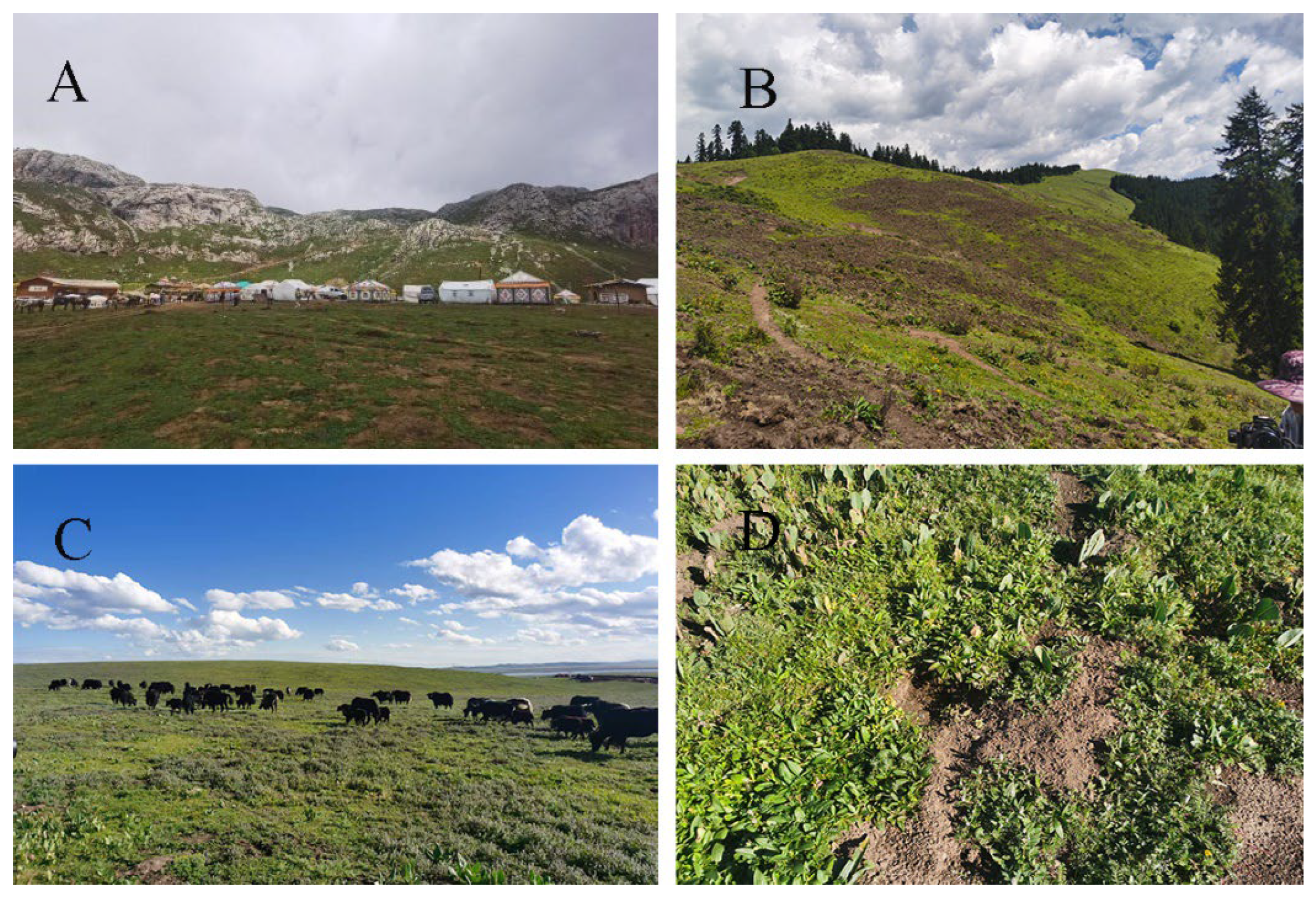
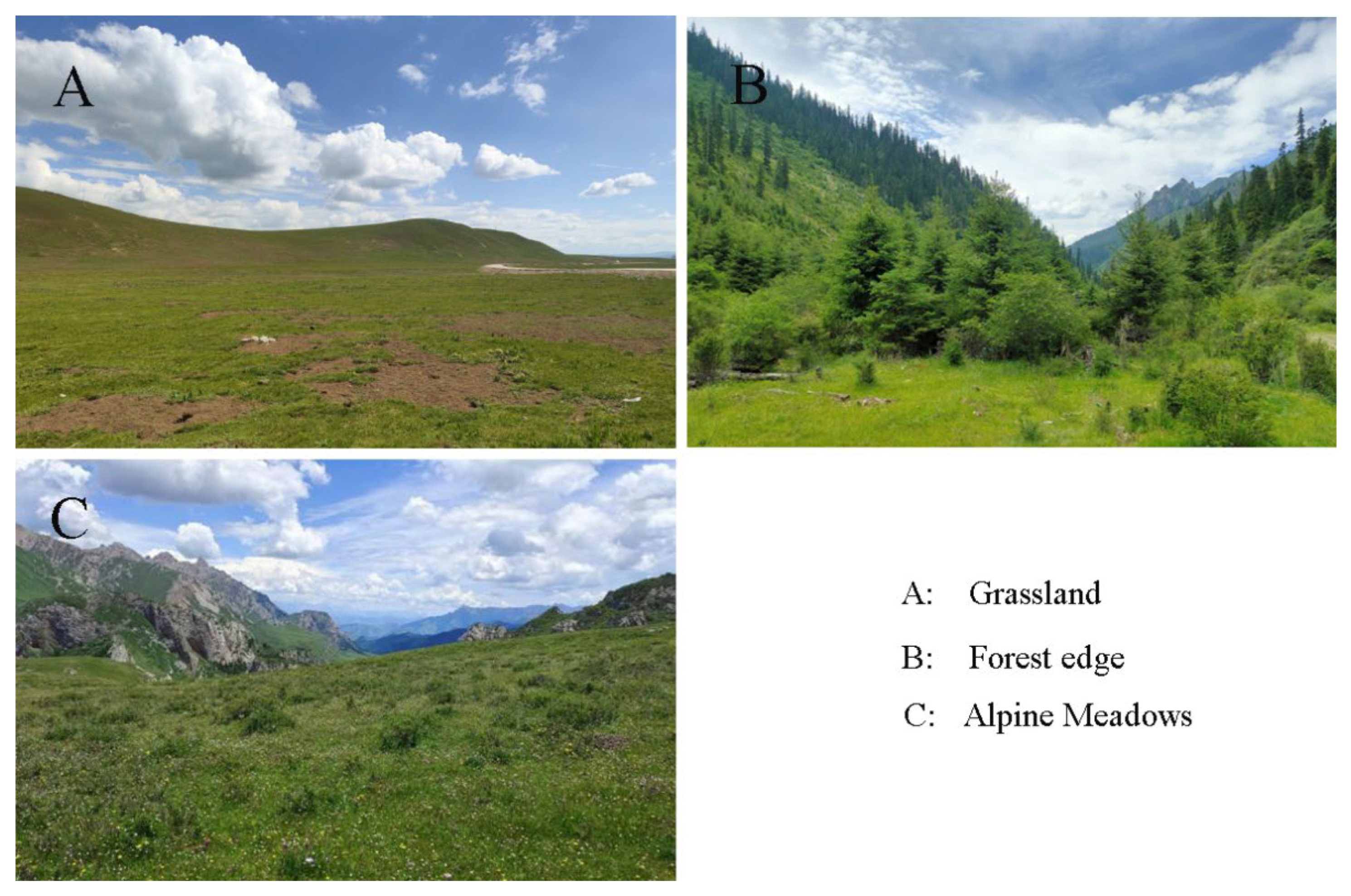
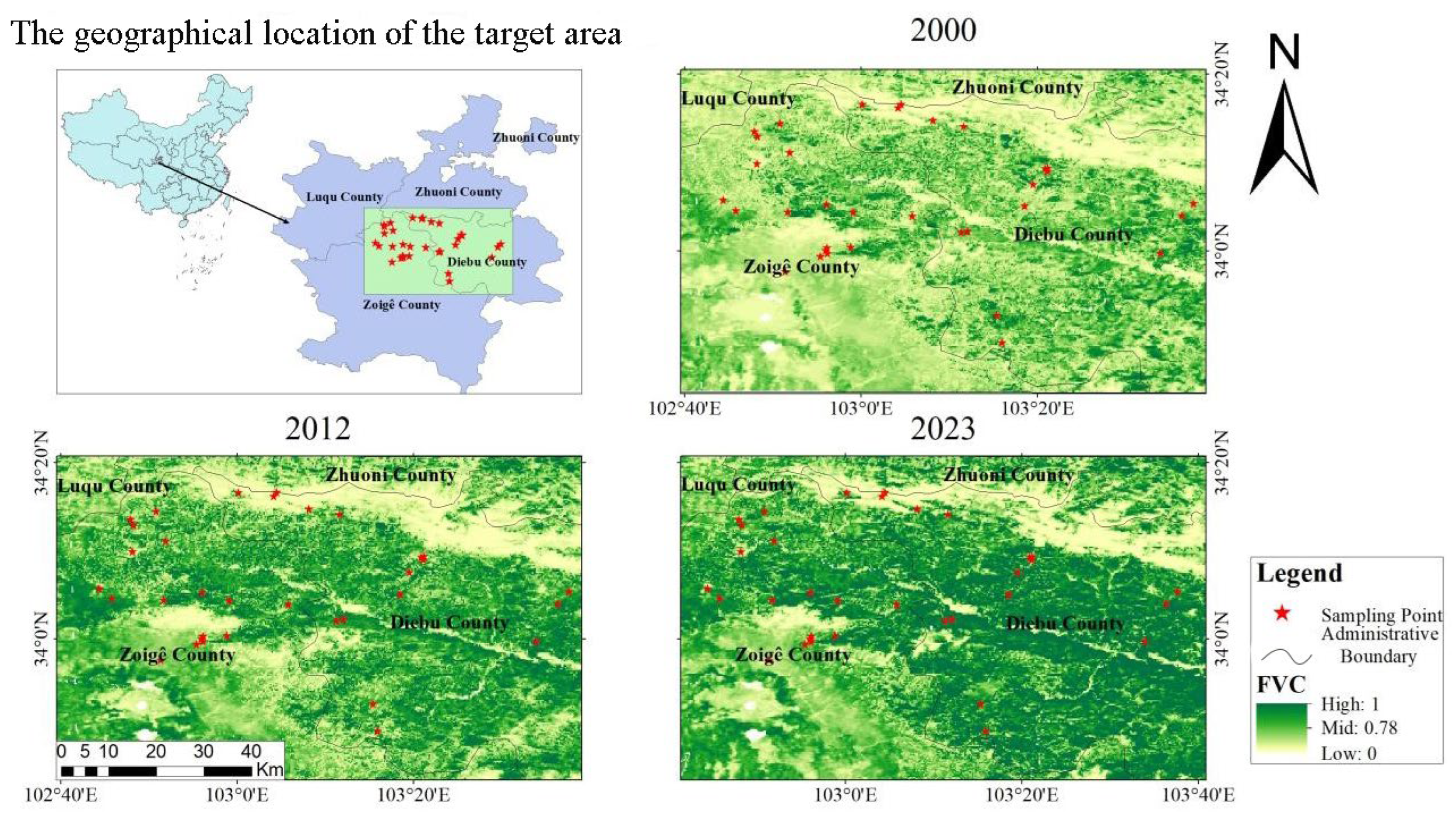
2.1. Overview of the Study Area
2.2. Transect Selection and Survey Methods
2.3. Bumblebee Diversity Analysis
2.4. Analysis of Bumblebee Communities
2.5. Statistical Analysis of Data
3. Results and Analysis
3.1. Species Composition of Bumblebee Community
3.2. Bumblebee Diversity
3.2.1. Bumblebee Diversity in Different Habitats
3.2.2. Distribution Pattern on Altitude of Bumblebees
3.2.3. Effects of Environmental Factors on Bumblebee Diversity
4. Discussion
4.1. Bumblebee Species Richness
4.2. Bumblebee Diversity in Three Type of Habitats
4.3. Bumblebee Diversity Across Altitudinal Gradient
4.4. Influence of Environmental Factors on Bumblebee Communities
4.5. Recommendations for the Conservation of Bumblebee Diversity
Author Contributions
Funding
Data Availability Statement
Acknowledgments
Conflicts of Interest
Appendix A. Information of Transects and Transect Counting Results
| Number | Place | Elevation (m) | Latitude | Longitude | Number of Species | Number of Individuals |
| 1 | Amitang village | 3027.7 | N: 34.086911° | E: 102.934802° | 11 | 34 |
| 2 | Amitang | 2877.6 | N: 34.072425° | E: 102.985878° | 1 | 3 |
| 3 | Top of Amitang | 3523.1 | N: 34.072632° | E: 102.861723° | 12 | 60 |
| 4 | Across the Bailongjiang River | 2932.1 | N: 34.183102° | E: 102.865450° | 6 | 33 |
| 5 | Dala Valley | 3077.2 | N: 33.826289° | E: 103.265317° | 7 | 26 |
| 6 | Dangduo Valley | 3183.8 | N: 34.240597° | E: 102.847530° | 4 | 9 |
| 7 | Top of Dieshan | 4166.5 | N: 34.276574° | E: 103.075590° | 12 | 85 |
| 8 | Dieshan ranch | 4008 | N: 34.269370° | E: 103.069908° | 8 | 59 |
| 9 | Hongxin ranch | 3228.1 | N: 34.074521° | E: 102.766655° | 11 | 51 |
| 10 | Hongxin village | 3175.5 | N: 34.095120° | E: 102.739920° | 5 | 15 |
| 11 | Hutoushan | 2727.6 | N: 34.034215° | E: 103.188822° | 10 | 52 |
| 12 | Hutoushan ranch | 2942.7 | N: 34.036399° | E: 103.201568° | 8 | 24 |
| 13 | Ranger station | 2690.4 | N: 33.877585° | E: 103.256695° | 4 | 15 |
| 15 | Huahu | 3501.3 | N: 33.960116° | E: 102.856405° | 9 | 17 |
| 16 | Jianni valley | 2216.4 | N: 33.994348° | E: 103.565417° | 1 | 3 |
| 17 | Top of Jianni valley | 2748.8 | N: 34.088883° | E: 103.627663° | 5 | 26 |
| 18 | middle of Jianni valley | 2550 | N: 34.066339° | E: 103.606333° | 1 | 2 |
| 19 | Jiangza | 3048.3 | N: 34.163896° | E: 102.808650° | 7 | 16 |
| 20 | Top of Jiangza | 3662.6 | N: 34.224938° | E: 102.799085° | 10 | 69 |
| 21 | Middle of Jiangza | 3551.8 | N: 34.214667° | E: 102.803680° | 16 | 61 |
| 22 | Reer | 2556.1 | N: 34.064755° | E: 103.097080° | 6 | 19 |
| 23 | Stone Mountain | 3284.2 | N: 34.005609° | E: 102.980660° | 10 | 34 |
| 24 | Teniza | 3557.6 | N: 34.004781° | E: 102.936338° | 3 | 12 |
| 25 | Middle of Teniza | 3727.4 | N: 34.000055° | E: 102.933488° | 10 | 45 |
| 26 | Top of Teniza | 3797.9 | N: 33.994798° | E: 102.936672° | 9 | 66 |
| 27 | Teniza ranch | 3690.2 | N: 33.989140° | E: 102.923732° | 1 | 2 |
| 28 | Xiawuka | 3544.9 | N: 34.276282 | E: 103.002623 | 15 | 68 |
| 29 | Zagana village | 2939.3 | N: 34.234969° | E: 103.194133° | 12 | 40 |
| 30 | Zagana moutain | 3492.3 | N: 34.245820° | E: 103.136100° | 10 | 20 |
| 31 | Top of Zirun valley | 3620.5 | N: 34.154483° | E: 103.348363° | 10 | 71 |
| 32 | Zirun valley | 3512.2 | N: 34.155564° | E: 103.353332° | 8 | 28 |
| 33 | Zirun ranch | 3409.6 | N: 34.148988° | E: 103.352220° | 8 | 23 |
| 34 | Middle of Zirun valley | 2984.7 | N: 34.083045° | E: 103.307977° | 8 | 18 |
| Total | 27 | 1106 |
References
- Woodard, S.H. Bumble bee ecophysiology: Integrating the changing environment and the organism. Curr. Opin. Insect Sci. 2017, 22, 101–108. [Google Scholar] [CrossRef]
- Velthuis, H.H.; Van Doorn, A. A century of advances in bumblebee domestication and the economic and environmental aspof its commercialization for pollination. Apidologie 2006, 37, 421–451. [Google Scholar] [CrossRef]
- Zhang, H.; Zhou, Z.; An, J. Pollen release dynamics and daily patterns of pollen-collecting activity of honeybee Apis mellifera and bumblebee Bombus lantschouensis in solar greenhouse. Insects 2019, 10, 216. [Google Scholar] [CrossRef] [PubMed]
- Zhang, H.; Han, C.; Breeze, T.D.; Li, M.; Mashilingi, S.K.; Hua, J.; Zhang, W.; Zhang, X.; Zhang, S.; An, J. Bumblebee pollination enhances yield and flavor of tomato in Gobi Desert greenhouses. Agriculture 2022, 12, 795. [Google Scholar] [CrossRef]
- Heinrich, B. Bumblebee Economics; Harvard University Press: Cambridge, MA, USA, 1979. [Google Scholar]
- Loken, A. Studies on Scandinavian bumblebees (Hymenoptera, Apidae). Nor. J. Entomol. 1973, 20, 1–218. [Google Scholar]
- Ricketts, T.H.; Regetz, J.; Steffan-Dewenter, I.; Cunningham, S.A.; Kremen, C.; Bogdanski, A.; Gemmill-Herren, B.; Greenleaf, S.S.; Klein, A.M.; Mayfield, M.M.; et al. Landscape effects on crop pollination services: Are there general patterns? Ecol. Lett. 2008, 11, 499–515. [Google Scholar] [CrossRef]
- Goulson, D.; Nicholls, E.; Botias, C.; Rotheray, E.L. Bee declines driven by combined stress from parasites, pesticides, and lack of flowers. Science 2015, 347, 1435. [Google Scholar] [CrossRef] [PubMed]
- Kerr, J.T.; Pindar, A.; Galpern, P.; Packer, L.; Potts, S.G.; Roberts, S.M.; Rasmont, P.; Schweiger, O.; Colla, S.R.; Richardson, L.L.; et al. Climate change impacts on bumblebees converge across continents. Science 2015, 349, 177–180. [Google Scholar] [CrossRef]
- Wang, M.N.; Lu, X.L.; Cui, Y.; Wang, M.; Ding, S.Y. Effects of woodland types with different levels of human disturbance on pollinators: A case study in Gongyi, Henan, China. Acta Ecol. Sin. 2018, 38, 464–474. [Google Scholar] [CrossRef]
- Han, Y.; Xue, Q.; Song, H.; Qi, J.; Gao, R.; Cui, S.; Men, L.; Zhang, Z. Diversity and influencing factors of flower-visiting insects in the Yanshan area. Biodivers. Sci. 2022, 30, 21448. [Google Scholar] [CrossRef]
- Cardinale, B.J.; Srivastava, D.S.; Duffy, J.E.; Wright, J.P.; Downing, A.L.; Sankaran, M.; Jouseau, C. Effects of biodiversity on the functioning of trophic groups and ecosystems. Nature 2006, 443, 989–992. [Google Scholar] [CrossRef]
- Cardinale, B.J. Biodiversity improves water quality through niche partitioning. Nature 2011, 472, 86–89. [Google Scholar] [CrossRef]
- Isbell, F.; Gonzalez, A.; Loreau, M.; Cowles, F.I.J.; Díaz, S.; Hector, A.; Mace, G.M.; Wardle, D.A.; O’Connor, M.I.; Duffy, J.E.; et al. Linking the influence and dependence of people on biodiversity across scales. Nature 2017, 546, 65–72. [Google Scholar] [CrossRef]
- Hooper, D.U.; Chapin, F.S., III; Ewel, J.J.; Hector, A.; Inchausti, P.; Lavorel, S.; Lawton, J.H.; Lodge, D.M.; Loreau, M.; Naeem, S.; et al. Effects of biodiversity on ecosystem functioning: A consensus of current knowledge. Ecol. Monogr. 2005, 75, 3–35. [Google Scholar] [CrossRef]
- Hector, A.; Schmid, B. Plant Diversity and Productivity Experiments in European Grasslands. Science 1999, 286, 1123. [Google Scholar] [CrossRef] [PubMed]
- Wagg, C.; Bender, S.F.; Widmer, F.; Van, D.H.M.G. Soil biodiversity and soil community composition determine ecosystem multifunctionality. Proc. Natl. Acad. Sci. USA 2014, 111, 5266–5270. [Google Scholar] [CrossRef] [PubMed]
- IUCN. The IUCN Red List of Threatened Species. Version 2025-1. 2025. Available online: https://www.iucnredlist.org (accessed on 15 May 2023).
- Bartomeus, I.; Ascher, J.S.; Gibbs, J.; Danforth, B.N.; Wagner, D.L.; Hedtke, S.M.; Winfree, R. Historical changes in northeastern US bee pollinators related to shared ecological traits. Proc. Natl. Acad. Sci. USA 2013, 110, 4656–4660. [Google Scholar] [CrossRef]
- Colla Sheila, R. Status, threats and conservation recommendations for wild bumble bees (Bombus spp.) in Ontario, Canada: A review for policymakers and practitioners. Nat. Areas J. 2016, 36, 412–426. [Google Scholar] [CrossRef]
- Inouye, D.; Droege, S.; Mawdsley, J. Words alone will not protect pollinators. Science 2017, 355, 357. [Google Scholar] [CrossRef]
- Williams, P.H.; Osborne, J.L. Bumblebee vulnerability and conservation world-wide. Apidologie 2009, 40, 367–387. [Google Scholar] [CrossRef]
- Ah-Peng, C.; Wilding, N.; Kluge, J.; Descamps-Julien, B.; Bardat, J.; Chuah-Petiot, M.; Strasberg, D.; Hedderson, T.A. Bryophyte diversity and range size distribution along two altitudinal gradients: Continent vs. island. Acta Oecologica 2012, 42, 58–65. [Google Scholar] [CrossRef]
- Egawa, S.; Itino, T. Contrasting altitudinal patterns of diversity between bumblebees and bumblebee-visited flowers: Poverty of bumblebee diversity in a high mountain of Japan. Ecol. Res. 2020, 35, 504–510. [Google Scholar] [CrossRef]
- Cameron, S.A.; Hines, H.M.; Williams, P.H. A comprehensive phylogeny of the bumble bees (Bombus). Biol. J. Linn. Soc. Lond. 2007, 91, 161–188. [Google Scholar] [CrossRef]
- Williams, P.H.; Altanchimeg, D.; Byvaltsev, A.; De Jonghe, R.; Jaffar, S.; Japoshvili, G.; Kahono, S.; Liang, H.; Mei, M.; Monfared, A.; et al. Widespread polytypic species or complexes of local species? Revising bumblebees of the subgenus Melanobombus world-wide (Hymenoptera, Apidae, Bombus). Eur. J. Taxon. 2020, 719, 1–120. [Google Scholar] [CrossRef]
- Williams, P.; An, J.; Huang, J.; Yao, J. BBCI: A new initiative to document Chinese bumble bees for pollination research. J. Apic. Res. 2010, 49, 221–222. [Google Scholar] [CrossRef]
- Myers, N.; Mittermeier, R.A.; Mittermeier, C.G.; Da Fonseca, G.A.; Kent, J. Biodiversity hotspots for conservation priorities. Nature 2000, 403, 853–858. [Google Scholar] [CrossRef] [PubMed]
- Williams, P.H.; Cameron, S.A.; Hines, H.M.; Cederberg, B.; Rasmont, P. A simplified subgeneric classification of the bumblebees (genus Bombus). Apidologie 2008, 39, 46–74. [Google Scholar] [CrossRef]
- Banaszak, J. Studies on methods of censusing the numbers of bees (Hymenoptera, Apoidea). Pol. Ecol. Stud. 1980, 6, 355–366. [Google Scholar]
- Magurran, A.E. Measuring Biological Diversity; Blackwell Publishing: Hoboken, NJ, USA, 2004. [Google Scholar]
- Hill, M.O. Diversity and evenness: A unifying notation and its consequences. Ecology 1973, 54, 427–432. [Google Scholar] [CrossRef]
- Fick, S.E.; Hijmans, R.J. WorldClim 2: New 1km spatial resolution climate surfaces for global land areas. Int. J. Climatol. 2017, 37, 4302–4315. [Google Scholar] [CrossRef]
- Oksanen, J.; Blanchet, F.G.; Kindt, R.; Legendre, P.; Minchin, P.R.; O’Hara, R.B.; Simpson, G.L.; Sólymos, P.; Stevens, M.H.H.; Wagner, H.; et al. vegan: Community Ecology Package (Version 2.0-10) [R Package]. Comprehensive R Archive Network. 2013. Available online: https://CRAN.R-project.org/package=vegan (accessed on 27 July 2023).
- Hsieh, T.C.; Ma, K.H.; Chao, A. iNEXT: An R package for rarefaction and extrapolation of species diversity (Hill numbers). Methods Ecol. Evol. 2016, 7, 1451–1456. [Google Scholar] [CrossRef]
- An, J.D.; Williams, P.H.; Zhou, B.; Miao, Z.; Qi, W. The bumblebees of Gansu, Northwest China (Hymenoptera, Apidae). Zootaxa 2011, 2865, 1–36. [Google Scholar] [CrossRef]
- Dong, S.K.; Tang, L.; Zhang, X.F.; Liu, S.L.; Liu, Q.R.; Su, X.K.; Zhang, Y.; Wu, X.; Zhao, Z.Z.; Li, Y.; et al. Relationship between plant species diversity and functional diversity in alpine grasslands. Acta Ecol. Sin. 2017, 37, 1472–1483. [Google Scholar] [CrossRef]
- Li, X.; Yang, Y.; He, Z.; Yang, G. Diversity of butterflies community and its environmental factors in Helan mountain nature reserve, Ningxia. J. Environ. Entomol. 2020, 42, 660–673. [Google Scholar]
- Xie, Z.; Williams, P.H.; Tang, Y. The effect of grazing on bumblebees in the high rangelands of the eastern Tibetan Plateau of Sichuan. J. Insect Conserv. 2008, 12, 695–703. [Google Scholar] [CrossRef]
- Huang, J.; An, J. Species diversity, pollination application and strategy for conservation of the bumblebees of China. Biodivers. Sci. 2018, 26, 486–497. [Google Scholar] [CrossRef]
- Li, H.; Ren, Z.; Wu, Z.; Xu, K.; Wang, H. Variation in floral traits of distylous Primula poissonii (Primulaceae) along geographic gradients. Biodivers. Sci. 2015, 23, 747. [Google Scholar] [CrossRef]
- Ye, X.Q.; Meng, J.L.; Zhao, Z.G.; Fan, B.L.; Du, G.Z. Optimal pollinator attraction strategies in Trollius ranunculoides Hemsl. (Ranunculaceae) at different altitudes: Increased floral display or promotion of nectar output? Plant Biol. 2011, 13, 551–555. [Google Scholar] [CrossRef]
- Parmesan, C. Ecological and Evolutionary Responses to Recent Climate Change. Annu. Rev. Ecol. Evol. Syst. 2006, 37, 637–669. [Google Scholar] [CrossRef]
- Bergmann, C. About the relationships between heat conservation and body size of animals. Goett. Stud. 1847, 1, 595–708. [Google Scholar]
- Shi, Y.; Hu, T.; Gao, H.; Luo, Q.; Yu, Y. The community vegetation composition and stability characteristics of alpine meadow under two grazing modes. Acta Prataculturae Sin. 2019, 28, 1–10. [Google Scholar]



| Habitat Types | Number of Species | Abundance |
|---|---|---|
| Grassland | 21 | 135 ± 12 |
| Alpine meadow | 24 | 612 ± 45 |
| Forest edge | 23 | 359 ± 28 |
| Elevation Gradient | No. of Species | No. of Individuals |
|---|---|---|
| 2500–2700 m | 10 | 41 |
| 2700–2900 m | 14 | 81 |
| 2900–3100 m | 20 | 189 |
| 3100–3300 m | 15 | 109 |
| 3300–3500 m | 12 | 43 |
| 3500–3700 m | 24 | 388 |
| 3700–3900 m | 14 | 111 |
| Above 3900 m | 15 | 144 |
Disclaimer/Publisher’s Note: The statements, opinions and data contained in all publications are solely those of the individual author(s) and contributor(s) and not of MDPI and/or the editor(s). MDPI and/or the editor(s) disclaim responsibility for any injury to people or property resulting from any ideas, methods, instructions or products referred to in the content. |
© 2025 by the authors. Licensee MDPI, Basel, Switzerland. This article is an open access article distributed under the terms and conditions of the Creative Commons Attribution (CC BY) license.
Share and Cite
Xu, X.; Bai, L.; Wang, Z.; He, J.; Zhang, Y.; Li, X. Bumblebee Diversity in Different Habitat Types and Along an Altitudinal Gradient at a Forest–Grassland Ecotone in the East Range of the Qinghai–Tibet Plateau. Insects 2026, 17, 49. https://doi.org/10.3390/insects17010049
Xu X, Bai L, Wang Z, He J, Zhang Y, Li X. Bumblebee Diversity in Different Habitat Types and Along an Altitudinal Gradient at a Forest–Grassland Ecotone in the East Range of the Qinghai–Tibet Plateau. Insects. 2026; 17(1):49. https://doi.org/10.3390/insects17010049
Chicago/Turabian StyleXu, Xunlu, Lei Bai, Zhaolong Wang, Jianping He, Yalin Zhang, and Xiushan Li. 2026. "Bumblebee Diversity in Different Habitat Types and Along an Altitudinal Gradient at a Forest–Grassland Ecotone in the East Range of the Qinghai–Tibet Plateau" Insects 17, no. 1: 49. https://doi.org/10.3390/insects17010049
APA StyleXu, X., Bai, L., Wang, Z., He, J., Zhang, Y., & Li, X. (2026). Bumblebee Diversity in Different Habitat Types and Along an Altitudinal Gradient at a Forest–Grassland Ecotone in the East Range of the Qinghai–Tibet Plateau. Insects, 17(1), 49. https://doi.org/10.3390/insects17010049