Screening for the Efficacy of Botanicals and Soaps in Controlling the Banana Aphid Pentalonia nigronervosa (Hemiptera: Aphididae) Under Laboratory and Screenhouse Conditions

 ,
, 
 , , and
Simple Summary
Abstract
1. Introduction
2. Materials and Methods
2.1. Aphid Rearing
2.2. Research Material and Preparation
2.3. Preparation of Fermented Plant Extracts
2.4. Preparation of Plant–Soap Mixtures
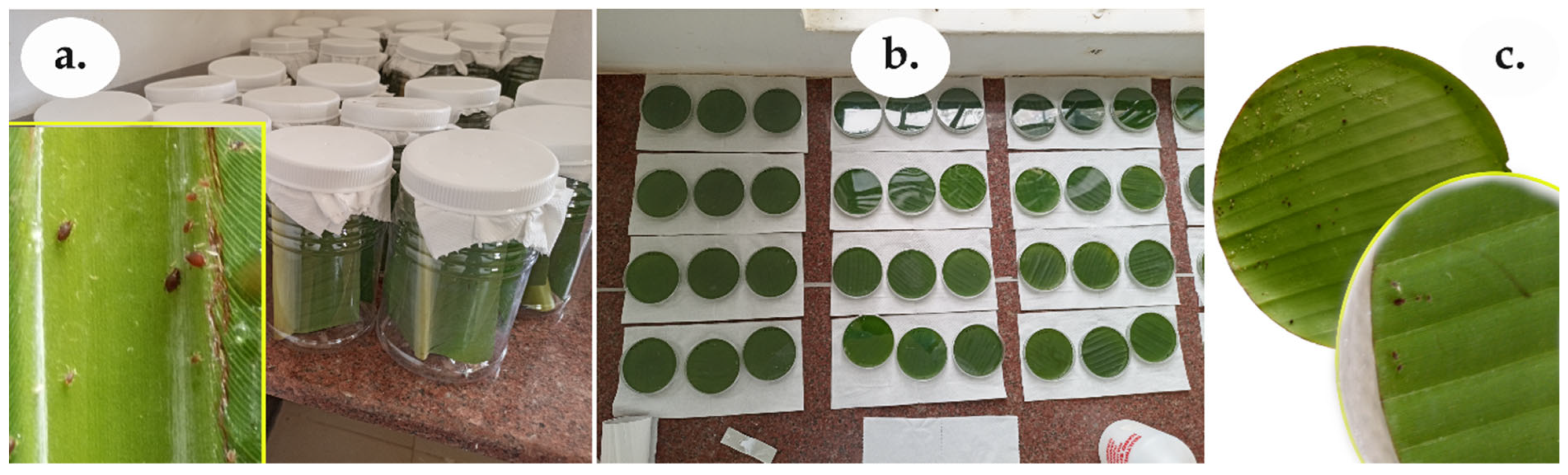
2.5. Bioassays: Assessment of Botanicals and/or Soap In Vitro
2.6. Experimental Design for the In Vitro Experiments
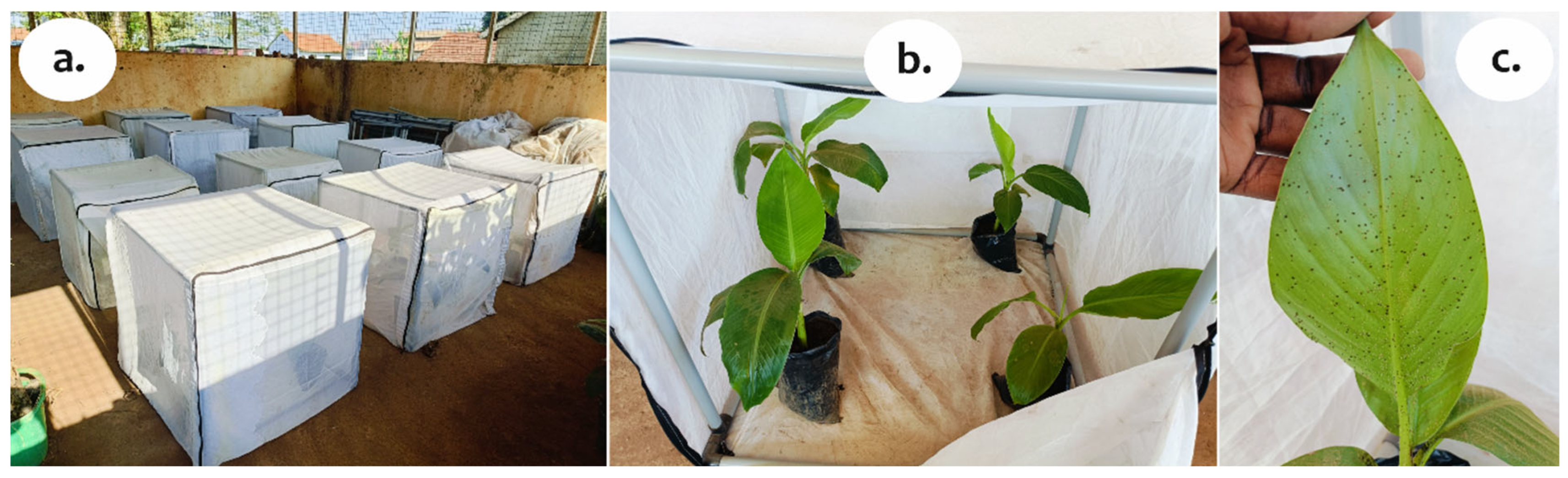
2.7. Experimental Design for the In Vivo Experiments
2.8. Cost and Risk Associated with the Preparations
2.9. Statistical Analysis
3. Results
3.1. In Vitro Evaluation of Botanicals and Soaps
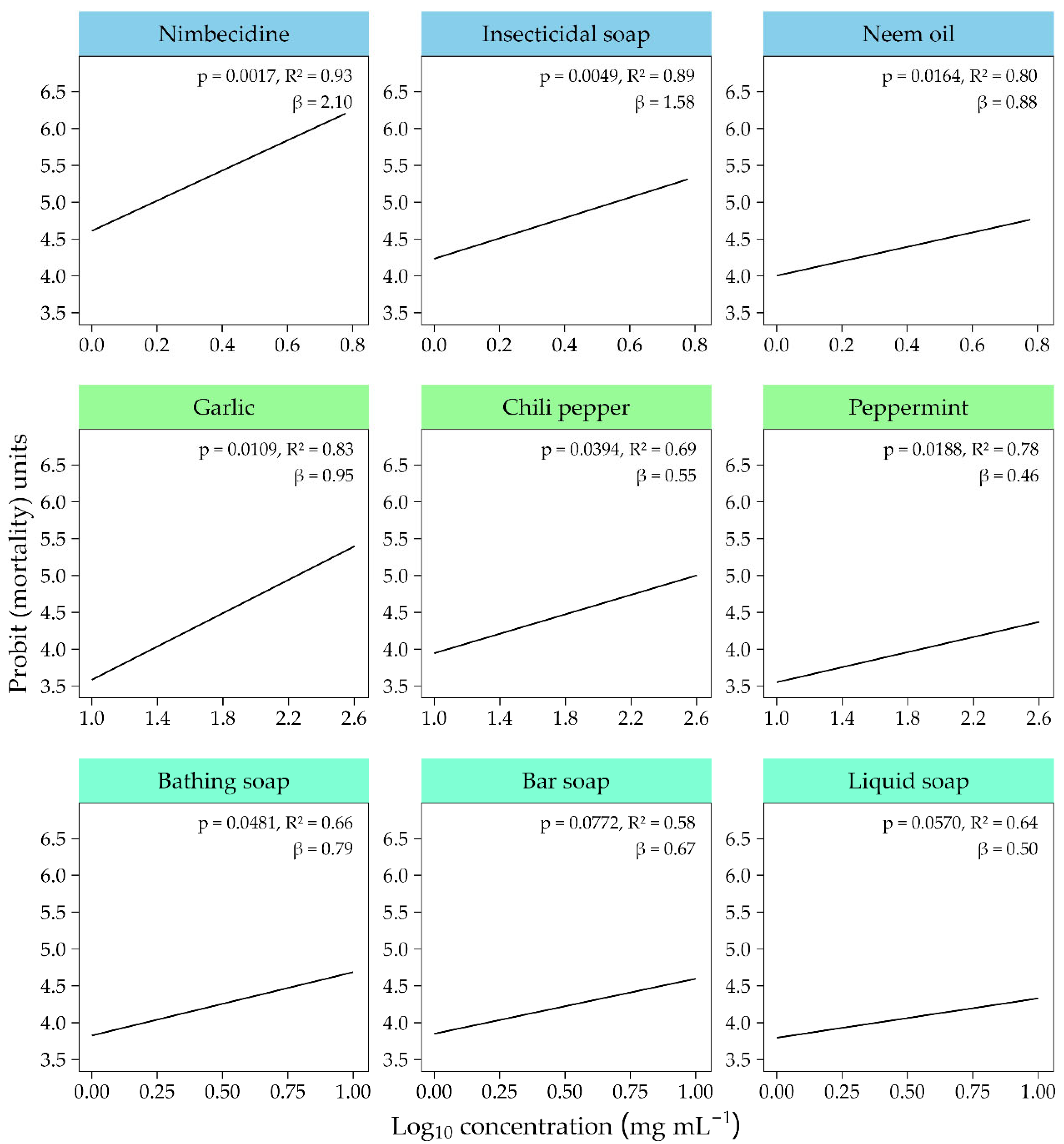
3.1.1. Aphid Mortality After Single Application of Non-Fermented or Fermented Botanicals and Soaps
3.1.2. Aphid Mortality Due to Mixing Non-Fermented or Fermented Botanicals with Best Soaps
3.2. In Vivo Evaluation of Selected Botanicals Mixed with Soap
3.2.1. Aphid Population Dynamics Due to Mixtures of Biorationals with Soap
3.2.2. Cost and Risk Associated with the Preparation of Biorationals
4. Discussion
5. Conclusions and Recommendations
Supplementary Materials
Author Contributions
Funding
Data Availability Statement
Acknowledgments
Conflicts of Interest
References
- Kumar, P.L.; Selvarajan, R.; Iskra-Caruana, M.L.; Chabannes, M.; Hanna, R.; Hartung, J.S. Biology, etiology, and control of virus diseases of banana and plantain. Adv. Virus Res. 2015, 91, 229–269. [Google Scholar] [CrossRef] [Scilit] [PubMed]
- Ajambo, S.; Rietveld, A.; Nkengla, L.W.; Akello, J.; Tinzaara, W.; Blomme, G. Recovering banana production in bunchy top-affected areas in Sub-Saharan Africa: Developing gender-responsive approaches. Acta Hortic. 2018, 1196, 219–228. [Google Scholar] [CrossRef] [Scilit]
- Ocimati, W.; Acema, D.; Kubiriba, J.; Ssekiwoko, F.; Tinzaara, W.; Nankinga, C.; Nanyonjo, A.; Kiggundu, A. First report of banana bunchy top disease caused by Banana bunchy top virus in Uganda. New Dis. Rep. 2021, 44, e12052. [Google Scholar] [CrossRef] [Scilit]
- Ocimati, W.; Ogwal, G.; Tazuba, A.F.; Kiggundu, A.; Kubiriba, J.; Tinzaara, W.; Acema, D.; Blomme, G. Mapping the vulnerability of banana production landscapes in Uganda to banana bunchy top disease. Front. Agron. 2024, 6, 1401478. [Google Scholar] [CrossRef] [Scilit]
- Shimwela, M.M.; Mahuku, G.; Mbanzibwa, D.R.; Mkamilo, G.; Mark, D.; Mosha, H.I.; Kumar, P.L. First report of banana bunchy top virus in banana and plantain (Musa spp.) in Tanzania. Plant Dis. 2022, 106, 1312. [Google Scholar] [CrossRef] [Scilit]
- Mahuku, G.; Kumar, P.L. Banana Bunchy Top Virus (BBTV) Delimiting Survey in Tanzania. Phase 1 Survey Summary Report; International Institute of Tropical Agriculture (IITA): Ibadan, Nigeria, 2023; Available online: https://hdl.handle.net/10568/137375 (accessed on 4 March 2024).
- Bouwmeester, H.; Blomme, G.; Omondi, A.B.; Were, E.; Kiggundu, A.; Karamura, D.; Kubiriba, J.; Nakato, V.; Tinzaara, W.; Bandyopadhyay, R.; et al. Banana bunchy top disease in Africa—Predicting continent-wide disease risks by combining survey data and expert knowledge. Plant Pathol. 2023, 72, 1476–1490. [Google Scholar] [CrossRef] [Scilit]
- Kumar, P.L.; Hanna, R.; Alabi, O.J.; Soko, M.M.; Oben, T.T.; Vangu, G.H.P.; Naidu, R.A. Banana bunchy top virus in sub-Saharan Africa: Investigations on virus distribution and diversity. Virus Res. 2011, 159, 171–182. [Google Scholar] [CrossRef] [Scilit]
- Stainton, D.; Kraberger, S.; Walters, M.; Wiltshire, E.J.; Rosario, K.; Halafihi, M.; Lolohea, S.; Katoa, I.; Faitua, T.; Aholelei, T.; et al. Evidence of inter-component recombination, intra-component recombination and reassortment in banana bunchy top virus. Virus Res. 2012, 93, 1103–1119. [Google Scholar] [CrossRef] [Scilit]
- Watanabe, S.; Borthakur, D.; Bressan, A. Localization of Banana bunchy top virus and cellular compartments in gut and salivary gland tissues of the aphid vector Pentalonia nigronervosa. Insect Sci. 2016, 23, 591–602. [Google Scholar] [CrossRef] [Scilit]
- Kubiriba, J.; Legg, J.P.; Tushemereirwe, W.; Adipala, E. Vector transmission of Banana streak virus in the screenhouse in Uganda. Ann. Appl. Biol. 2001, 139, 37–43. [Google Scholar] [CrossRef] [Scilit]
- Padmanaban, B.; Mani, M. Pests and their management in banana. In Trends in Horticultural Entomology; Mani, M., Ed.; Springer: Singapore, 2022; pp. 577–603. [Google Scholar] [CrossRef] [Scilit]
- Greenwell, A.M. Life Table Study of Pentalonia nigronervosa and P. caladii on Banana and Vector Transmission of Banana Bunchy Top Virus (BBTV). Master’s Thesis, University of Hawai‘i at Mānoa, Honolulu, HI, USA, 2012. Available online: http://hdl.handle.net/10125/101297 (accessed on 4 March 2024).
- Robson, J.D. Biology, and Ecology of Pentalonia nigronervosa Coq. in Hawaii and Aspects of Its Chemical Control with Imidacloprid. Ph.D. Thesis, University of Hawai‘I, Honolulu, HI, USA, 2006. Available online: https://scholarspace.manoa.hawaii.edu/items/1ce4696d-59be-4d13-bc1d-4f8ad92aae31 (accessed on 5 March 2024).
- Watanabe, S.; Greenwell, A.M.; Bressan, A. Localization, concentration, and transmission efficiency of Banana bunchy top virus in four asexual lineages of Pentalonia aphids. Viruses 2013, 5, 758–776. [Google Scholar] [CrossRef] [Scilit] [PubMed]
- Wang, K.H.; Uyeda, J.; Sugano, J. IPM for banana. In Banana Pest and Disease Management in the Tropical Pacific: A Guidebook for Banana Growers; College of Tropical Agriculture and Human Resources; University of Hawai‘i at Mānoa: Honolulu, HI, USA, 2016; Available online: https://cms.ctahr.hawaii.edu/wangkh/Research-and-Extension/Banana-IPM/Banana-IPM-Guidebook (accessed on 4 March 2024).
- Anhalt, M.D.; Almeida, R.P.P. Effect of temperature, vector life stage and plant access period on transmission of Banana bunchy top virus to banana. Phytopathology 2008, 98, 743–748. [Google Scholar] [CrossRef] [Scilit] [PubMed]
- Omondi, B.A.; Were, E.; Karamura, D.; Tinzaara, W.; Kubiriba, J.; Blomme, G. The effectiveness of consistent roguing in managing banana bunchy top disease in smallholder production in Africa. Plant Pathol. 2020, 69, 1754–1766. [Google Scholar] [CrossRef] [Scilit]
- Smith, M.C.; Holt, J.; Kenyon, L.; Seal, S.E. Quantitative epidemiology of banana bunchy top virus disease and its control. Plant Pathol. 1998, 47, 177–187. [Google Scholar] [CrossRef] [Scilit]
- Robson, J.D.; Wright, M.G.; Almeida, R.P. Effect of imidacloprid foliar treatment and banana leaf age on Pentalonia nigronervosa (Hemiptera: Aphididae) survival. N. Z. J. Crop Hortic. Sci. 2007, 35, 415–422. [Google Scholar] [CrossRef] [Scilit]
- Jactel, H.; Verheggen, F.; Thiéry, D.; Escobar-Gutiérrez, A.J.; Gachet, E.; Desneux, N. Alternatives to neonicotinoids. Environ. Int. 2019, 129, 423–429. [Google Scholar] [CrossRef] [Scilit]
- El-Gendy, I.R.; El-Banobi, M.I.; Villanueva-Jimenez, J.A. Bio-pesticides alternative diazinon to control peach fruit fly, Bactrocera zonata (Saunders) (Diptera: Tephritidae). Egypt. J. Biol. Pest Control 2021, 31, 49. [Google Scholar] [CrossRef] [Scilit]
- Haddi, K.; Turchen, L.M.; Viteri Jumbo, L.O.; Guedes, R.N.C.; Pereira, E.J.G.; Agostini, L.T.; Oliveira, E.E. Rethinking biorational insecticides for pest management: Unintended effects and consequences. Pest Manag. Sci. 2020, 76, 2286–2293. [Google Scholar] [CrossRef] [Scilit]
- Shankar, B.K.; Tripathi, P. Bio-rational approaches for management of major brinjal pests: A review. Pharma Innov. J. 2021, 10, 378–381. Available online: https://portal.sapp.lk/Resources_4_LCV/4.g.2%20biorational%20brinjal%20pest%20control.pdf (accessed on 5 March 2024).
- Isman, M.B. Botanical insecticides, deterrents, and repellents in modern agriculture and an increasingly regulated world. Annu. Rev. Entomol. 2006, 51, 45–66. [Google Scholar] [CrossRef] [Scilit]
- Walia, S.; Saha, S.; Rana, V.S. Phytochemical pesticides. In Advances in Plant Biopesticides; Singh, D., Ed.; Springer: New Delhi, India, 2014; pp. 265–286. [Google Scholar] [CrossRef] [Scilit]
- Curkovic, T. Detergents and soaps as tools for IPM in agriculture. In Integrated Pest Management (IPM): Environmentally Sound Pest Management; Gill, H.K., Goyal, G., Eds.; IntechOpen: Rijeka, Croatia, 2016; pp. 155–189. [Google Scholar] [CrossRef] [Scilit]
- Kareru, P.; Rotich, Z.K.; Maina, E.W. Use of botanicals and safer insecticides designed in controlling insects: The African case. In Insecticides—Development of Safer and More Effective Technologies; Trdan, S., Ed.; IntechOpen: London, UK, 2013; pp. 297–309. [Google Scholar] [CrossRef] [Scilit]
- Dimetry, N.Z. Different plant families as bioresource for pesticides. In Advances in Plant Biopesticides; Singh, D., Ed.; Springer: New Delhi, India, 2014; pp. 1–20. [Google Scholar] [CrossRef] [Scilit]
- Henn, T.; Weinzierl, R. Botanical insecticides and insecticidal soaps. In Alternatives in Insect Management; University of Illinois at Urbana-Champaign: Champaign, IL, USA, 1989; Illinois Natural History Survey Circular 1296; Available online: https://www.ideals.illinois.edu/items/29094 (accessed on 5 March 2024).
- Megersa, A. Botanical extracts for control of pea aphid (Acyrthosiphon pisum Harris). J. Entomol. Zool. Stud. 2016, 4, 623–627. Available online: https://www.entomoljournal.com/archives/2016/vol4issue1/PartI/3-5-16.pdf (accessed on 5 March 2024).
- Atieno, B. Assessment of the Effectiveness of Using Garlic, Hot Pepper, and Soap Spray in Control of Green Aphids (Brevicoryne brassicae L.) on Kales. Bachelor’s Thesis, University of Embu, Embu, Kenya, 2017. Available online: http://repository.embuni.ac.ke/handle/embuni/3524 (accessed on 6 March 2024).
- Bhatta, K.; Chaulagain, L.; Kafle, K.; Shrestha, J. Bio-efficacy of plant extracts against mustard aphid (Lipaphis erysimi Kalt.) on rapeseed (Brassica campestris Linn.). Syrian J. Agric. Res. 2019, 20, 10–20. Available online: https://agri-research-journal.net/sjar/wp-content/uploads/2019/12/v6n4p44.pdf (accessed on 6 March 2024).
- Gupta, G.; Sharma, S.; Kumar, N. Evaluation of Carica papaya aqueous leaf extracts against rose aphids (Macrosiphum rosae L.). J. Entomol. Zool. Stud. 2020, 8, 960–964. Available online: https://www.researchgate.net/profile/Garima-Gupta-21/publication/342171675_Carica_papaya_aqueous_leaf_extracts_as_potential_botanical_insecticide_against_rose_aphids_Macrosiphum_rosaeformis_D/links/5ee75d8b458515814a5ea9df/Carica-papaya-aqueous-leaf-extracts-as-potential-botanical-insecticide-against-rose-aphids-Macrosiphum-rosaeformis-D.pdf (accessed on 11 March 2024).
- Kokwane, R. Potential of Some Botanical Extracts, Soap Solutions and Companion Plants Against Cabbage Aphid (Brevicoryne brassicae L.) on Rape (Brassica napus L.). Master’s Thesis, Botswana University of Agriculture and Natural Resources, Gaborone, Botswana, 2021. Available online: https://researchhub.buan.ac.bw/handle/13049/380 (accessed on 11 March 2024).
- Nzanza, B.; Mashela, P.W. Control of whiteflies and aphids in tomato (Solanum lycopersicum L.) by fermented plant extracts of neem leaf and wild garlic. Afr. J. Biotechnol. 2012, 11, 16077–16082. [Google Scholar] [CrossRef] [Scilit]
- Kayange, C.D.; Masangano, C.M.; Mloza-Banda, H.R.; Nyirenda, S.P.; Mponela, P.; Phiri, N.A.; Belmain, S.R.; Stevenson, P.C. Field and laboratory evaluation of pesticidal plants for bioactivity against rape and tomato pests in Malawi. Adv. Agric. 2022, 2022, e8750950. [Google Scholar] [CrossRef] [Scilit]
- Chengala, L.; Singh, N. Botanical pesticides—A major alternative to chemical pesticides: A review. Int. J. Life Sci. 2017, 5, 722–729. Available online: https://www.researchgate.net/profile/Nandita-Singh-16/publication/354728412_Botanical_pesticides_-a_major_alternative_to_chemical_pesticides_A_review/links/6149f805a595d06017e11568/Botanical-pesticides-a-major-alternative-to-chemical-pesticides-A-review.pdf (accessed on 11 March 2024).
- Lengai, G.M.W.; Muthomi, J.W.; Mbega, E.R. Phytochemical activity and role of botanical pesticides in pest management for sustainable agricultural crop production. Sci. Afr. 2020, 7, e00239. [Google Scholar] [CrossRef] [Scilit]
- Baloch, S.A.; Lanjar, A.G.; Syed, T.S.; Jamali, A.A.; Rajput, N.A.; Khoso, G.M.; Mirani, A.H.; Panhwar, M.A.; Ali, Q.; Khanzada, M.A. Efficacy of different insecticides and botanicals against banana aphids (Pentalonia nigronervosa) under field conditions. Pure Appl. Biol. 2023, 12, 1302–1314. [Google Scholar] [CrossRef] [Scilit]
- Yongyue, L.; Guangwen, L.; Wanting, S.; Ping, C. Effect of plant extracts on banana aphid (Pentalonia nigronervosa f. Caladii Van der Goot). J. Huazhong Agric. Univ. 2002, 21, 334–337. [Google Scholar]
- Hata, T.Y.; Hara, A.H.; Jang, E.B.; Imaino, L.S.; Hu, B.K.S.; Tenbrink, V.L. Pest management before harvest and insecticidal dip after harvest as a systems approach to quarantine security for red ginger. J. Econ. Entomol. 1992, 85, 2310–2316. [Google Scholar] [CrossRef] [Scilit]
- Hansen, J.D.; Hara, A.H.; Tenbrink, V.L. Insecticidal dips for disinfesting commercial tropical cut flowers and foliage. Int. J. Pest Manag. 1992, 38, 245–249. [Google Scholar] [CrossRef] [Scilit]
- Ferreira, S.A.; Trujillo, E.E.; Ogata, D.Y. Banana bunchy top virus. Plant Dis. 1997, 12, 1–4. Available online: https://scholarspace.manoa.hawaii.edu/bitstream/10125/12378/1/PD-12.pdf (accessed on 12 March 2024).
- Rodríguez-del-Bosque, L.A. Field evaluation of bioinsecticides against Melanaphis sacchari (Hemiptera: Aphididae) on sorghum. Southwest. Entomol. 2021, 45, 917–920. [Google Scholar] [CrossRef] [Scilit]
- Kraiss, H.; Cullen, E.M. Efficacy and nontarget effects of reduced-risk insecticides on Aphis glycines (Hemiptera: Aphididae) and its biological control agent Harmonia axyridis. J. Econ. Entomol. 2014, 101, 391–398. [Google Scholar] [CrossRef] [Scilit]
- Ochieng, S.O.; Nderitu, P.W. Biocontrol approach to management of green peach aphid Myzus persicae in garden peas for a sustainable ecosystem. J. Hortic. For. 2011, 3, 231–237. Available online: https://academicjournals.org/journal/JHF/article-full-text-pdf/62743421641 (accessed on 12 March 2024).
- Ramanatha Menon, M.; Christudas, S.P. Investigations on the control of the banana aphid Pentalonia nigronervosa Coq. Agric. Res. J. 1966, 4, 92–94. Available online: http://14.139.185.57:8080/xmlui/handle/123456789/2051 (accessed on 12 March 2024).
- Oparaeke, A.M. Synergistic activity of aqueous extracts mixtures of some Nigerian plants against Maruca vitrata and Clavigralla tomentosicollis on field cowpea (Vigna unguiculata). Arch. Phytopathol. Plant Prot. 2007, 40, 257–263. [Google Scholar] [CrossRef] [Scilit]
- Romero, M.; Pinos-Rodríguez, J.M.; Herrera, J.G.; García, A.; González, S.S.; Bárcena, R.; Cobos, M.A.; Hernández, A. Influence of zilpaterol and mineral-yeast mixture on ruminal fermentation and growth performance in finishing steers. J. Appl. Anim. Res. 2009, 35, 77–81. [Google Scholar] [CrossRef] [Scilit]
- Divekar, P. Botanical pesticides: An eco-friendly approach for management of insect pests. Acta Sci. Agric. 2023, 7, 75–81. Available online: https://www.researchgate.net/profile/Pratap-Divekar/publication/367769355_Botanical_Pesticides_An_Eco-Friendly_Approach_for_Management_of_Insect_Pests/links/63e3cf37dea612175793104d/Botanical-Pesticides-An-Eco-Friendly-Approach-for-Management-of-Insect-Pests.pdf (accessed on 12 March 2024). [CrossRef] [Scilit]
- Nxumalo, K.A.; Aremu, A.O.; Fawole, O.A. Potentials of medicinal plant extracts as an alternative to synthetic chemicals in postharvest protection and preservation of horticultural crops: A review. Sustainability 2021, 13, 5897. [Google Scholar] [CrossRef] [Scilit]
- Feng, R.; Isman, M.B. Selection for resistance to azadirachtin in the green peach aphid, Myzus persicae. Entomol. Exp. Appl. 1995, 77, 283–289. [Google Scholar] [CrossRef] [Scilit]
- Oparaeke, A.M.; Dike, M.C.; Amatobi, C.I. Evaluation of botanical mixtures for insect pests’ management on cowpea plants. J. Agric. Rural Dev. Trop. Subtrop. 2005, 106, 41–48. Available online: http://www.jarts.info/index.php/jarts/article/view/80/73 (accessed on 13 March 2024).
- Subash, N.; Raju, G. Insecticidal activity of certain fermented plant extract against Spodoptera litura (Fab.) (Lepidoptera: Noctuidae). Int. J. Instit. Pharm. Life Sci. 2014, 4, 35–41. Available online: https://ijipls.co.in/archives.php?archid=21 (accessed on 13 March 2024).
- Ali, S.; Farooqi, M.A.; Sajjad, A.; Ullah, M.I.; Qureshi, A.K.; Siddique, B.; Waheed, W.; Sarfraz, M.; Asghar, A. Compatibility of entomopathogenic fungi and botanical extracts against the wheat aphid, Sitobion avenae (Fab.) (Hemiptera: Aphididae). Egypt. J. Biol. Pest Control 2018, 28, 97. [Google Scholar] [CrossRef] [Scilit]
- Harris, A. Integrated Organic Management of Cabbage Aphid on Brussels Sprouts. Master’s Thesis, Prescott College, Prescott, AZ, USA, 2019. Available online: https://scholars.unh.edu/thesis/1294/ (accessed on 13 March 2024).
- Gonfa, K.; Shiberu, T. Laboratory evaluation of indigenous botanical aqua extracts against cabbage aphids, Brevicoryne brassicae L. (Hemiptera: Aphididae) on cabbage (Brassica oleracea). Int. J. Fauna Biol. Stud. 2022, 9, 45–48. Available online: https://www.faunajournal.com/archives/2022/vol9issue1/PartA/9-2-10-269.pdf (accessed on 14 March 2024).
- Ngatat, S.; Hanna, R.; Lienou, J.; Ghogomu, R.T.; Nguidang, S.P.K.; Enoh, A.C.; Ndemba, B.; Korie, S. Musa germplasm A and B genomic composition differentially affects their susceptibility to banana bunchy top virus and its aphid vector, Pentalonia nigronervosa. Plants 2022, 11, 3092. [Google Scholar] [CrossRef] [Scilit]
- Iqbal, M.; Kahloon, M.; Nawaz, M.; Javaid, M. Efficacy of plant extracts against wheat aphids under field conditions. J. Anim. Plant Sci. 2011, 21, 114–116. Available online: https://thejaps.org.pk/docs/21(1)2011/EFFECTIVENESS-SOME-BOTANICAL.pdf (accessed on 15 March 2024).
- Khanam, Z.; Al-Yousef, H.M.; Singh, O.; Bhat, I.U.H. Neem oil. In Green Pesticides Handbook: Essential Oils for Pest Control; Nollet, L.M.L., Rathore, H.S., Eds.; CRC Press: Boca Raton, FL, USA, 2017; pp. 175–198. [Google Scholar] [CrossRef] [Scilit]
- Kyan, T.; Shintani, M.; Kanda, S.; Sakurai, M.; Ohashi, T. Kyusei Nature Farming and Effective Microorganisms: International Nature Farming Research Center Manual; International Nature Farming Research Center: Atami, Japan, 1999; 120p. [Google Scholar]
- Khadem, A.; Chin, N.L.; Mokhtar, A.S.; Lau, W.H. Effectiveness of fermented plant extracts against citrus mealybug (Planococcus citri) infestation on guava fruits. Ann. Agri-Bio Res. 2022, 27, 88–93. Available online: https://agribiop.com/wp-content/uploads/2019/11/AOABR-27-1-79-86.pdf (accessed on 24 February 2025).
- Insecticides Resistance Action Committee (IRAC). Susceptibility Test Methods 019. 2019. Available online: https://irac-online.org/methods/aphids-adultnymphs/ (accessed on 24 February 2025).
- Biale, H.; Mendel, Z.; Soroker, V. Insects associated with the banana aphid Pentalonia nigronervosa Coquerel (Hemiptera: Aphididae) in banana plantations with special emphasis on the ant community. Phytoparasitica 2017, 45, 503–507. [Google Scholar] [CrossRef] [Scilit]
- RStudio Team. RStudio: Integrated Development Environment for R; RStudio, PBC: Boston, MA, USA, 2024; Available online: https://posit.co/download/rstudio-desktop/ (accessed on 11 July 2024).
- R Core Team. R: A Language and Environment for Statistical Computing; R Foundation for Statistical Computing: Vienna, Austria, 2024; Available online: https://cran.rstudio.com/ (accessed on 11 July 2024).
- Dougoud, J.; Toepfer, S.; Bateman, M.; Jenner, W.H. Efficacy of homemade botanical insecticides based on traditional knowledge: A review. Agron. Sustain. Dev. 2019, 39, 37. [Google Scholar] [CrossRef] [Scilit]
- Yakkundi, S.R.; Thejavathi, R.; Ravindranath, B. Variation of azadirachtin content during growth and storage of neem (Azadirachta indica) seeds. J. Agric. Food Chem. 1995, 43, 2540–2542. [Google Scholar] [CrossRef] [Scilit]
- Yang, F.; Chen, C.; Ni, D.; Yang, Y.; Tian, J.; Li, Y.; Chen, S.; Ye, X.; Wang, L. Effects of Fermentation on Bioactivity and the Composition of Polyphenols Contained in Polyphenol-Rich Foods: A Review. Foods 2023, 12, 3315. [Google Scholar] [CrossRef] [Scilit] [PubMed]
- Basuini, M.F.E.; Shaban, M.M.E.A.; El-Hais, A.M.; Soliman, A.A.; Abu-Elala, N.M.; Teiba, I.I.; Alhoshy, M. Exploring the Dual Benefits of Fermented and Non-Fermented Garlic Powder on Growth, Antioxidative Capacity, Immune Responses, and Histology in Gray Mullet (Liza ramada). Fishes 2024, 9, 401. [Google Scholar] [CrossRef] [Scilit]
- Omarini, A.; Achimón, F.; Brito, V.D.; Zygadlo, J.A. Fermentation as an alternative process for the development of bioinsecticides. Fermentation 2020, 6, 120. [Google Scholar] [CrossRef] [Scilit]
- Al-Khayri, J.M.; Rashmi, R.; Toppo, V.; Chole, P.B.; Banadka, A.; Sudheer, W.N.; Nagella, P. Plant secondary metabolites: The weapons for biotic stress management. Metabolites 2023, 13, 716. [Google Scholar] [CrossRef] [Scilit]
- Arias, C.; Silva, G.; Tapia, M.; Hepp, R. Assessment of household soaps and detergents to control Trialeurodes vaporariorum (Westwood) in the greenhouse. Chilean J. Agric. Res. 2006, 22, 7–14. [Google Scholar] [CrossRef]
- Ramdani, C.; Bouharroud, R.; Sbaghi, M.; Mesfioui, A.; El Bouhssini, M. Field and laboratory evaluations of different botanical insecticides for the control of Dactylopius opuntiae (Cockerell) on cactus pear in Morocco. Int. J. Trop. Insect Sci. 2021, 41, 1623–1632. [Google Scholar] [CrossRef] [Scilit]
- Sarwar, M.; Salman, M. Success stories of eco-friendly organically acceptable insecticides as natural products discovery. Int. J. Mater. Chem. Phys. 2015, 1, 388–394. [Google Scholar]
- Mwanauta, R.W.; Venkataramana, P.B.; Ndakidemi, P.A. Insecticidal activity of selected plant-derived essential oils against papaya mealybug (Paracoccus marginatus). Sustainability 2023, 15, 16501. [Google Scholar] [CrossRef] [Scilit]
- Siam, A.; Abu-Elela, A.A. Laboratory evaluation of selected natural plant extracts on the mortality of the fall armyworm Spodoptera frugiperda (Lepidoptera: Noctuidae). Int. J. Mod. Agric. Environ. 2022, 1, 1–14. [Google Scholar] [CrossRef] [Scilit]
- Pascual-Villalobos, M.J.; Díaz, I.; Martín, F.; Cantó-Tejero, M.; Villora, G.; Guirao, P. Plant bioactive volatile products and their efficiency in aphid control. Ind. Crops Prod. 2022, 186, 115273. [Google Scholar] [CrossRef] [Scilit]
- Ansari, M.A.; Vasudevan, P.; Tandon, M.; Razdan, R.K. Larvicidal and mosquito repellent action of peppermint (Mentha piperita) oil. Bioresour. Technol. 2000, 71, 267–271. [Google Scholar] [CrossRef] [Scilit]
- Daraban, G.M.; Hlihor, R.M.; Suteu, D. Pesticides vs. biopesticides: From pest management to toxicity and impacts on the environment and human health. Toxics 2023, 11, 983. [Google Scholar] [CrossRef] [Scilit] [PubMed]
- Robson, J.D.; Wright, M.G.; Almeida, R.P.P. Within-plant distribution and binomial sampling of Pentalonia nigronervosa (Hemiptera: Aphididae) on banana. J. Econ. Entomol. 2006, 99, 2185–2190. [Google Scholar] [CrossRef] [Scilit]
- Walter, J.F. Commercial experience with neem products. In Biopesticides: Use and Delivery; Hall, F.R., Menn, J.J., Eds.; Springer: Dordrecht, The Netherlands, 1999; pp. 155–170. [Google Scholar] [CrossRef] [Scilit]
- Malinga, L.; Laing, M. Cost analysis of biopesticides and chemical insecticides: Implications for cotton farmers in South Africa. Entomol. Appl. Sci. Lett. 2023, 10, 28–36. Available online: https://easletters.com/article/cost-analysis-of-biopesticides-and-chemical-insecticides-implications-for-cotton-farmers-in-south-a-hxwy5gvcr0g8922 (accessed on 24 February 2025). [CrossRef] [Scilit]
- Fusar Poli, E.; Campos, J.M.; Martinez Ferrer, M.T.; Rahmouni, R.; Rouis, S.; Yurtkuran, Z.; Fontefrancesco, M.F. The difficult decision of using biopesticides: A comparative case-study analysis concerning the adoption of biopesticides in the Mediterranean Region. Agriculture 2025, 15, 640. [Google Scholar] [CrossRef] [Scilit]



| Treatment | Source | Single Application Rate (g/L or mL/L) | Application Rate in Mixture (g/L or mL/L) |
|---|---|---|---|
| Chili pepper | Backyard gardens | 100–400 g | 400 g |
| Garlic and peppermint | Local market (LM) | 100–400 g | 400 g |
| Neem oil | NARL, Kawanda | 1–6 mL | 10 mL a* |
| Nimbecidine® (Positive control) | RealIPM, Uganda | 1–6 mL | 6 mL |
| Bathing soap and laundry bar soap | LM | 1–10 g | 10 g b* |
| Liquid soap | Joint Medical Store, Uganda | 1–10 mL | - |
| Neudosan insecticidal soap (Positive control) | RealIPM, Uganda | 1–6 mL | 10 mL |
| Acetamectin Force® (Main positive control) | LM | 1.5 mL | 1.5 mL |
| Distilled water (Main negative control) | NARL | 0 mL | 0 mL |
| Fermented carbohydrate–yeast mixture with water only (Negative control) | This study | 0 mL | 0 mL |
| Treatments | Unit | Working Solutions (% w/v or v/v) for | |||||||
|---|---|---|---|---|---|---|---|---|---|
| Single Applications | Mixtures | ||||||||
| C6 | C5 | C4 | C3 | C2 | C1 | ||||
| Chili pepper, garlic, and peppermint | g/L | 40 | 30 | 20 | 10 | 5 | 1 | 40 | |
| Bathing soap, laundry soap, liquid soap | g/L | 1.0 | 0.8 | 0.6 | 0.5 | 0.3 | 0.1 | 1.0 | |
| Insecticidal soap (positive control), neem oil, and nimbecidine (positive control) | mL/L | 0.6 | 0.5 | 0.4 | 0.3 | 0.2 | 0.1 | 0.6 or 1.0 * | |
| Acetamectin Force® (positive control) | mL/L | 0.15 | 0.15 | ||||||
| Distilled water and fermented carbohydrate–yeast mixture with water only (negative control) | 0.0 | 0.0 | |||||||
| Category | Treatment | LC50 Estimate (mg/mL) | se | LCL | UCL | Slope | slope_se | χ2 | pgof_sig |
|---|---|---|---|---|---|---|---|---|---|
| Botanical | Nimbecidine | 1.5 | 1.15 | 1.0 | 1.9 | 1.974 | 0.306 | 4.40 | 0.355 |
| Neem oil | 10.0 | 1.61 | 5.7 | 1473.2 | 1.015 | 0.430 | 1.44 | 0.837 | |
| Garlic | 184.6 | 1.18 | 128.3 | 255.7 | 1.203 | 0.236 | 6.71 | 0.152 | |
| Chili pepper | 381.6 | 1.46 | 210.2 | 1513.4 | 0.691 | 0.202 | 5.40 | 0.249 | |
| Peppermint | 5259.8 | 8.39 | 729.6 | 3.6E-05 | 0.547 | 0.338 | 0.65 | 0.958 | |
| Soap | Insecticidal soap | 3.6 | 1.14 | 2.5 | 4.8 | 1.322 | 0.378 | 2.77 | 0.597 |
| Bathing soap | 22.0 | 1.98 | 10.4 | 9.2E+08 | 0.880 | 0.417 | 3.52 | 0.475 | |
| Bar soap | 32.0 | 2.67 | 11.9 | 0.0 | 0.770 | 0.417 | 2.28 | 0.685 | |
| Liquid soap | 154.0 | 17.12 | 17.7 | 4.0E-02 | 0.556 | 0.469 | 0.59 | 0.964 |
| Category | Treatment | 24 hps | 48 hps | 72 hps | 96 hps |
|---|---|---|---|---|---|
| Botanical | Nimbecidine | 87.2 ± 4.1 a | 88.1 ± 4.4 a | 89.6 ± 3.7 ab | 91.6 ± 3.1 ab |
| Fermented chili pepper | 42.7 ± 3.3 bc | 58.5 ± 5.1 bc | 69.9 ± 5.9 bcd | 76.6 ± 6.2 abc | |
| Garlic | 33.3 ± 8.8 cd | 49.9 ± 8.0 bcd | 72.5 ± 8.5 bc | 73.7 ± 9.2 abcd | |
| Chili pepper | 34.4 ± 9.2 cd | 43.7 ± 5.3 bcde | 51.7 ± 9.0 cdef | 60.0 ± 9.8 cdef | |
| Fermented garlic | 6.7 ± 1.3 f | 16.8 ± 1.0 fgh | 34.6 ± 2.2 fg | 51.7 ± 4.4 cdefg | |
| Neem oil | 32.5 ± 4.7 cd | 37.8 ± 4.0 cdef | 43.0 ± 2.8 efg | 46.3 ± 4.1 defg | |
| Fermented peppermint | 10.3 ± 3.2 ef | 17.0 ± 3.7 fgh | 24.8 ± 4.4 gh | 34.2 ± 4.8 fg | |
| Peppermint | 15.4 ± 2.1 def | 23.3 ± 3.1 efg | 27.2 ± 4.2 fgh | 29.6 ± 4.0 gh | |
| Soap | Insecticidal soap | 62.6 ± 5.3 b | 63.0 ± 5.6 b | 63.4 ± 4.8 cde | 65.4 ± 5.1 bcde |
| Bathing soap | 35.0 ± 4.4 cd | 43.2 ± 7.9 bcde | 45.2 ± 9.6 defg | 45.4 ± 10.0 efg | |
| Bar soap | 31.1 ± 2.6 cde | 32.3 ± 2.7 def | 37.5 ± 3.7 fg | 40.5 ± 3.2 efg | |
| Liquid soap | 18.7 ± 4.1 def | 20.2 ± 4.1 fgh | 24.4 ± 4.2 gh | 28.6 ± 4.1 ghi | |
| Control | Acetamectin Force | 98.4 ± 0.4 a | 100.0 ± 0.0 a | 100.0 ± 0.0 a | 100.0 ± 0.0 a |
| Fermented carbohydrate–yeast mixture with water only | 1.4 ± 0.9 f | 2.0 ± 1.4 gh | 3.4 ± 2.2 h | 4.6 ± 1.8 hi | |
| Water control | 0.2 ± 0.1 f | 0.6 ± 0.2 h | 1.6 ± 0.4 h | 2.1 ± 0.4 i |
| Category | Treatment | 24 hps | 48 hps | 72 hps | 96 hps |
|---|---|---|---|---|---|
| Insecticidal soap based | Garlic + insecticidal soap | 90.8 ± 0.4 a | 98.3 ± 1.7 a | 100.0 ± 0.0 a | 100.0 ± 0.0 a |
| Nimbecidine + insecticidal soap | 93.8 ± 2.0 a | 100.0 ± 0.0 a | 100.0 ± 0.0 a | 100.0 ± 0.0 a | |
| Fermented peppermint + insecticidal soap | 89.2 ± 4.2 a | 93.7 ± 4.2 a | 97.4 ± 2.6 ab | 98.2 ± 1.8 ab | |
| Fermented garlic + insecticidal soap | 79.4 ± 5.5 ab | 91.4 ± 5.0 a | 93.4 ± 5.4 abc | 96.9 ± 3.1 ab | |
| Fermented chili pepper + insecticidal soap | 85.4 ± 5.0 a | 92.9 ± 3.0 a | 93.4 ± 4.1 abc | 93.8 ± 2.9 abc | |
| Neem oil + insecticidal soap | 87.6 ± 3.0 a | 87.8 ± 4.2 ab | 89.3 ± 4.6 abcd | 92.9 ± 4.6 abc | |
| Chili pepper + insecticidal soap | 71.0 ± 6.9 ab | 73.4 ± 7.4 abc | 76.9 ± 6.9 abcdef | 77.9 ± 7.2 abcde | |
| Peppermint + insecticidal soap | 53.1 ± 2.4 bc | 59.3 ± 3.7 bcd | 61.3 ± 2.6 defg | 65.3 ± 2.0 def | |
| Bar soap based | Nimbecidine + bar soap | 80.8 ± 4.4 ab | 83.0 ± 4.4 ab | 83.6 ± 3.2 abcde | 85.5 ± 3.6 abcd |
| Neem oil + bar soap | 51.7 ± 9.6 bc | 60.6 ± 6.5 bcd | 69.4 ± 5.0 bcdef | 71.8 ± 5.2 bcde | |
| Fermented chili pepper + bar soap | 53.9 ± 3.8 bc | 61.1 ± 6.5 bcd | 67.4 ± 6.6 cdef | 67.7 ± 6.7 cde | |
| Garlic + bar soap | 53.2 ± 6.5 bc | 54.3 ± 6.3 cd | 56.6 ± 6.0 efg | 57.0 ± 5.5 ef | |
| Chili pepper + bar soap | 31.1 ± 6.6 cde | 46.1 ± 6.2 cde | 51.2 ± 4.3 fg | 56.4 ± 5.2 ef | |
| Fermented garlic + bar soap | 40.2 ± 15.4 cd | 46.0 ± 13.8 cde | 50.5 ± 12.4 fg | 53.4 ± 12.5 ef | |
| Peppermint + bar soap | 40.9 ± 2.8 c | 44.7 ± 4.7 de | 49.4 ± 5.6 fg | 51.0 ± 4.2 ef | |
| Fermented peppermint + bar soap | 10.8 ± 3.8 de | 24.6 ± 6.2 ef | 37.5 ± 10.0 g | 39.0 ± 10.1 f | |
| Control | Acetamectin Force | 99.9 ± 0.1 a | 100.0 ± 0.0 a | 100.0 ± 0.0 a | 100.0 ± 0.0 a |
| Water control | 2.1 ± 0.3 e | 2.9 ± 0.3 f | 3.3 ± 0.4 h | 3.3 ± 0.4 g |
| Category | Treatment | Time in Weeks (W) | ||||||||
|---|---|---|---|---|---|---|---|---|---|---|
| W0 | W1 | W2 | W3 | W4 | W5 | W6 | W7 | W8 | ||
| Insecticidal soap based | Neem oil + insecticidal soap | 80.1 ± 26.1 a | 8.6 ± 1.3 c | 21.7 ± 6.2 b | 6.0 ± 2.1 b | 9.3 ± 3.7 b | 4.5 ± 1.7 b | 6.1 ± 1.8 b | 2.2 ± 1.0 b | 1.0 ± 0.4 b |
| Garlic + insecticidal soap | 79.4 ± 17.4 a | 6.9 ± 2.0 c | 12.7 ± 5.6 b | 3.5 ± 0.9 b | 6.8 ± 1.9 b | 5.8 ± 2.0 b | 15.1 ± 6.5 b | 4.2 ± 0.7 b | 4.4 ± 1.0 b | |
| Fermented garlic + insecticidal soap | 78.4 ± 31.9 a | 10.2 ± 5.8 bc | 15.6 ± 10.7 b | 4.6 ± 3.0 b | 9.1 ± 4.7 b | 8.2 ± 6.5 b | 14.7 ± 12.0 b | 3.4 ± 2.2 b | 7.8 ± 4.5 b | |
| Fermented peppermint + insecticidal soap | 75.1 ± 9.4 a | 18.5 ± 4.8 bc | 23.7 ± 4.9 b | 4.6 ± 1.0 b | 8.1 ± 2.7 b | 5.5 ± 2.0 b | 9.7 ± 3.9 b | 9.2 ± 2.8 b | 11.6 ± 3.7 b | |
| Fermented chili pepper + insecticidal soap | 76.2 ± 26.5 a | 17.1 ± 7.7 bc | 27.7 ± 12.1 b | 12.3 ± 3.6 b | 23.9 ± 8.4 b | 12.8 ± 4.0 b | 31.0 ± 13.2 b | 11.7 ± 3.6 b | 21.8 ± 7.4 b | |
| Peppermint + insecticidal soap | 77.7 ± 11.6 a | 48.2 ± 16.5 bc | 68.9 ± 18.5 b | 55.6 ± 19.7 b | 62.8 ± 18.6 b | 44.9 ± 12.0 b | 50.0 ± 13.9 b | 20.0 ± 1.5 b | 30.6 ± 1.9 b | |
| Chili pepper + insecticidal soap | 82.4 ± 19.4 a | 26.3 ± 7.4 bc | 40.0 ± 9.5 b | 17.9 ± 5.0 b | 17.6 ± 3.5 b | 16.8 ± 3.4 b | 36.8 ± 7.9 b | 25.8 ± 6.5 b | 43.0 ± 13.5 b | |
| Bar soap based | Neem oil + bar soap | 73.0 ± 24.5 a | 38.7 ± 15.6 bc | 40.4 ± 17.7 b | 6.7 ± 3.0 b | 6.9 ± 3.2 b | 6.8 ± 2.8 b | 12.0 ± 7.3 b | 8.5 ± 5.3 b | 15.8 ± 9.0 b |
| Nimbecidine® + bar soap | 78.0 ± 19.1 a | 39.9 ± 10.9 bc | 60.8 ± 13.1 b | 29.5 ± 9.9 b | 40.5 ± 14.2 b | 21.5 ± 6.6 b | 38.5 ± 9.1 b | 18.0 ± 5.8 b | 26.2 ± 9.2 b | |
| Fermented chili pepper + bar soap | 68.2 ± 9.0 a | 39.2 ± 11.4 bc | 60.2 ± 16.0 b | 30.1 ± 10.1 b | 41.2 ± 14.3 b | 26.0 ± 5.2 b | 45.8 ± 9.1 b | 25.7 ± 5.3 b | 36.2 ± 8.9 b | |
| Garlic + bar soap | 73.6 ± 17.4 a | 65.5 ± 13.4 ab | 76.8 ± 15.5 b | 51.8 ± 20.1 b | 58.3 ± 21.3 b | 38.7 ± 6.5 b | 52.8 ± 6.4 b | 37.2 ± 5.2 b | 54.2 ± 3.8 b | |
| Control | Water control | 77.1 ± 17.6 a | 120.4 ± 20.4 a | 146.1 ± 21.0 a | 185.0 ± 19.3 a | 185.8 ± 21.2 a | 199.0 ± 24.9 a | 206.2 ± 29.4 a | 211.1 ± 31.0 a | 219.0 ± 29.5 a |
Disclaimer/Publisher’s Note: The statements, opinions and data contained in all publications are solely those of the individual author(s) and contributor(s) and not of MDPI and/or the editor(s). MDPI and/or the editor(s) disclaim responsibility for any injury to people or property resulting from any ideas, methods, instructions or products referred to in the content. |
© 2025 by the authors. Licensee MDPI, Basel, Switzerland. This article is an open access article distributed under the terms and conditions of the Creative Commons Attribution (CC BY) license.
Share and Cite
Ogwal, G.; Wasswa, P.; Ocimati, W.; Omondi, B.A.; Tazuba, A.F.; Otim, M.H.; Blomme, G. Screening for the Efficacy of Botanicals and Soaps in Controlling the Banana Aphid Pentalonia nigronervosa (Hemiptera: Aphididae) Under Laboratory and Screenhouse Conditions. Insects 2026, 17, 23. https://doi.org/10.3390/insects17010023
Ogwal G, Wasswa P, Ocimati W, Omondi BA, Tazuba AF, Otim MH, Blomme G. Screening for the Efficacy of Botanicals and Soaps in Controlling the Banana Aphid Pentalonia nigronervosa (Hemiptera: Aphididae) Under Laboratory and Screenhouse Conditions. Insects. 2026; 17(1):23. https://doi.org/10.3390/insects17010023
Chicago/Turabian StyleOgwal, Geofrey, Peter Wasswa, Walter Ocimati, Bonaventure Aman Omondi, Anthony Fredrick Tazuba, Michael Hilary Otim, and Guy Blomme. 2026. "Screening for the Efficacy of Botanicals and Soaps in Controlling the Banana Aphid Pentalonia nigronervosa (Hemiptera: Aphididae) Under Laboratory and Screenhouse Conditions" Insects 17, no. 1: 23. https://doi.org/10.3390/insects17010023
APA StyleOgwal, G., Wasswa, P., Ocimati, W., Omondi, B. A., Tazuba, A. F., Otim, M. H., & Blomme, G. (2026). Screening for the Efficacy of Botanicals and Soaps in Controlling the Banana Aphid Pentalonia nigronervosa (Hemiptera: Aphididae) Under Laboratory and Screenhouse Conditions. Insects, 17(1), 23. https://doi.org/10.3390/insects17010023