Susceptibility of Field Populations of Frankliniella intonsa to Spinetoram, Imidacloprid, and Acetamiprid in Xinjiang Cotton Fields, China

 , ,
, ,  ,
, 
Simple Summary
Abstract
1. Introduction
2. Materials and Methods
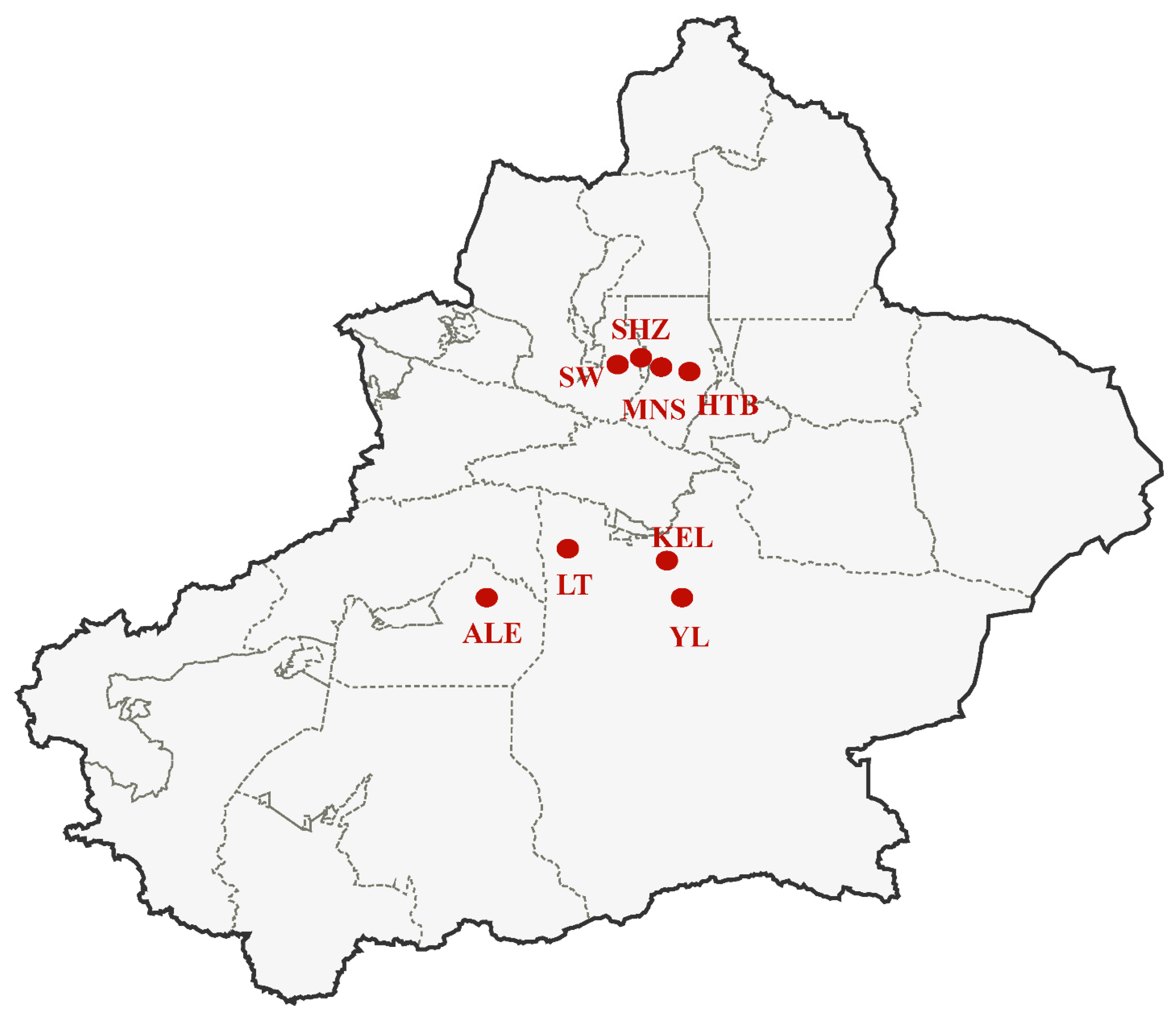
2.1. Test Populations
2.2. Insecticides
2.3. Bioassays
2.4. Statistical Analysis
3. Results
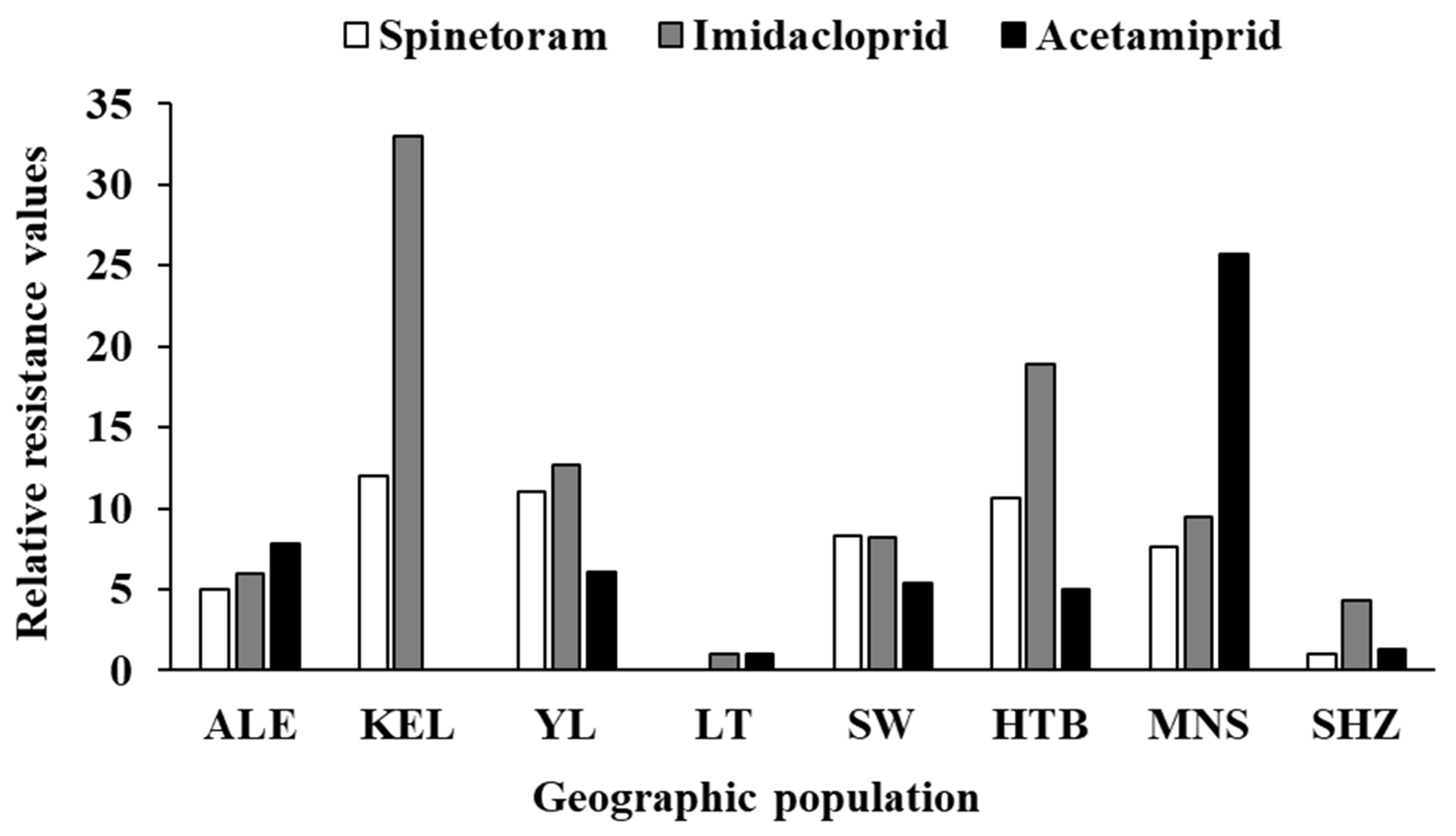
3.1. Susceptibility of Field Populations of Frankliniella intonsa to Spinetoram
3.2. Susceptibility of Field Populations of Frankliniella intonsa to Imidacloprid
3.3. Susceptibility of Field Populations of Frankliniella intonsa to Acetamiprid
4. Discussion
Author Contributions
Funding
Data Availability Statement
Conflicts of Interest
References
- National Bureau of Statistics (NBS) of China. Announcement of the National Bureau of Statistics on Cotton Production in 2024; National Bureau of Statistics (NBS) of China: Beijing, China, 2024. [Google Scholar]
- Wu, K.; Guo, Y.Y. The evolution of cotton pest management practices in China. Annu. Rev. Entomol. 2005, 50, 31–52. [Google Scholar] [CrossRef]
- Quan, Y.D.; Wu, K.M. Managing practical resistance of lepidopteran pests to Bt cotton in China. Insects 2023, 14, 179. [Google Scholar] [CrossRef]
- Pan, H.; Jiang, Y.; Wang, P.; Liu, J.; Lu, Y. Research progress in the status evolution and integrated control of cotton pests in Xinjiang. Plant Prot. 2018, 44, 42–50. [Google Scholar] [CrossRef]
- Gao, Y.; Luo, J.Y.; Wang, L.; Zhu, X.Z.; Zhang, K.X.; Li, D.Y.; Niu, L.; Gao, X.K.; Ji, J.C.; Hua, H.X.; et al. Thripidae pest species community identification and population genetic diversity analyses of 2 dominant thrips in cotton fields of China. J. Econ. Entomol. 2024, 117, 1113–1129. [Google Scholar] [CrossRef] [PubMed]
- Reay-Jones, F.; Greene, J.; Herbert, D.; Jacobson, A.; Kennedy, G.; Reisig, D.; Roberts, P. Within-plant distribution and dynamics of thrips species (Thysanoptera: Thripidae) in cotton. J. Econ. Entomol. 2017, 110, 1563–1575. [Google Scholar] [CrossRef] [PubMed]
- Chappell, T.M.; Ward, R.V.; DePolt, K.T.; Roberts, P.M.; Greene, J.K.; Kennedy, G.G. Cotton thrips infestation predictor: A practical tool for predicting tobacco thrips (Frankliniella fusca) infestation of cotton seedlings in the south-eastern United States. Pest. Manag. Sci. 2020, 76, 4018–4028. [Google Scholar] [CrossRef] [PubMed]
- Wang, W.; Zhang, R.; Liu, H.; Li, X.; Yao, J. Occurrence dynamics and spatial distribution pattern of Frankliniella intonsa in cotton fields in Xinjiang. Xinjiang Agric. Sci. 2025, 62, 202–209. [Google Scholar] [CrossRef]
- Wu, S.; Tang, L.; Zhang, X.; Xing, Z.; Lei, Z.; Gao, Y. A decade of a thrips invasion in China: Lessons learned. Ecotoxicology 2018, 27, 1032–1038. [Google Scholar] [CrossRef]
- Reitz, S.R.; Gao, Y.L.; Kirk, W.D.J.; Hoddle, M.S.; Leiss, K.A.; Funderburk, J.E. Invasion biology, ecology, and management of western flower thrips. Annu. Rev. Entomol. 2020, 65, 17–37. [Google Scholar] [CrossRef]
- Gao, Y.L.; Lei, Z.R.; Reitz, S.R. Western flower thrips resistance to insecticides: Detection, mechanisms and management strategies. Pest. Manag. Sci. 2012, 68, 1111–1121. [Google Scholar] [CrossRef]
- Nazemi, A.; Khajehali, J.; Van Leeuwen, T. Incidence and characterization of resistance to pyrethroid and organophosphorus insecticides in Thrips tabaci (Thysanoptera: Thripidae) in onion fields in Isfahan, Iran. Pestic. Biochem. Physiol. 2016, 129, 28–35. [Google Scholar] [CrossRef]
- Aizawa, M.; Watanabe, T.; Kumano, A.; Miyatake, T.; Sonoda, S. Cypermethrin resistance and reproductive types in onion thrips, Thrips tabaci (Thysanoptera: Thripidae). J. Pestic. Sci. 2016, 41, 167–170. [Google Scholar] [CrossRef]
- Bao, W.X.; Narai, Y.; Nakano, A.; Kaneda, T.; Murai, T.; Sonoda, S. Spinosad resistance of melon thrips, Thrips palmi, is conferred by G275E mutation in α6 subunit of nicotinic acetylcholine receptor and cytochrome P450 detoxification. Pestic. Biochem. Physiol. 2014, 112, 51–55. [Google Scholar] [CrossRef] [PubMed]
- Bao, W.X.; Kataoka, Y.; Fukada, K. Imidacloprid resistance of melon thrips, Thrips palmi, is conferred by CYP450-mediated detoxification. J. Pestic. Sci. 2015, 40, 65–68. [Google Scholar] [CrossRef]
- Cook, D.; Herbert, A.; Akin, D.S.; Reed, J. Biology, crop injury, and management of thrips (Thysanoptera: Thripidae) infesting cotton seedlings in the United States. J. Integr. Pest. Manag. 2011, 2, B1–B9. [Google Scholar] [CrossRef]
- D’Ambrosio, D.A.; Huseth, A.S.; Kennedy, G.G. Evaluation of alternative mode of action insecticides in managing neonicotinoid-resistant Frankliniella fusca in cotton. Crop Prot. 2018, 113, 56–63. [Google Scholar] [CrossRef]
- Liu, Y.P.; Dou, Z.C.; Ren, H.; Ma, X.L.; Liu, C.Y.; Qasim, M.; Han, X.Q. Study on plant protection unmanned aerial vehicle spraying technology based on the thrips population activity patterns during the cotton flowering period. Front. Plant Sci. 2024, 15, 1337560. [Google Scholar] [CrossRef]
- Wang, Z.-H.; Gong, Y.-J.; Jin, G.-H.; Li, B.-Y.; Chen, J.-C.; Kang, Z.-J.; Zhu, L.; Gao, Y.-L.; Reitz, S.; Wei, S.-J. Field-evolved resistance to insecticides in the invasive western flower thrips Frankliniella occidentalis (Pergande) (Thysanoptera: Thripidae) in China. Pest. Manag. Sci. 2016, 72, 1440–1444. [Google Scholar] [CrossRef]
- Gao, Y.-F.; Gong, Y.-J.; Cao, L.-J.; Chen, J.-C.; Gao, Y.-L.; Mirab-balou, M.; Chen, M.; Hoffmann, A.; Wei, S.-J. Geographical and interspecific variation in susceptibility of three common thrips species to the insecticide, spinetoram. J. Pest. Sci. 2021, 94, 93–99. [Google Scholar] [CrossRef]
- Wang, Y.; Chang, J.; Xiang, H.; Gui, J.; Ma, D.; Fan, Z.; Lu, W. Resistance monitoring of the field populations of Frankliniella intonsa (Thysanoptera: Thripidae) to six insecticides in four major cotton growing areas of Xinjiang, Northwest China. Acta Entomol. Sin. 2025, 68, 619–625. [Google Scholar]
- Sparks, T.C.; Wessels, F.J.; Perry, T.; Price, M.J.; Siebert, M.W.; Mann, D.G.J. Spinosyn resistance and cross-resistance–A 25 year review and analysis. Pestic. Biochem. Physiol. 2025, 210, 106363. [Google Scholar] [CrossRef] [PubMed]
- Tomizawa, M.; Casida, J.E. Neonicotinoid insecticide toxicology: Mechanisms of selective action. Annu. Rev. Pharmacol. Toxicol. 2005, 45, 247–268. [Google Scholar] [CrossRef]
- Cheng, S.H.; Li, R.; Chen, Z.B.; Ni, J.P.; Lv, N.N.; Liang, P.Z.; Guo, T.F.; Zhen, C.A.; Liang, P.; Gao, X.W. Comparative susceptibility of Aphis gossypii Glover (Hemiptera: Aphididae) on cotton crops to imidacloprid and a novel insecticide cyproflanilide in China. Ind. Crops Prod. 2023, 192, 116053. [Google Scholar] [CrossRef]
- Zhou, C.S.; Cao, Q.; Li, G.Z.; Ma, D.Y. Role of several cytochrome P450s in the resistance and cross-resistance against imidacloprid and acetamiprid of Bemisia tabaci (Hemiptera: Aleyrodidae) MEAM1 cryptic species in Xinjiang, China. Pestic. Biochem. Physiol. 2020, 163, 209–215. [Google Scholar] [CrossRef]
- Zhang, K.; Yuan, J.; Wang, J.; Hua, D.; Zheng, X.; Tao, M.; Zhang, Z.; Wan, Y.; Wang, S.; Zhang, Y.; et al. Susceptibility levels of field populations of Frankliniella occidentalis (Thysanoptera: Thripidae) to seven insecticides in China. Crop Prot. 2022, 153, 105886. [Google Scholar] [CrossRef]
- Fu, B.L.; Tao, M.; Xue, H.; Jin, H.F.; Liu, K.; Qiu, H.Y.; Yang, S.Y.; Yang, X.; Gui, L.Y.; Zhang, Y.J.; et al. Spinetoram resistance drives interspecific competition between Megalurothrips usitatus and Frankliniella intonsa. Pest. Manag. Sci. 2022, 78, 2129–2140. [Google Scholar] [CrossRef] [PubMed]
- Tian, H.P.; Chen, J.C.; Li, F.J.; Kang, J.J.; Li, H.J.; Gao, J.P.; Lu, G.C.; Gong, Y.J.; Wei, S.J. Susceptibility of five thrips pests to spinetoram and the frequency of G275E target-site mutation in a major vegetable production region of China. Crop Prot. 2025, 198, 107398. [Google Scholar] [CrossRef]
- Wang, C.; Liu, B.; Lu, W.; Lu, Y. Niche and interspecific associations of major pests and predatory enemies in cotton fields of Xinjiang, China. Plant Prot. 2025, 51, 52–60. [Google Scholar] [CrossRef]
- Bao, W.; Wang, C.; Zhu, W.; Han, T. Susceptibility of Frankliniella intonsa in Hohhot Region to nine insecticides. J. Green. Sci. Technol. 2021, 23, 141–143. [Google Scholar] [CrossRef]
- Shen, X.J.; Chen, J.C.; Cao, L.J.; Ma, Z.Z.; Sun, L.N.; Gao, Y.F.; Ma, L.J.; Wang, J.X.; Ren, Y.J.; Cao, H.Q.; et al. Interspecific and intraspecific variation in susceptibility of two co-occurring pest thrips, Frankliniella occidentalis and Thrips palmi, to nine insecticides. Pest. Manag. Sci. 2023, 79, 3218–3226. [Google Scholar] [CrossRef]
- Bielza, P. Insecticide resistance management strategies against the western flower thrips, Frankliniella occidentalis. Pest. Manag. Sci. 2008, 64, 1131–1138. [Google Scholar] [CrossRef]
- Mouden, S.; Sarmiento, K.F.; Klinkhamer, P.G.; Leiss, K.A. Integrated pest management in western flower thrips: Past, present and future. Pest. Manag. Sci. 2017, 73, 813–822. [Google Scholar] [CrossRef]
- Kirk, W.D.J.; de Kogel, W.J.; Koschier, E.H.; Teulon, D.A.J. Semiochemicals for thrips and their use in pest management. Annu. Rev. Entomol. 2021, 66, 101–119. [Google Scholar] [CrossRef] [PubMed]
- Mocchetti, A.; Dermauw, W.; Van Leeuwen, T. Incidence and molecular mechanisms of insecticide resistance in Frankliniella occidentalis, Thrips tabaci and other economically important thrips species. Entomol. Gen. 2023, 43, 587–604. [Google Scholar] [CrossRef]
- Zhang, K.; Chen, J.W.; Huang, H.X.; Wen, H.Q.; Yang, J.F.; Geng, J.J.; Wu, S.Y. The amino acid Ser223 acts as a key site for the binding of Thrips palmi α1 nicotinic acetylcholine receptor to neonicotinoid insecticides. Pestic. Biochem. Physiol. 2025, 213, 106484. [Google Scholar] [CrossRef] [PubMed]
- Jouraku, A.; Hirata, K.; Kuwazaki, S.; Nishio, F.; Shimomura, H.; Yokoyama, T.; Kusano, H.; Takagi, M.; Shirotsuka, K.; Shibao, M.; et al. Cythochrome P450-mediated dinotefuran resistance in onion thrips, Thrips tabaci. Pestic. Biochem. Physiol. 2025, 210, 106399. [Google Scholar] [CrossRef]



| Population | Collecting Location | Latitude (N) and Longitude (E) | Date of Collection |
|---|---|---|---|
| ALE | Alaer, Aksu | 40°39′13″, 81°30′7″ | August 2023 |
| KEL | Korla, Bayingolin | 41°45′0″, 85°48′36″ | August 2023 |
| YL | Yuli, Bayingolin | 41°17′47″, 86°15′0″ | August 2023 |
| LT | Luntai, Bayingolin | 41°59′55″, 85°6′59″ | August 2023 |
| SW | Shawan, Tacheng | 44°18′47″, 85°42′6″ | August 2023 |
| HTB | Hutubi, Changji | 43°49′1″, 87°33′33″ | August 2023 |
| MNS | Manasi, Changji | 44°12′25″, 86°26′4″ | August 2023 |
| SHZ | Shihezi, Shihezi | 44°17′15″, 85°57′38″ | August 2023 |
| Population | N a | Slope ± SE b | χ2 | df | LC50 (mg L−1) (95% CI c) | LC90 (mg L−1) (95% CI) | Relative Resistance d |
|---|---|---|---|---|---|---|---|
| ALE | 340 | 1.991 ± 0.286 | 49.336 | 32 | 0.015 (0.007–0.023) | 0.064 (0.043–0.111) | 5.00 |
| KEL | 330 | 2.148 ± 0.225 | 43.095 | 31 | 0.036 (0.027–0.048) | 0.142 (0.097–0.249) | 12.00 |
| YL | 330 | 2.701 ± 0.403 | 25.241 | 31 | 0.033 (0.025–0.042) | 0.099(0.074–0.155) | 11.00 |
| SW | 280 | 4.078 ± 0.718 | 28.257 | 26 | 0.025 (0.018–0.030) | 0.051(0.042–0.070) | 8.33 |
| HTB | 280 | 4.190 ± 0.811 | 22.981 | 22 | 0.032 (0.021–0.040) | 0.065 (0.053–0.086) | 10.67 |
| MNS | 350 | 3.413 ± 0.320 | 65.172 | 33 | 0.023 (0.019–0.028) | 0.056 (0.045–0.075) | 7.67 |
| SHZ | 280 | 1.471 ± 0.356 | 38.920 | 26 | 0.003 (0.000–0.006) | 0.024 (0.013–0.056) | 1 |
| Population | N a | Slope ± SE b | χ2 | df | LC50 (mg L−1) (95% CI c) | LC90 (mg L−1) (95% CI) | Relative Resistance d |
|---|---|---|---|---|---|---|---|
| ALE | 340 | 1.789 ± 0.190 | 61.855 | 32 | 26.178 (16.795–39.586) | 136.182 (82.272–303.500) | 6.00 |
| KEL | 220 | 0.843 ± 0.145 | 43.765 | 20 | 143.930 (72.428–499.435) | 4771.991 (835.222–58,955.337) | 33.00 |
| YL | 350 | 0.948 ± 0.109 | 47.730 | 33 | 55.240 (31.718–103.365) | 1242.643 (495.244–5713.300) | 12.67 |
| LT | 350 | 0.832 ± 0.098 | 49.699 | 33 | 4.361(2.080–7.895) | 151.278 (66.495–579.959) | 1 |
| SW | 270 | 1.274 ± 0.181 | 15.804 | 25 | 35.701 922.918–54.178) | 360.664 (198.691–1039.698) | 8.19 |
| HTB | 250 | 1.832 ± 0.507 | 24.700 | 23 | 82.261 (30.081–130.056) | 412.004 (235.305–2393.660) | 18.86 |
| MNS | 340 | 1.463 ± 0.202 | 21.871 | 32 | 41.506 (28.714–58.674) | 312.125 (188.553–694.108) | 9.52 |
| SHZ | 270 | 0.692 ± 0.117 | 24.700 | 23 | 18.872 (5.953–53.825) | 1342.636 (275.169–106,949.366) | 4.33 |
| Population | N a | Slope ± SE b | χ2 | df | LC50 (mg L−1) (95% CI c) | LC90 (mg L−1) (95% CI) | Relative Resistance d |
|---|---|---|---|---|---|---|---|
| ALE | 340 | 3.384 ± 0.629 | 70.220 | 32 | 14.613 (9.031–24.157) | 34.948 (21.812–127.163) | 7.80 |
| YL | 350 | 1.989 ± 0.219 | 25.300 | 33 | 11.394 (8.549–14.949) | 50.214 (35.635–80.462) | 6.08 |
| LT | 350 | 1.105 ± 0.131 | 25.413 | 33 | 1.873 (1.139–2.802) | 27.068 (16.421–55.106) | 1 |
| SW | 180 | 2.139 ± 0.381 | 46.202 | 16 | 10.013 (4.213–20.005) | 39.778 (19.934–457.314) | 5.35 |
| HTB | 280 | 1.637 ± 0.179 | 86.891 | 26 | 9.347 (4.352–17.735) | 56.714 (28.016–211.050) | 4.99 |
| MNS | 270 | 2.315 ± 0.407 | 26.988 | 25 | 48.154 (31.483–66.223) | 172.306 (117.382–346.374) | 25.71 |
| SHZ | 270 | 0.961 ± 0.142 | 52.606 | 25 | 2.403 (0.446–5.952) | 51.743 (221.227–256.909) | 1.283 |
Disclaimer/Publisher’s Note: The statements, opinions and data contained in all publications are solely those of the individual author(s) and contributor(s) and not of MDPI and/or the editor(s). MDPI and/or the editor(s) disclaim responsibility for any injury to people or property resulting from any ideas, methods, instructions or products referred to in the content. |
© 2025 by the authors. Licensee MDPI, Basel, Switzerland. This article is an open access article distributed under the terms and conditions of the Creative Commons Attribution (CC BY) license (https://creativecommons.org/licenses/by/4.0/).
Share and Cite
Li, X.; Wang, L.; Wang, W.; Yao, J.; Ullah, F.; Li, C.; Zhang, R.; Lu, Y. Susceptibility of Field Populations of Frankliniella intonsa to Spinetoram, Imidacloprid, and Acetamiprid in Xinjiang Cotton Fields, China. Insects 2025, 16, 1234. https://doi.org/10.3390/insects16121234
Li X, Wang L, Wang W, Yao J, Ullah F, Li C, Zhang R, Lu Y. Susceptibility of Field Populations of Frankliniella intonsa to Spinetoram, Imidacloprid, and Acetamiprid in Xinjiang Cotton Fields, China. Insects. 2025; 16(12):1234. https://doi.org/10.3390/insects16121234
Chicago/Turabian StyleLi, Xiaowei, Liqiu Wang, Wei Wang, Ju Yao, Farman Ullah, Chunmeng Li, Renfu Zhang, and Yaobin Lu. 2025. "Susceptibility of Field Populations of Frankliniella intonsa to Spinetoram, Imidacloprid, and Acetamiprid in Xinjiang Cotton Fields, China" Insects 16, no. 12: 1234. https://doi.org/10.3390/insects16121234
APA StyleLi, X., Wang, L., Wang, W., Yao, J., Ullah, F., Li, C., Zhang, R., & Lu, Y. (2025). Susceptibility of Field Populations of Frankliniella intonsa to Spinetoram, Imidacloprid, and Acetamiprid in Xinjiang Cotton Fields, China. Insects, 16(12), 1234. https://doi.org/10.3390/insects16121234