

Waste-Derived Composite Selection for Sustainable Automotive Brake Friction Materials Using Novel MEREC-RAM Decision Framework

 ,
,  ,
,  and
and 
Abstract
1. Introduction
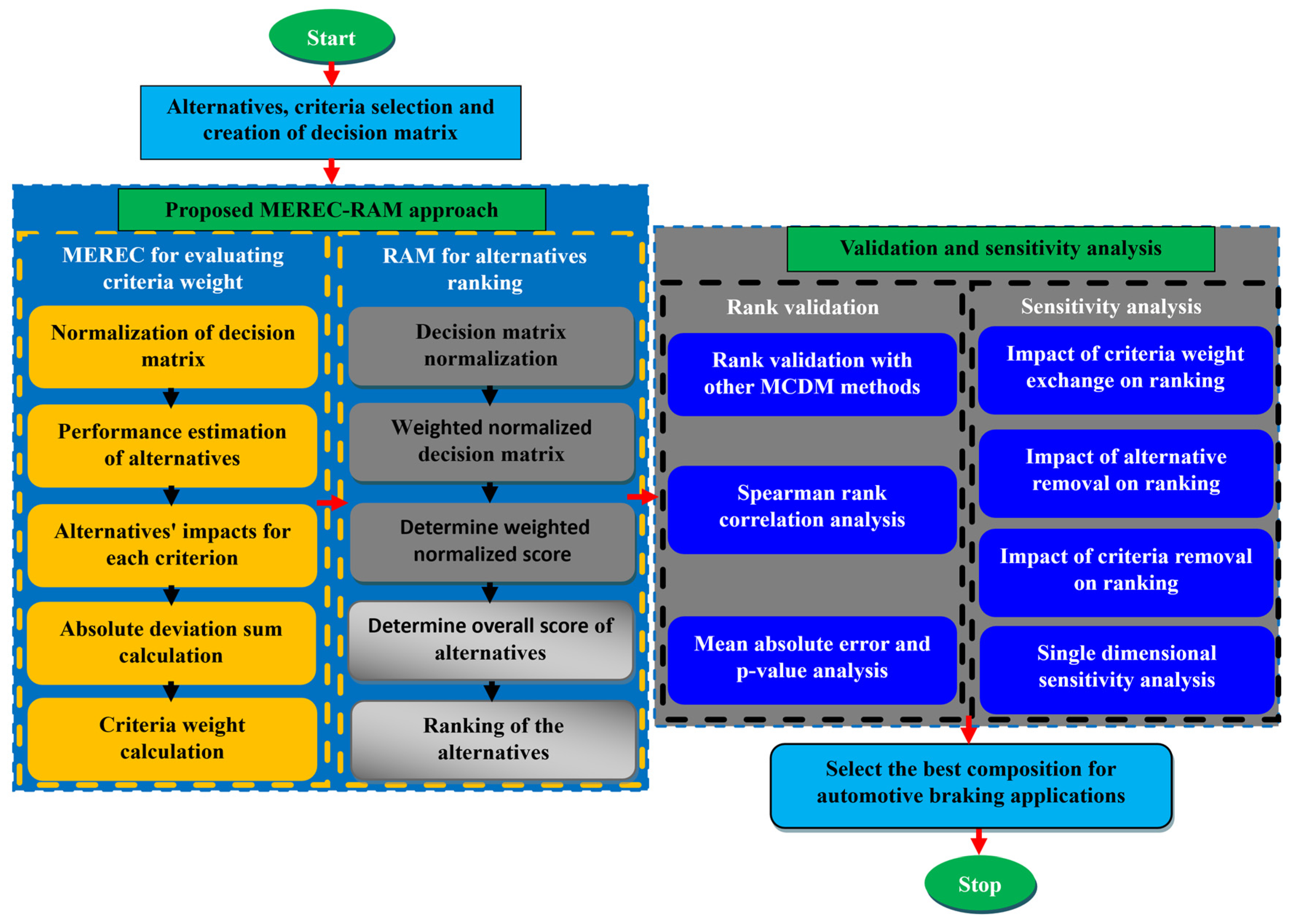
- The study uses the MEREC-weighted RAM technique to design a sustainable polymer composite material for automotive braking applications.
- The ranking findings of the MEREC-RAM technique were compared to nine MCDM (MACBETH, MOORA, VIKOR, PSI, MAIRCA, MARCOS, RAWEC, PIV, and CoCoSo) models and validated using the Spearman correlation coefficient, mean absolute error, and p-value.
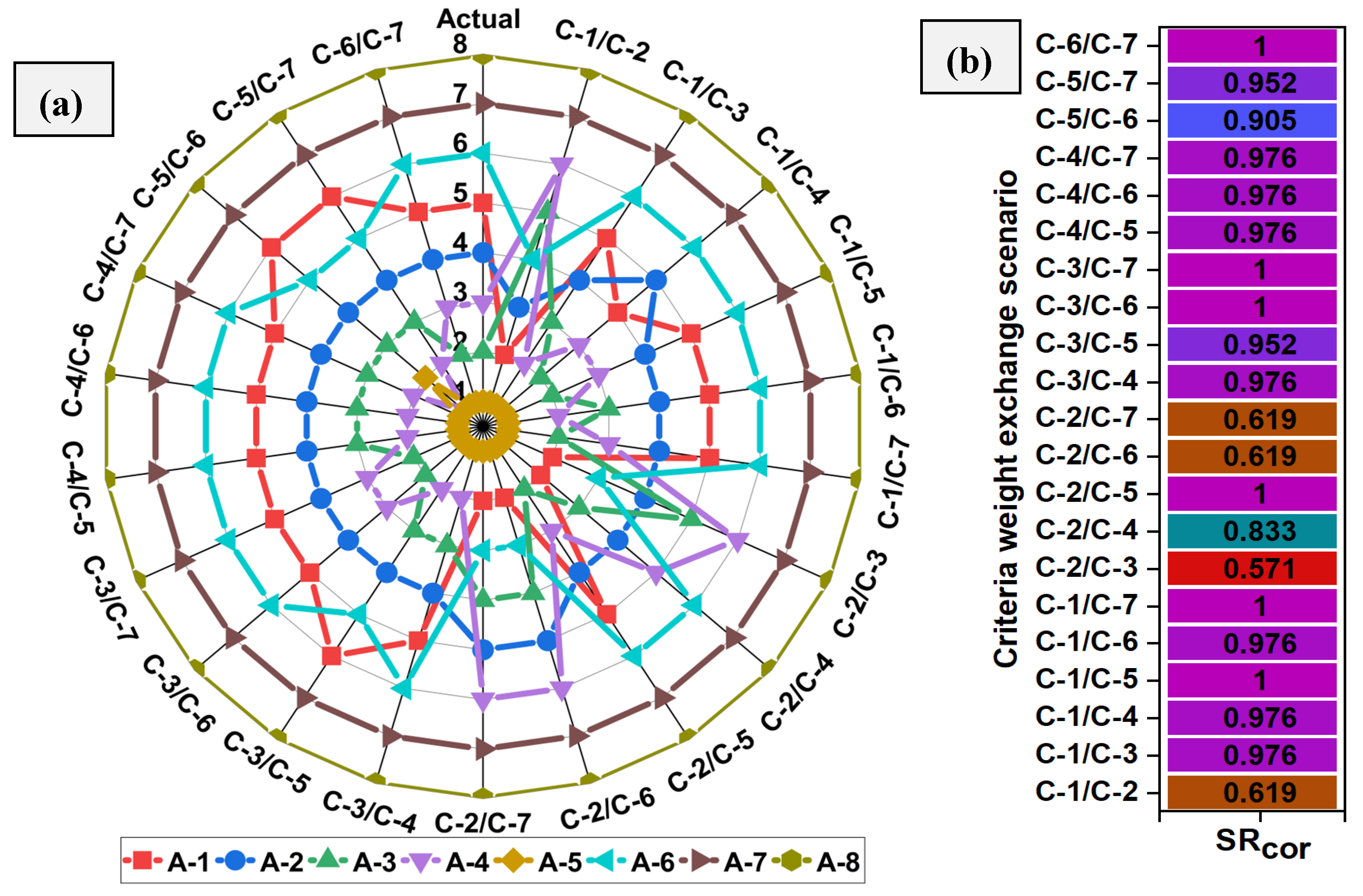
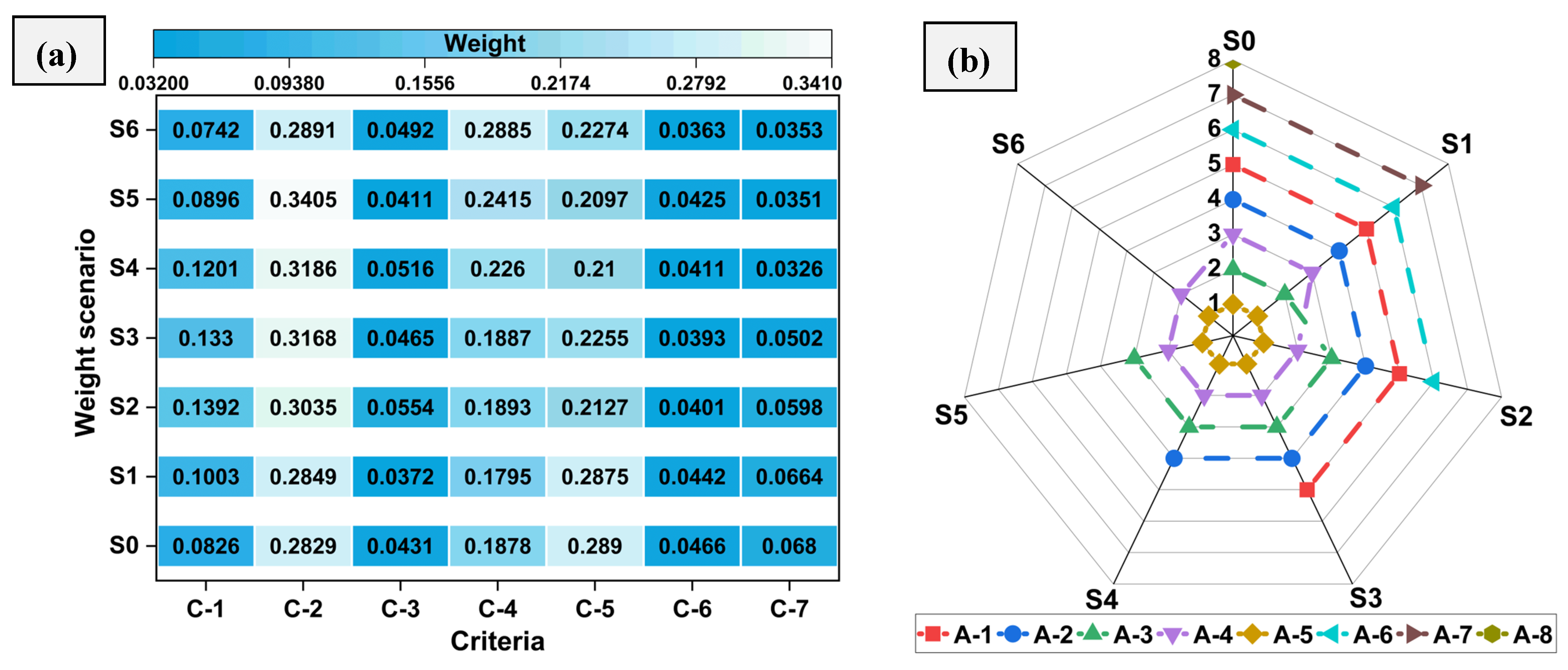
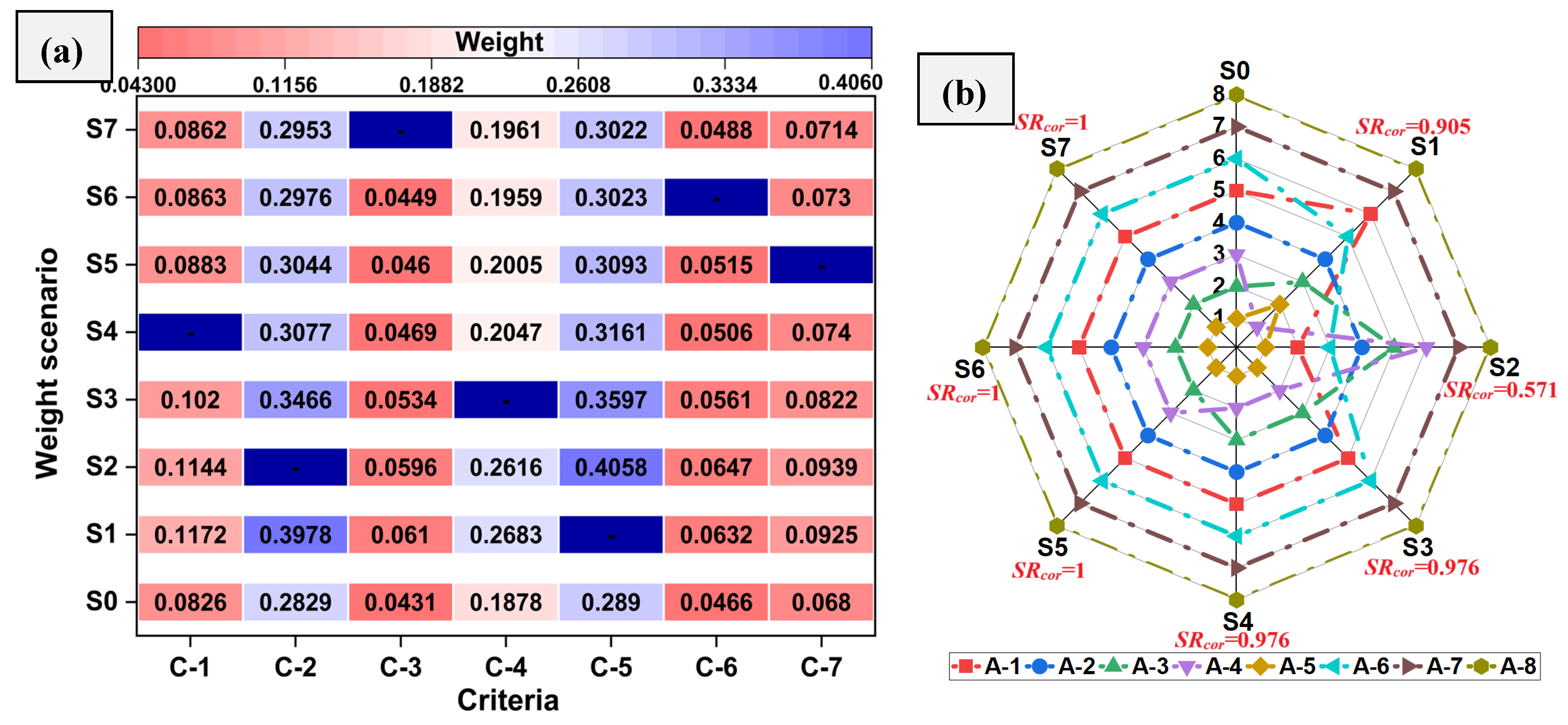
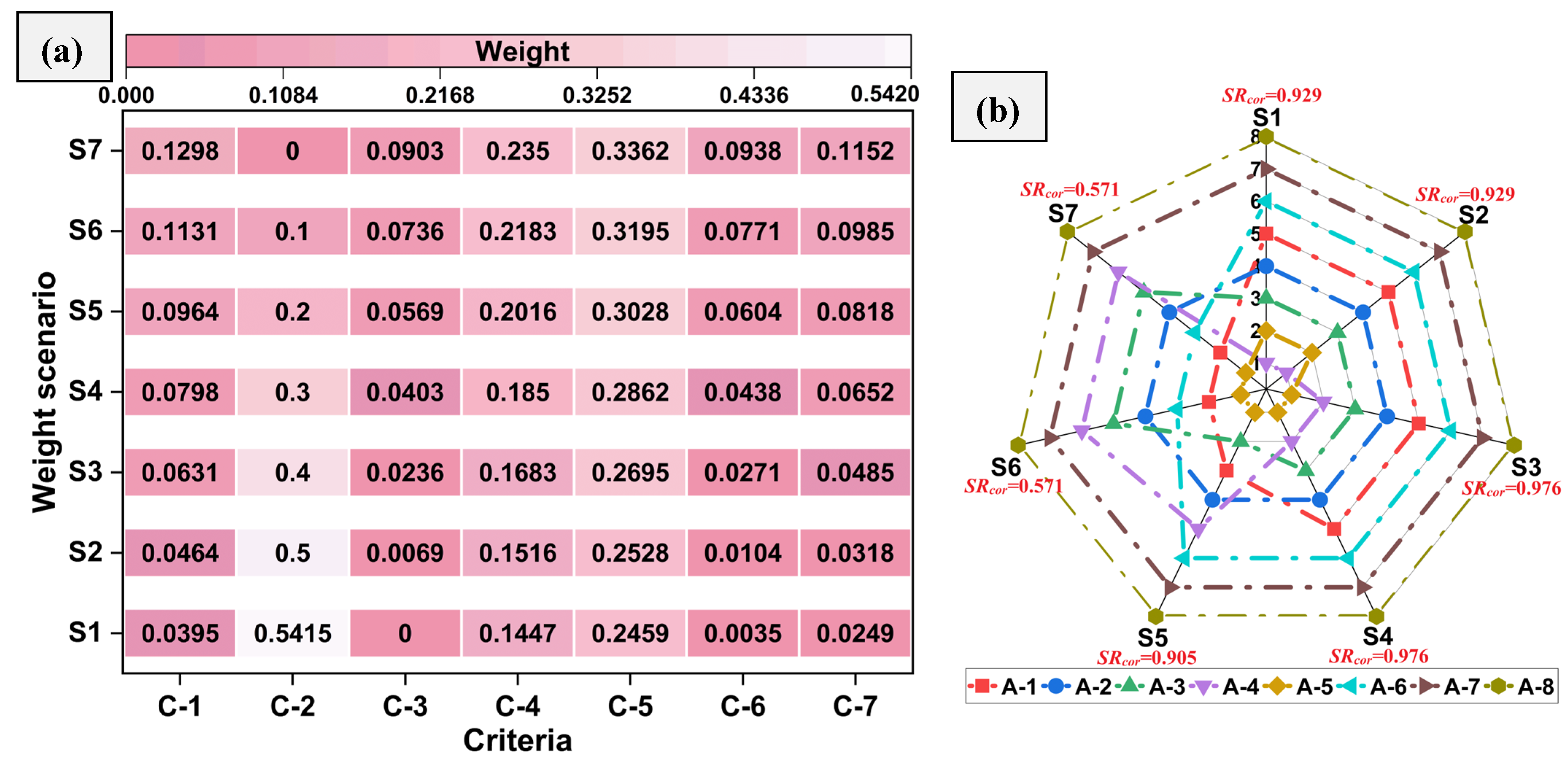
- A series of sensitivity analyses were conducted, including the MEREC method with swapping normalization steps, criterion weight exchange scenarios, alternative removal scenarios, criterion removal scenarios, and single dimensional sensitivity analysis, to evaluate the robustness and consistency of the proposed MEREC-RAM approach.
2. Methods
2.1. Hybrid MEREC-RAM Approach
2.1.1. MEREC Method for Criterion Weight Calculation
2.1.2. RAM for Alternative Ranking
2.2. Selection of Alternatives and Evaluation Criteria
2.2.1. Alternative Selection
2.2.2. Criterion Selection
3. Results
3.1. Criteria Results
3.2. Calculation of Criterion Weight and Ranking of the Composite Alternatives
3.3. Validation of Results
3.3.1. Rank Validation Using Other MCDM Models
3.3.2. Spearman Rank Correlation Analysis
3.3.3. Mean Absolute Error (MAE) and p-Value Analysis
3.4. Sensitivity Analysis
3.4.1. Sensitivity Analysis Using MEREC Method with Swapping Normalization Steps
3.4.2. Criterion Weight Exchange Sensitivity Analysis
3.4.3. Sensitivity Analysis Using Alternative Removal Scenarios
3.4.4. Sensitivity Analysis Using Criterion Removal Scenarios
3.4.5. Single-Dimensional Sensitivity Analysis
4. Conclusions
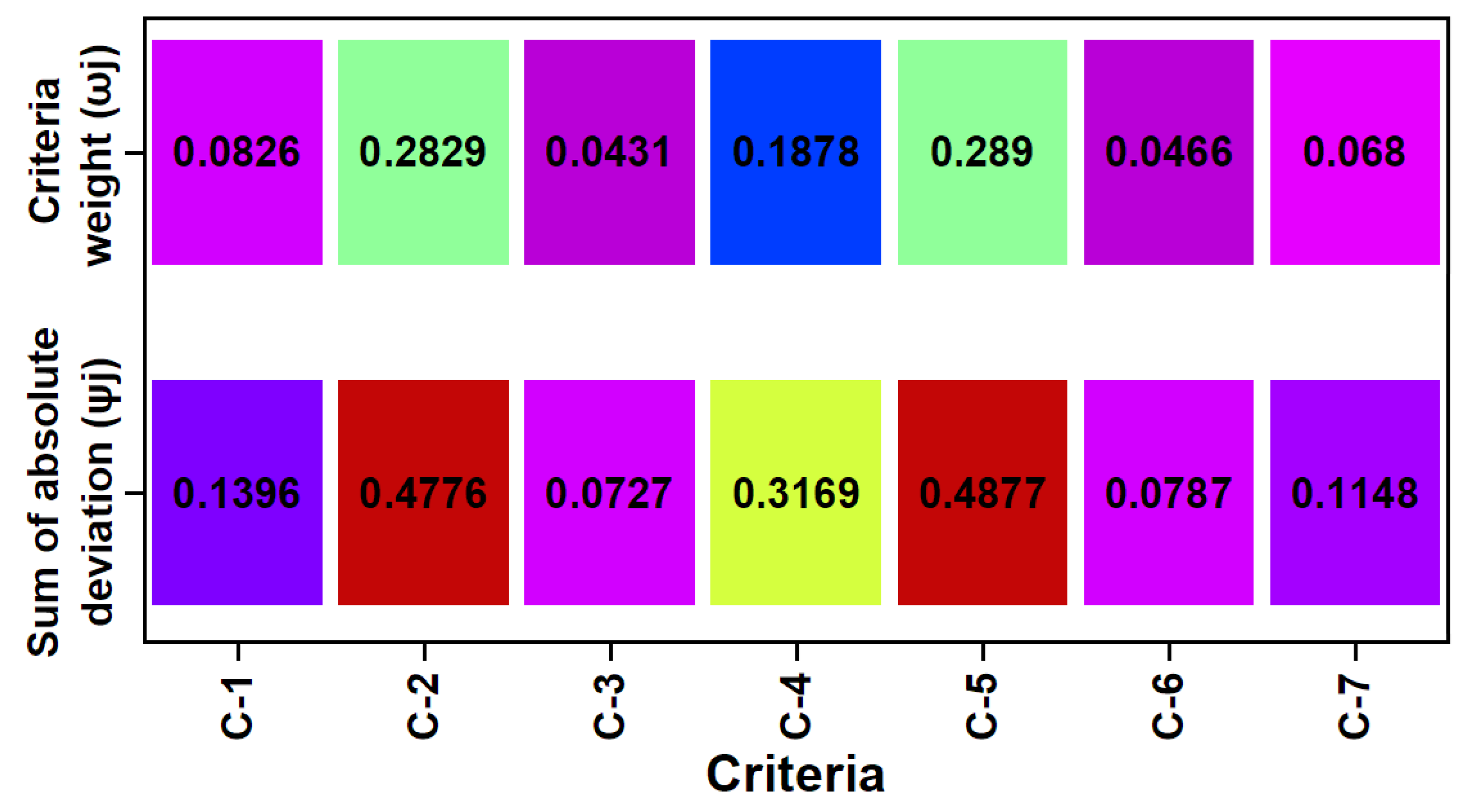
- The MEREC approach quantified the weight of each criterion, with fade% (0.2890) and wear (0.2829) identified as the most significant, followed by friction fluctuations (0.1878). Conversely, recovery% (0.0466) and friction stability (0.0431) were determined to be the least significant criteria.
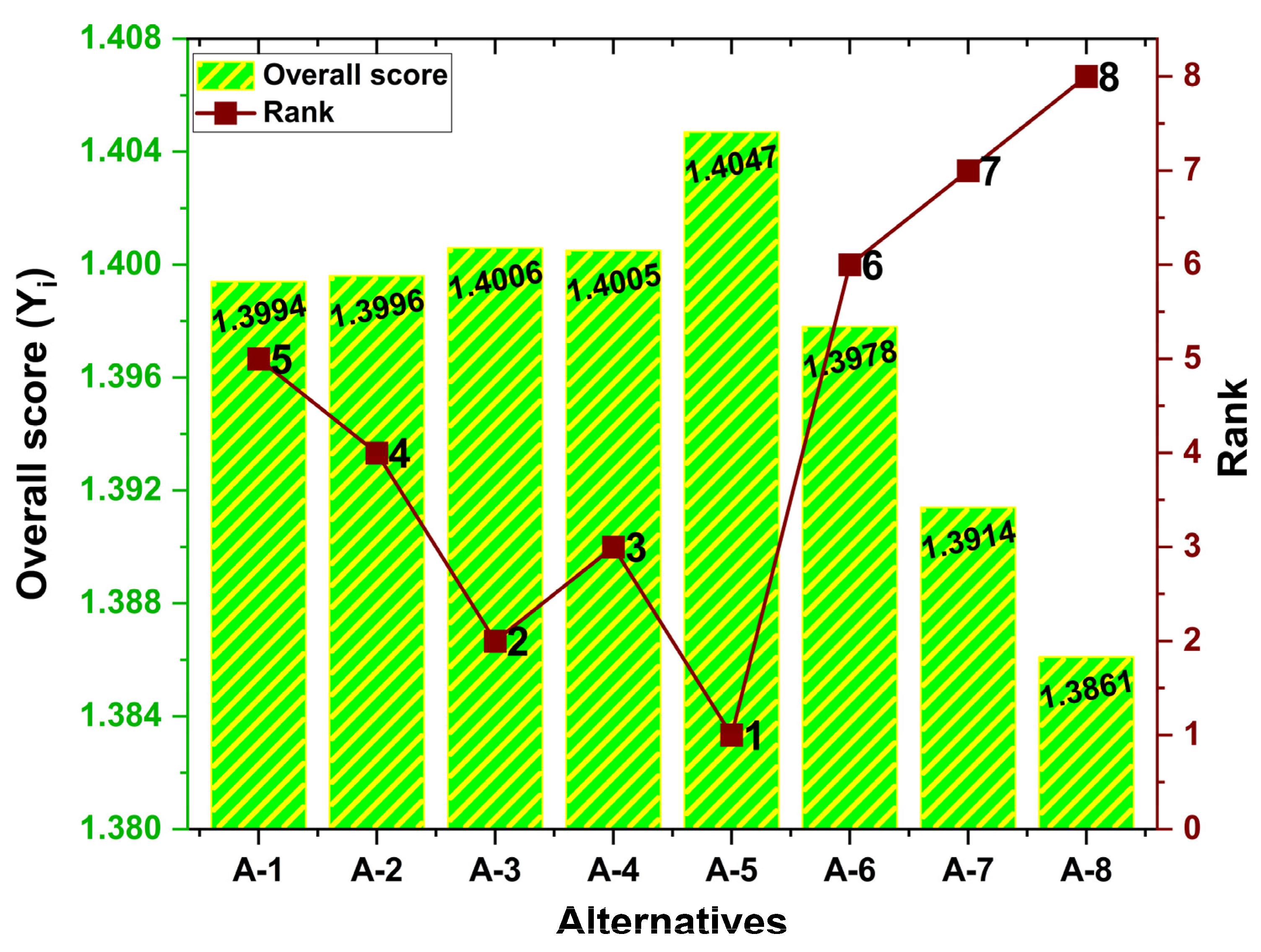
- By applying the RAM approach, the ranking of different slag waste-filled friction composites were obtained and the alternative with 60 wt.% slag waste and 5 wt.% coir fiber exhibited the optimal tribological properties and emerged as the best option.
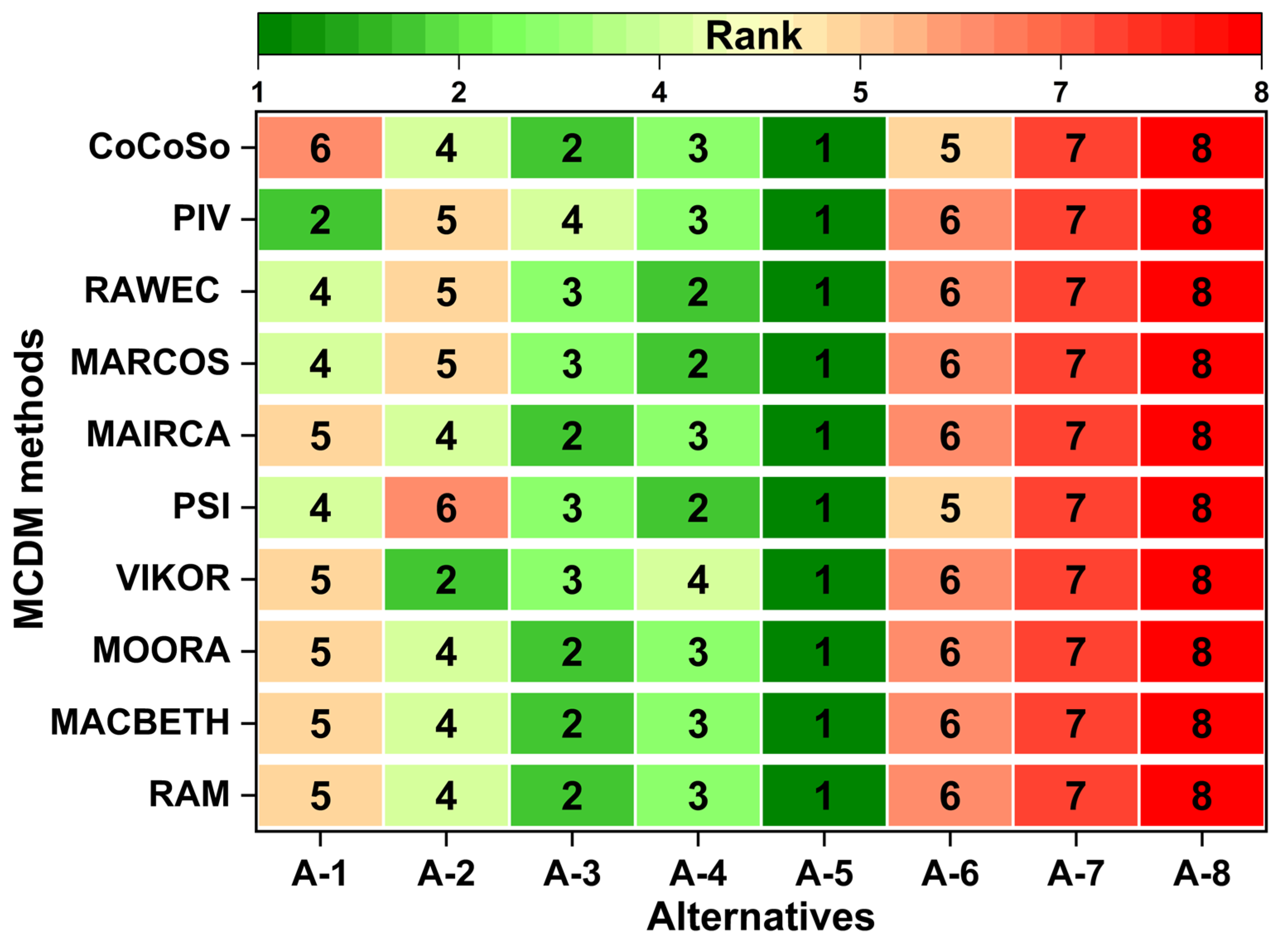
- The comparative analysis with nine established MCDM (MACBETH, MOORA, VIKOR, PSI, MAIRCA, MARCOS, RAWEC, PIV, and CoCoSo) models confirmed the optimal choice, supported by a higher (>0.8) Spearman’s rank correlation coefficient, low mean absolute error (<0.75), and significant p-values (<0.05).
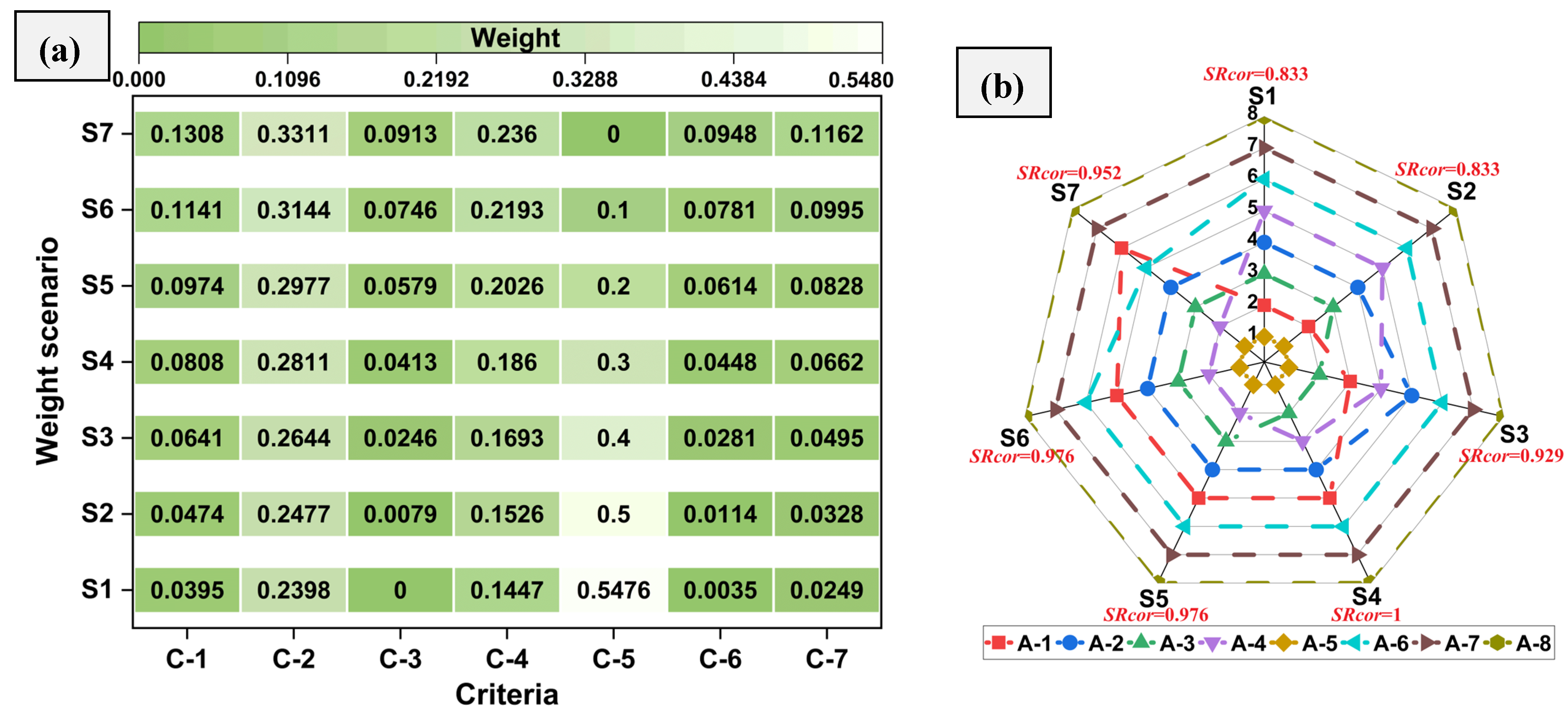
- Multiple sensitivity analysis approaches including criterion weight exchange, changing normalization procedure of MEREC, alternative/criterion removal, and single-dimension weight variation demonstrated that the rankings remain stable across varying weight scenarios and decision-making structures.
Author Contributions
Funding
Data Availability Statement
Conflicts of Interest
Abbreviations
| AHP | Analytic Hierarchy Process |
| CoCoSo | Combined Compromise Solution |
| COF | Coefficient of Friction |
| EDAS | Evaluation Based on Distance from Average Solution |
| GRA | Grey Relation Analysis |
| MACBETH | Measuring Attractiveness by a Categorical Based Evaluation Technique |
| MAE | Mean Absolute Error |
| MAIRCA | Multi-Attributive Ideal-Real Comparative Analysis |
| MARCOS | Measurement of Alternatives and Ranking according to COmpromise Solution |
| MCDM | Multi-Criteria Decision-Making |
| MEREC | Method Based On The Removal Effects Of Criteria |
| MOORA | Multi-Objective Optimization by Ratio Analysis |
| PIV | Proximity Index Value |
| PSI | Preference Selection Index |
| RAM | Root Assessment Method |
| RAWEC | Ranking Alternatives with Weights of Criterion |
| Spearman’s Rank Correlation | |
| TOPSIS | Technique for Order of Preference by Similarity to Ideal Solution |
| VIKOR | VIekriterijumsko KOmpromisno Rangiranje |
References
- Raghunathan, V.; Sathyamoorthy, G.; Ayyappan, V.; Srisuk, R.; Singaravelu, D.L.; Rangappa, S.M.; Siengchin, S. Advances in brake friction materials: A comprehensive review of ingredients, processing methods, and performance characteristics. J. Vinyl Addit. Technol. 2024, 30, 1396–1431. [Google Scholar] [CrossRef]
- Daimon, E.; Ito, Y. Effects of Titanate on Brake Wear Particle Emission Using a Brake Material Friction Test Dynamometer. Lubricants 2024, 12, 387. [Google Scholar] [CrossRef]
- Borawski, A.; Szpica, D.; Mieczkowski, G. Polytetrafluoroethylene and Aluminum Powder as an Alternative to Copper in Car Brakes Composite Friction Materials. Materials 2025, 18, 589. [Google Scholar] [CrossRef]
- Document 52022PC0586: Proposal for a Regulation of the European Parliament and of the Council on Type-Approval of Motor Vehicles and Engines and of Systems, Components and Separate Technical Units Intended for Such Vehicles, with Respect to their Emissions and Battery Durability (Euro 7) and Repealing Regulations (EC) No 715/2007 and (EC) No 595/2009. 2022. Available online: https://eur-lex.europa.eu/legal-content/EN/TXT/?uri=CELEX:52022PC0586 (accessed on 25 August 2025).
- Gautier di Confiengo, G.G.; Faga, M.G. Ecological Transition in the Field of Brake Pad Manufacturing: An Overview of the Potential Green Constituents. Sustainability 2022, 14, 2508. [Google Scholar] [CrossRef]
- Borawski, A.; Szpica, D.; Mieczkowski, G. The Possibility of Using Components of Plant Origin as Reinforcements in Composite Friction Materials-A Simulation-Based Braking Process Study. Materials 2024, 17, 5834. [Google Scholar] [CrossRef] [PubMed]
- Carlevaris, D.; Nogueira, A.P.G.; Rita, D.A.; Candeo, S.; Fambri, L.; Menapace, C.; Straffelini, G. Novel ingredients for sustainable brake pad friction materials: Benzoxazine resins and rice husk. Wear 2025, 564–565, 205698. [Google Scholar] [CrossRef]
- Mehta, V.; Kumar, N.; Algahtani, A.; Tirth, V.; Al-Mughanam, T.; Chau, K.-W. Comparative Study of Chemically Treated Sugarcane and Kevlar Fiber to Develop Brake Resistance Composites. Molecules 2023, 28, 4861. [Google Scholar] [CrossRef]
- Wang, C.; Li, R.; Lin, H.; Yuan, S.; Wang, L.; Ma, Y. Preparation and Properties of Brake Friction Materials Reinforced with Coconut Fiber and Dypsis Lutescens Fiber. Materials 2024, 17, 3926. [Google Scholar] [CrossRef]
- Jayashree, P.; Candeo, S.; Leonardi, M.; Fidelio, C.; Straffelini, G. Effect of the Addition of Waste Generated during the Plasma Cutting of Aluminum Products on the Friction and Emission Properties of a Commercial Friction Material Formulation. Atmosphere 2022, 13, 2056. [Google Scholar] [CrossRef]
- Khoshsepehr, Z.; Alinejad, S.; Alimohammadlou, M. Exploring industrial waste management challenges and smart solutions: An integrated hesitant fuzzy multi-criteria decision-making approach. J. Clean. Prod. 2023, 420, 138327. [Google Scholar] [CrossRef]
- Gotowska, M.; Jakubczak, A. Sustainable Biodegradable Waste Management for Circular Economy: Comparative Assessment of Composting Technologies. Sustainability 2025, 17, 8978. [Google Scholar] [CrossRef]
- Cappelli, M.A.; Cappelli, E.; Cappelli, F. AI-Driven Circular Waste Management Tool for Enhancing Circular Economy Practices in Healthcare Facilities. Environments 2025, 12, 295. [Google Scholar] [CrossRef]
- Straffelini, G.; Jayashree, P.; Barbieri, A.; Masciocchi, R. Tribological Behavior of Friction Materials Containing Aluminum Anodizing Waste Obtained by Different Industrial Drying Processes. Lubricants 2024, 12, 173. [Google Scholar] [CrossRef]
- Kanagaraj, M.; Babu, S.; Raj, S.; Jonah, N.; Fekete, G.; Christy, T.V. Influence of ground granulated blast furnace slag on the tribological characteristics of automotive brake friction materials. Ind. Lubr. Tribol. 2022, 74, 837–843. [Google Scholar] [CrossRef]
- Zheng, K.; Lin, Y.; Lai, T.; Gao, C.; Liu, M.; Ren, Z. Replacing copper in composites with waste foundry sand: A novel approach for Cu-free resin-based braking material. Tribol. Int. 2024, 191, 109110. [Google Scholar] [CrossRef]
- Jayashree, P.; Matějka, V.; Leonardi, M.; Straffelini, G. The influence of the addition of different kinds of slags on the friction and emission behavior of a commercially employed friction material formulation. Wear 2023, 522, 204705. [Google Scholar] [CrossRef]
- Sugözü, B. Tribological properties of brake friction materials containing fly ash Available to Purchase. Ind. Lubr. Tribol. 2018, 70, 902–906. [Google Scholar] [CrossRef]
- Kılıç, H. Tribo-evaluation with multi-criteria decision-making approach of fly ash-filled hybrid flax/basalt fiber reinforced brake friction composites. Polym. Compos. 2025, 46, 14506–14522. [Google Scholar] [CrossRef]
- Gehlen, G.S.; Neis, P.D.; Barros, L.Y.; Poletto, J.C.; Ferreira, N.F.; Amico, S.C. Tribological performance of eco-friendly friction materials with rice husk. Wear 2022, 500–501, 204374. [Google Scholar] [CrossRef]
- Unal, A.; Demirdalmis, O. The effects of using apricot kernel shell, an environmentally friendly material, in composite brake pads on friction performance. Tribol. Int. 2024, 197, 109734. [Google Scholar] [CrossRef]
- Avramova, T.; Peneva, T.; Ivanov, A. Overview of Existing Multi-Criteria Decision-Making (MCDM) Methods Used in Industrial Environments. Technologies 2025, 13, 444. [Google Scholar] [CrossRef]
- Shinde, D.; Öktem, H.; Kalita, K.; Chakraborty, S.; Gao, X.Z. Optimization of process parameters for friction materials using multi-criteria decision making: A comparative analysis. Processes 2021, 9, 1570. [Google Scholar] [CrossRef]
- Singh, T.; Gehlen, G.S.; Singh, V.; Ferreira, N.F.; de Barros, L.Y.; Lasch, G.; Poletto, J.C.; Ali, S.; Neis, P.D. Selection of automotive brake friction composites reinforced by agro-waste and natural fiber: An integrated multi-criteria decision-making approach. Results Eng. 2024, 22, 102030. [Google Scholar] [CrossRef]
- Sotoudeh-Anvari, A. Root Assessment Method (RAM): A novel multi-criteria decision making method and its applications in sustainability challenges. J. Clean. Prod. 2023, 423, 138695. [Google Scholar] [CrossRef]
- Hezam, I.M.; Ali, A.M.; Sallam, K.; Hameed, I.A.; Foul, A.; Abdel-Basset, M. An extension of root assessment method (RAM) under spherical fuzzy framework for optimal selection of electricity production technologies toward sustainability: A case study. Int. J. Energy Res. 2024, 2024, 24. [Google Scholar] [CrossRef]
- Wiȩckowski, J.; Hernes, M.; Sałabun, W. Comparison of multi-criteria decision analysis methods under comprehensive sensitivity analysis. IEEE Access 2025, 13, 128122–128138. [Google Scholar] [CrossRef]
- Keshavarz-Ghorabaee, M.; Amiri, M.; Zavadskas, E.K.; Turskis, Z.; Antucheviciene, J. Determination of Objective Weights Using a New Method Based on the Removal Effects of Criteria (MEREC). Symmetry 2021, 13, 525. [Google Scholar] [CrossRef]
- Pelit, İ.; Avşar, İ.İ. Turkiye’s Carbon Emission Profile: A Global Analysis with the MEREC-PROMETHEE Hybrid Method. Sustainability 2025, 17, 6527. [Google Scholar] [CrossRef]
- Liu, P.; Zhang, T.; Tian, F.; Teng, Y.; Yang, M. Optimized Grid Partitioning and Scheduling in Multi-Energy Systems Using a Hybrid Decision-Making Approach. Energies 2024, 17, 3253. [Google Scholar]
- Maliene, V.; Dixon-Gough, R.; Malys, N. Dispersion of relative importance values contributes to the ranking uncertainty: Sensitivity analysis of multiple criteria decision-making methods. Appl. Soft Comput. 2018, 67, 286–298. [Google Scholar] [CrossRef]
- Więckowski, J.; Sałabun, W. Sensitivity analysis approaches in multi-criteria decision analysis: A systematic review. Appl. Soft Comput. 2023, 148, 110915. [Google Scholar] [CrossRef]
- Rajan, R.; Tyagi, Y.K.; Singh, S. Waste and natural fiber based automotive brake composite materials: Influence of slag and coir on tribological performance. Polym. Compos. 2022, 43, 1508–1517. [Google Scholar] [CrossRef]
- Rajan, R.; Tyagi, Y.K.; Pruncu, C.I.; Kulshreshtha, S.; Ranakoti, L.; Singh, T. Tribological performance evaluation of slag waste filled phenolic composites for automotive braking applications. Polym. Compos. 2022, 43, 7118–7129. [Google Scholar] [CrossRef]
- Ma, Y.; Wu, S.; Zhuang, J.; Tong, J.; Qi, H. Tribological and physio-mechanical characterization of cow dung fibers reinforced friction composites: An effective utilization of cow dung waste. Tribol. Int. 2019, 131, 200–211. [Google Scholar] [CrossRef]
- Zhen-Yu, W.; Jie, W.; Feng-Hong, C.; Yun-Hai, M.; Singh, T.; Fekete, G. Influence of banana fiber on physicomechanical and tribological properties of phenolic based friction composites. Mater. Res. Express 2019, 6, 075103. [Google Scholar] [CrossRef]
- Ma, Y.; Wu, S.; Zhuang, J.; Tong, J.; Xiao, Y.; Qi, H. The evaluation of physio-mechanical and tribological characterization of friction composites reinforced by waste corn stalk. Materials 2018, 11, 901. [Google Scholar] [CrossRef]
- Kus, H.; Altiparmak, D. Effects of fly ash content on the friction-wear performance of bronze-based brake lining materials produced by the hot-pressing method. Ind. Lubr. Tribol. 2015, 67, 612–621. [Google Scholar] [CrossRef]
- Dadkar, N.; Tomar, B.S.; Satapathy, B.K.; Patnaik, A. Performance assessment of hybrid composite friction materials based on flyash–rock fibre combination. Mater. Des. 2010, 31, 723–731. [Google Scholar] [CrossRef]
- Kumar, N.; Singh, T.; Grewal, J.S.; Patnaik, A.; Fekete, G. Experimental investigation on the physical, mechanical and tribological properties of hemp fiber-based non-asbestos organic brake friction composites. Mater. Res. Express 2019, 6, 085710. [Google Scholar] [CrossRef]
- Wang, N.; Hou, G.; Yang, Z.; Jiang, Q.; Zhang, F.; Xie, M.; Yao, Z. Influence of slag weight fraction on mechanical, thermal and tribological properties of polymer based friction materials. Mater. Des. 2016, 90, 76–83. [Google Scholar] [CrossRef]
- Sagiroglu, S.; Akdogan, K. The effect of the addition of blast furnace slag on the wear behavior of heavy transport polymer-based brake pads. Tribol. Int. 2023, 189, 108845. [Google Scholar] [CrossRef]
- Jayashree, P.; Matějka, V.; Leonardi, M.; Straffelini, G. A novel path towards limiting non-exhaust particulate matter emissions of a commercial friction material through the addition of metallurgical slag. Sci. Rep. 2023, 13, 666. [Google Scholar] [CrossRef]
- Dadkar, N.; Tomar, B.S.; Satapathy, B.K. Evaluation of flyash-filled and aramid fibre reinforced hybrid polymer matrix composites (PMC) for friction braking applications. Mater. Des. 2009, 30, 4369–4376. [Google Scholar] [CrossRef]
- Wang, N.; Yin, Z.; Liu, H.; Guo, H. Effects of sisal fiber and fly ash on the mechanical and tribological performances of brake friction composites. Polym. Compos. 2024, 45, 12057–12070. [Google Scholar] [CrossRef]
- Karasulu, D.C.; Öncül, M.; Özcan, O.; Sütçü, M. Performance Evaluation of Lignocellulosic Fiber-Reinforced Brake Pads Using Hybrid Optimization Techniques. Polym. Compos. 2025. [Google Scholar] [CrossRef]
- Afolabi, K.; Babatunde, O.; Ighravwe, D.; Akintayo, B.; Olanrewaju, O.A. A Fuzzy Multi-Criteria Decision-Making Framework for Evaluating Non-Destructive Testing Techniques in Oil and Gas Facility Maintenance Operations. Eng 2025, 6, 214. [Google Scholar] [CrossRef]
- Dinh, V.-T.; Tran, H.-D.; Tran, Q.-H.; Vu, D.-B.; Vu, D.; Vu, N.-P.; Nguyen, T.-T. Multi-Objective Optimization of a Two-Stage Helical Gearbox Using MARCOS Method. Designs 2024, 8, 53. [Google Scholar] [CrossRef]
- Wang, C.-N.; Tran Thi, D.-O.; Nhieu, N.-L.; Hsueh, M.-H. An Integrated Entropy–MAIRCA Approach for Multi-Dimensional Strategic Classification of Agricultural Development in East Africa. Mathematics 2025, 13, 2465. [Google Scholar] [CrossRef]
- Singh, T. Entropy weighted WASPAS and MACBETH approaches for optimizing the performance of solar water heating system. Case Stud. Therm. Eng. 2024, 53, 103922. [Google Scholar] [CrossRef]
- Puška, A.; Štilić, A.; Pamučar, D.; Božanić, D.; Nedeljković, M. Introducing a novel multi-criteria ranking of alternatives with weights of criterion (RAWEC) model. MethodsX 2024, 12, 102628. [Google Scholar] [CrossRef]
- Salmi, A.; Vecchi, G.; Atzeni, E.; Iuliano, L. Hybrid Multi-Criteria Decision Making for Additive or Conventional Process Selection in the Preliminary Design Phase. Designs 2024, 8, 110. [Google Scholar] [CrossRef]
- Anes, V.; Abreu, A. A Hybrid FMEA-ROC-CoCoSo Approach for Improved Risk Assessment and Reduced Complexity in Failure Mode Prioritization. Algorithms 2024, 17, 585. [Google Scholar] [CrossRef]
- Ulutaş, A.; Balo, F.; Topal, A. Identifying the Most Efficient Natural Fibre for Common Commercial Building Insulation Materials with an Integrated PSI, MEREC, LOPCOW and MCRAT Model. Polymers 2023, 15, 1500. [Google Scholar] [CrossRef] [PubMed]
- Kaur, S.; Kumar, R.; Singh, K. Sustainable Component-Level Prioritization of PV Panels, Batteries, and Converters for Solar Technologies in Hybrid Renewable Energy Systems Using Objective-Weighted MCDM Models. Energies 2025, 18, 5410. [Google Scholar] [CrossRef]
- Keshavarz-Ghorabaee, M.M.; Amiri, M.; Hashemi-Tabatabaei, E.K.; Zavadskas, A.; Kaklauskas, A. A new decision-making approach based on fermatean fuzzy sets and WASPAS for green construction supplier evaluation. Mathematics 2020, 8, 2202. [Google Scholar] [CrossRef]
- Hodson, T.O. Root-mean-square error (RMSE) or mean absolute error (MAE): When to use them or not. Geosci. Model Dev. 2022, 15, 5481–5487. [Google Scholar] [CrossRef]
- Puška, A.; Božanić, D.; Mastilo, Z.; Pamučar, D. Extension of MEREC-CRADIS methods with double normalization-case study selection of electric cars. Soft Comput. 2023, 27, 7097–7113. [Google Scholar] [CrossRef]
- Kumari, A.; Acherjee, B. Material selection for milling cutter inserts in High-Speed machining applications using the CARCACS Method. Results Eng. 2025, 26, 105063. [Google Scholar] [CrossRef]

| Composite Designation/Alternatives | |||||||||
|---|---|---|---|---|---|---|---|---|---|
| A-1 | A-2 | A-3 | A-4 | A-5 | A-6 | A-7 | A-8 | ||
| Ingredients (wt.%) | Phenolic resin | 5 | 10 | 15 | 20 | 10 | 10 | 10 | 10 |
| Lapinus fibers | 10 | 10 | 10 | 10 | 10 | 10 | 10 | 10 | |
| Steel fibers | 10 | 10 | 10 | 10 | 10 | 10 | 10 | 10 | |
| Kevlar fibers | 5 | 5 | 5 | 5 | 0 | 0 | 0 | 0 | |
| Coir fiber | 0 | 0 | 0 | 0 | 5 | 10 | 15 | 20 | |
| Graphite | 5 | 5 | 5 | 5 | 5 | 5 | 5 | 5 | |
| Slag waste | 65 | 60 | 55 | 50 | 60 | 55 | 50 | 45 | |
| Criterion | Description | Performance Implication |
|---|---|---|
| C 1: COF | It is the average friction coefficient recorded during 70 braking instances during cold, recovery, and fade runs. | Beneficial (the higher the better) |
| C 2: Wear (g) | It is the loss of composite material during braking. | Cost (the lower the better) |
| C 3: friction stability coefficient | It is the ratio of the COF to the highest friction coefficient recorded during 70 braking instances in cold, recovery, and fade runs. | Beneficial (the higher the better) |
| C 4: Friction fluctuations | It is the difference between the highest and lowest friction coefficients recorded during 70 braking instances during cold, recovery, and fade runs. | Cost (the lower the better) |
| C 5: Fade performance (%) | It is determined using the COF and lowest friction coefficient recorded for 50 braking instances during fade runs. | Cost (the lower the better) |
| C 6: Recovery performance (%) | It is determined using the COF and highest friction coefficient recorded for 10 braking instances during recovery runs. | Beneficial (the higher the better) |
| C 7: Rise of disk temperature (°C) | It is considered as the maximum rise in disk temperature during 70 braking instances during cold, recovery, and fade runs. | Cost (the lower the better) |
| Criteria | Alternatives | |||||||
|---|---|---|---|---|---|---|---|---|
| A-1 | A-2 | A-3 | A-4 | A-5 | A-6 | A-7 | A-8 | |
| C-1 | 0.406 | 0.381 | 0.354 | 0.315 | 0.396 | 0.377 | 0.335 | 0.305 |
| C-2 | 10.8 | 8.25 | 6.32 | 4.45 | 9.58 | 11.34 | 12.98 | 15.66 |
| C-3 | 0.83 | 0.85 | 0.80 | 0.79 | 0.92 | 0.88 | 0.79 | 0.76 |
| C-4 | 0.209 | 0.214 | 0.221 | 0.238 | 0.101 | 0.195 | 0.26 | 0.299 |
| C-5 | 20.44 | 26.25 | 26.84 | 30.48 | 15.4 | 26.26 | 38.81 | 47.21 |
| C-6 | 106.65 | 108.14 | 114.97 | 120.63 | 109.09 | 111.67 | 124.48 | 131.8 |
| C-7 | 618 | 594 | 574 | 536 | 591 | 550 | 489 | 462 |
| Criteria | Priority of Alternatives |
|---|---|
| C-1 | A-1 > A-5 > A-2 > A-6 > A-3 > A-7 > A-4 > A-8 |
| C-2 | A-4 > A-3 > A-2 > A-5 > A-1 > A-6 > A-7 > A-8 |
| C-3 | A-5 > A-6 > A-2 > A-1 > A-3 > A-4~A-7 > A-8 |
| C-4 | A-5 > A-6 > A-1 > A-2 > A-3 > A-4 > A-7 > A-8 |
| C-5 | A-5 > A-1 > A-2 > A-6 > A-3 > A-4 > A-7 > A-8 |
| C-6 | A-8 > A-7 > A-4 > A-3 > A-6 > A-5 > A-2 > A-1 |
| C-7 | A-8 > A-7 > A-4 > A-6 > A-3 > A-5 > A-2 > A-1 |
| Criteria | Alternatives | |||||||
|---|---|---|---|---|---|---|---|---|
| A-1 | A-2 | A-3 | A-4 | A-5 | A-6 | A-7 | A-8 | |
| C-1 | 0.7512 | 0.8005 | 0.8616 | 0.9683 | 0.7702 | 0.809 | 0.9104 | 1.0000 |
| C-2 | 0.6897 | 0.5268 | 0.4036 | 0.2842 | 0.6117 | 0.7241 | 0.8289 | 1.0000 |
| C-3 | 0.9157 | 0.8941 | 0.9500 | 0.962 | 0.8261 | 0.8636 | 0.9620 | 1.0000 |
| C-4 | 0.6990 | 0.7157 | 0.7391 | 0.796 | 0.3378 | 0.6522 | 0.8696 | 1.0000 |
| C-5 | 0.4330 | 0.5560 | 0.5685 | 0.6456 | 0.3262 | 0.5562 | 0.8221 | 1.0000 |
| C-6 | 1.0000 | 0.9862 | 0.9276 | 0.8841 | 0.9776 | 0.9550 | 0.8568 | 0.8092 |
| C-7 | 1.0000 | 0.9612 | 0.9288 | 0.8673 | 0.9563 | 0.8900 | 0.7913 | 0.7476 |
| 0.2447 | 0.2458 | 0.265 | 0.2798 | 0.3781 | 0.2354 | 0.1391 | 0.0693 | |
| Criteria | Alternatives | |||||||
|---|---|---|---|---|---|---|---|---|
| A-1 | A-2 | A-3 | A-4 | A-5 | A-6 | A-7 | A-8 | |
| C-1 | 0.2122 | 0.2206 | 0.2485 | 0.2763 | 0.3522 | 0.2112 | 0.1273 | 0.0693 |
| C-2 | 0.2023 | 0.1715 | 0.1602 | 0.1338 | 0.3288 | 0.1983 | 0.1155 | 0.0693 |
| C-3 | 0.2348 | 0.2332 | 0.2593 | 0.2756 | 0.3592 | 0.2187 | 0.1343 | 0.0693 |
| C-4 | 0.2038 | 0.2077 | 0.2313 | 0.2549 | 0.2658 | 0.186 | 0.1216 | 0.0693 |
| C-5 | 0.1464 | 0.1779 | 0.2011 | 0.2314 | 0.262 | 0.1669 | 0.1144 | 0.0693 |
| C-6 | 0.2447 | 0.2442 | 0.2567 | 0.2664 | 0.3759 | 0.2302 | 0.1197 | 0.0407 |
| C-7 | 0.2447 | 0.2414 | 0.2568 | 0.2643 | 0.3737 | 0.2222 | 0.1096 | 0.0298 |
| Criteria | Alternatives | |||||||
|---|---|---|---|---|---|---|---|---|
| A-1 | A-2 | A-3 | A-4 | A-5 | A-6 | A-7 | A-8 | |
| C-1 | 0.1415 | 0.1328 | 0.1234 | 0.1098 | 0.138 | 0.1314 | 0.1168 | 0.1063 |
| C-2 | 0.1361 | 0.1039 | 0.0796 | 0.0561 | 0.1207 | 0.1429 | 0.1635 | 0.1973 |
| C-3 | 0.1254 | 0.1284 | 0.1208 | 0.1193 | 0.1390 | 0.1329 | 0.1193 | 0.1148 |
| C-4 | 0.1203 | 0.1232 | 0.1272 | 0.1370 | 0.0581 | 0.1123 | 0.1497 | 0.1721 |
| C-5 | 0.0882 | 0.1133 | 0.1158 | 0.1316 | 0.0665 | 0.1133 | 0.1675 | 0.2038 |
| C-6 | 0.1150 | 0.1166 | 0.1240 | 0.1301 | 0.1176 | 0.1204 | 0.1342 | 0.1421 |
| C-7 | 0.1400 | 0.1346 | 0.1300 | 0.1214 | 0.1339 | 0.1246 | 0.1108 | 0.1047 |
| Criteria | Alternatives | |||||||
|---|---|---|---|---|---|---|---|---|
| A-1 | A-2 | A-3 | A-4 | A-5 | A-6 | A-7 | A-8 | |
| C-1 | 0.0117 | 0.011 | 0.0102 | 0.0091 | 0.0114 | 0.0109 | 0.0096 | 0.0088 |
| C-2 | 0.0385 | 0.0294 | 0.0225 | 0.0159 | 0.0341 | 0.0404 | 0.0463 | 0.0558 |
| C-3 | 0.0054 | 0.0055 | 0.0052 | 0.0051 | 0.006 | 0.0057 | 0.0051 | 0.0049 |
| C-4 | 0.0226 | 0.0231 | 0.0239 | 0.0257 | 0.0109 | 0.0211 | 0.0281 | 0.0323 |
| C-5 | 0.0255 | 0.0327 | 0.0335 | 0.038 | 0.0192 | 0.0327 | 0.0484 | 0.0589 |
| C-6 | 0.0054 | 0.0054 | 0.0058 | 0.0061 | 0.0055 | 0.0056 | 0.0063 | 0.0066 |
| C-7 | 0.0095 | 0.0092 | 0.0088 | 0.0083 | 0.0091 | 0.0085 | 0.0075 | 0.0071 |
| 0.0225 | 0.0219 | 0.0212 | 0.0203 | 0.0229 | 0.0222 | 0.0210 | 0.0203 | |
| 0.0961 | 0.0944 | 0.0887 | 0.0879 | 0.0733 | 0.1027 | 0.1303 | 0.1541 | |
| MACBETH | MOORA | VIKOR | PSI | MAIRCA | MARCOS | RAWEC | PIV | CoCoSo | RAM | |
|---|---|---|---|---|---|---|---|---|---|---|
| MACBETH | 1 | 1 | 0.929 | 0.905 | 1 | 0.952 | 0.952 | 0.833 | 0.976 | 1 |
| MOORA | 1 | 1 | 0.929 | 0.905 | 1 | 0.952 | 0.952 | 0.833 | 0.976 | 1 |
| VIKOR | 0.929 | 0.929 | 1 | 0.738 | 0.929 | 0.833 | 0.833 | 0.762 | 0.905 | 0.929 |
| PSI | 0.905 | 0.905 | 0.738 | 1 | 0.905 | 0.976 | 0.976 | 0.905 | 0.881 | 0.905 |
| MAIRCA | 1 | 1 | 0.929 | 0.905 | 1 | 0.952 | 0.952 | 0.833 | 0.976 | 1 |
| MARCOS | 0.952 | 0.952 | 0.833 | 0.976 | 0.952 | 1 | 1 | 0.929 | 0.905 | 0.952 |
| RAWEC | 0.952 | 0.952 | 0.833 | 0.976 | 0.952 | 1 | 1 | 0.929 | 0.905 | 0.952 |
| PIV | 0.833 | 0.833 | 0.762 | 0.905 | 0.833 | 0.929 | 0.929 | 1 | 0.738 | 0.833 |
| CoCoSo | 0.976 | 0.976 | 0.905 | 0.881 | 0.976 | 0.905 | 0.905 | 0.738 | 1 | 0.976 |
| RAM | 1 | 1 | 0.929 | 0.905 | 1 | 0.952 | 0.952 | 0.833 | 0.976 | 1 |
| Mean value | 0.955 | 0.955 | 0.879 | 0.910 | 0.955 | 0.945 | 0.945 | 0.860 | 0.924 | 0.955 |
| MCDM Method | MAE | p-Value |
|---|---|---|
| MEREC-RAM vs. MACBETH | 0 | 0 |
| MEREC-RAM vs. MOORA | 0 | 0 |
| MEREC-RAM vs. VIKOR | 0.5 | 0.001 |
| MEREC-RAM vs. PSI | 0.75 | 0.002 |
| MEREC-RAM vs. MAIRCA | 0 | 0 |
| MEREC-RAM vs. MARCOS | 0.5 | 0 |
| MEREC-RAM vs. RAWEC | 0.5 | 0 |
| MEREC-RAM vs. PIV | 0.75 | 0.01 |
| MEREC-RAM vs. CoCoSo | 0.25 | 0 |
| MEREC Analysis | ||||||||
|---|---|---|---|---|---|---|---|---|
| Criteria | C-1 | C-2 | C-3 | C-4 | C-5 | C-6 | C-7 | |
| New weight | 0.048 | 0.2887 | 0.0401 | 0.2814 | 0.2207 | 0.052 | 0.0691 | |
| RAM analysis | ||||||||
| Alternatives | A-1 | A-2 | A-3 | A-4 | A-5 | A-6 | A-7 | A-8 |
| Overall score | 1.3964 | 1.3971 | 1.3982 | 1.3984 | 1.4027 | 1.3955 | 1.3894 | 1.3843 |
| New rank | 5 | 4 | 3 | 2 | 1 | 6 | 7 | 8 |
| Alternatives | ||||||||
| A-1 | A-2 | A-3 | A-4 | A-5 | A-6 | A-7 | A-8 | |
| Mean | 4.41 | 4.09 | 2.91 | 3.18 | 1.05 | 5.36 | 7 | 8 |
| Mode | 5 | 4 | 3 | 3 | 1 | 6 | 7 | 8 |
| Standard deviation | 1.40 | 0.43 | 0.92 | 1.56 | 0.21 | 1.09 | 0.00 | 0.00 |
Disclaimer/Publisher’s Note: The statements, opinions and data contained in all publications are solely those of the individual author(s) and contributor(s) and not of MDPI and/or the editor(s). MDPI and/or the editor(s) disclaim responsibility for any injury to people or property resulting from any ideas, methods, instructions or products referred to in the content. |
© 2025 by the authors. Licensee MDPI, Basel, Switzerland. This article is an open access article distributed under the terms and conditions of the Creative Commons Attribution (CC BY) license (https://creativecommons.org/licenses/by/4.0/).
Share and Cite
Kumar, R.; Ranakoti, L.; Negi, A.; Song, Y.; Fekete, G.; Singh, T. Waste-Derived Composite Selection for Sustainable Automotive Brake Friction Materials Using Novel MEREC-RAM Decision Framework. Lubricants 2025, 13, 533. https://doi.org/10.3390/lubricants13120533
Kumar R, Ranakoti L, Negi A, Song Y, Fekete G, Singh T. Waste-Derived Composite Selection for Sustainable Automotive Brake Friction Materials Using Novel MEREC-RAM Decision Framework. Lubricants. 2025; 13(12):533. https://doi.org/10.3390/lubricants13120533
Chicago/Turabian StyleKumar, Raj, Lalit Ranakoti, Akashdeep Negi, Yang Song, Gusztáv Fekete, and Tej Singh. 2025. "Waste-Derived Composite Selection for Sustainable Automotive Brake Friction Materials Using Novel MEREC-RAM Decision Framework" Lubricants 13, no. 12: 533. https://doi.org/10.3390/lubricants13120533
APA StyleKumar, R., Ranakoti, L., Negi, A., Song, Y., Fekete, G., & Singh, T. (2025). Waste-Derived Composite Selection for Sustainable Automotive Brake Friction Materials Using Novel MEREC-RAM Decision Framework. Lubricants, 13(12), 533. https://doi.org/10.3390/lubricants13120533

