


Early Optical Follow-Up Observations of Einstein Probe X-Ray Transients During the First Year
 , , ,
, , ,  , ,
, , 
Abstract
1. Introduction
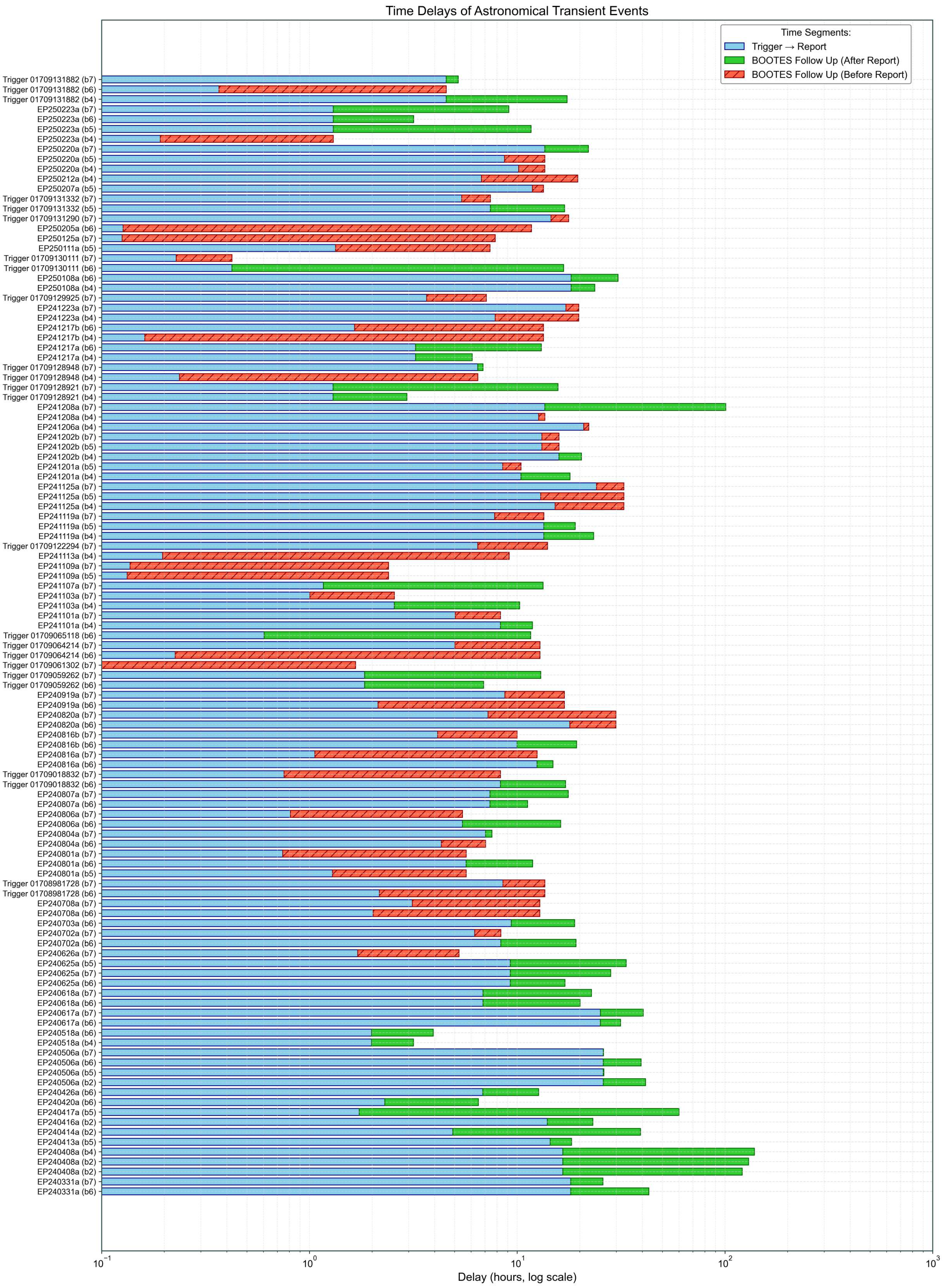
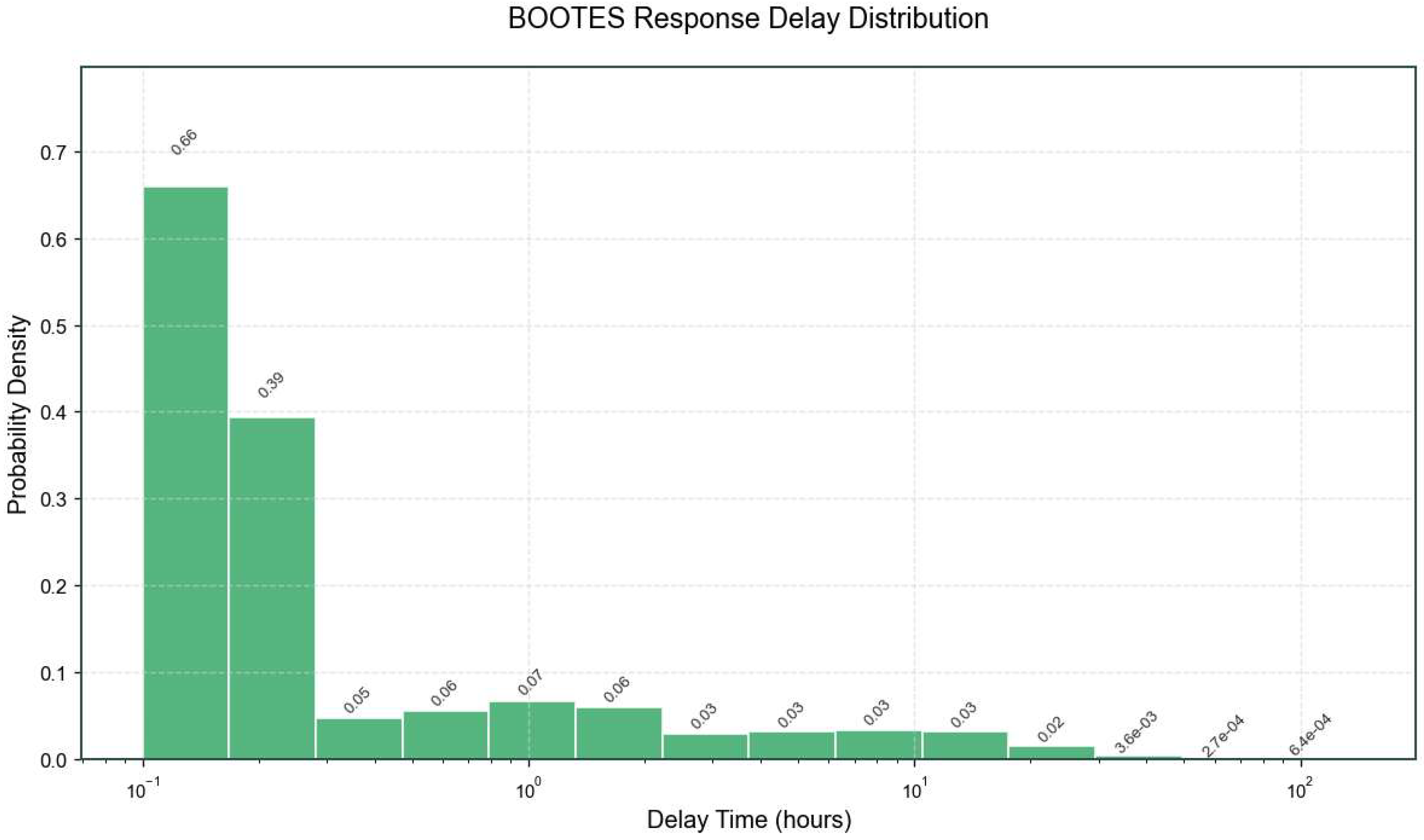
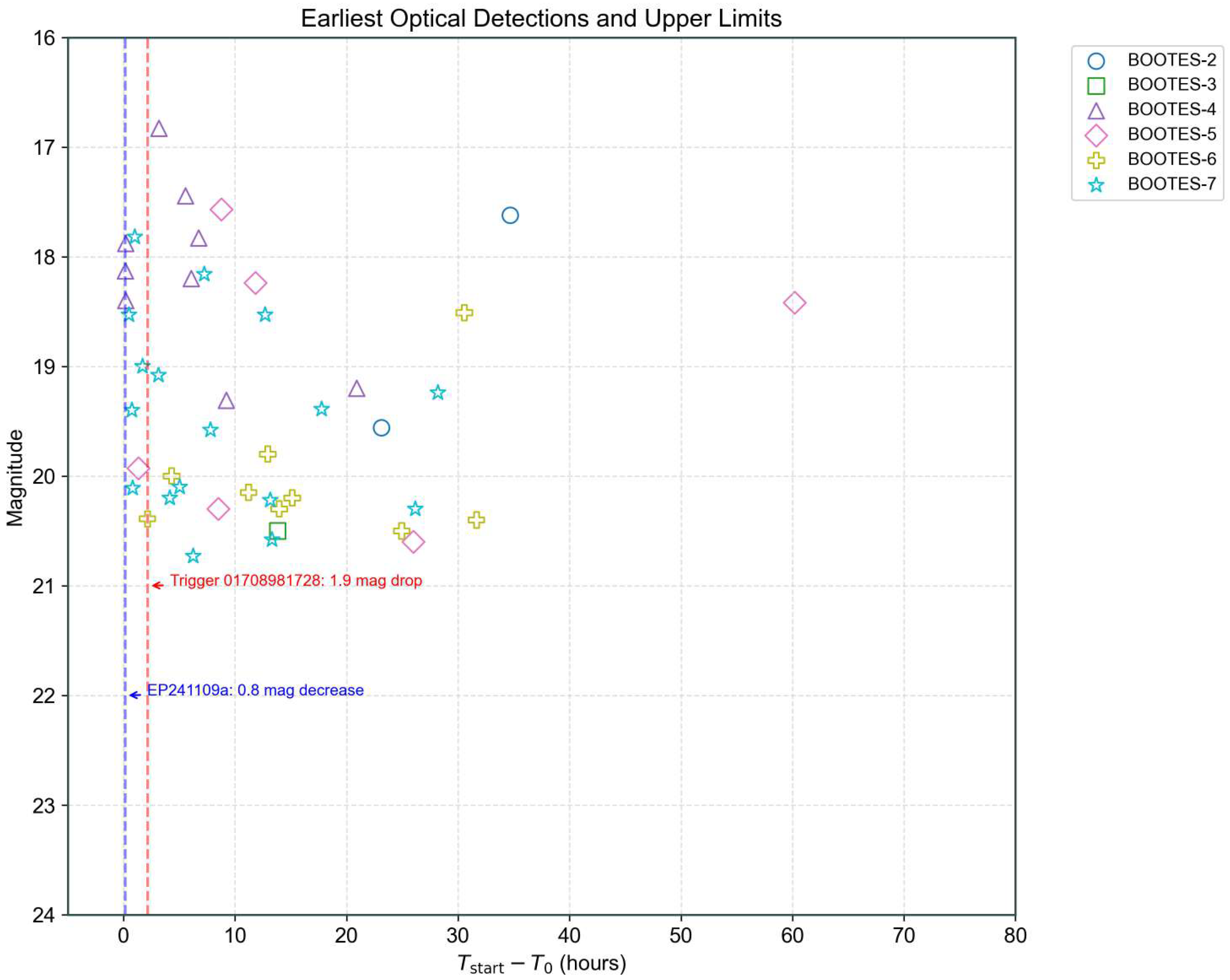
- Time delays between the EP X-ray triggers and our optical observations.
- BOOTES’s observational strategies and site-specific performance.
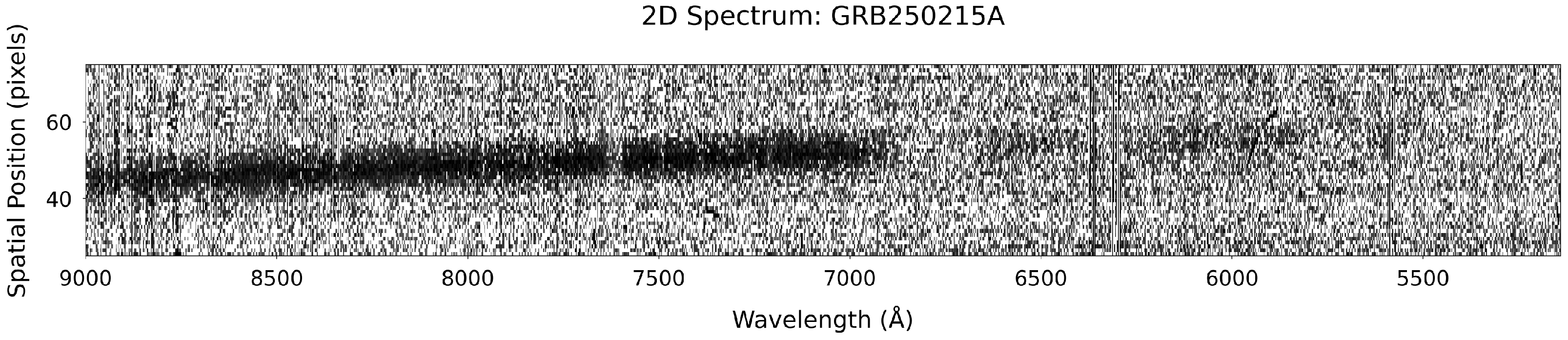
- Case studies of high-redshift GRBs (e.g., GRB 240315A at ) and outstanding transients (e.g., EP240408a).
2. Methods
2.1. Data Sources
- The GCN (Gamma-Ray Coordinates Network) Circulars, which provide prompt notifications of EP detections, including source coordinates and discovery time (https://gcn.nasa.gov/circulars, accessed on 26 February 2025).
- The Astronomer’s Telegram (ATel) reports, which contain follow-up observations and classification information from various teams (https://www.astronomerstelegram.org, accessed on 26 February 2025).
- Published papers focusing on specific EP sources, providing detailed multi-wavelength analysis and source characterization.
- Discovery time and position.
- Multi-wavelength follow-up observations, with a focus on optical data from the BOOTES network.
2.2. BOOTES Network Follow-Up Observations
2.2.1. Telescope Network
2.2.2. Instrumentation and Observations
2.2.3. Response Times and Observational Strategy
2.2.4. Spectroscopic Follow-Up with 10.4 m GTC
2.3. BOOTES Responsiveness
BOOTES Network Observations of Multiple Sources
3. Overview of EP X-Ray Transients During the First Year
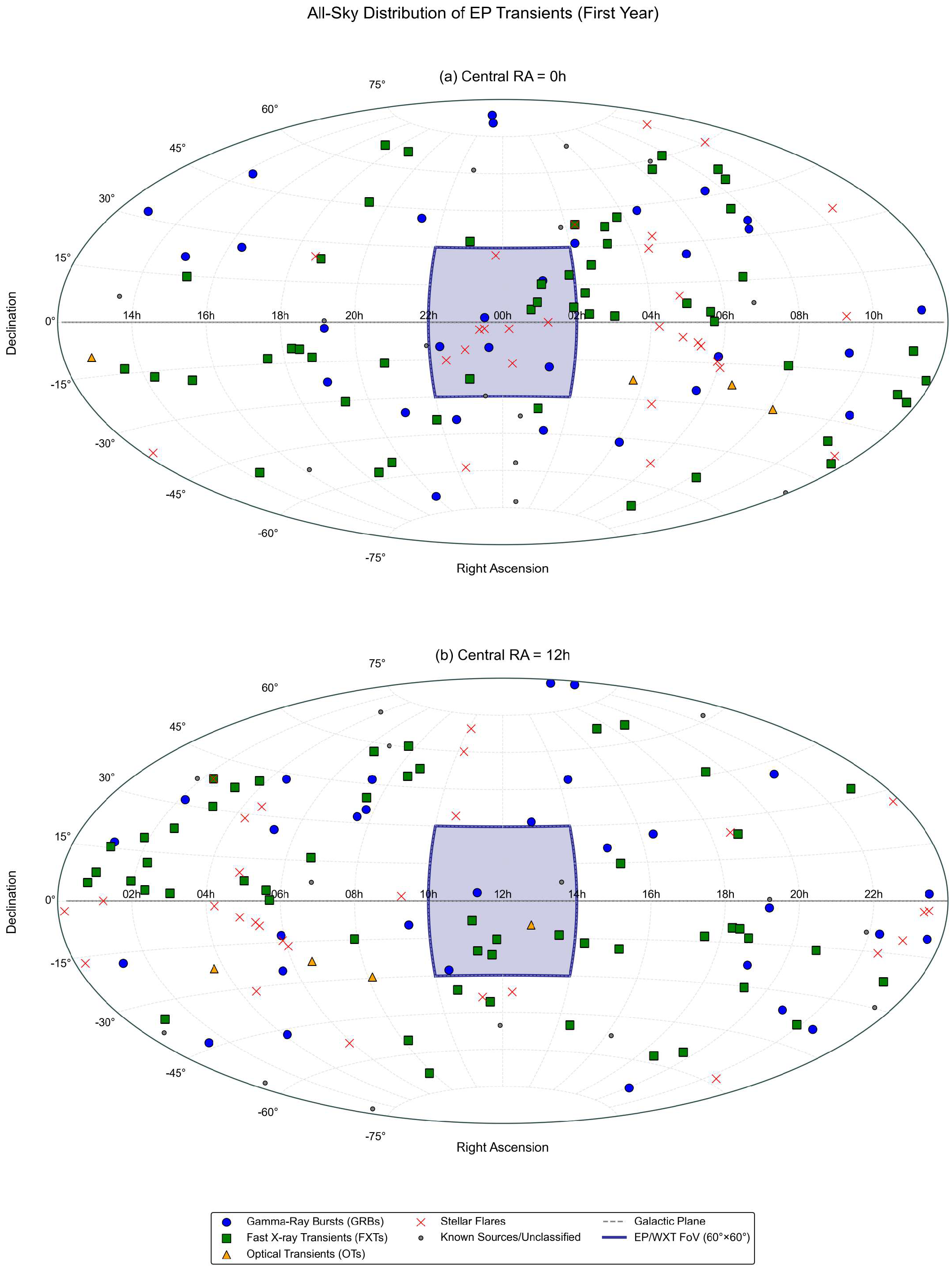
3.1. Source Classification
- Gamma-Ray Bursts (GRBs):
- −
- Identified based on high-energy X-ray/gamma-ray emissions.
- −
- Typically exhibit short (<2 s) or long (≳2 s) durations with rapid flux variability [17].
- −
- If associated with a known GRB event (e.g., detected by Fermi-GBM or Swift), they are classified as GRBs.
- −
- Sources with possible GRB-like properties but lacking definitive confirmation are marked as “Likely GRB”.
- Fast X-ray Transients (FXTs):
- −
- Short-lived (typical time scale range of seconds to kiloseconds) X-ray flares without clear GRB signatures [18].
- −
- Exhibit sudden onset and rapid decay in flux.
- −
- May lack a known gamma-ray counterpart but show variability consistent with X-ray transients.
- −
- If an FXT also has multi-wavelength detections, it is marked with additional secondary classifications.
- Optical Transients (OTs):
- −
- Transients with detected optical counterparts, either from follow-up observations or archival surveys.
- −
- Includes events such as Fast Blue Optical Transients (FBOTs) and optical afterglow candidates of GRBs.
- −
- If an optical transient is associated with a confirmed astrophysical event (e.g., a supernova), this is noted in the classification.
- Stellar Flares (M-dwarf Flares):
- −
- X-ray events associated with active low-mass stars (e.g., M-dwarfs).
- −
- Identified based on position coincidence with known stellar objects (e.g., Gaia DR3 sources).
- −
- Typically exhibit high-energy flaring activity over timescales of seconds to minutes.
- Known Sources/Unclassified:
- −
- Transients that do not fit neatly into any of the above categories.
- −
- May include weak X-ray sources, events with insufficient data for robust classification, or candidates for future multi-wavelength follow-up.
- −
- X-ray activity from cataloged astrophysical objects such as cataclysmic variables (CVs), high-mass X-ray binaries (HMXBs) or active galactic nuclei (AGNs).
3.2. Notable Sources
4. Conclusions
Author Contributions
Funding
Data Availability Statement
Acknowledgments
Conflicts of Interest
Abbreviations
| EP | Einstein Probe |
| WXT | Wide-field X-ray Telescope |
| FXT | Follow-up X-ray Telescope |
| FXTs | Fast X-ray Transients |
| SVOM | Space-based multi-band astronomical Variable Objects Monitor |
| BOOTES | Burst Observer and Optical Transient Exploring System |
| GCN | Gamma-ray Coordinates Network |
| TDE | Tidal Disruption Event |
| GRB | Gamma-Ray Burst |
| ATel | The Astronomer’s Telegram |
| NICER | Neutron star Interior Composition Explorer |
| eROSITA | extended Roentgen Survey with an Imaging Telescope Array |
| Chandra | Chandra X-Ray Observatory |
| XRT | X-ray Telescope |
| BAT | Burst Alert Telescope |
| GBM | Gamma-ray Burst Monitor |
| ROSAT | Roentgen Satellite |
| AGN | Active Galactic Nucleus |
| CV | Cataclysmic Variable |
| HMXB | High-Mass X-ray Binary |
| APEC | Astrophysical Plasma Emission Code |
| SDSS | Sloan Digital Sky Survey |
| WFCAM | Wide Field Camera |
| VISTA | Visible and Infrared Survey Telescope for Astronomy |
| VLT | Very Large Telescope |
| GTC | Gran Telescopio Canarias |
| OSIRIS | Optical System for Imaging and low-Intermediate-Resolution Integrated Spectroscopy |
| UCAC4 | U.S. Naval Observatory CCD Astrograph Catalog, 4th edition |
| Gaia DR3 | Gaia Data Release 3 |
Appendix A

| Name | Optical/NIR | X-Ray/Gamma-Ray | Radio/mm |
|---|---|---|---|
| EPW20240219aa | REM, LDT, NIRES, WINTER, Xinglong Observatory, GECKO/LOAO, 7DT, Mondy, Liverpool | SPI-ACS/INTEGRAL, Insight-HXMT/HE, Swift BAT, Fermi GBM | VLA |
| EP240305a | SALT, GRANDMA | Swift | ATCA |
| EP240309a | SALT | – | MeerKAT |
| EP240315a | WIRC, Ondřejov Observatory (D50), GTC, PRIME, 3.6 m TNG NIR, TShAO (Zeiss-1000), Kitab, Montarrenti, Lulin observatory, GROND J-band, VLT/X-shooter, Nanshan/HMT, Liverpool Telescope, ATLAS, Kinder | Chandra, Konus-Wind, Swift/BAT | e-MERLIN, ATCA, MeerKAT |
| EP240331a | BOOTES-6, 7, MASTER, GRANDMA, Kinder | – | |
| LXT 240402A | VLT X-shooter, WFST, AST3-3, MASTER, GWAC-F50A, Kinder | LEIA, Chandra, Swift, Konus-Wind, GECAM-C, Glowbug, Fermi GBM | MeerKAT, ATCA, e-Merlin |
| EP240408a | BOOTES-2, 4, GSP, MASTER, GROND, | GECAM-B, Swift-XRT | – |
| EP240413a | BOOTES-5, GOTO | GECAM-B | – |
| EP240414a | BOOTES-2, GTC, LBT, Gemini-South, NIRES, WINTER, Terskol Zeiss-2000, GMG, GSP, Pan-STARRS, Kinder | Chandra | MeerKAT |
| EP240416a | WINTER, Terskol Zeiss-2000, Khureltogoot, BOOTES-2/TELMA, MASTER, Kinder | – | – |
| EP240417a | BOOTES-5, YAHPT, SOAR | – | – |
| EP240420a | BOOTES-6, TNT, Xinglong, Nanshan, GWAC-F50A, NOT | – | – |
| EP240426a | BOOTES-6, GMG-2.4 m, DECam | EP-FXT | ASKAP, VAST |
| EP240426b | AST3-2 | – | – |
| EP240506a | BOOTES-2, 5, 6, 7, Xinglong, CrAO ZTSH, TRT, BOOTES Network, Kinder | – | RACS, VLASS |
| EP240518a | BOOTES-4, 6, GSP | – | – |
| EP240617a | BOOTES-6, 7, STEP/T80S | Swift/XRT, Fermi/GBM | – |
| EP240618a | BOOTES-6, 7, NOT, GSP, Abastumani, GRANDMA, TRT, OHP/T193 MISTRAL | Fermi/GBM, Swift/XRT | – |
| EP240625a | BOOTES-5, 6, 7, GRANDMA, NOT | – | – |
| EP240626a | BOOTES-7, Montarrenti Observatory, KAIT | – | – |
| EP240702a | BOOTES-6,7, 7DT, TRT, GSP | Swift/XRT | – |
| EP240703a | BOOTES-6, TRT, KAIT, BTA, Liverpool Telescope, Kinder, JinShan | Konus-Wind, Swift/XRT | – |
| EP240703b | GSP, TRT | Swift/XRT | – |
| EP240703c | Kinder | Swift/XRT | – |
| EP240708a | BOOTES-6,7, Kinder, GSP, KAIT, NOT, SVOM/C-GFT | Swift/XRT | – |
| EP240801a | BOOTES-5, 6, 7, GTC, Keck/LRIS, Assy-Turgen, BTA BVRI, ZTSh (CrAO), Osservatorio Astronomico Nastro Verde, SAO RAS, CrAO, AbAO, GRANDMA, Kilonova-Catcher, Leavitt Observatory, JinShan, NOT, LCOGT, GSP, Kinder, KAIT, GMG, TRT | – | GMRT |
| EP240802a | Kinder, SWIFT-UVOT, KAIT, Montarrenti Observatory, Bassano Bresciano Observatory | SWIFT-XRT, Konus-Wind, SVOM/GRM | – |
| EP240804a | LCOGT, BOOTES-6, NOT, GSP, VLT/X-shooter, LCOGT | Konus-Wind | – |
| EP240806a | BOOTES-6, 7, Global MASTER, Liverpool Telescope, Gemini North-GMOS, KAIT, LCOGT, GSP | – | – |
| EP240807a | BOOTES-6, 7, PRIME, STEP/T80S, Global MASTER | Konus-Wind | – |
| EP240816a | BOOTES-6, 7, Liverpool Telescope, KAIT, Global MASTER, TRT | – | – |
| EP240816b | BOOTES-6, 7, TRT, MASTER, KAIT, Liverpool | – | – |
| EP240820a | BOOTES-6, 7, PRIME, TRT | – | – |
| EP240904a | NOT | NuSTAR | ATCA |
| EP240908a | Gemini-North telescope, Mondy, AbAO, optical afterglow candidate, Global MASTER, TRT | WXT, FXT | – |
| EP240913a | AbAO, Mephisto, MASTER, VLT/HAWK-I, KAIT, NOT, JinShan, ESO-NTT | – | – |
| EP240918a | SVOM/VT, 1.6 m Mephisto, Global MASTER, JinShan, YAHPT, Kinder, GMG | Swift/XRT | – |
| EP240918b | Kinder | – | – |
| EP240918c | Kinder | – | – |
| EP240919a | BOOTES-6, 7, SVOM/VT, Mondy, REM, KAIT, Kinder, Global MASTER, NOT, Gemini, GOTO, JinShan | Fermi GBM, SVOM/GRM, INTEGRAL SPI-ACS | – |
| EP240930a | KAIT, CrAO ZTSH, SVOM/C-GFT, Liverpool Telescope, GOTO, Global MASTER | IPN triangulation, Swift/BAT | – |
| EP241021a | GTC, OSN, CAHA, Keck/LRIS, OHP/T193, SOAR, Kinder, Liverpool Telescope, Mephisto, SAO RAS, Gemini-South, Xinglong Observatory, Fraunhofer Telescope, VLT/FORS2, KAIT, DFOT, GSP, TRT, NOT, MASTER, GOTO | Konus-Wind, Swift-UVOT, Fermi-GBM | SMA, VLA, AMI-LA, ATCA, e-MERLIN |
| EP241025a | TNT, TRT | – | – |
| EP241026b | Keck/LRIS, Kinder, Liverpool Telescope, LBT, GROWTH, MASTER | – | – |
| EP241030a | Kinder, TNOT, SAO RAS, GMG, FTW, MASTER | – | – |
| EP241101a | BOOTES-4, 7, CrAO ZTSH, NUTTelA-TAO/BSTI, FTW, Kinder, OHP/T193, MASTER, | – | – |
| EP241103a | BOOTES-4, 7, GTC, GIT, GOTO, Gemini, GSP, LCO, MASTER | Swift XRT | – |
| EP241104a | Kinder | – | – |
| EP241107a | BOOTES-7, OSN, CAHA, GTC, SOAR, AbAO, MASTER, KAIT, Kinder, AKO, GSP, Gemini-South, OHP/T193, FTW, GIT, MASTER, SVOM/C-GFT, AKO | – | VLA |
| EP241109a | KAIT, Lick, BOOTES-5, 7 | – | – |
| EP241113a | BOOTES-4, OSN, Keck/LRIS, MASTER, WINTER | Swift XRT, Fermi-GBM | eMERLIN |
| EP241113b | OSN, Global MASTER | – | – |
| EP241115a | CAHA, Kinder, MASTER | Swift XRT, SVOM/GRM | – |
| EP241119a | BOOTES-4, 5, 7, 7DT, Kinder, GIT, WINTER, MASTER | – | – |
| EP241125a | BOOTES-b1b, 4, 5, 7, Kinder | – | – |
| EP241126a | BOOTES-7, SOAR, Mephisto, NOT, SVOM/VT, WFST, Kinder, GSP, TRT | – | – |
| EP241201a | BOOTES-4, 5, GTC, Mephisto, Kinder, NOT, MASTER | – | – |
| EP241202b | BOOTES-4, 5, 7, MASTER, KAIT | Fermi-GBM | – |
| EP241206a | MASTER, BOOTES, OSN | – | – |
| EP241208a | BOOTES-4, 7, OSN, MASTER, NOT, Kinder | SVOM/ECLAIRs | – |
| EP241213a | – | GRBAlpha, Konus-Wind, INTEGRAL/SPI-ACS | – |
| EP241217a | BOOTES-4, 6, OSN, GTC, SYSU, Liverpool, Leavitt, Mephisto, REM, NOT, GROWTH, Xinglong, MASTER, Gemini-North, Kinder, LCO | Fermi-GBM, Swift-XRT | – |
| EP241217b | Mephisto, GRANDMA/T1MPicduMidi, Nanshan/HMT, NOT, REM, SOAR, MASTER | Fermi-GBM | VLA, ATCA |
| EP241223a | BOOTES-4, 7, Mondy AZT-33IK, MASTER | – | – |
| EP241231b | Liverpool | – | – |
| EP250101a | Xinglong, Liverpool | – | – |
| EP250108a | BOOTES-4, 6, CAHA, AbAO, CMO, Terskol, DFOT, Gemini GMOS-S, NOT, GMG, SAO RAS, Mephisto, LCO, Liverpool Telescope, MASTER, VLT/X-shooter | Swift/XRT, Fermi-GBM | ATCA, VLA, MeerKAT |
| EP250109a | Mephisto, SVOM/VT, Terskol (INASAN), SAO RAS, GMG, MASTER, GOTO | GRBAlpha, Swift/BAT-GUANO, Swift/XRT, Swift/UVOT, Fermi-GBM | – |
| EP250109b | Liverpool | – | – |
| EP250111a | BOOTES-5, GTC, SAO RAS, KAIT, Mondy, NOT, MASTER | Einstein Probe WXT, Swift/XRT | – |
| EP250125a | BOOTES-7, DFOT, Kinder, Gemini, REM | Fermi, Swift | – |
| EP250205a | FTW | – | VLA |
| EP250207a | BOOTES-6, 7, NOT | Fermi-GRB, XRT | – |
| EP250207b | BOOTES-5, GTC, Xinglong, NOT, Liverpool, MASTER, Gemini | Chandra | VLA |
| EP250212a | FTW, Xinglong, MASTER, Liverpool, NOT | – | – |
| EP250215a | GTC, LCO, COLIBRI, NOT, Mephisto, Gemini, SVOM, MASTER | AstroSat CZTI, INTEGRAL SPI-ACS | – |
| EP250220a | FTW, Liverpool Telescope, Mephisto, Kinder, Xinglong, MASTER | – | – |
| EP250223a | BOOTES-4, CraO ZTSH, GMG, GROWTH-India, Kinder, GOTO, COLIBRI/DDRAGO, REM, TRT, Mephisto, SVOM/VT, OASDG, LCO, NOT, MASTER | Swift/XRT | – |
| EP250226a | Xinglong, SVOM/VT, Mephisto, Kinder, GSP, COLIBRI/DDRAGO, VLT/X-shooter, TRT, MASTER | INTEGRAL SPI-ACS and PICsIT, GECAM-B | – |
References
- Remillard, R.A.; McClintock, J.E. X-Ray Properties of Black-Hole Binaries. Annu. Rev. Astron. Astrophys. 2006, 44, 49–92. [Google Scholar] [CrossRef] [Scilit]
- Komossa, S. Tidal disruption of stars by supermassive black holes: Status of observations. J. High Energy Astrophys. 2015, 7, 148–157. [Google Scholar] [CrossRef] [Scilit]
- Kumar, P.; Zhang, B. The physics of gamma-ray bursts & relativistic jets. Phys. Rep. 2015, 561, 1–109. [Google Scholar] [CrossRef] [Scilit]
- Abbott, B.P.E.A. Multi-messenger Observations of a Binary Neutron Star Merger. Astrophys. J. Lett. 2017, 848, L12. [Google Scholar] [CrossRef] [Scilit]
- Salvaterra, R.; Della Valle, M.; Campana, S.; Chincarini, G.; Covino, S.; D’Avanzo, P.; Fernandez-Soto, A.; Guidorzi, C.; Tagliaferri, G.; Antonelli, L.A.; et al. GRB 090423 at a redshift of z 8.1. Nature 2009, 461, 1258–1260. [Google Scholar] [CrossRef] [Scilit]
- Yuan, W. The Einstein Probe mission. In Proceedings of the 44th COSPAR Scientific Assembly, Online, 16–24 July 2022. Abstract E1.16-0036-22. [Google Scholar]
- Yuan, W.; Dai, L.; Feng, H.; Jin, C.; Jonker, P.; Kuulkers, E.; Liu, Y.; Nandra, K.; O’Brien, P.; Piro, L.; et al. Science objectives of the Einstein Probe mission. Sci. China Phys. Mech. Astron. 2025, 68, 239501. [Google Scholar] [CrossRef] [Scilit]
- Castro-Tirado, A.J.; Soldán, J.; Bernas, M.; Páta, P.; Rezek, T.; Hudec, R.; Sanguino, T.M.; de la Morena, B.; Berná, J.A. The Burst Observer and Optical Transient Exploring System (BOOTES). Astron. Astrophys. Suppl. Ser. 1999, 138, 583–585. [Google Scholar] [CrossRef] [Scilit]
- Hu, Y.D.; Castro-Tirado, A.J.; Fernández-García, E.; Caballero-García, M.D.; Pérez-García, I.; Carrasco-García, I.M.; Castellón, A.; Pérez del Pulgar, C.; Reina Terol, A.J. The Burst Observer and Optical Transient Exploring System in the Multi-messenger Astronomy Era. Front. Astron. Space Sci. 2023, 10, 952887. [Google Scholar] [CrossRef] [Scilit]
- Castro-Tirado, A.J. Tracking transients night and day. Nat. Astron. 2023, 7, 1136. [Google Scholar] [CrossRef] [Scilit]
- O’Connor, B.; Pasham, D.; Andreoni, I.; Hare, J.; Beniamini, P.; Troja, E.; Ricci, R.; Dobie, D.; Chakraborty, J.; Ng, M.; et al. Characterization of a peculiar Einstein Probe transient EP240408a: An exotic gamma-ray burst or an abnormal jetted tidal disruption event? arXiv 2024, arXiv:2410.21622. [Google Scholar] [CrossRef] [Scilit]
- Caballero-García, M.D.; Jelínek, M.; Castro-Tirado, A.J.; Hudec, R.; Cunniffe, R. Initial follow-up of optical transients with COLORES using the BOOTES network. Acta Polytech. 2015, 55, 81–85. [Google Scholar] [CrossRef] [Scilit]
- Chambers, K.C.; Magnier, E.A.; Metcalfe, N.; Flewelling, H.A.; Huber, M.E.; Waters, C.Z.; Denneau, L.; Draper, P.W.; Farrow, D.; Finkbeiner, D.P.; et al. The Pan-STARRS1 Surveys. arXiv 2016, arXiv:1612.05560. [Google Scholar] [CrossRef]
- Caballero-García, M.D.; Simon, V.; Jelínek, M.; Castro-Tirado, A.J.; Cwiek, A.; Claret, A.; Opiela, R.; Żarnecki, A.F.; Gorosabel, J.; Oates, S.R.; et al. Early optical follow-up of the nearby active star DG CVn during its 2014 superflare. Mon. Not. R. Astron. Soc. 2015, 452, 4195–4202. [Google Scholar] [CrossRef] [Scilit]
- Kreps, J.; Narkhede, N.; Rao, J. Kafka: A Distributed Messaging System for Log Processing. In Proceedings of the 6th International Workshop on Networking Meets Databases, Athens, Greece, 12 June 2011. [Google Scholar]
- Antognini, J.M.O. Timescales of Kozai–Lidov oscillations at quadrupole and octupole order in the test particle limit. Mon. Not. R. Astron. Soc. 2015, 452, 3610–3619. [Google Scholar] [CrossRef] [Scilit]
- Kouveliotou, C.; Meegan, C.A.; Fishman, G.J.; Bhat, N.P.; Briggs, M.S.; Koshut, T.M.; Paciesas, W.S.; Pendleton, G.N. Identification of two classes of gamma-ray bursts. Astrophys. J. 1993, 413, L101. [Google Scholar] [CrossRef] [Scilit]
- Sguera, V.; Barlow, E.J.; Bird, A.J.; Dean, A.J.; Landi, R.; Lubinski, P.; Malizia, A.; Ubertini, P. INTEGRAL observations of recurring fast X-ray transients. Astron. Astrophys. 2005, 444, 221–231. [Google Scholar] [CrossRef] [Scilit]
- Zhang, C.; Ling, Z.X.; Liu, Y.; Pan, X.; Jin, C.; Cheng, H.Q.; Cui, C.Z.; Fan, D.W.; Hu, H.B.; Hu, J.W.; et al. Detection of a Bright X-Ray Flare by Einstein Probe in Its Commissioning Phase; Astronomer’s Telegram, No. 16463; Harvard University: Cambridge, MA, USA, 2024. [Google Scholar]
- Zhang, B.; Sun, H.; Yin, Y.H.I.; Yang, J.; Zhang, B.; Wu, X. EPW20240219aa Is Likely a GRB Event; Astronomer’s Telegram, No. 16473; Harvard University: Cambridge, MA, USA, 2024. [Google Scholar]
- Yin, Y.H.I.; Zhang, B.B.; Yang, J.; Sun, H.; Zhang, C.; Shao, Y.X.; Hu, Y.D.; Zhu, Z.P.; Xu, D.; An, L.; et al. Triggering the Untriggered: The First Einstein Probe-Detected Gamma-Ray Burst 240219A and Its Implications. arXiv 2024, arXiv:2407.10156. [Google Scholar] [CrossRef] [Scilit]
- Liu, Y.; Sun, H.; Xu, D.; Svinkin, D.S.; Delaunay, J.; Tanvir, N.R.; Gao, H.; Zhang, C.; Chen, Y.; Wu, X.F.; et al. Soft X-ray prompt emission from a high-redshift gamma-ray burst EP240315a. arXiv 2024, arXiv:2404.16425. [Google Scholar] [CrossRef] [Scilit]
- Levan, A.J.; Jonker, P.G.; Saccardi, A.; Malesani, D.B.; Tanvir, N.R.; Izzo, L.; Heintz, K.E.; Sánchez, D.M.; Quirola-Vásquez, J.; Torres, M.A.; et al. The fast X-ray transient EP240315a: A z 5 gamma-ray burst in a Lyman continuum leaking galaxy. arXiv 2024, arXiv:2404.16350. [Google Scholar]
- Tanvir, N.R.; Fox, D.B.; Levan, A.J.; Berger, E.; Wiersema, K.; Fynbo, J.P.U.; Cucchiara, A.; Krühler, T.; Perley, D.A.; Cenko, S.B.; et al. A γ-ray burst at a redshift of z∼8.2. Nature 2009, 461, 1254–1257. [Google Scholar] [CrossRef] [Scilit]
- Ricci, R.; Troja, E.; Yang, Y.H.; Yadav, M.; Liu, Y.; Sun, H.; Wu, X.; Gao, H.; Zhang, B.; Yuan, W. Long-term radio monitoring of the fast X-ray transient EP240315a: Evidence for a relativistic jet. arXiv 2024, arXiv:2407.18311. [Google Scholar]
- Gillanders, J.H.; Rhodes, L.; Srivastav, S.; Carotenuto, F.; Bright, J.; Huber, M.E.; Stevance, H.F.; Smartt, S.J.; Chambers, K.C.; Chen, T.W.; et al. Discovery of the optical and radio counterpart to the fast X-ray transient EP240315a. arXiv 2024, arXiv:2404.10660. [Google Scholar]
- Zhang, W.; Yuan, W.; Ling, Z.; Chen, Y.; Rea, N.; Rau, A.; Cai, Z.; Cheng, H.; Zelati, F.C.; Dai, L.; et al. Einstein Probe discovery of EP240408a: A peculiar X-ray transient with an intermediate timescale. Sci. China Phys. Mech. Astron. 2024, 68, 219511. [Google Scholar] [CrossRef] [Scilit]
- Sun, H.; Li, W.X.; Liu, L.D.; Gao, H.; Wang, X.F.; Yuan, W.; Zhang, B.; Filippenko, A.V.; Xu, D.; An, T.; et al. Extragalactic fast X-ray transient from a weak relativistic jet associated with a Type Ic-BL supernova. arXiv 2025, arXiv:2410.02315. [Google Scholar]
- Srivastav, S.; Chen, T.W.; Gillanders, J.H.; Rhodes, L.; Smartt, S.J.; Huber, M.E.; Aryan, A.; Yang, S.; Beri, A.; Cooper, A.J.; et al. Identification of the optical counterpart of the fast X-ray transient EP240414a. Astrophys. J. Lett. 2025, 978, L21. [Google Scholar] [CrossRef] [Scilit]
- Bright, J.S.; Carotenuto, F.; Fender, R.; Choza, C.; Mummery, A.; Jonker, P.G.; Smartt, S.J.; DeBoer, D.R.; Farah, W.; Matthews, J.; et al. The Radio Counterpart to the Fast X-ray Transient EP240414a. arXiv 2024, arXiv:2409.19055. [Google Scholar] [CrossRef] [Scilit]
- van Dalen, J.N.; Levan, A.J.; Jonker, P.G.; Malesani, D.B.; Izzo, L.; Sarin, N.; Quirola-Vásquez, J.; Sánchez, D.M.; de Ugarte Postigo, A.; van Hoof, A.P.; et al. The Einstein Probe transient EP240414a: Linking Fast X-ray Transients, Gamma-ray Bursts and Luminous Fast Blue Optical Transients. Astrophys. J. Lett. 2025, 982, L47. [Google Scholar] [CrossRef] [Scilit]
- Liu, M.; Zhang, Y.; Wang, Y.; Xue, R.; Buckley, D.; Howell, D.A.; Jin, C.; Li, W.; Monageng, I.; Pan, H.; et al. Detection of an Orphan X-ray Flare from a Blazar Candidate EP240709a with Einstein Probe. arXiv 2024, arXiv:2412.18463. [Google Scholar] [CrossRef] [Scilit]
- Ng, M.; Hare, J.; Jaisawal, G.K.; Malacaria, C.; Markwardt, C.B.; Sanna, A. Tentative Blazar Candidate EP240709A Associated with 4FGL J0031.5-5648: NICER and Archival Multiwavelength Observations. arXiv 2024, arXiv:2411.18718. [Google Scholar] [CrossRef] [Scilit]
| Parameter | Onboard Triggers | Ground Triggers |
|---|---|---|
| Energy Band | 0.5–4 keV | 0.5–4 keV |
| Brightness Threshold | >10−9 erg cm−2 s−1 | >10−11 erg cm−2 s−1 |
| Localization Accuracy | ∼1′ | ∼30″ |
| Site | Latitude | Longitude | Altitude (m) | Location |
|---|---|---|---|---|
| BOOTES-1 | 37°05′58.2″ N | 6°44′14.89″ W | 50 | Mazagón, Spain |
| BOOTES-2 | 36°45′24.84″ N | 4°02′33.83″ W | 70 | Algarrobo-Costa, Spain |
| BOOTES-3 | 45°02′22.92″ S | 169°41′0.6″ E | 360 | Lauder, New Zealand |
| BOOTES-4 | 26°41′42.8″ N | 100°01′48.24″ E | 3200 | Lijiang, China |
| BOOTES-5 | 31°02′39″ N | 115°27′49″ W | 2860 | Baja California, Mexico |
| BOOTES-6 | 29°02′20″ S | 26°24′13″ E | 1383 | Maselespoort, South Africa |
| BOOTES-7 | 22°57′09.8″ S | 68°10′48.7″ W | 2440 | Atacama, Chile |
| Name | RA (deg) | Dec (deg) | X-Ray Properties | Notes |
|---|---|---|---|---|
| Gamma-Ray Bursts (GRBs) | ||||
| EPW20240219aa | 80.016 | 25.541 | Fast rise to (0.5–4.0 keV) in ∼10 s, decaying to background () in ∼200 s. Spectrum: absorbed power-law with , . | A weak, untriggered gamma-ray counterpart detected |
| EP240315a | 141.644 | −9.547 | Duration: ∼1600 s, : , , : , : | Mainly classified as GRBs, with secondary characteristics of FXTs and OTs (z = 4.859) |
| LXT240402A | 245.451 | 25.763 | , , F (0.5–10 keV band): | Long GRB, associated with GRB 240402B, detected in 0.5–4 keV soft X-ray band, with FXT and OT secondary characteristics |
| EP240617a | 285.030 | −22.561 | : , , , : | X-ray-rich GRB, weak gamma-ray counterpart in Fermi/GBM data, likely GRB secondary classification |
| GRB240627B | 215.25 | 48.52 | 1st Exposure: 586 s, Upper limit: erg s−1 cm−2; 2nd Exposure: 1233 s, Upper limit: erg s−1 cm−2 | GRBs detected by SVOM: X-ray Upper Limits from EP-WXT |
| GRB240629A | 314.4 | −35.7 | 1st Exposure: 6429 s, Upper limit: erg s−1 cm−2; 2nd Exposure: 54,140 s, Upper limit: erg s−1 cm−2 | GRBs detected by SVOM: X-ray Upper Limits from EP-WXT |
| GRB240713A | 352.59 | 1.88 | A total of 13.3 h after the detection of SVOM/ECLAIRs, the exposure time is about 6.8 ks; 10 X-ray sources were found within the SVOM/ECLAIRs localization error box | X-ray follow-up observation with EP-FXT |
| EP240802a | 287.8070 | −2.3125 | Dur. > 500 s, lightcurve from WXT shows three sequentially weakened peaks, , , and . For the average FXT spectrum in the 0.5–10 keV band, , , | Associated with long GRB 240802A |
| EP240804a | 337.644 | −39.121 | For the WXT observed transient: Dur. > 100 s, , , (0.5–4 keV) For the FXT: The light curve shows significant variability. For the 0.5–10 keV spectrum, , , | Associated with GRB 240804B; optical candidate with large deviation detected |
| EP240807a | 300.970 | −68.777 | Dur. ∼ 70 s, : , , , : | Associated with GRB 240807A; X-ray afterglow confirmed by EP-FXT |
| GRB240821A | 354.23 | −10.18 | source #1 (RA = 354.2701 deg, DEC = −10.1911 deg): 1st epoch: TGRB-Tstart = 8.8 h, Exposure = 5.0 ks, Estimated Flux = erg s−1 cm−2; 2nd epoch: TGRB-Tstart = 15.2 h, Exposure = 8.0 ks, Estimated Flux = erg s−1 cm−2; 3rd epoch: TGRB-Tstart = 111.4 h, Exposure = 8.4 ks, Estimated Flux < erg s−1 cm−2 source #2 (RA = 354.1516 deg, DEC = −10.0504 deg): 1st epoch: TGRB-Tstart = 8.8 h, Exposure = 5.0 ks, Estimated Flux = erg s−1 cm−2; 2nd epoch: TGRB-Tstart = 15.2 h, Exposure = 8.0 ks, Estimated Flux = erg s−1 cm−2; 3rd epoch: TGRB-Tstart = 111.4 h, Exposure = 8.4 ks, Estimated Flux < erg s−1 cm−2 | Detected as a short-duration GRB by multiple instruments, with X-ray afterglow |
| EP240913a | 16.681 | 16.750 | At ∼T0 + 180 s, the light-curve has a fast pulse (Dur. ∼50 s) followed by weak emission up to 1100 s. : , , (fixed), : | Short gamma-ray burst, consistent in time and space with X-ray transient |
| EP240919a | 334.2797 | −9.7362 | Dur. > 400 s, , , (0.5–4 keV) | Associated with long GRB 240919A; radio counterpart candidate detected at 9 GHz |
| EP240930a | 319.899 | 41.303 | , (fixed), : | Consistent with long GRB 240930B in time and space, X-ray afterglow characteristics support GRB classification, also has FXT characteristic in initial stage |
| GRB241001A | 20.55276 | −43.47506 | The source faded by an order of magnitude to erg cm−2 s−1 in the 0.3–10 keV band. Confirmed: Swift/XRT source #2 is the afterglow of GRB 241001A | The optical counterpart was detected, qualifies as an X-Ray Flash (XRF), z = 0.573 |
| GRB241018A | 67.9992 | 43.0200 | , , Observed flux (0.5–10.0 keV): | Detected by multiple gamma-ray detectors, X-ray afterglow consistent with GRB characteristics |
| EP241025a | 333.6408 | 83.5772 | Trigger flux (0.5–4 keV, assumed absorbed power-law): erg s−1 cm−2, Source flux: erg s−1 cm−2 | Long GRB, the optical counterpart was detected, z = 4.20 |
| EP241030a | 343.013 | 80.449 | , (fixed), : | GRB 241030A X-ray Afterglow |
| EP241104a | 32.574 | 31.555 | Dur. , : (0.5–4 keV), , (fixed), : | Associated with known GRB 241104A |
| GRB241105A | 61.9 | −46.7 | For the two observations, the first one has an exposure time of 2894 s, of 22.0 h, and a flux in the 0.5–10 keV band of ; the second one has an exposure time of 7966 s, of 38.0 h, and a flux in the 0.5–10 keV band of | Known GRB event, multi-band observations support short-burst with extended radiation characteristics |
| EP241113b | 110.233 | 46.800 | , (with an uncertainty of ), : , Dur. of lightcurve from WXT = 100 s | Associated with known GRB event, multi-band observations support the classification |
| EP241115a | 19.416 | −17.954 | , (fixed), : | Associated with GRB 241115D |
| EP241213a | 116.182 | 35.271 | , (with an uncertainty of ), : | Associated with long GRB 241213A |
| EP241217b | 84.167 | −25.281 | WXT: - Light curve: 2 pulses. 1st from 10–620 s (2 short pulses at 150 s and 260 s, slewing 53–134 s), 2nd from 1000–1500 s. - Spectrum (134–2000 s after GRB trigger): Absorbed power-law, (fixed), , , , FXT: - Spectrum (134–7800 s after GRB trigger, annular region): Same model as WXT. , , | Associated with GRB 241217A, z = 1.879 |
| GRB241229A | 192.893 | 31.857 | EPF_J125139.4 + 315,311: R.A. = 192.9133 deg, DEC = 31.8867 deg, Sep. = 2.06 arcmin, F = erg s−1 cm−2 EPF_J125129.3 + 314,453: R.A. = 192.8715 deg, DEC = 31.7484 deg, Sep. = 6.61 arcmin, F = erg s−1 cm−2 EPF_J125101.6 + 315,007: R.A. = 192.7572 deg, DEC = 31.8356 deg, Sep. = 7.04 arcmin, F = erg s−1 cm−2 | Long GRB, EP-FXT detected afterglow candidates |
| EP250109a | 88.806 | −12.500 | WXT (EP250109a, trigger at 2025-01-09T06:17:58 UTC): - Peak: ∼60 s post-trigger, - Decay: To background within 200 s post-trigger - Spectrum: Absorbed power law, , (fixed), , , FXT (Obs. start: 2025-01-09T08:06:40 UTC, ∼1.8 h post-trigger, ks): - Spectrum: Absorbed power-law, , (fixed), , , | Associated with GRB 250109A, multi-band observations support the classification |
| GRB250127A | 169.6284 | 3.3508 | , (fixed), : | Long GRB event |
| EP250205a | 113.522 | 32.363 | WXT (0.5–4.0 keV): - Absorbed power-law, (fixed), - , , EP-FXT (average 0.5–10 keV): - Absorbed power-law, (fixed) - , | Associated with GRB 250205A, optical counterpart was detected |
| EP250215a | 156.3430 | −27.7040 | Duration = —, Peak flux = — | Associated with long GRB 250215A, optical counterpart was detected, z = 4.61 |
| EP250226a | 224.273 | 20.973 | WXT detection: Dur. s, (trigger at 2025-02-26T06:34:54 UTC). FXT follow-up: First epoch (44 min post-trigger): , (fixed), at R.A. = 224.2641°, Dec. = 20.9754° (10 arcsec error). Second epoch (11.9 h post-trigger): , indicating X-ray decline | Associated with GRB 250226A, optical counterpart detected, z = 3.315 |
| Stellar Flares (M-dwarf flares) | ||||
| EP trigger ID 01708913080 | 336.13 | −58.429 | Spectrum Model: Two apec components, keV, keV, erg s−1 cm−2 (2 orders of magnitude higher than eROSITA flux) If associated with M star, | Associated with M-dwarf UPM J2224-5826, X-ray flux significantly higher than eROSITA historical value |
| EP trigger ID 01708981728 | 336.513 | −15.302 | Spectrum Model: Two absorbed apec components, keV, keV, , erg s−1 cm−2 If associated with high-proper-motion star, erg s−1 | Associated with high-proper-motion star LP 820-19, optical observation confirms significant brightness enhancement during flare |
| EP trigger ID 01709018832 | 2.562 | −2.665 | Spectrum Model: Two absorbed apec components, keV, keV, (fixed) If source associated with star, | Associated with M-dwarf Gaia DR3 2445442335531658752, optical observation shows significant brightness change during flare |
| EP trigger ID 01709059262 | 278.807 | 24.588 | The position of the FXT source is associated with the star 2MASS J18351416 + 2,435,115 | Spectrum: Red continuum + strong Balmer, Ca II H&K, TiO emission lines, consistent with dMe star spectrum |
| EP trigger ID 01709061302 | 350.5437 | −3.0283 | The FXT source is associated with a K-type star, PM J23221-0301, at a distance of about 46 pc and located about 8 arcsec away from the FXT position | — |
| EP trigger ID 01709064214 | 352.558 | −2.614 | n M-type, high proper motion star 2MASS J23301129-0237227/2RXS J233013.0-023738, is at a distance of about 46 pc and located about 5.1 arcsec away from the position detected by FXT | The X-ray transient was also detected in the optical and confirm it originated from a flare star |
| EP trigger ID 01709065118 | 344.5674 | −11.0724 | The FXT source is associated with an M-type star, 1RXS J225817.2-110434, at a distance of about 32 pc and located about 5 arcsec away from the FXT position | Spectra: Red continuum + strong H Balmer, Ca II H&K, TiO emission lines, consistent with dMe star spectrum. Photometry: Trigger event associated with stellar flare |
| EP241109a | 18.3599 | 0.0184 | In GAIA DR3, a close star ( K, pc) lies within EP-FXT error circle of EP241109a | GAIA DR3 2534635509050352256: Brightness decreased by 0.8 mag (clear filter) in 40 min, confirming EP241109a as a stellar flare. Based on photometry and spectroscopy, EP241109a event is associated with this stellar flare |
| EP trigger ID 01709120856 | 4.023 | −16.604 | , (typical for M-type dwarf) | — |
| EP trigger ID 01709122294 | 64.628 | 28.458 | Spectrum Model: Absorbed apec, keV erg s−1 cm−2 If the transient is associated with V410 Tau, erg −1 | Flare decay in observations:
- In u and v bands: magnitudes decayed 0.24 and 0.11 in 7 h. - In g and r bands: no significant variations |
| EP trigger ID 01709128921 | 63.363 | −1.648 | Associated with a double or multiple star RX J0413.4-0139, , corresponding to | — |
| EP trigger ID 01709128948 | 79.405 | −7.557 | Associated with a young stellar object candidate ATO J079.4052-07.5576, , corresponding to | — |
| EP trigger ID 01709129023 | 151.839 | 69.35 | Associated with an eruptive variable UCAC4 797-019583, , corresponding to | — |
| EP trigger ID 01709129287 | 88.836 | −14.381 | Associated with a high proper motion star TYC 5360-423-1, , corresponding to | — |
| EP trigger ID 01709129925 | 90.609 | −16.579 | Associated with a high proper motion star 1RXS J060224.9-163451, , corresponding to | — |
| EP trigger ID 01709130111 | 67.339 | −31.395 | Associated with a low-mass star, RX J0429.3-3124, , corresponding to | — |
| EP trigger ID 01709131085 | 72.216 | 10.03 | Associated with a high proper motion star RX J0448.7 + 1003, , | Photometry: - At 26.7 min, mag. - Peaked at 43.6 min with mag. - At 187 min, mag. Conclusion: EP-WXT trigger event is associated with the stellar flare |
| EP trigger ID 01709131196 | 139.021 | 1.89 | Associated with an M-type star RX J0916.1 + 0153, | — |
| EP trigger ID 01709131290 | 88.148 | −53.067 | Associated with a star UCAC4 185-006985, , corresponding to | — |
| EP trigger ID 01709131332 | 184.462 | −36.741 | Associated with a high proper motion star UPM J1217-3644, , | — |
| The EP trigger 01709131347 | 158.298 | 34.176 | Associated with a spectroscopic binary G 118-68, , corresponding to | — |
| EP250207a | 356.902 | 27.027 | Associated with low-mass star 2MASS J23473680 + 2,702,068, 0.5–4 keV single-apec fit - Spectrum fit: 0.5–4 keV spectrum fitted with a single apec model, keV, no significant absorption. - Flux: 0.3–10 keV two-apec fit - Spectrum fit: 0.3–10 keV spectrum fitted with two apec components, keV, keV, no significant absorption. - Flux and luminosity: , | This high-proper-motion M9 dwarf brightened from (Pan-STARRS) to . Gaia DR3 shows a proper motion of mas/yr and parallax of mas, suggesting it is a nearby star having a +3-mag flare |
| EP J0433.6+3255 | 68.4 | 32.917 | Dur. s. The source is arcsec from an ROSAT X-ray source (1RXS J043335.1 + 325,432), which is spatially consistent with a nearby M-type star (Gaia DR3 172042272322881792; Assoc.: M-type star). The separation between the star and 1RXS J043335.1 + 325,432 is 11 arcsec. The outburst may be associated with both the M-type star (Assoc.: M-type star) and the X-ray source (Assoc.: X-ray source). If confirmed, the X-ray would show a ∼100-fold increase compared to the ROSAT (). The WXT spectrum is best fitted by an absorbed power-law with and (fixed). The corresponding is . If associated with Gaia DR3 172042272322881792, the 0.5–4 keV luminosity | — |
| EP J0452.7-0541 | 73.176 | −5.687 | Source position matches 1eRASS J045241.6-054101 with (0.2–2.3 keV). Associated with Gaia DR3 3188422199717067648 (separation 1.4 arcsec; Assoc.: star). WXT spectrum: abs apec model with keV, (fixed). (∼100× brighter than eROSITA). If associated, (0.5–4 keV) | — |
| RX J0218.7+3854 | 34.6990 | 38.9136 | FXT source spatially matches Gaia DR3 331926892386271872 (offset 3 arcsec; Assoc.: Gaia object). Spectrum (0.5–10 keV): absorbed power-law with , (fixed). , consistent with historical ROSAT flux. Spatial correlation with EP241206a suggests the WXT detection may represent an X-ray outburst from RX J0218.7 + 3854 | — |
| EP241212a | 153.817 | 60.068 | Faint X-ray source 1WGA J1015.3 + 6004/Gaia DR3 1048515045825830144 (R.A. = 153.83607, Dec. = +60.07485) at pc, offset 42 arcsec from WXT position. No significant variability. WXT spectrum: absorbed power-law with , . Absorbed 0.5–4 keV flux: | — |
| EP trigger ID 01709131775 | 80.748 | −8.833 | Associated with a T Tauri star RX J0523.0-0850, , corresponding to | — |
| EP trigger ID 01709131882 | 170.244 | −38.768 | Associated with a BY Dra Variable V1217 Cen, , corresponding to | — |
| Fast X-ray Transients | ||||
| EP240305a | 122.903 | −54.657 | Light curve shows double-peak profile. First flare: rise to (0.5–4.0 keV) in ∼100 s, decay to background () in ∼50 s. Second flare: rise to in ∼50 s, decay to background in ∼200 s. Averaged spectrum: absorbed power-law with , . | Maybe a late A or early F spectral-type star; radio counterpart detected |
| EP240331a | 169.414 | −20.042 | Light curve: symmetric profile, Dur. ∼ 100 s. Spectrum: absorbed power-law with , (fixed). (0.5–4 keV) | — |
| EP240408a | 158.840 | −35.749 | Dur. ∼ 10 s. (0.5–4.0 keV). Spectrum: absorbed power-law with , (fixed). . | Optical/NIR counterpart detected |
| EP240413a | 228.794 | −18.800 | Dur. = 200 s, , , , | If possible detection of the X-ray emission is true, EP240413a has faded by about 3 orders of magnitude in X-ray flux in about 14 h |
| EP240416a | 203.150 | −13.612 | Dur. ≥ 200 s, , , , | Optical counterpart candidate detected |
| EP240417a | 177.442 | −15.438 | Dur. ≥ 1500 s, , , , | No other band counterparts |
| EP240420a | 228.713 | 14.796 | Dur. > 100 s, | Short-time X-ray flare; X-ray flux decays by 3 orders of magnitude in 2 h; optical counterpart detected |
| EP240426b | 173.787 | −40.741 | Dur. = 300 s, , , , | No multi-band counterpart; 40-degree deviation from S240422ed |
| EP240506a | 213.978 | −16.715 | Dur. = 50 s, , , , | No optical counterpart detected; possible background radio source |
| EP240518a | 216.955 | −49.565 | Dur. > 1000 s, average (0.5–4 keV) | Possible stellar activity |
| EP240618a | 281.648 | 23.833 | Dur. ≈ 100 s, , , , | Optical candidate detected |
| EP240625a | 310.760 | −15.966 | Dur. ≈ 300 s, , , , | X-ray source decays slowly; optical candidate with low SNR detected |
| EP240626a | 263.023 | −13.051 | Dur. ≈ 160 s, , , , | Weak follow-up X-ray source detected; no optical counterpart |
| EP240702a | 328.203 | −38.980 | Dur. ≈ 50 s, , , (fixed), | No optical or radio counterpart; no matching known X-ray source |
| EP240703a | 273.803 | −9.681 | Dur. ≈ 300 s, (absorbed), , , ; When , , | Optical candidate detected but not independently confirmed; no matching known X-ray source |
| EP240703b | 279.539 | −57.401 | Dur. ≈ 600 s, (absorbed), , , ; When , , | No multi-band counterpart |
| EP240703c | 289.264 | −30.325 | Dur. > 1000 s, with multipeak lightcurve structure, , , | No clear multi-band counterpart; no matching known X-ray source |
| EP240708a | 345.963 | −22.840 | Dur. ≈ 1300 s, , , , | Weak follow-up X-ray source detected |
| EP240801a | 345.140 | 32.610 | Dur. > 80 s, lightcurve from WXT shows rapid brightening profile, , , (0.5–4 keV) | X-ray afterglow detected; optical candidate detected in the error circle, z = 1.673 |
| EP240806a | 11.491 | 5.091 | Dur. ≈ 150 s, , , | Optical counterpart detected, z = 2.818 |
| EP240816b | 16.013 | 15.398 | For the WXT: Dur. > 50 s, , , (0.5–4 keV) For the average FXT spectrum in 0.5–10 keV band: , , (0.5–10 keV) | No clear optical or radio counterpart |
| EP240816a | 292.925 | −54.412 | , , For the average FXT spectrum in the 0.5–10 keV band: , , (0.5–10 keV) | No multi-band counterpart |
| EP240820a | 16.221 | −34.698 | For the WXT observed transient: Dur. ≈ 250 s, , , (0.5–4 keV) For the FXT spectrum: Fitted with an absorbed power-law, parameters fixed to those from EP-WXT spectral fitting, | No multi-band counterpart |
| EP240904a | 276.8750 | −9.9426 | Detected by EP/WXT at 2024-09-04T17:20:40 UTC. WXT spectrum (0.5–4 keV): absorbed power-law with , (fixed). . EP/FXT follow-up (5.9 ks exposure) localized source at R.A. = 276.8750°, Dec. = −9.9426° (J2000; 10 arcsec error radius). Spectrum (0.5–10 keV): , . . | Radio counterpart detected |
| EP240908a | 14.0031 | 8.0735 | For the WXT observed transient: Dur. ≈ 950 s, (0.5–4 keV), , , (0.5–4 keV) For the FXT: , , | Optical counterpart detected |
| EP240918a | 289.3937 | 46.1281 | For the WXT observed transient: Dur. ≈ 170 s, , , , For the EP-FXT light curve: Shows a fast decline, flux decreased to within s | No clear optical or radio counterpart |
| EP240918b | 258.66 | 66.739 | Dur. ≈ 200 s, , , | No clear optical or radio counterpart |
| EP240918c | 281.338 | −13.167 | Dur. ≈ 100 s, (0.5–4 keV), , , | No previously known bright X-ray sources are found within the error circle around the source position |
| EP241021a | 28.852 | 5.957 | (0.5–4 keV), , , | Optical counterpart detected; redshift of host galaxy ; a bright source was detected at the optical transient (OT) position at a frequency of 5.5 GHz; the flux density of this source is |
| EP241026b | 56.403 | 41.031 | (0.5–4 keV), , , | Short-time X-ray flare; optical candidate with 1.9-magnitude brightening detected; an upper limit of 1.8 for the redshift |
| EP241101a | 37.763 | 22.731 | For the WXT observed transient: Dur. > 100 s, , , (0.5–4 keV) For the FXT: During its autonomous observation within the WXT error circle, no significant source was detected. The flux upper limit is (0.5–10 keV) | Possible detection of some optical counterparts |
| EP241103a | 27.7572 | 18.9587 | For the WXT: Duration: ≈ 60 s, , , , For FXT (in the 0.5–10 keV band): Exposure time: 2300 s, no significant light curve variation observed, fixed at Galactic value, , | No multi-band counterpart |
| EP241107a | 35.0085 | 3.3329 | The trigger flux: | Optical and radio (the flux density is ) counterpart candidates detected; z = 0.456 |
| EP241113a | 131.9964 | 52.3815 | WXT Observations: - , - : FXT Observations: Exp. time: 5000 s, significant decline in light-curve, , fixed - in 0.5–10 keV: | X-ray fading, no gamma-ray counterpart; tentative host redshift , likely extragalactic origin |
| EP241119a | 84.116 | 3.832 | By WXT: , . , , (0.5–4 keV). 9 h later by FXT, . | No multi-band association or optical candidate detected |
| EP241125a | 48.561 | 37.677 | 150 s, (0.5–4 keV). , (fixed), . | No multi-band association |
| EP241126a | 33.744 | 11.705 | 60 s, (0.5–4 keV). , (fixed), (0.5–4 keV). | Optical counterpart detected |
| EP241201a | 282.596 | 66.081 | 230 s, , , | Optical candidate detected |
| EP241202b | 45.302 | 2.441 | 140 s, . , , | Optical candidate detected |
| EP241206a | 34.702 | 38.914 | 400 s. , (fixed), | No multi-band counterpart detected |
| EP241208a | 127.812 | 49.082 | 50 s (trigger ID: 01709128715). , (fixed), | The long soft transient also was detected by SVOM |
| EP241217a | 46.957 | 30.901 | . In 0.5–4 keV, (absorbed power-law), . FXT follow-up: at 1.02 h post-trigger, ; at 8.18 h post-trigger, . Flux decay index , consistent with Swift-XRT. Spectral fits: negligible intrinsic absorption, , . | Optical candidate detected; z = 4.59; radio counterpart (the flux densities are at , at , and at ) |
| EP241223a | 74.804 | 7.110 | , , , (fixed), | No optical counterpart or other multi-band association detected |
| EP241231b | 100.064 | 16.171 | (absorbed flux) , (fixed), | No multi-band association or optical candidate detected |
| EP250101a | 85.575 | 0.352 | is seen. , , (fixed), | No optical counterpart or other multi-band association detected |
| EP250109b | 118.611 | −14.651 | Peak flux (0.5–4 keV) = , photon index (average 0.5–4 keV spectrum during flare) = (galactic column density fixed at ), average unabsorbed 0.5–4 keV flux = | Distance error circle of the nearby eclipsing binary MT Pup is 3.6 arcminutes (exceeding the positioning uncertainty range), and the flare luminosity (>) is much higher than that of a typical stellar flare (usually <) |
| EP250111a | 97.1809 | 56.8983 | 83 s, (fixed), , About 4 min later, FXT autonomous observation. For FXT 0.5–10 keV: Fitted with absorbed power-law, (fixed), , (0.5–10 keV). | Optical candidate detected |
| EP250125a | 175.364 | −21.708 | For WXT, 74 s, (fixed), , (0.5–4 keV). About 2 min later, FXT autonomous observation. For FXT 0.5–10 keV: Fitted with absorbed power-law, (fixed), , (0.5–10 keV). | Presence of optical candidates (at r = 19.3 mag); z = 2.89 |
| EP250207b | 167.495 | −7.906 | 120 s (before observation ended). For WXT, (fixed), , . FXT conducted two ToO observations: First observation: For FXT 0.5–10 keV, , , (0.5–10 keV). Second observation: (flux declined) | Optical candidate detected; needs follow-up; not verified by other observations |
| EP250212a | 114.949 | 60.493 | 360 s (from WXT light curve), , , , . (absorbed blackbody): , . EP-FXT follow-up ToO observation: Exposure time s, about 5.6 h after EP-WXT detection. For FXT 0.5–10 keV (absorbed power-law): (fixed), , . | No optical counterpart or other multi-band association detected |
| EP250220a | 113.400 | 39.795 | 150 s, (fixed), , . First FXT observation: 13 h after WXT detection, exposure . In the WXT error circle, an FXT module detected a faint X-ray source. Second FXT observation: 32 h after WXT detection, exposure . No source in the WXT error circle. With , , 0.5–10 keV upper limit is . | No optical counterpart or other multi-band association detected |
| EXO 0748-676/UY Vol | 117.140458 | −67.752138 | EXO 0748-676/UY Vol exhibited renewed X-ray activity with multiple Type-I bursts detected since June 2024, ending its 16-year quiescence since 2008. EP-WXT initially detected the source on 9 July 2024 (26 ks exposure) with (0.5–4 keV; fixed, ). Subsequent non-detections in July–August 2024 set . Renewed brightening was observed from 2024-10-04T22:42:34 UTC onward, with increasing from to (0.5–4 keV), indicating ∼20× flux enhancement compared to July levels. | Neutron star thermonuclear bursts |
| Optical Transients | ||||
| EP240414a | 191.498 | −9.695 | WXT: FXT: (fixed), , (0.5–10 keV), associated with EP240414a, faded by 4 orders of magnitude in X-ray flux in 2 h since WXT detection | Optical counterpart AT2024gsa detected; later spectral evolution to SN Ic-BL; radio detection similar to long GRB |
| EP240426a | 121.8567 | −29.4609 | Assuming a power-law spectrum with and galactic absorption, (0.5–10 keV) | As an optical counterpart reported by DECam, AT 2024hfq shows obvious optical excitation characteristics, which is consistent with the electromagnetic counterpart in the context of multiple messengers. At the same time, the X-ray signal detected by EP-FXT is auxiliary information, which supports that the event is related to the merger of compact objects triggered by gravitational waves |
| EP250108a | 55.623 | −22.509 | Dur. s. (0.5–4 keV). Spectrum: absorbed power-law with , (fixed). | Associated with optical counterpart AT 2025kg, redshift |
| EP250223a | 98.258 | −22.432 | WXT: s, , (fixed), , . FXT: About 2 min later, for FXT 0.5–10 keV, , , . | Optical counterpart detected, z = 2.756 |
| Known Sources/Unclassified | ||||
| EP240309a | 178.566 | −50.29 | WXT detected persistent emission (16 March 2024 before) with – (0.5–4 keV), upper limit (17 March 2024). Historical detections: XMMSL J115415.6-501758 (, 0.2–2 keV; 10 January 2022), Swift/XRT (, 0.3–10 keV; 20 July 2021), 1eRASS J115415.7-501758 (, 0.2–2.3 keV FXT spectrum: , , (0.3–10 keV). Spatial association with highly variable UV/optical source Gaia DR3 5370642890382757888 (–17; offset arcsec), suggesting Galactic CV’s origin | Galactic CV candidate |
| EP240327a | 203.853 | 7.488 | Spectrum: absorbed blackbody (tbabs * bbody) with (fixed), eV. (0.5–4.0 keV). Source associated with nucleus of early-type galaxy SDSS J133519.91 + 072,807.4 () | Possible AGN flare |
| GOTO065054.49 + 593,624.51 | 102.7272 | 59.6078 | Spectrum (0.5–10 keV): absorbed power-law with , . | Galactic WZ Sge-type dwarf nova outburst (high-amplitude optical/X-ray transient; spectra confirm Balmer/HeI absorption lines) |
| EP J0052.9-7230 | 13.215 | −72.494 | Associated with CXOU J005245.0-722844, WXT spectra (0.5–4 keV): absorbed blackbody with keV, (fixed). Corresponding | Potential neutron star/white dwarf origin |
| EP240709a | 7.910 | −56.760 | WXT spectrum (0.5–4 keV): absorbed power-law with , (fixed). . FXT follow-up observation Spectrum: , . (0.5–10 keV). | Associated with high-energy gamma-ray source 4FGL J0031.5-564 |
| CV GD 1662 | 352.248 | −29.749 | Historical Swift/XRT observations show high variability: (17 October 2008) vs. (10 August 2015; 0.5–10 keV). FXT spectrum: absorbed power-law with . | CV flare activity |
| HMXB 4U 2238 + 60 | 339.8390 | 61.2729 | EP/WXT detected . EP/FXT follow-up (2421 s exposure) localized source at R.A. = 339.8390°, Dec. = 61.2729° (10 arcsec error radius; Assoc.: HMXB 4U 2238 + 60, 5.5 arcsec from Gaia EDR3). Historical Chandra detection (2013): (0.5–7 keV). FXT spectrum: , (0.5–10 keV), indicating a ∼140× flux increase | HMXB outburst |
| PHL 1811 | 328.756302 | −9.373429 | EP/WXT detected a flare from quasar PHL 1811 (9.24 ks exposure), (0.5–4 keV). EP/FXT follow-up (2024-08-04T14:35:25 UTC, 33 h later) confirmed association, with and (0.5–10 keV). Swift/XRT non-detection (2024-08-06T20:45:02 UTC) sets (0.3–10 keV). Historical fluxes: (XMM-Newton 1 November 2004; 0.2–12 keV), (Swift/XRT 22 October 2005; 0.3–10 keV). EP flare shows ∼100× flux enhancement, indicating day-timescale X-ray variability in this X-ray weak WLQ | Quasar X-ray flare |
| Aql X-1 | 287.816905 | 0.584963 | Detected by EP-WXT: Power-law: , , (0.5–4 keV); Diskbb: keV, , . 2024-09-18T15:53:42 UTC (flux increased): Power-law: , , ; Diskbb: keV, , | LMXB accretion state transition |
| S241125n | 58.079 | +69.689 | Duration = Following the gravitational wave event S241125n and the Swift/BAT candidate, EP/FXT conducted an 11 ks observation of the BAT localization region (R.A. = 58.079°, Dec. = +69.689°) 26 h post-trigger. Within the 5 arcmin error circle, an X-ray source EPF_J035226 + 6938 (R.A. = 58.1097°, Dec. = 69.6392°, 10 arcsec positional uncertainty) was detected, consistent with the Swift/XRT source S241125n_X3 (GCN 38324). Its spectrum is well fitted by a power-law model with ( fixed), yielding (0.5–10 keV). Six additional X-ray sources were detected within a 10 arcmin radius, including three cross-matched with Swift/XRT. The brightest source, EPF_J035113 + 6949, has an observed flux of | Gravitational wave counterpart candidate |
| RX J0032.9-7348 | 8.232 | −37.807 | Detected possible X-ray brightening of HMXB RX J0032.9-7348 (SMC) on 2024-10-27T19:36:51 UTC (5.6 ks exposure), localized at R.A. = 8.232°/−73.807° (2.2 arcmin error). Follow-up EP/FXT observations (14.5/20.9 h post-detection) confirmed a source at R.A. = 8.2249°/−73.8094° (10 arcsec precision; Assoc.: RX J0032.9-7348, 3.6 arcsec offset from Haberl & Sturm, 2016 position). Time-resolved FXT spectra show , , (0.5–10 keV), ∼40× brighter than historical upper limits (RASS 1993: ∼; XMM-Newton/Swift 2010–2024: ), indicating a potential outburst | HMXB potential outburst |
| LAMOST J015016.17 + 375,618.9 | 27.556 | 37.937 | Detected X-ray brightening of CV LAMOST J015016.17 + 375,618.9 on 2024-11-05T07:13:32 UTC (11.8 ks exposure), localized at R.A. = 27.556°/+37.937° (2.3 arcmin uncertainty). Stacked pre-flare data (7 September 2024) sets . WXT spectrum: ( fixed), (0.5–4 keV). EP/FXT follow-up (2024-11-06T08:52:05 UTC) confirmed the source at R.A. = 27.5677°/+37.9381° (10 arcsec precision; Assoc.: CV LAMOST J015016.17 + 375,618.9, 1.9 arcsec offset) with , (0.5–10 keV), ∼40× brighter than ROSAT All-Sky Survey flux () | CV outburst |
| QX Nor | 243.162 | −52.404 | Detected possible X-ray brightening of LMXB QX Nor (1.6 ks exposure). Spectrum: absorbed power-law with , . (0.5–4 keV). | LMXB accretion flare |
| EP J064833.4 + 065,624 | 102.133 | 6.919 | Detected a new X-ray outburst (EP J064833.4 + 065,624) associated with CV PNV J06483343 + 0,656,236. WXT spectrum: ( fixed), (0.5–4 keV). Follow-up EP/FXT (2025-02-10T18:11:45 UTC) localized source at R.A. = 102.1393°/Dec. = 6.9401° (10 arcsec precision; Assoc.: PNV J06483343+0656236, 1.3 arcsec offset) with , , (0.5–10 keV; ∼40× brighter than ROSAT ). Coincident optical outburst observed since 29 January 2025 with mag brightening (ASAS-SN). First X-ray detection from this CV. | CV outburst with optical counterpart |
Disclaimer/Publisher’s Note: The statements, opinions and data contained in all publications are solely those of the individual author(s) and contributor(s) and not of MDPI and/or the editor(s). MDPI and/or the editor(s) disclaim responsibility for any injury to people or property resulting from any ideas, methods, instructions or products referred to in the content. |
© 2025 by the authors. Licensee MDPI, Basel, Switzerland. This article is an open access article distributed under the terms and conditions of the Creative Commons Attribution (CC BY) license (https://creativecommons.org/licenses/by/4.0/).
Share and Cite
Wu, S.; Pérez-García, I.; Castro-Tirado, A.J.; Hu, Y.; Gritsevich, M.; Caballero-García, M.D.; Sánchez-Ramírez, R.; Guziy, S.; Fernández-García, E.J.; García Segura, G.; et al. Early Optical Follow-Up Observations of Einstein Probe X-Ray Transients During the First Year. Galaxies 2025, 13, 62. https://doi.org/10.3390/galaxies13030062
Wu S, Pérez-García I, Castro-Tirado AJ, Hu Y, Gritsevich M, Caballero-García MD, Sánchez-Ramírez R, Guziy S, Fernández-García EJ, García Segura G, et al. Early Optical Follow-Up Observations of Einstein Probe X-Ray Transients During the First Year. Galaxies. 2025; 13(3):62. https://doi.org/10.3390/galaxies13030062
Chicago/Turabian StyleWu, Siyu, Ignacio Pérez-García, Alberto J. Castro-Tirado, Youdong Hu, Maria Gritsevich, María D. Caballero-García, Rubén Sánchez-Ramírez, Sergiy Guziy, Emilio J. Fernández-García, Guillermo García Segura, and et al. 2025. "Early Optical Follow-Up Observations of Einstein Probe X-Ray Transients During the First Year" Galaxies 13, no. 3: 62. https://doi.org/10.3390/galaxies13030062
APA StyleWu, S., Pérez-García, I., Castro-Tirado, A. J., Hu, Y., Gritsevich, M., Caballero-García, M. D., Sánchez-Ramírez, R., Guziy, S., Fernández-García, E. J., García Segura, G., Pérez-del-Pulgar, C., Xiong, D., & Zhang, B.-B. (2025). Early Optical Follow-Up Observations of Einstein Probe X-Ray Transients During the First Year. Galaxies, 13(3), 62. https://doi.org/10.3390/galaxies13030062

