


The Acromial Index, but Not the Critical Shoulder Angle, Affects Functional and Clinical Outcomes in Patients with Rotator Cuff Tears

 ,
,  , ,
, ,
Abstract
1. Introduction
2. Methods
2.1. Study Design and Patient Enrollment
2.2. Radiographic Assessment
2.3. Functional Outcomes
Shoulder Muscle Performance
2.4. Clinical Outcomes
Patient-Reported Outcomes (PROs)
2.5. Statistical Analysis
3. Results
3.1. Demographic Data
3.2. Comparison of Shoulder Muscle Performance and PROs for CSA
3.3. Comparison of Shoulder Muscle Performance and PROs for AI

| CSA > 35° (n = 45) | CSA < 35° (n = 45) | p-value | 95% CI | |
| Cohen’s d | ||||
| IR strength | 31.5 ± 11.1 | 32.9 ± 12.3 | 0.585 | −6.3 to 3.6 |
| −0.11 | ||||
| ER strength | 13.0 ± 5.7 | 14.8 ± 6.0 | 0.152 | −4.2 to 0.7 |
| −0.30 | ||||
| FF strength | 32.1 ± 12.6 | 32.2 ± 13.0 | 0.450 | −5.4 to 5.2 |
| 0 | ||||
| IR endurance | 279.4 ± 127.3 | 296.0 ± 180.0 | 0.089 | −121.8 to 8.8 |
| −0.10 | ||||
| ER endurance | 70.8 ± 50.8 | 100.1 ± 73.0 | 0.030 * | −55.7 to −3.0 |
| −0.47 | ||||
| FF endurance | 262.1 ± 196.9 | 290.0 ± 161.4 | 0.450 | −104.2 to 46.6 |
| −0.15 | ||||
| UCLA score | 19.6 ± 6.1 | 20.1 ± 4.1 | 0.643 | −2.7 to 1.7 |
| −0.10 | ||||
| Constant score | 50.9 ± 15.2 | 50.0 ± 16.2 | 0.766 | −5.6 to 7.6 |
| 0.06 | ||||
| AI > 0.75 (n = 42) | AI < 0.75 (n = 48) | p-value | 95% CI | |
| Cohen’s d | ||||
| IR strength | 31.2 ± 10.6 | 32.4 ± 12.1 | 0.613 | −6.0 to 3.6 |
| 0.11 | ||||
| ER strength | 12.8 ± 5.1 | 15.1 ± 6.3 | 0.063 | −4.7 to 0.1 |
| −0.40 | ||||
| FF strength | 33.6 ± 12.4 | 34.5 ± 16.9 | 0.769 | −7.2 to 5.3 |
| −0.06 | ||||
| IR endurance | 277.7 ± 131.4 | 298.5 ± 177.1 | 0.130 | −116.9 to 15.3 |
| −0.13 | ||||
| ER endurance | 68.6 ± 41.9 | 102.8 ± 74.8 | 0.010 * | −60.1 to −8.3 |
| −0.56 | ||||
| FF endurance | 289.8 ± 201.4 | 294.8 ± 182.0 | 0.903 | −85.3 to 75.4 |
| −0.02 | ||||
| UCLA score | 18.5 ± 5.7 | 21.3 ± 4.3 | 0.010 * | −4.9 to −0.7 |
| −0.55 | ||||
| Constant score | 54.0 ± 13.4 | 53.5 ± 16.9 | 0.884 | −6.0 to 6.9 |
| 0.03 |
3.4. Multiple Linear Regression Analysis for CAS and AI
3.5. Interaction Between CSA and AI
4. Discussion
Limitations
5. Conclusions
Author Contributions
Funding
Institutional Review Board Statement
Informed Consent Statement
Data Availability Statement
Conflicts of Interest
References
- Yubran, A.P.; Pesquera, L.C.; Juan, E.L.S.; Saralegui, F.I.; Canga, A.C.; Camara, A.C.; Valdivieso, G.M.; Pisanti Lopez, C. Rotator cuff tear patterns: MRI appearance and its surgical relevance. Insights Imaging 2024, 15, 61. [Google Scholar] [CrossRef] [Scilit]
- Guevara, B.G. Editorial Commentary: In Contrast to Chronic, Degenerative Rotator Cuff Tears, the Critical Shoulder Angle in Traumatic Rotator Cuff Tears Can Be Ignored. Arthroscopy 2023, 39, 232–233. [Google Scholar] [CrossRef] [Scilit]
- Zhao, J.; Luo, M.; Liang, G.; Pan, J.; Han, Y.; Zeng, L.; Yang, W.; Liu, J. What Factors Are Associated with Symptomatic Rotator Cuff Tears: A Meta-analysis. Clin. Orthop. Relat. Res. 2022, 480, 96–105. [Google Scholar] [CrossRef] [Scilit]
- Moor, B.K.; Bouaicha, S.; Rothenfluh, D.A.; Sukthankar, A.; Gerber, C. Is there an association between the individual anatomy of the scapula and the development of rotator cuff tears or osteoarthritis of the glenohumeral joint? A radiological study of the critical shoulder angle. Bone Jt. J. 2013, 95-b, 935–941. [Google Scholar] [CrossRef] [Scilit]
- Nyffeler, R.W.; Meyer, D.C. Acromion and glenoid shape: Why are they important predictive factors for the future of our shoulders? EFORT Open Rev. 2017, 2, 141–150. [Google Scholar] [CrossRef] [Scilit] [PubMed]
- Bedeir, Y.H.; Grawe, B.M. Critical shoulder angle and acromial index do not influence functional outcomes after repair of massive rotator cuff tears. J. Isakos 2024, 9, 100300. [Google Scholar] [CrossRef] [Scilit]
- Kashyap, D.; Jain, V.; Ghasi, R.G.; Ahuja, S. Comparative Analysis of Critical Shoulder Angle and Acromion Index in Patients with or without Rotator Cuff Tear. J. Arthrosc. Jt. Surg. 2024, 11, 198–203. [Google Scholar] [CrossRef] [Scilit]
- Kim, H.M.; Dahiya, N.; Teefey, S.A.; Keener, J.D.; Galatz, L.M.; Yamaguchi, K. Relationship of tear size and location to fatty degeneration of the rotator cuff. J. Bone Jt. Surg. Am. 2010, 92, 829–839. [Google Scholar] [CrossRef] [Scilit]
- Khair, M.M.; Lehman, J.; Tsouris, N.; Gulotta, L.V. A Systematic Review of Preoperative Fatty Infiltration and Rotator Cuff Outcomes. HSS J. 2016, 12, 170–176. [Google Scholar] [CrossRef] [Scilit] [PubMed]
- Scheiderer, B.; Imhoff, F.B.; Johnson, J.D.; Aglio, J.; Cote, M.P.; Beitzel, K.; Imhoff, A.B.; Arciero, R.A.; Mazzocca, A.D.; Morikawa, D. Higher Critical Shoulder Angle and Acromion Index Are Associated With Increased Retear Risk After Isolated Supraspinatus Tendon Repair at Short-Term Follow Up. Arthroscopy 2018, 34, 2748–2754. [Google Scholar] [CrossRef] [Scilit]
- Lee, M.; Chen, J.Y.; Liow, M.H.L.; Chong, H.C.; Chang, P.; Lie, D. Critical Shoulder Angle and Acromial Index Do Not Influence 24-Month Functional Outcome After Arthroscopic Rotator Cuff Repair. Am. J. Sports Med. 2017, 45, 2989–2994. [Google Scholar] [CrossRef] [Scilit]
- Li, H.; Chen, Y.; Chen, J.; Hua, Y.; Chen, S. Large Critical Shoulder Angle Has Higher Risk of Tendon Retear After Arthroscopic Rotator Cuff Repair. Am. J. Sports Med. 2018, 46, 1892–1900. [Google Scholar] [CrossRef] [Scilit]
- Ames, J.B.; Horan, M.P.; Van der Meijden, O.A.; Leake, M.J.; Millett, P.J. Association between acromial index and outcomes following arthroscopic repair of full-thickness rotator cuff tears. J. Bone Jt. Surg. Am. 2012, 94, 1862–1869. [Google Scholar] [CrossRef] [Scilit]
- Kim, M.S.; Rhee, S.M.; Jeon, H.J.; Rhee, Y.G. Anteroposterior and Lateral Coverage of the Acromion: Prediction of the Rotator Cuff Tear and Tear Size. Clin. Orthop. Surg. 2022, 14, 593–602. [Google Scholar] [CrossRef] [Scilit]
- Cabezas, A.F.; Krebes, K.; Hussey, M.M.; Santoni, B.G.; Kim, H.S.; Frankle, M.A.; Oh, J.H. Morphologic Variability of the Shoulder between the Populations of North American and East Asian. Clin. Orthop. Surg. 2016, 8, 280–287. [Google Scholar] [CrossRef] [Scilit]
- Zhao, J.; Pan, J.; Zeng, L.F.; Wu, M.; Yang, W.; Liu, J. Risk factors for full-thickness rotator cuff tears: A systematic review and meta-analysis. EFORT Open Rev. 2021, 6, 1087–1096. [Google Scholar] [CrossRef] [Scilit]
- Lee, S.M.; Seo, Y.G.; Park, W.H.; Yoo, J.C. Preoperative Rotator Muscle Strength Ratio Predicts Shoulder Function in Patients After Rotator Cuff Repair. Orthop. J. Sports Med. 2020, 8, 2325967119899346. [Google Scholar] [CrossRef] [Scilit] [PubMed]
- Moorthy, V.; Chen, J.Y.; Lee, M.; Ang, B.F.H.; Lie, D.T.T. The UCLA Shoulder Score Is a Better Predictor of Treatment Success Than the Constant and Oxford Shoulder Scores After Arthroscopic Rotator Cuff Repair: A 2-Year Follow-Up Study. Arthrosc. Sports Med. Rehabil. 2021, 3, e485–e490. [Google Scholar] [CrossRef] [Scilit] [PubMed]
- Opsomer, G.J.; Verstuyft, L.; Muermans, S. Long-term follow-up of patients with a high critical shoulder angle and acromion index: Is there an increased retear risk after arthroscopic supraspinatus tendon repair? JSES Int. 2020, 4, 882–887. [Google Scholar] [CrossRef] [Scilit] [PubMed]
- Kim, S.C.; Kim, H.G.; Park, J.H.; Kim, J.S.; Kim, J.I.; Yoo, J.C. Arthroscopic Repair of Large Subscapularis Tear Over the First Facet. Am. J. Sports Med. 2023, 51, 3383–3392. [Google Scholar] [CrossRef] [Scilit]
- Laron, D.; Samagh, S.P.; Liu, X.; Kim, H.T.; Feeley, B.T. Muscle degeneration in rotator cuff tears. J. Shoulder Elb. Surg. 2012, 21, 164–174. [Google Scholar] [CrossRef] [Scilit]
- Suter, T.; Gerber Popp, A.; Zhang, Y.; Zhang, C.; Tashjian, R.Z.; Henninger, H.B. The influence of radiographic viewing perspective and demographics on the critical shoulder angle. J. Shoulder Elb. Surg. 2015, 24, e149–e158. [Google Scholar] [CrossRef] [Scilit] [PubMed]
- Lee, J.H.; Park, J.S.; Jeong, W.K. Importance of Initial Peak Torque of the Supraspinatus Muscle during Shoulder Flexion. Clin. Orthop. Surg. 2022, 14, 272–280. [Google Scholar] [CrossRef] [Scilit]
- Stokes, M. Reliability and repeatability of methods for measuring muscle in physiotherapy. Physiother. Pract. 1985, 1, 71–76. [Google Scholar] [CrossRef] [Scilit]
- García-Buendía, G.; Rodríguez-Perea, Á.; Chirosa-Ríos, I.; Chirosa-Ríos, L.J.; Martínez-García, D. Reliability of Dynamic Shoulder Strength Test Battery Using Multi-Joint Isokinetic Device. Sensors 2024, 24, 3568. [Google Scholar] [CrossRef] [Scilit]
- Kaur, R.; Dahuja, A.; Garg, S.; Bansal, K.; Garg, R.S.; Singh, P. Correlation of acromial morphology in association with rotator cuff tear: A retrospective study. Pol. J. Radiol. 2019, 84, e459–e463. [Google Scholar] [CrossRef] [Scilit] [PubMed]
- Yang, J.; Xiang, M.; Li, Y.; Zhang, Q.; Dai, F. The Correlation between Various Shoulder Anatomical Indices on X-Ray and Subacromial Impingement and Morphology of Rotator Cuff Tears. Orthop. Surg. 2023, 15, 1997–2006. [Google Scholar] [CrossRef] [Scilit]
- Dyrna, F.; Kumar, N.S.; Obopilwe, E.; Scheiderer, B.; Comer, B.; Nowak, M.; Romeo, A.A.; Mazzocca, A.D.; Beitzel, K. Relationship Between Deltoid and Rotator Cuff Muscles During Dynamic Shoulder Abduction: A Biomechanical Study of Rotator Cuff Tear Progression. Am. J. Sports Med. 2018, 46, 1919–1926. [Google Scholar] [CrossRef] [Scilit] [PubMed]
- Oh, J.H.; Yoon, J.P.; Kim, D.H.; Chung, S.W.; Kim, J.Y.; Lee, H.J.; Il, S.; Park, K.H.; Lee, H. Does strength deficit correlate with shoulder function in patients with rotator cuff tears? Characteristics of massive tears. J. Shoulder Elb. Surg. 2019, 28, 1861–1868. [Google Scholar] [CrossRef] [Scilit]
- Veen, E.J.D.; Koorevaar, C.T.; Verdonschot, K.H.M.; Sluijter, T.E.; de Groot, T.; van der Hoeven, J.H.; Diercks, R.L.; Stevens, M. Compensatory Movement Patterns Are Based on Abnormal Activity of the Biceps Brachii and Posterior Deltoid Muscles in Patients with Symptomatic Rotator Cuff Tears. Clin. Orthop. Relat. Res. 2021, 479, 378–388. [Google Scholar] [CrossRef] [Scilit]
- Oh, J.H.; Jun, B.J.; McGarry, M.H.; Lee, T.Q. Does a critical rotator cuff tear stage exist?: A biomechanical study of rotator cuff tear progression in human cadaver shoulders. J. Bone Jt. Surg. Am. 2011, 93, 2100–2109. [Google Scholar] [CrossRef] [Scilit] [PubMed]
- Yoon, S.H.; Seo, J.B.; Kim, M.G.; Yoo, J.S. The anterior translation of the humeral head leads to a decrease in the coracohumeral distance in subscapularis tear. J. Orthop. 2020, 22, 535–538. [Google Scholar] [CrossRef] [Scilit] [PubMed]
- Sözlü, U.; Başar, S.; Kanatlı, U. Scapular muscle endurance, shoulder pain, and functionality in patients with rotator-cuff-related shoulder pain: A matched, case-control study. Clin. Shoulder Elb. 2024, 27, 52–58. [Google Scholar] [CrossRef] [Scilit]
- Smith, G.C.S.; Liu, V. High Critical Shoulder Angle Values Are Associated With Full-Thickness Posterosuperior Cuff Tears and Low Values With Primary Glenohumeral Osteoarthritis. Arthroscopy 2022, 38, 709–715.e701. [Google Scholar] [CrossRef] [Scilit]
- Burkhart, S.S.; Danaceau, S.M.; Pearce, C.E., Jr. Arthroscopic rotator cuff repair: Analysis of results by tear size and by repair technique-margin convergence versus direct tendon-to-bone repair. Arthroscopy 2001, 17, 905–912. [Google Scholar] [CrossRef] [Scilit] [PubMed]
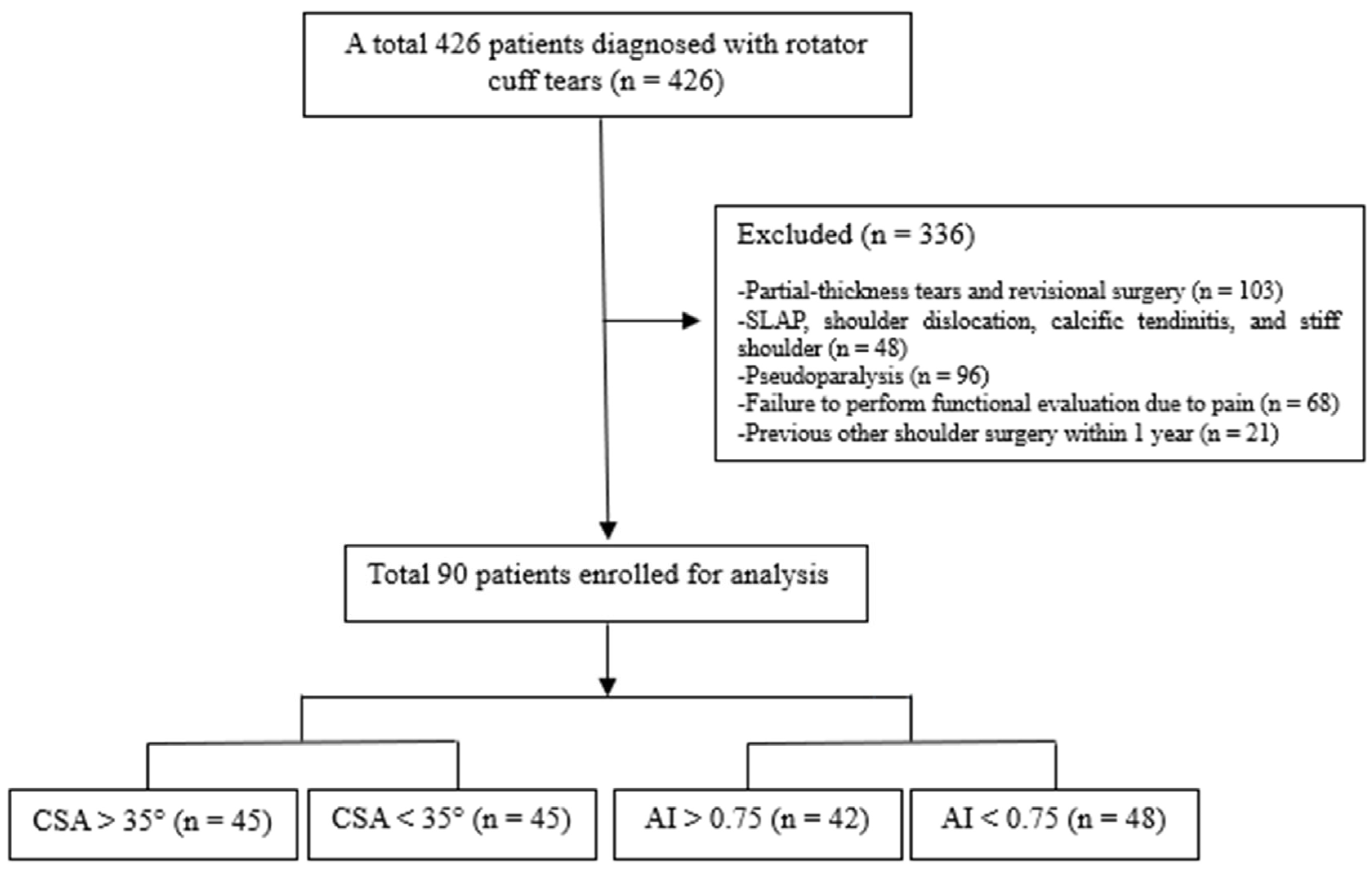
| CSA > 35° (n = 45) | CSA < 35° (n = 45) | p-value | |
| Sex (male/female) | 11/34 | 16/29 | 0.358 |
| Age (y) | 65.5 ± 8.5 | 67.0 ± 8.0 | 0.644 |
| Height | 158.9 ± 8.6 | 160.8 ± 8.7 | 0.281 |
| Weight | 63.0 ± 9.2 | 64.0 ± 11.9 | 0.647 |
| Body mass index (kg/m2) | 24.9 ± 3.2 | 24.6 ± 2.6 | 0.525 |
| Injured arm (right/left) | 38/7 | 30/15 | 0.085 |
| Dominant arm (right/left) | 45/0 | 44/1 | 1.0 |
| Visual Analogue Scale (pain) | 6.8 ± 0.3 | 6.7 ± 0.1 | 1.0 |
| Subscapularis tears (n: I, IIA, IIB, III, IV, and V) | 8, 7, 5, 0, 1,0 | 9, 8, 3, 0, 0 | 0.943 |
| Tear size | 2.3 ± 1.6 | 2.1 ± 0.9 | 0.919 |
| Fatty degeneration (n: O, I, II, III, and IV) | |||
| Supraspinatus | 13, 11, 12, 9, 0 | 14, 5, 20, 4, 2 | 0.084 |
| Infraspinatus | 15, 20, 5, 5, 0 | 27, 12, 4, 2, 0 | 0.078 |
| Teres minor | 40, 5, 0, 0, 0 | 36, 7, 2, 0, 0 | 0.280 |
| Subscapularis | 33, 7, 5, 0, 0 | 40, 4, 1, 0, 0 | 0.125 |
| AI > 0.75 (n = 42) | AI < 0.75 (n = 48) | p-value | |
| Sex (male/female) | 11/31 | 16/32 | 0.262 |
| Age (y) | 66.7 ± 8.3 | 65.4 ± 8.5 | 0.475 |
| Height | 159.2 ± 8.4 | 162.5 ± 8.4 | 0.065 |
| Weight | 61.7 ± 8.2 | 64.7 ± 9.3 | 0.105 |
| Body mass index (kg/m2) | 24.7 ± 3.2 | 25.0 ± 2.7 | 0.643 |
| Injured arm (right/left) | 32/10 | 36/12 | 0.811 |
| Dominant arm (right/left) | 42/0 | 47/1 | 1.0 |
| Visual Analogue Scale (pain) | 6.5 ± 0.2 | 6.9 ± 0.1 | 0.297 |
| Subscapularis tears (n: I, IIA, IIB, III, IV, and V) | 10, 8, 5, 0, 0 | 7, 7, 3, 1, 0 | 0.680 |
| Tear size | 2.2 ± 1.9 | 2.0 ± 0.8 | 0.767 |
| Fatty degeneration (n: O, I, II, III, and IV) | |||
| Supraspinatus | 13, 8, 14, 7, 0 | 14, 8, 18, 6, 2 | 0.751 |
| Infraspinatus | 15, 19, 4, 4, 0 | 27, 13, 5, 3, 0 | 0.141 |
| Teres minor | 38, 3, 1, 0, 0 | 38, 9, 1, 0, 0 | 0.271 |
| Subscapularis | 31, 6, 5, 0, 0 | 42, 5, 1, 0, 0 | 0.133 |
| CSA | AI | |||
|---|---|---|---|---|
| Parameters | PCC (r) | p-Value | PCC (r) | p-Value |
| IR endurance | −0.440 | 0.023 * | −0.239 | 0.023 * |
| ER endurance | −0.490 | 0.006 * | −0.329 | 0.002 * |
| UCLA score | - | - | −0.243 | 0.021 * |
| Dependent Variables | Predictor | Standardized Coefficients | ||||
|---|---|---|---|---|---|---|
| B | Error | β | t | p-Value | ||
| ER endurance | CSA | −3.211 | 1.624 | −0.287 | −1.978 | 0.053 |
| AI | −17.204 | 7.920 | −0.531 | −2.172 | 0.032 | |
| Sex | −47.566 | 13.904 | −0.341 | −3.421 | 0.001 | |
| Age | −1.498 | 0.770 | −0.193 | −1.946 | 0.055 | |
| Tear size | −1.035 | 5.101 | −0.020 | −0.203 | 0.840 | |
| Goutallier SSP | 9.503 | 10.154 | 0.166 | 0.936 | 0.352 | |
| Goutallier ISP | −7.427 | 17.975 | −0.106 | −0.413 | 0.681 | |
| Goutallier TM | 2.167 | 23.977 | 0.014 | 0.090 | 0.928 | |
| Goutallier SSC | 2.834 | 20.175 | 0.024 | 0.140 | 0.889 | |
| UCLA score | CSA | −1.466 | 1.470 | −0.161 | −0.997 | 0.322 |
| AI | −3.269 | 1.591 | −0.556 | −2.055 | 0.039 | |
| Sex | −1.395 | 1.252 | −0.124 | −1.114 | 0.269 | |
| Age | −0.005 | 0.069 | −0.008 | −0.077 | 0.939 | |
| Tear size | −0.140 | 0.459 | −0.034 | −0.305 | 0.762 | |
| Goutallier SSP | −0.643 | 0.915 | −0.139 | −0.703 | 0.484 | |
| Goutallier ISP | 2.092 | 1.619 | 0.370 | 1.292 | 0.200 | |
| Goutallier TM | −4.798 | 2.160 | −0.373 | −2.222 | 0.029 | |
| Goutallier SSC | 0.828 | 1.817 | 0.086 | 0.456 | 0.650 | |
Disclaimer/Publisher’s Note: The statements, opinions and data contained in all publications are solely those of the individual author(s) and contributor(s) and not of MDPI and/or the editor(s). MDPI and/or the editor(s) disclaim responsibility for any injury to people or property resulting from any ideas, methods, instructions or products referred to in the content. |
© 2026 by the authors. Licensee MDPI, Basel, Switzerland. This article is an open access article distributed under the terms and conditions of the Creative Commons Attribution (CC BY) license.
Share and Cite
Lee, J.H.; Lee, G.B.; Pyun, S.W.; Chung, W.Y.; Wang, J.W.; Song, D.; Jeong, W.K. The Acromial Index, but Not the Critical Shoulder Angle, Affects Functional and Clinical Outcomes in Patients with Rotator Cuff Tears. Diagnostics 2026, 16, 142. https://doi.org/10.3390/diagnostics16010142
Lee JH, Lee GB, Pyun SW, Chung WY, Wang JW, Song D, Jeong WK. The Acromial Index, but Not the Critical Shoulder Angle, Affects Functional and Clinical Outcomes in Patients with Rotator Cuff Tears. Diagnostics. 2026; 16(1):142. https://doi.org/10.3390/diagnostics16010142
Chicago/Turabian StyleLee, Jin Hyuck, Gyu Bin Lee, Sang Woo Pyun, Woo Yong Chung, Ji Won Wang, Dongik Song, and Woong Kyo Jeong. 2026. "The Acromial Index, but Not the Critical Shoulder Angle, Affects Functional and Clinical Outcomes in Patients with Rotator Cuff Tears" Diagnostics 16, no. 1: 142. https://doi.org/10.3390/diagnostics16010142
APA StyleLee, J. H., Lee, G. B., Pyun, S. W., Chung, W. Y., Wang, J. W., Song, D., & Jeong, W. K. (2026). The Acromial Index, but Not the Critical Shoulder Angle, Affects Functional and Clinical Outcomes in Patients with Rotator Cuff Tears. Diagnostics, 16(1), 142. https://doi.org/10.3390/diagnostics16010142

