Figure 1.
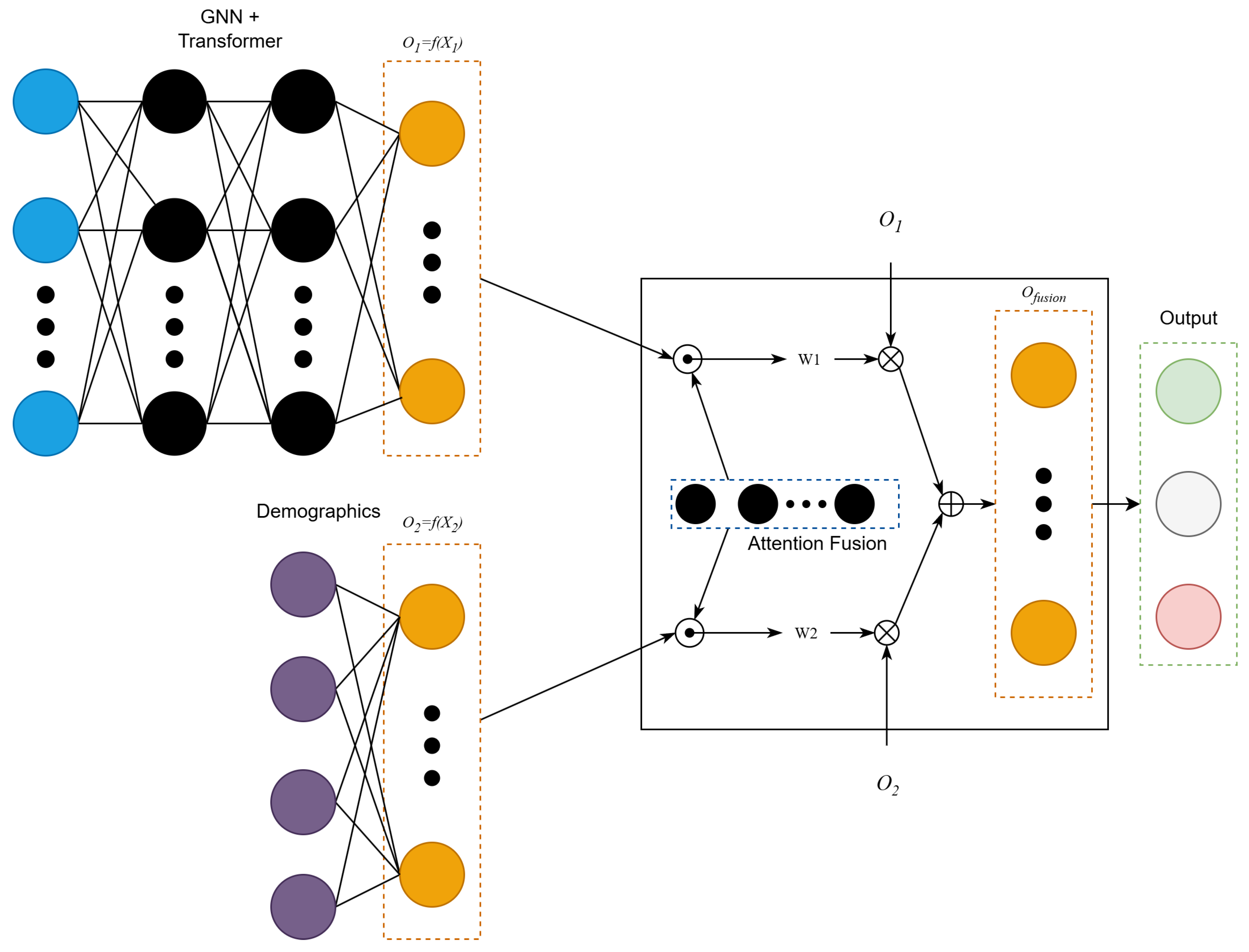
The GNN and Transformer reduce 310 EEG-derived DE features to a 16-dimensional vector (). Demographic features (age, sex, nationality) are projected from 4 to 16 dimensions (). An attention module learns weights and to fuse and before classification.
Figure 1.
The GNN and Transformer reduce 310 EEG-derived DE features to a 16-dimensional vector (). Demographic features (age, sex, nationality) are projected from 4 to 16 dimensions (). An attention module learns weights and to fuse and before classification.
Figure 2.
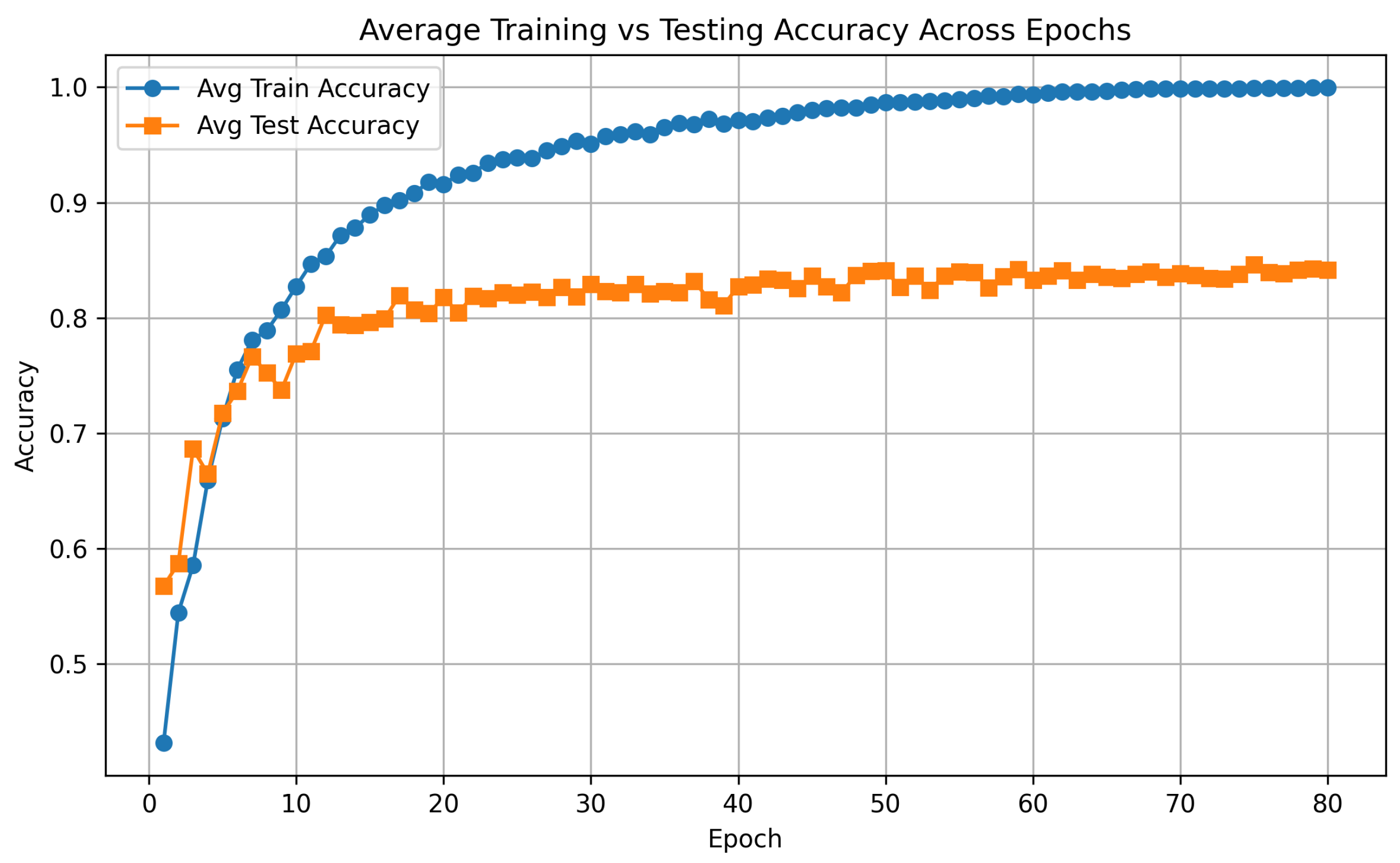
Training and testing accuracy averaged over all subjects per-epoch across 80 epochs.
Figure 2.
Training and testing accuracy averaged over all subjects per-epoch across 80 epochs.
Figure 3.
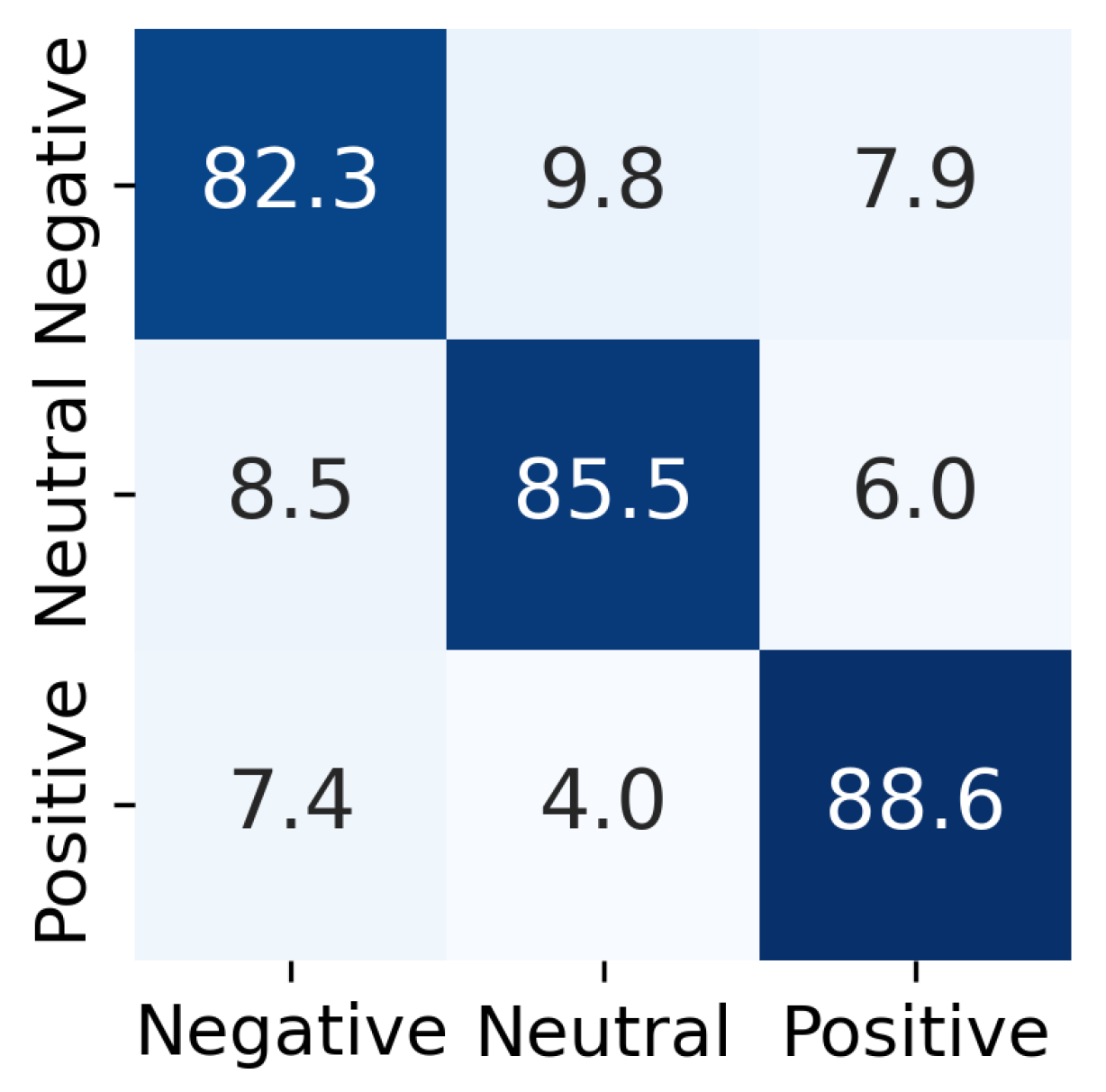
Confusion matrix for the extended model.
Figure 3.
Confusion matrix for the extended model.
Figure 4.
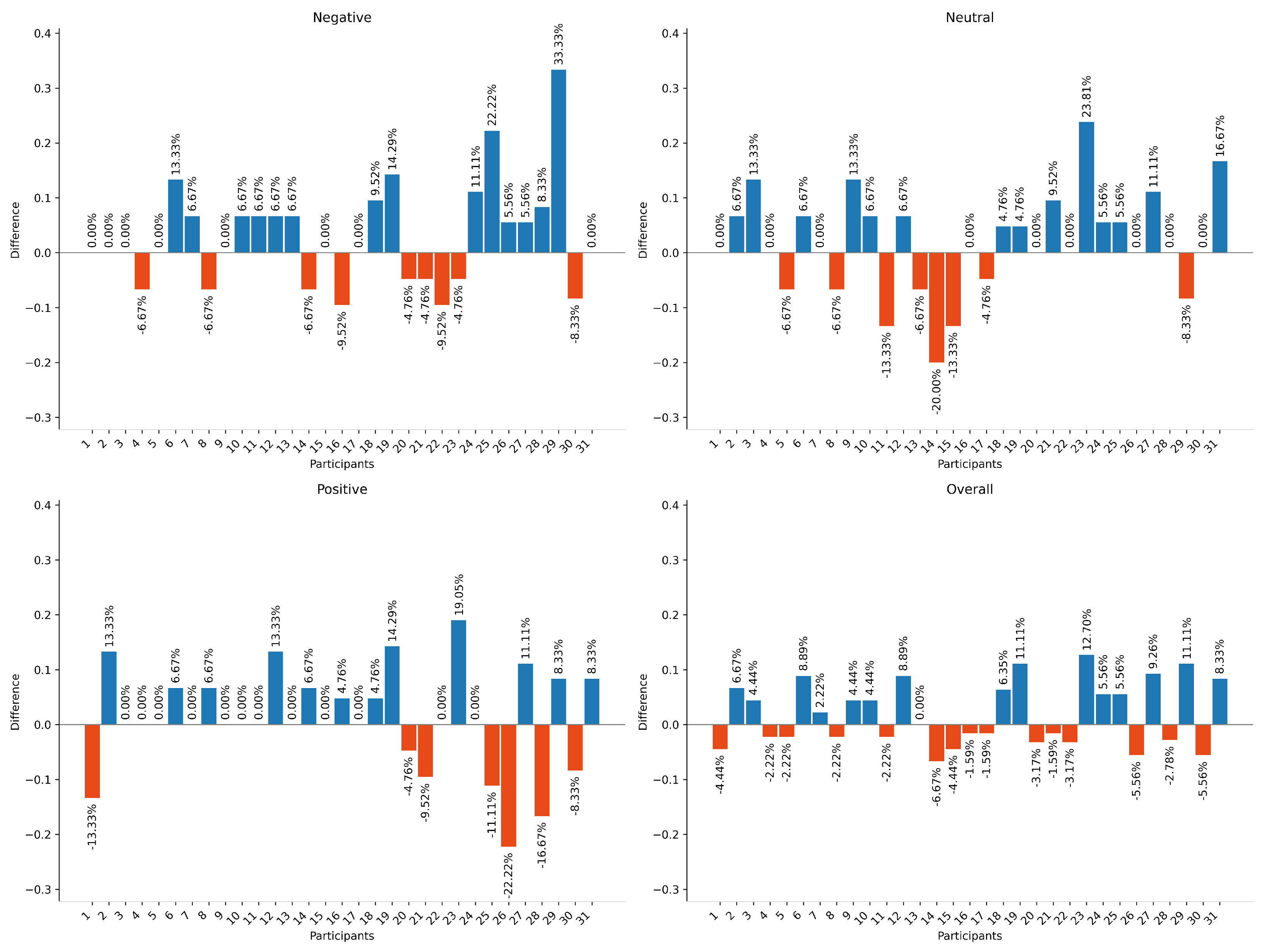
Performance differences between the extended and baseline models in predicting negative, neutral, positive, and overall emotions. Blue bars represent improvements in prediction accuracy after incorporating demographic information, while red bars indicate a reduction in performance.
Figure 4.
Performance differences between the extended and baseline models in predicting negative, neutral, positive, and overall emotions. Blue bars represent improvements in prediction accuracy after incorporating demographic information, while red bars indicate a reduction in performance.
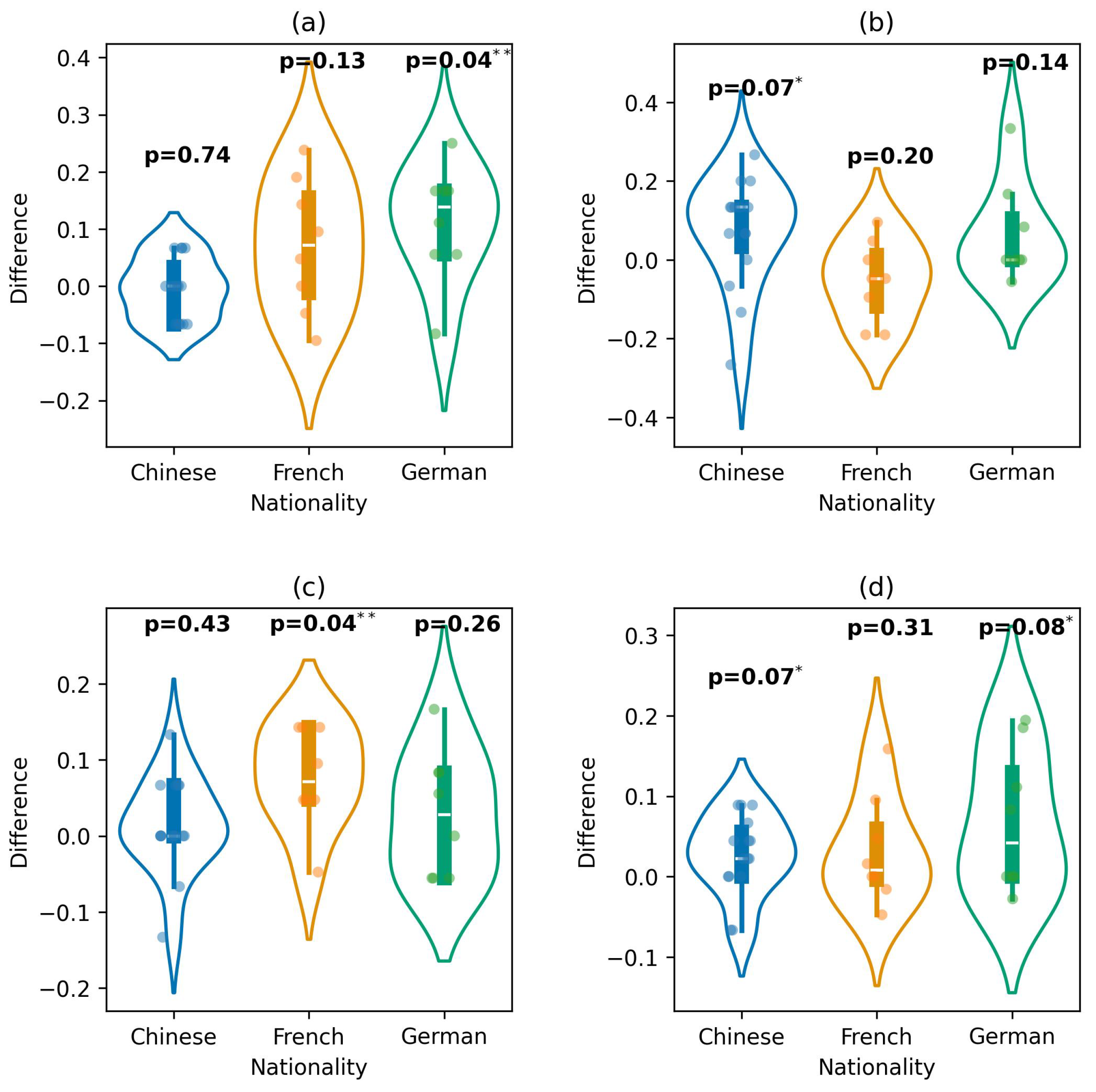
Figure 5.
Performance difference between the extended and baseline models across nationality groups for predicting: (a) negative, (b) neutral, (c) positive, and (d) overall emotions (* p-value < 0.1; ** p-value < 0.05).
Figure 5.
Performance difference between the extended and baseline models across nationality groups for predicting: (a) negative, (b) neutral, (c) positive, and (d) overall emotions (* p-value < 0.1; ** p-value < 0.05).
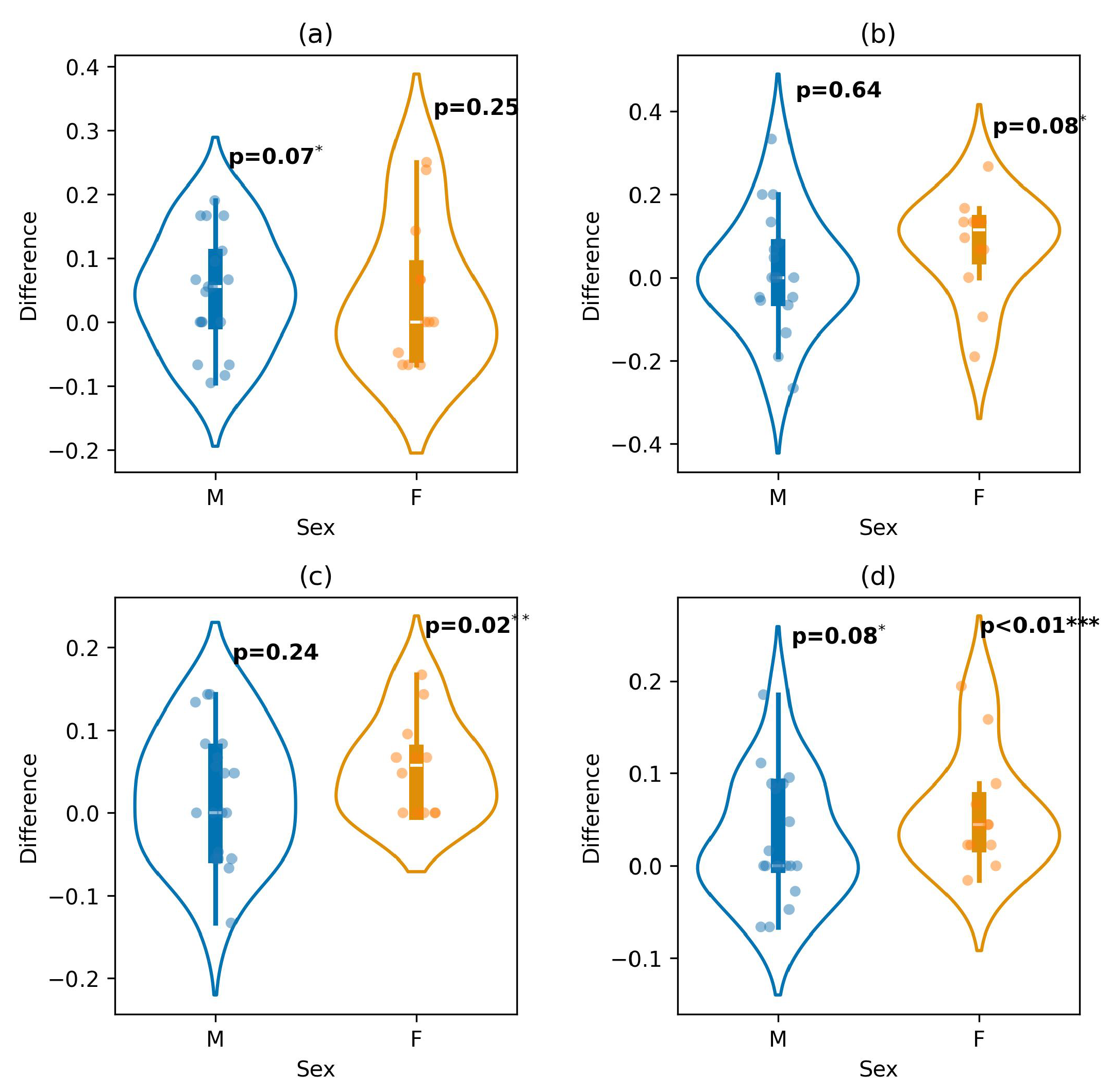
Figure 6.
Performance difference between the extended and baseline models across sex groups for predicting: (a) negative, (b) neutral, (c) positive, and (d) overall emotions (* p-value < 0.1; ** p-value < 0.05; *** p-value < 0.01).
Figure 6.
Performance difference between the extended and baseline models across sex groups for predicting: (a) negative, (b) neutral, (c) positive, and (d) overall emotions (* p-value < 0.1; ** p-value < 0.05; *** p-value < 0.01).
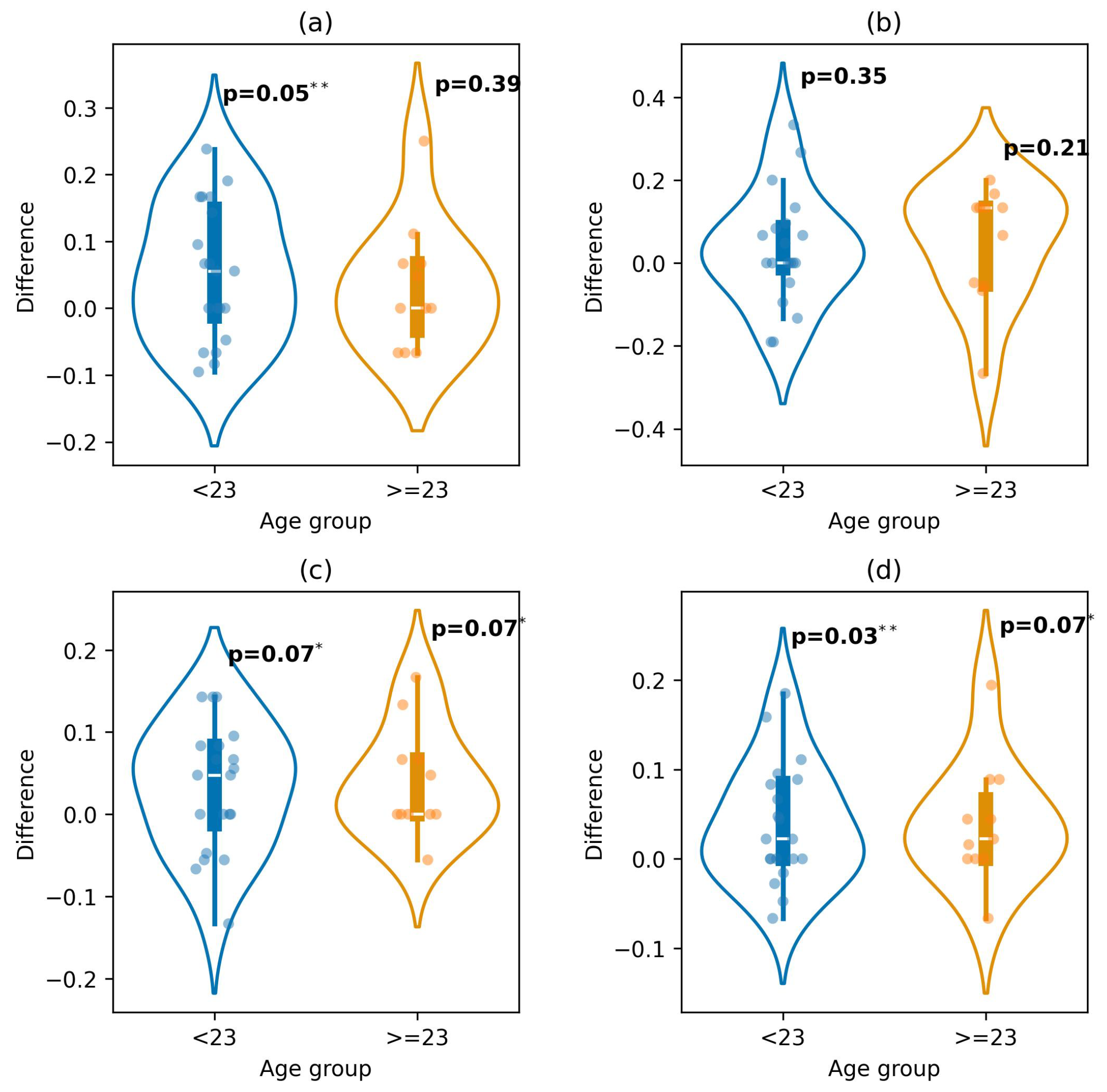
Figure 7.
Performance difference between the extended and baseline models across age groups for predicting: (a) negative, (b) neutral, (c) positive, and (d) overall emotions (* p-value < 0.1; ** p-value < 0.05).
Figure 7.
Performance difference between the extended and baseline models across age groups for predicting: (a) negative, (b) neutral, (c) positive, and (d) overall emotions (* p-value < 0.1; ** p-value < 0.05).
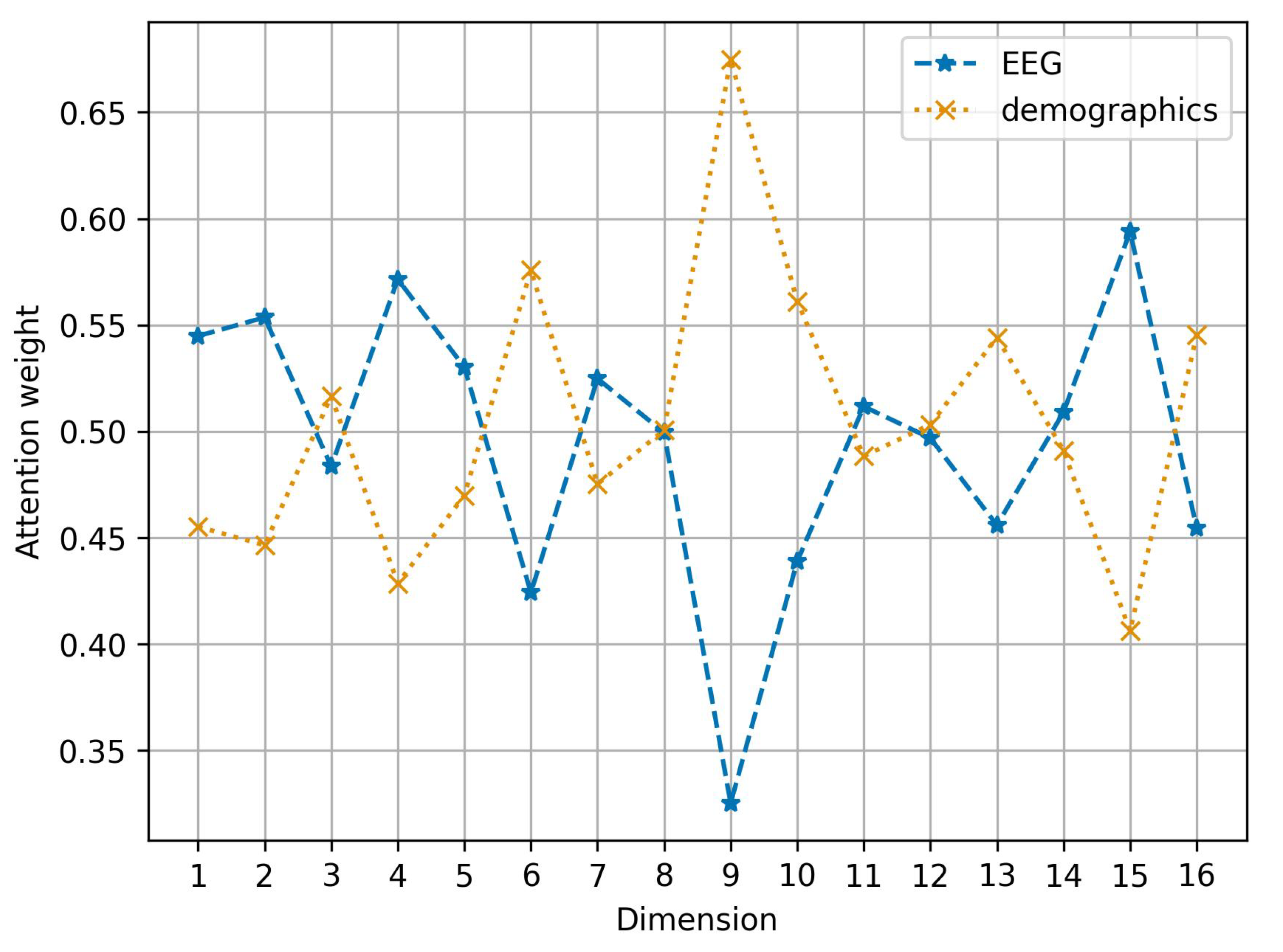
Figure 8.
Average weights ( for EEG features and for demographic features) for the 16 dimension of the attention fusing model.
Figure 8.
Average weights ( for EEG features and for demographic features) for the 16 dimension of the attention fusing model.
Figure 9.
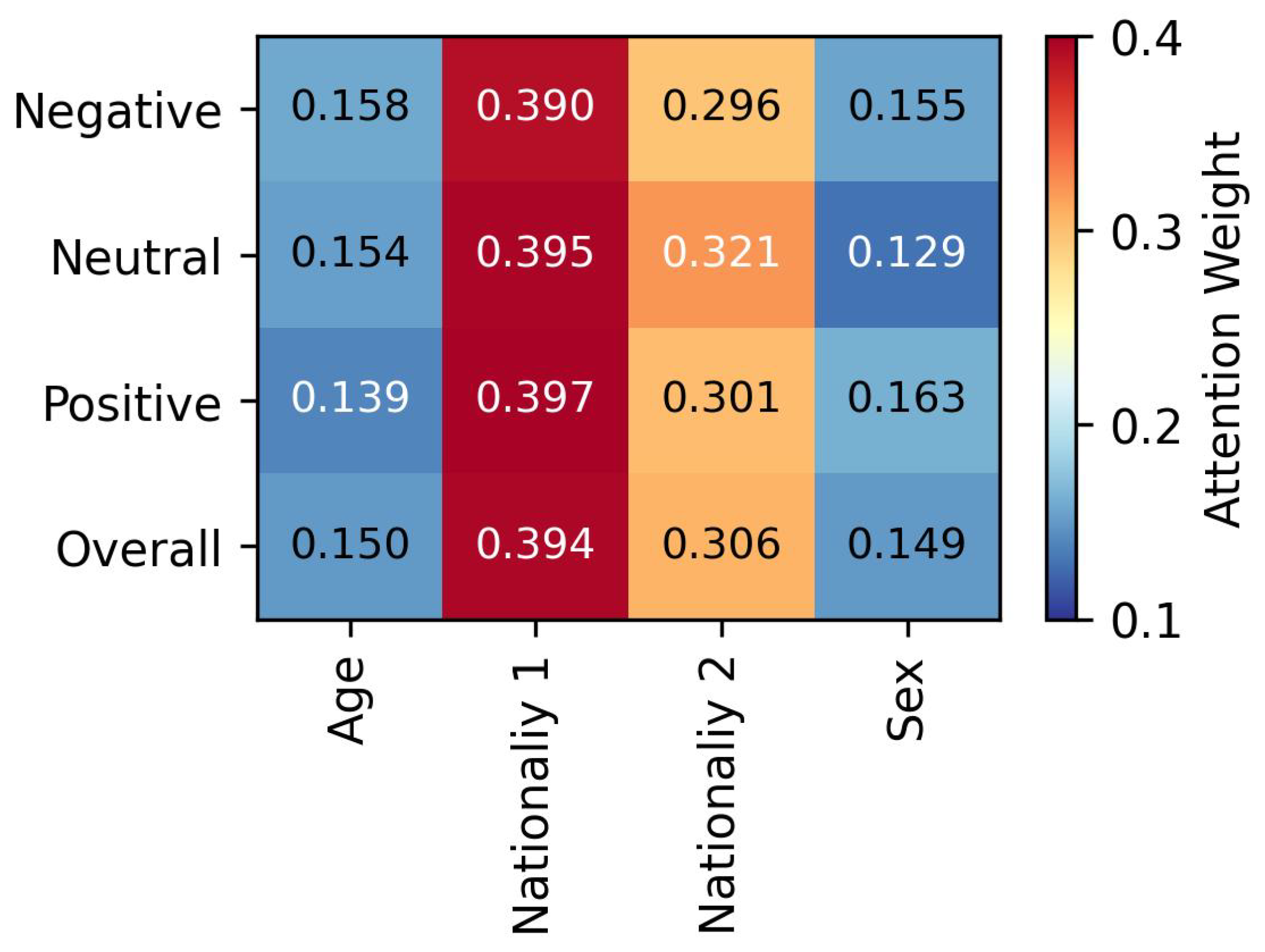
Average attention weights (scaled by ) assigned to the four demographic variables across emotion categories. Higher values (red tones) indicate greater relative importance of the demographic feature in emotion prediction.
Figure 9.
Average attention weights (scaled by ) assigned to the four demographic variables across emotion categories. Higher values (red tones) indicate greater relative importance of the demographic feature in emotion prediction.
Table 1.
Summary of related work on demographic-aware EEG-based emotion recognition.
Table 1.
Summary of related work on demographic-aware EEG-based emotion recognition.
| Study | Dataset/Subjects | Demographic Factors | Method/Experimental Design | Key Findings |
|---|
| Li et al. (2022) [23] | SEED (same nationality) | Age, Sex | Demographic variables appended at final layer of deep network under subject-independent setting | Age + sex improved recognition performance; cultural factors not considered |
| Peng et al. (2023) [24] | SEED (Chinese subjects) | Sex | Compared same-sex vs. cross-sex training/testing workflows | Same-sex models outperformed cross-sex models; demographic mismatch degrades performance |
| Liu et al. (2022) [25] | SEED, SEED-GER, SEED-FRA | Nationality | Compared within-nationality vs. cross-nationality deep learning pipelines | Models trained/tested on same nationality achieved highest accuracy; cultural background affects emotion-related EEG patterns |
| Sheoran et al. (2025a) [26] | SEED-family | Sex, Age, Nationality | Demographic-informed model using auxiliary metadata fusion | Including sex, age, nationality increased likelihood of correct prediction |
| Sheoran et al. (2025b) [27] | SEED-family | Sex, Age, Nationality | Evaluated demographic-dependent architectures under subject-independent setup | Biological sex and nationality strongly affect model generalization |
Table 2.
Descriptions of the SEED, SEED-FRA, and SEED-GER datasets. For each dataset, the total number of subjects, number of EEG recordings per subject, nationality, male/female ratio, and average subject age are provided.
Table 2.
Descriptions of the SEED, SEED-FRA, and SEED-GER datasets. For each dataset, the total number of subjects, number of EEG recordings per subject, nationality, male/female ratio, and average subject age are provided.
| Dataset | Subjects | EEG per Subject | Nationality | Male/Female | Average Age |
|---|
| SEED [34] | 15 | 45 | Chinese | 7/8 | 23.27 |
| SEED-FRA [25] | 8 | 63 | French | 5/3 | 22.50 |
| SEED-GER [25] | 8 | 54 | German | 7/1 | 22.25 |
Table 3.
Model architecture summary. Abbrev.: B = batch, W = windows, N = 62 nodes, F = 5 features, g = graph feat dim, h = LSTM hidden.
Table 3.
Model architecture summary. Abbrev.: B = batch, W = windows, N = 62 nodes, F = 5 features, g = graph feat dim, h = LSTM hidden.
| Model | Layers/Modules | Input → Output | Key Dims |
|---|
| CNN | 2 × Conv2D + MaxPool + FC | | 32/64 filters; pool 2 × 1; drop 0.2 |
| GNN | GraphConv + FC | | ; ReLU + LayerNorm; drop 0.3 |
| GNN + LSTM | GraphConv + BiLSTM + FC | | ; (bi, concat); drop 0.3 |
| GNN + Transf. (no demo) | GraphConv + Transformer + FC | | ; heads = H; 1 layer |
| GNN + Transf. (demo) | GraphConv + Transformer + Fusion + FC | + | ; heads = H; 1 layer; fusion: Attn(16) |
Table 4.
Hyperparameters for the CNN, GNN, GNN + LSTM, and GNN + Transformer.
Table 4.
Hyperparameters for the CNN, GNN, GNN + LSTM, and GNN + Transformer.
| Model | Epochs | Learning Rate | Optimizer | Weight Decay |
|---|
| CNN | 30 | 0.001 | SGD | 0 |
| GNN | 50 | 0.01 | SGD | 0 |
| GNN + LSTM | 80 | 0.001 | AdamW | 0.1 |
| GNN + Transformer | 80 | 0.001 | AdamW | 0.1 |
Table 5.
Performance per class of the CNN, GNN, GNN + LSTM, and GNN + Transformer for Approach 1.
Table 5.
Performance per class of the CNN, GNN, GNN + LSTM, and GNN + Transformer for Approach 1.
| Model | Negative (%) | Neutral (%) | Positive (%) |
|---|
| CNN | 59 | 51 | 69 |
| GNN | 78 | 53 | 52 |
| GNN + LSTM | 73 | 87 | 80 |
| GNN + Transformer | 79 | 80 | 86 |
Table 6.
Overall Performance of the CNN, GNN, GNN + LSTM, and GNN + Transformer for Approach 1.
Table 6.
Overall Performance of the CNN, GNN, GNN + LSTM, and GNN + Transformer for Approach 1.
| Model | Accuracy (%) | Macro F1-Score (%) | Macro AUC (%) |
|---|
| CNN | 60 | 62 | 80 |
| GNN | 61 | 63 | 81 |
| GNN + LSTM | 80 | 80 | 91 |
| GNN + Transformer | 82 | 82 | 93 |
Table 7.
Recall, Precision, and F1-score macro for the extended model. For each metric, the mean, standard deviation (SD), and 95% confidence interval (CI) is provided.
Table 7.
Recall, Precision, and F1-score macro for the extended model. For each metric, the mean, standard deviation (SD), and 95% confidence interval (CI) is provided.
| Metric | Recall (%) | Precision (%) | Macro F1-Score (%) |
|---|
| Mean | 85.5 | 86.2 | 85.4 |
| SD | 8.3 | 8.0 | 8.4 |
| Lower CI | 82.4 | 83.3 | 82.3 |
| Upper CI | 88.5 | 89.2 | 88.5 |
Table 8.
95% confidence intervals for the difference between the extended and baseline models for negative, neutral, positive, and overall emotion prediction. * indicates p < 0.05.
Table 8.
95% confidence intervals for the difference between the extended and baseline models for negative, neutral, positive, and overall emotion prediction. * indicates p < 0.05.
| Type | Lower CI (%) | Upper CI (%) | p-Value |
|---|
| Negative | 1.1 | 7.9 | 0.033 * |
| Neutral | −0.9 | 8.4 | 0.103 |
| Positive | 0.9 | 5.9 | 0.013 * |
| Overall | 1.6 | 6.1 | 0.004 * |
Table 9.
Ablation study assessing the impact of removing each demographic variable from the extended approach. The Receiver Operating Characteristic Area Under the Curve (ROC-AUC) is reported for each emotion. The minus are used to indicate that the feature was not included.
Table 9.
Ablation study assessing the impact of removing each demographic variable from the extended approach. The Receiver Operating Characteristic Area Under the Curve (ROC-AUC) is reported for each emotion. The minus are used to indicate that the feature was not included.
| Model | Negative (%) | Neutral (%) | Positive (%) | Overall (%) |
|---|
| All features | 92.2 | 94 | 95.7 | 94.0 |
| - age | 93.1 | 94.5 | 95.1 | 94.3 |
| - nationality | 91.7 | 93.7 | 93.8 | 93.1 |
| - sex | 92.4 | 94.4 | 95.6 | 94.1 |
Table 10.
Concise comparison of prior methods and our approach on SEED, SEED-FRA, and SEED-GER datasets. Performance reported as accuracy (Acc.) and standard deviation (SD).
Table 10.
Concise comparison of prior methods and our approach on SEED, SEED-FRA, and SEED-GER datasets. Performance reported as accuracy (Acc.) and standard deviation (SD).
| Demographic Variable | Reference | Dataset | Performance (Acc./SD) |
|---|
| Nationality | KNN [25] | SEED | 54.1/8.7 |
| | SEED-FRA | 37.2/6.8 |
| | SEED-GER | 41.0/7.4 |
| SVM [25] | SEED | 72.6/10.5 |
| | SEED-FRA | 50.1/10.3 |
| | SEED-GER | 55.6/12.2 |
| LR [25] | SEED | 68.4/11.7 |
| | SEED-FRA | 47.2/12.2 |
| | SEED-GER | 50.4/10.9 |
| DNN [25] | SEED | 82.8/7.5 |
| | SEED-FRA | 64.2/8.6 |
| | SEED-GER | 65.9/10.1 |
| DL-LR [27] | SEED | 77.2/5.3 |
| | SEED-FRA | 73.0/5.0 |
| | SEED-GER | 65.6/6.0 |
| Sex | SVM [45] | SEED | 83.2/9.6 |
| BiDANN [46] | 83.2/9.6 |
| DGCNN [47] | 79.9/9.0 |
| A-LSTM [48] | 72.1/10.8 |
| IAG [49] | 86.3/6.9 |
| RGNN [50] | 85.3/6.7 |
| BiHDM [51] | 85.4/7.5 |
| GECNN [52] | 82.4/- |
| BiHDM w/o DA [53] | 81.5/9.7 |
| GMSS [53] | 86.5/6.2 |
| JD-IRT [54] | 83.2/- |
| Graph-LSTM [8] | 79.3/5.8 |
| DL-LR [26] | 81.5/7.8 |
| Sex, Age, Nationality | Ours | SEED | 85.2/5.6 |
| SEED-FRA | 78.2/7.4 |
| SEED-GER | 72.1/6.6 |