Diagnostic Accuracy of Lung Ultrasound for Pneumonia in Acutely and Critically Ill Neonates, Children, and Young Adults: A Systematic Review and Meta-Analysis

 , , , and
Abstract
1. Introduction
2. Material and Methods
2.1. Study Design and Protocol Registration
2.2. Data Sources and Search Strategy
2.3. Eligibility Criteria
2.4. Study Selection
2.5. Data Extraction and Management
- Study characteristics: Author, year, country, setting, sample size, design.
- Study design: Randomised, blinded, prospective/retrospective.
- Participant characteristics: Age range, sex, clinical setting.
- Diagnostic method details: LUS equipment and protocols, probe type, scanning zones, operator expertise, blinding procedures, follow-up.
- Outcome data: True positives, false positives, false negatives, true negatives, and statistical measures of diagnostic accuracy.
- Adverse events and other relevant findings.
2.6. Risk of Publication Bias Assessment
2.7. Statistical Analysis
3. Results
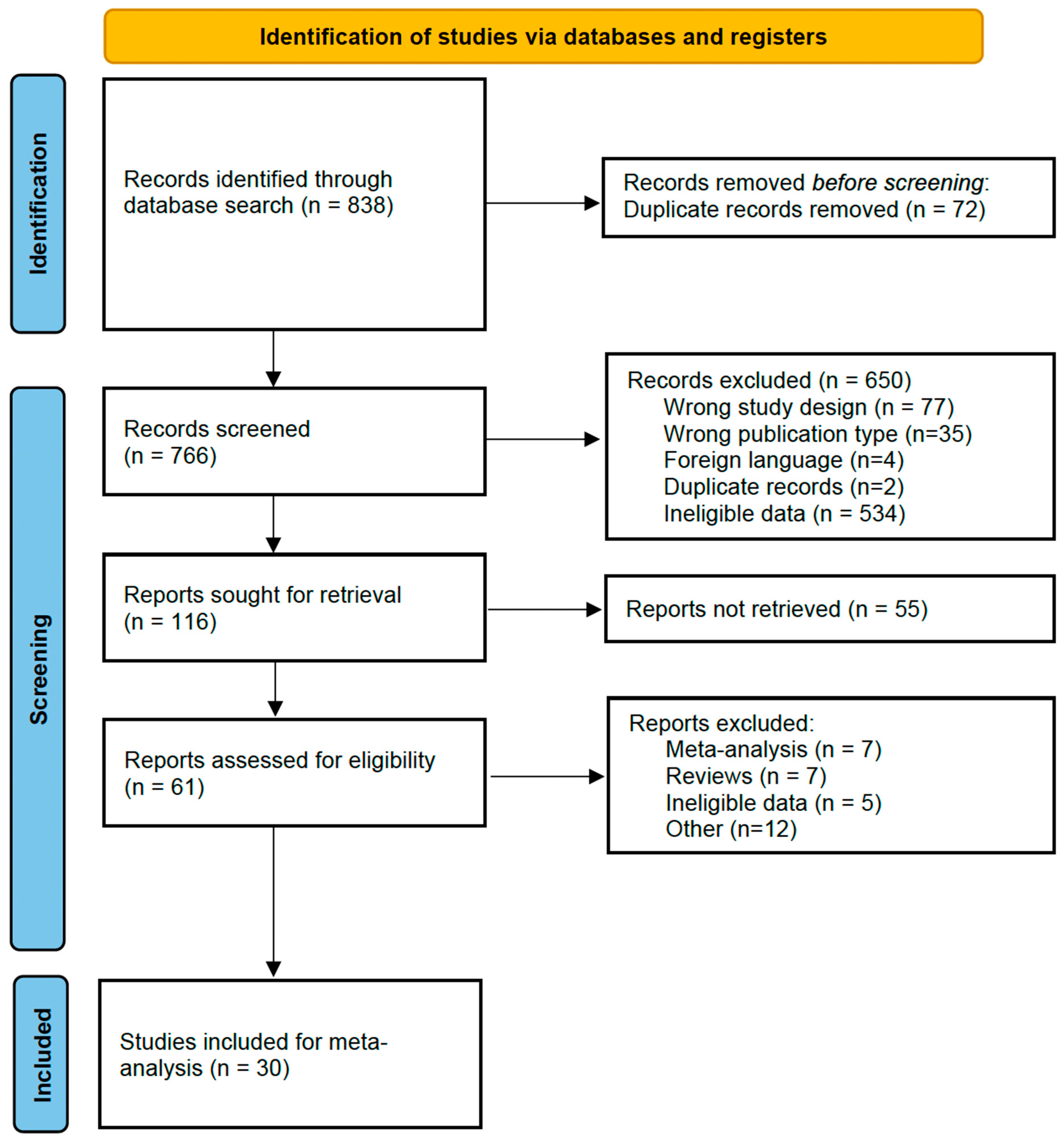
3.1. Study Selection
3.2. Characteristics of Included Studies
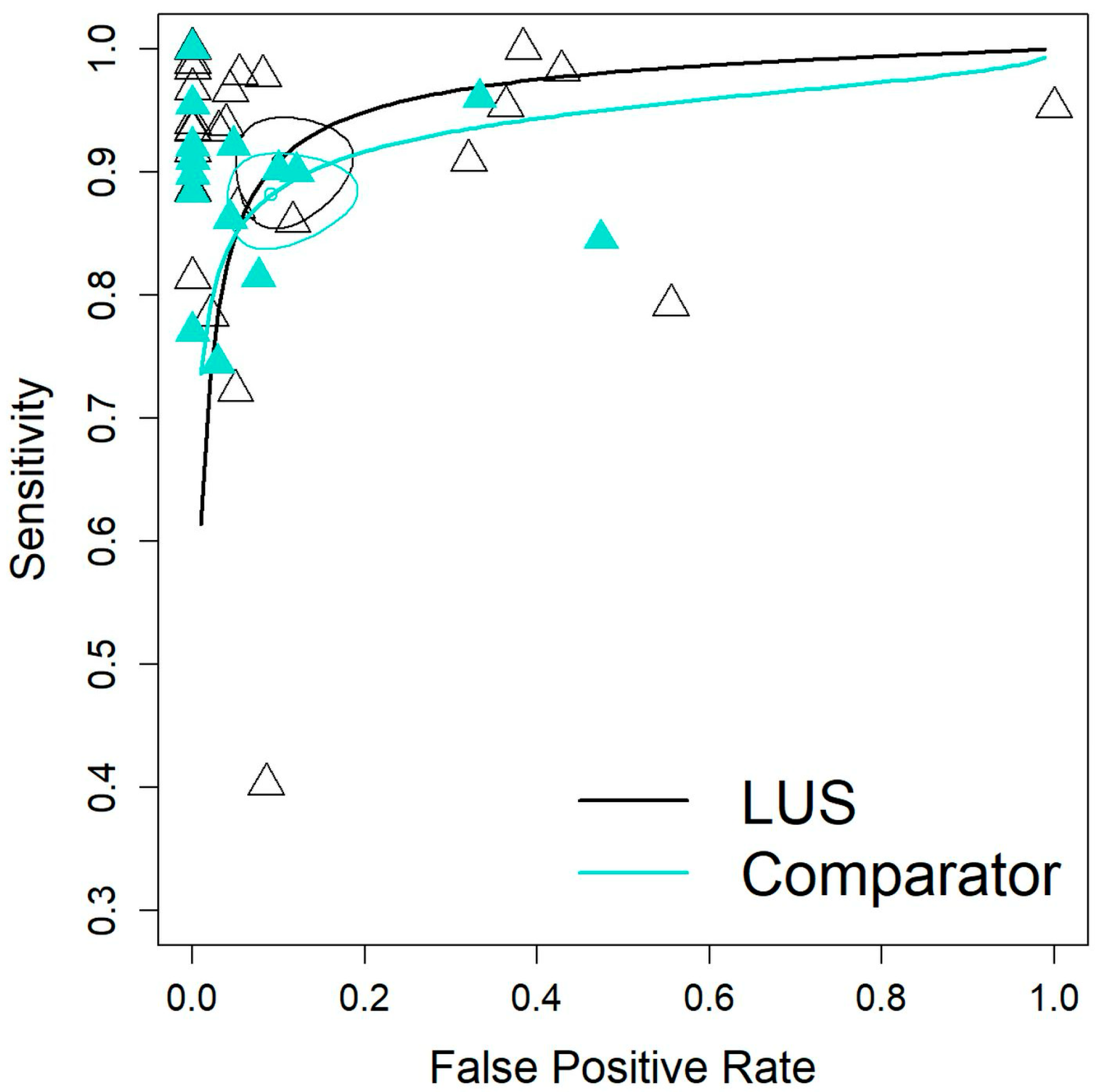
3.3. Pooled Diagnostic Accuracy
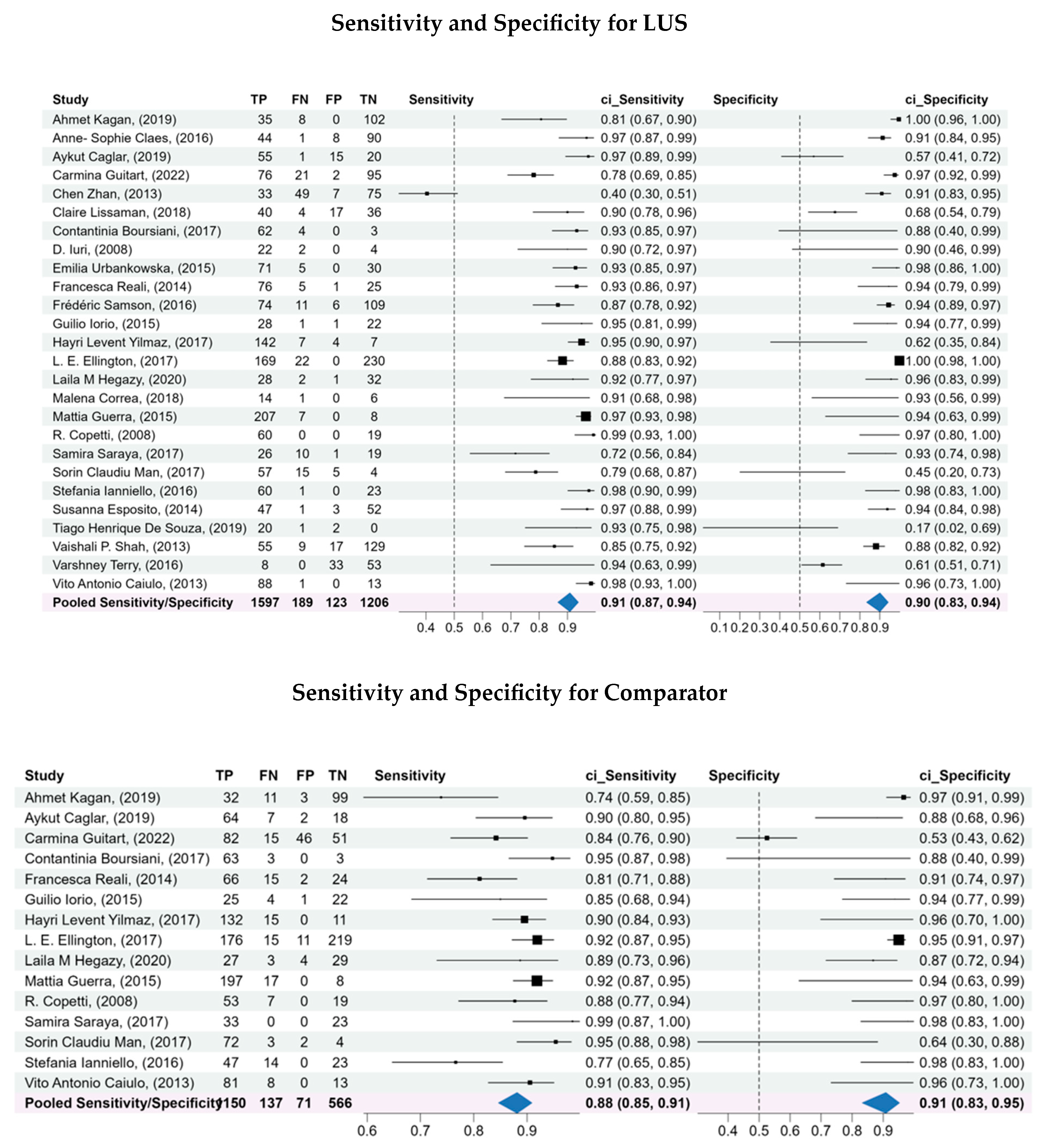
3.4. Forest Plot Analysis
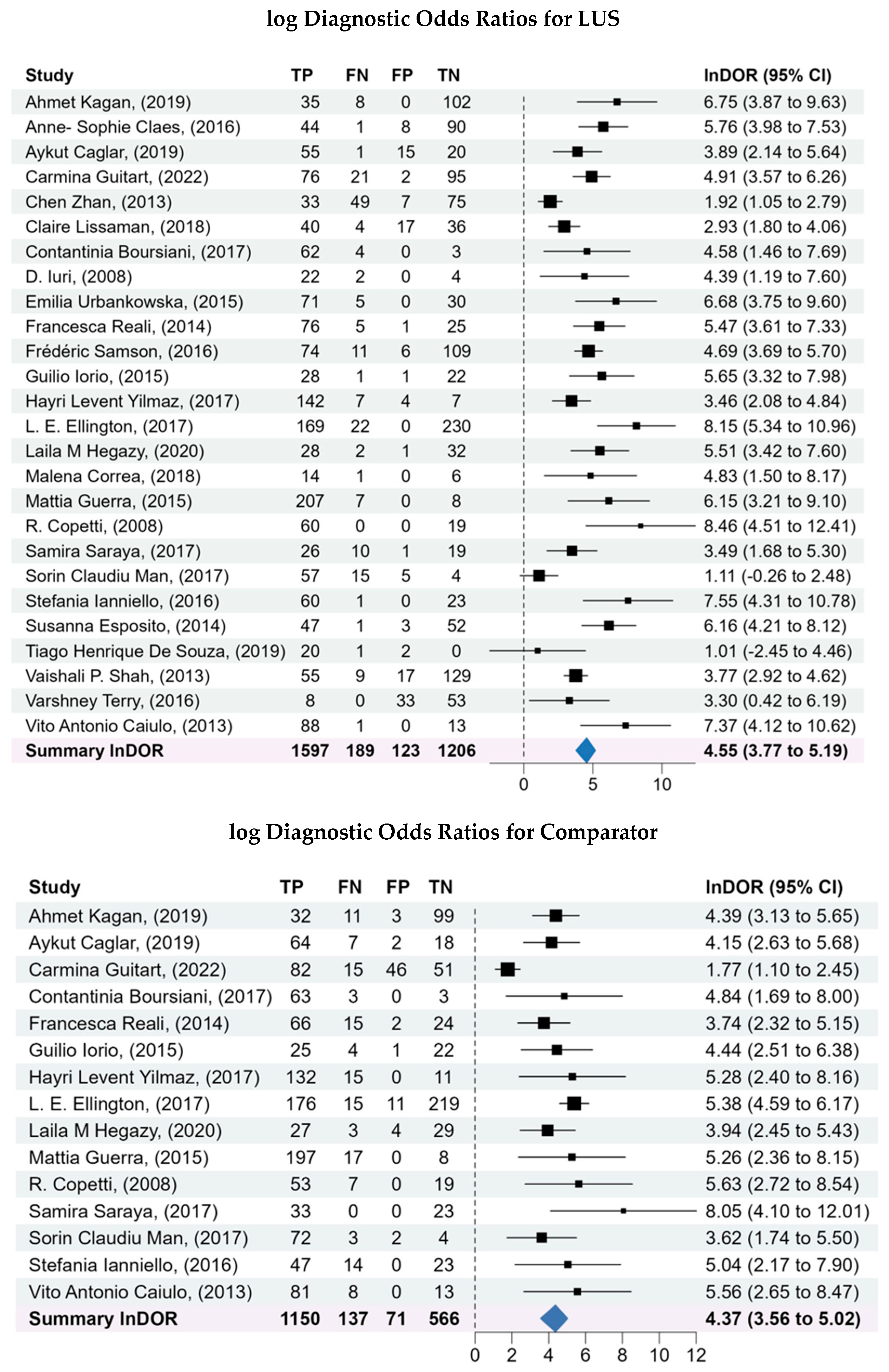
3.5. Diagnostic Odds Ratios (DOR)
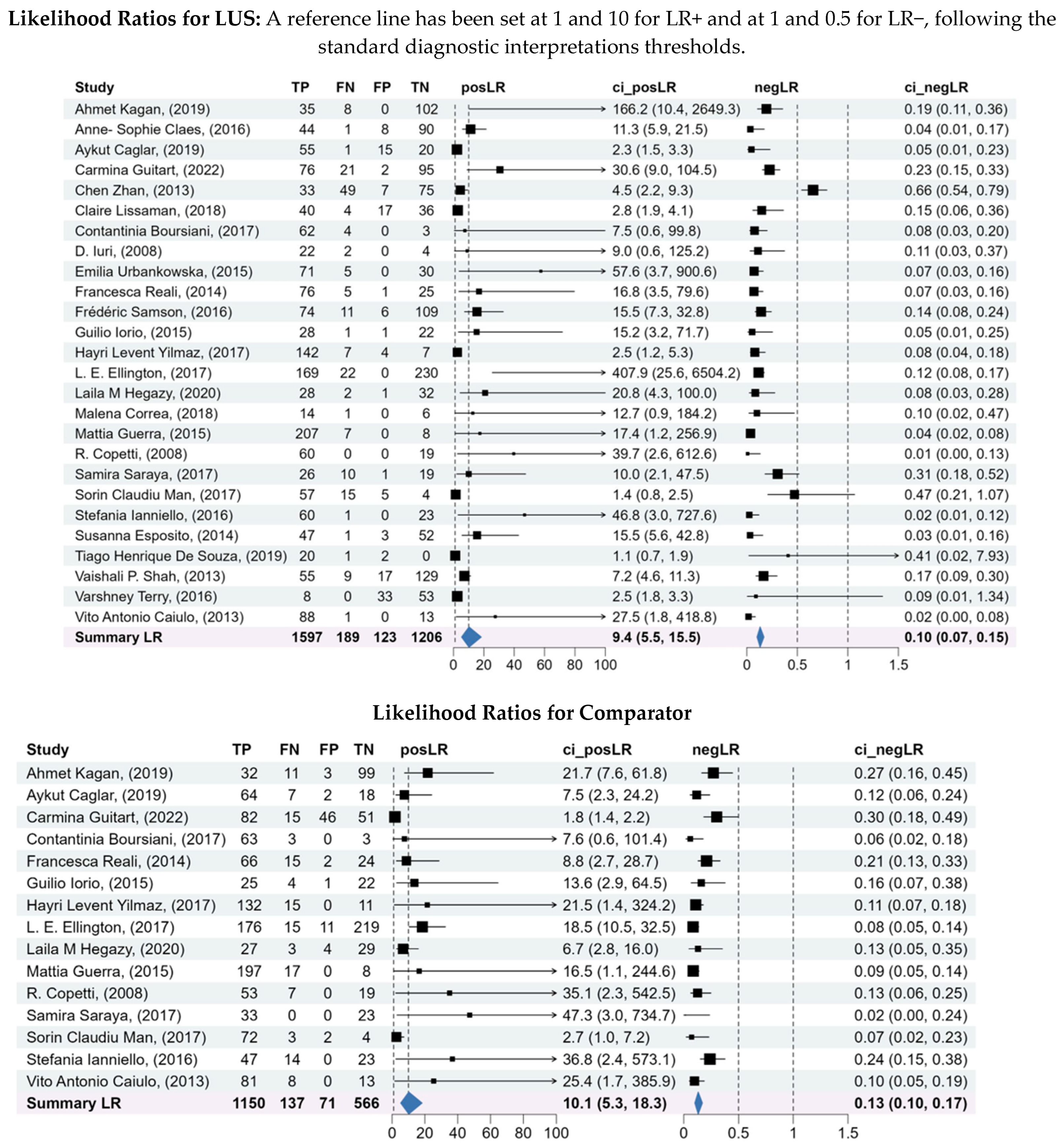
3.6. Likelihood Ratios
4. Discussion
5. Limitations
6. Conclusions
Supplementary Materials
Author Contributions
Funding
Institutional Review Board Statement
Informed Consent Statement
Data Availability Statement
Acknowledgments
Conflicts of Interest
References
- Pereda, M.A.; Chavez, M.A.; Hooper-Miele, C.C.; Gilman, R.H.; Steinhoff, M.C.; Ellington, L.E.; Gross, M.; Price, C.; Tielsch, J.M.; Checkley, W. Lung ultrasound for the diagnosis of pneumonia in children: A meta-analysis. Pediatr. Am. Acad. Pediatr. 2015, 135, 714–722. [Google Scholar] [CrossRef]
- World Health Organization. Pneumonia in Children. 2022. Available online: www.who.int/news-room/fact-sheets/detail/pneumonia (accessed on 1 January 2024).
- UNICEF Data. Pneumonia. 2023. Available online: https://data.unicef.org/topic/child-health/pneumonia/#:~:text=Globally%2C%20there%20are%20over%201%2C400,1%2C620%20cases%20per%20100%2C000%20children (accessed on 1 January 2024).
- Boeddha, N.P.; Schlapbach, L.J.; Driessen, G.J.; Herberg, J.A.; Rivero-Calle, I.; Cebey-López, M.; Klobassa, D.S.; Philipsen, R.; De Groot, R.; Inwald, D.P.; et al. Mortality and morbidity in community-acquired sepsis in European pediatric intensive care units: A prospective cohort study from the European Childhood Life-threatening Infectious Disease Study (EUCLIDS). Crit Care 2018, 22, 143. [Google Scholar] [CrossRef]
- Akinkugbe, O.; Cooke, F.J.; Pathan, N. Healthcare-Associated bacterial infections in the paediatric ICU. JAC Antimicrob. Resist. 2020, 2, dlaa066. [Google Scholar] [CrossRef] [PubMed]
- Walker, C.L.F.; Rudan, I.; Liu, L.; Nair, H.; Theodoratou, E.; Bhutta, Z.A.; O’Brien, K.L.; Campbell, H.; Black, R.E. Global burden of childhood pneumonia and diarrhoea. Lancet 2013, 381, 1405–1416. [Google Scholar] [CrossRef] [PubMed]
- Prayle, A.; Atkinson, M.; Smyth, A. Pneumonia in the developed world. Paediatr. Respir. Rev. 2011, 12, 60–69. [Google Scholar] [CrossRef]
- MARKH EBELL. Clinical Diagnosis of Pneumonia in Children. Am. Fam. Physician 2010, 82, 192–193. Available online: http://www.aafp.org/afp/poc (accessed on 1 January 2024).
- Shah, S.; Sharieff, G.Q. Pediatric Respiratory Infections. Emerg. Med. Clin. N. Am. 2007, 25, 961–979. [Google Scholar] [CrossRef] [PubMed]
- Williams, G.J.; Macaskill, P.; Kerr, M.; Fitzgerald, D.A.; Isaacs, D.; Codarini, M.; McCaskill, M.; Prelog, K.; Craig, J.C. Variability and accuracy in interpretation of consolidation on chest radiography for diagnosing pneumonia in children under 5 years of age. Pediatr. Pulmonol. 2013, 48, 1195–1200. [Google Scholar] [CrossRef]
- Levinsky, Y.; Mimouni, F.B.; Fisher, D.; Ehrlichman, M. Chest radiography of acute paediatric lower respiratory infections: Experience versus interobserver variation. Acta Paediatr. 2013, 102, e310–e314. [Google Scholar] [CrossRef]
- Johnson, J.; Kline, J.A. Intraobserver and interobserver agreement of the interpretation of pediatric chest radiographs. Emerg. Radiol. 2010, 17, 285–290. [Google Scholar] [CrossRef]
- Florin, T.A.; French, B.; Zorc, J.J.; Alpern, E.R.; Shah, S.S. Variation in Emergency Department Diagnostic Testing and Disposition Outcomes in Pneumonia. Pediatrics 2013, 132, 237–244. [Google Scholar] [CrossRef]
- Bradley, J.S.; Byington, C.L.; Shah, S.S.; Alverson, B.; Carter, E.R.; Harrison, C.; Kaplan, S.L.; Mace, S.E.; McCracken, G.H.; Moore, M.R.; et al. The management of community-acquired pneumonia in infants and children older than 3 months of age: Clinical practice guidelines by the pediatric infectious diseases society and the infectious diseases society of America. Clin. Infect. Dis. 2011, 53, e25–e76. [Google Scholar] [CrossRef]
- Frush, D.P.; Donnelly, L.F.; Rosen, N.S. Computed tomography and radiation risks: What pediatric health care providers should know. Pediatrics 2003, 112, 951–957. [Google Scholar] [CrossRef] [PubMed]
- Orso, D.; Ban, A.; Guglielmo, N. Lung ultrasound in diagnosing pneumonia in childhood: A systematic review and meta-analysis. J. Ultrasound 2018, 21, 183–195. [Google Scholar] [CrossRef] [PubMed]
- Rodríguez-Fanjul, J.; Guitart, C.; Bobillo-Perez, S.; Balaguer, M.; Jordan, I. Procalcitonin and lung ultrasound algorithm to diagnose severe pneumonia in critical paediatric patients (PROLUSP study). A randomised clinical trial. Respir. Res. 2020, 21, 255. [Google Scholar] [CrossRef]
- Guitart, C.; Rodríguez-Fanjul, J.; Bobillo-Perez, S.; Carrasco, J.L.; Clemente, E.J.I.; Cambra, F.J.; Balaguer, M.; Jordan, I. An algorithm combining procalcitonin and lung ultrasound improves the diagnosis of bacterial pneumonia in critically ill children: The PROLUSP study, a randomized clinical trial. Pediatr. Pulmonol. 2022, 57, 711–723. [Google Scholar] [CrossRef]
- Ye, X.; Xiao, H.; Chen, B.; Zhang, S.Y. Accuracy of lung ultrasonography versus chest radiography for the diagnosis of adult community-acquired pneumonia: Review of the literature and meta-analysis. PLoS ONE 2015, 10, e0130066. [Google Scholar] [CrossRef]
- Whiting, P.F.; Rutjes, A.W.; Westwood, M.E.; Mallett, S.; Deeks, J.J.; Reitsma, J.B.; Leeflang, M.M.; Sterne, J.A.C.; Bossuyt, P.M.M. QUADAS-2: A Revised Tool for the Quality Assessment of Diagnostic Accuracy Studies. Ann. Intern. Med. 2011, 155, 529–536. [Google Scholar] [CrossRef]
- Ouzzani, M.; Hammady, H.; Fedorowicz, Z.; Elmagarmid, A. Rayyan—A web and mobile app for systematic reviews. Syst. Rev. 2016, 5, 210. [Google Scholar] [CrossRef] [PubMed]
- Hong, C.; Salanti, G.; Morton, S.C.; Riley, R.D.; Chu, H.; Kimmel, S.E.; Chen, Y. Discussion on “Testing small study effects in multivariate meta-analysis” by Chuan Hong, Georgia Salanti, Sally Morton, Richard Riley, Haitao Chu, Stephen E. Kimmel, and Yong Chen. Biometrics 2020, 76, 1255–1259. [Google Scholar] [CrossRef]
- Balduzzi, S.; Rücker, G.; Schwarzer, G. How to perform a meta-analysis with R: A practical tutorial. Evid. Based Ment. Health 2019, 22, 153–160. [Google Scholar] [CrossRef]
- Viechtbauer, W. Conducting Meta-Analyses in R with the metafor Package. J. Stat. Softw. 2010, 36, 1–48. [Google Scholar] [CrossRef]
- Dersimonian, R.; Laird, N. Meta-Analysis in Clinical Trials. Control Clin. Trials 1986, 7, 177–188. [Google Scholar] [CrossRef]
- Cochran, W.G. The comparison of percentages in matched sample. Biometrika 1950, 37, 256–266. [Google Scholar] [CrossRef]
- Higgins, J.P.T.; Thompson, S.G. Quantifying heterogeneity in a meta-analysis. Stat. Med. 2002, 21, 1539–1558. [Google Scholar] [CrossRef]
- Bossuyt, P.; Davenport, C.; Deeks, J.; Hyde, C.; Leeflang, M.; Scholten, R. Chapter 11 Interpreting Results and Drawing Conclusions. In Cochrane Handbook for Systematic Reviews of Diagnostic Test Accuracy Version 0.9; Deeks, J.J., Bossuyt, P.M., Gatsonis, C., Eds.; The Cochrane Collaboration: London, UK, 2013; Available online: http://srdta.cochrane.org/ (accessed on 1 January 2024).
- Reitsma, J.B.; Glas, A.S.; Rutjes, A.W.S.; Scholten, R.J.P.M.; Bossuyt, P.M.; Zwinderman, A.H. Bivariate analysis of sensitivity and specificity produces informative summary measures in diagnostic reviews. J. Clin. Epidemiol. 2005, 58, 982–990. [Google Scholar] [CrossRef] [PubMed]
- Doebler, P.; Sousa-Pinto, B. Mada: Meta-Analysis of Diagnostic Accuracy. 2022. Available online: https://CRAN.R-project.org/package=mada (accessed on 5 February 2025).
- Zwinderman, A.H.; Bossuyt, P.M. We should not pool diagnostic likelihood ratios in systematic reviews. Stat. Med. 2008, 27, 687–697. [Google Scholar] [CrossRef]
- Noma, H.; Matsushima, Y.; Ishii, R. Confidence interval for the AUC of SROC curve and some related methods using bootstrap for meta-analysis of diagnostic accuracy studies. Commun. Stat. Case Stud. Data Anal. Appl. 2021, 7, 344–358. [Google Scholar] [CrossRef]
- Rutter, C.M.; Gatsonis, C.A. A hierarchical regression approach to meta-analysis of diagnostic test accuracy evaluations. Stat. Med. 2001, 20, 2865–2884. [Google Scholar] [CrossRef] [PubMed]
- Alimu, D. Forestploter: Create a Flexible Forest Plot. 2024. Available online: https://CRAN.R-project.org/package=forestploter (accessed on 5 February 2025).
- Copetti, R.; Cattarossi, L. Diagnosi ecografica di polmonite nell’età pediatrica. Radiol. Medica 2008, 113, 190–198. [Google Scholar] [CrossRef]
- Kurian, J.; Levin, T.L.; Han, B.K.; Taragin, B.H.; Weinstein, S. Comparison of ultrasound and CT in the evaluation of pneumonia complicated by parapneumonic effusion in children. Am. J. Roentgenol. 2009, 193, 1648–1654. [Google Scholar] [CrossRef] [PubMed]
- Iuri, D.; De Candia, A.; Bazzocchi, M. Valutazione del quadro polmonare nei pazienti pediatrici con sospetto clinico di polmonite: Apporto dell’ecografia. Radiol. Medica 2009, 114, 321–330. [Google Scholar] [CrossRef]
- Shah, V.P.; Tunik, M.G.; Tsung, J.W. Prospective evaluation of point-of-care ultrasonography for the diagnosis of pneumonia in children and young adults. JAMA Pediatr. 2013, 167, 119–125. [Google Scholar] [CrossRef] [PubMed]
- Caiulo, V.A.; Gargani, L.; Caiulo, S.; Fisicaro, A.; Moramarco, F.; Latini, G.; Picano, E.; Mele, G. Lung ultrasound characteristics of community-acquired pneumonia in hospitalized children. Pediatr. Pulmonol. 2013, 48, 280–287. [Google Scholar] [CrossRef]
- Esposito, S.; Papa, S.S.; Borzani, I.; Pinzani, R.; Giannitto, C.; Consonni, D.; Principi, N. Performance of Lung Ultrasonography in Children with Community-Acquired Pneumonia. Ital. J. Pediatr. 2014, 40, 37. Available online: http://www.ijponline.net/content/40/1/37 (accessed on 1 January 2024). [CrossRef]
- Reali, F.; Papa, G.F.S.; Carlucci, P.; Fracasso, P.; Di Marco, F.; Mandelli, M.; Soldi, S.; Riva, E.; Centanni, S. Can lung ultrasound replace chest radiography for the diagnosis of pneumonia in hospitalized children? Respiration 2014, 88, 112–115. [Google Scholar] [CrossRef]
- Dianova, T.I.; Dianova, T.I. Ultrasound monitoring and age sonographic characteristics of community-acquired pneumonia in children. Sovrem. Tehnol. Med. 2015, 7, 113–118. [Google Scholar] [CrossRef]
- Urbankowska, E.; Krenke, K.; Drobczyński, Ł.; Korczyński, P.; Urbankowski, T.; Krawiec, M.; Kraj, G.; Brzewski, M.; Kulus, M. Lung ultrasound in the diagnosis and monitoring of community acquired pneumonia in children. Respir. Med. 2015, 109, 1207–1212. [Google Scholar] [CrossRef]
- Ho, M.C.; Ker, C.R.; Hsu, J.H.; Wu, J.R.; Dai, Z.K.; Chen, I.C. Usefulness of lung ultrasound in the diagnosis of community-acquired pneumonia in children. Pediatr. Neonatol. 2015, 56, 40–45. [Google Scholar] [CrossRef]
- Iorio, G.; Capasso, M.; De Luca, G.; Prisco, S.; Mancusi, C.; Laganà, B.; Comune, V. Lung ultrasound in the diagnosis of pneumonia in children: Proposal for a new diagnostic algorithm. PeerJ. 2015, 3, e1374. [Google Scholar] [CrossRef]
- Guerra, M.; Crichiutti, G.; Pecile, P.; Romanello, C.; Busolini, E.; Valent, F.; Rosolen, A. Ultrasound detection of pneumonia in febrile children with respiratory distress: A prospective study. Eur. J. Pediatr. 2016, 175, 163–170. [Google Scholar] [CrossRef]
- Ianniello, S.; Piccolo, C.L.; Buquicchio, G.L.; Trinci, M.; Miele, V. First-line diagnosis of paediatric pneumonia in emergency: Lung ultrasound (LUS) in addition to chest-X-ray (CXR) and its role in follow-up. Br. J. Radiol. 2016, 89, 20150998. [Google Scholar] [CrossRef]
- Zhan, C.; Grundtvig, N.; Klug, H. Performance of Bedside Lung Ultrasound by a Pediatric Resident A Useful Diagnostic Tool in Children With Suspected Pneumonia. Pediatr. Emerg. Care 2016, 34, 618–622. [Google Scholar] [CrossRef]
- Varshney, T.; Mok, E.; Shapiro, A.J.; Li, P.; Dubrovsky, A.S. Point-of-care lung ultrasound in young children with respiratory tract infections and wheeze. Emerg. Med. J. 2016, 33, 603–610. [Google Scholar] [CrossRef]
- Claes, A.S.; Clapuyt, P.; Menten, R.; Michoux, N.; Dumitriu, D. Performance of chest ultrasound in pediatric pneumonia. Eur. J. Radiol. 2017, 88, 82–87. [Google Scholar] [CrossRef]
- Yilmaz, H.L.; Özkaya, A.K.; Sarı Gökay, S.; Tolu Kendir, Ö.; Şenol, H. Point-of-care lung ultrasound in children with community acquired pneumonia. Am. J. Emerg. Med. 2017, 35, 964–969. [Google Scholar] [CrossRef]
- Boursiani, C.; Tsolia, M.; Koumanidou, C.; Malagari, A.; Vakaki, M.; Karapostolakis, G.; Mazioti, A.; Alexopoulou, E. Lung Ultrasound as First-Line Examination for the Diagnosis of Community-Acquired Pneumonia in Children. Pediatr. Emerg. Care 2017, 33, 62–66. [Google Scholar] [CrossRef] [PubMed]
- Yadav, K.K.; Awasthi, S.; Parihar, A. Lung Ultrasound is Comparable with Chest Roentgenogram for Diagnosis of Community-Acquired Pneumonia in Hospitalised Children. Indian J. Pediatr. 2017, 84, 499–504. [Google Scholar] [CrossRef]
- Saraya, S.; El Bakry, R. Ultrasound: Can it replace CT in the evaluation of pneumonia in pediatric age group? Egypt. J. Radiol. Nucl. Med. 2017, 48, 687–694. [Google Scholar] [CrossRef]
- Man, S.C.; Fufezan, O.; Sas, V.; Schnell, C. Performance of lung ultrasonography for the diagnosis of communityacquired pneumonia in hospitalized children. Med. Ultrason. 2017, 19, 276–281. [Google Scholar] [CrossRef] [PubMed]
- Ellington, L.E.; Gilman, R.H.; Chavez, M.A.; Pervaiz, F.; Marin-Concha, J.; Compen-Chang, P.; Riedel, S.; Rodriguez, S.J.; Gaydos, C.; Hardick, J.; et al. Lung ultrasound as a diagnostic tool for radiographically-confirmed pneumonia in low resource settings. Respir. Med. 2017, 128, 57–64. [Google Scholar] [CrossRef]
- Samson, F.; Gorostiza, I.; González, A.; Landa, M.; Ruiz, L.; Grau, M. Prospective evaluation of clinical lung ultrasonography in the diagnosis of community-acquired pneumonia in a pediatric emergency department. Eur. J. Emerg. Med. 2018, 25, 65–70. [Google Scholar] [CrossRef]
- Correa, M.; Zimic, M.; Barrientos, F.; Barrientos, R.; Román-Gonzalez, A.; Pajuelo, M.J.; Anticona, C.; Mayta, H.; Alva, A.; Solis-Vasquez, L.; et al. Automatic classification of pediatric pneumonia based on lung ultrasound pattern recognition. PLoS ONE 2018, 13, e0206410. [Google Scholar] [CrossRef]
- Lissaman, C.; Kanjanauptom, P.; Ong, C.; Tessaro, M.; Long, E.; O’Brien, A. Prospective observational study of point-of-care ultrasound for diagnosing pneumonia. Arch. Dis. Child. 2019, 104, 12–18. [Google Scholar] [CrossRef] [PubMed]
- Özkaya, A.K.; Başkan Vuralkan, F.; Ardıç, Ş. Point-of-care lung ultrasound in children with non-cardiac respiratory distress or tachypnea. Am. J. Emerg. Med. 2019, 37, 2102–2106. [Google Scholar] [CrossRef] [PubMed]
- de Souza, T.H.; Nadal, J.A.H.; Peixoto, A.O.; Pereira, R.M.; Giatti, M.P.; Soub, A.C.S.; Brandão, M.B. Lung ultrasound in children with pneumonia: Interoperator agreement on specific thoracic regions. Eur. J. Pediatr. 2019, 178, 1369–1377. [Google Scholar] [CrossRef]
- Çağlar, A.; Ulusoy, E.; Er, A.; Akgül, F.; Çitlenbik, H.; Yılmaz, D.; Duman, M. Is lung ultrasonography a useful method to diagnose children with community-acquired pneumonia in emergency settings? Hong Kong J. Emerg. Med. 2019, 26, 91–97. [Google Scholar] [CrossRef]
- Hegazy, L.M.; Rezk, A.R.; Sakr, H.M.; Ahmed, A.S. Comparison of efficacy of lus and cxr in the diagnosis of children presenting with respiratory distress to emergency department. Indian J. Crit. Care Med. 2020, 24, 459–464. [Google Scholar] [CrossRef]
- Shi, C.; Xu, X.; Xu, Y. Systematic review and meta-analysis of the accuracy of lung ultrasound and chest radiography in diagnosing community acquired pneumonia in children. Pediatr. Pulmonol. 2024, 59, 3130–3147. [Google Scholar] [CrossRef]
- Tsou, P.-Y.; Chen, K.P.; Wang, Y.-H.; Fishe, J.; Gillon, J.; Lee, C.-C.; Deanehan, J.K.; Kuo, P.-L.; Yu, D.T.Y. Diagnostic Accuracy of Lung Ultrasound Performed by Novice Versus Advanced Sonographers for Pneumonia in Children: A Systematic Review and Meta-analysis. Acad. Emerg. Med. 2019, 26, 1074–1088. [Google Scholar] [CrossRef] [PubMed]
- Yan, J.H.; Yu, N.; Wang, Y.H.; Gao, Y.B.; Pan, L. Lung ultrasound vs chest radiography in the diagnosis of children pneumonia: Systematic evidence. Medicine 2020, 99, E23671. [Google Scholar] [CrossRef] [PubMed]
- Balk, D.S.; Lee, C.; Schafer, J.; Welwarth, J.; Hardin, J.; Novack, V.; Yarza, S.; Hoffmann, B. Lung ultrasound compared to chest X-ray for diagnosis of pediatric pneumonia: A meta-analysis. Pediatr. Pulmonol. 2018, 53, 1130–1139. [Google Scholar] [CrossRef] [PubMed]
- Tripathi, S.; Ganatra, H.; Martinez, E.; Mannaa, M.; Peters, J. Accuracy and reliability of bedside thoracic ultrasound in detecting pulmonary pathology in a heterogeneous pediatric intensive care unit population. J. Clin. Ultrasound 2019, 47, 63–70. [Google Scholar] [CrossRef] [PubMed]



| Author | Year | Country | Study Type | Sample | Gender (Female) | Age Range | Setting | Comparator |
|---|---|---|---|---|---|---|---|---|
| R. Copetti [35] | 2008 | Italy | Cohorts | 79 | - | 6 month–16 years | ER | CXR/CT |
| J. Kurian [36] | 2009 | United States | Cohorts | 19 | 53% | 8 month–17 years | ER | CT |
| D. Iuri [37] | 2009 | Italy | Cohorts | 28 | 39% | 0–17 years | ER | CXR |
| V.P. Shah [38] | 2013 | United States | Cohorts | 200 | 44% | 0–21 years | ER | CXR |
| V.A. Caiulo [39] | 2013 | Italy | Cohorts | 102 | - | 1–16 years | Ward | CXR |
| S. Esposito [40] | 2014 | Italy | Other | 103 | 46% | 1 month–14 years | PICU | CXR |
| F. Reali [41] | 2014 | Italy | Cohorts | 107 | 43% | ≤16 years | Ward | CXR |
| T.I. Dianova [42] | 2015 | Russia | Cohorts | 154 | 44% | <18 years | Ward | CXR+ CT + Clinical |
| E. Urbankowska [43] | 2015 | Poland | Cohorts | 106 | 37% | 1 month–18 years | ER | CXR |
| M.C. Ho [44] | 2015 | Taiwan | Cohorts | 163 | 44% | Paediatric (median age 73.2 month) | Ward | CXR |
| G. Iorio [45] | 2015 | Italy | Cohorts | 52 | - | 2 month–12.5 years | Ward | CXR + Clinical |
| M. Guerra [46] | 2016 | Italy | Cohorts | 222 | - | 3 month–16 years | ER | CRX |
| S. Ianniello [47] | 2016 | Italy | Cohorts | 84 | 48% | 3–16 years | ER | CXR |
| C. Zhan [48] | 2016 | China | Other | 82 | 43% | 0–15 years | ER | CXR |
| T. Varshney [49] | 2016 | United States | Cross-sectional | 94 | - | >2 years | ER | - |
| A.S. Claes [50] | 2017 | Belgium | Other | 143 | 46% | 0–16 years | ER | CXR |
| H. Levent [51] | 2017 | Turkey | Observational prospective study | 160 | 45% | 1 month–18 years | ER | CXR |
| C. Boursiani [52] | 2017 | Greece | Cohorts | 69 | 60% | 6 month–12 years | ER | CXR |
| K. Kumar [53] | 2017 | India | Cohorts | 118 | 45% | 2–59 month | Ward | CXR |
| S. Saraya [54] | 2017 | Egypt | Other | 56 | 52% | 4 month–10 years | ER | CT |
| S. Claudiu [55] | 2017 | Romania | Case–control | 81 | 48% | Paediatric | Ward | CXR |
| L.E. Ellington [56] | 2017 | United States | Cohorts | 1300 | 43% | 2–59 month | ER + Ward | CXR |
| F. Samson [57] | 2018 | France | Cohorts | 200 | 42% | Paediatric | ER | CXR |
| M. Correa [58] | 2018 | Argentina | Cohorts | 21 | 60% | <5 years | ER + Ward | - |
| C. Lissaman [59] | 2019 | United Kingdom | Cohorts | 97 | 48% | 1 month–18 years | ER | CXR |
| A. Kağan [60] | 2019 | Turkey | Observational prospective study | 145 | 44% | <18 years | ER | Clinical + CXR |
| T.H. da Souza [61] | 2019 | Brazil | Cohorts | 23 | 48% | <14 years | PICU + Ward | CXR |
| A. Cağlar [62] | 2019 | Turkey | Other | 91 | 41% | 0–18 years | ER | CXR |
| L.M. Hegazy [63] | 2020 | Egypt | Cross-sectional | 63 | 52% | 1 month–18 years | ER | CXR |
| C. Guitart [18] | 2022 | Spain | Intervention trial | 194 | 58% | <18 years | PICU | CXR |
| Author | Nº LUS | Nº Comparator | Operator | LUS Equipment and Prove | Scanning Zones | LUS Pattern | Blinding |
|---|---|---|---|---|---|---|---|
| R. Copetti [35] | 79 | 79 | Expert | Megas CVX, Esaote Medical Systems, Genova, Italy. 3.5–5 MHz convex probe and a high-resolution 7.5–10 MHz linear probe | Ant, post, lat, sup, inf | C, PE | Yes |
| J. Kurian [36] | 19 | 19 | Two experienced ultrasound technologists performed US, radiologist reviewed US | U22, HDI 5000 (Philips Healthcare) (Eindhoven, The Netherlands), Acuson Sequoia 512 (Siemens Healthcare) (Erlangen, Germany) Linear (5–12 MHz), convex (2–5, 4–9, or 5–8 MHz), and vector (5–8 MHz) probe | Ant, post, lat | C, PE | Yes |
| D. Iuri [37] | 32 | 32 | Experienced physician | ATL (Hong Kong, China), HDI 5000 units, convex probe 2–5 MHz high-resolution linear probe 5–12 MHz | Ant, post, lat, sup, inf | C, AB, PE | Yes |
| V.P. Shah [38] | 200 | 200 | 15 paediatric emergency physicians with different degrees of expertise | Micromaxx Sonosite (Bothell, WA, USA) and GS60 Siemens (Erlangen, Germany), linear probe (7.5–10 MHz) | - | C, AB | Yes |
| V.A. Caiulo [39] | 102 | 102 | Experienced physician/expert | Kontron Agile, Toshiba (Kanagawa, Japan), Nemio High-resolution linear probe (6 to 12 MHz) | Ant, post, lat, sup, inf | C, AB/FB, PE | Yes |
| S. Esposito [40] | 103 | 103 | 3 h training course | MyLab™ 25 Gold (Esaote, Genova, Italy) with a convex 2.5–6.6 MHz probe and a linear 7.5–12 MHz probe | Ant, post, lat, sup, inf | C, AB | Yes |
| F. Reali [41] | 107 | 107 | Expert | Mylab 25; (Esaote, Genova, Italy). Linear probe (7.5–10 MHz) | Ant, post, lat, sup, inf | C | Yes |
| T.I. Dianova [42] | 154 | 154 | Unspecified | Hitachi Vision Avius (Tokio, Japan) and Sonoscape s8Exp (Shenzhen, China) 4–11 mHz multifrequency linear probes and 4–11 mHz convex probes | Ant, post, lat, sup, inf | C, AB and/or pleural abnormalities | No |
| E. Urbankowska [43] | 106 | 106 | Paediatric sonographer | ProSound a6 ALOKA, (Tokio, Japan). Linear (5–9 MHz) and convex (3–7 MHz) probe | Ant, post, lat, sup, inf | C | Yes |
| M.C. Ho [44] | 163 | 163 | Expert Pulmonologist | Philips (Eindhoven, The Netherlands), (Sono 57500) Bothell, WA, USA 5 MHz convex probe | Ant, post, lat, sup, inf | C, AB/FB, PE | Yes |
| G. Iorio [45] | 52 | 52 | Expert | Sonosite MicroMaax Systems Bothell, WA, USA 5–10 MHz linear probe | Ant, post, lat, sup, inf | C, AB/FB, PE | Yes |
| M. Guerra [46] | 222 | 222 | Expert | MyLAB 25, Esaote Medical Systems, (Genova, Italy). A high-resolution (7.5–10 MHz) linear probe and 3.5–5 MHz convex probe | Ant, post, lat, sup, inf | C, AB | Yes |
| S. Ianniello [47] | 84 | 84 | Unspecified | Siemens Acuson Seuoia 512 system (Erlangen, Germany). Curved array 4 Mhz multifrequency probe and lineal probe (7.5–10 Mhz) | Ant, post, lat, sup, inf | C, AB/FB, PE | No |
| C. Zhan [48] | 164 | 164 | 3 h training course | Sonosite Titan scanner (Bothell, WA, USA) with a 5–10 MHz linear array transducer, and GE LOGIQe with a 5- to 13- MHz | Ant, post, lat, sup, inf | C, AB, PE | Yes |
| T. Varshney [49] | 94 | 0 | 2 operators (one novice and one senior) | Zonare, (Mountain View, CA, USA). linear ultrasound probe (L14–3 MHz) | Ant, post, lat, sup, inf | C | Yes |
| A.S. Claes [50] | 143 | 143 | Senior | Philips iU-22. (Eindhoven, The Netherlands) Linear probe (L 12–5 MHz) and medium frequency convex probe (C 9–4 MHz) | Ant, post, lat, sup, inf | C | No |
| H. Levent [51] | 160 | 160 | Expert | SonoSite (Bothell, WA, USA) Edge ultrasound device with 6–13 MHz linear probe | Ant, post, lat, sup, inf | C, AB/FB, PE | Yes |
| C. Boursiani [52] | 69 | 69 | Expert (>25 years of experience) | 5–8 MHz micro convex, 5–12 MHz linear array, and 3–5 MHz convex transducers | Ant, post, lat, sup, inf | C, PE | Yes |
| K. Kumar [53] | 118 | 118 | No expert | LOGIQ P5 ultrasound(GE, Boston, MA, USA), High-resolution micro-convex transducer with the depth of 8 cm | Ant, post, lat, sup, inf | C, AB, FB, PE | No |
| S. Saraya [54] | 56 | 56 | Radiologist | LOGIC S8 (GE, Boston, MA, USA) health- care ultrasound Linear (6–12 MHz) ± convex (2–5 MHz) probe | Ant, post, lat, sup, inf | C, AB | Yes |
| S. Claudiu [55] | 81 | 81 | Senior radiologist | Accuviz V20 Medison US (Samsung, Seoul, Republic of Korea) since 2014, after that Toshiba Xario 200 US Convex probe (7–11 MHz) and linear probe (3,5–5 MHz) | Ant, post, lat, sup, inf | C, AB, PE | No |
| L.E. Ellington [56] | 1062 | 1138 | Paediatrician trained in LUS/Paediatric radiologist | Micromaxx portable ultrasound medicine (Sonosite, Bothell, WA, USA) HFL38/13–6 MHz linear transducer | Ant, post, lat, sup, inf | C, PE | Yes |
| F. Samson [57] | 200 | 200 | Paediatrician, 3 h training course | S-Nerve Sonosite (Sonosite, Bothell, WA, USA) 6–15 MHz linear probe | Ant, lat | C, AB | Yes |
| M. Correa [58] | 21 | 15 | Vectors/brightness | Ultrasonix SonixTouch (GE, Boston, MA, USA) Linear prove L14/38 | - | Artificial intelligence methods | Yes |
| C. Lissaman [59] | 97 | 97 | Physician/ Paediatrician | Zonar Z.one ultra L 14–5 MHz linear transducer | Ant, post, lat, sup, inf | C, AB | Yes |
| A. Kağan [60] | 145 | 120 | Expert (>200 LUS) | Mindray M5, Mindray Nanshan, Shenzhen, China. 5–10 MHz linear and 2.5–5 MHz curved probes | Ant, post, lat, sup, inf | C, AB/FB, PE | Yes |
| T.H. da Souza [61] | 23 | 23 | 5 years focus experience | GE Healthcare Vivid Q (GE, Boston, MA, USA) 5–13 MHz linear probe | Ant, post, lat, sup, inf | C, PE | Yes |
| A. Cağlar [62] | 91 | 91 | Unspecified | Philips ClearVue 350 (Philips, Eindhoven, The Netherlands) Linear (L12–4 MHz) and curved (C5- 1 MHz) probes | Ant, post, lat, sup, inf | C, AB | No |
| L.M. Hegazy [63] | 63 | 63 | Unspecified | - | Ant, post, lat, sup, inf | C | Yes |
| C. Guitart [18] | 96 | 98 | By intensive care physicians with special training in LUS and had at least 3 years of experience | A 12-Mhz linear probe | Ant, post, lat, sup, inf | C, AB | Yes |
| Patients | Pneumonia | True Positive | False Positive | False Negative | True Negative | |
|---|---|---|---|---|---|---|
| R. Copetti [35] | 79 | 60 | 60 | 0 | 0 | 19 |
| J. Kurian [36] | 19 | 19 | 18 | 0 | 1 | 0 |
| D. Iuri [37] | 28 | 24 | 22 | 0 | 2 | 4 |
| V.P. Shah [38] | 200 | 64 | 55 | 17 | 9 | 129 |
| V.A. Caiulo [39] | 102 | 89 | 88 | 0 | 1 | 13 |
| S. Esposito [40] | 103 | 48 | 47 | 3 | 1 | 52 |
| F. Reali [41] | 107 | 81 | 76 | 1 | 5 | 25 |
| T.I. Dianova [42] | 154 | 154 | 147 | 0 | 7 | 0 |
| E. Urbankowska [43] | 106 | 76 | 71 | 0 | 5 | 30 |
| M.C. Ho [44] | 163 | 163 | 159 | 0 | 4 | 0 |
| G. Iorio [45] | 52 | 29 | 28 | 1 | 1 | 22 |
| M. Guerra [46] | 222 | 214 | 207 | 0 | 7 | 8 |
| S. Ianniello [47] | 84 | 61 | 60 | 0 | 1 | 23 |
| C. Zhan [48] | 82 | 82 | 33 | 7 | 49 | 75 |
| T. Varshney [49] | 94 | 8 | 8 | 33 | 0 | 53 |
| A.S. Claes [50] | 143 | 45 | 44 | 8 | 1 | 90 |
| H. Levent [51] | 160 | 149 | 142 | 4 | 7 | 7 |
| C. Boursiani [52] | 69 | 66 | 62 | 0 | 4 | 3 |
| K. Kumar [53] | 118 | 118 | 105 | 0 | 13 | 0 |
| S. Saraya [54] | 56 | 36 | 26 | 1 | 10 | 19 |
| S. Claudiu [55] | 81 | 72 | 57 | 5 | 15 | 4 |
| L. E. Ellington [56] | 1300 | 191 | 169 | 0 | 22 | 230 |
| F. Samson [57] | 200 | 85 | 74 | 6 | 11 | 109 |
| M. Correa [58] | 21 | 15 | 14 | 0 | 1 | 6 |
| C. Lissaman [59] | 97 | 44 | 40 | 17 | 4 | 36 |
| A. Kağan [60] | 145 | 43 | 35 | 0 | 8 | 102 |
| T.H. da Souza [61] | 23 | 21 | 20 | 2 | 1 | 0 |
| A. Cağlar [62] | 91 | 56 | 55 | 15 | 1 | 20 |
| L.M. Hegazy [63] | 63 | 30 | 28 | 1 | 2 | 32 |
| C. Guitart [18] | 194 | 97 | 76 | 2 | 21 | 95 |
| LUS | Comparator | |||||
|---|---|---|---|---|---|---|
| Estimate | Conf. Low | Conf. High | Estimate | Conf. Low | Conf. High | |
| Sensitivity | 0.9085 | 0.8664 | 0.9383 | 0.8813 | 0.8466 | 0.9089 |
| Specificity | 0.9001 | 0.8343 | 0.9416 | 0.9086 | 0.833 | 0.9519 |
| posLR | 9.44 | 5.48 | 15.5 | 10.2 | 5.28 | 18.2 |
| negLR | 0.104 | 0.0688 | 0.149 | 0.132 | 0.101 | 0.17 |
| lnDOR | 4.557 | 3.795 | 5.193 | 4.368 | 3.578 | 5.024 |
| I2 | 0.08475 | 0.04977 | 0.08671 | 0.03539 | 0.0252 | 0.03583 |
Disclaimer/Publisher’s Note: The statements, opinions and data contained in all publications are solely those of the individual author(s) and contributor(s) and not of MDPI and/or the editor(s). MDPI and/or the editor(s) disclaim responsibility for any injury to people or property resulting from any ideas, methods, instructions or products referred to in the content. |
© 2025 by the authors. Licensee MDPI, Basel, Switzerland. This article is an open access article distributed under the terms and conditions of the Creative Commons Attribution (CC BY) license (https://creativecommons.org/licenses/by/4.0/).
Share and Cite
Guitart, C.; Becerra, J.; Bobillo-Perez, S.; Carrasco, J.L.; Peon, G.; Balaguer, M.; Jordan, I. Diagnostic Accuracy of Lung Ultrasound for Pneumonia in Acutely and Critically Ill Neonates, Children, and Young Adults: A Systematic Review and Meta-Analysis. Diagnostics 2025, 15, 3122. https://doi.org/10.3390/diagnostics15243122
Guitart C, Becerra J, Bobillo-Perez S, Carrasco JL, Peon G, Balaguer M, Jordan I. Diagnostic Accuracy of Lung Ultrasound for Pneumonia in Acutely and Critically Ill Neonates, Children, and Young Adults: A Systematic Review and Meta-Analysis. Diagnostics. 2025; 15(24):3122. https://doi.org/10.3390/diagnostics15243122
Chicago/Turabian StyleGuitart, Carmina, Judit Becerra, Sara Bobillo-Perez, Josep L. Carrasco, Gonzalo Peon, Monica Balaguer, and Iolanda Jordan. 2025. "Diagnostic Accuracy of Lung Ultrasound for Pneumonia in Acutely and Critically Ill Neonates, Children, and Young Adults: A Systematic Review and Meta-Analysis" Diagnostics 15, no. 24: 3122. https://doi.org/10.3390/diagnostics15243122
APA StyleGuitart, C., Becerra, J., Bobillo-Perez, S., Carrasco, J. L., Peon, G., Balaguer, M., & Jordan, I. (2025). Diagnostic Accuracy of Lung Ultrasound for Pneumonia in Acutely and Critically Ill Neonates, Children, and Young Adults: A Systematic Review and Meta-Analysis. Diagnostics, 15(24), 3122. https://doi.org/10.3390/diagnostics15243122