


Abstract
Microtubule minus-end binding proteins (−TIPs) are critical regulators of microtubule dynamics and stability, whose dysfunctions are increasingly associated with tumorigenesis and cancer progression. This review systematically consolidates current research advances on the molecular characteristics, oncogenic mechanisms, and therapeutic potential of −TIPs in cancer. By integrating preclinical studies, multi-omics data, and clinical evidence, it was found that calmodulin-regulated spectrin-associated proteins (CAMSAPs) and abnormal spindle microtubule assembly (ASPM) primarily exhibit oncogenic properties, whereas CAMSAP3 acts as a tumor suppressor by negatively regulating tumor cell migration. Studies also demonstrate that pharmacological inhibition of the γ-tubulin ring complex (γ-TuRC) effectively attenuates the centrosomal hyper-clustering capacity of malignant cells, thereby suppressing invasive phenotypes. This result underscores the therapeutic value of targeting −TIPs. In summary, −TIPs play critical and complex roles in cancer progression and hold significant potential as prognostic biomarkers and therapeutic targets. Intervention strategies focusing on specific −TIPs, such as γ-TuRC, offer promising strategies for precision cancer therapy; however, the context-dependent functions of these proteins require further investigation to facilitate clinical translation.
1. Introduction
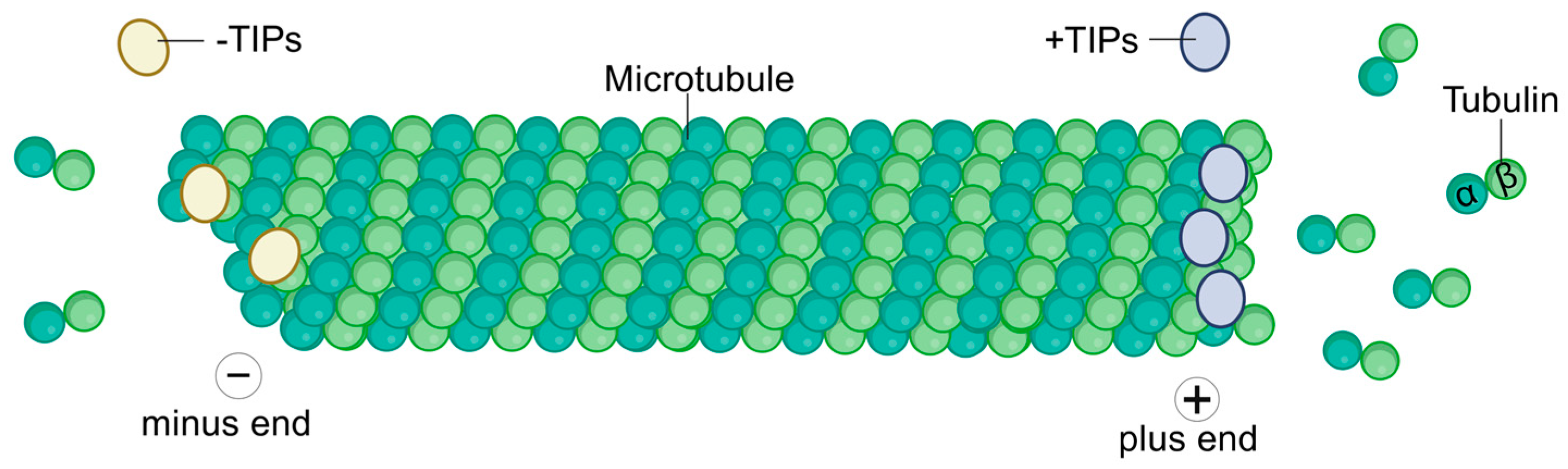
As fundamental components of the eukaryotic cytoskeleton, microtubules constitute polarized tubular polymers assembled through the dynamic association of α/β-tubulin heterodimers. The β-tubulin-exposed terminus (designated as the plus-end) exhibits faster polymerization kinetics, whereas the α-tubulin-exposed terminus (minus-end) demonstrates slower growth dynamics. Through dynamic polymerization/depolymerization cycles, microtubules coordinate essential cellular processes including mitotic progression, intracellular trafficking, signal transduction, and polarity establishment, with precise regulation of their dynamic instability being paramount for cellular homeostasis. Research efforts have predominantly focused on plus-end binding proteins (+TIPs) such as CLIP-170 and EBs, whereas systematic understanding of minus-end regulation remains comparatively limited. Recent advancements in super-resolution imaging and cryo-electron tomography, coupled with genomic profiling approaches, have propelled −TIPs to the forefront of cytoskeletal research [1,2,3,4]. These regulatory proteins orchestrate microtubule nucleation and spatial organization through minus-end anchoring, stabilization, and post-translational modifications, thereby governing mitotic fidelity, directional migration, and polarized growth [2,5,6,7,8,9,10,11]. A schematic diagram of a microtubule, highlighting its polarity and the binding locations of +TIPs and −TIPs, is shown in Figure 1.
Figure 1.
Schematic representation of a microtubule and its end-binding proteins. Microtubules are polarized filaments with a dynamic plus-end and a relatively stable minus-end. +TIP accumulate at the growing plus-end. −TIPs associate with and stabilize the minus-end.
Dysregulation of −TIPs has been pathologically linked to multiple disease states, with oncogenic processes garnering significant research interest [7,9,12,13,14]. The dynamic reorganization of microtubule networks constitutes an essential determinant of neoplastic transformation, particularly in facilitating metastatic dissemination through cytoskeletal remodeling. Emerging evidence demonstrates that centrosomal microtubule hypernucleation promotes invasive potential in malignant cells, while non-centrosomal microtubule stabilization directly correlates with enhanced migratory capacity and pathological angiogenesis. Mechanistic studies have elucidated distinct oncogenic roles: (i) CAMSAP2 stabilizes non-centrosomal microtubules to facilitate hepatocellular carcinoma metastasis; (ii) γ-TuRC constitutive activation enhances centrosomal nucleation efficiency, potentiating invasive phenotypes; (iii) ASPM orchestrates oncogenic signaling via canonical Wnt/β-catenin pathway activation, driving solid tumor progression. Notably, the same family members may exhibit functional heterogeneity in different tumor types or molecular backgrounds. CAMSAP3 exhibits oncogenic properties in lung cancer, while CAMSAP1 is associated with immune escape in some tumors. This complexity suggests that the function of −TIPs may be finely regulated by the tumor microenvironment, epigenetic modifications and signaling pathway interactions.
While current research has elucidated fundamental aspects of −TIPs in oncogenesis, three critical translational challenges persist: (i) Mechanistic insights remain largely confined to preclinical models, with limited clinical validation in human tumor specimens; (ii) Context-dependent functional pleiotropy complicating precision oncology approaches; (iii) The mechanistic basis underlying post-translational modification-mediated regulation (phosphorylation, ubiquitination, acetylation) of microtubule affinity and neoplastic reprogramming remains elusive. In addition, the molecular mechanism by which cyclic RNA expression affects tumor progression adds a new research direction to this field.
In this paper, we systematically review the molecular features, functional networks and their roles in tumors of −TIPs such as CAMSAPs, γ-TuRC, and ASPM, focusing on their translational potentials in prognostic assessment and targeted therapies. By integrating multi-omics data and clinical evidence, this paper aims to provide a new perspective for resolving the association between microtubule dynamics and tumor malignant phenotypes, and to lay a theoretical foundation for the development of precise anti-tumor strategies based on microtubule minus-end regulation.
2. Classification and Role of −TIPs
The dynamic assembly and stability regulation of microtubules are crucial for cellular biological processes. While early investigations predominantly focused on microtubule plus-end-binding proteins, recent advances in molecular characterization techniques have revealed an expanding repertoire of minus-end-associated proteins offering critical insights for deciphering the microtubule minus-end regulatory network. As key regulators of microtubule minus-end stabilization, CAMSAPs modulate microtubule dynamics via distinct domains, orchestrating essential cellular processes including mitotic progression, synaptogenesis, and epithelial morphogenesis. The identification of evolutionarily conserved regulators including γ-TuRC, Asp/ASPM, and plant-specific Spiral2 has significantly broadened our understanding of minus-end regulatory mechanisms. Emerging evidence demonstrates that CEP170B coordinates with KIF2A to counterbalance CAMSAP2-mediated stabilization, elucidating sophisticated homeostatic control mechanisms governing microtubule minus-end dynamics.
The CAMSAPs play a pivotal role in microtubule minus-end regulation, with individual members employing distinct molecular mechanisms to modulate microtubule dynamics: CAMSAP1 exhibits dynamic tracking of microtubule minus-ends while maintaining structural integrity, whereas CAMSAP2/3 attenuate tubulin incorporation rates, thereby stabilizing microtubule integrity [5]. Recent paradigm shifts in microtubule research have established spatial organization regulation as a key research priority, particularly regarding microtubule crossover site. Notably, CAMSAP2/3 colocalize at these nodal points, where their depletion induces abnormal microtubule bundling that compromises intracellular trafficking efficiency [2]. In Drosophila, Patronin (the sole CAMSAP ortholog) was the first identified endogenous microtubule minus-end stabilizer, crucially coordinating presynaptic microtubule organization to maintain synaptic architecture [15], participating in epithelial morphogenesis through nucleation of non-centrosomal microtubule arrays [16], while also governing mitotic spindle scaling [6]. In Caenorhabditis elegans, PTRN-1 (the nematode CAMSAP homolog) demonstrates dual functionality in axonal regeneration and dendritic microtubule polarization [17], with emerging evidence implicating its novel role in actin cytoskeleton crosstalk for cytoskeletal homeostasis maintenance [18]. The distinct but coordinated functions, expression patterns, and pathological consequences of different CAMSAPs are systematically summarized in Table 1.
Table 1.
Functional Characterization of CAMSAPs.
The γ-TuRC, recognized as a foundational microtubule minus-end binding complex, is structurally composed of γ-tubulin, GCP2-GCP6 proteins, actin, and regulatory subunits such as MZT1/MZT2. Microtubule assembly begins with the process of microtubule nucleation, γ-TuRC, as a major microtubule nucleation factor, is involved in microtubule nucleation both in vivo and in vitro [32]. However, Aher et al. proposed that γ-TuRC is an inefficient template for nucleation, which may be related to its extensive transition from the free state to the tightly bound microtubule state [1]. Notably, there is biochemical crosstalk between the microtubule minus-end regulatory pathways: Rai et al. proposed from in vitro reconstruction experiments that all CAMSAPs bind to the minus-end of γ-TuRC-connected microtubules, and that CAMSAPs drive the translocation of γ-TuRC from newly nucleated microtubules to generate free and stable microtubule minus-end [10].
Asp was one of the first mitotic genes identified in Drosophila, and the subsequent finding that mutations in its human homologue, ASPM, is the most common cause of autosomal recessive inheritance of primary microcephaly has attracted intense interest [12]. The Asp/ASPM-encoded proteins are localized at the spindle pole around the centrosome as well as at the outer portion of the central spindle, where they bind to the minus-end of microtubules that are separated from the centrosome [8]. Its subcellular localization is inextricably linked to its functional properties, and Asp/ASPM plays a central role in the regulation of cytokinesis, with depletion affecting processes such as stellate formation, spindle pole focusing, centrosome-spindle coupling, and spindle orientation [8].
The KAT8 regulatory complex subunit 3 gene (KANSL3) encoded protein was first identified by Meunier et al. as a −TIPs that autonomously binds, stabilizes, and promotes the assembly of microtubule minus-end, which are significantly enriched at the spindle poles during mitotic prophase. KANSL3 has been identified to play regulatory roles in multiple systems, and its depletion or deficiency leads to a variety of severe consequences: defects such as chromosomal misalignment, multipolar spindle formation and delayed midcycle division [9]; stochastic accumulation of nuclear anomalies in a pattern of genomic instability including chromosome fragmentation [33]; triggering a wide range of metabolic defects [34]; and triggering spectrum-specific defects in the inner cell mass of the mutant blastocyst as well as leading to early embryonic lethality [35].
Bolhuis et al. found in plant studies that Spiral2 is involved in the process of microtubule array reorientation in epidermal cells, and its role as a plant-specific −TIPs can stabilize newly formed microtubule arrays by autonomously accumulating at cortical microtubule minus-end and inhibiting microtubule contraction [36].
γ-TuRC is mainly involved in microtubule nucleation, and the discovery of proteins encoded by Asp/ASPM and KANSL3 extends the importance of negative regulation in the key position of cell division and genome stability maintenance, and the plant-specific protein Spiral2 stabilizes newly formed microtubules. Previous studies have found that CAMSAPs can effectively protect the microtubule minus-end from Kinesin-13-induced depolymerization in vitro, but microtubule minus-end depolymerization does occur in cells, suggesting that there is a substance that works synergistically with microtubule depolymerization enzymes to antagonize the effects of the CAMSAPs. Guan et al. discovered this phenomenon and explored it in depth, finding that CEP170B was able to bind to free microtubule minus-end and block minus-end growth, and that CEP170B in combination with KIF2A acted as a potent microtubule minus-end depolymerizing enzyme to antagonize the stabilizing effect of CAMSAPs on non-centrosomal microtubules [37]. This finding reveals an antagonistic mechanism to control the spatial distribution of microtubule minus-end and opens a new chapter in the study of −TIPs.
−TIPs regulate microtubule dynamics and spatial distribution through complex and sophisticated interaction mechanisms, thus maintaining cytoskeletal homeostasis and supporting a wide range of biological functions. The functions of the CAMSAPs are conserved and specific among species. Notably, the minus-end depolymerization mechanism synergistically mediated by CEP170B and KIF2A provides a new idea to understand the functional antagonism of CAMSAPs. These studies not only deepen the knowledge of the complexity of the microtubule minus-end regulatory network, but also provide potential targets for the resolution of disease mechanisms.
3. Characterization of the Domains of −TIPs
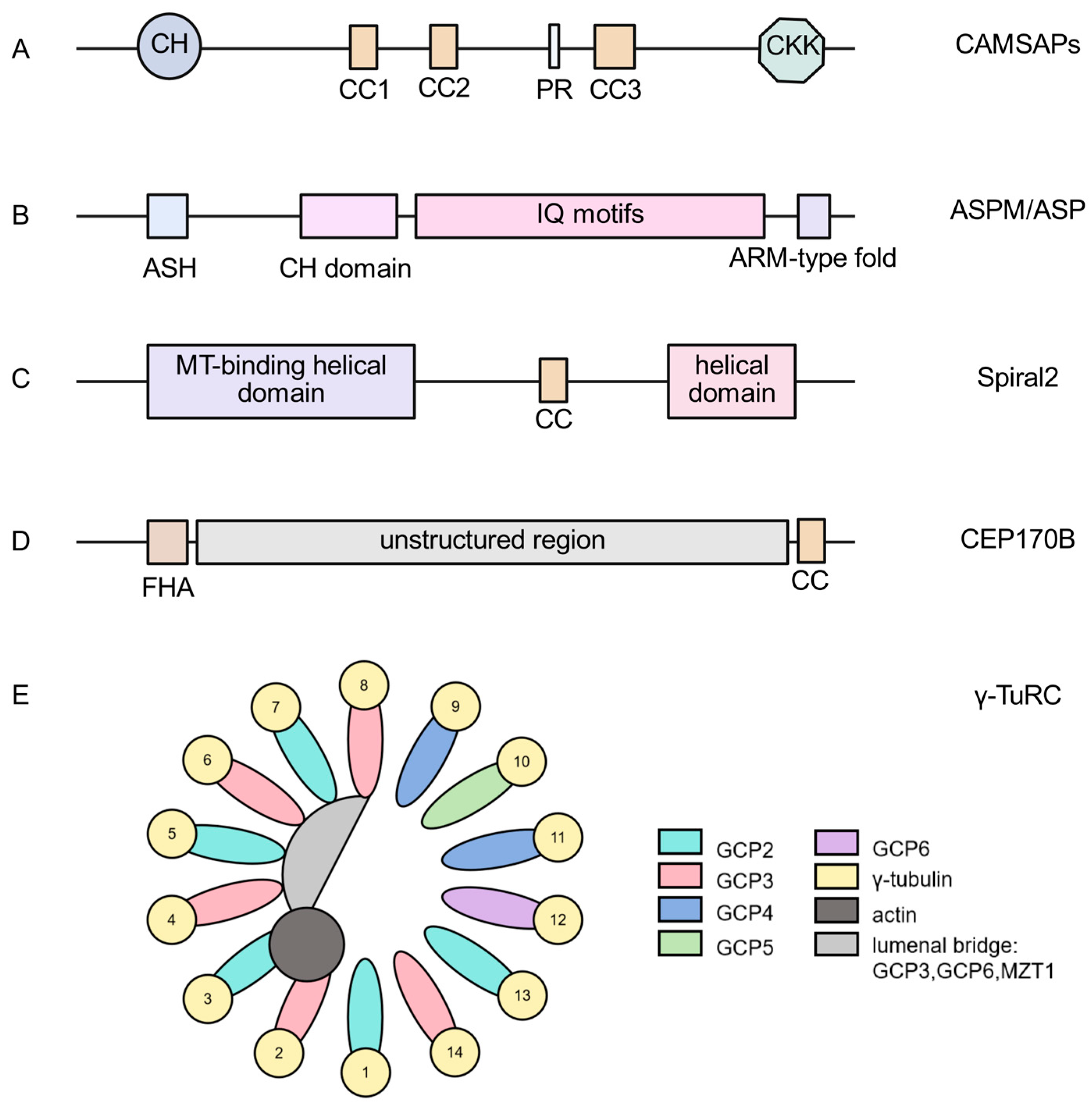
The dynamic regulation of microtubule minus-end is essential for maintaining cell polarity, directional migration and material transport, a process that relies on a variety of −TIPs with specific domains. Different proteins are functionally differentiated through the combination of their unique domains, which precisely regulate the nucleation, stabilization and dynamic reorganization of the microtubule minus-end, forming a multilevel regulatory network. The domain organizations of major −TIPs discussed in this section are summarized in Figure 2.
Figure 2.
Domain organization of representative −TIPs. Schematic representations of the primary domain structures of key −TIPs. (A) CAMSAPs contain CH domains (blue circle), CC regions (pale yellow rectangle), proline-rich region (PR) (white rectangle), and the characteristic CKK domain (green octagon). (B) ASPM/ASP comprises an N-terminal region with Aspm-SPD 2-Hydin (ASH) domains (pale blue rectangle), a central region with multiple CH domains (purple red rectangle) and IQ motifs (pink rectangle), and a C-terminal region predicted to contain ARM repeats (purple rectangle). (C) Spiral2 consists of an N-terminal microtubule-binding helical domain (deep purple rectangle), a central CC region (pale yellow rectangle), and a C-terminal helical domain (pale pink rectangle). (D) CEP170B contains an N-terminal FHA domain (brown rectangle) and a C-terminal CC domain (pale yellow rectangle), connected by a long unstructured region (grey rectangle). (E) γ-TuRC is composed of 14 spokes, each containing γ-tubulin (yellow round) and a GCP protein (GCP2-GCP6) (ellipses of different colors), along with additional structural components including actin (dark gray round) and MZT (light gray semicircle). 1–14 is the number of spokes. Rectangles with different colors on the right side are an explanation of the components of the left figure.
CAMSAPs have several conserved domains, including the characteristic CKK domain, CH domain, CC domain, and proline-rich region, which collaborate with each other to jointly regulate microtubule behaviors. The CKK domain confers CAMSAPs with specific binding ability to the minus-end of microtubules through the mechanism of compression of the microtubule lattice and imposition of the right-handed superhelices modification [38]. Notably, the pioneering work by Meng et al. identified CAMSAP3 (also known as Nezha) as a key stabilizer of non-centrosomal microtubules, highlighting the fundamental role of its CKK domain [39]. Furthermore, structural studies have shown that the C-terminal region of CAMSAP3, including the α-helix, is critical for forming a stabilizing lattice at the minus end and enhancing microtubule affinity through dimerization [40]. Other domains play multiple roles in functional regulation: the CC domain is not only involved in regulating the extension direction of non-centrosomal microtubules, which plays a key role in controlling cell motility by coupling microtubules with actin filaments [41], but also necessary for Patronin binding to the minus-end of microtubules [5]. The critical importance of the C-terminal region, which houses the CKK domain, is powerfully demonstrated by in vivo studies. Research utilizing the Camsap3-dc mutant mouse model, which expresses a truncated protein lacking the C-terminal domain, has revealed severe phenotypes. These include a loss of apical-to-basal microtubule polarity in epithelial cells and defects in cellular organization, underscoring the indispensable role of an intact C-terminal domain for proper microtubule anchoring and function in tissue homeostasis [31]. The CH domain, as a common structural module of cytoskeletal regulatory proteins, may mediate the interaction between CAMSAPs and actin or microtubules [18]. Particularly in Patronin, the synergistic effect of CKK and CH domains has an important regulatory function on neuromuscular junction development [15]. This multi-domain synergistic mechanism enables the CAMSAPs to precisely regulate the spatiotemporal dynamic properties of microtubule networks.
Vertebrate γ-TuRC exists in an open left-handed helical conformation with a core backbone consisting of an arrangement of 14 spokes, each of which is formed by the binding of one GCP protein to one γ-tubulin via the GRIP2 domain of GCP. All GCP proteins contain conserved GRIP1 and GRIP2 domains that mediate interactions with γ-tubulin. Notably, unlike other GCP proteins, GCP6 contains an extended insertion domain that consists of nine repetitive sequences and a highly α-helicalized region. Through this special structure, GCP6 is able to specifically interact with the N-terminus of GCP2 and GCP5, thereby driving the precise assembly of the γ-TuRC three-dimensional structure. Further studies revealed that actin is also a structural component of γ-TuRC, which binds directly to γ-tubulin (spoke 2) through the D-loop [11]. This mode of interaction not only reveals the structural localization of actin in γ-TuRC, but also implies that it may be involved in the microtubule nucleation process by regulating the conformational changes in the complex.
The modular structure of Asp/ASPM proteins consists of three parts: the N-terminal, the central region, and the C-terminal, and each domain regulates its biological function through synergistic interactions. The N-terminal region contains two key domains: the Hydin domain, which is hypothesized to have microtubule-binding activity [42], and the spatially overlapping MSP domain, the function of which is not yet clear and may be involved in unknown molecular interactions [43]. The central region contains multiple CH domains, which are responsible for microtubule binding function, and many IQ repeats are also distributed in this region [43,44]. The C-terminal region may contain HEAT repeats [8], the specific function of which is unknown, but studies have shown that it may not be related to the microtubule minus-end binding function [43], suggesting that this region may achieve functional expansion by recruiting other regulatory factors or participating in protein complex assembly [42].
CEP170B contains an N-terminal FHA domain and a C-terminal convoluted helical domain connected by a long unstructured region. Current studies have shown that CEP170B does not bind to other proteins through its domain when interacting with them, but rather binds to the domains of other proteins through extended fragments located in the unstructured middle region. Its N-terminal region has minus-end specificity and is able to inhibit minus-end growth in a dose-dependent manner, and its C-terminal region provides additional microtubule lattice binding affinity and has the ability to track contractile ends [37].
Spiral2 consists of three regions: an N-terminal microtubule-binding helical domain, a convoluted helical region, and a C-terminal helical domain [45]. The N-terminal domain is responsible for microtubule binding, the convoluted helical region is used for oligomerization, and the C-terminal helical domain is highly α-helical, but the functional significance remains to be elucidated [45,46]. In animals, CAMSAPs have been identified as a functional homolog of Spiral2. Unlike Spiral2, the CKK domain of CAMSAPs belongs to the α + β domains [46,47], which may also explain their different functions; while CAMSAP2/3 promote microtubule assembly at the minus-end, Spiral2 and Patronin only inhibit microtubule disassembly and do not enhance microtubule polymerization [6,47,48,49].
Different −TIPs achieve functional differentiation through the combination of specific domains: for example, the CAMSAPs rely on the CKK domain to bind to the microtubule minus-end, γ-TuRC uses the extended domain of GCP6 to drive the molecular assembly, and Asp/ASPM anchors microtubules through the CH domain. The diverse combinations of these domains together construct a precise regulatory system of microtubule minus-end, providing a molecular basis for the establishment of cell polarity and movement regulation.
4. Relationship Between −TIPs and Tumor Prognosis
−TIPs play an important role in maintaining microtubule function and dynamic homeostasis, and their aberrant expression may be associated with tumor development, prognosis, and chemotherapy resistance. Currently, more studies on the relationship between −TIPs and tumor prognosis have been conducted on CAMSAPs and ASPM, while fewer studies have been conducted on the relationship between γ-TuRC, KANSL3 and CEP170B and tumor prognosis, mainly focusing on gliomas [3,50,51].
CAMSAPs, as key regulators of microtubule dynamics, exhibit multifaceted roles in tumorigenesis and development. The functions of this family members in tumors show significant heterogeneity, with CAMSAP1 and CAMSAP2 mainly exerting pro-tumorigenic effects, while CAMSAP3 exhibits tumor suppressor properties.
CAMSAP1 shows different roles in different tumors: CAMSAP1 mutation can be used as a platinum-based chemotherapeutic drug sensitivity marker in small cell lung cancer [21]; its high expression has been found to correlate with advanced progression and poor prognosis in hepatocellular carcinoma by bioinformatics analysis [4]. Notably, cyclic RNA circCAMSAP1 is commonly highly expressed in colorectal, hepatocellular and nasopharyngeal cancers and plays a key role by promoting tumor cell proliferation, migration or invasion [52,53,54]. In hematologic tumors, CAMSAP1 expression levels are valuable for prognostic assessment of acute lymphoblastic leukemia [55].
The oncogenic mechanism of CAMSAP2 mainly involves several classical signaling pathways: in hepatocellular carcinoma, inhibition of HDAC6 through the JNK/c-Jun pathway promotes microtubule acetylation-mediated tumor metastasis [7]; in colorectal cancer, activation of the JNK/c-jun/MMP-1 signaling axis drives cellular invasion [13]; and in gastric cancer, it promotes epithelial–mesenchymal transition (EMT) progression through upregulation of TGF-β signaling [56]. The pro-metastatic role of this protein is particularly prominent in non-small cell lung cancer, both reversing the oncogenic effect of miR-2355-5p and promoting metastasis by regulating RASAL2 degradation [14,57]. Notably, its involvement in the mechanism of HBV-mediated hepatocarcinogenesis provides a new perspective for viral carcinogenesis research [58].
Unlike other members of the family, CAMSAP3 has tumor suppressor potential: it inhibits cell migration through an EMT-dependent mechanism [59]; and it acts through multiple mechanisms in lung cancer, inhibiting both tumor invasion and angiogenesis by negatively regulating HIF-1α mRNA stability [60]; and inducing a cellular senescence-like phenotype by mediating cell cycle arrest through ERK phosphorylation regulation [27]. Recent studies revealed its critical position in autophagic cell death, with HDAC inhibitors inducing tumor cell death by enhancing CAMSAP3 interactions with acetylated HMGB1 [61]. Moreover, its prognostic value in endometrial cancer suggests its broad-spectrum oncogenic potential [62].
ASPM, as an evolutionarily conserved oncogene, plays a central role in a variety of solid tumors through the Wnt/β-catenin signaling axis: it drives the EMT process through β-catenin nuclear translocation in colorectal cancer [63]; and regulates the cell cycle and Wnt signaling in glioblastoma [64]. Its pro-carcinogenic mechanisms are highly diverse: it regulates cell growth through CDK4 in lung squamous carcinoma [65]; regulates cell motility by stabilizing KIF11 in interstitial thyroid carcinoma [66]; and forms a pro-carcinogenic axis with METTL3 in hepatocellular carcinoma [67]. Notably, ASPM expression levels are closely associated with the development of digestive system tumors such as cholangio carcinoma, esophageal cancer, and pancreatic ductal adenocarcinoma [68,69,70], and its potential as a cross-cancer prognostic marker has been validated in multi-tumor species such as bladder cancer and renal cancer [71,72,73,74]. In addition, ASPM isoform 1 (ASPM-i1) is associated with poor prognosis in patients with small cell lung cancer or gastric cancer and is critical for tumorigenesis in these malignancies [75,76].
−TIPs play an important role in regulating tumor cell biology. CAMSAPs have different functions in different types of tumors (see Table 2), among which CAMSAP1 and CAMSAP2 exhibit pro-oncogenic roles in a variety of solid tumors, while CAMSAP3 has an oncogenic role in some tumors. ASPM is closely associated with poor prognosis of a variety of cancers and can promote tumor progression through signaling pathways such as Wnt/β-catenin. These results suggest that multiple −TIPs have potential value in tumor diagnosis, prognosis and treatment.
Table 2.
Relationship between −TIPs and tumor prognosis.
5. Mechanisms of −TIPs in Cancer Promotion
The dynamic balance of the microtubule system is a central element in maintaining cellular homeostasis, and its dysfunction can lead to abnormal cell division and tumorigenesis. As a key regulator of microtubule minus-end, the pro-tumorigenic mechanism of −TIPs is still unclear, which may involve cell cycle regulation, cytoskeleton alteration, angiogenesis and other aspects.
−TIPs may affect cell proliferation and apoptosis by regulating cell cycle changes. For example, upregulation of circCAMSAP1 induces G2/M phase arrest in nasopharyngeal carcinoma cells [54], and knockdown of circCAMSAP1 induces G1 phase cell cycle arrest in colorectal carcinoma [52]; CAMSAP3 deletion inhibits the expression level of the cell cycle protein D1 and induces G1 cell cycle arrest, which leads to irreversible growth arrest and tumor aggressiveness [27]. This spatiotemporal specificity of cell cycle regulation suggests that −TIPs may dynamically regulate the proliferative state of tumor cells through multiple mechanisms.
The core of tumor cell metastasis lies in the ability to establish cell polarity and directional migration. Studies have shown that CAMSAP1 dysfunction can lead to abnormal neuronal polarity and impaired migration [77], a mechanism that may be hijacked in tumor metastasis: −TIPs remodel the spatial conformation of the cytoskeletal network by modulating microtubule dynamic stability. Its aberrant expression can disrupt the mechanical balance between the anterior and posterior cell poles, contributing to the acquisition of an invasive phenotype by tumor cells. Notably, −TIPs can construct a metastasis-friendly cytoskeletal microenvironment by coordinating the interaction of microtubules with other cytoskeletal protein networks, such as actin [78].
Tumor angiogenesis is dependent on the directional migration capacity of endothelial cells. CAMSAP2 has been found to play a key role in vascular sprout formation by stabilizing non-centrosomal microtubules: it maintains the polarized distribution of microtubules in single-cell protrusions and ensures the continuous migration required for angiogenesis [79]. This unique microtubule stabilization mechanism provides an adequate nutrient supply to the tumor and establishes a “high speed pathway” for metastasis.
Overall, the relationship between −TIPs and tumor prognosis is complex, and the specific role may depend on factors such as tumor type and expression level of −TIPs. Therefore, more studies are needed to delve into the mechanism of −TIPs in different tumor types, as well as their potential applications in tumor prognostic assessment and treatment.
6. Translational Studies of −TIPs
With the increasing morbidity and mortality of malignant tumors in China and the emergence of various novel anti-cancer drugs, molecular targeted therapy has become an important direction in tumor treatment. Microtubules, as key structures for cell division, migration and material transportation, can be significantly affected by kinetic disorders, and thus microtubules have become a core target for cancer therapy. Microtubule-targeting agents that directly bind to microtubules are currently the most common and effective chemotherapeutic agents, for example, various anti-microtubule drugs such as paclitaxel and alkaloids have been widely used to enhance the treatment of malignant tumors, such as lung and pancreatic cancers.
However, due to the complexity of microtubule regulation, there are problems of resistance and drug toxicity of such drugs, which limit the effectiveness of their clinical application. Therefore, exploring new therapeutic strategies for microtubule inhibition has become the focus of current research. Studies have shown that abnormal enhancement of centrosomal microtubule nucleation ability promotes tumor cell invasiveness, whereas blocking γ-TuRC function effectively reverses the high nucleation ability of centrosomes, which may impede the invasive and metastatic behaviors of tumor cells with redundant centrosomes, and thus targeting γ-TuRC may provide a viable alternative to perturbing tumor cells [51]. In addition, −TIPs may also play a key role in tumorigenesis and development by influencing the post-translational modification process of non-centrosomal microtubules. For example, CAMSAP2 promotes hepatocellular carcinoma metastasis by promoting non-centrosomal microtubule acetylation [7]. Therefore, future studies should further resolve the specific mechanisms of −TIPs in different tumor types, with the aim of providing more effective solutions for precision tumor therapy.
7. Discussion
−TIPs, as key factors regulating microtubule dynamics and stability, are closely related to tumorigenesis and development in terms of their expression and functional abnormalities. In this paper, we systematically reviewed the molecular features, functional mechanisms and their potential roles in tumors of −TIPs, such as CAMSAPs, γ-TuRC, ASPM, and KANSL3-encoded proteins. It was shown that these proteins affect core biological processes such as cell division, polarity establishment, material transport and cell migration by regulating the dynamic assembly and disassembly of microtubule minus-end. For example, CAMSAP2 is involved in tumor cell invasion and metastasis by stabilizing the minus-end of non-centrosomal microtubules; abnormal activation of γ-TuRC, a core factor in microtubule nucleation, may promote the over-assembly of centrosomal microtubules, thereby enhancing the malignant phenotype of tumor cells; and ASPM may be involved in tumor progression by regulating spindle microtubule dynamics. Notably, the role of −TIPs in tumors is significantly heterogeneous. The same family members may exhibit different biological effects in different tumor types or molecular contexts. For example, CAMSAP1 promotes tumor progression in hepatocellular carcinoma, but its mutation correlates with elevated chemosensitivity in small cell lung cancer; CAMSAP2 significantly promotes invasive metastasis in a variety of solid tumors such as hepatocellular carcinoma and colorectal carcinoma; and CAMSAP3 can negatively regulate cell migration through an EMT-dependent mechanism. This complexity suggests that the function of −TIPs may depend on the tumor microenvironment, epigenetic modifications, and interactions with other signaling pathways. In addition, antagonistic mechanisms between −TIPs reveal the importance of the fine balance of the microtubule dynamics regulatory network to maintain cellular homeostasis, and its imbalance may become a critical node for tumor cells to escape from therapy. At the translational medicine level, intervention strategies targeting −TIPs show potential therapeutic promise. For example, inhibition of γ-TuRC function reverses the centrosomal hypernucleation ability of tumor cells, reduces cell invasiveness and metastatic potential, and provides a new direction in the search for tumor therapeutic targets. However, existing studies are mostly limited to cell and animal models, and clinical translation still faces challenges.
Furthermore, although this review focuses on the roles of −TIPs in tumorigenesis and metastasis, it is noteworthy that CAMSAPs also play indispensable roles in various non-cancerous tissues and developmental processes. Evidence from CAMSAP-deficient mouse models demonstrates significant microtubule-related phenotypes across multiple organs, including loss of polarity in intestinal epithelial cells [31], structural abnormalities in sperm flagella [20], impaired tracheal ciliary function [30], disrupted renal tubule morphogenesis [28], and neuronal migration defects [29]. These phenotypes collectively indicate conserved functions for CAMSAPs in fundamental processes including cell polarity maintenance, ciliogenesis, cytoskeletal stability, and directed cell migration. These same processes, in particular the establishment of cell polarity and migratory capacity, are key for tumor cells to acquire invasive and metastatic properties. Consequently, elucidating the physiological functions of CAMSAPs in normal tissues is crucial for understanding the pathology of their dysregulation in cancer and provides critical insights into how microtubule stability dysfunction contributes to various diseases. Future studies that integrate the roles of CAMSAPs in development, tissue homeostasis, and cancer will be essential for a comprehensive evaluation of −TIPs as therapeutic targets.
Although this review has focused on the functions of CAMSAPs, γ-TuRC, and ASPM in animal cells and cancer, it is important to recognize that the principles of microtubule minus-end regulation are well-documented in the plant kingdom. For instance, in Arabidopsis thaliana, the Spiral2 protein family, which are functional analogues of CAMSAPs, sustains persistent microtubule growth by suppressing depolymerization [45]. Although plant systems are not directly associated with human cancer pathogenesis, the core regulatory mechanism of the Spiral2 family, which stabilizes microtubule minus-ends to establish and maintain specific polarized cellular structures, is functionally analogous to that of CAMSAPs in cancer cell migration, polarized growth, and angiogenesis. This cross-kingdom conservation suggests that the regulation of microtubule minus-end stability represents an ancient and fundamental mechanism underlying the construction of complex cellular architectures and directed cell movement. Therefore, investigating plant-specific −TIPs such as Spiral2 will not only deepen our evolutionary understanding of microtubule biology but could also inspire novel intervention strategies for microtubule-related diseases, including cancer invasion and metastasis.
In conclusion, the study of −TIPs, as an important bridge connecting cytoskeleton regulation and tumor malignant phenotypes, has not only deepened the understanding of microtubule biological mechanisms but also provided new molecular targets for tumor-targeted therapies. With the advancement of technology and the deepening of interdisciplinary cooperation, translational research in this field is expected to bring breakthroughs in tumor treatment strategies.
Author Contributions
Conceptualization, X.D. and D.L.; writing—original draft preparation, Q.W., M.X. and X.L.; writing—review and editing, Q.W., M.X., X.L., X.D. and D.L.; funding acquisition, X.D. and D.L. All authors have read and agreed to the published version of the manuscript.
Funding
This research was funded by the National Natural Science Foundation of China, grant number 82470653; the Henan Provincial Joint Fund Program for Science and Technology Research and Development, grant number 232301420056; the Henan Provincial Key Medical Research and Development Project, grant number SBGJ202503004 and SBGJ202503003.
Institutional Review Board Statement
Not applicable.
Informed Consent Statement
Not applicable.
Data Availability Statement
No new data were created or analyzed in this study. Data sharing is not applicable to this article.
Conflicts of Interest
The authors declare no conflicts of interest.
Abbreviations
The following abbreviations are used in this manuscript:
| CAMSAPs | calmodulin-regulated spectrin-associated proteins |
| γ-TuRC | γ-tubulin ring complex |
| ASPM | abnormal spindle microtubule assembly |
| KANSL3 | KAT8 regulatory complex subunit 3 gene |
| SCLC | small-cell lung cancer |
| LIHC | liver hepatocellular carcinoma |
| CRC | colorectal cancer |
| NPC | nasopharyngeal carcinoma |
| HCC | hepatocellular carcinoma |
| NSCLC | non-small-cell lung cancer |
| LC | lung cancer |
| LUAD | lung adenocarcinoma |
| LSCC | Lung squamous cell carcinoma |
| GC | gastric cancer |
| PRCC | papillary renal cell carcinoma |
| ASPM-i1 | ASPM isoform 1 |
| ATC | anaplastic thyroid carcinoma |
| EMT | epithelial–mesenchymal transition |
| GRAMD1A | GRAM Domain Containing 1A |
| JNK | c-Jun N-terminal kinase |
| MMP-1 | Matrix Metalloproteinase-1 |
| CircSOD2 | circRNA SOD2 |
| TGF-β | transforming growth factor-β |
| RASAL2 | Ras protein activator-like 2 |
| ERK | extracellular signal-regulated kinase |
| Rac1 | Ras-related C3 botulinum toxin substrate 1 |
| HDAC6 | histone deacetylases 6 |
| HMGB1 | high mobility group box 1 |
| TSA | trichostatin A |
| NCL | nucleolin |
| HIF-1α | hypoxia-inducible factor-1α |
| CDK4 | cyclin dependent kinases 4 |
| GLI1 | glioma-associated oncogene homolog 1 |
| FOXM1 | Forkhead box protein M1 |
| Dvl-3 | disheveled-3 |
| Smo | Smoothened |
| KIF11 | kinesin family member 11 |
| METTL3 | methyltransferase-like 3 |
| m6A | N6-methyladenosine |
References
- Aher, A.; Urnavicius, L.; Xue, A.; Neselu, K.; Kapoor, T.M. Structure of the γ-tubulin ring complex-capped microtubule. Nat. Struct. Mol. Biol. 2024, 31, 1124–1133. [Google Scholar] [CrossRef] [Scilit] [PubMed]
- Zhang, R.; Gu, L.; Chen, W.; Tanaka, N.; Zhou, Z.; Xu, H.; Xu, T.; Ji, W.; Liang, X.; Meng, W. CAMSAP2 and CAMSAP3 localize at microtubule intersections to regulate the spatial distribution of microtubules. J. Mol. Cell Biol. 2024, 15, mjad050. [Google Scholar] [CrossRef] [Scilit] [PubMed]
- Wenger, A.; Karlsson, I.; Kling, T.; Carén, H. CRISPR-Cas9 knockout screen identifies novel treatment targets in childhood high-grade glioma. Clin. Epigenet. 2023, 15, 80. [Google Scholar] [CrossRef] [Scilit] [PubMed]
- Wang, W.; Zhang, J.; Wang, Y.; Xu, Y.; Zhang, S. Non-coding ribonucleic acid-mediated CAMSAP1 upregulation leads to poor prognosis with suppressed immune infiltration in liver hepatocellular carcinoma. Front. Genet. 2022, 13, 916847. [Google Scholar] [CrossRef] [Scilit]
- Hendershott, M.C.; Vale, R.D. Regulation of microtubule minus-end dynamics by CAMSAPs and Patronin. Proc. Natl. Acad. Sci. USA 2014, 111, 5860–5865. [Google Scholar] [CrossRef] [Scilit]
- Goodwin, S.S.; Vale, R.D. Patronin Regulates the Microtubule Network by Protecting Microtubule Minus Ends. Cell 2010, 143, 263–274. [Google Scholar] [CrossRef] [Scilit]
- Li, D.; Ding, X.; Xie, M.; Huang, Z.; Han, P.; Tian, D.; Xia, L. CAMSAP2-mediated noncentrosomal microtubule acetylation drives hepatocellular carcinoma metastasis. Theranostics 2020, 10, 3749–3766. [Google Scholar] [CrossRef] [Scilit]
- Razuvaeva, A.V.; Graziadio, L.; Palumbo, V.; Pavlova, G.A.; Popova, J.V.; Pindyurin, A.V.; Bonaccorsi, S.; Somma, M.P.; Gatti, M. The Multiple Mitotic Roles of the ASPM Orthologous Proteins: Insight into the Etiology of ASPM-Dependent Microcephaly. Cells 2023, 12, 922. [Google Scholar] [CrossRef] [Scilit]
- Meunier, S.; Shvedunova, M.; Van Nguyen, N.; Avila, L.; Vernos, I.; Akhtar, A. An epigenetic regulator emerges as microtubule minus-end binding and stabilizing factor in mitosis. Nat. Commun. 2015, 6, 7889. [Google Scholar] [CrossRef] [Scilit]
- Rai, D.; Song, Y.; Hua, S.; Stecker, K.; Monster, J.L.; Yin, V.; Stucchi, R.; Xu, Y.; Zhang, Y.; Chen, F.; et al. CAMSAPs and nucleation-promoting factors control microtubule release from γ-TuRC. Nat. Cell Biol. 2024, 26, 404–420. [Google Scholar] [CrossRef] [Scilit]
- Liu, P.; Zupa, E.; Neuner, A.; Böhler, A.; Loerke, J.; Flemming, D.; Ruppert, T.; Rudack, T.; Peter, C.; Spahn, C.; et al. Insights into the assembly and activation of the microtubule nucleator γ-TuRC. Nature 2020, 578, 467–471. [Google Scholar] [CrossRef] [Scilit]
- Létard, P.; Drunat, S.; Vial, Y.; Duerinckx, S.; Ernault, A.; Amram, D.; Arpin, S.; Bertoli, M.; Busa, T.; Ceulemans, B.; et al. Autosomal recessive primary microcephaly due to ASPM mutations: An update. Hum. Mutat. 2018, 39, 319–332. [Google Scholar] [CrossRef] [Scilit]
- Wang, X.; Liu, Y.; Ding, Y.; Feng, G. CAMSAP2 promotes colorectal cancer cell migration and invasion through activation of JNK/c-Jun/MMP-1 signaling pathway. Sci. Rep. 2022, 12, 16899. [Google Scholar] [CrossRef] [Scilit]
- Singharajkomron, N.; Yodsurang, V.; Limprasutr, V.; Wattanathamsan, O.; Iksen, I.; Hayakawa, Y.; Pongrakhananon, V. CAMSAP2 enhances lung cancer cell metastasis by mediating RASAL2 degradation. Life Sci. 2024, 338, 122391. [Google Scholar] [CrossRef] [Scilit] [PubMed]
- Gao, Z.; Huang, E.; Wang, W.; Xu, L.; Xu, W.; Zheng, T.; Rui, M. Patronin regulates presynaptic microtubule organization and neuromuscular junction development in Drosophila. iScience 2024, 27, 108944. [Google Scholar] [CrossRef] [Scilit] [PubMed]
- Panzade, S.; Matis, M. The Microtubule Minus-End Binding Protein Patronin Is Required for the Epithelial Remodeling in the Drosophila Abdomen. Front. Cell Dev. Biol. 2021, 9, 682083. [Google Scholar] [CrossRef] [Scilit] [PubMed]
- He, L.; Van Beem, L.; Snel, B.; Hoogenraad, C.C.; Harterink, M. PTRN-1 (CAMSAP) and NOCA-2 (NINEIN) are required for microtubule polarity in Caenorhabditis elegans dendrites. PLoS Biol. 2022, 20, e3001855. [Google Scholar] [CrossRef] [Scilit]
- Gong, T.; Yan, Y.; Zhang, J.; Liu, S.; Liu, H.; Gao, J.; Zhou, X.; Chen, J.; Shi, A. PTRN-1/CAMSAP promotes CYK-1/formin-dependent actin polymerization during endocytic recycling. EMBO J. 2018, 37, e98556. [Google Scholar] [CrossRef] [Scilit]
- Zhou, Z.; Xu, H.; Li, Y.; Yang, M.; Zhang, R.; Shiraishi, A.; Kiyonari, H.; Liang, X.; Huang, X.; Wang, Y.; et al. CAMSAP1 breaks the homeostatic microtubule network to instruct neuronal polarity. Proc. Natl. Acad. Sci. USA 2020, 117, 22193–22203. [Google Scholar] [CrossRef] [Scilit]
- Hu, W.; Zhang, R.; Xu, H.; Li, Y.; Yang, X.; Zhou, Z.; Huang, X.; Wang, Y.; Ji, W.; Gao, F.; et al. CAMSAP1 role in orchestrating structure and dynamics of manchette microtubule minus-ends impacts male fertility during spermiogenesis. Proc. Natl. Acad. Sci. USA 2023, 120, e2313787120. [Google Scholar] [CrossRef] [Scilit]
- Yi, Y.; Qiu, Z.; Yao, Z.; Lin, A.; Qin, Y.; Sha, R.; Wei, T.; Wang, Y.; Cheng, Q.; Zhang, J.; et al. CAMSAP1 Mutation Correlates With Improved Prognosis in Small Cell Lung Cancer Patients Treated With Platinum-Based Chemotherapy. Front. Cell Dev. Biol. 2022, 9, 770811. [Google Scholar] [CrossRef] [Scilit]
- Wan, Z.; Yang, X.; Liu, X.; Sun, Y.; Yu, P.; Xu, F.; Deng, H. M2 macrophage-derived exosomal microRNA-411-5p impedes the activation of hepatic stellate cells by targeting CAMSAP1 in NASH model. iScience 2022, 25, 104597. [Google Scholar] [CrossRef] [Scilit] [PubMed]
- Qiao, Y.; Wang, D.; Yan, G.; Yang, Z.; Tang, C. MiR-411-5p Promotes Vascular Smooth Muscle Cell Phenotype Switch by Inhibiting Expression of Calmodulin Regulated Spectrin-Associated Protein-1. Int. Heart J. 2024, 65, 557–565. [Google Scholar] [CrossRef] [Scilit]
- Ho, K.-H.; Jayathilake, A.; Yagan, M.; Nour, A.; Osipovich, A.B.; Magnuson, M.A.; Gu, G.; Kaverina, I. CAMSAP2 localizes to the Golgi in islet β-cells and facilitates Golgi-ER trafficking. iScience 2023, 26, 105938. [Google Scholar] [CrossRef] [Scilit]
- Zhou, Z.; Yang, X.; Mao, A.; Xu, H.; Lin, C.; Yang, M.; Hu, W.; Shao, J.; Xu, P.; Li, Y.; et al. Deficiency of CAMSAP2 impairs olfaction and the morphogenesis of mitral cells. EMBO Rep. 2024, 25, 2861–2877. [Google Scholar] [CrossRef] [Scilit]
- Zhang, S.; Kwan, P.; Baum, L. The potential role of CAMSAP1L1 in symptomatic epilepsy. Neurosci. Lett. 2013, 556, 146–151. [Google Scholar] [CrossRef] [Scilit]
- Wattanathamsan, O.; Chetprayoon, P.; Chantaravisoot, N.; Wongkongkathep, P.; Chanvorachote, P.; Pongrakhananon, V. CAMSAP3 depletion induces lung cancer cell senescence-associated phenotypes through extracellular signal-regulated kinase inactivation. Cancer Med. 2021, 10, 8961–8975. [Google Scholar] [CrossRef] [Scilit] [PubMed]
- Mitsuhata, Y.; Abe, T.; Misaki, K.; Nakajima, Y.; Kiriya, K.; Kawasaki, M.; Kiyonari, H.; Takeichi, M.; Toya, M.; Sato, M. Cyst formation in proximal renal tubules caused by dysfunction of the microtubule minus-end regulator CAMSAP3. Sci. Rep. 2021, 11, 5857. [Google Scholar] [CrossRef] [Scilit] [PubMed]
- Kimura, T.; Saito, H.; Kawasaki, M.; Takeichi, M. CAMSAP3 is required for mTORC1-dependent ependymal cell growth and lateral ventricle shaping in mouse brains. Development 2021, 148, dev195073. [Google Scholar] [CrossRef] [Scilit]
- Saito, H.; Matsukawa-Usami, F.; Fujimori, T.; Kimura, T.; Ide, T.; Yamamoto, T.; Shibata, T.; Onoue, K.; Okayama, S.; Yonemura, S.; et al. Tracheal motile cilia in mice require CAMSAP3 for the formation of central microtubule pair and coordinated beating. Mol. Biol. Cell 2021, 32, ar12. [Google Scholar] [CrossRef] [Scilit]
- Toya, M.; Kobayashi, S.; Kawasaki, M.; Shioi, G.; Kaneko, M.; Ishiuchi, T.; Misaki, K.; Meng, W.; Takeichi, M. CAMSAP3 orients the apical-to-basal polarity of microtubule arrays in epithelial cells. Proc. Natl. Acad. Sci. USA 2016, 113, 332–337. [Google Scholar] [CrossRef] [Scilit]
- Mogensen, M.M.; Malik, A.; Piel, M.; Bouckson-Castaing, V.; Bornens, M. Microtubule minus-end anchorage at centrosomal and non-centrosomal sites: The role of ninein. J. Cell Sci. 2000, 113, 3013–3023. [Google Scholar] [CrossRef] [Scilit]
- Karoutas, A.; Szymanski, W.; Rausch, T.; Guhathakurta, S.; Rog-Zielinska, E.A.; Peyronnet, R.; Seyfferth, J.; Chen, H.-R.; De Leeuw, R.; Herquel, B.; et al. The NSL complex maintains nuclear architecture stability via lamin A/C acetylation. Nat. Cell Biol. 2019, 21, 1248–1260. [Google Scholar] [CrossRef] [Scilit]
- Sheikh, B.N.; Guhathakurta, S.; Tsang, T.H.; Schwabenland, M.; Renschler, G.; Herquel, B.; Bhardwaj, V.; Holz, H.; Stehle, T.; Bondareva, O.; et al. Neural metabolic imbalance induced by MOF dysfunction triggers pericyte activation and breakdown of vasculature. Nat. Cell Biol. 2020, 22, 828–841. [Google Scholar] [CrossRef] [Scilit] [PubMed]
- Chander, A.; Mager, J. Loss of KANSL3 leads to defective inner cell mass and early embryonic lethality. Mol. Reprod. Devel. 2024, 91, e23760. [Google Scholar] [CrossRef] [Scilit] [PubMed]
- Bolhuis, D.L.; Dixit, R.; Slep, K.C. Crystal structure of the Arabidopsis SPIRAL2 C-terminal domain reveals a p80-Katanin-like domain. PLoS ONE 2023, 18, e0290024. [Google Scholar] [CrossRef] [Scilit] [PubMed]
- Guan, C.; Hua, S.; Jiang, K. The CEP170B-KIF2A complex destabilizes microtubule minus ends to generate polarized microtubule network. EMBO J. 2023, 42, e112953. [Google Scholar] [CrossRef] [Scilit]
- Atherton, J.; Luo, Y.; Xiang, S.; Yang, C.; Vemu, A.; Stangier, M.; Cook, A.; Wang, S.; Jiang, K.; Steinmetz, M.; et al. Structural Model for Preferential Microtubule Minus End Binding by CAMSAP CKK Domains. Biophys. J. 2019, 116, 251a. [Google Scholar] [CrossRef] [Scilit]
- Meng, W.; Mushika, Y.; Ichii, T.; Takeichi, M. Anchorage of Microtubule Minus Ends to Adherens Junctions Regulates Epithelial Cell-Cell Contacts. Cell 2008, 135, 948–959. [Google Scholar] [CrossRef] [Scilit]
- Li, Y.; Zhang, R.; Ren, J.; Chen, W.; Zhou, Z.; Xu, H.; Li, D.; Cheng, H.; Xie, Q.; Ji, W.; et al. CAMSAP3 forms dimers via its α-helix domain that directly stabilize non-centrosomal microtubule minus ends. J. Cell Sci. 2024, 137, jcs263609. [Google Scholar] [CrossRef] [Scilit]
- Ning, W.; Yu, Y.; Xu, H.; Liu, X.; Wang, D.; Wang, J.; Wang, Y.; Meng, W. The CAMSAP3-ACF7 Complex Couples Noncentrosomal Microtubules with Actin Filaments to Coordinate Their Dynamics. Dev. Cell 2016, 39, 61–74. [Google Scholar] [CrossRef] [Scilit]
- Rujano, M.A.; Sanchez-Pulido, L.; Pennetier, C.; Le Dez, G.; Basto, R. The microcephaly protein Asp regulates neuroepithelium morphogenesis by controlling the spatial distribution of myosin II. Nat. Cell Biol. 2013, 15, 1294–1306. [Google Scholar] [CrossRef] [Scilit]
- Jiang, K.; Rezabkova, L.; Hua, S.; Liu, Q.; Capitani, G.; Altelaar, A.F.M.; Heck, A.J.R.; Kammerer, R.A.; Steinmetz, M.O.; Akhmanova, A. Microtubule minus-end regulation at spindle poles by an ASPM–katanin complex. Nat. Cell Biol. 2017, 19, 480–492. [Google Scholar] [CrossRef] [Scilit]
- Ito, A.; Goshima, G. Microcephaly protein Asp focuses the minus ends of spindle microtubules at the pole and within the spindle. J. Cell Biol. 2015, 211, 999–1009. [Google Scholar] [CrossRef] [Scilit]
- Yao, M.; Wakamatsu, Y.; Itoh, T.J.; Shoji, T.; Hashimoto, T. Arabidopsis SPIRAL2 promotes uninterrupted microtubule growth by suppressing the pause state of microtubule dynamics. J. Cell Sci. 2008, 121, 2372–2381. [Google Scholar] [CrossRef] [Scilit]
- Ohno, M.; Higuchi, Y.; Yamai, K.; Fuchigami, S.; Sasaki, T.; Oda, Y.; Hayashi, I. Structural analysis of microtubule binding by minus-end targeting protein Spiral2. Biochim. Et Biophys. Acta (BBA)—Mol. Cell Res. 2024, 1871, 119858. [Google Scholar] [CrossRef] [Scilit]
- Jiang, K.; Hua, S.; Mohan, R.; Grigoriev, I.; Yau, K.W.; Liu, Q.; Katrukha, E.A.; Altelaar, A.F.M.; Heck, A.J.R.; Hoogenraad, C.C.; et al. Microtubule Minus-End Stabilization by Polymerization-Driven CAMSAP Deposition. Dev. Cell 2014, 28, 295–309. [Google Scholar] [CrossRef] [Scilit]
- Fan, Y.; Burkart, G.M.; Dixit, R. The Arabidopsis SPIRAL2 Protein Targets and Stabilizes Microtubule Minus Ends. Curr. Biol. 2018, 28, 987–994.e3. [Google Scholar] [CrossRef] [Scilit]
- Leong, S.Y.; Yamada, M.; Yanagisawa, N.; Goshima, G. SPIRAL2 Stabilises Endoplasmic Microtubule Minus Ends in the Moss Physcomitrella patens. Cell Struct. Funct. 2018, 43, 53–60. [Google Scholar] [CrossRef] [Scilit] [PubMed]
- Zhao, K.; Bai, X.; Wang, X.; Cao, Y.; Zhang, L.; Li, W.; Wang, S. Insight on the hub gene associated signatures and potential therapeutic agents in epilepsy and glioma. Brain Res. Bull. 2023, 199, 110666. [Google Scholar] [CrossRef] [Scilit] [PubMed]
- Dráber, P.; Dráberová, E. Dysregulation of Microtubule Nucleating Proteins in Cancer Cells. Cancers 2021, 13, 5638. [Google Scholar] [CrossRef] [Scilit]
- Zhou, C.; Liu, H.; Wang, F.; Hu, T.; Liang, Z.; Lan, N.; He, X.; Zheng, X.; Wu, X.; Xie, D.; et al. circCAMSAP1 Promotes Tumor Growth in Colorectal Cancer via the miR-328-5p/E2F1 Axis. Mol. Ther. 2020, 28, 914–928. [Google Scholar] [CrossRef] [Scilit] [PubMed]
- Luo, Z.; Lu, L.; Tang, Q.; Wei, W.; Chen, P.; Chen, Y.; Pu, J.; Wang, J. CircCAMSAP1 promotes hepatocellular carcinoma progression through miR-1294/GRAMD1A pathway. J. Cell. Mol. Med. 2021, 25, 3793–3802. [Google Scholar] [CrossRef] [Scilit]
- Wang, Y.; Yan, Q.; Mo, Y.; Liu, Y.; Wang, Y.; Zhang, S.; Guo, C.; Wang, F.; Li, G.; Zeng, Z.; et al. Splicing factor derived circular RNA circCAMSAP1 accelerates nasopharyngeal carcinoma tumorigenesis via a SERPINH1/c-Myc positive feedback loop. Mol. Cancer 2022, 21, 62. [Google Scholar] [CrossRef] [Scilit]
- Wang, J.; Mi, J.-Q.; Debernardi, A.; Vitte, A.-L.; Emadali, A.; Meyer, J.A.; Charmpi, K.; Ycart, B.; Callanan, M.B.; Carroll, W.L.; et al. A six gene expression signature defines aggressive subtypes and predicts outcome in childhood and adult acute lymphoblastic leukemia. Oncotarget 2015, 6, 16527–16542. [Google Scholar] [CrossRef] [Scilit]
- Lugen, Z.; Lian, W.; Zi, Y.; Junjie, L.; Wenfeng, W.; Jing, L.; Yueyue, W.; Xue, S.; Xiaofeng, Z.; Zhijun, G. High expression of CAMSAP2 promotes invasion and metastasis of gastric cancer cells by upregulating TGF-β signaling. J. South Med. Univ. 2023, 43, 1460–1468. [Google Scholar]
- Lv, C.; Hu, Y.; Zhou, X.; Zhu, Y.; Wang, J.; Zhou, F. CircRNA SOD2 motivates non-small cell lungs cancer advancement with EMT via acting as microRNA-2355-5p’s competing endogenous RNA to mediate calmodulin regulated spectrin associated proteins-2. Bioengineered 2022, 13, 5756–5768. [Google Scholar] [CrossRef] [Scilit] [PubMed]
- Hu, X.; Jiang, J.; Ni, C.; Xu, Q.; Ye, S.; Wu, J.; Ge, F.; Han, Y.; Mo, Y.; Huang, D.; et al. HBV Integration-mediated Cell Apoptosis in HepG2.2.15. J. Cancer 2019, 10, 4142–4150. [Google Scholar] [CrossRef] [Scilit] [PubMed]
- Pongrakhananon, V.; Wattanathamsan, O.; Takeichi, M.; Chetprayoon, P.; Chanvorachote, P. Loss of CAMSAP3 promotes EMT via the modification of microtubule–Akt machinery. J. Cell Sci. 2018, 131, jcs216168. [Google Scholar] [CrossRef] [Scilit]
- Seephan, S.; Sasaki, S.-I.; Wattanathamsan, O.; Singharajkomron, N.; He, K.; Ucche, S.; Kungsukool, S.; Petchjorm, S.; Chantaravisoot, N.; Wongkongkathep, P.; et al. CAMSAP3 negatively regulates lung cancer cell invasion and angiogenesis through nucleolin/HIF-1α mRNA complex stabilization. Life Sci. 2023, 322, 121655. [Google Scholar] [CrossRef] [Scilit]
- Singharajkomron, N.; Seephan, S.; Iksen, I.; Chantaravisoot, N.; Wongkongkathep, P.; Hayakawa, Y.; Pongrakhananon, V. CAMSAP3-mediated regulation of HMGB1 acetylation and subcellular localization in lung cancer cells: Implications for cell death modulation. Biochim. Et Biophys. Acta (BBA)—Gen. Subj. 2024, 1868, 130614. [Google Scholar] [CrossRef] [Scilit]
- Mao, X.; Tang, X.; Ye, J.; Xu, S.; Wang, Y.; Liu, X.; Wu, Q.; Lin, X.; Zhang, M.; Liu, J.; et al. Multi-omics profiling reveal cells with novel oncogenic cluster, TRAP1low/CAMSAP3low, emerge more aggressive behavior and poor-prognosis in early-stage endometrial cancer. Mol. Cancer 2024, 23, 127. [Google Scholar] [CrossRef] [Scilit]
- Wang, L.; Hu, X.; Li, S.; Liang, X.; Ren, L.; Lv, S. ASPM facilitates colorectal cancer cells migration and invasion by enhancing β-catenin expression and nuclear translocation. Kaohsiung J. Med. Sci. 2022, 38, 129–138. [Google Scholar] [CrossRef] [Scilit]
- Chen, X.; Huang, L.; Yang, Y.; Chen, S.; Sun, J.; Ma, C.; Xie, J.; Song, Y.; Yang, J. ASPM promotes glioblastoma growth by regulating G1 restriction point progression and Wnt-β-catenin signaling. Aging 2020, 12, 224–241. [Google Scholar] [CrossRef] [Scilit] [PubMed]
- Yuan, Y.-J.; Sun, Y.; Gao, R.; Yin, Z.; Yuan, Z.; Xu, L.-M. Abnormal spindle-like microcephaly-associated protein (ASPM) contributes to the progression of Lung Squamous Cell Carcinoma (LSCC) by regulating CDK4. J. Cancer 2020, 11, 5413–5423. [Google Scholar] [CrossRef] [Scilit]
- Fang, Q.; Li, Q.; Qi, Y.; Pan, Z.; Feng, T.; Xin, W. ASPM promotes migration and invasion of anaplastic thyroid carcinoma by stabilizing KIF11. Cell Biol. Int. 2023, 47, 1209–1221. [Google Scholar] [CrossRef] [Scilit] [PubMed]
- Wang, A.; Chen, X.; Li, D.; Yang, L.; Jiang, J. METTL3-mediated m6A methylation of ASPM drives hepatocellular carcinoma cells growth and metastasis. Clin. Lab. Anal. 2021, 35, e23931. [Google Scholar] [CrossRef] [Scilit] [PubMed]
- Ala, U.; Fagoonee, S. RNA-binding protein transcripts as potential biomarkers for detecting Primary Sclerosing Cholangitis and for predicting its progression to Cholangiocarcinoma. Front. Mol. Biosci. 2024, 11, 1388294. [Google Scholar] [CrossRef] [Scilit]
- Khosravani, H.; Ataee Disfani, R.; Farhadi, B.; Tohidian, M.; Garrosi, L.; Shirvani, P.; Zabihi, M.R.; Akhoondian, M.; Norouzkhani, N.; Farzan, R. Esophageal chemical burns as a risk factor for esophageal malignancies: In-silico analyses-experimental research. Ann. Med. Surg. 2024, 86, 5170–5178. [Google Scholar] [CrossRef] [Scilit]
- JagadeeswaraRao, G.; SivaPrasad, A. Identification of potential biomarkers for pancreatic ductal adenocarcinoma: A bioinformatics analysis. Comput. Methods Biomech. Biomed. Eng. 2024, 28, 2049–2063. [Google Scholar] [CrossRef] [Scilit]
- Saleh, A.A.; Gohar, S.F.; Hemida, A.S.; Elgharbawy, M.; Soliman, S.E. Evaluation of ASPM and TEF Gene Expressions as Potential Biomarkers for Bladder Cancer. Biochem. Genet. 2020, 58, 490–507. [Google Scholar] [CrossRef] [Scilit] [PubMed]
- Li, N.; Chu, J.; Hu, K.; Zhang, H.; Li, N.; Chu, J.; Hu, K.; Zhang, H. ASPM overexpression enhances cellular proliferation and migration and predicts worse prognosis for papillary renal cell carcinoma. J. Biosci. 2023, 48, 17. [Google Scholar] [CrossRef] [Scilit]
- Deng, T.; Liu, Y.; Zhuang, J.; Tang, Y.; Huo, Q. ASPM Is a Prognostic Biomarker and Correlates With Immune Infiltration in Kidney Renal Clear Cell Carcinoma and Liver Hepatocellular Carcinoma. Front. Oncol. 2022, 12, 632042. [Google Scholar] [CrossRef] [Scilit] [PubMed]
- Zhang, Q.; Wang, Y.; Xue, F. ASPM, CDC20, DLGAP5, BUB1B, CDCA8, and NCAPG May Serve as Diagnostic and Prognostic Biomarkers in Endometrial Carcinoma. Genet. Res. 2022, 2022, 3217248. [Google Scholar] [CrossRef] [Scilit]
- Cheng, L.-H.; Hsu, C.-C.; Tsai, H.-W.; Liao, W.-Y.; Yang, P.-M.; Liao, T.-Y.; Hsieh, H.-Y.; Chan, T.-S.; Tsai, K.K. ASPM Activates Hedgehog and Wnt Signaling to Promote Small Cell Lung Cancer Stemness and Progression. Cancer Res. 2023, 83, 830–844. [Google Scholar] [CrossRef] [Scilit] [PubMed]
- Hsu, C.-C.; Liao, W.-Y.; Chang, K.-Y.; Chan, T.-S.; Huang, P.-J.; Chiang, C.-T.; Shan, Y.-S.; Cheng, L.-H.; Liao, T.-Y.; Tsai, K.K. A multi-mode Wnt- and stemness-regulatory module dictated by FOXM1 and ASPM isoform I in gastric cancer. Gastric Cancer 2021, 24, 624–639. [Google Scholar] [CrossRef] [Scilit]
- Khalaf-Nazzal, R.; Fasham, J.; Inskeep, K.A.; Blizzard, L.E.; Leslie, J.S.; Wakeling, M.N.; Ubeyratna, N.; Mitani, T.; Griffith, J.L.; Baker, W.; et al. Bi-allelic CAMSAP1 variants cause a clinically recognizable neuronal migration disorder. Am. J. Hum. Genet. 2022, 109, 2068–2079. [Google Scholar] [CrossRef] [Scilit]
- Hubert, T.; Perdu, S.; Vandekerckhove, J.; Gettemans, J. γ-Tubulin localizes at actin-based membrane protrusions and inhibits formation of stress-fibers. Biochem. Biophys. Res. Commun. 2011, 408, 248–252. [Google Scholar] [CrossRef] [Scilit]
- Martin, M.; Veloso, A.; Wu, J.; Katrukha, E.A.; Akhmanova, A. Control of endothelial cell polarity and sprouting angiogenesis by non-centrosomal microtubules. eLife 2018, 7, e33864. [Google Scholar] [CrossRef] [Scilit]



Disclaimer/Publisher’s Note: The statements, opinions and data contained in all publications are solely those of the individual author(s) and contributor(s) and not of MDPI and/or the editor(s). MDPI and/or the editor(s) disclaim responsibility for any injury to people or property resulting from any ideas, methods, instructions or products referred to in the content. |
© 2025 by the authors. Licensee MDPI, Basel, Switzerland. This article is an open access article distributed under the terms and conditions of the Creative Commons Attribution (CC BY) license (https://creativecommons.org/licenses/by/4.0/).