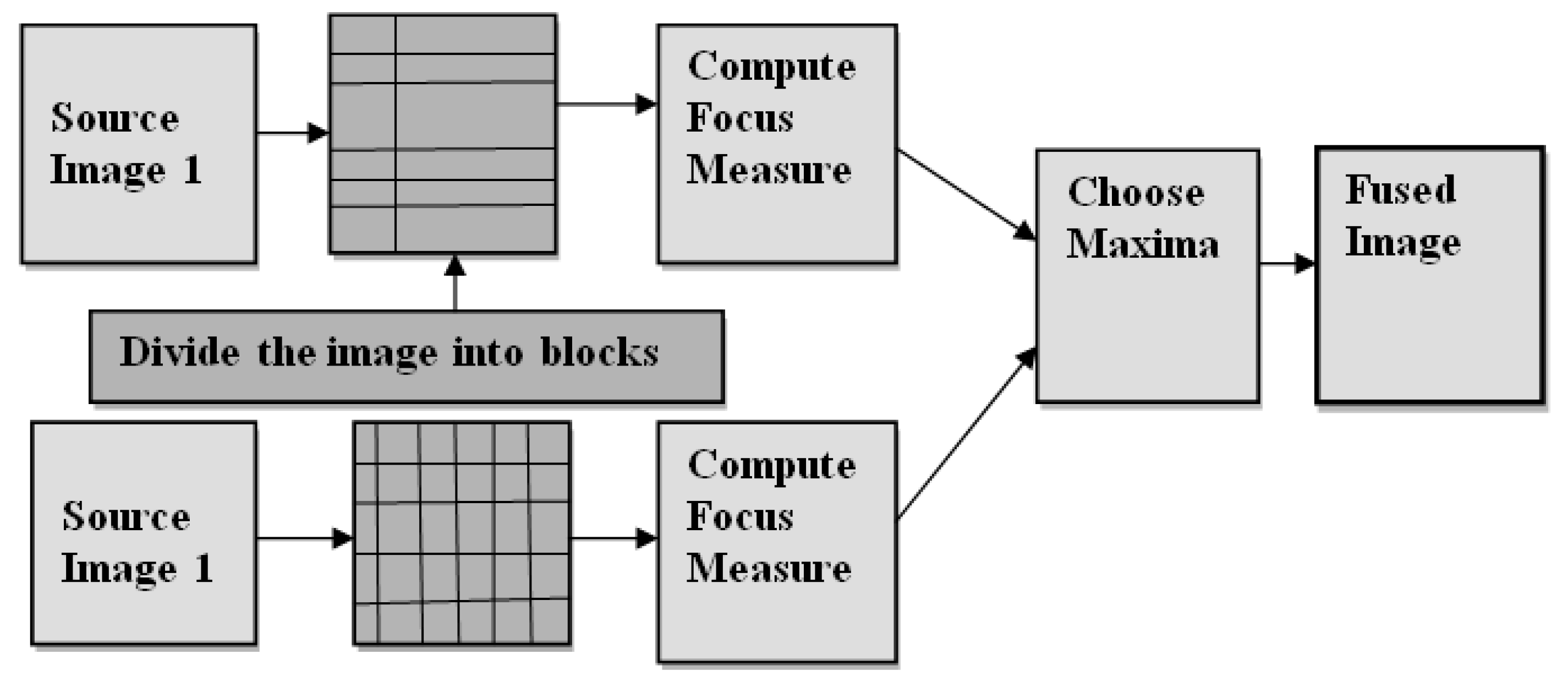
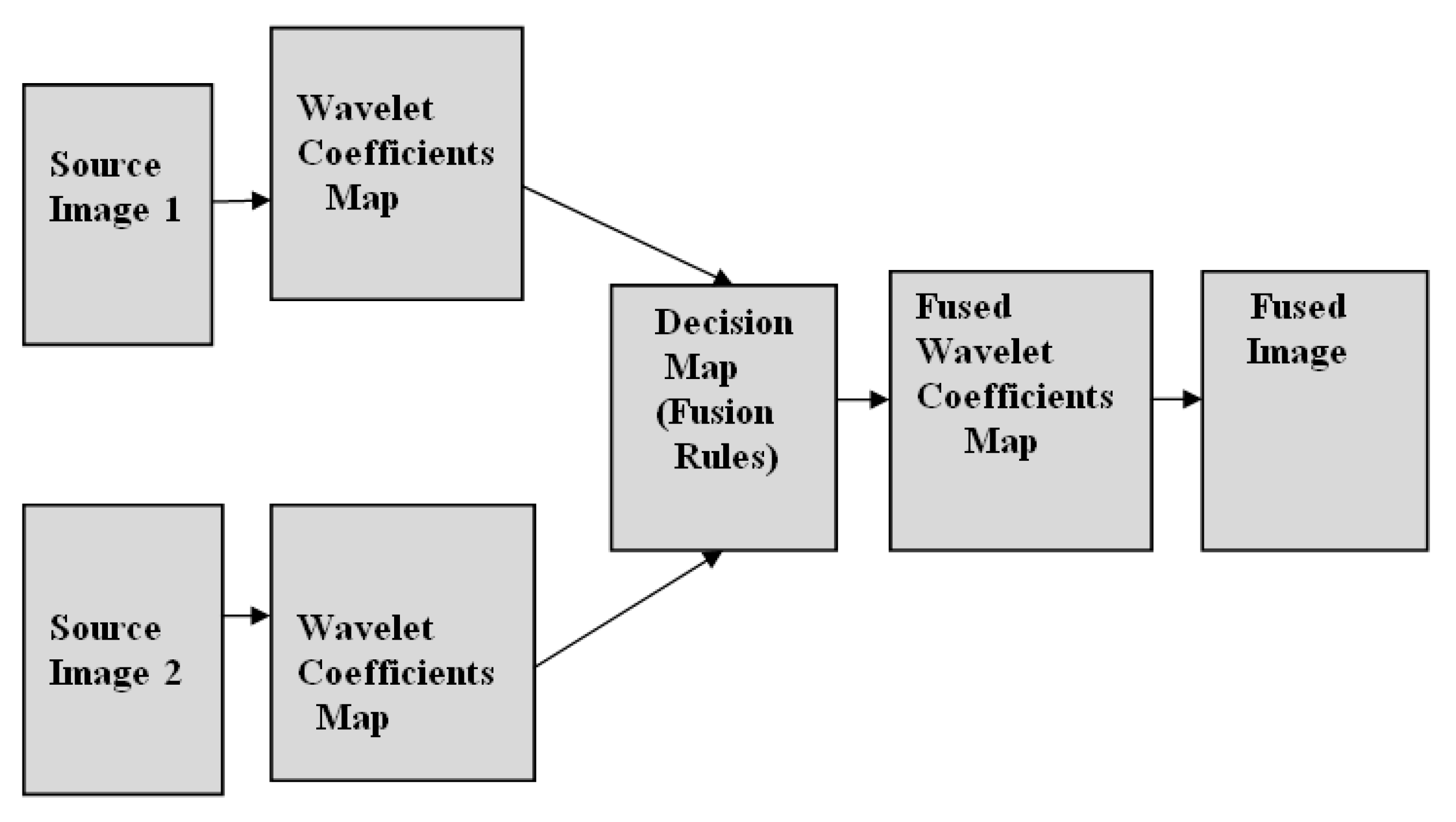
A Non-Conventional Review on Multi-Modality-Based Medical Image Fusion



Abstract
1. Introduction
Major Contributions
- A detailed introduction to non-conventional multi-modal medical image fusion techniques is presented. Most of the works selected for this survey are recent;
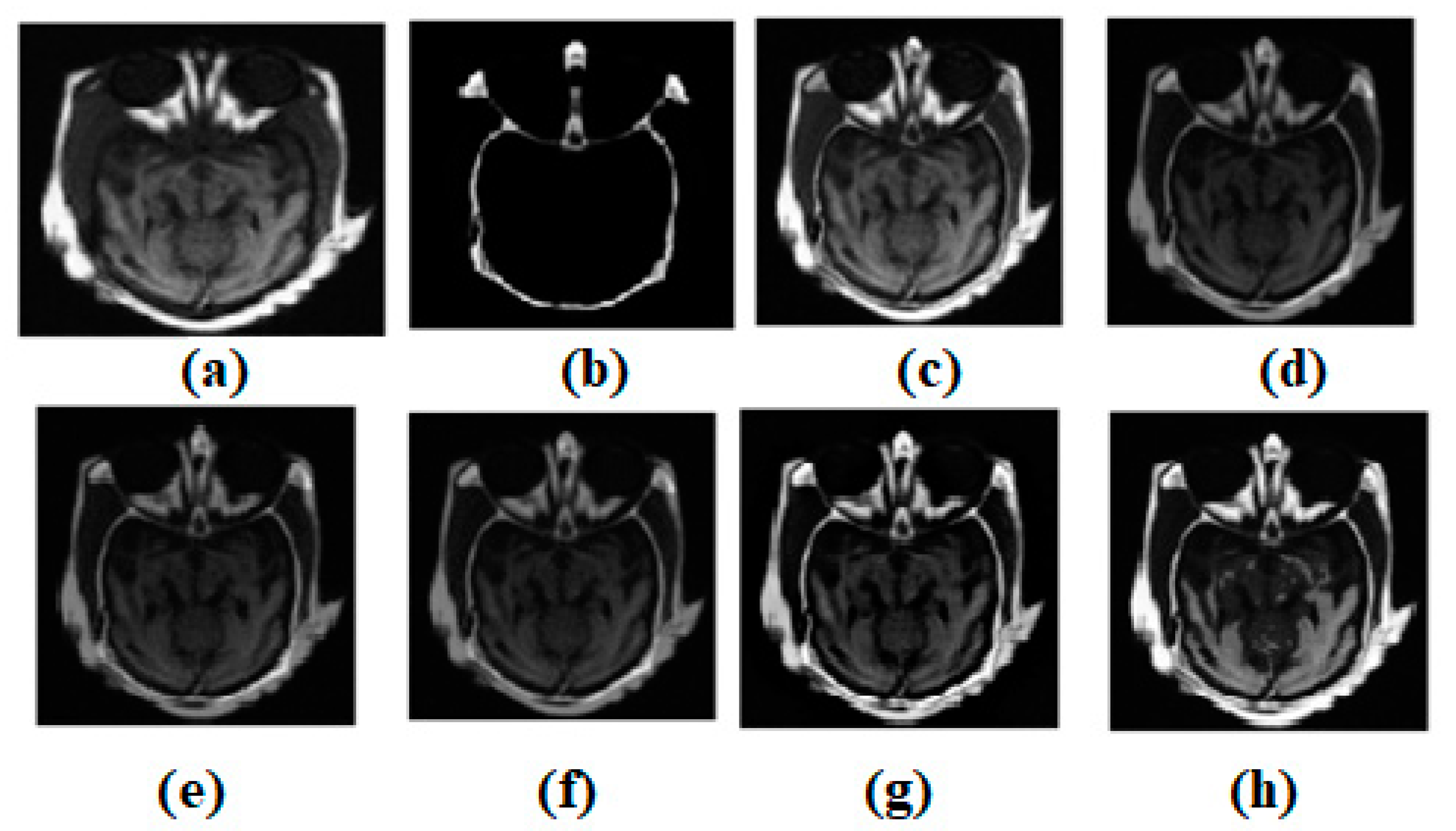
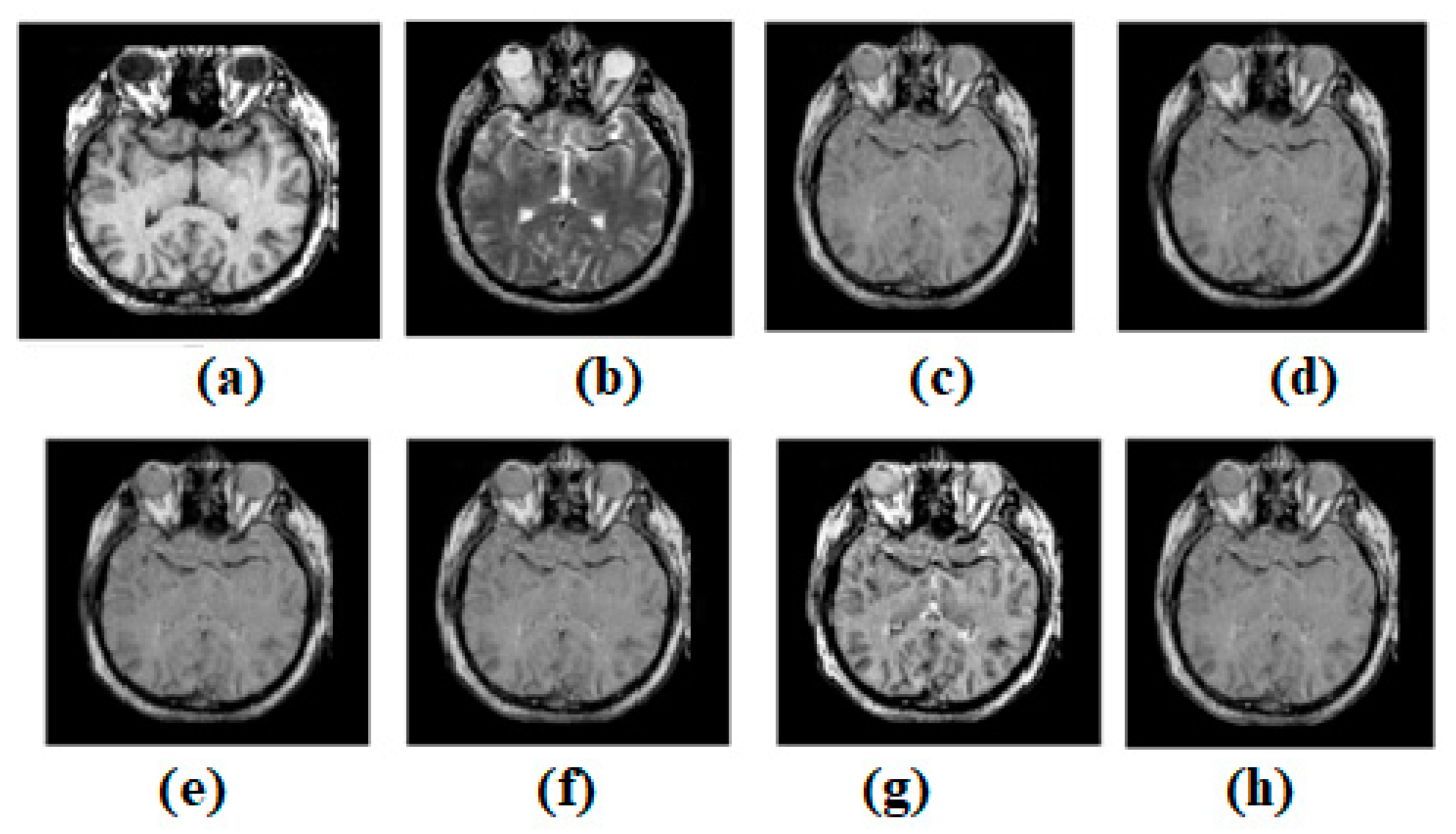
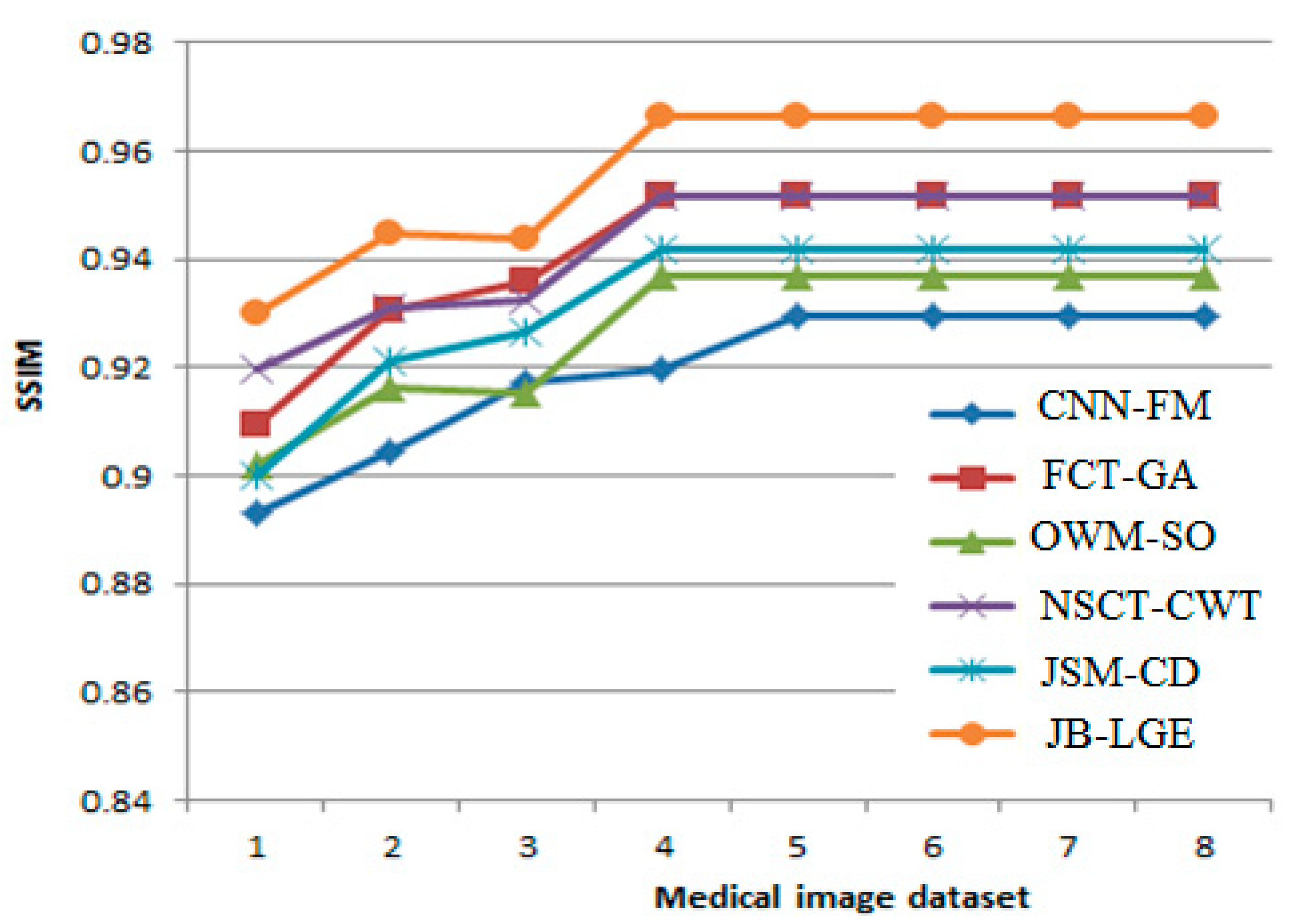
- In addition, an analysis of non-conventional strategies for fusing many types of medical images is performed. Using multi-modal-source images generated from a CT scan, a SPECT, an MR-T1 image, and an MR-T2 image, six typical medical image fusion algorithms are compared and contrasted based on the results of five prominent objective metrics;
- Some future research potentials for non-conventional multi-modal image fusion are proposed, while the existing difficulties in this area are highlighted.
2. Multi-Modality Image Fusion
3. Related Work
4. Comparative Analysis of Non-Conventional Related Work

| Related Work | Methodology | Objectives | Merits | Demerits |
|---|---|---|---|---|
| Manchand, Meenu et al. [42] (2018) | Fuzzy transform | Combines many phases of an FTR pair’s reconstructed picture. | Protects all vital, useful, and interconnected data from input medical pictures of various modalities. Free from the problem of artifacts. | High computational cost. |
| Yang, Yong, et al. [43] (2018) | Fuzzy discrimination with structural patch decomposition | Combining images with data from many sources | Successful suppression of hue shift, leading to enhanced diagnostic performance. | Requirement of optimization to improve the computational efficiency. |
| Singh et al. [44] (2019) | Decomposition of hybrid layers utilizing convolutional neural networks for feature mapping and structural clustering | Improve diagnostic prediction, seeks to combine data from several sensors into a single picture. | Enhancing the structural fine details while minimizing the impact of major artefacts and noise. | Lack in pixel contrast and preservation of tiny edges. |
| Gambhir et al. [45] (2019) | Wave atoms transform-based medical image fusion | Medical analysis and treatment | Improved clarity and expanded information; a real advantage for faster illness diagnosis and more effective therapy. | Requirement of contrast improvement. |
| Li, X., et al. [46] (2020) | Laplacian redecomposition framework | Image enhancement while preserving the heterogeneous characteristics of redundant and complementary information | Qualitatively and statistically superior to other widely used fusion techniques. | Eliminates the problem of color distortion, blurring, and noise. |
| Arif, M., et al. [47] (2020) | Fast curvelet transform through genetic algorithm | Improve the input picture by clearing out any doubts or haze and maximizing its fusion qualities in the process. | Keeping all original data and color standards intact in the base picture, Fast computation process. | Not able to adaptively identify the breakdown level. |
| Li, X. et al. [48] (2021) | Joint bilateral filter and local gradient energy | To fuse the structure layer and the abs-max rule to fuse the energy layer | Easy to implementation, easy to understand and achieve high computational efficiency Has the capability to successfully used to another wide variety of image-fusion issues. | Not able to bridge the gap between multimodal medical image fusion methods and certain practical clinical applications. |
| Shehanaz, S., et al. [49] (2021) | Optimum weighted image fusion using particle swarm optimization | To improve the multimodal mapping performance | Powerful in both normal and noisy fusion settings in terms of information mapping, edge quality, and structural similarity. | Cannot be used in multicentral applications, has higher computational time, and experimentation is applied on normalized and registered public image database. |
| Tang, W., et al. [50] (2022) | Multiscale adaptive transformer | Integrate the complementing information from several modalities to improve clinical diagnosis and surgical navigation. | Constraints for preserving information at both the structural and feature levels are built using a structural loss and a region mutual information loss, and good generalization capability. | Execution time is Higher. |
| Alseelawi, N., et al. [51] (2022) | Hybrid approach of NSCT and DTCWT | Uses a variety of imaging modalities to compile a comprehensive picture of a disease | Highest-quality fused pictures, lower processing period, and visual quality. | In some cases, blurriness in the result is found. |
| Li, W., et al. [52] (2023) | Network with improved dual-branch features, trained using transformers and convolutional features | Recover texture information from images and determine the intensity distribution of pixels in a picture. | The texture details of the original image are well-kept, and the more important information about how the pixels are distributed in the original image is not lost. | Tried out a few samples of medical images. |
| Zhang, C., et al. [53] (2023) | Joint sparse model with coupled dictionary | To correct the flaw in the joint sparse model caused by using a single dictionary, and to emphasize and enlarge on the relevant parts of the source pictures. | Time efficiency is enhanced while less functional and structural data is lost. | Method is not implemented on color medical images as it can provide more precise treatment. |
| Vasu, G.T., et al. [64] (2023) | Weighted anisotropic diffusion filter | Generate a single image from many images of the same subject with different forefront and backdrop emphasis. | Efficient in edge-preserving feature. | Execution time is Higher. |
| Xu, H., et al. [85] (2021) | Performed surface-level and deep-level constraints in unsupervised fusion network | To preserve the unique information of source images To preserve high-quality texture details in the MRI image. | Enhanced information preservation. | High computational cost due to pixel level processing. |
| Zhang, G., et al. [86] (2023) | Pair feature difference guided network | To address the defects of complementary feature extraction and luminance degradation. | Preserves rich luminance in CT images, tissue texture in MRI images, and functional (PET/SPECT) details from source image. | Features that go together between source images can be taken out, less luminescence information achieved, and the network can be improved to get more features. |
5. Experimental Results
6. Challenges, Future Trends, and Significance
6.1. Current Challenges
6.2. Future Prospects
6.3. Significance
7. Conclusions
Author Contributions
Funding
Institutional Review Board Statement
Informed Consent Statement
Data Availability Statement
Conflicts of Interest
References
- Li, H.; Manjunath, B.S.; Mitra, S.K. Multisensor image fusion using the wavelet transform. Graph. Models Image Process. 1995, 57, 235–245. [Google Scholar] [CrossRef] [Scilit]
- Shu-Long, Z. Image fusion using wavelet transform. Int. Arch. Photogramm. Remote Sens. Spat. Inf. Sci. 2002, 34, 552–556. [Google Scholar]
- Atrey, P.K.; Hossain, M.A.; El Saddik, A.; Kankanhalli, M.S. Multimodal fusion for multimedia analysis: A survey. Multimed. Syst. 2010, 16, 345–379. [Google Scholar] [CrossRef] [Scilit]
- Mittal, A.; Moorthy, A.K.; Bovik, A.C. No-reference image quality assessment in the spatial domain. IEEE Trans. Image Process. 2012, 21, 4695–4708. [Google Scholar] [CrossRef] [Scilit] [PubMed]
- Singh, P.; Diwakar, M.; Cheng, X.; Shankar, A. A new wavelet-based multi-focus image fusion technique using method noise and anisotropic diffusion for real-time surveillance application. J. Real-Time Image Process. 2021, 18, 1051–1068. [Google Scholar] [CrossRef] [Scilit]
- Diwakar, M.; Tripathi, A.; Joshi, K.; Sharma, A.; Singh, P.; Memoria, M.; Kumar, N. A comparative review: Medical image fusion using SWT and DWT. Mater. Today Proc. 2020, 37 Pt 2, 3411–3416. [Google Scholar] [CrossRef] [Scilit]
- Sahu, D.K.; Parsai, M.P. Different image fusion techniques–A critical review. Int. J. Mod. Eng. Res. IJMER 2012, 2, 4298–4301. [Google Scholar]
- Ramandeep, R.K. Review on different aspects of image fusion for medical imaging. Int. J. Sci. Res. 2014, 3, 1887–1889. [Google Scholar]
- James, A.P.; Dasarathy, B.V. Medical image fusion: A survey of the state of the art. Inf. Fusion 2014, 19, 4–19. [Google Scholar] [CrossRef] [Scilit]
- Indira, K.P.; Hemamalini, R.R. Analysis on image fusion techniques for medical applications. Int. J. Adv. Res. Electr. Electron. Instrum. Eng. 2014, 3, 2278–8875. [Google Scholar]
- Bhatnagar, G.; Wu, Q.J.; Liu, Z. A new contrast based multimodal medical image fusion framework. Neurocomputing 2015, 157, 143–152. [Google Scholar] [CrossRef] [Scilit]
- Diwakar, M.; Singh, P.; Shankar, A.; Nayak, S.R.; Nayak, J.; Vimal, S.; Singh, R.; Sisodia, D. Directive clustering contrast-based multi-modality medical image fusion for smart healthcare system. Netw. Model. Anal. Health Inform. Bioinform. 2022, 11, 15. [Google Scholar] [CrossRef] [Scilit]
- Deshmukh, D.P.; Malviya, A.V. A Review On: Image Fusion Using Wavelet Transform. Int. J. Eng. Trends Technol. 2015, 21, 376–379. [Google Scholar] [CrossRef] [Scilit]
- Bhavana, V.; Krishnappa, H.K. Multi-modality medical image fusion using discrete wavelet transform. Procedia Comput. Sci. 2015, 70, 625–631. [Google Scholar] [CrossRef] [Scilit]
- Ma, W.; Wang, K.; Li, J.; Yang, S.X.; Li, J.; Song, L.; Li, Q. Infrared and Visible Image Fusion Technology and Application: A Review. Sensors 2023, 23, 599. [Google Scholar] [CrossRef] [Scilit]
- El-Gamal, F.E.Z.A.; Elmogy, M.; Atwan, A. Current trends in medical image registration and fusion. Egypt. Inform. J. 2016, 17, 99–124. [Google Scholar] [CrossRef] [Scilit]
- Singh, P.; Diwakar, M.; Chakraborty, A.; Jindal, M.; Tripathi, A.; Bajal, E. A non-conventional review on image fusion techniques. In Proceedings of the 2021 IEEE 8th Uttar Pradesh Section International Conference on Electrical, Electronics and Computer Engineering, UPCON 2021, Dehradun, India, 11–13 November 2021; IEEE: Piscataway, NJ, USA, 2022. [Google Scholar] [CrossRef] [Scilit]
- Tiwari, A.K.; Pachori, R.B.; Kanhangad, V.; Panigrahi, B.K. Automated diagnosis of epilepsy using key-point-based local binary pattern of EEG signals. IEEE J. Biomed. Health Inform. 2016, 21, 888–896. [Google Scholar] [CrossRef] [Scilit]
- Li, H.; Liu, X.; Yu, Z.; Zhang, Y. Performance improvement scheme of multifocus image fusion derived by difference images. Signal Process. 2016, 128, 474–493. [Google Scholar] [CrossRef] [Scilit]
- Dhaundiyal, R.; Tripathi, A.; Joshi, K.; Diwakar, M.; Singh, P. Clustering based multi-modality medical image fusion. J. Phys. Conf. Ser. 2020, 1478, 12024. [Google Scholar] [CrossRef] [Scilit]
- Singh, P.; Diwakar, M. Wavelet-based multi-focus image fusion using average method noise diffusion (AMND). Recent Adv. Comput. Sci. Commun. 2021, 14, 2436–2448. [Google Scholar] [CrossRef] [Scilit]
- Diwakar, M.; Singh, P.; Shankar, A. Multi-modal medical image fusion framework using co-occurrence filter and local extrema in NSST domain. Biomed. Signal Process. Control 2021, 68, 102788. [Google Scholar] [CrossRef] [Scilit]
- Nsengiyumva, W.; Zhong, S.; Luo, M.; Zhang, Q.; Lin, J. Critical insights into the state-of-the-art NDE data fusion techniques for the inspection of structural systems. Struct. Control. Health Monit. 2022, 29, e2857. [Google Scholar] [CrossRef] [Scilit]
- Nejati, M.; Samavi, S.; Karimi, N.; Soroushmehr, S.R.; Shirani, S.; Roosta, I.; Najarian, K. Surface area-based focus criterion for multi-focus image fusion. Inf. Fusion 2017, 36, 284–295. [Google Scholar] [CrossRef] [Scilit]
- Xiao, D.; Wang, L.; Xiang, T.; Wang, Y. Multi-focus image fusion and robust encryption algorithm based on compressive sensing. Opt. Laser Technol. 2017, 91, 212–225. [Google Scholar] [CrossRef] [Scilit]
- Luo, X.; Zhang, Z.; Zhang, C.; Wu, X. Multi-focus image fusion using HOSVD and edge intensity. J. Vis. Commun. Image Represent. 2017, 45, 46–61. [Google Scholar] [CrossRef] [Scilit]
- Qin, X.; Zheng, J.; Hu, G.; Wang, J. Multi-focus image fusion based on window empirical mode decomposition. Infrared Phys. Technol. 2017, 85, 251–260. [Google Scholar] [CrossRef] [Scilit]
- Zong, J.J.; Qiu, T.S. Medical image fusion based on sparse representation of classified image patches. Biomed. Signal Process. Control 2017, 34, 195–205. [Google Scholar] [CrossRef] [Scilit]
- Daniel, E.; Anitha, J.; Kamaleshwaran, K.K.; Rani, I. Optimum spectrum mask based medical image fusion using Gray Wolf Optimization. Biomed. Signal Process. Control 2017, 34, 36–43. [Google Scholar] [CrossRef] [Scilit]
- Diwakar, M.; Rastogi, V.; Singh, P. Multi-modality Medical Image Fusion Using Fuzzy Local Information C-Means Clustering in SWT Domain. In Proceedings of the International Conference on Futuristic Trends in Networks and Computing Technologies, Chandigarh, India, 22–23 November 2019; Springer: Singapore, 2019; pp. 557–564. [Google Scholar]
- Li, H.; Qiu, H.; Yu, Z.; Li, B. Multifocus image fusion via fixed window technique of multiscale images and non-local means filtering. Signal Process. 2017, 138, 71–85. [Google Scholar] [CrossRef] [Scilit]
- Singh, S.; Anand, R.S. Ripplet domain fusion approach for CT and MR medical image information. Biomed. Signal Process. Control 2018, 46, 281–292. [Google Scholar] [CrossRef] [Scilit]
- Aishwarya, N.; Thangammal, C.B. Visible and infrared image fusion using DTCWT and adaptive combined clustered dictionary. Infrared Phys. Technol. 2018, 93, 300–309. [Google Scholar] [CrossRef] [Scilit]
- Shahdoosti, H.R.; Mehrabi, A. Multimodal image fusion using sparse representation classification in tetrolet domain. Digit. Signal Process. 2018, 79, 9–22. [Google Scholar] [CrossRef] [Scilit]
- He, C.; Liu, Q.; Li, H.; Wang, H. Multimodal medical image fusion based on IHS and PCA. Procedia Eng. 2010, 7, 280–285. [Google Scholar] [CrossRef] [Scilit]
- Daneshvar, S.; Ghassemian, H. MR and PET image fusion by combining IHS and retina-inspired models. Inf. Fusion 2010, 11, 114–123. [Google Scholar] [CrossRef] [Scilit]
- Escalante-Ramírez, B. The Hermite transform as an efficient model for local image analysis: An application to medical image fusion. Comput. Electr. Eng. 2008, 34, 99–110. [Google Scholar] [CrossRef] [Scilit]
- Yang, J.; Han, F.; Zhao, D. A block advanced PCA fusion algorithm based on PET/CT. In Proceedings of the 2011 Fourth International Conference on Intelligent Computation Technology and Automation, Shenzhen, China, 28–29 March 2011; IEEE: Piscataway, NJ, USA, 2011; Volume 2, pp. 925–928. [Google Scholar]
- Jindal, M.; Bajal, E.; Chakraborty, A.; Singh, P.; Diwakar, M.; Kumar, N. A novel multi-focus image fusion paradigm: A hybrid approach. Mater. Today Proc. 2020, 37, 2952–2958. [Google Scholar] [CrossRef] [Scilit]
- Vivone, G. Multispectral and hyperspectral image fusion in remote sensing: A survey. Inf. Fusion 2023, 89, 405–417. [Google Scholar] [CrossRef] [Scilit]
- Singh, P.; Shree, R. A New Computationally Improved Homomorphic Despeckling Technique of SAR Images. Int. J. Adv. Res. Comput. Sci. 2017, 8, 894–898. [Google Scholar]
- Manchanda, M.; Sharma, R. An improved multimodal medical image fusion algorithm based on fuzzy transform. J. Vis. Commun. Image Represent. 2018, 51, 76–94. [Google Scholar] [CrossRef] [Scilit]
- Yang, Y.; Wu, J.; Huang, S.; Fang, Y.; Lin, P.; Que, Y. Multimodal medical image fusion based on fuzzy discrimination with structural patch decomposition. IEEE J. Biomed. Health Inform. 2018, 23, 1647–1660. [Google Scholar] [CrossRef] [Scilit]
- Singh, S.; Anand, R.S. Multimodal medical image fusion using hybrid layer decomposition with CNN-based feature mapping and structural clustering. IEEE Trans. Instrum. Meas. 2019, 69, 3855–3865. [Google Scholar] [CrossRef] [Scilit]
- Gambhir, D.; Manchanda, M. Waveatom transform-based multimodal medical image fusion. Signal Image Video Process. 2019, 13, 321–329. [Google Scholar] [CrossRef] [Scilit]
- Li, X.; Guo, X.; Han, P.; Wang, X.; Li, H.; Luo, T. Laplacian redecomposition for multimodal medical image fusion. IEEE Trans. Instrum. Meas. 2020, 69, 6880–6890. [Google Scholar] [CrossRef] [Scilit]
- Arif, M.; Wang, G. Fast curvelet transform through genetic algorithm for multimodal medical image fusion. Soft Comput. 2020, 24, 1815–1836. [Google Scholar] [CrossRef] [Scilit]
- Li, X.; Zhou, F.; Tan, H.; Zhang, W.; Zhao, C. Multimodal medical image fusion based on joint bilateral filter and local gradient energy. Inf. Sci. 2021, 569, 302–325. [Google Scholar] [CrossRef] [Scilit]
- Shehanaz, S.; Daniel, E.; Guntur, S.R.; Satrasupalli, S. Optimum weighted multimodal medical image fusion using particle swarm optimization. Optik 2021, 231, 166413. [Google Scholar] [CrossRef] [Scilit]
- Tang, W.; He, F.; Liu, Y.; Duan, Y. MATR: Multimodal medical image fusion via multiscale adaptive transformer. IEEE Trans. Image Process. 2022, 31, 5134–5149. [Google Scholar] [CrossRef] [Scilit]
- Alseelawi, N.; Hazim, H.T.; Salim ALRikabi, H.T. A Novel Method of Multimodal Medical Image Fusion Based on Hybrid Approach of NSCT and DTCWT. Int. J. Online Biomed. Eng. 2022, 18, 28011. [Google Scholar] [CrossRef] [Scilit]
- Li, W.; Zhang, Y.; Wang, G.; Huang, Y.; Li, R. DFENet: A dual-branch feature enhanced network integrating transformers and convolutional feature learning for multimodal medical image fusion. Biomed. Signal Process. Control 2023, 80, 104402. [Google Scholar] [CrossRef] [Scilit]
- Zhang, C.; Zhang, Z.; Feng, Z.; Yi, L. Joint sparse model with coupled dictionary for medical image fusion. Biomed. Signal Process. Control 2023, 79, 104030. [Google Scholar] [CrossRef] [Scilit]
- Zhou, T.; Li, Q.; Lu, H.; Cheng, Q.; Zhang, X. GAN review: Models and medical image fusion applications. Inf. Fusion 2023, 91, 134–148. [Google Scholar] [CrossRef] [Scilit]
- Liu, J.; Dian, R.; Li, S.; Liu, H. SGFusion: A saliency guided deep-learning framework for pixel-level image fusion. Inf. Fusion 2023, 91, 205–214. [Google Scholar] [CrossRef] [Scilit]
- Rajalingam, B.; Priya, R.; Bhavani, R.; Santhoshkumar, R. Image Fusion Techniques for Different Multimodality Medical Images Based on Various Conventional and Hybrid Algorithms for Disease Analysis. In Research Anthology on Improving Medical Imaging Techniques for Analysis and Intervention; IGI Global: Hershey, PA, USA, 2023; pp. 268–299. [Google Scholar]
- Wang, X.; Hua, Z.; Li, J. Multi-focus image fusion framework based on transformer and feedback mechanism. Ain Shams Eng. J. 2023, 14, 101978. [Google Scholar] [CrossRef] [Scilit]
- Xie, L.; Wisse, L.E.; Wang, J.; Ravikumar, S.; Khandelwal, P.; Glenn, T.; Luther, A.; Lim, S.; Wolk, D.A.; Yushkevich, P.A. Deep label fusion: A generalizable hybrid multi-atlas and deep convolutional neural network for medical image segmentation. Med. Image Anal. 2023, 83, 102683. [Google Scholar] [CrossRef] [Scilit] [PubMed]
- Zhan, B.; Song, E.; Liu, H.; Gong, Z.; Ma, G.; Hung, C.C. CFNet: A medical image segmentation method using the multi-view attention mechanism and adaptive fusion strategy. Biomed. Signal Process. Control 2023, 79, 104112. [Google Scholar] [CrossRef] [Scilit]
- Yuan, F.; Zhang, Z.; Fang, Z. An effective CNN and Transformer complementary network for medical image segmentation. Pattern Recognit. 2023, 136, 109228. [Google Scholar] [CrossRef] [Scilit]
- Xie, S.; Li, H.; Wang, Z.; Zhou, D.; Ding, Z.; Liu, Y. PSMFF: A progressive series-parallel modality feature filtering framework for infrared and visible image fusion. Digit. Signal Process. 2023, 134, 103881. [Google Scholar] [CrossRef] [Scilit]
- Liu, X.; Wang, R.; Huo, H.; Yang, X.; Li, J. An attention-guided and wavelet-constrained generative adversarial network for infrared and visible image fusion. Infrared Phys. Technol. 2023, 129, 104570. [Google Scholar] [CrossRef] [Scilit]
- Alshathri, S.; Hemdan, E.E.D. An efficient audio watermarking scheme with scrambled medical images for secure medical internet of things systems. Multimed. Tools Appl. 2023, 82, 1–19. [Google Scholar] [CrossRef] [Scilit]
- Vasu, G.T.; Palanisamy, P. Gradient-based multi-focus image fusion using foreground and background pattern recognition with weighted anisotropic diffusion filter. Signal Image Video Process. 2023, 17, 1–13. [Google Scholar] [CrossRef] [Scilit]
- Jaganathan, S.; Kukla, M.; Wang, J.; Shetty, K.; Maier, A. Self-Supervised 2D/3D Registration for X-Ray to CT Image Fusion. In Proceedings of the IEEE/CVF Winter Conference on Applications of Computer Vision, Waikoloa, HI, USA, 3–7 January 2023; pp. 2788–2798. [Google Scholar]
- Li, H.; Qian, W.; Nie, R.; Cao, J.; Xu, D. Siamese conditional generative adversarial network for multi-focus image fusion. Appl. Intell. 2023, 53, 1–16. [Google Scholar] [CrossRef] [Scilit]
- Fletcher, P.; De Santis, M.; Ippoliti, S.; Orecchia, L.; Charlesworth, P.; Barrett, T.; Kastner, C. Vector Prostate Biopsy: A Novel Magnetic Resonance Imaging/Ultrasound Image Fusion Transperineal Biopsy Technique Using Electromagnetic Needle Tracking Under Local Anaesthesia. Eur. Urol. 2023, 83, 249–256. [Google Scholar] [CrossRef] [Scilit] [PubMed]
- AlDahoul, N.; Karim, H.A.; Momo, M.A.; Escobara, F.I.F.; Tan, M.J.T. Space Object Recognition with Stacking of CoAtNets using Fusion of RGB and Depth Images. IEEE Access 2023, 11, 5089–5109. [Google Scholar] [CrossRef] [Scilit]
- Bao, H.; Zhu, Y.; Li, Q. Hybrid-scale contextual fusion network for medical image segmentation. Comput. Biol. Med. 2023, 152, 106439. [Google Scholar] [CrossRef] [Scilit]
- Wu, P.; Jiang, L.; Hua, Z.; Li, J. Multi-focus image fusion: Transformer and shallow feature attention matters. Displays 2023, 76, 102353. [Google Scholar] [CrossRef] [Scilit]
- Wang, C.; Lv, X.; Shao, M.; Qian, Y.; Zhang, Y. A novel fuzzy hierarchical fusion attention convolution neural network for medical image super-resolution reconstruction. Inf. Sci. 2023, 622, 424–436. [Google Scholar] [CrossRef] [Scilit]
- Li, J.; Liu, J.; Zhou, S.; Zhang, Q.; Kasabov, N.K. Infrared and visible image fusion based on residual dense network and gradient loss. Infrared Phys. Technol. 2023, 128, 104486. [Google Scholar] [CrossRef] [Scilit]
- Zeng, X.; Dong, Q.; Li, Y. MG-CNFNet: A multiple grained channel normalized fusion networks for medical image deblurring. Biomed. Signal Process. Control 2023, 82, 104572. [Google Scholar] [CrossRef] [Scilit]
- Zheng, J.; Liu, H.; Feng, Y.; Xu, J.; Zhao, L. CASF-Net: Cross-attention and cross-scale fusion network for medical image segmentation. Comput. Methods Programs Biomed. 2023, 229, 107307. [Google Scholar] [CrossRef] [Scilit]
- Yin, W.; He, K.; Xu, D.; Yue, Y.; Luo, Y. Adaptive low light visual enhancement and high-significant target detection for infrared and visible image fusion. Vis. Comput. 2023, 39, 1–20. [Google Scholar] [CrossRef] [Scilit]
- Hu, X.; Jiang, J.; Liu, X.; Ma, J. ZMFF: Zero-shot multi-focus image fusion. Inf. Fusion 2023, 92, 127–138. [Google Scholar] [CrossRef] [Scilit]
- Yang, X.; Huo, H.; Wang, R.; Li, C.; Liu, X.; Li, J. DGLT-Fusion: A decoupled global–local infrared and visible image fusion transformer. Infrared Phys. Technol. 2023, 128, 104522. [Google Scholar] [CrossRef] [Scilit]
- Kaya, Y.; Gürsoy, E. A novel multi-head CNN design to identify plant diseases using the fusion of RGB images. Ecol. Inform. 2023, 73, 101998. [Google Scholar] [CrossRef] [Scilit]
- Zhou, H.; Yang, G.; Jing, X.; Zhou, Y.; Ding, J.; Wang, Y.; Wang, F.; Zhao, L. Predictive Value of Ablative Margin Assessment After Microwave Ablation for Local Tumor Progression in Medium and Large Hepatocellular Carcinoma: Computed Tomography–Computed Tomography Image Fusion Method Versus Side-by-Side Method. J. Comput. Assist. Tomogr. 2023, 47, 31–37. [Google Scholar] [CrossRef] [Scilit]
- Wu, L.; Jiang, X.; Yin, Y.; Cheng, T.C.E.; Sima, X. Multi-band remote sensing image fusion based on collaborative representation. Inf. Fusion 2023, 90, 23–35. [Google Scholar] [CrossRef] [Scilit]
- El-Shafai, W.; Mahmoud, A.A.; Ali, A.M.; El-Rabaie, E.S.M.; Taha, T.E.; El-Fishawy, A.S.; Zahran, O.; El-Samie, F.E.A. Efficient classification of different medical image multimodalities based on simple CNN architecture and augmentation algorithms. J. Opt. 2023, 51, 1–13. [Google Scholar] [CrossRef] [Scilit]
- Kaur, P.; Singh, R.K. A review on optimization techniques for medical image analysis. Concurr. Comput. Pract. Exp. 2023, 35, e7443. [Google Scholar] [CrossRef] [Scilit]
- Fournier, E.; Batteux, C.; Mostefa-Kara, M.; Valdeolmillos, E.; Maltret, A.; Cohen, S.; Aerschot, I.V.; Guirgis, L.; Hascoët, S. Cardiac tomography-echocardiography imaging fusion: A new approach to congenital heart disease. Rev. Española Cardiol. Engl. Ed. 2023, 76, 10–18. [Google Scholar] [CrossRef] [Scilit]
- Li, L.; Mazomenos, E.; Chandler, J.H.; Obstein, K.L.; Valdastri, P.; Stoyanov, D.; Vasconcelos, F. Robust endoscopic image mosaicking via fusion of multimodal estimation. Med. Image Anal. 2023, 84, 102709. [Google Scholar] [CrossRef] [Scilit]
- Xu, H.; Ma, J. EMFusion: An unsupervised enhanced medical image fusion network. Inf. Fusion 2021, 76, 177–186. [Google Scholar] [CrossRef] [Scilit]
- Zhang, G.; Nie, R.; Cao, J.; Chen, L.; Zhu, Y. FDGNet: A pair feature difference guided network for multimodal medical image fusion. Biomed. Signal Process. Control 2023, 81, 104545. [Google Scholar] [CrossRef] [Scilit]
- Liu, Y.; Wang, L.; Cheng, J.; Li, C.; Chen, X. Multi-focus image fusion: A survey of the state of the art. Inf. Fusion 2020, 64, 71–91. [Google Scholar] [CrossRef] [Scilit]
- Liu, Y.; Shi, Y.; Mu, F.; Cheng, J.; Chen, X. Glioma segmentation-oriented multi-modal mr image fusion with adversarial learning. IEEE/CAA J. Autom. Sin. 2022, 9, 1528–1531. [Google Scholar] [CrossRef] [Scilit]
- Zhang, Y.; Xiang, W.; Zhang, S.; Shen, J.; Wei, R.; Bai, X.; Zhang, L.; Zhang, Q. Local extreme map guided multi-modal brain image fusion. Front. Neurosci. 2022, 16, 1866. [Google Scholar] [CrossRef] [Scilit]
- Wang, A.; Luo, X.; Zhang, Z.; Wu, X.J. A disentangled representation based brain image fusion via group lasso penalty. Front. Neurosci. 2022, 16, 937861. [Google Scholar] [CrossRef] [Scilit]
- Naik, S.; Tech, M.; Limbachiya, T.; Kakadiya, U.; Satasiya, V. Multi Focus Image Fusion Techniques. Int. J. Recent Innov. Trends Comput. Commun. 2019, 3, 5. [Google Scholar] [CrossRef] [Scilit]
- Liu, H.; Li, S.; Zhu, J.; Deng, K.; Liu, M.; Nie, L. DDIFN: A Dual-discriminator Multi-modal Medical Image Fusion Network. ACM Trans. Multimed. Comput. Commun. Appl. 2023, 19, 3574136. [Google Scholar] [CrossRef] [Scilit]
- Qu, L.; Liu, S.; Wang, M.; Song, Z. Rethinking multi-exposure image fusion with extreme and diverse exposure levels: A robust framework based on Fourier transform and contrastive learning. Inf. Fusion 2023, 92, 389–403. [Google Scholar] [CrossRef] [Scilit]
- Ulucan, O.; Ulucan, D.; Turkan, M. Ghosting-free multi-exposure image fusion for static and dynamic scenes. Signal Process. 2023, 202, 108774. [Google Scholar] [CrossRef] [Scilit]
- Liu, Y.; Zhou, D.; Nie, R.; Hou, R.; Ding, Z.; Xia, W.; Li, M. Green fluorescent protein and phase contrast image fusion via Spectral TV filter-based decomposition. Biomed. Signal Process. Control 2023, 79, 104265. [Google Scholar] [CrossRef] [Scilit]
- Zhang, Y.; Wang, M.; Xia, X.; Sun, D.; Zhou, X.; Wang, Y.; Dai, Q.; Jin, M.; Liu, L.; Huang, G. Medical image fusion based on quasi-cross bilateral filtering. Biomed. Signal Process. Control 2023, 80, 104259. [Google Scholar] [CrossRef] [Scilit]
- Zhang, X.; Dai, X.; Zhang, X.; Jin, G. Joint principal component analysis and total variation for infrared and visible image fusion. Infrared Phys. Technol. 2023, 128, 104523. [Google Scholar] [CrossRef] [Scilit]
- Chen, J.; Ding, J.; Yu, Y.; Gong, W. THFuse: An Infrared and Visible Image Fusion Network using Transformer and Hybrid Feature Extractor. Neurocomputing 2023, 527, 71–82. [Google Scholar] [CrossRef] [Scilit]
- Kalantari, N.K.; Ramamoorthi, R. Deep high dynamic range imaging of dynamic scenes. ACM Trans. Graph. 2017, 36, 144. [Google Scholar] [CrossRef] [Scilit]
- Wang, Z.; Huang, L.; Kodama, K. Robust extension of light fields with probable 3D distribution based on iterative scene estimation from multi-focus images. Signal Processing: Image Commun. 2023, 111, 116896. [Google Scholar] [CrossRef] [Scilit]
- Haribabu, M.; Guriviah, V.; Yogarajah, P. Recent Advancements in Multimodal Medical Image Fusion Techniques for Better Diagnosis: An overview. Curr. Med. Imaging Former. Curr. Med. Imaging Rev. 2022, 18. [Google Scholar] [CrossRef] [Scilit] [PubMed]
- Huang, B.; Yang, F.; Yin, M.; Mo, X.; Zhong, C. A review of multimodal medical image fusion techniques. Comput. Math. Methods Med. 2020, 2020, 8279342. [Google Scholar] [CrossRef] [Scilit]


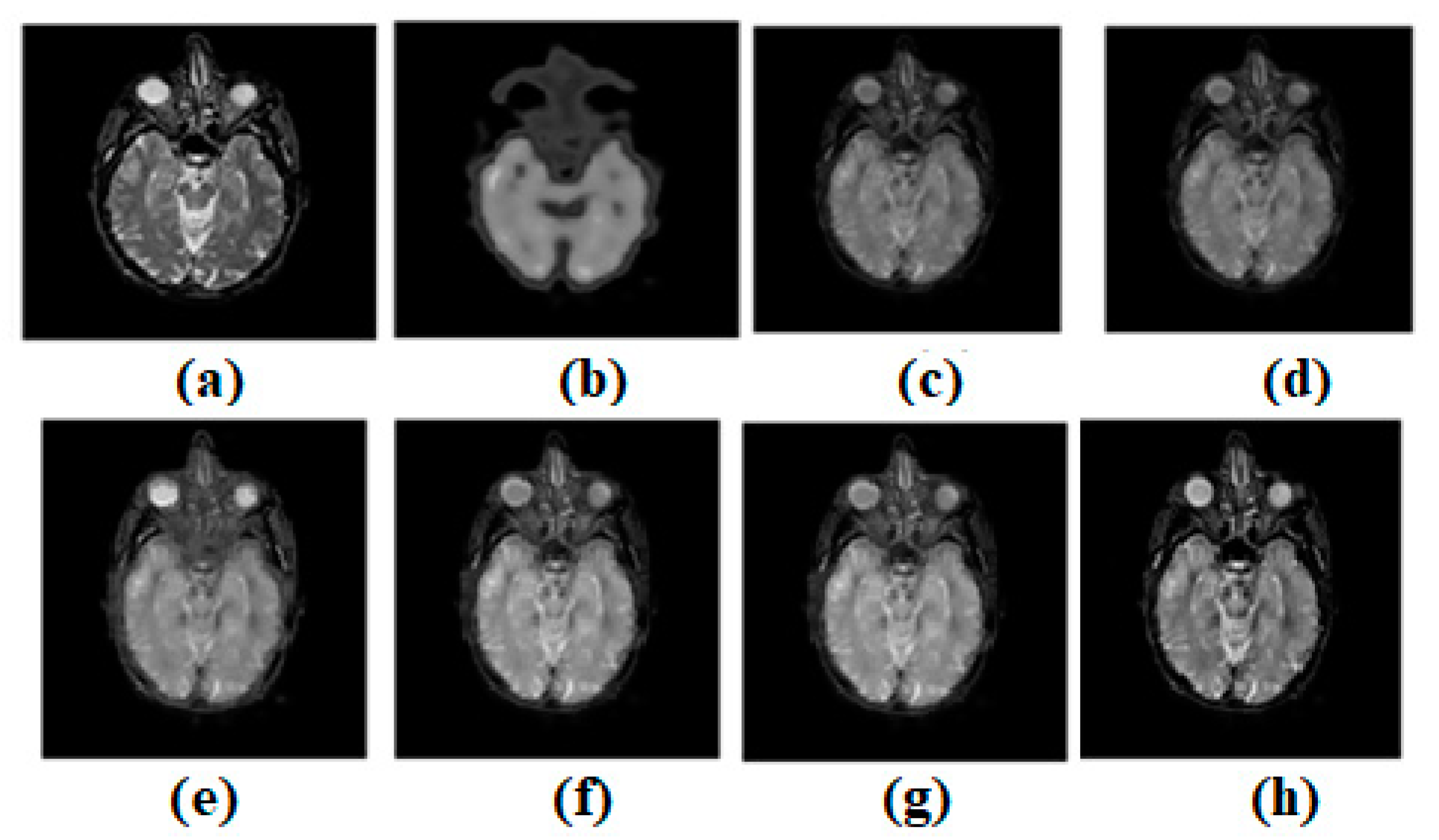
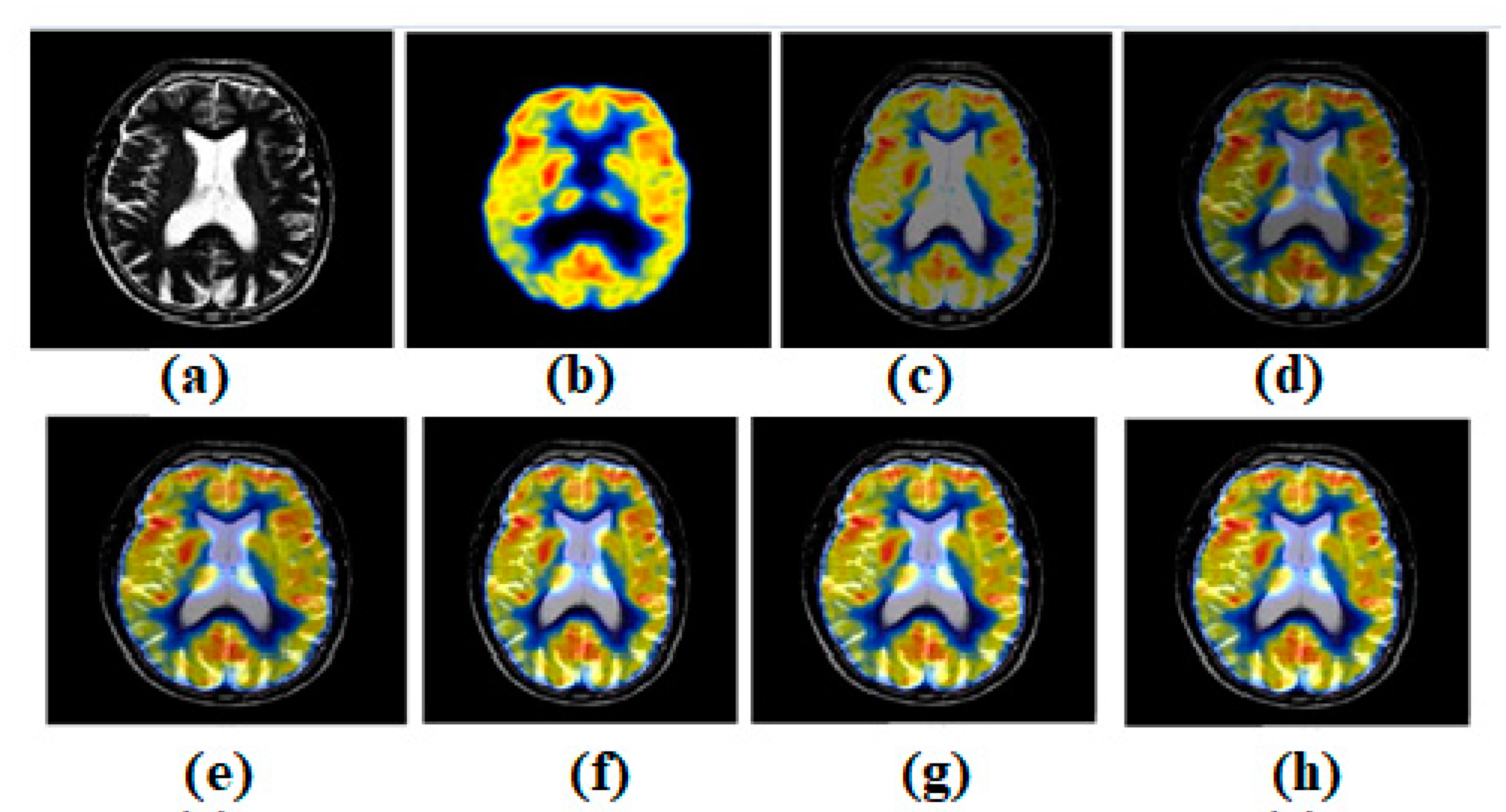
| Merits | Demerits | Applications |
|---|---|---|
| Extracting all the useful information from the input images and merging the two images to get crucial information | In the image fusion process, noise can affect the fused image | Medical treatment |
| The fusion technique does not show any errors for the human preceptors | During the experimental analysis because of the application of the fusion technique | Object recognition and detection |
| In the process of fusion, it has robust imperfections such as misregistration and is reliable | The illumination problem in the fused images | Guidance for the navigation |
| The process of image fusion can show better reliability, capability, and complementary information | The processing of the data is slow when the images are fused | Surveillance for military and civilian |
| It is good for the identification and recognition | More input images are required for the fusion process | In the field of robotics fusion, images are mostly applied for the frequency variations in the images |
| Method | MIAB,F | QAB,F | SF | SSIM | NIQE |
|---|---|---|---|---|---|
| [44] | 3.4603 | 0.2961 | 12.9609 | 0.9929 | 30.1237 |
| [47] | 3.8704 | 0.7537 | 11.1020 | 0.9976 | 22.2551 |
| [48] | 3.8104 | 0.7582 | 11.1321 | 0.9967 | 22.2321 |
| [49] | 3.8859 | 0.7763 | 11.3601 | 0.9976 | 21.6689 |
| [51] | 3.8820 | 0.7918 | 11.6428 | 0.9975 | 24.7500 |
| [53] | 3.9616 | 0.7974 | 9.6098 | 0.9969 | 23.3457 |
| Method | MIAB,F | QAB,F | SF | SSIM | NIQE |
|---|---|---|---|---|---|
| [44] | 3.4603 | 0.3387 | 19.9778 | 0.9486 | 22.3801 |
| [47] | 3.8704 | 0.3855 | 22.7752 | 0.9729 | 21.9882 |
| [48] | 3.8504 | 0.3582 | 21.1221 | 0.9667 | 22.0021 |
| [49] | 3.8859 | 0.4369 | 25.3019 | 0.9738 | 20.4692 |
| [51] | 3.8820 | 0.4276 | 23.1627 | 0.9752 | 21.1289 |
| [53] | 3.9616 | 0.3545 | 18.0624 | 0.9979 | 22.4254 |
| Method | MIAB,F | QAB,F | SF | SSIM | NIQE |
|---|---|---|---|---|---|
| [44] | 3.1319 | 0.5508 | 16.9281 | 0.9949 | 22.2935 |
| [47] | 3.2324 | 0.5919 | 14.4240 | 0.9883 | 22.1577 |
| [48] | 3.1404 | 0.6682 | 14.1421 | 0.9887 | 22.0111 |
| [49] | 3.2335 | 0.6449 | 15.1480 | 0.9902 | 22.7697 |
| [51] | 3.2482 | 0.6562 | 14.9759 | 0.9942 | 22.4171 |
| [53] | 3.2317 | 0.6439 | 15.9881 | 0.9996 | 22.1535 |
| Method | MIAB,F | QAB,F | SF | SSIM | NIQE |
|---|---|---|---|---|---|
| [44] | 3.0889 | 0.3118 | 41.2059 | 0.9893 | 22.7915 |
| [47] | 3.1979 | 0.2905 | 38.9116 | 0.9905 | 21.7460 |
| [48] | 3.1204 | 0.3562 | 38.1021 | 0.9917 | 21.7321 |
| [49] | 3.1979 | 0.3505 | 42.4170 | 0.9908 | 20.5352 |
| [51] | 3.1990 | 0.3591 | 39.8955 | 0.9938 | 22.2407 |
| [53] | 3.1980 | 0.3618 | 36.5719 | 0.9995 | 19.5832 |
Disclaimer/Publisher’s Note: The statements, opinions and data contained in all publications are solely those of the individual author(s) and contributor(s) and not of MDPI and/or the editor(s). MDPI and/or the editor(s) disclaim responsibility for any injury to people or property resulting from any ideas, methods, instructions or products referred to in the content. |
© 2023 by the authors. Licensee MDPI, Basel, Switzerland. This article is an open access article distributed under the terms and conditions of the Creative Commons Attribution (CC BY) license (https://creativecommons.org/licenses/by/4.0/).
Share and Cite
Diwakar, M.; Singh, P.; Ravi, V.; Maurya, A. A Non-Conventional Review on Multi-Modality-Based Medical Image Fusion. Diagnostics 2023, 13, 820. https://doi.org/10.3390/diagnostics13050820
Diwakar M, Singh P, Ravi V, Maurya A. A Non-Conventional Review on Multi-Modality-Based Medical Image Fusion. Diagnostics. 2023; 13(5):820. https://doi.org/10.3390/diagnostics13050820
Chicago/Turabian StyleDiwakar, Manoj, Prabhishek Singh, Vinayakumar Ravi, and Ankur Maurya. 2023. "A Non-Conventional Review on Multi-Modality-Based Medical Image Fusion" Diagnostics 13, no. 5: 820. https://doi.org/10.3390/diagnostics13050820
APA StyleDiwakar, M., Singh, P., Ravi, V., & Maurya, A. (2023). A Non-Conventional Review on Multi-Modality-Based Medical Image Fusion. Diagnostics, 13(5), 820. https://doi.org/10.3390/diagnostics13050820