Effectiveness of Telerehabilitation-Based Therapeutic Exercise on Functional Capacity in Chronic Stroke: Study Protocol for a Multicenter Randomized Controlled Trial
 ,
,  , ,
, ,
Abstract
1. Introduction
2. Materials and Methods
2.1. Study Design and Setting
2.2. Recruitment and Blinding
2.3. Sample Size
2.4. Selection Criteria
2.5. Outcome Measure
Assessments
2.6. Interventions
Intervention Description
- -
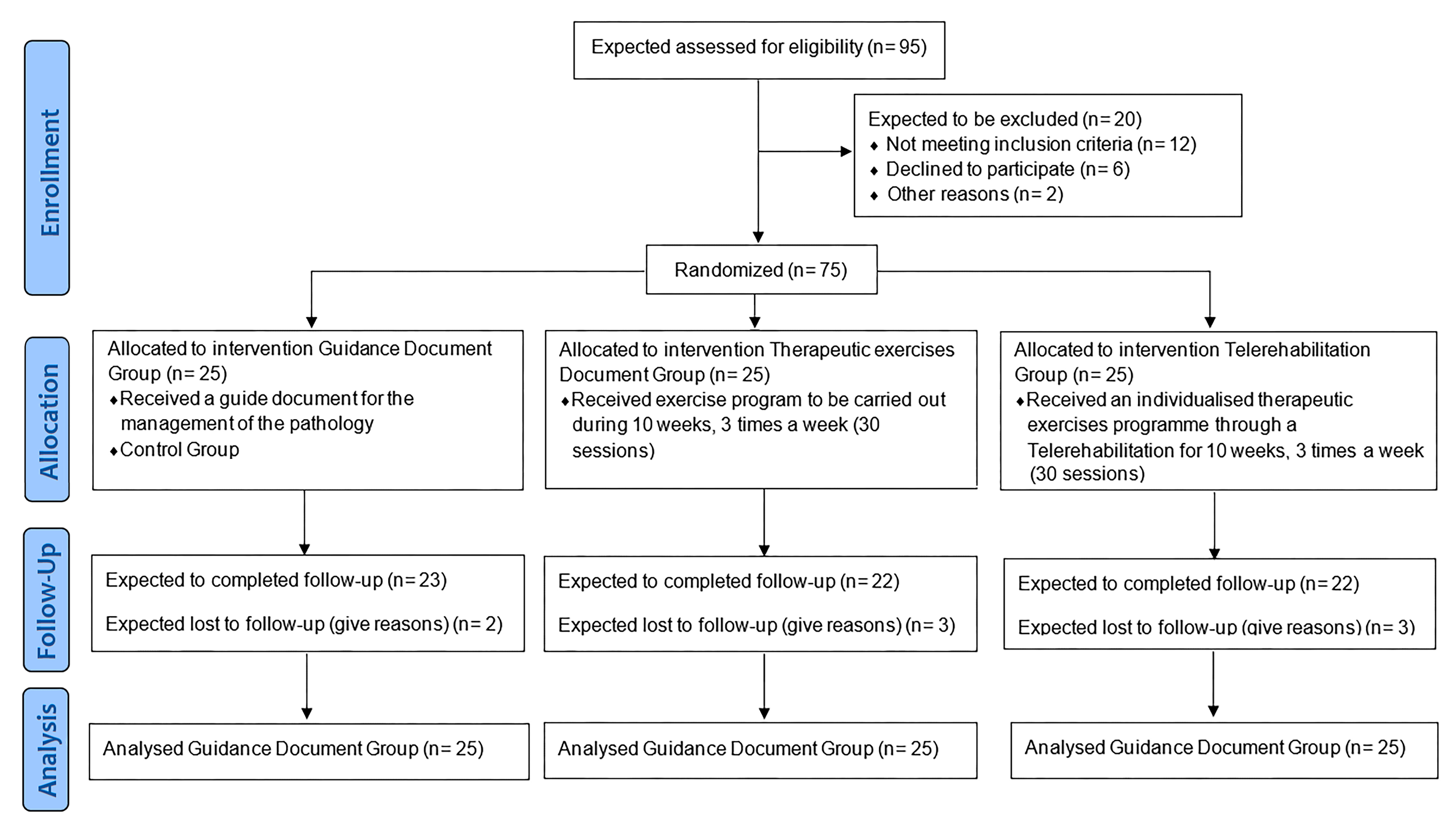
- Guidance Document Group (n = 25): The primary and community care physiotherapist will carry out an individual face-to-face consultation at the Primary Care Center with the person participating in the study, where they will deliver a guide document for the management of the pathology, as well as guidelines for the promotion and prevention of important health issues after a stroke. The document is the “Guide aimed at people affected by cerebral vascular disease and their families and caregivers” created by the Department of Health of the Generalitat de Catalunya, together with the Stroke Foundation in 2022. This group is the control, since the intervention is the one that most resembles the intervention that is currently being carried out in Catalonia from the Primary Care Centers for Stroke in the chronic phase.
- -
- Therapeutic Exercises Document Group (n = 25): The physiotherapist will carry out an individual face-to-face consultation at the Primary Care Center with the person participating in the study. The document “Home-Based Therapeutic Exercise Program” will be explained and delivered, and contains an exercise program to be carried out during the next 10 weeks, with a frequency of 3 times a week. The explanatory document consists of 3 exercise tables for each week of intervention (30 sessions) [48,49,50,51,52]. In addition to the corresponding description of each exercise for the correct performance, it will also specify the dosage, both in repetitions, as well as in series and load to be performed. It will also contain a checklist template for tracking completed activities. Strength exercises will be performed for the different muscle groups of the lower extremity and upper extremity, and trunk. Also, stretching exercises for the most relevant flexor muscles of the lower extremity and upper extremity and trunk will be undertaken. In addition, stretching exercises will be included for the most relevant flexor muscles of these regions. In addition, exercises wil be added for the efficiency of standing walking, such as the previous step. And, finally, mobility exercises and global balance will be included.
- -
- Telerehabilitation Group (n = 25): The physiotherapist will carry out an individual face-to-face consultation at the Primary Care Center with the person participating in the study, where the intervention of an individualized program of therapeutic exercises will be explained through a Telerehabilitation platform (Physitrack) for the following 10 weeks, with a frequency of 3 times a week (30 sessions). In addition, participants will be given an explanatory document called “Guide for the use of the Physitrack Telerehabilitation Platform” that contains the necessary information for the correct access and use of Physitrack. Likewise, the consultation will include a brief overview of the platform’s operation and a practical demonstration. The therapeutic exercise program will follow the same standardized structure and dosage as that of the Therapeutic Exercises Document Intervention Group (same exercices, number of sessions, sets, repetitions, intensity, and progression criteria). Participants in this group will receive structured follow-up every two weeks (five contacts in total), delivered through the telerehabilitation platform. These remote contacts (approximately 10–15 min each) will allow the physiotherapist to review adherence, address questions, and adjust the exercise program according to each patient’s progression. Participants will also be able to communicate directly with the physiotherapist through the platform.
2.7. Safety Monitoring and Adverse Events
2.8. Statistical Analysis
3. Discussion
Limitations
4. Conclusions
Supplementary Materials
Author Contributions
Funding
Institutional Review Board Statement
Informed Consent Statement
Data Availability Statement
Conflicts of Interest
Abbreviations
| CG | Conventional Group |
| EG | Experimental Group |
| BI | Barthel Index |
| MMAS | Modified Motor Assessment Scale |
| MAS | Modified Ashworth Scale |
| MRC | Medical Research Council |
| PASS | Postural Assessment Scale for Stroke Patients |
| WGS | Wisconsin Gait Scale |
| 4MWT | 4 Meter Gait Speed Test |
| BPI | Brief Pain Inventory |
| FSS | Fatigue Severity Scale |
| TUG | Time Up and Go Test |
| NEWSQOL | Newcastle Stroke-Specific Quality of Life Measure |
| GROC | Global Rating of Change Scale |
| SERNS | Spanish Society of Neurorehabilitation |
| RCT | Randomized Control Trial |
| ICS | Institut Català de la Salut |
| AE | Adverse events |
References
- Capdevila, M.S.; Alzamora Sas, M.T.; Vila Morientes, N.; Forés Raurell, R.; Vicheto Capdevila, M.; Heras Tebar, A. Abordaje de Los Ictus: Colaboración Entre Atención Primaria y Especializada. Semer. Med. Fam. 2005, 31, 314–318. [Google Scholar] [CrossRef]
- Díaz-Guzmán, J.; Egido, J.-A.; Gabriel-Sánchez, R.; Barberá-Comes, G.; Fuentes-Gimeno, B.; Fernández-Pérez, C. Stroke and Transient Ischemic Attack Incidence Rate in Spain: The IBERICTUS Study. Cerebrovasc. Dis. 2012, 34, 272–281. [Google Scholar] [CrossRef]
- Soto, A.; Guillén-Grima, F.; Morales, G.; Muñoz, S.; Aguinaga-Ontoso, I.; Fuentes-Aspe, R. Prevalence and Incidence of Ictus in Europe: Systematic Review and Meta-Analysis. An. Sist. Sanit. Navar. 2022, 45, 979. [Google Scholar] [CrossRef]
- Lucas-Noll, J.; Lleixà-Fortuño, M.; Queralt-Tomas, L.; Panisello-Tafalla, A.; Carles-Lavila, M.; Clua-Espuny, J.L. Organization and Costs of Stroke Care in Outpatient Settings: Systematic Review. Atención Primaria 2023, 55, 102578. [Google Scholar] [CrossRef]
- Oliva-Moreno, J.; Aranda-Reneo, I.; Vilaplana-Prieto, C.; González-Domínguez, A.; Hidalgo-Vega, A. Economic Valuation of Informal Care in Cerebrovascular Accident Survivors in Spain. BMC Health Serv. Res. 2013, 13, 508. [Google Scholar] [CrossRef]
- Abilleira, S.; Ribera, A.; Sánchez, E.; Roquer, J.; Duarte, E.; Tresserras, R.; Gallofré, M. In-Hospital Stroke Care in Catalonia [Spain]. Results of the “First Clinical Audit of Stroke. Catalonia, 2005/2006”. Gac. Sanit. 2008, 22, 565–573. [Google Scholar] [CrossRef]
- Martins, T.; Ribeiro, J.P.; Garrett, M.C.L.A. Incapacidad y Calidad de Vida Del Paciente Afectado Por Un Accidente Vascular Cerebral: Evaluación Nueve Meses Después Del Alta Hospitalaria. Rev. Neurol. 2006, 42, 655. [Google Scholar] [CrossRef] [PubMed]
- Cabasés Hita, J.M.; Sánchez Iriso, E.; Ollo López, A.; Errea Rodríguez M. Ministerio de Sanidad, Servicios Sociales e Igualdad. Encuesta Nacional de Salud España 2011/12; Calidad de Vida Relacionada Con La Salud En Adultos: EQ-5D-5L; Serie Informes Monográficos No 3; Ministerio de Sanidad, Servicios Sociales e Igualdad: Madrid, Spain, 2014. [Google Scholar]
- Cristina López Mompó, M.; Catarineu Almansa, B.; Duarte Oller, E.; Garreta Figuera, R.; González Durán, M.; Lapeira Viñeta, M.; Rodríguez Campello, A.; Rodríguez Molinet, P.; Torrequebrada Giménez, A. Consens Català Sobre Avaluació i Tractament del Pacient Postictus; Societat Catalana de Medicina Familiar i Comunitària (CAMFiC): Barcelona, Spain, 2017; p. 38. [Google Scholar]
- Baker, K.B.; Plow, E.B.; Nagel, S.; Rosenfeldt, A.B.; Gopalakrishnan, R.; Clark, C.; Wyant, A.; Schroedel, M.; Ozinga, J.; Davidson, S.; et al. Cerebellar Deep Brain Stimulation for Chronic Post-Stroke Motor Rehabilitation: A Phase I Trial. Nat. Med. 2023, 29, 2366–2374. [Google Scholar] [CrossRef] [PubMed]
- Kumar, J.; Patel, T.; Sugandh, F.; Dev, J.; Kumar, U.; Adeeb, M.; Kachhadia, M.P.; Puri, P.; Prachi, F.; Zaman, M.U.; et al. Innovative Approaches and Therapies to Enhance Neuroplasticity and Promote Recovery in Patients with Neurological Disorders: A Narrative Review. Cureus 2023, 15, e41914. [Google Scholar] [CrossRef] [PubMed]
- Dromerick, A.W.; Geed, S.; Barth, J.; Brady, K.; Giannetti, M.L.; Mitchell, A.; Edwardson, M.A.; Tan, M.T.; Zhou, Y.; Newport, E.L.; et al. Critical Period After Stroke Study (CPASS): A Phase II Clinical Trial Testing an Optimal Time for Motor Recovery after Stroke in Humans. Proc. Natl. Acad. Sci. USA 2021, 118, e2026676118. [Google Scholar] [CrossRef] [PubMed]
- Bravo-Esteban, E.; López-Larraz, E. Enhancement of motor relearning and functional recovery in stroke patients: Non-invasive strategies for modulating the central nervous system. Rev. Neurol. 2016, 62, 273–281. [Google Scholar] [CrossRef]
- Lin, Y.; Jiang, Z.; Zhan, G.; Su, H.; Kang, X.; Jia, J. Brain Network Characteristics between Subacute and Chronic Stroke Survivors in Active, Imagery, Passive Movement Task: A Pilot Study. Front. Neurol. 2023, 14, 1143955. [Google Scholar] [CrossRef]
- Maejima, H.; Inoue, T.; Takamatsu, Y. Therapeutic Exercise Accompanied by Neuronal Modulation to Enhance Neurotrophic Factors in the Brain with Central Nervous System Disorders. Phys. Ther. Res. 2019, 22, 38–43. [Google Scholar] [CrossRef]
- Kaas, J.H. Plasticity of Sensory and Motor Maps in Adult Mammals. Annu. Rev. Neurosci. 1991, 14, 137–167. [Google Scholar] [CrossRef] [PubMed]
- Zotey, V.; Andhale, A.; Shegekar, T.; Juganavar, A. Adaptive Neuroplasticity in Brain Injury Recovery: Strategies and Insights. Cureus 2023, 15, e45873. [Google Scholar] [CrossRef] [PubMed]
- Noé, E.; Gómez, A.; Bernabeu, M.; Quemada, I.; Rodríguez, R.; Pérez, T.; López, C.; Laxe, S.; Colomer, C.; Ríos, M.; et al. Guidelines: Basic Principles of Neurorehabilitation for Patients with Acquired Brain Injury. Recommendations of the Spanish Society of Neurorehabilitation. Neurología (Engl. Ed.) 2024, 39, 261–281. [Google Scholar] [CrossRef] [PubMed]
- Departament de Salut. Generalitat de Catalunya Pla de Rehabilitació de Catalunya: Abordatge Integral del Funcionament i La Discapacitat; Departament de Salut: Catalonia, Spain, 2022. [Google Scholar]
- Generalitat de Catalunya. Departament de Salud Pla de Rehabilitació de Catalunya: Els Processos Assistencials En Rehabilitació; Generalitat de Catalunya: Barcelona, Spain, 2008. [Google Scholar]
- The Burden of Stroke in Europe|The Burden of Stroke in Europe Report. Available online: https://strokeeurope.eu/index/the-burden-of-stroke-in-europe (accessed on 7 May 2025).
- Wafa, H.A.; Wolfe, C.D.A.; Emmett, E.; Roth, G.A.; Johnson, C.O.; Wang, Y. Burden of Stroke in Europe. Stroke 2020, 51, 2418–2427. [Google Scholar] [CrossRef]
- Malik, A.N.; Tariq, H.; Afridi, A.; Rathore, F.A. Technological Advancements in Stroke Rehabilitation. J. Pak. Med. Assoc. 2022, 72, 1672–1674. [Google Scholar] [CrossRef]
- Cramer, S.C.; Dodakian, L.; Le, V.; See, J.; Augsburger, R.; McKenzie, A.; Zhou, R.J.; Chiu, N.L.; Heckhausen, J.; Cassidy, J.M.; et al. Efficacy of Home-Based Telerehabilitation vs. In-Clinic Therapy for Adults After Stroke. JAMA Neurol. 2019, 76, 1079. [Google Scholar] [CrossRef]
- Tchero, H.; Teguo, M.T.; Lannuzel, A.; Rusch, E. Telerehabilitation for Stroke Survivors: Systematic Review and Meta-Analysis. J. Med. Internet Res. 2018, 20, e10867. [Google Scholar] [CrossRef]
- Knepley, K.D.; Mao, J.Z.; Wieczorek, P.; Okoye, F.O.; Jain, A.P.; Harel, N.Y. Impact of Telerehabilitation for Stroke-Related Deficits. Telemed. e-Health 2021, 27, 239–246. [Google Scholar] [CrossRef]
- Stroke Rehabilitation in Adults NICE Guideline. 2023. Available online: https://www.nice.org.uk/guidance/ng236 (accessed on 18 May 2025).
- Seron, P.; Oliveros, M.-J.; Gutierrez-Arias, R.; Fuentes-Aspe, R.; Torres-Castro, R.C.; Merino-Osorio, C.; Nahuelhual, P.; Inostroza, J.; Jalil, Y.; Solano, R.; et al. Effectiveness of Telerehabilitation in Physical Therapy: A Rapid Overview. Phys. Ther. 2021, 101, pzab053. [Google Scholar] [CrossRef]
- López, C.; Closa, C.; Lucas, E. Telemedicina En Rehabilitación: Necesidad y Oportunidad Post-COVID. Rehabilitacion 2020, 54, 225–227. [Google Scholar] [CrossRef]
- Chan, A.; Tetzlaff, J.M.; Altman, D.G. 2013 Statement: Defining Standard Protocol Items for Clinical Trials. Ann. Intern. Med. 2016, 158, 200–207. [Google Scholar] [CrossRef]
- Aphiphaksakul, P.; Siriphorn, A. Home-Based Exercise Using Balance Disc and Smartphone Inclinometer Application Improves Balance and Activity of Daily Living in Individuals with Stroke: A Randomized Controlled Trial. PLoS ONE 2022, 17, e0277870. [Google Scholar] [CrossRef]
- Hsieh, Y.-W.; Wang, C.-H.; Wu, S.-C.; Chen, P.-C.; Sheu, C.-F.; Hsieh, C.-L. Establishing the Minimal Clinically Important Difference of the Barthel Index in Stroke Patients. Neurorehabilit. Neural Repair 2007, 21, 233–238. [Google Scholar] [CrossRef]
- Cid-Ruzafa, J.; Damián-Moreno, J. Valoración de La Discapacidad Física: El Indice de Barthel. Rev. Española Salud Pública 1997, 71, 127–137. [Google Scholar] [CrossRef]
- Carr, J.H.; Shepherd, R.B.; Nordholm, L.; Lynne, D. Investigation of a New Motor Assessment Scale for Stroke Patients. Phys. Ther. 1985, 65, 175–180. [Google Scholar] [CrossRef] [PubMed]
- Loewen, S.C.; Anderson, B.A. Reliability of the Modified Motor Assessment Scale and the Barthel Index. Phys. Ther. 1988, 68, 1077–1081. [Google Scholar] [CrossRef] [PubMed]
- Bohannon, R.W.; Smith, M.B. Interrater Reliability of a Modified Ashworth Scale of Muscle Spasticity. Phys. Ther. 1987, 67, 206–207. [Google Scholar] [CrossRef]
- Meseguer-Henarejos, A.-B.; Sánchez-Meca, J.; López-Pina, J.-A.; Carles-Hernández, R. Inter- and Intra-Rater Reliability of the Modified Ashworth Scale: A Systematic Review and Meta-Analysis. Eur. J. Phys. Rehabil. Med. 2018, 54, 576–590. [Google Scholar] [CrossRef]
- Conde, R.M.; de Almeida Pereira Pena, L.; do Nascimento Elias, A.H.; Guerreiro, C.T.; Pereira, D.A.; da Rosa Sobreira, C.F.; Marques, W.; Barreira, A.A. Inter-rater Reliability of the Rasch-modified Medical Research Council Scoring Criteria for Manual Muscle Testing in Neuromuscular Diseases. J. Peripher. Nerv. Syst. 2023, 28, 119–124. [Google Scholar] [CrossRef]
- Kiper, P.; Rimini, D.; Falla, D.; Baba, A.; Rutkowski, S.; Maistrello, L.; Turolla, A. Does the Score on the MRC Strength Scale Reflect Instrumented Measures of Maximal Torque and Muscle Activity in Post-Stroke Survivors? Sensors 2021, 21, 8175. [Google Scholar] [CrossRef]
- Jellinger, K.A. Aids to the Examination of the Peripheral Nervous System. Eur. J. Neurol. 2001, 8, 377. [Google Scholar] [CrossRef]
- Cabanas-Valdés, R.; Girabent-Farrés, M.; Cánovas-Vergé, D.; Caballero-Gómez, F.M.; Germán-Romero, A.; Bagur-Calafat, C. Spanish translation and validation of the Postural Assessment Scale for Stroke Patients (PASS) to assess balance and postural control in adult post-stroke patients. Rev. Neurol. 2015, 60, 151–158. [Google Scholar]
- Cabanas-Valdés, R.; García-Rueda, L.; Salgueiro, C.; Pérez-Bellmunt, A.; Rodríguez-Sanz, J.; López-de-Celis, C. Assessment of the 4-Meter Walk Test Test-Retest Reliability and Concurrent Validity and Its Correlation with the Five Sit-to-Stand Test in Chronic Ambulatory Stroke Survivors. Gait Posture 2023, 101, 8–13. [Google Scholar] [CrossRef] [PubMed]
- de Andrés Ares, J.; Cruces Prado, L.M.; Canos Verdecho, M.A.; Penide Villanueva, L.; Del Valle Hoyos, M.; Herdman, M.; Traseira Lugilde, S.; Velázquez Rivera, I. Validation of the Short Form of the Brief Pain Inventory (BPI-SF) in Spanish Patients with Non-Cancer-Related Pain. Pain Pract. 2015, 15, 643–653. [Google Scholar] [CrossRef] [PubMed]
- Ozyemisci-Taskiran, O.; Batur, E.B.; Yuksel, S.; Cengiz, M.; Karatas, G.K. Validity and Reliability of Fatigue Severity Scale in Stroke. Top. Stroke Rehabil. 2019, 26, 122–127. [Google Scholar] [CrossRef]
- Chan, P.P.; Si Tou, J.I.; Tse, M.M.; Ng, S.S. Reliability and Validity of the Timed Up and Go Test with a Motor Task in People with Chronic Stroke. Arch. Phys. Med. Rehabil. 2017, 98, 2213–2220. [Google Scholar] [CrossRef]
- Soto-Vidal, C.; Calvo-Fuente, V.; Muriel-García, A.; Gallego-Izquierdo, T.; González-Alted, C.; Pacheco-da-Costa, S. Responsiveness of the Spanish Version of Newcastle Stroke-Specific Quality of Life Measure (NEWSQOL). Int. J. Environ. Res. Public Health 2021, 18, 10034. [Google Scholar] [CrossRef] [PubMed]
- Kamper, S.J.; Maher, C.G.; Mackay, G. Global Rating of Change Scales: A Review of Strengths and Weaknesses and Considerations for Design. J. Man. Manip. Ther. 2009, 17, 163–170. [Google Scholar] [CrossRef]
- Boyne, P.; Billinger, S.A.; Reisman, D.S.; Awosika, O.O.; Buckley, S.; Burson, J.; Carl, D.; DeLange, M.; Doren, S.; Earnest, M.; et al. Optimal Intensity and Duration of Walking Rehabilitation in Patients with Chronic Stroke. JAMA Neurol. 2023, 80, 342. [Google Scholar] [CrossRef]
- Stuart, M.; Dromerick, A.W.; Macko, R.; Benvenuti, F.; Beamer, B.; Sorkin, J.; Chard, S.; Weinrich, M. Adaptive Physical Activity for Stroke: An Early-Stage Randomized Controlled Trial in the United States. Neurorehabilit. Neural Repair 2019, 33, 668–680. [Google Scholar] [CrossRef]
- Lund, C.; Dalgas, U.; Grønborg, T.K.; Andersen, H.; Severinsen, K.; Riemenschneider, M.; Overgaard, K. Balance and Walking Performance Are Improved after Resistance and Aerobic Training in Persons with Chronic Stroke. Disabil. Rehabil. 2018, 40, 2408–2415. [Google Scholar] [CrossRef]
- Emmerson, K.B.; Harding, K.E.; Taylor, N.F. Home Exercise Programmes Supported by Video and Automated Reminders Compared with Standard Paper-Based Home Exercise Programmes in Patients with Stroke: A Randomized Controlled Trial. Clin. Rehabil. 2017, 31, 1068–1077. [Google Scholar] [CrossRef] [PubMed]
- Aaron, S.E.; Hunnicutt, J.L.; Embry, A.E.; Bowden, M.G.; Gregory, C.M. POWER Training in Chronic Stroke Individuals: Differences between Responders and Nonresponders. Top. Stroke Rehabil. 2017, 24, 496–502. [Google Scholar] [CrossRef] [PubMed]
- Cohen, J. Statistical Power Analysis for the Behavioral Sciences; Lawrence Erlbaum Associates: Hillsdale, NJ, USA, 1988. [Google Scholar]
- Vive, S.; Bunketorp-Käll, L. Absolute and Relative Intrarater Reliability of the Modified Motor Assessment Scale According to Uppsala Academic Hospital -99. Physiother. Theory Pract. 2024, 40, 594–602. [Google Scholar] [CrossRef]
- Chen, C.-L.; Chen, C.-Y.; Chen, H.-C.; Wu, C.-Y.; Lin, K.-C.; Hsieh, Y.-W.; Shen, I.-H. Responsiveness and Minimal Clinically Important Difference of Modified Ashworth Scale in Patients with Stroke. Eur. J. Phys. Rehabil. Med. 2019, 55, 754–760. [Google Scholar] [CrossRef]
- Guzik, A.; Drużbicki, M.; Wolan-Nieroda, A.; Przysada, G.; Kwolek, A. The Wisconsin Gait Scale—The Minimal Clinically Important Difference. Gait Posture 2019, 68, 453–457. [Google Scholar] [CrossRef]
- Lien, H.-P.; Shieh, Y.-J.; Chen, C.-P.; Huang, Y.-J.; Wang, I.; Chen, M.-H.; Hsieh, C.-L. The Minimal Important Difference for the Postural Assessment Scale for Stroke Patients in the Subacute Stage. Braz. J. Phys. Ther. 2024, 28, 100595. [Google Scholar] [CrossRef] [PubMed]
- Fulk, G.D.; Echternach, J.L. Test-Retest Reliability and Minimal Detectable Change of Gait Speed in Individuals Undergoing Rehabilitation after Stroke. J. Neurol. Phys. Ther. 2008, 32, 8–13. [Google Scholar] [CrossRef] [PubMed]
- Matérne, M.; Simpson, G.; Jarl, G.; Appelros, P.; Arvidsson-Lindvall, M. Contribution of Participation and Resilience to Quality of Life among Persons Living with Stroke in Sweden: A Qualitative Study. Int. J. Qual. Stud. Health Well-Being 2022, 17, 2119676. [Google Scholar] [CrossRef] [PubMed]
- Inoa, V.; Goyal, N. Role of Stroke Scales and Scores in Cerebrovascular Disease. Neurol. Clin. 2024, 42, 753–765. [Google Scholar] [CrossRef]


| Assessment Tools | Variables |
|---|---|
| Primary outcome | |
| Barthel Index | Functional capacity |
| Key Secondary Outcome | |
| Modified Motor Assessment Scale | Motor function |
| Modified Ashworth Scale | Muscle tone |
| Medical Research Council Scale | Muscle strength |
| Postural Assessment Scale for Stroke Patients | Balance |
| NewsQol | Perceived quality of life |
| Additional Secondary Outcome | |
| Wisconsin Gait Scale | Gait |
| 4-Metre Gait Speed Test | Gait speed |
| Brief Pain Inventory | Perceived pain |
| Fatigue Severity Scale | Fatigue |
| Time Up and Go Test | Fall risk |
| Global Rating of Change Scale | Subjective perceived change |
| Adherence metrics | Exercise program adherence |
Disclaimer/Publisher’s Note: The statements, opinions and data contained in all publications are solely those of the individual author(s) and contributor(s) and not of MDPI and/or the editor(s). MDPI and/or the editor(s) disclaim responsibility for any injury to people or property resulting from any ideas, methods, instructions or products referred to in the content. |
© 2025 by the authors. Licensee MDPI, Basel, Switzerland. This article is an open access article distributed under the terms and conditions of the Creative Commons Attribution (CC BY) license (https://creativecommons.org/licenses/by/4.0/).
Share and Cite
Casas-Rodríguez, Y.; López-de-Celis, C.; Inglés-Martínez, G.; González-Tova, L.; Martínez-González, M.B.; Barayazarra-López, I.; Escribà-Salvans, A. Effectiveness of Telerehabilitation-Based Therapeutic Exercise on Functional Capacity in Chronic Stroke: Study Protocol for a Multicenter Randomized Controlled Trial. Life 2025, 15, 1905. https://doi.org/10.3390/life15121905
Casas-Rodríguez Y, López-de-Celis C, Inglés-Martínez G, González-Tova L, Martínez-González MB, Barayazarra-López I, Escribà-Salvans A. Effectiveness of Telerehabilitation-Based Therapeutic Exercise on Functional Capacity in Chronic Stroke: Study Protocol for a Multicenter Randomized Controlled Trial. Life. 2025; 15(12):1905. https://doi.org/10.3390/life15121905
Chicago/Turabian StyleCasas-Rodríguez, Yaiza, Carlos López-de-Celis, Gala Inglés-Martínez, Lidia González-Tova, María Benilde Martínez-González, Izaskun Barayazarra-López, and Anna Escribà-Salvans. 2025. "Effectiveness of Telerehabilitation-Based Therapeutic Exercise on Functional Capacity in Chronic Stroke: Study Protocol for a Multicenter Randomized Controlled Trial" Life 15, no. 12: 1905. https://doi.org/10.3390/life15121905
APA StyleCasas-Rodríguez, Y., López-de-Celis, C., Inglés-Martínez, G., González-Tova, L., Martínez-González, M. B., Barayazarra-López, I., & Escribà-Salvans, A. (2025). Effectiveness of Telerehabilitation-Based Therapeutic Exercise on Functional Capacity in Chronic Stroke: Study Protocol for a Multicenter Randomized Controlled Trial. Life, 15(12), 1905. https://doi.org/10.3390/life15121905