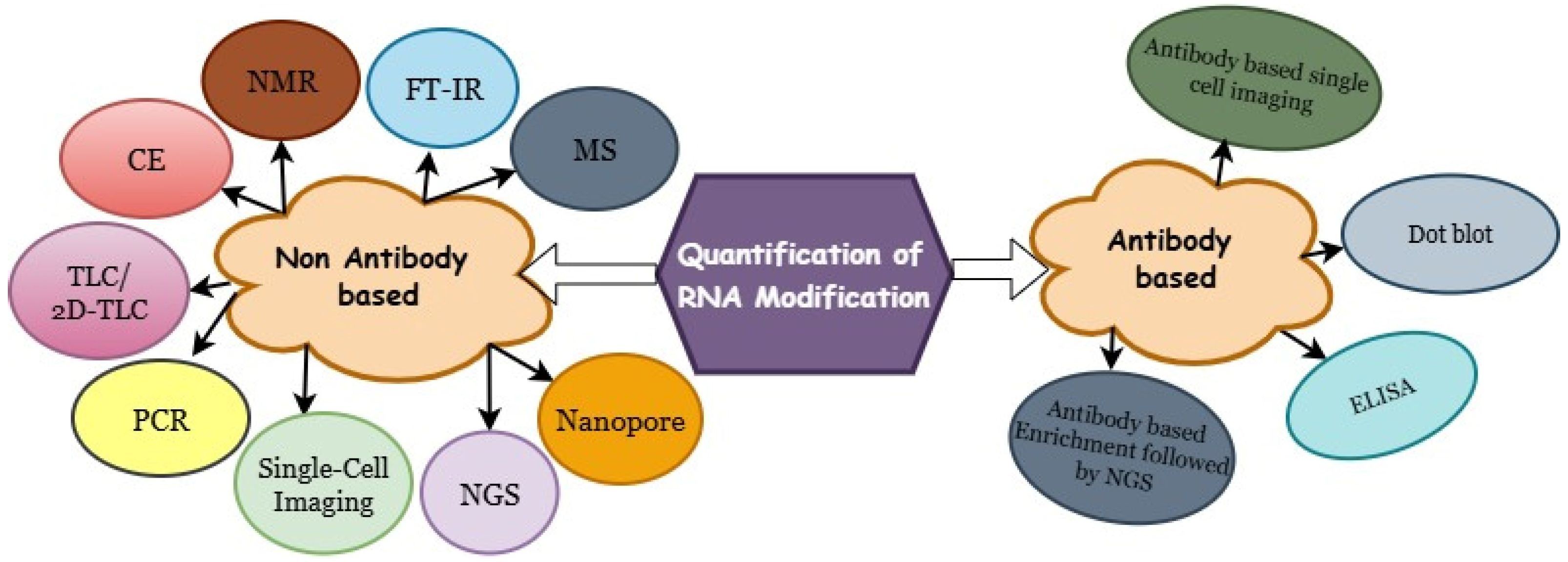
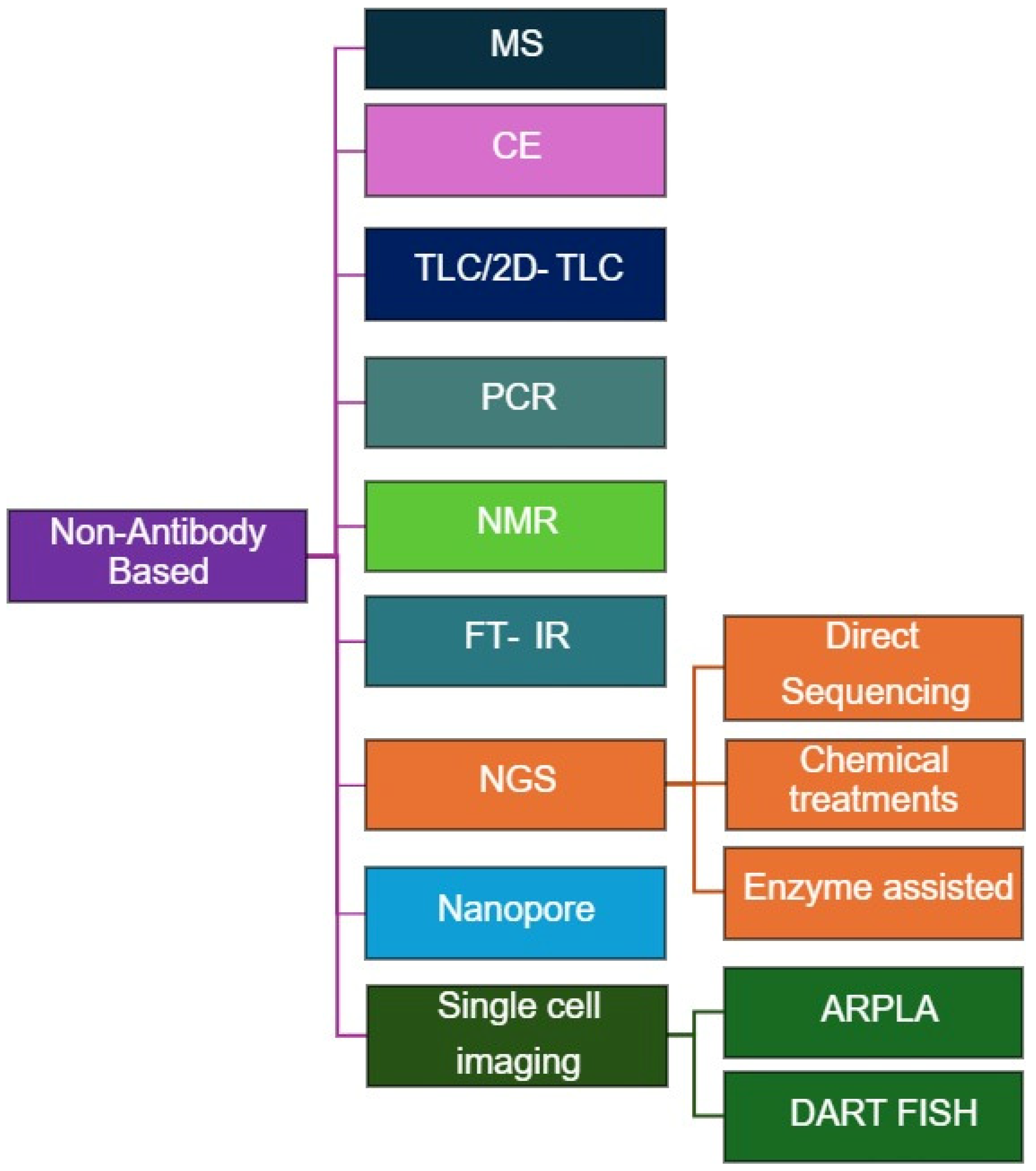
Advances in Quantitative Techniques for Mapping RNA Modifications


Abstract
1. Introduction
2. Methods for RNA Quantification and Imaging
2.1. Antibody-Based Methods
2.1.1. Dot Blot
2.1.2. Enzyme-Linked Immunosorbent Assay (ELISA)
2.1.3. Antibody-Based Enrichment Coupled with Next-Generation Sequencing (NGS)
2.1.4. Antibody-Based Single-Cell Imaging of RNA Modifications
2.2. Non-Antibody-Based Methods
2.2.1. Mass Spectrometry (MS)-Based Methods
Bottom-Up MS Approach
Top-Down MS Approach
2.2.2. Capillary Electrophoresis (CE)
2.2.3. Thin-Layer Chromatography (TLC) and Two-Dimensional TLC (2D-TLC)
2.2.4. Polymerase Chain Reaction (PCR)-Based Methods
2.2.5. Nuclear Magnetic Resonance (NMR) Spectroscopy
2.2.6. FT-IR Spectroscopy

| Method | Subtypes/Mechanism | Examples of RNA Modifications Studied | References |
|---|---|---|---|
| MS | Direct chemical analysis of nucleosides after RNA digestion; detection and quantification of modified nucleotides based on mass-to-charge ratios (e.g., LC–MS, LC–MS/MS). | m6A, m5C, hm5C, ac4C, Ψ, m1A, m7G, other nucleoside-level modifications. | [33,34,35,36,37,38,39,40,41,42,43,44,45,46,47,48,49,50,51,52,53,54,55,56,57,58,59,60,61] |
| CE | Separates RNA fragments based on size and charge. | I, X, Ψ, m2G, m1A, m2,2G, m6A, Am, m5C | [62,63,64] |
| TLC/2D-TLC | Resolves RNA modifications using distinct nucleotide mobilities in orthogonal solvent systems. | Ψ, m6A | [65,66,67,68,69] |
| PCR | RNA modifications impede reverse transcription or DNA polymerase activity. | Nm, Ψ | [70,71,72,73,74,75] |
| NMR | Detects unique chemical shifts and coupling patterns from modified nucleotides. | mnm5U, t6A, mnm5s2U, m7G, m1A, m6A, m1G, m1acp3-Ψ, m5U, Ψ, D | [76,77,78,79,80,81,82,83,84,85,86,87,88,89] |
| NGS | Direct sequencing: RT misincorporations (I → G). Chemical treatments: Various chemical reactions generate RT signatures (e.g., NaBH4, NaCNBH3, Bromoacrylamide, CMC, aC, allyl-SeAM). Enzyme-assisted: Modification-sensitive enzymes or engineered RT introduce mutations or cleave modified nucleotides. | I, Nm, m6A, m7G, ac4C, Ψ, m3C, m5C | [91,92,93,94,95,96,97,98,99,100,101,102,103,104,105,106,107,108,109,110,111,112,113,114,115,116,117,118,119,120,121,122,123,124,125,126,127,128,129] |
| Nanopore | Direct RNA sequencing; detects modifications by analyzing disruptions in ionic current. | m6A, m7G, m5C, Ψ | [130,131,132,133,134,135,136,137] |
| Single-cell imaging | ARPLA: Sialic acid-specific aptamer + PLA-RCA. DART-FISH: Combines DART-seq with FISH for m6A detection. | glycoRNA, m6A | [138,139] |
2.2.7. Next-Generation Sequencing (NGS)-Based Approaches
Direct Sequencing
Chemical Treatment Approaches
Enzyme-Assisted Methods
2.2.8. Nanopore Sequencing
2.2.9. Non-Antibody-Based Single-Cell Imaging
3. Computational and Bioinformatics Approaches
4. Conclusions and Future Perspectives
Author Contributions
Funding
Institutional Review Board Statement
Informed Consent Statement
Data Availability Statement
Acknowledgments
Conflicts of Interest
References
- Davis, F.F.; Allen, F.W. Ribonucleic acids from yeast which contain a fifth nucleotide. J. Biol. Chem. 1957, 227, 907–915. [Google Scholar] [CrossRef] [Scilit] [PubMed]
- Cappannini, A.; Ray, A.; Purta, E.; Mukherjee, S.; Boccaletto, P.; Moafinejad, S.N.; Lechner, A.; Barchet, C.; Klaholz, B.P.; Stefaniak, F.; et al. MODOMICS: A database of RNA modifications and related information. 2023 update. Nucleic Acids Res. 2024, 52, D239–D244. [Google Scholar] [CrossRef] [Scilit] [PubMed]
- Arzumanian, V.A.; Dolgalev, G.V.; Kurbatov, I.Y.; Kiseleva, O.I.; Poverennaya, E.V. Epitranscriptome: Review of Top 25 Most-Studied RNA Modifications. Int. J. Mol. Sci. 2022, 23, 13851. [Google Scholar] [CrossRef] [Scilit]
- Sun, H.; Yin, F.; Zou, Z.; Gu, Y.; Guo, C. A review of advances in analytical strategies for RNA methylation. Anal. Chim. Acta 2025, 1333, 343154. [Google Scholar] [CrossRef] [Scilit]
- Zhang, Y.; Lu, L.; Li, X. Detection technologies for RNA modifications. Exp. Mol. Med. 2022, 54, 1601–1616. [Google Scholar] [CrossRef] [Scilit]
- Xiong, J.; Wu, J.; Liu, Y.; Feng, Y.J.; Yuan, B.F. Quantification and mapping of RNA modifications. TrAC Trends Anal. Chem. 2024, 172, 117606. [Google Scholar] [CrossRef] [Scilit]
- Herbert, C.; Valesyan, S.; Kist, J.; Limbach, P.A. Analysis of RNA and Its Modifications. Annu. Rev. Anal. Chem. 2024, 17, 47–68. [Google Scholar] [CrossRef] [Scilit]
- National Academies of Sciences, Engineering, and Medicine. Charting a Future for Sequencing RNA and Its Modifications: A New Era for Biology and Medicine; The National Academies Press: Washington, DC, USA, 2024. [Google Scholar]
- Desrosiers, R.; Friderici, K.; Rottman, F. Identification of methylated nucleosides in messenger RNA from Novikoff hepatoma cells. Proc. Natl. Acad. Sci. USA 1974, 71, 3971–3975. [Google Scholar] [CrossRef] [Scilit]
- Reynaud, C.; Bruno, C.; Boullanger, P.; Grange, J.; Barbesti, S.; Niveleau, A. Monitoring of urinary excretion of modified nucleosides in cancer patients using a set of six monoclonal antibodies. Cancer Lett. 1992, 61, 255–262. [Google Scholar] [CrossRef] [Scilit]
- Cui, X.; Liang, Z.; Shen, L.; Zhang, Q.; Bao, S.; Geng, Y.; Zhang, B.; Leo, V.; Vardy, L.A.; Lu, T.; et al. 5-Methylcytosine RNA Methylation in Arabidopsis Thaliana. Mol. Plant 2017, 10, 1387–1399. [Google Scholar] [CrossRef] [Scilit] [PubMed]
- Miao, Z.; Xin, N.; Wei, B.; Hua, X.; Zhang, G.; Leng, C.; Zhao, C.; Wu, D.; Li, J.; Ge, W.; et al. 5-Hydroxymethylcytosine is detected in RNA from mouse brain tissues. Brain Res. 2016, 1642, 546–552. [Google Scholar] [CrossRef] [Scilit]
- Delatte, B.; Wang, F.; Ngoc, L.V.; Collignon, E.; Bonvin, E.; Deplus, R.; Calonne, E.; Hassabi, B.; Putmans, P.; Awe, S.; et al. Transcriptome-wide distribution and function of RNA hydroxymethylcytosine. Science 2016, 351, 282–285. [Google Scholar] [CrossRef] [Scilit] [PubMed]
- Shen, L.; Liang, Z.; Yu, H. Dot blot analysis of N6-methyladenosine RNA modification levels. Bio-Protocol 2017, 7, 4–8. [Google Scholar] [CrossRef] [Scilit]
- Nagarajan, A.; Janostiak, R.; Wajapeyee, N. Dot Blot Analysis for Measuring Global N(6)-Methyladenosine Modification of RNA. Methods Mol. Biol. 2019, 1870, 263–271. [Google Scholar]
- Mishima, E.; Jinno, D.; Akiyama, Y.; Itoh, K.; Nankumo, S.; Shima, H.; Kikuchi, K.; Takeuchi, Y.; Elkordy, A.; Suzuki, T.; et al. Immuno-Northern Blotting: Detection of RNA Modifications by Using Antibodies against Modified Nucleosides. PLoS ONE 2015, 10, e0143756. [Google Scholar] [CrossRef] [Scilit]
- D’Ambrosio, S.M.; Gibson-D’Ambrosio, R.E.; Trewyn, R.W. An enzyme-linked immunosorbent assay (ELISA) for the detection and quantitation of the tumor marker 1-methylinosine in human urine. Clin. Chim. Acta 1991, 199, 119–128. [Google Scholar] [CrossRef] [Scilit]
- Ensinck, I.; Sideri, T.; Modic, M.; Capitanchik, C.; Vivori, C.; Toolan-Kerr, P.; van Werven, F.J. m6A-ELISA, a simple method for quantifying N6-methyladenosine from mRNA populations. RNA 2023, 29, 705–712. [Google Scholar] [CrossRef] [Scilit]
- Dominissini, D.; Moshitch-Moshkovitz, S.; Schwartz, S.; Salmon-Divon, M.; Ungar, L.; Osenberg, S.; Cesarkas, K.; Jacob-Hirsch, J.; Amariglio, N.; Kupiec, M.; et al. Topology of the human and mouse m6A RNA methylomes revealed by m6A-seq. Nature 2012, 485, 201–206. [Google Scholar] [CrossRef] [Scilit] [PubMed]
- Meyer, K.D.; Saletore, Y.; Zumbo, P.; Elemento, O.; Mason, C.E.; Jaffrey, S.R. Comprehensive analysis of mRNA methylation reveals enrichment in 3′ UTRs and near stop codons. Cell 2012, 149, 1635–1646. [Google Scholar] [CrossRef] [Scilit] [PubMed]
- Ke, S.; Alemu, E.A.; Mertens, C.; Gantman, E.C.; Fak, J.J.; Mele, A.; Haripal, B.; Zucker-Scharff, I.; Moore, M.J.; Park, C.Y.; et al. A majority of m6A residues are in the last exons, allowing the potential for 3′ UTR regulation. Genes Dev. 2015, 29, 2037–2053. [Google Scholar] [CrossRef] [Scilit] [PubMed]
- Linder, B.; Grozhik, A.V.; Olarerin-George, A.O.; Meydan, C.; Mason, C.E.; Jaffrey, S.R. Single-nucleotide-resolution mapping of m6A and m6Am throughout the transcriptome. Nat. Methods 2015, 12, 767–772. [Google Scholar] [CrossRef] [Scilit]
- Boulias, K.; Toczydłowska-Socha, D.; Hawley, B.R.; Liberman, N.; Takashima, K.; Zaccara, S.; Guez, T.; Vasseur, J.J.; Debart, F.; Aravind, L.; et al. Identification of the m6Am Methyltransferase PCIF1 Reveals the Location and Functions of m6Am in the Transcriptome. Mol. Cell. 2019, 75, 631–643.e8. [Google Scholar] [CrossRef] [Scilit] [PubMed] [PubMed Central]
- Li, X.; Xiong, X.; Wang, K.; Wang, L.; Shu, X.; Ma, S.; Yi, C. Transcriptome-wide mapping reveals reversible and dynamic N1-methyladenosine methylome. Nat. Chem. Biol. 2016, 12, 311–316. [Google Scholar] [CrossRef] [Scilit]
- Li, X.; Xiong, X.; Zhang, M.; Wang, K.; Chen, Y.; Zhou, J.; Mao, Y.; Lv, J.; Yi, D.; Chen, X.W.; et al. Base-Resolution Mapping Reveals Distinct m1A Methylome in Nuclear- and Mitochondrial-Encoded Transcripts. Mol. Cell. 2017, 68, 993–1005. [Google Scholar] [CrossRef] [Scilit]
- Dominissini, D.; Nachtergaele, S.; Moshitch-Moshkovitz, S.; Peer, E.; Kol, N.; Ben-Haim, M.S.; Dai, Q.; Di Segni, A.; Salmon-Divon, M.; Clark, W.C.; et al. The dynamic N(1)-methyladenosine methylome in eukaryotic messenger RNA. Nature 2016, 530, 441–446. [Google Scholar] [CrossRef] [Scilit]
- Arango, D.; Sturgill, D.; Alhusaini, N.; Dillman, A.A.; Sweet, T.J.; Hanson, G.; Hosogane, M.; Sinclair, W.R.; Nanan, K.K.; Mandler, M.D.; et al. Acetylation of cytidine in mRNA promotes translation efficiency. Cell 2018, 175, 1872–1886.e24. [Google Scholar] [CrossRef] [Scilit]
- Malbec, L.; Zhang, T.; Chen, Y.S.; Zhang, Y.; Sun, B.F.; Shi, B.Y.; Zhao, Y.L.; Yang, Y.; Yang, Y.G. Dynamic methylome of internal mRNA N7-methylguanosine and its regulatory role in translation. Cell Res. 2019, 29, 927–941. [Google Scholar] [CrossRef] [Scilit] [PubMed]
- Grozhik, A.V.; Olarerin-George, A.O.; Sindelar, M.; Li, X.; Gross, S.S.; Jaffrey, S.R. Antibody cross-reactivity accounts for widespread appearance of m1A in 5′UTRs. Nat. Commun. 2019, 10, 5126. [Google Scholar] [CrossRef] [Scilit] [PubMed]
- Li, Y.; Wang, Y.; Vera-Rodriguez, M.; Lindeman, L.C.; Skuggen, L.E.; Rasmussen, E.M.K.; Jermstad, I.; Khan, S.; Fosslie, M.; Skuland, T.; et al. Single-cell m6A mapping in vivo using picoMeRIP–seq. Nat. Biotechnol. 2023, 42, 591–596. [Google Scholar] [CrossRef] [Scilit] [PubMed]
- Ren, X.; Deng, R.; Zhang, K.; Sun, Y.; Li, Y.; Li, J. Single-cell imaging of m6A modified RNA using m6A-specific in situ hybridization mediated proximity ligation assay (m6AISH-PLA). Angew. Chem. Int. Ed. Engl. 2021, 60, 22646–22651. [Google Scholar] [CrossRef] [Scilit]
- Mao, D.; Tang, X.; Zhang, R.; Hu, S.; Gou, H.; Zhang, P.; Li, W.; Pan, Q.; Shen, B.; Zhu, X. Multichrome encoding-based multiplexed, spatially resolved imaging reveals single-cell RNA epigenetic modifications heterogeneity. Nat. Commun. 2025, 16, 958. [Google Scholar] [CrossRef] [Scilit] [PubMed]
- Kowalak, J.A.; Pomerantz, S.C.; Crain, P.F.; McCloskey, J.A. A novel method for the determination of post-transcriptional modification in RNA by mass spectrometry. Nucleic Acids Res. 1993, 21, 4577–4585. [Google Scholar] [CrossRef] [Scilit]
- Wetzel, C.; Limbach, P. Mass spectrometry of modified RNAs: Recent developments (Minireview). Analyst 2015, 141, 16–23. [Google Scholar] [CrossRef] [Scilit]
- Schmid, K.; Thuring, K.; Keller, P.; Ochel, A.; Kellner, S.; Helm, M. Variable presence of 5-methylcytosine in commercial RNA and DNA. RNA Biol. 2015, 12, 1152–1158. [Google Scholar] [CrossRef] [Scilit]
- Kellner, S.; Ochel, A.; Thüring, K.; Spenkuch, F.; Neumann, J.; Sharma, S.; Entian, K.D.; Schneider, D.; Helm, M. Absolute and relative quantification of RNA modifications via biosynthetic isotopomers. Nucleic Acids Res. 2014, 42, e142. [Google Scholar] [CrossRef] [Scilit]
- Chen, Y.Y.; Gui, Z.; Hu, D.; Chen, M.Y.; He, J.G.; Feng, Y.Q.; Wang, J.; Yuan, B.F. Adolescent alcohol exposure changes RNA modifications in adult brain by mass spectrometry-based comprehensive profiling analysis. Chin. Chem. Lett. 2024, 35, 108522. [Google Scholar] [CrossRef] [Scilit]
- Feng, T.; Gao, Y.L.; Hu, D.; Yuan, K.Y.; Gu, S.Y.; Gu, Y.H.; Yu, S.Y.; Xiong, J.; Feng, Y.Q.; Wang, J.; et al. Chronic sleep deprivation induces alterations in DNA and RNA modifications by liquid chromatography-mass spectrometry analysis. Chin. Chem. Lett. 2024, 35, 109259. [Google Scholar] [CrossRef] [Scilit]
- Baek, A.; Rayhan, A.; Lee, G.E.; Golconda, S.; Yu, H.; Kim, S.; Limbach, P.A.; Addepalli, B.; Kim, S. Mapping m6A sites on HIV-1 RNA using oligonucleotide LC-MS/MS. Methods Protoc. 2024, 7, 7. [Google Scholar] [CrossRef] [Scilit]
- Stejskal, S.; Rajecka, V.; Covelo-Molares, H.; Sinigaglia, K.; Brozinova, K.; Kasiarova, L.; Dohnalkova, M.; Reyes-Gutierrez, P.E.; Cahova, H.; Keegan, L.P.; et al. Global analysis by LC-MS/MS of N6-methyladenosine and inosine in mRNA reveals complex incidence. RNA 2025, 31, 514–528. [Google Scholar] [CrossRef] [Scilit] [PubMed]
- Sarkar, A.; Gasperi, W.; Begley, U.; Nevins, S.; Huber, S.M.; Dedon, P.C.; Begley, T.J. Detecting the epitranscriptome. Wiley Interdiscip. Rev. RNA 2021, 12, e1663. [Google Scholar] [CrossRef] [Scilit] [PubMed]
- Jora, M.; Corcoran, D.; Parungao, G.G.; Lobue, P.A.; Oliveira, L.F.L.; Stan, G.; Addepalli, B.; Limbach, P.A. Higher-energy collisional dissociation mass spectral networks for the rapid, semi-automated characterization of known and unknown ribonucleoside modifications. Anal. Chem. 2022, 94, 13958–13967. [Google Scholar] [CrossRef] [Scilit]
- Kellner, S.; Neumann, J.; Rosenkranz, D.; Lebedeva, S.; Ketting, R.F.; Zischler, H.; Schneider, D.; Helm, M. Profiling of RNA modifications by multiplexed stable isotope labelling. Chem. Commun. 2014, 50, 3516–3518. [Google Scholar] [CrossRef] [Scilit]
- Su, D.; Chan, C.T.Y.; Gu, C.; Lim, K.S.; Chionh, Y.H.; McBee, M.E.; Russell, B.S.; Babu, I.R.; Begley, T.J.; Dedon, P.C. Quantitative analysis of tRNA modifications by HPLC-coupled mass spectrometry. Nat. Protoc. 2014, 9, 828–841. [Google Scholar] [CrossRef] [Scilit]
- Addepalli, B.; Limbach, P.A. Mass spectrometry-based quantification of pseudouridine in RNA. J. Am. Soc. Mass. Spectrom. 2011, 22, 1363–1372. [Google Scholar] [CrossRef] [Scilit] [PubMed]
- Hermon, S.J.; Sennikova, A.; Becker, S. Quantitative detection of pseudouridine in RNA by mass spectrometry. Sci. Rep. 2024, 14, 27564. [Google Scholar] [CrossRef] [Scilit] [PubMed]
- Heiss, M.; Hagelskamp, L.; Gross, M.; Urlaub, H.; Thuring, K.L. Quantification of 2′-O-methylcytidine in tRNA using LC-MS/MS. Anal. Chem. 2017, 89, 13304–13312. [Google Scholar]
- Wang, J.; Chew, B.L.A.; Lai, Y.; Dong, H.; Xu, L.; Liu, Y.; Fu, X.Y.; Lin, Z.; Shi, P.Y.; Lu, T.K.; et al. A systems-level mass spectrometry-based technique for accurate and sensitive quantification of the RNA cap epitranscriptome. Nat. Protoc. 2023, 18, 2671–2698. [Google Scholar] [CrossRef] [Scilit]
- Bessler, W.; Müller, M.; Helm, M.; Kellner, S. Quantification of N4-acetylcytidine in tRNA by LC-MS/MS. RNA 2020, 26, 852–861. [Google Scholar]
- Amalric, A.; Bastide, A.; Attina, A.; Choquet, A.; Vialaret, J.; Lehmann, S.; David, A.; Hirtz, C. Quantifying RNA modifications by mass spectrometry: A novel source of biomarkers in oncology. Crit. Rev. Clin. Lab. Sci. 2022, 59, 1–18. [Google Scholar] [CrossRef] [Scilit]
- Zhang, X.; Trebak, F.; Souza, L.A.C.; Shi, J.; Zhou, T.; Kehoe, P.G.; Chen, Q.; Feng, E.Y. Small RNA modifications in Alzheimer’s disease. Neurobiol. Dis. 2020, 145, 105058. [Google Scholar] [CrossRef] [Scilit] [PubMed]
- Liu, J.; Xu, Y.P.; Li, K.; Ye, Q.; Zhou, H.Y.; Sun, H.; Li, X.; Yu, L.; Deng, Y.Q.; Li, R.T.; et al. The m6A methylome of SARS-CoV-2 in host cells. Cell Res. 2021, 31, 404–414. [Google Scholar] [CrossRef] [Scilit] [PubMed]
- Wang, H.; Feng, J.; Fu, Z.; Xu, T.; Liu, J.; Yang, S.; Li, Y.; Deng, J.; Zhang, Y.; Guo, M.; et al. Epitranscriptomic m5C methylation of SARS-CoV-2 RNA regulates viral replication and the virulence of progeny viruses in the new infection. Sci. Adv. 2024, 10, eadn9519. [Google Scholar] [CrossRef] [Scilit] [PubMed]
- Rose, R.E.; Quinn, R.; Sayre, J.L.; Fabris, D. Profiling ribonucleotide modifications at full-transcriptome level: A step toward MS-based epitranscriptomics. RNA 2015, 21, 1361–1374. [Google Scholar] [CrossRef] [Scilit]
- Jora, M.; Burns, A.P.; Ross, R.L.; Lobue, P.A.; Zhao, R.; Palumbo, C.M.; Beal, P.A.; Addepalli, B.; Limbach, P.A. Differentiating positional isomers of nucleoside modifications by higher-energy collisional dissociation mass spectrometry (HCD MS). J. Am. Soc. Mass. Spectrom. 2018, 29, 1745–1756. [Google Scholar] [CrossRef] [Scilit]
- Limbach, P.A.; Crain, P.F.; McCloskey, J.A. Characterization of oligonucleotides and nucleic acids by mass spectrometry. Curr. Opin. Biotechnol. 1995, 6, 96–102. [Google Scholar] [CrossRef] [Scilit] [PubMed]
- Taucher, M.; Breuker, K. Top-down mass spectrometry for sequencing of larger (up to 61 nt) RNA by CAD and EDD. J. Am. Soc. Mass. Spectrom. 2010, 21, 918–929. [Google Scholar] [CrossRef] [Scilit]
- Huang, T.Y.; Liu, J.; McLuckey, S.A. Top-down tandem mass spectrometry of tRNA via ion trap collision-induced dissociation. J. Am. Soc. Mass. Spectrom. 2010, 21, 890–898. [Google Scholar] [CrossRef] [Scilit]
- Taucher, M.; Breuker, K. Characterization of modified RNA by top-down mass spectrometry. Angew. Chem. Int. Ed. Engl. 2012, 51, 11289–11292. [Google Scholar] [CrossRef] [Scilit]
- Calderisi, G.; Glasner, H.; Breuker, K. Radical transfer dissociation for de novo characterization of modified ribonucleic acids by mass spectrometry. Angew. Chem. Int. Ed. Engl. 2020, 59, 4309–4313. [Google Scholar] [CrossRef] [Scilit]
- Peters-Clarke, T.M.; Quan, Q.; Brademan, D.R.; Hebert, A.S.; Westphall, M.S.; Coon, J.J. Ribonucleic acid sequence characterization by negative electron transfer dissociation mass spectrometry. Anal. Chem. 2020, 92, 4436–4444. [Google Scholar] [CrossRef] [Scilit]
- Jiang, Y.; Ma, Y. A fast capillary electrophoresis method for separation and quantification of modified nucleosides in urinary samples. Anal. Chem. 2009, 81, 6474–6480. [Google Scholar] [CrossRef] [Scilit]
- Stephen, T.K.; Guillemette, K.L.; Green, T.K. Analysis of trinitrophenylated adenosine and inosine by capillary electrophoresis and gamma-cyclodextrin-enhanced fluorescence detection. Anal. Chem. 2016, 88, 7777–7785. [Google Scholar] [CrossRef] [Scilit] [PubMed]
- Yu, Y.; Zhu, S.H.; Yuan, F.; Zhang, X.H.; Lu, Y.Y.; Zhou, Y.L.; Zhang, X.X. Ultrasensitive and simultaneous determination of RNA modified nucleotides by sheathless interfaced capillary electrophoresis-tandem mass spectrometry. Chem. Commun. 2019, 55, 7595–7598. [Google Scholar] [CrossRef] [Scilit] [PubMed]
- Reddy, R.; Dale, H.; Epstein, P.; Busch, H. Primary and secondary structure of U2 snRNA. Nucleic Acids Res. 1981, 9, 5645–5658. [Google Scholar] [CrossRef] [Scilit] [PubMed]
- Kuchino, Y.; Mizushima, H.; Nishimura, S. Analysis of modified nucleosides and nucleotide sequence of tRNA. Methods Enzymol. 1987, 155, 379–396. [Google Scholar] [PubMed]
- Grosjean, H.; Motorin, Y.; Morin, A. RNA-modifying and RNA-editing enzymes: Methods for their identification. In Modification and Editing of RNA; Grosjean, H., Benne, R., Eds.; ASM Press: Washington, DC, USA, 1998; pp. 21–46. [Google Scholar]
- Zhao, X.; Yu, Y.T. Detection and quantitation of RNA base modifications. RNA 2004, 10, 996–1002. [Google Scholar] [CrossRef] [Scilit]
- Liu, N.; Parisien, M.; Dai, Q.; Zheng, G.; He, C.; Pan, T. Probing N6-methyladenosine RNA modification status at single nucleotide resolution in mRNA and long noncoding RNA. RNA 2013, 19, 1848–1856. [Google Scholar] [CrossRef] [Scilit]
- Liu, W.; Yan, J.; Zhang, Z.; Pian, H.; Liu, C.; Li, Z. Identification of a selective DNA ligase for accurate recognition and ultrasensitive quantification of N6-methyladenosine in RNA. Chem. Sci. 2018, 9, 3354–3359. [Google Scholar] [CrossRef] [Scilit]
- Xiao, Y.; Wang, Y.; Tang, Q.; Wei, L.; Zhang, X.; Jia, G. An elongation- and ligation-based qPCR amplification method for radiolabeling-free detection of locus-specific N6-methyladenosine. Angew. Chem. Int. Ed. 2018, 57, 15995–16000. [Google Scholar] [CrossRef] [Scilit]
- Ding, J.H.; Ma, C.J.; Chen, M.Y.; Chen, B.; Yuan, B.F.; Feng, Y.Q. Quantification and single-base resolution analysis of N1-methyladenosine in mRNA by ligation-assisted differentiation. Anal. Chem. 2020, 92, 2612–2619. [Google Scholar] [CrossRef] [Scilit]
- Dong, Z.W.; Shao, P.; Diao, L.T.; Zhou, H.; Yu, C.H.; Qu, L.H. RTL-P: A sensitive approach for detecting sites of 2′-O-methylation in RNA molecules. Nucleic Acids Res. 2012, 40, e157. [Google Scholar] [CrossRef] [Scilit] [PubMed] [PubMed Central]
- Aschenbrenner, J.; Marx, A. Direct quantification of RNA 2′-O-methylation by PCR with an engineered DNA polymerase. Nucleic Acids Res. 2016, 44, 3495–3502. [Google Scholar] [CrossRef] [Scilit]
- Lei, Z.; Yi, C. A radiolabeling-free qPCR method for pseudouridine detection. Angew. Chem. Int. Ed. 2017, 56, 14878–14882. [Google Scholar] [CrossRef] [Scilit]
- Crawford, J.E.; Chan, S.I.; Schweizer, M.P. NMR studies of organic solvent denatured yeast phenylalanyl transfer RNA at 220 MHz. Biochem. Biophys. Res. Commun. 1971, 44, 1–7. [Google Scholar] [CrossRef] [Scilit] [PubMed]
- Kan, L.S.; Ts’o, P.O.P.; Haar Fvd Sprinzl, M.; Cramer, F. NMR study on the methyl and methylene proton resonances of tRNA Phe yeast. Biochem. Biophys. Res. Commun. 1974, 59, 22–29. [Google Scholar] [CrossRef] [Scilit]
- Barraud, P.; Gato, A.; Heiss, M.; Catala, M.; Kellner, S.; Tisne, C. Time-resolved NMR monitoring of tRNA maturation. Nat. Commun. 2019, 10, 3373. [Google Scholar] [CrossRef] [Scilit] [PubMed]
- Yoluç, Y.; Ammann, G.; Barraud, P.; Jora, M.; Limbach, P.A.; Motorin, Y.; Marchand, V.; Tisné, C.; Borland, K.; Kellner, S. Instrumental analysis of RNA modifications. Crit. Rev. Biochem. Mol. Biol. 2021, 56, 178–204. [Google Scholar] [CrossRef] [Scilit]
- Sakamoto, K.; Kawai, G.; Niimi, T.; Satoh, T.; Sekine, M.; Yamaizumi, Z.; Nishimura, S.; Miyazawa, T.; Yokoyama, S. A modified uridine in the first position of the anticodon of a minor species of arginine tRNA, the argU gene product, from Escherichia coli. Eur. J. Biochem. 1993, 216, 369–375. [Google Scholar] [CrossRef] [Scilit]
- Gaudin, C.; Nonin-Lecomte, S.; Tisné, C.; Corvaisier, S.; Bordeau, V.; Dardel, F.; Felden, B. The tRNA-like domains of E. coli and A. aeolicus transfer-messenger RNA: Structural and functional studies. J. Mol. Biol. 2003, 331, 457–471. [Google Scholar] [CrossRef] [Scilit]
- Wurm, J.P.; Meyer, B.; Bahr, U.; Held, M.; Frolow, O.; Kötter, P.; Engels, J.W.; Heckel, A.; Karas, M.; Entian, K.-D.; et al. The ribosome assembly factor Nep1 responsible for Bowen-Conradi syndrome is a pseudouridine-N1-specific methyltransferase. Nucleic Acids Res. 2010, 38, 2387–2398. [Google Scholar] [CrossRef] [Scilit] [PubMed]
- Ranaei-Siadat, E.; Fabret, C.; Seijo, B.; Dardel, F.; Grosjean, H.; Nonin-Lecomte, S. RNA-methyltransferase TrmA is a dual-specific enzyme responsible for C5-methylation of uridine in both tmRNA and tRNA. RNA Biol. 2013, 10, 572–578. [Google Scholar] [CrossRef] [Scilit] [PubMed]
- Zhou, H.; Kimsey, I.J.; Nikolova, E.N.; Sathyamoorthy, B.; Grazioli, G.; McSally, J.; Bai, T.; Wunderlich, C.H.; Kreutz, C.; Andricioaei, I.; et al. m(1)A and m(1)G disrupt A-RNA structure through the intrinsic instability of Hoogsteen base pairs. Nat. Struct. Mol. Biol. 2016, 23, 803–810. [Google Scholar] [CrossRef] [Scilit]
- Shi, H.; Liu, B.; Nussbaumer, F.; Rangadurai, A.; Kreutz, C.; Al-Hashimi, H.M. NMR chemical exchange measurements reveal that N6-methyladenosine slows RNA annealing. J. Am. Chem. Soc. 2019, 141, 19988–19993. [Google Scholar] [CrossRef] [Scilit]
- Jones, A.N.; Tikhaia, E.; Mourão, A.; Sattler, M. Structural effects of m6A modification of the Xist A-repeat AUCG tetraloop and its recognition by YTHDC1. Nucleic Acids Res. 2022, 50, 2350–2362. [Google Scholar] [CrossRef] [Scilit]
- Zhou, K.I.; Parisien, M.; Dai, Q.; Liu, N.; Diatchenko, L.; Sachleben, J.R.; Pan, T. N(6)-methyladenosine modification in a long noncoding RNA hairpin predisposes its conformation to protein binding. J. Mol. Biol. 2016, 428, 822–833. [Google Scholar] [CrossRef] [Scilit]
- Davis, D.R.; Poulter, C.D. 1H-15N NMR studies of Escherichia coli tRNA(Phe) from hisT mutants: A structural role for pseudouridine. Biochemistry 1991, 30, 4223–4231. [Google Scholar] [CrossRef] [Scilit]
- Dyubankova, N.; Sochacka, E.; Kraszewska, K.; Nawrot, B.; Herdewijn, P.; Lescrinier, E. Contribution of dihydrouridine in folding of the D-arm in tRNA. Org. Biomol. Chem. 2015, 13, 4960–4966. [Google Scholar] [CrossRef] [Scilit]
- Sağlam, B.; Akkuş, O.; Akçaöz-Alasar, A.; Ceylan, Ç.; Güler, G.; Akgül, B. An Investigation of RNA Methylations with Biophysical Approaches in a Cervical Cancer Cell Model. Cells 2024, 13, 1832. [Google Scholar] [CrossRef] [Scilit] [PubMed] [PubMed Central]
- Motorin, Y.; Marchand, V. Analysis of RNA modifications by second- and third-generation deep sequencing: 2020 update. Genes 2021, 12, 278. [Google Scholar] [CrossRef] [Scilit] [PubMed]
- Ron, K.; Kahn, J.; Malka-Tunitsky, N.; Sas-Chen, A. High-throughput detection of RNA modifications at single base resolution. FEBS Lett. 2025, 599, 19–32. [Google Scholar] [CrossRef] [Scilit] [PubMed]
- Li, M.Y.; Wang, I.X.; Li, Y.; Bruzel, A.; Richards, A.L.; Toung, J.M.; Cheung, V.G. Widespread RNA and DNA sequence differences in the human transcriptome. Science 2011, 333, 53–58. [Google Scholar] [CrossRef] [Scilit] [PubMed]
- Bahn, J.H.; Lee, J.H.; Li, G.; Greer, C.; Peng, G.; Xiao, X. Accurate identification of A-to-I RNA editing in human by transcriptome sequencing. Genome Res. 2012, 22, 142–150. [Google Scholar] [CrossRef] [Scilit]
- Peng, Z.; Cheng, Y.; Tan, B.C.; Kang, L.; Tian, Z.; Zhu, Y.; Zhang, W.; Liang, Y.; Hu, X.; Tan, X.; et al. Comprehensive analysis of RNA-Seq data reveals extensive RNA editing in a human transcriptome. Nat. Biotechnol. 2012, 30, 253–260. [Google Scholar] [CrossRef] [Scilit]
- Incarnato, D.; Anselmi, F.; Morandi, E.; Neri, F.; Maldotti, M.; Rapelli, S.; Parlato, C.; Basile, G.; Oliviero, S. High-throughput single-base resolution mapping of RNA 2′-O-methylated residues. Nucleic Acids Res. 2017, 45, 1433–1441. [Google Scholar] [CrossRef] [Scilit]
- Bartoli, K.M.; Schaening, C.; Carlile, T.M.; Gilbert, W.V. Conserved Methyltransferase Spb1 Targets mRNAs for Regulated Modification with 2’-O-Methyl Ribose. bioRxiv 2018. [Google Scholar] [CrossRef] [Scilit]
- Behm-Ansmant, I.; Helm, M.; Motorin, Y. Use of specific chemical reagents for detection of modified nucleotides in RNA. J. Nucleic Acids 2011, 2011, 408053. [Google Scholar] [CrossRef] [Scilit] [PubMed]
- Enroth, C.; Poulsen, L.D.; Iversen, S.; Kirpekar, F.; Albrechtsen, A.; Vinther, J. Detection of internal N7-methylguanosine (m7G) RNA modifications by mutational profiling sequencing. Nucleic Acids Res. 2019, 47, e126. [Google Scholar] [CrossRef] [Scilit]
- Pandolfini, L.; Barbieri, I.; Bannister, A.J.; Hendrick, A.; Andrews, B.; Webster, N.; Murat, P.; Mach, P.; Brandi, R.; Robson, S.C.; et al. METTL1 promotes Let-7 microRNA processing via m7G methylation. Mol. Cell 2019, 74, 1278–1290.e9. [Google Scholar] [CrossRef] [Scilit]
- Zhang, L.S.; Ju, C.W.; Liu, C.; Wei, J.; Dai, Q.; Chen, L.; Ye, C.; He, C. m(7)G-quant-seq: Quantitative detection of RNA internal N(7)-methylguanosine. ACS Chem. Biol. 2022, 17, 3306–3312. [Google Scholar] [CrossRef] [Scilit]
- Sas-Chen, A.; Thomas, J.M.; Matzov, D.; Taoka, M.; Nance, K.D.; Nir, R.; Bryson, K.M.; Shachar, R.; Liman, G.L.S.; Burkhart, B.W.; et al. Dynamic RNA acetylation revealed by quantitative cross-evolutionary mapping. Nature 2020, 583, 638–643. [Google Scholar] [CrossRef] [Scilit] [PubMed]
- Thalalla Gamage, S.; Sas-Chen, A.; Schwartz, S.; Meier, J.L. Quantitative nucleotide resolution profiling of RNA cytidine acetylation by ac4C-seq. Nat. Protoc. 2021, 16, 2286–2307. [Google Scholar] [CrossRef] [Scilit]
- Xu, H.; Kong, L.; Cheng, J.; Al Moussawi, K.; Chen, X.; Iqbal, A.; Wing, P.A.C.; Harris, J.M.; Tsukuda, S.; Embarc-Buh, A.; et al. Absolute quantitative and base-resolution sequencing reveals comprehensive landscape of pseudouridine across the human transcriptome. Nat. Methods 2024, 21, 2024–2033. [Google Scholar] [CrossRef] [Scilit]
- Carlile, T.M.; Rojas-Duran, M.F.; Zinshteyn, B.; Shin, H.; Bartoli, K.M.; Gilbert, W.V. Pseudouridine profiling reveals regulated mRNA pseudouridylation in yeast and human cells. Nature 2014, 515, 143–146. [Google Scholar] [CrossRef] [Scilit]
- Schwartz, S.; Bernstein, D.A.; Mumbach, M.R.; Jovanovic, M.; Herbst, R.H.; León-Ricardo, B.X.; Regev, A. Transcriptome-wide mapping reveals widespread dynamic-regulated pseudouridylation of ncRNA and mRNA. Cell 2014, 159, 148–162. [Google Scholar] [CrossRef] [Scilit] [PubMed]
- Liu, C.; Sun, H.; Yi, Y.; Shen, W.; Li, K.; Xiao, Y.; Li, F.; Li, Y.; Hou, Y.; Lu, B.; et al. Absolute quantification of single-base m6A methylation in the mammalian transcriptome using GLORI. Nat. Biotechnol. 2022, 41, 355–366. [Google Scholar] [CrossRef] [Scilit] [PubMed]
- Shen, W.; Sun, H.; Liu, C.; Yi, Y.; Hou, Y.; Xiao, Y.; Hu, Y.; Lu, B.; Peng, J.; Wang, J.; et al. GLORI for absolute quantification of transcriptome-wide m6A at single-base resolution. Nat. Protoc. 2024, 19, 1252–1287. [Google Scholar] [CrossRef] [Scilit]
- Sakurai, M.; Ueda, H.; Yano, T.; Okada, S.; Terajima, H.; Mitsuyama, T.; Toyoda, A.; Fujiyama, A.; Kawabata, H.; Suzuki, T. A biochemical landscape of A-to-I RNA editing in the human brain transcriptome. Genome Res. 2014, 24, 522–534. [Google Scholar] [CrossRef] [Scilit] [PubMed] [PubMed Central]
- Birkedal, U.; Christensen-Dalsgaard, M.; Krogh, N.; Sabarinathan, R.; Gorodkin, J.; Nielsen, H. Profiling of ribose methylations in RNA by high-throughput sequencing. Angew. Chem. Int. Ed. Engl. 2015, 54, 451–455. [Google Scholar] [CrossRef] [Scilit] [PubMed]
- Marchand, V.; Blanloeil-Oillo, F.; Helm, M.; Motorin, Y. Illumina-based RiboMethSeq approach for mapping of 2′-O-Me residues in RNA. Nucleic Acids Res. 2016, 44, e135. [Google Scholar] [CrossRef] [Scilit] [PubMed]
- Dai, Q.; Moshitch-Moshkovitz, S.; Han, D.; Kol, N.; Amariglio, N.; Rechavi, G.; Dominissini, D.; He, C. Nm-seq maps 2′-O-methylation sites in human mRNA with base precision. Nat. Methods 2017, 14, 695–698. [Google Scholar] [CrossRef] [Scilit]
- Zhu, Y.; Pirnie, S.P.; Carmichael, G.G. High-throughput and site-specific identification of 2′-O-methylation sites using ribose oxidation sequencing (RibOxi-seq). RNA 2017, 23, 1303–1314. [Google Scholar] [CrossRef] [Scilit]
- Marchand, V.; Ayadi, L.; Ernst, F.G.M.; Hertler, J.; Bourguignon-Igel, V.; Galvanin, A.; Kotter, A.; Helm, M.; Lafontaine, D.L.J.; Motorin, Y. AlkAniline-Seq: Profiling of m7G and m3C RNA modifications at single nucleotide resolution. Angew. Chem. Int. Ed. Engl. 2018, 57, 16785–16790. [Google Scholar] [CrossRef] [Scilit]
- Marchand, V.; Pichot, F.; Neybecker, P.; Ayadi, L.; Bourguignon-Igel, V.; Wacheul, L.; Lafontaine, D.L.J.; Pinzano, A.; Helm, M.; Motorin, Y. HydraPsiSeq: A method for systematic and quantitative mapping of pseudouridines in RNA. Nucleic Acids Res. 2020, 48, e110. [Google Scholar] [CrossRef] [Scilit]
- Schaefer, M.; Pollex, T.; Hanna, K.; Lyko, F. RNA cytosine methylation analysis by bisulfite sequencing. Nucleic Acids Res. 2008, 37, e12. [Google Scholar] [CrossRef] [Scilit]
- Dai, Q.; Ye, C.; Irkliyenko, I.; Wang, Y.; Sun, H.; Gao, Y.; Liu, Y.; Beadell, A.; Perea, J.; Goel, A.; et al. Ultrafast bisulfite sequencing detection of 5-methylcytosine in DNA and RNA. Nat. Biotechnol. 2024, 42, 1559–1570. [Google Scholar] [CrossRef] [Scilit]
- Werner, S.; Galliot, A.; Pichot, F.; Kemmer, T.; Marchand, V.; Sednev, M.V.; Lence, T.; Roignant, J.Y.; König, J.; Höbartner, C.; et al. NOseq: Amplicon sequencing evaluation method for RNA m6A sites after chemical deamination. Nucleic Acids Res. 2021, 49, e23. [Google Scholar] [CrossRef] [Scilit] [PubMed]
- Xie, Y.; Han, S.; Li, Q.; Fang, Z.; Yang, W.; Wei, Q.; Wang, Y.; Zhou, Y.; Weng, X.; Zhou, X. Transcriptome-wide profiling of N(6)-methyladenosine via a selective chemical labeling method. Chem. Sci. 2022, 13, 12149–12157. [Google Scholar] [CrossRef] [Scilit] [PubMed]
- Shu, X.; Cao, J.; Cheng, M.; Xiang, S.; Gao, M.; Li, T.; Ying, X.; Wang, F.; Yue, Y.; Lu, Z.; et al. A metabolic labeling method detects m6A transcriptome-wide at single base resolution. Nat. Chem. Biol. 2020, 16, 887–895. [Google Scholar] [CrossRef] [Scilit]
- Chen, L.; Zhang, L.S.; Ye, C.; Zhou, H.Q.; Liu, B.; Gao, B.Y.; Deng, Z.X.; Zhao, C.M.; He, C.; Dickinson, B.C. Nm-Mut-seq: A base-resolution quantitative method for mapping transcriptome-wide 2′-methylation. Cell Res. 2023, 33, 727–730. [Google Scholar] [CrossRef] [Scilit] [PubMed]
- Cattenoz, P.B.; Taft, R.J.; Westhof, E.; Mattick, J.S. Transcriptome-wide identification of A > I RNA editing sites by inosine specific cleavage. RNA 2013, 19, 257–270. [Google Scholar] [CrossRef] [Scilit]
- Chen, J.J.; You, X.J.; Li, L.; Xie, N.B.; Ding, J.H.; Yuan, B.F.; Feng, Y.Q. Single-base resolution detection of adenosine-to-inosine RNA editing by endonuclease-mediated sequencing. Anal. Chem. 2022, 94, 8740–8747. [Google Scholar] [CrossRef] [Scilit]
- Knutson, S.D.; Arthur, R.A.; Johnston, H.R.; Heemstra, J.M. Selective enrichment of A-to-I edited transcripts from cellular RNA using endonuclease V. J. Am. Chem. Soc. 2020, 142, 5241–5251. [Google Scholar] [CrossRef] [Scilit]
- Wei, Q.; Han, S.; Yuan, K.; He, Z.; Chen, Y.; Xi, X.; Han, J.; Yan, S.; Chen, Y.; Yuan, B.; et al. Transcriptome-wide profiling of A-to-I RNA editing by Slic-seq. Nucleic Acids Res. 2023, 51, e87. [Google Scholar] [CrossRef] [Scilit]
- Meyer, K.D. DART-seq: An antibody-free method for global m6A detection. Nat. Methods 2019, 16, 1275–1280. [Google Scholar] [CrossRef] [Scilit] [PubMed]
- Tegowski, M.; Flamand, M.N.; Meyer, K.D. scDART-seq reveals distinct m6A signatures and mRNA methylation heterogeneity in single cells. Mol. Cell 2022, 82, 868–878.e810. [Google Scholar] [CrossRef] [Scilit] [PubMed]
- Xiao, Y.L.; Liu, S.; Ge, R.; Wu, Y.; He, C.; Chen, M.; Tang, W. Transcriptome-wide profiling and quantification of N6-methyladenosine by enzyme-assisted adenosine deamination. Nat. Biotechnol. 2023, 41, 993–1003. [Google Scholar] [CrossRef] [Scilit] [PubMed]
- Shao, W.X.; Min, Y.H.; Chen, W.; Xiong, J.; Guo, X.; Xie, N.; Zhang, S.; Yu, S.; Xie, C.; Feng, Y.; et al. Single-base resolution detection of N6-methyladenosine in RNA by adenosine deamination sequencing. Anal. Chem. 2023, 95, 10588–10594. [Google Scholar] [CrossRef] [Scilit]
- Garalde, D.R.; Snell, E.A.; Jachimowicz, D.; Sipos, B.; Lloyd, J.H.; Bruce, M.; Pantic, N.; Admassu, T.; James, P.; Warland, A.; et al. Highly parallel direct RNA sequencing on an array of nanopores. Nat. Methods 2018, 15, 201–206. [Google Scholar] [CrossRef] [Scilit]
- Jenjaroenpun, P.; Wongsurawat, T.; Wadley, T.D.; Wassenaar, T.M.; Liu, J.; Dai, Q.; Wanchai, V.; Akel, N.S.; Jamshidi-Parsian, A.; Franco, A.T.; et al. Decoding the epitranscriptional landscape from native RNA sequences. Nucleic Acids Res. 2021, 49, e7. [Google Scholar] [CrossRef] [Scilit]
- Liu, H.; Begik, O.; Lucas, M.C.; Ramirez, J.M.; Mason, C.E.; Wiener, D.; Schwartz, S.; Mattick, J.S.; Smith, M.A.; Novoa, E.M. Accurate detection of m6A RNA modifications in native RNA sequences. Nat. Commun. 2019, 10, 4079. [Google Scholar] [CrossRef] [Scilit]
- Parker, M.T.; Knop, K.; Sherwood, A.V.; Schurch, N.J.; Mackinnon, K.; Gould, P.D.; Hall, A.J.; Barton, G.J.; Simpson, G.G. Nanopore direct RNA sequencing maps the complexity of Arabidopsis mRNA processing and m6A modification. Elife 2020, 9, e49658. [Google Scholar] [CrossRef] [Scilit]
- Smith, A.M.; Jain, M.; Mulroney, L.; Garalde, D.R.; Akeson, M. Reading canonical and modified nucleobases in 16S ribosomal RNA using nanopore native RNA sequencing. PLoS ONE 2019, 14, e0216709. [Google Scholar] [CrossRef] [Scilit]
- Begik, O.; Lucas, M.C.; Pryszcz, L.P.; Ramirez, J.M.; Medina, R.; Milenkovic, I.; Cruciani, S.; Liu, H.; Vieira, H.G.S.; Sas-Chen, A.; et al. Quantitative profiling of pseudouridylation dynamics in native RNAs with nanopore sequencing. Nat. Biotechnol. 2021, 39, 1278–1291. [Google Scholar] [CrossRef] [Scilit]
- Leger, A.; Amaral, P.P.; Pandolfini, L.; Capitanchik, C.; Capraro, F.; Miano, V.; Migliori, V.; Toolan-Kerr, P.; Sideri, T.; Enright, A.J.; et al. RNA modifications detection by comparative nanopore direct RNA sequencing. Nat. Commun. 2021, 12, 7198. [Google Scholar] [CrossRef] [Scilit]
- Wang, Y.; Zhao, Y.; Bollas, A.; Wang, Y.; Au, K.F. Nanopore sequencing technology, bioinformatics and applications. Nat. Biotechnol. 2021, 39, 1348–1365. [Google Scholar] [CrossRef] [Scilit]
- Ma, Y.; Guo, W.; Mou, Q.; Shao, X.; Lyu, M.; Garcia, V.; Kong, L.; Lewis, W.; Ward, C.; Yang, Z.; et al. Spatial imaging of glycoRNA in single cells with ARPLA. Nat. Biotechnol. 2024, 42, 608–616. [Google Scholar] [CrossRef] [Scilit]
- Sheehan, C.J.; Marayati, B.F.; Bhatia, J.; Meyer, K. In situ visualization of m6A sites in cellular mRNAs. Nucleic Acids Res. 2023, 51, e101. [Google Scholar] [CrossRef] [Scilit]
- Pratanwanich, P.N.; Yao, F.; Chen, Y.; Koh, C.W.Q.; Wan, Y.K.; Hendra, C.; Poon, P.; Goh, Y.T.; Yap, P.M.L.; Chooi, J.Y.; et al. Identification of differential RNA modifications from nanopore direct RNA sequencing with xPore. Nat. Biotechnol. 2021, 39, 1394–1402. [Google Scholar] [CrossRef] [Scilit] [PubMed]
- Liu, H.; Begik, O.; Novoa, E.M. EpiNano: Detection of m6A RNA Modifications Using Oxford Nanopore Direct RNA Sequencing. Methods Mol. Biol. 2021, 2298, 31–52. [Google Scholar] [CrossRef] [Scilit] [PubMed]
- Piechotta, M.; Naarmann-de Vries, I.S.; Wang, Q.; Altmüller, J.; Dieterich, C. RNA modification mapping with JACUSA2. Genome Biol. 2022, 23, 115. [Google Scholar] [CrossRef] [Scilit] [PubMed] [PubMed Central]
- Furlan, M.; Delgado-Tejedor, A.; Mulroney, L.; Pelizzola, M.; Novoa, E.M.; Leonardi, T. Computational methods for RNA modification detection from nanopore direct RNA sequencing data. RNA Biol. 2021, 18, 31–40. [Google Scholar] [CrossRef] [Scilit] [PubMed] [PubMed Central]
- Wu, Y.; Shao, W.; Yan, M.; Wang, Y.; Xu, P.; Huang, G.; Li, X.; Gregory, B.D.; Yang, J.; Wang, H.; et al. Transfer learning enables identification of multiple types of RNA modifications using nanopore direct RNA sequencing. Nat. Commun. 2024, 15, 4049. [Google Scholar] [CrossRef] [Scilit] [PubMed] [PubMed Central]
- Alagna, N.; Mündnich, S.; Miedema, J.; Pastore, S.; Lehmann, L.; Wierczeiko, A.; Friedrich, J.; Walz, L.; Jörg, M.; Butto, T.; et al. ModiDeC: A multi-RNA modification classifier for direct nanopore sequencing. Nucleic Acids Res. 2025, 53, gkaf673. [Google Scholar] [CrossRef] [Scilit] [PubMed]
- Lin, Z.; Bao, X.; Zhang, L.; Huang, Y.; Li, H.; Liu, W.; Ren, J.; Zuo, Z.; Hu, K. RMPore: A comprehensive database of single-molecule RNA modifications detected by Nanopore direct RNA sequencing. Nucleic Acids Res. 2025, gkaf1144. [Google Scholar] [CrossRef] [Scilit]
- Ammann, G.; Berg, M.; Dalwigk, J.F.; Kaiser, S.M. Pitfalls in RNA modification quantification using nucleoside mass spectrometry. Acc. Chem. Res. 2023, 56, 3121–3131. [Google Scholar] [CrossRef] [Scilit]
- Hengesbach, M.; Chan, C.-K.; Bhandari, T.; Bruzel, A.; DeMott, M.S.; Podoprygorina, G.; Sun, G.; Tabeling, E.; Cheung, V.G.; Dedon, P.C.; et al. Toward standardized epitranscriptome analytics: An inter-laboratory comparison of mass spectrometric detection and quantification of modified ribonucleosides in human RNA. Nucleic Acids Res. 2025, 53, gkaf895. [Google Scholar] [CrossRef] [Scilit]
- Jora, M.; Lobue, P.A.; Ross, R.L.; Williams, B.; Addepalli, B. Detection of ribonucleoside modifications by liquid chromatography coupled with mass spectrometry. Biochim. Biophys. Acta Gene Regul. Mech. 2019, 1862, 280–290. [Google Scholar] [CrossRef] [Scilit] [PubMed] [PubMed Central]
- Fulton, R.J.; McDade, R.L.; Smith, P.L.; Kienker, L.J.; Kettman, J.R. Advanced multiplexed analysis with the FlowMetrix system. Clin. Chem. 1997, 43, 1749–1756. [Google Scholar] [CrossRef] [Scilit]
- Dunbar, S.A. Applications of Luminex xMAP technology for rapid, high-throughput multiplexed nucleic acid detection. Clin. Chim. Acta 2006, 363, 71–82. [Google Scholar] [CrossRef] [Scilit]
- Heyduk, E.; Dummit, B.; Chang, Y.H.; Heyduk, T. Molecular pincers: Antibody-based homogeneous protein sensors. Anal. Chem. 2008, 80, 5152–5159. [Google Scholar] [CrossRef] [Scilit]
- Natchiar, S.K.; Myasnikov, A.G.; Kratzat, H.; Hazemann, I.; Klaholz, B.P. Visualization of chemical modifications in the human 80S ribosome structure. Nature 2017, 551, 472–477. [Google Scholar] [CrossRef] [Scilit] [PubMed]
- Ma, H.; Jia, X.; Zhang, K.; Su, Z. Cryo-EM advances in RNA structure determination. Sig. Transduct. Target. Ther. 2022, 7, 58. [Google Scholar] [CrossRef] [Scilit]
- Pellegrino, S.; Dent, K.C.; Spikes, T.; Warren, A.J. Cryo-EM reconstruction of the human 40S ribosomal subunit at 2.15 Å resolution. Nucleic Acids Res. 2023, 51, 4043–4054. [Google Scholar] [CrossRef] [Scilit]
- Egli, M.; Pallan, P.S. Crystallographic studies of chemically modified nucleic acids: A backward glance. Chem. Biodivers. 2010, 7, 60–89. [Google Scholar] [CrossRef] [Scilit] [PubMed]
- Jackson, R.W.; Smathers, C.M.; Robart, A.R. General strategies for RNA X-ray crystallography. Molecules 2023, 28, 2111. [Google Scholar] [CrossRef] [Scilit]
- Cox, D.B.T.; Gootenberg, J.S.; Abudayyeh, O.; Franklin, B.; Kellner, M.J.; Joung, J.; Zhang, F. RNA editing with CRISPR-Cas13. Science 2017, 358, 1019–1027. [Google Scholar] [CrossRef] [Scilit]
- Wilson, C.; Chen, P.J.; Miao, Z.; Liu, D.R. Programmable m6A modification of cellular RNAs with a Cas13-directed methyltransferase. Nat. Biotechnol. 2020, 38, 1431–1440. [Google Scholar] [CrossRef] [Scilit]
- Wang, M.; Chen, K.; Wu, Q.; Peng, R.; Zhang, R.; Li, J. RCasFISH: CRISPR/dCas9-mediated in situ imaging of mRNA transcripts in fixed cells and tissues. Anal. Chem. 2020, 92, 2468–2475. [Google Scholar] [CrossRef] [Scilit] [PubMed]

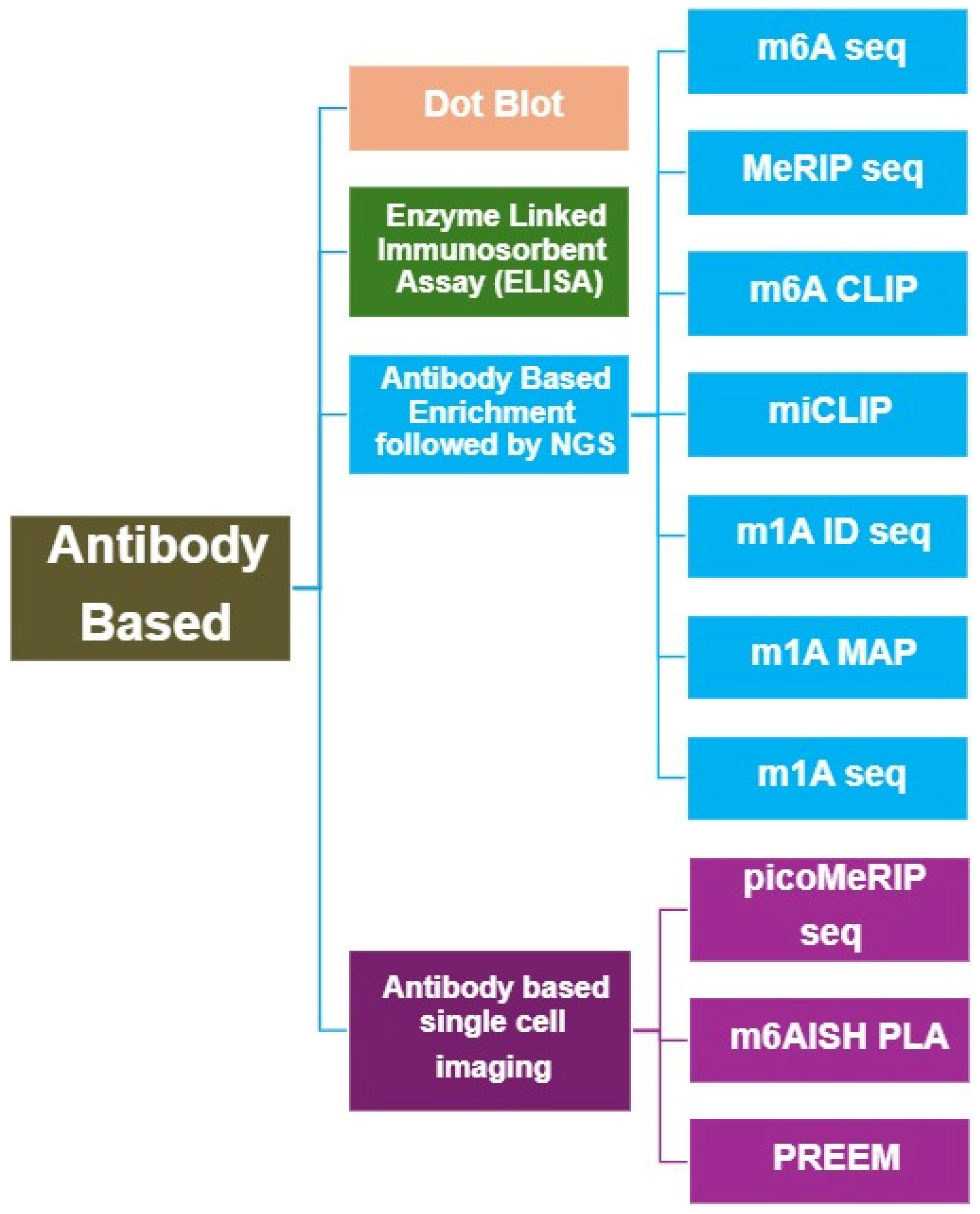

| Method | Subtype | Mechanism | Examples Studied | References |
|---|---|---|---|---|
| Dot Blot | – | RNA is spotted onto a membrane and incubated with a modification-specific antibody; detection is achieved via a secondary antibody. | Ψ, m5C, hm5C, m6A | [10,11,12,13,14,15,16] |
| ELISA | – | RNA samples compete with immobilized modified RNA for binding to modification-specific antibodies; bound antibodies are detected via colorimetric or fluorescent signals. | m6A, m1A, m5C, I, m1I | [17,18] |
| Antibody-Based Enrichment + NGS | m6A-seq/MeRIP-seq | RNA is fragmented and enriched using modification-specific antibodies, followed by sequencing. | m6A, m1A, hm5C, ac4C, m7G | [19,20] |
| m6A-CLIP/miCLIP | Uses UV crosslinking to achieve single-nucleotide resolution. | m6A, m1A, hm5C, ac4C, m7G | [21,22,23] | |
| m1A-ID-seq/m1A-MAP/m1A-seq | Enrichment followed by sequencing to detect m1A modifications. | m1A | [24,25,26,27,28,29] | |
| Antibody-Based Single-Cell Imaging | picoMeRIP-seq | Optimized MeRIP-seq for single-cell or rare cell types, improving sample recovery and signal-to-noise ratio. | m6A | [30] |
| m6AISH-PLA | FISH probe hybridizes near the m6A site; secondary antibody complex + rolling circle amplification enables fluorescent detection. | m6A | [31] | |
| PREEM | Combines “AND” Boolean logic recognition with CAD-HCR amplification to detect multiple m6A sites simultaneously in single cells. | m6A | [32] |
| Feature | Antibody-Based | Non-Antibody-Based |
|---|---|---|
| Input Requirement | ng–µg | ng–µg (varies) |
| Multiplexing | Limited (except advanced platforms) | High (MS, NGS, chemical) |
| Spatial Information | Possible (imaging, PLA) | Rare |
| Throughput | Moderate | High (MS, NGS, Nanopore) |
| Quantitative Accuracy | Moderate | High (MS, chemical-assisted NGS) |
| Limitations | Antibody specificity, enrichment bias | Harsh conditions, instrumentation, data analysis |
| Tool | Platform | Modification Type(s) | Unique Features | Limitations |
|---|---|---|---|---|
| xPore | ONT DRS | Various (m6A, others) | Statistical model for differential modification detection; stoichiometry estimation | Requires replicates and adequate coverage; limited to modifications that alter signal significantly |
| Nanocompore | ONT DRS | Various | Raw signal comparison between conditions; no supervised training required | Needs unmodified/control sample; sensitivity drops with low coverage; positional precision varies |
| m6Anet | ONT DRS | m6A | Multiple instance learning; transcriptome-wide m6A detection and stoichiometry | Focused only on m6A; dependent on training dataset and basecaller |
| EpiNano | ONT DRS | m6A | Uses basecalling errors and engineered features; supports custom training | Mainly tuned for m6A; performance affected by basecaller changes |
| JACUSA2 | Illumina/ONT | Various | Detects mismatch, indels, RT signatures; integrates multiple library types | Signature-based; may be confounded by sequence or library prep biases |
| ELIGOS | ONT DRS | Various | Compares error profiles with controls to infer modifications | Sensitive to basecaller, coverage, and sequence context; high-depth requirement |
| Tombo | ONT DRS | Various | Resquiggle raw signal; flexible for custom analyses | Lower specificity without robust training or controls; resquiggling can fail in some regions |
| Nanopolish | ONT DRS | Various | Raw signal access for modification detection and downstream analysis | Dependent on chemistry and basecaller; limited modification specificity |
| nanoRMS | ONT DRS | Various | Read-level classification; per-site stoichiometry estimation | Requires high read depth; pipeline complexity; dependent on training data |
| TandemMod | ONT DRS | Multiple | Deep-learning framework for multi-mod detection via transfer learning | Sensitive to basecaller/chemistry changes; early-stage tool |
| ModiDeC | ONT DRS | Multiple | Modular classifier; extensible to new modifications | Real-world robustness not fully established |
| RMPore | ONT DRS (database) | Various | Aggregated single-molecule modification calls; benchmarking resource | Inherits biases of contributing datasets; absence of calls ≠ absence of modifications |
| Category | Method | Principle | Advantages | Resolution | Typical Applications | Sensitivity | Specificity/Modification Coverage | Quantitative Accuracy | Limitations/Biases |
|---|---|---|---|---|---|---|---|---|---|
| >Antibody-based | Dot blot/Immuno-Northern blot | RNA immobilized on membrane; probed with modification-specific antibodies | Simple, inexpensive, fast | Global modification level | Detecting global levels of m6A, m5C, Ψ | Moderate (pmol-nmol) | Limited; depends on antibody cross-reactivity | Low–Moderate | Semi-quantitative; no site info; antibody-dependent. Antibody bias |
| ELISA | Modified RNA competes with coated standards for antibody binding | Quantitative; easy; low RNA input | Global modification level. | Global quantification of m6A, m1A, m5C | Moderate (pmol-nmol) | Moderate; affected by antibody and matrix effects | Moderate | Cross-reactivity; limited dynamic range. | |
| Immunoprecipitation + NGS (MeRIP-seq, miCLIP) | Antibody enriches modified RNA fragments for sequencing | Transcriptome-wide mapping; single-nucleotide resolution possible | Transcrip-tome-wide mapping; sin-gle-nucleotide resolu-tion possible (miCLIP) | Mapping m6A, m1A, m7G, ac4C, hm5C | Moderate (pmol-nmol) | Often limited; many false positives from off-target binding | Moderate–High (relative) | Antibody bias; fragmentation bias; needs high input; Peak-calling bias (MeRIP-seq); UV damage and crosslinking efficiency bias (miCLIP) | |
| Antibody-based Imaging (picoMeRIP-seq, m6A-ISH-PLA, PREEM) | Fluorescent or proximity ligation imaging | Single-cell/molecule resolution; spatial visualization | Single-cell/molecule resolution | Visualizing m6A and other marks in single cells/tissues | Moderate (pmol-nmol) | Moderate; driven by probe and antibody design | Semi-quantitative | Antibody bias; Low throughput; technically demanding. | |
| Non-antibody-based | Capillary Electrophoresis (CE/CE–MS) | Separation by charge/mass in capillary; detection via UV/LIF or MS | High separation efficiency; fast | Global modification level. | Detection of Ψ, I, m2G, m1A, m6A, m5C | Moderate (pmol-nmol) | High for well-resolved peaks; co-migration lowers it | Moderate | Reproducibility issues; moderate sensitivity. Digestion bias; Ionization bias in CE–MS |
| Thin-layer Chromatography (TLC/2D-TLC/SCARLET) | Radiolabeled nucleotides separated by mobility on plates | Simple, low-cost | Global modification level (TLC/2D-TLC); Single-nucleotide resolution (SCARLET) | Site-specific quantification of m6A, Ψ | Moderate (pmol-nmol) | High when sequence/site is predefined (SCARLET) | Low–Moderate | Radioactive; low precision; prior sequence needed; digestion bias. | |
| PCR-based (SELECT, RTL-P, ligation-qPCR) | RNA modifications alter RT/ligase efficiency; quantified via qPCR | Sensitive, specific; low input | Single-nucleotide resolution | Site-specific quantification of m6A, m1A, Nm, Ψ | High | High when probe/primer design is optimal | High (relative) | Needs sequence knowledge; indirect detection; ligase discrimination bias; reverse transcriptase bias | |
| NMR Spectroscopy | Measures chemical shifts from modified nucleotides | Non-destructive; structural & dynamic insights | Single-nucleotide resolution possible. | Structural studies; effects of m6A, Ψ, D, m1A on RNA folding | Low | High | Moderate | Low sensitivity; requires large, pure RNA; structural bias. | |
| NGS-based (chemical/enzyme-assisted) | Chemical/enzymatic treatment induces RT signatures | High-throughput; single-nucleotide resolution | Transcrip-tome-wide mapping; Single-nucleotide resolution | Transcriptome-wide mapping (Pseudoseq, ac4C-seq, GLORI, DART-seq) | High | Often high but depends on reaction specificity and RT signature interpretation | Moderate–High | Often harsh chemicals; high RNA input; computationally complex. | |
| Nanopore Direct RNA Sequencing (DRS) | Direct sequencing of native RNA; detects current changes | Direct, long-read, real-time; no cDNA | Transcrip-tome-wide mapping; Single-nucleotide resolution | Global detection of m6A, m5C, Ψ, m7G | Moderate (pmol-nmol) | Moderate–high; model- and context-dependent | Moderate | High error rate; expensive; large input required. | |
| Non-antibody Imaging (ARPLA, DART-FISH) | Aptamer or deaminase labeling + FISH | Single-cell/molecule imaging; multiplex | Single-cell/molecule resolution | Visualizing m6A or glycoRNA localization | Moderate (pmol-nmol) | Limited; target-specific | Semi-quantitative | Lower throughput; partial transcript coverage. structure/accessibility bias | |
| Mass Spectrometry (MS)-based | Bottom-up MS (LC–MS, LC–MS/MS) | RNA digested into nucleosides or short oligos before MS detection | Highly sensitive; detects multiple modifications simultaneously | Localize modification to a digested fragment. | Quantification of m6A, m5C, Ψ, etc., in mRNA, rRNA, tRNA, clinical samples | High (femtomole–picomole range) | High; mass/fragment–based discrimination | High, absolute quantification possible | Loses sequence context; isomer resolution challenging; digestion bias; ionization bias; fragmentation bias; modification-stability bias |
| Top-down MS (FT-ICR, QqTOF) | Intact RNA molecules analyzed directly | Preserves sequence context; detects multiple modifications per molecule | Single-nucleotide resolution possible when fragmentation covers every backbone bond. | Structural analysis; site-specific mapping in small RNAs | Moderate–High (low pmol) | Multiple modifications in same molecule | Moderate–High | Requires pure RNA; complex spectra; limited throughput, ionization bias; fragmentation bias; modification-stability bias |
Disclaimer/Publisher’s Note: The statements, opinions and data contained in all publications are solely those of the individual author(s) and contributor(s) and not of MDPI and/or the editor(s). MDPI and/or the editor(s) disclaim responsibility for any injury to people or property resulting from any ideas, methods, instructions or products referred to in the content. |
© 2025 by the authors. Licensee MDPI, Basel, Switzerland. This article is an open access article distributed under the terms and conditions of the Creative Commons Attribution (CC BY) license (https://creativecommons.org/licenses/by/4.0/).
Share and Cite
Tian, L.; Vallabhaneni, B.; Chang, Y.-H. Advances in Quantitative Techniques for Mapping RNA Modifications. Life 2025, 15, 1888. https://doi.org/10.3390/life15121888
Tian L, Vallabhaneni B, Chang Y-H. Advances in Quantitative Techniques for Mapping RNA Modifications. Life. 2025; 15(12):1888. https://doi.org/10.3390/life15121888
Chicago/Turabian StyleTian, Ling, Bharathi Vallabhaneni, and Yie-Hwa Chang. 2025. "Advances in Quantitative Techniques for Mapping RNA Modifications" Life 15, no. 12: 1888. https://doi.org/10.3390/life15121888
APA StyleTian, L., Vallabhaneni, B., & Chang, Y.-H. (2025). Advances in Quantitative Techniques for Mapping RNA Modifications. Life, 15(12), 1888. https://doi.org/10.3390/life15121888