


Genetic Diversity and Population Structure Analysis of Pinus elliottii Germplasm Resources in Jiangxi Province


Abstract
1. Introduction
2. Materials and Methods
2.1. Experimental Materials
2.2. Research Methods
2.2.1. Genomic DNA Extraction and Detection
2.2.2. SSR Primer Screening
2.2.3. PCR Amplification and Capillary Electrophoresis
2.2.4. Statistical Analysis
3. Results
3.1. Polymorphism Analysis of EST-SSR Markers
3.2. Cross-Species Applicability of EST-SSR Markers
3.3. Genetic Diversity Analysis of Loci
3.4. Comparison of Genetic Diversity Among Provenances
3.5. Genetic Differentiation and Gene Flow Among Provenances
3.6. Population Genetic Structure Analysis
3.7. PCoA and Genetic Clustering
4. Discussion
4.1. Development and Cross-Species Applicability of P. elliottii Primers
4.2. Genetic Diversity of P. elliottii Populations
4.3. Genetic Differentiation and Gene Flow in P. elliottii Populations
4.4. Genetic Structure and Clustering Analysis of P. elliottii Populations
5. Conclusions
Author Contributions
Funding
Institutional Review Board Statement
Informed Consent Statement
Data Availability Statement
Acknowledgments
Conflicts of Interest
References
- Susaeta, A.; Peter, G.F.; Hodges, A.W.; Carter, D.R. Oleoresin tapping of planted slash pine (Pinus elliottii Engelm. var. elliottii) adds value and management flexibility to landowners in the southern United States. Biomass Bioenergy 2014, 68, 55–61. [Google Scholar]
- Neis, F.A.; de Costa, F.; de Almeida, M.R.; Colling, L.C.; de Oliveira Junkes, C.F.; Fett, J.P.; Fett-Neto, A.G. Resin exudation profile, chemical composition, and secretory canal characterization in contrasting yield phenotypes of Pinus elliottii Engelm. Ind. Crop. Prod. 2019, 132, 76–83. [Google Scholar] [CrossRef] [Scilit]
- Lai, M.; Dong, L.M.; Su, R.F.; Zhang, L.; Jia, T.; Chen, T.X.; Yi, M. Needle functional features in contrasting yield phenotypes of slash pine at three locations in southern China. Ind. Crop. Prod. 2023, 206, 117613. [Google Scholar] [CrossRef] [Scilit]
- Ding, X.; Li, Y.; Zhang, Y.; Diao, S.; Luan, Q.; Jiang, J. Genetic analysis and elite tree selection of the main resin components of slash pine. Front. Plant Sci. 2023, 14, 1079952. [Google Scholar] [CrossRef] [Scilit] [PubMed]
- Lai, M.; Zhang, L.; Lei, L.; Liu, S.; Jia, T.; Yi, M. Inheritance of resin yield and main resin components in Pinus elliottii Engelm. at three locations in southern China. Ind. Crop. Prod. 2020, 144, 112065. [Google Scholar] [CrossRef] [Scilit]
- Yi, M.; Zhang, L.; Cheng, Z.; Hu, R.; Gao, Y.; Jin, C.; Yuan, S.; Sun, S.; Lai, M. Identification of key genes for oleoresin biosynthesis in high and low oleoresin-yielding slash pine based on transcriptome analysis. Forests 2022, 13, 1337. [Google Scholar] [CrossRef] [Scilit]
- Dungey, H.S. Pine hybrids—A review of their use performance and genetics. For. Ecol. Manage. 2001, 148, 243–258. [Google Scholar] [CrossRef] [Scilit]
- Sun, M.S.; Feng, Y.H.; Jia, J.; Yang, Z.Q. Fertility of different interspecific hybrid types of pines. Guihaia 2021, 41, 1270–1279. [Google Scholar]
- Luan, Q.; Lu, P.; Xiao, F.; Jiang, J.; Yu, M. Investigation on the damage of Pinus elliottii in the freezing rain and snow area and the analysis on the reason. Sci. Silv. Sin. 2008, 44, 50–55. [Google Scholar]
- Zhou, B.; Gu, L.; Ding, Y.; Shao, L.; Wu, Z.; Yang, X.; Li, C.; Li, Z.; Wang, X.; Cao, Y.; et al. The great 2008 Chinese ice storm: Its socioeconomic-ecological impact and sustainability lessons learned. Bull. Am. Meteorol. Soc. 2011, 92, 47–60. [Google Scholar] [CrossRef] [Scilit]
- Mei, L.; Wen, X.; Fan, F.; Yang, Z.; Xie, W.; Hong, Y. Genetic diversity and population structure of masson pine (Pinus massoniana Lamb.) superior clones in South China as revealed by EST-SSR markers. Genet. Resour. Crop. Evol. 2021, 68, 1987–2002. [Google Scholar] [CrossRef] [Scilit]
- Sheller, M.; Tóth, E.G.; Ciocîrlan, E.; Mikhaylov, P.; Kulakov, S.; Kulakova, N.; Melnichenko, N.; Ibe, A.; Sukhikh, T.; Curtu, A.L. Genetic diversity and population structure of scots pine (Pinus sylvestris L.) in Middle Siberia. Forests 2023, 14, 119. [Google Scholar] [CrossRef] [Scilit]
- Lu, M.M.; Krutovsky, K.V.; Nelson, C.D.; Koralewski, T.E.; Byram, T.D.; Loopstra, C.A. Exome genotyping, linkage disequilibrium and population structure in loblolly pine (Pinus taeda L.). BMC Genom. 2016, 17, 730. [Google Scholar] [CrossRef] [Scilit]
- Yan, P.; Xie, Z.; Feng, K.; Qiu, X.; Zhang, L.; Zhang, H. Genetic diversity analysis and fingerprint construction of Korean pine (Pinus koraiensis) clonal seed orchard. Front. Plant Sci. 2023, 13, 1079571. [Google Scholar] [CrossRef] [Scilit]
- Gramazio, P.; Plesa, I.M.; Truta, A.M.; Sestras, A.F.; Vilanova, S.; Plazas, M.; Vicente, O.; Boscaiu, M.; Prohens, J.; Sestras, R.E. Highly informative SSR genotyping reveals large genetic diversity and limited differentiation in European larch (Larix decidua) populations from Romania. Turk. J. Agric. For. 2018, 42, 165–175. [Google Scholar] [CrossRef] [Scilit]
- Rana, J.C.; Chahota, R.K.; Sharma, V.; Rana, M.; Verma, N.; Verma, B.; Sharma, T.R. Genetic diversity and structure of Pyrus accessions of Indian Himalayan region based on morphological and SSR markers. Tree Genet. Genomes 2015, 11, 821. [Google Scholar] [CrossRef] [Scilit]
- Porth, I.; El-Kassaby, Y.A. Assessment of the genetic diversity in forest tree populations using molecular markers. Diversity 2014, 6, 283–295. [Google Scholar] [CrossRef] [Scilit]
- Grover, A.; Sharma, P.C. Development and use of molecular markers: Past and present. Crit. Rev. Biotechnol. 2016, 36, 290–302. [Google Scholar] [CrossRef] [Scilit]
- Powell, W.; Machray, G.C.; Provan, J. Polymorphism revealed by simple sequence repeats. Trends Plant Sci. 1996, 1, 215–222. [Google Scholar] [CrossRef] [Scilit]
- Carletti, G.; Cattivelli, L.; Vietto, L.; Nervo, G. Multiallelic and multilocus simple sequence repeats (SSRs) to assess the genetic diversity of a Salix spp. germplasm collection. J. For. Res. 2021, 32, 263–271. [Google Scholar] [CrossRef] [Scilit]
- Kavaliauskas, D.; Danusevičius, D.; Baliuckas, V. New insight into genetic structure and diversity of Scots pine (Pinus sylvestris L.) populations in Lithuania based on nuclear, chloroplast and mitochondrial DNA markers. Forests 2022, 13, 1179. [Google Scholar] [CrossRef] [Scilit]
- Zhou, B.; Zhang, Z.; Li, Y.; Ma, Y.; Zhang, S.; Niu, S.; Li, Y. Genetic diversity, genetic structure, and germplasm source of Chinese pine in North China. Eur. J. For. Res. 2023, 142, 183–195. [Google Scholar] [CrossRef] [Scilit]
- de Oliveira Junkes, C.F.; de Araújo Júnior, A.T.; de Lima, J.C.; de Costa, F.; Füller, T.; de Almeida, M.R.; Neis, F.A.; da Silva Rodrigues-Correa, K.C.; Fett, J.P.; Fett-Neto, A.G. Resin tapping transcriptome in adult slash pine (Pinus elliottii var. elliottii). Ind. Crop. Prod. 2019, 139, 111545. [Google Scholar] [CrossRef] [Scilit]
- Yi, M.; Zhang, L.; Lei, L.; Cheng, Z.; Sun, S.; Lai, M. Analysis of SSR information in transcriptome and development of EST-SSR molecular markers in Pinus elliottii Engelm. J. Nanjing For. Univ. 2020, 44, 75. [Google Scholar]
- Nelson, C.D.; Nance, W.L.; Doudrick, R.L. A partial genetic linkage map of slash pine (Pinus elliottii Engelm. var. elliottii) based on random amplified polymorphic DNAs. Theor. Appl. Genet. 1993, 87, 145–151. [Google Scholar]
- Acosta, J.J.; Fahrenkrog, A.M.; Neves, L.G.; Resende, M.F.; Dervinis, C.; Davis, J.M.; Holliday, J.A.; Kirst, M. Exome resequencing reveals evolutionary history, genomic diversity, and targets of selection in the conifers Pinus taeda and Pinus elliottii. Genome Biol. Evol. 2019, 11, 508–520. [Google Scholar] [CrossRef] [Scilit]
- Westbrook, J.W.; Chhatre, V.E.; Wu, L.S.; Chamala, S.; Neves, L.G.; Muñoz, P.; Martínez-García, P.J.; Neale, D.B.; Kirst, M.; Mockaitis, K.; et al. A consensus genetic map for Pinus taeda and Pinus elliottii and extent of linkage disequilibrium in two genotype-phenotype discovery populations of Pinus taeda. G3 Genes Genomes Genet. 2015, 5, 1685–1694. [Google Scholar] [CrossRef] [Scilit]
- Untergasser, A.; Cutcutache, I.; Koressaar, T.; Ye, J.; Faircloth, B.; Remm, M.; Rozen, S. Primer3—New capabilities and interfaces. Nucleic Acids Res. 2012, 40, 115. [Google Scholar] [CrossRef] [Scilit]
- Holland, M.; Parson, W. GeneMarker® HID: A reliable software tool for the analysis of forensic STR data. J. Forensic Sci. 2011, 56, 29–35. [Google Scholar] [CrossRef] [Scilit]
- Fan, W.; Gai, H.; Sun, X.; Yang, A.; Zhang, Z.; Ren, M. DataFormater, a software for SSR data formatting to develop population genetics analysis. Mol. Plant Breed. 2016, 14, 265–270. [Google Scholar]
- Peakall, R.O.D.; Smouse, P.E. GENALEX 6: Genetic analysis in Excel. Population genetic software for teaching and research. Mol. Ecol. Notes 2006, 6, 288–295. [Google Scholar] [CrossRef] [Scilit]
- Yeh, F.C.; Yang, R.C.; Boyle, T.B.J.; Ye, Z.H.; Mao, J.X. Popgene, the user friendly shareware for population genetic analysis. In Molecular Biology and Biotechnology Centre; University of Alberta: Edmonton, AB, Canada, 1997. [Google Scholar]
- Liu, K.; Muse, S.V. PowerMarker: An integrated analysis environment for genetic marker analysis. Bioinformatics 2005, 21, 2128–2129. [Google Scholar] [CrossRef] [Scilit]
- Excoffier, L.; Lischer, H.E.L. Arlequin suite ver 3.5: A new series of programs to perform population genetics analyses under Linux and Windows. Mol. Ecol. Resour. 2010, 10, 564–567. [Google Scholar] [CrossRef] [Scilit]
- Evanno, G.; Regnaut, S.; Goudet, J. Detecting the number of clusters of individuals using the software STRUCTURE: A simulation study. Mol. Ecol. 2005, 14, 2611–2620. [Google Scholar] [CrossRef] [Scilit]
- Tamura, K.; Dudley, J.; Nei, M.; Kumar, S. MEGA4: Molecular evolutionary genetics analysis (MEGA) software version 4.0. Mol. Biol. Evol. 2007, 24, 1596–1599. [Google Scholar] [CrossRef] [Scilit]
- Neale, D.B. Genomics to tree breeding and forest health. Curr. Opin. Genet. Dev. 2007, 17, 539–544. [Google Scholar] [CrossRef] [Scilit]
- Neale, D.B.; Ingvarsson, P.K. Population, quantitative and comparative genomics of adaptation in forest trees. Curr. Opin. Plant Biol. 2008, 11, 149–155. [Google Scholar] [CrossRef] [Scilit]
- Leonarduzzi, C.; Spanu, I.; Labriola, M.; González-Martínez, S.C.; Piotti, A.; Vendramin, G.G. Development and characterization of three highly informative EST-SSR multiplexes for Pinus halepensis Mill. and their transferability to other Mediterranean pines. Plant Mol. Biol. Rep. 2016, 34, 993–1002. [Google Scholar] [CrossRef] [Scilit]
- Lesser, M.R.; Parchman, T.L.; Buerkle, C.A. Cross-species transferability of SSR loci developed from transciptome sequencing in lodgepole pine. Mol. Ecol. Resour. 2012, 12, 448–455. [Google Scholar] [CrossRef] [Scilit]
- Dong, M.; Wang, Z.; He, Q.; Zhao, J.; Fan, Z.; Zhang, J. Development of EST-SSR markers in Larix principis-rupprechtii Mayr and evaluation of their polymorphism and cross-species amplification. Trees 2018, 32, 1559–1571. [Google Scholar] [CrossRef] [Scilit]
- Uzun, A.; Yesiloglu, T.; Polat, I.; Aka-Kacar, Y.; Gulsen, O.; Yildirim, B.; Tuzcu, O.; Tepe, S.; Canan, I.; Anil, S. Evaluation of genetic diversity in lemons and some of their relatives based on SRAP and SSR markers. Plant Mol. Biol. Rep. 2011, 29, 693–701. [Google Scholar] [CrossRef] [Scilit]
- Botstein, D.; White, R.L.; Skolnick, M.; Davis, R.W. Construction of a genetic linkage map in man using restriction fragment length polymorphisms. Am. J. Hum. Genet. 1980, 32, 314. [Google Scholar] [PubMed]
- Schmidt, T.L.; Jasper, M.E.; Weeks, A.R.; Hoffmann, A.A. Unbiased population heterozygosity estimates from genome-wide sequence data. Methods Ecol. Evol. 2021, 12, 1888–1898. [Google Scholar] [CrossRef] [Scilit]
- Vasilyeva, Y.; Chertov, N.; Nechaeva, Y.; Sboeva, Y.; Pystogova, N.; Boronnikova, S.; Kalendar, R. Genetic structure, differentiation and originality of Pinus sylvestris L. populations in the east of the East European Plain. Forests 2021, 12, 999. [Google Scholar] [CrossRef] [Scilit]
- Yang, Z.; Feng, Y.; Wu, D. Analysis of genetic diversity of Pinus yunnanensis var. tenuifolia nature populations by SSR marker. Guihaia 2014, 34, 10–14. [Google Scholar]
- Luo, Q.; Feng, Y.; Wu, D.; Yang, Z. Genetic diversity of Pinus taiwanensis var. damingshanensis natural populations by SSR markers. Guihaia 2022, 42, 1367–1373. [Google Scholar]
- Yang, B.; Niu, S.; El-Kassaby, Y.A.; Li, W. Monitoring genetic diversity across Pinus tabuliformis seed orchard generations using SSR markers. Can. J. For. Res. 2021, 51, 1534–1540. [Google Scholar] [CrossRef] [Scilit]
- Li, X.; Zhao, M.; Xu, Y.; Li, Y.; Tigabu, M.; Zhao, X. Genetic diversity and population differentiation of Pinus koraiensis in China. Horticulturae 2021, 7, 104. [Google Scholar] [CrossRef] [Scilit]
- Du, C.; Sun, X.; Xie, Y.; Hou, Y. Genetic diversity of Larix kaempferi populations with different levels of improvement in northern subtropical region. Sci. Silvae Sin. 2021, 57, 68–76. [Google Scholar]
- Fageria, M.S.; Rajora, O.P. Effects of silvicultural practices on genetic diversity and population structure of white spruce in Saskatchewan. Tree Genet. Genomes 2014, 10, 287–296. [Google Scholar] [CrossRef] [Scilit]
- Chhatre, V.E.; Byram, T.D.; Neale, D.B.; Wegrzyn, J.L.; Krutovsky, K.V. Genetic structure and association mapping of adaptive and selective traits in the east Texas loblolly pine (Pinus taeda L.) breeding populations. Tree Genet. Genomes 2013, 9, 1161–1178. [Google Scholar] [CrossRef] [Scilit]
- Yu, D.; Yuan, D.; Zhang, D.; Fan, Y.; Li, D.; Zhang, H.; Zhang, J. Genetic diversity of Larix principisrupprechtii Mayr. seed orchard among generations. J. Plant Genet. Resour. 2014, 15, 940–947. [Google Scholar]
- Jing, Y.; Bian, L.; Zhang, X.; Zhao, B.; Zheng, R.; Su, S.; Ye, D.; Zheng, X.; El-Kassaby, Y.A.; Shi, J. Genetic diversity and structure of the 4th cycle breeding population of Chinese fir (Cunninghamia lanceolata (lamb.) hook). Front. Plant Sci. 2023, 14, 1106615. [Google Scholar] [CrossRef] [Scilit] [PubMed]
- Chaisurisri, K.; El-Kassaby, Y.A. Genetic diversity in a seed production population vs. natural populations of Sitka spruce. Biodivers. Conserv. 1994, 3, 512–523. [Google Scholar] [CrossRef] [Scilit]
- Isik, F.; McKeand, S.E. Fourth cycle breeding and testing strategy for Pinus taeda in the NC State University Cooperative Tree Improvement Program. Tree Genet. Genomes 2019, 15, 70. [Google Scholar] [CrossRef] [Scilit]
- Pearse, D.E.; Crandall, K.A. Beyond F ST: Analysis of population genetic data for conservation. Conserv. Genet. 2004, 5, 585–602. [Google Scholar] [CrossRef] [Scilit]
- Stojnić, S.V.; Avramidou, E.; Fussi, B.; Westergren, M.; Orlović, S.; Matović, B.; Trudić, B.; Kraigher, H.A.; Aravanopoulos, F.; Konnert, M. Assessment of genetic diversity and population genetic structure of Norway spruce (Picea abies L.) Karsten at Its southern lineage in Europe. Implications for conservation of forest genetic resources. Forests 2019, 10, 258. [Google Scholar] [CrossRef] [Scilit]
- Lin, E.; Zhuang, H.; Yu, J.; Liu, X.; Huang, H.; Zhu, M.; Tong, Z. Genome survey of Chinese fir (Cunninghamia lanceolata): Identification of genomic SSRs and demonstration of their utility in genetic diversity analysis. Sci. Rep. 2020, 10, 4698. [Google Scholar] [CrossRef] [Scilit]
- Ithnin, M.; The, C.K.; Ratnam, W. Genetic diversity of Elaeis oleifera (HBK) Cortes populations using cross species SSRs: Implication’s for germplasm utilization and conservation. BMC Genet. 2017, 18, 37. [Google Scholar] [CrossRef] [Scilit]
- Hamrick, J.L.; Godt, M.J.W. Allozyme diversity in plants. In Population Genetics, Breeding and Genetic Resources, 2nd ed.; Brown, A.D.H., Clegg, M.T., Kahler, A.L., Weir, B.S., Eds.; Sinauer & Associates: Sunderland, MA, USA, 1989; pp. 43–63. [Google Scholar]
- Petit, R.J.; Duminil, J.; Fineschi, S.; Hampe, A.; Salvini, D.; Vendramin, G.G. Invited review: Comparative organization of chloroplast, mitochondrial and nuclear diversity in plant populations. Mol. Ecol. 2005, 14, 689–701. [Google Scholar] [CrossRef] [Scilit]
- Tong, Y.; Lewis, B.J.; Zhou, W.; Mao, C.; Wang, Y.; Zhou, L.; Yu, D.; Dai, L.; Qi, L. Genetic diversity and population structure of natural Pinus koraiensis populations. Forests 2019, 11, 39. [Google Scholar] [CrossRef] [Scilit]
- Wang, S. Genetic diversity and population structure of the endangered species Paeonia decomposita endemic to China and implications for its conservation. BMC Plant Biol. 2020, 20, 510. [Google Scholar] [CrossRef] [Scilit] [PubMed]
- Deng, L.; Liu, Q.; Zhou, Z.; Gao, K.; Luo, D. Genetic diversity analysis and core collection of pinewood nematodiasis-resistant Pinus massoniana germplasm resources. J. Zhejiang Agric. For. Univ. 2024, 41, 67–78. [Google Scholar]

| Provenance | Ways to Save | Source | Sample Number | Effective Amplification Number | Afforestation Site and Year |
|---|---|---|---|---|---|
| IP * | Introduced family trial forest | Georgia, Mississippi, and Florida, USA | 113 | 112 | Ji’an (1990) |
| Florida, USA | 30 | 8 | Jingdezhen (2011) | ||
| Florida, USA | 10 | 10 | Jingdezhen (2018) | ||
| Kansas, USA | 40 | 40 | Ganzhou (2018) | ||
| FP | First-generation seed orchard | Early-introduced slash pine plantations in Jiangxi Province, China | 44 | 44 | Ji’an (1992) |
| 77 | 77 | Xiajiang (1980) | |||
| IGP | Improved-generation seed orchard | Experimental forests planted with selected superior trees across Jiangxi province, China | 47 | 47 | Xiajiang (2015) |
| 79 | 79 | Ji’an (2011) |
| Reaction System | Reaction Procedure | |||
|---|---|---|---|---|
| Component and Concentration | Volume (μL) | Cycling Parameters | Time (min, s) | |
| 10 × buffer (plus Mg2+) | 2 | 94 °C initial denaturation | 5 min | 30 cycles |
| 10 mol/L dNTPs | 1.6 | 94 °C denaturation | 30 s | |
| forward primer | 0.8 | 56–60 °C annealing | 30 s | |
| reverse primer | 0.8 | 72 °C extension | 60 s | |
| Taq DNA polymerase (5 μ/µL) | 0.1 | 72 °C final extension | 7 min | |
| ddH2O | 13.7 | 4 °C keep | ||
| Template DNA (50 ng/μL) | 1 | |||
| Locus | Repeat Motif | Product Size (bp) | Primer Sequence (5′-3′) |
|---|---|---|---|
| Pe145169 | (CT)11 | 257 | F: TGAATCCTCGGAATTTCTGG |
| R: TGCCATTGAAACAAGCTGAA | |||
| Pe144426 | (AT)8 | 152 | F: AATGCGAGTGGCAACAAAGT |
| R: ATTTCACATTCCCGTTCTCG | |||
| Pe138370 | (CCCTG)5 | 179 | F: CCTGACGCAACATAATCCCT |
| R: ATAAAAGACACACCCCGCAG | |||
| Pe130187 | (TC)6 | 213 | F: TTCTCATGCTAAGCACACGC |
| R: ATTTCTTCCATGGGTTCGTG | |||
| Pe132622 | (AC)10 | 262 | F: TATAACGTCAGCCCAGGGAC |
| R: TTGCTTCTGCAGGAAAGGTT | |||
| Pe146453 | (CATT)5 | 257 | F: CTGATCCACCCTCATCTGCT |
| R: GGGAGCAACCAGAACAACAT | |||
| Pe134815 | (CTG)7 | 181 | F: CCCCAAACCCCAACTTAGAT |
| R: AAGTGGGAAAAATGAGGGCT | |||
| Pe131259 | (AT)7 | 183 | F: GGATTGATCCAAGCCAACAG |
| R: ACCCGGAGGCAAATCTATCT | |||
| Pe103802 | (AT)7 | 141 | F: GGATGATCAGGGCATGAAAT |
| R: CATAAAAGTTGGCACCACCA | |||
| Pe123077 | (AAT)6 | 129 | F: ATTGGGTTGAATCCGAACAT |
| R: CCAGACAAAATTGTGGCCTT | |||
| Pe106732 | (AGG)5 | 163 | F: CGGTGGAAGATTTAGGTCCA |
| R: GAAAAACAGCGGCAGAAAAG | |||
| Pe145380 | (AC)9 | 244 | F: CAACATTTGCTGTGAGCGTT |
| R: ATGCATCCCTGATGCTCTTC | |||
| Pe119033 | (AT)6 | 267 | F: TTCTTGATACATCGGGGCAT |
| R: AAACCTGTTCAAATCCTCACAA | |||
| Pe135178 | (TTC)5 | 145 | F: ATTTCAGAAGGTCAATGCGG |
| R: GCAGGACATAAATGGGCAGT | |||
| Pe140688 | (GATG)5 | 264 | F: ATGAACGCTTTAGTTCCCCC |
| R: GTGATGCGAGATGTGCAGTT | |||
| Pe110222 | (TTG)5 | 277 | F: TCTGTAACTTGGACTGGCCC |
| R: CAGCCACAGTAGGTGCAACA | |||
| Pe113019 | (AG)7 | 240 | F: ATCTAGCGATCCCGGAAGTT |
| R: ACCACCTTCTTCCTCCCATT | |||
| Pe139538 | (TTAG)5 | 280 | F: TGAAAGGTGGAGATCCTTGG |
| R: AGGTCTGAGAGCATGGAGGA | |||
| Pe114582 | (TA)6 | 275 | F: ATACCTAGGCAGATGCCCCT |
| R: TTAGGCTGGACAACCCAAAC |
| Sample | Amplification and Polymorphic (pair) | Amplification but No Polymorphism (pair) | No Amplification (pair) | Applicability (%) | Proportion of Polymorphic Sites (%) |
|---|---|---|---|---|---|
| Pinus massoniana | 19 | 0 | 0 | 100% | 100% |
| Pinus taeda | 17 | 2 | 0 | 100% | 89.47% |
| Locus | Na * | Ne | I | Ho | He | PIC |
|---|---|---|---|---|---|---|
| Pe145169 | 7 | 4.491 | 1.638 | 0.636 | 0.777 | 0.743 |
| Pe144426 | 7 | 3.361 | 1.332 | 0.448 | 0.702 | 0.651 |
| Pe138370 | 5 | 2.800 | 1.168 | 0.564 | 0.643 | 0.580 |
| Pe130187 | 7 | 2.386 | 1.200 | 0.505 | 0.581 | 0.538 |
| Pe132622 | 7 | 2.275 | 1.068 | 0.498 | 0.560 | 0.511 |
| Pe146453 | 4 | 2.461 | 1.006 | 0.352 | 0.594 | 0.513 |
| Pe134815 | 7 | 1.879 | 0.947 | 0.451 | 0.468 | 0.436 |
| Pe131259 | 5 | 1.956 | 0.908 | 0.441 | 0.489 | 0.444 |
| Pe103802 | 13 | 1.777 | 0.978 | 0.408 | 0.437 | 0.413 |
| Pe123077 | 2 | 1.964 | 0.684 | 0.795 | 0.491 | 0.370 |
| Pe106732 | 4 | 1.724 | 0.836 | 0.430 | 0.420 | 0.394 |
| Pe145380 | 5 | 1.799 | 0.789 | 0.383 | 0.444 | 0.385 |
| Pe119033 | 6 | 1.660 | 0.836 | 0.423 | 0.397 | 0.373 |
| Pe135178 | 3 | 1.688 | 0.605 | 0.368 | 0.408 | 0.325 |
| Pe140688 | 3 | 1.512 | 0.578 | 0.224 | 0.339 | 0.293 |
| Pe110222 | 3 | 1.450 | 0.571 | 0.264 | 0.311 | 0.281 |
| Pe113019 | 8 | 1.263 | 0.445 | 0.159 | 0.208 | 0.194 |
| Pe139538 | 2 | 1.352 | 0.429 | 0.144 | 0.260 | 0.226 |
| Pe114582 | 5 | 1.175 | 0.370 | 0.138 | 0.149 | 0.146 |
| Mean | 5.421 | 2.051 | 0.862 | 0.402 | 0.457 | 0.411 |
| Locus | Provenance | Na | Ne | I | Ho | He | PIC |
|---|---|---|---|---|---|---|---|
| Pe146453 | IP | 4 | 2.475 | 0.997 | 0.357 | 0.596 | 0.519 |
| FP | 4 | 2.195 | 0.866 | 0.422 | 0.544 | 0.440 | |
| IGP | 4 | 2.575 | 1.078 | 0.277 | 0.612 | 0.545 | |
| Pe145380 | IP | 3 | 1.647 | 0.657 | 0.389 | 0.393 | 0.335 |
| FP | 4 | 1.844 | 0.775 | 0.314 | 0.458 | 0.390 | |
| IGP | 5 | 1.973 | 0.907 | 0.447 | 0.493 | 0.437 | |
| Pe145169 | IP | 7 | 4.273 | 1.565 | 0.645 | 0.766 | 0.728 |
| FP | 7 | 3.858 | 1.475 | 0.708 | 0.741 | 0.695 | |
| IGP | 7 | 5.125 | 1.765 | 0.553 | 0.805 | 0.779 | |
| Pe144426 | IP | 5 | 3.270 | 1.271 | 0.518 | 0.694 | 0.637 |
| FP | 6 | 3.189 | 1.312 | 0.298 | 0.686 | 0.635 | |
| IGP | 5 | 3.518 | 1.373 | 0.500 | 0.716 | 0.668 | |
| Pe140688 | IP | 2 | 1.302 | 0.394 | 0.161 | 0.232 | 0.205 |
| FP | 3 | 1.514 | 0.625 | 0.314 | 0.340 | 0.309 | |
| IGP | 3 | 1.780 | 0.662 | 0.222 | 0.438 | 0.349 | |
| Pe132622 | IP | 5 | 2.158 | 0.968 | 0.453 | 0.537 | 0.484 |
| FP | 6 | 2.130 | 1.006 | 0.513 | 0.531 | 0.479 | |
| IGP | 6 | 2.573 | 1.181 | 0.544 | 0.611 | 0.564 | |
| Pe131259 | IP | 4 | 1.781 | 0.787 | 0.455 | 0.438 | 0.395 |
| FP | 5 | 1.928 | 0.903 | 0.525 | 0.481 | 0.432 | |
| IGP | 4 | 2.177 | 0.974 | 0.344 | 0.541 | 0.488 | |
| Pe130187 | IP | 7 | 1.998 | 1.022 | 0.518 | 0.500 | 0.467 |
| FP | 7 | 2.606 | 1.259 | 0.525 | 0.616 | 0.572 | |
| IGP | 7 | 2.646 | 1.259 | 0.468 | 0.622 | 0.566 | |
| Pe123077 | IP | 2 | 1.867 | 0.657 | 0.708 | 0.464 | 0.357 |
| FP | 2 | 1.976 | 0.687 | 0.891 | 0.494 | 0.372 | |
| IGP | 2 | 2.00 | 0.693 | 0.815 | 0.500 | 0.375 | |
| Pe119033 | IP | 5 | 1.444 | 0.588 | 0.343 | 0.308 | 0.279 |
| FP | 5 | 1.610 | 0.794 | 0.376 | 0.379 | 0.359 | |
| IGP | 6 | 2.045 | 1.048 | 0.571 | 0.511 | 0.480 | |
| Pe114582 | IP | 4 | 1.116 | 0.261 | 0.108 | 0.104 | 0.102 |
| FP | 4 | 1.193 | 0.363 | 0.174 | 0.162 | 0.155 | |
| IGP | 5 | 1.241 | 0.467 | 0.142 | 0.194 | 0.189 | |
| Pe139538 | IP | 2 | 1.079 | 0.162 | 0.076 | 0.074 | 0.071 |
| FP | 2 | 1.371 | 0.442 | 0.223 | 0.270 | 0.234 | |
| IGP | 2 | 1.734 | 0.614 | 0.160 | 0.423 | 0.334 | |
| Pe138370 | IP | 4 | 2.501 | 1.051 | 0.575 | 0.600 | 0.526 |
| FP | 4 | 3.263 | 1.268 | 0.583 | 0.694 | 0.638 | |
| IGP | 5 | 2.736 | 1.165 | 0.532 | 0.634 | 0.572 | |
| Pe135178 | IP | 3 | 1.611 | 0.582 | 0.327 | 0.379 | 0.310 |
| FP | 2 | 1.642 | 0.580 | 0.400 | 0.391 | 0.315 | |
| IGP | 2 | 1.823 | 0.644 | 0.393 | 0.451 | 0.350 | |
| Pe134815 | IP | 6 | 1.804 | 0.872 | 0.464 | 0.446 | 0.408 |
| FP | 4 | 1.790 | 0.853 | 0.455 | 0.441 | 0.409 | |
| IGP | 7 | 2.056 | 1.060 | 0.432 | 0.514 | 0.481 | |
| Pe113019 | IP | 4 | 1.160 | 0.297 | 0.124 | 0.138 | 0.131 |
| FP | 3 | 1.320 | 0.425 | 0.116 | 0.243 | 0.215 | |
| IGP | 8 | 1.356 | 0.594 | 0.246 | 0.262 | 0.248 | |
| Pe110222 | IP | 2 | 1.209 | 0.315 | 0.117 | 0.173 | 0.158 |
| FP | 3 | 1.751 | 0.726 | 0.451 | 0.429 | 0.370 | |
| IGP | 3 | 1.533 | 0.647 | 0.286 | 0.348 | 0.319 | |
| Pe106732 | IP | 4 | 1.565 | 0.683 | 0.391 | 0.361 | 0.326 |
| FP | 4 | 1.403 | 0.596 | 0.275 | 0.287 | 0.271 | |
| IGP | 4 | 2.351 | 1.092 | 0.632 | 0.575 | 0.535 | |
| Pe103802 | IP | 9 | 1.545 | 0.809 | 0.329 | 0.353 | 0.338 |
| FP | 8 | 1.973 | 0.979 | 0.438 | 0.493 | 0.449 | |
| IGP | 10 | 1.918 | 1.083 | 0.484 | 0.479 | 0.456 | |
| Mean | IP | 4.316 | 1.885 | 0.734 | 0.371 | 0.398 | 0.356 |
| FP | 4.368 | 2.029 | 0.839 | 0.421 | 0.457 | 0.407 | |
| IGP | 5.000 | 2.272 | 0.964 | 0.424 | 0.512 | 0.460 | |
| Total | - | 4.561 | 2.062 | 0.845 | 0.405 | 0.456 | 0.408 |
| Locus | Fis * | Fit | Fst | Nm | Locus | Fis | Fit | Fst | Nm |
|---|---|---|---|---|---|---|---|---|---|
| Pe145169 | 0.175 | 0.183 | 0.009 | 26.595 | 106732 | −0.061 | −0.019 | 0.039 | 6.123 |
| Pe144426 | 0.373 | 0.376 | 0.006 | 43.219 | 145380 | 0.144 | 0.148 | 0.005 | 53.260 |
| Pe138370 | 0.124 | 0.131 | 0.008 | 30.356 | 119033 | −0.078 | −0.060 | 0.017 | 14.541 |
| Pe130187 | 0.131 | 0.145 | 0.017 | 14.397 | 135178 | 0.083 | 0.090 | 0.008 | 30.815 |
| Pe132622 | 0.101 | 0.106 | 0.006 | 45.202 | 140688 | 0.310 | 0.335 | 0.037 | 6.550 |
| Pe146453 | 0.397 | 0.406 | 0.015 | 16.605 | 110222 | 0.100 | 0.129 | 0.032 | 7.517 |
| Pe134815 | 0.036 | 0.042 | 0.006 | 40.009 | 113019 | 0.244 | 0.252 | 0.010 | 25.888 |
| Pe131259 | 0.094 | 0.107 | 0.014 | 17.531 | 139538 | 0.401 | 0.451 | 0.084 | 2.710 |
| Pe103802 | 0.055 | 0.067 | 0.012 | 20.022 | 114582 | 0.079 | 0.086 | 0.007 | 34.196 |
| Pe123077 | −0.655 | −0.634 | 0.013 | 19.125 | Mean | 0.110 | 0.124 | 0.016 | 15.715 |
| Source | Degrees of Freedom | Sum of Squares | Variance Components | Percent of Variation (%) |
|---|---|---|---|---|
| Among provenance | 2 | 54.576 | 0.085 | 2.10% |
| Within provenance | 831 | 3289.002 | 3.958 | 97.90% |
| Total | 833 | 3343.578 | 4.043 | 100% |
| Provenance | IP | FP | IGP |
|---|---|---|---|
| IP | **** | 0.986 | 0.980 |
| FP | 0.014 | **** | 0.981 |
| IGP | 0.020 | 0.019 | **** |
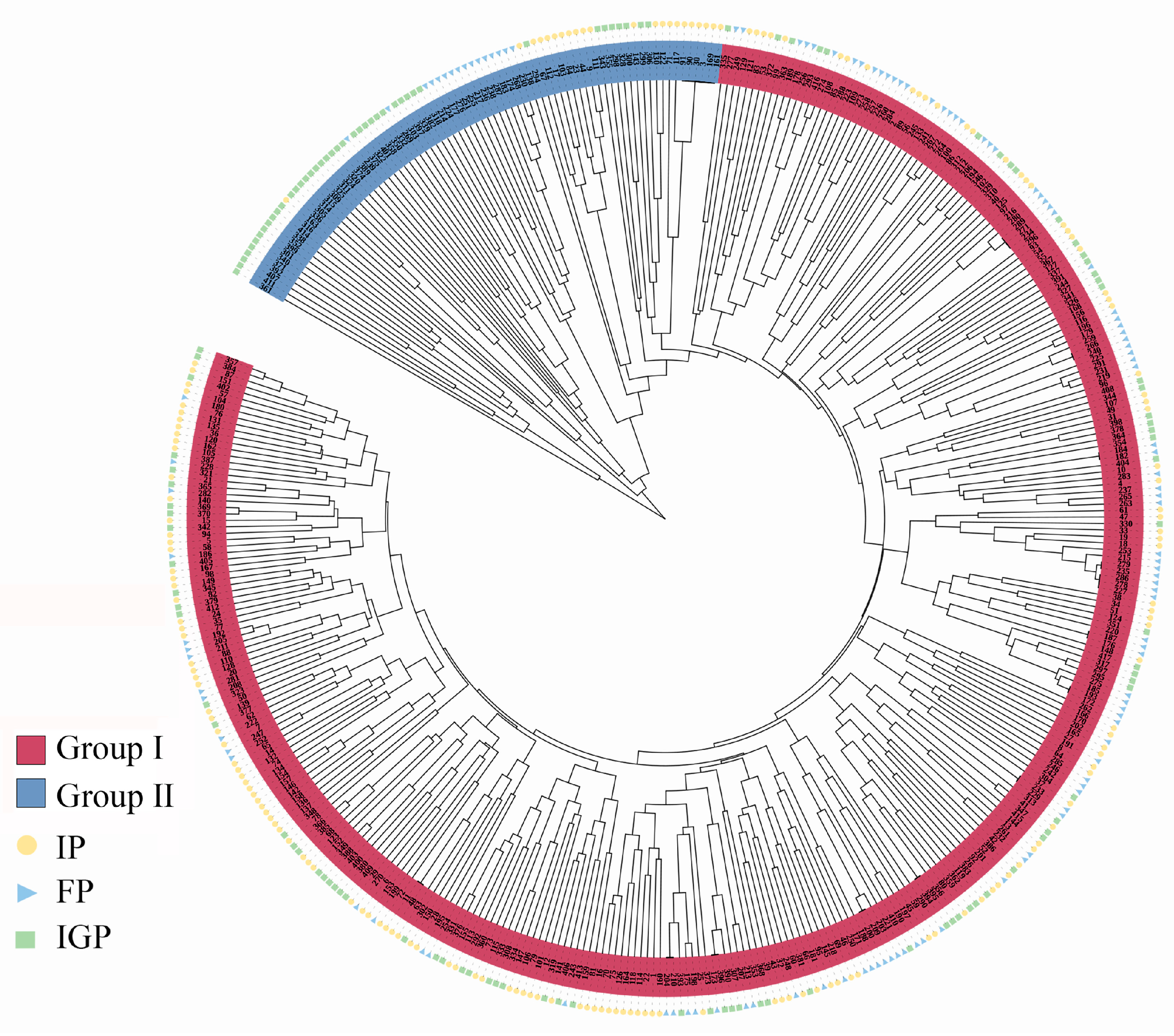
| Provenance | Ways to Save | Subgroup I | Subgroup II | Mix Group |
|---|---|---|---|---|
| IP | Introduced family trial forest | 159 | 4 | 7 |
| FP | First-generation seed orchard | 105 | 16 | 0 |
| IGP | Advanced-generation seed orchard | 88 | 38 | 0 |
Disclaimer/Publisher’s Note: The statements, opinions and data contained in all publications are solely those of the individual author(s) and contributor(s) and not of MDPI and/or the editor(s). MDPI and/or the editor(s) disclaim responsibility for any injury to people or property resulting from any ideas, methods, instructions or products referred to in the content. |
© 2024 by the authors. Licensee MDPI, Basel, Switzerland. This article is an open access article distributed under the terms and conditions of the Creative Commons Attribution (CC BY) license (https://creativecommons.org/licenses/by/4.0/).
Share and Cite
Yi, M.; Hu, R.; Huang, W.; Chen, T.; Xie, W.; Xie, H.; Luo, X.; Lai, M. Genetic Diversity and Population Structure Analysis of Pinus elliottii Germplasm Resources in Jiangxi Province. Life 2024, 14, 1401. https://doi.org/10.3390/life14111401
Yi M, Hu R, Huang W, Chen T, Xie W, Xie H, Luo X, Lai M. Genetic Diversity and Population Structure Analysis of Pinus elliottii Germplasm Resources in Jiangxi Province. Life. 2024; 14(11):1401. https://doi.org/10.3390/life14111401
Chicago/Turabian StyleYi, Min, Rong Hu, Wending Huang, Tingxuan Chen, Wenlei Xie, Haiping Xie, Xin Luo, and Meng Lai. 2024. "Genetic Diversity and Population Structure Analysis of Pinus elliottii Germplasm Resources in Jiangxi Province" Life 14, no. 11: 1401. https://doi.org/10.3390/life14111401
APA StyleYi, M., Hu, R., Huang, W., Chen, T., Xie, W., Xie, H., Luo, X., & Lai, M. (2024). Genetic Diversity and Population Structure Analysis of Pinus elliottii Germplasm Resources in Jiangxi Province. Life, 14(11), 1401. https://doi.org/10.3390/life14111401



