1. Introduction
Globally, energy security and environmental pollution have become increasingly prominent issues, posing significant constraints on sustainable economic and social development. In recent years, global greenhouse gas emissions have remained at a high level and continued to increase. Statistics show that global fossil fuel CO
2 emissions reached approximately 36.8 GtCO
2 in 2023, representing an increase of about 1.4% compared with 2022, and are projected to further rise to around 37.4 GtCO
2 in 2024, setting a new historical record [
1]. Existing studies indicate that global carbon emissions have not yet shown clear signs of peaking, underscoring the growing urgency of low-carbon transitions and emission-reduction efforts [
2]. As one of the major contributors to global energy consumption and carbon emissions, the manufacturing sector is highly dependent on energy supply; under energy structures dominated by fossil fuels, its carbon emissions remain particularly significant. In this context, reducing carbon emissions while ensuring production efficiency and system stability has become a critical challenge for the transformation and upgrading of the manufacturing sector [
3,
4,
5].
To achieve sustainable development, the concept of green manufacturing has gradually become a mainstream direction in industrial development. In this context, the integration of renewable energy presents a significant opportunity to reduce carbon emissions in the manufacturing sector. Clean energy sources such as wind, solar, hydro, and biomass are not only renewable and low-emission but also effectively reduce dependence on fossil fuels [
6,
7]. With the maturity of photovoltaic and wind power technologies, an increasing number of manufacturing enterprises have begun to adopt clean energy for production. However, renewable energy is inherently intermittent and fluctuating. When utilizing such energy sources, manufacturers must ensure both supply stability and continuity of the production process. This imposes higher demands on production planning and scheduling strategies, particularly in terms of multi-objective trade-offs and adaptation to dynamic environments.
The flexible job shop scheduling problem (FJSP) provides an important theoretical foundation for optimization and scheduling research in manufacturing systems. Compared with the traditional job shop scheduling problem (JSP), FJSP offers greater flexibility in resource allocation and task execution routing, enabling better adaptation to the diverse demands of complex manufacturing environments [
8]. This characteristic has led to the widespread application of FJSP in industries such as semiconductor manufacturing, aerospace, and precision machinery. In recent years, researchers have begun to focus on green FJSP, aiming to incorporate energy consumption and carbon emission metrics in addition to traditional objectives such as makespan and tardiness [
9]. Such studies have played a positive role in promoting green manufacturing; however, most are based on static scenarios and give limited consideration to the uncertainty of energy supply.
In actual manufacturing systems, the environment is often dynamic. Random job arrivals, temporary changes in delivery deadlines, equipment failures and maintenance, as well as the insertion of high-priority jobs, can all disrupt the original scheduling plan [
10]. In the context of integrating renewable energy, the complexity of the problem increases further. On one hand, production loads need to be matched in real time with the fluctuating supply of clean energy; on the other hand, the uncertainty of energy supply often coincides with production disturbances, making it difficult for traditional scheduling methods to generate high-quality schedules within a limited time [
11]. Furthermore, existing green FJSP studies have largely focused on energy consumption optimization and lack systematic modeling of the fluctuation characteristics of renewable energy, resulting in limited robustness of scheduling solutions under dynamic environments [
12]. In practice, this manifests as reduced production efficiency, insufficient energy utilization, and difficulty in achieving carbon reduction targets.
Therefore, an intelligent scheduling approach capable of simultaneously perceiving both production and energy states is required to achieve coordinated optimization of multiple objectives such as production efficiency, energy consumption, and carbon emissions. In recent years, deep reinforcement learning (DRL), with its adaptability in uncertain environments and its ability for policy learning, has received growing attention in complex scheduling problems. In particular, multi-agent reinforcement learning methods, which model different scheduling components through distributed decision-making, have shown promising potential in dynamic FJSP (DFJSP) involving stochastic job arrivals and machine status variations.
However, as renewable energy is increasingly integrated into manufacturing power systems, the time-varying and fluctuating nature of energy supply begins to directly affect scheduling feasibility and optimization outcomes. Although existing studies have made progress in handling production-side disturbances, uncertainties on the energy side are still largely overlooked. Most existing DRL-based FJSP approaches assume a stable energy supply, lacking systematic modeling of renewable energy variability and a unified decision-making framework that can jointly address production disturbances and energy fluctuations. This research gap limits the full potential of DRL in dynamic green scheduling scenarios where energy availability plays a significant role.
Motivated by these challenges, this study focuses on DRL-based FJSP under renewable energy fluctuations and formulates a low-carbon and energy-efficient renewable-energy-integrated dynamic FJSP (LEDFJSP-RE). The main contributions of this work are as follows:
A dynamic flexible job shop scheduling model with renewable energy integration (LEDFJSP-RE) is formulated. The model establishes a real-time coupling mechanism between production workloads and renewable energy supply, enabling energy-aware and low-carbon decision-making under dynamic job arrivals.
A multi-agent PPO framework is developed to solve the LEDFJSP-RE. The framework supports variable-length state inputs and incorporates a state representation compatible with dynamic events. The state space, action space, and reward mechanism are specifically designed to capture both production dynamics and renewable energy fluctuations.
Numerical experiments with different scales of job insertions are conducted to assess the adaptability and performance of the proposed approach. In addition to comparisons with conventional dispatching rules, further experiments against representative DRL-based and evolutionary scheduling methods, as well as an energy-oriented scheduling rule, are carried out to provide a more comprehensive evaluation. The results indicate that the proposed approach achieves consistently superior performance in terms of scheduling efficiency, energy consumption, carbon emissions, and overall cost across diverse problem settings.
The structure of this paper is organized as follows:
Section 2 reviews the research progress on green FJSP and DRL-based FJSP;
Section 3 introduces the mathematical modeling of the LEDFJSP-RE;
Section 4 presents the multi-agent reinforcement learning solution framework;
Section 5 describes the experimental design and results analysis; and
Section 6 concludes the study and discusses future research directions.
3. Problem Formulation
As shown in
Figure 1, the LEDFJSP-RE model consists of photovoltaic (PV), wind turbines (WT), an energy storage system (ESS), an energy management system (EMS), and a job shop. The job shop system, serving as the load unit of the LEDFJSP-RE model, is composed of m heterogeneous machines that execute processing tasks of arriving jobs. Each job
consists of multiple operations, and each operation
can be processed on any of the m machines, with varying processing times and energy consumption across different machines.
During the production process, the PV and WT units can directly supply energy to the job shop. Let and denote the power outputs of the PV and WT units at time , and let represent the load demand of the job shop at time . When , the EMS stores the surplus energy into the ESS. Conversely, when , the ESS is first used to cover the shortage; if the remaining energy in the ESS is insufficient, additional power is purchased from the main grid to meet the load demand. This energy management logic defines the real-time energy balance constraints under which scheduling decisions are executed in the job shop.
Under this energy structure, different scheduling decisions can significantly affect both the production performance and the energy-related outcomes of the job shop. Therefore, the scheduling system must optimize traditional objectives while simultaneously pursuing low-carbon operation under fluctuating renewable energy supply. To this end, an energy-aware scheduling strategy driven by two cooperative intelligent agents is designed. As shown in
Figure 2, the routing agent (RA) determines the assignment of operations to machines, while the sequencing agent (SA) selects the next job to be processed from the waiting queue when a machine becomes idle. At each decision epoch triggered by dynamic events such as job arrivals or machine idle states, the agents observe both production states and energy-related information and generate corresponding scheduling actions. Through this hierarchical decision structure, job routing and sequencing decisions are jointly optimized, enabling the system to dynamically adapt to variations in job arrivals and renewable energy supply while balancing scheduling efficiency and carbon emission control. In this way, the LEDFJSP-RE is formulated as a sequential decision-making problem under coupled production and energy dynamics. To simplify the modeling complexity and focus on the scheduling and energy-aware decision-making mechanisms, a set of commonly adopted assumptions is introduced in this study, following related research on flexible job shop scheduling and energy-aware production scheduling. It should be noted that these assumptions mainly correspond to operational constraints that are frequently encountered in practical manufacturing systems but are not central to the decision logic investigated in this work. Neglecting these constraints allows clearer analysis and comparison of scheduling strategies without affecting the core scheduling mechanisms:
Each machine can process at most one operation at any given time.
The operations of each job must be executed sequentially according to a predefined technological order.
Once an operation starts processing, it cannot be interrupted.
Job transportation times between machines are not considered.
Finite buffer constraints between consecutive operations are not considered, and unlimited intermediate buffers are assumed.
Sequence-dependent setup times, such as tool changes or product changeovers, are not considered.
Random machine failures and maintenance downtime are not taken into account.
Transitions between idle and processing states of machines are assumed not to incur additional time delays.
These assumptions are widely adopted in the flexible job shop scheduling literature to maintain model tractability while preserving the essential characteristics of scheduling decision-making. The incorporation of the above omitted constraints into the proposed framework will be considered as an important direction for future research.
The parameters and key variables of the LEDFJSP-RE model are presented in
Table 2.
Mathematical Model
Equations (1)–(4) represent the optimization objectives of this study: makespan, average job tardiness, total carbon emissions, and total energy consumption. In Equation (3), denotes the unit carbon emission coefficient, denotes the power of main grid at time , min. In Equation (4), , min. This study aims to minimize these objectives.
Equations (5)–(7) define the total cost model used to evaluate the economic performance of a scheduling solution. In Equation (5), Cost represents the total cost incurred during the scheduling process, which consists of the tardiness cost and the electricity cost . Equation (6) formulates the tardiness cost . Here, and denote the completion time and due date of job , respectively. The term represents the tardiness of job , and the total tardiness is weighted by the unit tardiness penalty coefficient . Equation (7) describes the electricity cost , where denotes the unit electricity price and represents the power purchased from the main grid at time . The electricity cost is obtained by accumulating the grid power consumption over the scheduling horizon with a time interval of .
Equations (8)–(17) represent the constraints of this study. Equation (8) indicates that each operation can only be assigned to one machine. if , it means that is unassigned at time . Equation (9) enforces the machine capacity constraint, indicating that two different operations assigned to the same machine cannot be processed simultaneously, and their processing intervals must not overlap. Equation (10) represents the technological precedence constraint, which ensures that the operations of each job are executed sequentially in the predefined order. Equation (11) defines the completion time of each operation as the sum of its start time and the processing time on the selected machine, thereby reflecting the non-preemptive processing assumption. Equation (12) ensures that the power consumption of each machine does not fall below its idle power , reflecting the baseline energy consumption of machines even when they are not actively processing. Equation (13) defines the power balance within the job shop. The total load demand at time must be met by the sum of renewable generation from PV and WT units, the discharging power of ESS, and supplementary power purchased from the main grid, minus the charging power of ESS. Equation (14) describes the state update of ESS. The energy stored in ESS at time , denoted by , depends on the previous energy level, the effective charging power, and the effective discharging power. Equations (15) and (16) sets the feasible ranges of charging and discharging power. Equation (17) imposes the operational constraint that ESS cannot charge and discharge simultaneously. The binary variables and are introduced to indicate the charging and discharging states, ensuring mutual exclusivity.
4. Proposed Approach
4.1. DRL and PPO
In reinforcement learning (RL), the interaction process between an agent and the environment is typically modeled as a Markov decision process (MDP), which is widely used for sequential decision-making problems. An MDP is usually defined as a five-tuple , where is the state space, is the action space, is the state transition probability function, is the reward function, and is the discount factor.
At each time step
, the agent observes the current state
, selects an action
, receives an immediate reward
, and transitions to the next state
. The goal is to learn an optimal policy
that maximizes the expected cumulative discounted reward
, as defined in Equation (18):
where
. To achieve this objective, policy gradient (PG) methods are widely applied, especially in complex environments with high-dimensional or continuous state-action spaces. PG optimizes the policy by computing the gradient of the expected return with respect to the policy parameters and iteratively updating the policy toward optimality. However, traditional PG methods face challenges in selecting appropriate policy update step sizes, which can lead to instability during training.
To address this, trust region policy optimization (TRPO) was proposed. It introduces a Kullback–Leibler (KL) divergence constraint between the new and old policies to limit the magnitude of policy updates, thereby improving learning stability [
27]. Building on this, PPO further replaces the KL divergence constraint with a clipping mechanism in the objective function, simplifying the optimization process and improving training efficiency and stability in large-scale tasks [
28]. Unlike fixed exploration probability strategies, PPO employs a sampling mechanism based on the policy’s probability distribution, allowing it to automatically adjust the exploration intensity during training. This approach notably enhances policy robustness and convergence efficiency, especially in the later stages of learning.
The optimization objective of PPO is formulated as
, as defined in Equation (19):
where
represents the probability ratio of the new and old policies for the current action,
is the hyperparameter for the cutting range, and
is the estimated advantage function, commonly computed via generalized advantage estimation (GAE), as defined in Equation (20):
In the study, considering the characteristics of the job shop scheduling problem—such as dynamic state scales, heterogeneous constraints, and long-term dependencies—we adopt a unified PPO-based policy optimization approach to train both RA and SA. This method is well-suited to handling variable input structures and offers strong policy sampling capabilities and convergence stability. By combining the clipping mechanism with advantage function estimation, PPO effectively controls the magnitude of policy updates, preventing policy oscillation and degradation, thereby enabling more efficient scheduling decisions in complex scheduling systems.
4.2. State
Before detailing the state modeling of RA, we introduce the concept of the power purchase ratio, denoted as . The power purchase ratio is defined as the ratio of actual purchased power to the total energy consumption, serving as a key indicator for the system to perceive changes in energy availability. The power purchase ratio aggregates the expected dependence of a job–machine assignment on grid electricity, reflecting the overall balance between energy demand and renewable supply during the upcoming operation.
The state of RA is composed of four categories of information sets, detailed as follows:
The set of estimated utilization rates for all machines in the system.
The set of estimated processing times of job on each machine.
The set of estimated processing power consumptions of job on each machine.
The set of estimated power purchase ratios of job on each machine.
We first define the expected utilization rate of
at scheduling time t as
, as defined in Equation (21):
where
denotes the estimated idle time of machine
at rescheduling time
. It is important to note that the machine utilization rate calculated here is forward-looking, taking into account the jobs in the machine’s queue that have not yet started processing.
We further define the expected energy consumption of the system at rescheduling time
as
, as defined in Equation (22):
where
denotes the power consumption of machine
at time
. If
, then
represents the actual power consumption, which includes both idle and processing power, depending on the machine’s operational state. For instance, if
is processing operation
at time
, then
. If
, then
represents the expected power, which is estimated based on the job queue
. Jobs are assumed to be processed sequentially according to the queue, and the corresponding power usage is projected accordingly.
Furthermore, to characterize the energy consumption and carbon emissions associated with assigning a job to different machines, we define the expected total power purchase rate
when
is assigned to
, as defined in Equation (23):
where
denotes the estimated maximum machine idle end time across all machines; the numerator represents the expected amount of electricity to be purchased from the grid over the upcoming processing period—i.e., the net power demand, calculated as the machine’s power requirement minus the available renewable energy supply, and the denominator corresponds to the expected energy consumption required to process the assigned job.
Although short-term renewable variations are not explicitly included in the state, the use of
still enables adaptive behavior. When renewable output drops, the effective grid purchase for certain assignments increases, leading to lower rewards under the grid-purchase penalty. Through training, the routing agent (RA) learns to avoid such assignments and favor those with lower
. Thus, RA responds to renewable fluctuations implicitly without relying on high-frequency renewable measurements. This design is consistent with existing multi-agent scheduling studies that use aggregated process-level indicators to maintain tractability while preserving sensitivity to dynamic energy conditions [
29,
30].
The state of RA is modeled as a matrix with dimensions
where each row corresponds to one of the four categories of information described above, and each column represents a specific machine. The detailed composition of the state set is presented in
Table 3.
We assign one SA to each machine in the system. The state information for each SA also consists of four categories:
The set of processing times for each job.
The set of slack times for each job.
The set of expected tardiness rates for each job.
The set of actual tardiness rates for each job.
The slack time
of
at time
is defined as the ratio between its remaining time until the due date and the estimated remaining processing time, as defined in Equation (24):
where
is the estimated processing time of operation
.
To calculate the tardiness rate, we first introduce the tardiness indicator function:
. During each decision-making step, SA on
selects a job
from the queue and places it at the front, forming a new job queue:
. For each job
in the new queue
, its waiting time is calculated as
, as defined in Equation (25):
Based on this, we define the expected tardiness rate
and the actual tardiness rate
of the selected job
, as defined in Equations (26) and (27), respectively:
In the actual scheduling process, the job queue on each machine dynamically evolves as jobs arrive and are completed. Accordingly, the state of the sequencing agent (SA) is explicitly modeled as a job-level matrix with dimensions
, where
denotes the current number of jobs waiting in the queue of machine
, and each column corresponds to the feature vector of one queued job. The four state features describe the dynamic attributes of each job and are detailed in
Table 4.
4.3. Action
The action space of RA is a discrete set representing the candidate machines to which the current operation can be assigned. If there are machines available in the system, the action space is defined as: , where each action corresponds to assigning the current operation to machine with index .
For SA on machine , the action space consists of the indices of all jobs waiting in the current queue. It is defined as: , where each action selects the job at the corresponding position in the queue for processing next.
4.4. Reward
To guide RA to make decisions that balance energy efficiency and scheduling quality whenever an operation
arrives in the system, we design an immediate reward feedback mechanism based on the state-action pair. The instant reward
for RA upon completing action
is defined as the sum of three components, as defined in Equation (28):
Firstly, RA is encouraged to prioritize jobs with lower power purchase ratios. The corresponding reward
is defined as in Equation (29):
In addition to controlling the power purchase intensity, further reducing the processing energy consumption of jobs also helps decrease the total purchased electricity, thereby indirectly enhancing the utilization of clean energy and reducing carbon dioxide emissions. Therefore, we introduce a reward component based on energy consumption deviation. Let
denote the average processing energy consumption of the target operation
across all machines, and
be its processing energy consumption on the currently selected machine
. The energy efficiency reward deviation term
is then defined as in Equation (30):
where
,
. Let the average expected machine utilization before and after the current scheduling action be
and
, respectively, where
, The machine utilization reward deviation term
is defined as in Equation (31):
SA is triggered when machine
becomes idle and selects a job from its queue
to process. To guide SA to consider both scheduling urgency and queue disruption risk when selecting jobs, we formulate the following immediate reward function
, as defined in Equation (32):
where the slackness guidance term
is used to encourage prioritizing jobs with smaller slack times. Let
be the normalized slack time, and
the set of normalized slack times. If the currently selected job
satisfies:
then the slackness reward
is defined as in Equation (34):
where
is tolerance threshold for slackness. The values
and
are assigned to establish slackness as the dominant priority signal in the reward structure. A relatively strong positive value (0.7) ensures that jobs with the smallest slack are consistently prioritized, whereas a mild penalty (−0.1) prevents non-urgent selections without destabilizing learning. The magnitude difference reflects the importance of slackness while allowing sufficient exploration.
Let
denote the normalized processing time, and
the set of normalized processing times. If, within the slackness neighborhood, the currently selected job’s processing time satisfies:
then the processing time reward
is defined as in Equation (36):
where
is tolerance threshold for processing time. The value
is intentionally smaller than the slack reward (0.7), reflecting that shorter processing time is a secondary preference used only to refine decisions within the urgent-job neighborhood. The zero reward for non-qualifying jobs avoids imposing unnecessary negative signals and helps maintain policy diversity.
The expected and actual tardiness interference terms,
and
, are defined in Equations (37) and (38), respectively:
The penalty magnitudes follow a rational hierarchy: a mild penalty (–0.1) is applied to expected tardiness, as it is an estimated risk, whereas a stronger penalty (–0.3) is applied to actual tardiness, which directly harms scheduling performance. Keeping both penalties moderate avoids destabilizing the learning dynamics while ensuring that the agent consistently avoids tardiness-inducing decisions.
4.5. Process and Structure of Network
To address the dynamic job queue length faced by SA at each decision point, we design a variable-length job feature sequence-based policy modeling approach (this method is also applicable to RA). As shown in
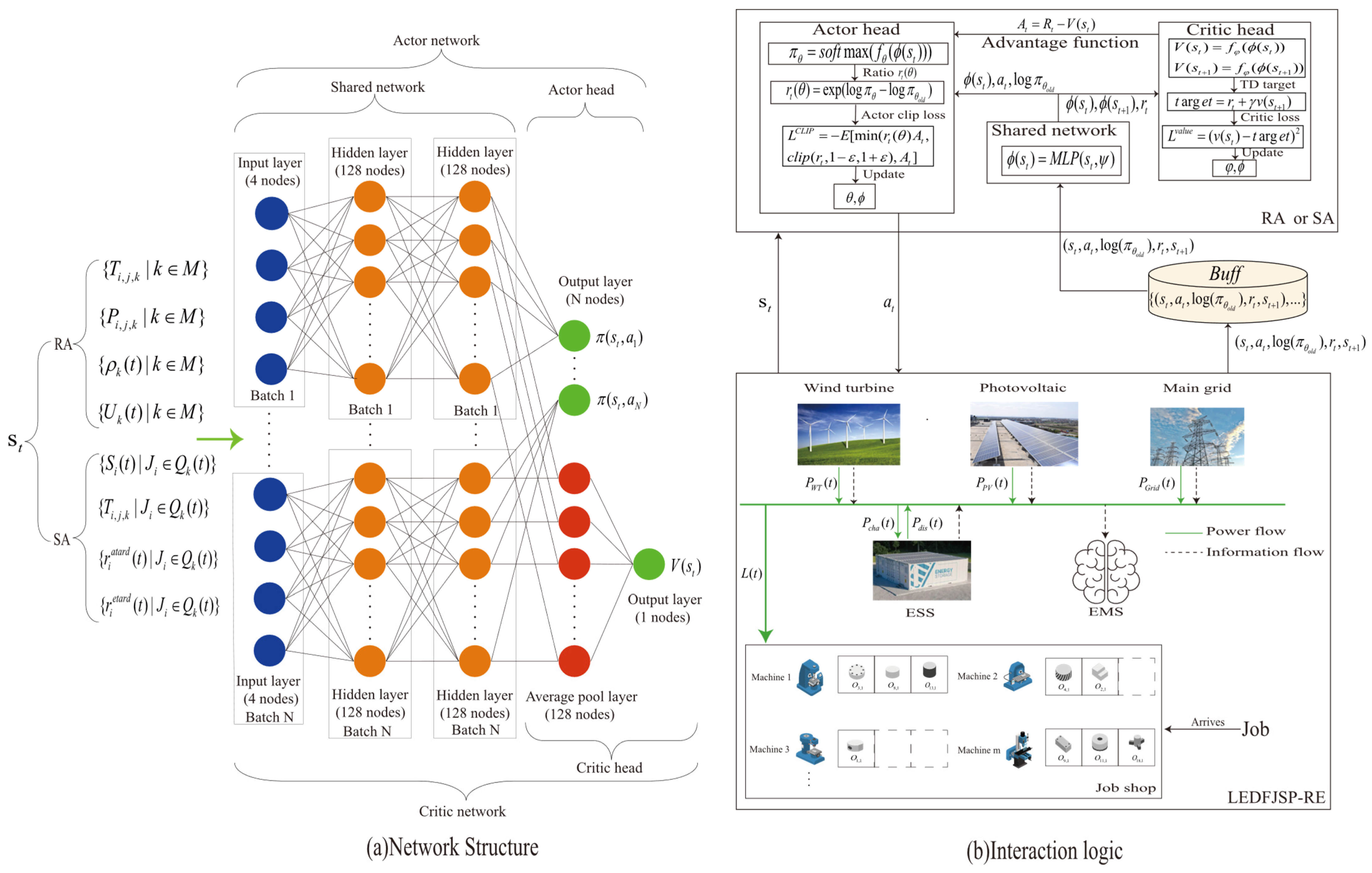
Figure 3, both RA and SA adopt the same Actor–Critic architecture and train their scheduling policies based on the PPO algorithm.
This architecture consists of two subnetworks: the Actor network and the Critic network. At each scheduling decision point , the agent receives the current system state —a variable-length feature sequence of size —as input. The policy network outputs the probability distribution over all candidate actions, from which an action is sampled. After executing , the agent obtains an immediate reward and transitions to the next state .
Simultaneously, we record , the log-probability of the chosen action under the old policy. This is crucial because in PPO, the policy ratio used for updates is: , and corresponds to the policy used to sample the current action. Hence, we must store at action sampling to serve as a baseline during subsequent training for ratio computation. The tuple is recorded and stored in a centralized replay buffer as the data foundation for future policy updates. We compute the advantage vector to update the Actor network and use the mean squared error loss between the return and the state value estimate to update the Critic network.
The entire neural network consists of three main components:
Shared network: This part consists of two fully connected layers with 128 and 128 nodes, respectively, each using the ReLU activation function. It extracts state features and constructs a unified feature embedding. This module is shared between the Actor and Critic networks to enhance representation consistency and training efficiency.
Actor head: After obtaining the embedding for each state feature, a linear transformation layer (dimension 128 → 1) generates a score for each feature. Then, a Softmax function normalizes these scores into a probability distribution, representing the action-selection policy under the current state.
Critic head: First, average pooling is applied to all state feature embeddings to obtain a compact representation of the global state. Then, a linear layer (128 → 1) estimates the value function of this state.
Algorithm 1 Presents the details of the PPO algorithm.
| Algorithm 1: PPO algorithm |
- 1:
Initialize shared network parameters , actor head parameters , critic head parameters - 2:
Set learning rate , clipping threshold , discount factor , GAE , training episode number , mini-batch size , buffer capacity , number of training epochs - 3:
Initialize centralized experience buffer - 4:
for do - 5:
Reset environment; get initial state - 6:
while not done do - 7:
Observe current state - 8:
Compute action probabilities - 9:
Sample action - 10:
Execute observe next state and reward - 11:
Compute and store - 12:
Store transition in buffer - 13:
if then remove oldest () transitions - 14:
end while - 15:
if then - 16:
Compute for all in - 17:
Compute - 18:
Estimate advantages and returns via GAE - 19:
for do - 20:
Sample min-batch - 21:
Compute for all in - 22:
Compute actor loss: - 23:
Compute value loss: - 24:
Backpropagate - 25:
Backpropagate - 26:
end for - 27:
- 28:
end if - 29:
end for - 30:
Return , ,
|
5. Numerical Experiments
This section presents the experimental design and performance evaluation of the proposed framework. Specifically,
Section 5.1 describes the parameter settings of the numerical test instances, followed by the evaluation metrics for multi-objective optimization in
Section 5.2. The training details of the RA and SA are then introduced in
Section 5.3.
Section 5.4 and
Section 5.5 report the experimental results on static and dynamic instances, respectively, including comparisons with rule-based heuristics as well as representative DRL-based and evolutionary scheduling methods. Finally,
Section 5.6 provides a case study to analyze the scheduling behaviors of different methods in energy-aware scheduling scenarios.
5.1. Parameters of Numerical Instances
Based on the study [
31], the paper randomly generates numerical simulation instances to train and evaluate the proposed RA and SA. The job arrival process is assumed to follow an exponential distribution
, where
, and
denotes the average inter-arrival time of new jobs. Each job consists of multiple operations, and the number of operations is randomly sampled within a predefined range to represent manufacturing tasks of varying complexity.
Each operation can be processed on
candidate machines. To capture heterogeneous processing capabilities and energy consumption differences, the processing time
and power consumption
of each operation on each machine are randomly generated. Additionally, the idle power
of each machine is assigned varying values to highlight the scheduling challenges under energy constraints. The due date
of job
is calculated by scaling the total average processing time of its operations with a tightness factor
and adding the current system time offset, creating a mix of high-urgency and low-urgency tasks:
Regarding energy modeling, the outputs of PV and WT are subject to natural variability and are modeled as stochastic time series. Wind power output depends on wind speed and follows a Weibull distribution [
32], expressed as:
where
is the actual wind speed,
is the rated wind speed,
and
are the cut-in and cut-out speeds, and
is the rated output power. PV power generation primarily depends on solar irradiance and panel efficiency [
33], and can be approximated as:
where
is the PV panel area,
is the solar irradiance, and
is the PV conversion efficiency. The daily outputs of PV and WT over 24 h are illustrated in
Figure 4 [
32] and serve as input for scheduling simulations.
The value ranges and generation methods of all parameters are summarized in
Table 5, where
denotes uniform integer sampling and
denotes uniform floating-point sampling. This instance generation framework enables realistic simulation of dynamic job arrivals, heterogeneous machine capabilities, and renewable energy fluctuations, providing a robust basis for training and evaluating multi-agent scheduling strategies.
5.2. Evaluation Metrics
To evaluate the overall performance of RA and SA in the multi-objective scheduling task, we adopt three comprehensive performance metrics: Generational Distance (GD) [
34], Inverted Generational Distance Plus (IGD+) [
35], and Hypervolume (HV) [
36]. Among these, GD measures the convergence of the solution set. IGD+ evaluates both convergence and distribution uniformity, using a modified distance calculation to more accurately reflect the quality of the solution set relative to the reference Pareto front. HV indicates the dominance extent and distribution quality of the solution set within the objective space.
Before calculating these metrics, all solution sets are normalized using min-max scaling.
- (1)
GD
GD measures the average distance from the obtained solution set
to the true Pareto front
, as defined in Equation (42):
where
denotes the Euclidean distance between solution
and its closest point
on the reference Pareto front. A smaller GD value indicates that the solution set is closer to the true Pareto front.
- (2)
IGD+
IGD+ is a commonly used comprehensive metric in multi-objective optimization for evaluating the quality of a solution set, taking into account both convergence and distribution uniformity, as defined in Equation (43):
where
denotes the solution set to be evaluated,
represents the reference Pareto front, and
is the direction-sensitive modified distance function. This function only accounts for the distance when the objective values of solution
are worse than those of the reference point
, thereby emphasizing the penalty for solutions that are dominated relative to the Pareto front.
Compared to GD, which measures from the solution set’s perspective, IGD+ is based on the reference Pareto front, allowing it to comprehensively assess both how well the current solution set approximates and covers the true Pareto boundary. A smaller IGD+ value indicates that the solution set is more uniformly distributed along the reference front and closer to the Pareto optimum, reflecting better overall performance.
- (3)
HV
HV measures the volume covered by the solution set in the objective space and is defined as in Equation (44):
where
is the reference point (typically chosen beyond the maximum values of all objectives in the solution set), and
denotes the number of objectives. A larger HV value indicates that the solution set dominates a larger region in the objective space, reflecting higher solution quality.
5.3. The Training Details of RA and SA
Before introducing the content of this section, we first present the well-known routing and sequencing rules as shown in
Table 6 and
Table 7. In this study, we adopt a separated asynchronous learning architecture: RA is independently trained using the PPO method under the FIFO sequencing baseline rule, while SA is independently trained using PPO under the EA routing baseline rule. Specifically, both RA and SA are trained independently in a job shop with 10 machines. The training simulates 100 new job insertions, with the urgency factor
for each job set to 1.
The training tasks are implemented using the SimPy discrete-event simulation framework (SimPy 4.0.1) [
37] and executed on a locally configured computing platform equipped with an Intel i7 processor, 16 GB RAM, and an NVIDIA RTX 3060 GPU. To ensure experimental reproducibility, the Python environment (Python 3.9.0) and deep learning framework (PyTorch 2.1) are explicitly specified, a fixed random seed (seed = 42) is applied to all training runs, and the entire training duration is recorded.
The main PPO parameters include the learning rate
, mini-batch size
, and discount factor
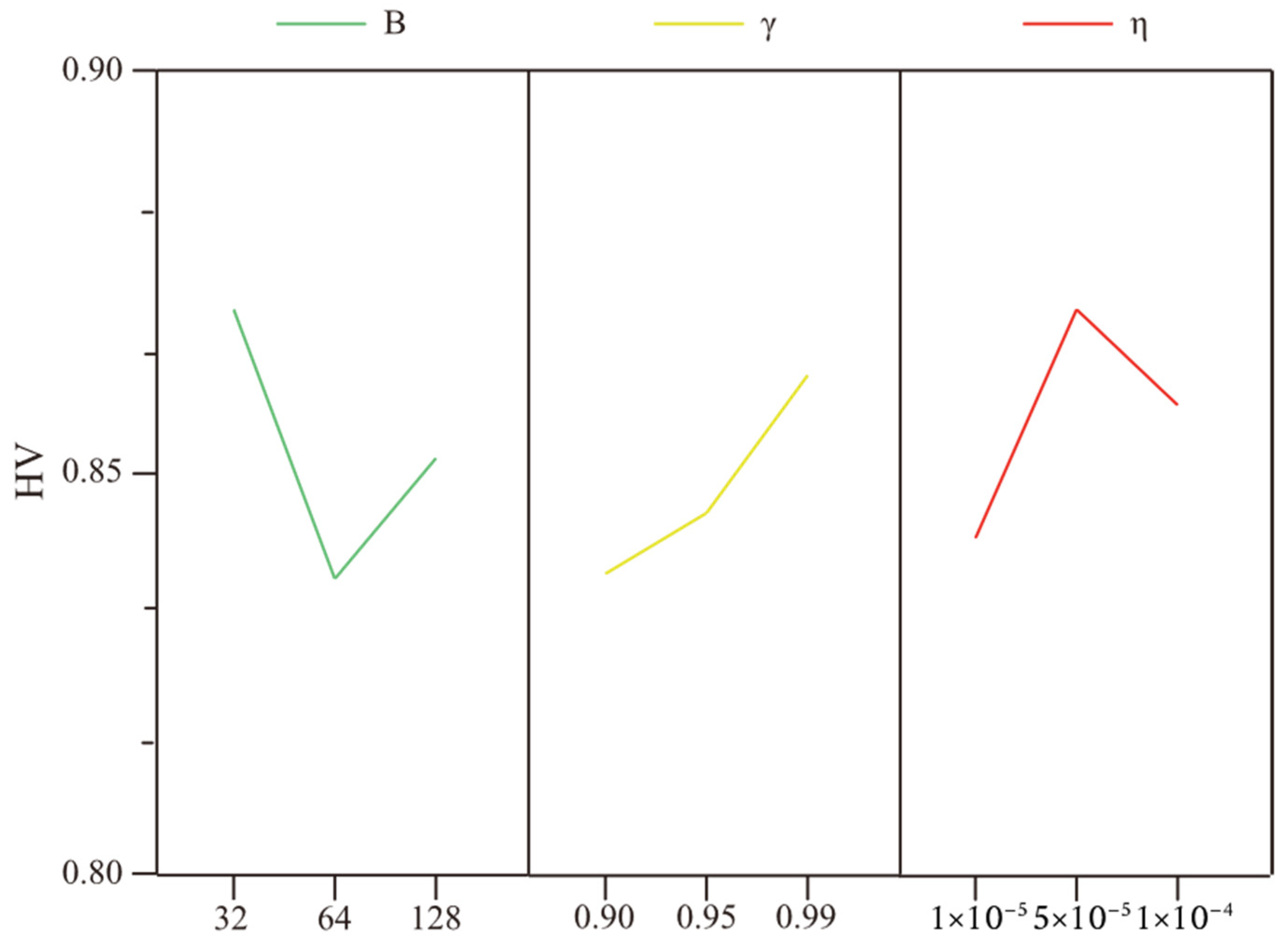
. In addition, the recommended clipping ratio of 0.2 is adopted, and the Adam optimizer is used to improve gradient-based optimization efficiency. Considering the significant influence of these parameters on training performance, an orthogonal experimental design is employed to determine their combinations, with the specific parameter levels provided in
Table 8. For each parameter configuration, 10 independent training runs are conducted for every instance, with the number of training episodes fixed at 1500. The averaged HV values obtained from these experiments are subsequently compared and analyzed, and the trends of the seven parameter settings are illustrated in
Figure 5.
Based on the experimental results, the optimal parameter combination is determined to be
,
, and
. The final PPO parameter configurations are summarized in
Table 9.
The training results are shown in
Figure 6. As training episodes increase, the cumulative rewards of both RA and SA show an overall upward trend, indicating that the agents have successfully learned effective policies.
5.4. Experimental Results on Static Instances
To comprehensively evaluate the generalization ability and robustness of the proposed RA_SA method for solving the LEDFJSP-RE problem, this section compares it with eleven representative scheduling approaches, including the DDQN-based method proposed in [
31], the classical genetic algorithm (GA), and nine rule-based strategies listed in
Table 10. To ensure fairness and comparability among different solution paradigms, all experiments were conducted on the widely used Brandimarte benchmark instances. In the static experimental setting, job arrival dynamics and renewable energy fluctuations are not considered. The machine power levels and job due-date parameters are set according to [
31], thereby ensuring the rationality and consistency of the experimental configuration. Each instance is independently executed ten times, and the average values of all evaluation metrics are reported to mitigate the influence of randomness.
Table 11,
Table 12 and
Table 13 present the comparative results of different algorithms under multiple performance metrics, where the best results are highlighted in bold. The experimental results show that RA_SA achieves the lowest IGD+ values in most benchmark instances, particularly in Mk02, Mk03, and Mk04, indicating its superior convergence performance. Meanwhile, RA_SA attains the minimum GD values in several instances, including Mk02, Mk04, Mk05, and Mk10, suggesting that the obtained solution sets are closer to the true Pareto front and exhibit higher overall solution quality. Even in cases where RA_SA does not achieve the best IGD+ or GD values, it still demonstrates a clear advantage in terms of HV, reflecting stronger stability and consistency in balancing multiple objectives.
Furthermore, as illustrated by the Pareto fronts in
Figure 7, RA_SA is able to obtain solution sets that are closer to the ideal front than those produced by DDQN and GA in most benchmark instances. This observation indicates that scheduling methods based on fixed or predefined rules are limited in their ability to fully capture system state characteristics at each decision stage and to adapt effectively to environmental changes, leading to performance degradation in complex scheduling scenarios. In contrast, reinforcement learning–based agents can dynamically perceive environmental states through continuous interaction and make adaptive decisions accordingly, thereby exhibiting superior optimization capability in multi-objective scheduling problems.
Further analysis indicates that although the single-agent DDQN method exhibits a certain degree of convergence in some instances, it still suffers from notable limitations in terms of solution diversity and stability. This limitation mainly arises from its single-agent decision-making structure, in which job assignment and sequencing decisions are coupled within a unified policy, thereby lacking sufficient flexibility and coordination when handling conflicting multiple objectives.
Figure 8 presents violin plots of the four optimization objectives for the MK04 and MK10 instances, from which it can be observed that the solution sets obtained by RA_SA are clearly superior to those of the other comparative methods in terms of both distribution uniformity and numerical performance.
5.5. Experimental Results on Dynamic Instances
To comprehensively evaluate the performance of the proposed RA_SA framework under dynamic scheduling scenarios, a series of systematic experiments were conducted on multiple dynamic test instances. All experiments were carried out under conditions involving dynamic job arrivals and scheduling disturbances, in order to more realistically characterize the uncertainties encountered in practical production environments.
Table 14,
Table 15 and
Table 16 present the comparative results of different algorithms under multiple performance metrics, where the best results are highlighted in bold. The experimental results indicate that RA_SA achieves the lowest IGD+ values in most instances, attains the minimum GD values in several representative cases, and shows clear advantages in terms of the HV metric for the majority of instances. Overall, across all static test instances, RA_SA achieves the best IGD+ values in approximately 55.6% of the cases, the best GD values in about 61.1% of the cases, and the best HV values in roughly 88.8% of the cases. These quantitative results provide concrete support for the qualitative observations regarding the advantages of RA_SA presented earlier. This demonstrates its superior convergence performance, higher solution quality, and stronger stability and consistency in balancing multiple objectives.
Furthermore, the Pareto fronts obtained by RA_SA and other competing algorithms for several representative instances are illustrated in
Figure 9. It can be observed that RA_SA is able to generate solution sets that are closer to the ideal Pareto front and exhibit a more balanced distribution among different objectives, highlighting its comprehensive advantages in terms of convergence and diversity. These results indicate that RA_SA can effectively coordinate conflicting objectives such as makespan, energy consumption, and carbon emissions in dynamic environments.
Further analysis from the perspective of problem scale reveals that RA_SA performs particularly well on medium- and large-scale instances, especially those with high job volumes and system complexity, such as the case of 1.5 × 20 × 200 ( × × ). Such instances typically involve higher decision dimensionality and more complex job–resource coupling relationships, posing greater challenges to scheduling strategies. The experimental results demonstrate that RA_SA is able to maintain good convergence behavior and solution quality under these conditions, reflecting its strong robustness and scalability.
Overall, the dynamic experimental results demonstrate that RA_SA can effectively handle job insertions, renewable energy fluctuations, and multi-objective conflicts. Compared with traditional rule-based methods and single-agent approaches, RA_SA exhibits stronger adaptability and superior overall optimization performance in dynamic environments, confirming its effectiveness and practicality for complex green scheduling problems.
5.6. Case Study
It should be noted that the primary objective of this case study is not to directly demonstrate the immediate industrial deployability of the proposed framework, but rather to analyze and illustrate the decision-making behaviors of different scheduling paradigms under coupled job–energy dynamics. By constructing a scheduling scenario with renewable energy participation, this case study aims to provide insights into how different scheduling strategies respond to interactions among production load, energy utilization, and carbon emission control, thereby offering an analytical basis for future extensions toward practical industrial applications.
A test instance with a scale of 1.5 × 20 × 200 () is selected to evaluate the scheduling performance of RA_SA in terms of carbon emission control and operational cost under scenarios involving renewable energy participation. In addition to RA_SA, three comparative scheduling strategies are considered in the case study, including the EA_FIFO, the CT_SPT rule that ranked second overall in the previous experiments, and an energy-oriented scheduling method that combines a minimum energy routing rule (denoted as ME) with the SPT sequencing rule. Specifically, the ME routing rule prioritizes the assignment of each operation to the machine with the lowest processing energy consumption at the machine-selection stage.
Figure 10 presents a comparative illustration of the production load and renewable energy supply curves obtained by the three scheduling rules under the same renewable energy scenario. It can be observed that the ME routing rule consistently favors low-energy-consumption machines during machine selection, while neither explicitly accounting for the temporal fluctuations of renewable energy supply nor imposing constraints on job completion time and tardiness risk. As a result, jobs tend to be concentrated on a small number of low-energy machines, leading to load congestion in the time dimension and a significant extension of the makespan. Meanwhile, traditional rules such as EA_FIFO and CT_SPT, which lack a joint consideration of energy states and overall system load, struggle to achieve a balanced trade-off among makespan, energy consumption, carbon emissions, and job tardiness. In contrast, RA_SA not only accounts for machine-level energy consumption differences but also incorporates explicit awareness of renewable energy generation states. Through cooperative multi-agent decision-making, RA_SA dynamically adjusts job assignments and processing sequences, enabling the production load to better align with the renewable energy supply curve over time. This allows RA_SA to effectively reduce energy consumption and carbon emissions while simultaneously restraining the growth of makespan and job tardiness.
Furthermore, as shown in
Table 17, additional experiments conducted on multiple randomly selected test instances yield consistent results with the above observations. Across different problem instances, RA_SA is able to achieve a more balanced trade-off between carbon emission reduction and operational cost, demonstrating its effectiveness and robustness in complex scheduling environments with renewable energy participation.
6. Conclusions and Future Work
This study develops an LEDFJSP-RE scheduling framework to support low-carbon and efficient operation in smart manufacturing environments. To address dynamic job arrivals and fluctuations in renewable energy supply, two cooperative agents—RA and SA—are designed and independently trained using PPO. With problem-specific state representations, tailored reward mechanisms, and a self-adaptive job-selection strategy, both agents maintain stable decision-making performance under dynamic conditions. Experimental results show that the proposed multi-agent framework consistently outperforms a wide range of baseline scheduling strategies under different disturbance scenarios. Case analyses further indicate that the coordinated RA_SA mechanism provides greater scheduling flexibility and enables better temporal alignment between production load and renewable energy generation profiles. Overall, the framework offers an effective intelligent solution for energy-aware scheduling in flexible job-shop environments.
Several limitations should be acknowledged. The framework is validated in a simulation environment, which enables controlled modeling of dynamic events and systematic analysis of scheduling behaviors, but inevitably abstracts certain complexities of real production systems. Factors such as transportation delays, sequence-dependent setup operations, finite buffer capacities, stochastic machine failures, and detailed machine-level energy behaviors (e.g., start-up peaks, shutdown policies, and idle-to-active transition costs) are not included. These simplifications reduce modeling complexity but may constrain direct applicability in certain industrial scenarios.
As manufacturing systems continue to evolve toward higher uncertainty and tighter coupling between production and energy resources, incorporating the omitted operational constraints will be essential. This includes modeling equipment failures, material-handling delays, buffer limitations, and setup operations, as well as integrating the scheduling framework more closely with energy management functions such as renewable energy forecasting, energy storage operation, and time-dependent electricity pricing. In addition, constructing standardized dynamic benchmark sets would facilitate more systematic and comprehensive comparisons across different classes of scheduling methods. Furthermore, recent advances in digital-twin-assisted dynamic rescheduling provide promising directions for enabling real-time state synchronization, disturbance prediction, and adaptive schedule adjustment [
38]. Integrating digital twin mechanisms into the proposed MARL framework may further enhance its responsiveness and robustness in complex industrial environments.
Overall, the LEDFJSP-RE framework establishes a solid foundation for real-time, energy-aware scheduling in flexible job-shop systems. With the progressive integration of more realistic operational constraints, advanced energy management strategies, and real-time feedback mechanisms, the framework has the potential to evolve into a practical and scalable solution for more complex and large-scale manufacturing settings.