
Skip to Content
MachinesMachines
  • Article
  • Open Access

1 January 2026

Model Predictive Control of Doubly Fed Induction Motors Based on Fuzzy Logic
,
,
,
and
1
Robotics and Autonomous Systems Thrust, The Hong Kong University of Science and Technology (Guangzhou), Guuangzhou 511453, China
2
CSG PGC Energy Storage Research Institute, China Southern Power Grid Co., Ltd., Guangzhou 511499, China
*
Author to whom correspondence should be addressed.

Abstract

Model predictive control (MPC) has become an attractive solution for doubly fed induction motors (DFIMs) due to its fast dynamic response and multi-variable constraint handling capability. However, the performance of conventional MPC relies on the accuracy of the system model. To further enhance the control performance and adaptability, this paper proposes a fuzzy logic-based model predictive control (FL-MPC) strategy. The proposed method continuously monitors the current tracking errors and their rates of change, utilizing a fuzzy inference system to dynamically optimize the weight distribution within the predictive model. This enables the controller to autonomously adjust its behavior for optimal performance across a wide range of operating conditions. Both simulation and experimental results demonstrate that, compared to the conventional MPC, the proposed FL-MPC strategy achieves superior dynamic response.

1. Introduction

Doubly fed induction motors (DFIMs) have been widely employed in renewable energy systems such as pumped storage and wind power generation, owing to their wide speed regulation range and low implementation cost [1,2,3]. It can flexibly operate in either motoring or generating modes, depending on the system requirements. The effectiveness of the rotor magnetic field control strategy in DFIMs directly determines their energy conversion efficiency and the quality of the grid-connected power. Therefore, the development of highly stable control algorithms for DFIMs holds significant theoretical and practical importance for ensuring the safe and stable operation of modern power systems.
Currently, vector control remains the most widely implemented control strategy for DFIMs. The method first decouples the torque and excitation components of the DFIM magnetizing current via coordinate transformation. Then, PI regulators are applied to maintain desirable steady-state performance [4,5]. However, the vector control strategy also exhibits inherent limitations. On the one hand, the tuning process of PI regulators is tedious and offers limited capability in optimizing the system’s dynamic response. On the other hand, conventional vector control typically adopts a cascaded control structure, in which the dynamic response of the inner current loop is constrained by the bandwidth of the PI regulator, making it difficult to achieve optimal dynamic performance [6,7,8]. These limitations have motivated researchers to explore more advanced control schemes.
Model predictive control (MPC) has attracted extensive attention in recent years in the fields of power electronics and motor drives, owing to its intuitive concept, capability to handle multivariable constraints, and excellent dynamic performance. Unlike vector control, MPC utilizes a discrete-time system model to predict the future behavior of controlled variables and computes the amplitude and angle of the reference voltage vector based on the mathematical model of the machine [9,10,11,12]. This control mechanism enables the simultaneous handling of multiple control objectives, thereby demonstrating great potential in improving both dynamic response and overall control performance. However, MPC still exhibits limited robustness when facing parameter variations caused by temperature rise and magnetic saturation. Some studies have proposed the use of disturbance observers or model reference adaptive strategy to mitigate the impact of model uncertainties on control performance [13,14]. These algorithms are characterized by high computational complexity and a tendency to amplify sensor noise. In permanent magnet synchronous motor control, various data-driven approaches and model-free control strategies have also been extensively investigated [15,16,17,18,19]. These methods are associated with several limitations, such as difficulties in initial parameter tuning and challenges in ensuring closed-loop stability.
The main contribution of this paper lies in the development of a fuzzy logic model predictive control (FL-MPC) strategy for DFIMs. The core of this contribution is an mechanism that dynamically optimizes the controller’s weight factors in real-time, based on the tracking error and its derivative. This approach eliminates the dependency on fixed weighting coefficients in conventional MPC, granting the controller self-adaptive capabilities. The efficacy of the proposed strategy is conclusively verified through comparative simulation and experimental results, which confirm significant improvements in dynamic response and overall control performance.

2. Mathematical Model of DFIMs

The DFIMs consists of both stator and rotor windings. The stator winding is directly connected to the power grid, and thus the stator side can be regarded as uncontrollable. Consequently, the control of the rotor speed can only be achieved by regulating the frequency of the magnetic field in the rotor winding. To ensure the stable operation of the DFIMs, the air-gap fundamental magnetic field produced by the stator current must have the same frequency as that generated by the rotor current. Therefore, the following relationship must be satisfied:
ω s m = ω r m + p ω r
where ω s m , ω r m , p and ω r represent the angular velocity of the stator current, the angular velocity of the rotor current, the number of pole pairs of the stator winding, and the mechanical angular speed of the rotor, respectively. The voltage equations of the DFIMs in the d q reference frame can be expressed as follows:
u s d = R s i s d + d ψ s d d t ω s m ψ s q u s q = R s i s q + d ψ s q d t + ω s m ψ s d u r d = R r i r d + d ψ r d d t ω r m ψ r q u r q = R r i r q + d ψ r q d t + ω r m ψ r d
where u, i and ψ represent the phase voltage, phase current, and flux linkage, respectively. The subscripts s and r denote the stator and rotor, respectively, while R s and R r represent the phase resistances of the stator and rotor windings. The flux linkage equations of the DFIMs in the d q reference frame can be expressed as follows:
ψ s d = L s i s d + L m i r d ψ s q = L s i s q + L m i r q ψ r d = L m i s d + L r i r d ψ r q = L m i s q + L r i r q
where L m denotes the mutual inductance between the stator and rotor windings of the same phase, while L s and L r represent the self-inductances of the stator and rotor phase windings, respectively.

3. Model Predictive Control Method

3.1. Conventional Model Predictive Control

In the design of motor control systems, digital control typically requires the discretization of continuous-time models. For DFIMs, when the sampling period T s is sufficiently short, the continuous-time model can be discretized using a first-order Taylor expansion. This discretization method allows for the prediction of system state variations within each control cycle, enabling precise current tracking. As a result, the control system can track the reference current in the next control cycle, thereby forming the MPC algorithm. Based on this analytical framework, the equations in continuous time, such as those in (2) and (3), can be transformed into the following rotor voltage equations:
u r d ( k + 1 ) = R r i r d ( k ) + σ L r T s [ i r d * ( k + 1 ) i r d ( k ) ] + L m T s L s [ ψ s ψ s ( k ) ] ω r m ( k ) ψ r q ( k ) u r q ( k + 1 ) = R r i r q ( k ) + σ L r T s [ i r q * ( k + 1 ) i r q ( k ) ] + ω r m ( k ) ψ r d ( k )
where i r d * and i r q * denote the reference value of the d q axis current, and σ represents the leakage coefficient. If model errors, inverter dead time, and other non-ideal factors are neglected, the voltage synthesized by the inverter through PWM control according to (4) can achieve satisfactory current tracking performance. However, parameter variations during motor operation may cause deviations between the predicted voltage vector and the actual voltage vector required by the system. If such deviations are not properly compensated, they will have an adverse impact on the overall control performance of the motor.

3.2. Parameter Mismatch Analysis

From the above analysis, it can be observed that the MPC algorithm of the DFIMs is highly dependent on the machine parameters. In practical operation, temperature rise primarily affects the resistance, while inductance is significantly influenced by magnetic saturation. Therefore, it is necessary to analyze the effects of parameter mismatches to maintain the effectiveness of the control algorithm. Considering the parameter variations, (4) can be rewritten as follows:
u r d ( k + 1 ) = ( R r + Δ R r ) i r d ( k ) + σ ( L r + Δ L r ) T s [ i r d * ( k + 1 ) i r d ( k ) ] + L m Δ L M T s L s [ ψ s ψ s ( k ) ] ω r m ( k ) ψ r q ( k ) u r q ( k + 1 ) = ( R r + Δ R r ) i r q ( k ) + σ ( L r + Δ L r ) T s [ i r q * ( k + 1 ) i r q ( k ) ] + ω r m ( k ) ψ r d ( k )
where Δ R r and Δ L r represent the variations of resistance and rotor self-inductance that occur during the actual operation of the machine. It can be observed that fluctuations in these parameters make it difficult to accurately compute the predicted value of the reference voltage. For computational convenience, the mathematical model of the DFIMs considering parameter variations, as given in (5), can be rearranged into the following form:
u r d ( k + 1 ) = η 11 R r i r d ( k ) + η 12 σ L r T s [ i r d * ( k + 1 ) i r d ( k ) ] + η 13 L m T s L s [ ψ s ψ s ( k ) ] ω r m ( k ) ψ r q ( k ) u r q ( k + 1 ) = η 21 R r i r q ( k ) + η 22 σ L r T s [ i r q * ( k + 1 ) i r q ( k ) ] + ω r m ( k ) ψ r d ( k )
where η 11 , η 12 , η 13 , η 21 , η 22 represent the parameter variation coefficients. By multiplying the rated parameters with these coefficients, the rated values can be adjusted to approximate the actual parameters. If these parameters can be identified online, the adverse effects of parameter variations on system control can be effectively eliminated. Therefore, this paper proposes a disturbance-rejection MPC algorithm based on fuzzy logic.

4. Proposed Fuzzy Logic MPC for DFIMs

Conventional MPC typically employs a mathematical model with fixed parameters, making it sensitive to parameter disturbances that occur during motor operation. Moreover, complex coupling relationships exist among the internal parameters of the system. To address these issues, a fuzzy controller is introduced in this section to dynamically adjust the mathematical model according to the actual operating conditions of the machine, thereby enhancing the overall control performance. The designed fuzzy controller takes as input variables. The fuzzy controller designed in this paper determines the operating condition of the DFIMs based on the relationship between the d q axis currents and their reference values. Its inputs can be defined as follows:
Δ i r d ( k ) = i r d * ( k + 1 ) i r d ( k ) Δ i r q ( k ) = i r q * ( k + 1 ) i r q ( k )
δ i r d ( k ) = ( i r d ( k ) i r d ( k 1 ) ) / T s δ i r q ( k ) = ( i r q ( k ) i r q ( k 1 ) ) / T s
where Δ i r d q denotes the deviation between the actual d q axis current and its reference value, and δ i r d q represents the rate of change of the d q axis current. The implementation of the fuzzy controller consists of three main steps: fuzzification, fuzzy inference, and defuzzification. The universes of discourse for the input variables are defined based on the rated current of the DFIMs and are set to [−15, 15] and [−150, 150] respectively in this paper. The input and output variables are discretized, and the fuzzy sets {Positive Big (PB), Positive Middle (PM), Positive Small (PS), Zero (ZE), Negative Small (NS), Negative Middle (NM), Negative Big (NB)} are defined accordingly. The detailed definition of the domain of fuzzy control is presented in the Table 1. The fuzzy sets of Δ i r d q and δ i r d q are defined as κ Δ i r d q and κ δ i r d q , respectively, as shown below:
κ Δ i r d q = NB , BM , BS , ZE , PS , PM , PB κ δ i r d q = NB , BM , BS , ZE , PS , PM , PB
Table 1. The domain of proposed fuzzy Controller.
Fuzzification refers to the process of mapping the precisely measured data into the corresponding fuzzy domain within the defined universe of discourse through membership functions, and calculating the degree of membership of each measured value to the respective fuzzy sets. To reduce computational complexity, symmetric triangular membership functions are adopted in this paper. Taking the d axis as an example, the membership functions of its two input variables are defined as follows.
μ Δ i r d 1 , μ Δ i r d 2 , μ Δ i r d 7 κ Δ i r d
μ δ i r d 1 , μ δ i r d 2 , μ δ i r d 7 κ δ i r d
where μ Δ i r d and μ δ i r d represent the membership functions associated with the two input variables. Each element within the fuzzy set corresponds to a specific membership function.
Fuzzy inference refers to the process of performing fuzzy logic operations based on the membership values obtained from fuzzification and the predefined fuzzy rules listed in Table 2 and Table 3. According to the fuzzy rules given in Table 2, each combination of elements in the fuzzy domain can be mapped to a corresponding set of fuzzy outputs, denoted as γ 1 υ , υ = 1 , 2 , 3 . These outputs are subsequently incorporated into the computation of η 1 υ , as expressed in the following equation:
η 1 υ = k = 1 7 j = 1 7 μ Δ i r d k μ δ i r d j γ 1 υ k j
Table 2. Fuzzy rule of the controller in d axis.
Table 3. Fuzzy rule of the controller in q axis.
Defuzzification is the process of converting the fuzzy output set obtained from the inference stage into a precise numerical value required by the controller. To achieve smooth output performance, the centroid method is employed for defuzzification.
From the above analysis, it can be concluded that the proposed fuzzy controller is capable of transforming the current control deviation and its rate of change into dynamic model coefficients, thereby achieving real-time compensation for model deviations. Since the fuzzy controller does not rely on the mathematical model of the machine itself, it exhibits robustness against parameter variations.
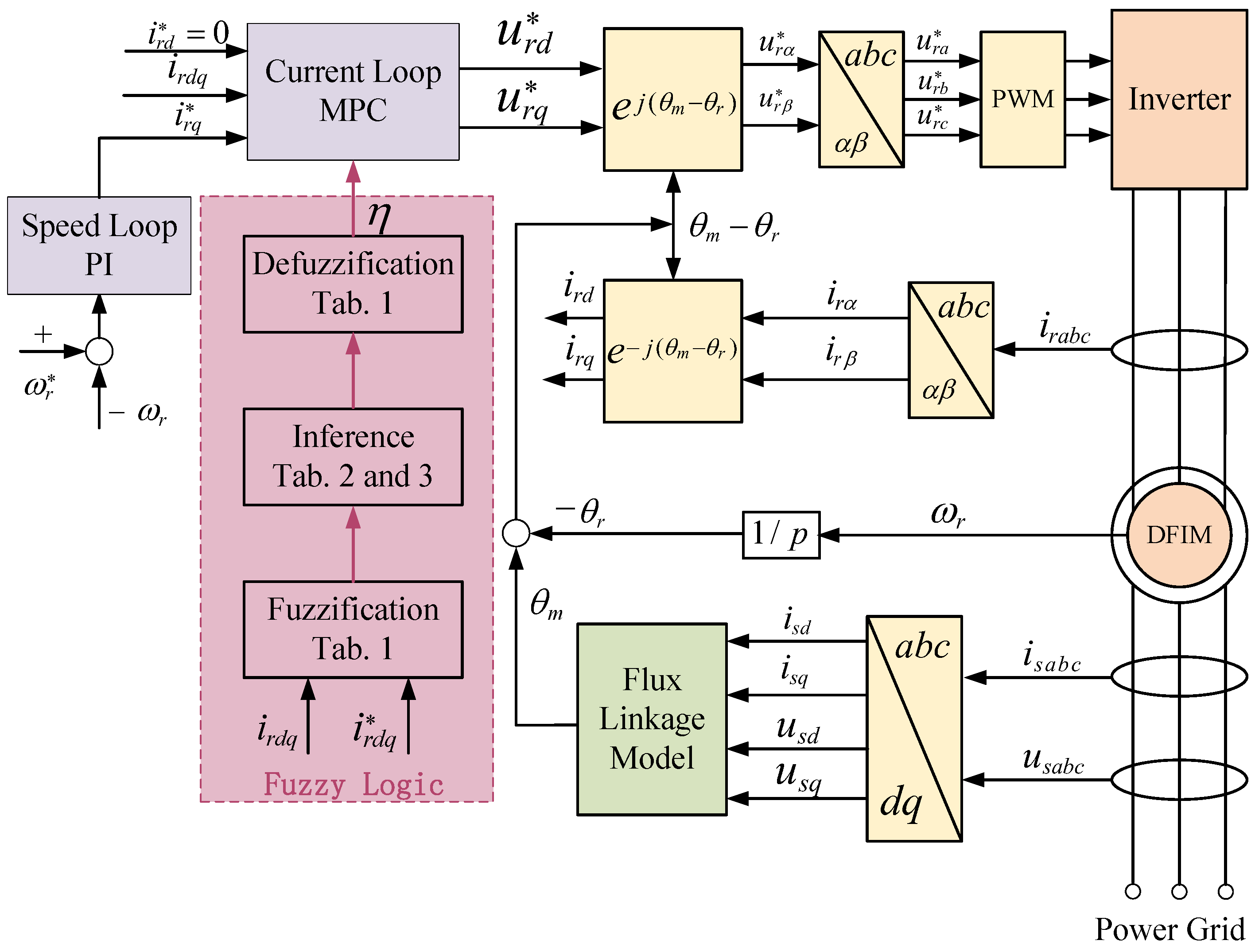
The control block diagram of the proposed FL-MPC scheme is illustrated in Figure 1. As shown in the Figure 1, a flux linkage model is required to estimate the stator flux angle, which is then used to compute the slip frequency and perform the coordinate transformation in the rotor field oriented control. The rotor speed loop and current loop are regulated by a PI controller and an MPC controller, respectively. The primary function of the proposed FL-MPC algorithm is to compute an adaptive value of η using a fuzzy control scheme based on the current errors, thereby enhancing the stability of the controller.
Figure 1. The control block diagram of proposed fuzzy logic MPC.

5. Simulation and Experimental Results

To validate the effectiveness of the proposed algorithm, both a Simulink simulation model and an experimental platform are developed. The proposed FL-MPC algorithm is then compared with the conventional MPC method. The main control system parameters are summarized in Table 4. In both the simulation and experimental tests, the sampling frequencies of the current loop and the speed loop are set to 10 kHz and 2 kHz, respectively.
Table 4. The Parameters of DFIMs.

5.1. Simulation Results

5.1.1. Simulation Comparison of Current Loop Response

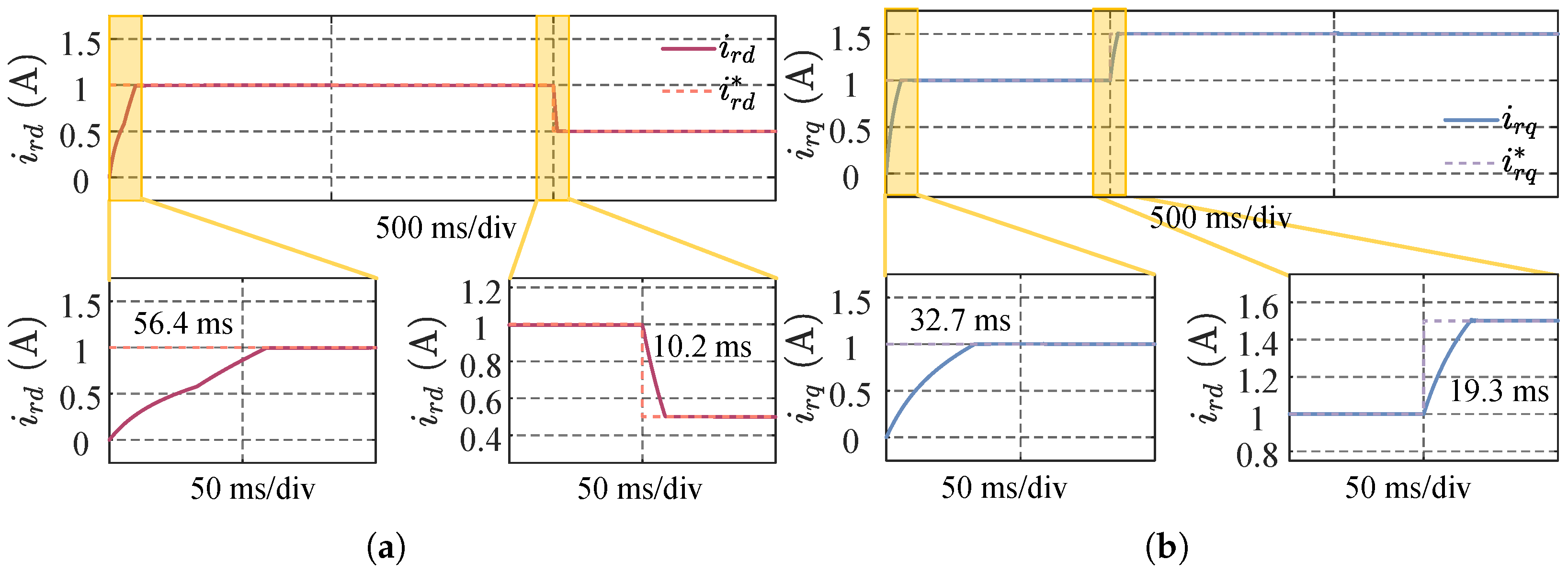
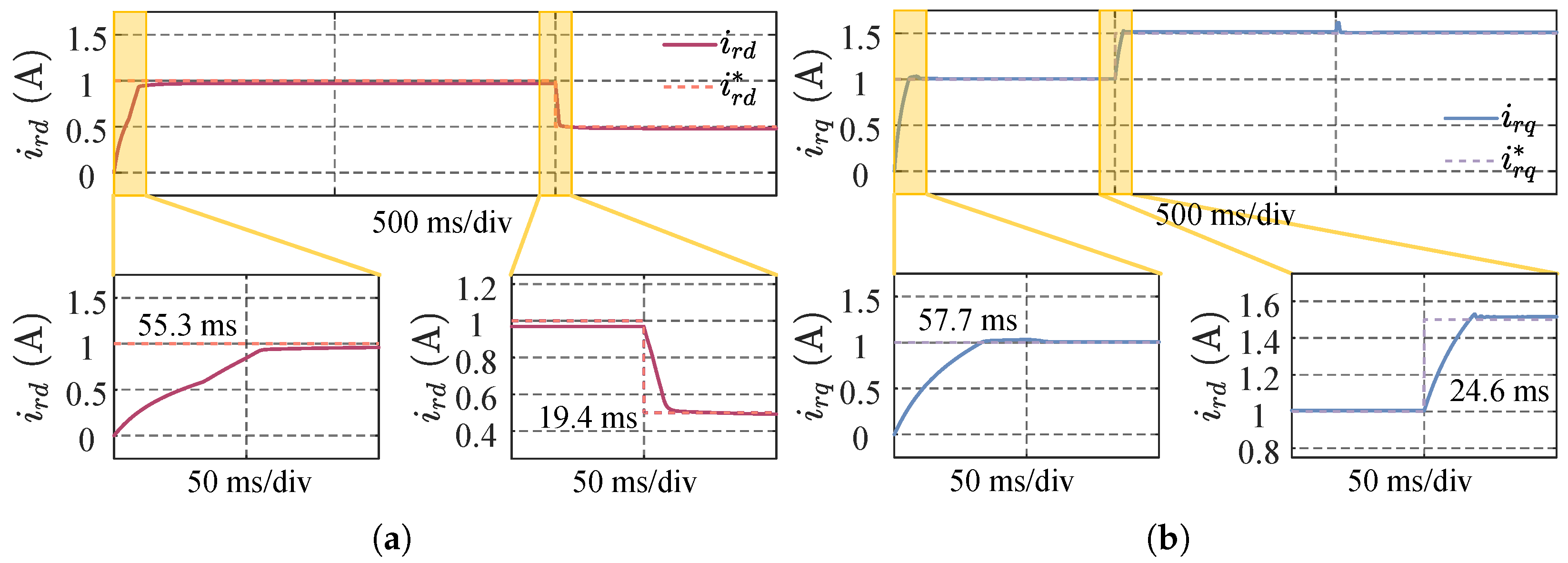
In the simulation, the current loop control performance is evaluated, and the results are shown in Figure 2 and Figure 3. The simulation is conducted under the condition that the motor shaft remained stationary, and the angle used in the coordinate transformation is set to zero. The d q axis current references are directly applied under these conditions. Both the d and q axis current reference values are initially set to 1 A. At 0.5 s, the q axis current reference is increased to 1.5 A, and at 1 s, the d axis current reference is reduced to 0.5 A.
Figure 2. Simulation results of current loop with MPC strategy. (a) d axis current response with MPC strategy. (b) q axis current response with MPC strategy.
Figure 3. Simulation results of current loop with FL-MPC strategy. (a) d axis current response with FL-MPC strategy. (b) q axis current response with FL-MPC strategy.
From the simulation results, it can be observed that the proposed algorithm exhibits a smaller q axis current overshoot during the initial stage and reaches the reference value within 32.7 ms. When the d q axis reference currents change, the proposed algorithm achieves tracking within 10.2 ms and 19.3 ms, respectively, demonstrating faster response and better tracking performance than the MPC algorithm.
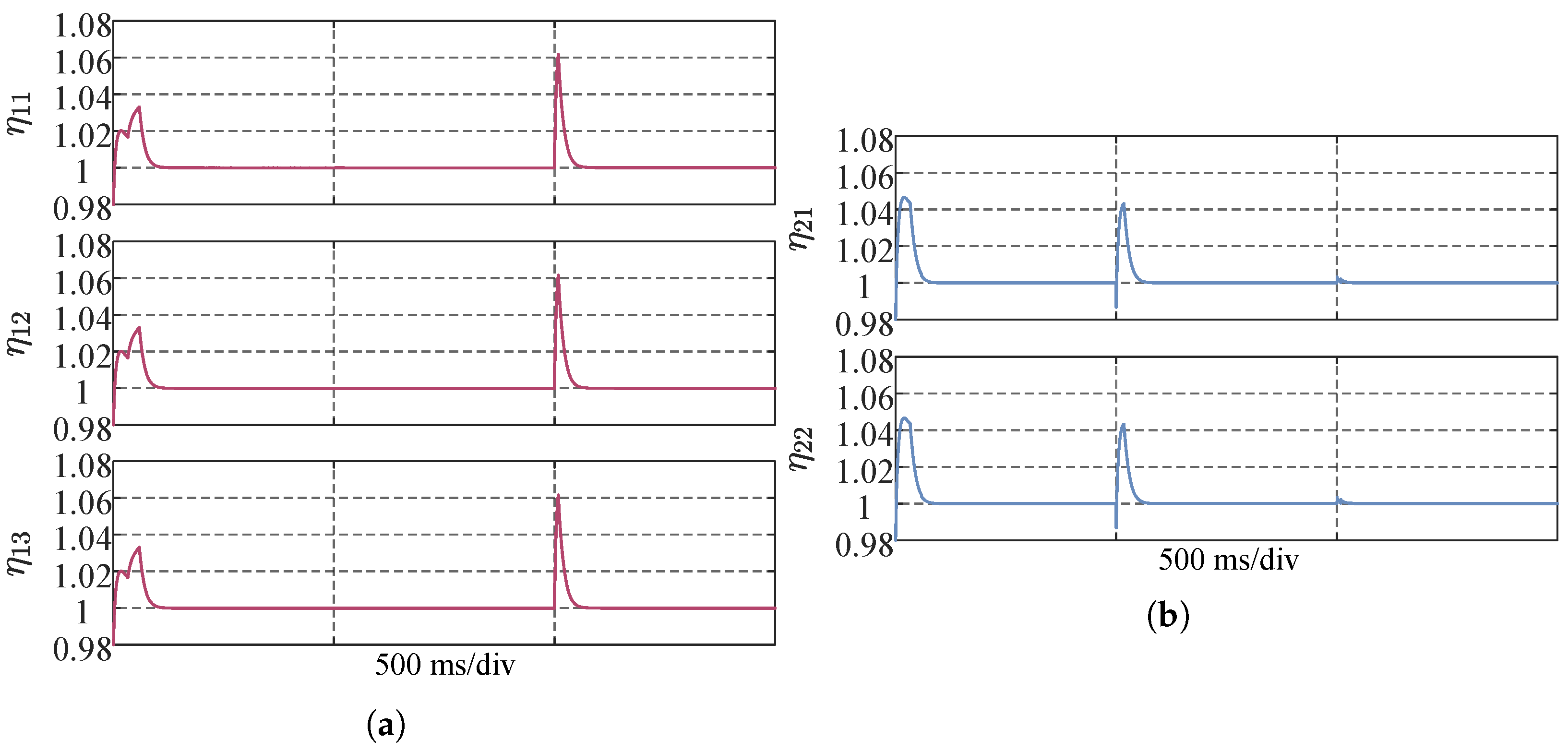
Figure 4 illustrates the dynamic evolution of the fuzzy controller output η during current variations in the simulation. It can be observed that η 1 υ mainly follows the variation of the d axis current, whereas η 2 υ is primarily associated with the q axis current. When a large deviation exists between the actual current and the reference current, the fuzzy controller generates an output to accelerate the current response. Once the actual current accurately tracks the reference, the fuzzy controller output converges to 1 and thus does not affect the MPC controller.
Figure 4. Simulation results of fuzzy logic controller under current fluctuations. (a) Output of the fuzzy controller under d axis current fluctuations. (b) Output of the fuzzy controller under q axis current fluctuations.

5.1.2. Simulation Comparison of Speed Loop Response

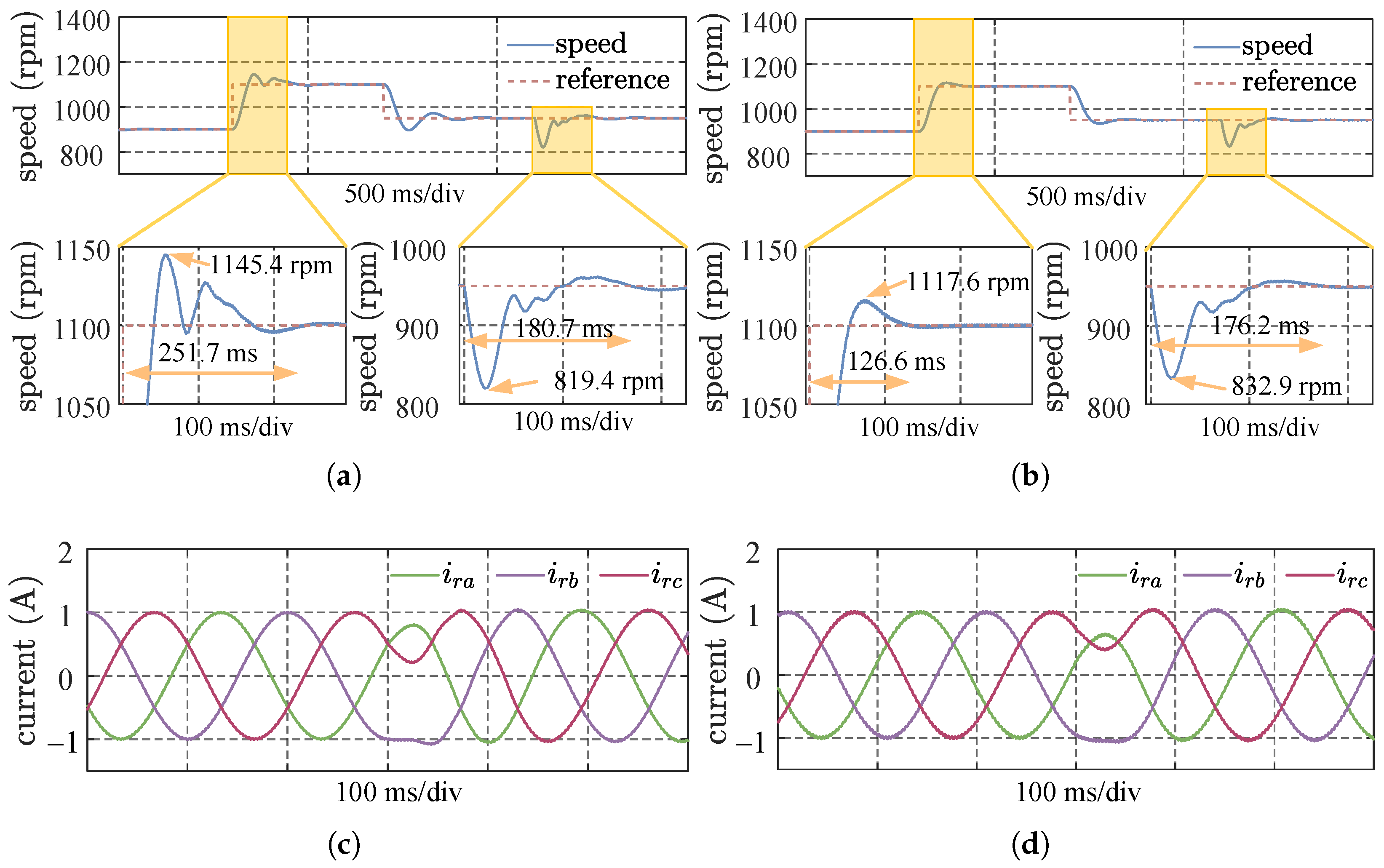
Figure 5 illustrates the dynamic response of the MPC and FL-MPC strategies when the stator current frequency is maintained at 50 Hz and the reference speed is shifted from the subsynchronous to the supersynchronous region. The simulation conditions are specified as follows: the machine is initially operated steadily at 900 rpm; at 0.3 s, the reference speed is increased from 900 rpm to 1100 rpm; at 0.7 s, it is decreased to 1000 rpm; and at 1.1 s, a sudden load disturbance of 1 N·m is applied.
Figure 5. Simulation results of speed loop response with different strategies. (a) Speed control performance with MPC strategy. (b) Speed control performance with FL-MPC strategy. (c) Three phase current with MPC strategy. (d) Three phase current with FL-MPC strategy.
From the simulation results, it can be observed that the conventional MPC strategy has considerable speed oscillations and overshoot during both acceleration and deceleration. By contrast, with the proposed FL-MPC strategy, the overshoot in the acceleration stage is reduced by 19.12%, and the settling time is shortened by 125.1 ms. After the application of the sudden load disturbance, the speed drop under FL-MPC is 13.5 rpm smaller than that obtained with MPC, indicating that enhanced disturbance-rejection capability is achieved by the proposed method.

5.2. Experimental Results

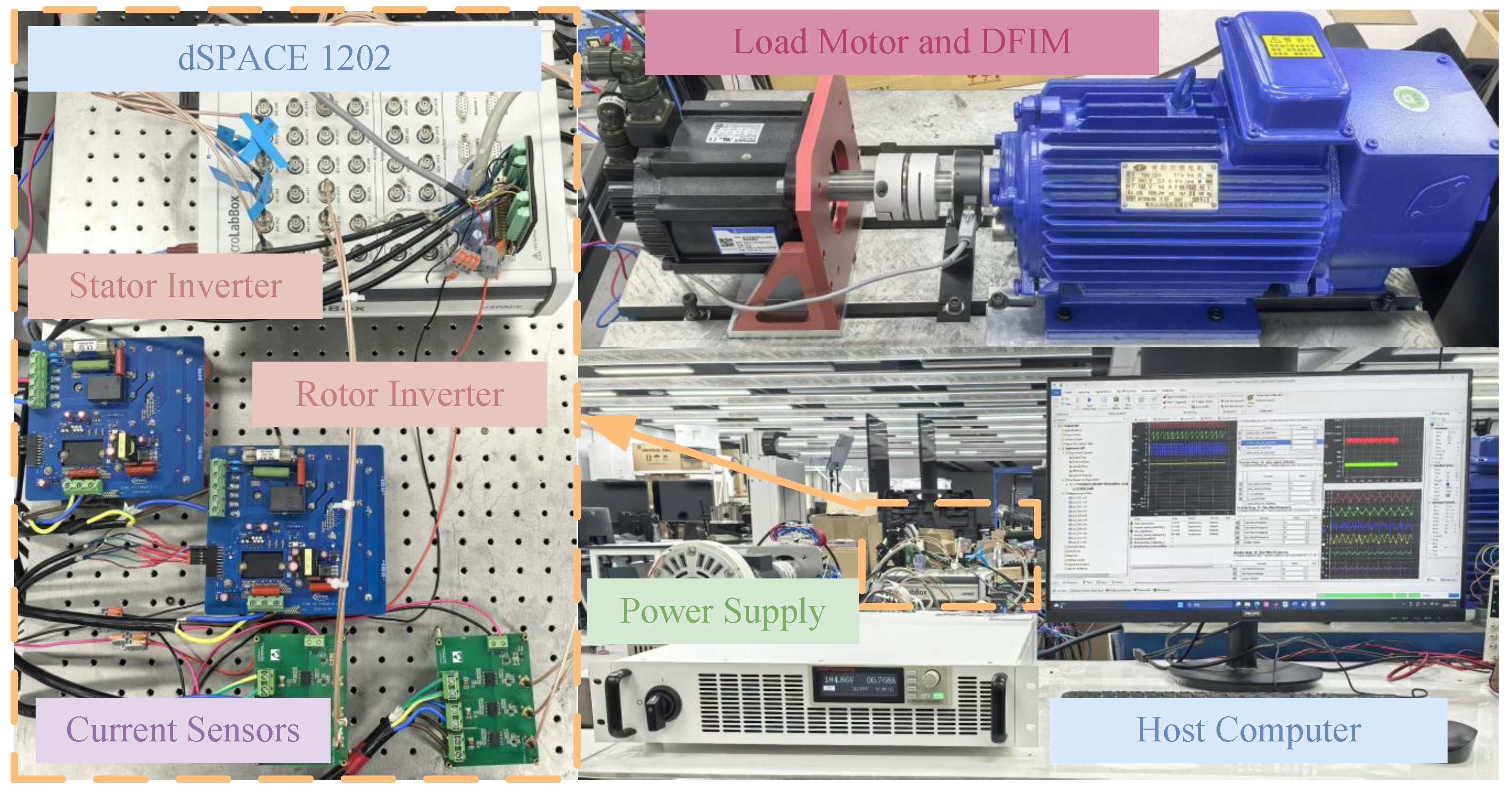
The experimental setup is shown in Figure 6. Due to equipment limitations, the stator winding is not directly connected to the power grid, nor is grid-emulation equipment available. Therefore, an additional inverter is employed to supply the stator winding. The stator is driven in open loop through dSPACE, where two sinusoidal signals with a 90° phase shift are generated and processed through SVPWM to produce a three-phase sinusoidal voltage with adjustable amplitude and frequency. The control algorithm proposed in this paper is also executed on dSPACE and is used to regulate the rotor windings. The motor parameters are kept consistent with those listed in Table 4.
Figure 6. The experiment platform.

5.2.1. Experimental Comparison of Current Loop Response

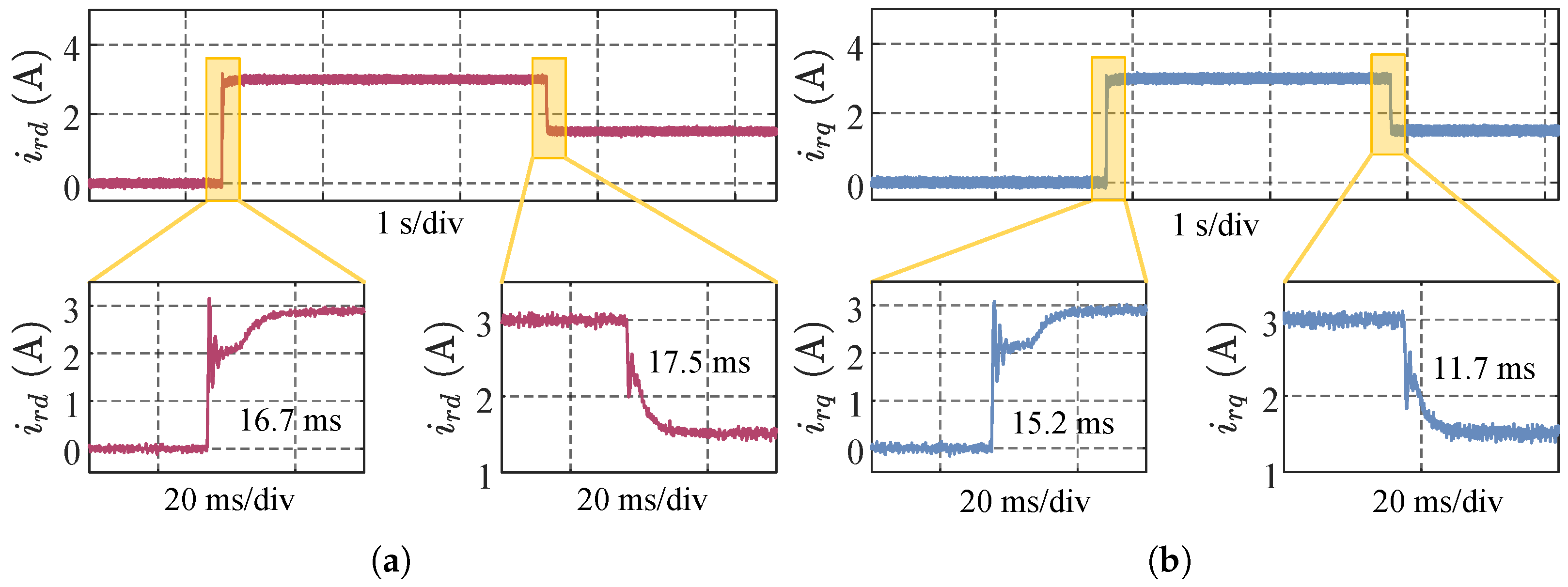
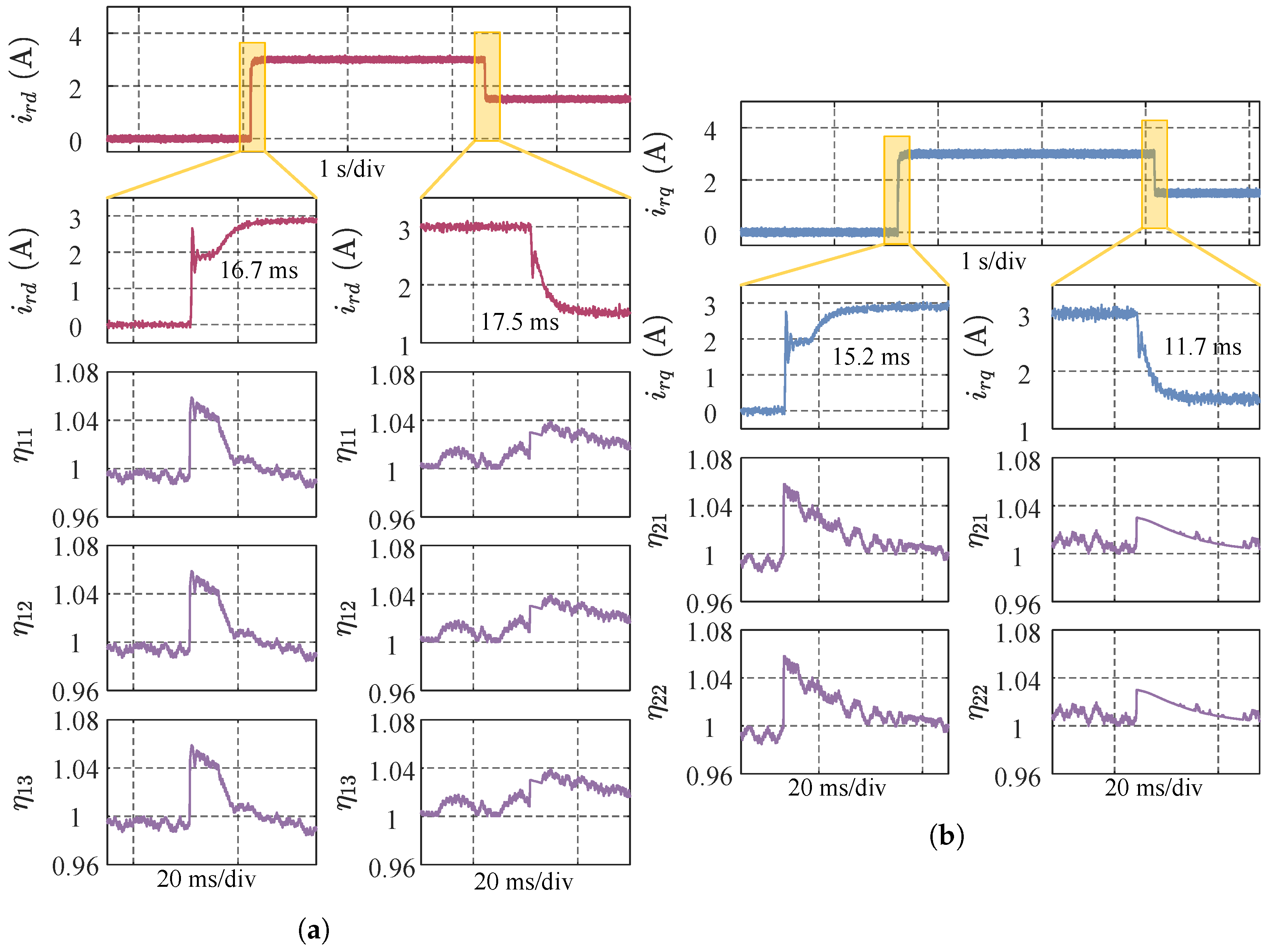
The experimental results of the current loop are presented in Figure 7 and Figure 8. To evaluate the current loop control performance, the d q axis current references are set from 0 A to 3 A and then reduced to 1.5 A. It is observed that the d q axis current rise times under the MPC strategy are 16.7 ms and 15.2 ms, respectively, whereas the FL-MPC strategy achieves current tracking in only 12.4 ms and 12.5 ms. Compared with the MPC strategy, the proposed FL-MPC strategy reduces the d axis current rise time by 25.75% and the q axis current rise time by 17.76%. The purple curves in the figure depict the variations of η 1 υ and η 2 υ during the current transition. It can be observed that when the reference current changes from 0 A to 3 A, both η 1 υ and η 2 υ increase, reaching a maximum value of 1.06. This trend is consistent with the simulation results.
Figure 7. Experimental results of current loop with MPC strategy. (a) d axis current response with MPC strategy. (b) q axis current response with MPC strategy.
Figure 8. Experimental results of current loop with FL-MPC strategy. (a) d axis current response and output of fuzzy logic controller with FL-MPC strategy. (b) q axis current response and output of fuzzy logic controller with FL-MPC strategy.

5.2.2. Experimental Comparison of Speed Loop Response

In this paper, the stator current frequency is set to 10 Hz, corresponding to a DFIM synchronous speed of 200 rpm. The target speed is first set to 50 rpm, and after the motor reaches steady operation, it is changed to 150 rpm to evaluate the dynamic response performance of the algorithms. The experimental results are shown in Figure 9. It is observed that the proposed strategy reaches the target speed within 0.57 s, representing a 51.69% reduction compared with the MPC strategy. Due to experimental limitations, the tests are conducted only at relatively low frequencies and in the sub-synchronous operating region. Future work can include speed control experiments under the rated grid frequency.
Figure 9. Experimental results of speed loop response with different strategies. (a) Speed control performance with MPC strategy. (b) Speed control performance with FL-MPC strategy.

6. Conclusions

This paper has proposed a FL-MPC strategy to enhance the robustness of DFIMs drives. A fuzzy logic controller is introduced to dynamically adjust the weighting coefficients in the DFIMs mathematical model based on real-time current errors and their rates of change. The proposed FL-MPC method employs a fuzzy inference process, comprising fuzzification, rule evaluation, and defuzzification, to adaptively compensate for model inaccuracies without relying on precise parameters. The experimental results show that, a reduction of 25.75% in the d axis current rise time and 17.76% in the q axis current rise time is achieved by the proposed FL-MPC strategy compared with the MPC strategy. The FL-MPC strategy achieves speed tracking within 0.57 s, whereas the MPC strategy requires 1.18 s. The proposed approach introduces adaptive capability, making it highly suitable for practical industrial applications where operating conditions vary widely. Future work may focus on extending this method to other types of electrical machines and exploring its implementation under more complex grid conditions.

Author Contributions

Conceptualization, Y.M.; methodology, Z.O.; validation, F.Z.; formal analysis, X.W.; resources, Y.M.; writing—review and editing, X.W.; visualization, Z.O.; supervision, H.Z. All authors have read and agreed to the published version of the manuscript.

Funding

This work was supported by the Design Optimization and Mechanistic Digital Twin Technology Research of Variable Speed Pumped Storage Units project of Southern Power Grid Energy Storage Co., Ltd., STKJXM20230036).

Data Availability Statement

The original contributions presented in this study are included in the article. Further inquiries can be directed to the corresponding author.

Acknowledgments

During the preparation of this manuscript, the authors used ChatGPT-4o for improving grammar. The authors have reviewed and edited the output and take full responsibility for the content of this publication.

Conflicts of Interest

Author Yiming Ma was employed by the China Southern Power Grid Co., Ltd. The remaining authors declare that the research was conducted in the absence of any commercial or financial relationships that could be construed as a potential conflict of interest.

References

  1. Odhano, S.; Rubino, S.; Tang, M.; Zanchetta, P.; Bojoi, R. Stator Current-Sensorless-Modulated Model Predictive Direct Power Control of a DFIM With Magnetizing Characteristic Identification. IEEE J. Emerg. Sel. Top. Power Electron. 2021, 9, 2797–2806. [Google Scholar] [CrossRef]
  2. Kuwabara, T.; Shibuya, A.; Furuta, H.; Kita, E.; Mitsuhashi, K. Design and dynamic response characteristics of 400 MW adjustable speed pumped storage unit for Ohkawachi Power Station. IEEE Trans. Energy Convers. 1996, 11, 376–384. [Google Scholar] [CrossRef]
  3. Kumari, R.; Prabhakaran, K.K.; Desingu, K.; Chelliah, T.R.; Sarma, S.V.A. Improved Hydroturbine Control and Future Prospects of Variable Speed Hydropower Plant. IEEE Trans. Ind. Appl. 2021, 57, 941–952. [Google Scholar] [CrossRef]
  4. BonnetFrancois, F.; Vidal, P.E.; Pietrzak-David, M. Dual Direct Torque Control of Doubly Fed Induction Machine. IEEE Trans. Ind. Electron. 2007, 54, 2482–2490. [Google Scholar] [CrossRef]
  5. Vasudevan, K.R.; Ramachandaramurthy, V.K.; Venugopal, G.; Ekanayake, J.; Tiong, S. Variable speed pumped hydro storage: A review of converters, controls and energy management strategies. Renew. Sustain. Energy Rev. 2021, 135, 110156. [Google Scholar] [CrossRef]
  6. Abouseda, A.I.; Doruk, R.O.; Amini, A. Parameter Identification and Speed Control of a Small-Scale BLDC Motor: Experimental Validation and Real-Time PI Control with Low-Pass Filtering. Machines 2025, 13, 656. [Google Scholar] [CrossRef]
  7. De Martin, I.D.; Pasqualotto, D.; Tinazzi, F.; Zigliotto, M. Model-Free Predictive Current Control of Synchronous Reluctance Motor Drives for Pump Applications. Machines 2021, 9, 217. [Google Scholar] [CrossRef]
  8. Yin, Z.; Chen, X.; Shen, Y.; Su, X.; Xiao, D.; Abel, D.; Zhao, H. Plant-Physics-Guided Neural Network Control for Permanent Magnet Synchronous Motors. IEEE J. Sel. Top. Signal Process. 2025, 19, 74–87. [Google Scholar] [CrossRef]
  9. Olloqui, A.; Elizondo, J.L.; Rivera, M.; Macías, M.E.; Micheloud, O.M.; Peña, R.; Wheeler, P. Model-Based Predictive Rotor Current Control Strategy for Indirect Power Control of a DFIM Driven by an Indirect Matrix Converter. IEEE Trans. Energy Convers. 2021, 36, 1510–1516. [Google Scholar] [CrossRef]
  10. Chen, Y.; Xu, W.; Liu, Y.; Bao, Z.; Mao, Z.; Rashad, E.M. Modeling and Transient Response Analysis of Doubly-Fed Variable Speed Pumped Storage Unit in Pumping Mode. IEEE Trans. Ind. Electron. 2023, 70, 9935–9947. [Google Scholar] [CrossRef]
  11. Yin, Z.; Wang, X.; Su, X.; Shen, Y.; Xiao, D.; Zhao, H. A switched ultra-local model-free predictive controller for PMSMs. IEEE Trans. Power Electron. 2024, 39, 10665–10669. [Google Scholar] [CrossRef]
  12. Shen, Y.; Yin, Z.; Zhou, F.; Zhang, Y.; Wang, X.; Zhao, H. Tiny Neural Network-Based Ultra-Local Model-Free Predictive Control for PMSMs. IEEE Trans. Power Electron. 2026, 41, 132–136. [Google Scholar] [CrossRef]
  13. Dezza, F.C.; Foglia, G.; Iacchetti, M.F.; Perini, R. An MRAS Observer for Sensorless DFIM Drives with Direct Estimation of the Torque and Flux Rotor Current Components. IEEE Trans. Power Electron. 2012, 27, 2576–2584. [Google Scholar] [CrossRef]
  14. Mauricio, J.M.; LeÓn, A.E.; Gomez-Exposito, A.; Solsona, J.A. An Adaptive Nonlinear Controller for DFIM-Based Wind Energy Conversion Systems. IEEE Trans. Energy Convers. 2008, 23, 1025–1035. [Google Scholar] [CrossRef]
  15. Dang, C.; Dou, M.; Yan, S.; Dang, M.; Zhao, D.; Hua, Z. An Improved Model-Free Predictive Current Control for SPMSM Drives Based on Adaptive Extended State Observer with Robust Sliding Mode Speed Controller. IEEE Trans. Power Electron. 2025, 40, 12378–12392. [Google Scholar] [CrossRef]
  16. Wang, L.; Zhang, S.; Zhang, C.; Huang, Y.; Dong, Y.; Wang, S. An Improved Model-Free Adaptive Current Control for PMSM Based on Prior-Optimization. IEEE Trans. Ind. Electron. 2025, 72, 5591–5601. [Google Scholar] [CrossRef]
  17. Gao, S.; Wang, J.; Guan, C.; Zhou, Z.; Liu, Z. Dynamic Characteristic Modeling and RBF-SMC Based Torque Control of a Novel Torque Vectoring Drive-Axle for Electric Vehicles. IEEE Trans. Veh. Technol. 2025, 74, 5757–5770. [Google Scholar] [CrossRef]
  18. Zhao, C.; Zuo, Y.; Wang, H.; Cao, H.; Lee, C.H.T. Smooth Speed Control for Electric Drives Based on Adaptive RBF Neural Network Method. IEEE Trans. Power Electron. 2025, 40, 16158–16168. [Google Scholar] [CrossRef]
  19. Zhu, X.; Huang, J.; Wang, P.; Li, Y.; Qi, G.; Wu, Y.; He, Y.; Zhang, Y. An Improved Sliding Model Observer Sensorless Control for PMSM Based on Fuzzy Logic Controller and DSOGI-FLL. IEEE Trans. Transp. Electrif. 2025, 11, 823–834. [Google Scholar] [CrossRef]
Disclaimer/Publisher’s Note: The statements, opinions and data contained in all publications are solely those of the individual author(s) and contributor(s) and not of MDPI and/or the editor(s). MDPI and/or the editor(s) disclaim responsibility for any injury to people or property resulting from any ideas, methods, instructions or products referred to in the content.

Article Metrics

Citations

Article Access Statistics

Multiple requests from the same IP address are counted as one view.