A Model-Based Digital Toolbox for Unified Kinematics and Dimensional Synthesis in Parallel Robot Design

 , and
, and
Abstract
1. Introduction
2. Basic Theory
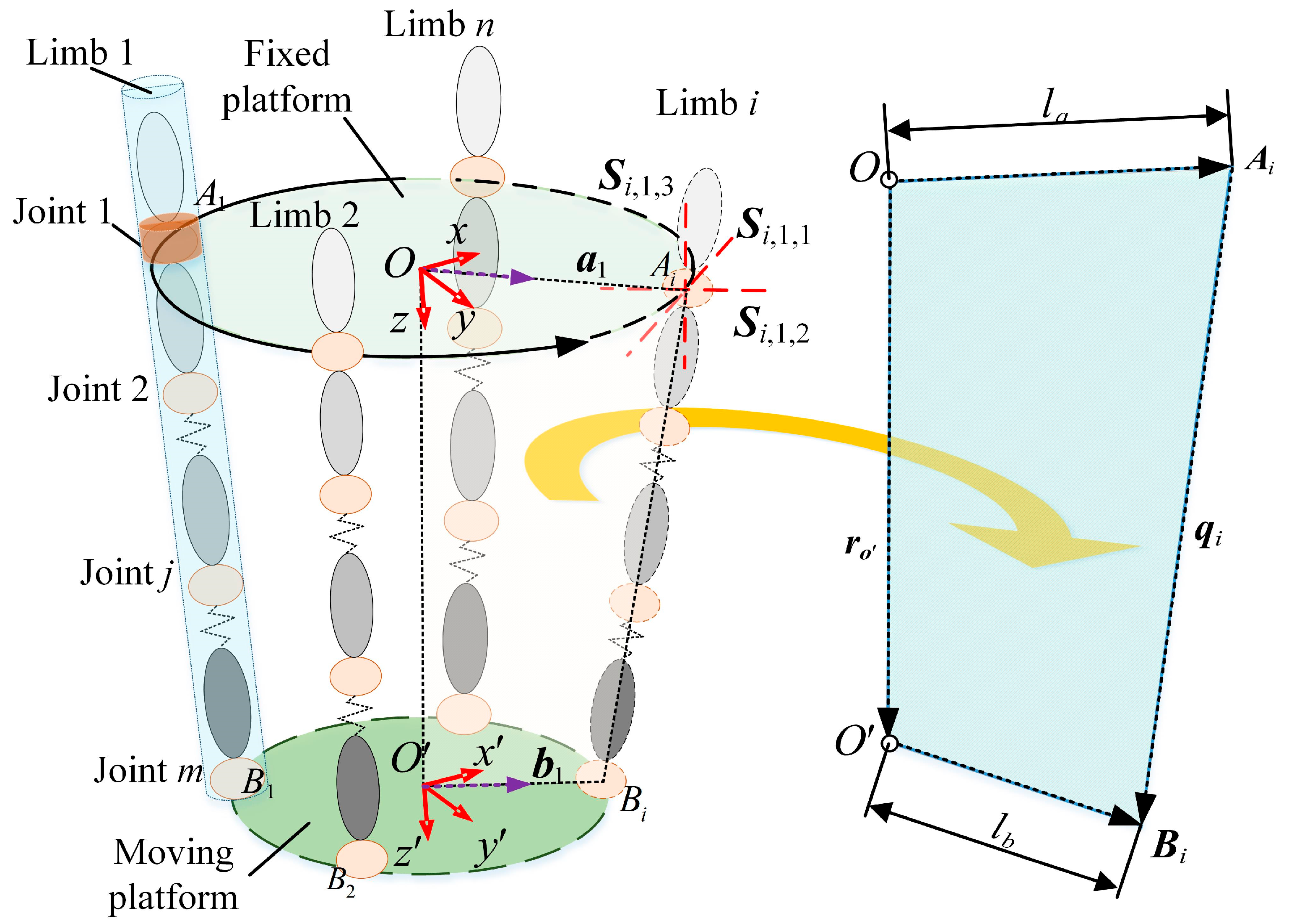
2.1. Mobility Analysis Model
- Translational screw ;
- Rotational screw .
2.2. Kinematic Analysis Mode
2.3. Dexterity Analysis Model
3. Digital Toolbox Design
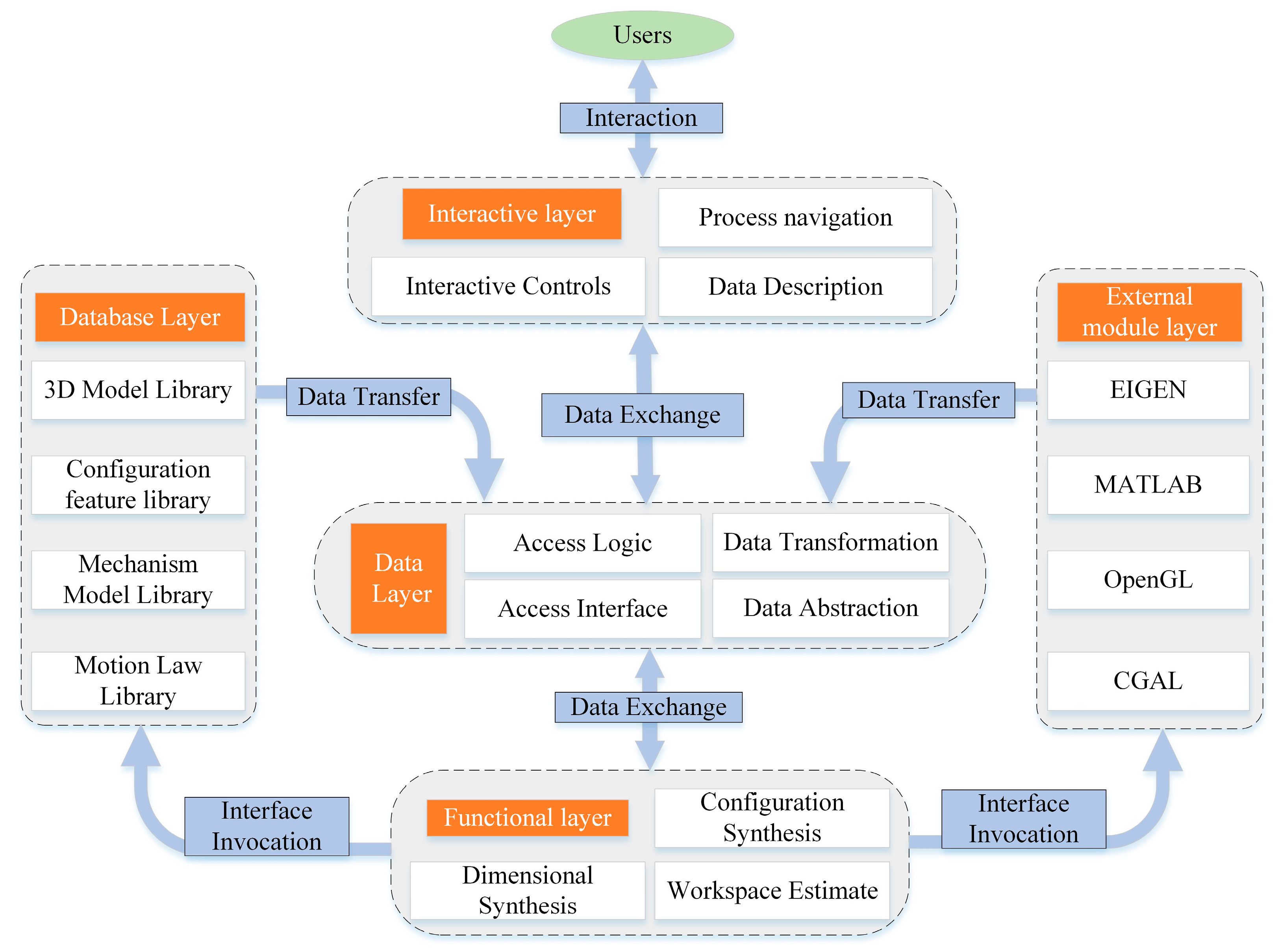
3.1. Framework Description
- Parameter initialization (geometric constraints, material properties).
- Inter-module data exchange through standardized APIs.
- Persistent storage of intermediate states (XML-based serialization).
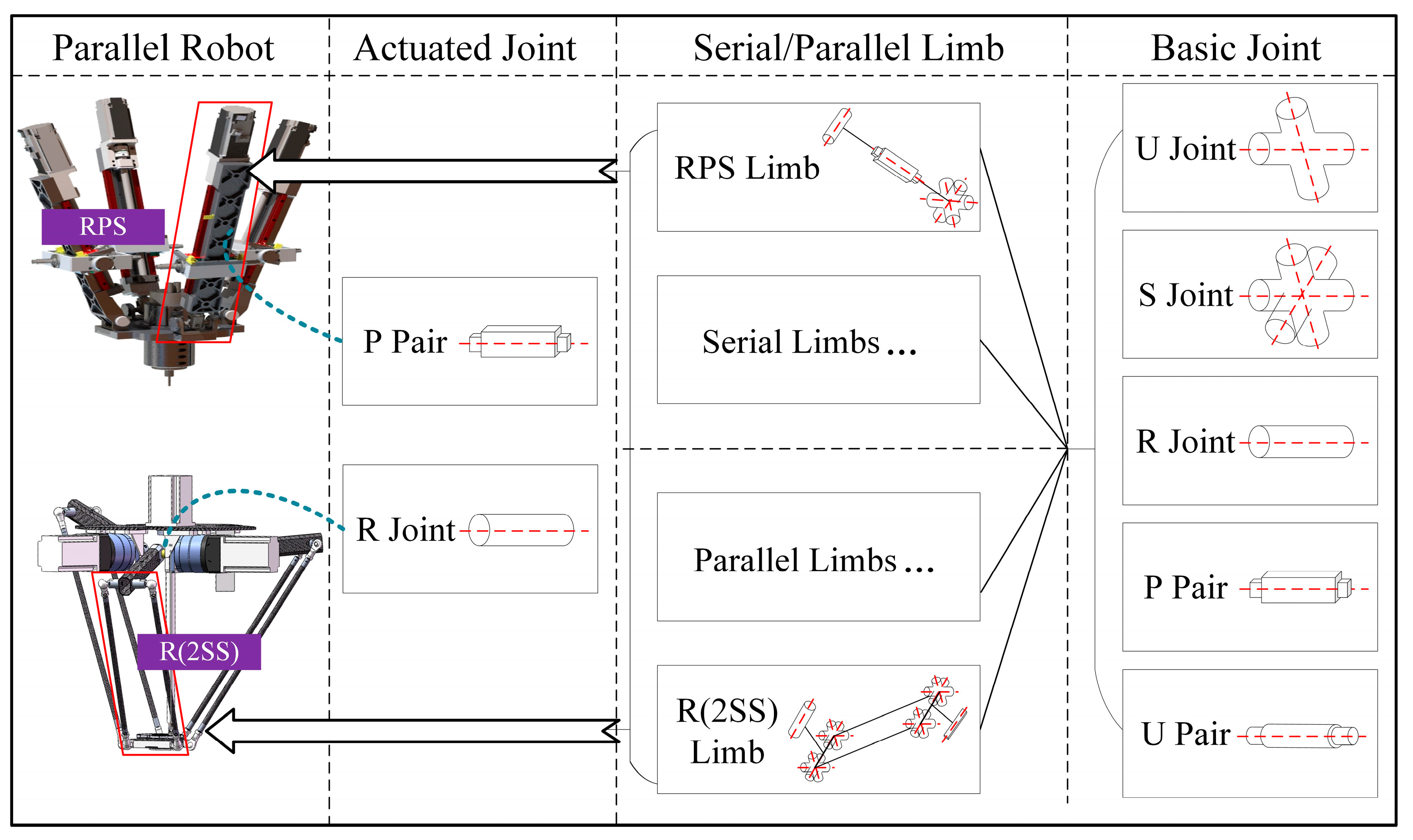
- Kinematic chain templates (3-RRR, 6-SPS configurations).
- Performance metric archives (condition numbers, workspace volumes).
- Material property datasets (Young’s modulus, inertia tensors).
- Streamlining workflows through intuitive guidance and effective data management.
- Allowing the addition of new robot configurations and functionalities via its scalable architecture.
- Utilizing external tools for complex calculations and visualization, thereby advancing data analysis.
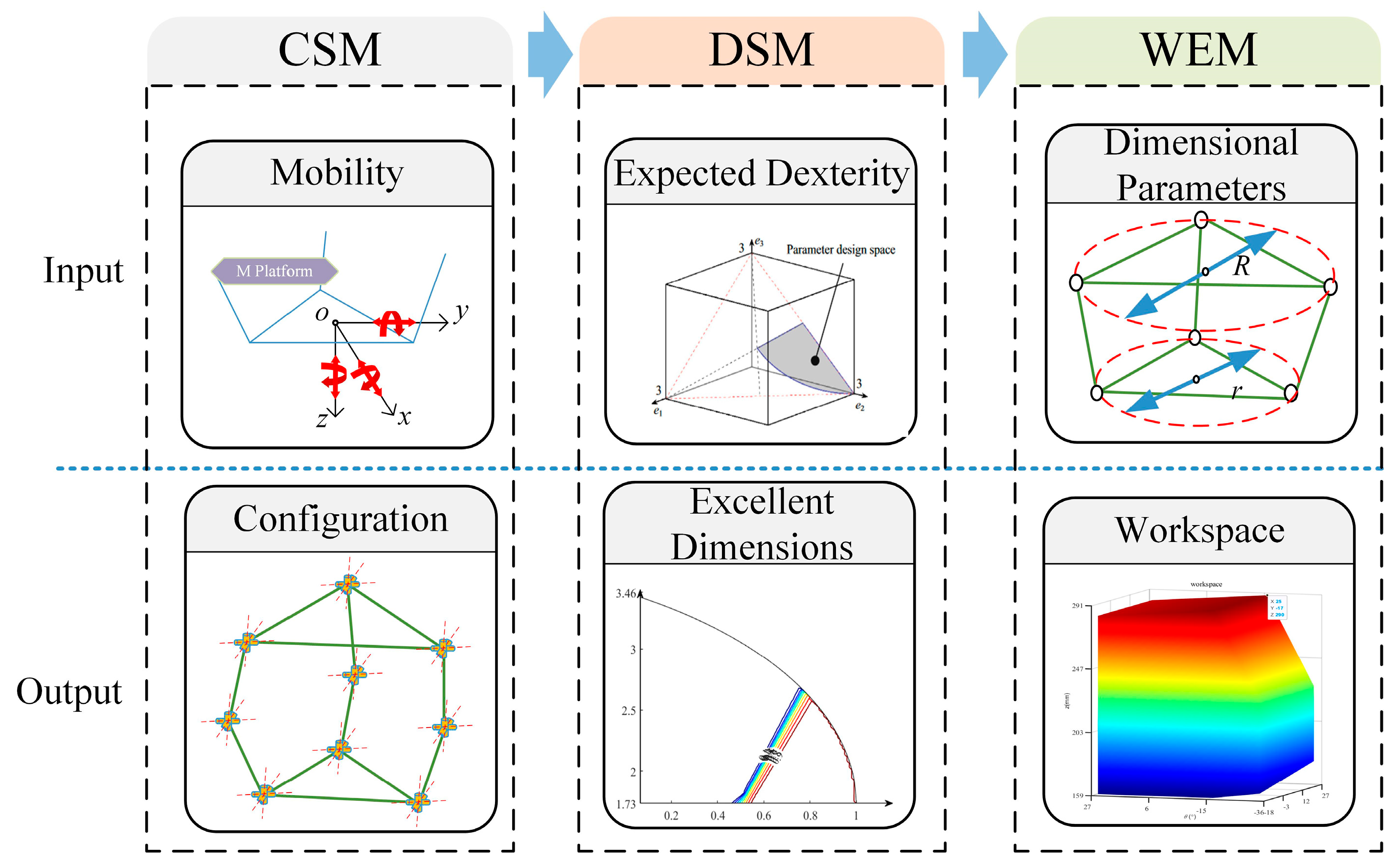
3.2. Functional Modules
3.2.1. Configuration Synthesis Module (CSM)
- Nonlinear kinematic coupling between limbs.
- Over-constrained motion transmission mechanisms.
- Configuration-dependent singularity conditions.
- (1)
- Nonlinear kinematic coupling between limbs means that the motion of one limb affects the constraint system of others, making the overall mobility a function of the combined screw systems, not a sum of limb freedoms.
- (2)
- Over-constrained motion transmission mechanisms (e.g., redundant constraints) can reduce the effective degrees of freedom in ways that are not visually apparent from the limb topology alone.
- (3)
- Configuration-dependent singularity conditions can instantaneously change the mobility characteristics, meaning that a mobility analysis must be valid across the entire workspace, not just at a single pose.
- User-defined kinematic criteria (DOF types, limb topologies)
- Database query optimization via fuzzy-logic pattern matching.
- Open-source configuration labeling for community-driven expansion.
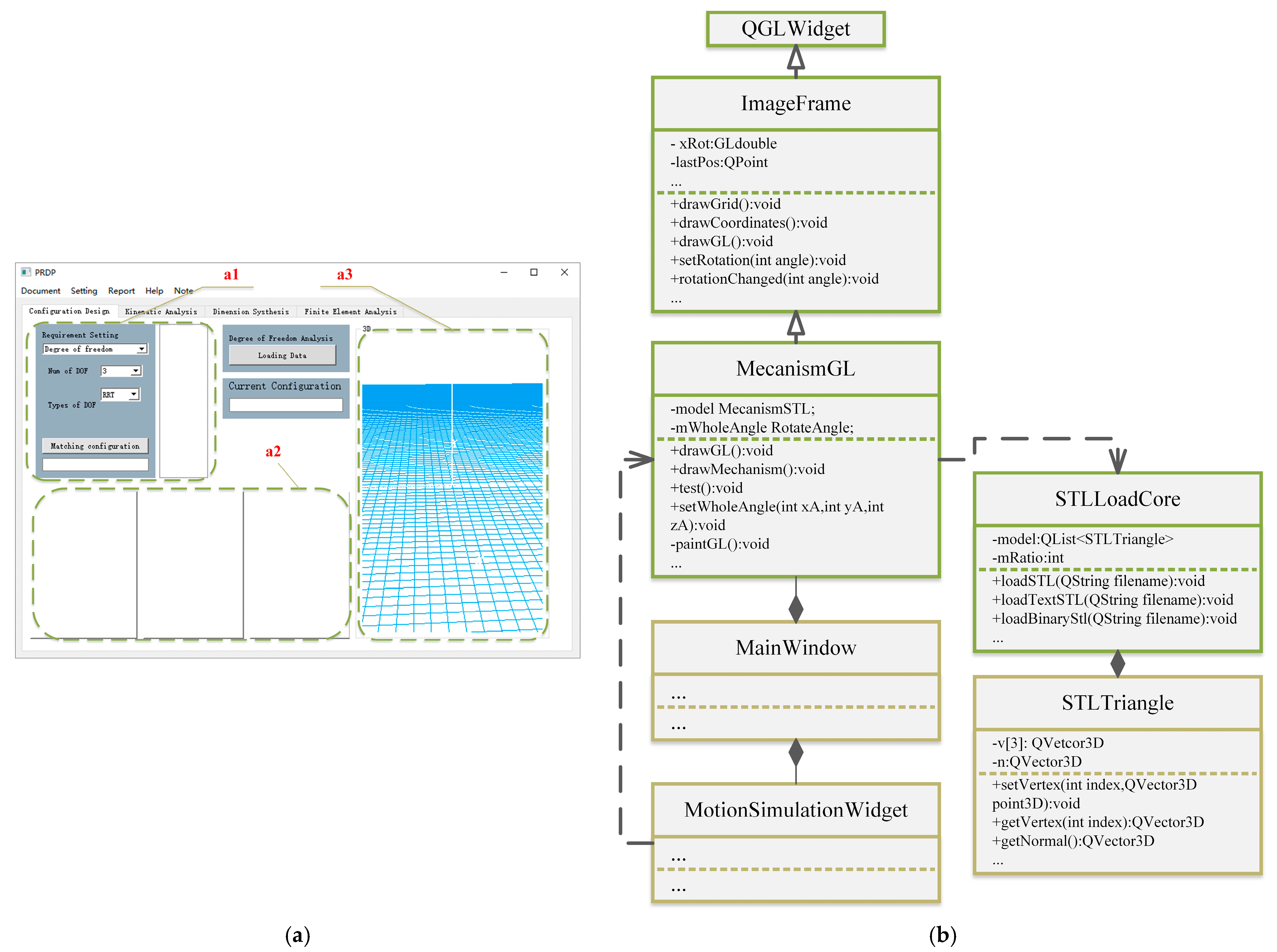
- Integrates modular components through:
- Parametric assembly of joint/limb/platform CAD models.
- Real-time OpenGL rendering pipeline (STL file compatibility).
- UML-based class relationship visualization (Figure 5b).
- Screw-coordinate-based trajectory generation.
- Interactive DOF-specific motion decomposition.
- Grübler–Kutzbach criterion validation.
- DOF characteristics (translational/rotational constraints).
- Limb topology (serial/parallel chain configurations).
- Joint type (revolute/prismatic/spherical).
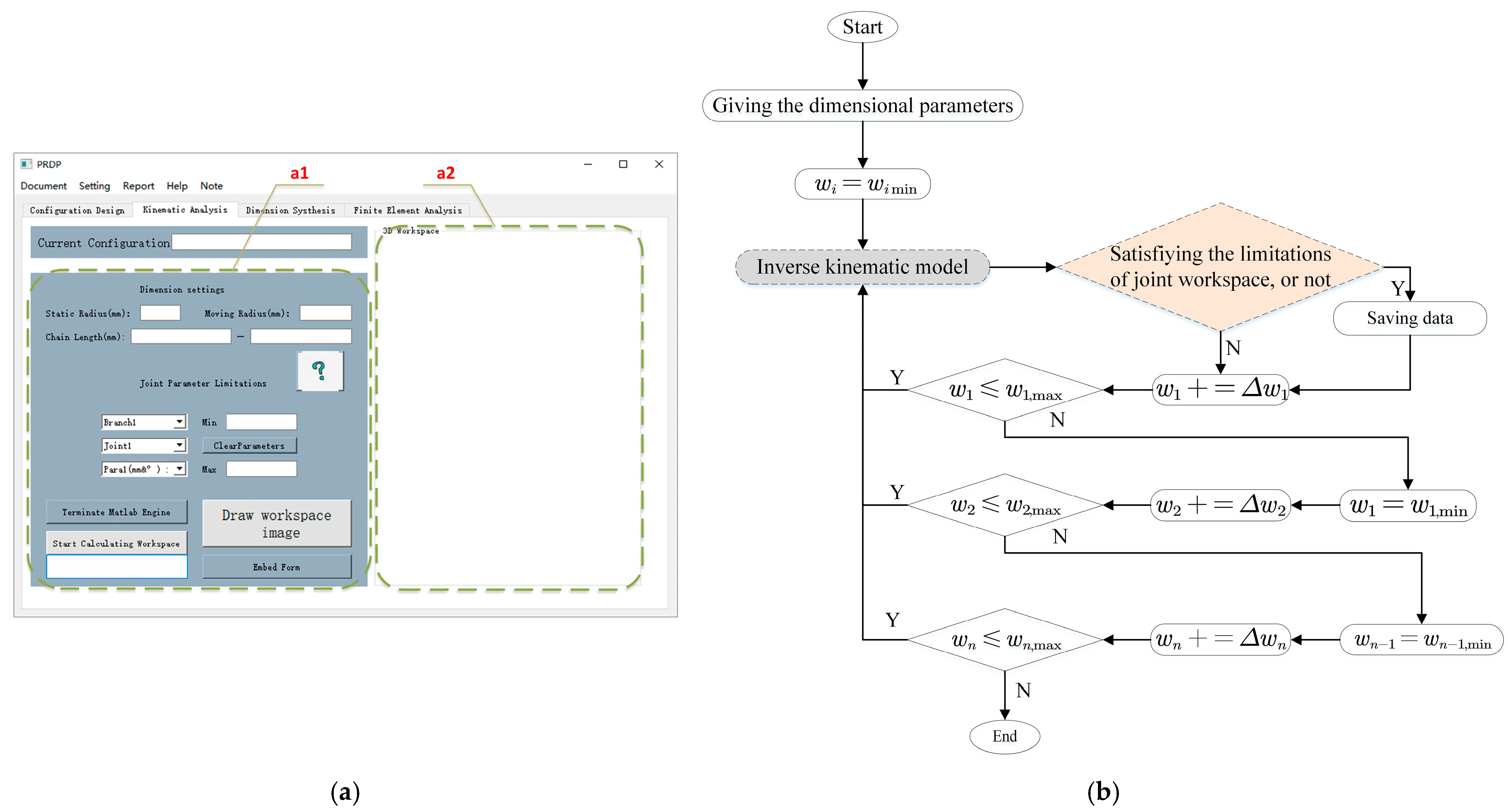
3.2.2. Workspace Estimation Module (WEM)
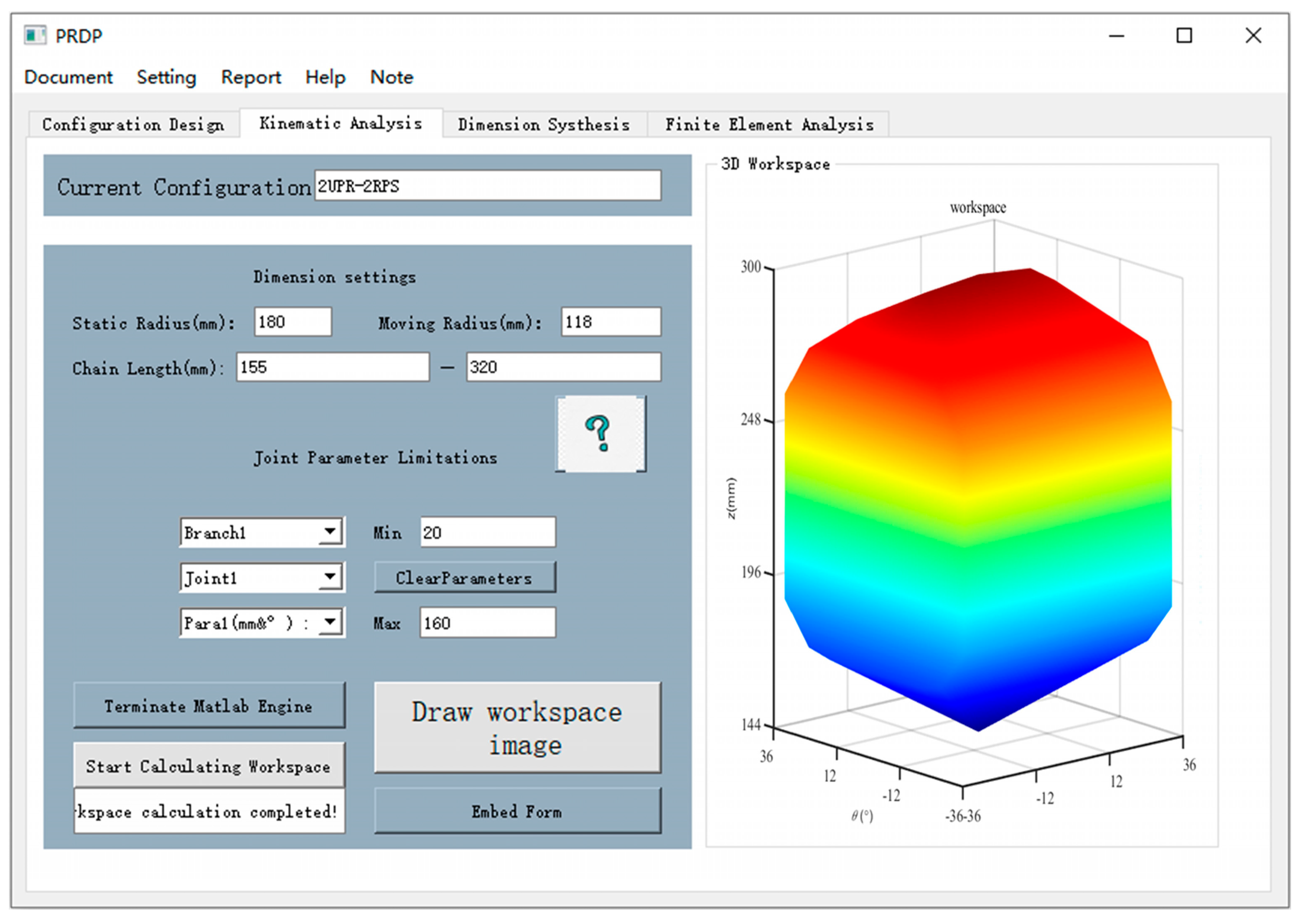
- Dimensional constraints of kinematic chains.
- Joint motion boundary definitions.
- Component a2 subsequently performs automated workspace characterization through the following:
- Constraint-conditioned reachability analysis.
- Spatial occupancy visualization.
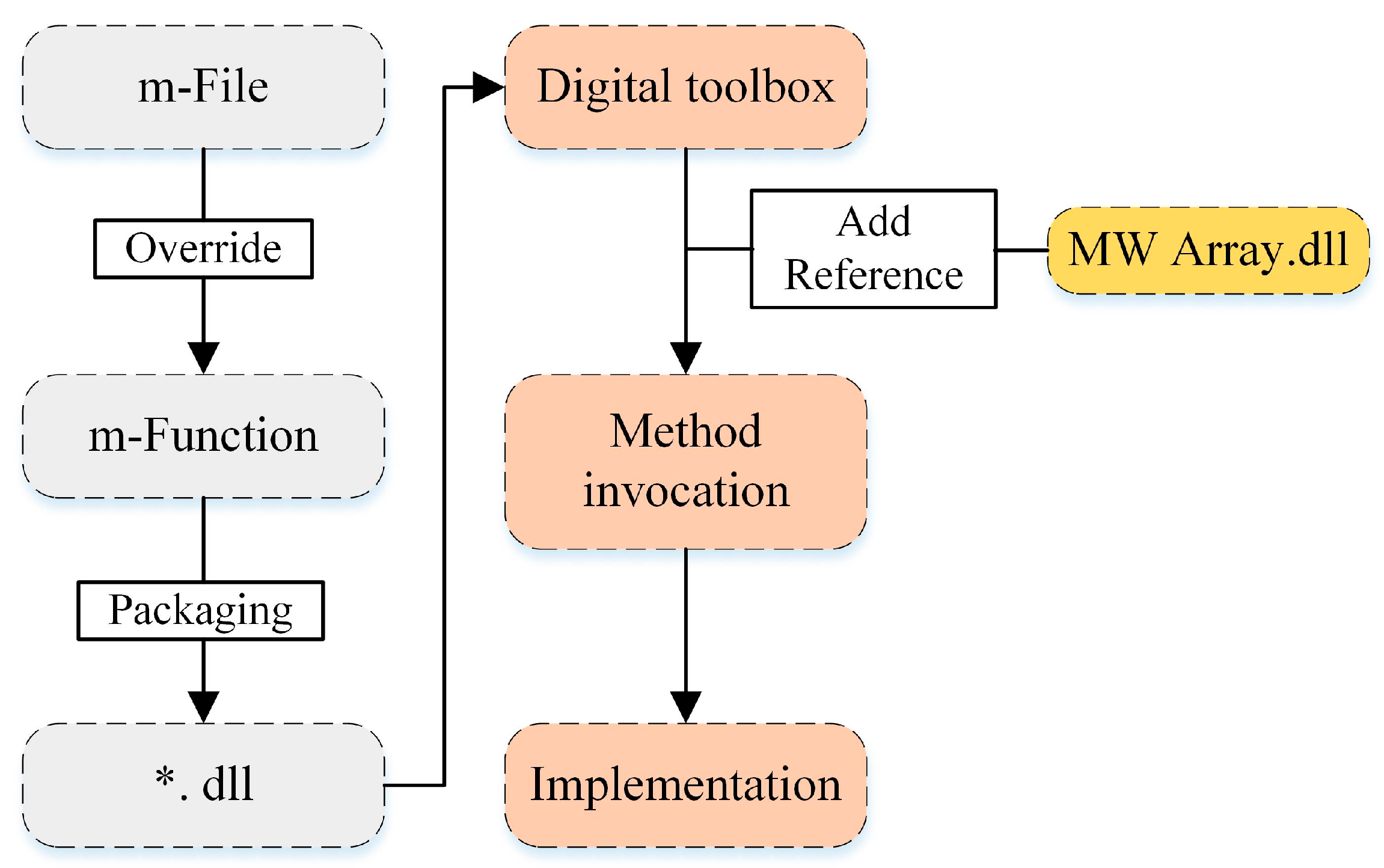
- Algorithm encapsulation: MATLAB core algorithms → DLLs via MATLAB Compiler SDK.
- Interface development: Qt-based GUI with COM interoperability.
- Data pipeline: XML-based parameter exchange (ISO/IEC 19775-1 compliant) [36].
- This architecture preserves MATLAB’s computational advantages (e.g., matrix operations, visualization toolboxes) while enabling the following:
- Cross-platform deployment without MATLAB runtime.
- Memory-efficient C++ execution management.
- Seamless integration with robotic middleware (ROS-compatible).
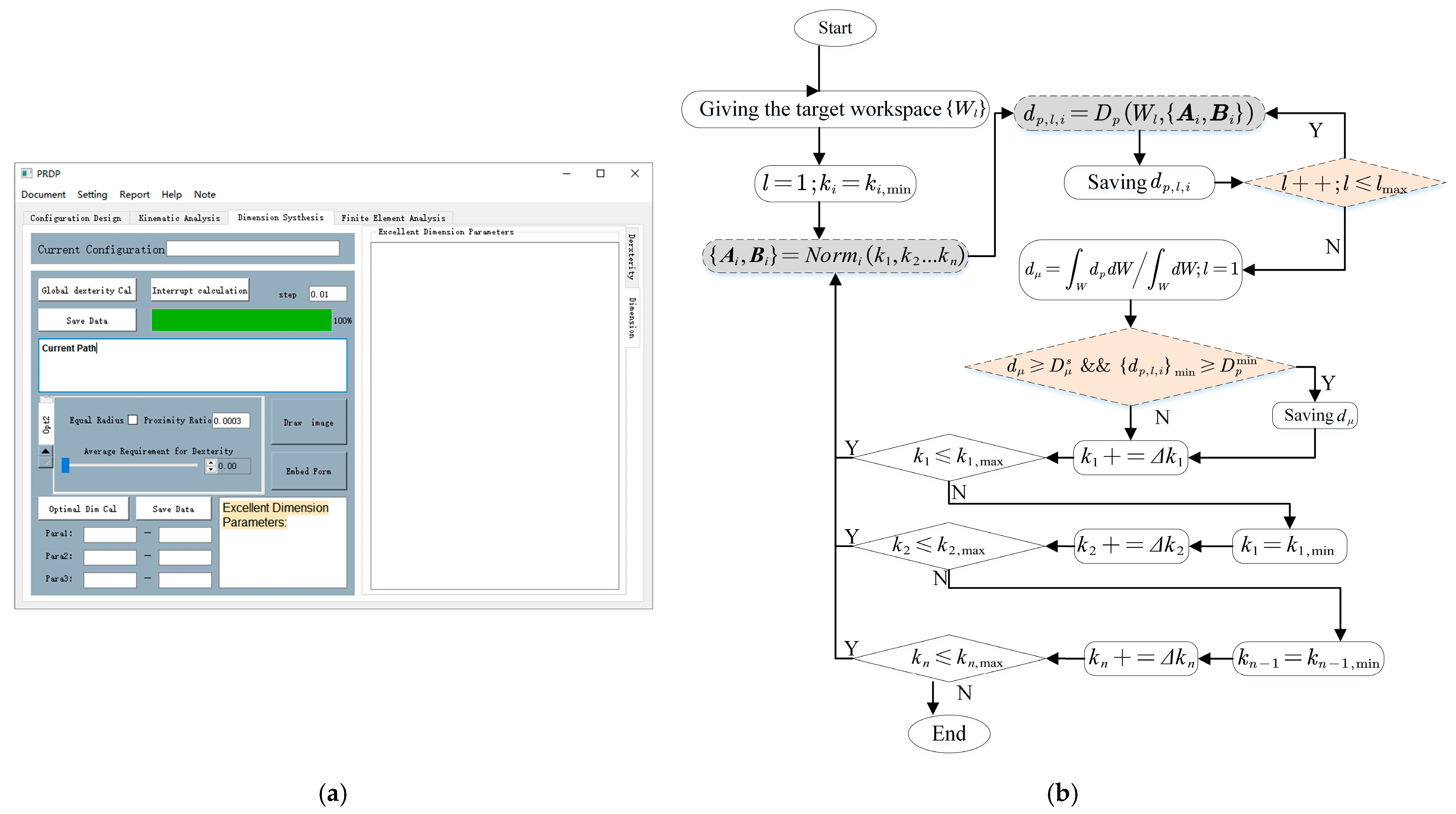
3.2.3. Dimension Synthesis Module (DSM)
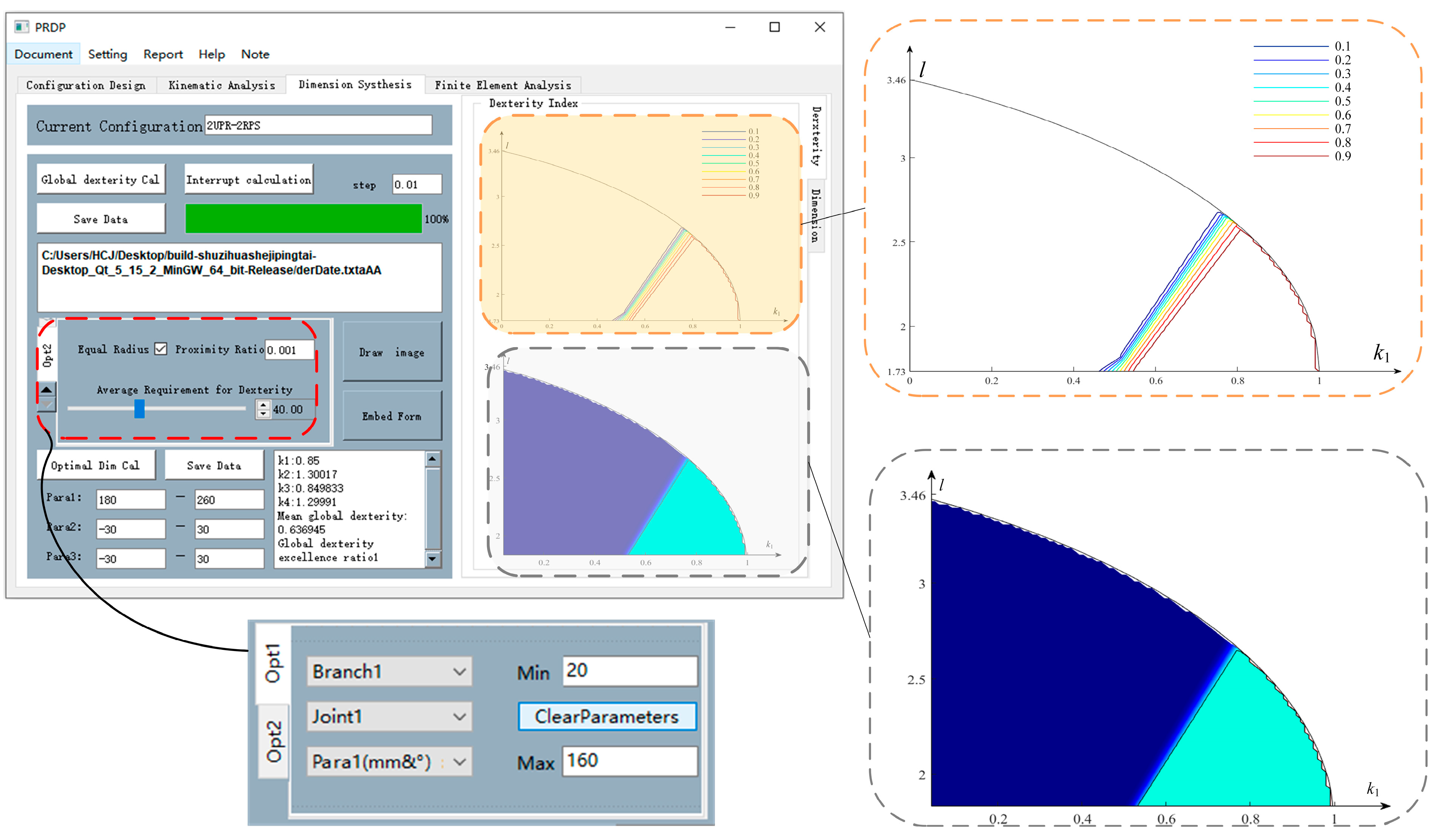
- Constraint Integration: Inherits joint motion limits from WEM outputs and computes global dexterity indices.
- Workspace Parameterization: Defines target workspace boundaries.
- Dexterity Mapping: Visualizes the spatial distribution of dexterity metrics.
- Dimensional Optimization: Selects Pareto-optimal solutions from candidate parameters.
- A kinematic configuration (limb arrangement, joint types).
- A target workspace Wt (defined by ranges in position and orientation).
- Joint motion limits.
- Normalization factor k1, k2, …, kn.
- A lower bound on acceptable local dexterity .
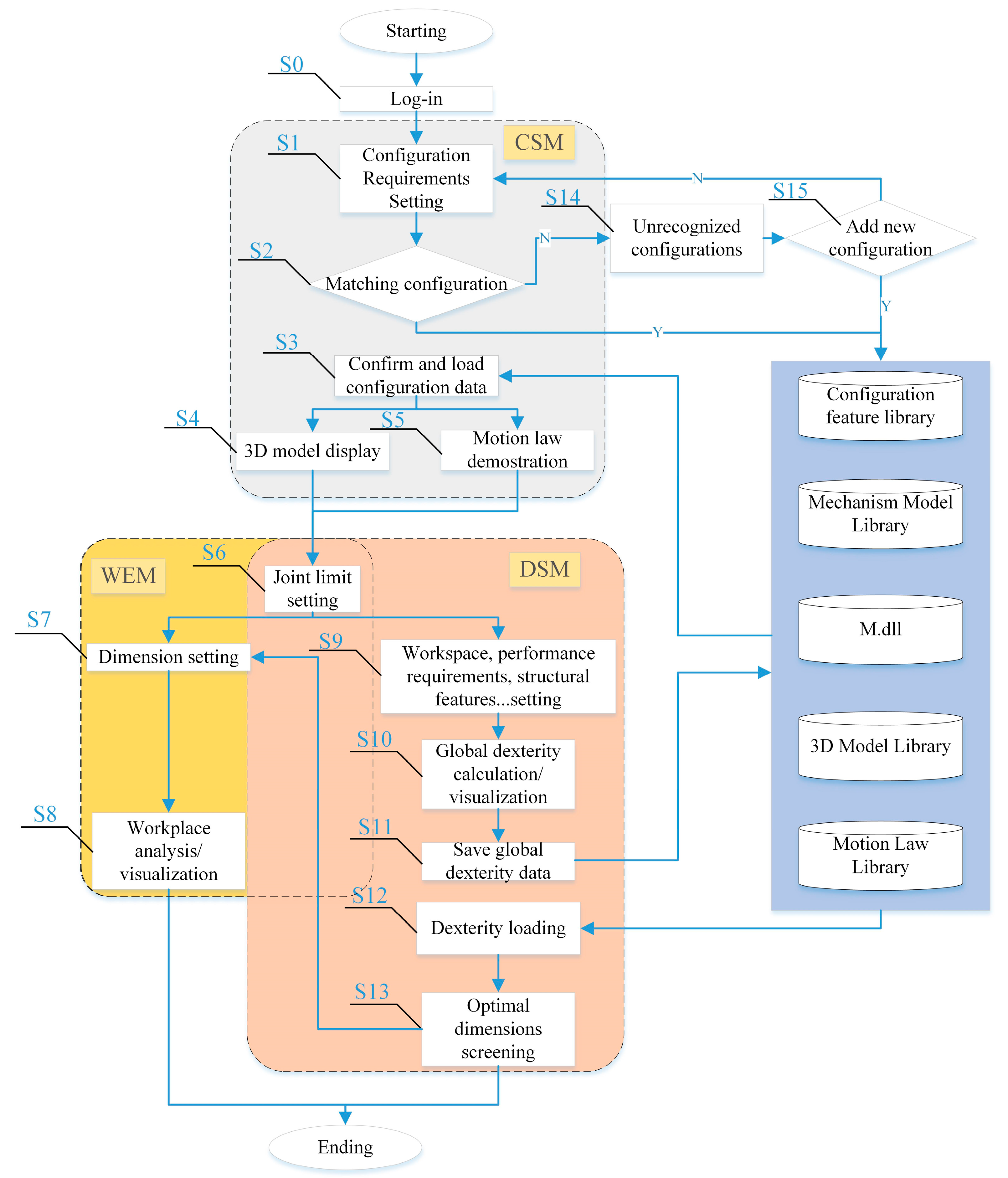
3.3. Module Integration and Implementation Flow
- Cross-reference user-defined requirements against the kinematic feature database.
- Match identified: Extract valid configuration parameters for module initialization.
- No match: Trigger dynamic library expansion or requirement reevaluation.
- Adjust multi-view 3D schematic perspectives (S4).
- Verify motion characteristics via interactive simulation (S5).
- Derive joint mobility limits from validated kinematics.
- Synchronize constraints across WEMs and DSMs.
- Parametrize platform geometries (moving/fixed radii) in WEM.
- Generate configuration-specific workspace envelopes (S8).
- Input: Target workspace boundaries and structural constraints (S9).
- Compute: Global dexterity indices (S10) with database archiving (S11).
- Output: Manual selection of Pareto-optimal solutions via embedded algorithms (S12).
- Option 1: Feed optimized parameters to WEM for workspace validation.
- Option 2: Terminate analysis with export-ready configuration data.
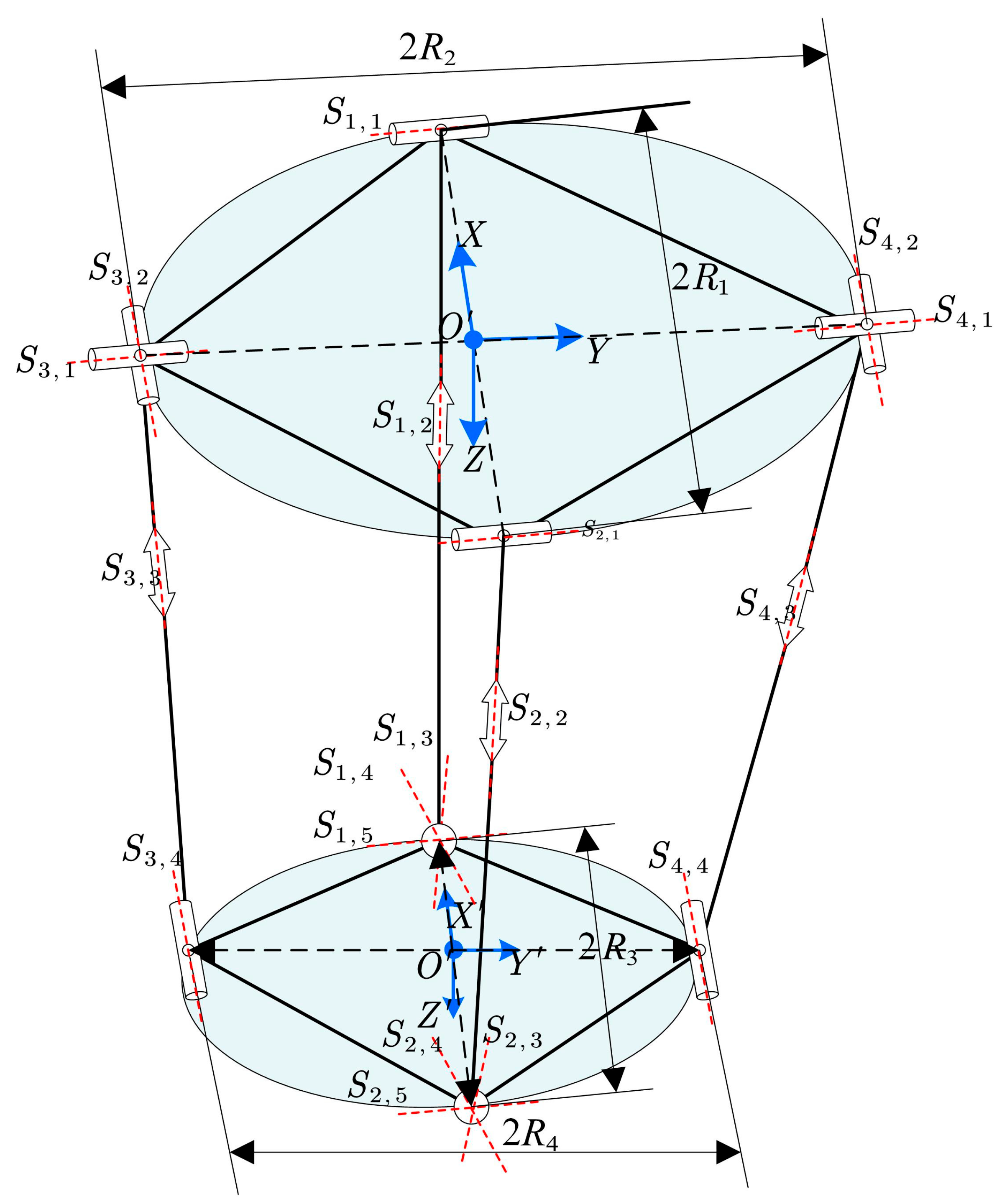
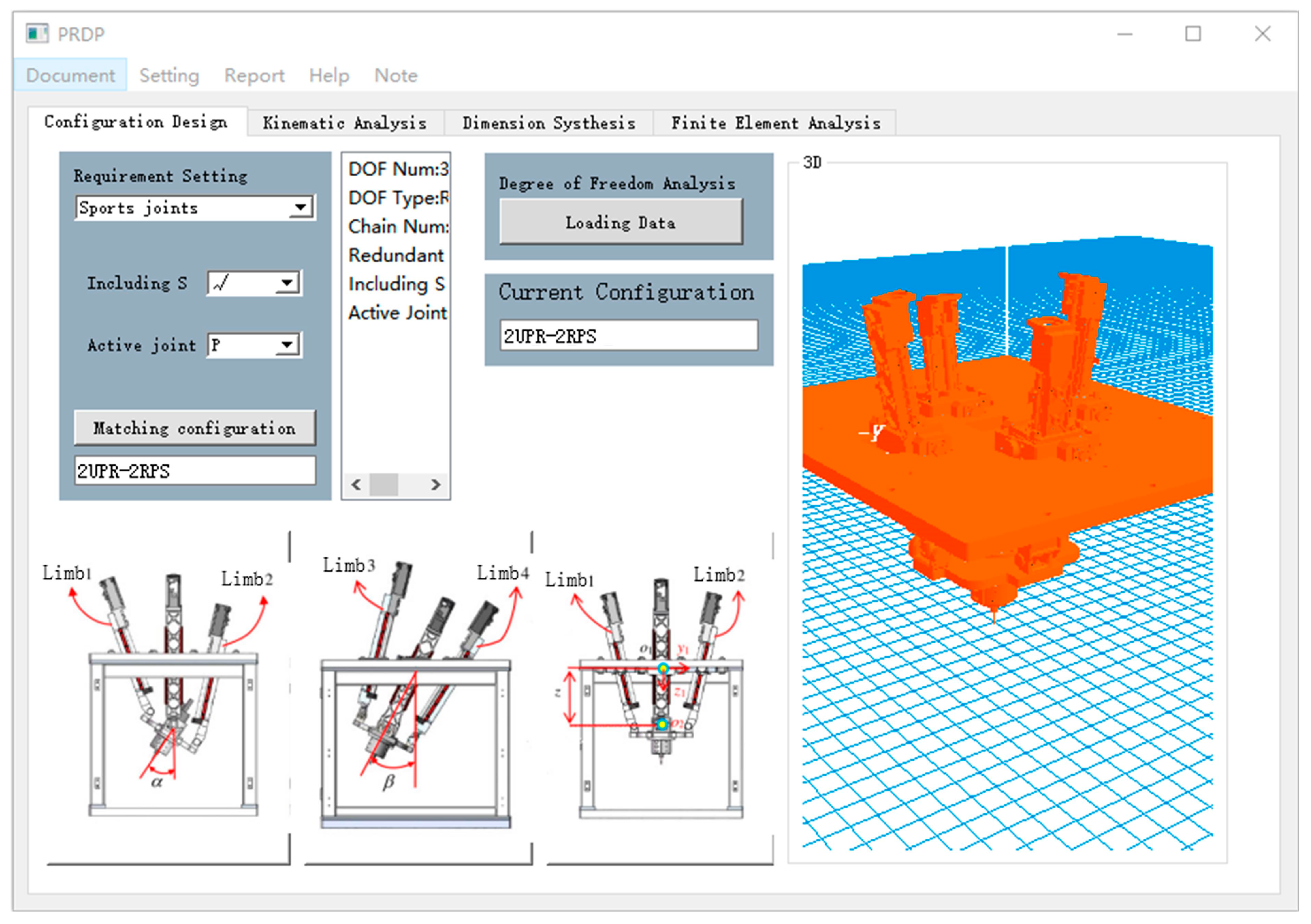
4. Case Study: 2UPR-2RPS Parallel Robot Implementation
4.1. Problem Description
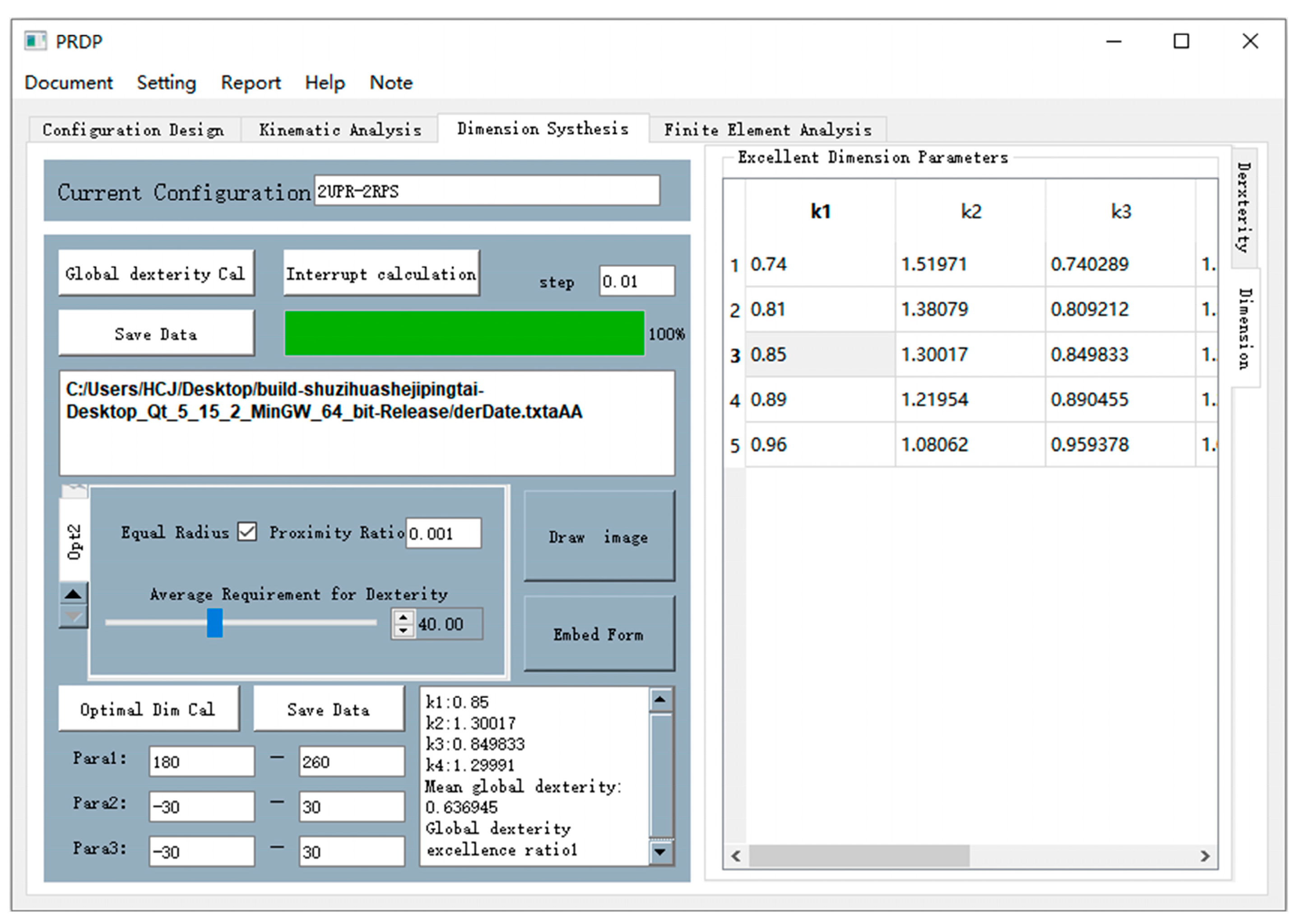
4.2. Kinematic Analysis and Dimensional Synthesis Procedure
4.3. Discussion and Future Extensions
5. Conclusions
- A screw theory-driven decomposition method standardizes mobility and constraint analysis, enabling rapid kinematic characterization of complex parallel mechanisms.
- The five-layer digital toolbox (interactive, data, external module, database, functional) ensures seamless integration of design, analysis, and optimization modules, supported by hybrid MATLAB-C++ programming for real-time visualization.
- Pareto-optimal dimension synthesis and XML-driven data interoperability enhance computational efficiency and design flexibility.
- Application to a 2UPR-2RPS robot demonstrates the toolbox’s capability to optimize dimensional parameters (k1 = k3 = 0.85, k2 = k4 = 1.3) and validate workspace symmetry, achieving a mean dexterity index of 0.637.
Author Contributions
Funding
Data Availability Statement
Conflicts of Interest
Abbreviations
| DH | Denavit–Hartenberg |
| CAD | Computer-aided design |
| CAE | Computer-aided engineering |
| FEA | Finite element analysis |
| DOF | Degree of freedom |
| GUI | Graphical user interface |
| HMI | Human-machine interface |
| R | Revolute joint |
| P | Prismatic joint |
| U | Universal joint |
| C | Cylindrical joint |
| S | Spherical joint |
| CSM | Configuration synthesis module |
| WEM | Workspace estimation module |
| DSM | Dimension synthesis module |
| UML | Unified modeling language |
| XML | Extensible markup language |
| CGAL | Computational geometry algorithms library |
| SDK | Software development kit |
| COM | Component object model |
| ROS | Robot operating system |
References
- Wang, M.; Song, Y.; Lian, B.; Wang, P.; Chen, K.; Sun, T. Dimensional parameters and structural topology integrated design method of a planar 5R parallel machining robot. Mech. Mach. Theory 2022, 175, 104964. [Google Scholar] [CrossRef] [Scilit]
- Dong, C.; Liu, H.; Huang, T.; Chetwynd, D.G. A screw theory-based semi-analytical approach for elastodynamics of the tricept robot. J. Mech. Robot. 2019, 11, 031005. [Google Scholar] [CrossRef] [Scilit]
- Fang, H.; Tang, T.; He, Z.; Liu, Y.; Zhang, J. A novel hybrid machine tool integrating a symmetrical redundantly actuated parallel mechanism: Design, kinematics, prototype and experiment. Mech. Mach. Theory 2022, 176. [Google Scholar] [CrossRef] [Scilit]
- Liang, D.; Liu, T.; Song, Y.; Chang, B.; Jin, G. Design, mathematical modeling and dynamic dimension synthesis for a modular parallel robot with end-articulated structure. Appl. Math. Model. 2025, 144, 116058. [Google Scholar] [CrossRef] [Scilit]
- Chen, X.; Liu, X.-J.; Xie, F.; Sun, T. A Comparison Study on Motion/Force Transmissibility of Two Typical 3-DOF Parallel Manipulators: The Sprint Z3 and A3 Tool Heads. Int. J. Adv. Robot. Syst. 2014, 11, 5. [Google Scholar] [CrossRef] [Scilit]
- López-Custodio, P.; Fu, R.; Dai, J.; Jin, Y. Compliance model of Exechon manipulators with an offset wrist. Mech. Mach. Theory 2022, 167, 104558. [Google Scholar] [CrossRef] [Scilit]
- Dong, C.L.; Li, J.T.; Liu, H.T.; Huang, T. Isotropy of Tangential Motion Transmissibility and Kinematic Performance Analysis of TriMule and Exechon Robots. J. Mech. Eng. 2021, 57, 23–32. [Google Scholar] [CrossRef] [Scilit]
- Qin, X.; Li, Y.; Feng, G.; Bao, Z.; Li, S.; Liu, H.; Li, H. A novel surface topography prediction method for hybrid robot milling considering the dynamic displacement of end effector. Int. J. Adv. Manuf. Technol. 2024, 130, 3495–3508. [Google Scholar] [CrossRef] [Scilit]
- Xie, Z.; Xie, F.; Liu, X.-J.; Wang, J.; Mei, B. Tracking error prediction informed motion control of a parallel machine tool for high-performance machining. Int. J. Mach. Tools Manuf. 2021, 164, 103714. [Google Scholar] [CrossRef] [Scilit]
- Wang, J.; Liang, F.; Zhou, H.; Yang, M.; Wang, Q. Analysis of position, pose and force decoupling characteristics of a 4-UPS/1-RPS parallel grinding robot. Symmetry 2022, 14, 825. [Google Scholar] [CrossRef] [Scilit]
- Tian, H.-B.; Wang, C.-Y.; Ma, H.-W.; Xia, J. Kinematic analysis and workspace investigation of novel 3-RPS/(H) metamorphic parallel mechanism. J. Mech. Robot. 2023, 15, 041008. [Google Scholar] [CrossRef] [Scilit]
- Zhang, Y.; Wu, H.; Zhao, J.; Yan, S. Design and performance analysis of morphing nose cone driven by a novel bionic parallel mechanism for aerospace vehicle. Aerosp. Sci. Technol. 2023, 139, 108365. [Google Scholar] [CrossRef] [Scilit]
- Liu, J.; Yang, Z.; Ding, H.; Li, M. Design and kinematical performance analysis of a novel reconfigurable parallel mechanism with three remote center-of-motion modes. Mech. Mach. Theory 2024, 191, 105513. [Google Scholar] [CrossRef] [Scilit]
- Meng, Q.; Liu, X.-J.; Xie, F. Design and development of a Schönflies-motion parallel robot with articulated platforms and closed-loop passive limbs. Robot. Comput. Integr. Manuf. 2022, 77, 102352. [Google Scholar] [CrossRef] [Scilit]
- Vargas-Riaño, J.; Agudelo-Varela, Ó.; Valera, Á. Applying Screw Theory to Design the Turmell-Bot: A Cable-Driven, Reconfigurable Ankle Rehabilitation Parallel Robot. Robotics 2023, 12, 154. [Google Scholar] [CrossRef] [Scilit]
- Shi, J.; Li, R.; Guo, W. Configuration Synthesis and Performance Analysis of 1T2R Decoupled Wheel-Legged Reconfigurable Mechanism. Micromachines 2025, 16, 903. [Google Scholar] [CrossRef] [Scilit] [PubMed]
- Shen, X.; Xu, L.; Li, Q. Motion/Force constraint indices of redundantly actuated parallel manipulators with over constraints. Mech. Mach. Theory 2021, 165, 104427. [Google Scholar] [CrossRef] [Scilit]
- Ben, H.I.; Laribi, M.A.; Mlika, A.; Romdhane, L.; Zeghloul, S. Dimensional Synthesis and Performance Evaluation of Four Translational Parallel Manipulators. Robotica 2021, 39, 233–249. [Google Scholar] [CrossRef] [Scilit]
- Stoughton, R.; Arai, T. A modified Stewart platform manipulator with improved dexterity. IEEE Trans. Robot. Autom. 1993, 9, 166–173. [Google Scholar] [CrossRef] [Scilit]
- Angeles, J.; López-Cajún, C.S. Kinematic isotropy and the conditioning index of serial robotic manipulators. Int. J. Robot. Res. 1992, 11, 560–571. [Google Scholar] [CrossRef] [Scilit]
- Bianchi, G.; Fassi, I.; Tosatti, L.M. PKM Analysis and design in a virtual prototyping environment. J. Adv. Manuf. Syst. 2002, 1, 211–226. [Google Scholar] [CrossRef] [Scilit]
- Ding, H.; Huang, P.; Liu, J.; Kecskeméthy, A. Automatic structural synthesis of the whole family of planar 3-degrees of freedom closed loop mechanisms. J. Mech. Robot. 2013, 5, 041006. [Google Scholar] [CrossRef] [Scilit]
- Ding, H.; Huang, P.; Zi, B.; Kecskeméthy, A. Automatic synthesis of kinematic structures of mechanisms and robots especially for those with complex structures. Appl. Math. Model. 2012, 36, 6122–6131. [Google Scholar] [CrossRef] [Scilit]
- Ding, H.; Cao, W.; Cai, C.; Kecskeméthy, A. Computer-aided structural synthesis of 5-DOF parallel mechanisms and the establishment of kinematic structure databases. Mech. Mach. Theory 2015, 83, 14–30. [Google Scholar] [CrossRef] [Scilit]
- Wang, J.; Niu, W.; Ma, Y.; Xue, L.; Cun, H.; Nie, Y.; Zhang, D. A CAD/CAE-integrated structural design framework for machine tools. Int. J. Adv. Manuf. Technol. 2017, 91, 545–568. [Google Scholar] [CrossRef] [Scilit]
- Zhang, D.; Wang, L.; Lang, S.Y.T. Parallel kinematic machines: Design, analysis and simulation in an integrated virtual environment. J. Mech. Des. 2005, 127, 580–588. [Google Scholar] [CrossRef] [Scilit]
- Zhang, D.; Wang, L.; Esmailzadeh, E. PKM capabilities and applications exploration in a collaborative virtual environment. Robot. Comput. Integr. Manuf. 2006, 22, 384–395. [Google Scholar] [CrossRef] [Scilit]
- Rega, A.; Genua, A.; Vitolo, F.; Patalano, S.; Sanseverino, G.; Penter, L.; Arnold, F.; Ihlenfeldt, S.; Lanzotti, A. Toward a framework for virtual testing of complex machine tools. In Proceedings of the 3rd International Conference on Design Tools and Methods in Industrial Engineering, ADM 2023, Florence, Italy, 6–8 September 2023; Springer: Cham, Switzerland, 2024; pp. 530–536. [Google Scholar] [CrossRef] [Scilit]
- Koçak, M.; Can, F.C.; Gezgin, E. Design of a graphical user interface for the structural synthesis of parallel manipulators with single platform. In Proceedings of the 4th International Conference on Interactive Collaborative Robotics (ICR), Istanbul, Turkey, 20–25 August 2019; pp. 182–192. [Google Scholar] [CrossRef] [Scilit]
- Hess-Coelho, T.; de Oliveira, É.; Orsino, R.; Malvezzi, F. Modular modeling methodology applied to kinematically redundant parallel mechanisms. Mech. Mach. Theory 2024, 194, 105567. [Google Scholar] [CrossRef] [Scilit]
- Chen, Z.; Kong, X.; Zhao, C.; Huang, Z. Type synthesis of 3-RSR equivalent 2R1T parallel mechanisms based on screw theory. Mech. Mach. Theory 2025, 211, 106032. [Google Scholar] [CrossRef] [Scilit]
- Li, L.; Zhang, H.; Jin, X.; Chen, Q.; Ye, W. Motion/force transmissibility analysis and inverse kinematics optimization of kinematically redundant parallel mechanisms. Robotica 2025, 43, 3058–3079. [Google Scholar] [CrossRef] [Scilit]
- Zarkandi, S. Kinematic analysis and optimal design of a novel 3-PRR spherical parallel manipulator. Proc. Inst. Mech. Eng. Part C J. Mech. Eng. Sci. 2021, 235, 693–712. [Google Scholar] [CrossRef] [Scilit]
- Xu, J.; Gao, M.; Feng, X.; Tu, Z.; Zhang, S.; Tan, J.; Tu, L.; Yao, R. Dexterity distribution design for attitude adjustment of multi-joint robotics based on singularity-free workspace decomposition. Mech. Based Des. Struct. Mach. 2024, 52, 1764–1784. [Google Scholar] [CrossRef] [Scilit]
- Ding, J.; Han, B.; Tang, C.; Li, J. Research on dexterity of a redundant parallel machine applied in multi-facet drill grinding. Int. J. Adv. Manuf. Technol. 2025, 140, 3809–3831. [Google Scholar] [CrossRef] [Scilit]
- AS ISO/IEC 19775.1-2025; Information Technology—Computer Graphics, Image Processing and Environmental Data Representation—Extensible 3D (X3D) Architecture and Base. Standards Australia: Sydney, Australia, 2025.






| Configuration (Function) | Equation |
|---|---|
| 2UPR-2RPS (Mobility) | (23) |
| 2UPR-2RPS (Inverse) | (26) |
| 2UPR-2RPS (Norm) | (28), (29) |
| 2UPR-2RPS (Jpa) | (16), (27) |
| DOF Setting | Limbs Setting | Joint Setting | |||
|---|---|---|---|---|---|
| num | 3 | num | 3 | Including S | √ |
| type | RRT | Redundantly | √ | Active Joint | P |
| Joint Constraint/ Workspace Range | Min (mm/Degree) | Max (mm/Degree) |
|---|---|---|
| P1,1,1 | 20 | 160 |
| P1,2,1 | 155 | 340 |
| P1,3,1 | 40 | 140 |
| P1,3,2 | 40 | 140 |
| P1,3,3 | 40 | 140 |
| P2,1,1 | 20 | 160 |
| P2,2,1 | 155 | 340 |
| P2,3,1 | 40 | 140 |
| P2,3,2 | 40 | 140 |
| P2,3,3 | 40 | 140 |
| P3,1,1 | 40 | 140 |
| P3,1,2 | 40 | 140 |
| P3,2,1 | 155 | 340 |
| P3,3,1 | 20 | 160 |
| P4,1,1 | 40 | 140 |
| P4,1,2 | 40 | 140 |
| P4,2,1 | 155 | 340 |
| P4,3,1 | 20 | 160 |
| 180 | 260 | |
| −30 | 30 | |
| −30 | 30 |
| R1 (mm) | R2 (mm) | R3 (mm) | R4 (mm) |
|---|---|---|---|
| 118 | 180 | 118 | 180 |
Disclaimer/Publisher’s Note: The statements, opinions and data contained in all publications are solely those of the individual author(s) and contributor(s) and not of MDPI and/or the editor(s). MDPI and/or the editor(s) disclaim responsibility for any injury to people or property resulting from any ideas, methods, instructions or products referred to in the content. |
© 2025 by the authors. Licensee MDPI, Basel, Switzerland. This article is an open access article distributed under the terms and conditions of the Creative Commons Attribution (CC BY) license.
Share and Cite
He, Z.; Hu, C.; Tang, T.; Fang, H.; Jiang, Y.; Yang, F.; Zhang, J. A Model-Based Digital Toolbox for Unified Kinematics and Dimensional Synthesis in Parallel Robot Design. Machines 2026, 14, 52. https://doi.org/10.3390/machines14010052
He Z, Hu C, Tang T, Fang H, Jiang Y, Yang F, Zhang J. A Model-Based Digital Toolbox for Unified Kinematics and Dimensional Synthesis in Parallel Robot Design. Machines. 2026; 14(1):52. https://doi.org/10.3390/machines14010052
Chicago/Turabian StyleHe, Zhen, Chengjin Hu, Tengfei Tang, Hanliang Fang, Yibo Jiang, Fufu Yang, and Jun Zhang. 2026. "A Model-Based Digital Toolbox for Unified Kinematics and Dimensional Synthesis in Parallel Robot Design" Machines 14, no. 1: 52. https://doi.org/10.3390/machines14010052
APA StyleHe, Z., Hu, C., Tang, T., Fang, H., Jiang, Y., Yang, F., & Zhang, J. (2026). A Model-Based Digital Toolbox for Unified Kinematics and Dimensional Synthesis in Parallel Robot Design. Machines, 14(1), 52. https://doi.org/10.3390/machines14010052