
Improvement in DFIG-Based Wind Energy Conversion System LVRT Capability in Compliance with Algerian Grid Code


 ,
, 
 and
and 
Abstract
1. Introduction
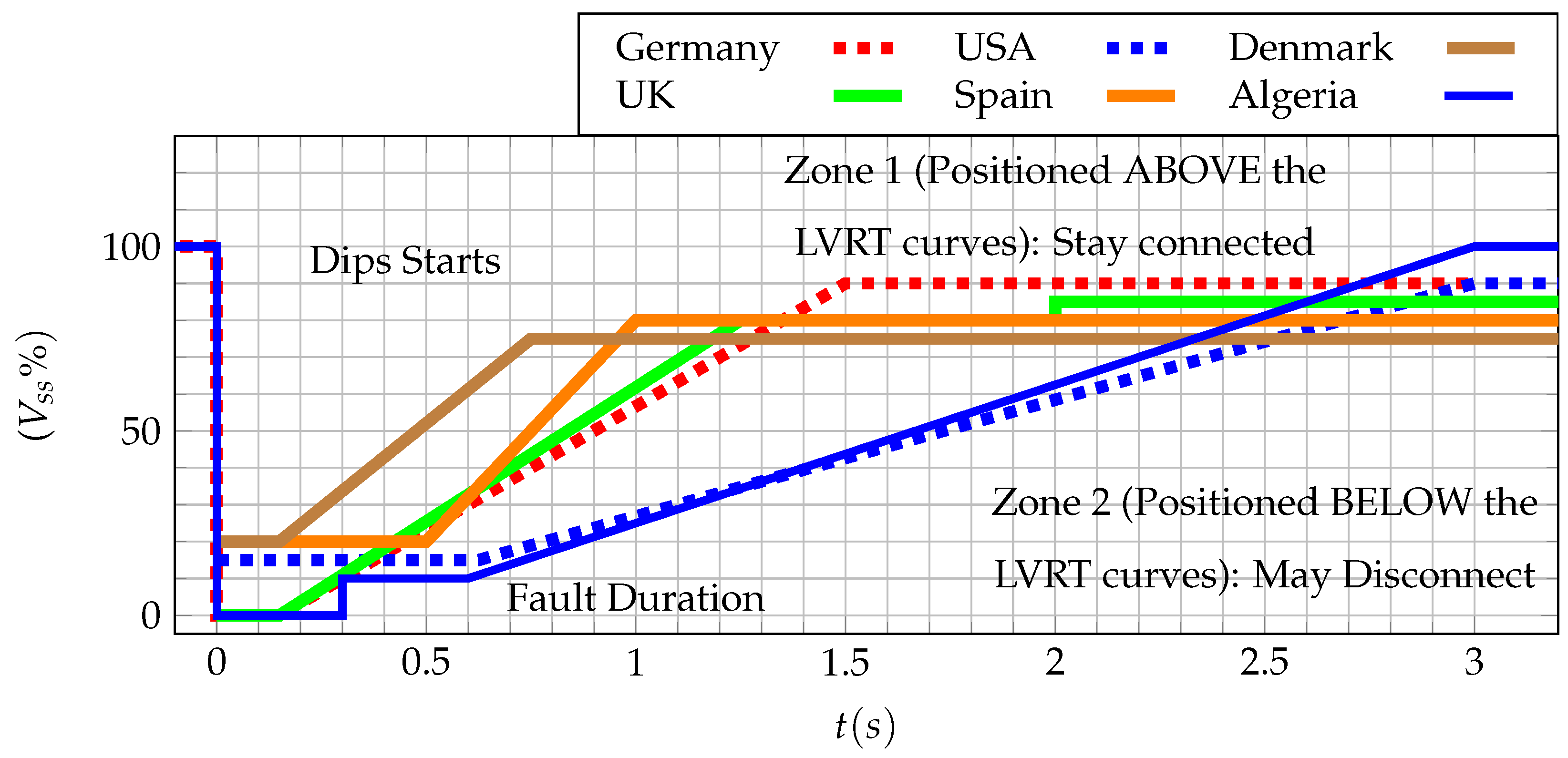
2. LVRT Strategies
3. Technical Regulations for Connecting the Electricity System in Algeria
3.1. Non-Synchronous Power Generation System
3.1.1. Specific Requirements for Non-Synchronous Power Generation System
- Power Factor: Installations must be designed to achieve a power factor of 0.90 at the injection point.
- Voltage Range: The specified voltage ranges during normal operation are outlined in Table 1.
- Reactive Power: At nominal active power, the electricity generation system must be able to absorb a maximum reactive power of at nominal voltage .
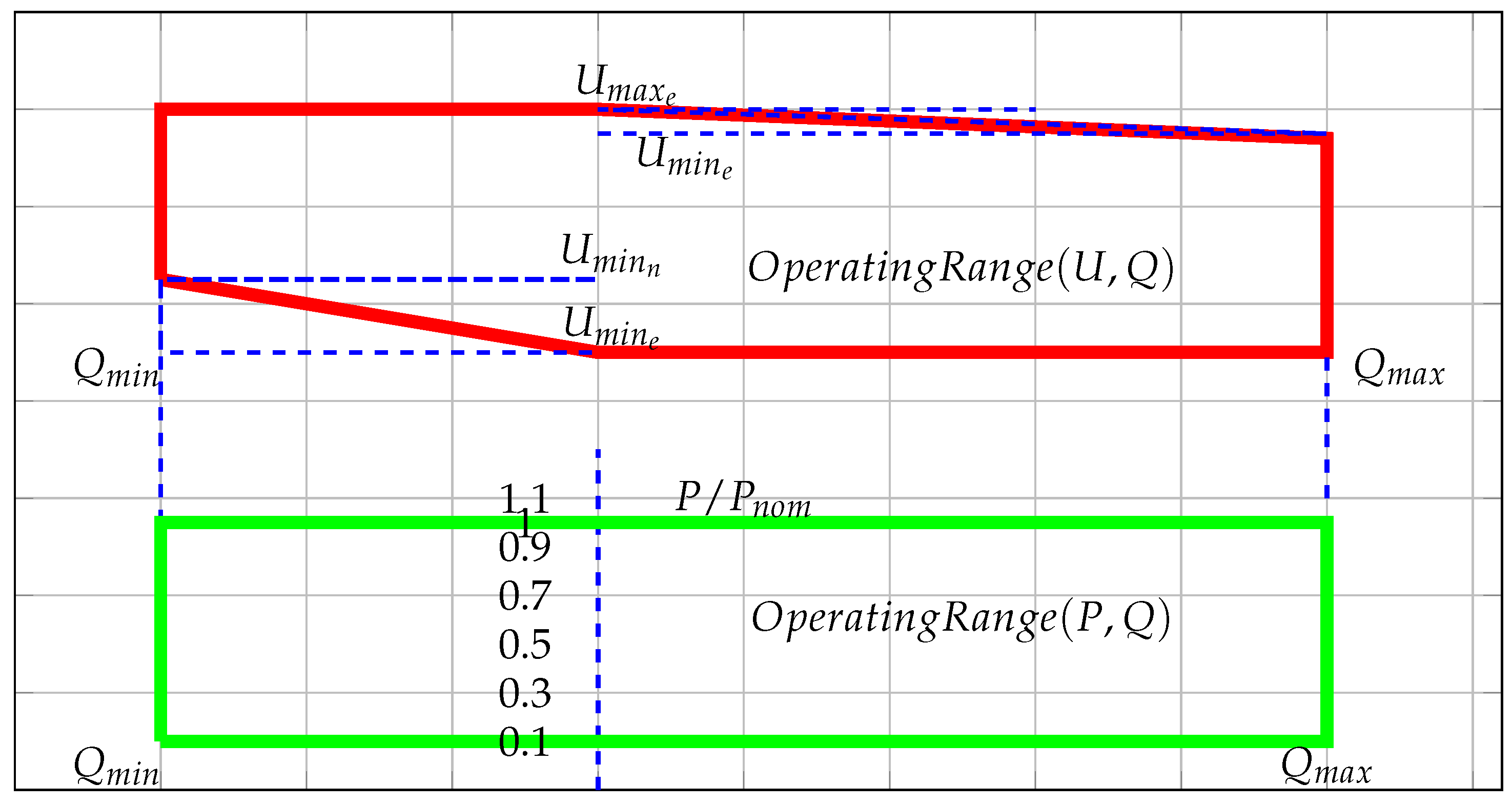
- Operating Range: For active power greater than , the installation must operate within the defined diagram, with no time limitation at any point in the normal operating range. The diagram is specified in Figure 2.
- Low Active Power Operation: For active power less than , non-synchronous installations must be able to operate with reactive power within the range , where and .
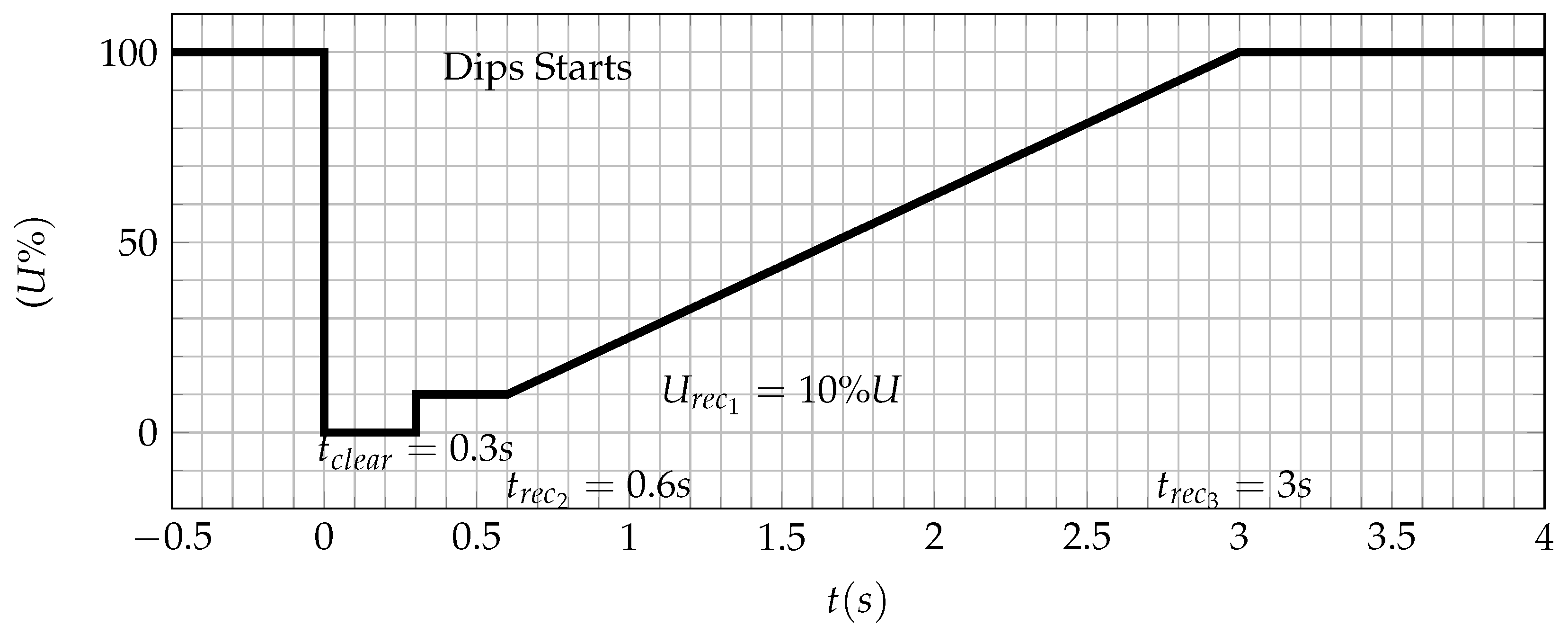
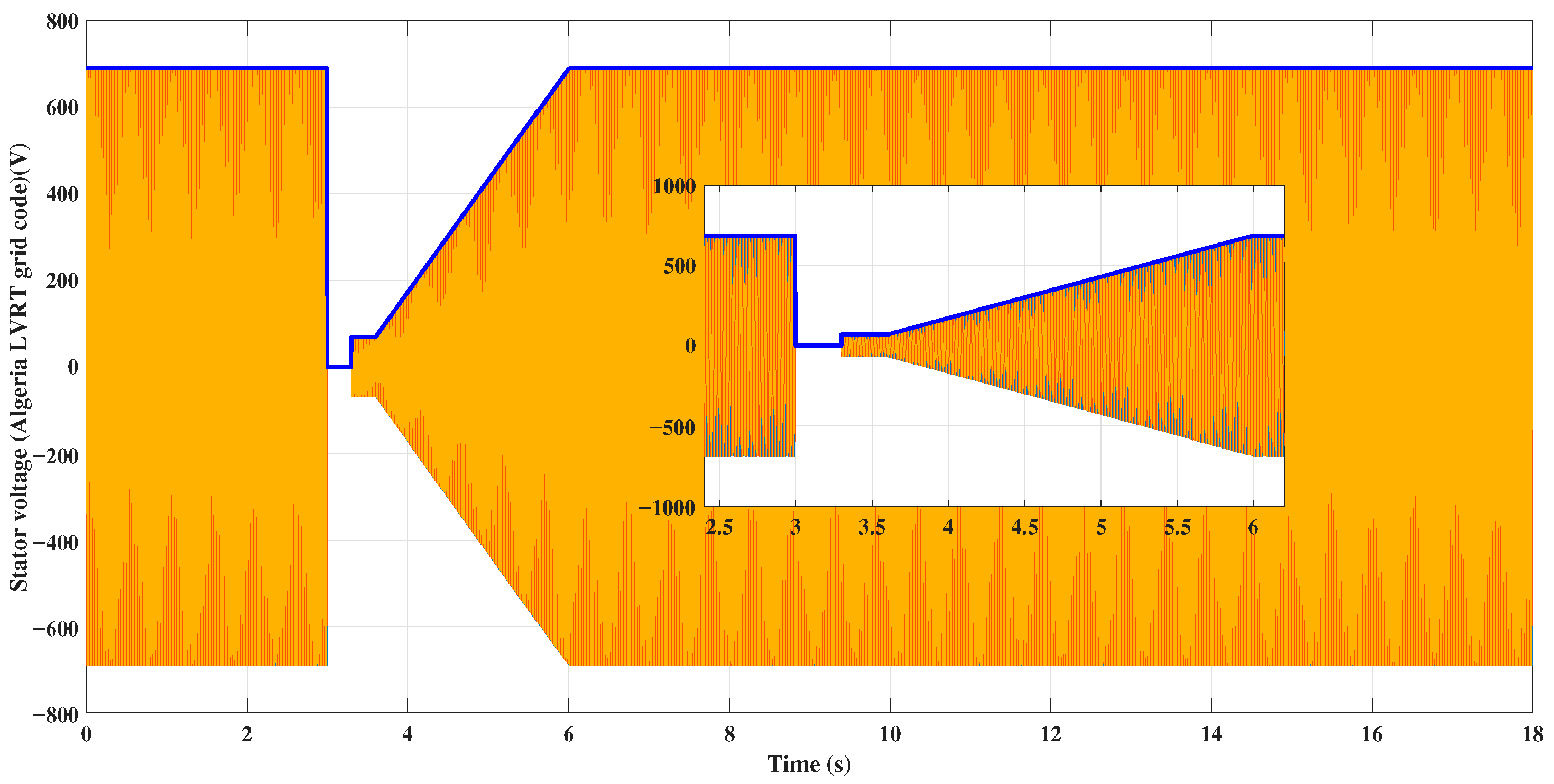
3.1.2. Technical Specifications for Disturbed Conditions Operation
3.2. Synchronous Power Generation System
3.2.1. Specific Requirements for Synchronous Power Generation Systems
- Power Transformer Voltage Regulation: The power transformer should be fitted with a no-load voltage regulator, offering five adjustable tap positions (−5%, −2.5%, 0, +2.5%, +5%) on the high-voltage side for connections to a 220 kV or higher electricity transmission network. For a 60 kV network, only three positions (−5%, 0, +5%) are required. Additionally, the transformer may incorporate an on-load tap changer, with the adjustment range to be agreed upon with the System Operator.
- Voltage and Reactive Power Control: Power generation installations must be equipped with regulators to control voltage and/or reactive power. The voltage regulation system should include a manual backup regulator to ensure continuous operation in case of failure.
- Voltage Stabilization Systems: The voltage regulation system must include at least one stabilizer that adjusts to variations in power. Depending on the specific needs, additional types of stabilizers may also be used to enhance the stability and reliability of the power generation system.
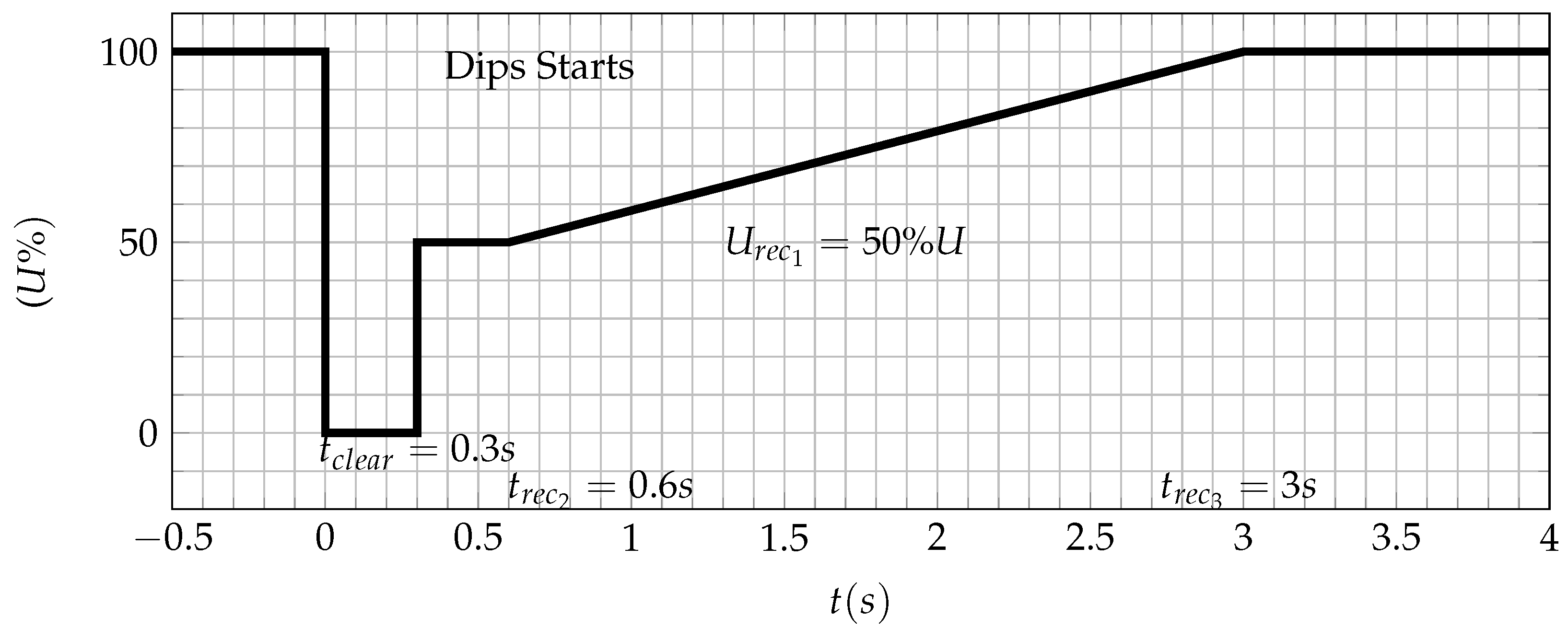
3.2.2. Technical Specifications for Operating Under Disturbed Conditions
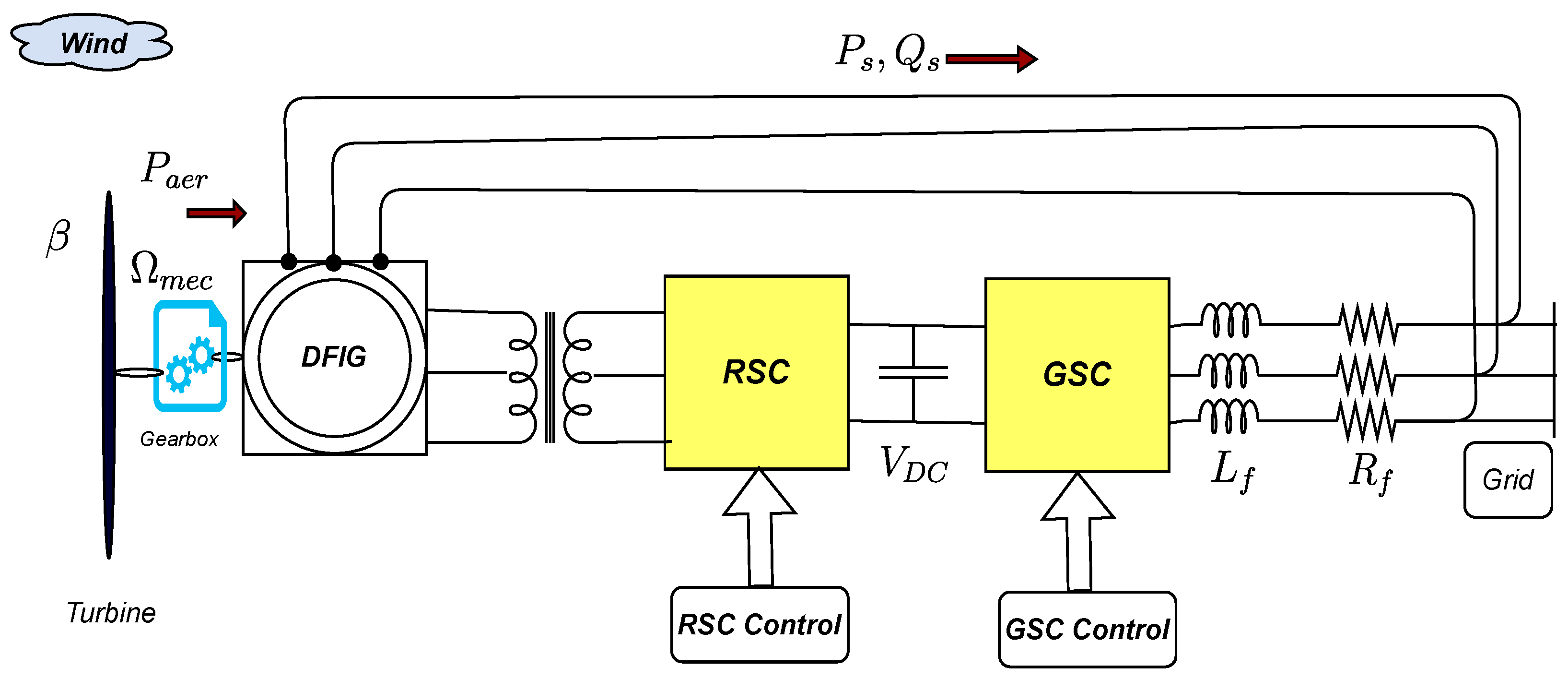
4. DFIG Modeling and Control
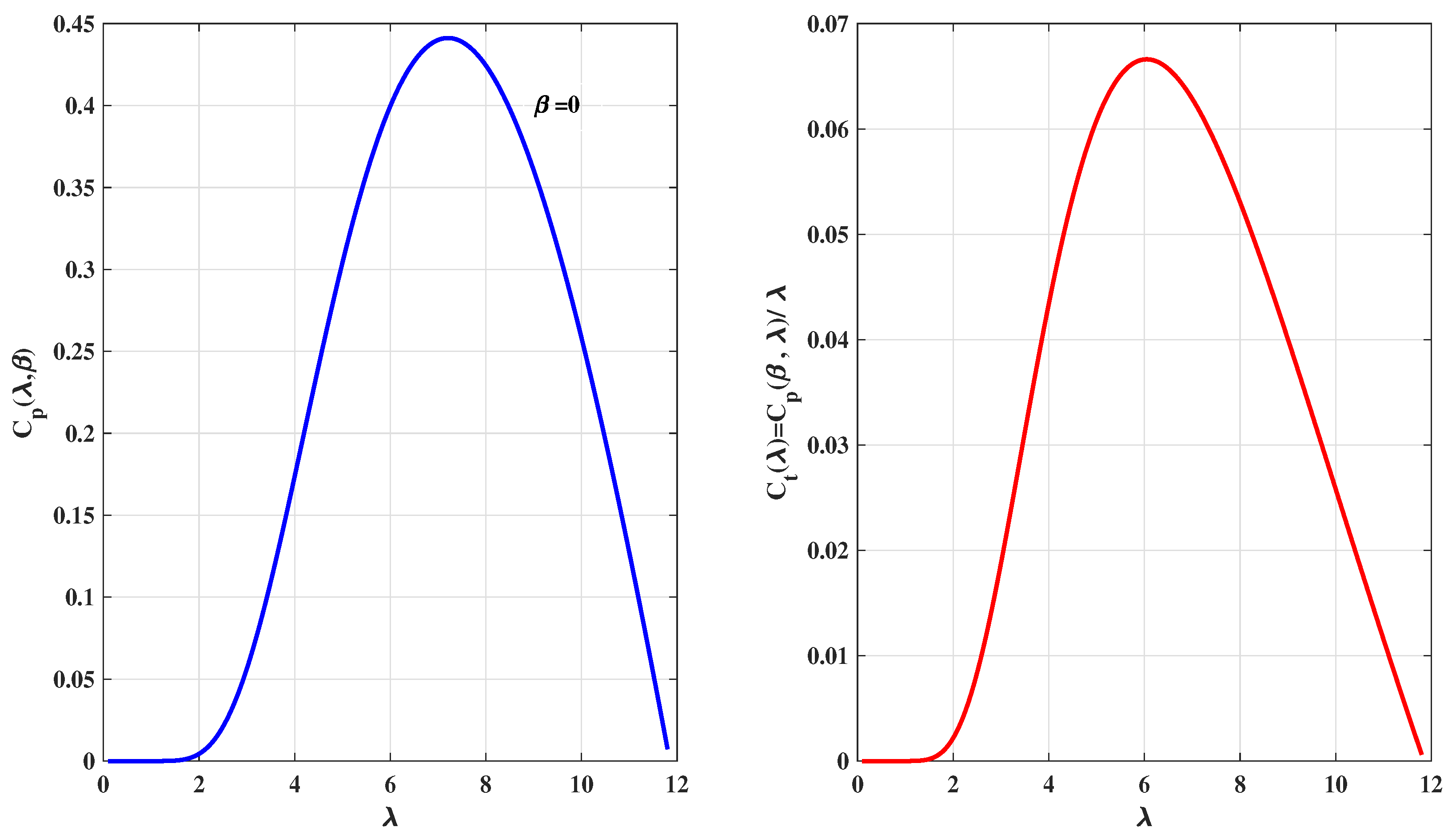
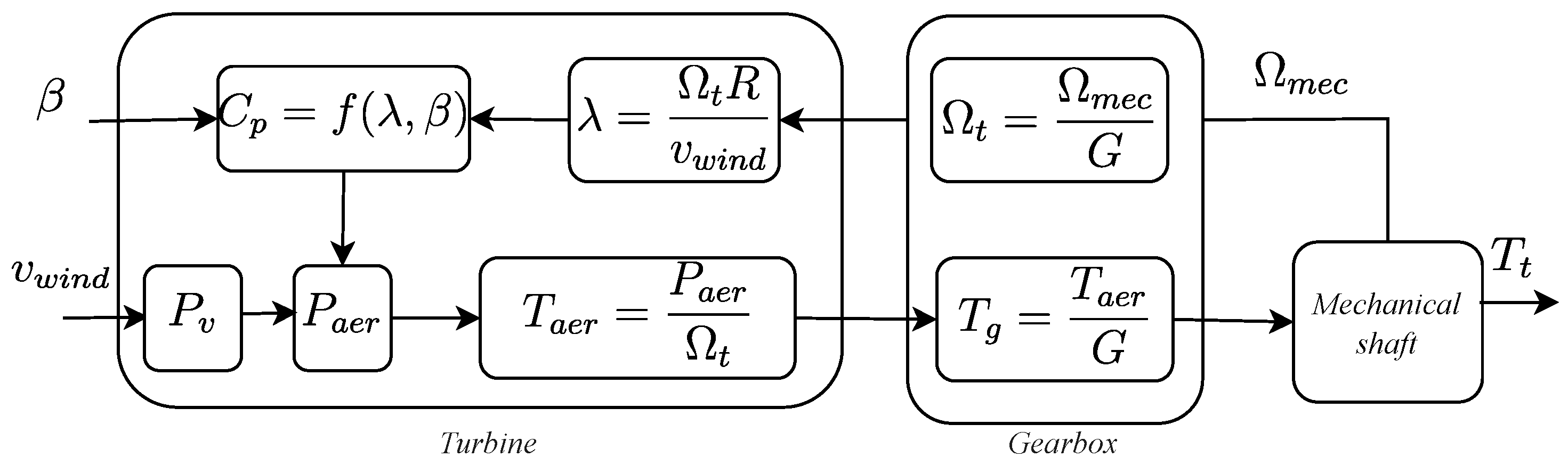
4.1. Turbine Speed Control
4.2. DFIG Modelling
- J is the total moment of inertia (turbine inertia referred to generator side plus generator inertia in 2;
- is the rotor mechanical speed ();
- is the mechanical torque from the turbine ();
- is the electromagnetic torque ();
- is the viscous friction coefficient ().
4.3. Stator and Rotor Flux Estimation
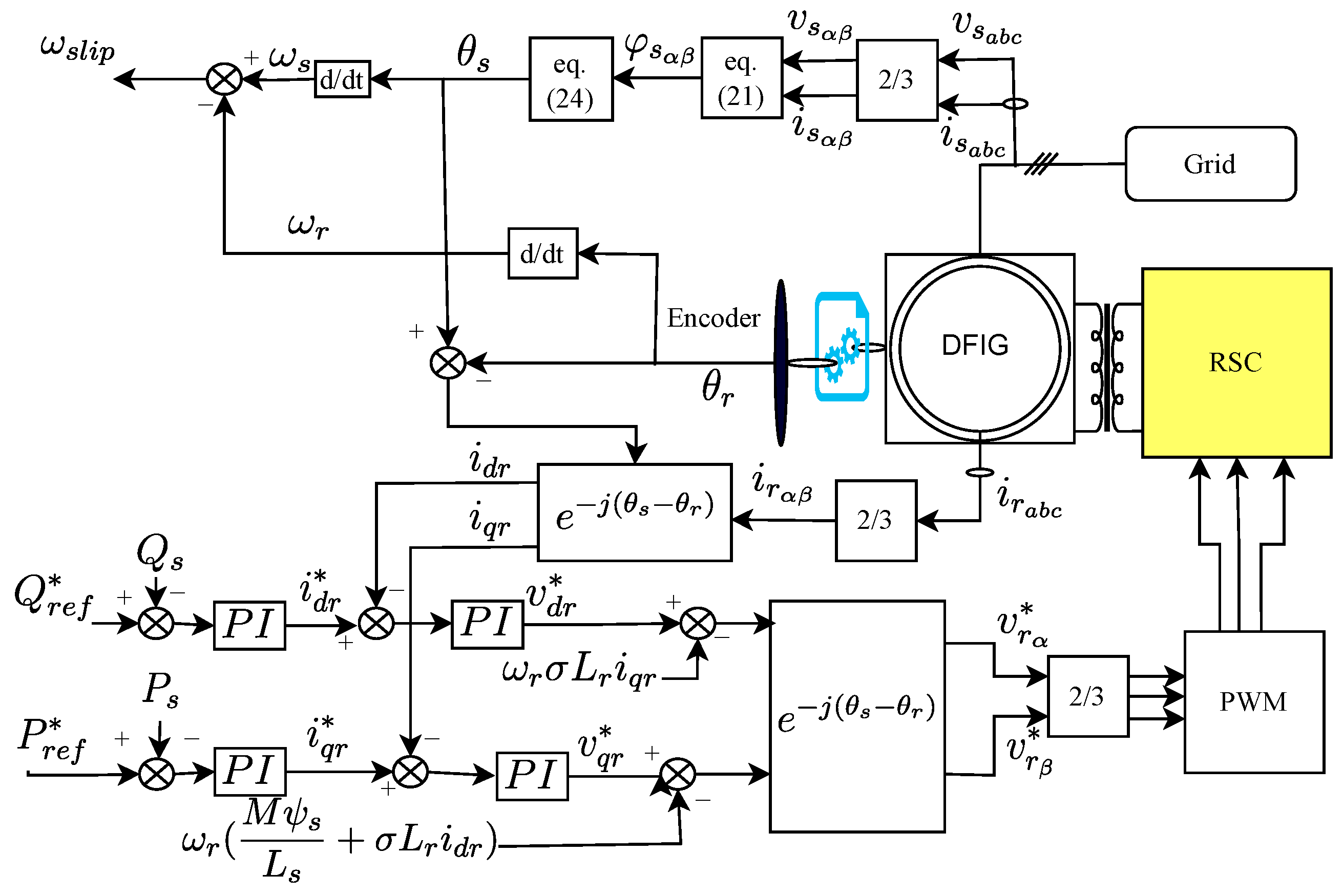
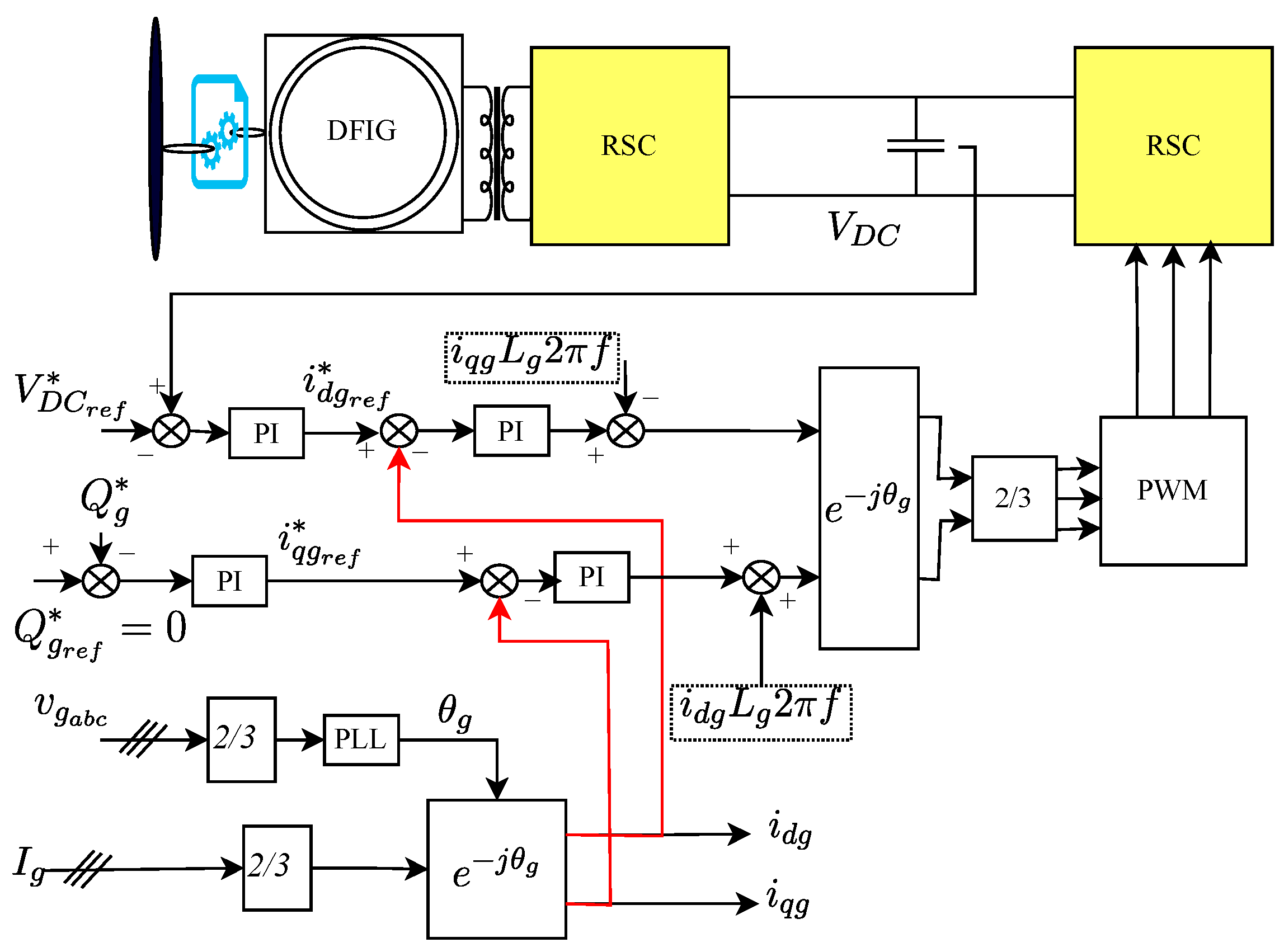
4.4. DFIG Control
5. Analysis of DFIG-Based Wind Turbines During Voltage Dips
5.1. Impact of Severe Voltage Dip on a DFIG-Based WECS
5.2. LVRT of a DFIG-Based WECS
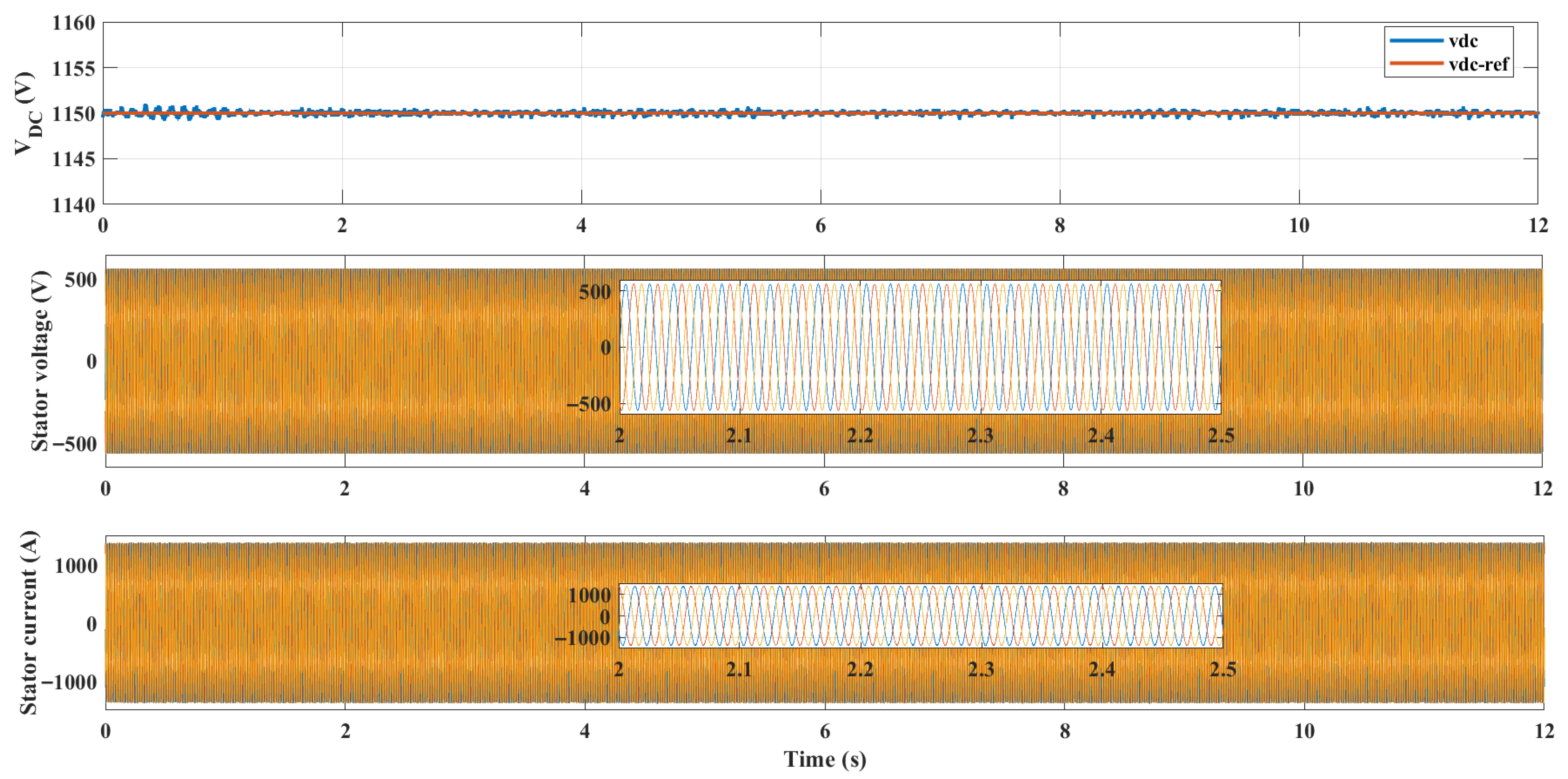
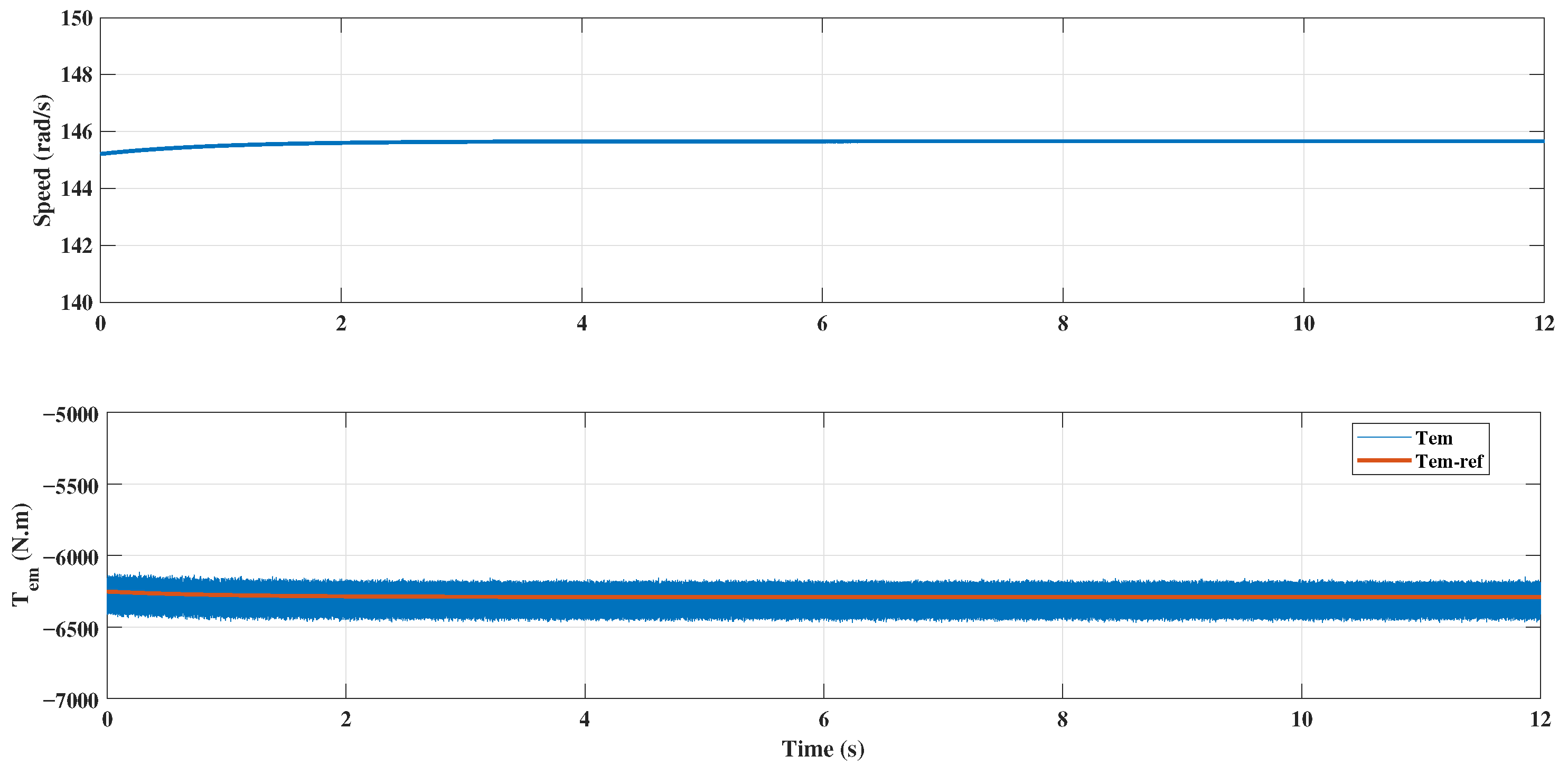
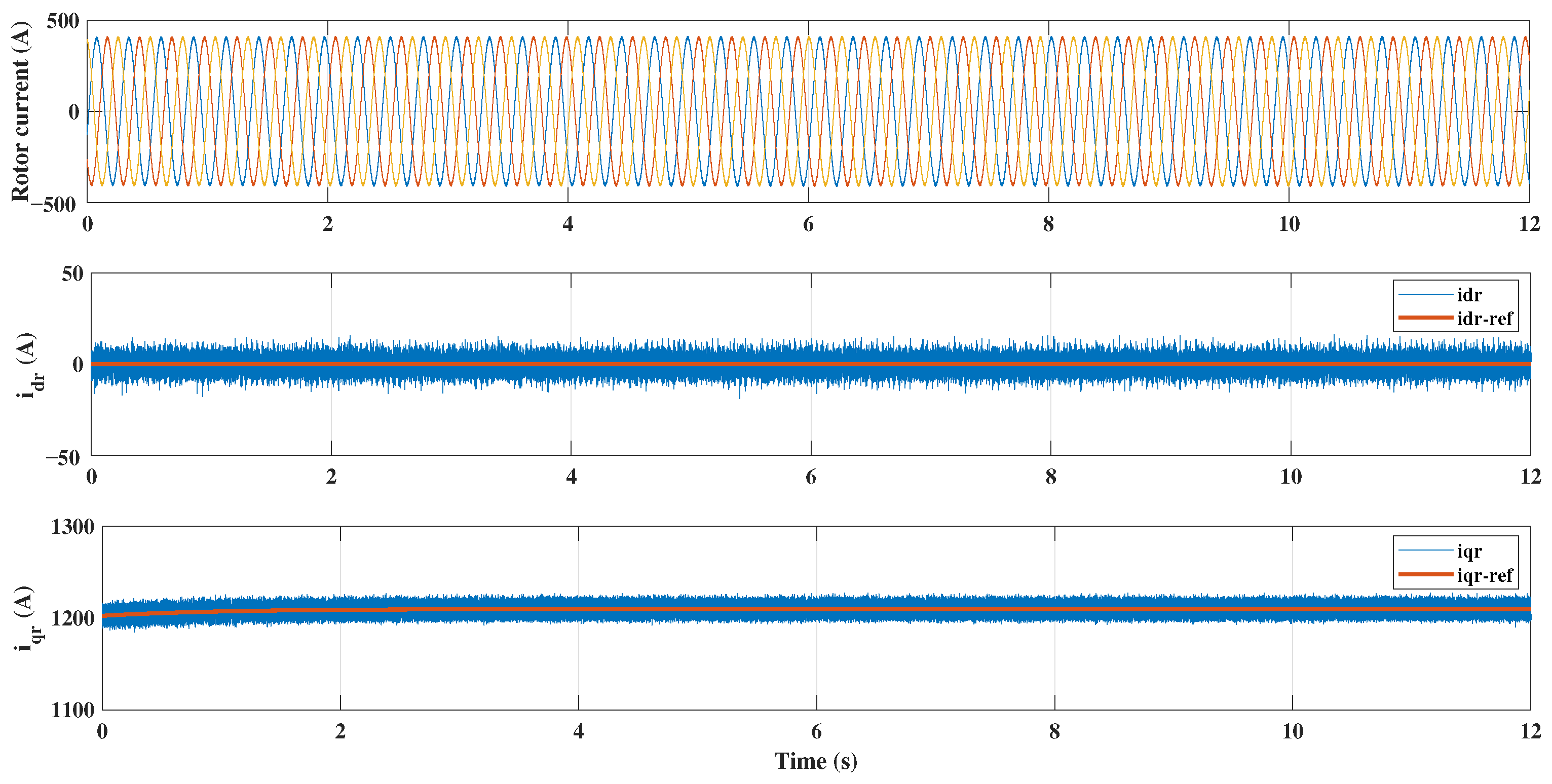
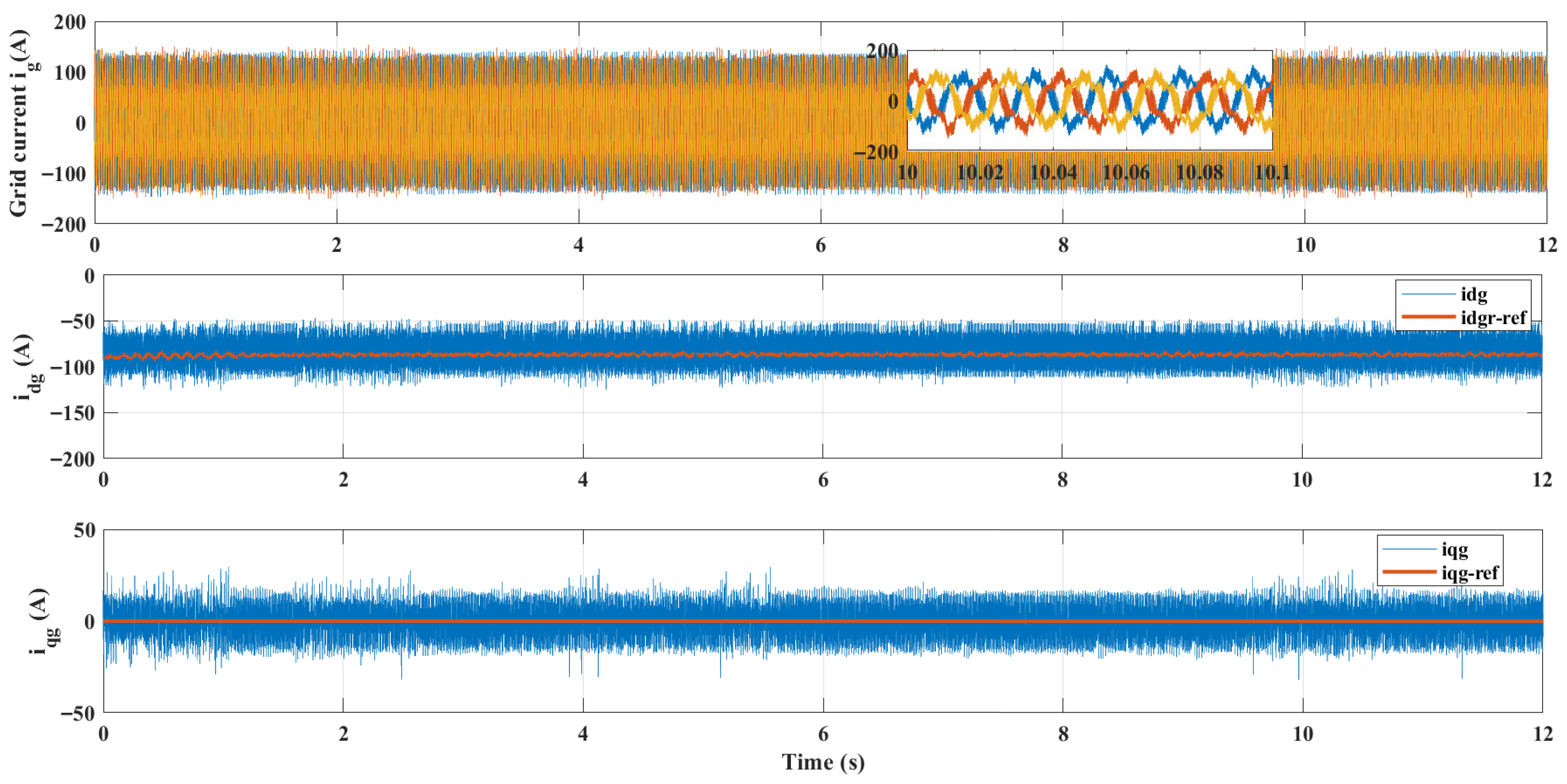
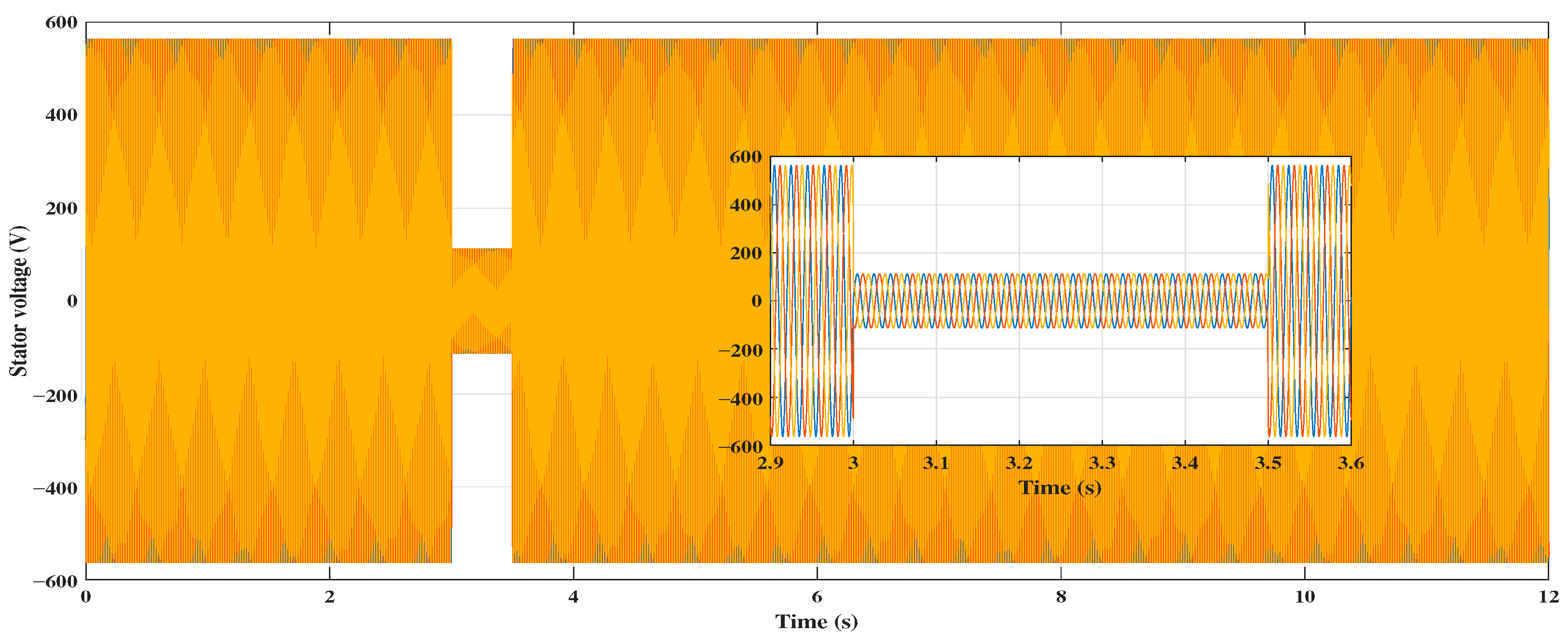
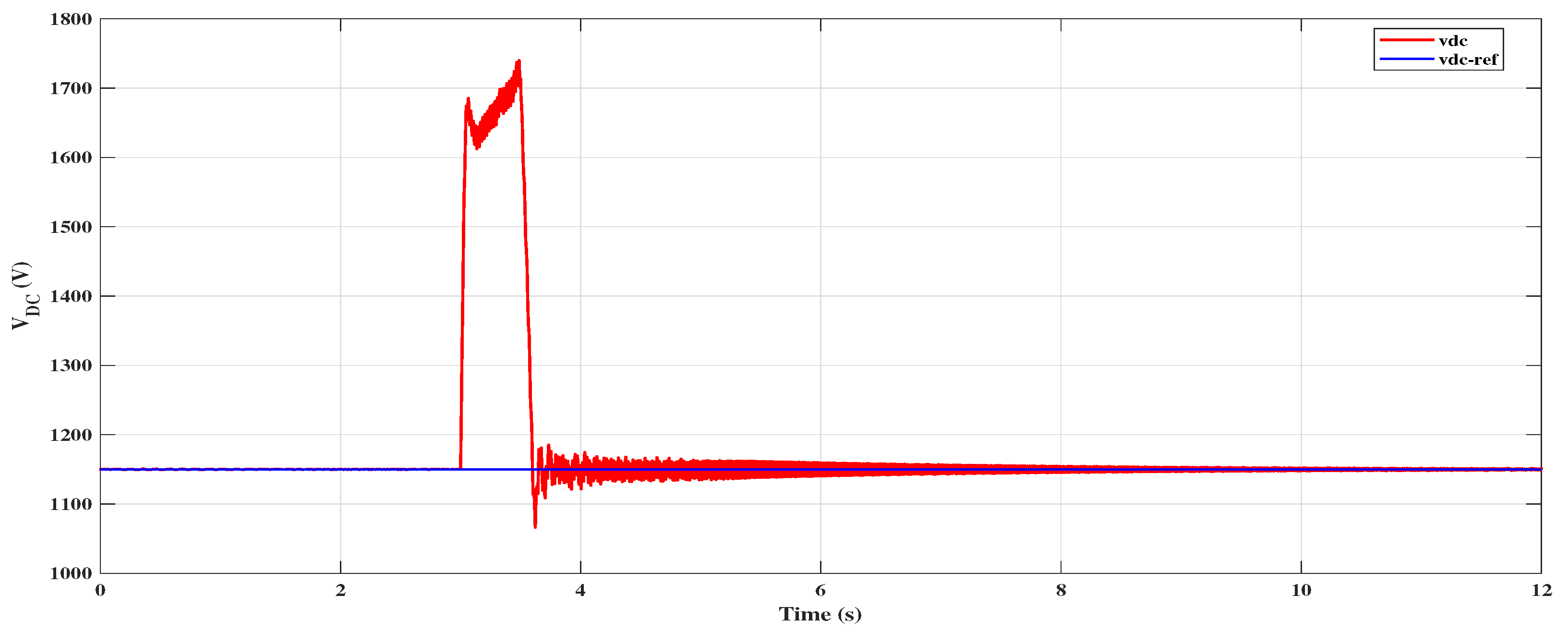
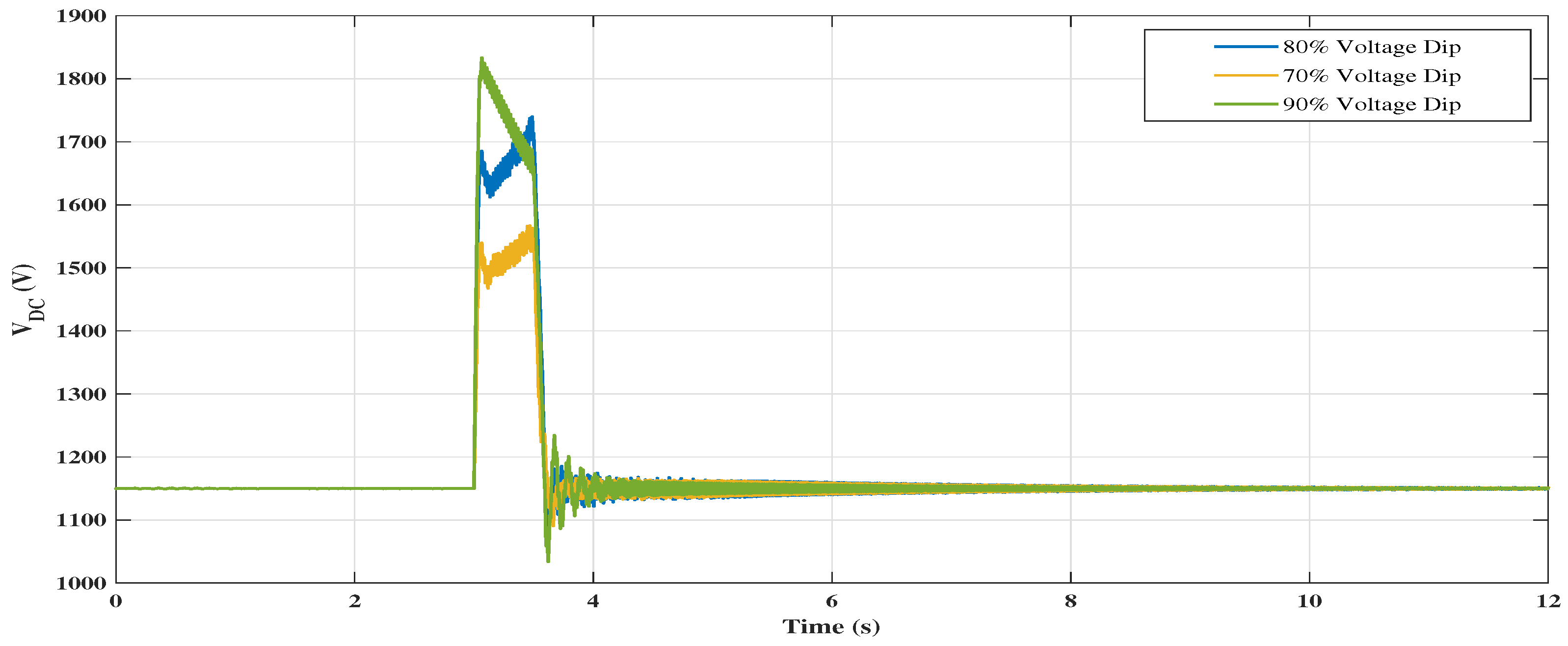
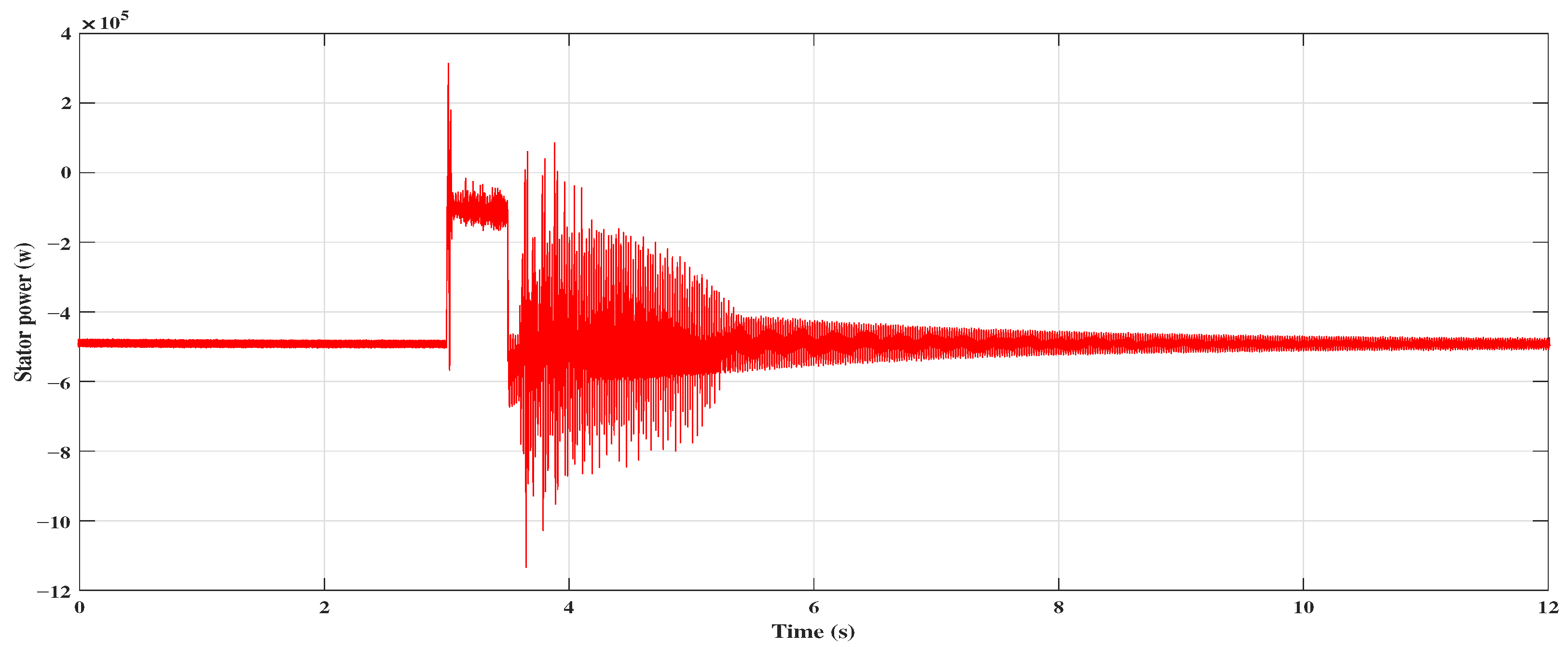
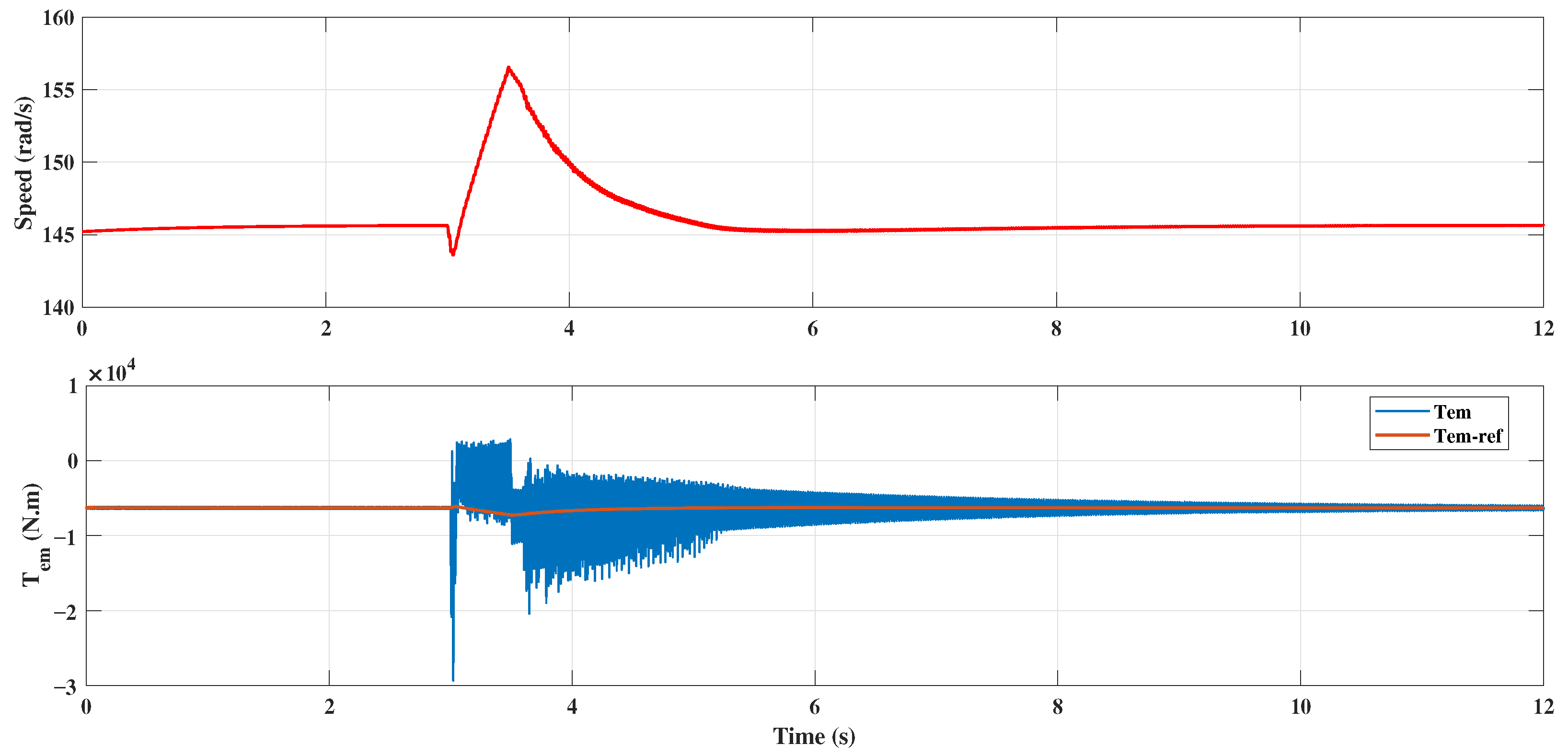
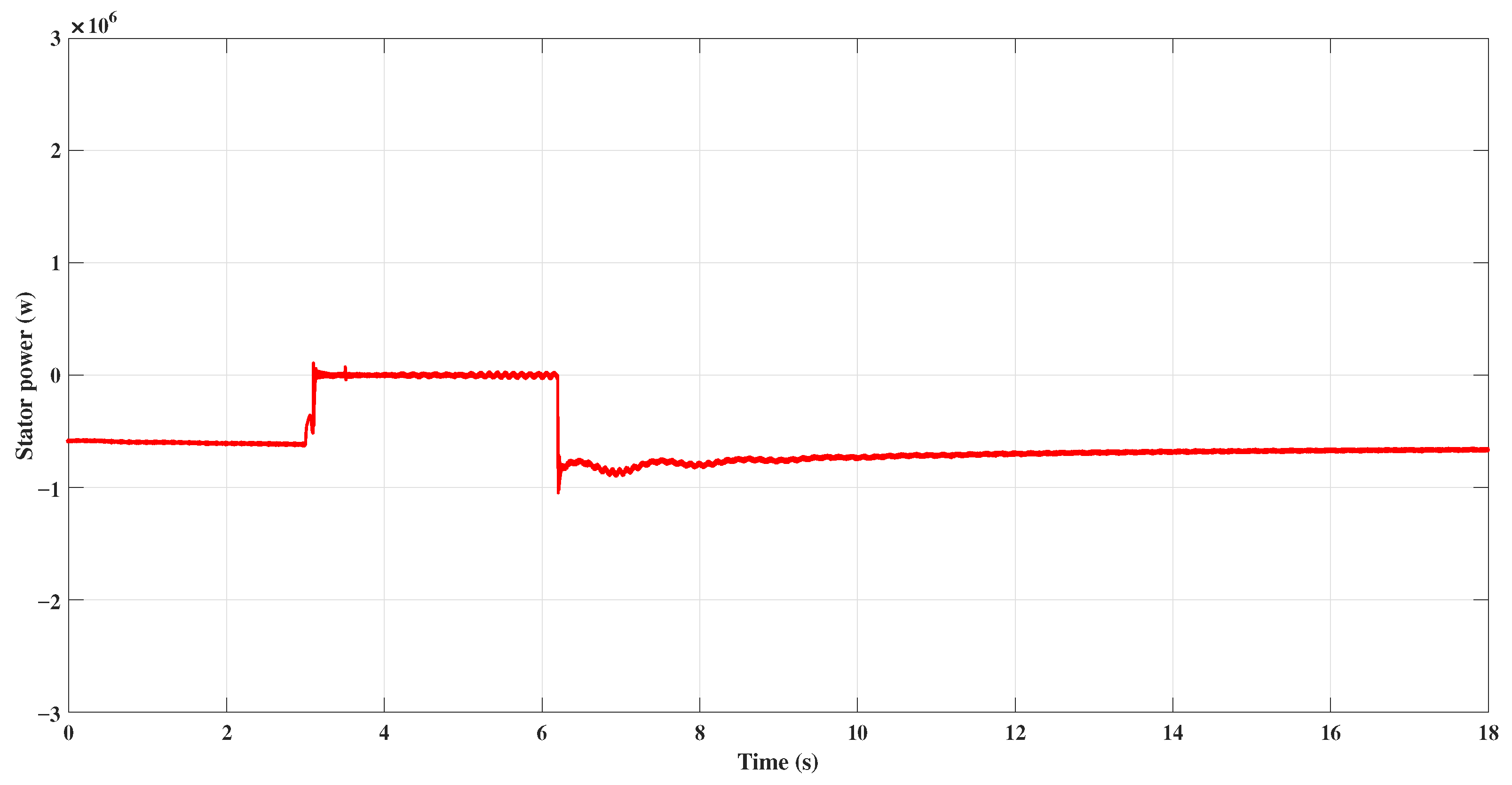
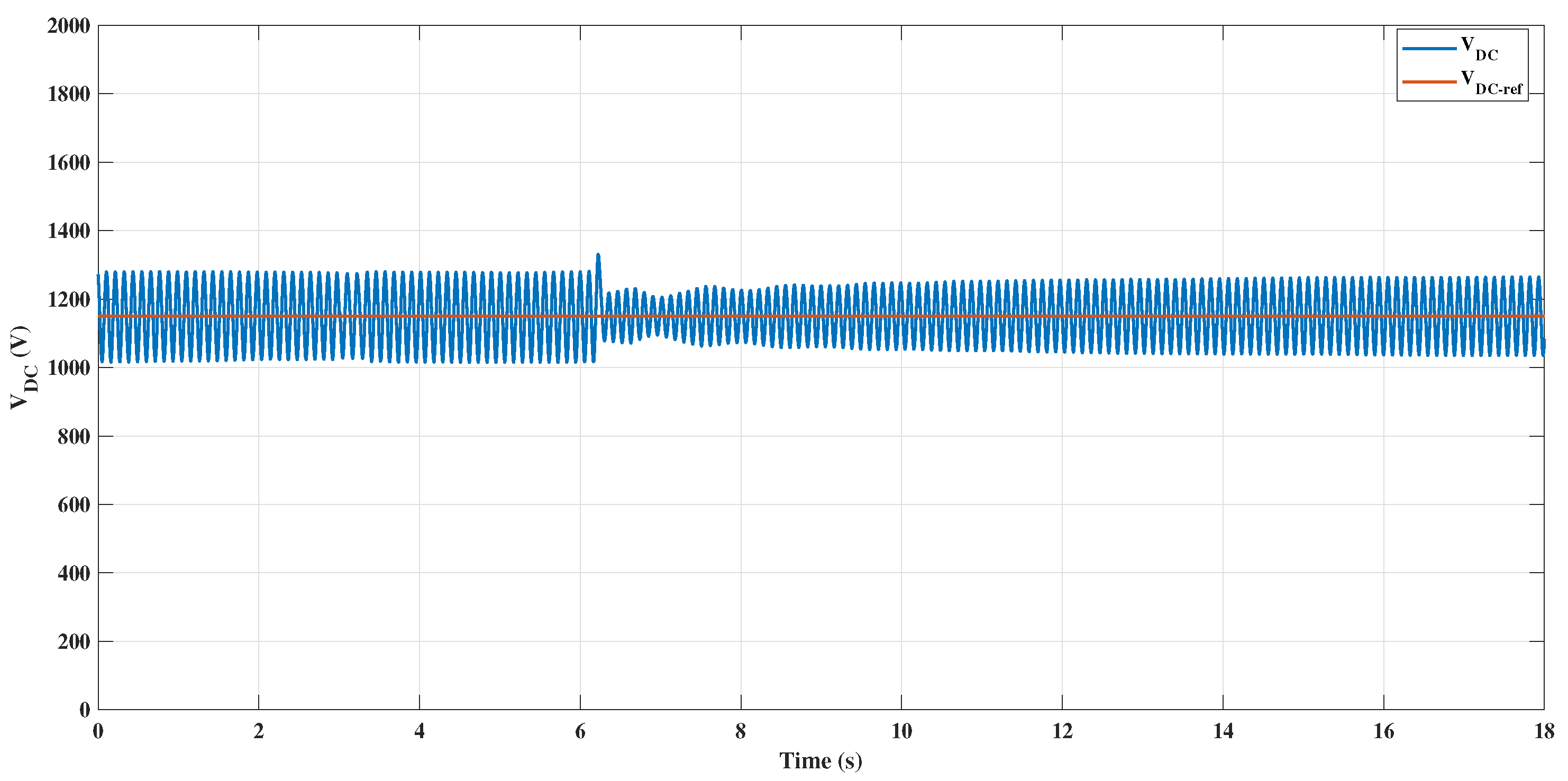
6. Simulation Results
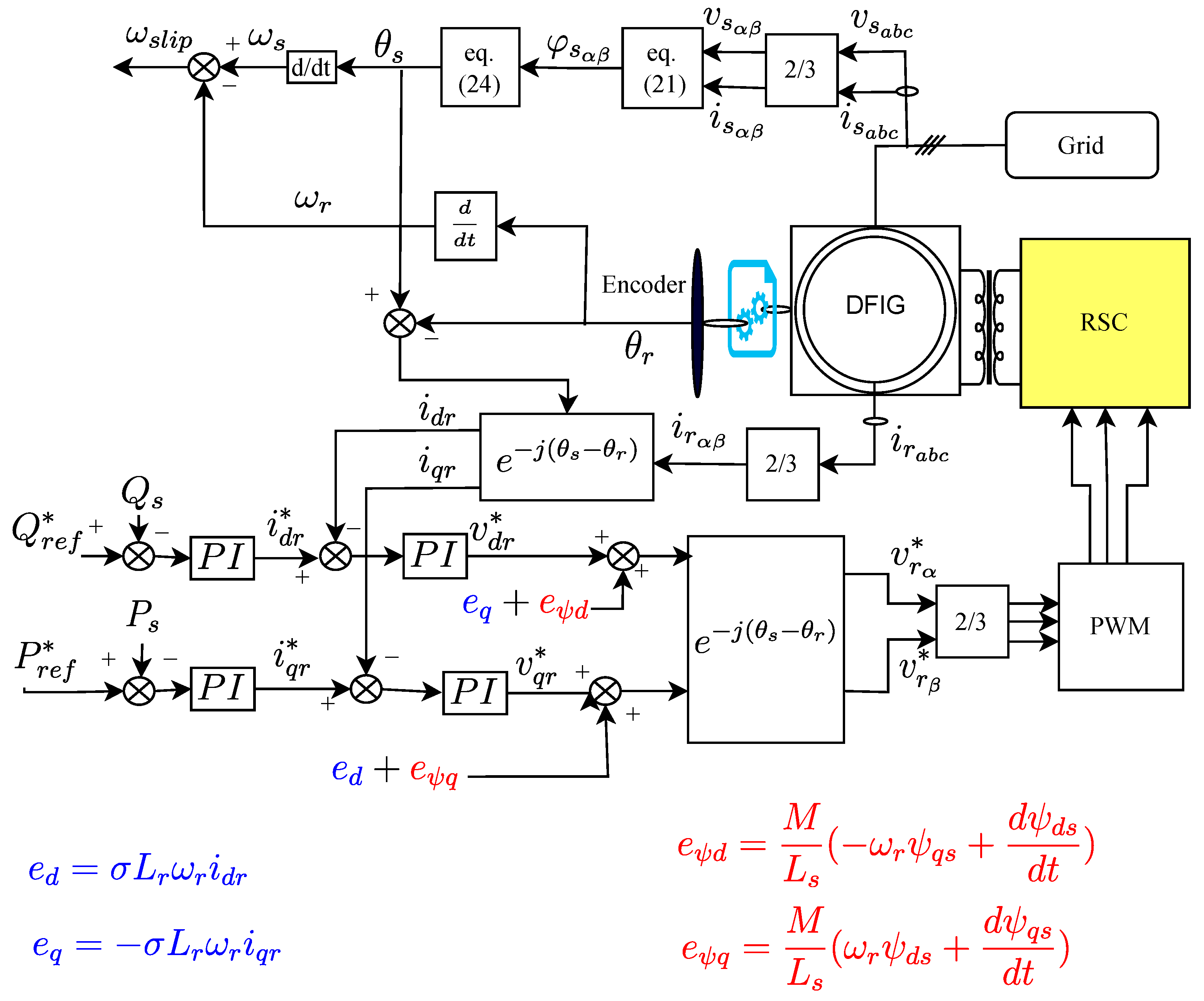
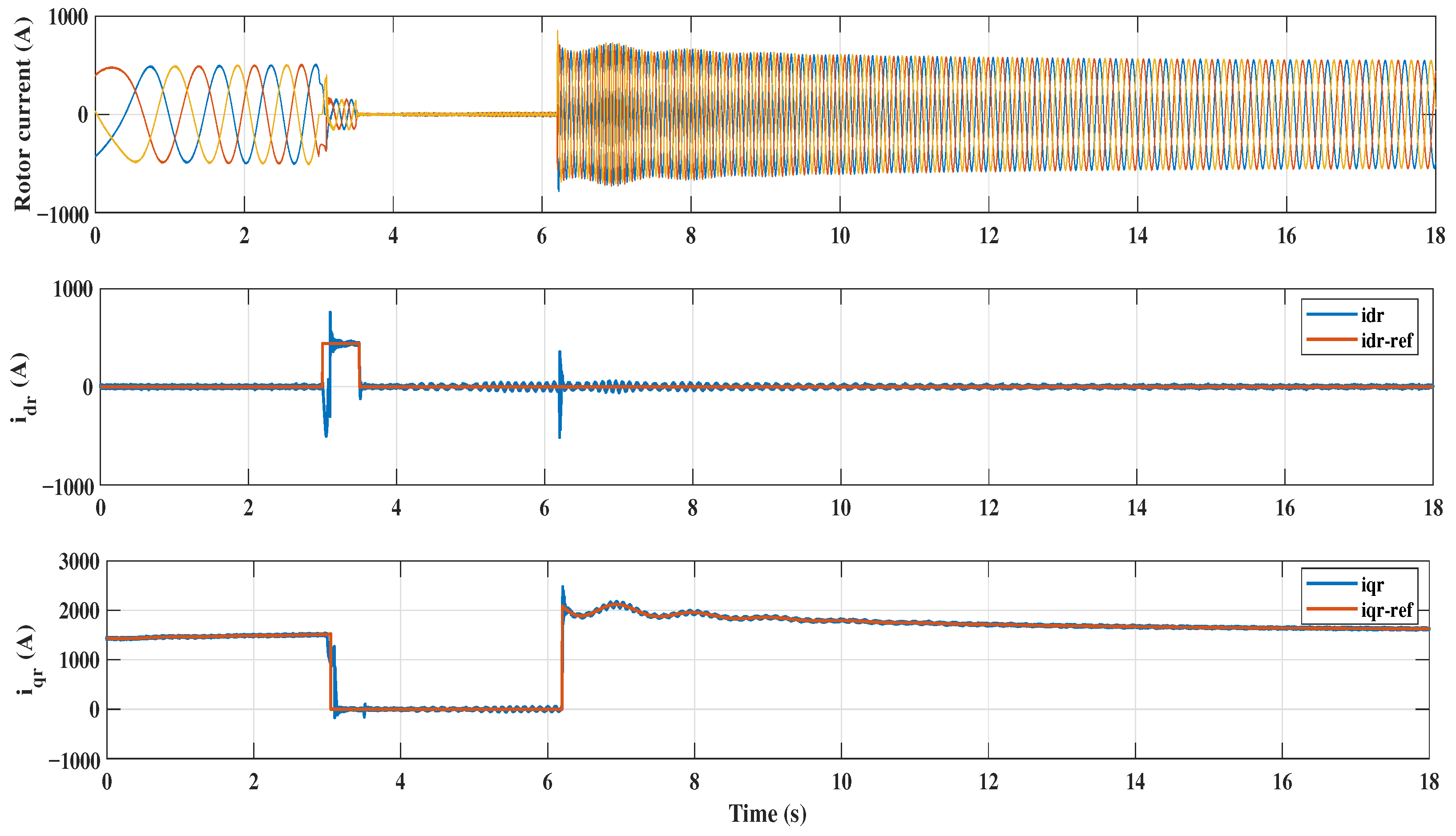
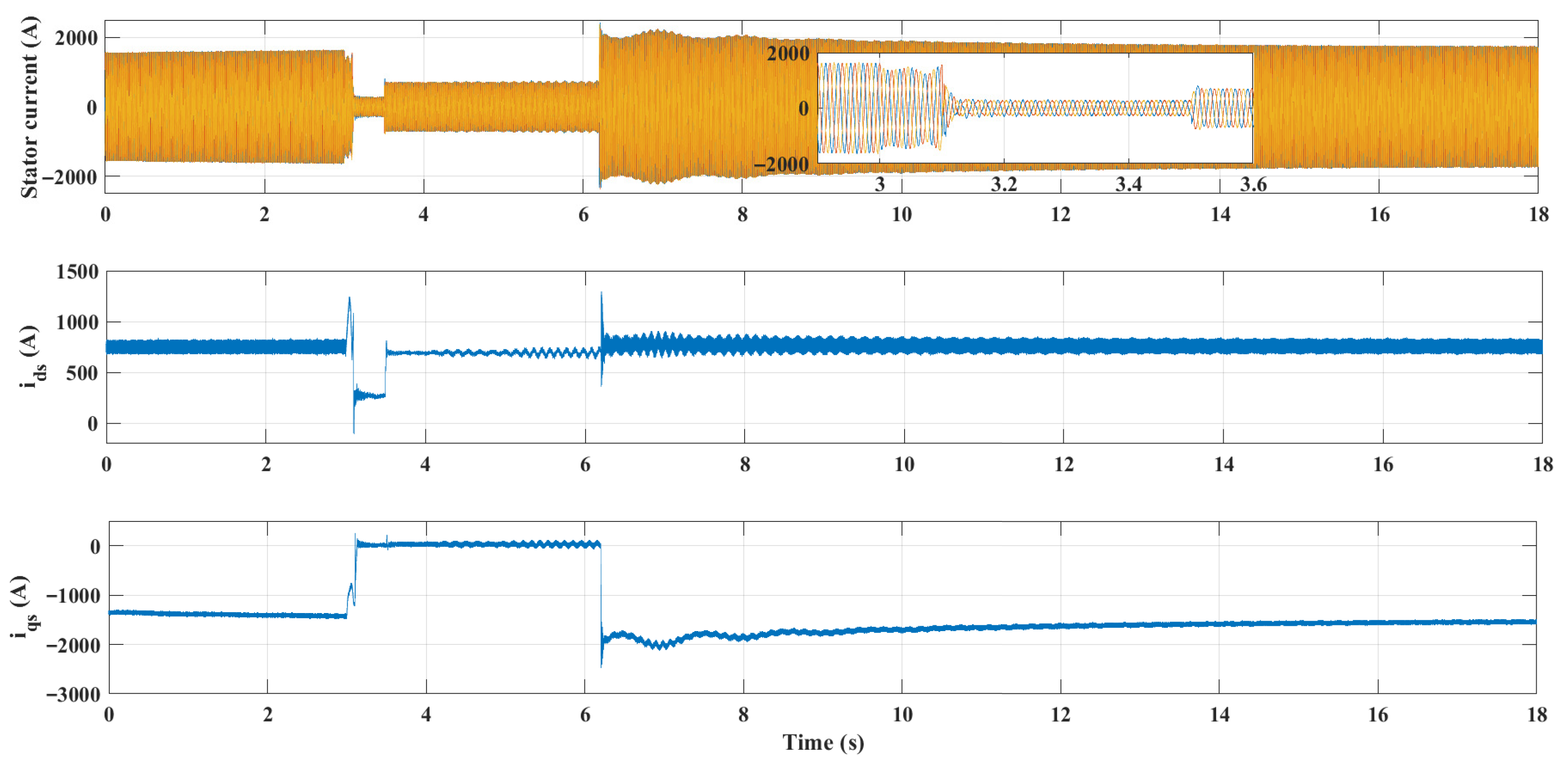
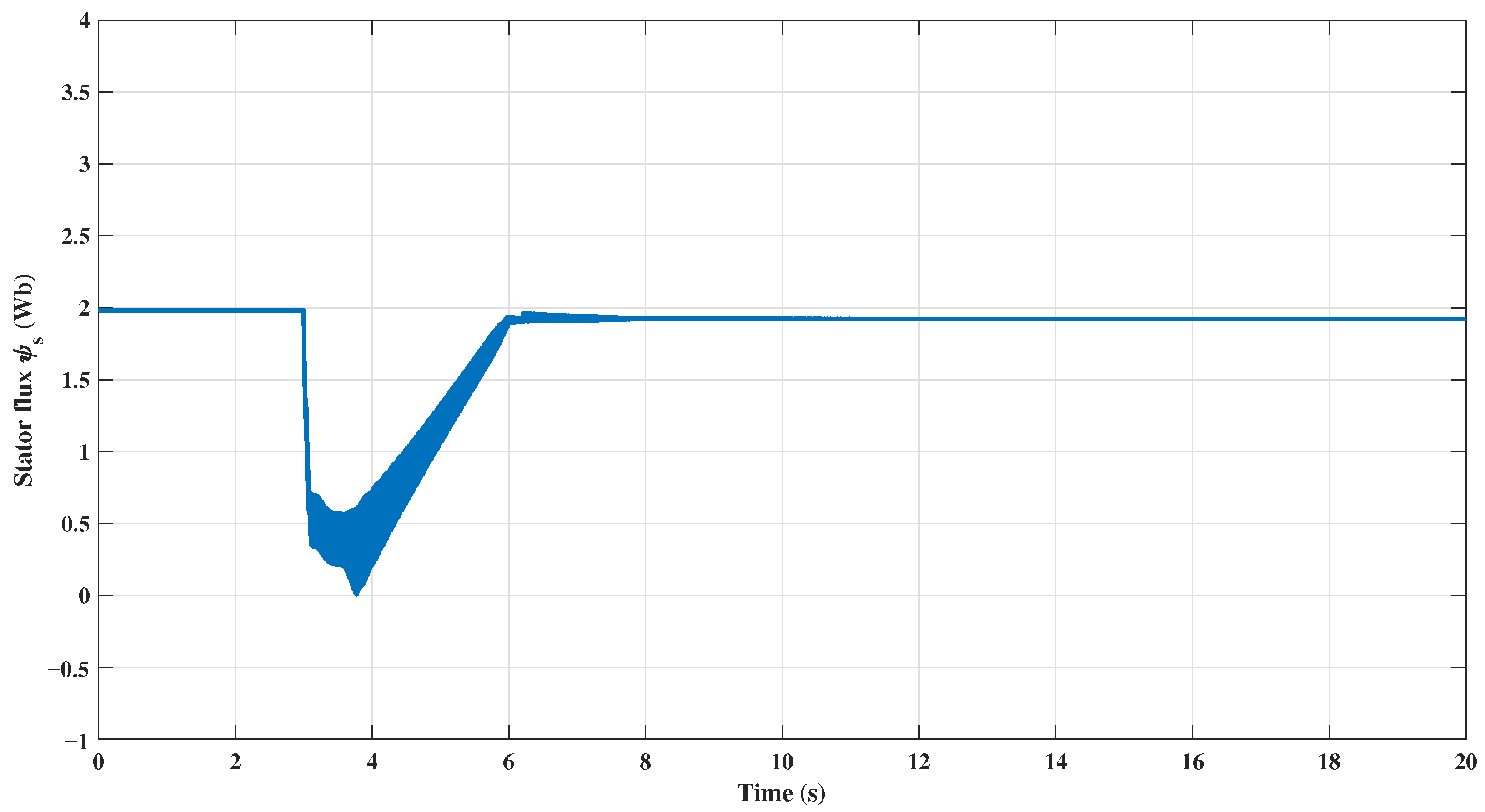
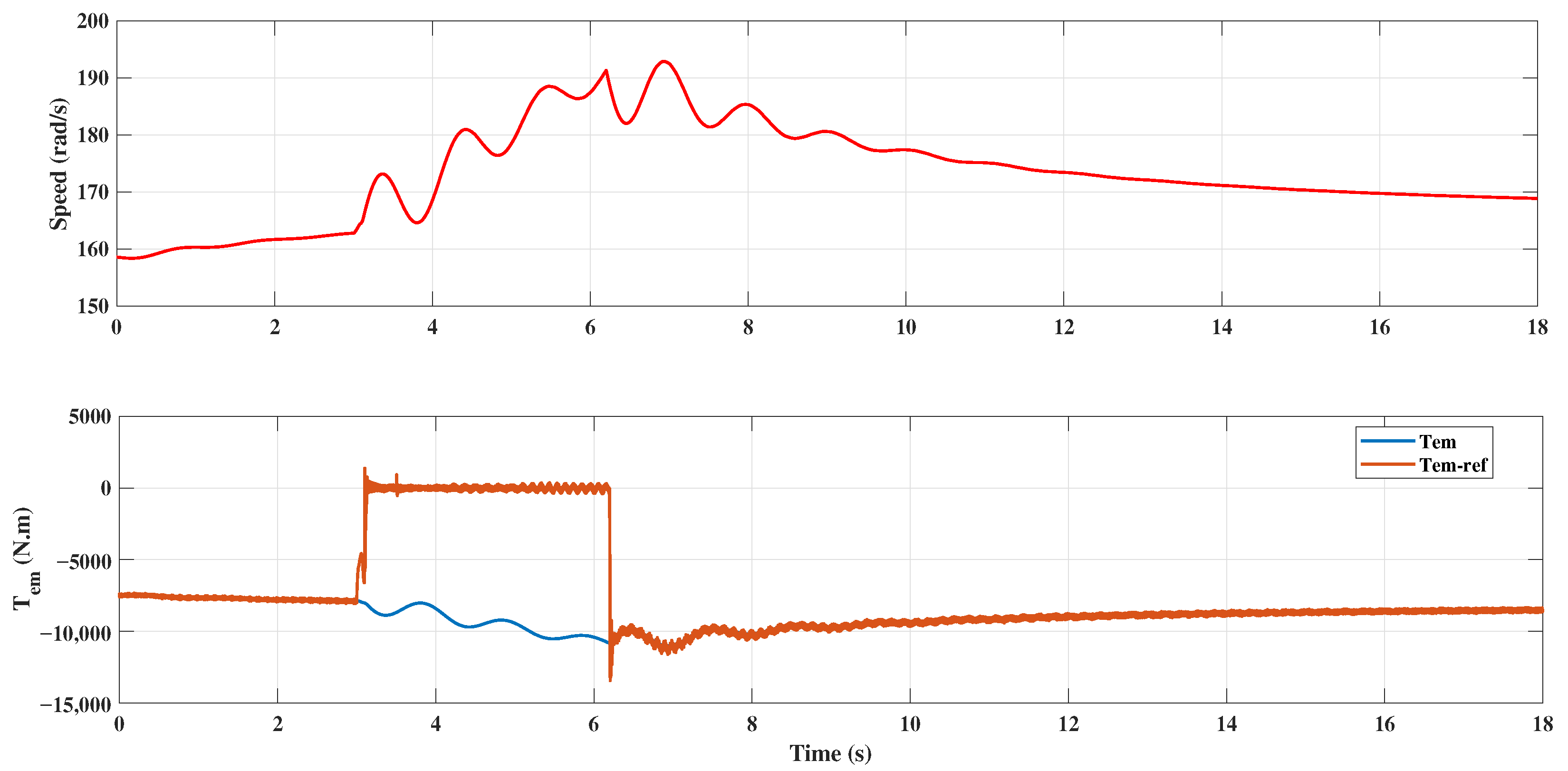
- The integration of a Modified Vector Control scheme applied to the DFIG.
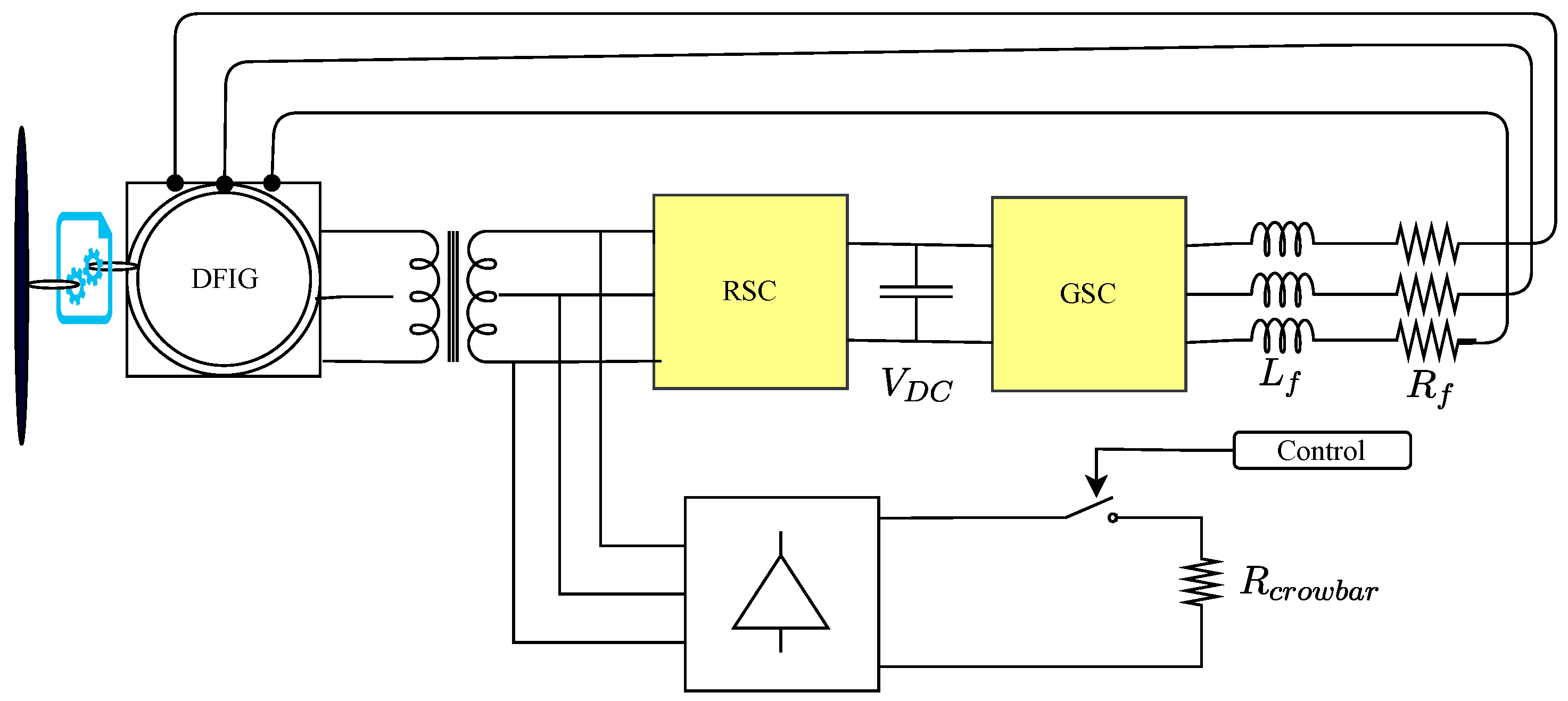
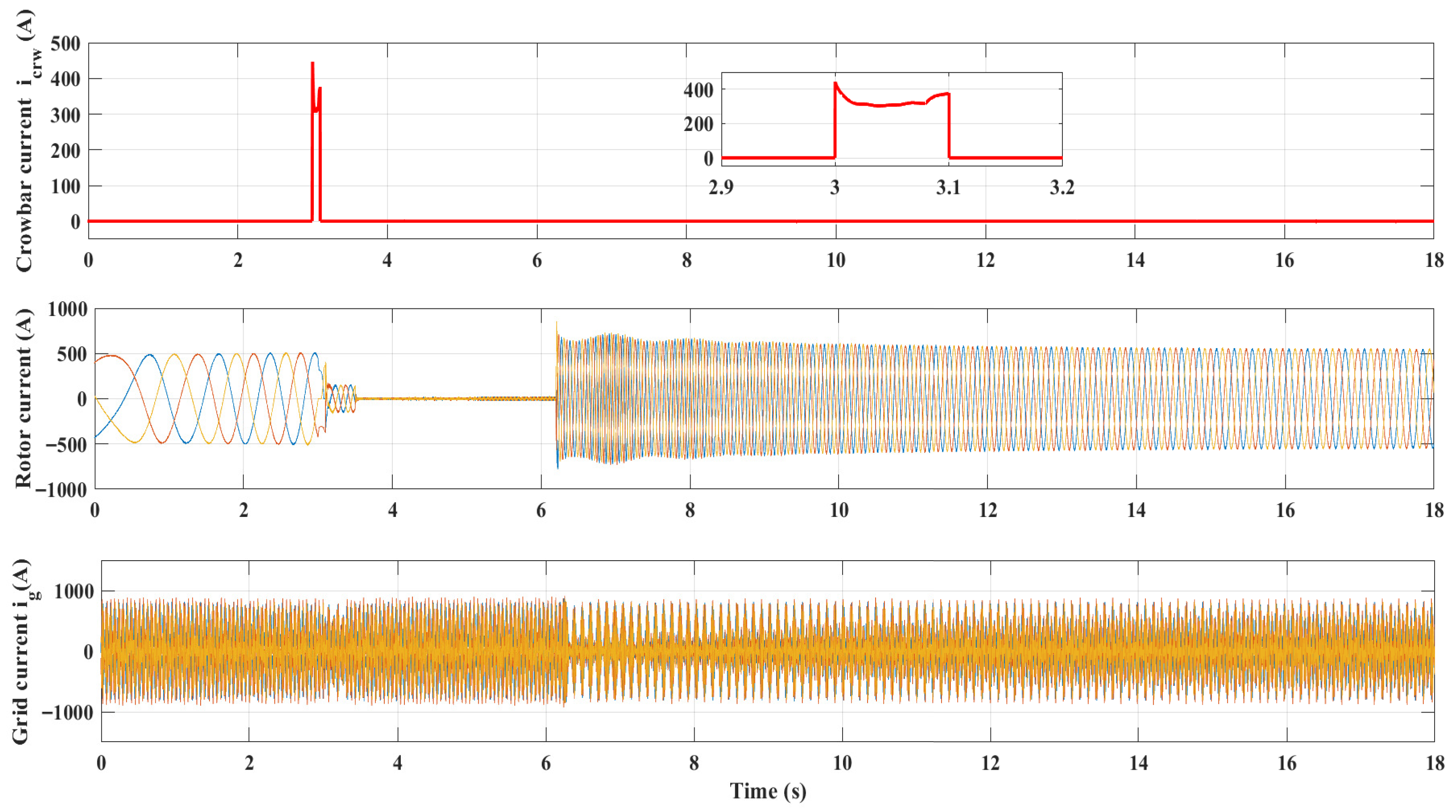
- The use of an R-crowbar circuit during the fault.
7. Conclusions
Author Contributions
Funding
Data Availability Statement
Acknowledgments
Conflicts of Interest
Abbreviations
| DFIG | Doubly Fed Induction Generator |
| LVRT | Low Voltage Ride Through |
| WECS | Wind Energy Conversion System |
| MPPT | Maximum Power Point Tracking |
| TRS | Tip Speed Ratio |
| GSC | Grid Side Converter |
| RSC | Rotor Side Converter |
| PWM | Pulse Width Modulation |
| PLL | Phase Lock Loop |
| SDR | Series Dynamic Resistor |
Appendix A. WECS Parameters and Simulation Data [41]

| Value | Parameter |
|---|---|
| Rated active power () | |
| Nominal stator voltage (V) | |
| Mechanical speed () | |
| DC bus voltage ) | |
| Wind turbine radius (m) | |
| Air density at 15 °C () | |
| Gearbox gain | |
| Stator one-phase winding resistance (m) | |
| Rotor one-phase winding resistance (m) | |
| Stator leakage inductance () | |
| Rotor leakage inductance () | |
| Mutual inductance () | |
| Stator inductance () | |
| Rotor inductance () | |
| Shaft inertia () | |
| Friction coefficient of the induction machine (/) | |
| Leakage coefficient | |
| Number of pole pairs | |
| Stator time constant (s) | |
| Rotor time constant (s) |
| Value | Parameter |
|---|---|
| Power grid frequency (Hz) | |
| Grid angular frequency (rad/s) | |
| Filter resistance () | |
| Filter inductance (H) | |
| DC bus capacitance (mF) |
| Value | Parameter | |
|---|---|---|
| Proportional gain ()/() | RSC current PI controller | |
| Integral gain ()/() | ||
| = 10,160 | Proportional gain | RSC powers PI controller |
| = 406,400 | Integral gain | |
| Proportional gain ()/() | GSC current PI controller | |
| Integral gain ()/() | ||
| Proportional gain | GSC PI Controller | |
| = 30,000 | Integral gain |
References
- Bessalem, C.; Diemer, A.; Batisse, C. Les transitions énergétiques a l’horizon 2030 et 2050, le retour en grâce des scenarios et de la prospective. Rev. Francoph. Dev. Durable 2022, 19, 1–67. [Google Scholar]
- Les Énergies Renouvelables: État des Lieux des Pourcentages dans le Monde. 2025. Available online: https://www.energiesrenouvelables.org/energie-eolienne/impact-environnemental/energies-renouvelables-monde/ (accessed on 10 August 2025).
- Himri, Y.; Rehman, S.; Mostafaeipour, A.; Himri, S.; Mellit, A.; Merzouk, M.; Merzouk, N.K. Overview of the Role of Energy Resources in Algeria’s Energy Transition. Energies 2022, 15, 4731. [Google Scholar] [CrossRef] [Scilit]
- Africa Energy Portal. Ethiopia to Exploit Full Potential of Solar Energy to Accelerate Energy Transition. Available online: https://africa-energy-portal.org/news/ethiopia-exploit-full-potential-solar-energy-accelerate-energy-transition (accessed on 15 September 2024).
- MESIA; Middle East Energy Dubai. MENA Solar and Renewable Energy Report; Middle East Solar Industry Association (MESIA): Dubai, United Arab Emirates, 2022. [Google Scholar]
- Himri, Y.; Rehman, S.; Draoui, B.; Himri, S. Wind power potential assessment for three locations in Algeria. Renew. Sustain. Energy Rev. 2008, 12, 2495–2504. [Google Scholar] [CrossRef] [Scilit]
- Diaf, S.; Belhamel, M.; Haddadi, M.; Louche, A. Assessment of wind energy resource in southern Algeria. Rev. Energ. Renouvelables 2007, 10, 321–333. [Google Scholar] [CrossRef] [Scilit]
- Mederreg, D.; Salmi, M.; Rachid, M.; Ahmad, H.; Lorenzini, G.; Menni, Y.; Ameur, H. Assessment of the Resources of Wind Energy in Various Regions of Algeria. Int. J. Sustain. Dev. Plan. 2021, 16, 641–650. [Google Scholar] [CrossRef] [Scilit]
- Loza, B.; Minchala, L.I.; Ochoa-Correa, D.; Martinez, S. Grid-Friendly Integration of Wind Energy: A Review of Power Forecasting and Frequency Control Techniques. Sustainability 2024, 16, 9535. [Google Scholar] [CrossRef] [Scilit]
- Ministry of Energy and Mines of Algeria. National Strategy for Renewable Energy: Achievements and Prospects; Ministry of Energy and Mines of Algeria: Algiers, Algeria, 2019.
- Senapati, M.K.; Pradhan, C.; Nayak, P.K.; Padmanaban, S.; Gjengedal, T. Modified demagnetisation control strategy for low-voltage ride-through enhancement in DFIG-based wind systems. IET Renew. Power Gener. 2020, 14, 3487–3499. [Google Scholar] [CrossRef] [Scilit]
- Zhou, D.; Song, Y.; Blaabjerg, F. Control of Wind Turbine System. In Control of Power Electronic Converters and Systems; AALBORG Universitet Press: Aalborg, Denmark, 2018; Volume 10, pp. 269–298. [Google Scholar]
- Yadav, M.; Pal, N.; Saini, D.K. Low voltage ride through capability for resilient electrical distribution system integrated with renewable energy resources. Energy Rep. 2023, 9, 833–858. [Google Scholar] [CrossRef] [Scilit]
- Ntuli, W.K.; Kabeya, M.; Moloi, K. Review of Low Voltage Ride-Through Capabilities in Wind Energy Conversion System. Energies 2024, 17, 5321. [Google Scholar] [CrossRef] [Scilit]
- Ali, S.W.; Sadiq, M.; Terriche, Y.; Naqvi, S.A.R.; Hoang, L.Q.N.; Mutarraf, M.U. Offshore Wind Farm-Grid Integration: A Review on Infrastructure, Challenges, and Grid Solutions. IEEE Access 2021, 9, 102811–102827. [Google Scholar] [CrossRef] [Scilit]
- Velasco, D.; López, J. Low Voltage Ride-Through (LVRT) Capability of an enhanced DFIG System. In Proceedings of the PCIM Europe 2016 International Exhibition and Conference for Power Electronics, Intelligent Motion, Renewable Energy and Energy Management, Nuremberg, Germany, 10–12 May 2016; pp. 2043–2049. [Google Scholar]
- Wang, L.; Kerrouche, K.D.E.; Mezouar, A.; Van Den Bossche, A.; Draou, A.; Boumediene, L. Feasibility Study of Wind Farm Grid-Connected Project in Algeria Under Grid Fault Conditions Using D-Facts Devices. Appl. Sci. 2018, 8, 2250. [Google Scholar] [CrossRef] [Scilit]
- Baccouche, G.; Saidi, A.S.; Salah, C.B.; Makhloufi, S.; Hamida, A.H. A Comparative Analysis Study of Tunisian and Algerian Grid Codes Relevant to PV Solar Energy Installations. In Proceedings of the 2021 18th International Multi-Conference on Systems, Signals & Devices (SSD), Monastir, Tunisia, 22–25 March 2021; pp. 719–724. [Google Scholar]
- Martins, H. Integration of Renewable Energy Sources in Power Systems: Challenges and Solutions. J. Electr. Electron. Syst. 2023, 12, 42. [Google Scholar]
- Yaramasu, V.; Wu, B. Model Predictive Control of Wind Energy Conversion Systems; Wiley: Hoboken, NJ, USA, 2017; ISBN 978-1-118-98858-9. [Google Scholar]
- Zakeri, B.; Syri, S. Electrical energy storage systems: A comparative life cycle cost analysis. Renew. Sustain. Energy Rev. 2015, 42, 569–596. [Google Scholar] [CrossRef] [Scilit]
- Peng, L. Research on Graphical Modeling and Low Voltage Ride-Through Control Strategies of Doubly Fed Induction Wind Generator System. Ph.D. Thesis, Central School of Lille, Villeneuve-d’Ascq, France, 17 June 2010. [Google Scholar]
- Hiremath, R.; Moger, T. Comparative Analysis of Different Controllers for Enhancing the LVRT of DFIG system. In Proceedings of the 2021 9th International Renewable and Sustainable Energy Conference (IRSEC), Tetouan, Morocco, 23–27 November 2021; ISBN 978-1-6654-1319-0/21. [Google Scholar]
- Villanueva, I.; Rosales, A.; Ponce, P.; Molina, A. Grid-Voltage-Oriented Sliding Mode Control for DFIG Under Balanced and Unbalanced Grid Faults. IEEE Trans. Sustain. Energy 2017, 9, 1090–1098. [Google Scholar] [CrossRef] [Scilit]
- Rezaei, M.M.; Soltani, J. Sliding Mode Control of a Grid-Connected Distributed Generation Unit under Unbalanced Voltage Conditions. Automatika 2016, 57, 89–98. [Google Scholar] [CrossRef] [Scilit]
- Ardjoun, S.A.E.M.; Denai, M.; Abid, M. A robust power control strategy to enhance LVRT capability of grid-connected DFIG-based wind energy systems. Wind Energy 2019, 22, 834–847. [Google Scholar] [CrossRef] [Scilit]
- Cakmak, F.; Meral, M.E. Comparative Analysis of PI and PR Control Strategies for Enhancing Voltage Quality in D-Statcom-Based Distribution Networks. Balk. J. Electr. Comput. Eng. 2024, 12, 282–293. [Google Scholar] [CrossRef] [Scilit]
- Wang, Y.; Wu, Q.; Gong, W.; Gryning, M.P.S. H∞ Robust Current Control for DFIG Based Wind Turbine subject to Grid Voltage Distortions. IEEE Trans. Sustain. Energy 2016, 8, 816–825. [Google Scholar] [CrossRef] [Scilit]
- Baiju, P.; Rajeev, T. Low Voltage Ride Through in DFIG Based Wind Turbines: A Review. In Proceedings of the 2015 International Conference on Control Communication & Computing India (ICCC), Trivandrum, India, 19–21 November 2015; pp. 19–21. [Google Scholar]
- Nadour, M.; Essadki, A.; Nasser, T. Improving low-voltage ride-through capability of a multimegawatt DFIG based wind turbine under grid faults. Prot. Control. Mod. Power Syst. 2020, 5, 33. [Google Scholar] [CrossRef] [Scilit]
- Niiranen, J. Voltage dip ride through of a doubly-fed generator equipped with an active Crowbar. In Proceedings of the Nordic Wind Power Conference NWPC 2004, Gothenburg, Sweden, 1–2 March 2004. [Google Scholar]
- Qin, B.; Li, H.; Zhou, X.; Li, J.; Liu, W. Low-Voltage Ride-Through Techniques in DFIG-Based Wind Turbines: A Review. Appl. Sci. 2020, 10, 2154. [Google Scholar] [CrossRef] [Scilit]
- Abdelbar, F.N.; Alaboudy, A.H.K.; El-Zohri, E.H.; Mahmoud, H.A. Improved Protection Schemes for DFIG Based Wind Turbines during the Grid Faults. IOSR J. Electr. Electron. Eng. 2016, 11, 74–84. [Google Scholar]
- Muyeen, S.M.; Takahashi, R.; Murata, T.; Tamura, J.; Ali, M.H.; Matsumura, Y.; Kuwayama, A.; Matsumoto, T. Low voltage ride through capability enhancement of wind turbine generator system during network disturbance. IET Renew. Power Gener. 2009, 3, 65–74. [Google Scholar] [CrossRef] [Scilit]
- Marwa, E.; Benbouzid, M.; Muyeen, S.M.; Harnefors, L. Low-Voltage Ride-Through Techniques for DFIG-Based Wind Turbines: State-of-the-Art Review and Future Trends. In Proceedings of the IECON 2013—39th Annual Conference of the IEEE Industrial Electronics Society, Vienna, Austria, 10–13 November 2013; pp. 7681–7686. [Google Scholar]
- Hossain, M.J.; Pota, H.R.; Ugrinovskii, V.A.; Ramos, R.A. Simultaneous STATCOM and pitch angle control for improved LVRT capability of fixedspeed wind turbines. IEEE Trans. Sustain. Energy 2010, 1, 142–151. [Google Scholar] [CrossRef] [Scilit]
- Hiremath, R.; Moger, T. Comprehensive review on low voltage ride through capability of wind turbine generators. Int. Trans. Electr. Energy Syst. 2020, 30, e12524. [Google Scholar] [CrossRef] [Scilit]
- Badreldien, M.M.; Abouzayed, U.R.; El-Wakeel, A.S.; Abdelaziz, A.Y. Modeling, Analysis and Control of Doubly Fed Induction Generators for Wind Turbines. In Proceedings of the 9th International Conference on Electrical Engineering ICEENG-9, Military Technical College, Cairo, Egypt, 27–29 May 2014. [Google Scholar]
- Djidel, B.; Mokrani, L.; Machmoum, M.; Kouzou, A. Investigation of LVRT Capability of a DFIG Based WECS Under Different Grid Codes. In Proceedings of the 2022 19th International Multi-Conference on Systems, Signals & Devices (SSD), Sétif, Algeria, 6–10 May 2022. [Google Scholar]
- Miloševic, D.; Đurišic, Ž. Single-phase reclosing technique for reducing islanding events of distributed generators during temporary faults. Int. Trans. Electr. Energy Syst. 2020, 30, e12311. [Google Scholar] [CrossRef] [Scilit]
- Omaç, Z.; Erdem, İ. Rotor Field-Oriented Control of Doubly Fed Induction Generator in Wind Energy Conversion System. Gazi Univ. J. Sci. 2023, 36, 1217–1229. [Google Scholar] [CrossRef] [Scilit]
- Abad, G.; López, J.; Rodríguez, M.A.; Marroyo, L.; Iwanski, G. Doubly Fed Induction Machine: Modeling and Control for Wind Energy Generation; Wiley: Hoboken, NJ, USA, 2011. [Google Scholar]
- Justo, J.J.; Mwasilu, F.; Jung, J.-W. Doubly-fed induction generator based wind turbines: A comprehensive review of fault ride-through strategies. Renew. Sustain. Energy Rev. 2015, 45, 447–467. [Google Scholar] [CrossRef] [Scilit]
- Arifi, E.A. Modelling & Simulation of a Wind Turbine with Doubly-Fed Induction Generator (DFIG). Ph.D. Thesis, North China Electric Power University, Beijing, China, 2020. [Google Scholar]
- Peng, L. Reconfiguration du Dispositif de Commande D’une Éolienne en cas de Creux de Tension. Ph.D. Thesis, Ecole Centrale de Lille, Villeneuve-d’Ascq, France, 17 June 2010. [Google Scholar]
- Kadri, A.; Marzougui, H.; Aouiti, A.; Bacha, F. Energy Management and Control Strategy for a DFIG Wind Turbine/Fuel Cell Hybrid System with Super Capacitor Storage System. Energy 2020, 192, 116518. [Google Scholar] [CrossRef] [Scilit]
- Achkar, M.E.; Mbayed, R.; Salloum, G.; Patin, N.; Ballois, S.L.; Monmasson, E. Power operating domain of a cascaded doubly fed induction machinem. Math. Comput. Simul. 2016, 130, 142–154. [Google Scholar] [CrossRef] [Scilit]
- IEEE Std 1566-2015; IEEE Standard for Performance of Adjustable-Speed AC Drives Rated 375 kW and Larger. IEEE: New York, NY, USA, 2015; pp. 1–74.
- López, J.; Gubía, E.; Sanchis, P.; Roboam, X.; Marroyo, L. Wind Turbines Based on Doubly Fed Induction Generator Under Asymmetrical Voltage Dips. IEEE Trans. Energy Convers. 2008, 23, 321–330. [Google Scholar] [CrossRef] [Scilit]
- Murad, N.S.F.M.; Kamarudin, M.N.; Hanafi, A.N.; Rozali, S.M.; Ibrahim, M.A. Exploration of Characteristic Equation Towards the Analysis of Dynamical Stability for Synchronous Generators through Swing Equation. Int. J. Electr. Eng. Appl. Sci. 2024, 7, 25–30. [Google Scholar]
- Swing Equation in Power System|Derivation. 2025. Available online: https://electricalacademia.com/electric-power/swing-equation-power-system/ (accessed on 10 December 2024).
- Saleh, M.A.H.; Eskander, M.N. Sizing of Converters Interfacing the Rotor of Wind Driven DFIG to the Power Grid. Smart Grid Renew. Energy 2011, 2, 300–304. [Google Scholar] [CrossRef]
- IEC 61400-21-1; Wind Energy Generation Systems—Part 21-1: Measurement and Assessment of Electrical Characteristics—Wind Turbines. IEC: Geneva, Switzerland, 2019.
- Wu, D.; Seo, G.S.; Xu, L.; Su, C.; Kocewiak, L.; Sun, Y. Grid Integration of Offshore Wind Power: Standards, Control, Power Quality and Transmission. IEEE Open J. Power Electron. 2024, 5, 583–604. [Google Scholar] [CrossRef] [Scilit]
- Nouri, B.; Göksu, Ö.; Gevorgian, V.; Sørensen, P.E. Generic characterization of electrical test benches for AC- and HVDC-connected wind power plants. Wind Energy Sci. 2020, 5, 561–575. [Google Scholar] [CrossRef] [Scilit]
- Zhou, D.; Song, Y.; Blaabjerg, F. Modeling and Stress Analysis of Doubly-Fed Induction Generator during Grid Voltage Swell. In Proceedings of the IECON 2016—42nd Annual Conference of the IEEE Industrial Electronics Society, Florence, Italy, 23–26 October 2016; pp. 4175–4180. [Google Scholar]
- Xu, S.; Dong, Y.; Zhang, Y.; Wang, Y.; Yuan, S. Protective strategy of Crowbar circuit when network voltage drop sharply. In Proceedings of the International Conference on Information Technology and Management Innovation (ICITMI 2015), Shenzhen, China, 12–13 September 2015; pp. 377–383. [Google Scholar]
- Jing, Y.; Zhang, J.; Su, L.; Shi, G.; Zang, J.; Zhou, J. A Novel Modular DC Chopper Based on Combination of Fully and Semi-Controlled Devices for Offshore Wind VSC-HVDC Transmission System. IEEE Trans. Power Electron. 2025, 41, 1282–1296. [Google Scholar] [CrossRef] [Scilit]
- Zeng, Z.; Zhu, C.; Goetz, S.M. Fault-Tolerant Multiparallel Three-Phase Two-Level Converters with Adaptive Hardware Reconfiguration. IEEE Trans. Power Electron. 2024, 39, 3925–3930. [Google Scholar] [CrossRef] [Scilit]
- Elabideen, S.; Helal, A.; El-Arabawy, I. Low Votage Ride though Capability Techniques for DFIG-based Wind Turbines. Int. J. Energy Power Eng. 2016, 10, 910–918. [Google Scholar]
- Morren, J.; de Haan, S.W.H. Short-Circuit Current of Wind Turbines with Doubly Fed Induction Generator. IEEE Trans. Energy Convers. 2007, 22, 174–180. [Google Scholar] [CrossRef] [Scilit]
- Justo, J.J.; Ro, K.-S. Control strategies of doubly fed induction generator-based wind turbine system with new rotor current protection topology. J. Renew. Sustain. Energy 2012, 4, 043123. [Google Scholar] [CrossRef] [Scilit]
- Yang, J.; Fletcher, J.E.; O’Reilly, J. A Series-Dynamic-Resistor-Based Converter Protection Scheme for Doubly-Fed Induction Generator During Various Fault Conditions. IEEE Trans. Energy Convers. 2010, 25, 422–432. [Google Scholar] [CrossRef] [Scilit]
- Pannell, G.; Atkinson, D.J.; Zahawi, B. Minimum-Threshold Crowbar for a Fault-Ride-Through Grid-Code-Compliant DFIG Wind Turbine. IEEE Trans. Energy Convers. 2010, 25, 750–759. [Google Scholar] [CrossRef] [Scilit]
- Abu-Rub, H.; Malinowski, M.; Al-Haddad, K. Power Electronics for Renewable Energy Systems, Transportation and Industrial Applications; John Wiley & Sons Ltd.: Hoboken, NJ, USA, 2014. [Google Scholar]
- Liu, Y.; Yao, H.; Di, P.; Qin, Y.; Ma, Y.; Alkahtani, M. Region of Attraction Estimation for Power Systems with Multiple Integrated DFIG-Based Wind Turbines. IEEE Trans. Sustain. Energy 2025, 16, 3095–3109. [Google Scholar] [CrossRef] [Scilit]
- Gao, W.; Xiahou, K.; Liu, Y.; Li, Z.; Wu, Q.H.; Chang, D. Transient Frequency-Voltage Support Strategy for VSC-MTDC Integrated Offshore Wind Farms Based on Perturbation Observer and Funnel Control. IEEE Trans. Sustain. Energy 2025, 16, 1931–1943. [Google Scholar] [CrossRef] [Scilit]
- Lohde, R.; Jensen, S.; Knop, A.; Fuchs, F.W. Analysis of Three Phase Grid Failure and Doubly Fed Induction Generator Ride-through using Crowbars. In Proceedings of the 2007 European Conference on Power Electronics and Applications, Aalborg, Denmark, 2–5 September 2007. [Google Scholar]
- Noureldeena, O. Behavior of DFIG Wind Turbines with Crowbar Protection under Short Circuit. Int. J. Electr. Comput. Sci. 2012, 12, 32–37. [Google Scholar]
- Wang, H.; Wang, Y.; Xiao, X.; Ma, Z.; Xu, Q. Investigation on Transformer Inrush Current in Wind Farms Connected MMC-HVDC Systems. J. Mod. Power Syst. Clean Energy 2025, 1–11. [Google Scholar] [CrossRef] [Scilit]
- Xu, X.; Xiahou, K.; Du, W.; Liu, Y.; Li, Z.; Liu, Z. Security Assessment of Cascading Failures in Cyber-Physical Power Systems with Wind Power Penetration. IEEE Trans. Power Syst. 2025, 40, 4480–4492. [Google Scholar] [CrossRef] [Scilit]
- Yang, M.; Peng, T.; Zhang, W.; Su, X.; Han, C.; Fan, F. Abnormal Data Identification and Reconstruction Based on Wind Speed Characteristics. CSEE J. Power Energy Syst. 2025, 11, 612–622. [Google Scholar] [CrossRef] [Scilit]
- Wang, S.; Jiang, A.; Ma, J.; Wang, P.; Zhang, R.; Liu, T. Transient Stability Analysis for Hybrid Parallel-Connected Converters by Two-Dimensional Phase Portrait. IEEE Trans. Power Electron. 2025, 40, 7765–7776. [Google Scholar] [CrossRef] [Scilit]
- Wang, H.; Wang, Y.; Xiao, X.; Ma, Z.; Xu, Q. Harmonic State Space Based Stability Analysis of LCC-HVDC System with Saturated Transformer. IEEE Trans. Power Deliv. 2025, 40, 2254–2266. [Google Scholar] [CrossRef] [Scilit]
- Yang, M.; Jiang, R.; Yu, X.; Wang, B.; Su, X.; Ma, C. Extraction and application of intrinsic predictable component in day-ahead power prediction for wind farm cluster. Energy 2025, 328, 136530. [Google Scholar] [CrossRef] [Scilit]






| Adjustment Range | ||
|---|---|---|
| Rated Voltage (kV) | (kV) | (kV) |
| 400 | 420 | 380 |
| 220 | 235 | 205 |
| 150 | 159 | 141 |
| 90 | 95 | 84 |
| 60 | 66 | 56 |
| Voltage U | Operating Time |
|---|---|
| Unlimited | |
| Agreed with the | |
| System Operator | |
| Obtained by linear interpolation | |
| between and | |
| Condition | Current Limit (pu) | Duration (s) | Purpose |
|---|---|---|---|
| Normal operation | 1.2–1.5 | 1–2 | Keep thermal stress within device limits (RSC, GSC and windings). |
| Severe voltage drop | 2.0–3.0 | 0.1–0.5 | Fault ride-through and reactive support while avoiding device damage. |
Disclaimer/Publisher’s Note: The statements, opinions and data contained in all publications are solely those of the individual author(s) and contributor(s) and not of MDPI and/or the editor(s). MDPI and/or the editor(s) disclaim responsibility for any injury to people or property resulting from any ideas, methods, instructions or products referred to in the content. |
© 2025 by the authors. Licensee MDPI, Basel, Switzerland. This article is an open access article distributed under the terms and conditions of the Creative Commons Attribution (CC BY) license.
Share and Cite
Djidel, B.; Mokrani, L.; Kouzou, A.; Machmoum, M.; Rodriguez, J.; Abdelrahem, M. Improvement in DFIG-Based Wind Energy Conversion System LVRT Capability in Compliance with Algerian Grid Code. Machines 2026, 14, 22. https://doi.org/10.3390/machines14010022
Djidel B, Mokrani L, Kouzou A, Machmoum M, Rodriguez J, Abdelrahem M. Improvement in DFIG-Based Wind Energy Conversion System LVRT Capability in Compliance with Algerian Grid Code. Machines. 2026; 14(1):22. https://doi.org/10.3390/machines14010022
Chicago/Turabian StyleDjidel, Brahim, Lakhdar Mokrani, Abdellah Kouzou, Mohamed Machmoum, Jose Rodriguez, and Mohamed Abdelrahem. 2026. "Improvement in DFIG-Based Wind Energy Conversion System LVRT Capability in Compliance with Algerian Grid Code" Machines 14, no. 1: 22. https://doi.org/10.3390/machines14010022
APA StyleDjidel, B., Mokrani, L., Kouzou, A., Machmoum, M., Rodriguez, J., & Abdelrahem, M. (2026). Improvement in DFIG-Based Wind Energy Conversion System LVRT Capability in Compliance with Algerian Grid Code. Machines, 14(1), 22. https://doi.org/10.3390/machines14010022