Abstract
This paper presents a systematic review of linear motor-based electromagnetic suspension, a key technology for reconciling vehicle comfort, handling stability, and energy consumption. The review focuses on two core areas: actuator configuration and control strategy. In configuration design, a comparison of moving-coil, permanent magnet synchronous (PMSLM), and switched-reluctance linear motors identifies the PMSLM as the mainstream approach due to its high-power density and performance. Key design challenges for meeting stringent vehicle operating conditions, such as mass-volume optimization, thermal management, and high reliability, are also analyzed. Regarding control strategy, the review outlines the evolutionary path from classical to advanced and intelligent control. It also examines the energy-efficiency trade-off between vibration suppression and energy recovery. Furthermore, the paper summarizes three core challenges for industrialization: nonlinear issues like thrust fluctuation and friction, the coupling of electromagnetic–mechanical–thermal multi-physical fields, and bottlenecks related to high costs and reliability verification. Finally, future research directions are envisioned, including new materials, sensorless control, and active safety integration for autonomous driving.
1. Introduction
1.1. Research Background
The chassis, serving as the fundamental load-bearing platform, plays a pivotal role in various domains such as automotive engineering [1,2,3,4,5] and agricultural machinery [6,7,8,9,10]. It provides structural support and connectivity for the powertrain system, transmission system, vehicle body or working implements, and payload. In addition to these functions, it facilitates the transmission of driving and braking forces while enduring complex impacts from road surfaces and operational activities. Nonetheless, a significant challenge facing chassis design is achieving a balance between the robustness necessary for load-bearing capabilities and the adaptability required to navigate uneven terrain. If the wheels were rigidly affixed to the chassis, road surface irregularities would generate severe impacts, leading to passenger discomfort, damage to cargo (especially any precision equipment being transported), loss of wheel grip, and premature fatigue failure of the chassis structure.
The suspension system serves as the fundamental solution to this conflict and plays a pivotal role in enhancing chassis performance. Employing elastic components (e.g., springs) and dampers, the suspension fulfills three essential functions: shock absorption and vibration damping, ensuring continuous wheel-to-ground contact, and stabilizing the vehicle’s body posture [11,12]. Consequently, the suspension acts as both an intelligent execution unit and a dynamic stabilizer of the chassis, striking a balance between stiffness and compliance. Its effectiveness directly influences the vehicle’s ability to efficiently, smoothly, and safely convert power into controllable motion under complex conditions. This capability significantly affects overall handling, comfort, safety, and operational efficiency. Thus, it constitutes the core subsystem that enables the chassis to achieve its full potential [13,14].
1.2. Development Needs of Suspension Systems
The design and optimization of suspension systems have consistently centered around three fundamental objectives: ride comfort, handling stability, and driving safety [15]. These performance requirements are the primary catalysts for technological advancements in suspension systems, necessitating ongoing enhancements in their design philosophies and control strategies.
Ride Comfort [16,17] pertains to a vehicle’s capacity to isolate and attenuate vibrations and shocks induced by road irregularities during travel, thereby creating a smooth and comfortable environment for occupants.
Handling Stability [18,19,20] encompasses the vehicle’s response—both transient and steady-state—to driver inputs such as steering, acceleration, and braking. Additionally, it involves the vehicle’s ability to withstand external disturbances like crosswinds or road banking while maintaining a stable driving posture. Effective handling stability demands that the suspension system proficiently suppresses variations in the vehicle’s body attitude while ensuring optimal tire adhesion [21].
Driving Safety [22,23] is paramount in vehicle design considerations. The role of the suspension system in enhancing safety has evolved from merely addressing passive safety concerns (ensuring structural integrity) to encompassing active safety measures. During emergency maneuvers—such as abrupt obstacle avoidance, high-speed cornering, or braking on slippery surfaces—the performance of the suspension system becomes critically linked to the vehicle’s capability to maintain control.
1.3. Development Trends of Vehicle Suspension Configurations
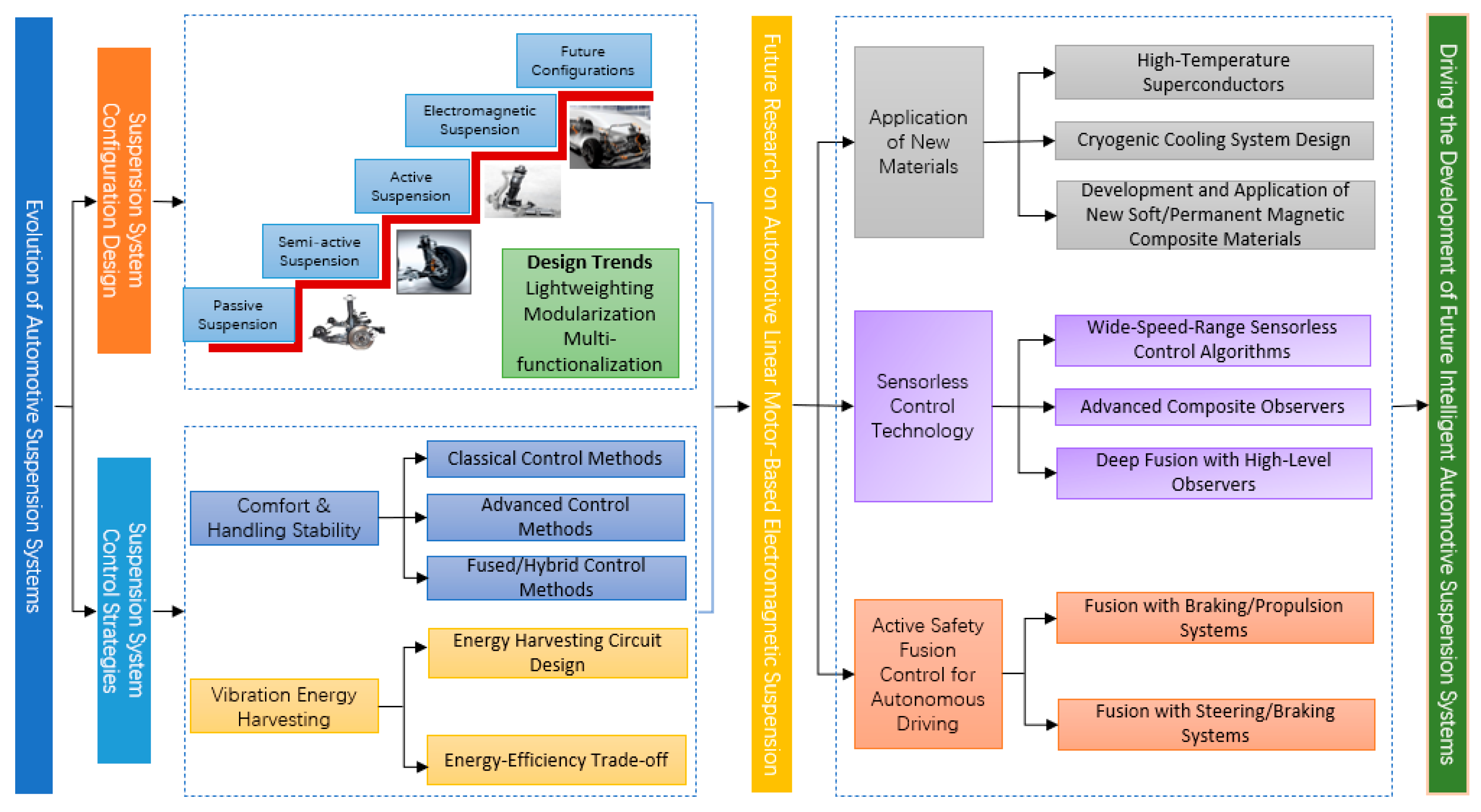
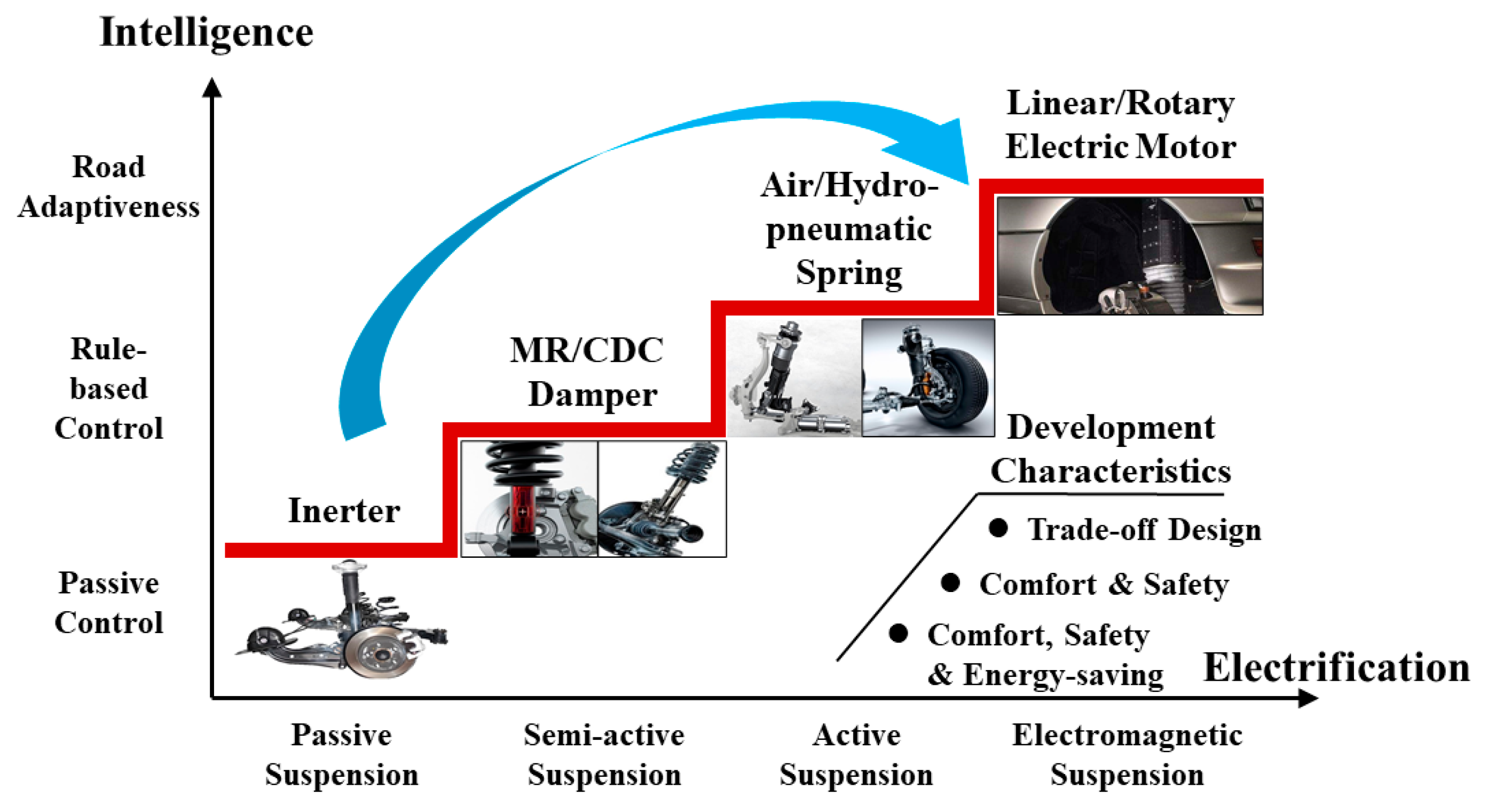
The conceptual framework for this evolution is depicted in Figure 1. The development of automotive suspension systems has followed a defined sequence, evolving through passive, semi-active, and active configurations, with electromagnetic suspension representing the current frontier. This progression corresponds to a sequential enhancement in control capability: from fixed passive mechanisms, to rule-based semi-active adjustments, to adaptive active control utilizing real-time road inputs, and more recently, to intelligent control strategies that incorporate predictive information and high-level decision-making. It is now heading towards intelligent control that incorporates predictive analytics and high-level decision-making processes. This technological maturation has been propelled by innovations in critical hardware components such as variable dampers (for instance, Magnetorheological (MR) and Continuous Damping Control (CDC) systems), alongside active elements like air springs. The culmination of these advancements is evident in the deployment of electromagnetic actuators characterized by their high dynamic response rates. The development trends within automotive suspension demonstrate clear trajectories toward intellectualization and electrification. This technological pathway directly addresses the core challenge of the comfort-handling trade-off in conventional suspension design. The aim is to collectively enhance performance across multiple domains—ride comfort, handling stability, and energy efficiency—to satisfy the stringent and integrated requirements of future intelligent electric vehicle platforms.
Figure 1.
Technology evolution roadmap of automotive suspension.
In passive suspensions, employing low damping is advantageous for mitigating body resonance and enhancing comfort. However, this approach results in suboptimal control of wheel hop and diminished tire grip. Conversely, utilizing high damping effectively suppresses wheel hop to ensure handling performance but also transmits more high-frequency vibrations to the vehicle chassis, thereby compromising comfort. As a result, the parameters selected for a passive suspension represent a compromise directed toward achieving specific evaluation metrics, making it unattainable to realize optimal performance across all operating conditions. In recent years, advancements in electrohydraulic and active air suspensions have made notable strides by enabling active control of ride height and suspension forces through sophisticated control algorithms. This development effectively enhances vehicle performance [24,25]. Nevertheless, these active suspension systems still face challenges such as structural complexity, elevated costs, significant energy consumption, limited response speed and control bandwidth, along with an increase in unsprung mass [26,27].
Precisely due to the irreconcilable conflicts inherent in traditional passive suspensions and the considerable application hurdles faced by existing mainstream active suspensions concerning cost-efficiency, energy demands, and responsiveness, novel suspension technologies exhibiting strong potential have garnered extensive attention. Among these, the linear motor-based electromagnetic suspension is prominent. Its straightforward architecture, rapid response, precise control, and energy regeneration capabilities position it as a key solution to the aforementioned challenges and a fundamental driver for the development of next-generation chassis systems.
1.4. Scope and Structure of This Review
The preceding sections have detailed the research background, developmental needs, and technological advantages of vehicle suspensions, as well as the application challenges of mainstream active suspension systems. Given these advantages, linear motor-based electromagnetic suspension has emerged as a critical development direction for next-generation high-performance suspensions. Therefore, to thoroughly elucidate the current research status and developmental trajectory of this technology, this review will subsequently focus on two core areas: (1) the configuration design of linear electromagnetic actuators, and (2) control methodologies. The former constitutes the physical embodiment and hardware foundation for achieving superior mechanical output, while the latter provides the theoretical underpinnings and control strategies essential for realizing intended performance objectives and multi-objective optimization.
2. Research on Configurations of Linear Motor-Based Electromagnetic Suspension

2.1. Motor Types and Topologies
As the essential actuation component of a linear motor-based electromagnetic suspension system, the design configuration and type selection of the electromagnetic actuator serve as foundational elements that determine the overall performance of the system [28]. Various motor types and topologies exhibit considerable differences in thrust density, dynamic response, control complexity, energy conversion efficiency, and manufacturing costs. Consequently, research focusing on their configuration design is fundamental within this domain.
2.1.1. Moving-Coil Linear Motor (Voice Coil Actuator, VCA)
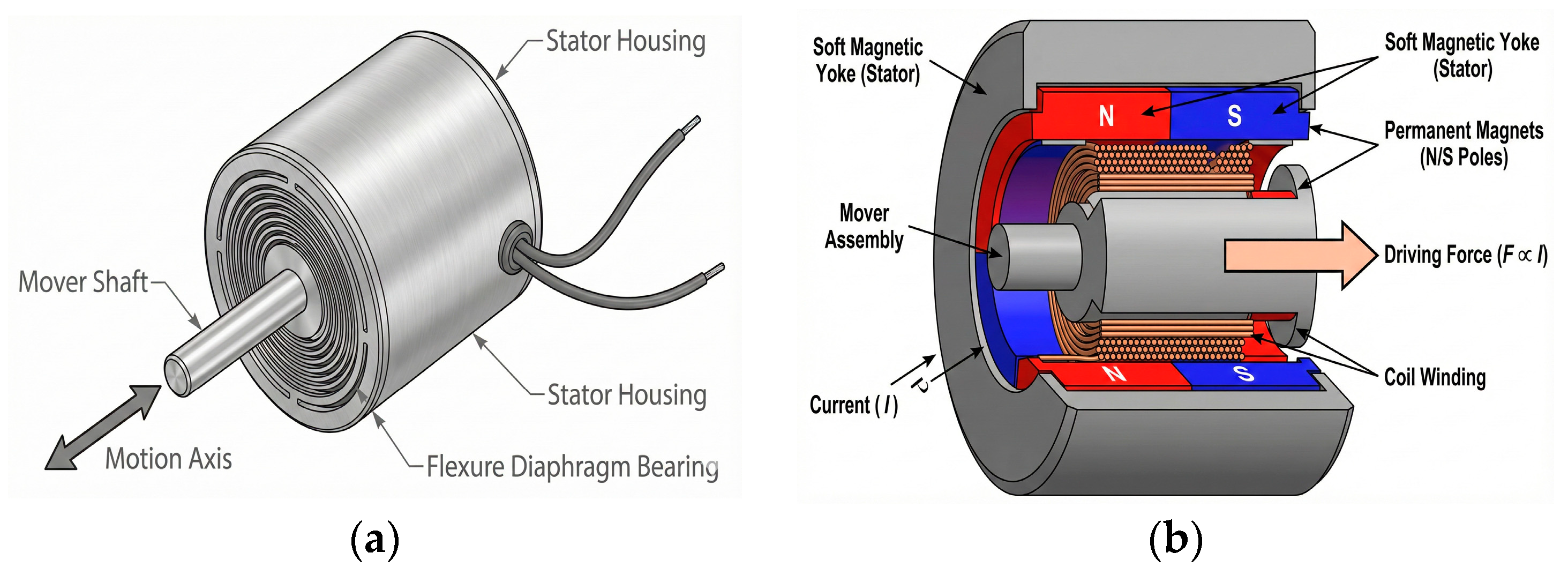
The moving-coil linear motor, commonly referred to as the Voice Coil Actuator (VCA), features a simple yet effective structure comprising a permanent magnet field assembly paired with coil windings, as shown in Figure 2. By applying an electric current through the coil, a driving force proportional to the current’s magnitude is generated within the magnetic field. Initially employed extensively in applications such as audio loudspeakers and magnetic head positioning for hard disk drives, VCAs are favored for several advantages including high acceleration capabilities, rapid response times, hysteresis-free operation, straightforward construction, smooth thrust output characteristics, and ease of achieving precise linear control. These benefits have led scholars to investigate their potential applications in high-performance control fields such as active suspension systems.
Figure 2.
Structure of a moving-coil linear motor: (a) three-dimensional schematic of the actuator assembly; (b) cross-sectional view illustrating the arrangement of permanent magnets and coil windings.
Focusing on the application of Voice Coil Actuators (VCAs) in precision motion control, Okyay et al. [29] proposed a comprehensive design and optimization methodology for cylindrical VCAs. They employed Finite Element Analysis to carry out parameter optimization with the dual objectives of maximizing acceleration and minimizing thermal dissipation. By decoupling the selection of coil specifications from performance optimization, they established a theoretical foundation for designing high-dynamic-performance VCAs, thus achieving performance enhancement at the structural level. Feng et al. [30] conducted a comparative analysis of two typical Voice Coil Motor (VCM) configurations and clearly elucidated their derivative relationship, providing an intuitive conceptual model for understanding the interconnections among various VCM structures. Luo et al. [31] innovatively integrated a VCA into an active suspension system. In their test rig, they connected the mover of the moving-coil motor to the wheel while linking the stator to the vehicle body. A parallel coil spring was incorporated to jointly support the load applied by the vehicle body, resulting in a complete quarter-car physical model representing an active suspension system.
Despite the theoretical advantages of Voice Coil Actuators (VCAs) as active suspension actuators—due to their technical characteristics including rapid transient response, backlash-free direct drive, and high control linearity—their commercialization continues to confront several fundamental obstacles that appear insurmountable. The primary technical bottleneck is their excessively high energy dissipation. To produce the significant control forces necessary for effective suspension operation, a VCA must function at elevated peak currents, resulting in instantaneous power consumption levels reaching several hundred kilowatts—vastly exceeding the supply capacity of conventional vehicle energy systems. Additionally, their inherently limited thrust density, combined with challenges in achieving force amplification through mechanical structures, restricts their applicability on heavy-duty platforms. Furthermore, the substantial thermal effects induced by high current usage not only disrupt control accuracy due to fluctuations in coil resistance but also present considerable challenges for system thermal management design. This challenge ultimately increases complexity, cost, and weight implications. Lastly, the considerable mass of the actuator itself can adversely affect unsprung mass dynamics and thereby compromise overall vehicle handling performance. In conclusion, this combination of technical constraints has collectively relegated VCA-based active suspension solutions primarily to theoretical research stages and experimental validation efforts.
2.1.2. Moving-Magnet Linear Motor (Permanent Magnet Synchronous Linear Motor, PMSLM)
The Permanent Magnet Synchronous Linear Motor (PMSLM) employs high-energy-product rare-earth permanent magnet materials, such as Neodymium Iron Boron (NdFeB), as its excitation source. This design eliminates the need for additional excitation windings and the corresponding excitation losses, thereby achieving exceptionally high energy conversion efficiency and power factor. In particular, within the moving-magnet configuration, the armature winding—responsible for generating a significant amount of heat—is positioned in the stator. This strategic placement facilitates an efficient connection to the vehicle chassis or other heat-dissipating structures, forming an effective thermal pathway. Consequently, this design mitigates the thermal bottleneck often encountered in moving-coil actuators (VCAs), ensuring both thermal stability and operational reliability under conditions of high power and long strokes [32].
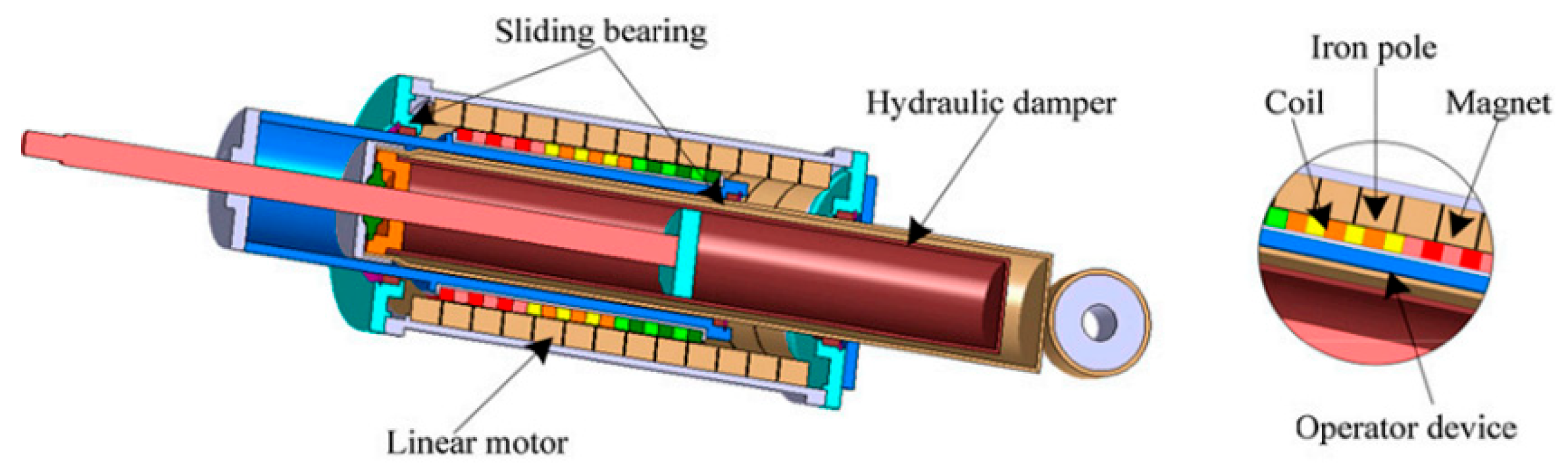
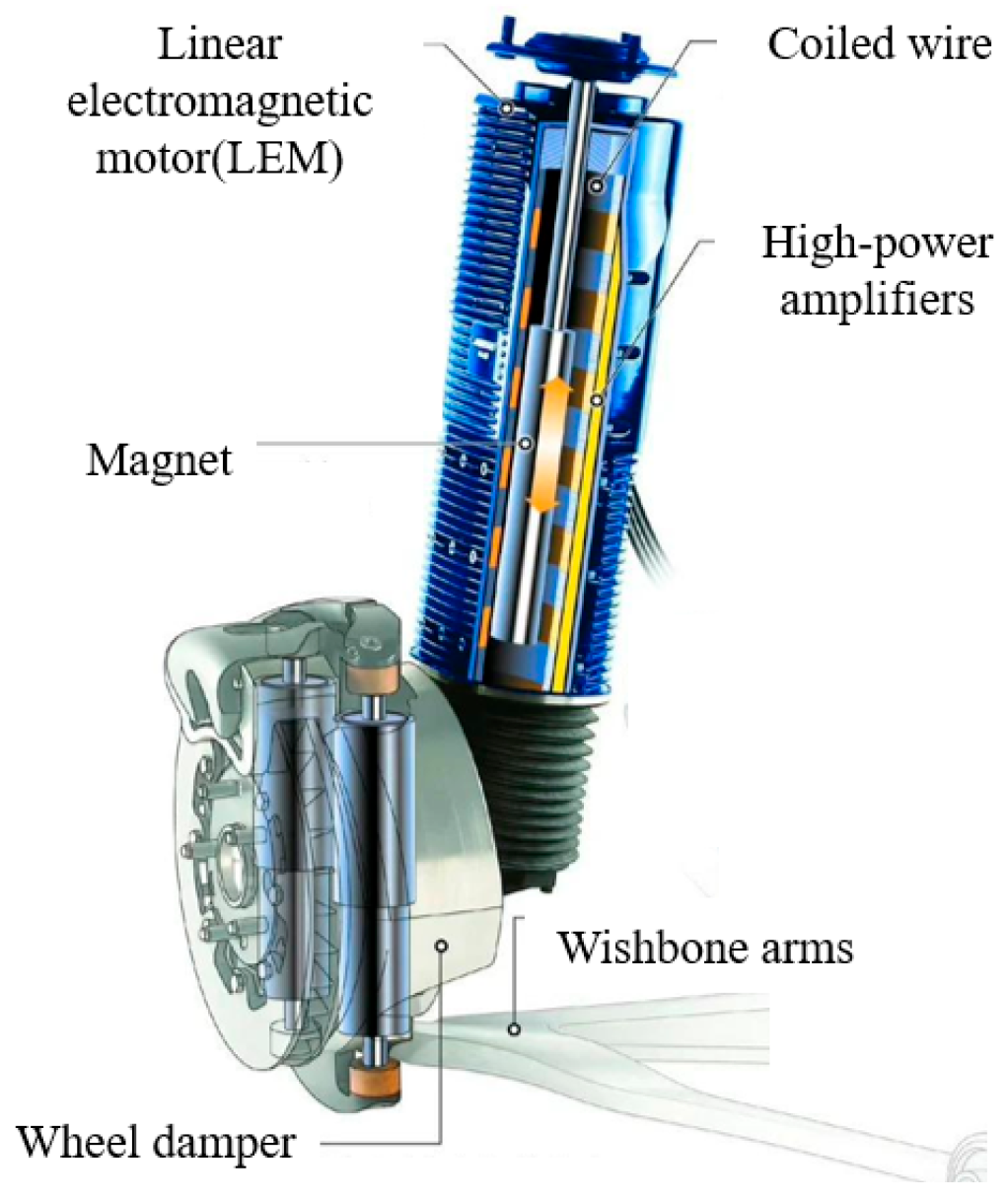
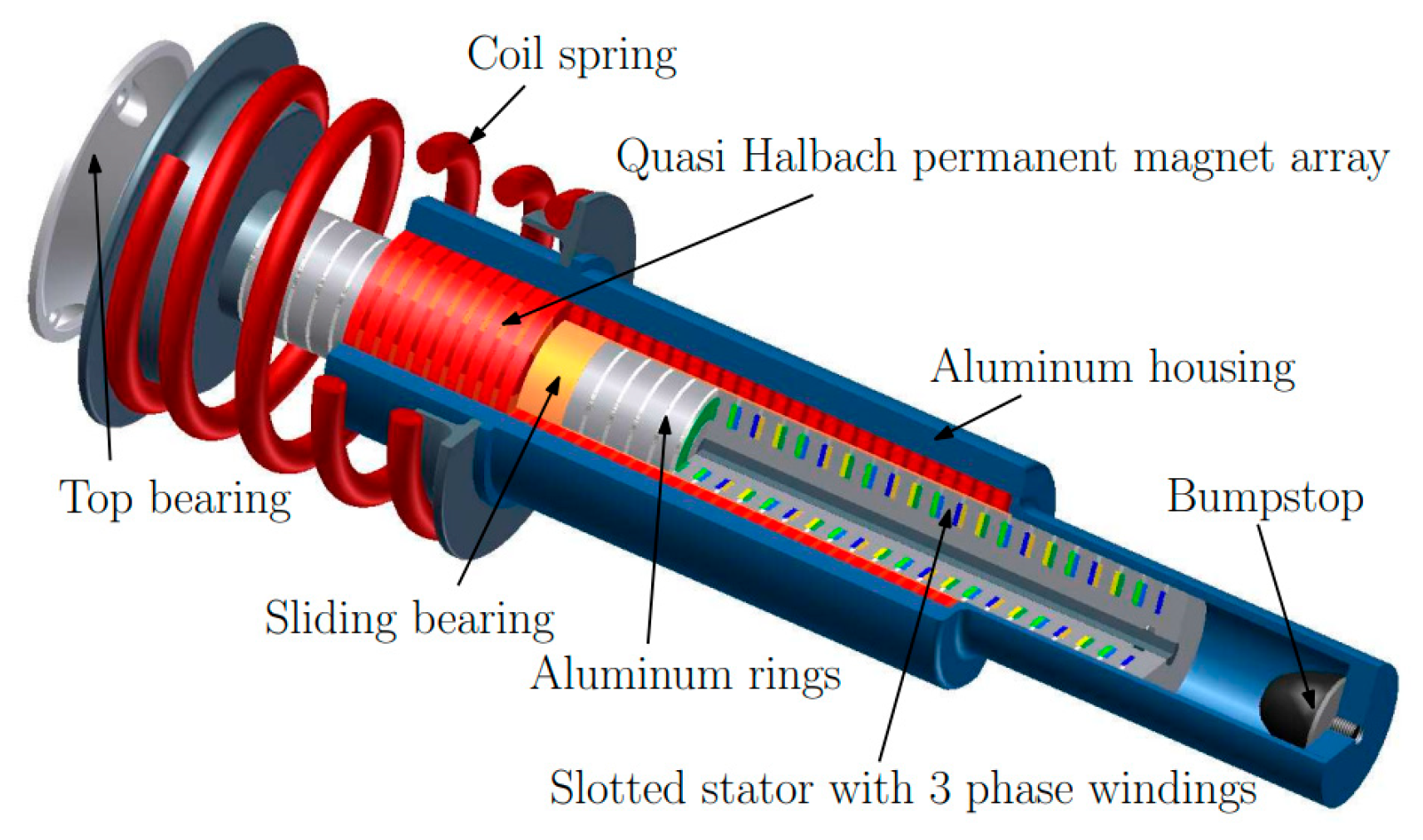
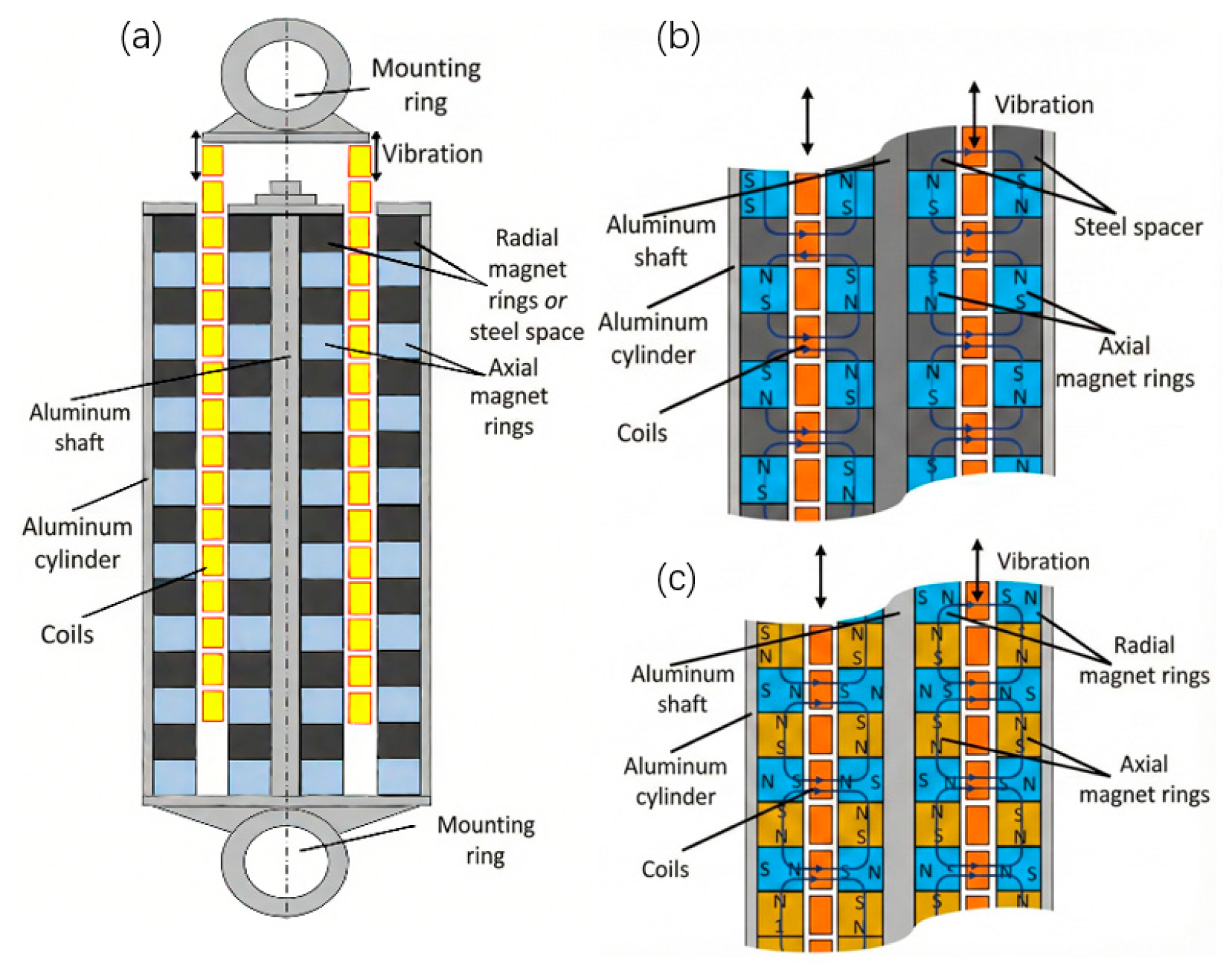
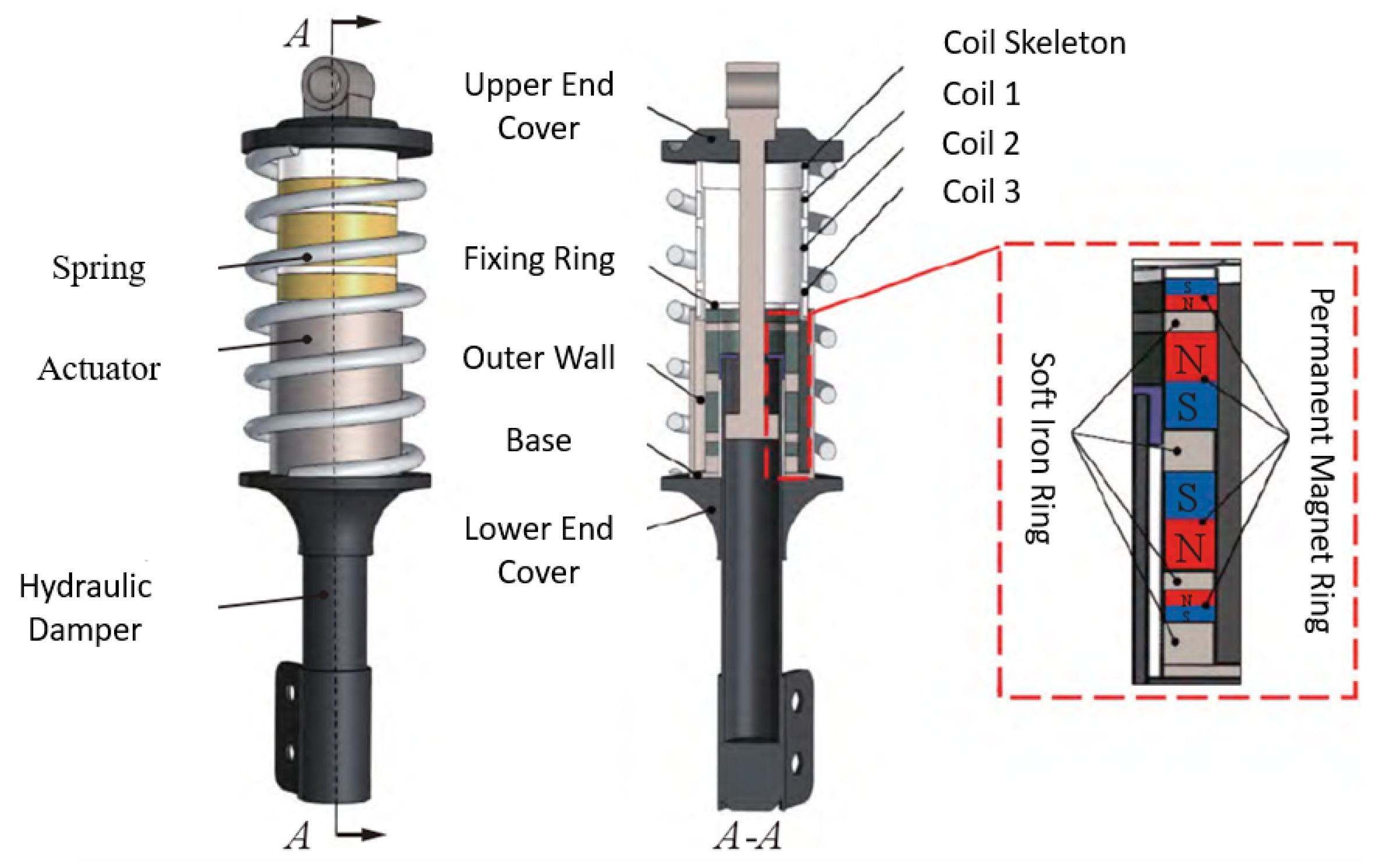
As shown in Figure 3, Bose Corporation publicly showcased its independently developed linear motor-based electromagnetic suspension system on a Lexus LS400. The test results indicated that the electromagnetic suspension achieved what can be described as a “perfect” control effect—characterized by “no squat during acceleration, no dive during braking, no roll during cornering, and no shaking over bumps” [33]. Professor Kim from Texas A&M University [34,35] has designed various control methods for application to linear electromagnetic actuators, demonstrating that linear electromagnetic active suspensions can significantly enhance vehicles’ dynamic performance. Researchers Gysen et al. [36,37,38] from Eindhoven University of Technology in the Netherlands proposed an active electromagnetic suspension system featuring a tubular permanent magnet actuator arranged in parallel with a passive spring, as shown in Figure 4. This design also incorporates integrated passive eddy-current damping, which employs the eddy-current effect to generate damping force, thereby improving energy utilization efficiency under diverse driving conditions. As shown in Figure 5, Ding et al. [27,39,40] from Jiangsu University have innovatively combined a permanent magnet synchronous linear motor with a variable reluctance motor to achieve a highly integrated and compact structure. This configuration enables synergistic operation of the actuators: the PMLSM delivers high-dynamic-response active control forces while the VRM provides variable passive damping/stiffness forces with reduced energy consumption, thus achieving functional complementarity. Tang et al. [41] from Stony Brook University in the USA built upon a single-layer tubular linear electromagnetic actuator by replacing the conventional soft magnetic steel spacer rings with radial magnets. They also introduced a dual-layer magnet configuration that integrates both axial and radial magnets, as shown in Figure 6. This innovative dual-layer design achieved superior power density and damping density. Furthermore, Sun et al. [42,43] from Shenyang University of Technology incorporated a linear motor between the spring and the damper, thereby endowing the suspension system with dual functionalities: active control and energy harvesting, which demonstrated effective body attitude control under complex operating conditions, which is shown in Figure 7.
Figure 3.
The linear motor-based electromagnetic suspension developed by Bose Corporation (Framingham, MA, USA).
Figure 4.
The linear electromagnetic actuator proposed by the Eindhoven University of Technology.
Figure 5.
The linear motor actuator designed by Ding et al. [27,39,40]: Schematic of the hybrid electromagnetic actuator.
Figure 6.
Double-layer LETs designed by Tang et al. [41]: (a) Overview, (b) With axial magnets and steel spacers, (c) With both axial and radial magnets.
Figure 7.
The linear hybrid electromagnetic actuator designed by Sun et al. [42,43].
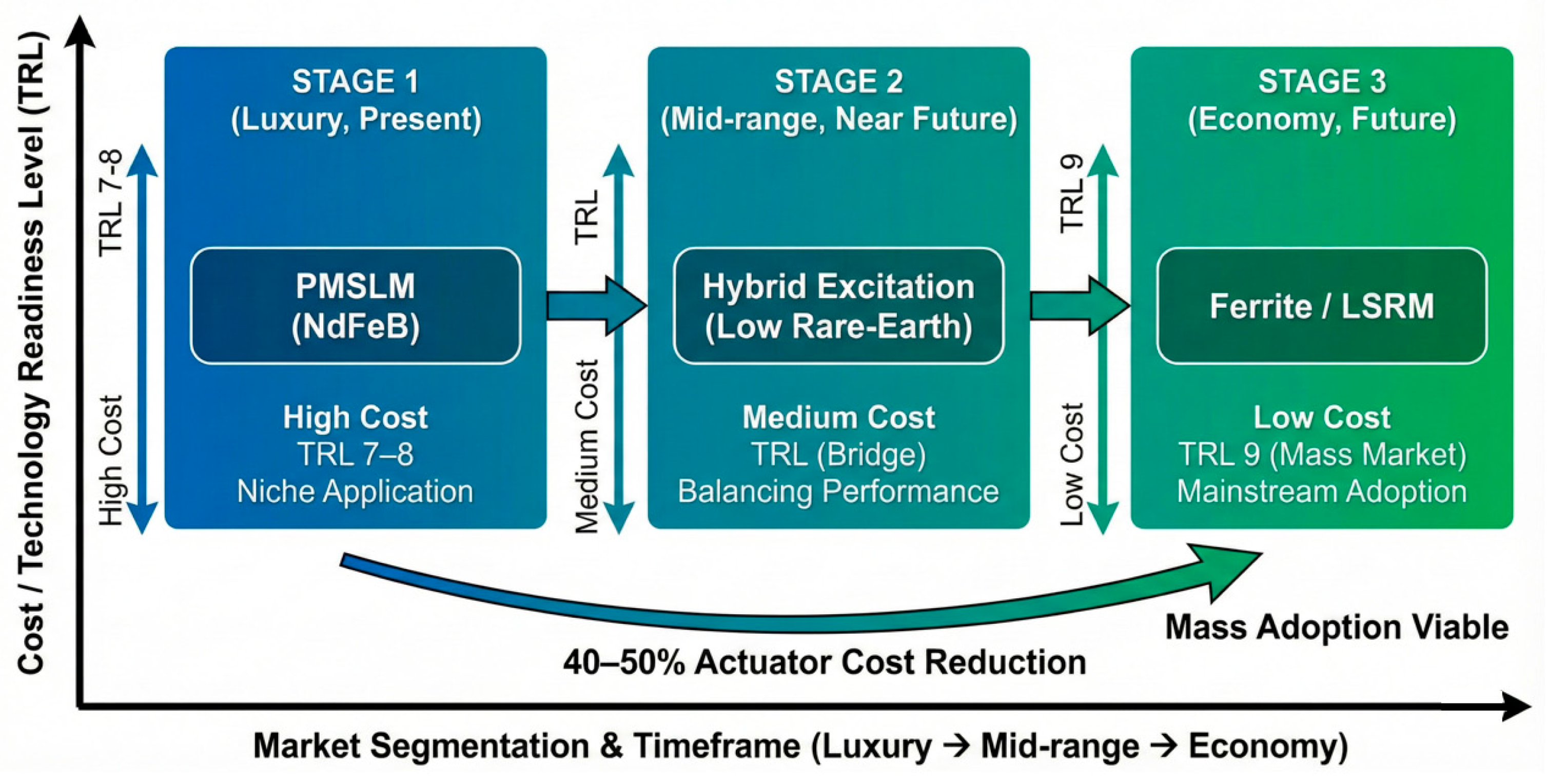
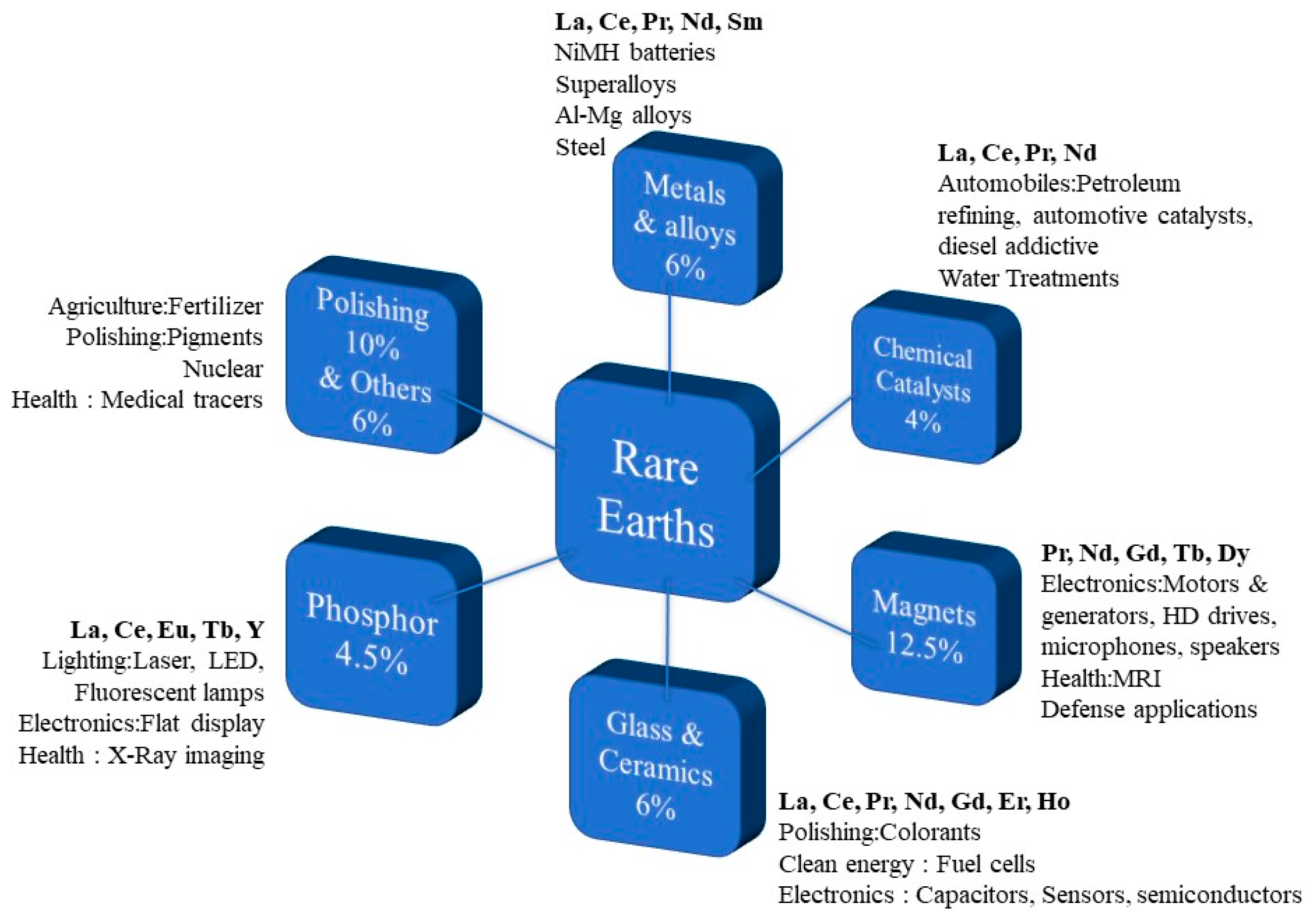
Despite its dominant position in configuration design, the PMSLM confronts three intrinsic limitations that hinder its widespread application. The first is electromagnetic nonlinearity. Interactions between stator slots and permanent magnets, combined with end effects, generate inherent cogging forces and thrust ripples. These parasitic fluctuations disrupt control smoothness, particularly during low-speed micro-movements. Furthermore, magnetic field saturation introduces strong nonlinearities during high-speed operation. These characteristics often couple with mechanical vibrations, which significantly complicates the development of accurate models and robust control strategies. The second challenge is thermal instability. PMSLMs typically rely on sintered Neodymium Iron Boron (NdFeB) magnets for excitation. These materials are highly sensitive to temperature fluctuations. Under continuous high-load conditions, such as driving on rough terrain, the actuator generates substantial heat. Without efficient thermal management, heat accumulation can trigger irreversible demagnetization. This results in permanent performance degradation or even complete actuator failure [44]. The third constraint is economic and industrial viability. The superior performance of PMSLMs depends heavily on rare-earth materials. This dependency drastically elevates manufacturing costs. Moreover, it exposes the technology to supply chain vulnerabilities driven by the geopolitical dynamics of rare-earth resources. These factors currently restrict the adoption of PMSLMs primarily to high-end or specialized vehicle platforms.
2.1.3. Switched Reluctance Linear Motor (LSRM)
The Switched Reluctance Machine (SRM) is a type of motor characterized by its doubly salient pole structure, which operates without permanent magnets or rotor windings, as shown in Figure 8 [45]. Its functioning principles are founded on the minimum reluctance principle; sequential excitation of the stator phase windings generates an electromagnetic field that attracts the salient poles on the mover, thereby facilitating either linear or rotary motion. Owing to its robust construction, cost-effectiveness, high-temperature resilience, and exceptional fault-tolerant capabilities, the SRM is regarded as a formidable candidate for applications in demanding automotive environments, such as integrated starter/generator systems [46].
Figure 8.
Structure of a switched reluctance linear motor.
Nevertheless, the intrinsic doubly salient architecture and pulsed excitation mode of the SRM give rise to significant challenges related to thrust ripple and acoustic noise—issues that remain pivotal constraints on its applicability. Consequently, academic research has predominantly concentrated on advanced control strategies and optimization of motor topology. At the design level of these motors, Ma et al. [47] utilized finite element simulations to explore various methods aimed at actively mitigating thrust ripple through modifications in mover slot geometry. Additionally, considering the highly nonlinear electromagnetic characteristics inherent in SRMs, accurate modeling emerges as a crucial prerequisite for attaining high-performance control solutions. The research conducted by Xue et al. [48] underscored the importance of accounting for intricate factors such as mutual inductance between phases during this modeling process.
Although the switched reluctance motor (SRM) presents several advantages—such as robustness, high-temperature resistance, and impressive fault tolerance due to its lack of permanent magnets—it theoretically offers a highly resilient drive option for automotive applications. However, its significant thrust ripple and acoustic noise, which arise from its doubly salient structure and pulsed excitation, constitute primary technical limitations that impede its adoption in passenger car suspensions. To address these adverse effects, reliance on complex nonlinear models and sophisticated control algorithms with substantial computational demands is necessary. This requirement significantly escalates both the development complexity and cost of the control system. Furthermore, when compared to permanent magnet synchronous motors (PMSMs), SRMs typically exhibit lower power density and efficiency—especially at low speeds—and their distinct power converter topology is inherently more intricate. These combined factors present challenges for SRMs in competing with permanent magnet motors within the realm of passenger car suspensions. Consequently, their application potential tends to be concentrated in specialized vehicles or specific industrial contexts that are less sensitive to noise and vibration or have exceptionally high demands for reliability and temperature resistance [49].
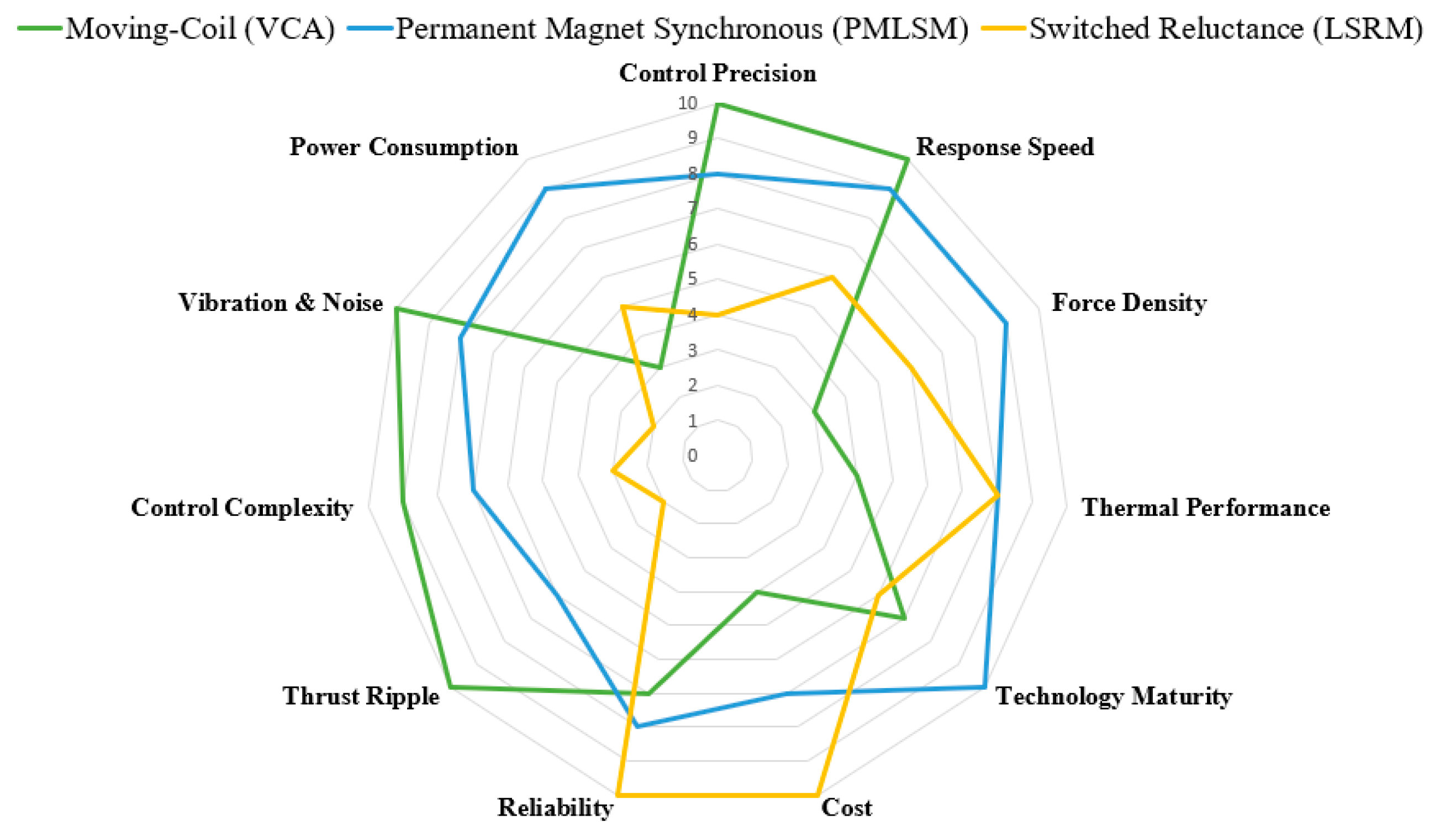
To provide a clearer perspective on the selection of actuator configurations, a comparative summary of the three motor types—focusing on performance, cost implications (specifically rare-earth dependence), and application maturity—is presented in Table 1. This comparison complements the performance radar chart shown in Figure 9.
Table 1.
Comparative summary of typical linear motor configurations for electromagnetic suspension.
Figure 9.
Comparison of the advantages and disadvantages of different linear motor types.
Therefore, the permanent magnet synchronous linear motor (PMSLM) currently represents the most promising mainstream technological pathway for electromagnetic suspension actuators. In contrast to the inherent limitations of moving-coil actuators concerning energy consumption and thermal dissipation, as well as the challenging thrust ripple issues associated with switched reluctance motors, the PMSLM showcases significant advantages in terms of power density, energy efficiency, and thermal management. While it does encounter challenges such as cogging force, these are considered engineering problems that can be addressed through design optimization and advanced control algorithms. This firmly establishes its pivotal role in the advancement of high-performance active suspensions.
2.2. Challenges in Structural Design
2.2.1. Mass-Volume Optimization
In the field of vehicle dynamics theory, unsprung mass is a critical parameter influencing both ride comfort and handling performance. However, the electromagnetic actuator itself adds considerable mass, and its placement on the vehicle significantly affects the overall unsprung mass. Consequently, a fundamental design challenge arises: how to maximize reductions in the volume and weight of the actuator while ensuring adequate thrust output [50,51].
Jiang et al. [52] employed a multi-objective topology optimization method for the housing and brackets of the actuator, achieving substantial weight reduction while adhering to stiffness constraints. This approach provides an effective model for lightweight design. Regarding material applications, Vishrut Shah et al. [53] developed an automotive chassis using titanium, aluminum, and carbon fiber composite materials. When compared to traditional steel chassis designs, their innovative structure demonstrated a 64% increase in stiffness alongside a 32% reduction in weight—highlighting the significant potential of new materials for enhancing strength-to-weight ratios. Furthermore, optimizing core motor design to enhance force density can also contribute to equivalent objectives in lightweighting pursuits. For instance, Serdal Arslan’s novel tubular flux-switching permanent magnet linear motor [54] achieved increased force density without noticeably augmenting overall system mass; it exhibited commendable vibration-damping performance within semi-active suspension systems.
2.2.2. Axial Gap and Eccentric Load Compensation
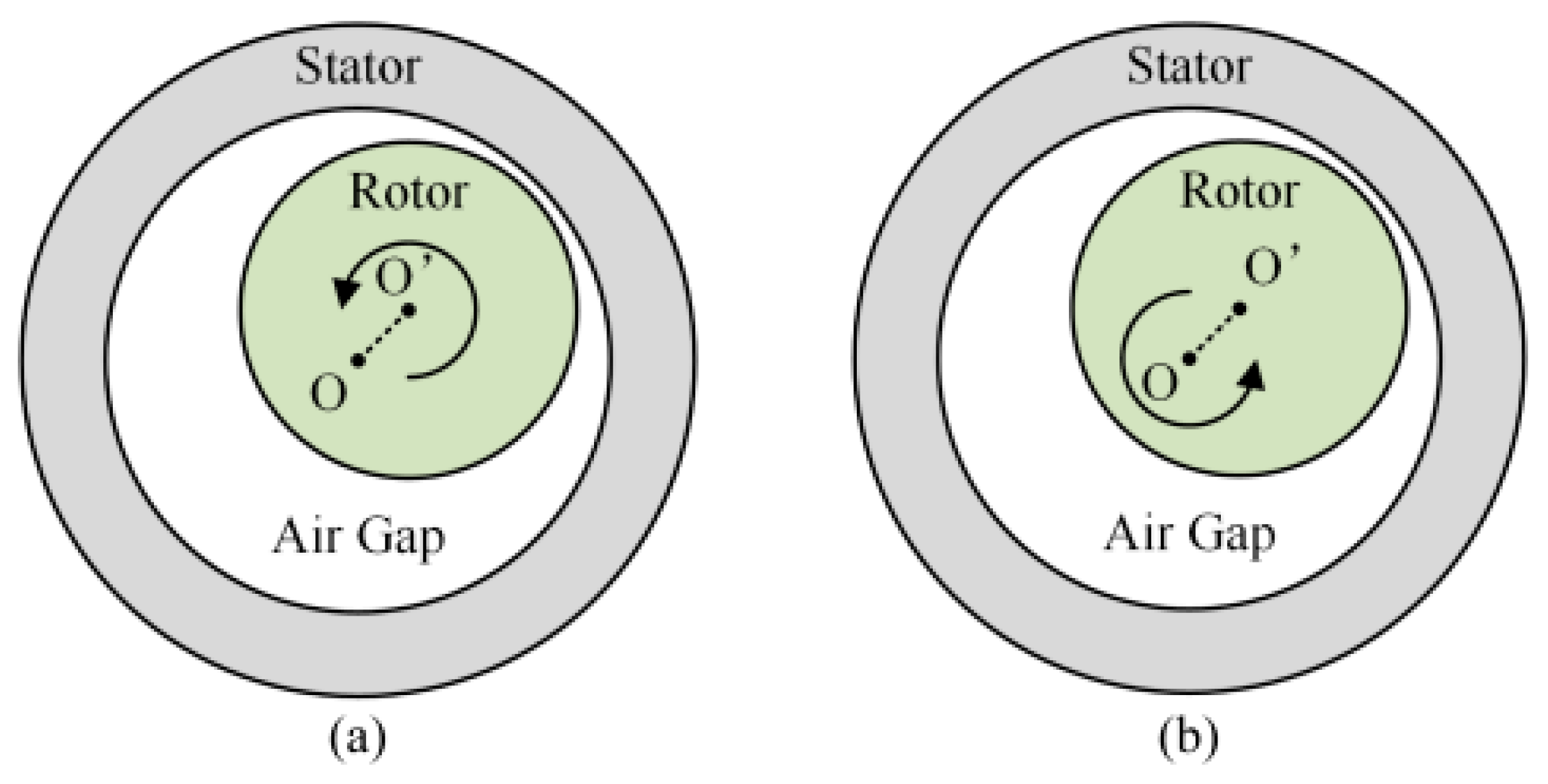
In electromagnetic suspensions utilizing linear motor technology, the performance of the actuator is highly contingent upon maintaining a precise and uniform radial air gap between the stator and the mover. However, under real-world vehicle operating conditions—such as during cornering or braking—the suspension actuator experiences considerable lateral loads that result in radial eccentricity of the mover relative to the stator, as shown in Figure 10. This eccentricity disrupts the symmetry of the magnetic field within the air gap, thereby generating a detrimental radial parasitic force commonly referred to as Unbalanced Magnetic Pull (UMP) [55]. The presence of UMP further exacerbates this eccentricity of the mover. Not only does this force lead to increased friction and wear within the guidance mechanism, but it also induces vibration and noise. More critically, UMP significantly compromises control accuracy over the actuator’s primary thrust. In extreme instances, it can even provoke mechanical contact between the mover and stator, potentially leading to systemic failure. As a consequence, effectively compensating for lateral loads while minimizing UMP represents a fundamental challenge in designing robust electromagnetic suspensions.
Figure 10.
Schematic of mover eccentricity: (a) static eccentricity, (b) dynamic eccentricity.
Current research on the suppression of Unbalanced Magnetic Pull (UMP) predominantly centers around passive strategies, which are achieved through the optimization of both the motor’s electromagnetic configuration and its mechanical structure. At the electromagnetic design level, researchers have explored various avenues. Xinjie Wen et al. [56] employed a parallel winding structure and selected an appropriate slot-pole combination to significantly enhance the actuator’s inherent robustness against eccentric loads without complicating control mechanisms. Drawing upon magnetic field modulation theory, Yang Gongde et al. [57] proposed optimizing structural parameters to adjust the initial phase of key harmonics, thereby improving the self-cancellation effect among different harmonic components of UMP. At the mechanical structure level, Dongwen Wang et al. [58] advanced a strategy for optimizing support points within the rotor-bearing system. Their findings indicated that simply adjusting the relative positions of components could reduce maximum vibration acceleration due to UMP by 54.9%. Furthermore, an accurate UMP model serves as a fundamental basis for both design optimization and active control techniques. Emami et al. [59] innovatively simplified UMP calculations into a second-order algebraic vector function based on stator current variables. This model not only maintains high concordance with results from Finite Element Analysis (FEA) but also enhances computational speed by several orders of magnitude.
2.2.3. Thermal Management Technology
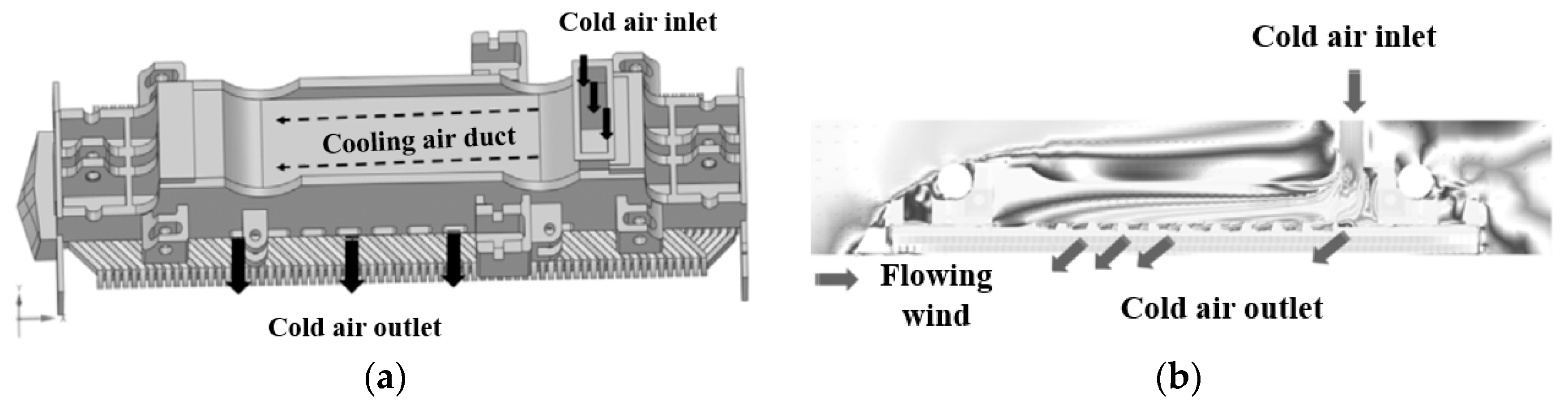
Thermal management plays a pivotal role in ensuring the stable performance and operational reliability of electromagnetic suspension actuators operating under high-power, long-stroke conditions. When these actuators continuously deliver high thrust to contend with rough roads or aggressive driving scenarios, significant heat is generated due to copper losses in the windings and iron losses in the core. If this heat cannot be efficiently dissipated, a rapid increase in temperature within the motor can result in a series of severe complications. Consequently, for automotive active electromagnetic actuators, passive cooling via natural convection proves inadequate. An effective active cooling system must be devised, with current research primarily focusing on two technical approaches: forced-air cooling and liquid cooling, as shown in Figure 11.
Figure 11.
The improved linear motor with an air duct and its cooling airflow diagram: (a) three-dimensional structural schematic of the motor housing; (b) cross-sectional view showing the cooling airflow distribution.
Forced-air cooling technology offers simplicity in structure and cost-effectiveness; however, its capacity for heat dissipation remains limited [60]. Research efforts are dedicated to enhancing its cooling efficiency. Shewalkar et al. [61], through thermal analysis, quantified how variations in cooling air velocity affect the internal temperature distribution and hotspot locations within permanent magnet synchronous motors. In order to address the limitations associated with conventional air-cooling methods, Zhang Yongcai et al. [62] developed a design featuring an integrated through-type air duct that significantly improved both cooling efficiency and temperature uniformity by expanding the convective heat transfer area. Furthermore, Li Xunbao et al. [63] established a comprehensive design process encompassing loss calculations, multiphysics simulations, and experimental validation—systematically analyzing how key parameters of the cooling fan (air volume and air pressure) impact motor temperature rise thus providing quantitative data essential for engineering decision-making.
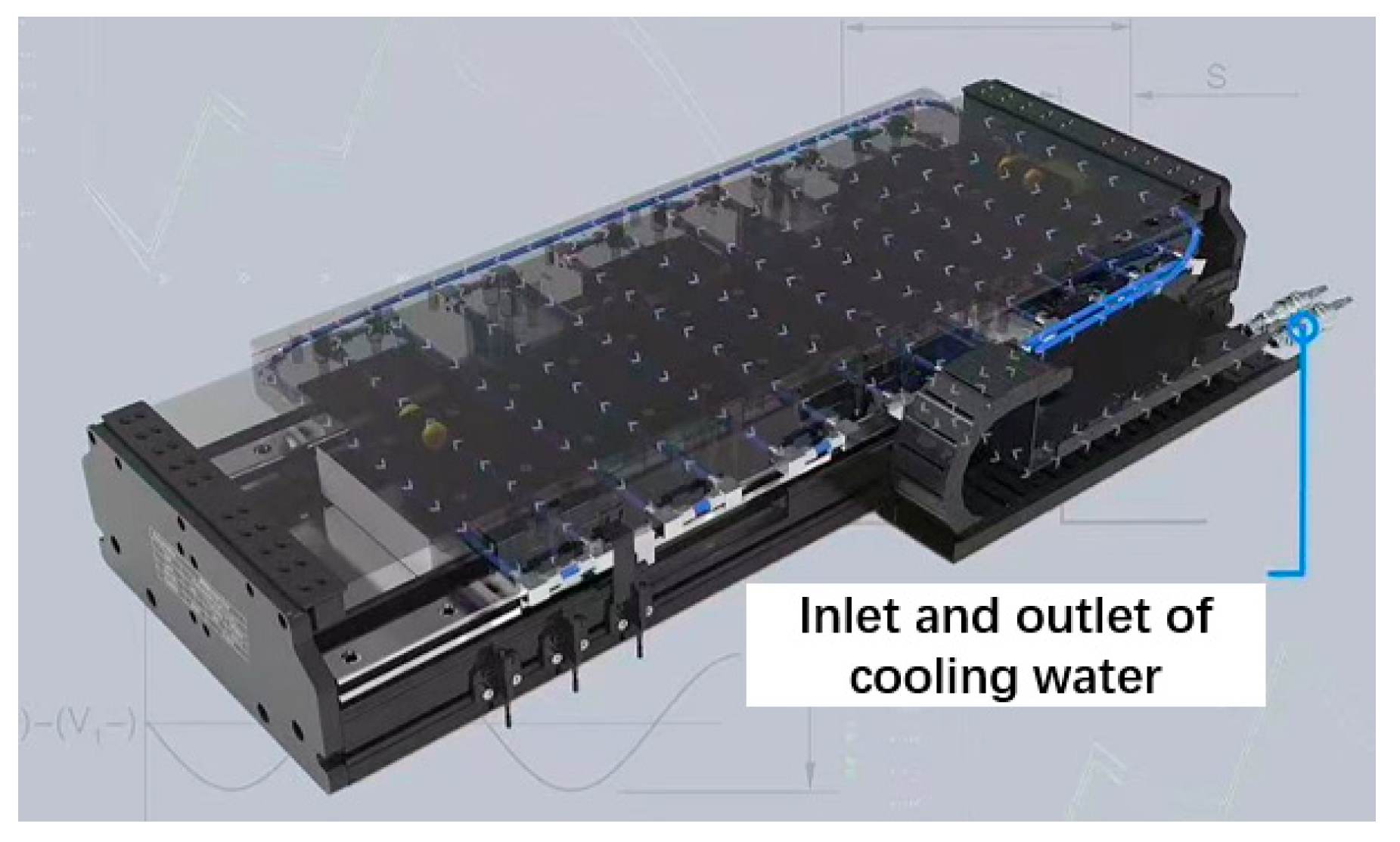
Liquid cooling technology is widely acknowledged as the most effective method for heat dissipation in high-performance electromagnetic suspensions, as shown in Figure 12. Current research emphasizes the structural optimization of cooling channels alongside multi-physics coupling analysis. Rui Xu [64] and Weihua Chen [65], among others, have proposed innovative liquid cooling configurations, including an embedded interleaved dual-channel design and a double-layer spiral structure. Utilizing techniques such as electromagnetic-thermal-fluid multi-physics coupling modeling and multi-objective genetic algorithms, these researchers optimized the geometric parameters of the water channels to achieve a synergistic reduction in both peak motor temperature and temperature non-uniformity. Moreover, research efforts have expanded towards integrated systems. Zhu Jiyuan et al. [66] conceptualized a comprehensive integrated water-cooling solution for a dual-axis linear motor module that encompassed the motor stator, slider, and ball screw, yielding impressive results.
Figure 12.
A permanent magnet synchronous linear motor with a water-cooling structure.
2.2.4. Reliability Technology
As a critical component of the chassis that directly impacts driving safety, the electromagnetic suspension actuator must demonstrate exceptional reliability throughout the vehicle’s entire lifecycle—potentially extending over a decade or encompassing hundreds of thousands of kilometers—while functioning in challenging in-vehicle environments characterized by extreme temperatures, high humidity, salt spray corrosion, gravel impact, and high-frequency vibrations. Consequently, designing for its reliability presents a systematic engineering challenge that involves addressing sealing and protection issues, shock and vibration resistance, and wear prevention. These efforts are all aimed at ensuring stable performance and functional safety of the actuator across its full operational lifespan.
Sealing and environmental protection form the cornerstone of actuator reliability; their primary objective is to prevent external contaminants such as moisture and dust from penetrating the system. Typically, protection levels are required to meet IP67 standards [67]. This level of safeguarding is accomplished through optimized designs for sealing components as well as comprehensive evaluations of the sealing structure itself. Jie Wei Li et al. [68] employed Finite Element Analysis (FEA) to pinpoint key mechanical failure factors associated with a Y-shaped sealing ring; they effectively enhanced both wear resistance and service life by optimizing its lip geometry. At a structural level, Yi Xiaojun et al. [69] also utilized FEA to perform modal and stress analyses on the sealing cylinder of a tubular linear motor in order to assess dynamic characteristics alongside structural integrity under complex excitations—thereby ensuring robust protection for internal core components.
To endure instantaneous high-intensity loads, such as those encountered during road impacts, it is essential to enhance mechanical robustness. A pivotal process in this enhancement is potting (or encapsulation) [70], which entails the application of materials like thermally conductive epoxy resin to vacuum-infill the stator windings and permanent magnets, subsequently curing them into a high-strength, void-free solid unit. This method significantly improves the shock and vibration resistance of internal components while also aiding in heat dissipation and moisture protection. Furthermore, conducting modal analysis and impact response assessments on critical load-bearing components—such as the housing and brackets—to identify and fortify structural weak points is an indispensable step towards ensuring structural reliability.
Wear protection primarily focuses on the linear guidance mechanism and dynamic sealing elements within the actuator, which are subjected to tens or even hundreds of millions of reciprocating cycles. Prolonged exposure to high-frequency, high-load frictional contact is among the primary contributors to actuator performance degradation (e.g., decreased precision, unusual noise) or even complete failure. Consequently, material selection along with tribological design necessitates special attention. A prevalent solution for achieving prolonged lifespan with low-friction motion involves employing a guide shaft featuring a hardened surface combined with self-lubricating bushings crafted from advanced engineering plastics. Moreover, comprehensive investigation into lubrication dynamics and wear mechanisms between the dynamic seal lip and reciprocating shaft—as well as developing long-lasting greases or utilizing self-lubricating sealing materials—is crucial for maintaining effective sealing performance throughout the entire product lifecycle.
2.3. Summary
This chapter systematically reviewed the configurations of linear motor-based electromagnetic suspensions. By analyzing the electromagnetic topologies, the Permanent Magnet Synchronous Linear Motor (PMSLM) was identified as the mainstream technical pathway due to its superior power density and control performance, despite the cost and thermal challenges discussed in Section 2.1.2. In contrast, while the Switched Reluctance Linear Motor (LSRM) offers cost/robustness benefits, its application is currently constrained by the NVH issues noted in Section 2.1.3. Regarding mechanical design, the review highlighted critical engineering challenges including mass-volume optimization, UMP compensation, and thermal management, summarizing state-of-the-art solutions for creating a robust actuator hardware foundation.
3. Suspension Control Strategies
The development of control strategies for electromagnetic suspension begins with the formulation of fundamental control objectives. These objectives are intricately linked to the key dynamic performance characteristics of the vehicle and are evaluated through a set of quantifiable performance indices. Typically, the control objectives encompass three essential dimensions: ride comfort, handling stability, and energy efficiency.
3.1. Mapping of Structural Challenges to Control Strategies
As discussed in Section 2, linear motor actuators inherently exhibit structural and electromagnetic imperfections, such as thrust ripple, unbalanced magnetic pull (UMP), and thermal parameter drift. While structural optimization can mitigate these issues to some extent, it is often constrained by manufacturing costs and physical limits. Consequently, the burden of “fine-tuning” system performance falls on the control strategy. Control algorithms must not only achieve the primary suspension objectives (comfort and handling) but also act as a “software compensator” for hardware limitations. To provide a clear logical link between the actuator physics (Section 2) and control methodologies (Section 3), Table 2 summarizes the mapping between key structural challenges and their corresponding control solutions.
Table 2.
Mapping of structural/electromagnetic challenges to control solutions.
3.2. Classical Control Methods
Classical control methods are conventionally applied in single-input single-output (SISO) linear time-invariant (LTI) systems. The primary analytical tools utilized within these methods include frequency-domain analysis and transfer function models. Renowned for their intuitive nature, practical applicability, and exceptional problem-solving capabilities in engineering contexts [71], impacts these approaches serve as foundational techniques in this field. In this section, we will analyze three representative methodologies: Skyhook and Groundhook control, Linear Quadratic optimal control, and Proportional-Integral-Derivative (PID) controllers alongside their enhanced algorithms.
3.2.1. Skyhook and Groundhook Control
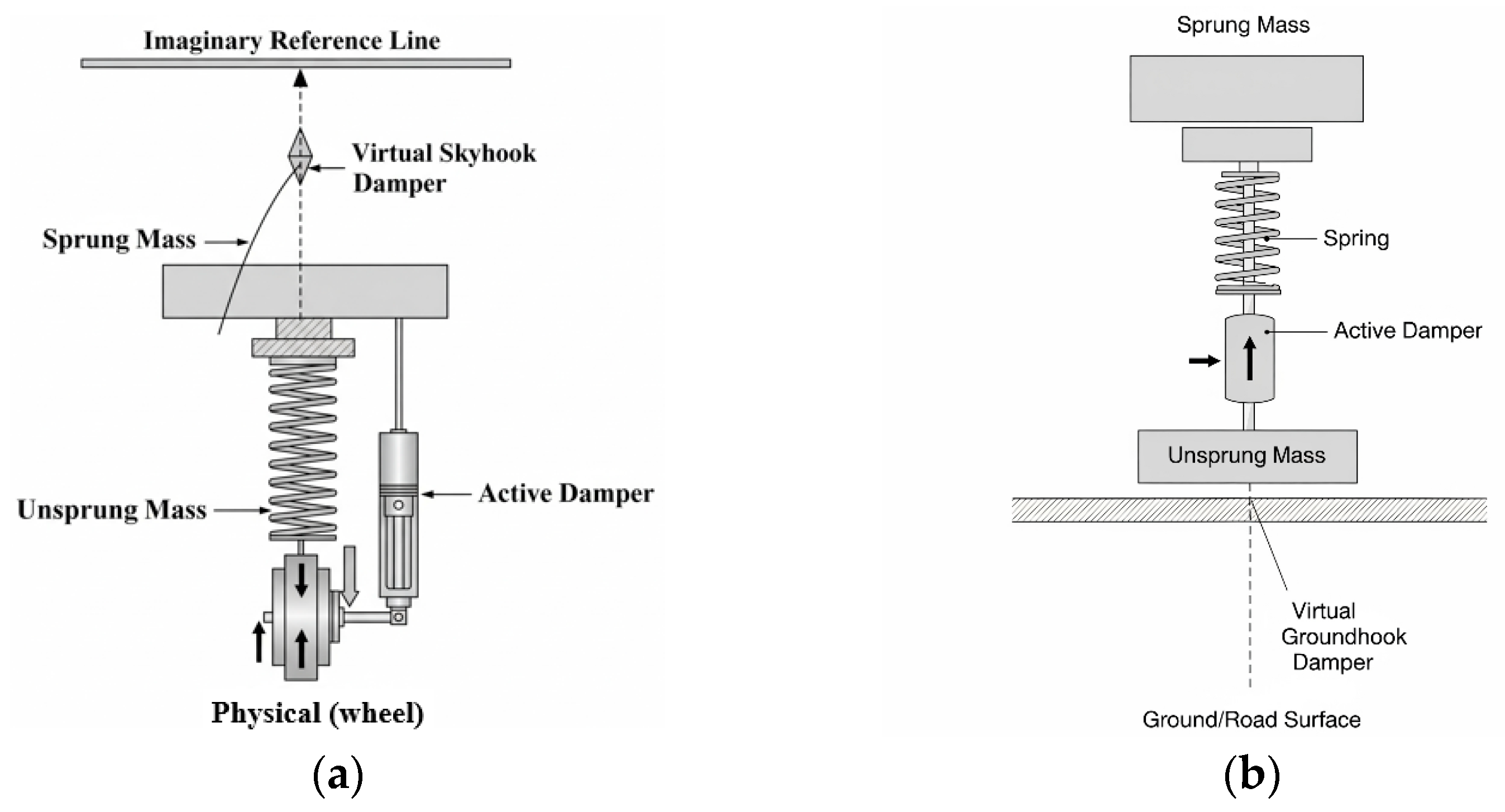
Skyhook and Groundhook control represent two of the most fundamental and classic concepts in the realm of active and semi-active suspension systems, as shown in Figure 13. These approaches aim to address two core yet often conflicting objectives: ride comfort and handling stability. Skyhook control seeks to minimize vehicle body vibrations to enhance ride comfort, while Groundhook control prioritizes improving tire-to-road contact for enhanced handling stability. Given the inherent difficulty in simultaneously achieving both ideal control objectives in practice, recent research efforts have focused on developing advanced hybrid or adaptive control strategies designed to strike an optimal balance between these competing goals.
Figure 13.
Schematic of Skyhook and Groundhook control principles: (a) Skyhook control, (b) Groundhook control.
To synergistically optimize the ride comfort and handling stability of active suspensions, researchers have proposed various Skyhook-Groundhook hybrid control strategies. Early research, such as that by Yerge et al. [72], proposed a controller based on discrete switching logic, which toggled between the two control modes by evaluating the product of the sprung and unsprung mass velocities. To overcome the abruptness of switching control, subsequent research shifted towards hybrid control with continuous adjustment. Changning Liu et al. [73] introduced a frequency-varying adaptive weighting factor. This achieves a dynamic balance of control objectives adapted to road excitation. Similarly, Vu Van Tan et al. [74] utilized a Genetic Algorithm (GA) to search for optimal weighting parameters. This approach offers an automated solution to balance comfort and handling. Yi Yang et al. [75] then integrated Skyhook and Groundhook control into a unified framework. They used Particle Swarm Optimization (PSO) to tune key control parameters offline. To further enhance the controller’s adaptability, researchers have explored more advanced intelligent algorithms. Kou Farong et al. [76] introduced the feedback mechanism of the biological endocrine system into the controller design, constructing a bionic intelligent algorithm that achieved nonlinear, continuous, and adaptive regulation of the control objectives. Liu Zhonghai et al. [77], on the other hand, focused on improving the performance of a single controller. The fuzzy logic Skyhook controller they designed could adjust the damping force online based on the real-time velocities of the vehicle body and suspension, significantly improving ride comfort compared to traditional fixed-gain Skyhook control.
3.2.2. Linear Quadratic Optimal Control (LQR/LQG)
Linear Quadratic Regulator (LQR) is a classic method in active suspension control due to its ability to systematically trade off conflicting performance indices within a unified framework. However, its performance is highly sensitive to the selection of weighting matrices Q and R. Traditional trial-and-error tuning relies heavily on engineering experience and often fails to guarantee a global optimum.
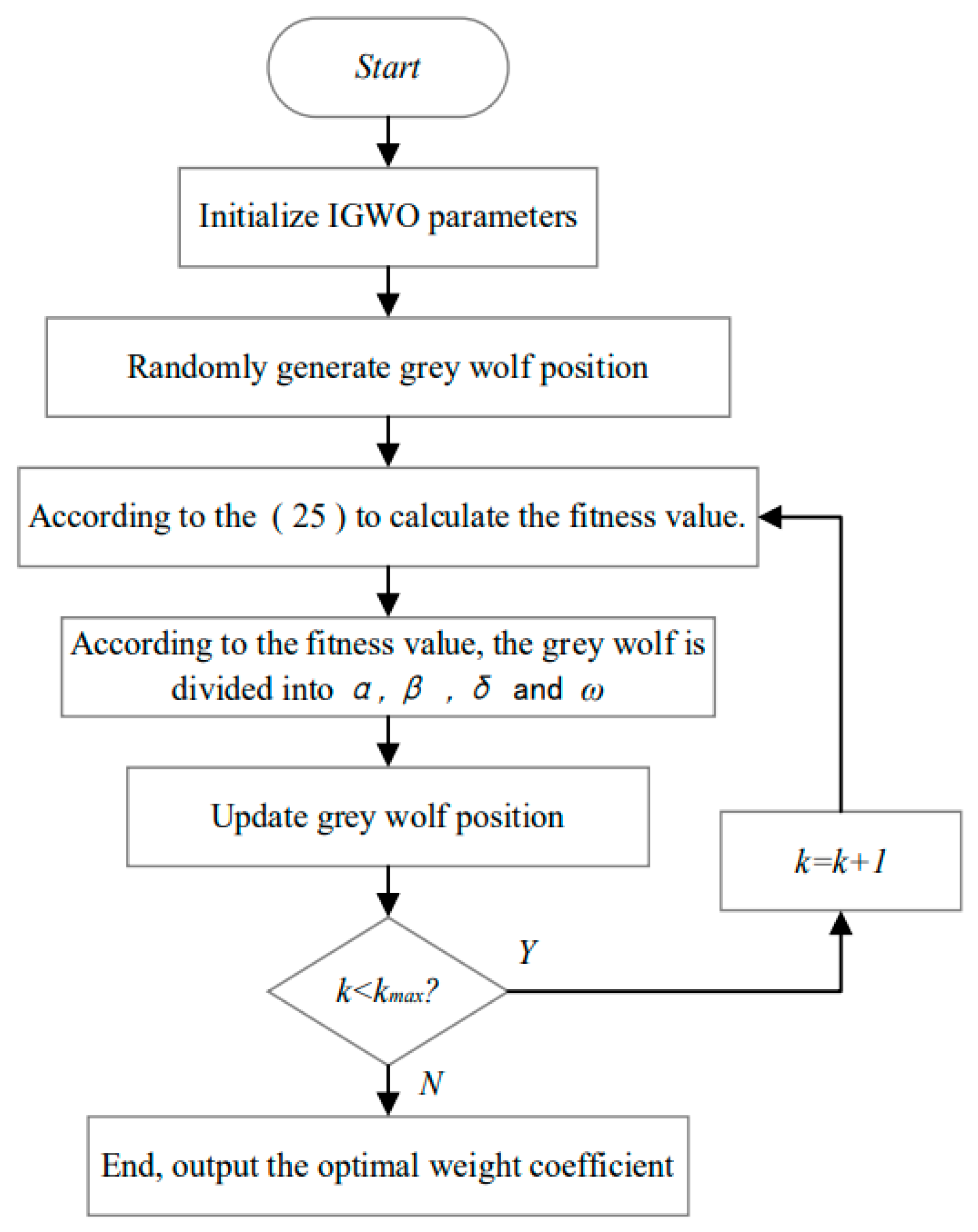
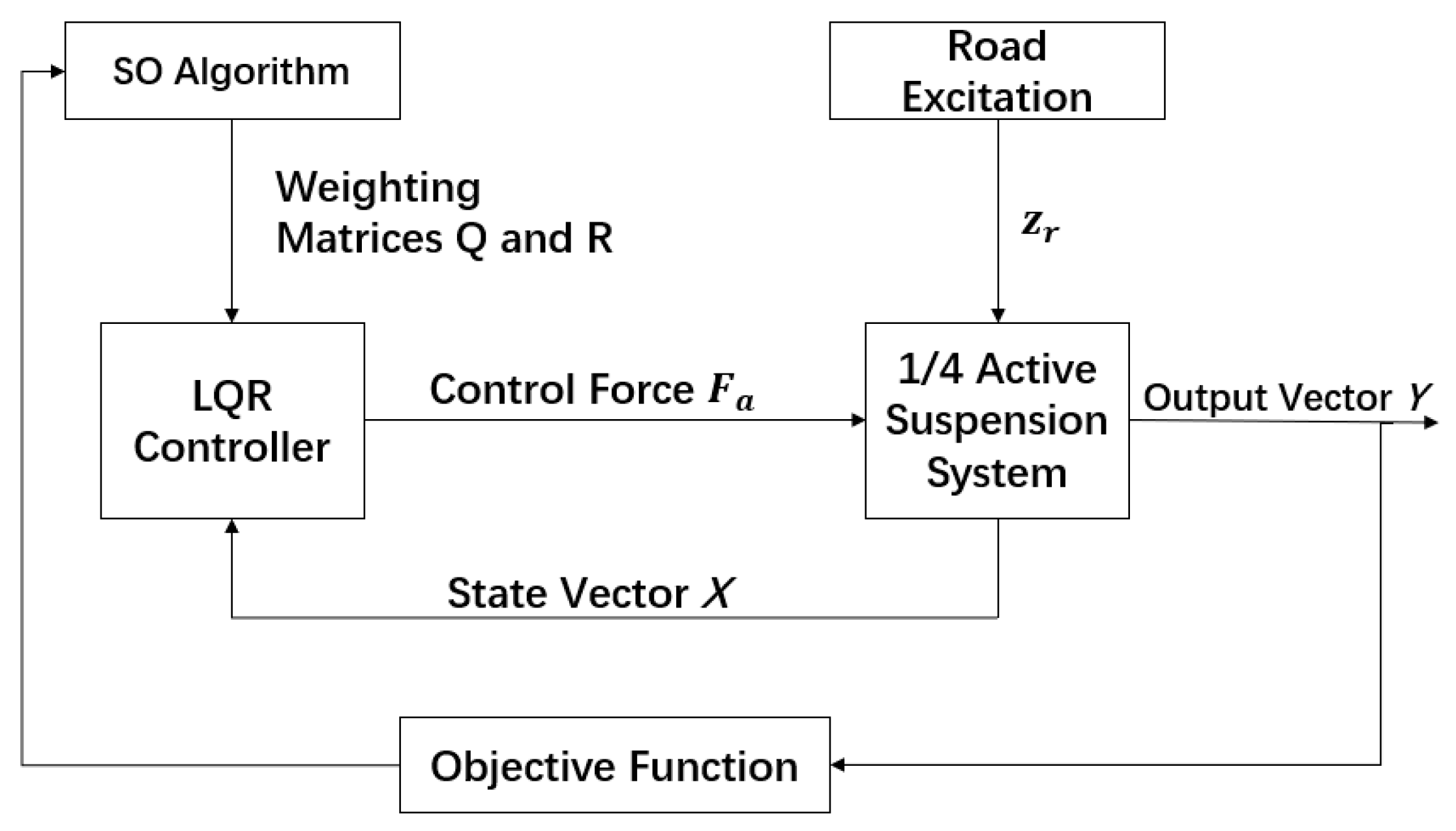
To address the challenge of weight optimization, recent research has shifted towards intelligent bio-inspired algorithms. These methods aim to automate the search for optimal parameters by minimizing a comprehensive objective function. Swarm intelligence algorithms have proven particularly effective in this regard. For instance, Zhuo et al. [78] and Başak et al. [79] employed Grey Wolf Optimization (GWO) and its hybrid variants to enhance global search capabilities, as shown in Figure 14. Similarly, other heuristic approaches, such as the Artificial Fish Swarm Algorithm (AFSA) [80], Improved Particle Swarm Optimization (IPSO) [81], and the novel Snake Optimizer (SO) [82] (Schematic is shown in Figure 15), have been successfully implemented to escape local optima.
Figure 14.
Flowchart of an Improved Grey Wolf Optimization algorithm used to optimize an LQR controller.
Figure 15.
Schematic of the Snake Optimizer (SO) algorithm for optimizing an active suspension LQR controller.
In comparison to empirical tuning, these algorithm-optimized LQR controllers demonstrate superior robustness and a better balance between ride comfort and handling stability. Furthermore, for practical implementations involving sensor noise, Duan et al. [83] extended this optimization logic to LQG controllers, utilizing Genetic Algorithms (GA) to tune variable weights, thereby enhancing adaptability to diverse road conditions.
3.2.3. PID and Its Improved Algorithms (Anti-Windup, Gain Scheduling)
The Proportional-Integral-Derivative (PID) controller, owing to its simple structure, high reliability, and ease of engineering implementation, has played a significant role in the early research and basic applications of active suspensions. However, the fixed parameters of a traditional linear PID controller make it difficult to adapt to the inherent nonlinearities of the suspension system and the variable operating conditions of the vehicle. Furthermore, the physical limits of the actuator’s force output can easily lead to integral windup, which deteriorates control performance. To overcome these limitations, recent research has focused on combining PID control with various advanced algorithms, pursuing in-depth improvements from multiple perspectives, including multi-variable coordination, gain scheduling, and offline global optimization.
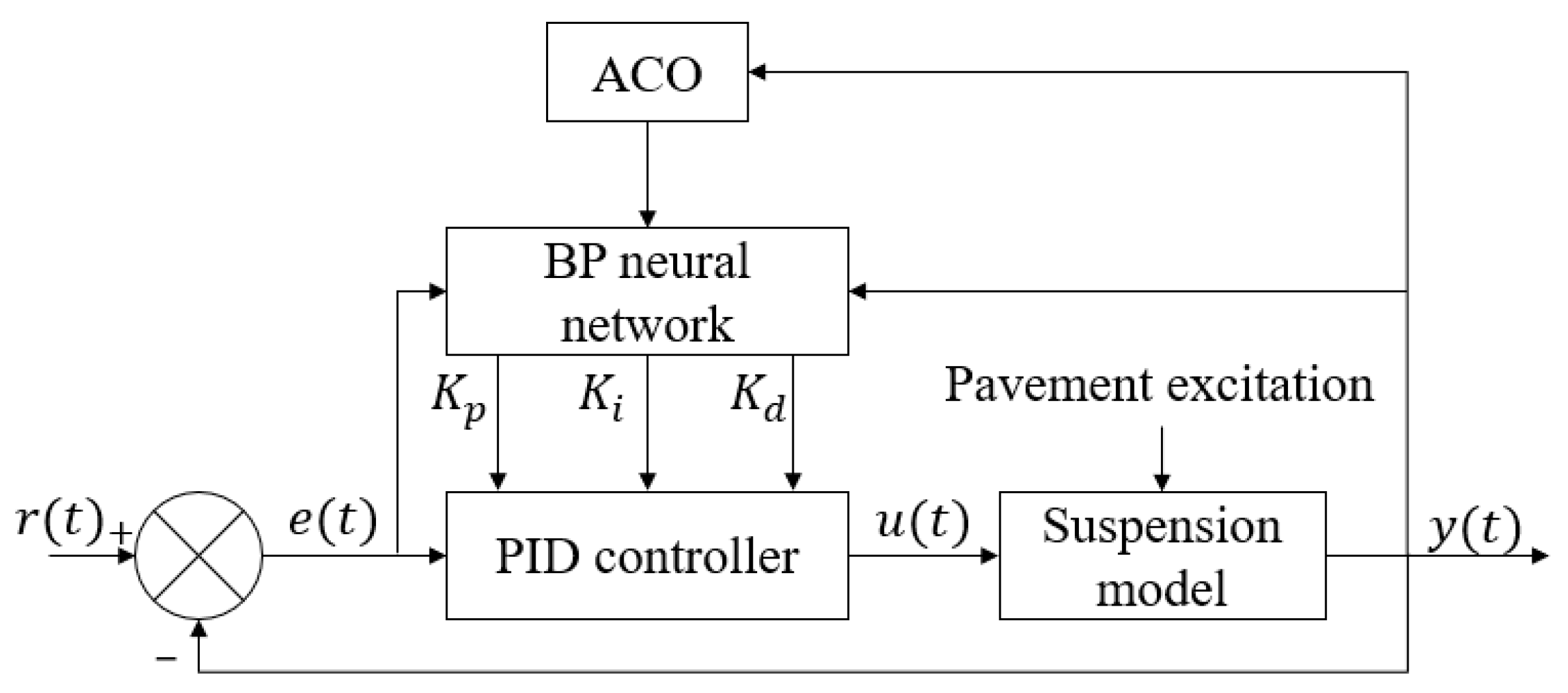
To address the limitations of traditional single-variable PID in handling coupled motions such as vertical heave and pitch, Zhou Peng et al. [84] proposed a multi-variable PID design method based on model decoupling and parameter tuning using a characteristic matrix, achieving coordinated multi-degree-of-freedom control. To endow the controller with online adaptive capabilities, researchers have introduced intelligent algorithms for gain scheduling. Wangshui Yu et al. [85], in conjunction with road recognition, constructed a variable universe fuzzy PID controller that could self-adjust its parameters according to operating conditions and used a chaos particle swarm algorithm for its global optimization. Similarly, Yang [86] and Chen et al. [24], respectively, applied fuzzy PID and single-neuron adaptive PID to the leveling and height stability control of agricultural vehicles, verifying their effectiveness in rapid response and suppression of abrupt load changes. In pursuit of superior control performance, researchers have further developed multi-level, nested intelligent control systems. For example, as shown in Figure 16, the ACO-BP-PID composite strategy proposed by An Xinkai et al. [87] utilizes an Ant Colony Optimization (ACO) algorithm to offline-optimize the initial weights of a BP neural network, which then online-tunes the PID parameters. This controller, optimized by a dual layer of intelligent algorithms, demonstrated stronger comprehensive performance in vibration suppression compared to traditional PID and single-layer intelligent PID controllers.
Figure 16.
Control structure diagram of a BP neural network PID optimized by ACO.
3.3. Advanced Control Strategies
Although classical control methods have laid the theoretical foundation for active suspensions, they typically rely on precise linearized models. This limits their control performance when dealing with complex real-world problems such as the strong nonlinearities, time-varying parameters, and variable operating conditions inherent in vehicle suspensions. To overcome these limitations, researchers have introduced modern control theory into the field, developing a series of advanced control strategies. These methods, based on state-space equations, are a further extension and continuation of classical control theory, focusing on the evolution of state variables in multi-input multi-output (MIMO) control systems [88,89].
3.3.1. Adaptive Control
Adaptive control is an advanced control theory that can automatically adjust controller parameters to adapt to changes in the controlled object and the external environment [90]. It is exceptionally well-suited for addressing the parameter uncertainties and time-varying characteristics present in vehicle suspension systems [91,92]. In the active suspension field, adaptive control is primarily realized through two technical approaches: Model Reference Adaptive Control (MRAC) and Self-Tuning Control (STC).
The core idea of Model Reference Adaptive Control (MRAC) is to first define a reference model with a desired dynamic response. Then, a controller with adjustable parameters is designed, and an adaptation law is used to online-adjust these parameters based on the error between the actual system output and the reference model output. This forces the dynamic characteristics of the closed-loop system to ultimately track and approximate those of the reference model. To address parameter uncertainties such as changes in vehicle load, Hu Guoliang et al. [93] designed an MRAC scheme based on Lyapunov theory, verifying its vibration-damping performance under different loads. To enhance robustness against external disturbances and non-ideal actuator dynamics, Mousavi et al. [94] proposed a Tube-based Model Reference Adaptive Control (TMRAC) that incorporated a disturbance observer, achieving active compensation for unknown disturbances. Taking this further, MRAC has been integrated into more complex control frameworks. For instance, Yeneneh et al. [95] constructed a hybrid architecture that coordinated H∞, MRAC, and frequency-domain optimization to systematically address multiple control challenges. Its application has also been extended to multi-modal vehicle platforms like legged-wheel vehicles, validating the theory’s effectiveness in handling strongly nonlinear coupled systems [96]. At the theoretical frontier, Chen Yandong et al. [97] extended the reference model of MRAC from integer-order to fractional-order. Leveraging the advantages of fractional-order models in describing complex dynamics, they defined more flexible ideal dynamic targets for the suspension, opening up new theoretical avenues for improving control performance.
The efficacy of Self-Tuning Control (STC) hinges fundamentally on the accuracy of its online system identification. Research in this domain illustrates a clear evolutionary trajectory of the estimator technology: from traditional linear methods to advanced intelligent recognition. Initial approaches relied on classical mathematical techniques like Recursive Least Squares (RLS) to identify vehicle parameters online [98,99]. While computationally efficient, these linear methods often struggle to track rapid parameter variations in strongly nonlinear suspension systems. To overcome this limitation, subsequent research integrated intelligent algorithms as nonlinear estimators. For instance, Fuzzy Logic [100], Radial Basis Function Neural Networks (RBFNN) [101], and improved NARMA-L2 models [102] have been employed to approximate total system uncertainty in real-time. These methods offer superior tracking of unmodeled dynamics and nonlinear friction compared to traditional linear estimators. Representing a further leap in adaptability, recent studies have incorporated Deep Learning to introduce predictive capabilities. By utilizing Long Short-Term Memory (LSTM) networks for road recognition [103], the controller can evolve from “passive adaptation” (reacting to past errors) to “proactive compensation” (anticipating road changes), significantly reducing the phase lag inherent in traditional feedback mechanisms.
3.3.2. Robust Control
Robust control aims to ensure that a control system can maintain stability and meet predefined performance specifications in the presence of model uncertainties and external disturbances [11]. It does not rely on the online identification of uncertainties; instead, it involves designing a fixed controller that guarantees good performance across a predefined range of all possible uncertainties. In the active suspension field, control and Sliding Mode Control (SMC) are the two most widely applied and theoretically mature robust control methods.
H∞ control achieves optimal disturbance rejection by minimizing the H∞ norm of the closed-loop transfer function from external disturbances to the system’s performance output. In the application of the classic H∞ control framework, Zhen Wang et al. [104] used a mixed-sensitivity approach, constructing a robust controller that could effectively trade off among multiple conflicting objectives—such as ride comfort, handling stability, and control energy consumption—by carefully designing performance weighting functions. To further enhance controller reliability, Zhendong Liu et al. [105] introduced the concept of “non-fragile” control. The H∞ control framework they constructed not only considered parameter uncertainties in the vehicle model but also simultaneously accounted for the controller’s own gain variations, resulting in a non-fragile controller that is insensitive to implementation errors. Furthermore, to overcome the conservatism of traditional H∞ control, which arises from optimizing over the entire frequency domain, Hui Jing et al. [106] proposed robust finite-frequency H∞ control. This approach strictly confines the optimization of performance indices to specific frequency bands that have the most significant impact on suspension performance, thereby achieving superior vibration suppression. At the same time, to make H∞ control more applicable to engineering practice, researchers have worked to address the time-delay issues caused by digital control and actuator response. Gao Xiaolin et al. [107] modeled the active suspension as a discrete-time system with time delay and designed a corresponding discrete H∞ robust controller. Sun Dong et al. [108] more specifically modeled the actuator’s response lag as a time-delay element and integrated it into an H2/H∞ robust control framework. These efforts have extended the application of H∞ control from ideal continuous-time models to more challenging discrete-time systems with delays. Additionally, H∞ control has also been applied in the integrated design of innovative suspension hardware.
Sliding Mode Control (SMC) [109] has received considerable attention in active suspension control due to its strong robustness to matched uncertainties. However, the chattering phenomenon caused by its discontinuous switching term is a core challenge that urgently needs to be addressed [91]. To suppress chattering, early research focused on improving first-order sliding mode controllers. Xu Ming et al. [110] effectively weakened the control output’s chattering by designing an improved exponential reaching law and using a saturation function to replace the discontinuous sign function. Samsuria et al. [111] proposed a more systematic design paradigm: using Linear Quadratic Regulator (LQR) theory to design an optimal sliding surface and combining it with optimization algorithms to systematically tune key parameters like the sliding surface coefficients and the saturation function’s boundary layer. This provided a complete solution for designing controllers that balance both robustness and low chattering. To eliminate chattering at its source, Higher-Order Sliding Mode Control (HOSMC), particularly the Super-Twisting Algorithm (STA) which can generate a continuous control action, has become a more advanced solution. Furthermore, to enhance the adaptability of SMC in specific applications, Peng et al. [112], in the context of agricultural chassis leveling control, employed fuzzy logic to online-adjust the switching gain of the sliding mode control, achieving more stable real-time dynamic leveling.
3.3.3. Predictive Control
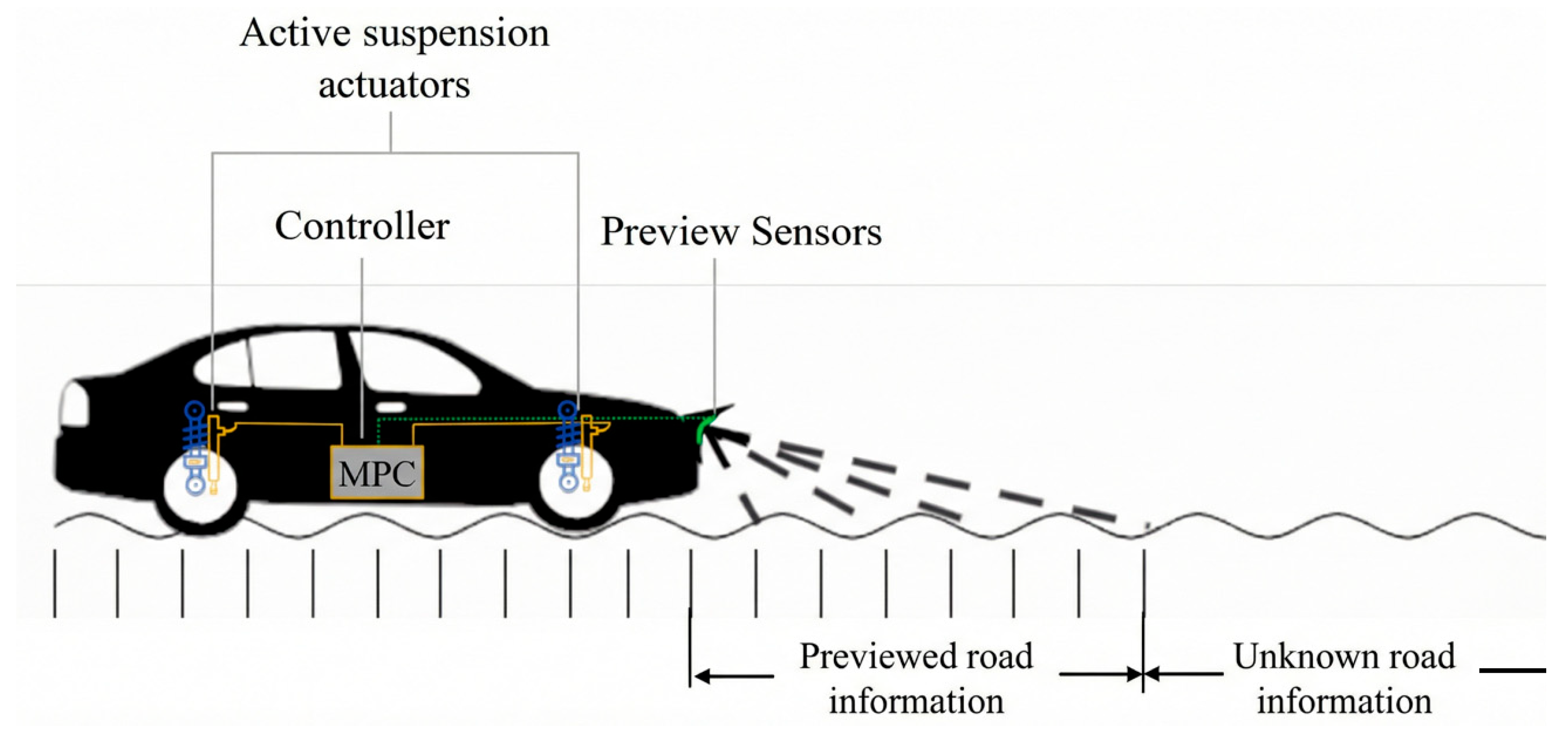
As shown in Figure 17, predictive control, especially Model Predictive Control (MPC), is considered one of the most ideal frameworks for solving complex suspension control problems due to its ability to online-optimize multi-objective performance, systematically handle physical constraints, and naturally incorporate future road information. Recent research has primarily focused on two directions: first, using MPC for multi-objective constrained optimization; and second, combining MPC with road preview information to achieve further performance breakthroughs.
Figure 17.
Schematic of a model predictive control active suspension with road preview functionality.
Even without external preview information, MPC can still serve as a powerful multi-objective constrained optimizer. To address the mismatch between the predictive model and the actual nonlinear dynamics of the vehicle, researchers have focused on integrating machine learning techniques with MPC. Gu Suying et al. [113] utilized a Radial Basis Function (RBF) neural network to online-identify and construct a high-precision suspension predictive model, thereby improving the optimization accuracy of the MPC. Furthermore, Mazouchi et al. [114] used a Gaussian Process (GP) to online-learn and compensate for prediction errors caused by model uncertainty, positioning machine learning as a parallel compensator for the MPC. When integrating road preview information, to cope with persistent model uncertainties, Papadimitrakis et al. [115] also employed an RBF neural network as an online estimator, achieving a deep fusion of preview MPC and intelligent estimation. To enhance the engineering practicality of MPC, researchers have improved the algorithmic framework itself. To address the computational burden, Wang Ruochen et al. [116] proposed a variable-horizon MPC, which significantly reduced the average computational load while maintaining performance by adaptively adjusting the prediction horizon online. Niaona Zhang et al. [117] proposed a distributed multi-agent MPC architecture, which decomposes the overall vehicle control task among four independent controllers for coordinated completion, greatly reducing the complexity and computational demands of centralized control. These studies are progressively transforming MPC from an idealized optimal controller into a more intelligent, efficient, and robust advanced control strategy capable of handling complex real-world operating conditions.
3.3.4. Intelligent Control
Intelligent control provides a powerful toolkit for solving the complex problems inherent in suspension systems—such as strong nonlinearities, model uncertainties, and multi-objective conflicts—by simulating human capabilities for logical reasoning, learning, and optimization. Unlike classical or modern control theories that rely on precise mathematical models, intelligent control methods are often data-driven or rule-based, offering greater adaptability and robustness.
Fuzzy Logic Control (FLC) simulates human reasoning by constructing “IF-THEN” rules, making it suitable for handling complex nonlinear systems that are difficult to model with precision [118]. In fundamental applications to active suspension, Dong Zhaowen et al. [119] used vehicle body velocity and acceleration as inputs to a fuzzy inference system to adjust suspension damping in real-time, effectively improving ride comfort. This application was subsequently extended to full-vehicle attitude control, as seen in the work of Pan Gongyu et al. [120], who designed a fuzzy controller capable of coordinated pitch and roll control based on a seven-degree-of-freedom (7-DOF) model. To overcome the limitations of fixed rules in traditional FLC, researchers have explored more advanced adaptive frameworks. Inspired by bionics, Kou Farong et al. [121] proposed an endocrine composite fuzzy control strategy that mimics biological hormone regulation mechanisms to achieve nonlinear, adaptive adjustment of control objectives. Another, more theoretically profound, technical path involves integrating fuzzy theory with modern robust control. Mohammad et al. [122] utilized a Takagi-Sugeno (T-S) fuzzy model to accurately describe the nonlinear suspension system, upon which they designed a gain-scheduled H∞ controller. This method not only guarantees the system’s robustness across the entire nonlinear operating range but also allows physical constraints, such as suspension travel, to be systematically integrated into the controller design, representing a cutting-edge direction for handling strongly nonlinear, multi-constraint problems.
Neural Networks (NNs), due to their nonlinear mapping and self-learning capabilities, play multiple roles in active suspension control, from online optimizers to end-to-end controllers [123,124]. Wang et al. [125] applied a BP neural network to the leveling of an agricultural machinery chassis, and its control effect was superior to that of traditional PID in terms of settling time, overshoot, and steady-state error. Taking this further, researchers have utilized Deep Reinforcement Learning (DRL) to construct end-to-end nonlinear control strategies. For example, Xuebin Zhu et al. [126] employed the DDPG algorithm, enabling the controller to autonomously learn the optimal control law by maximizing a comprehensive performance reward function through trial-and-error interaction with a simulation environment. This method does not require a precise dynamic model. To enhance the fidelity and adaptability of intelligent control, Huanqing Qiu et al. [127] proposed a new adaptive control paradigm that integrates a digital twin with an Artificial Neural Network (ANN). By providing continuous, real-time data feedback from a high-fidelity digital twin model to the ANN, they achieved a deep fusion and co-optimization of the physical system and its virtual counterpart.
Reinforcement Learning (RL) offers a data-driven paradigm that learns optimal control policies through environmental interaction. Current applications in active suspension generally follow two distinct technical pathways: hierarchical tuning and end-to-end control. The hierarchical approach utilizes RL as a high-level supervisor to optimize the parameters of a lower-level classical controller online. For example, Q-learning has been applied to adaptively tune PID gains [128,129] or to solve the LQR optimal control problem in a model-free manner [130]. This strategy retains the stability and explicit structure of classical control while endowing it with adaptability. In contrast, the end-to-end approach employs Deep Reinforcement Learning (DRL) algorithms to map state inputs directly to optimal control forces. Studies utilizing algorithms such as DDPG [126], TD3 [131], and PPO [132] have demonstrated that this method can theoretically achieve higher performance in handling high-dimensional, multi-objective constraints without reliance on precise dynamic models. However, compared to hierarchical methods, it faces greater engineering challenges regarding training convergence and policy interpretability. To provide a clear overview, the key features of these major suspension control strategies are summarized in Table 3.
Table 3.
Features of major suspension control strategies.
3.4. Energy Optimization Strategies
Beyond achieving enhanced ride comfort and improved handling stability, a significant advantage of linear motor-based electromagnetic suspension—distinguishing it from traditional high-energy-consumption active suspensions—is its potential for energy regeneration. However, effective realization and maximization of this potential necessitate systematic design and optimization at both the hardware (circuitry) and software (algorithm) levels. On one hand, efficient energy harvesting circuits must be developed to function as the physical interface for energy conversion and management. On the other hand, a sophisticated high-level control algorithm must intelligently assess and balance the conflicting objectives of vibration suppression and energy harvesting.
3.4.1. Regenerative Vibration Energy Harvesting Circuit Design
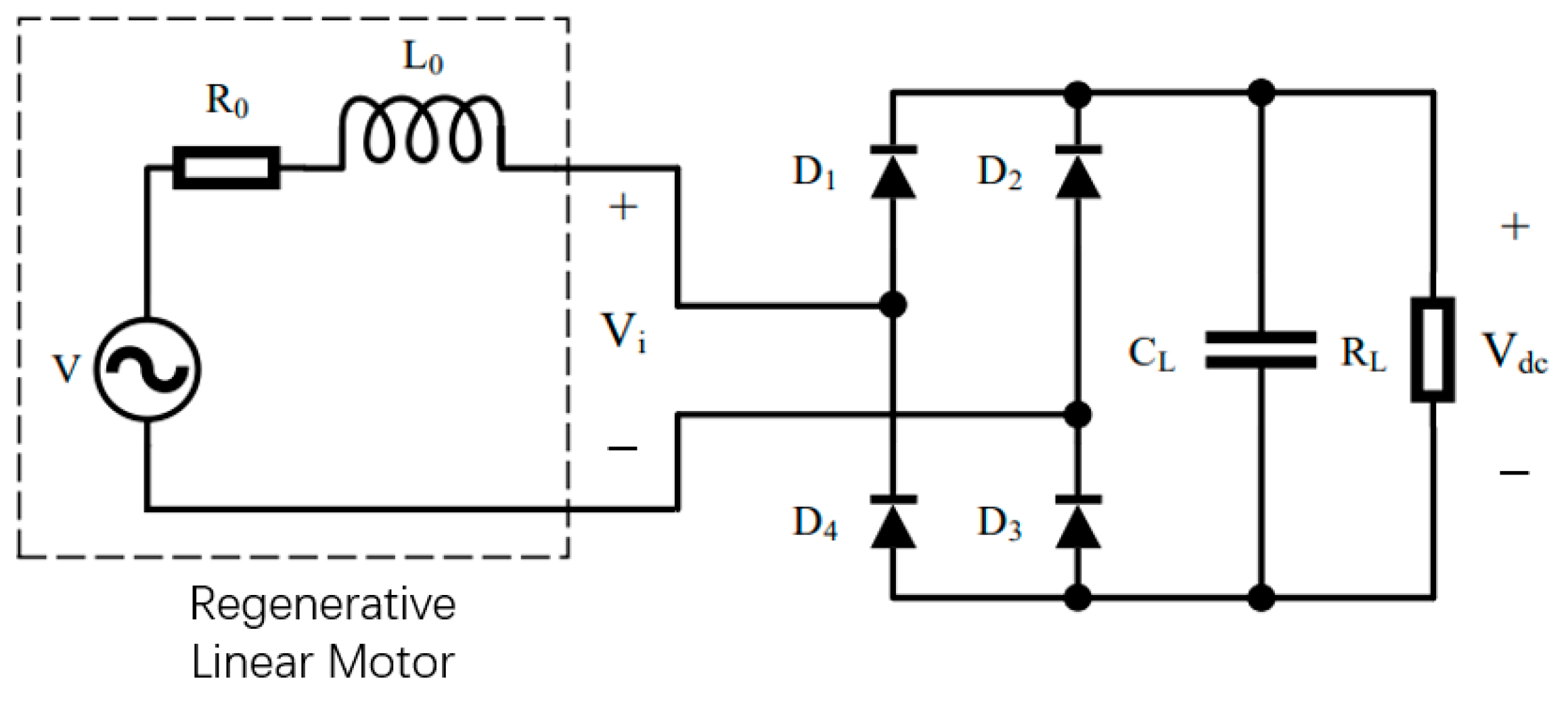
The energy harvesting circuit serves as the foundational component for transforming the alternating current (AC) electromotive force generated by the linear motor into a stable direct current (DC), which is subsequently fed into the vehicle’s energy storage system, as shown in Figure 18. Its design plays a crucial role in determining both the efficiency and flexibility of energy recovery.
Figure 18.
Schematic of a standard energy harvesting circuit.
Research on energy harvesting circuits seeks to delineate the performance boundaries of various topologies while enhancing conversion efficiency. Initial investigations concentrated on systematic comparative analyses of fundamental circuit designs. For instance, Lu Tao [133] and Hongfan Li [134], among others, conducted experimental and quantitative evaluations of configurations such as uncontrolled bridge rectifiers and basic DC-DC converters, including integrated Buck/Boost converters. Their work offers data-driven guidance for circuit selection. In summary, energy harvesting circuits are experiencing a distinct evolution from rudimentary passive rectification to controllable DC-DC conversion, ultimately progressing towards high-efficiency active synchronous switching technologies.
3.4.2. Energy-Efficiency Trade-Offs in Control Algorithms
Due to the inherent conflict between the damping force generated during the energy harvesting process and the active force required to achieve optimal comfort or handling, the core of research in this area is to design control strategies that can effectively trade off among multiple objectives.
To resolve the intrinsic conflict among ride comfort, handling stability, and energy harvesting in active/semi-active suspensions, the research first required a theoretical definition of this multi-objective problem. Lei Zuo et al. [135], through systematic analysis, clearly quantified the theoretical trade-off relationships and performance boundaries among these three main objectives, laying a theoretical foundation for subsequent research on coordinated control strategies. At the practical level, intelligent switching control is one of the mainstream technical approaches. Ding Renkai et al. [136] designed an “on-demand intervention” switching logic to maximize the reduction in active energy consumption while ensuring comfort. A more refined solution was designed by Xiangjun Xia [137,138], who not only developed an actuator with multiple modes, including pure damping and pure regeneration, but also utilized a hierarchical multi-objective fuzzy control strategy to achieve smooth and intelligent switching between these operating modes. In addition to mode switching, a composite control architecture is another effective path. The dual-loop fuzzy PID strategy proposed by Azmi et al. [139] decouples the control tasks: the outer loop is responsible for suppressing vibration, while the inner loop precisely regulates the duty cycle of the energy harvesting circuit. This architecture achieves parallel and coordinated optimization of the conflicting goals of vibration suppression and energy recovery.
The energy-efficiency trade-off control strategies for electromagnetic suspension are evolving towards becoming more intelligent and systematic. Through means such as operating condition recognition, mode switching, and composite control, a dynamic balance among multiple conflicting objectives—including comfort, handling, and energy recovery—has been achieved. Future research directions will likely focus more on deeply integrating suspension energy optimization into vehicle-level energy management systems and utilizing advanced AI technologies, such as deep reinforcement learning, to achieve end-to-end online policy optimization of the overall performance, thereby seeking globally optimal energy efficiency in more complex dynamic environments.
3.5. Experimental Validation and Quantitative Performance Analysis
Validating theoretical control strategies on physical platforms is critical for industrialization. Current research presents a multi-level validation landscape ranging from component simulations to full-vehicle tests, providing key quantitative indicators of performance improvement.
At the structural component level, quantitative gains are significant. For instance, through the use of novel composite materials, Shah et al. [53] achieved a 64% increase in chassis stiffness alongside a 32% reduction in weight. Similarly, by optimizing the rotor-bearing support points to counteract unbalanced magnetic pull, Wang et al. [58] successfully reduced the maximum vibration acceleration by 54.9%.
At the system control level, validation focuses on the trade-off between dynamics and energy. In quarter-car rig tests, Ding et al. [136] demonstrated that an “on-demand” control strategy could significantly reduce active energy consumption while maintaining vibration isolation performance. In more advanced full-vehicle applications, the Bose Corporation [33] reported qualitative breakthroughs, achieving “zero roll” and “zero pitch” during aggressive maneuvers, effectively eliminating squat and dive phenomena. Furthermore, in agricultural machinery applications, Wang et al. [125] validated via field tests that Neural Network control offered superior settling time and lower steady-state error compared to traditional PID controllers.
Despite these successes, it is important to note that systematic quantitative comparisons across different studies remain difficult due to the lack of unified testing benchmarks (e.g., standardized road inputs like ISO 2631 [140]). Future research must prioritize establishing these standards to facilitate direct performance benchmarking.
3.6. Summary
This chapter systematically reviewed the evolution of control strategies for electromagnetic suspension, transitioning from classical methods to advanced and intelligent techniques. Classical methodologies, such as Skyhook and PID, established the theoretical foundation but are limited by linear assumptions. Advanced strategies, including Adaptive and Robust control, overcame these limits by handling system uncertainties, while Model Predictive Control (MPC) introduced effective constraint management. Furthermore, Intelligent methods like Neural Networks and Reinforcement Learning have enabled data-driven solutions for complex nonlinear problems.
Crucially, the selection of these strategies must align with the specific vehicle platform. For heavy commercial and agricultural vehicles, the priority is managing drastic mass variations; thus, Robust and Adaptive controls are preferred for stability, ideally integrated with energy harvesting logic to improve efficiency. For high-performance luxury vehicles, where dynamics outweigh cost, MPC with road preview and Deep Reinforcement Learning are ideal for resolving multi-objective conflicts. Conversely, for economy platforms constrained by hardware costs, Improved PID and Fuzzy Logic remain the most pragmatic choices due to their low computational demands. This analysis highlights that future development requires not only algorithmic innovation but also the precise matching of control logic to specific engineering scenarios.
4. Key Technologies and Challenges
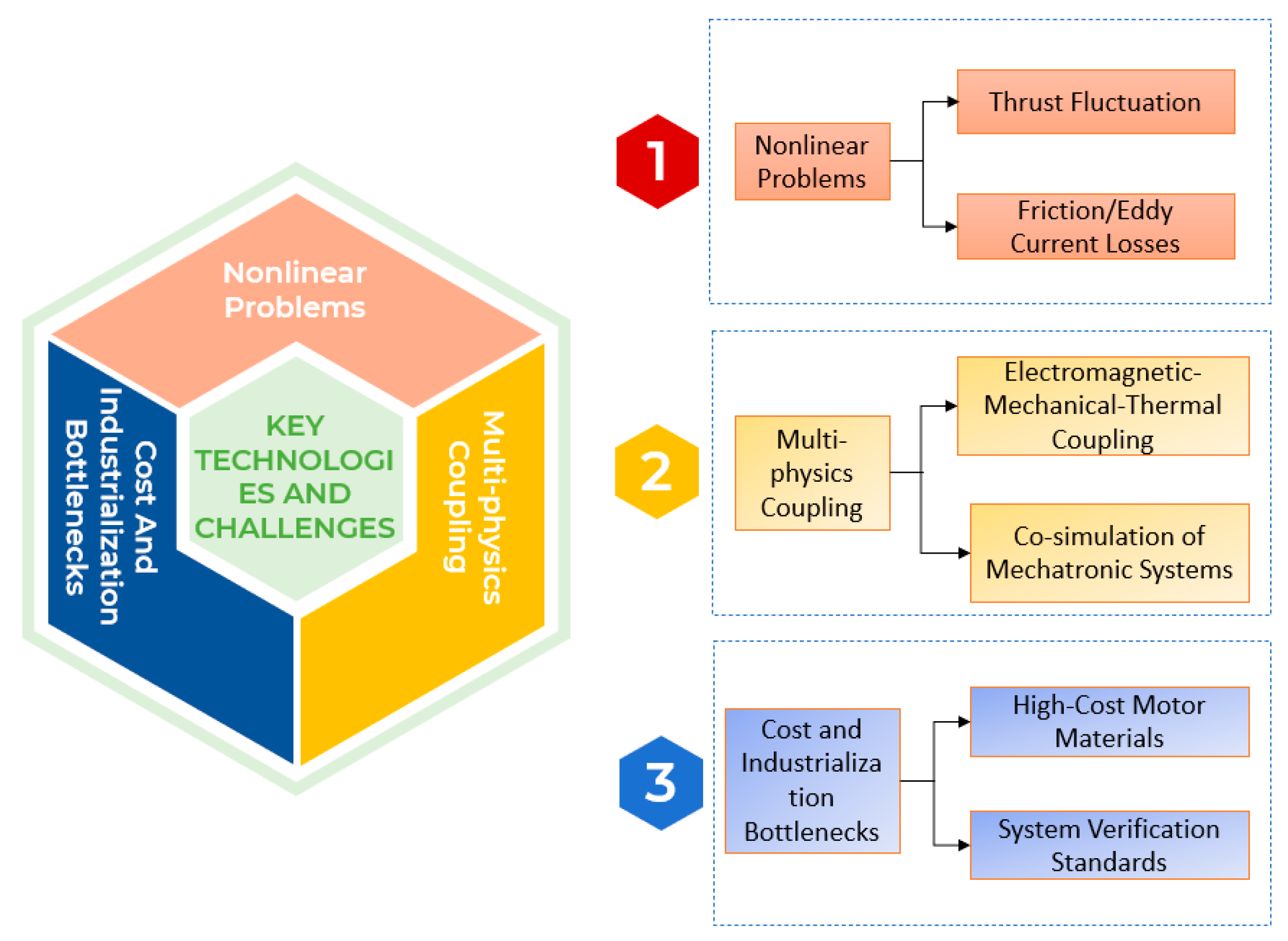
While linear motor-based electromagnetic suspension offers superior theoretical performance, its transition from laboratory research to widespread industrial application is confronted by a series of complex engineering challenges. As illustrated in Figure 19, these critical technical barriers can be systematically categorized into three core dimensions: nonlinear dynamics, multi-physics coupling mechanisms, and industrialization bottlenecks. This section will first address the nonlinear problems inherent to the actuator—specifically thrust fluctuation and friction—which fundamentally compromise control precision. Subsequently, it will examine the intricate coupling effects among electromagnetic, mechanical, and thermal fields that complicate high-fidelity modeling. Finally, the analysis will extend to economic and practical constraints, focusing on the high cost of motor materials and the absence of unified system verification standards, which currently hinder large-scale commercial adoption.
Figure 19.
Key technologies and challenges.
4.1. Nonlinear Problems
Although advanced control strategies have the potential to achieve superior performance in theory, their practical effectiveness in physical systems is significantly constrained by the inherent and complex nonlinear characteristics of electromagnetic actuators. These nonlinear factors pose one of the primary technical challenges currently confronting this field, as they directly influence control precision, operational smoothness, and overall energy efficiency. The fundamental issue lies in the fact that these nonlinearities are not merely static disturbances; rather, they are dynamic variables intricately linked to the system’s state (e.g., velocity, current, temperature). This complexity renders traditional linear control theory inadequate and necessitates a shift towards more sophisticated modeling and compensation strategies, as shown in Figure 19. This section will primarily address two core types of nonlinear problems: first, thrust fluctuations directly attributable to the motor’s electromagnetic design; second, frictional losses and eddy currents arising from both mechanical and electrical characteristics within the system.
4.1.1. Motor Thrust Fluctuation Compensation
During operation, the Permanent Magnet Synchronous Linear Motor (PMSLM) inevitably experiences parasitic force fluctuations, commonly referred to as thrust ripple. This phenomenon arises from the inherent characteristics of its magnetic circuit structure. The significance of this challenge is underscored by the fact that thrust ripple not only impacts static positioning accuracy but can also serve as an endogenous vibration source, continuously exciting system vibrations if its spectral components fall within the controller’s bandwidth or coincide with the mechanical resonance frequencies of the vehicle body or suspension. This dynamic coupling effect has been highlighted in research conducted by Xiaojun Yang et al. [141]. Consequently, suppressing thrust ripple is essential for achieving high-performance control. Current research primarily focuses on two approaches: structural optimization and control compensation.
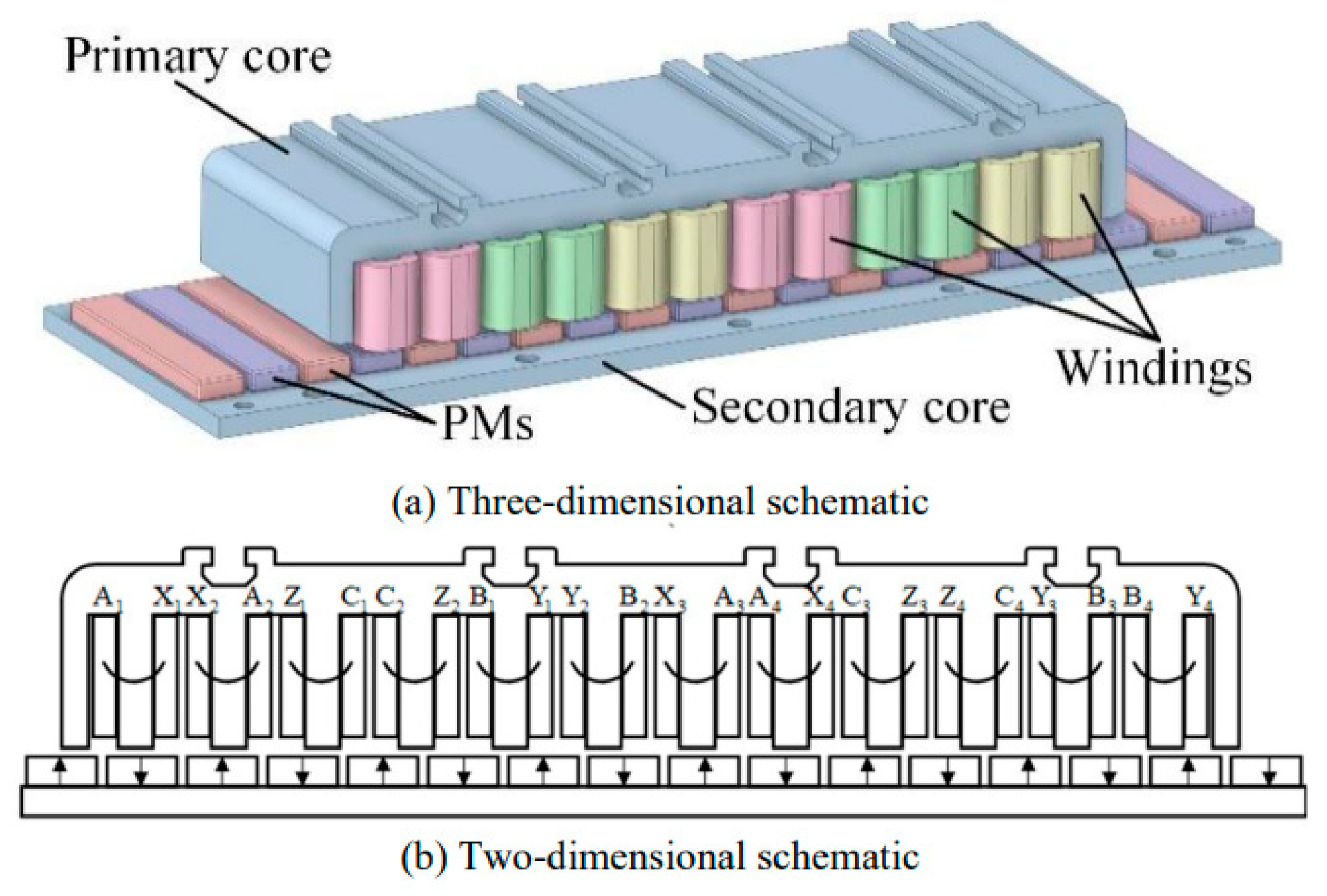
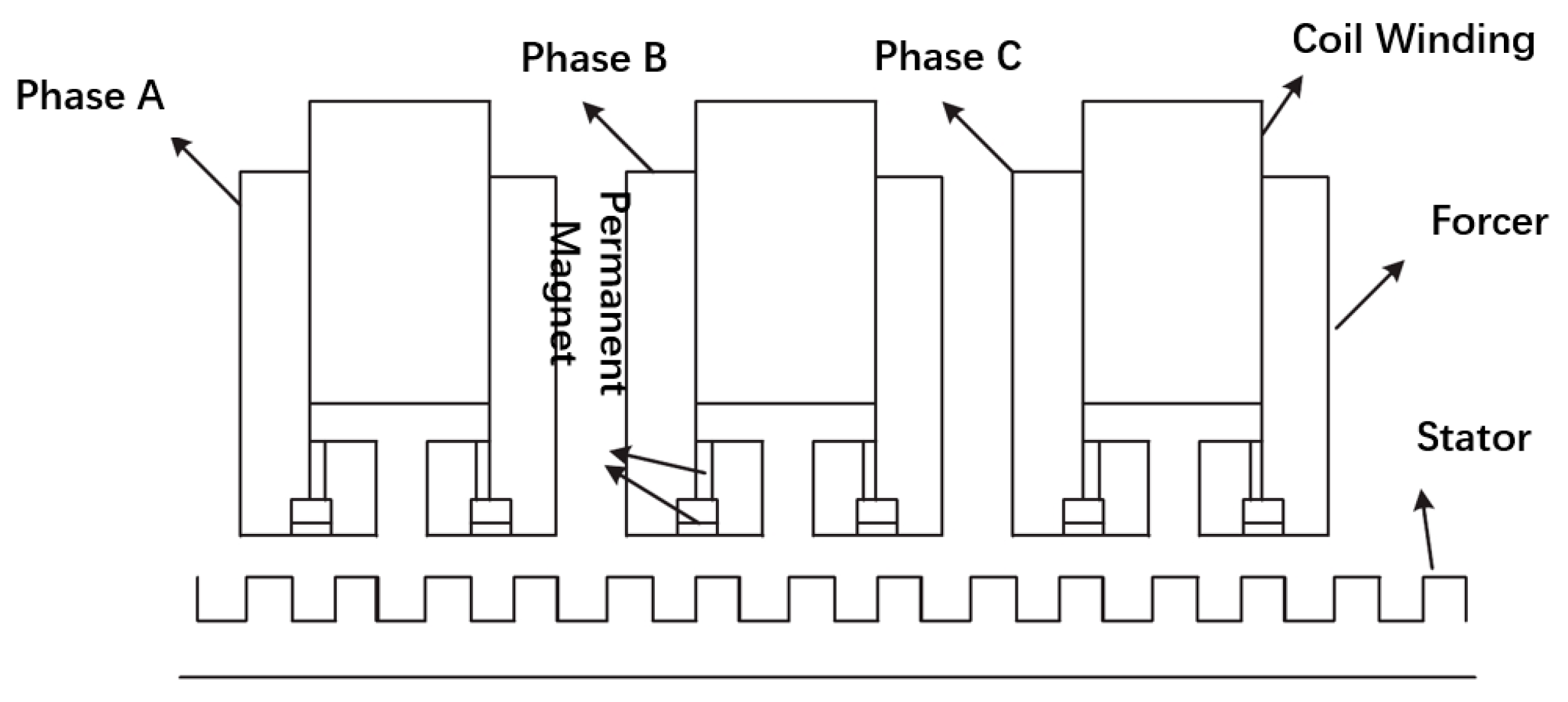
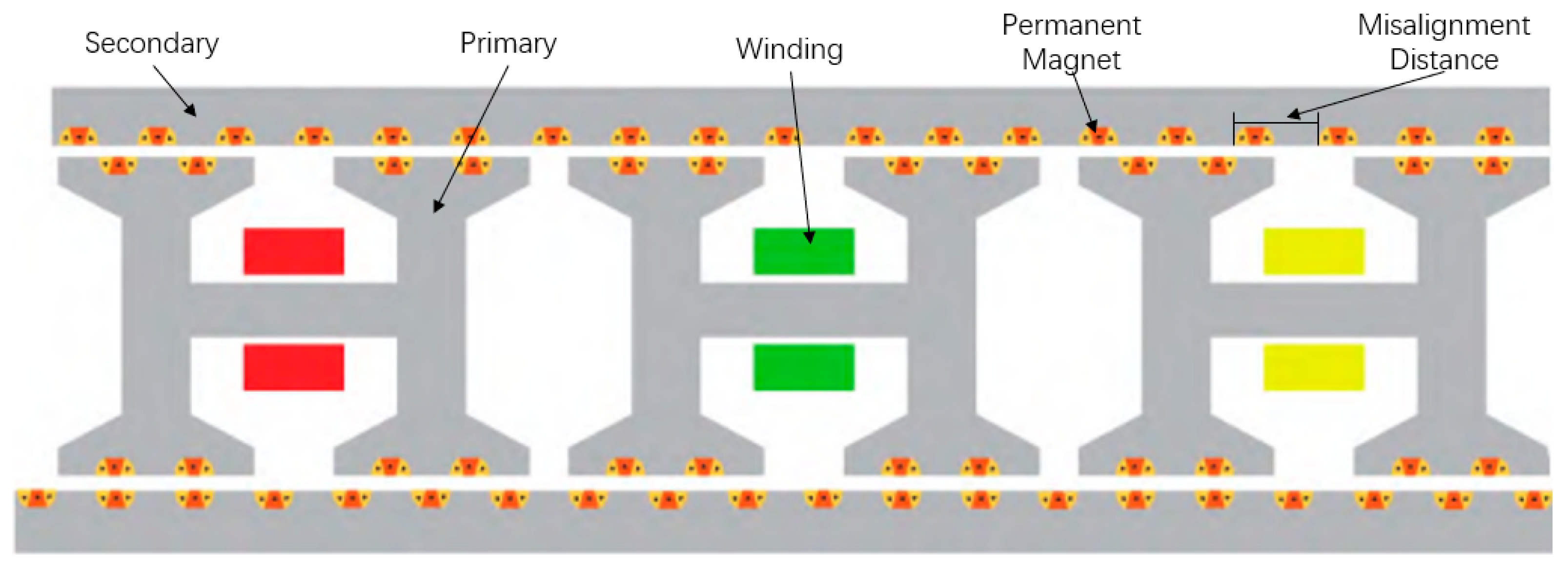
Structural optimization represents a fundamental approach, incorporating techniques such as the optimization of magnet pole shapes, the implementation of skewed pole/slot configurations, and the strategic arrangement of windings to mitigate harmonic magnetic fields. As shown in Figure 20, Miao Zhongcui et al. [142] utilized multi-objective optimization methods, including the Taguchi method, to synergistically adjust key structural parameters with the objective of achieving an optimal design characterized by “high average thrust and low thrust ripple.” However, there exists a highly nonlinear coupling relationship between design parameters and system performance, complicating accurate predictions regarding performance responses to variations in these parameters. Additionally, inherent conflicts arise among various performance indices (e.g., thrust density, efficiency, thrust ripple) and engineering constraints (e.g., cost, volume), necessitating careful optimization that balances these mutually restrictive objectives. For example, an excessive focus on optimizing cogging torque may result in diminished thrust density or increased manufacturing costs and process complexities. Moreover, once a design is finalized, its optimization effects become static and incapable of accommodating random fluctuations introduced by manufacturing tolerances or variations across material batches.
Figure 20.
The bilateral staggered-tooth topology proposed by Miao Zhongcui et al. [142]: the gray parts indicate the primary and secondary iron cores, the green and yellow blocks represent the armature windings, and the red and orange blocks represent the permanent magnets.
Control compensation is dedicated to the active cancellation of existing thrust ripple utilizing advanced algorithms. One approach originates from the electrical source, exemplified by the work of Jiawei Hu et al. [143], who introduced specific voltage harmonics to counteract current harmonics that generate fluctuating torque. A significant challenge associated with this method is its exceptionally high demand for precise online identification of motor parameters, particularly inductance; any parameter mismatch can severely degrade the compensation effect or even introduce new fluctuations. An alternative and more generalized strategy involves compensation based on a disturbance observer (DOB). The specialized observer devised by Mingfei Huang et al. [144] is capable of estimating the total thrust ripple in real time and providing feedforward compensation. However, this approach presents challenges related to balancing the observer’s bandwidth against its sensitivity to noise: while a higher bandwidth is essential for accurately tracking high-frequency ripples, it also amplifies measurement noise. Additionally, the inherent phase lag within the observer can further constrain compensation accuracy during high-dynamic responses.
In conclusion, a singular technical pathway proves insufficient for achieving an ideal solution to this problem. Future challenges will hinge on realizing a co-design between mechanical structures and control algorithms as well as developing nonlinear compensation algorithms that exhibit insensitivity to variations in model parameters and possess robust adaptive capabilities. This focus is essential for ensuring consistent performance throughout the lifecycle of actuators.
4.1.2. Friction/Eddy Current Loss Modeling and Compensation
In addition to thrust ripple, the suspension actuator also exhibits nonlinearities stemming from its mechanical and electrical characteristics, primarily including friction and eddy current damping forces. The crux of this challenge lies in the fact that these forces, particularly friction, display extremely complex dynamic characteristics (e.g., hysteresis, the Stribeck effect, pre-sliding behavior). The intricacy of their mathematical representation and the difficulty associated with parameter identification pose fundamental obstacles that hinder precise force control at low speeds and during micro-movements. Regarding friction, contemporary research has delineated two primary technical pathways: model-driven approaches and data-driven/model-free techniques.
The model-driven approach aims to develop high-fidelity friction models. For example, Wang Limei et al. [145] utilized the LuGre dynamic model, while Xinlong Xu et al. [146] implemented the Prandtl-Ishlinskii (P-I) model which more accurately captures hysteresis phenomena. However, a critical challenge emerges from the stark conflict between a model’s “fidelity” and its “complexity.” As models become more accurate—characterized by an increasing number of parameters—their physical significance becomes less clear; consequently, this complexity complicates offline identification processes while making it challenging to ensure that parameters remain stable under real-world operating conditions (such as temperature fluctuations or wear). Although Liu Zhiguo et al. [147] have employed online identification methods like Recursive Least Squares (RLS) to address time-varying parameters, issues concerning algorithm convergence and robustness persist as significant challenges for practical online application.
In contrast to the model-driven approach, model-free compensation strategies aim to circumvent the complexities associated with identification processes. The Active Disturbance Rejection Control (ADRC) proposed by Chang Debiao et al. [148] treats friction as a component of a “total disturbance,” which is estimated and compensated for in real-time using an Extended State Observer (ESO). The advantage of this method lies in its remarkable robustness against model uncertainties; however, it faces challenges since it fundamentally serves as a “compensation” mechanism rather than a “decoupling” one. Its performance is constrained by the estimation bandwidth and accuracy of the ESO, particularly when addressing high-frequency or abrupt nonlinear forces where the efficacy of compensation may be compromised. Regarding eddy current damping force, which becomes significant during high-speed motion, its modeling tends to be relatively straightforward—typically represented as proportional to velocity or through higher-order relationships. Consequently, research efforts are increasingly directed toward suppressing these effects at their source through structural optimization. As shown in Figure 21, Qi Li et al. [149], by designing an innovative multi-layer permanent magnet structure, effectively disrupted eddy current paths and significantly diminished eddy current losses, thereby offering a feasible solution for the passive suppression of this nonlinear phenomenon.
Figure 21.
The multi-layer permanent magnet structure designed by Qi Li et al. [149] significantly reduces eddy current losses.
Looking ahead, the technical approach to addressing complex nonlinear challenges is evolving towards a deep integration of physics-based models and data-driven methodologies. A pivotal concept involves the development of hybrid modeling techniques that synergize a priori models grounded in physical mechanisms with data-driven models such as deep neural networks. This strategy aims to harness the strengths of the physics-based model to ensure interpretability and extrapolation capabilities, while leveraging the robust nonlinear fitting capacity of data-driven models to learn and compensate for intricate residual terms inadequately represented by the a priori model, ultimately achieving high-fidelity system identification. A more progressive research direction seeks to realize end-to-end intelligent compensation through exploration of advanced artificial intelligence technologies like reinforcement learning. The objective is to completely circumvent the intricate explicit modeling and parameter identification processes associated with traditional methods, enabling optimal control laws to be learned and generated online via direct interaction between actuators and their environments. This facilitates adaptive compensation for various nonlinear effects such as friction and eddy currents. However, it is crucial to acknowledge that applying these data-driven AI methodologies within safety-critical automotive chassis systems presents a long-term and formidable engineering challenge concerning verification of their robustness, safety, and interpretability.
4.2. Multi-Physics Coupling Mechanisms
The electromagnetic suspension system based on linear motors exemplifies a typical multi-physics coupling scenario, characterized by intricate bidirectional interactions among the electromagnetic field, mechanical motion, and temperature distribution. A significant challenge currently confronting this domain lies in the inadequacies of conventional “decoupled” or “one-way coupling” analysis methodologies, which grossly underestimate the effects of coupling phenomena on the system’s overall performance, dynamic response, and long-term reliability. Consequently, this oversight results in disproportionately large design margins or imprecise performance forecasts. Therefore, it is crucial to develop high-fidelity two-way coupled multi-physics models and integrate their application throughout the entire design and control process to effectively address these performance bottlenecks.
4.2.1. Electromagnetic–Mechanical–Thermal Coupling Effects
In the electromagnetic suspension actuator, the specific pathways of multi-physics coupling effects include: electromagnetic losses (such as copper loss, iron loss, and eddy current loss) acting as a heat source (electromagnetic-thermal); temperature increases that alter the remanence and coercivity of permanent magnets as well as the resistance of windings (thermal-electromagnetic); and non-uniform temperature distributions leading to thermal stress and structural deformation, which in turn affects the precise dimensions of the air gap (thermal-mechanical).
Current research challenges have evolved from investigating “whether coupling is feasible” to addressing “how to achieve efficient and accurate coupling.” The one-way coupling analysis employed by Xu Chong [150] and Xiuping Wang et al. [151] treats electromagnetic losses solely as a static heat source. While this approach provides an initial basis for thermal design, it neglects the negative feedback effects associated with temperature variations. A fundamental limitation lies in its inability to predict the thermal degradation of motor performance under conditions of overload or prolonged operation. To illustrate the severity of this discrepancy, consider the feedback loop between temperature and winding resistance. In a traditional decoupled analysis where resistance is treated as constant, the predicted temperature rise might settle at 60 °C. However, a bidirectional coupled simulation accounts for the physical reality that copper resistance increases by approximately 0.4% per degree Celsius. This creates a positive feedback loop: higher temperature increases resistance, which in turn amplifies Ohmic losses (), further raising the temperature. Comparative studies indicate that this coupling effect can push the actual steady-state temperature to over 85 °C. This deviation of nearly 40% demonstrates that decoupled models may inadvertently validate designs that are actually at risk of insulation failure. To address this issue, Yan Jin et al. [152] developed a two-way coupling model, while Liping Tan et al. [153] established a magnetic-thermal-fluid three-field coupled model that significantly enhances simulation accuracy. However, such high-fidelity finite element models come at considerable computational expense; a single comprehensive transient coupled simulation may require hours or even days to complete. This renders them nearly impractical for design optimization or system-level simulations that necessitate numerous iterations.
Future research is expected to concentrate on the advancement of efficient Reduced-Order Models (ROMs). This entails exploring methodologies for applying model order reduction techniques to derive low-dimensional, computationally efficient analytical or semi-analytical models from high-dimensional finite element models, while still capturing the essential coupling dynamics. Additionally, transient coupling analysis emerges as a significant area of focus. Current investigations predominantly revolve around steady-state or quasi-static coupling; however, suspension systems are frequently subjected to impulsive road inputs. It is imperative to elucidate the system’s transient electromagnetic-mechanical-thermal dynamic response characteristics under millisecond-level shock loads in order to assess its survivability in extreme conditions. Nevertheless, this necessitates enhanced requirements regarding both the dynamic range and computational speed of the coupled models.
4.2.2. Real-Time Co-Simulation of Mechatronic Systems
To accurately assess the suspension performance at the full-vehicle level during the design phase, co-simulation is indispensable. The inherent challenge lies in balancing “model fidelity” with “real-time simulation capability,” a tension that becomes particularly evident during Hardware-in-the-Loop (HIL) testing.
At the software co-simulation level, solutions such as Adams (MSC Software, Newport Beach, CA, USA)/Simulink (MathWorks, Natick, MA, USA, https://www.mathworks.com, accessed on 17 December 2025) and CarSim/Simulink (Mechanical Simulation Corporation, Ann Arbor, MI, USA, https://www.carsim.com, accessed on 17 December 2025) have been extensively compared by Huidong Hou et al. [154], along with their application demonstrated by Pan Gongyu et al. [155]. These approaches utilize high-fidelity full-vehicle models provided by software like CarSim, thereby circumventing inaccuracies associated with self-developed simplified models. However, a significant limitation remains: actuator models within Simulink are often still oversimplified and cannot adequately capture the aforementioned nonlinear multi-physics coupling effects.
To address this issue, Hardware-in-the-Loop (HIL) simulation has emerged as a pivotal link between the virtual and real environments. Based on the degree of hardware integration, it can be classified into two categories: Controller-HIL (CHIL) and Mechanical-HIL (mHIL). In the case of Controller-HIL, Sun Ye et al. [156] utilized a dSPACE-based platform to integrate a real controller into the simulation loop. A significant challenge in this approach is that the “plant” model employed for real-time simulation—encompassing elements such as electromagnetic suspension and vehicle dynamics—must be highly simplified to satisfy the stringent hard real-time requirements inherent to HIL simulations. This simplification may obscure certain issues that only become apparent when the controller interacts with actual physical objects. Conversely, in Mechanical-HIL applications, Zhu Yugang et al. [157] successfully integrated an actual actuator within a closed-loop system. Currently regarded as the highest-fidelity validation method, this approach allows for realistic testing of an actuator’s dynamic response, nonlinear characteristics, and thermal effects. However, it poses challenges related to high costs and complexity involved in constructing test rigs; furthermore, replicating test conditions is constrained by both bandwidth limitations and accuracy considerations of loading equipment—resulting in difficulties associated with large-scale testing across all conditions.
Looking ahead, resolving these identified conflicts hinges on developing efficient reduced-order coupled models (ROMs) capable of operating effectively on HIL platforms. The ultimate objective is to create a high-fidelity digital twin system rigorously validated against mHIL test data. Such a system could facilitate not only offline and online validation of control algorithms but also enable fault diagnosis, lifespan prediction, and online performance optimization efforts.
4.3. Cost and Industrialization Bottlenecks
Although the linear motor-based electromagnetic suspension demonstrates enormous potential in performance, its high cost and stringent reliability requirements are the two core bottlenecks restricting its proliferation from high-end vehicles to the mainstream market.
4.3.1. High-Cost Motor Materials
The significant dependence of contemporary high-performance Permanent Magnet Synchronous Linear Motors (PMSLMs) on rare-earth permanent magnet materials, notably Neodymium Iron Boron (NdFeB), represents a major barrier to cost-effectiveness. The challenge extends beyond the elevated prices of these rare-earth materials; it also encompasses the vulnerability of their supply chains, which is shown in Figure 22. As highlighted by Csongor Horváth [158] and Tong Xin et al. [159], geopolitical dynamics and market fluctuations can introduce considerable risks to the security of these supply chains. Consequently, the endeavor to “reduce or eliminate rare-earth” materials transcends mere fiscal considerations; it emerges as a strategic issue pertaining to technological sovereignty and self-sufficiency.
Figure 22.
Main application fields of rare-earth elements.
Research addressing this challenge has primarily concentrated on the development of novel motor topologies utilizing cost-effective magnetic materials. The most straightforward solution involves substituting rare-earth magnets with affordable ferrite permanent magnets. Wang Haoliang et al. [160] have confirmed the feasibility of this approach. Nonetheless, a fundamental challenge remains: bridging the significant disparity in magnetic properties between ferrite and NdFeB magnets, as their magnetic energy products differ by nearly an order of magnitude. To achieve comparable thrust density within similar volume and weight constraints, disruptive innovations in magnetic circuit design are essential, such as employing complex flux-focusing structures. However, these innovations introduce increased manufacturing complexity and higher iron losses. The “rare-earth/ferrite” hybrid excitation explored by Pang Xingzhe et al. [161], along with the permanent magnet-assisted switched reluctance motor investigated by Nugraha et al. [162], currently represent more practical compromise solutions. The core challenge lies in optimally arranging and managing the magnetic circuits of two types of permanent magnets with vastly different characteristics to attain a synergistic effect (1 + 1 > 2), while also preventing performance mismatches between the different materials at various operational points—especially under elevated temperatures.
The future technological challenge involves the development of entirely new, non-permanent-magnet motor topologies, such as Switched Reluctance Motors (SRMs) and Synchronous Reluctance Motors (SynRMs). Addressing their inherent issues—namely lower thrust density, significant torque/thrust ripple, and intricate noise and vibration control—is essential in order to enhance their overall performance to a level comparable with that of permanent magnet motors.
Addressing these material constraints requires a clear economic roadmap to guide the technology from niche applications to mass adoption. Currently, high-performance PMSLM solutions have reached Technology Readiness Level (TRL) 7–8, yet their high cost restricts them to the luxury vehicle segment. To bridge the gap to TRL 9 (Mass Market), a phased cost-reduction strategy is essential. Phase 1 targets mid-range vehicles by adopting hybrid excitation topologies (low rare-earth), balancing performance with moderate cost. Phase 2 aims at economy platforms by transitioning to ferrite-based or Switched Reluctance architectures. This evolutionary path is projected to reduce actuator costs by 40–50%, making electromagnetic active suspension economically viable for mainstream consumers, as illustrated in the proposed roadmap in Figure 23.
Figure 23.
Industrialization roadmap and cost-reduction pathway for automotive electromagnetic suspension systems.
4.3.2. System Reliability Verification Standards and Protocols
As a safety-critical chassis component, the electromagnetic suspension must fulfill stringent automotive reliability standards. Yet, a comprehensive and unified testing standard specifically for this technology is currently absent. Consequently, the industry relies on a “patchwork” of existing specifications drawn from related fields. For instance, mechanical durability tests are often adapted from hydraulic damper standards, while electronic reliability typically references general automotive standards such as ISO 16750 [163] for environmental conditions and AEC-Q100 [164] for integrated circuit stress qualification.
Nevertheless, simply applying these separate standards is insufficient because they fail to uncover the unique coupled failure modes inherent to electromagnetic actuators. Traditional validation processes often treat thermal and mechanical loads in isolation, whereas the actuator faces simultaneous multi-physics challenges in operation. A prime example is the interaction between thermal and magnetic fields; prolonged high-current operation generates significant heat which, when combined with a reverse magnetic field, can trigger irreversible demagnetization of the permanent magnets. Similarly, high-frequency road vibrations introduce risks of fatigue failures in electrical components, such as solder joints and connector harnesses, which are less common in traditional hydraulic systems.
To bridge this gap and ensure industrial viability, establishing a standardized validation protocol is essential. We propose a two-step pathway that moves from virtual verification to physical stress testing. The process should begin with Mechanical Hardware-in-the-Loop (mHIL), where the physical actuator interacts with a real-time vehicle model to safely validate control logic and dynamic response under extreme virtual scenarios. Following this, the actuator must undergo Combined Stress Accelerated Life Testing (ALT) to verify long-term durability. This stage involves subjecting the motor to simultaneous high-current heating and random road vibration to simulate a 10-year service life, effectively exposing the specific weak points in insulation, magnets, and electronics mentioned above.
4.4. Summary
This chapter presents a comprehensive analysis of the fundamental technical challenges encountered by linear motor-based electromagnetic suspension systems as they advance towards practical engineering applications, alongside a review of the corresponding solutions. First and foremost, nonlinear issues pose significant obstacles to control precision, manifesting in the form of inherent thrust ripple within the motor, as well as systemic friction and eddy current losses. Current research endeavors are focused on mitigating these effects through an integrated approach that encompasses structural optimization and advanced control compensation; however, enhancing robustness and adaptability remains a critical area for future investigation. Secondly, electromagnetic suspension operates as a multi-physics system characterized by intricate electromagnetic-mechanical-thermal coupling. The primary challenge lies in achieving high-fidelity coupled modeling and simulation at an acceptable computational cost to effectively guide design decisions and facilitate virtual validation. Research efforts in this domain are transitioning from simplified one-way analyses to more sophisticated two-way multi-field coupled assessments alongside Hardware-in-the-Loop (HIL) validation strategies which better reflect real-world conditions. The development of efficient reduced-order models is pivotal for overcoming existing bottlenecks in this regard. Lastly, prohibitive costs and demanding reliability requirements constitute two major barriers hindering the industrialization of this technology. To tackle cost-related challenges, there has been increasing interest in developing low-rare-earth or rare-earth-free motors utilizing economical materials such as ferrite; however, balancing performance with these alternatives presents complex design challenges. In terms of reliability, the absence of dedicated industry standards suggests that current validation processes primarily rely on pre-existing specifications related to similar technologies—posing yet another hurdle to successful industrial implementation. Together, these challenges delineate the forefront of current research efforts while highlighting key focus areas within this field that will pave the way for future technological advancements.
5. Conclusions and Outlook
5.1. Technical Development Summary
As shown in Figure 24, reviewing the comprehensive history of technological development, two parallel and mutually reinforcing mainstreams emerge. The first is the design of actuator configurations, which serves as the foundational physical framework, characterized by a trend towards increasingly higher performance density, reduced costs, and enhanced system integration. The second is the control strategy—often regarded as the essence of the system—which has evolved from traditional methods for addressing singular performance objectives to advanced intelligent control mechanisms that enable synergistic optimization across multiple, and occasionally conflicting, performance indices.
Figure 24.
Evolution and future outlook of automotive electromagnetic suspension systems.
5.1.1. Configuration Design Trends
Lightweighting remains a fundamental theme in configuration design, primarily driven by the imperative to control a vehicle’s unsprung mass. As previously discussed, reducing unsprung mass serves as the physical foundation for enhancing ride comfort and handling in vehicles. Nevertheless, electromagnetic actuators inherently possess considerable weight; thus, a central design challenge lies in optimizing the reduction in both volume and mass while ensuring adequate thrust output.
Modularization has become an indispensable approach to address the complex integration needs of modern vehicles amid increasing pressures to reduce costs and boost efficiency. The prevailing trend is toward highly integrating these components into a plug-and-play “intelligent actuator module.” This modular design encapsulates not only the linear motor but also high-efficiency SiC/GaN power drivers, a microcontroller for low-level force/current closed-loop control, and essential sensors (such as position and temperature sensors) within a single compact and sealed unit.
Multi-functional integration represents the most forward-looking developmental direction in configuration design. Its objective is to enable the suspension actuator to assume additional functions beyond merely controlling vertical forces, thereby facilitating a profound integration of the chassis system. A significant avenue for exploration is the incorporation of an energy harvesting function. By designing efficient bidirectional power conversion circuits and aligning them with advanced control algorithms, vibrational energy can be effectively transformed into electrical energy, enhancing the overall energy efficiency of the vehicle. Another more transformative approach involves integrating hub or in-wheel drive motors to create a “corner module.” This design not only conserves a substantial amount of unsprung space but also provides a critical foundation for ultra-high-bandwidth coordinated control over propulsion, braking, and suspension systems. It exemplifies an ideal hardware configuration for realizing a “software-defined chassis.”
5.1.2. Evolution of Control Strategies
Corresponding to the evolution of hardware in configuration design, control strategies have similarly experienced a profound transformation in software. The primary evolutionary trajectory has progressed from classical control, which addresses singular performance objectives, to advanced intelligent control, capable of synergistically optimizing multiple—and often conflicting—performance indices.
In the classical control phase, research primarily focused on several core and relatively independent control objectives. To enhance ride comfort, strategies exemplified by Skyhook control were extensively studied with the aim of suppressing vertical body acceleration. In pursuit of improved handling stability, Groundhook control strategies were developed to optimize tire dynamic loads. As performance expectations for vehicles escalated, control strategies evolved into the advanced control phase. A defining aspect of this stage was the integration of modern control theory to tackle practical challenges such as system uncertainties, nonlinearities, and constraints. Presently, control strategies are comprehensively advancing into a new dimension characterized by intelligent control and system coordination. Intelligent control methodologies—including fuzzy logic, neural networks, and reinforcement learning—offer robust data-driven tools for addressing the complex issues inherent in suspension systems; these include significant nonlinearities, model uncertainties, and multi-objective conflicts.
5.2. Future Research Directions
Based on an assessment of the current technical challenges and development trends, future research on automotive linear motor-based electromagnetic suspension is likely to achieve breakthroughs in the following frontier directions.
5.2.1. Application of New Materials
New materials are the bedrock of actuator performance, yet their successful deployment demands a shift from simple substitution to a “Material-Structure-Function” integrated design framework. Addressing the thrust density bottleneck requires a specific Cryogenic-Electromagnetic Integrated Architecture for High-Temperature Superconducting (HTS) motors. While HTS materials offer near-zero resistance at liquid nitrogen temperatures, the “cooling penalty” remains a critical barrier. To overcome this, future designs must embed micro-channel cooling loops directly within stator slots using advanced ceramic insulators, while simultaneously enveloping the stator in a multi-layer vacuum structure to minimize radiant heat transfer. This “cryostat-in-actuator” configuration fundamentally resolves thermal management issues while reducing mass by an order of magnitude. Parallel to this, the application of Soft Magnetic Composites (SMC) necessitates a transition to 3D Topology Optimization. Unlike traditional laminated steel which restricts flux to 2D planes, SMCs’ magnetic isotropy allows for complex 3D flux-path configurations, such as claw-pole structures, manufactured via efficient Net-Shape pressing to maximize thrust density. Finally, to mitigate the cost and thermal sensitivity of permanent magnets, the focus must shift to atomic-scale Micro-structure Engineering. Techniques like Grain Boundary Diffusion (GBD) infiltrate heavy rare-earth elements solely along grain boundaries rather than uniformly, significantly enhancing high-temperature coercivity without the prohibitive cost of bulk alloying.
5.2.2. Sensorless Control Technology
Reducing costs while enhancing system integration and reliability are fundamental requirements for industrialization. Sensorless control technology represents one of the key strategies to achieve this objective. Traditional electromagnetic suspension control depends on a variety of sensors, including position sensors (such as Hall effect sensors and optical encoders) for motor commutation and velocity feedback, as well as accelerometers and displacement sensors for high-level control functions. The inclusion of these sensors not only elevates the overall cost and volume of the system but also introduces potential points of failure through their associated signal harnesses and connectors.
Reducing hardware dependency while enhancing reliability requires a paradigm shift from physical redundancy to algorithmic estimation, necessitating a “Deep Fusion Virtual Sensing Framework.” Traditional control relies on a complex array of Hall sensors, encoders, and displacement transducers, which escalate costs and introduce failure points. To eliminate these constraints, the proposed framework addresses challenges across three hierarchical dimensions.
The first dimension targets the “observability singularity” at zero speed. Conventional back-EMF observers fail at standstill. Overcoming this requires a hybrid architecture that seamlessly fuses High-Frequency Signal Injection (HFSI)—utilizing motor saliency for position detection at zero speed—with model-based sliding mode observers for high-speed operation. The critical breakthrough lies in designing a weighted handover algorithm to eliminate signal chattering during mode transitions.
The second-dimension advances from kinematic estimation to dynamic force observation. To replace expensive force sensors, research must utilize Extended State Observers (ESO). By treating external suspension loads and friction as lumped disturbances within the motor’s dynamic equations, these algorithms decouple and reconstruct the “suspension force” in real-time from electrical signatures, enabling high-fidelity closed-loop force control without direct measurements.
The third dimension realizes minimalist system-level state reconstruction. By integrating internal motor states with low-cost chassis inertial data via a Dual-layer Kalman Filter, the system synthesizes a “virtual displacement sensor.” This fusion enables accurate estimation of complex suspension states, such as dynamic deflection, effectively stripping the system down to a sensorless configuration reliant purely on the actuator and basic inertial feedback.
5.2.3. Active Safety Fusion Control: Integrated Chassis Dynamics
As autonomous driving technology advances toward high-level automation, the role of the suspension system is shifting from a passive isolation component to a core actuator within the integrated chassis control domain. Future research must focus on a hierarchical architecture that coordinates electromagnetic suspension with braking and steering systems to exploit the coupling effects between vertical tire loads and planar vehicle dynamics.
In the context of longitudinal dynamics, the primary technical objective is to optimize the utilization of the tire friction circle. Conventional braking maneuvers induce significant longitudinal load transfer, resulting in uneven vertical pressure distribution that prematurely saturates the adhesion limits of unloaded wheels. By implementing a dynamic anti-pitch control strategy, the electromagnetic suspension can actively suppress body dive, thereby homogenizing the vertical load across all four wheels. This mechanical equalization ensures that each tire operates at the optimal boundary of its friction ellipse, converting the actuator’s rapid response capability into reduced stopping distances and enhanced traction efficiency without altering the braking hardware.
Regarding lateral stability, the control framework should exploit the nonlinear dependency of tire cornering stiffness on vertical load. Unlike traditional Electronic Stability Programs (ESP) that rely on differential braking to generate corrective yaw moments—a process that inevitably dissipates kinetic energy—electromagnetic suspension offers a non-intrusive alternative. Through the active redistribution of vertical loads between inner and outer wheels, the system can instantaneously modulate the lateral force potential of specific tires. This capability allows for the generation of corrective yaw moments to counteract oversteer or understeer while maintaining vehicle velocity, offering a significant advantage in limit-handling scenarios.
Finally, the integration of perception layers marks the transition from reactive feedback to predictive feedforward control. Current chassis systems relying solely on inertial feedback suffer from inherent phase lags. Future architectures will fuse suspension control with autonomous driving perception streams, such as LiDAR and vision data, to construct a preview-based control horizon. This enables the system to pre-adjust suspension stiffness and chassis attitude in anticipation of road friction changes or obstacle avoidance maneuvers, fundamentally elevating active safety from post-event correction to pre-event prevention.
Author Contributions
Methodology, R.D. and R.W.; formal analysis, R.D. and X.C.; investigation, X.C. and D.J.; writing—original draft preparation, R.D. and X.C.; writing—review and editing, R.W. and D.J.; visualization, X.C.; supervision, R.W.; project administration, R.D. All authors have read and agreed to the published version of the manuscript.
Funding
This research received no external funding.
Data Availability Statement
No new data were created or analyzed in this study.
Acknowledgments
I would like to express my sincere gratitude to Bin Xu of Jiangsu Xinri E-Vehicle Co., Ltd. for his professional guidance and valuable suggestions provided for this review.
Conflicts of Interest
The authors declare no conflicts of interest.
References
- Wu, F.; Qiu, H.; Chen, W.; Li, Y.; Lin, S.; Ke, Y. Design and Obstacle Crossing Performance Analysis of a New Type Wheeled Walking Self-Adjusting Chassis. In Proceedings of the 8th International Conference on Computing, Control and Industrial Engineering (CCIE2024), Wuhan, China, 21–22 June 2024; Shmaliy, S.Y., Ed.; Springer: Singapore, 2024. [Google Scholar]
- Repin, S.; Bukirov, R.; Vasilieva, P. Study on effects of damping characteristics of base chassis suspension on operational safety of transport and handling machinery. Transp. Res. Procedia 2020, 50, 574–581. [Google Scholar] [CrossRef]
- Garthe, D.; Schmidt, C.; Denkena, B. Lightweight Design in Agricultural Machinery—CFRP Chassis for Forage Harvesters. ATZ Heavy Duty Worldw. 2024, 17, 32–37. [Google Scholar] [CrossRef]
- Ibrahim, A.M.; Ali, A.M.; Kamel, H. Design optimization and production of a small-scale semi-trailer chassis for testing. J. Eng. Appl. Sci. 2023, 70, 35. [Google Scholar] [CrossRef]
- Wang, Y.; Chen, K.; Dong, M. Research on Active Suspension System of Heavy Commercial Vehicle Controlled by PID Controller Based on Genetic Algorithm. In Advances in Precision Instruments and Optical Engineering; Liu, G., Cen, F., Eds.; Springer Proceedings in Physics; Springer: Singapore, 2022; Volume 270. [Google Scholar]
- Wang, B.; Du, X.; Wang, Y.; Mao, H. Multi-machine collaboration realization conditions and precise and efficient production mode of intelligent agricultural machinery. Int. J. Agric. Biol. Eng. 2024, 17, 27–36. [Google Scholar] [CrossRef]
- Tang, Z.; Wang, H.; Jing, T.; Liu, S.; Shen, C. Centroid Swinging Property of a Machine Body Undergoing Longitudinal Excitation in a Straw Compression Baler. Eng. Agric. 2024, 44, e20230109. [Google Scholar] [CrossRef]
- Li, J.; Nie, Z.; Chen, Y.; Ge, D.; Li, M. Development of Boom Posture Adjustment and Control System for Wide Spray Boom. Agriculture 2023, 13, 2162. [Google Scholar] [CrossRef]
- Lu, Y.; Xu, W.; Leng, J. Review and Research Prospects on Additive Manufacturing Technology for Agricultural Manufacturing. Agriculture 2024, 14, 1207. [Google Scholar] [CrossRef]
- Zhang, F.; Teng, S.; Wang, Y.; Guo, Z.; Wang, J.; Xu, R. Design of bionic goat quadruped robot mechanism and walking gait planning. Int. J. Agric. Biol. Eng. 2020, 13, 32–39. [Google Scholar] [CrossRef]
- Wang, R.; Zhang, K.; Ding, R.; Jiang, Y.; Jiang, Y. A Novel Hydraulic Interconnection Design and Sliding Mode Synchronization Control of Leveling System for Crawler Work Machine. Agriculture 2025, 15, 137. [Google Scholar] [CrossRef]
- Jiang, H.; Fan, W. Design and Testing of a Small Orchard Tractor Driven by a Power Battery. Eng. Agric. 2023, 43, e20220195. [Google Scholar] [CrossRef]
- Zhu, Z.; Zeng, L.; Chen, L.; Zou, R.; Cai, Y. Fuzzy Adaptive Energy Management Strategy for a Hybrid Agricultural Tractor Equipped with HMCVT. Agriculture 2022, 12, 1986. [Google Scholar] [CrossRef]
- Liu, J.; Xia, C.; Jiang, D.; Shang, G.; Han, J.; Sun, Y. Determination and application of maximum efficiency curve of crawler electric tractor motors. Math. Probl. Eng. 2021, 2021, 1310926. [Google Scholar] [CrossRef]
- Xu, L.; Chai, X.; Gao, Z.; Li, Y.; Wang, Y. Experimental Study on Driver Seat Vibration Characteristics of Crawler-type Combine Harvester. Int. J. Agric. Biol. Eng. 2019, 12, 90–97. [Google Scholar] [CrossRef]
- Tang, Z.; Ren, H.; Li, X.; Liu, X.; Zhang, B. Structure Design and Bearing Capacity Analysis for Crawler Chassis of Rice Combine Harvester. Complexity 2020, 2020, 7610767. [Google Scholar] [CrossRef]
- Jia, W.; Tai, K.; Wang, X.; Dong, X.; Ou, M. Design and Simulation of Intra-Row Obstacle Avoidance Shovel-Type Weeding Machine in Orchard. Agriculture 2024, 14, 1124. [Google Scholar] [CrossRef]
- Liu, W.; Zhou, J.; Zhang, T.; Zhang, P.; Yao, M.; Li, J.; Sun, Z.; Ma, G.; Chen, X.; Hu, J. Key Technologies in Intelligent Seeding Machinery for Cereals: Recent Advances and Future Perspectives. Agriculture 2025, 15, 8. [Google Scholar] [CrossRef]
- Li, Y.; Liu, Y.; Ji, K.; Zhu, R. A Fault Diagnosis Method for a Differential Inverse Gearbox of a Crawler Combine Harvester Based on Order Analysis. Agriculture 2022, 12, 1300. [Google Scholar] [CrossRef]
- Wang, R.; Su, Z.; Ding, R.; Sun, Z.; Jiang, Y.; Guo, Z. Omnidirectional Leveling System of Crawler Machine Based on Sliding Mode Synchronous Position Control. Trans. Chin. Soc. Agric. Mach. 2024, 55, 394–401. [Google Scholar]
- Pacejka, H.B. Tire and Vehicle Dynamics, 3rd ed.; Butterworth-Heinemann: Oxford, UK, 2012; pp. 1–58. [Google Scholar]
- Liu, J.; Xia, C.; Jiang, D.; Sun, Y. Development and Testing of the Power Transmission System of a Crawler Electric Tractor for Greenhouses. Appl. Eng. Agric. 2020, 36, 797–805. [Google Scholar] [CrossRef]
- Liu, S.; Tang, Z.; Zhang, B.; Liang, Y.; Gu, X. Ergonomic Design of Cab Structure for Wheeled Combine Harvester. Eng. Agric. 2022, 42, e20220023. [Google Scholar] [CrossRef]
- Chen, Y.; Chen, L.; Wang, R.; Xu, X.; Shen, Y.; Liu, Y. Modeling and test on height adjustment system of electrically-controlled air suspension for agricultural vehicles. Int. J. Agric. Biol. Eng. 2016, 9, 40–47. [Google Scholar]
- Cui, L.; Xue, X.; Le, F.; Mao, H.; Ding, S. Design and experiment of electro hydraulic active suspension for controlling the rolling motion of spray boom. Int. J. Agric. Biol. Eng. 2019, 12, 72–81. [Google Scholar] [CrossRef]
- Wang, H.; Jasim, A.; Chen, X. Energy harvesting technologies in roadway and bridge for different applications—A comprehensive review. Appl. Energy 2018, 212, 1083–1094. [Google Scholar] [CrossRef]
- Ding, R.; Wang, R.; Meng, X.; Chen, L. Study on coordinated control of the energy regeneration and the vibration isolation in a hybrid electromagnetic suspension. Proc. Inst. Mech. Eng. Part D J. Automob. Eng. 2017, 231, 1530–1539. [Google Scholar] [CrossRef]
- Jin, Y.; Liu, J.; Xu, Z.; Yuan, S.; Li, P.; Wang, J. Development status and trend of agricultural robot technology. Int. J. Agric. Biol. Eng. 2021, 14, 1–19. [Google Scholar] [CrossRef]
- Okyay, A.; Khamesee, M.B.; Erkorkmaz, K. Design and Optimization of a Voice Coil Actuator for Precision Motion Applications. IEEE Trans. Magn. 2015, 51, 8202811. [Google Scholar] [CrossRef]
- Feng, X.; Duan, Y.; Fu, Y.; Sun, A.; Zhang, D. The technology and application of voice coil actuator. In Proceedings of the 2011 Second International Conference on Mechanic Automation and Control Engineering, Tianjin, China, 15–17 July 2011; pp. 892–895. [Google Scholar]
- Luo, J.; Wu, W.; Ge, L. Vertical Dynamics of Voice Coil Motor Active Suspension with Active Disturbance Rejection Control. In Proceedings of the 2019 IEEE International Conference on Mechatronics and Automation (ICMA), Tianjin, China, 4–7 August 2019; pp. 1919–1924. [Google Scholar]
- Wang, J.; Wang, W.; Atallah, K. A Linear Permanent-Magnet Motor for Active Vehicle Suspension. IEEE Trans. Veh. Technol. 2011, 60, 55–63. [Google Scholar] [CrossRef]
- Parison, J.A. Linear Motor. U.S. Patent 6,952,060, 4 October 2005. [Google Scholar]
- Kim, W.; Murphy, B.C. Development of a novel direct-drive tubular linear brushless permanent-magnet motor. Int. J. Control Autom. Syst. 2004, 2, 279–288. [Google Scholar]
- Lee, S.; Kim, W. Active suspension control with direct-drive tubular linear brushless permanent-magnet motor. IEEE Trans. Control Syst. Technol. 2009, 18, 859–870. [Google Scholar] [CrossRef]
- Gysen, B.L.J.; Paulides, J.J.H.; Janssen, J.L.G.; Lomonova, E.A. Active electromagnetic suspension system for improved vehicle dynamics. IEEE Trans. Veh. Technol. 2009, 59, 1156–1163. [Google Scholar] [CrossRef]
- Gysen, B.L.J.; Janssen, J.L.G.; Paulides, J.J.H.; Lomonova, E.A. Design aspects of an active electromagnetic suspension system for automotive applications. IEEE Trans. Ind. Appl. 2009, 45, 1589–1597. [Google Scholar] [CrossRef]
- Gysen, B.L.; van der Sande, T.P.J.; Paulides, J.J.H.; Lomonova, E.A. Efficiency of a regenerative direct-drive electromagnetic active suspension. IEEE Trans. Veh. Technol. 2011, 60, 1384–1393. [Google Scholar] [CrossRef]
- Ding, R.; Wang, R.; Meng, X.; Chen, L. Energy consumption sensitivity analysis and energy-reduction control of hybrid electromagnetic active suspension. Mech. Syst. Signal Process. 2019, 134, 106301. [Google Scholar] [CrossRef]
- Ding, R.; Wang, R.; Meng, X.; Chen, L. Mode-switching control and stability analysis of a hybrid electromagnetic actuator for the vehicle suspension. J. Vib. Control 2020, 26, 1804–1814. [Google Scholar]
- Tang, X.; Lin, T.; Zuo, L. Design and optimization of a tubular linear electromagnetic vibration energyharvester. IEEE/ASME Trans. Mechatron. 2013, 19, 615–622. [Google Scholar]
- Sun, F.; Xing, D.; Zhou, R.; Jin, J.; Xu, F. LQR Control Strategy for Electromagnetic Active Suspension Considering Energy Consumption. J. Southwest Jiaotong Univ. 2023, 58, 754–760+798. [Google Scholar]
- Sun, F.; Zhao, J.; Zhou, R.; Wang, S.; Xu, F.; Jin, J. Riding comfort based on robust control of electromagnetic active suspension for whole vehicle. J. Shenyang Univ. Technol. 2023, 45, 418–427. [Google Scholar]
- Shi, Z.; Cao, R.; Zhang, S.; Guo, J.; Yu, S.; Chen, H. Active suspension H∞/generalized H2 static output feedback control. J. Vib. Control 2024, 30, 5183–5195. [Google Scholar] [CrossRef]
- Krishnan, R. Switched Reluctance Motor Drives: Modeling, Simulation, Analysis, Design, and Applications; CRC Press: Boca Raton, FL, USA, 2001. [Google Scholar]
- Lovatt, H.C.; Stephenson, J.M. Computer-optimized smooth-torque current-waveforms for switched-reluctance motors. IEEE Proc.-B-Electr. Power Appl. 1994, 141, 45–51. [Google Scholar] [CrossRef]
- Ma, J.; Wan, Z.; Wang, D.; Wan, Z. Design and Thrust Optimization of Linear Switched Reluctance Motor. Small Spec. Electr. Mach. 2020, 48, 12–16+21. [Google Scholar]
- Xue, X.; Cheng, K.; Ho, S. An Algorithm for Solving Initial Value Problems of Multiphase Switched Reluctance Motors Taking into Account of Mutual Coupling. Electr. Power Compon. Syst. 2002, 30, 637–651. [Google Scholar]
- Fahimi, B.; Emadi, A.; Sepe, R.B. A switched reluctance machine-based starter/alternator for more electric cars. IEEE Trans. Energy Convers. 2004, 19, 116–124. [Google Scholar]
- Wang, B.; Chen, S.; Wang, G.; Tang, Z.; Ding, H. Damping Optimization Method of Combine Harvester Frame Undergoing Multi-Source Excitation. Agriculture 2024, 14, 815. [Google Scholar] [CrossRef]
- Zhang, H.; Ji, W.; Xu, B.; Yu, X. Optimizing Contact Force on an Apple Picking Robot End-Effector. Agriculture 2024, 14, 996. [Google Scholar] [CrossRef]
- Jiang, R.; Jin, Z.; Liu, D.; Wang, D. Multi-Objective Lightweight Optimization of Parameterized Suspension Components Based on NSGA-II Algorithm Coupling with Surrogate Model. Machines 2021, 9, 107. [Google Scholar] [CrossRef]
- Shah, V.; Pamwar, M.; Sangha, B.; Kim, I.Y. All-terrain vehicle chassis design using multi-material topology optimization. Struct. Multidisc. Optim. 2023, 66, 45. [Google Scholar] [CrossRef]
- Arslan, S. Developing a Tubular Type Flux-Switching Permanent Magnet Linear Machine for a Semi-active Suspension Systems. Int. J. Automot. Technol. 2024, 25, 1201–1214. [Google Scholar] [CrossRef]
- Wang, W.; Chen, X.; Wang, J. Unsprung Mass Effects on Electric Vehicle Dynamics based on Coordinated Control Scheme. In Proceedings of the 2019 American Control Conference (ACC), Philadelphia, PA, USA, 10–12 July 2019; pp. 971–976. [Google Scholar]
- Wen, X.; Fang, H.; Li, R.; Liu, Z.; Zhou, J.; Li, D.; Qu, R. Research on Sensitivity of Slot-Pole Combination to Unbalanced Magnetic Pull Induced by Rotor Eccentricity. IEEE Trans. Ind. Appl. 2024, 60, 6186–6196. [Google Scholar] [CrossRef]
- Yang, G.; Chen, Z.; Lin, M. Research on Suppression of Unbalanced Magnetic Tension in FSCW PMSM Based on Harmonic Phase Regulation of Air-gap Magnetic Density. Trans. China Electrotech. Soc. 2025; in press. [Google Scholar] [CrossRef]
- Wang, D.; Yang, W.; Yang, J.; Jiang, K.; Zhang, J.; Fu, Y. Research on the vibration characteristics and performance optimization of the rotor-shaft system of an unbalanced permanent magnet synchronous motor. J. Mech. Sci. Technol. 2023, 37, 4425–4439. [Google Scholar] [CrossRef]
- Emami, S.P.; Taghipour Boroujeni, S.; Takorabet, N. Fast prediction of unbalanced magnetic pull in PM machines. Electr. Eng. 2021, 103, 2595–2602. [Google Scholar] [CrossRef]
- Adăscăliţei, C.; Marţiş, C.S.; Cosman, S.I. Advanced Thermal Management Techniques for Electric Motors: A Comparative Analysis. In Proceedings of the 2024 IEEE International Conference and Exposition on Electric and Power Engineering (EPEi), Iasi, Romania, 17–19 October 2024; pp. 112–117. [Google Scholar]
- Shewalkar, A.G.; Dhoble, A.S.; Kumar, V.; Bhakre, S.S. Experimental and numerical thermal analysis of a 1.2-kW air-cooled PMSM motor used in electric vehicle. J. Therm. Anal. Calorim. 2025, 150, 12501–12511. [Google Scholar] [CrossRef]
- Zhang, Y.; Yu, X.; Zhang, X.; Liu, F. A Brief Discussion on an Improved Forced Air-Cooled Linear Motor with Air Duct. China Plant Eng. 2022, 2, 106–107. (In Chinese) [Google Scholar]
- Li, X.; He, Y.; Wang, S.; Gong, S. Engineering design of forced air-cooled linear induction traction motor. Micromotors 2022, 55, 113–117. [Google Scholar]
- Xu, R.; Zhao, J.; Wang, J.; Yu, Z.; Pan, Z.; Wang, L.; Wang, S.; Hu, X.; Jiang, M. Heat Transfer Performance Improvement of Permanent Magnet Synchronous Linear Motor Based on Embedded Staggered Double Channel Water-Cooling Structure. IEEE Trans. Transp. Electrif. 2024, 10, 10158–10168. [Google Scholar] [CrossRef]
- Chen, W.; Luo, Q.; Cai, Z.; Wang, C. Temperature field analysis and cooling structure optimization of permanent magnet linear synchronous motor. Therm. Sci. Eng. Prog. 2024, 50, 102532. [Google Scholar] [CrossRef]
- Zhu, J.; Mei, J. Optimization Design of Water-cooling Structure for Dual-axis Linear Motor Module. Electro-Mech. Eng. 2024, 40, 59–64. [Google Scholar]
- IEC 60529; Degrees of Protection Provided by Enclosures (IP Code). International Electrotechnical Commission: Geneva, Switzerland, 1989.
- Li, J.W.; Chen, G.Q.; Yang, L.; Wang, Y. Failure Analysis and Structural Optimization of High-Pressure Reciprocating Y-Shaped Sealing Ring. J. Fail. Anal. Prev. 2024, 24, 1957–1975. [Google Scholar]
- Yi, X.; She, Y.; Wan, T.; Nie, R.; Zeng, Z. Design and Simulation Analysis of Seal Tube of Tubular Permanent Magnet Linear Motor. J. Wuhan Inst. Technol. 2022, 44, 566–571. [Google Scholar] [CrossRef]
- Yao, Y.; Lu, G.Q.; Boroyevich, D.; Ngo, K.D. Survey of High-Temperature Polymeric Encapsulants for Power Electronics Packaging. IEEE Trans. Compon. Packag. Manuf. Technol. 2015, 5, 168–181. [Google Scholar]
- Gao, Y.; Yang, Y.; Hu, Y.; Han, X.; Feng, K.; Li, P.; Wei, X.; Zhai, C. Study on Operating Vibration Characteristics of Different No-Tillage Planter Row Units in Wheat Stubble Fields. Agriculture 2024, 14, 1878. [Google Scholar] [CrossRef]
- Yerge, R.M.; Shendge, P.D.; Paighan, V.; Phadke, S.B. Design and implementation of a two objective active suspension using hybrid skyhook and groundhook strategy. In Proceedings of the 2017 2nd IEEE International Conference on Recent Trends in Electronics, Information & Communication Technology (RTEICT), Bangalore, India, 19–20 May 2017; pp. 968–972. [Google Scholar]
- Liu, C.; Chen, L.; Lee, H.; Yang, Y.; Zhang, X. Generalized Skyhook-Groundhook Hybrid Strategy and Control on Vehicle Suspension. IEEE Trans. Veh. Technol. 2023, 72, 1689–1700. [Google Scholar]
- Van Tan, V.; Van Vinh, N.; Thang, P.T.; Mihaly, A.; Gaspar, P. Optimizing a Hybrid Controller for Automotive Active Suspension System by Using Genetic Algorithms with Two High Level Parameters. IEEE Access 2024, 12, 172451–172464. [Google Scholar] [CrossRef]
- Yang, Y.; Liu, C.; Chen, L.; Zhang, X. Phase deviation of semi-active suspension control and its compensation with inertial suspension. Acta Mech. Sin. 2024, 40, 523367. [Google Scholar] [CrossRef]
- Kou, F.; Jing, Q.; Ma, J.; Zhang, K.; Chen, C. Research on Endocrine Compound Skyhook and Groundhook Control of Electro-magnetic Hybrid Active Suspension. Mech. Sci. Technol. Aerosp. Eng. 2020, 39, 1615–1623. [Google Scholar] [CrossRef]
- Liu, Z.; Wang, S.; Guan, H.; Li, X.; Lin, S. Research on Semi-Active Suspension Strategy Based on Fuzzy Logic and Skyhook Control. Automob. Appl. Technol. 2024, 49, 26–29+58. [Google Scholar]
- Zhuo, Z.; Zhang, N.; Xu, H.; Xie, J. Research on LQR control of active suspension based on Improved Grey Wolf Optimization algorithm. In Proceedings of the 2023 7th CAA International Conference on Vehicular Control and Intelligence (CVCI), Changsha, China, 27–29 October 2023; pp. 1–6. [Google Scholar]
- Başak, H. Hybrid coati–grey wolf optimization with application to tuning linear quadratic regulator controller of active suspension systems. Eng. Sci. Technol. Int. J. 2024, 56, 101765. [Google Scholar] [CrossRef]
- Zhao, W.; Gu, L.; Dong, M. Application of Artificial Fish Swarm Algorithm in LQR Control for Active Suspension. In Proceedings of the 2022 13th Asian Control Conference (ASCC), Jeju, Republic of Korea, 4–7 May 2022; pp. 2406–2409. [Google Scholar]
- Wang, X.; Bao, D. Application of Improved Particle Swarm Algorithm in LQR Semi-active Suspension. Mech. Sci. Technol. Aerosp. Eng. 2023, 42, 468–474. [Google Scholar]
- Fan, Q.; Zhang, K.; Xu, L.; Gong, Y.; Chang, K. Optimized Design of Active Suspension LQR Controller Based on Snake Optimizer. Sci. Technol. Eng. 2024, 24, 3852–3860. [Google Scholar]
- Duan, Y.; Li, J.; Luo, J. A modified genetic algorithm of weighting optimization in LQG controller design for active suspensions. J. Vib. Shock 2023, 42, 278–283. [Google Scholar]
- Peng, Z.; Hui, Z.; Zhi, F. A Multivariable PID Controller Design Algorithm for Active Suspensions. In Proceedings of the 2022 34th Chinese Control and Decision Conference (CCDC), Hefei, China, 21–23 May 2022; pp. 2932–2937. [Google Scholar]
- Yu, W.; Zhu, K.; Yu, Y. Variable Universe Fuzzy PID Control for Active Suspension System with Combination of Chaotic Particle Swarm Optimization and Road Recognition. IEEE Access 2024, 12, 29113–29125. [Google Scholar] [CrossRef]
- Yang, F.Z.; Niu, H.L.; Sun, J.B.; Liu, Z.J.; Li, Y.L.; Chu, H.L. Design and Experiment of Attitude Cooperative Control System of Mountain Crawler Tractor and Farm Tools. Trans. Chin. Soc. Agric. Mach. 2022, 53, 414–422. [Google Scholar]
- An, X.; Zhao, J.; Wang, Y.; Zhi, J.; Wang, L. Research on BP-PID Active Suspension Control Strategy Based on Ant Colony Optimization Algorithm. Mach. Des. Manuf. Eng. 2025, 54, 87–93. [Google Scholar]
- Chai, X.; Hu, J.; Ma, T.; Liu, P.; Shi, M.; Zhu, L.; Zhang, M.; Xu, L. Construction and Characteristic Analysis of Dynamic Stress Coupling Simulation Models for the Attitude-Adjustable Chassis of a Combine Harvester. Agronomy 2024, 14, 1874. [Google Scholar] [CrossRef]
- Yu, Y.; Hao, S.; Guo, S.; Tang, Z.; Chen, S. Motor Torque Distribution Strategy for Different Tillage Modes of Agricultural Electric Tractors. Agriculture 2022, 12, 1373. [Google Scholar] [CrossRef]
- Hu, J.; Pan, J.; Dai, B.; Chai, X.; Sun, Y.; Xu, L. Development of an attitude adjustment crawler chassis for combine harvester and experiment of adaptive leveling system. Agronomy 2022, 12, 717. [Google Scholar] [CrossRef]
- Lu, E.; Ma, Z.; Li, Y.; Xu, L.; Tang, Z. Adaptive backstepping control of tracked robot running trajectory based on real-time slip parameter estimation. Int. J. Agric. Biol. Eng. 2020, 13, 178–187. [Google Scholar] [CrossRef]
- Sun, J.; Wang, Z.; Ding, S.; Xia, J.; Xing, G. Adaptive disturbance observer-based fixed time nonsingular terminal sliding mode control for path-tracking of unmanned agricultural tractors. Biosyst. Eng. 2024, 246, 96–109. [Google Scholar] [CrossRef]
- Hu, G.; Fang, B.; Yu, L.; Zhang, J.; Zhu, W. MRAC of magnetorheological semi-active suspension with variable loads. J. Nanchang Inst. Technol. 2024, 43, 21–27. [Google Scholar]
- Mousavi, Y.; Zarei, A.; Kucukdemiral, I.B.; Fekih, A.; Alfi, A. Disturbance Observer and Tube-based Model Reference Adaptive Control for Active Suspension Systems with Non-ideal Actuators. IFAC PapersOnLine 2023, 56, 1075–1081. [Google Scholar] [CrossRef]
- Yeneneh, K.; Walle, M.; Mamo, T.; Yalew, Y. Optimizing active suspension systems with robust h∞ control and adaptive techniques under uncertainties. Appl. Eng. Sci. 2025, 22, 100225. [Google Scholar] [CrossRef]
- Zhu, Z.; Zhou, Y.; Bai, G.; Guo, M.; Qin, Y. Model Reference Adaptive Vibration Control for Wheeled-legged Multi-mode Vehicle. In Proceedings of the 2023 7th CAA International Conference on Vehicular Control and Intelligence (CVCI), Changsha, China, 27–29 October 2023; pp. 1–6. [Google Scholar]
- Chen, Y.; Yang, M. Adaptive Control of Semi-active Suspension Based on Fractional Reference Model. Sci. Technol. Innov. Her. 2015, 12, 244–246+248. [Google Scholar]
- Yu, F.; Guo, K. Adaptive and Self-tuning Control of Vehicle Suspension. Automot. Eng. 1998, 4, 193–200+205. [Google Scholar] [CrossRef]
- Cao, M. Parameter Estimation and Self-correcting Control of Active Suspensions. Automot. Eng. 2001, 3, 177–180+208. [Google Scholar] [CrossRef]
- Huang, S.; Chen, H. Adaptive sliding controller with self-tuning fuzzy compensation for vehicle suspension control. Mechatronics 2006, 16, 607–622. [Google Scholar] [CrossRef]
- Li, H.-W.; Zhang, D.; Lu, Y.; Ni, Y.-Q.; Xu, Z.-D.; Zhu, Q.; Wang, S.-M. Self-Tuning Dual-Layer Sliding Mode Control of Electromagnetic Suspension System. IEEE Trans. Intell. Transp. Syst. 2025, 26, 2366–2380. [Google Scholar] [CrossRef]
- Hou, X.; Li, L. Modified NARMA-L2 model and its neuralnetwork implicit self-tuning controller. J. Heilongjiang Univ. Sci. Technol. 2021, 31, 782–787. [Google Scholar]
- Jiang, X.; Chen, T.; Xiong, X.; Zeng, J.; Zhao, Y.; Chen, R.; Hao, W.; Cheng, T. The self-tuning fuzzy sliding mode control method for the suspension system with the LSTM network road identification. J. Sound Vib. 2024, 581, 118401. [Google Scholar] [CrossRef]
- Wang, Z.; Yin, G.; Jin, X. Design of robust controllers for active suspension using the robust H∞ optimal control. In Proceedings of the 2016 35th Chinese Control Conference (CCC), Chengdu, China, 27–29 July 2016; pp. 8818–8823. [Google Scholar]
- Liu, Z.; Dai, Z.; Guan, J.; Zhu, X.; Li, W.; Yu, Y. Multi-Objective Robust Non-Fragile H∞ Control for Active Suspension System with Parameter Uncertainty. In Proceedings of the 2023 China Automation Congress (CAC), Chongqing, China, 27–29 July 2023; pp. 3279–3284. [Google Scholar]
- Jing, H.; Wang, R.; Li, C.; Bao, J. Robust finite-frequency H∞ control of full-car active suspension. J. Sound Vib. 2019, 441, 221–239. [Google Scholar] [CrossRef]
- Gao, X.; Cao, Q.; Yi, X. H∞ robust control of active suspension discrete control system with time delay. J. Mach. Des. 2022, 39, 118–125. [Google Scholar]
- Sun, D.; Wang, R.D.; Ren, K. H2/H∞ robust control of magnetorheological suspension considering actuator response time-delay. J. Vib. Shock 2022, 41, 276–282+290. [Google Scholar]
- Li, J.; Shang, Z.; Li, R.; Cui, B. Adaptive Sliding Mode Path Tracking Control of Unmanned Rice Transplanter. Agriculture 2022, 12, 1225. [Google Scholar] [CrossRef]
- Xu, M.; Huang, Q.; Li, G. Sliding Mode Variable Structure Optimization Control of Vehicle Magneto-rheological Semi-active Suspension. Mech. Sci. Technol. Aerosp. Eng. 2021, 40, 1106–1113. [Google Scholar]
- Samsuria, E.; Sam, Y.M.; Ramli, L. Active Suspension Control by Using Linear Quadratic Regulator and Sliding Mode Control Techniques with Optimisation. In Proceedings of the 2018 IEEE Conference on Systems, Process and Control (ICSPC), Melaka, Malaysia, 14–15 December 2018; pp. 135–140. [Google Scholar]
- Peng, H.; Ma, W.; Wang, Z.; Yuan, Z. Leveling Control of Hillside Tractor Body Based on Fuzzy Sliding Mode Variable Structure. Appl. Sci. 2023, 13, 6066. [Google Scholar] [CrossRef]
- Gu, S.; Jiang, C. Simulation study on model predictive control of vehicle active suspension based on RBF neural network. Chin. J. Constr. Mach. 2025, 23, 410–414. [Google Scholar]
- Mazouchi, M.; Li, Z.; Srivastava, V.; Tai, W.-C.; Goryca, J. Learning-Enhanced Active Vehicle Suspension Control Using Preview-augmented Model Predictive Control and Gaussian Process. IFAC PapersOnLine 2024, 58, 246–251. [Google Scholar] [CrossRef]
- Papadimitrakis, M.; Alexandridis, A. Active vehicle suspension control using road preview model predictive control and radial basis function networks. Appl. Soft Comput. 2022, 120, 108646. [Google Scholar] [CrossRef]
- Wang, R.; Guo, Y.; Wang, W.; Ding, R.; Sun, Z.; Meng, X. Hybrid electromagnetic suspension control method based on variable time domain model prediction. J. Jiangsu Univ. (Nat. Sci. Ed.) 2023, 44, 408–414. [Google Scholar]
- Zhang, N.; He, Y.; Whang, Y.; Wang, J. Active Suspension Control Based on Multi-agent Predictive Algorithm. In Proceedings of the 2020 4th CAA International Conference on Vehicular Control and Intelligence (CVCI), Hangzhou, China, 18–20 December 2020; pp. 354–358. [Google Scholar]
- Chen, J.; Ning, X.; Li, Y.; Yang, G.; Wu, P.; Chen, S. A fuzzy control strategy for the forward speed of a combine harvester based on KDD. Appl. Eng. Agric. 2017, 33, 15–22. [Google Scholar] [CrossRef]
- Dong, C.; Huang, L. Research on Semi-Active Suspension of Automobiles Based on Fuzzy Control. Constr. Mach. Equip. 2024, 55, 60–64+68. [Google Scholar]
- Pan, G.; Fan, F.; Feng, X. Research on the whole vehicle attitude control strategy based on active suspension. Electron. Meas. Technol. 2024, 47, 79–88. [Google Scholar]
- Kou, F.; Jing, Q.; Gao, Y.; Wu, J. A novel endocrine composite fuzzy control strategy of electromagnetic hybrid suspension. IEEE Access 2020, 8, 211750–211761. [Google Scholar] [CrossRef]
- Azizi, M.J.; Mirzaei, M.; Rafatnia, S.; Mehrabani, E.B. Fuzzy-Scheduled Constrained Control of Active Vehicle Suspension System. In Proceedings of the 2024 20th CSI International Symposium on Artificial Intelligence and Signal Processing (AISP), Babol, Iran, 21–22 February 2024; pp. 1–6. [Google Scholar]
- Huan, J.; Cao, W.; Liu, X. A dissolved oxygen prediction method based on k-means clustering and the elm neural network: A case study of the Changdang Lake, China. Appl. Eng. Agric. 2017, 33, 461–469. [Google Scholar] [CrossRef]
- Wang, Y.; Zhang, X.; Ma, G.; Du, X.; Shaheen, N.; Mao, H. Recognition of weeds at asparagus fields using multi-feature fusion and backpropagation neural network. Int. J. Agric. Biol. Eng. 2021, 14, 190–198. [Google Scholar] [CrossRef]
- Wang, R.; Jiang, Y.; Ding, R.; Sun, Z.; Xu, K. Omnidirectional levelling control of electromechanical machine using BP neural network PID. Trans. Chin. Soc. Agric. Eng. (Trans. CSAE) 2024, 40, 52–62. [Google Scholar]
- Zhu, X.; Chen, Z.; Zhang, S.; Zhang, C. Intelligent Control Strategy of Vehicle Active Suspension Based on Deep Reinforcement Learning. In Proceedings of the 2022 China Automation Congress (CAC), Xiamen, China, 25–27 November 2022; pp. 4871–4876. [Google Scholar]
- Qiu, H.; Al-Nussairi, A.K.J.; Chevinli, Z.S.; Singh, N.S.S.; Chyad, M.H.; Yu, J.; Maesoumi, M. Integrating digital twins with neural networks for adaptive control of automotive suspension systems. Sci. Rep. 2025, 15, 11078. [Google Scholar] [CrossRef]
- Jiang, Y.; Sun, Z.; Wang, R.; Ding, R.; Ye, Q. Design and control of a new omnidirectional levelling system for hilly crawler work machines. Comput. Electron. Agric. 2024, 218, 108661. [Google Scholar] [CrossRef]
- Xie, Q. PID Control of Semi-active Suspension Based on Reinforcement Learning. Auto Electr. Parts 2024, 12, 29–32. [Google Scholar] [CrossRef]
- Ahmad, A.; Radi, M.A.; Ahmad, A.; Boudiaf, A. Reinforcement Learning-Based Optimal Control Design for Active Suspension Systems. In Proceedings of the 2024 Advances in Science and Engineering Technology International Conferences (ASET), Abu Dhabi, United Arab Emirates, 26–29 February 2024; pp. 1–6. [Google Scholar]
- Wei, W.; Xie, Q.; Sun, J.; Yan, T. Research on Reinforcement Learning Control Strategy of Semi-Active Suspension with Twin Delayed DDPG. Manuf. Autom. 2025, 47, 85–92. [Google Scholar]
- Dridi, I.; Hamza, A.; Yahia, N.B.E.N. Optimizing full vehicle active suspension model with advanced reinforcement learning controller. Int. J. Interact. Des. Manuf. 2025, 19, 5269–5289. [Google Scholar] [CrossRef]
- Lu, T. Research on Electromagnetic Vibration Energy Recovery. Electron. Test 2021, 12, 24–25. [Google Scholar] [CrossRef]
- Li, H.; Liu, P.; Xia, X.; Ning, D. Research on Vibration Control of Electromagnetic Suspension Based on a Novel Energy Recycling Circuit. In Selected Contributions of 2024 2nd International Conference on Electric Vehicle and Vehicle Engineering. CEVVE 2024; Wong, P.K., Xu, J., Eds.; Lecture Notes in Electrical Engineering; Springer: Singapore, 2025; Volume 1424. [Google Scholar]
- Zuo, L.; Zhang, P. Energy Harvesting Ride Comfort Road Handling of Regenerative Vehicle Suspensions. J. Vib. Acoust. 2013, 135, 011002. [Google Scholar] [CrossRef]
- Ding, R.; Wang, R.; Meng, X.; Chen, L. A modified energy-saving skyhook for active suspension based on a hybrid electromagnetic actuator. J. Vib. Control 2019, 25, 286–297. [Google Scholar] [CrossRef]
- Xia, X.; Ning, D.; Liao, Y.; Liu, P.; Du, H.; Li, W. A Novel Semi-Active Electromagnetic Suspension for Ride Comfort and Energy Harvesting. In Proceedings of the 2022 IEEE PES 14th Asia-Pacific Power and Energy Engineering Conference (APPEEC), Melbourne, Australia, 20–23 November 2022; pp. 1–7. [Google Scholar]
- Xia, X.; Ning, D.; Liao, Y.; Liu, P.; Du, H.; Li, W.; Liu, G. Multiobjective Control Strategies of a Novel Multifunction Electrically Interconnected Suspension. IEEE/ASME Trans. Mechatron. 2023, 28, 3339–3351. [Google Scholar] [CrossRef]
- Azmi, R.; Mirzaei, M.; Habibzadeh-Sharif, A. A novel optimal control strategy for regenerative active suspension system to enhance energy harvesting. Energy Convers. Manag. 2023, 291, 117277. [Google Scholar] [CrossRef]
- ISO 2631-1; Mechanical Vibration and Shock—Evaluation of Human Exposure to Whole-Body Vibration—Part 1: General Requirements. International Organization for Standardization: Geneva, Switzerland, 1997.
- Yang, X.; Liu, H.; Lu, D.; Zhao, W. Investigation of the dynamic electromechanical coupling due to the thrust harmonics in the linear motor feed system. Mech. Syst. Signal Process. 2018, 111, 492–508. [Google Scholar] [CrossRef]
- Miao, Z.; Zhang, L.; Su, Y.; Zhang, H.; Li, Y. Optimization of thrust characteristics of permanent magnet linear motor with bilateral magnetic field modulation. Electr. Mach. Control 2025, 29, 146–159. [Google Scholar]
- Hu, J.; Guo, L.; Yang, Y.; Wu, X.; Zhang, P. Research on Thrust Ripple Suppression Control Algorithm of Permanent Magnet Linear Synchronous Motor. In Conference Proceedings of 2021 International Joint Conference on Energy, Electrical and Power Engineering; Lecture Notes in Electrical Engineering; Springer: Singapore, 2022; Volume 916. [Google Scholar]
- Huang, M.; Deng, Y.; Li, H.; Liu, J.; Shao, M. Thrust Ripple Minimization of PMLSM Using Robust Two Degrees-of-Freedom controller and Thrust Ripple Observer. In Proceedings of the 2021 IEEE International Conference on Real-time Computing and Robotics (RCAR), Xining, China, 15–19 July 2021; pp. 927–932. [Google Scholar]
- Li, M.; Lin, W. Adaptive friction compensation for permanent magnet linear synchronous motor. In Proceedings of the 2009 Chinese Control and Decision Conference, Guilin, China, 17–19 June 2009; pp. 1164–1168. [Google Scholar]
- Xu, X.; Yu, J.; Wang, Y. Research on Friction Compensation Feedforward Control for Linear Motors Based on the Prandtl-Ishlinskii Model. In Proceedings of the 2024 International Conference on Advanced Mechatronic Systems (ICAMechS), Kusatsu, Japan, 26–30 November 2024; pp. 303–308. [Google Scholar]
- Liu, Z.; Liu, Q. Friction Adaptive Compensation Control of Linear Motor Feed System. Mach. Tool Hydraul. 2022, 50, 152–155. [Google Scholar]
- Chang, D.; Cao, R.; Hou, Z. Model Free Active Disturbance Rejection Friction Compensation Contour Control for Two-dimensional Linear Motor. Control Eng. China 2025, 32, 459–468. [Google Scholar]
- Li, Q.; Chen, Y.; Zhu, Y.; Wang, Y.; Li, O.; Liu, Q. Eddy Current Loss Minimization Method of Linear Permanent Magnet Synchronous Motor. In Proceedings of the 2024 Boao New Power System International Forum—Power System and New Energy Technology Innovation Forum (NPSIF), Qionghai, China, 8–10 December 2024; pp. 556–563. [Google Scholar]
- Xu, C.; Zhao, Q.; Jiang, N.; Ma, K. Magnetic-thermal coupling analysis based on cylindrical linear permanent magnet motors. J. Qingdao Univ. (Eng. Technol. Ed.) 2023, 38, 81–87. [Google Scholar]
- Wang, X.; Li, G.; Qu, C. Temperature Field Analysis of Primary Permanent Magnet Linear Motor with Magnetic Barrier Coupling. In Proceedings of the 2021 13th International Symposium on Linear Drives for Industry Applications (LDIA), Wuhan, China, 1–3 July 2021; pp. 1–5. [Google Scholar]
- Yan, J.; Su, C.; Mao, H.; Cao, Y.; Luo, Y. Magneto-Thermal Bidirectional Coupling of Tubular Permanent Magnet Linear Motor. J. Wuhan Inst. Technol. 2022, 44, 551–555+590. [Google Scholar]
- Tan, L.P.; Zhou, Y.F.; Xiao, W.S.; Cui, J.G.; Zhao, H.Y.; Qin, H.Z.; Mei, L.P.; Li, C.J.; Gao, X. Magnetic-Thermal-Fluid Field Coupling Method Study on Temperature Rise Analysis of Permanent Magnet Motor. In Proceedings of the 2021 International Petroleum and Petrochemical Technology Conference, IPPTC, Beijing, China, 30 March–1 April 2021; Springer: Singapore, 2021. [Google Scholar]
- Hou, H.; Han, S.; Huang, Y.; Na, J. Dynamic Modeling and Co-simulation for Active Suspension Systems. In Proceedings of 2020 Chinese Intelligent Systems Conference. CISC 2020; Lecture Notes in Electrical Engineering; Springer: Singapore, 2021; Volume 706. [Google Scholar]
- Pan, G.; Feng, X.; Wang, W. Research on multi-objective switching control strategy of active suspension. Electron. Meas. Technol. 2023, 46, 67–75. [Google Scholar]
- Sun, Y.; Yu, C.; Wu, Y. The Road Simulation Test for Semi-Active Suspension Vehicle Based on HIL and RPC Technologies. Automob. Technol. 2020, 9, 34–38. [Google Scholar] [CrossRef]
- Zhu, Y.; Bian, X.; Chen, D.; Shi, Y.; Jin, T. Experimental Study on Adaptive Semi-active Suspension Systems Using Mechanical Hardware-in-the-loop Technique. Noise Vib. Control 2021, 41, 248–254. [Google Scholar]
- Horváth, C. The Current Situation of the Rare-Earth Material Usage in the Field of Electromobility. In Vehicle and Automotive Engineering 4; Jármai, K., Cservenák, Á., Eds.; Springer: Cham, Switzerland, 2022. [Google Scholar]
- Tong, X.; Sun, X.; Wang, P.; Qiu, Z.; Li, J.; Shi, J.; Wang, H.; Ding, Y. Resource risks and the impact of rare earth reduction of permanent magnet motors in passenger vehicles under full electrification. Sci. Technol. Rev. 2023, 41, 114–126. [Google Scholar]
- Wang, H.; Yu, Z.; Zhang, X. Electromagnetic Performance Analysis of Permanent Magnet Synchronous Motor with Ferrite. Ind. Control Comput. 2023, 36, 146–147. [Google Scholar]
- Pang, X.; Zhang, X.; Wang, M.; Wu, J.; Hu, W.; Geng, H.; Wang, L. Optimisation of Torque Performance of Less-rare-earth PMSM for Electric Vehicles. J. Electr. Eng. 2025; published online. Available online: https://link.cnki.net/urlid/10.1289.TM.20250313.1751.012 (accessed on 8 December 2025).
- Nugraha, Y.U.; Anton Asfani, D.; Riawan, D.C.; Nur Yuniarto, M. Performance Improvement of Axial Switched Reluctance Motor Using Low-Cost Magnet. In Proceedings of the 2019 6th International Conference on Electric Vehicular Technology (ICEVT), Bali, Indonesia, 18–21 November 2019; pp. 300–303. [Google Scholar]
- ISO 16750-1; Road Vehicles—Environmental Conditions and Testing for Electrical and Electronic Equipment—Part 1: General. International Organization for Standardization: Geneva, Switzerland, 2018.
- AEC-Q100; Failure Mechanism Based Stress Test Qualification for Integrated Circuits. Automotive Electronics Council: Detroit, MI, USA, 2014.
Disclaimer/Publisher’s Note: The statements, opinions and data contained in all publications are solely those of the individual author(s) and contributor(s) and not of MDPI and/or the editor(s). MDPI and/or the editor(s) disclaim responsibility for any injury to people or property resulting from any ideas, methods, instructions or products referred to in the content. |
© 2025 by the authors. Licensee MDPI, Basel, Switzerland. This article is an open access article distributed under the terms and conditions of the Creative Commons Attribution (CC BY) license.