1. Introduction
The work of A. J. Greimas and the Paris School of structural semiotics has long emphasized the use of formal structures, diagrams, and relational models in the analysis of meaning. Dosse observes that their goals and methods were motivated by rigor, precision and a desire to adopt a mathematic-like terminology that could further inform “procedural algorithms”, “rules for establishing equivalences”, and “conversion rules” [
1] (p. 213). Rather than treating meaning as a collection of atomic entities, the Paris School approached semiotic systems as networks of relations governed by positional and functional constraints. Central to this perspective is the notion of a “category”, understood not as a substance or class of Objects, but as a relational structure that organizes oppositions, roles, and semantic functions within a system.
In
Semiotics and Language, Greimas and Courtés [
2] explicitly characterize categories as paradigmatic structures whose elements are defined by their admissible positions within a syntagmatic chain and by the relations they sustain with other elements. From a structural standpoint, categories are not reducible to individual terms but correspond to semantic axes or relational oppositions. This relational conception aligns with a broader structural principle inherited from Saussure [
3], such that semiotic systems are fundamentally relational rather than substantial, and therefore meaning emerges from the organization of differences within a network.
Although the term “category” is shared between structural semiotics and mathematical category theory, the connection pursued in this article is not merely terminological. Rather, both frameworks adopt a relational ontology in which entities are characterized by their positions within structured systems of relations. In category theory, Objects are understood primarily through their morphisms and compositional behavior—a perspective formalized by the Yoneda Lemma, which captures the principle that an Object is determined, up to isomorphism, by the morphisms it admits within a category. In Greimasian semiotics, actantial roles are likewise defined through their functional relations within narrative structures rather than by intrinsic properties. This shared emphasis on relational structure suggests that category theory provides a natural formal framework for reconstructing and extending what Greimas [
4] called his
actantial model, which he visualized as follows:
The actantial model of Greimas offers a canonical example of a relational system in which roles are defined not by intrinsic properties but by their functional positions within a narrative configuration. As found in its diagrammatic depiction in (
1), the actants “Subject”, (Sujet) “Object”, (Objet) “Sender”, (Destinateur) “Helper”, (Adjuvant) “Opponent”, (Opposant) and “Receiver” (Destinataire) are organized along semantic “axes” corresponding to the themes of desire, communication, and power. While the model is typically presented diagrammatically, its underlying structure admits a formal interpretation in terms of Objects and relations, making it amenable to categorical reconstruction.
Actants are functional or
syntagmatic units that subsume narrative roles within a given trajectory rather than denoting fixed entities [
2] (p. 5). An actant does not correspond to a specific Object or agent, but to an abstract role that may be instantiated by diverse kinds of entities depending on the narrative context. These may include: agents, Objects, collectives, or conceptual elements [
5] (p. 73). As such, actants are defined by the relations they sustain within a narrative configuration, not by any intrinsic or ontological properties.
What Greimas calls the axes of the actantial model emerge from oppositional structures in a plot and “the arrangement of actants in a certain sequence according to a limited set of possibilities” [
6] (p. 34). Actants themselves are “established inventories of roles” [
7] (p. 45), such that there exist three sets of oppositions. These are between: Subject and Object, Sender and Receiver, and Helper and Opponent. We can think of the axes as subsets of actants (where each element is a labeled vertex) that contain a directed edge that joins them. Greimas uses the axes to identify particular relations and oppositions in a text, and thus imply motivations, courses of action or moral questions that are a result of the union of the elements within a subset. The subset {Subject, Object} corresponds to the “axis of desire”, the subset {Sender, Object, Receiver} to the “axis of knowledge”, and the subset {Helper, Subject, Opponent} to the “axis of power”.
In this paper, we formalize the actantial model as a categorical schema using the framework of
ontological logs of Spivak and Kent [
8]. By constructing a category whose Objects and morphisms encode actantial roles and their relations, standard categorical constructions such as pullbacks, morphism images, comma categories, and product categories can be systematically applied. These constructions reveal additional structural relations that are implicit in the original model of Greimas but not explicitly articulated, thereby extending its formal expressive power. As such, throughout this article, we use the term
schema to denote a small category representing a structured conceptual domain; an
instance is a functor from such a schema to
Set; an
actant refers to a structural role within the actantial model rather than a concrete character. These distinctions are maintained consistently across narrative and discursive levels.
Beyond its application to narrative analysis, our proposed framework illustrates how role-based relational systems can be modeled using categorical schemas and their associated databases. The use of functorial mappings between categories further suggests a principled approach to tracking structural repetition and variation across narrative instances, with potential relevance to other domains involving relational role structures. In this way, the actantial model serves as a case study for a more general schema-theoretic approach to conceptual modeling using category theory.
2. The Actantial Model as a Categorical Schema
In the following section we reformulate the actantial model as a categorical schema. Since the original model is given as a minimal directed diagram without an explicit compositional semantics, the primary task is not to introduce category theory per se, but to justify how and why the actantial relations can be interpreted as morphisms in a small category. To this end, we adopt the schema-theoretic presentation of categories developed by Spivak and Kent [
8], which makes explicit the role of path equivalences in encoding compositional structure.
2.1. Schemas and Relational Minimalism
The actantial model introduced by Greimas is presented as a directed diagram whose vertices represent actantial roles and whose arrows encode functional relations between them. While the diagram is intentionally minimal—lacking explicit composition, identity, or algebraic structure—it nevertheless suggests a relational organization that admits formal reconstruction. By interpreting the actantial diagram as a categorical schema, we can endow it with precise compositional semantics while still preserving its original relational economy.
A categorical schema consists of a directed multigraph together with a specified set of path equivalences. From a mathematical standpoint, such a schema is equivalent to a small category [
9], but its presentation emphasizes the role of explicit relational constraints rather than abstract axioms. This makes schema-theoretic category theory particularly well suited to modeling systems that originate in sparse relational diagrams such as the actantial model.
Definition 1 (Directed multigraph)
. A directed multigraph consists of a set V of vertices, a set A of arrows, and a set of functions:which assign to each arrow its source and target. An arrow with and is written . Paths in a directed multigraph are finite composable sequences of arrows, including trivial paths at vertices. Path composition is defined by concatenation when sources and targets agree.
Definition 2 (Categorical path equivalence). Let G be a directed multigraph. A categorical path equivalence on G is an equivalence relation ≃ on the set of paths in G, such that equivalent paths have the same source and target and are preserved under pre- and post-composition with arrows.
Definition 3 (Categorical schema). A categorical schema is a pair consisting of a directed multigraph G together with a categorical path equivalence ≃. Such a schema presents a small category whose Objects are the vertices of G and whose morphisms are equivalence classes of paths.
In what follows, we adopt Spivak’s terminology interchangeably with standard categorical language.
2.2. Functional Interpretation of the Actantial Diagram
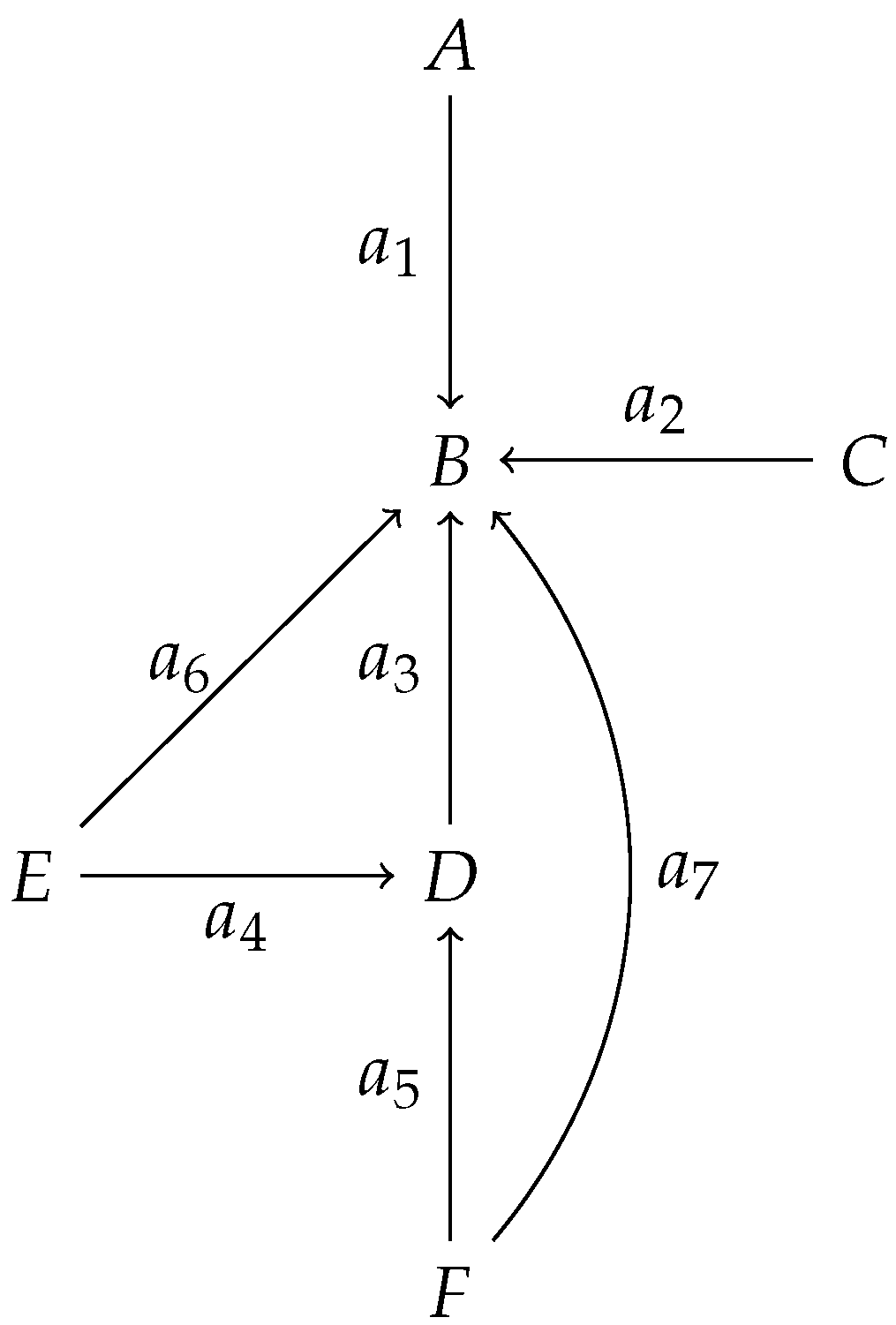
To interpret the actantial model as a schema in , arrows in the original diagram (cf. Equation (1)) must be understood as functions between sets of actantial instances. This imposes a functional constraint: each element of a source type must be associated with a unique element of the target type. As a consequence, two arrows in Greimas’s original diagram must be reversed in order to preserve functionality. The reversal of arrows in the functional interpretation reflects a shift from ontological dependency to relational directionality. While Greimas’s diagram presents actantial positions as structural oppositions, the categorical encoding treats morphisms as functional mappings. Reversing the arrows ensures that morphisms represent the direction of semantic dependence rather than merely graphical opposition.
To make this precise, consider the relation between Receiver and Object in the original Greimas diagram. If interpreted directly as a function in the direction of narrative flow, one would obtain a mapping . However, in general, a single Object may be obtained by multiple Receivers (e.g., “enlightenment”, “courage” or the “truth” as the Object), which violates functionality in that direction. By reversing the arrow and modeling the relation as a function , each Receiver is associated with (at least) one Object of desire, preserving functionality in Set. The reversal therefore reflects not narrative chronology but functional dependence, ensuring that morphisms represent well-defined mappings rather than arbitrary relations.
Figure 1 presents a relabeled directed multigraph
encoding the actantial model, together with the path equivalences
These equivalences express structural constraints already implicit in Greimas’s theory: the Helper and the Opponent are related to the Object via their respective relations to the Subject. The reversal of arrow directions does not alter the semiotic interpretation of the model but reflects the shift from narrative vectors to functional relations. The arrows thus encode relational dependency rather than narrative flow.
2.3. Ontological Logs and Compositional Semantics
An
ontological log (olog) is a labeling of a categorical schema that assigns to each Object a type (a set of instances) and to each morphism a functional aspect between types.
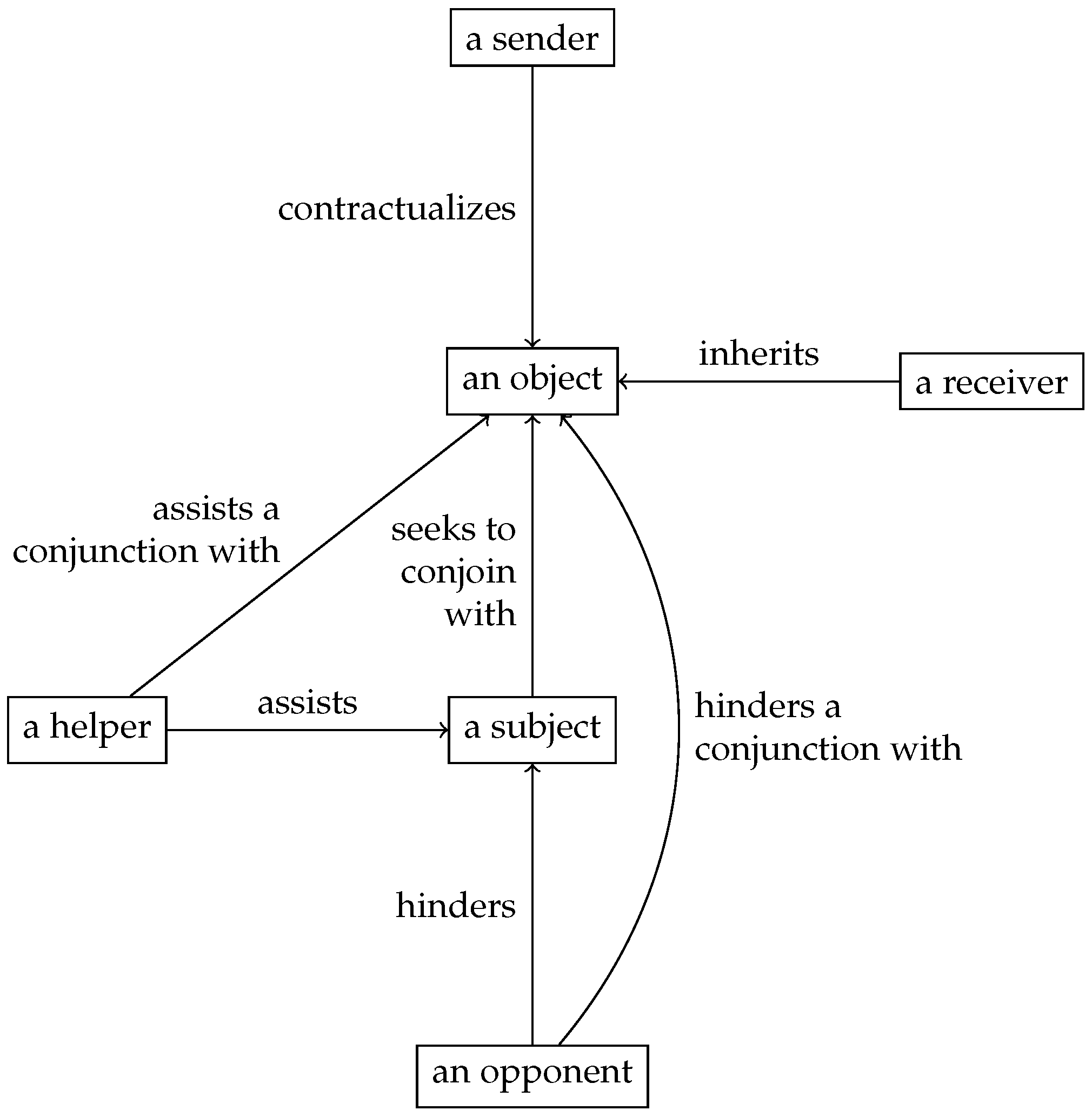
Figure 2 presents an olog of the schema
, with vertices labeled by singular indefinite noun phrases and arrows labeled by verb phrases.
The specified path equivalences function as factual assertions: they identify composite aspects with primitive ones, thereby encoding semantic constraints. In the present case, they correspond to Greimas’s opposition between conjunction and disjunction in the realization of a narrative program. The Helper actualizes the Subject–Object conjunction, while the Opponent inhibits it; these modalities are captured compositionally through the schema.
Viewed categorically, the actantial model thus acquires compositional semantics in which role relations can be composed, compared, and mapped functorially. This reconstruction not only clarifies the internal structure of the model but also enables functorial translations between actantial schemas, opening the possibility of tracking structural repetition and variation across narrative instances.
2.4. Functorial Instances and Syncretism
The actantial schema
acquires empirical and comparative relevance only when instantiated by particular narratives. Categorically, such instantiations are expressed by functors from
to
, assigning to each actantial type a set of narrative entities and to each aspect a functional relation between them. This aligns closely with Greimas’s methodological practice of
syncretism [
2] (p. 326), whereby abstract actantial roles are realized by heterogeneous narrative elements drawn from a text.
Formally, an instance of a categorical schema is a functor to . Although this notion is developed by Spivak via category presentations, it coincides with the standard categorical notion of a Set-valued functor.
Definition 4 (Instance on a schema)
. Let be a categorical schema. An instance on is a functorsuch that Objects of are mapped to sets of instances and morphisms are mapped to functions respecting all specified path equivalences. Instances themselves form a category.
Definition 5 (Category of finite instances)
. Let be a categorical schema. The category of finite instances on , denoted , has Objects that are instances (functors as ), and morphisms that are natural transformations between instances. Given the instances on , and the morphism , we say that for each Object v, there is a component of η at v, such that the following diagram commutes: This construction allows distinct narrative realizations to be compared whenever they conform to the same underlying actantial schema. From a categorical standpoint, this relational conception aligns with the Yoneda Lemma as the assertion that an Object is fully determined by its morphisms and their compositional behavior. Analogously, an actant in Greimas’s model acquires its identity not from intrinsic attributes but from its position within a structured network of roles and relations. Functorial instances of the actantial schema can therefore be interpreted as evaluations of this relational identity in concrete narrative contexts.
2.5. The Grothendieck Construction and Narrative Realization
Given an instance , one may form its Grothendieck construction, which assembles all actantial instances into a single category equipped with a canonical projection back to .
Definition 6 (Grothendieck construction)
. The Grothendieck construction associates the functor on to the pair , where is the category of elements (or realization) of the instance I, and is the projection functor from . The construction consists of the following Objects and morphisms:for which the functor sends the Object to s and the morphism to . We use “category of elements” and “category of instances” interchangeably to refer to the Grothendieck construction; the former emphasizes its categorical origin, while the latter reflects its interpretation in ontological logs. In the construction itself, the projection may be understood as a formalization of Greimas’s syncretism: heterogeneous narrative elements are superimposed onto abstract actantial roles while preserving their relational structure. In semiotic terms, corresponds to the discursive level, while represents the narrative level.
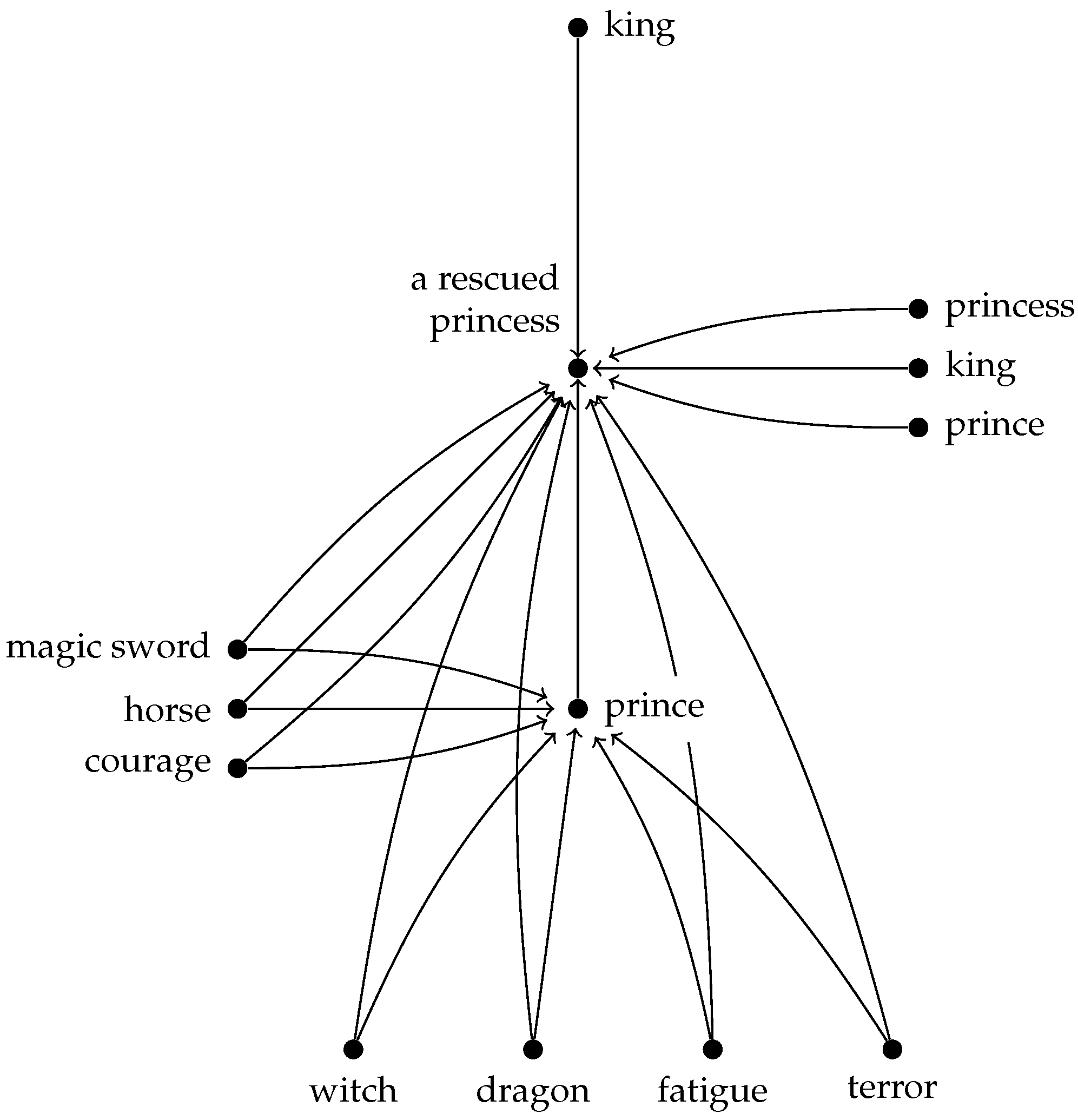
Figure 3 depicts the Grothendieck construction associated with typical instances from Western fairy tales identified by Hébert [
5] (p. 71) that follows the work of Propp [
10]. The figure illustrates how concrete narrative entities (e.g., characters, Objects, qualities) populate the actantial roles defined by
. The resulting category records not only which entities instantiate which roles but also how they participate in the actantial relations encoded by the schema.
2.6. Database Semantics
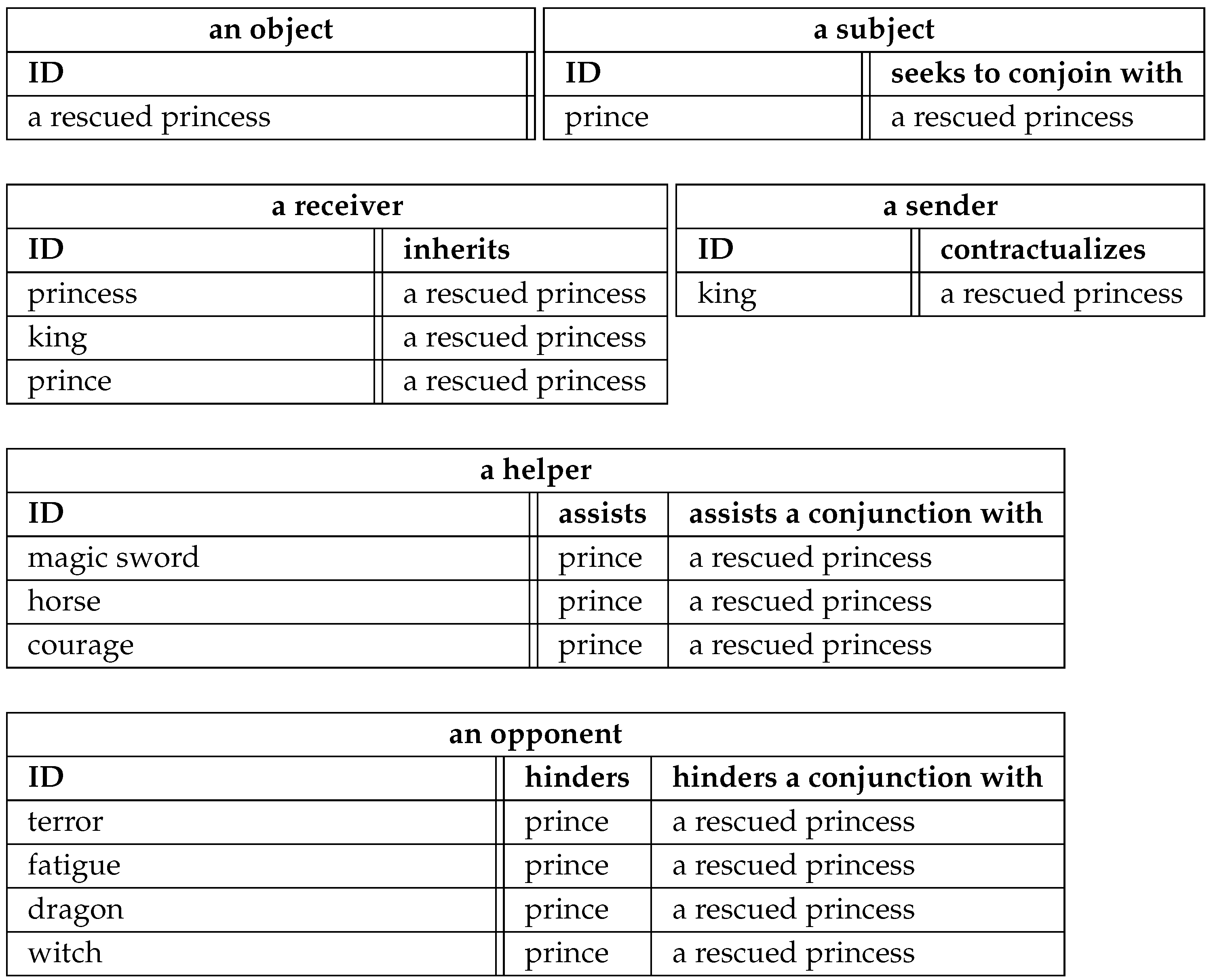
A distinctive feature of categorical schemas is that each instance admits a faithful representation as a relational database. For each Object of , one obtains a table whose rows correspond to instances and whose columns correspond to outgoing aspects, with primary keys given by identity morphisms.
Figure 4 presents the database associated with the instance
I of Hébert’s narrative. From this perspective, the category of instances functions as a structured repository of actantial realizations, enabling systematic comparison across narratives. Functoriality ensures that semantic constraints imposed by the schema are respected uniformly across all data.
This database interpretation is not incidental but follows directly from the categorical formulation. It provides a concrete mechanism for tracking structural repetition and variation across texts, extending the methodological ambitions of structural semiotics with a formally grounded, compositional framework.
2.7. Axes of the Actantial Model
In the actantial model, Greimas distinguishes three fundamental axes of desire, knowledge, and power, each defined by a constrained configuration of actantial roles. Concretely, the axis of desire involves the pair {Subject, Object}, the axis of knowledge involves the triple {Sender, Object, Receiver}, and the axis of power involves the triple {Helper, Subject, Opponent}. These axes do not merely collect actants but articulate specific relational conditions under which actants function within a narrative.
From a categorical perspective, such axes can be understood as relational descriptions of actants: they specify how an actant participates in a narrative by jointly constraining its relations to other actants. This suggests modeling axes not as subsets of Objects but as constructions determined by shared morphisms. In particular, pullbacks and images provide canonical means of forming new Objects whose identity is fixed by the relations they satisfy.
Definition 7. A pullback
, denoted as , is the fiber product or limit of a diagram, and contains two morphisms: and that share a common codomain. A pullback is defined as the set:together with the mappings and . The pullback thus produces the following communicative square in which the symbol “⌟
” denotes the pullback:This construction satisfies the universal property characterizing pullbacks, and thus defines the categorical limit of the diagram in Set.
Intuitively, a pullback may be understood as a way of “synchronizing” two structures that share a common reference point. It collects precisely those pairs of elements that agree under comparison to a third type. In narrative terms, pullbacks formalize situations in which distinct actantial roles are coordinated through a shared function or Object. In a structural semiotics context, pullbacks thus serve to define new actantial types whose identity satisfies multiple relational constraints simultaneously.
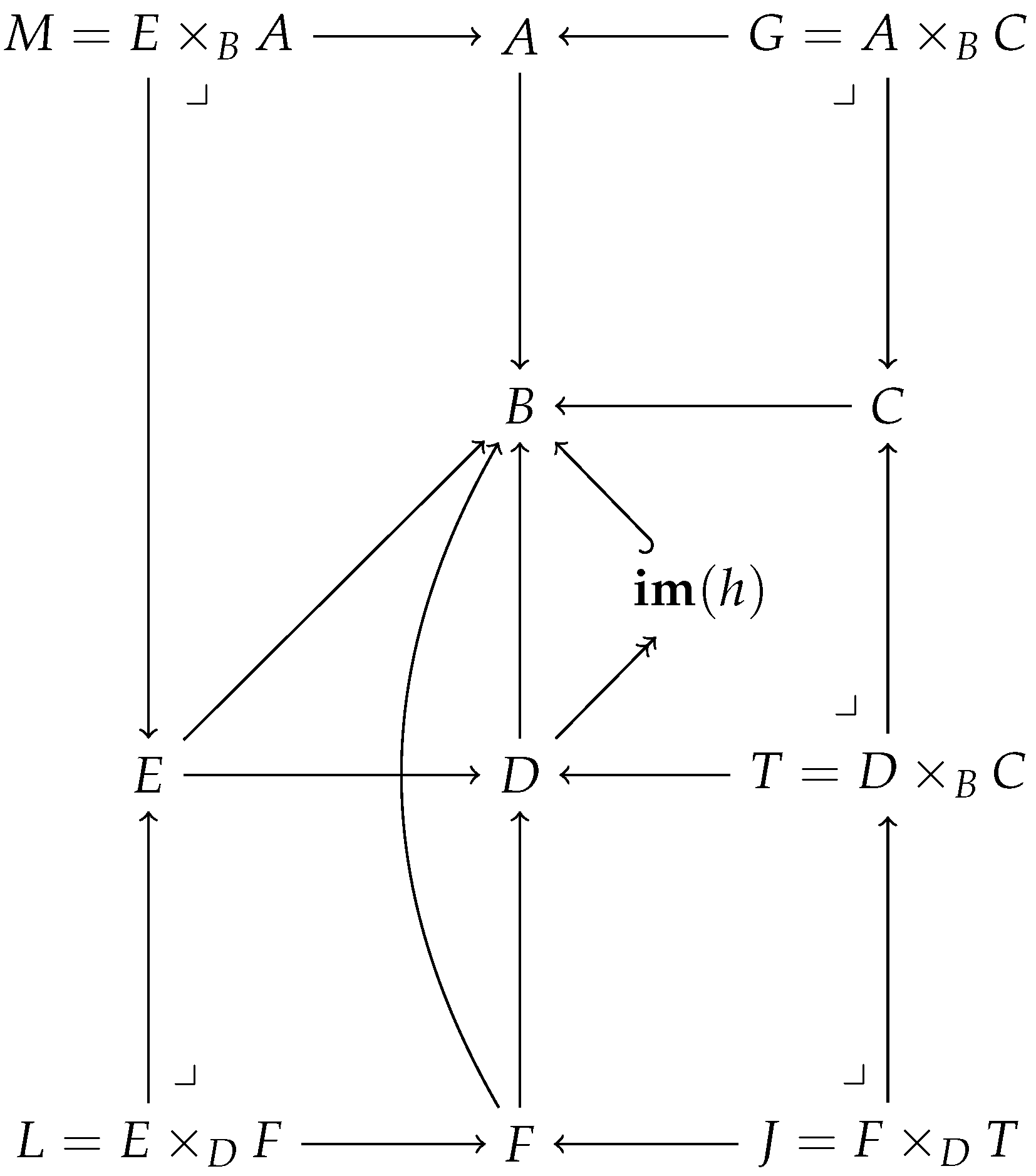
Figure 5 presents a general sketch, or specification [
11], over the category schema
, denoted
. This sketch extends
by designating specific limits that correspond to Greimas’s actantial axes.
Within
, the axis of power and the axis of knowledge are realized as pullbacks on sub-diagrams of
, or, in Spivak’s terminology, as
layouts [
8]. Concretely, these axes correspond to the Objects
whose defining property is that their elements jointly satisfy the relations imposed by the surrounding actantial structure. As fiber products, the Objects
G and
L may be read as relationally defined actants:
G consists of Sender–Receiver pairs coordinated through a common Object, while
L consists of Helper–Opponent pairs coordinated through a Subject. These constructions refine actantial roles by description rather than by extension, introducing no new primitives but articulating additional structure implicit in the original model.
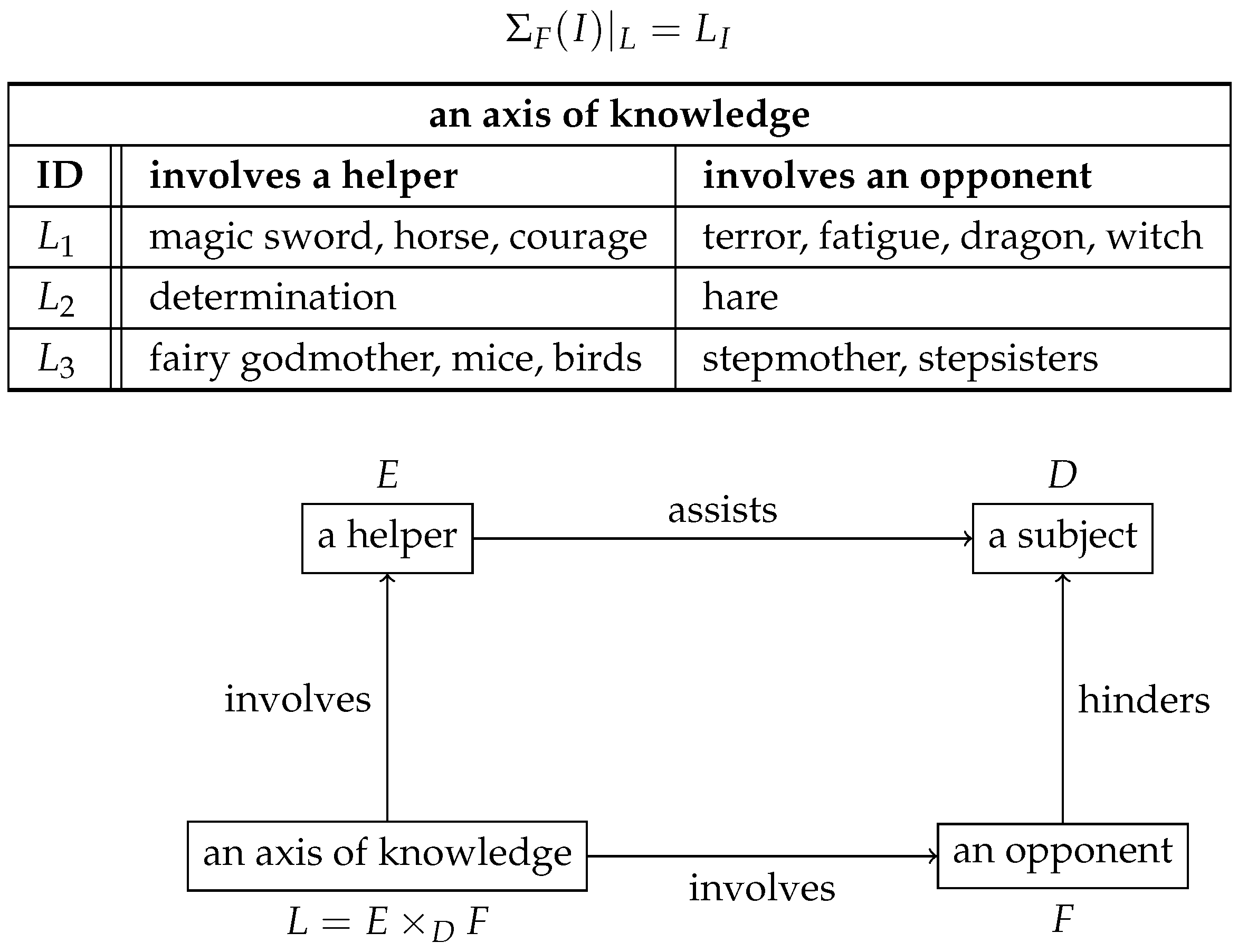
We can also derive the semantics of G and L through an olog on . Here, a pullback in these cases yields for the axis of power: “a Sender and a Receiver who respectively contractualize and inherit an Object”, and for the axis of knowledge: “a Helper and an Opponent who respectively assist and hinder a Subject”. An instance of the axis of power thus yields pairs consisting of a Helper and an Opponent relative to a Subject, illustrating how categorical constraints refine actantial roles without introducing new primitives.
The axis of desire, which consists of the pair , is captured categorically by the image of the morphism , expressing the relation “seeks to conjoin with”.
Definition 8. Let be a category in for which the image
of the morphism is a subset of its codomain and given as:The image of f is denoted as the injective morphism , such that there is also a surjective morphism and :Given the Object P in with the morphism and injective morphism , the morphism is unique, such that and . While pullbacks introduce types defined by simultaneous relational constraints, the image construction isolates those Objects that are actually realized as “goals of desire” within a narrative instance. Formally, the image of
determines a subobject of
B whose elements are precisely those Objects hit by some Subject via the desire relation. This yields a distinguished subtype of Object, which we interpret as the type “a goal”. The resulting factorization
encodes the idea that multiple Subjects may pursue the same goal, while each goal remains uniquely identified as an Object. In this sense, the identity of a goal is determined entirely by the pattern of morphisms through which it is desired, rather than by any intrinsic properties of the Object itself.
Secondary Axes as Layouts
Beyond the primary axes identified by Greimas, the sketch
(
Figure 5) specifies additional pullbacks that define further actantial types not explicitly represented in the original model. These arise naturally as
layouts in the sense of Spivak and Kent [
8], and correspond to composite relational roles induced by the existing morphisms of
. These secondary axes have not been postulated independently, but arise formally through pullback constructions. In this sense, category theory does not merely formalize the actantial model but reveals additional relational structure implicit in it. This includes the following pullbacks:
Each of these Objects defines a derived actantial type whose identity is determined entirely by the satisfaction of multiple relational constraints.
Interpreted in terms of an olog, these layouts admit the following readings: T corresponds to a Subject–Receiver pair mediated by an Object; J refines this structure by introducing an Opponent acting upon such a pair; and M identifies Helper–Sender pairs relative to a shared Object. Importantly, these types do not introduce new narrative primitives, but rather articulate higher-order relations implicit in the actantial schema; their emergence reflects structural dependencies already present in Greimas’ model, made explicit through categorical reconstruction.
In the cases of J and T, the corresponding layouts are related by composition. The Object appears as an intermediate pullback in the construction of , so that J is obtained by imposing additional constraints on the structure already captured by T. This situation exemplifies a standard categorical phenomenon of the pasting of pullbacks. When pullbacks are composed along compatible morphisms, the resulting construction may equivalently be described as a single pullback over a larger diagram.
Proposition 1. Consider the diagramwith . Then there is a canonical isomorphism As sketch components, the derived layouts
T,
J, and
M correspond to structured configurations of actantial relations that persist across narrative instances. In this sense, they align with what Rastier [
12] describes as
themes: stable semantic organizations that operate at the discursive level. Rather than positing themes as independent entities, the present framework derives them categorically as higher-order relational types induced by the actantial schema itself. Accordingly,
may be understood as specifying a family of generic thematic structures associated with recurrent domains of narrative action, grounded in formally defined relational constraints rather than interpretive abstraction.
3. Instance Migration and Comma Categories
While the preceding sections focus on the internal structure of a single actantial schema, categorical schemas also support principled transformations between different structural descriptions. Such transformations are essential for modeling variation across narratives, where distinct texts may instantiate related but non-identical actantial configurations. In this setting, a functor between schemas represents a structural alignment between role systems, while instances encode concrete narrative realizations.
To transport instances along such a structural alignment, we make use of the left pushforward functor. Conceptually, the left pushforward aggregates instances from a source schema into the target schema in a way that preserves relational provenance. From a narrative perspective, the left pushforward models the integration of a newly analyzed text into an existing actantial schema. Rather than redefining the schema, the new instance is transported along a functor, preserving structural coherence while enriching the domain of discourse. This mirrors comparative semiotic practice, where new narratives are interpreted relative to established structural models. Thus, rather than mapping individual actants in isolation, the construction collects all source instances that contribute to a given target role and assembles them coherently. The technical mechanism underlying this aggregation is a comma category.
Definition 9 (Comma category)
. Let , and be categories for which there exists the functors and . A comma category of the functors F and G, denoted is the category of morphisms of from F to G with Objects as triples:Let and be Objects of . The morphisms between these two Objects forms the set:for which the following diagram commutes:We call the diagram the setup for the comma category . There are two canonical functors called the left projection, denoted that sends to a, and a right projection, denoted , which sends to b. For a fixed Object
d in the target schema in a migration, the comma category
indexes precisely those Objects of the source schema whose images under
F map into
d. In this way, the comma category serves as a contextual index of contributing actantial configurations, ensuring that instance migration respects the relational structure encoded by the schema. Below we give a formal definition of the left pushforward functor following Spivak [
13].
Definition 10 (Left pushforward)
. Let be a functor between categorical schemas, and an instance on . We call the functor the left pushforward on . To compute , we start with an Object , and form the comma category from the setup , where is the terminal category with one Object and an identity morphism. There exists a canonical projection functor , which when composed with yields the functor , for whichdefines on Objects . Given a morphism of the form , there exists a functor , such that the following diagram commutes:Given the universal property of colimits we have, To illustrate the interpretive utility of the left pushforward, in
Figure 6, we consider three distinct narrative texts that instantiate the actantial schema in different ways. We draw on the database in
Figure 4 that records instances drawn from the analysis of the fairytale corpus by Hébert [
5] as well as Aesop’s
The Hare and the Tortoise and Giambattista Basile’s
Cinderella, each of which yields a markedly different configuration of actants, despite conforming to the same underlying schema.
The left pushforward provides a principled means of migrating these narrative-specific instances into a common semantic space. In this setting, individual actants such as “magic sword” or “determination” are not compared directly, but rather through the roles they realize within the actantial structure. The construction thus supports the aggregation and comparison of heterogeneous narratives while preserving their structural semantics.
4. Actorialization and Discourse-Level Association
In the preceding sections, we introduced categorical structures for modeling the actantial organization of narrative discourse, abstracted from any particular textual realization. To account for the process that Greimas and Courtés [
2] (p. 8) describe as
actorialization, or the binding of actantial roles to concrete fragments of discourse, we now introduce
profunctors as a natural mediating structure between an actantial schema and a textual domain. A profunctor can be viewed as a generalized relation between two categories. Rather than assigning elements directly, it specifies admissible correspondences. In narrative terms, this makes it particularly suited to modeling actorialization, where structural roles and textual fragments stand in many-to-many association. Informally, actorialization does not introduce new actants, but rather establishes systematic correspondences between actants and segments of text in which they are engaged.
Before introducing the profunctorial association between actants and text, we must account for the category of actants at the level of discourse. The actantial model introduced earlier, denoted
(
Figure 1), functions as a purely structural schema: its Objects correspond to actantial roles, abstracted from any particular instantiation. In order to pass from this schematic level to a category suitable for discursive association, we first utilize a
constant functor.
Definition 11 (Constant functor)
. Let be a small category. The constant functorassigns to each Object of a singleton set and to each morphism the identity function. The category of elements associated with the constant functor provides a discoursive realization of the actantial schema: its Objects correspond to actant instances whose only distinguishing feature is their structural identity. We denote this category as and use it in the profunctorial association with textual material.
Definition 12 (Profunctor)
. Let and be categories. A profunctoris a functor In the simplest case relevant here,
may be taken to be the terminal category with a single Object corresponding to the type “a text”. The profunctor then assigns to each actant a set of textual fragments in which that actant is instantiated. The resulting category of elements of
P may be presented concretely as a table whose rows pair actants with passages from the source text.
Table 1 provides such a presentation, which we interpret as a single Object—an actorialization—arising from the profunctorial association between an actantial schema and a corpus of discourse. The table should be read column-wise: each row corresponds to a role-indexed actant instance paired with a textual fragment, while the subscripts indicate role membership rather than identity.
Profunctors provide a precise mathematical language for the correspondence between actant and text, allowing instances of discourse to be associated with actantial roles without collapsing the distinction between structural positions and their textual manifestations.
From a categorical perspective, the category of elements , obtained via the Grothendieck construction on the instance , may be understood as fibered over the actantial schema . Under this interpretation, individuals do not appear as untyped entities, but only as Objects relative to an actantial role: each Object of lies in a fiber over a role in . Thus expressions such as “Miles Davis (Opponent)” or “girl (Receiver)” do not denote annotations of a single underlying individual, but rather distinct role-indexed instantiations. This reflects the actantial insight that meaning is produced not by entities alone, but by entities as they occupy positions within a narrative structure.
5. Conclusions
The motivation for this article has been to introduce a category-theoretic framework for the Greimasian actantial model in order to examine more closely some of the foundational principles underlying the structural semiotics project of the Paris School. By recasting the actantial model as a categorical schema, populating it with instances, and extending it to discourse-level association through functorial and profunctorial constructions, we have shown that categorical methods provide not only a precise formal language but also operational tools for organizing, migrating, and comparing meaning across levels of narrative analysis—a central concern of Greimasian semiotics.
While the categorical reconstruction presented in this article is faithful to the relational spirit of the Greimas actantial model, it inevitably introduces structural precision that exceeds Greimas’s own program. In particular, categorical constructions such as pullbacks and comma categories make explicit certain higher-order relations that remain only implicit in the original theory. This should not be read as a claim about Greimas’s intentions, but rather as a formal clarification of structures that become visible once the model is expressed categorically. Moreover, the present framework abstracts away from pragmatic, rhetorical, and historical dimensions of narrative that were central to later developments in structural semiotics. The approach therefore complements rather than replaces traditional interpretive analysis.
Our category-theoretic framing thus brings a formal clarity to the distinction Greimas draws between the narrative plane, where actantial relations are specified abstractly, and the discursive plane, where these relations are realized through actors, themes, and texts. Category theory offers an axiomatic means of maintaining this distinction while accounting for their systematic interaction. Schemas capture the narrative plane as structured collections of types and relations, while instances, functors, and profunctors articulate how these structures are realized, transported, and compared at the discursive level without collapsing one plane into the other.
The introduction of Spivak’s left pushforward functor makes explicit how instances may be migrated between schemas, allowing heterogeneous narrative corpora to be integrated into a shared actantial framework without redefining its underlying structure. From an axiomatic perspective, this operation highlights the importance of universal constructions (here, colimits over comma categories) in modeling the extension and comparison of semiotic systems. Pullbacks similarly provide a canonical account of Greimas’ actantial axes, showing how composite narrative functions arise from formally specified interactions between more basic actantial roles.
An important consequence of this reconstruction is that category theory does not merely restate Greimas’ actantial distinctions in formal terms, but actively exposes additional structure latent in the model. While certain axes of the actantial system are explicitly named by Greimas, others emerge automatically once the model is treated as a categorical schema subjected to standard universal constructions. In particular, pullbacks and morphism images not only formalize established actantial relations but also generate further composite roles and dependencies that were not isolated in the original formulation. These structures are not imposed from outside the theory; rather, they arise as necessary consequences of the relational commitments already present in the actantial model.
At the level of discourse, profunctors serve as a mathematically natural interface between actantial schemas and textual domains. Rather than identifying structural roles with textual fragments directly, profunctors model actorialization as a correspondence: a relation that preserves the autonomy of both abstract roles and concrete discourse material. The resulting category of elements admits a concrete tabular representation, aligning naturally with Spivak’s ontological logs and database semantics, while remaining grounded in well-established categorical principles.
Many of these constructions are unified by a Yoneda-style perspective, according to which actantial roles are characterized not by intrinsic properties but by their relational behavior and modes of instantiation across contexts. From this standpoint, an actant is determined by the web of morphisms, instances, and correspondences in which it participates. This relational, extensional viewpoint closely mirrors the structural commitments of Greimasian semiotics and clarifies why category theory provides an especially well-matched foundational framework.
Beyond the specific semiotic application developed here, the proposed framework suggests broader methodological possibilities. Because schemas, instances, and their transformations are defined axiomatically, they may be reused to track semantic isotopies, thematic recurrences, and role transformations across narrative corpora, and extended to computational or database-oriented settings. Interpreting the actantial model as a categorical schema that is amenable to database-style querying then allows for collections of narratives to be stored as structured data whose invariants may be retrieved via categorical limits and functorial comparison. This means that one may query across a corpus for recurring Subject–Object–Opponent configurations or detect the persistence of derived actantial layouts such as T, J, or M. In this way, the framework not only clarifies structural semantics but also supports automated or semi-automated comparative narrative analysis. In this sense, category theory does not impose an external formalism on semiotics, but makes explicit the abstract structures and transformations already implicit in semiotic analysis, while providing additional tools for rigor, comparison, and reuse.