Abstract
This paper investigates the fixed-time (FXT) and predefined-time (PDT) synchronization of memristive neural networks (MNNs) subject to stochastic disturbances, reaction-diffusion terms, and time delays. First, a new PDT stability criterion is established for stochastic nonlinear systems, which permits a priori assignment of the settling time bound regardless of initial conditions, and offers a more concise form than prior results. Second, by leveraging Green’s formula, integral inequality, and stochastic analysis, some sufficient conditions are derived to guarantee FXT and PDT synchronization of introduced stochastic MNNs with reaction-diffusion terms. Finally, numerical simulations are given to validate the effectiveness of the proposed synchronization scheme.
Keywords:
fixed/predefined-time synchronization; reaction-diffusion; memristive neural network; stochastic disturbances MSC:
34D06; 93E15; 93D40
1. Introduction
Over the past thirty years, neural networks have attracted considerable attention due to their powerful information processing capabilities and wide applications in pattern recognition, signal processing, associative memory, and optimization [1,2]. Therefore, the various dynamical behavior of neural networks such as stability, periodicity, and synchronization has been extensively studied [3]. Meanwhile, in 1971, Chua predicted the existence of the memristor as the fourth basic circuit element [4], and its physical realization in 2008 [5] opened new avenues for neuromorphic computing. In fact, memristors can exhibit synapse-like learning and memory properties, making them an ideal tool for constructing MNNs where connection weights vary according to the history of neuronal activity [6,7,8]. MNNs have shown great potential in various applications including pattern recognition [9], signal processing [10], and associative memory [11].
It is well known that time delays are inherent in neural systems due to finite signal transmission speeds along axons, synaptic processing times, and feedback loops. The presence of delays can significantly affect network dynamics, potentially causing oscillations, instability, or bifurcations. The analysis of delay differential equations constitutes a vibrant field of research, with applications spanning from predator–prey systems [12] to neural networks. Therefore, introducing time delays into MNNs models is essential for accurate description of real neural circuits and hardware implementations. Besides time delay, real neural systems are inevitably subject to various stochastic perturbations, such as thermal noise in electronic components, random release of neurotransmitters at synapses, and environmental fluctuations. In fact, stochastic modeling is crucial for robustness analysis, as demonstrated in diverse fields including epidemiological dynamics [13]. For MNNs, stochastic disturbances must be explicitly considered to ensure reliable performance under realistic noisy conditions [14].
In addition, a reaction-diffusion process is a common phenomenon of spatial diffusion observed in the information transmission of biological neurons and the movement of electrons in non-uniform electromagnetic fields [15,16]. Reaction-diffusion neural network models have been proposed to capture this spatial-temporal coupling, where the state evolution depends on both spatial and temporal variables [17,18]. In recent decades, reaction-diffusion effects have been incorporated into MNNs modeling, leading to significant progress in the dynamics analysis of MNNs with reaction-diffusion [19,20,21,22,23]. In [24], by designing a pinning feedback controller, the author investigated the synchronization problem of a stochastic delay memristive reaction-diffusion neural network. In [25], the authors analyzed the global exponential stability problem for stochastic MNNs with reaction-diffusion terms and hybrid delays.
In practical applications, we usually aim to achieve synchronization of the drive–response neural network system in a bounded time [26,27]. In contrast to infinite-time synchronization, finite-time (FNT) synchronization inherently requires a faster convergence rate. However, the settling time of FNT synchronization depends on the initial conditions, which cause a difficulty to estimate or adjust in practice. To address this issue, Polyakov introduced the FXT convergence concept [28], where the settling time is bounded and independent of the system’s initial conditions. Currently, FXT synchronization of various types of neural networks including MNNs have be investigated [29,30,31,32,33].
Despite the considerable advances in FXT control for MNNs, its settling time still depends on system parameters and thus it is challenging to adjust to meet the engineering requirements. To address this issue, PDT stability is introduced where system solutions can reach zero point before the given predefined time and it is independent of any system parameters and initial values. Owing to this advantageous feature, various PDT control schemes have been developed [34,35] and applied in many fields [36]. However, there are few results addressing the FXT and PDT synchronization problems for stochastic MNNs with reaction-diffusion terms and time delays. Motivated by the discussion above, this paper studies the FXT and PDT synchronization of delayed stochastic MNNs with reaction-diffusion terms. The main contributions of it are summarized below: (1) A novel PDT stability criterion is proposed for stochastic nonlinear systems, which has a more concise form. (2) By integrating the Lyapunov function method with the divergence theorem and inequality techniques, several sufficient conditions for ensuring the FXT/PDT synchronization of the addressed system are introduced. (3) Some numerical simulations are given to verify the theoretical results.
Notations: Let be a bounded compact set with a smooth boundary and , where denotes the Lebesgue measure of , and the n-dimensional Euclidean space. Some key parameters used in the paper are explained in Table 1.
Table 1.
Key parameters and descriptions.
2. Model Description and Preliminaries
We consider the following stochastic delayed memristive reaction-diffusion neural networks model
where , with N standing for the total neuron number. represents the state of the m-th neuron at time t and spatial point . is the transmission diffusion coefficient, is the self-inhibition coefficient. denotes the constant transmission delay between neurons. The functions and represent the neuronal activation functions of the n-th neuron at the times t and , respectively. Furthermore, denotes the noise intensity function, and is a scalar standard Brownian motion defined on the complete probability space . The memristive connection weights and are defined as follows:
where denotes the switching jump; , , , and for are known constants associated with memristances. The boundary conditions and initial values of system (1) are specified as follows:
where for is a continuous and bounded function.
Due to the discontinuous nature of the right-hand side in the switching system (1), regular solutions are not defined. Therefore, from the theory of differential inclusions and Filippov solutions, system (1) can be re-expressed as
where
and
where denotes the convex closure of a set.
For simplicity, let , , , , , . Then, according to the measurable selection theorem, there exist two functions and such that
By considering system (1) as the drive system, we introduce the response system under control inputs as:
where is the control input to be designed.
The boundary conditions and initial values for system (6) are given as follows:
where the function is continuous and bounded.
Similarly, there exist measurable functions and such that
Let be the synchronization error, then the error system can be derived as:
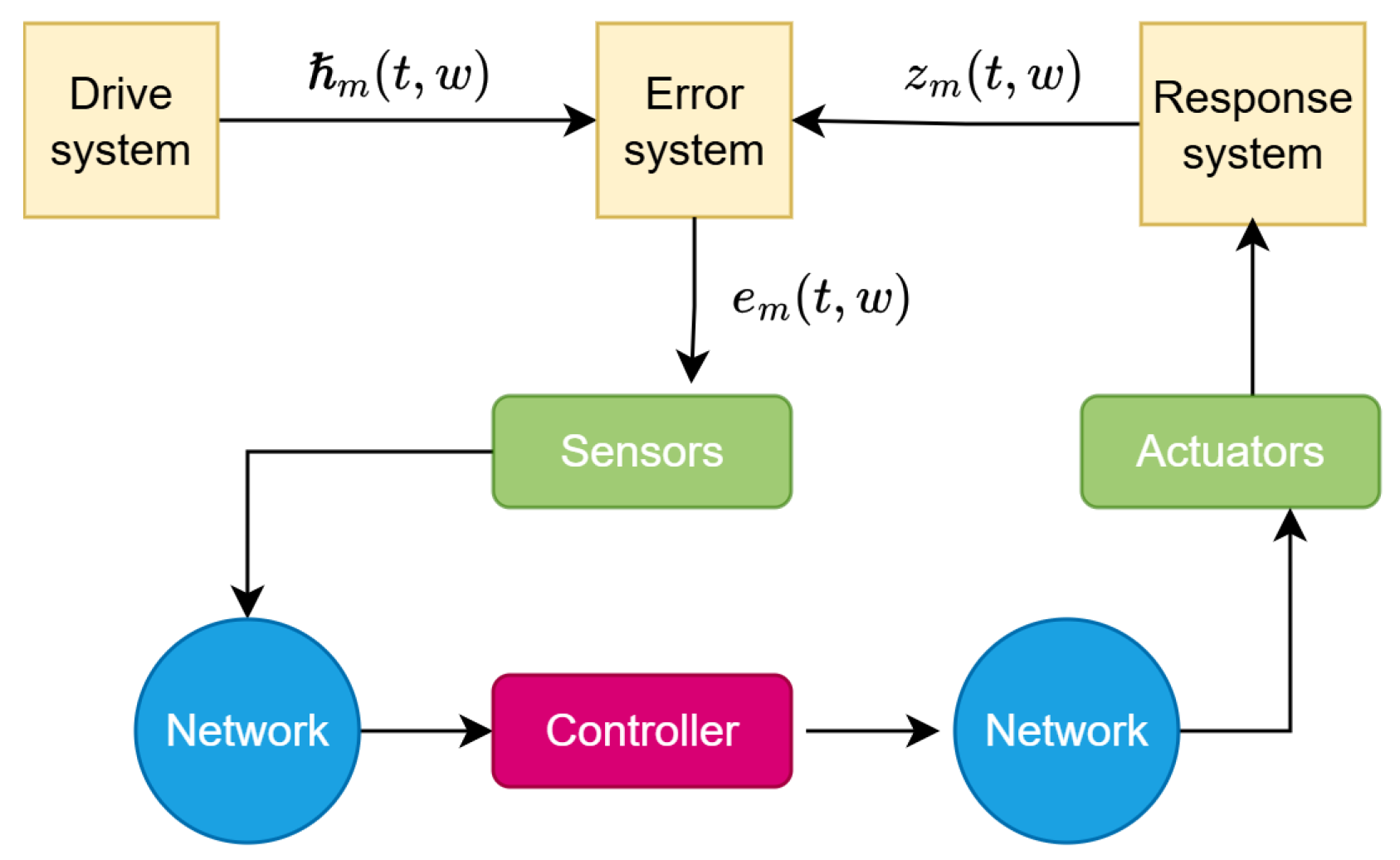
where . The structural framework of the drive and response systems is illustrated in Figure 1.
Figure 1.
Structure of drive and response systems.
Remark 1.
Compared with the models studied in [15,16,17], system (1) exhibits a higher level of generality since it incorporates reaction-diffusion terms, time delays, and stochastic disturbances. When the memristive connection weights are set to constant values, system (1) can be reduced to a common reaction-diffusion neural network models with stochastic disturbances. In fact, system (1) integrates several physically meaningful features: (1) The memristive weights and emulate synaptic plasticity, whose connection strengths can be dynamically adjusted according to the activity state of neurons; (2) The reaction-diffusion terms describe the propagation process of spatial signals, such as the conduction process of electrical potential in neural tissue; (3) The stochastic disturbance term corresponds to various noise sources, such as the random release process of neurotransmitters. Table 2 presents comparisons between existing studies and our work.
Table 2.
Comparisons between existing studies and our work.
Assumption 1.
The activation functions and are globally Lipschitz continuous and bounded, i.e., there exist positive constants , , , and such that for any and ,
and
Assumption 2.
The noise intensity function satisfies the uniformly Lipschitz condition:
where is a positive constant.
Take the following stochastic nonlinear system into consideration:
where , is the system state, and is a scalar Brownian motion defined on the complete probability space . The functions and are continuous, with and .
Definition 1
([38]). For a function that is twice continuously differentiable, the infinitesimal generator corresponding to system (9) is defined as follows:
Definition 2
([39]). The trivial solution of system (9) is said to be stochastically FNT stable, if the stochastic system (9) admits a solution for any initial value , and the following statements hold:
- (i)
- FNT attractiveness in probability: For every initial value , and any solution , the first hitting time of , i.e., , called stochastic ST, is finite almost surely, that is . Furthermore, .
- (ii)
- Stability in probability: For any solution , and every pair of and , there exists a such that whenever .
Definition 3
([40]). The trivial solution of system (9) is said to be stochastically FXT stable if the following conditions hold:
- (i)
- The trivial solution is stochastically FNT stable.
- (ii)
- There exists a constant , which is independent of the initial condition , such that
Definition 4
([41]). System (9) is said to be stochastically PDT stable if it is stochastically FXT stable, and any
Lemma 1
([42]). Let denote a real-valued continuous function defined on Ω with . Then,
Lemma 2
([37]). Suppose is a C-regular function and satisfies the differential inequality presented as follows:
where , , , , and . Then, the zero equilibrium of system (9) achieves FXT stability in probability, with the ST being estimable by
where .
Lemma 3
([41]). Given any , if there exits a positive and radially unbounded Lyapunov function such that
where is a function satisfying , for all , and . Then, system (9) is stochastically PDT stabilizable, with .
Lemma 4.
For system (9), suppose there exists a positive definite and radially unbounded Lyapunov function . Given any , a control input exists such that when applied to system (9), the resulting state satisfies
where , , , and , and . Then, system (9) achieves stochastic PDT stability, i.e., holds true.
Proof.
Let , obviously and , moreover,
Therefore, from Lemma 3, the conclusion of Lemma 4 is satisfied. □
Remark 2.
Compared with the
in Corollary 2.3 of Reference [41], the requirement of
in this paper is more general.
Remark 3.
Lemma 4 establishes a Lyapunov-based criterion for stochastic PDT stability. When the integral condition holds, the system (9) achieves stochastic PDT stability. If the condition is relaxed to , then system (9) can be in stochastic FXT stable.
3. Main Results
3.1. Fixed-Time Synchronization
In this subsection, we derive some FXT synchronization criteria between drive–response systems (1) and (5). To achieve this goal, we design the controller in the response system (5) as follows:
where , , , , , and are positive constants.
Remark 4.
In this paper, the sign function terms are introduced into the controller design. These terms play a crucial role in establishing the synchronization of the proposed drive–response system within the FXT/PDT framework. Although the inclusion of sign functions may introduce minor chattering in the control signal, such chattering remains within acceptable limits. In practical applications, to further attenuate chattering, the sign functions can be substituted with saturation functions, which can be defined in the following forms:
where , are odd numbers, . Investigating FXT/PDT synchronization of stochastic MNNs via such smooth saturation-based control schemes constitutes an important direction for future research, and it will be one of our future research directions.
For convenience, denote
Theorem 1.
Under the Assumptions 1 and 2, if control gains , and of controller (10) satisfy the following inequalities:
then the drive–response systems (1) and (5) can realize FXT synchronization in probability, with ST estimation .
Proof.
Select the Lyapunov function given below:
Calculating the along the solution of system (8), we get
By applying the divergence theorem on the basis of boundary conditions, we get
where “·” represents the inner product, denotes the outward-pointing unit normal field corresponding to the boundary , stands for the gradient operator, and is defined as the transposed vector .
From Lemma 1, we get
Using the Assumption 1 and inequality for , one has
Based on Assumption 2, we derive
Furthermore, we have
Substituting (17)–(25) into (16), it gains
where , and .
Let , , , and . By inequality (17), we can infer that . Therefore, based on Lemma 2, the drive–response systems (1) and (5) can realize FXT synchronization in probability, and the ST is , as defined in Lemma 2. The proof is completed. □
Remark 5.
Notably, the parameter imposed on the constraint in Assumption 2 is incorporated as a positive term of . This indicates that under the conditions of Assumption 2, the effect of noise is suppressed via selecting the feasible range of the parameter .
Remark 6.
It is easy to conclude from Theorem 1 that the upper bound of ST is closely associated with the controller parameters α, β, , , , and . Thus, by properly tuning these controller parameters, we can achieve the optimal convergence performance.
When the memristor-based connection weights become constants, i.e., and and the delayed feedback connection weights by , systems (1) and (5) are transformed into the subsequent form.
consequently, we can deduce the error systems as
Correspondingly, the controller is designed as follows:
where , , , and are positive constants.
Corollary 1.
Suppose that the Assumptions 1 and 2 are satisfied and control gains and of the controller (30) satisfy inequality (13) and (14). Then, under controller (30), the drive–response systems (27) and (28) can achieve FXT synchronization in probability with ST estimation .
Proof.
Take into account the Lyapunov function (15). Then, we can calculate the along the solution of system (29) as
The remaining steps are identical to those in Theorem 1 and thus are omitted herein. □
3.2. Predefined-Time Synchronization
This section provides analysis of the PDT synchronization problem for the drive–response systems (1) and (5).
First, we introduce the following PDT controller
where , , , , , , and are positive constants, and is any given time.
Remark 7.
The power terms and parameter in the controller are derived based on the predefined-time stability Lemma 4. Specifically, the power structures with and , together with the expression of , jointly guarantee that the system achieves synchronization convergence within the PDT.
Denote
Theorem 2.
If Assumptions 1 and 2 are valid and the control gains , , and meet the requirements specified in conditions (12)–(14), then the drive–response systems (1) and (5) will attain PDT synchronization in a probabilistic sense under controller (32).
Proof.
Select the Lyapunov function presented below:
By calculating , we get
Similar to the proof of Theorem 1, we get
Substituting (36) and (37) into (35), yields
where , , , , , , and .
Since can be insured from Lemma 4, thus the drive–response systems (1) and (5) achieve PDT synchronization in probability. The proof is completed. □
4. Numerical Examples and Simulations
Example 1.
For , consider the following reaction-diffusion MNNs with stochastic disturbances
where . The memristor-based connection weights are given as
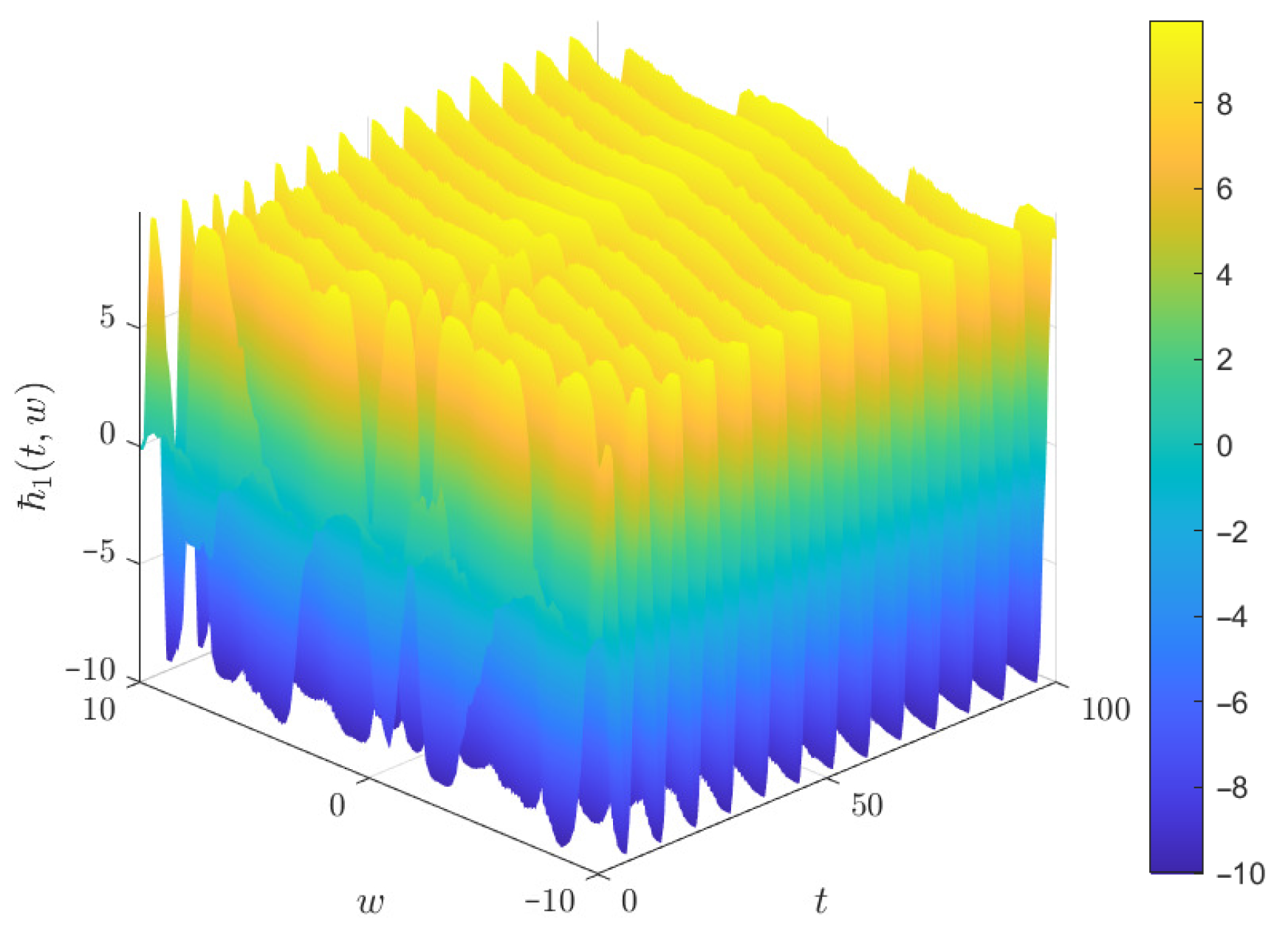
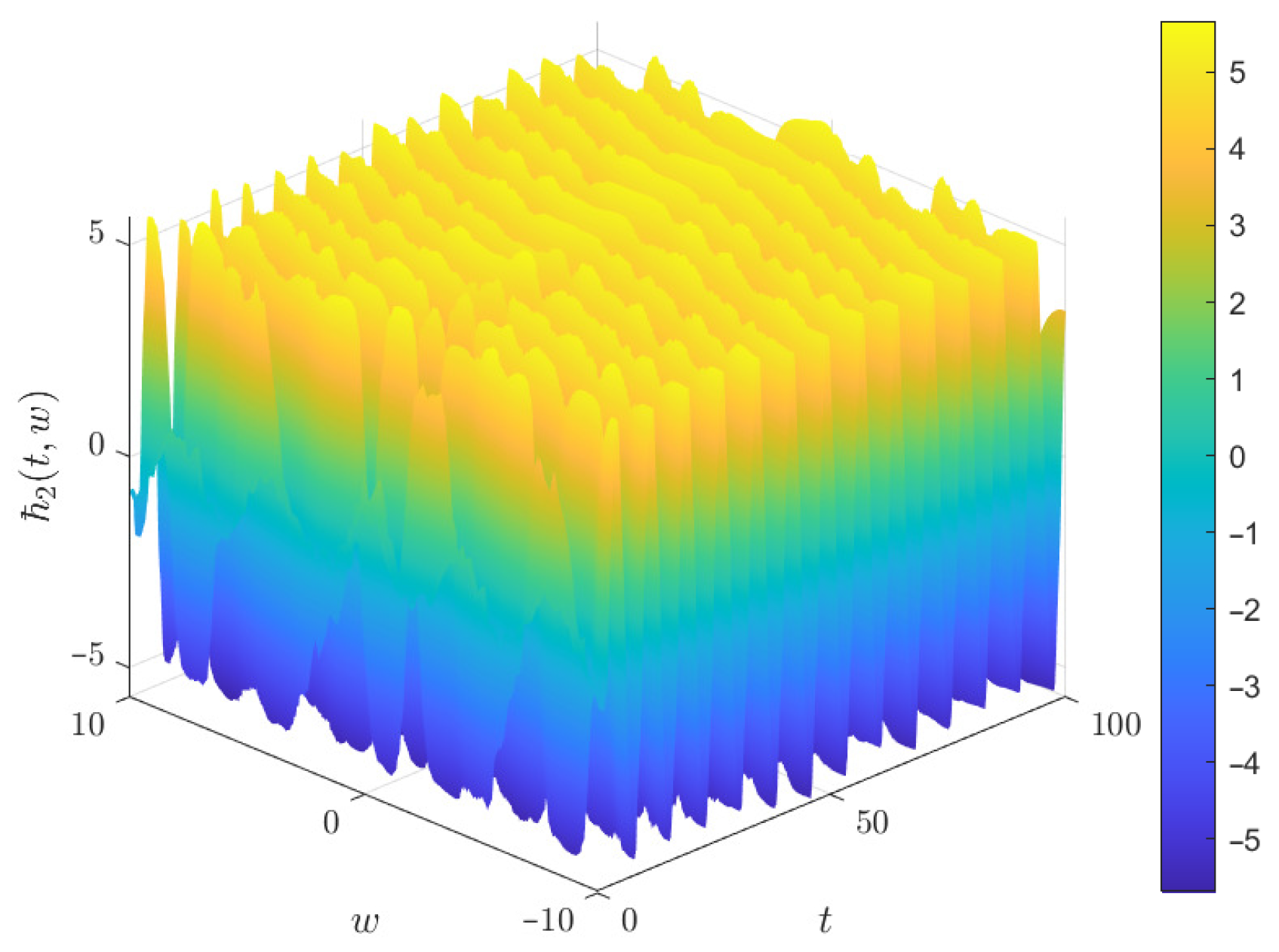
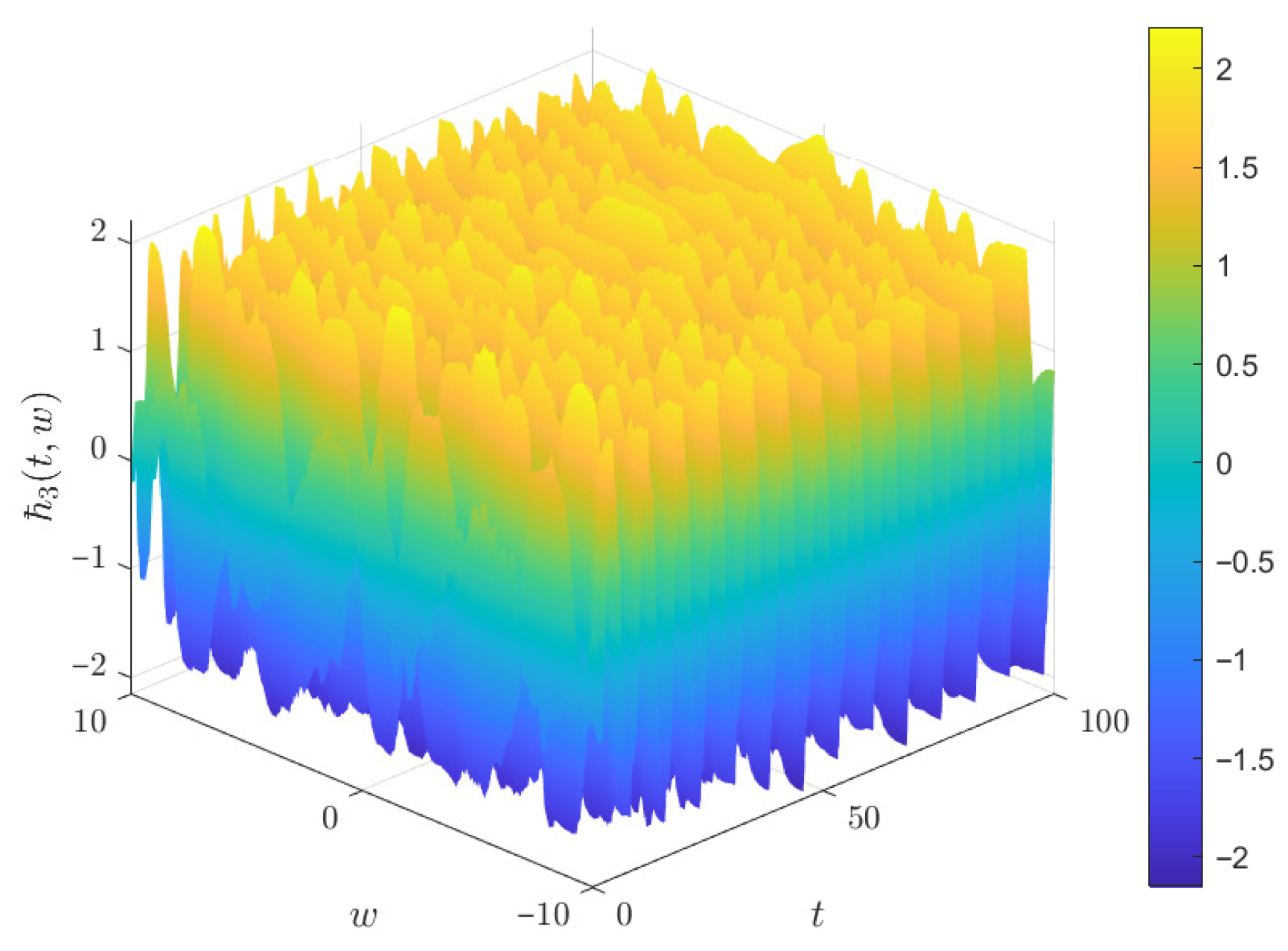
It is obvious that , , , , , , , , , , , , , , , , , , , , , , , , , , , , , , , , , , and . By choosing and , , , , , , then MATLAB 2020a simulations of system (39) corresponding to the initial conditions , and are given in Figure 2, Figure 3 and Figure 4, which verifies that system (40) possesses a chaotic attractor.
Figure 2.
Evolution of in system (39).
Figure 3.
Evolution of in system (39).
Figure 4.
Evolution of in system (39).
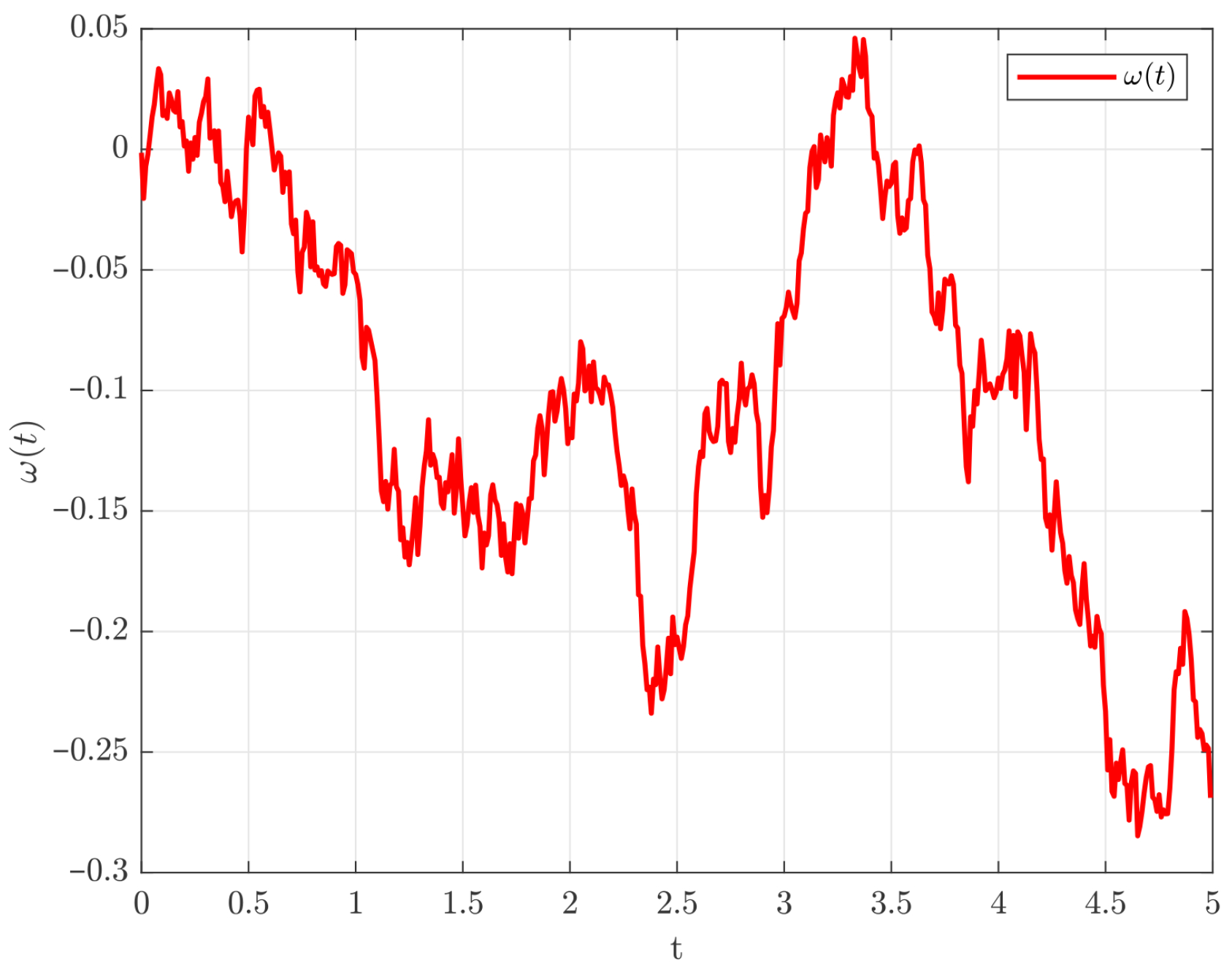
We choose the Brownian motion such that , where is step size and ℷ obeys a normal distribution N(0,1.28); the simulation of is shown in Figure 5.
Figure 5.
Trajectories of Brownian motion .
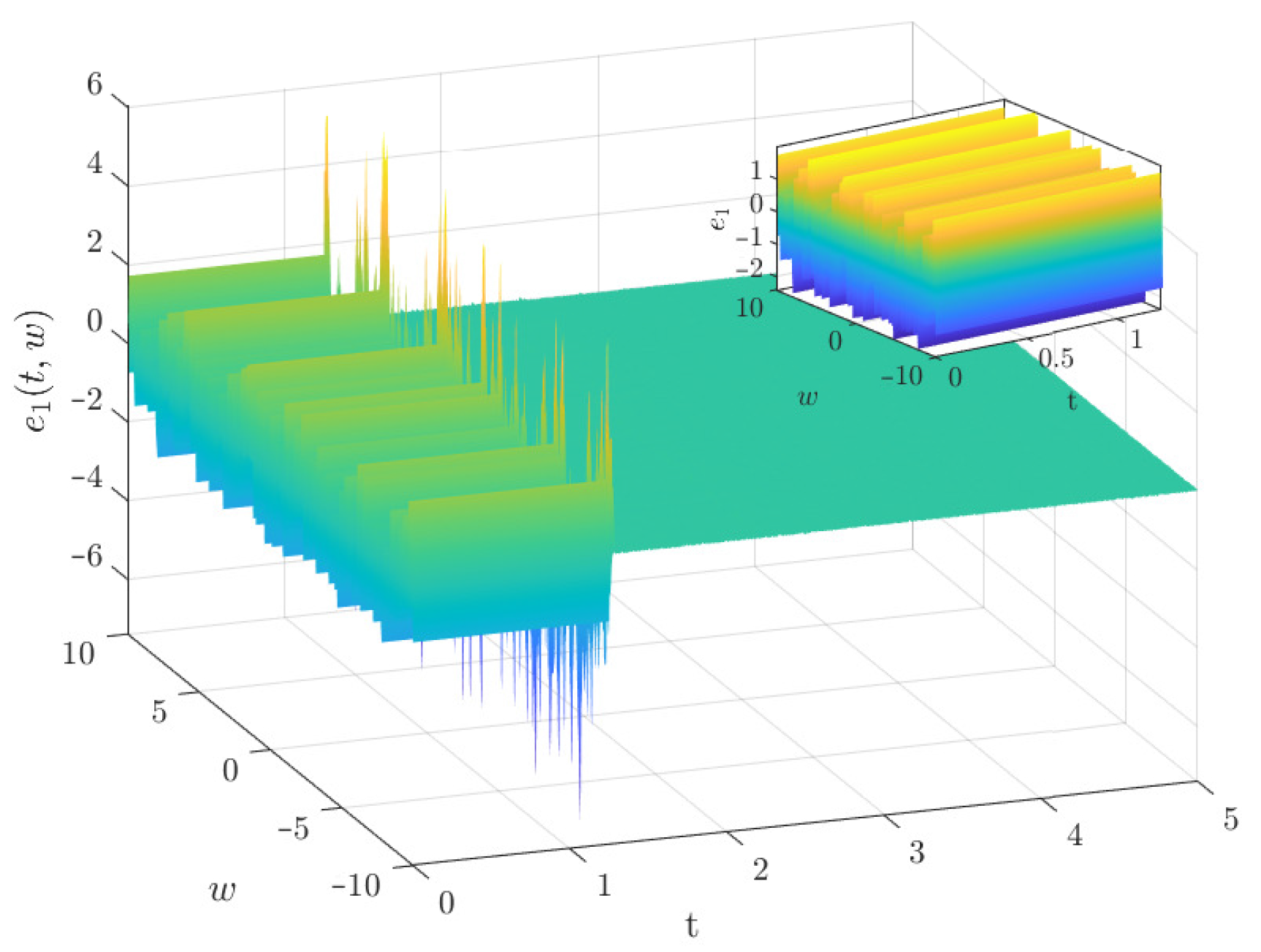
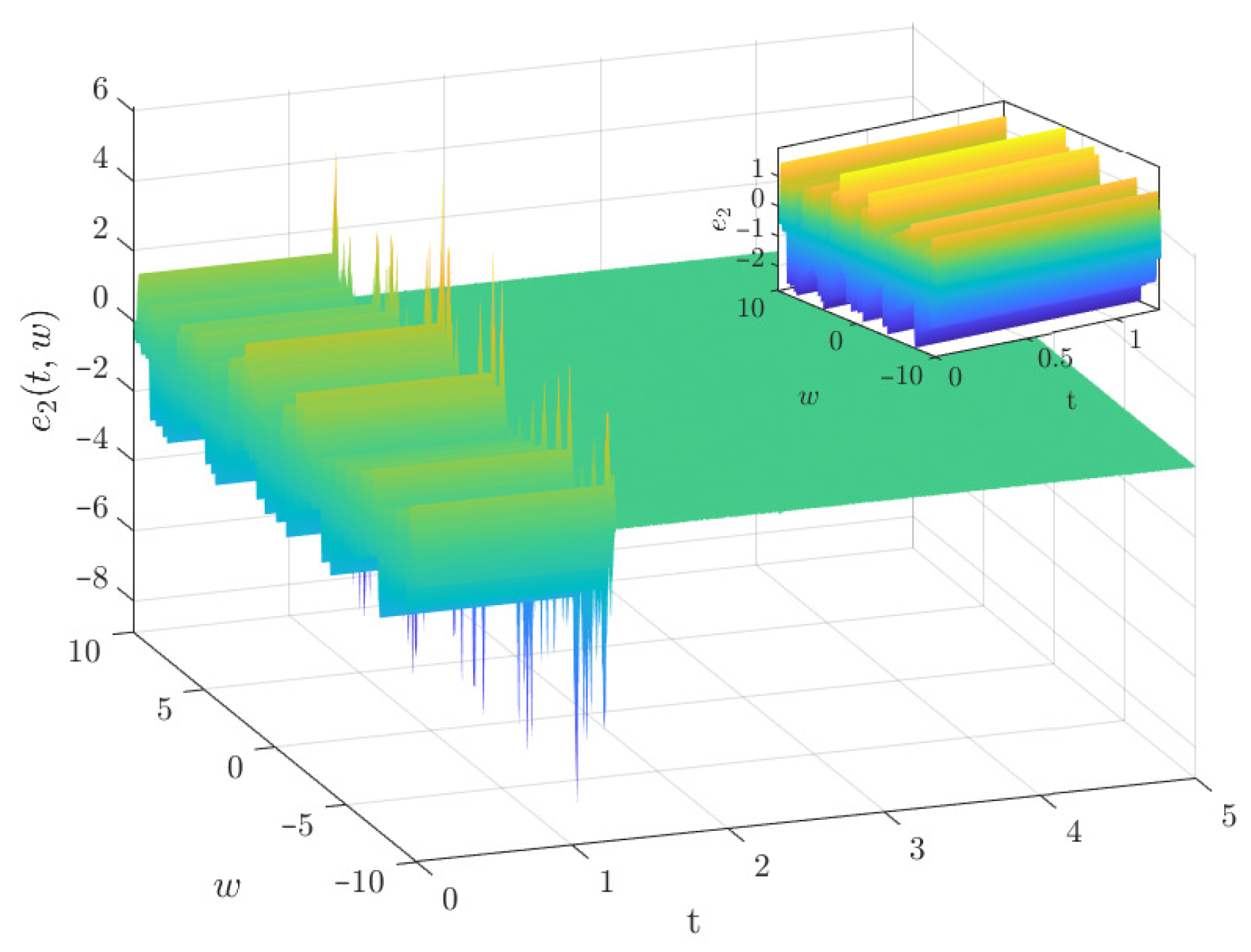
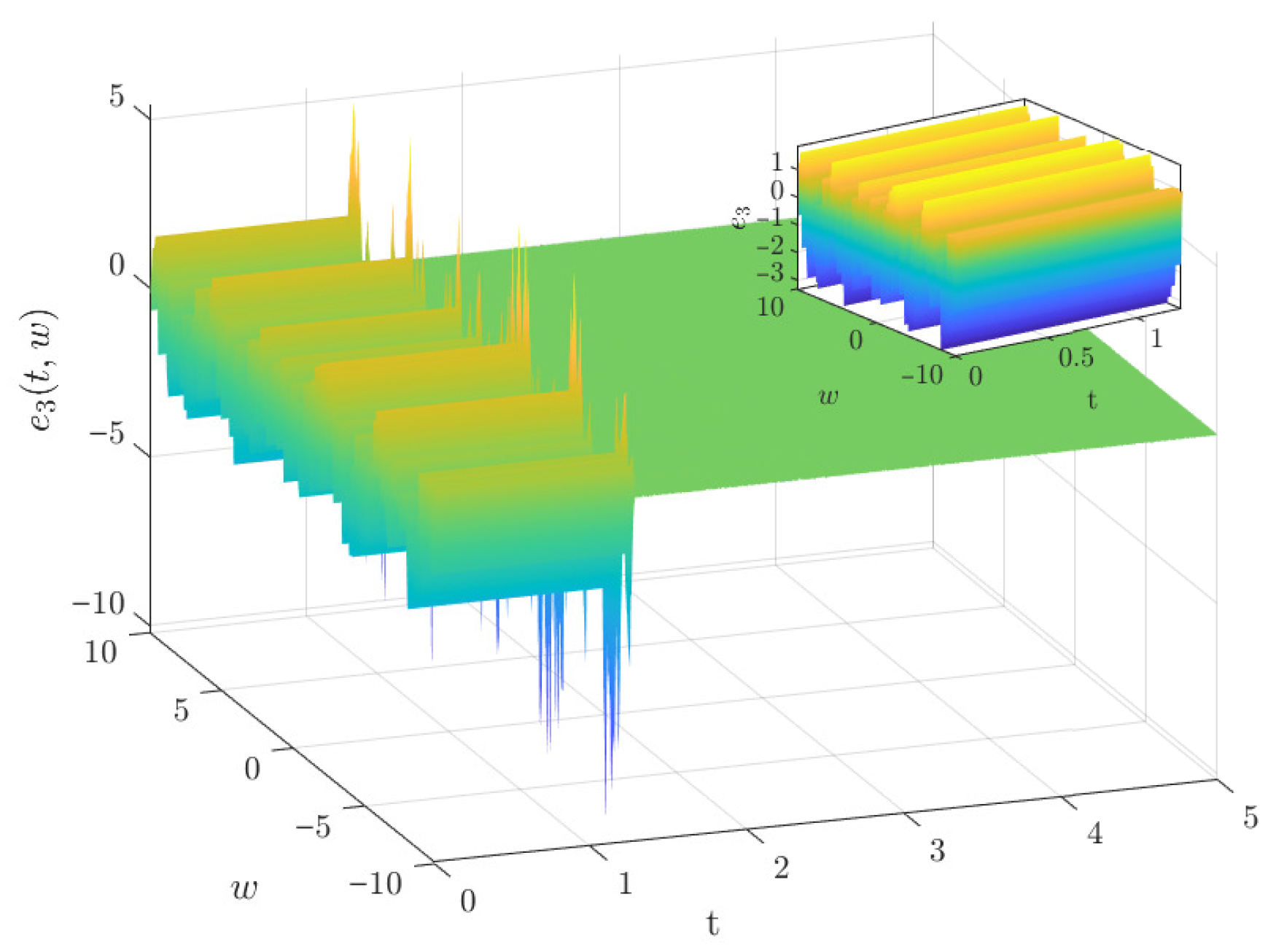
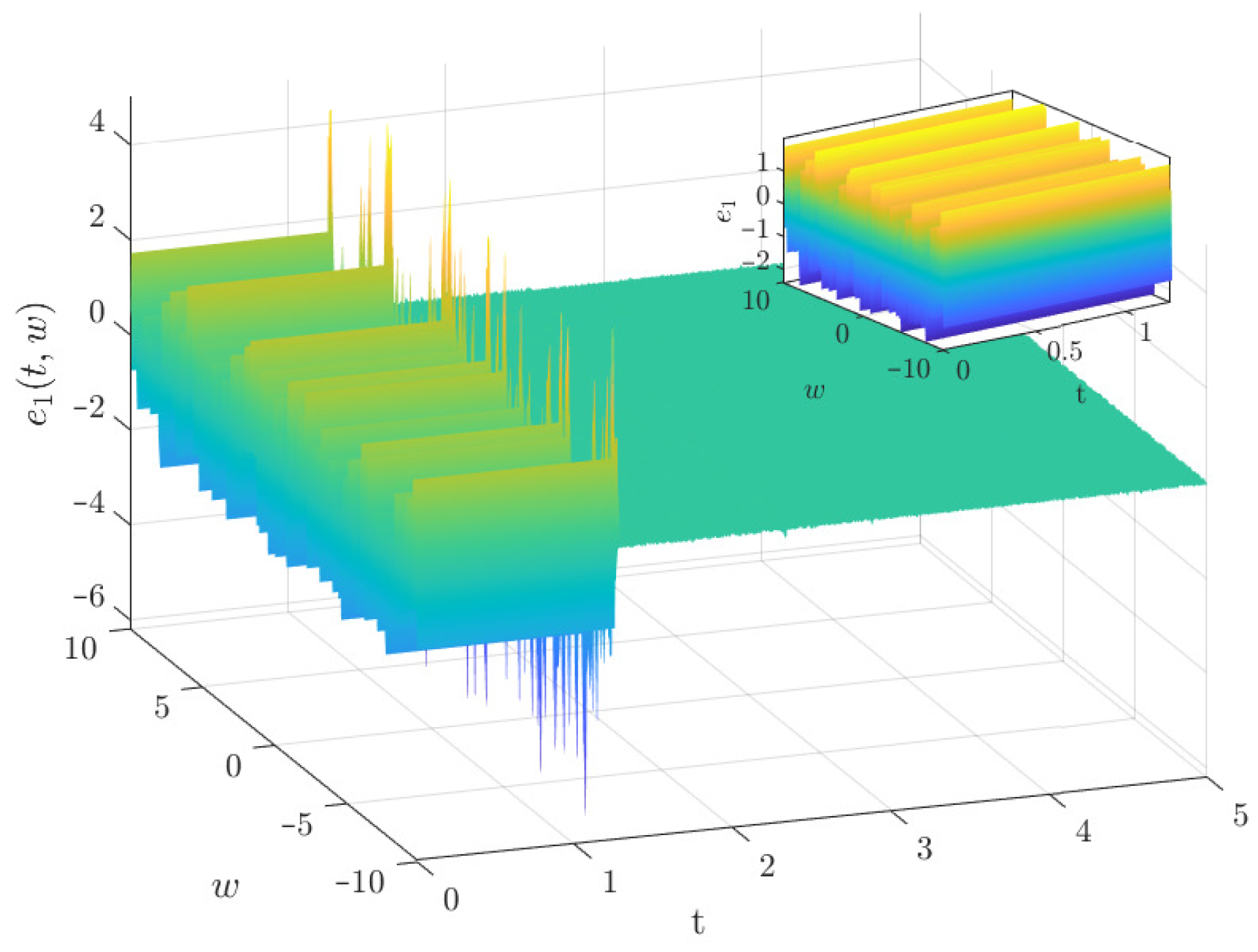
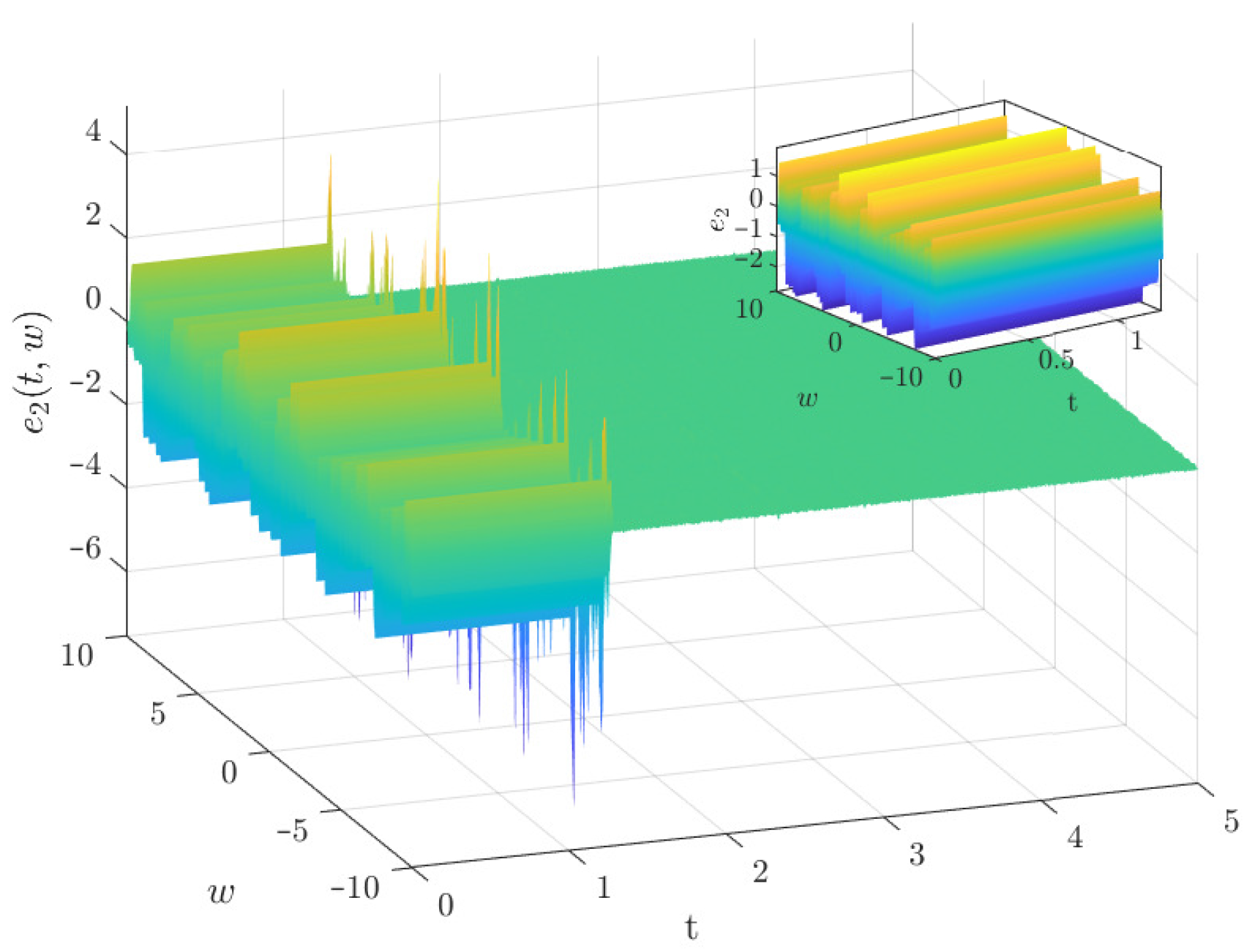
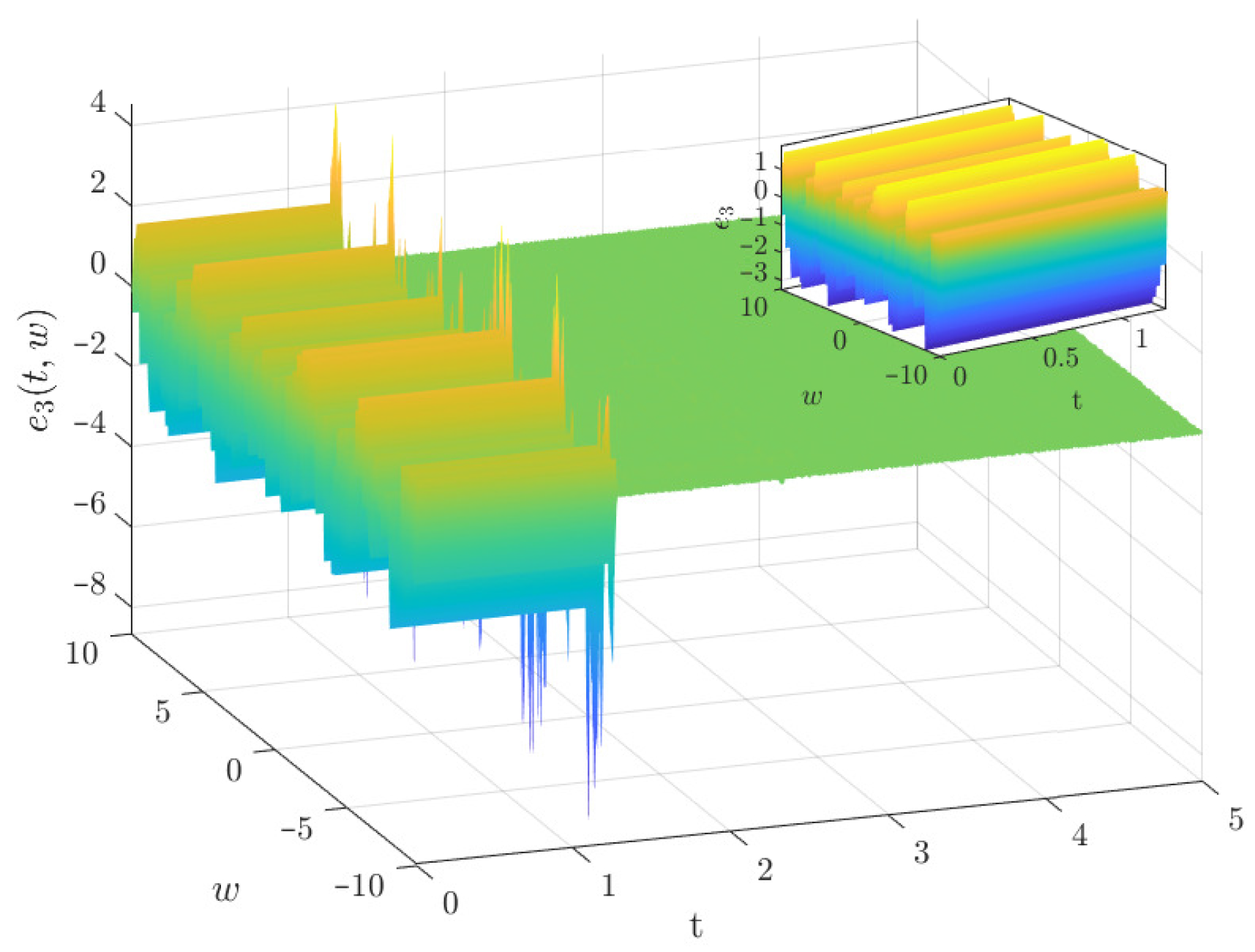
Obviously, we can check that , , . By selecting the control parameters as , , , , , and , a simple calculation shows that , , , , , , . Since , it is easy to verify that (12) and (14) hold true. Thus, based on Theorem 1, the drive–response systems (39) and (40) can realize FXT synchronization under controller (10) within ST . Figure 6, Figure 7 and Figure 8 describe the time evolutions of drive–response systems (39) and (40) under controller (10).
Figure 6.
Evolution of synchronization error of .
Figure 7.
Evolution of synchronization error of .
Figure 8.
Evolution of synchronization error of .
Next, we investigate the PDT synchronization between the drive–response systems (40) and (41) via controller (32). By choosing PDT , and setting , , , we can compute that , , , , . Therefore, from Theorem 2, we obtain that drive–response systems (39) and (40) achieve PDT synchronization in probability. Figure 9, Figure 10 and Figure 11 show the time evolutions synchronization errors between drive–response systems (39) and (40) under controller (32) with .
Figure 9.
Evolution of synchronization error of under .
Figure 10.
Evolution of synchronization error of under .
Figure 11.
Evolution of synchronization error of under .
Remark 8.
Under comparable parameter settings, we compare the upper bound of ST obtained from Theorem 1 in this paper with the results from [33,37]. The upper bounds of ST in [33,37] were and , respectively. In comparison, the estimation of ST in this paper is significantly more precise.
Furthermore, to validate the chaotic characteristics of our proposed stochastic delayed memristive reaction-diffusion neural networks, we compute the Lyapunov exponents under parameter settings: , , and different initial conditions. The results are summarized in Table 3.
Table 3.
Lyapunov exponents of the proposed stochastic delayed memristive reaction-diffusion neural networks (43) under different initial conditions.
5. Conclusions
This paper investigated the FXT and PDT synchronization of a class of delayed MNNs with stochastic disturbances and reaction-diffusion terms. First, a new stochastic PDT stability lemma is introduced based on previous FXT stability results. Then, via the design of innovative controllers and the utilization of analysis techniques, some new FXT and PDT synchronization criteria are derived to insure the FXT and PDT synchronization of delayed MNNs with stochastic disturbances and reaction-diffusion terms. Lastly, the affectivity of the derived results are validated through numerical simulations.
It is worth noting that the spatial norm introduced in controllers (10) and (32) requires access to the synchronization error information over the entire spatial domain of the network. In contrast, distributed or decentralized controllers only rely on local error information or the errors of adjacent neurons within a finite spatial radius. So, how to insure the FXT and PDT synchronization of reaction diffusion MNNs with stochastic perturbations is an interesting research topic and it will be one of our future research directions. In addition, the FXT and PDT synchronization framework developed in this paper for MNNs may also provide useful insights for other neural network architectures. In particular, Kolmogorov–Arnold Networks (KANs) [43], which have recently demonstrated effectiveness in highly precise temporal synchronization tasks such as audio-visual speech generation. Extending the current theoretical framework to KANs under stochastic perturbations is a meaningful research direction, and will also be one of our future research directions.
Author Contributions
G.W.: Writing, methodology, and visualization; I.M.: Visualization, review, and editing; A.A.: Review, editing, and funding acquisition. All authors have read and agreed to the published version of the manuscript.
Funding
This research was funded by the National Natural Science Foundation of China (Grant no. 62266042) and the Outstanding Youth Program of Xinjiang, China (Grant no. 2022D01E10).
Data Availability Statement
There are no data associated with this paper.
Conflicts of Interest
The authors declare that they have no competing interest regarding the publication of this article.
Abbreviations
The following abbreviations are used in this manuscript:
| FXT | Fixed-time |
| PDT | Predefined-time |
| MNNs | Memristive neural networks |
| ST | Settling time |
References
- Cao, J.; Wang, J. Global asymptotic stability of a general class of recurrent neural networks with time-varying delays. IEEE Trans. Circuits Syst. I Fundam. Theory Appl. 2003, 50, 34–44. [Google Scholar]
- Noorani, I.; Mehrdoust, F. Parameter estimation of uncertain differential equation by implementing an optimized artificial neural network. Chaos Solitons Fractals 2022, 165, 112769. [Google Scholar] [CrossRef]
- Maharajan, C.; Sowmiya, C.; Xu, C.J. Lagrange stability of inertial type neural networks: A Lyapunov Krasovskii functional approach. Evol. Syst. 2025, 16, 63. [Google Scholar] [CrossRef]
- Chua, L. Memristor-the missing circuit element. IEEE Trans. Circuit Theory 1971, 18, 507–519. [Google Scholar] [CrossRef]
- Strukov, D.B.; Snider, G.S.; Stewart, D.R.; Williams, R.S. The missing memristor found. Nature 2008, 453, 80–83. [Google Scholar] [CrossRef]
- Zhang, Y.Y.; Kong, F.C.; Zhu, Q.X.; Huang, T. Quantized Control Based on Stabilization of Discontinuous Memristor-Based Fuzzy Inertial Neural Networks with Proportional Delays. IEEE Trans. Syst. Man Cybern. Syst. 2024, 54, 5756–5767. [Google Scholar] [CrossRef]
- Belmiloudi, A. Brain Connectivity Dynamics and Mittag-Leffler Synchronization in Asymmetric Complex Networks for a Class of Coupled Nonlinear Fractional-Order Memristive Neural Network System with Coupling Boundary Conditions. Axioms 2024, 13, 440. [Google Scholar] [CrossRef]
- Abudireman, A.; Abdurahman, A. Fixed-time synchronization of spatiotemporal fuzzy neural network via aperiodic intermittent control with hyperbolic sine function. J. Appl. Math. Comput. 2025, 71, 6651–6673. [Google Scholar] [CrossRef]
- Park, S.; Chu, M.; Kim, J.; Noh, J.; Jeon, M.; Hun Lee, B.; Hwang, H.; Lee, B.; Lee, B.G. Electronic system with memristive synapses for pattern recognition. Sci. Rep. 2015, 5, 10123. [Google Scholar] [CrossRef]
- Xiu, C.B.; Zhou, R.X.; Liu, Y.X. New chaotic memristive cellular neural network and its application in secure communication system. Chaos Solitons Fractals 2020, 141, 110316. [Google Scholar] [CrossRef]
- Wang, Y.; Wang, G.; Shen, Y.; Iu, H.H. A memristor neural network using synaptic plasticity and its associative memory. Circuits Syst. Signal Process 2020, 39, 3496–3511. [Google Scholar] [CrossRef]
- Lin, J.T.; Xu, C.J.; Zhao, Y.Y. Bifurcation and control of a predator-prey system with two time delays. J. Appl. Anal. Comput. 2026, 16, 807–859. [Google Scholar] [CrossRef]
- Farah, E.M.; Amine, S.; Ahmad, S.; Nonlaopon, K.; Allali, K. Theoretical and numerical results of a stochastic model describing resistance and non-resistance strains of influenza. Eur. Phys. J. Plus 2022, 137, 1169. [Google Scholar] [CrossRef]
- Zhou, L.L.; Lin, H.; Tan, F. Fixed/predefined-time synchronization of coupled memristor-based neural networks with stochastic disturbance. Chaos Solitons Fractals 2023, 173, 113643. [Google Scholar] [CrossRef]
- Hu, C.; Jiang, H.J.; Teng, Z.D. Impulsive control and synchronization for delayed neural networks with reaction-diffusion terms. IEEE Trans. Neural Netw. 2010, 21, 67–81. [Google Scholar]
- Wang, Z.S.; Zhang, H.G. Global Asymptotic stability of reaction-diffusion cohen–grossberg neural networks with continuously distributed delays. IEEE Trans. Neural Netw. 2010, 21, 39–49. [Google Scholar] [CrossRef]
- Chen, W.H.; Luo, S.X.; Zheng, W.X. Impulsive synchronization of reaction-diffusion neural networks with mixed delays and its application to image encryption. IEEE Trans. Neural Netw. Learn. Syst. 2016, 27, 2696–2710. [Google Scholar] [CrossRef]
- Wang, Z.Y.; Cao, J.D.; Cai, Z.W.; Rutkowski, L. Anti-synchronization in fixed time for discontinuous reaction-diffusion neural networks with time-varying coefficients and time delay. IEEE Trans. Cybern. 2020, 50, 2758–2769. [Google Scholar] [CrossRef]
- Tu, Z.W.; Ding, N.; Li, L.L.; Feng, Y.M.; Zou, L.M.; Zhang, W. Adaptive synchronization of memristive neural networks with time-varying delays and reaction-diffusion term. Appl. Math. Comput. 2017, 311, 118–128. [Google Scholar] [CrossRef]
- Guo, Z.Y.; Wang, S.Q.; Wang, J. Global exponential synchronization of coupled delayed memristive neural networks with reaction-diffusion terms via distributed pinning controls. IEEE Trans. Neural Netw. Learn. Syst. 2021, 32, 105–116. [Google Scholar] [CrossRef] [PubMed]
- Cang, Y.Y.; Jiang, W.J.; Wang, J.H. Anti-synchronization of delayed memristive neural networks with leakage term and reaction-diffusion terms. Knowl.-Based Syst. 2021, 233, 107539. [Google Scholar]
- Wang, L.M.; He, H.B.; Zeng, Z.G.; Hu, C. Global stabilization of fuzzy memristor-based reaction-diffusion neural networks. IEEE Trans. Cybern. 2020, 50, 4658–4669. [Google Scholar] [CrossRef] [PubMed]
- Zhang, R.M.; Zeng, D.Q.; Park, J.H.; Lam, H.K.; Zhong, S.M. Fuzzy adaptive event-triggered sampled-data control for stabilization of T–S fuzzy memristive neural networks with reaction-diffusion terms. IEEE Trans. Fuzzy Syst. 2021, 29, 1775–1785. [Google Scholar] [CrossRef]
- Wu, X.; Liu, S.T.; Wang, H.Y. Pinning synchronization of stochastic neutral memristive neural networks with reaction-diffusion terms. Neural Netw. 2023, 157, 1–10. [Google Scholar] [CrossRef]
- Shao, Y.F.; Wang, Q.Y.; Wang, L.M.; Yin, Q. Global exponential stability and stabilization of stochastic memristive neural networks with spatial diffusions and hybrid delays. Commun. Nonlinear Sci. Numer. Simul. 2024, 128, 107673. [Google Scholar] [CrossRef]
- Wang, J.J.; Zhu, S. Finite-time synchronization of delayed quaternion-valued neural networks by non-decomposition and improved two-step methods. Neurocomputing 2025, 647, 130537. [Google Scholar] [CrossRef]
- Liu, X.Y.; Su, H.; Chen, M.Z.Q. A switching approach to designing finite-time synchronization controllers of coupled neural networks. IEEE Trans. Neural Netw. Learn. Syst. 2016, 27, 471–482. [Google Scholar] [CrossRef]
- Polyakov, A. Nonlinear feedback design for fixed-time stabilization of linear control systems. IEEE Trans. Autom. Control 2012, 57, 2106–2110. [Google Scholar] [CrossRef]
- Abdurahman, A.; Tohti, R.; Li, C.C. New results on fixed-time synchronization of impulsive neural networks via optimized fixed-time stability. J. Appl. Math. Comput. 2024, 70, 2809–2826. [Google Scholar] [CrossRef]
- Zhang, G.D.; Cao, J.D. Aperiodically semi-intermittent-based fixed-time stabilization and synchronization of delayed discontinuous inertial neural networks. Sci. China Inf. Sci. 2025, 68, 112202. [Google Scholar] [CrossRef]
- Tang, H.A.; Wang, Y.H.; Hu, X.F.; Duan, S.K.; Wang, L.D. Fixed-time passivity and synchronization of multiweighted coupled memristive neural networks with adaptive couplings. IEEE Trans. Neural Netw. Learn. Syst. 2025, 36, 8485–8498. [Google Scholar] [CrossRef] [PubMed]
- Qiao, Y.; Abudireman, A.; Abdurahman, A.; You, J. Semi-Intermittent Control Based Fixed/Predefined-Time Synchronization of Spatiotemporal Memristive Neural Networks. J. Nonlinear Dyn. Appl. 2025, 1, 52–62. [Google Scholar] [CrossRef]
- Zheng, M.W.; Li, L.X.; Peng, H.P.; Xiao, J.H.; Yang, Y.X.; Zhang, Y.P. Fixed-time synchronization of memristive fuzzy BAM cellular neural networks with time-varying delays based on feedback controllers. IEEE Access 2018, 6, 12085–12102. [Google Scholar] [CrossRef]
- Zhang, G.D.; Cao, J.D. New results on fixed/predefined-time synchronization of delayed fuzzy inertial discontinuous neural networks: Non-reduced order approach. Appl. Math. Comput. 2023, 440, 127671. [Google Scholar] [CrossRef]
- Abdurahman, A.; Abudusaimaiti, M.; Jiang, H.J. Fixed/predefined-time lag synchronization of complex-valued BAM neural networks with stochastic perturbations. Appl. Math. Comput. 2023, 444, 127811. [Google Scholar] [CrossRef]
- Kong, F.C.; Ni, H.L.; Zhu, Q.X.; Hu, C.; Huang, T.W. Fixed-Time and Predefined-Time Synchronization of Discontinuous Neutral-Type Competitive Networks via Non-Chattering Adaptive Control Strategy. IEEE Trans. Netw. Sci. Eng. 2023, 10, 3644–3657. [Google Scholar] [CrossRef]
- Abudusaimaiti, M.; Abdurahman, A.; Jiang, H.J.; Hu, C. Fixed/predefined-time synchronization of fuzzy neural networks with stochastic perturbations. Chaos Solitons Fractals 2022, 154, 111596. [Google Scholar] [CrossRef]
- Yin, J.L.; Khoo, S.Y.; Man, Z.H.; Yu, X.H. Finite-time stability and instability of stochastic nonlinear systems. Automatica 2011, 47, 2671–2677. [Google Scholar] [CrossRef]
- Yu, W.; Yin, J.L.; Khoo, S.Y. Generalized Lyapunov criteria on finite-time stability of stochastic nonlinear systems. Automatica 2019, 107, 183–189. [Google Scholar] [CrossRef]
- Min, H.; Shi, S.; Xu, S.; Guo, J.; Zhang, Z.Q. Fixed-time Lyapunov criteria of stochastic nonlinear systems and its generalization. IEEE Trans. Autom. Control 2023, 68, 5052–5058. [Google Scholar] [CrossRef]
- Zhang, T.L.; Xu, S.Y.; Zhang, W.H. Predefined-time stabilization for nonlinear stochastic Itô systems. Sci. China Inf. Sci. 2023, 66, 182202. [Google Scholar] [CrossRef]
- Lu, J.G. Global exponential stability and periodicity of reaction-diffusion delayed recurrent neural networks with Dirichlet boundary conditions. Chaos Solitons Fractals 2008, 35, 116–125. [Google Scholar] [CrossRef]
- Noorizadegan, A.; Wang, S.F.; Ling, L.V.; Dominguez-Morales, J.P. A practitioner’s guide to Kolmogorov-Arnold networks. arXiv 2026, arXiv:2510.25781. [Google Scholar]
Disclaimer/Publisher’s Note: The statements, opinions and data contained in all publications are solely those of the individual author(s) and contributor(s) and not of MDPI and/or the editor(s). MDPI and/or the editor(s) disclaim responsibility for any injury to people or property resulting from any ideas, methods, instructions or products referred to in the content. |
© 2026 by the authors. Licensee MDPI, Basel, Switzerland. This article is an open access article distributed under the terms and conditions of the Creative Commons Attribution (CC BY) license.