1. Introduction
Operator matrices, viewed as block matrices with linear operators as elements, play a fundamental role in various areas such as elasticity theory and quantum mechanics [
1,
2]. In particular, the analysis of their spectral structure is of central importance, since spectral characteristics not only determine the evolution of the underlying physical systems but are also directly related to their stability properties [
3,
4]. In practical problems, the spectral theory of non-self-adjoint operators is especially significant; however, in contrast to the self-adjoint case, the corresponding spectral analysis to the non-self-adjoint case is considerably more intricate. Describing the behavior of non-self-adjoint dynamical systems solely in terms of spectral information is often inadequate and may even lead to incorrect conclusions. Moreover, the spectrum of a linear operator can be highly sensitive to small perturbations, which makes it difficult to compute reliably in numerical practice. These issues highlight the inherent limitations of classical spectral analysis in many applications.
To overcome the above difficulties, the notion of pseudospectrum has been introduced. As an extension of the classical spectrum, the pseudospectrum provides a more effective tool for characterizing the stability of non-normal systems [
5,
6,
7]. In recent years, the theory of pseudospectrum has attracted considerable attention and has become an active area of research in operator theory [
8,
9]. For instance, in [
10], effective estimates for the pseudospectrum of upper triangular block matrices were obtained in terms of the pseudospectrum of their diagonal blocks. While ref. [
10] works in finite-dimensional space and derives outer and inner approximations of the pseudospectra of block triangular matrices in terms of the pseudospectra of the diagonal blocks, the present work focuses on upper triangular bounded operator matrices on Hilbert spaces and relates their pseudospectra to the quadratic numerical range. In particular, our main results can be viewed as operator-theoretic counterparts of the pseudospectral enclosure bounds in [
10], with the quadratic numerical range serving as a refined localization set better suited to block operator matrices.
For a linear operator
A on a Hilbert space, it is well known that the spectrum
is always contained in the closure of its numerical range
. However, the numerical range usually fails to provide a sharp description of the spectrum. To address this issue, Langer and Tretter [
4] introduced the concept of the quadratic numerical range
for an operator matrix of the following form in Hilbert spaces:
and proved that
. They further showed that, for an unbounded operator matrix
, the point spectrum
and the approximate point spectrum
satisfy
The subsequent work in [
11] demonstrated that, when
is a bounded operator matrix, the following spectral inclusion holds:
In recent years, considerable attention has been devoted to the quadratic numerical range [
12,
13,
14]. It has been proven to be effective for it to have applications in several domains such as Krylov subspace methods, the analysis of damped systems, spectral perturbation theory, and the localization of polynomial zeros.
In another direction, it was established in [
15] that the
-pseudospectrum
of a linear operator
A admits the inclusion
where
denotes the closed disc centered at the origin with radius
. More recently, quadratic numerical ranges were employed in [
16] to study spectral inclusion properties for a class of anti-triangular operator matrices, and related results on spectral gaps were also obtained. However, the numerical computation of pseudospectra is still rather demanding even in finite-dimensional settings, since it usually requires repeated evaluations of the smallest singular value of
. To reduce this cost, several techniques have been proposed, such as Lanczos-type approximation methods [
17], inverse iteration applied to
[
18], and structure-preserving schemes that exploit the shift structure of
[
19]. Nonetheless, despite these advances, accurately and robustly computing pseudospectra for large-scale problems remains highly nontrivial.
In recent years, substantial progress has been made in understanding the relationship between the spectrum and the quadratic numerical range, as well as the intrinsic connection between the pseudospectrum and the numerical range. However, to the best of our knowledge, the deeper links between the pseudospectrum and the quadratic numerical range have not yet been explored in the literature.
Stimulated by the substantial computational challenges associated with pseudospectra and the relatively limited research on their relationship with the quadratic numerical range, we investigate the structural properties of
upper triangular bounded operator matrices and the norm equivalence of the associated matrices. On this basis, we systematically establish inclusion relations between their pseudospectra and quadratic numerical ranges, and hence provide a more precise description of the pseudospectral sets from the perspective of the quadratic numerical range. Since the main technical tools in this paper are matrix operations, in particular matrix multiplication and block matrices, it is worth mentioning that a wide variety of fast algorithms for matrix multiplication and related procedures have been developed in the literature. Many other matrix operations can, in fact, be reduced to matrix multiplication, and modern fast matrix multiplication algorithms crucially exploit block matrix structures. We refer the reader to the survey by Respondek [
20] for an intelligible and comprehensive overview of so-called matrix black box algorithms and their numerous applications in matrix and non-matrix problems.
2. Preliminaries
In what follows, we denote by X a Hilbert space and by the corresponding product Hilbert space. The symbols and stand for the sets of all bounded linear operators on X and on , respectively. The inner product of two elements x and y in a Hilbert space will be denoted by whenever no confusion can arise.
Furthermore, denotes the set of all complex matrices, and denotes the set of all block matrices with entries in . The symbols I and denote the identity operator and the zero operator on X, respectively. For a matrix A, its spectral norm, Frobenius norm and infinity norm are denoted by , and , respectively.
The equivalent norms used in this paper (such as the 2-norm, Frobenius norm, and infinity norm) always act on finite-dimensional matrices. In contrast, for bounded linear operators (or operator matrices) on infinite-dimensional spaces, we still use the standard operator norm. In addition, and denote the smallest and largest singular values of the matrix A, respectively. In the subsequent analysis, we will frequently pass from operator-theoretic expressions on to finite-dimensional block matrices to exploit explicit singular value formulas and norm equivalences. Whenever such a transition is made, it will be indicated in the notation.
In this section, we recall the definitions of the pseudospectrum, the numerical range, and the quadratic numerical range.
Definition 1. ([6]) Let . For any , the ϵ-pseudospectrum of the operator A is defined by Using a perturbation characterization, this can equivalently be written as Definition 2. ([21]) Let . The numerical range of the operator A is defined by Definition 3. ([4]) Let be a block operator matrix, where . For unit elements , definewhich is called the companion matrix of associated with f and g. The quadratic numerical range of the operator matrix is defined bywhere denotes the set of all eigenvalues of the matrix . Moreover, the spectrum, quadratic numerical range, and numerical range of a bounded operator matrix satisfy the inclusion relation [
3]
which shows that, compared with the numerical range, the quadratic numerical range provides a finer description of the spectral distribution of operator matrices, and can capture the spectral properties of the operator more accurately.
Definition 4. ([22]) Let and be two norms of an element A in the matrix space , where . If there exist positive constants and , independent of A, such thatthen the norms and are said to be equivalent. Furthermore, any two matrix norms on are equivalent, and the 2
-norm, Frobenius norm, and infinity norm of satisfy the following relations: Let
. In what follows, we always use
to denote
upper triangular bounded operator matrices.
3. Main Results
In this section, we first establish norm estimates, in the Frobenius norm , for the upper triangular bounded operator matrix . Subsequently, we present the computation formulas and related properties for the largest and smallest singular values of upper triangular matrices. On this basis, by exploiting the equivalence of matrix norms, we further construct two outer approximation sets of the pseudospectrum of in terms of the spectral norm and the quadratic numerical range, thereby systematically revealing the intrinsic relationship between its pseudospectrum and quadratic numerical range.
To characterize the pseudospectrum of the upper triangular operator matrix , we first need to derive suitable estimates for its operator norm.
Lemma 1. Assume that is given as in (2). Then Proof of Lemma 1. Let
. By the definition of the operator norm, we have
Because
, by the norm formula in the product Hilbert space
, we have
By the definition of the vector norm, it follows that
Set
,
,
,
, and
. Our goal is to compute
To this end, consider the following auxiliary Lagrange function:
From the conditions
, after simplification we obtain
By the theory of linear algebra, a nontrivial solution exists if and only if the determinant of the coefficient matrix is zero, that is,
A direct calculation yields
Since
is continuous on the compact set
, it attains its maximum and minimum there, and
Since
, we have
Therefore, we obtain
, and hence
□
The literature [
10] investigates the pseudospectra of block upper triangular matrices in finite-dimensional spaces and establishes sharp outer and inner approximation estimates in terms of the pseudospectra of the diagonal blocks. In particular, ref. [
10] provides the explicit singular value formulas and monotonicity properties for
upper triangular matrices stated in Lemmas 2 and 3 above.
Building on Lemma 1 and on the equivalence of matrix norms, the present paper extends the outer approximation results from [
10] to the setting of general upper triangular bounded operator matrices on Hilbert spaces. Instead of working solely with the pseudospectra of the diagonal entries, we derive pseudospectral enclosure results in terms of the quadratic numerical range
of the block operator matrix
, thereby linking the pseudospectrum to a finer spectral localization set.
Lemma 2. ([10]) The singular values of the matrix are given by Moreover, .
Lemma 3. ([10]) Let for . Then the following assertions hold: The literature [
10] investigates the pseudospectra of block upper triangular matrices in finite-dimensional spaces and establishes corresponding outer approximation estimates. Building on Lemma 1 and on the equivalence of matrix norms, the present paper extends these outer approximation results to the case of general upper triangular bounded operator matrices. To this end, we first state the following two lemmas.
Lemma 4. For any , it then holds thatwhere . Proof of Lemma 4. If
, then it is clear that
. Let
and assume in what follows that
. If
, then we have
We now regard the operator norms of the four blocks as scalar entries, forming a
numerical matrix, to which we can then apply the singular value theory for matrices. By (
1), for any
matrix
M, one has
, then we have
Rearranging the above inequality yields
When the left-hand side of (
3) is nonnegative, squaring both sides and simplifying gives
. Hence
.
When the left-hand side of (
3) is negative, we have
Noting that
we again obtain
, and consequently
. □
For the convenience of stating the following lemma, we first recall the definition of the separation between two operators
:
By Definition 1, it follows that
Denote . If , then and are disjoint. In what follows, we take , , and .
Lemma 5. Assume that . Then, for any ,where Proof of Lemma 5. Let
. Without loss of generality, assume that
If, in addition,
, then
This implies that . □
We now introduce some notation that will be used to state the next two lemmas. Let
of (
2). If
A and
D are operators such that
, then the equation
has a unique solution
R for every operator
B. This is known as the Sylvester-Rosenblum Theorem [
23]. Let
, where
and
U denote unitary operator. Then
and
. Let the operator matrix
be the projection of
onto
along the complementary space. We put
Lemma 6. Let . With the notation introduced previously, we derive for all , Proof of Lemma 6. By
, we have
for all
. This directly yields
For
, from Lemma 1 and Lemma 2, we have
where
. Therefore,
. □
Lemma 7. Suppose and assume that and . Using the notation established above, we have Proof of Lemma 7. For
, we can assume that
From (
7) we have
where
.
Setting , we can conclude that
The formulae are equivalent to
Combining the definition of pseudospectra, we get
So, .
Next we only need to prove
under the condition
Adding two inequalities of (
9), we conclude
Due to
, then it yields
By Lemma 2, we get
. Then
fulfills the quadratic equation:
Plugging this into (
10) and combining terms we deduce that
By (
6) we have
, inserting this in above equation
Clearly the quadratic polynomial
has two real zeros,
and
, which satisfy
. Moreover,
By (
11),
or
. From Lemma 3,
. Accordingly,
. □
Remark 1. Suppose that is defined as in Lemma 7. Let and be the smaller zero of quadratic polynomial , for we have . Since is an increasing function with respect to ϵ, then . By , then and as . Hence, . This shows is an increasing function of ϵ with and .
The following theorem is the main result of this paper. It describes an inclusion relationship between the pseudospectrum and the quadratic numerical range of upper triangular operator matrices.
Theorem 1. For any , the following statements hold:
- (i)
, where ;
- (ii)
if , then , where and ;
- (iii)
under the condition , where k is defined in (6); - (iv)
under the condition , and , where is defined in Lemma 7.
Proof of Theorem 1. - (i)
By Lemma 4, we have
Noting that
and that
, we obtain
- (ii)
By Lemma 5, we have
Since
, together with
it follows that
- (iii)
By Lemma 6, we have
Using the identity
and the inclusions
we conclude that
- (iv)
By Lemma 7, we have
Putting together
with
yields
□
Next, we present two examples to verify the effectiveness of Theorem 1.
Example 1. It is easy to see that andso that Consider . Then . We now verify thatwhich demonstrates the validity of Theorem 1. In fact, by the definition of the pseudospectrum, it suffices to show that, for any , we have . First, is equivalent to . Hence, We then obtainand similarly, Combining (1), (12), (13) and the properties of the Frobenius norm for block matrices, we obtain Thus, for any λ satisfying , we havethat is, . This shows that, for , The case with can be treated in the same way as the case . □
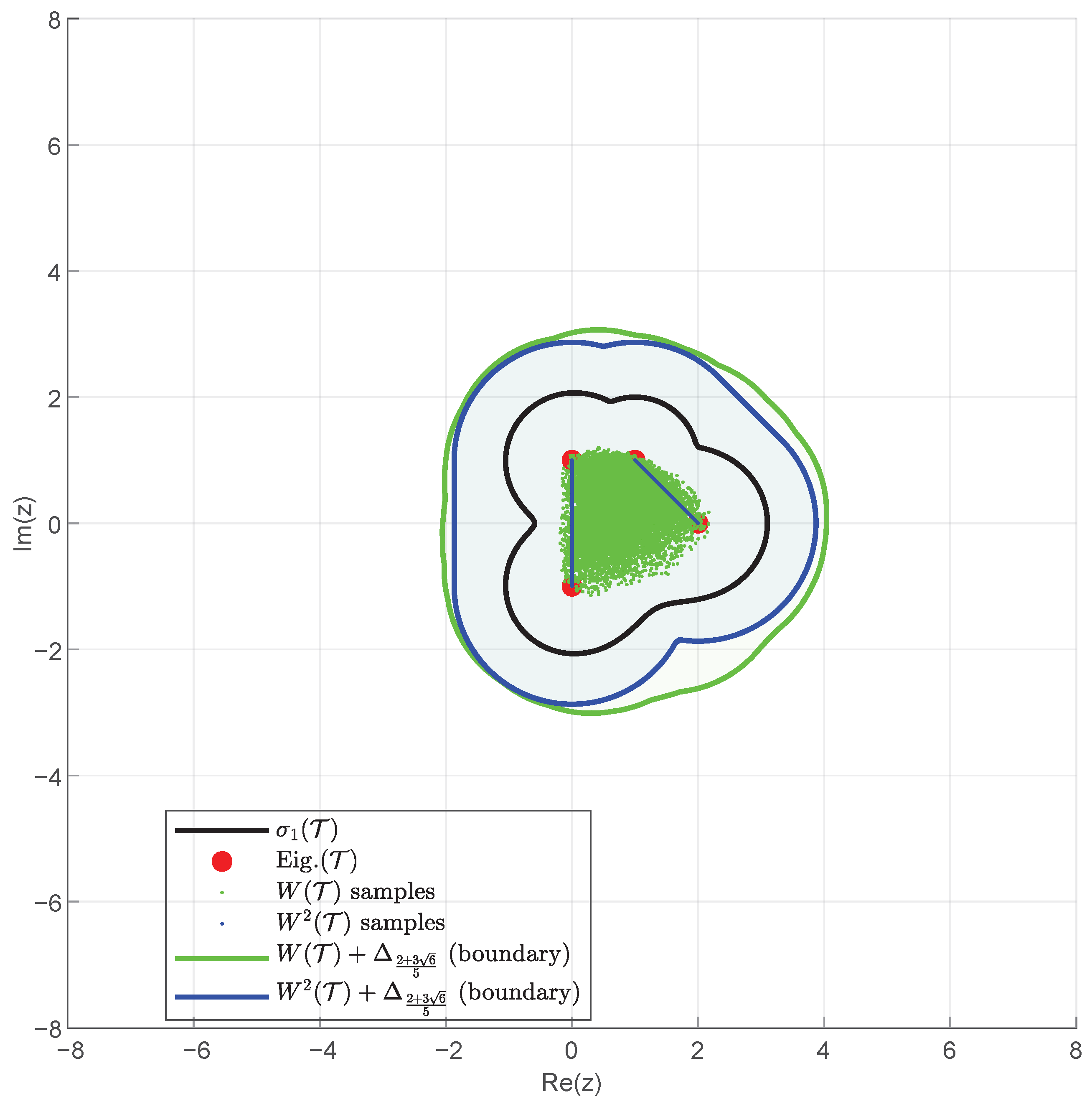
Example 2. Consider the non-normal block matrix It is easy to see that andso that In the numerical experiments, we discretize the complex plane on a uniform grid and evaluate at each grid point λ. We approximate the ϵ-pseudospectrum by computing the contour . Moreover, for the matrix case, the computation of is given by [24]. Define . A direct calculation yieldsand consequently . In the case (ii) of Theorem 1, can be computed as: The numerical range is approximated via Monte Carlo sampling: we generate random unit vectors , compute the Rayleigh quotients and plot the resulting points in the complex plane where stands for the conjugate of x. To approximate the quadratic numerical range , we exploit the block structure of . Specifically, we draw random unit-vector pairs to form the corresponding compression matrices , and plot their eigenvalues. Finally, with , we depict the Minkowski sums and .
Figure 1 displays the numerical range and the quadratic numerical range , together with their -neighbourhoods, and the ϵ-pseudospectrum for . The curves are coded as follows: green corresponds to (classical enclosure), blue to (quadratic enclosure), and black to . This visualization enables a direct assessment of the tightness of the two enclosures relative to the pseudospectrum. As can be seen from Figure 1, the enclosure derived from the quadratic numerical range (blue) is markedly tighter than the classical numerical-range enclosure (green), and it tracks the pseudospectral boundary (black) more closely. This example corroborates the case (ii) of Theorem 1 and shows that delivers computable stability bounds and a markedly tighter pseudospectral enclosure than . For non-normal , this is advantageous because it replaces the costly computation of by the more tractable computation of .
4. Conclusions
In this paper, we investigated the pseudospectral inclusion properties of upper triangular bounded operator matrices on Hilbert spaces by means of the quadratic numerical range. Starting from a refined norm estimate for such block operator matrices, we derived explicit bounds for their largest and smallest singular values, which in turn yielded several external approximations of the pseudospectrum in terms of equivalent matrix norms.
On this basis, we established a family of pseudospectral enclosures for upper triangular operator matrices, showing that their
-pseudospectrum are contained in suitable enlargements of the quadratic numerical range. More precisely, we obtained a series of inclusion results under increasingly restrictive spectral separation assumptions on the diagonal blocks, where the enclosure radii are explicitly described via separation quantities and solutions of a Sylvester–Rosenblum type equation. These results extend classical spectral inclusion theorems from the spectrum to the pseudospectrum and clarify the intrinsic role of the quadratic numerical range in capturing pseudospectral behavior of non-selfadjoint block operator matrices. In this sense, our results complement and extend the pseudospectral enclosure bounds for block triangular matrices obtained in [
10] by moving from a purely finite-dimensional matrix framework to bounded operator matrices and by replacing the diagonal-block-based descriptions by enclosures in terms of the quadratic numerical range.
Finally, a detailed block matrix example and a numerical example involving a non-normal block matrix were provided to verify the sharpness and applicability of the derived enclosures. The analysis highlights the effectiveness of the quadratic numerical range as a tool for locating pseudospectrum of upper triangular operator matrices and suggests further applications to stability analysis, perturbation theory, and numerical methods for non-normal operators. In particular, a numerical example of a finite-dimensional non-normal block matrix demonstrates that the quadratic numerical range–based enclosure can be significantly tighter than the classical numerical range–based one. In future work, it would be of particular interest to extend these techniques to more general block structures and to investigate their implications for concrete classes of differential and integral operators.