


Abstract
This article develops a comprehensive theory of multiary graded polyadic algebras, extending the classical concept of group-graded algebras to higher-arity structures. We introduce the notion of grading by multiary groups and investigate various compatibility conditions between the arity of algebra operations and grading group operations. Key results include quantization rules connecting arities, classification of graded homomorphisms, the First Isomorphism Theorem for graded polyadic algebras and concrete examples including ternary superalgebras and polynomial algebras over n-ary matrices. The theory reveals fundamentally new phenomena not present in the binary case, such as the existence of higher power gradings and nontrivial constraints on arity compatibility.
MSC:
13A02; 13A30; 16W50; 17A70; 20H20; 20N10; 20N15; 81Q60
1. Introduction
The theory of graded algebras and rings [1,2,3] represents a fundamental chapter in modern algebra [4,5], with profound applications across mathematics [6,7,8,9] and theoretical physics [10,11,12,13,14]. Classically, a grading on an algebra over a field by a group consists of a decomposition into homogeneous components such that the multiplication respects the group structure . This elegant framework encompasses numerous important structures including superalgebras (graded by ) [15,16,17], polynomial algebras (graded by degree) [18,19], group algebras and rings [20,21,22].
Recent developments in polyadic (multiplace) algebra [23] have opened new avenues for generalization, where binary operations are replaced by n-ary ones. Building upon our previous work on the polyadic generalization of group rings [24], we now extend the related concept of the grading to the polyadic realm. Polyadic structures exhibit rich and often surprising behavior: polyadic groups may lack identity elements, polyadic fields may have no zero or unit, and associativity takes more intricate forms. These features necessitate a fundamental revision of many standard algebraic constructions.
In this work, we introduce and systematically develop the theory of multiary graded polyadic algebras. Our approach follows the “arity freedom principle” [23], allowing initial arities to be arbitrary, with structural constraints emerging from compatibility conditions. The main contributions are as follows:
- (1)
- A general definition of multiary -graded polyadic -algebras, where both the algebra operations and grading group operations may have arbitrary arities (Section 3).
- (2)
- Quantization rules connecting the arities of algebra multiplication (n), grading group multiplication (), and algebra addition (m) with the order of the grading group (Theorems 1 and 3).
- (3)
- A classification of graded homomorphisms between multiary graded algebras, and the First Isomorphism Theorem for graded polyadic algebras is proved (Section 4).
- (4)
- Concrete examples including
- (5)
- Investigation of support properties, strong grading conditions, and the relationship between graded components and polyadic powers.
Our results reveal that the transition from binary to polyadic grading introduces qualitatively new phenomena. For instance, the compatibility condition between algebra n-ary multiplication and grading group -ary multiplication leads to “quantization” rules like for strongly graded algebras, while higher power gradings satisfy , where ℓ denotes polyadic power. These constraints have no analogs in classical graded algebra theory.
The article is structured as follows: Section 2 reviews the essential polyadic notations and preliminaries. Section 3 presents the general theory of multiary graded polyadic algebras. Section 4 develops the theory of graded homomorphisms. Section 5, Section 6 and Section 7 provide detailed examples and applications, demonstrating the richness and versatility of the theory.
2. Preliminaries
A grading on an algebra (over a field , say) by a group (called the grading group) is a way to decompose into “layers” indexed by elements of . Formally, the algebra is -graded, if
- (1)
- is a direct sum of -vector spaceswhere each is called the homogeneous component of degree , and they do not intersect: , if . So, every element of can be uniquely written as , with , notation , and only finitely many nonzero elements , such that, in each component, it has finite support.
- (2)
- The multiplication in respects the grading, that is, for product of algebra componentswhere the grading group is typically abelian (), written additively, with the identity . Thus, , and . The grading is strong if, instead of (2), the equality holds (used for crossed product algebras).
The grading is “natural”, if algebra homomorphisms preserve grading, that is, for any algebras map , the homogeneity is preserved , for any . If the algebra is associative, we can extend the associativity across grades to preserve degrees. If the algebra element is invertible, then (in additive notation).
The most common examples of the graded algebra are polynomial algebra , exterior algebra and superalgebra and group algebra (any is a -graded algebra, but not vice-versa).
To generalize the concept of graded algebra to the polyadic case, we need some polyadic notation [23], to be self-consistent here.
Notation 1.
An algebraic structure will be denoted by
where represents the number of operation places under consideration, that is, arity(ies), denotes the number of the carrier element or power of underlying set(s), gives additional variable(s), which characterize the structure , and they are used when necessary.
Let A be a set and be a polyadic multiplication. An n-ary magma is A closed under and denoted by . The admissible word length in is “quantized”, which means
where ℓ is a polyadic power, that is, the “number of multiplications”. For any element , the polyadic power ℓ is denoted by
An n-ary operation is strictly nonderived, if it cannot be composed from a binary operation without fixing elements or additional conditions. A polyadic identity is defined as (if it exists)
and the polyadic zero is
A polyadic semigroup in a one-set one-operation structure , which is totally associative
with respect to the position of the middle multiplication, where are polyads (sequences of elements) of the needed sizes. Note, that in higher arity case the associativity can be partial [25], which can lead to more complicated structural consequences (see, e.g., [26,27]).
The querelement for is defined by
which can be treated as an unary queroperation . If every element of an n-ary semigroup has the unique querelement, it is called a polyadic (n-ary) group . A polyadic or -ring is a one-set two operation algebraic structure , such that m-ary addition and n-ary multiplication satisfy distributivity [28].
Example 1
(Ternary polynomial graded algebra). A natural example of a ternary -graded algebra is a polynomial ring of three variables over a field , , and the addition and multiplication by scalar are binary for the algebra . The grading of elements is defined by , , and the monomial degree is
where , and therefore, the grading group is binary . The direct sum decomposition (1) becomes
where is the homogeneous component of degree , and obviously, for . The ternary product in algebra is defined as the ordinary multiplication of polynomials in three variables as
such that is trilinear and respects grading, because from (10) and (12), cf. the binary case (2), it follows that
Because there is equality in (13), the grading is strong. Thus, the ternary graded algebra is commutative and ternary associative, it is non-truncated because there are no relations, and the polynomial ring is free. It is infinite-dimensional as a vector space, but each homogeneous component of the direct sum decomposition (11) is finite-dimensional, and .
3. General Grading of Polyadic Algebra by Multiary Group
Let us generalize the grading concept to the polyadic case by consideration of higher arity in both the algebra and grading group. According to the “arity freedom principle” [23], the initial arities can be arbitrary; then, the structural constraints appear from the general dependences leading to “quantization rules”. Polyadic structures can display unusual properties and behaviors. For example, some polyadic groups have no identity element at all, while others may have multiple identities. Likewise, there are polyadic fields that lack a zero, a unit, or both [23]. These features can require a substantial rethinking of many standard mathematical statements.
A polyadic algebra over a polyadic field is the 2-set 5-higher arity operation algebraic structure satisfying compatibility axioms [23,29]. However, in our consideration here, we will use the binary field and consider only the corresponding -algebra m-ary addition and n-ary multiplication , and therefore, for n-ary algebra we denote
where A is its underlying set, and zero or unit are not necessary. The grading group now becomes the -ary group
where G is the group underlying set, the -ary multiplication is , and is the unary operation of taking querelement (polyadic inverse (9)), while no identity element (6) is necessary but can exist for some polyadic groups; see, e.g., [23]. Similarly to the binary case, we assume that the grading -ary group is commutative.
Notation 2.
We call the generic algebraic structure with multiplace operations (after [30]) “polyadic” (ring, field, algebra, group), while for the grading group, just for distinctiveness, convenience and clarity, we use its Latin synonym “multiary” [31].
Remark 1.
To be far from the well-known binary case, we assume both multiplications and are nonderived (or not strictly derived), i.e., they are not consequent compositions of binary operations only (the weaker b-derived multiplication is a different story [32]).
The expansion into the direct sum for the polyadic algebra (14) does not differ from that of the binary algebras (1). The crucial peculiarities come from the polyadic analog of the compatibility condition (2), which gives several kinds of the polyadic graded algebras.
Definition 1.
A multiary -graded polyadic -algebra is the direct sum decomposition of -vector spaces
such that the n-ary multiplication in the algebra respects the -ary multiplication in the grading group
where is the ith component of the decomposition (16).
A polyadic algebra is strongly graded, if, as in (17), the the equality is
Definition 2.
The support of a polyadic -graded algebra supp is the set of all grading group elements such that the corresponding component as -vector space contributes to the direct sum decomposition (16).
The number of “non-zero” (contributing) summands in the decomposition (16) is exactly the cardinality of the support; that is, . Because supp, the number of summands in (16) is .
Assertion 1.
For strongly -graded polyadic algebra (18),
Proof.
If is strongly graded and “non-zero”, then every is “non-zero”, and therefore, the number of summands coincides with the graded group order . □
Proposition 1.
The strong polyadic algebra arity of multiplication and the arity of multiary grading group coincide:
Proof.
This follows from the construction (18) by equating the number of components as the multiplier in the algebra product and number of the elements in the grading group product . □
Remark 2.
Remark 3.
The strong consistency condition (18) can be interpreted such that the components for satisfy the polyadic homomorphism relation [23].
In the next section, it will be shown that there exist such multiary gradings, for which the arities and n are different, which can lead to unusual structural consequences, which are impossible in the ordinary binary case.
In the manifest form, the direct sum decomposition (16) means that each element of can be written as a finite sum (using the algebra m-ary addition) of homogeneous elements
However, this expression contains only one algebra addition operation , which corresponds to the one summation in the binary case as , while the binary decomposition (1) contains summations. Denote by the polyadic power (5) of m-ary addition in the polyadic algebra . Then, instead of (21), we have the decomposition of each element as
For a strongly graded algebra , there are no zeroes among homogeneous components . In this case, the support is not just a subgroup; it is the entire group supp.
Theorem 1.
In the polyadic strongly -graded algebras, the order of the finite grading group and the arity of algebra addition m are connected by
Proof.
In the case of the binary algebra addition , the number of summands in the decomposition becomes , where is the number of sum signs (5). In most cases, supp is a subgroup of If is unital with the unity , then , where is the identity of the group (if it exists), and then supp.
4. Polyadic Graded Homomorphisms
Consider another multiary -graded polyadic algebra,
which has the same arity shape as (14).
Definition 3.
A polyadic graded homomorphism is a pair of maps and , which respect m-ary additions
and n-ary multiplications
in algebras and -ary multiplications in the grading groups
being algebra and grading group homomorphisms, respectively. In addition, they “preserve” grading, such that
for every graded component in (16).
In the case , the grading groups coincide , and homogeneous elements in are really preserved as
which means that they are mapped to the same corresponding homogeneous elements in .
Definition 4.
A graded homomorphism of polyadic algebras, which is defined by the pair of maps , , becomes a graded isomorphism (for binary case see, e.g., [33]), if both Φ and Ψ are bijective, which preserves the grading by definition of bijectivity, and therefore, the inverse , is also a graded homomorphism . If both inverse maps exist, the polyadic graded algebras and are called graded isomorphic. If , and , the graded isomorphism becomes a graded automorphism.
Example 2
(Graded homomorphism). Let be the ternary graded algebra from Example 1. Consider the map defined by
The map Φ (30) preserves (see (25)) the binary addition, which follows from the ordinary additivity of polynomials . Therefore, Φ is a ternary homomorphism of the ternary algebra .
To show that Φ preserves grading, for each graded component in the decomposition (11), we should have (28). Indeed, acting by Φ on any monomial (10) does not increase its degree, because no terms of higher degree appear, and so, obviously, , and , which means that Φ maps each homogeneous component to itself.
Thus, the map Φ (30) is a graded homomorphism (being of zero grading) of the ternary algebra , it is nontrivial since it changes polynomials; moreover, it is a graded automorphism, because Φ is an isomorphism of the algebra to itself, and , where , .
The main difference of polyadic structures (rings, fields, algebras, groups) from their binary counterparts is not the necessity of the existence of identities, units (6) or zeroes (7), such that there exist, e.g., unitless and zeroless fields or algebras, as well as polyadic groups without identity or many identities. Instead, the invertibility is governed by the existence of querelements (9) for multiplications and additions (for review and examples, see [23]). Therefore, the properties of graded homomorphisms are changed correspondingly: mappings of unit to unit and zero to zero are demanded, if they exist. However, querelements should be mapped to querelements. Thus, we have
Proposition 2.
If and only if both algebras in have units (6) and (are unital), and both polyadic groups in have identities and , respectively, then
Proof.
This follows directly from application of the mapping to the definitions (6) and using the homomorphism property. □
Obviously,
Assertion 2.
Sets of elements in and that map under and to the unit and identity of and form subalgebra of and subgroup of , respectively.
Proposition 3.
If and only if both algebras in have zeroes (6) and , respectively, then
Denote , and , as the querelements of polyadic algebra elements , and the grading -ary group elements , , respectively (see (9)). Then,
Proposition 4.
The querelements are mapped to the corresponding querelements, as
Corollary 1.
If is a graded subalgebra of , then is a graded subalgebra of . Oppositely, if is a graded subalgebra of , then is a graded subalgebra of .
Definition 5.
If is the graded homomorphism, then its image is defined by
Because and are graded having the direct sum decompositions (16) and (24), the subspaces form a grading (decomposition) of the image, as follows:
which is a polyadic graded subalgebra, since it follows from (17) and the homomorphism multiplicative property of , that
Remark 4.
In contrast to the binary case, where a zero element always exists, and the kernel is therefore always definable as the preimage of zero, in the polyadic setting, the standard kernel can be defined only if the polyadic algebra possesses a zero.
Definition 6
(Standard kernel). If and only if the algebra in has zero (6) , then the standard kernel of Φ can be defined by
Because is a polyadic algebra homomorphism (26), its standard kernel (41) is an ideal of (not only a graded subalgebra, as ). Moreover, inherits a grading from becoming a graded ideal, which means that there is decomposition on homogeneous components
such that, if an element belongs to the standard kernel, than each of its homogeneous components also belongs to it. Thus, is always generated, as an ideal, by the homogeneous components of any element of the standard kernel (41).
A more general definition of a kernel is needed to avoid difficulty with the absence of some elements; see Remark 4. In universal algebra [5,34] the kernel is defined as a special equivalence relation (congruence) on the domain and not as a set of elements mapping to the identity (for groups) or to zero for (41).
Definition 7
(Congruence kernel). The congruence kernel of the homomorphism Φ, denoted , is the equivalence relation
which is compatible with all operations in .
The set definition (41) is a special case of the congruence definition (43), where the algebraic structure gives the possibility (which is not always the case, see Remark 4) to describe the congruence by a single distinguished congruence class: the preimage of identity or zero. The congruence respects grading, such that it only relates elements of the same degree (cf. (42)):
The congruence definition (43) allows us to form the quotient polyadic algebra , whose elements are the equivalence classes of the congruence denoted by for :
The operations on classes can be naturally defined using representatives, as follows:
and they are well-defined, because the resulting r.h.s. do not depend on the choice of the representatives (which directly follows from the homorphism property and (43)). The quotient polyadic algebra respects multiary grading, such that the decomposition (16) with the compatibility (17) provides
and therefore, is a multiary graded polyadic algebra.
Theorem 2
(First Isomorphism Theorem). Let and be multiary graded polyadic algebras, and let be a multiary graded homomorphism; then, the quotient algebra (45) is isomorphic to the graded image being a subalgebra of ,
Proof.
Define the map on the congruence classes (45) by
It is well-defined, because, if , , then , and so ; thus, .
The map respects -grading: if , , then , and so , the graded component of the image .
It is an algebra map that preserves the polyadic operations; that is, we derive
because is a homomorphism of .
The map is injective, such that, if , , then , and so, ; hence, .
It is surjective, because for any , there exists with , and so, .
Thus, the First Isomorphism Theorem for -graded polyadic algebras states that the structure of the image of a homomorphism is exactly the same as the structure of the domain “collapsed” by the equivalence relation induced by the map. This formulation ensures that all structural properties (the polyadic algebra operations and the multiary group grading) are rigorously preserved through the isomorphism.
Let us denote the set of N elements by . The simplest binary group on is the cyclic group of order 2 (or integers modulo 2) with the binary operation , .
Example 3.
Consider the polynomial ring graded by degree, reduced and . The corresponding -graded ternary algebra with zero and the zeroless -graded ternary algebra are
where is a ternary algebra with zero named in its signature as the null-ary operation , and is a ternary algebra without zero (in signature), without binary substruction. The coefficients and are in (different) congruence classes of and , respectively. The graded components () have . The operations in and are
By construction, the ternary operations (57) and (58) satisfy ternary distributivity and are totally associative and commutative, as both algebras are, and they respect grading by the group ; that is,
We define the homomorphism by
The map Φ is a graded homomorphism (of degree zero), because it acts degreewise , and therefore, . The standard kernel (41) cannot be defined, because the target algebra is zeroless (no zero as null-operation in its signature (56), and there is no relation (35) for Φ). However, the graded congruence kernel (43) can be defined as by the equivalence relation
Using (43) and (61), we obtain three congruence classes at each degree k
and so the graded quotient becomes
Therefore, there is the isomorphism of -graded ternary algebras
which preserves both the ternary algebra structure and the grading simultaneously.
5. Ternary Superalgebras
Let us consider examples of multiary (-ary) abelian grading groups of lowest order N in additive notation.
Example 4
(Derived ternary superalgebra). The simplest example is the derived ternary algebra over the field on two elements, which is derived from the binary algebra , as follows:
having the relations
Therefore, is -graded derived ternary algebra or commutative ternary superalgebra:
Define the mappings
Thus, the pair is actually the (because of (72)) graded homomorphism of the ternary superalgebra .
A counterexample to Φ (70) is , , for which , and therefore, does not preserve grading.
We are interested in strictly nonderived groups (or not reducible, meaning they cannot be reduced to any binary group, even with an automorphism), which exist for every [32]. In general, if -ary group has an idempotent (or identity), it is derived, and therefore the first condition to be not strictly derived is
This follows from the condition of the neutral element in as written additively , which gives , or N and are coprime.
Example 5
(Nonderived ternary grading group). The only strictly nonderived ternary group with two elements is
It has , and so, no neutral element (identity) exists. The Cayley table for is
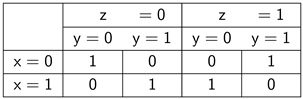
The corresponding ternary algebra has the decomposition (16) in two parts (), and so its addition is binary, because of (23) with and :
where and are “even” and “odd” components of the algebra. Using the Cayley Table (78), the conditions (18) in components now become
where is the ternary algebra multiplication, which is strictly nonderived and can be noncommutative.
Remark 5.
In general, the affine ternary multiplication of the -ary grading group can be generalized to any N and as follows:
which gives strictly the nonderived grading -ary group, if the condition of absence of idempotents (75) holds valid. For instance, if , then should be odd, and the case of works always.
Remark 6.
For higher values of N and , there exist strictly nonderived grading -ary groups whose multiplication law differs from the affine form given in (82).
6. -Graded Polynomials Over -ary Matrices
The next example comes from polynomial rings in one indeterminate x over a field graded by monomial degree d, such that the direct sum decomposition (16) is , where the nonzero components are , , (for , it is assumed ). The elements from are homogeneous of degree d, since , and the polynomial product is
which means that the the binary grading group now is the additive group of the ring of integers .
The polyadization of this grading group can be done by considering the additive group of the -ring of polyadic integers consisting of the representatives of the congruence class , (, which was introduced in [23,35]. Instead of an indeterminate x we will consider the block-shift matrices [23,36] which obey n-ary multiplication and binary addition.
Let us introduce n-ary “matrix indeterminates” as the block-shift matrices of size
which are closed under n-ary multiplication, which is strictly nonderived [36]. Without any additional requirements the set of n-ary matrices (84) form the totally commutative n-ary semigroup
where the matrix product in the r.h.s. is in . Obviously,
If x is invertible, then becomes an n-ary group with the querelement
The polyadic identity in is
as
Due to the “quantization” (4), we can multiply only the admissible number of the matrix indeterminates, and the degree (word length of x’s) is also “quantized”:
where is the polyadic power (5). So, we have the polyadic monomials as polyadic powers (instead of )
Remark 7.
In the binary case , the degree (94) becomes , and so, the zero polyadic power corresponds to one degree. Let informally ; then, in the general case, (94) is . Thus, the free term (having zero degree ) of a polynomial belongs to only in the binary case; see (91) and (96). Note that negative polyadic power is calculated for n-ary groups in the special way; that is, [23]. Therefore, the free term in the n-ary case becomes (as for ordinary polynomial ).
Thus, the generic polynomial over n-ary matrices of the length with indeterminate x has the form
As for ordinary polynomials, , if , and therefore, the sum (97) is direct.
The polyadic matrix algebra corresponding to has the similar direct sum decomposition
where , l see (95) and (97). Obviously, , if , as in the binary case, and the n-ary multiplication is given by the ordinary matrix product in :
Recall that the polyadic integers [35] are special representatives of a congruence class , , , , , which satisfy the “quantization” conditions (the arity shape invariants should be positive integers)
In this case only, the representatives form the strictly nonderived -ring
which is a polyadic analog of the ring of ordinary integers , for which both shape invariants (101) and (102) vanish:
Now, we use the additive -ary group of as the grading group for polyadic polynomials, by full analogy with the binary case (83). This means that the consistency condition of the grading (17) should be
It follows from (107) that the arities of algebra multiplication and the grading ring addition (being the arity of the grading group ) coincide as
We assume that every degree of the monomial in is equal to the corresponding representative of the grading polyadic ring in (107), which gives the relations (together with (108))
This means that a polyadic algebra with given arity of multiplication n can be graded not by arbitrary polyadic integers, as in the binary case, but by those coming from the special polyadic rings having the same arity of addition , arbitrary arity of multiplication and the fixed arity shape invariants (101) and (102):
Example 6.
Let us consider the concrete polynomial over 4-ary (block-shift) matrices with the indeterminate x, as
The degree (94) now becomes
The monomials are as follows: free constant term , has polyadic power , has polyadic power , has the polyadic power , and has the polyadic power . The sum (117) is direct, evidently, and so, we obtain the unique direct sum decomposition of the corresponding (to ) algebra
Then, we choose the grading polyadic ring (103) using (111)–(113) for and and take, for instance, . The additive 4-ary group of this ring should be used to “add” the degrees, while multiplying 4 polynomials of the fixed degrees in (107). For instance, the main consistency condition (107) for all nonconstant graded components of the polynomial (117) has the form (using (110))
where on r.h.s. there are elements of the polyadic ring .
7. Higher Power Multiary Gradings
The compatibility condition (17) in the higher arity case can have a more complicated structure, leading to inequality instead of (20), if we use polyadic powers and the “quantization” of word length (4).
Definition 8.
A multiary higher power -graded polyadic -algebra is the direct sum decomposition of -vector spaces (16) such that the n-ary multiplication in the algebra respects the -ary multiplication in the grading group as follows:
where is the ith component of the decomposition (16), while and are polyadic powers (5) of the algebra and the grading group multiplications, respectively.
A higher power polyadic algebra is strongly graded, if, in (121), the equality is
Theorem 3.
The arity of multiplication of the higher power polyadic algebra and the arity of the multiary grading group are “quantized” and connected by (cf. (20)), as follows:
Proof.
The “quantization” condition (123) together with table (124) shows that multiary gradings of higher arity polyadic algebras are possible only for certain specific combinations of arities and powers. In contrast, the binary case imposes no such restrictions.
Example 7.
Let us consider the ternary grading group from Example 5 as in (76) and (77). To satisfy (123), we take the second solution in (124) , , , , which shows that the higher power polyadic algebra with binary addition (because of in the decomposition (79)) should have 5-ary multiplication, and so, it is . Since , the higher (third) polyadic power -ary grading group multiplication becomes
The Cayley table of (125) is

The corresponding polyadic algebra has the decomposition (16) in two parts ():
where and are the “even” and “odd” components of the algebra. Using the Cayley table (126), the conditions (18) in components now become
8. Conclusions
In this work, we have established a comprehensive framework for multiary graded polyadic algebras, extending classical grading theory to higher-arity algebraic structures. Our investigation has revealed several fundamentally new phenomena that distinguish the polyadic case from its binary counterpart.
Main contributions
1. General framework: We introduced the concept of multiary -graded polyadic algebras, defined by the decomposition with the compatibility condition . This definition accommodates arbitrary arities for both algebra operations and grading group operations.
2. Quantization rules: We discovered precise constraints connecting the arities:
- For strongly -graded algebras, the arity of graded group coincides with the multiplication arity of algebra (Proposition 1).
- The relation between the grading group order and the arity of the algebra addition is (Theorem 1).
- For higher power gradings, (Theorem 3).
These “quantization” rules represent a distinctive feature of polyadic grading, with no analog in binary graded algebra theory.
3. Support properties: We established that for strongly -graded polyadic algebras, the support satisfies , ensuring that all homogeneous components are nontrivial.
4. Graded homomorphisms: We developed the theory of polyadic graded homomorphisms as pairs , preserving both the algebraic structure and grading, with particular attention to cases where . The First Isomorphism Theorem for graded polyadic algebras is proved.
Key examples and applications
1. Ternary superalgebras: We constructed explicit examples including the following:
- Derived ternary superalgebras with binary -grading;
- Strictly nonderived ternary superalgebras graded by ternary groups without identity (Example 5).
These examples demonstrate the possibility of grading by groups that lack neutral elements—a situation impossible in classical grading theory.
2. Polynomial algebras over n-ary matrices: We developed the theory of polynomials over block-shift matrices, showing they can be graded by polyadic integers with specific “quantization” conditions: , , and (Section 6).
3. Higher power gradings: We introduced the concept of higher power gradings where , providing explicit solutions to the “quantization” condition and constructing a 5-ary superalgebra with ternary grading (Section 7).
Theoretical implications
1. Arity freedom with constraints: While initial arities can be chosen freely according to the arity freedom principle, meaningful grading structures impose specific constraints through “quantization” rules. This represents a natural selection mechanism for compatible arities in polyadic graded systems.
2. Role of identity elements: The classical requirement that grading groups contain an identity element is relaxed in the polyadic setting. We have shown that meaningful gradings exist even when lacks such an element, as demonstrated by strictly nonderived ternary grading groups.
3. Support as structural invariant: The support of a graded polyadic algebra becomes a more delicate invariant than in the binary case, intimately connected with polyadic powers and word length “quantization”.
4. Nonderived operations: Our emphasis on strictly nonderived operations (Remark 1) ensures that the constructed examples are genuinely polyadic rather than disguised binary structures, revealing the essential features of higher arity.
Open problems and future directions
1. Classification problem: Classify all possible multiary gradings for given arities and finite group orders , including the enumeration of non-isomorphic graded structures.
2. Homological aspects: Develop homology and cohomology theories for multiary graded algebras, extending the classical theory of group cohomology for graded rings.
3. Representation theory: Investigate representations of multiary graded algebras, particularly the decomposition of modules into homogeneous components and the behavior of graded module categories.
4. Physical applications: Explore potential applications in theoretical physics, where
- Ternary and higher-arity structures appear in Nambu mechanics and ternary “quantization”;
- Higher power gradings might model symmetries in extended physical systems;
- Polyadic superalgebras could provide mathematical frameworks for generalizations of supersymmetry.
5. Geometric realizations: Develop geometric interpretations of multiary graded algebras, potentially through noncommutative geometry or graded manifold theory extended to polyadic settings.
6. Connection with higher categories: Investigate relationships between multiary graded algebras and higher categorical structures, where composition laws themselves have higher arity.
7. Computational aspects: Develop algorithms for determining whether a given polyadic algebra admits nontrivial multiary gradings, and for classifying such gradings computationally.
Concluding remarks
The theory of multiary graded polyadic algebras represents a natural and rich extension of classical grading concepts to higher-arity algebraic structures. The “quantization” rules we have discovered reveal an intricate interplay between the arities of operations, the order of grading groups, and polyadic powers—a layer of structure absent in binary algebra.
The examples we have constructed, particularly the strictly nonderived cases, demonstrate that this generalization is not merely formal but yields genuinely new mathematical objects with interesting properties. The relaxation of requirements such as the existence of identity elements in grading groups opens new possibilities for algebraic structures.
As polyadic algebra continues to develop as a field [23,24], the theory of graded structures will likely play an increasingly important role, both in pure mathematics and in potential applications to physics and other sciences. The framework established here provides a solid foundation for these future developments, offering both concrete examples and general principles to guide further exploration.
Funding
This research received no external funding.
Data Availability Statement
Data are contained within the article.
Conflicts of Interest
The author declares no conflicts of interest.
References
- Năstăsescu, C.; Van Oystaeyen, F. Graded Ring Theory; Elsevier: Amsterdam, The Netherlands, 1982. [Google Scholar]
- Năstăsescu, C.; Van Oystaeyen, F. Methods of Graded Rings; Springer: Berlin/Heidelberg, Germany, 2004. [Google Scholar]
- Hazrat, R. Graded Rings and Graded Grothendieck Groups; Cambridge University Press: Cambridge, MA, USA, 2016. [Google Scholar]
- Rotman, J.J. Advanced Modern Algebra, 2nd ed.; AMS: Providence, RI, USA, 2010. [Google Scholar] [CrossRef] [Scilit]
- Lang, S. Algebra, 3rd ed.; Springer: New York, NY, USA, 2002; p. 914. [Google Scholar]
- Bahturin, Y.; Sehgal, S.; Zaicev, M. Group gradings on associative algebras. J. Algebra 2001, 241, 677–698. [Google Scholar] [CrossRef] [Scilit]
- Kelarev, A. Ring Constructions and Applications; World Scientific: Singapore, 2002. [Google Scholar]
- Hazewinkel, M.; Gubareni, N.M. Algebras, Rings and Modules: Non-Commutative Algebras and Rings; CRC Press: Boca Raton, FL, USA, 2016; p. 388. [Google Scholar]
- Lam, T.Y. A First Course in Noncommutative Rings; Springer: New York, NY, USA, 1991. [Google Scholar] [CrossRef] [Scilit]
- Wess, J.; Bagger, J. Supersymmetry and Supergravity; Princeton University Press: Princeton, NJ, USA, 1983; p. 216. [Google Scholar]
- Deligne, P.; Etingof, P.; Freed, D.S.; Jeffrey, L.C.; Kazhdan, D.; Morgan, J.W.; Morrison, D.R.; Witten, E. (Eds.) Quantum Fields and Strings: A Cource for Mathematicians; American Mathematical Society: Providence, RI, USA, 1999; Volumes 1–2. [Google Scholar]
- Terning, J. Modern Supersymmetry; Oxford University Press: Oxford, UK, 2005; p. 336. [Google Scholar]
- Green, M.B.; Schwarz, J.H.; Witten, E. Superstring Theory; Cambridge University Press: Cambridge, MA, USA, 1987; Volumes 1–2. [Google Scholar]
- Kaku, M. Introduction to Superstrings and M-Theory; Springer: Berlin/Heidelberg, Germany, 1998; p. 587. [Google Scholar]
- Berezin, F.A. Introduction to Superanalysis; Reidel: Dordrecht, The Netherlands, 1987; p. 421. [Google Scholar]
- Kac, V.G. Lie superalgebras. Adv. Math. 1977, 26, 8–96. [Google Scholar] [CrossRef] [Scilit]
- Bernstein, J.; Leites, D.; Molotkov, V.; Shander, V. Algebra and calculus. In Seminars of Supersymmetries; MCCME: Moscow, Russia, 2013; Volume 1. [Google Scholar]
- Matsumura, H. On the graded rings of polynomials. J. Math. Soc. Jpn. 1959, 11, 17–27. [Google Scholar]
- Russell, P. Gradings of polynomial rings. In Proceedings of the Algebraic Geometry and Its Applications; Bajaj, C.L., Ed.; Springer: Berlin/Heidelberg, Germany, 1994; pp. 365–373. [Google Scholar] [CrossRef] [Scilit]
- Zalesskii, A.E.; Mikhalev, A.V. Group rings. J. Sov. Math. 1975, 4, 1–78. [Google Scholar] [CrossRef] [Scilit]
- Passman, D.S. The Algebraic Structure of Group Rings; John Wiley and Sons: Hoboken, NJ, USA, 1977; pp. xiv + 720. [Google Scholar]
- Bovdi, A.A. Group Rings; Uzgorod University: Uzhgorod, Ukraine, 1974; p. 118. [Google Scholar]
- Duplij, S. Polyadic Algebraic Structures; IOP Publishing: London, UK; Bristol, UK, 2022; p. 461. [Google Scholar] [CrossRef] [Scilit]
- Duplij, S. Higher power polyadic group rings. arXiv 2025, arXiv:2510.14029. [Google Scholar] [CrossRef] [Scilit]
- Sokhatsky, F.M. On the associativity of multiplace operations. Quasigroups Relat. Syst. 1997, 4, 51–66. [Google Scholar]
- Kumduang, T.; Wattanatripop, K. Partial algebras of formulas under generalized superpositions. Bull. Irkutsk State Univ. Ser. Math. 2025, 54, 160–175. [Google Scholar] [CrossRef] [Scilit]
- Sampson, M.; George, R. Semigroups in distributed computations: N-ary operations and irreducibility. Eur. J. Pure Appl. Math. 2026, 19, 7215. [Google Scholar] [CrossRef] [Scilit]
- Leeson, J.J.; Butson, A.T. On the general theory of (m, n) rings. Algebra Universalis 1980, 11, 42–76. [Google Scholar] [CrossRef] [Scilit]
- Duplij, S. Arity shape of polyadic algebraic structures. J. Math. Phys. Anal. Geom. 2019, 15, 3–56. [Google Scholar] [CrossRef] [Scilit]
- Post, E.L. Polyadic groups. Trans. Amer. Math. Soc. 1940, 48, 208–350. [Google Scholar] [CrossRef]
- Kasner, E. An extension of the group concept. Bull. Am. Math. Soc. 1904, 10, 290–291, Reported by L. G. Weld at 53rd Annual Meeting of AAAS, St. Louis, 1904. [Google Scholar] [CrossRef] [Scilit]
- Dörnte, W. Unterschungen über einen verallgemeinerten Gruppenbegriff. Math. Z. 1929, 29, 1–19. [Google Scholar] [CrossRef] [Scilit]
- Boboc, C.; Dăscălescu, S.; van Wyk, L. Cyclic algebras, symbol algebras and gradings on matrices. Linear Algebra Appl. 2024, 688, 157–178. [Google Scholar] [CrossRef] [Scilit]
- Cohn, P.M. Universal Algebra; Harper & Row: New York, NY, USA, 1965; p. 352. [Google Scholar]
- Duplij, S. Polyadic integer numbers and finite (m, n)-fields. P-Adic Numbers, Ultrametric Anal. Appl. 2017, 9, 257–281. [Google Scholar] [CrossRef] [Scilit]
- Duplij, S. Polyadization of algebraic structures. Symmetry 2022, 14, 1782. [Google Scholar] [CrossRef] [Scilit]
Disclaimer/Publisher’s Note: The statements, opinions and data contained in all publications are solely those of the individual author(s) and contributor(s) and not of MDPI and/or the editor(s). MDPI and/or the editor(s) disclaim responsibility for any injury to people or property resulting from any ideas, methods, instructions or products referred to in the content. |
© 2026 by the author. Licensee MDPI, Basel, Switzerland. This article is an open access article distributed under the terms and conditions of the Creative Commons Attribution (CC BY) license.