


Abstract
We obtain different categories of singularities of fuzzy retracts, fuzzy deformation retracts, and fuzzy foldings on fuzzy fundamental groups of the fuzzy Friedmann–Lemaître–Robertson–Walker Space . The fuzzy fundamental groups of fuzzy submanifolds in are characterized combinatorially using these fuzzy geometrical transformations. Also, the fuzzy fundamental groups of the fuzzy geodesics and the limit fuzzy foldings of are described. New types of fuzzy singularity of some fuzzy geometrical transformations of are obtained. Finally, the regularity of some other fuzzy retract singularities are discussed.
Keywords:
singularity; fuzzy Friedmann–Robertson–Walker space MSC:
53A35; 51H20; 57N20
1. Introduction
The concept of fuzzy sets, initially introduced by Zadeh [1], has been extensively employed in various scientific fields [2,3,4,5,6]. Fuzzy folding, fuzzy retraction, and fuzzy deformation retracts are well known as being among the most fascinating issues in both Euclidean and non-Euclidean spaces. Several branches of differential geometry and topology have examined these topics.
In a series of papers (see, e.g., [7,8,9,10]), El-Ahmady, El-Ghoul, and others studied fuzzy folding and fuzzy deformation retracts of fuzzy horocycles and horospheres. In their studies, a new type of connection between fuzzy spheres in fuzzy Minskowski space and fuzzy open ball in fuzzy Euclidean space are obtained by using some fuzzy geometric transformations. In addition, Types of fundamental groups of the Klein bottle, elastic Klein bottle, Buchdahi space, Minkowski space, and some geometric transformations are achieved. After that, they defined the folding of chaotic fractal space-time. Then, the variation of the density functions on chaotic spheres in chaotic space-like Minkowski space time was introduced. In addition, folding–retraction of chaotic dynamical manifold and the VAK of vacuum fluctuation are also discussed. In later studies, some operations on the chaotic graphs, such as the union and the intersection—also both of the chaotic incidence matrices and the chaotic adjacency matrices, representing the chaotic graphs induced from these operations—were studied. Moreover, a calculation of geodesics in chaotic flat space, Ricci space, Schwarzchild space, and folding are obtained. The deformation shrinkage and topological folding of the Buchdahi space, and the deformation shrinkage and topological folding of the Schwarzschild space are also obtained. On parallel ruled surfaces in Minkowski 3-space and their retractions, the folding of fuzzy hypertori and their retractions, limits of fuzzy retractions of fuzzy hyperspheres and their foldings, and also fuzzy retractions of fuzzy open flat Robertson–Walker space are presented and obtained. The geodesic deformation retract of the Klein bottle and its folding are deduced. Finally, the topological folding of the hyperbola in Minkowski 3-space is presented.
The Friedmann–Lemaître–Robertson–Walker space, denoted by , is yet a significant and iconic discovery in the annals of geometry (see, e.g., [11]) for recent studies). In spite of their initial appearance for geometric purposes, they have become significant in numerous branches of mathematics and physics. The convergence of geometry and applied science produced a beneficial impact as applied science contributed to the validation of the Friedmann–Lemaître–Robertson–Walker space, enabling its formalization [12]. The study of space is linked with fractal-fractional calculus. In particular, the end of the limits of fuzzy foldings of fuzzy space is equivalent to a type of fuzzy fractals of , which reduces the dimension from integer to fractal. Moreover, the types of fuzzy deformation retracts of represent types of fuzzy fractals.
Singularity theory is a field of deep study in modern mathematics, with relations to many branches, including differential geometry, algebra, and topology. In fact, the essential way to understand an object is to classify its type, i.e., whether it is regular or singular. The exploration of the geometry of singular objects and its applications has been greatly stimulated since the beginning of the 19th century. Among many applications in the field of differential geometry and symplectic geometry, the geometric features of singular surfaces can be understood when classifying functions or mappings on such surfaces with respect to the -equivalence relation (see, e.g., [13,14,15,16,17]). One of the goals of the current paper is to classify the fuzzy retract singularities.
The main goal of this work is to provide a comprehensive analysis of the fuzzy fundamental groups of the fuzzy Friedmann–Lemaître–Robertson–Walker space . The manuscript has been divided into four major sections. In Section 2, we introduce basic and new definitions and recall some other ones, illustrating the main techniques and approaches that are used. In Section 3, the main results are stated with full details. In Section 4, the connections of the fuzzy retracts and singularity theory are discussed. Finally, in Section 5, the most important applications are investigated.
2. Preliminary
In the current section, we establish the basic definitions from differential geometry and recall some concepts from singularity theory, which will be used consistently throughout the paper.
We refer to a manifold with some physical features expressed through the density function as a fuzzy manifold, which will be denoted by .
Definition 1.
A subset of is classified as a fuzzy retract (or retraction) singularity if a continuous mapping exists such that serves as the identity on and at least one component of is identically zero. The function is then termed a fuzzy retraction singularity.
Definition 2.
A subset is designated as b fuzzy deformation retract (or retraction) singularity if there exists a fuzzy retraction singularity and a fuzzy homotopy that satisfies the following conditions:
- (1)
- (2)
- (3)
for all , , and .
Definition 3.
A map is referred to as b fuzzy isometric folding singularity of into itself if the generated path is b piecewise fuzzy geodesic and has the same length as γ (where ). If fails to preserve lengths, it is b topological fuzzy folding of , and at least one of its components is identically zero. In other words, the stratification is represented by the fuzzy folds or the fuzzy singularity.
Example 1 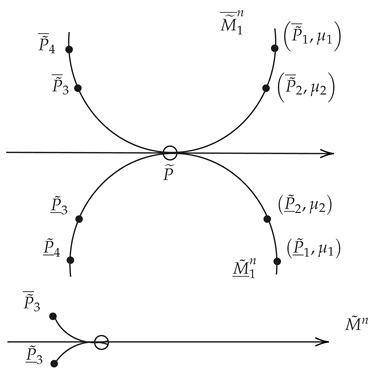
([7]). Consider the distinct points , and of , then there are points of , where have the same membership degrees for each i and has maximum membership degrees, as illustrated in the following figure:
Now, let be fuzzy foldings of into itself, such that
Then, the limit of the fuzzy folding is , which is a subset of , i.e., has the same dimension as . Also, for any fuzzy folding up of into itself, there are induced fuzzy foldings of into itself.
Example 2. 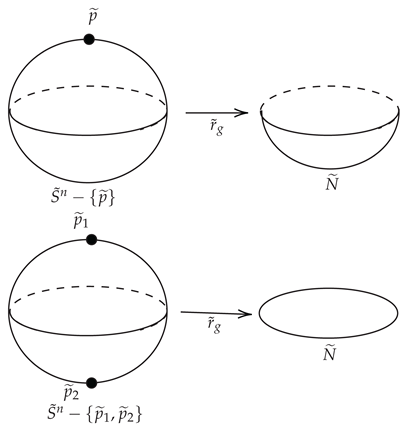
Let , where is a fuzzy n-sphere, is any point of . Let be a geometric retraction that takes to the lower hemisphere, as illustrated in the following figures:
This retraction will condense the physical character in . In this case, which means that induces a fuzzy retraction of the physical character.
Now, if we start with a fuzzy retraction , such that where is the lower hemisphere. In this case, does not affect anything except the physical character, i.e., fuzzy retraction does not induce, in general, a geometric retraction.
Note that if we consider and as a geometric retraction, which takes to circle , then this retraction again induces a fuzzy retraction.
Example 3. 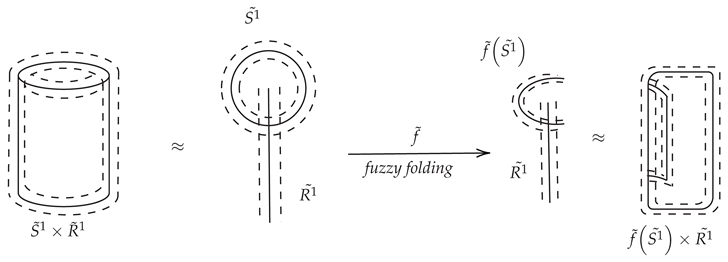
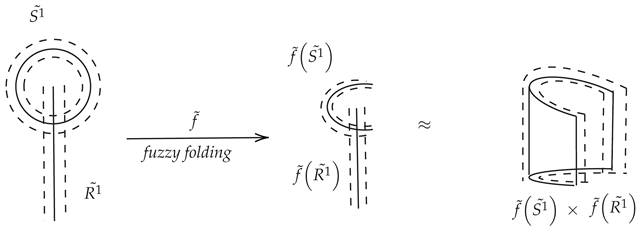
Let be an infinite fuzzy cylinder, then a fuzzy folding of the fuzzy cylinder can be defined as follows:
This means that .
This means that .
This means that .
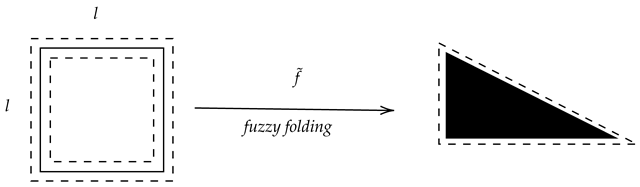
Let . Consider the following fuzzy folding of a fuzzy sheet of a fuzzy square paper, as shown in the next diagram.
Example 4. 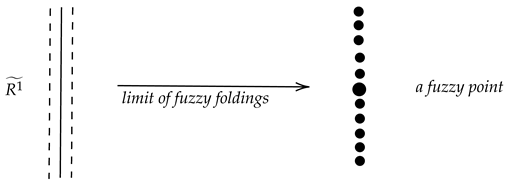
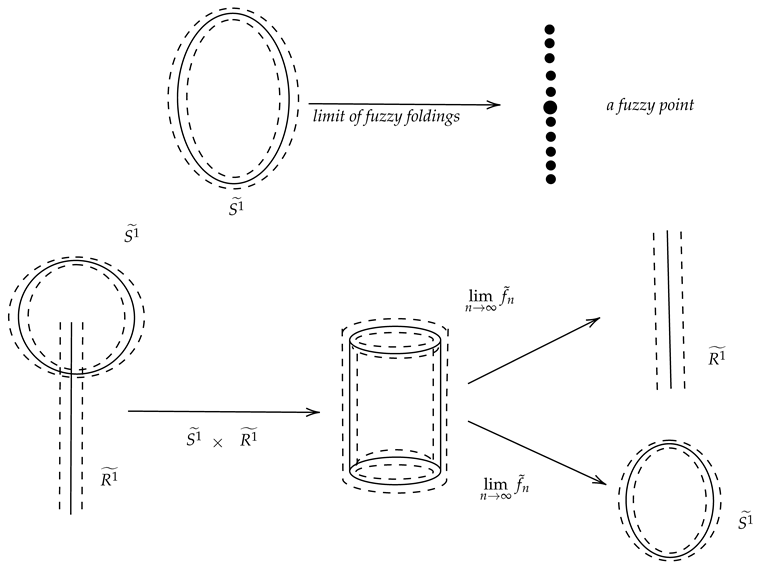
Let be an infinite fuzzy cylinder, then the limit of fuzzy folding can be introduced as follows:
Example 5. 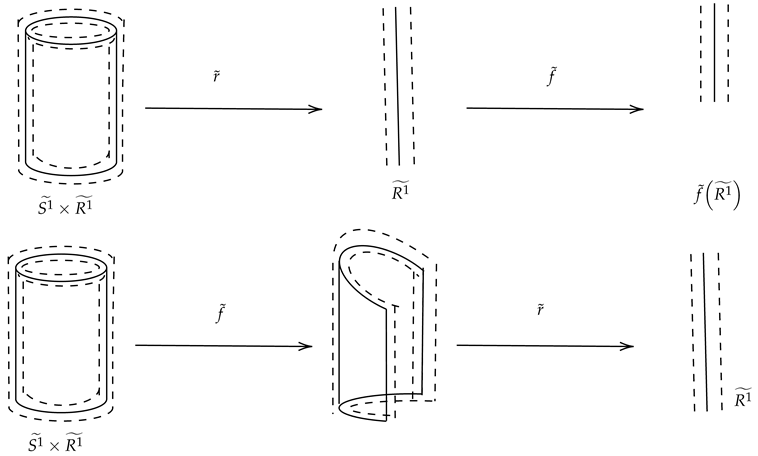
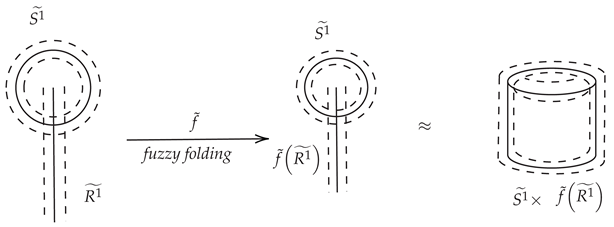
Let be an infinite fuzzy cylinder. The fuzzy retraction and fuzzy folding of are defined as in the following diagram.
Example 6. 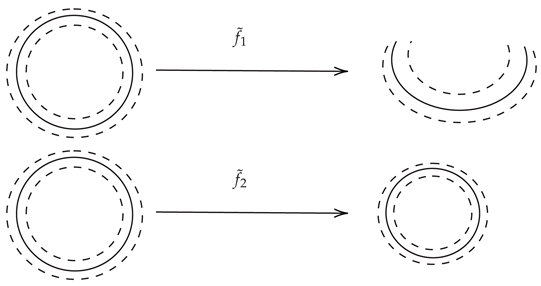
The fuzzy fundamental group of any fuzzy fobbing of fuzzy circle is either isomorphic to or fuzzy identify group, i.e., if the fuzzy folding with singularity of , then to a fuzzy identity group. Also, if the fuzzy folding without singularity of , then is a fuzzy manifold hemeomorphic to , and . See the next diagram.
Let be a differentiable map between two arbitrary manifolds M and N, with dimensions m and n, respectively. The derivative of a map at a point is a linear map, denoted by , of the tangent space to the tangent space :
Definition 4
([15]). A point is known as a critical point or singularity point of F if the rank of the derivative meets the following condition:
and it is referred to as a “critical value.”
Let be local coordinates in the neighborhood of u, and be the local coordinates in the neighborhood of ). Let , be the smooth functions that define F locally at u.
Definition 5
([18]). The Jacobian matrix of F, represented as or , is the matrix with its -th element defined as or explicitly
Remark 1
([18]).
- 1.
- Locally, point u is a critical point or singularity point of F if the rank of the Jacobian matrix of F at u is not maximum; that is, .
- 2.
- The critical set of F, denoted by , is the set of all critical points.
- 3.
- The image is called the critical value of F.
- 4.
- Assume . If F has critical points, then the image of F is singular or non-regular; otherwise, it is regular.
Our approach relies on the construction of a fuzzy deformation retract map on the fuzzy Friedmann–Lemaître–Robertson–Walker space . This map is constructed by getting started with the fuzzy geodesic and then obtaining its spherical coordinates through the calculation of the Lagrangian equations. Also, the fuzzy retraction singularities of are obtained through the use of some fuzzy geometrical transformations and discussing their type via tools from singularity theory. These transformations are viewed from the perspective of the Remannian metric that pertains to .
3. Main Results
Theorem 1.
The fuzzy geodesic retractions of from the viewpoint of Lagrangian equations are fuzzy spheres, fuzzy circles, and fuzzy subspaces.
Proof.
Consider the fuzzy Friedmann–Lemaître–Robertson–Walker space , in the fuzzy cylindrical coordinates , and , with the following fuzzy metric:
where , , , and
The fuzzy coordinates of are given by
Note that .
Let , , , and . Then, (1) becomes
We obtain the fuzzy geodesic singularities and fuzzy retract singularities in by solving the Lagrangian equations, as follows:
where Thus, we obtain the following relations
and
To be able to solve the Lagrangian equations and to find the fuzzy geodesics and the fuzzy retractions, we have to choose particular values. We will address the subsequent special cases:
- (i)
- From Equation (4), is a particular solution, and therefore, (2) gives the fuzzy spacewhich is a fuzzy 3-sphere; that is, the three-dimensional fuzzy closed space of constant positive curvature in .If is considered to be a constant, say , then the space (8) yieldswhich is a 2-fuzzy sphere of radius b, covered by the standard fuzzy spherical polar coordinates and .On the other hand, if is a constant equal , then (8) giveswhich is again a 2-fuzzy sphere of radius b covered by the standard fuzzy spherical polar coordinates and .If , then (8) leadswhich is the fuzzy circle. Note that if and is an arbitrary constant, then the fuzzy circles of constant latitude are transformed to fuzzy circles on a disc.For if is constant and equal to , (8) leads towhich is a 2-fuzzy sphere of radius b covered by the standard fuzzy spherical polar coordinates and . Again, if is constant and equals 0, then (12) becomeswhich is a fuzzy circle in the -plane.Also, if , then (12) yieldswhich is a fuzzy circle in the -plane.Clearly, all of , and are fuzzy geodesic and retraction singularities.
- (ii)
- From Equation (7), we have , where is a constant. When , then . In particular, if , then we obtain from (2)which is a 3-dimensional fuzzy subspace. It is a fuzzy retraction singularity.Also, from Equation (7), we have , where . Hence, , and it follows from (2) that we obtain eitherorwhich are both 2-dimensional fuzzy subspaces (see Figure 1), covered by the fuzzy coordinates and . They are fuzzy retraction singularities.
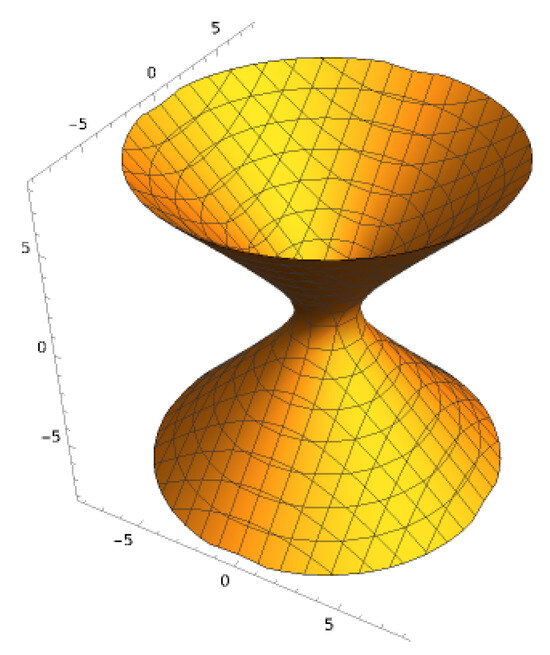 Figure 1. The 2-dimensional cylinder.
 - (iii)
- Finally, if we set and in (2), then we obtainandwhich are both 1-dimensional fuzzy subspaces of . They are fuzzy retraction singularities. Note that, are fuzzy coordinate singularities.
□
Theorem 2.
The fuzzy fundamental group of types of fuzzy deformation retracts of is either isomorphic to or it represents a fuzzy identity group.
Proof.
We will show that all of , and are the fuzzy deformation retract of open fuzzy Friedmann–Lemaître–Robertson–Walker .
Let
being the fuzzy deformation retract of , where is the open fuzzy Friedmann–Lemaître–Robertson–Walker space .
Let
being the fuzzy retractions of , where .
Then, the fuzzy deformation retract of onto is defined as
Hence, the .
The fuzzy deformation retract of onto is given by
So, .
For , the fuzzy deformation retract of is given by
Therefore, .
Furthermore, the fuzzy deformation retract of onto is defined as
Accordingly, .
The fuzzy deformation retract of onto is
Thus,
For , the fuzzy deformation retract of is
where
and
Hence, is isomorphic to
Finally, the fuzzy deformation retract of onto is
where
and
Thus, is isomorphic to
Similar arguments can be made for the remaining fuzzy retract singularities, and the proof is completed. □
Theorem 3.
The fuzzy fundamental group of the limit of the fuzzy foldings by cut of one of the fuzzy retract singularities , and in is isomorphic to
Proof.

Consider the fuzzy great sphere , which is a 2-dimensional space, and is expressed explicitly as . Clearly, it is fuzzy geodesic and a fuzzy retraction singularity in
Let be b fuzzy folding by cut. Inductively, define the sequence of fuzzy folding by cut maps as follows:
Thus, is a fuzzy circle of dimension one. Therefore, Sequentially, the fuzzy folding by cut of the fuzzy geodesic and retraction singularity is isomorphic to (see Figure 2, which represents a sequence of fuzzy foloding by cut such that the final result gives a fuzzy fundamental group that is isomorphic to ). Similar arguments hold for and . □
Figure 2.
Stages of fuzzy folding by cut maps .
Remark 2.
In the proof of Theorem 3, it is observed in the folding by stages that the singularity points appear on the surface, while at the end of the fuzzy folding (by cuts), the surface turns into a smooth curve. Moreover, this type of fuzzy folding induces boundaries.
Theorem 4.
The fuzzy fundamental group of the fuzzy coordinates singularity is the fuzzy identity group.
Proof.
The fuzzy poles of are the fuzzy single points and . Since the fuzzy points and Hence, the fuzzy fundamental group of the fuzzy points and is the fuzzy identity group. □
Theorem 5.
The fuzzy induces the fuzzy and , such that the fuzzy fundamental group of the fuzzy deformation retract of onto induces the fuzzy fundamental groups of the fuzzy deformation retracts of onto and onto .
Proof. 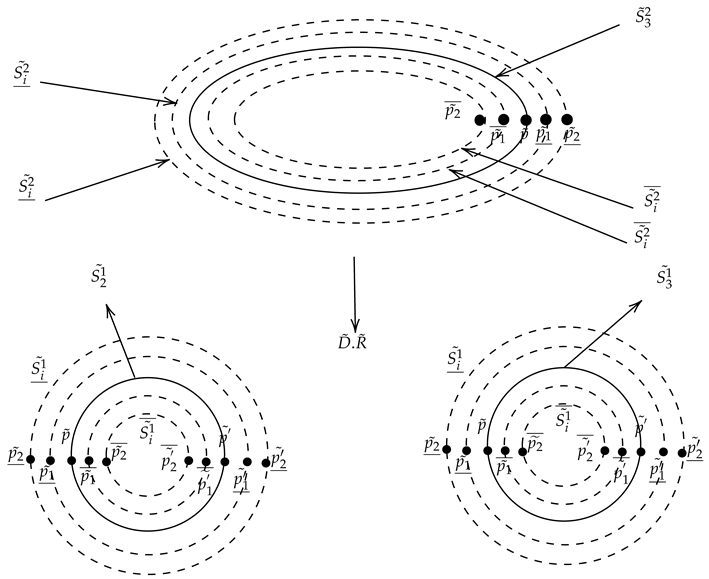
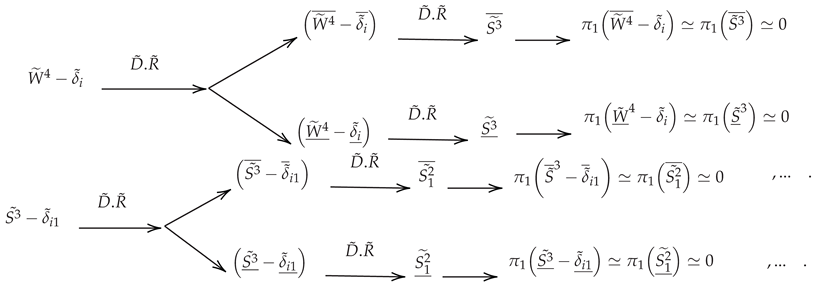
Consider a fuzzy with fuzzy retractions and . There are nested fuzzy circles and inside and outside and , respectively. Denote by the fuzzy deformation retract and consider the following diagram.
Note that from the above diagram that any fuzzy deformation retract of onto induce fuzzy deformation retracts of ( ) onto and onto . Thus, we have
Also, we have
This is a fuzzy deformation retract for . We conclude that the fuzzy deformation retract of is as follows:
□
Theorem 6.
The fuzzy fundamental group of generates the b couple of the fuzzy fundamental group of the two fuzzy systems of fuzzy and .
Proof.
Using Equation (8), is a fuzzy sphere and , for all points . Therefore, there are nested 2-chains of n-pure fuzzy spheres and induced. Thus, the fuzzy system consists of fuzzy spheres inside and outer , with membership degree , where as and , as and , .
Now, nested n-fuzzy spheres with common centers exist, as in Figure 3, so the nested fuzzy fundamental group of exists inside , and nested fuzzy fundamental groups of outer , apart from the fuzzy fundamental group of . It follows that we have
and
Therefore, is isomorphic to fuzzy identity group. Moreover, the fuzzy identity group for is a chain of points up and down (see Figure 3). The proof is completed.
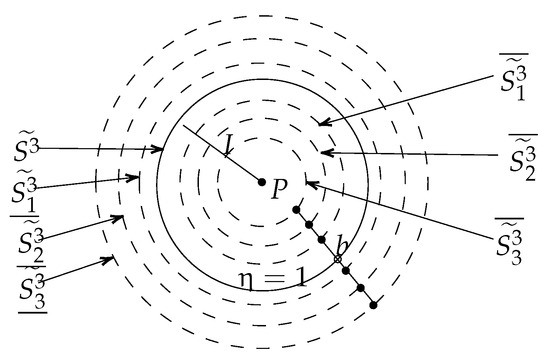
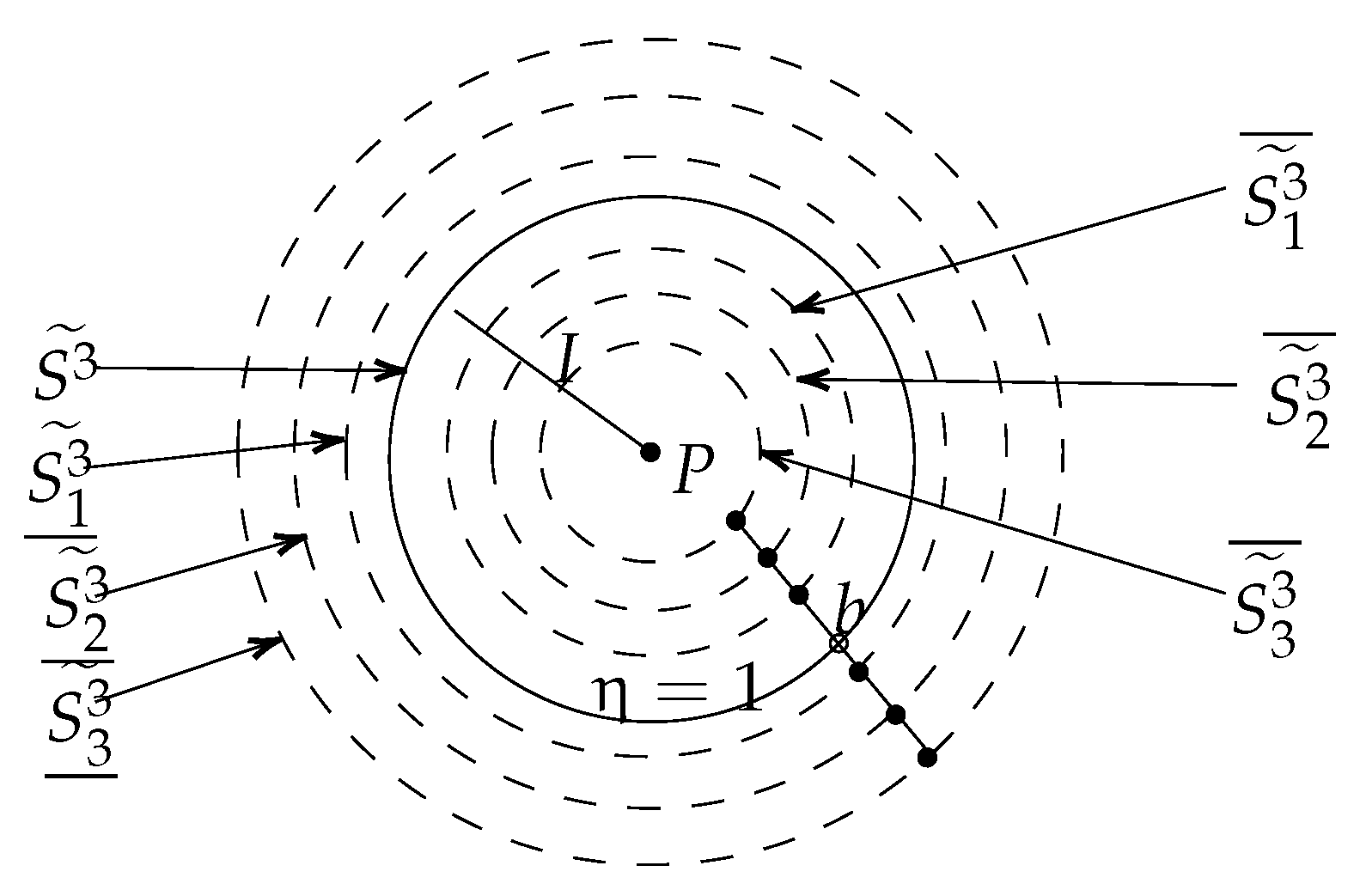
Figure 3.
The n-fuzzy spheres with common center.
Figure 3.
The n-fuzzy spheres with common center.
□
Theorem 7.
Let
then there are induced 2-chains of fuzzy retractions and fuzzy foldings, such that
Proof. 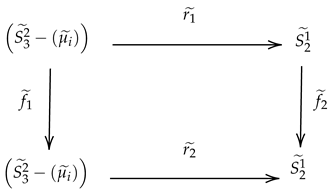
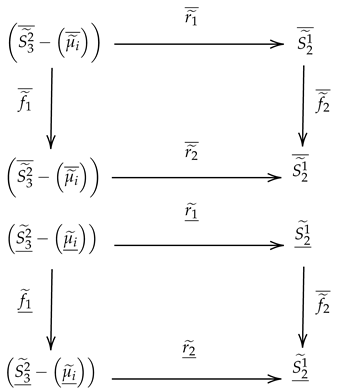
Let the fuzzy retraction of be defined as
, and the fuzzy foldings of are given by . Then, there are induced 2-chains of fuzzy retraction and fuzzy foldings given by
Hence, the following diagrams are commutative:
It follows that .
Also, we have
Therefore,
and
This finishes the proof. □
Theorem 8.
If the fuzzy retraction of is and the limit of the fuzzy foldings : , then there are induced chains of fuzzy retractions and the limit of fuzzy folding, such that
Proof. 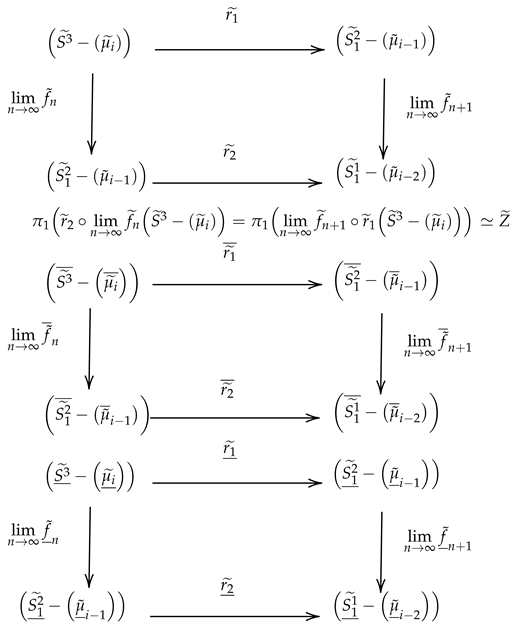
Let the fuzzy retractions of be defined by and the limit of fuzzy folding is given by
⋮
Note that . Therefore, .
Hence, the following diagrams are commutative:
Therfore,
and
□
4. The Discriminants of the Fuzzy Retracts
In the current section, we discuss the discriminants of the fuzzy retract singularities, which were obtained in the previous section and are not well described. In particular, we shall consider the singularities , and .
Throughout this section and for simplicity, we shall set and .
Consider the fuzzy retract , which is parametrized locally in by
Then, the Jacobian matrix of f is
The critical points of f satisfy . So, we have to consider the -matrix which is obtained from by removing the ith row, and solve , for all i. Thus, the critical points of f satisfy
and
Clearly, the common solutions of (20), (21), (22) and (23) is . Therefore, the set of critical values is the union of
and
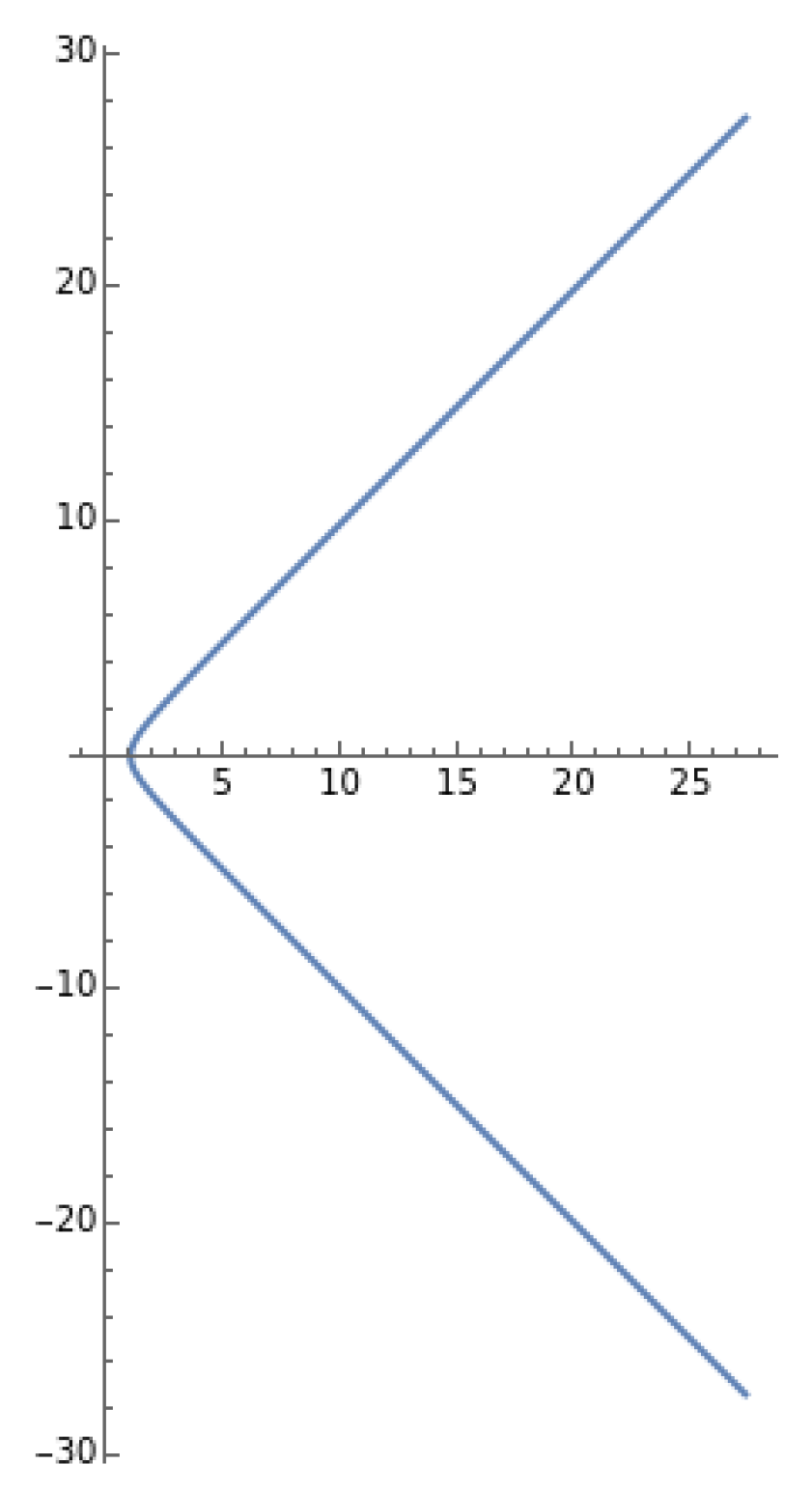
Note that the set is a parametrization of one of the two connected components of a hyperbola (see Figure 4). Moreover, it is a fuzzy retract singularity.
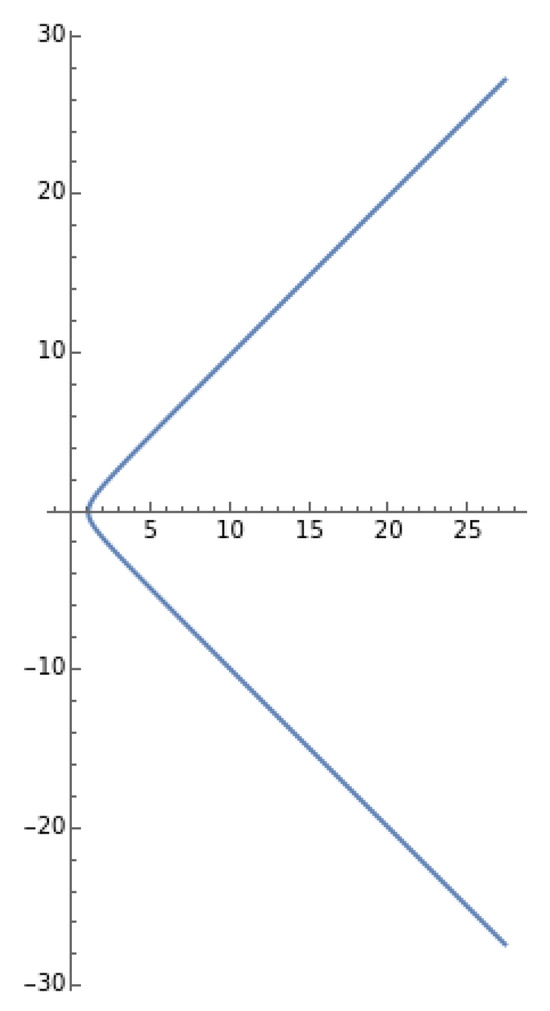
Figure 4.
A connected component of a hyperbola .
On the other hand, the set represents a 2-fuzzy sphere, which is also a fuzzy retract singularity.
Next, consider the fuzzy retract , which is parametrized locally in by
The Jacobian matrix of h is
Note that the matrix can have if and only if the following are satisfied
and
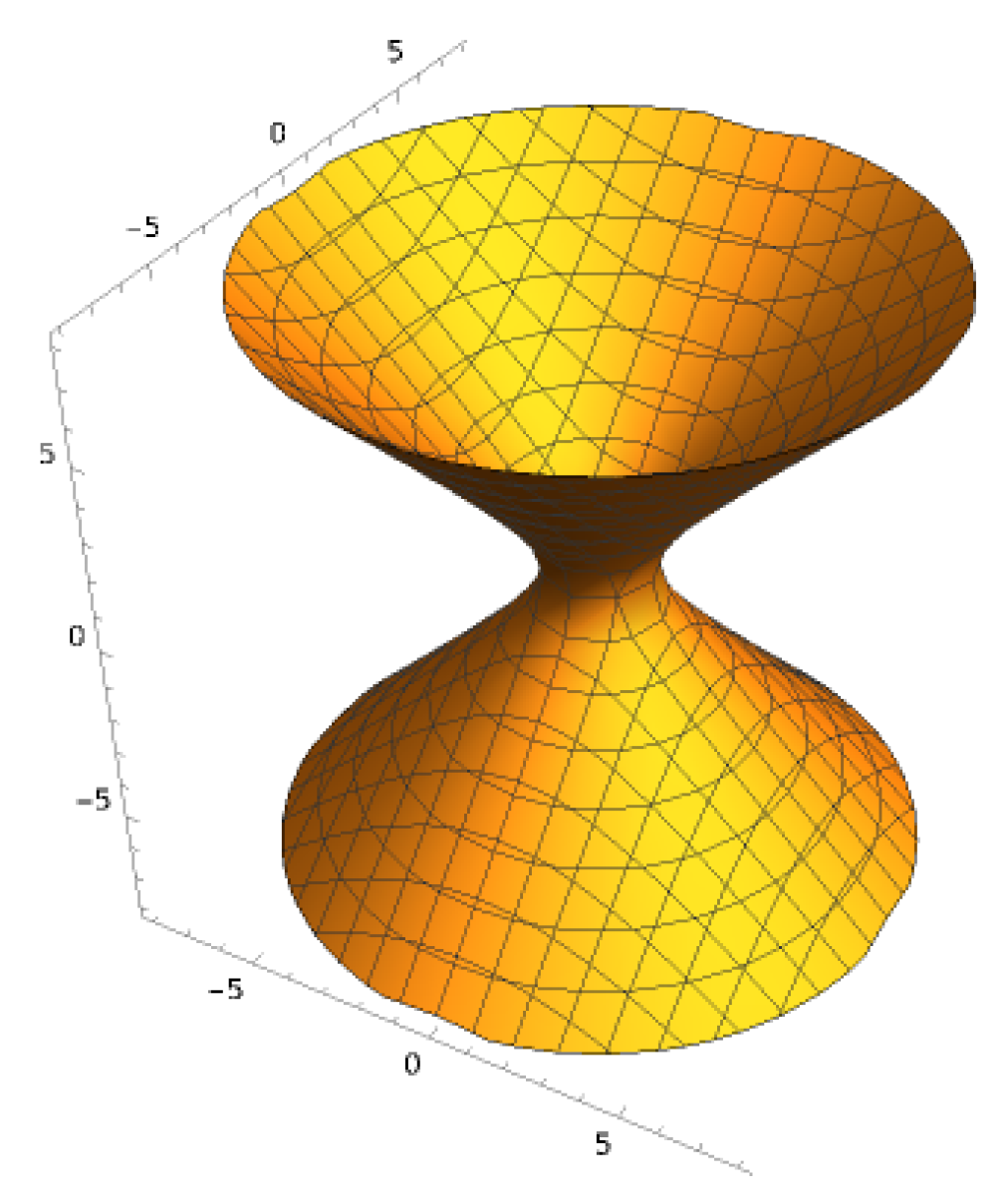
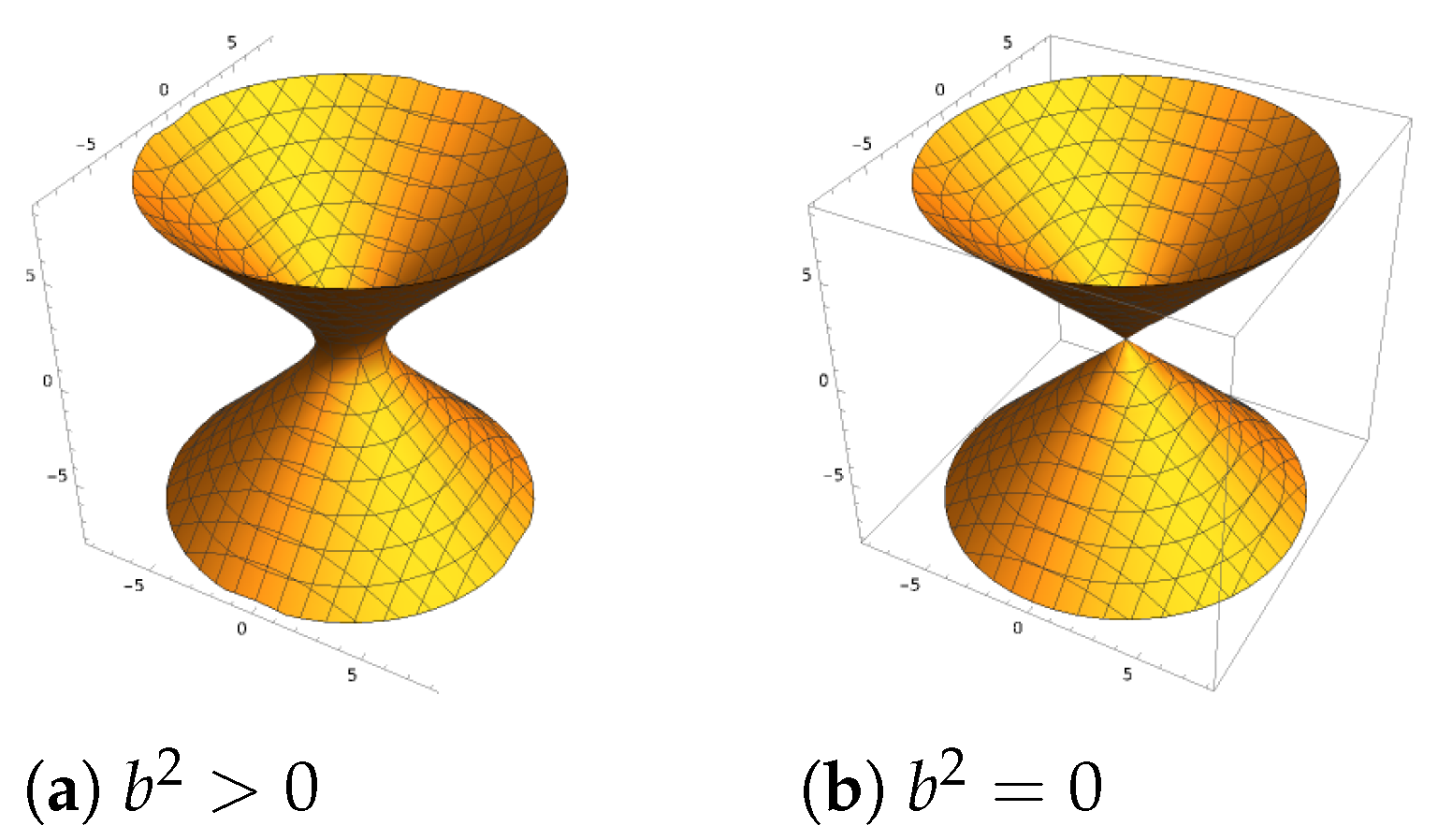
However, relations (27) and (28) can not hold simultaneously for all values of t and . Hence, is regular and there is no further fuzzy retract singularity in it. Indeed, can be written explicitly as , which represents a regular cylinder (see Figure 5a), unless b is identically zero, in which case becomes singular at the origin (see Figure 5b).
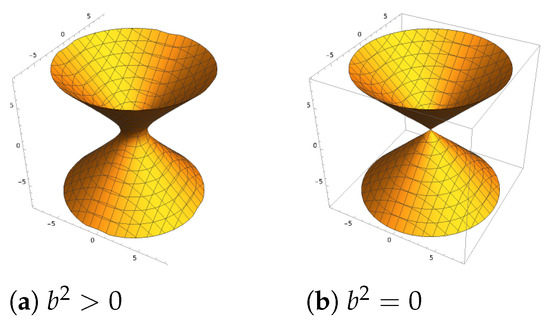
Figure 5.
The cylinder .
The above discussion implies the following.
Proposition 1.
The non-regular fuzzy retract singularities induce new ones in it. In particular, the singularity induces the two fuzzy retract singularities and .
5. Applications
- (i)
- There are many applications for these density functions. In medicine, for example, a patient with cancer develops numerous other sub-diseases in the heart, kidneys, blood, prostate, skin, and virtually every other organ. People who are infected with the hepatitis virus suffer from many symptoms in their bodies as a result of liver problems. Also, in the field of medicine, there is a dizziness of the eyes: the eye will see fish in the air, and some real figures in the air, if the person concerned is unwell. The phenomenon is represented by one of the matrices , where is inside the cone, is on the cone, and is outside the cone.Mathematically, these factors and symptoms are expressed by the density functions where , , are the effective functions.
- (ii)
- The geometric metric function represents real phenomena if the metric is a Riemannian metric ( in our setting). Still, in the case of a pseudo-Riemannian metric, it will be applied in phenomena that are not real, like the complex potential function and complex radiation.
- (iii)
- The Ritz variational method [19], which was used to calculate the ground-state energy, is in a fuzzy framework. Consider Hamilton H and an arbitrary square integrable function , so that . Considering as a fuzzy function and the ranking system, as defined in [19], it can be shown that is a fuzzy upper bound on (ground-state energy). Now, should be minimizing the distance between and with respect to a number of parameters . This can be performed by minimizing the distance between and .
6. Conclusions
In this article, we studied the fuzzy Friedmann–Lemaître–Robertson–Walker space. By solving the Lagrangian equations, new types of fuzzy retract singularities in are obtained. Then, we described the fundamental groups of fuzzy deformation retracts of , which appeared to be isomorphic to either the fuzzy identity group or . Then, we discussed the fuzzy fundamental group of fuzzy deformation retracts of , and we found that it induces the chains of fuzzy fundamental groups up and down The fuzzy fundamental group of fuzzy fold boundaries was also determined by cutting some fuzzy contraction singularities, and proved to be isomorphic to
Moreover, we showed that two chains of fuzzy fundamental groups of the two fuzzy systems of fuzzy and are induced by the fuzzy fundamental group of . In conclusion, we discussed the regularity of the fuzzy retract singularities and found that the non-regular one induces new ones.
Author Contributions
Validation, Y.L.; Formal analysis, A.E.E.-A.; Investigation, F.A.; Writing—original draft, F.A.; Writing—review & editing, Y.L. and A.E.E.-A. All authors have read and agreed to the published version of the manuscript.
Funding
This research was partially funded through the third author by Tanta University, grant number: EGP2024-125635NB-I02.
Data Availability Statement
Data is contained within the article.
Acknowledgments
We wish to thank the anonymous reviewers for their insightful suggestions and careful reading of the manuscript.
Conflicts of Interest
The authors declare no conflicts of interest.
References
- Zadeh, L.A. Fuzzy sets. Inf. Control 1965, 8, 338–353. [Google Scholar] [CrossRef]
- Ramot, D.; Milo, R.; Friedman, M.; Kandel, A. Complex fuzzy sets. IEEE Trans. Fuzzy Syst. 2002, 10, 171–186. [Google Scholar] [CrossRef]
- Demirci, M. Smooth subgroups and smooth homomorphisms. Fuzzy Sets Syst. 2001, 117, 439–446. [Google Scholar] [CrossRef]
- Ramot, D.; Friedman, M.; Langholz, G.; Kandel, A. Complex fuzzy logic. IEEE Trans. Fuzzy Syst. 2003, 11, 450–461. [Google Scholar] [CrossRef]
- Yogalakshmi, T.; Roja, E.; Uma, M.K. Soft fuzzy soft homotopy and its topological foldings of b soft fuzzy soft manifold. Ann. Fuzzy Math. Inform. 2014, 8, 125–139. [Google Scholar]
- Demirci, M. Smooth groups. Fuzzy Sets Syst. 2001, 117, 431–437. [Google Scholar] [CrossRef]
- El-Ghoul, M. Folding of fuzzy graphs and fuzzy spheres. Fuzzy Sets Syst. 1993, 58, 355–363. [Google Scholar] [CrossRef]
- El-Ghoul, M.; Shamara, H.M. Folding of some types of fuzzy manifolds and their retractions. Fuzzy Sets Syst. 1998, 97, 387–391. [Google Scholar] [CrossRef]
- El-Ahmady, A.E. Fuzzy folding of fuzzy horocycle. Rend. Del Circ. Mat. Di Palermo 2004, 53, 443–450. [Google Scholar] [CrossRef]
- Addeb, G.T.; Alqaraleh, S.M.; El-Ahmady, A.E.; Al Jaraden, J.J. On Fuzzy Fundamental Groups and Fuzzy Folding of Fuzzy Minkowski Space. Adv. Fuzzy Syst. 2021, 2021, 47394. [Google Scholar] [CrossRef]
- Melia, F. The Friedmann-Lemaître-Robertson-Walker metric and the principle of equivalence. Z. Naturforschung A 2023, 78, 525–533. [Google Scholar] [CrossRef]
- Griffiths, J.B.; Podolsky, J. Exact Space-Times in Einstein’s General Relativity; Cambridge University Press: Campridge, UK, 2009. [Google Scholar]
- Mather, J. Stability of C∞-mappings III: Finitely determined map germs. Inst. Hautes Etudes Sci. Publ. Math. 1968, 35, 127–156. [Google Scholar] [CrossRef]
- Arnold, V.I.; Gusein-Zade, S.M.; Varchenko, A.N. Singularities of Differentiable Maps. Vol. I. Monographs in Mathematics 82; Birkhäuser Boston: Boston, MA, USA, 1985. [Google Scholar]
- Arnold, V.I. Singularities of Caustics and Wave Fronts. Mathematics and Its Applications 62; Kluwer Academic Publishers: Dordrecht, The Netherlands, 1990. [Google Scholar]
- Oset Sinha, R.; Saji, K. On the geometry of folded cuspidal edges. Rev. Mat. Complut. 2018, 31, 627–650. [Google Scholar] [CrossRef]
- Alharbi, F.; Li, Y. Vector fields on bifurcation diagrams of quasi singularities. AIMS Math. 2024, 9, 36047–36068. [Google Scholar] [CrossRef]
- Montaldi, J. Singularities, Bifurcations and Catastrophes; Cambridge University Press: Cambridge, UK, 2021. [Google Scholar]
- El-Ahmady, A.E.; El-Araby, A. On fuzzy spheres in fuzzy Minkowski space. NuovoCimento 2010, 125B, 1153–1160. [Google Scholar]

Disclaimer/Publisher’s Note: The statements, opinions and data contained in all publications are solely those of the individual author(s) and contributor(s) and not of MDPI and/or the editor(s). MDPI and/or the editor(s) disclaim responsibility for any injury to people or property resulting from any ideas, methods, instructions or products referred to in the content. |
© 2025 by the authors. Licensee MDPI, Basel, Switzerland. This article is an open access article distributed under the terms and conditions of the Creative Commons Attribution (CC BY) license (https://creativecommons.org/licenses/by/4.0/).