


Abstract
Uninorms are aggregation operators that generalize the t-norms (t-conorms), which are extensions of the logical connectives to the fuzzy set theory. The methods of constructing uninorms on more general algebraic structures (such as bounded posets, lattices, etc.) are an important subject of study, including an extensive work concerning these operations on the unit real interval . The construction of uninorms on bounded lattices has been extensively studied using various aggregation functions, such as t-norms, t-conorms, and t-subnorms. In this paper, we present construction methods for uninorms, based on the elements of a lattice, without using the existence of the mentioned operators. We determine the necessary and sufficient conditions for the introduced construction methods to result in the uninorms. Then, we show the differences between our methods and several methods known from the literature, including some illustrative examples.
MSC:
03E72; 03B52; 03G10
1. Introduction
Aggregation functions are basic functions that combine several inputs into a single output. They satisfy the monotonicity and boundary conditions. Triangular norms, triangular conorms, uninorms, nullnorms, etc., are among the well-known aggregation functions. A uninorm becomes a t-norm when the neutral element is 1, and a t-conorm when it is 0.
Uninorms are a special type of associative aggregation operator having a neutral element in , introduced by Yager and Rybalov in [1], the Tivity property, and they have a neutral element e in . In addition, they are frequently studied in pure mathematics, expert systems, economics and finance, computer and engineering sciences, and social sciences, and some of the applied sciences where they have an application [1,2,3,4].
The journey of uninorms on bounded lattices commenced with Karaçal and Mesiar’s seminal work, where they conclusively established the presence of these operators on any given bounded lattice, as detailed in [5]. Then, uninorms were studied from many different perspectives [2,6,7,8,9,10]. Researchers working with uninorms on bounded lattices have been heavily focused on figuring out constructing methods of uninorms on bounded lattices [1,5,11,12,13,14,15,16,17], in which the authors utilized some aggregation operators on subintervals. According to our best knowledge, there is no element-based construction method for uninorms on a bounded lattice. In this paper, we investigate element-based construction methods for uninorms by elaborating on different cases of an element of a bounded lattice L and establishing the necessary and sufficient conditions required for these construction methods to produce a uninorm on L. Also, we give explanatory examples as well as comparative examples with the existing methods.
The paper is organized as follows: Section 2 provides a brief overview of bounded lattices, t-norms, t-conorms, and uninorms on bounded lattices. Section 3 contains the main results: new element based construction methods for uninorms on a bounded lattice L when or or . We determine the necessary and sufficient conditions for each position of the element to obtain uninorms and put the necessary and sufficient conditions on the bounded lattice L. Moreover, the dual forms are also provided. Meanwhile, we provide some examples to illustrate the construction methods. Furthermore, we show that our new construction methods are different from the existing methods in the literature.
2. Notations, Definitions and a Review of Previous Results
In this section, we revisit some fundamental concepts.
Definition 1
([18]). Let be a bounded lattice. If or , then the elements u and v are called comparable; otherwise, they are called incomparable, and in this case, the notation is used.
Hereafter, we define as the set of all elements such that u is incomparable with e; formally, , it has all elements of the lattice L which are incomparable with the element e. Let be the set defined by .
Definition 2
([18]). Let be a bounded lattice and with . The interval is a subset of L given by
Similarly, and can be defined.
Definition 3
([19]). Let be a bounded lattice. An operation is called a triangular norm, t-norm in short (triangular conorm, t-conorm in short) if it exhibits the following properties: it is increasing, Abelian, associative, and possesses 1 (0) as its neutral element.
Example 1.
Let be a bounded lattice. The minimal t-norm and the maximal t-norm on a bounded lattice L are given, respectively, as follows:
The minimal t-conorm and the maximal t-conorm on a bounded lattice L are given, respectively, as follows:
Definition 4
([16]). Let be a bounded lattice. An Abelian semigroup operation is called a uninorm if it has a neutral element and it is increasing.
Note that a uninorm is a t-norm (t-conorm) when ().
Proposition 1
([5]). Let be a bounded lattice, and U be a uninorm on L with the neutral element e. Then the following properties hold:
- (i) for .
- (ii) for .
- (iii) for .
- (iv) for .
- (v) for .
Proposition 2
([5]). Let be a bounded lattice, and U a uninorm with the neutral element e on L. Then
- is a t-norm on .
- is a t-conorm on .
Definition 5
([2]). Let L be a bounded lattice and A and B be two aggregation functions on L. A is called smaller than B if for any elements , .
We recommend [5,6,11,12,13,14,15,16,20,21,22,23,24,25] for more details about uninorms on bounded lattices.
3. Element-Based Construction Methods of Uninorms on Bounded Lattices
In this section, Theorems 1, 3 and 5 propose three construction methods for uninorms on a bounded lattice L, determined by an arbitrary fixed point , under which additional constraints are introduced. Our construction methods are compared with some construction methods known from the related literature. Also, the differences between our construction methods and those in the literature are emphasized. Some illustrative examples for our construction methods for uninorms on a bounded lattice are provided.
In the following theorem, a method to produce uninorms by means of an arbitrary element is given.
Theorem 1.
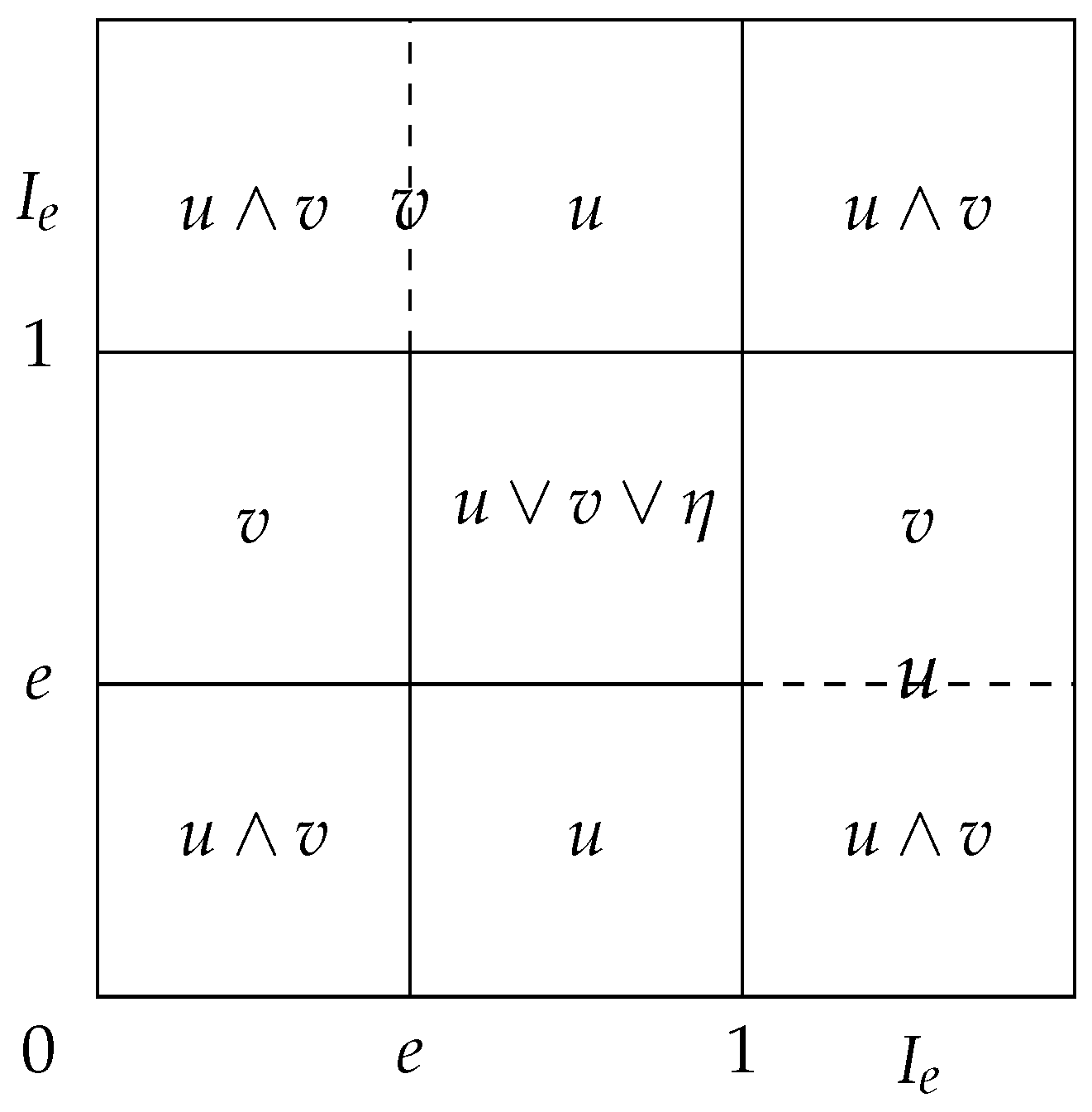
Let be a bounded lattice, and . Then the function defined by
is a uninorm on L with the neutral element e if and only if for all .
Proof.
Necessity. Since is monotone, when and . Therefore, it is obtained that .
Sufficiency. (i) Monotonicity: Let us show that for every element with , for all . If u and v are both elements of or or or , is always satisfied for all since . If or , the inequality is satisfied; therefore, they are omitted. The proof is then split into all the remaining possible cases as follows:
- 1.
- Let .
- 1.1.
- ,
- 1.1.1.
- If , then
- 1.1.2
- If , then
- 1.1.3.
- If , then
- 1.2.
- ,
- 1.2.1.
- If , then
- 1.2.2.
- If , then
- 1.2.3.
- If , then
- 1.3.
- ,
- 1.3.1.
- If
- 1.3.2.
- If , then
- 1.3.3.
- If , then
- 2.
- ,
- 2.1.
- ,
- 2.1.1.
- If , then
- 2.1.2.
- If , then
- 2.1.3.
- If , then
- 3.
- ,
- 3.1.
- ,
- 3.1.1.
- If , then
- 3.1.2.
- If , then
- 3.1.3.
- If , then
- (ii) Associativity: We demonstrate that for all . If , the equality is satisfied; therefore, they are omitted. Again, the proof is split into all the remaining possible cases by considering the relationships between the elements and e as follows.
- 1.
- Let .
- 1.1.
- ,
1.1.1. If , then
1.1.2. If , then
- 1.2.
- ,
1.2.1. If , then
1.2.2. If , then
- 2.
- .
- 2.1.
- ,
2.1.1. If , then
2.1.2. If , then
- 2.2.
- ,
2.2.1. If , then
2.2.2. If , then
It is easy to observe the commutativity of and the fact that e is a neutral element of .
Therefore, is a uninorm on L with the neutral element e. □
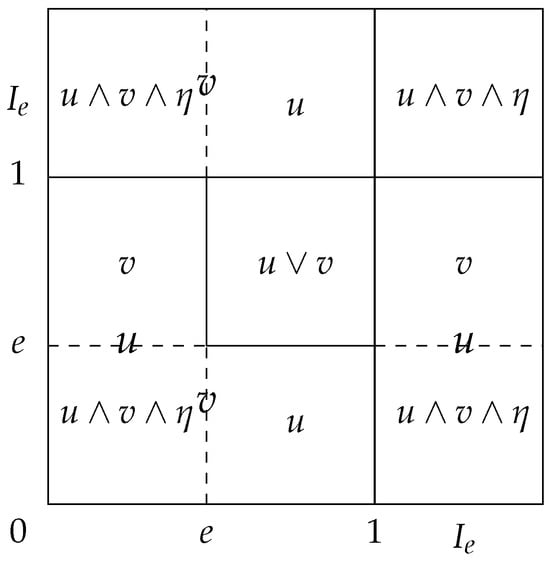
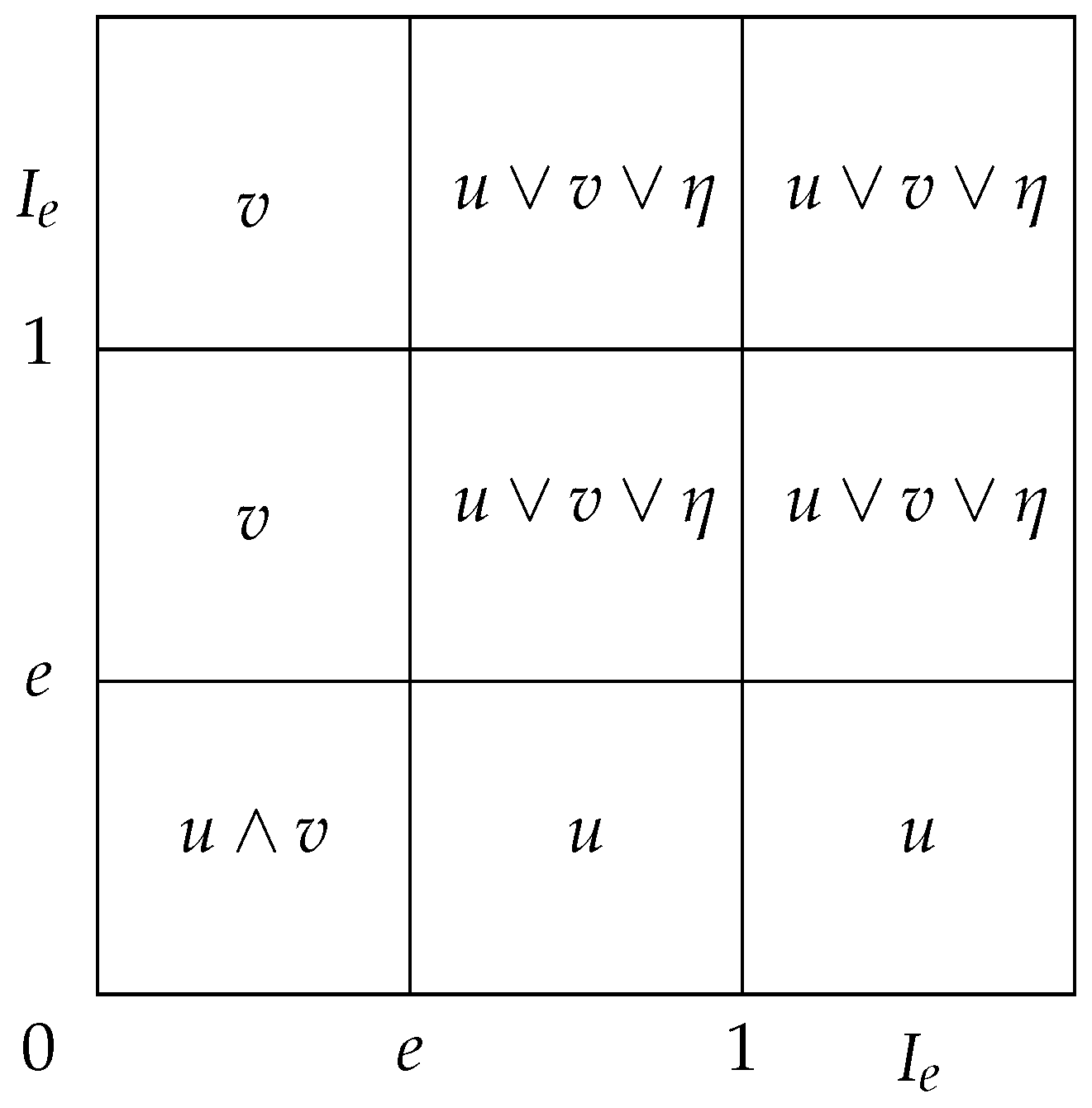
Figure 1.
The structure of the uninorm .
In the following example, an illustration of how Theorem 1 is applied is provided.
Example 2.
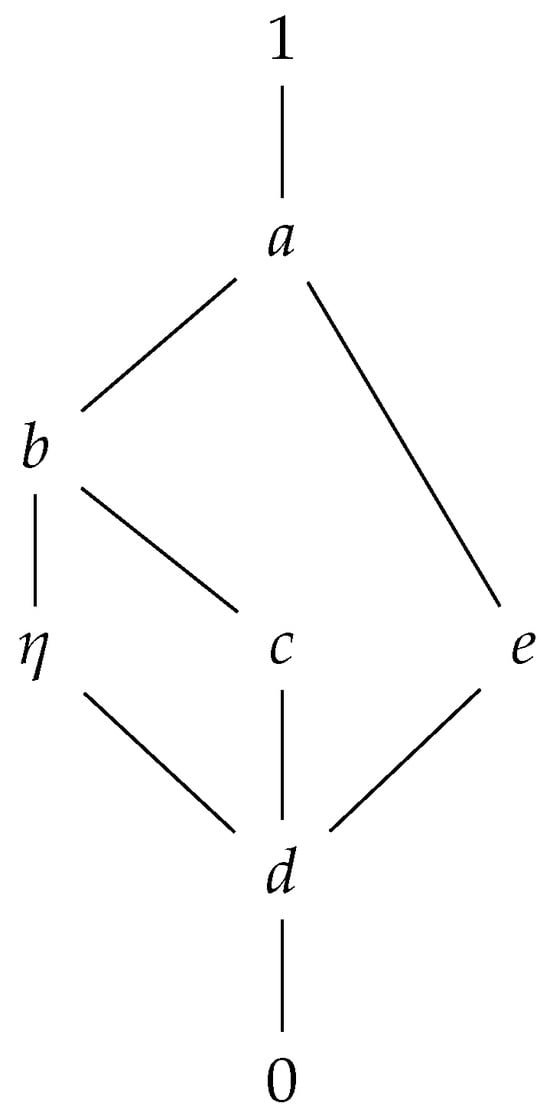

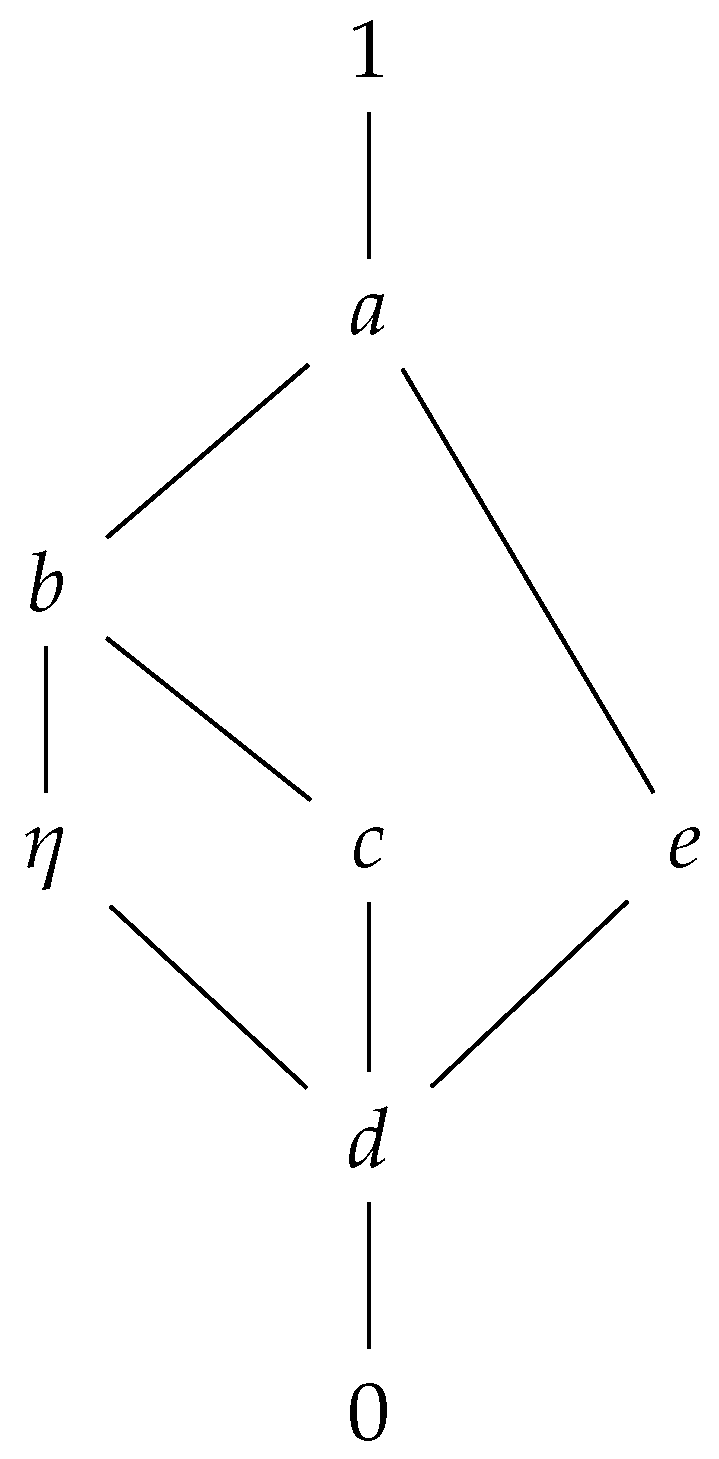
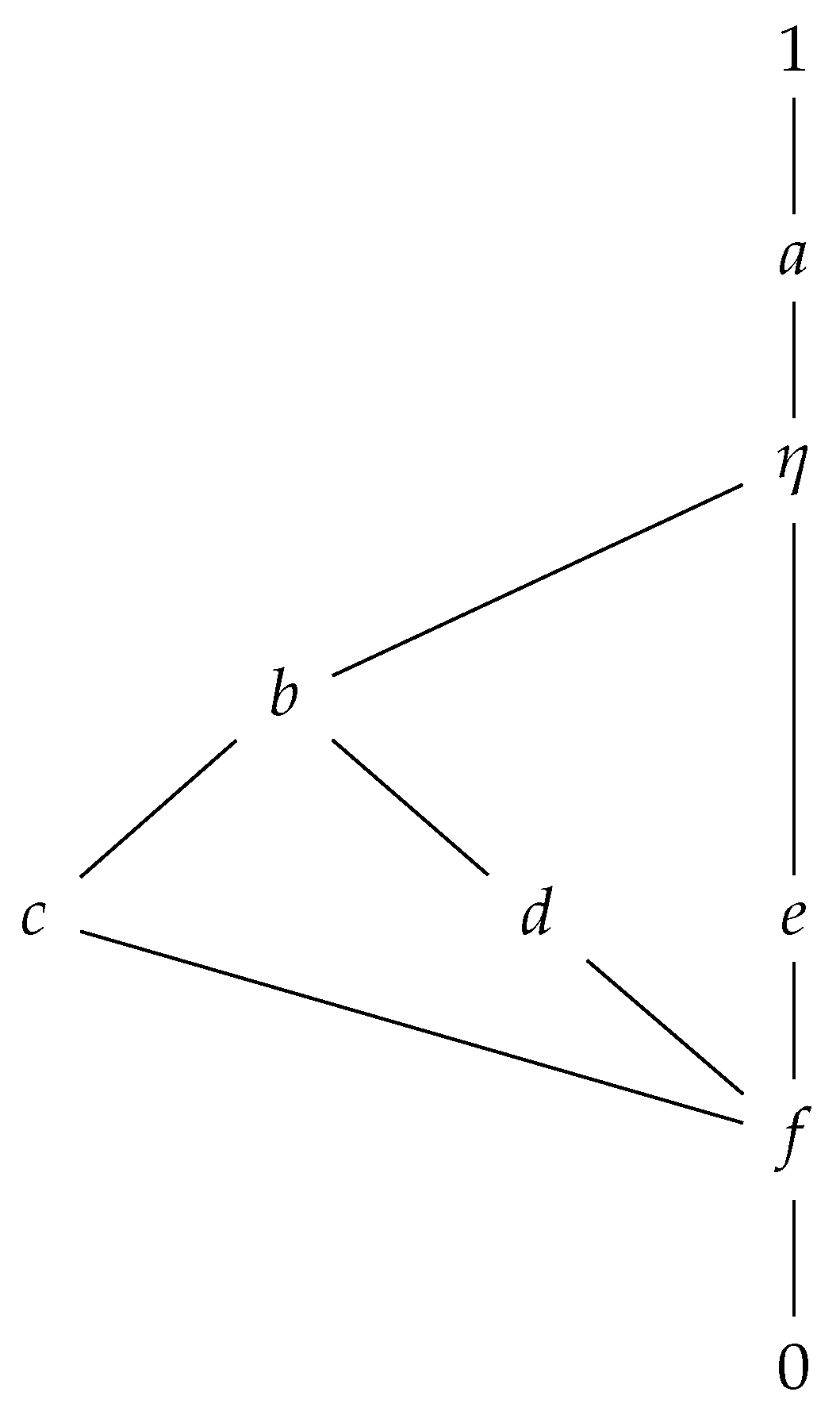
Consider the bounded lattice characterized by the Hasse diagram in Figure 2. If we apply the formula (1) in Theorem 1, the uninorm on is obtained as in Table 1.
Figure 2.
Hasse diagram of .
Table 1.
The uninorm induced by the Formula (1) in Theorem 1.
Remark 1.
In general, the uninorm defined in Theorem 1 is different from the uninorms obtained by the construction methods of uninorms in the literature. Considering Example 2, it is easily seen that and , regardless of the choice of the corresponding t-norms on in [5,11,13,15], since
respectively. Also, it is clear that the lattice satisfies the constraints of Theorem 3.1 in [12] and Theorem 3.1 in [14]. We obtain since regardless of the choice of the t-norm on in [12]. In addition, since regardless of the choice of the t-norm on and the t-conorm on in [14]. Moreover, regardless of the choice of the t-conorm S on in [22], since . Besides all this, since and on any lattice regardless of the choice of the corresponding t-norms on and/or t-conorms on in [5,11,12,13,14,15,22].
Based on the duality principle, another construction method for uninorms on the bounded lattice L is introduced.
Theorem 2.
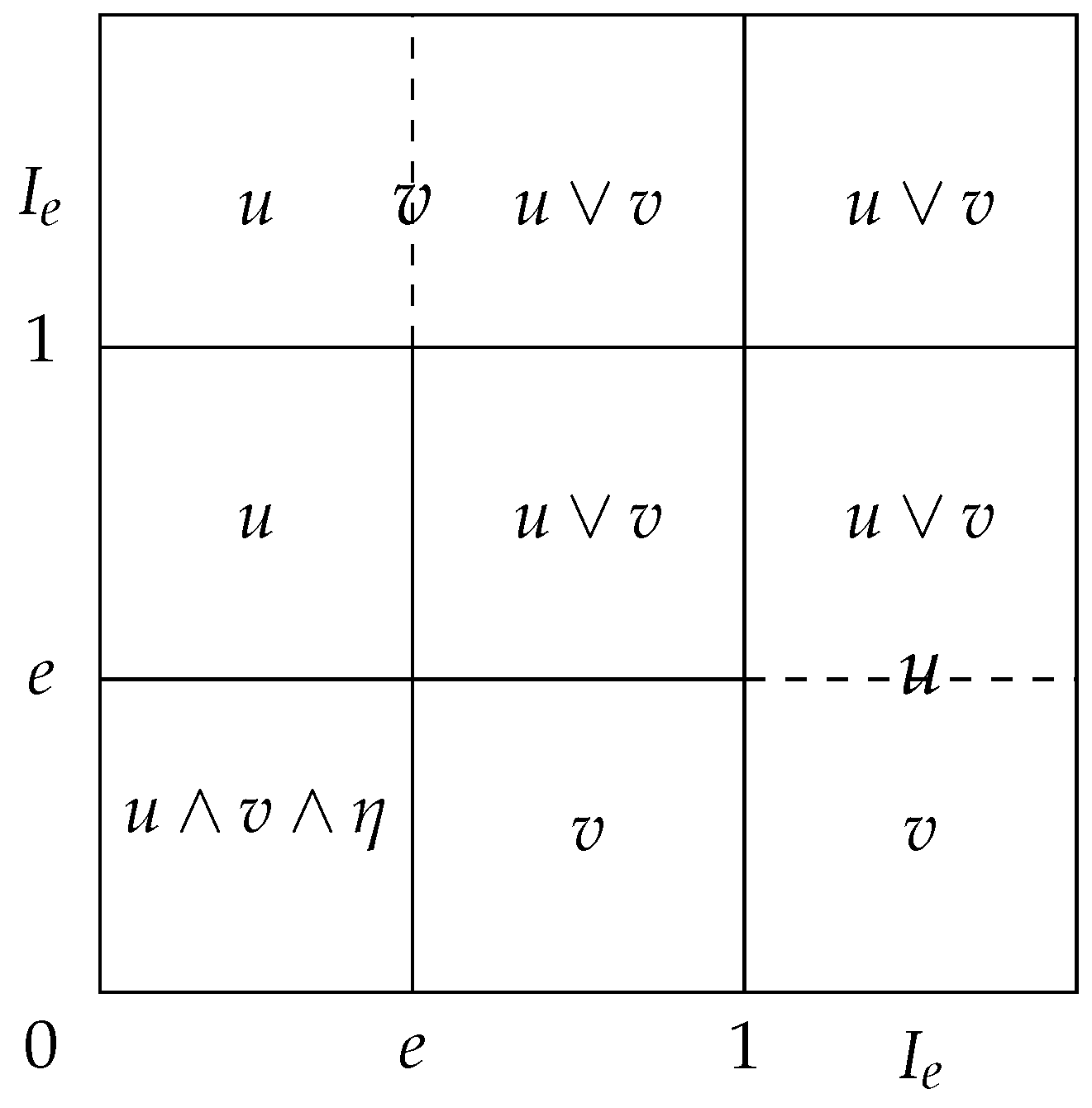
Let be a bounded lattice, and . Then the function defined by
is a uninorm on L with the neutral element e if and only if for all .
Proof.
The proof follows easily from Theorem 1, and therefore, it is omitted. □
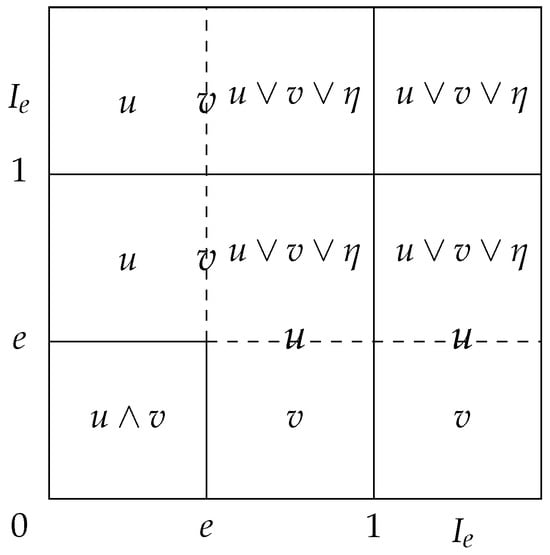
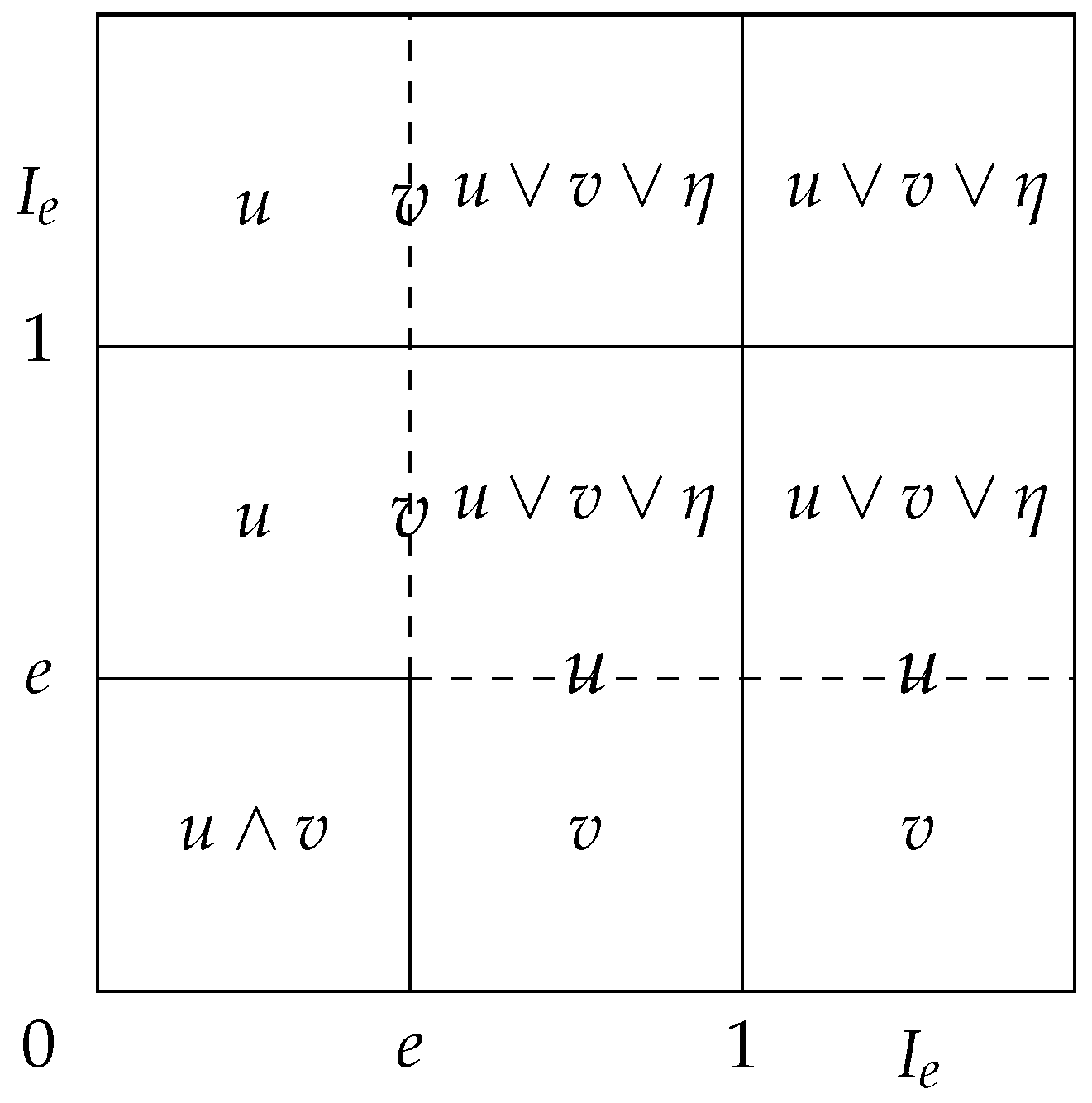
Figure 3.
The structure of the uninorm .
With the following theorem, another method to produce a uninorm by means of an arbitrary element is given.
Theorem 3.
Let be a bounded lattice, and . Then the function defined by
is a uninorm on L with the neutral element e if and only if for all .
Proof.
Necessity. Since is monotone, when and ; therefore, it is obtained that .
Sufficiency. (i) Monotonicity: Let us show that for every element with , for all . If u and v are both elements of or or or , is always satisfied for all since . If or , the inequality is satisfied; therefore, they are omitted. The proof is then split into all the remaining possible cases as follows:
- 1.
- Let .
- 1.1.
- ,
- 1.1.1.
- If , then
- 1.1.2.
- If , then
- 1.2.
- ,
- 1.2.1.
- If , then
- 1.2.2.
- If , then
- 1.2.3.
- If , then
- 1.3.
- ,
- 1.3.1.
- If , then
- 1.3.2.
- If , then
- 1.3.3.
- If , then
- 2.
- ,
- 2.1
- ,
- 2.1.1.
- If , then
- 2.1.2.
- If , then
- 2.1.3.
- If , then
- 3.
- ,
- 3.1.
- ,
- 3.1.1.
- If , then
- 3.1.2.
- If , then
- 3.1.3.
- If , then
- (ii) Associativity: We demonstrate that for all . If , the equality is satisfied; therefore, they are omitted. Again, the proof is split into all the remaining possible cases by considering the relationships between the elements and e as follows.
- 1.
- Let .
- 1.1.
- ,
1.1.1. If , then
1.1.2. If , then
- 1.2.
- ,
1.2.1. If , then
1.2.2. If , then
- 2.
- .
- 2.1.
- ,
2.1.1. If , then
2.1.2. If , then
- 2.2.
- ,
2.2.1. If , then
2.2.2. If , then
It is easy to observe the commutativity of and the fact that e is a neutral element of .
Therefore, is a uninorm on L with the neutral element e. □
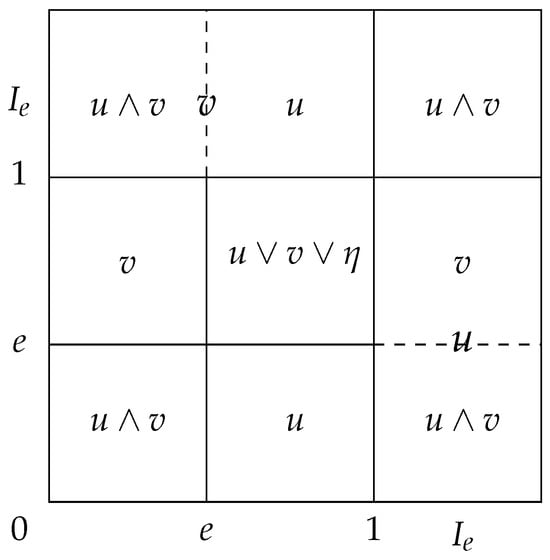
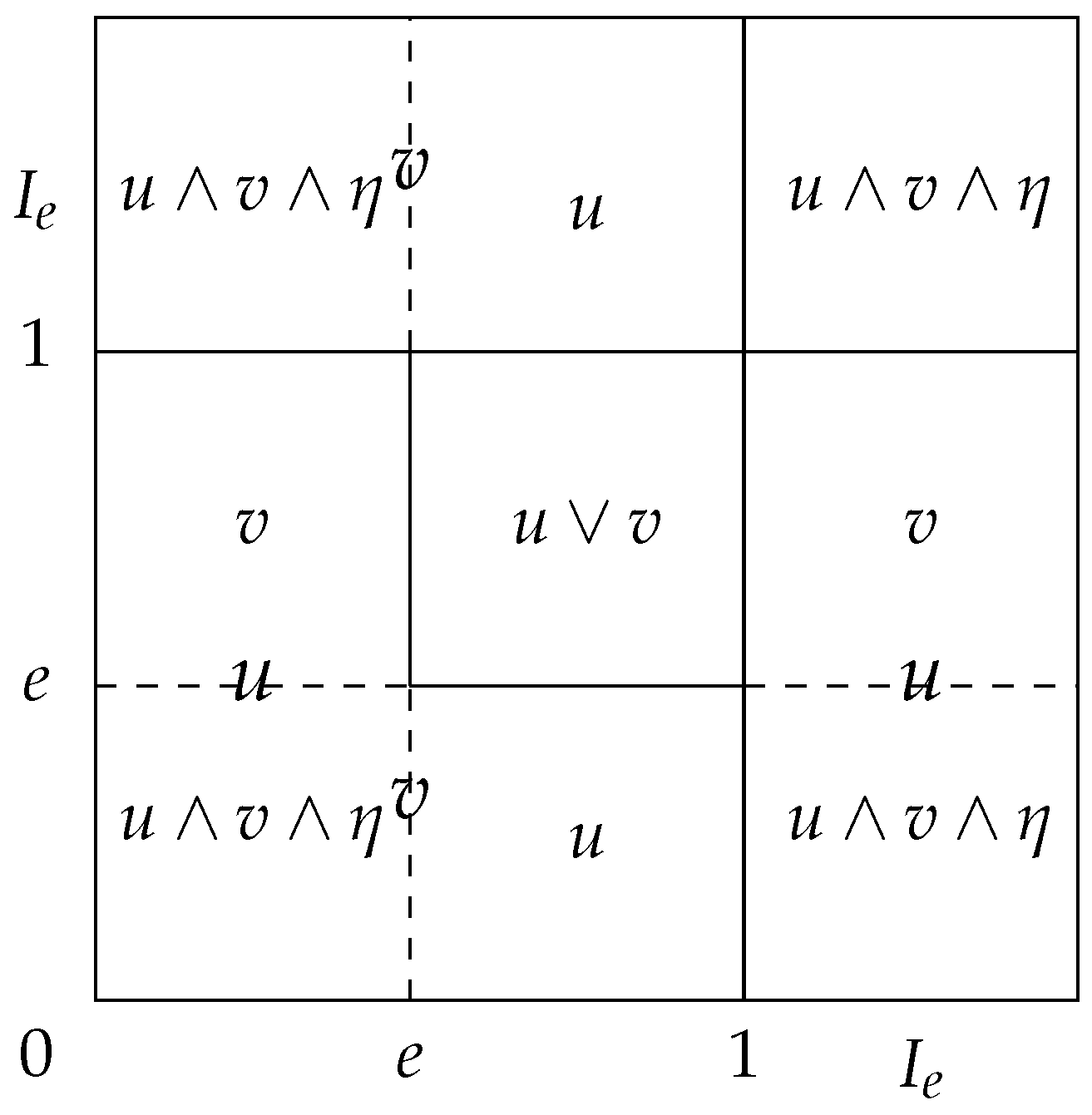
Figure 4.
The structure of the uninorm .
In the following example, a uninorm on the bounded lattice with the element is constructed by means of Theorem 3.
Example 3.
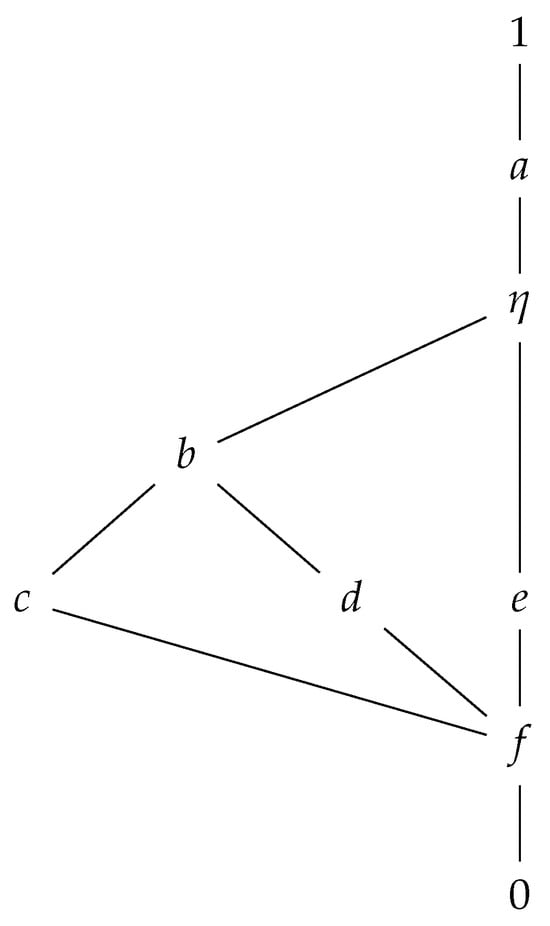
Consider the bounded lattice characterized by the Hasse diagram in Figure 5. If we apply the formula (3) in Theorem 3, the uninorm on is obtained as in Table 2.
Figure 5.
Hasse diagram of .
Table 2.
The uninorm induced by the Formula (3) in Theorem 3.
Remark 2.
It is worth noting that the uninorm is not equal, up to our best knowledge, to the uninorms obtained by the construction methods of uninorms in the literature. Considering Example 3, it is easily seen that and regardless of the choice of the corresponding t-norms on in [5,11,13,15], since
respectively. Also, it is clear that the lattice satisfies the constraints of Theorem 3.1 in [12] and Theorem 3.1 in [14]. We obtain since regardless of the choice of the t-norm on in [12]. In addition, since regardless of the choice of the t-norm on and t-conorm on in [14]. Moreover, regardless of the choice of the t-conorm on in [22], since . Furthermore, since and on any lattice regardless of the choice of the corresponding t-norms on and/or t-conorms on in [5,11,12,13,14,15,22].
Another construction method is introduced in Theorem 4 without proof, as it is dual to Theorem 3.
Theorem 4.
Let be a bounded lattice, and . Then the function defined by
is a uninorm on L with the neutral element e if and only if for all , .
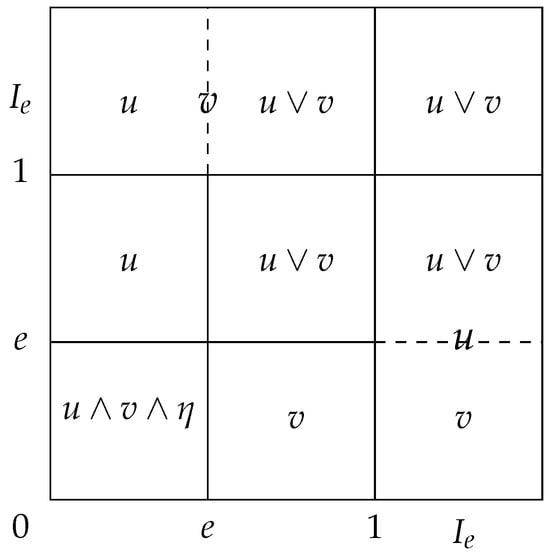
Figure 6.
The structure of the uninorm .
In the following theorem, a method to produce uninorm by means of a fixed element is given.
Theorem 5.
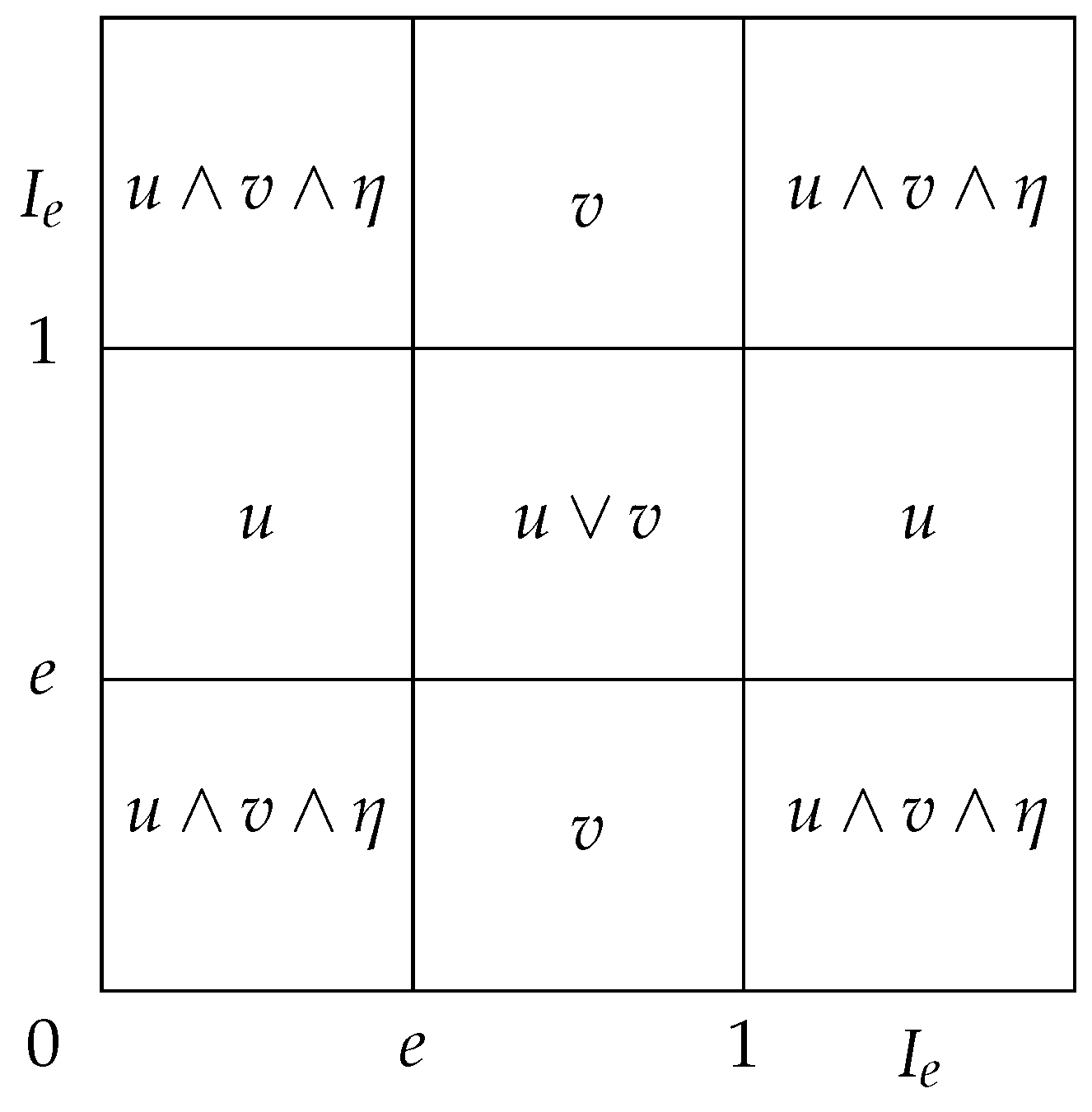
Let be a bounded lattice, and . Then the function defined by
is a uninorm on L with the neutral element e.
Proof.
(i) Monotonicity: Let us show that for every element with , for all . If u and v are both elements of or or or , is always satisfied for all since . If or , the inequality is satisfied; therefore, they are omitted. The proof is then split into all the remaining possible cases as follows.
- 1.
- Let .
- 1.1.
- ,
- 1.1.1.
- If , then
- 1.1.2.
- If , then
- 1.2.
- ,
- 1.2.1.
- If , then
- 1.2.2.
- If , then
- 1.2.3.
- If , then
- 1.3.
- ,
- 1.3.1.
- If , then
- 1.3.2.
- If , then
- 2.
- ,
- 2.1.
- ,
- 2.1.1.
- If , then
- 2.1.2.
- If , then
- 2.1.3.
- If , then
- 3.
- ,
- 3.1.
- ,
- 3.1.1.
- If , then
- 3.1.2.
- If , then
- 3.1.3.
- If , then
- (ii) Associativity: We demonstrate that for all . If , the equality is satisfied; therefore, they are omitted. Again, the proof is split into all the remaining possible cases by considering the relationships between the elements and e as follows.
- 1.
- Let .
- 1.1.
- ,
1.1.1. If , then
1.1.2. If , then
- 1.2.
- ,
1.2.1. If , then
1.2.2. If , then
- 2.
- .
- 2.1.
- ,
2.1.1. If , then
2.1.2. If , then
- 2.2.
- ,
2.2.1. If , then
2.2.2. If , then
It is easy to observe the commutativity of and the fact that e is a neutral element of .
Therefore, is a uninorm on L with the neutral element e. □
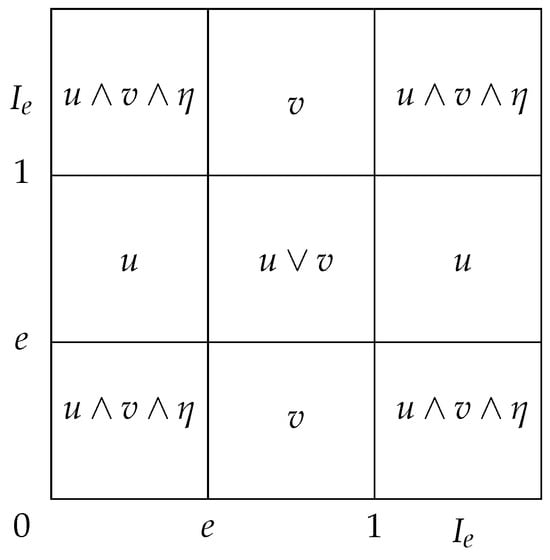
Figure 7.
The structure of the uninorm .
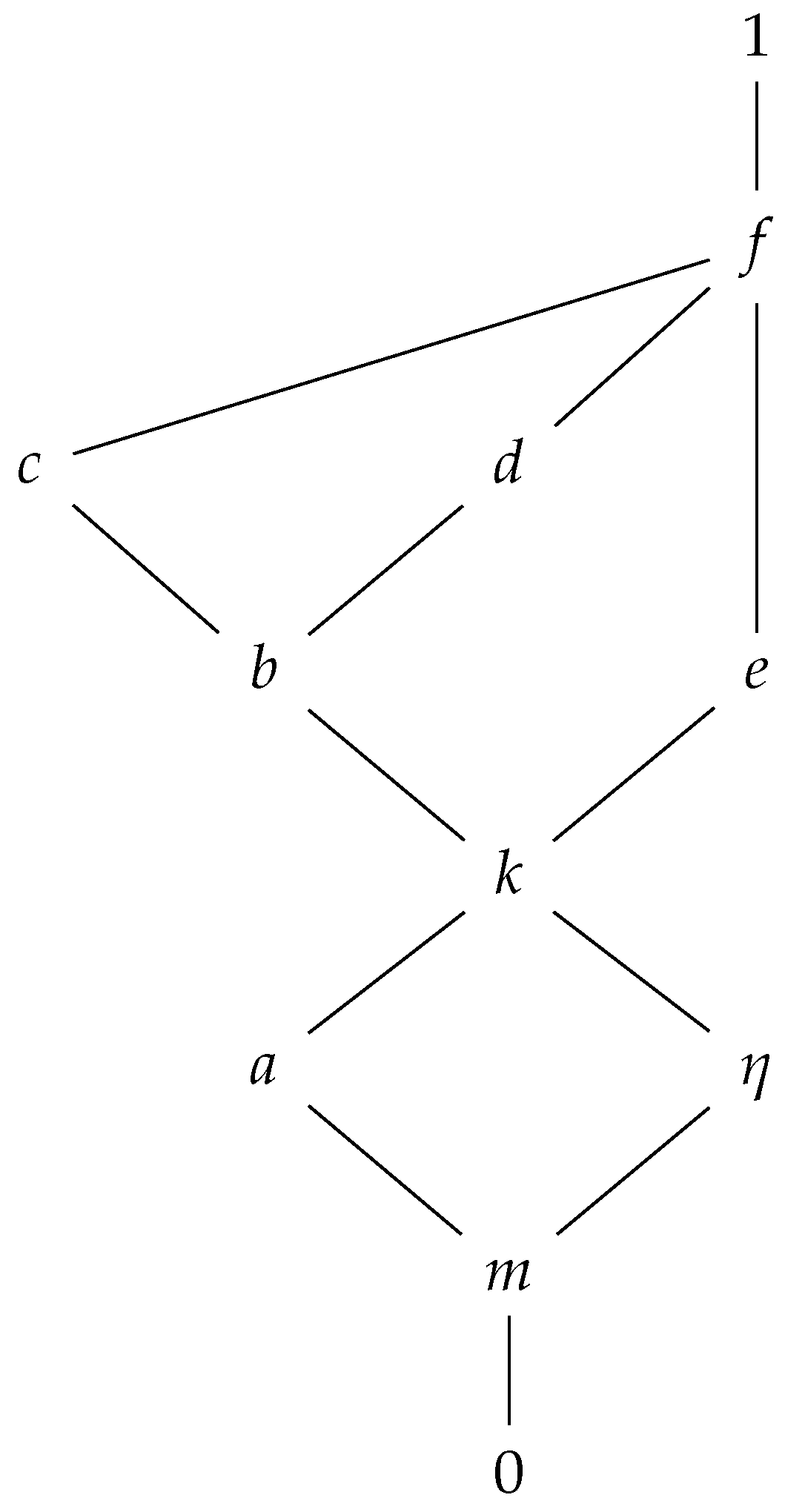
Example 4.
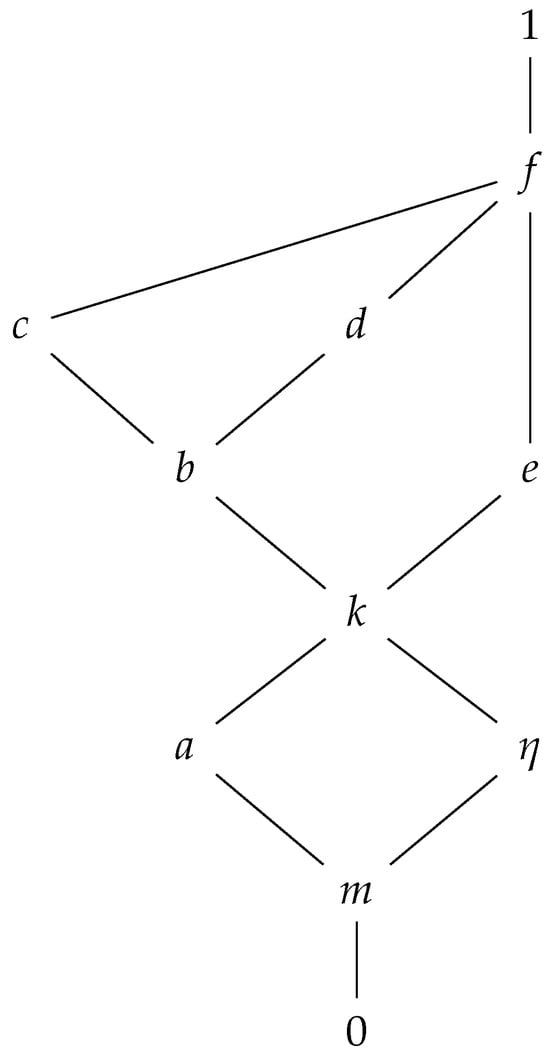
Consider the bounded lattice characterized by the Hasse diagram in Figure 8. If we apply the formula (5) in Theorem 5, the uninorm on is obtained as in Table 3.
Figure 8.
Hasse diagram of .
Table 3.
The uninorm induced by the Formula (5) in Theorem 5.
Remark 3.
In general, the construction method given by Theorem 5 produces a different uninorm from the uninorms obtained by the construction methods of uninorms in the literature. Regardless of the choice of the lattice L and the corresponding t-norms on and/or t-conorms on in [5,11,12,13,14,15,22], and since Also, considering Example 4, and since
respectively. Furthermore, one can easily check that the lattice satisfies the constraints of Theorem 3.12 in [12] and Theorem 3.8 in [14]. We obtain since regardless of the choice of the t-conorm on in [12]. In addition, since regardless of the choice of the t-norm on and the t-conorm on in [14]. Moreover, regardless of the choice of the t-norm on in [5,11,12,13,14,15,22].
Based on the duality principle, another construction method for uninorms on the bounded lattice L is introduced.
Theorem 6.
Let be a bounded lattice, and . Then the function defined by
is a uninorm on L with the neutral element e.
Proof.
The proof follows easily from Theorem 5, and therefore, it is omitted. □
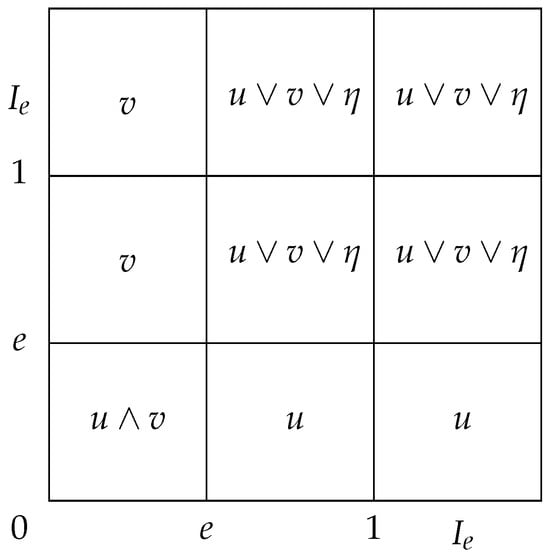
Figure 9.
The structure of the uninorm .
4. Conclusions
In this article, we have developed new methods for constructing uninorms with a neutral element e on a bounded lattice L using an arbitrary fixed that is not or 1. We thoroughly explored all possible cases of the element of the lattice L, i.e., or or . For each construction method, we established necessary and sufficient conditions to ensure the resulting operation is indeed a uninorm on L. To clarify our methods, we have provided numerous examples and compared our techniques with existing ones in the literature. Looking ahead, we will continue studying element-based construction methods for nullnorms and some other aggregation functions on bounded lattices.
Author Contributions
Conceptualization, Ü.E. and R.M.; methodology, Ü.E., M.Y. and R.M.; validation, Ü.E., M.Y. and R.M.; investigation, Ü.E., M.Y. and R.M.; writing—original draft preparation, M.Y.; writing—review and editing, Ü.E., M.Y. and R.M.; visualization, Ü.E. and R.M.; supervision, Ü.E. and R.M. All authors have read and agreed to the published version of the manuscript.
Funding
This research received no external funding.
Institutional Review Board Statement
Not applicable.
Informed Consent Statement
Not applicable.
Data Availability Statement
The authors declare the availability of the data.
Acknowledgments
This study was supported by Scientific and Technological Research Council of Turkey (TÜBİTAK) under the Grant Number 122F472. The authors thank to TÜBİTAK for their support. This study was supported by Office of Scientific Research Projects of Karadeniz Technical University. Project Number: FDK-2022-10396. The third author kindly acknowledges the support of the grant VEGA 1/0036/23.
Conflicts of Interest
The authors declare no conflicts of interest.
References
- Yager, R.R.; Rybalov, A. Uninorms aggregation operators. Fuzzy Sets Syst. 1996, 180, 111–120. [Google Scholar] [CrossRef]
- Grabisch, M.; Marichal, J.-L.; Mesiar, R.; Pap, E. Aggregation Functions; Cambridge University Press: Cambridge, UK, 2009. [Google Scholar]
- Kerre, E.E.; Nachtegael, M. Fuzzy Techniques in Image Processing; Studies in Fuzziness and Soft Computing; Physica-Verlag: Heidelberg, Germany, 2000. [Google Scholar]
- Mayor, G.; Torrens, J. On a class of operators for expert systems. Int. J. Intell. Syst. 1993, 8, 771–778. [Google Scholar] [CrossRef]
- Karaçal, F.; Mesiar, R. Uninorms on bounded lattices. Fuzzy Sets Syst. 2015, 261, 33–43. [Google Scholar] [CrossRef]
- Ertuğrul, Ü.; Kesicioğlu, M.N.; Karaçal, F. Ordering based on uninorms. Inf. Sci. 2016, 330, 315–327. [Google Scholar] [CrossRef]
- Jočić, D.; Štajner-Papuga, I. Distributivity of a uni-nullnorm with continuous and archimedean underlying t-norms and t-conorms over an arbitrary uninorm. Math. Slovaca 2023, 73, 1527–1544. [Google Scholar] [CrossRef]
- Kalina, M. On uninorms and nullnorms on direct product of bounded lattices. Open Phys. 2016, 14, 321–327. [Google Scholar] [CrossRef]
- Kesicioğlu, M.N.; Ertuğrul, Ü.; Karaçal, F. An equivalence relation based on the U-partial order. Inf. Sci. 2017, 411, 39–51. [Google Scholar] [CrossRef]
- Kesicioğlu, M.N.; Ertuğrul, Ü.; Karaçal, F. Some notes on U-partial order. Kybernetika 2019, 55, 518–530. [Google Scholar] [CrossRef]
- Çaylı, G.D.; Karaçal, F.; Mesiar, R. On a new class of uninorms on bounded lattices. Inf. Sci. 2016, 367, 221–231. [Google Scholar] [CrossRef]
- Çaylı, G.D.; Karaçal, F. Construction of uninorms on bounded lattices. Kybernetika 2017, 53, 394–417. [Google Scholar] [CrossRef][Green Version]
- Çaylı, G.D. A characterization of uninorms on bounded lattices by means of triangular norms and triangular conorms. Int. J. Gen. Syst. 2018, 47, 772–793. [Google Scholar] [CrossRef]
- Çaylı, G.D.; Mesiar, R. Methods for obtaining uninorms on some special classes of bounded lattices. Iran. J. Fuzzy Syst. 2023, 20, 111–126. [Google Scholar]
- Dan, Y.; Hu, B.Q. A new structure for uninorms on bounded lattices. Fuzzy Sets Syst. 2020, 386, 77–94. [Google Scholar] [CrossRef]
- Karaçal, F.; Ertuğrul, Ü.; Mesiar, R. Characterization of uninorms on bounded lattices. Fuzzy Sets Syst. 2017, 308, 54–71. [Google Scholar] [CrossRef]
- Yager, R.R. Uninorms in fuzzy system modeling. Fuzzy Sets Syst. 2001, 122, 165–175. [Google Scholar] [CrossRef]
- Birkhoff, G. Lattice Theory; American Mathematical Society Colloquium Publishers: Providence, RI, USA, 1968. [Google Scholar]
- Klement, E.P.; Mesiar, R.; Pap, E. Triangular Norms; Kluwer Academic Publishers: Dordrecht, The Netherlands, 2000. [Google Scholar]
- Çaylı, G.D.; Ertuğrul, Ü.; Karaçal, F. Some further construction methods for uninorms on bounded lattices. Int. J. Gen. Syst. 2023, 52, 414–442. [Google Scholar] [CrossRef]
- Ouyang, Y.; Zhang, H.P. Constructing uninorms via closure operators on a bounded lattice. Fuzzy Sets Syst. 2020, 395, 93–106. [Google Scholar] [CrossRef]
- Çaylı, G.D. New methods to construct uninorms on bounded lattices. Int. J. Approx. Reason. 2019, 115, 254–264. [Google Scholar] [CrossRef]
- Xie, A.; Li, S. On constructing the largest and smallest uninorms on bounded lattices. Fuzzy Sets Syst. 2020, 386, 95–104. [Google Scholar] [CrossRef]
- Zhang, H.P.; Wu, M.; Wang, Z.; Ouyang, Y.; De Baets, B. A characterization of the classes Umin and Umax of uninorms on a bounded lattice. Fuzzy Sets Syst. 2021, 423, 107–121. [Google Scholar] [CrossRef]
- Karaçal, F.; Şanlı, Z. Some new construction methods of t-norms and t-conorms on bounded lattices. Fuzzy Sets Syst. 2022, 451, 84–93. [Google Scholar] [CrossRef]
Disclaimer/Publisher’s Note: The statements, opinions and data contained in all publications are solely those of the individual author(s) and contributor(s) and not of MDPI and/or the editor(s). MDPI and/or the editor(s) disclaim responsibility for any injury to people or property resulting from any ideas, methods, instructions or products referred to in the content. |
© 2025 by the authors. Licensee MDPI, Basel, Switzerland. This article is an open access article distributed under the terms and conditions of the Creative Commons Attribution (CC BY) license (https://creativecommons.org/licenses/by/4.0/).