


Abstract
This manuscript associates with a study of Frobenius–Euler–Simsek-type Polynomials. In this research work, we construct a new sequence of Szász–Beta type operators via Frobenius–Euler–Simsek-type Polynomials to discuss approximation properties for the Lebesgue integrable functions, i.e., , . Furthermore, estimates in view of test functions and central moments are studied. Next, rate of convergence is discussed with the aid of the Korovkin theorem and the Voronovskaja type theorem. Moreover, direct approximation results in terms of modulus of continuity of first- and second-order, Peetre’s K-functional, Lipschitz type space, and the -order Lipschitz type maximal functions are investigated. In the subsequent section, we present weighted approximation results, and statistical approximation theorems are discussed. To demonstrate the effectiveness and applicability of the proposed operators, we present several illustrative examples and visualize the results graphically.
Keywords:
modulus of smoothness; mathematical operators; Szász operator; Frobenius–Euler–Simsek-type polynomials; approximation algorithms; order of approximation; rate of convergence MSC:
41A25; 41A30; 41A35; 41A36
1. Introduction
The systematic development of operator theory began in the late 19th century. An important aspect of approximation in operator theory is to find simple, computationally tractable approximations that capture the essential properties of more complex functions. These approximations can then be used for analysis, simulation, or computation in various applications, such as quantum mechanics, signal processing, and control theory. It provides powerful tools for solving problems and analyzing systems involving operators. In the last decade, there has been continued research and development in approximation theory in operator theory, with a focus on more advanced techniques having applications in data science and machine learning. In approximation theory, Weierstrass (1885) [1] formulated an elegant result known as the Weierstrass approximation theorem. Proving this theorem in a more straightforward and comprehensible manner has been the focus of several prominent mathematicians.
Bernstein (1912) [2] developed a sequence of polynomials called Bernstein polynomials to give a concise demonstration of Weierstrass approximation theorem using binomial distribution as:
where is a continuous and bounded function on . The operators in (1) restrict the approximation for continuous functions on bounded interval . In order to discuss approximation properties on unbounded interval , Szász [3] provided the modification to the operators in (1), which has played a significant role in the evolution of operator theory, as follows:
where real valued function . As given in (2), the linear positive operators are solely limited to continuous functional space. Many integral variants of these sequences of operators are obtained in order to approximate the longer class of functions, i.e., Lebesgue measurable functional space, Szász–Durremeyer and Szász–Kantorovich type operators, etc. ([4,5]). Many researchers, e.g., Acu et al. ([6,7]), Mohiuddine et al. ([8,9]), Mursaleen et al. ([10,11]), Khan et al. [12], Nasiruzzaman [13], and Rao et al. ([14,15,16,17]), have provided a number of generalizations for these kinds of sequences to investigate flexibility in approximation properties across several functional spaces.
In 2021, Simsek defined Frobenius–Euler–Simsek-type polynomials and numbers. He investigated the relations and identities between these special polynomials and numbers, such as Fubini polynomials and numbers and Bernoulli polynomials and numbers [18]. The Frobenius–Euler–Simsek-type polynomial has a generating function given as:
Taking p = 2, we have
For more information on Euler-type polynomials and their applications, see also [19,20].
2. Construction of Operators
By the motivation from the definition of Frobenius–Euler–Simsek-type polynomials in Equation (3) with , we present a sequence of positive and linear Szász–Beta operators to provide approximations in larger functional space, i.e., Lebesgue measurable functional space , for and as:
where , Beta function,
The operators in Equation (4) are positive and linear. Basic information about linear positive operators, along with their applications and generalizations, can be found in [21].
Lemma 1.
The sequence of operators is linear.
Proof.
Let and . Then, in view of Equation (4), we have
□
Lemma 2.
Let , be the test functions. Then, we have
Lemma 3.
In view of Equation (3), we have the following equalities:
Lemma 4.
For the generating function given in Equation (3), we have
Proof.
Employing Lemma 3 and Equation (3), for w = 1, we can easily prove the above equalities. □
Lemma 5.
Proof.
In the direction of (4), we have
Now, for j = 0, by Lemma 4,
For j = 1,
For j = 2,
Hence, we complete proof of Lemma 5. □
Lemma 6.
Proof.
With the aid of Lemma 5 and linearity property, one can easily obtain Lemma 6. □
Further, we examine the convergence rate of operators and their approximation order. Specifically, we discuss direct local and global results across several spaces. In the final section, we explore some results of A-Statistical approximation in various functional spaces.
3. Convergence Rate and Approximation Order
Definition 1
([22]). The modulus of smoothness for is given by
and
Theorem 1.
Let be operators described in Equation (4). Then, on every bounded and closed subset of , , for all , where ⇉ denotes uniform convergence.
Proof.
Considering the classical Korovkin-type theorem [23], which characterizes the sequence of positive and linear operators for uniform convergence, it is sufficient to see that
uniformly on all bounded and closed subsets of We can easily establish this result with the help of Lemma 5. □
Now, we show the Voronovskaja-type asymptotic approximation theorem for the given in (4).
Let : Denotes a real valued functional space having bounded and continuous functions and .
Theorem 2.
For and existing at a point , we get
Proof.
In accordance with Taylor’s formula for the function , we have
where is the Peano remainder and
Applying operators on both sides in (6), we yield
In view of Lemma 6,
Operating the limits on both sides of the above expression, we get
Now, we need to show that
Using Cauchy–Schwarz inequality, we calculate the last term of the above expression as:
In view of Lemma 6, , and we see that and . Thus, we have
Hence, the proof is completed. □
In accordance with Shisha et al. [24], the order of the convergence relative to the Ditzian–Totik modulus of continuity can easily be proven.
Theorem 3.
Proof.
In accordance with Lemmas 5 and 6, Equation (5), and Cauchy–Schwarz inequality, we have
By selecting , we obtained the desired result. □
Locally Approximation Results
We recall a few functional spaces and functional relations in this part, such as Peetre’s K-functional [22], defined as
where associated with the norm , and second-order Ditzian–Totik modulus of smoothness is presented by
We revisit a result from DeVore and Lorentz ([22], page no. 177, Theorem 2.4) as:
where C is an absolute constant. To establish the next result, we consider the auxiliary operator defined as:
where , , and . From Equation (10), one can yield
Lemma 7.
If and , we have
where and .
Proof.
For and by Taylor expansion, we get
Implementing the auxiliary operators introduced in Equation (10) to both sides of Equation (12), we obtain
Since,
then
Theorem 4.
For , there exists non-negative constant with
where is given by Lemma 7.
Proof.
For and and with the definition of given in (10), we get
In accordance with Lemma 7 and the inequalities mentioned in Equation (11), we acquire
By employing Equation (9), we established the desired result. □
Now, we address the result in Lipschitz-type space presented by [25] as:
where , and .
Theorem 5.
Proof.
For and , we get
Since , for each , we acquire
which indicates that Theorem 5 is valid for . Next, we examine the case where , and in accordance with Hölder’s inequality, by selecting and , we obtain
Since , for all , one gets
Thus, we conclude the desired result. □
Next, we address the local approximation in terms of the rth-order modulus of smoothness, followed by the Lipschitz-type maximal function introduced by Lenze [25] as:
Theorem 6.
Assume and . Then, for every , we get
Proof.
It can be observed that
By Equation (17), one gets
Then, by employing Hölder’s inequality with and , we obtain
Thus, we conclude the proof. □
4. Results of Global Approximation
Consider as the weight function. Then, , where the constant depends on and represents the continuous functional space in along with the norm and where constant depends on .
If is a function on closed interval where , then the Ditzian–Totik modulus of continuity is given as
It is straightforward to observe that, for any , the modulus of smoothness defined in Equation (18) tends to zero.
Theorem 7.
Let and denotes the modulus of smoothness defined on . Then, for any , we obtain
where .
Proof.
For any and , one has
Implementing operator on both sides, we acquire
Now, in accordance with Lemma 6 and , one has
Selecting , the desired result can be easily obtained. □
Remark 1.
We employ the test function defined by , .
Theorem 8
([21,26]). Assume that the sequence of linear positive operators mapping from to meets the conditions
thus, for we get
Theorem 9.
Let . Then, we obtain
Proof.
First verify that
Considering Lemma 5, one can see that , where and ; also
For a large value of , one gets .
Also,
which implies that as . Thus, we conclude the proof of Theorem 9 □
Theorem 10.
Let and . Then,
Proof.
Since , for any real fixed number , we get
Now,
In view of Lemma 5, it gives
For any arbitrary , there exists with
Therefore
Hence, we get
If we take to be so large that , then we have
Now, from Theorem 7, there corresponds with
5. Properties of A-Statistical Approximation
We revisit some notations from [27]. Suppose that is an infinite, non-negative suitability matrix. Sequence is A-statistically convergent to L, denoted as , if for each
Let be a sequence such that the following assertions are true:
Theorem 11.
Consider to be a non-negative regular suitability matrix. Let sequence satisfy the condition (23), , . Then, for every , .
Proof.
In accordance with Lemma 5, one has . and
Now,
Here, ; this shows that . Therefore, we get
Now, by using Lemma 5, we have
For a given , one has
It can be observed that . Therefore, we acquire
As , we have
Thus, we conclude the proof of Theorem 11. □
Next, we will examine the convergence rate of A-Statistical approximation with respect to Peetre’s K-functional for the operators .
Theorem 12.
Let . Then,
Proof.
Considering Taylor’s result, one has
where . Operating , on both sides, we acquire
which yields
From (26), one gets
Thus, as
Hence, we acquire the desired proof. □
Theorem 13.
Let . Then,
where , and
6. Numerical Observations
To confirm the theoretical approximation outcomes, numerical experiments are conducted. This section includes a series of simulations showcasing the proposed operators’ precision and effectiveness. We analyze their behavior across multiple benchmark functions and draw comparisons. The experimental data validate the theoretical developments and demonstrate the practical strength of the suggested method. In the graphical representation, we consider .
Example 1.
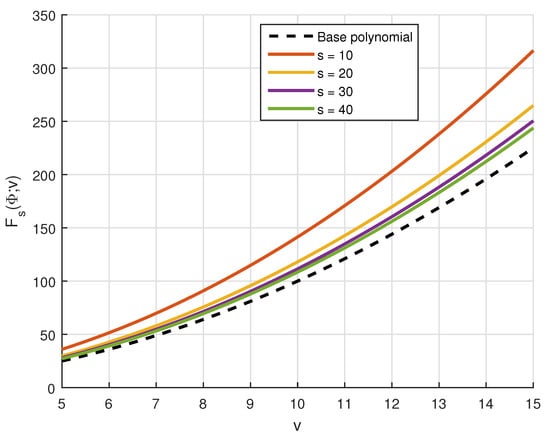
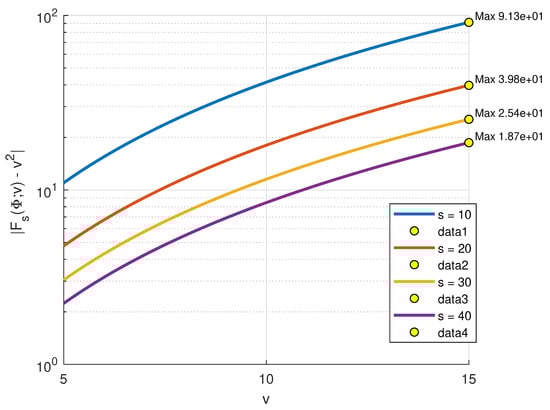

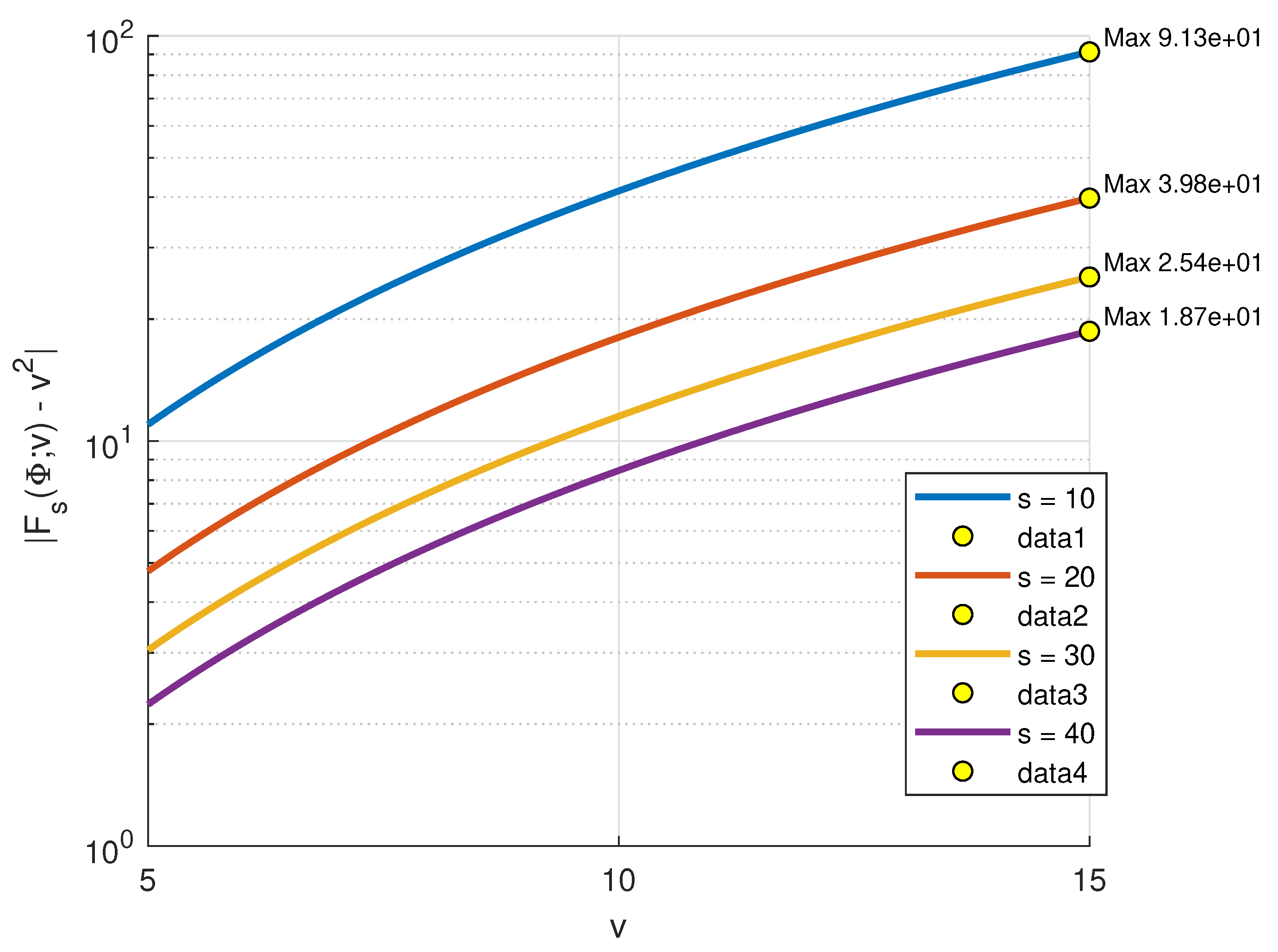
Consider the function . Using MATLAB R2015a on a standard HP laptop equipped with an Intel Core i7 processor and 8 GB of RAM, we compute the operator for values of v ranging from 5 to 15, and for distinct values of the parameter s, namely . In Figure 1, we present the approximation behavior of the operator for the function , which demonstrates how the operator acts on this specific test function. Additionally, we calculated the absolute error between the exact function and its approximation using the same parameters, , and the results are depicted in Figure 2 and also provided in Table 1 for the same. This helps illustrate the convergence behavior and accuracy of the operator with respect to the increase in parameter s.
Figure 1.
Plot for and at .
Figure 2.
Absolute errors: .
Table 1.
Absolute errors for distinct s.
Example 2.
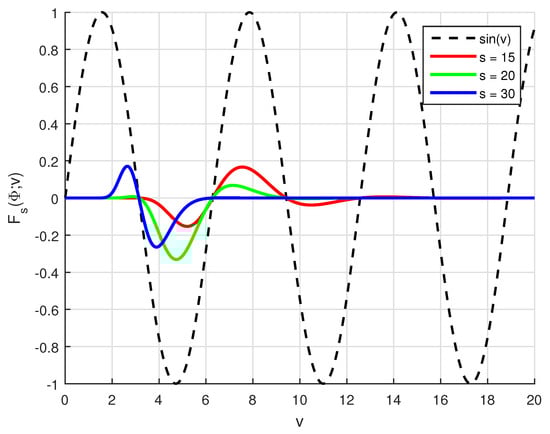
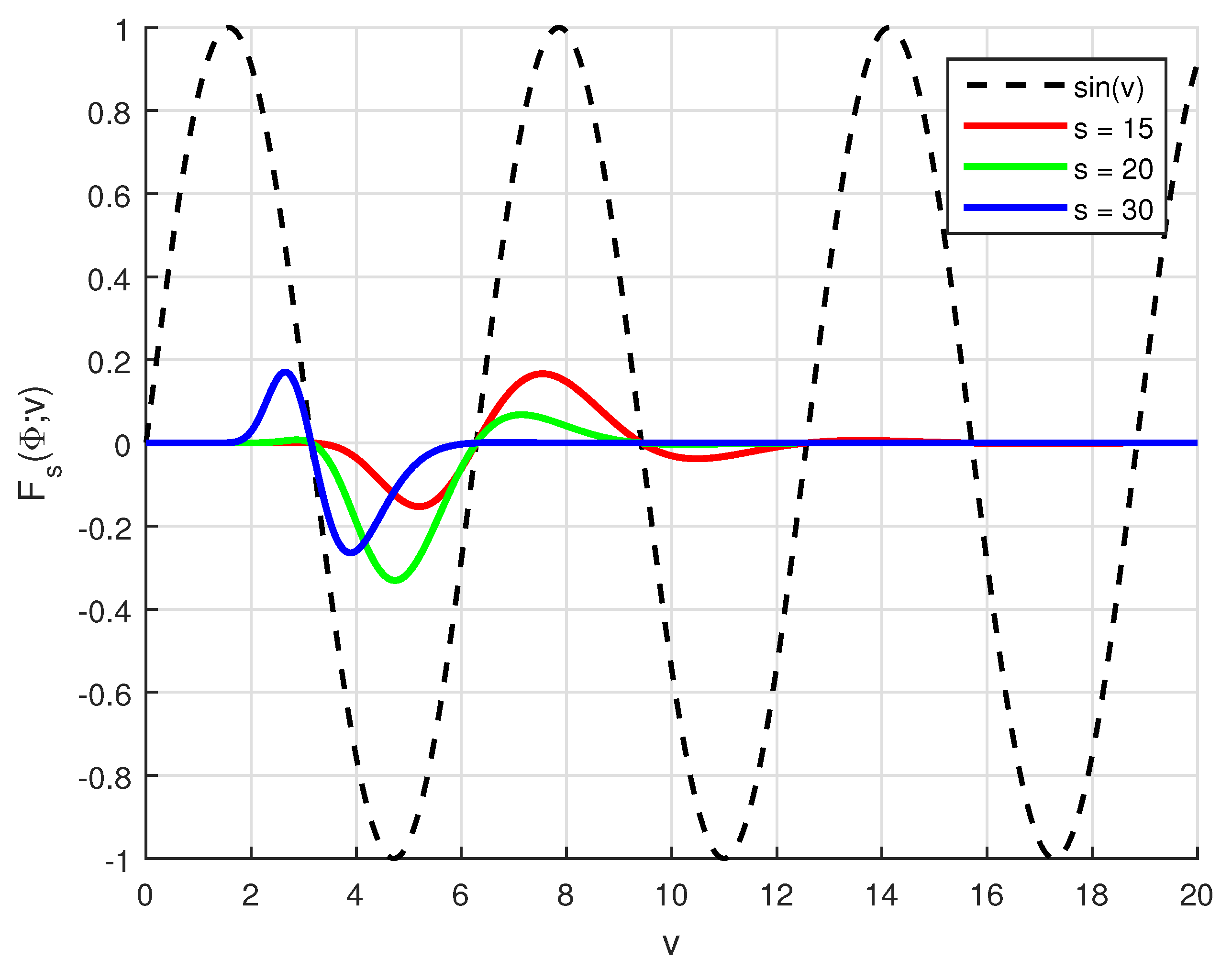
Consider the function . Using MATLAB R2015a on a standard HP laptop equipped with an Intel Core i7 processor and 8 GB of RAM, we compute the operator for values of v ranging from 0 to 20, and for distinct values of the parameter s, namely . In Figure 3, we present the approximation behavior of the operator for the function , which demonstrates how the operator acts on this specific test function. This helps illustrate the convergence behavior and accuracy of the operator with respect to the increase in parameter s.
Figure 3.
Plot for and at .
7. Conclusions
In this paper, we introduce a sequence of positive linear operators formulated using Frobenius–Euler–Şimşek-type polynomials in integral form. These operators, referred to as Szász–Beta type operators and defined in (4), are constructed to approximate functions defined on Lebesgue measurable spaces. We establish essential estimates to analyze the rate of convergence and the accuracy of approximation. Furthermore, we investigate various aspects of approximation theory, including both local and global results, as well as A-statistical convergence properties. To demonstrate the effectiveness and applicability of the proposed operators, we present several illustrative examples and visualize the results graphically. These examples highlight the practical behavior and confirm the validity of our theoretical findings across different functional settings.
Author Contributions
Conceptualization, N.R.; Software, M.F.; Writing—original draft, N.R. and S.B.; Writing—review & editing, M.F. and S.B. All authors have read and agreed to the published version of the manuscript.
Funding
The APC was funded by the Deanship of Graduate Studies and Scientific Research at Qassim University for financial support (QU-APC-2025).
Data Availability Statement
No new data were created or analyzed in this study. Data sharing is not applicable to this article.
Acknowledgments
The Researchers would like to thank the Deanship of Graduate Studies and Scientific Research at Qassim University for financial support (QU-APC-2025).
Conflicts of Interest
The authors declare no conflicts of interest.
References
- Weierstrass, K. Über die Analytische Darstellbarkeit Sogenannter Willkürlicher Functionen einer Reellen Veränderlichen; Sitzungsberichte der Königlich Preußischen Akademie der Wissenschaften zu Berlin: Berlin, Germany, 1885; Volume 2, pp. 633–639. [Google Scholar]
- Bernstein, S.N. Démonstration du théorème de Weierstrass fondée sur le calcul de probabilités. Commun. Kharkov Math. Soc. 1912, 13, 1–2. [Google Scholar]
- Szász, O. Generalization of Bernstein’s polynomials to the infinite interval. J. Res. Nat. Bur. Stds. 1950, 45, 239–245. [Google Scholar] [CrossRef]
- Özger, F. Weighted statistical approximation properties of univariate and bivariate λ-Kantorovich operators. Filomat 2019, 33, 3473–3486. [Google Scholar] [CrossRef]
- Aslan, R. Approximation by Szász Mirakjan Durrneyer operators based on shape parameter λ. Commun. Fac. Sci. Univ. Ank. Ser. A1 Math. Stat. 2022, 71, 407–421. [Google Scholar] [CrossRef]
- Acu, A.M.; Gonska, H.; Raşa, I. Grüss-type and Ostrowski-type inequalities in approximation theory. Ukr. Math. J. 2011, 63, 843–864. [Google Scholar] [CrossRef]
- Acu, A.M.; Acar, T.; Radu, V.A. Approximation by modified operators. Rev. R. Acad. Ciene. Exactas Fis. Nat. Ser. A Math. RACSAM 2019, 113, 2715–2729. [Google Scholar] [CrossRef]
- Mohiuddine, S.A.; Acar, T.; Alotaibi, A. Construction of a new family of Bernstein-Kantorovich operators. Math. Methods Appl. Sci. 2017, 40, 7749–7759. [Google Scholar] [CrossRef]
- Mohiuddine, S.A.; Ahmad, N.; Özger, F.; Alotaibi, A.; Hazarika, B. Approximation by the parametric generalization of Baskakov–Kantorovich operators linking with Stancu operators. Iran. J. Sci. Technol. Trans. 2021, 45, 593–605. [Google Scholar] [CrossRef]
- Mursaleen, M.; Ansari, K.J.; Khan, A. Approximation properties and error estimation of q-Bernstein shifted operators. Numer. Algorithms 2020, 84, 207–227. [Google Scholar] [CrossRef]
- Mursaleen, M.; Naaz, A.; Khan, A. Improved approximation and error estimations by King type (p, q)-Szász-Mirakjan Kantorovich operators. Appl. Math. Comput. 2019, 348, 2175–2185. [Google Scholar] [CrossRef]
- Khan, A.; Mansoori, M.; Khan, K.; Mursaleen, M. Phillips-type q-Bernstein operators on triangles. J. Funct. Spaces 2021, 2021, 6637893. [Google Scholar] [CrossRef]
- Nasiruzzaman, M. Approximation properties by Szász–Mirakjan operators to bivariate functions via Dunkl analogue. Iran. J. Sci. Technol. Trans. 2021, 45, 259–269. [Google Scholar] [CrossRef]
- Rao, N.; Farid, M.; Ali, R. Study of Szász–Durremeyer-Type Operators Involving Adjoint Bernoulli Polynomials. Mathematics 2024, 12, 3645. [Google Scholar] [CrossRef]
- Rao, N.; Farid, M.; Raiz, M. Symmetric Properties of λ-Szász Operators Coupled with Generalized Beta Functions and Approximation Theory. Symmetry 2024, 16, 1703. [Google Scholar] [CrossRef]
- Rao, N.; Farid, M.; Raiz, M. Approximation Results: Szász– Kantorovich Operators Enhanced by Frobenius–Euler–Type Polynomials. Axioms 2025, 14, 252. [Google Scholar] [CrossRef]
- Rao, N.; Farid, M.; Raiz, M. On the Approximations and Symmetric Properties of Frobenius–Euler–Şimşek Polynomials Connecting Szász Operators. Symmetry 2025, 17, 648. [Google Scholar] [CrossRef]
- Simsek, Y. Applications of constructed new families of generating-type functions interpolating new and known classes of polynomials and numbers. Math. Methods Appl. Sci. 2021, 44, 11245–11268. [Google Scholar] [CrossRef]
- Simsek, Y. On generating functions for the special polynomials. Filomat 2017, 31, 9–16. [Google Scholar] [CrossRef]
- Simsek, Y. Construction of some new families of Apostol-type numbers and polynomials via Dirichlet character and p-adic q-integrals. Turk. J. Math. 2018, 42, 557–577. [Google Scholar] [CrossRef]
- Gadjiev, A.D. The convergence problem for a sequence of positive linear operators on bounded sets and theorems analogous to that of P. P. Korovkin. Dokl. Akad. Nauk SSSR 1974, 218, 1001–1004. [Google Scholar]
- DeVore, R.A.; Lorentz, G.G. Constructive Approximation; Grudlehren der Mathematischen Wissenschaften Fundamental Principales of Mathematical Sciences; Springer: Berlin, Germany, 1993. [Google Scholar]
- Korovkin, P.P. On convergence of linear positive operators in the space of continuous functions. Dokl. Akad. Nauk. SSSR 1953, 90, 961–964. [Google Scholar]
- Shisha, O.; Mond, B. The degree of convergence of linear positive operators. Proc. Nat. Acad. Sci. USA 1968, 60, 1196–1200. [Google Scholar] [CrossRef] [PubMed]
- Lenze, B. On Lipschitz type maximal functions and their smoothness spaces. Nederl Akad Indag Math. 1988, 50, 53–63. [Google Scholar] [CrossRef]
- Gadjiev, A.D. On P. P. Korovkin type theorems. Mat. Zametki 1976, 20, 781–786, reprinted in Transl. in Math. Notes 1978, 5–6, 995–998. [Google Scholar]
- Gadjiev, A.D.; Orhan, C. Some approximation theorems via statistical convergence. Rocky Mt. J. Math. 2007, 32, 129–138. [Google Scholar] [CrossRef]
Disclaimer/Publisher’s Note: The statements, opinions and data contained in all publications are solely those of the individual author(s) and contributor(s) and not of MDPI and/or the editor(s). MDPI and/or the editor(s) disclaim responsibility for any injury to people or property resulting from any ideas, methods, instructions or products referred to in the content. |
© 2025 by the authors. Licensee MDPI, Basel, Switzerland. This article is an open access article distributed under the terms and conditions of the Creative Commons Attribution (CC BY) license (https://creativecommons.org/licenses/by/4.0/).