


Abstract
In this study, we introduce a new hybrid identity that effectively combines Newton–Cotes and Gauss quadrature, allowing us to recover well-known formulas such as Simpson’s second rule and the left- and right-Radau two-point rules, among others. Building upon this flexible framework, we establish several new biparametrized fractal integral inequalities for functions whose local fractional derivatives are of a generalized convex type. In addition to employing tools from local fractional calculus, our approach utilizes the Hölder inequality, the power mean inequality, and a refined version of the latter. Further results are also derived using the concept of generalized concavity. To support our theoretical findings, we provide a graphical example that illustrates the validity of the obtained results, along with some practical applications that demonstrate their effectiveness.
Keywords:
Newton–Cotes inequalities; generalized convex functions; Gauss–Radau formula; local fractional integrals MSC:
26D10; 26D15; 26A51
1. Introduction
A function is recognized as convex on the interval I if for any in I and t in , the following condition holds [1]:
The significance of convexity becomes even more pronounced when considering integral inequalities, a fundamental area of study in mathematical analysis. Integral inequalities serve as powerful tools for estimating and bounding the values of integrals, playing a pivotal role in the study of differential equations and the stability of solutions. For some papers dealing with inequalities via convexity, we refer the readers to [2,3,4].
The authors in [4] introduced the subsequent -Simpson-type inequality for convex first-order derivatives:
In [5], Laribi et al. offered an enhancement of the previously mentioned outcome for the same class of functions in the following manner:
In [6], Meftah et al. derived the following two-point left-Radau-type inequality for differentiable convex functions:
In the same context, Rebiai et al. [7] provided the two-point right-Radau-type inequality for differentiable convex functions in the following manner:
For more results on Radau-type inequalities, we refer the readers to [8,9].
The enigmatic world of fractal sets, characterized by their self-similar structures and intricate geometries, continues to fascinate and challenge researchers. These sets, which defy traditional Euclidean geometry, necessitate the use of advanced mathematical tools for their analysis and comprehension. Among these tools, local fractional calculus stands out as a cornerstone for investigating fractal sets. This calculus extends the concept of classical differentiation and integration to non-integer orders, allowing for a more nuanced exploration of the irregular and fragmented dimensions intrinsic to fractal structures [10,11,12].
Local fractional calculus not only provides a deeper understanding of fractal sets but also bridges the gap between classical mathematical concepts and the complex nature of fractals. It is within this framework that the notion of convexity gains new dimensions. Traditionally, convexity has been a central concept in mathematical analysis and optimization, offering a structured and robust approach to understanding the behavior of functions and sets. In the realm of fractal sets, convexity interacts uniquely with the fractional dimensions, leading to novel insights and results; see [13,14].
In [15], Mo et al. expanded the concept of convexity to the framework of fractal sets in the following manner.
A function is recognized as generalized convex on I if for any and , the following inequality holds:
After introducing such a concept, numerous researchers devoted their efforts to investigating local fractional integrals and establishing error bounds for various quadrature rules. In [16], Khan et al. established generalized trapezium-type inequalities using generalized convexity. Saleh et al. provided a companion of Ostrowski’s inequality for the same class of functions in [17]. Sarikaya et al. presented Simpson-type inequalities in [18].
In [19], Luo and coauthors derived Fejér–Hermite–Hadamard-type inequalities involving generalized h-convexity, while Sun established Ostrowski’s inequality for the same class of functions in [20]. Du et al. provided certain integral inequalities considering generalized m-convexity on fractal sets in [21] and Hermite–Hadamard- and Pachpatte-type inequalities for generalized subadditive functions in the fractal sense in [22]. Zhang and coauthors explored properties and weighted parametric inequalities via generalized -preinvex mappings in [23]. Yu et al. proposed Bullen-type inequalities as well as certain error bounds for parameterized integral inequalities in [24,25], respectively. In [26], Sun obtained Hermite–Hadamard-type local fractional integral inequalities with a Mittag–Leffler kernel for generalized preinvex functions. In [27], Razzaq et al. established Hermite–Hadamard inequalities for generalized -convex functions, while Napoles Valdes investigated Milne’s inequality via generalized modified -convex functions in [28]. For further studies via different types of generalized convexity, we refer the reader to [29,30,31,32].
Beyond the aforementioned works, further interesting parametric studies were carried out by Du and Yan, and Xu et al. in [33,34], respectively. More importantly, Li et al. conducted a multiparameter analysis leading to a wide range of results based on generalized -convexity in [35], while Xu et al. also performed a multiparametrized investigation of local fractional integral inequalities via generalized -convexity in [36]. For additional studies in this direction, we refer the reader to [37,38,39,40].
In Ref. [41], the authors established the following Simpson second formula inequality related to local fractional integrals:
where is a generalized convex function.
In [42], Bin-Mohsin et al. provided an extension of the two-point left-Radau inequality to fractal sets in the following manner:
where is a generalized convex function.
In this study, we delve into the intersection of these profound concepts. By introducing a novel hybrid identity that amalgamates the strengths of Newton–Cotes and Gauss quadrature, we recover renowned formulas and extend our understanding to encompass the left- and right-Radau two-point rules, among others. Our exploration of biparametrized fractal integral inequalities for functions with generalized convex local fractional derivatives paves the way for innovative theoretical developments and practical applications, demonstrating the immense potential and versatility of our results.
2. Preliminaries
In this section, we offer the fundamental definitions, propositions, and lemmas essential for grasping the concept of local calculus as introduced by Yang [13,43]. For , let denote the -type fractal set of real line numbers.
If and belong to , then the following properties are true:
- •
- and belong to .
- •
- .
- •
- .
- •
- .
- •
- .
- •
- .
- •
- and .
Definition 1
([43]). A function is local fractional continuous at if
holds for , where . We denote the set of all local fractional continuous functions on by .
Definition 2
([43]). The local fractional derivative of of order γ at is defined as
where .
If there exists for any , then we say that , where
Definition 3
([43]). Let . Then, the local fractional integral is defined by
with and , where , and is a partition of interval .
Here, it follows that if and if . If for any there exists , then we denote .
Lemma 1
([43]).
- 1.
- (Local fractional integration is anti-differentiation) Suppose that . Then, we have
- 2.
- (Local fractional integration by parts) Suppose that and .Then, we have
Lemma 2
([43]). For , we have the following identities:
Lemma 3
(Generalized Hölder’s inequality [44]). Let and , where with are both integrable under the frame of the fractal spaces. Then, we have
Lemma 4
(Generalized power mean inequality [44]). Let and , , where is integrable under the frame of the fractal spaces. Then, we have
Lemma 5
(Improved generalized power mean inequality [45]). Let and , where is integrable under the frame of the fractal spaces. Then, we have
3. Main Results
In this section, we will present some results that we will use later.
Lemma 6.
Let be a local fractional differentiable on , with , and . Then, for all real numbers and with , the following equality holds:
where
Proof.
Let
where
and
Using Lemma 1, gives
Similarly, we obtain
and
Theorem 1.
Proof.
From Lemma 6 and the properties of the modulus, we have
Using the generalized convexity of , we obtain
where we used
and
Thus, the proof is complete. □
Corollary 1.
In Theorem 1, using the generalized convexity of , we obtain
Remark 1.
- 1.
- If we attempt to take , Theorem 1 will be reduced to Theorem 2 from [42].
- 2.
- If we attempt to take , Corollary 1 will be reduced to Corollary 2 from [42].
Corollary 2.
In Theorem 1, taking , we obtain the right-Radau-type inequality
Corollary 3.
In Corollary 2, if , we obtain
Corollary 4.
In Theorem 1, taking , we obtain Simpson’s second formula inequality:
Corollary 5.
In Corollary 4, if , we obtain
which is the same result given in Corollary 2.1 from [5].
Corollary 6.
In Corollary 1, taking , we obtain the right-Radau-type inequality
Corollary 7.
In Corollary 1, taking , we obtain Simpson’s second formula:
Corollary 8.
In Corollary 7, if , we obtain
which is the same result given in Remark 3 from [4].
Theorem 2.
Assume that all the assumptions of Theorem 1 are satisfied. If is generalized convex, then we have
where Υ is defined by (12) and with .
Proof.
From Lemma 6 and the properties of the modulus among with a generalized Hölder inequality, we have
Using the generalized convexity of , we obtain
where we have used
and
The proof is complete. □
Corollary 9.
In Theorem 2, using the generalized convexity of , we obtain
Corollary 10.
In Theorem 2, taking , we obtain the left-Radau-type inequality
Corollary 11.
In Theorem 2, taking , we obtain the right-Radau-type inequality
Corollary 12.
In Theorem 2, taking , we obtain Simpson’s second formula inequality:
Corollary 13.
In Corollary 12, if , we obtain
which is the same result given in Corollary 3.5 from [2].
Corollary 14.
In Corollary 9, taking , we obtain the left-Radau-type inequality
Corollary 15.
In Corollary 9, taking , we obtain the right-Radau-type inequality
Corollary 16.
In Corollary 9, taking , we obtain Simpson’s second formula inequality:
Theorem 3.
Proof.
From Lemma 6 and the properties of the modulus with a generalized power mean inequality, we have
This completes the proof. □
Corollary 17.
In Theorem 3, using the generalized convexity of , we obtain
Corollary 18.
In Theorem 3, taking , we obtain the left-Radau type-inequality
Corollary 19.
In Theorem 3, taking , we obtain the right-Radau-type inequality
Corollary 20.
In Theorem 3, taking , we obtain Simpson’s second formula inequality:
Corollary 21.
In Corollary 20, if , we obtain
Corollary 22.
In Corollary 17, taking , we obtain the left-Radau-type inequality
Corollary 23.
In Corollary 17, taking , we obtain the right-Radau-type inequality
Corollary 24.
In Corollary 17, taking , we obtain Simpson’s second formula inequality:
Theorem 4.
Proof.
From Lemma 6, the properties of the modulus, and improved generalized power mean inequality, along with the generalized convexity of , we have
where we have used
and
The proof is complete. □
Corollary 25.
In Theorem 4, using the generalized convexity of , we obtain
Theorem 5.
Assume that all the assumptions of Theorem 1 are satisfied. If is generalized concave, then we have
where Υ is defined by (12) and with .
Proof.
Corollary 26.
In Theorem 5, taking , we obtain the left-Radau-type inequality
Corollary 27.
In Theorem 5, taking , we obtain the right-Radau-type inequality
Corollary 28.
In Theorem 5, taking , we obtain Simpson’s second formula inequality:
4. Numerical Example and Graphical Illustration
In this section, we present a numerical example accompanied by a graphical representation to demonstrate the accuracy and validity of the theoretical results obtained.
Example 1.
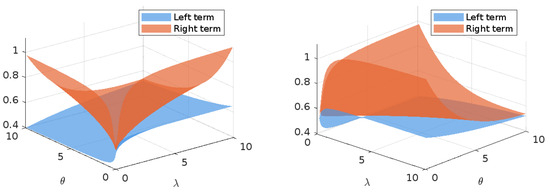
Consider the function defined by
which has the local fractional derivative
By selecting , , and , it becomes evident that the function exhibits convexity over the specified interval, thereby fulfilling the fundamental assumption required by our results.
From Theorem 1, we obtain
where for are given by
and
The left and right terms of inequality (30) are represented in two different views by Figure 1 for .
Figure 1.
Graphical illustration of Theorem 1.
As shown in Figure 1, the numerical results support the theoretical statement of Theorem 1, confirming its validity.
5. Applications
5.1. Quadrature Formula
Let be the partition of the points of the interval , and consider the quadrature formula
where
and denotes the associated approximation error.
Proposition 1.
Let and be a local fractional differentiable on with and . If is genaralized convex, we have
Proof.
Applying Corollary 6 on the subintervals of the partition , we obtain
By multiplying both sides of the above inequalities by , we obtain
Finally, by summing the above inequalities over all and applying the triangle inequality, we obtain the desired result. □
5.2. Special Means
For arbitrary real numbers , we have the following:
The generalized arithmetic mean: .
The generalized p-logarithmic mean: , , and .
Proposition 2.
Let with and . Then, we have
Proof.
This follows from Theorem 1 with and , applied to the function , where . □
6. Conclusions
In this study, we delved into the intersection of profound mathematical concepts. Through the introduction of a novel hybrid identity that combines the strengths of Newton–Cotes and Gauss quadrature, we not only rediscovered well-known formulas but also extended our understanding to include the left- and right-Radau two-point rules, among others. Our exploration of biparametrized fractal integral inequalities for functions with generalized convex local fractional derivatives opens the door to innovative theoretical advancements and practical applications. These findings demonstrate the immense potential and versatility of our results, paving the way for further exploration in this exciting field.
Author Contributions
Conceptualization, B.M., M.U.A. and A.L.; methodology, W.S.; software, A.L.; validation, B.M., M.U.A. and L.C.; formal analysis, W.S. and L.C.; investigation, W.S., L.C. and A.L.; resources, M.U.A.; data curation, W.S.; writing—original draft preparation, B.M., M.U.A. and A.L.; writing—review and editing, B.M., W.S., M.U.A., L.C. and A.L.; visualization, A.L.; supervision, B.M. and M.U.A.; project administration, L.C.; funding acquisition, L.C. All authors have read and agreed to the published version of the manuscript.
Funding
This research received no external funding.
Data Availability Statement
The original contributions presented in this study are included in the article. Further inquiries can be directed to the corresponding author.
Conflicts of Interest
The authors declare no conflicts of interest.
References
- Pečarić, J.E.; Proschan, F.; Tong, Y.L. Convex functions, partial orderings, and statistical applications. In Mathematics in Science and Engineering; Academic Press, Inc.: Boston, MA, USA, 1992; Volume 187. [Google Scholar]
- Noor, M.A.; Noor, K.I.; Iftikhar, S. Newton inequalities for p-harmonic convex functions. Honam Math. J. 2018, 40, 239–250. [Google Scholar]
- Ögülmü, H.; Sarikaya, M.Z. Some Hermite-Hadamard type inequalities for h-convex functions and their applications. Iran. J. Sci. Technol. Trans. A Sci. 2020, 44, 813–819. [Google Scholar] [CrossRef]
- Sitthiwirattham, T.; Nonlaopon, K.; Ali, M.A.; Budak, H. Riemann-Liouville fractional Newton’s type inequalities for differentiable convex functions. Fractal Fract. 2022, 6, 175. [Google Scholar] [CrossRef]
- Laribi, N.; Meftah, B. 3/8-Simpson type inequalities for differentiable s-convex functions. Jordan J. Math. Stat. 2023, 16, 79–98. [Google Scholar]
- Meftah, B.; Lakhdari, A.; Saleh, W. 2-point left Radau-type inequalities via s-convexity. J. Appl. Anal. 2023, 29, 341–346. [Google Scholar] [CrossRef]
- Rebiai, G.; Meftah, B. 2-point right Radau inequalities for differentiable s-convex functions. J. Interdiscip. Math. 2024, 27, 1243–1255. [Google Scholar] [CrossRef]
- Berkane, A.; Meftah, B.; Lakhdari, A. Right-Radau-type inequalities for multiplicative differentiable s-convex functions. J. Appl. Math. Inform. 2024, 42, 785–800. [Google Scholar]
- Liu, X.L.; Xu, H.Y.; Shokri, A.; Lakhdari, A.; Meftah, B. Some Error Bounds for 2-Point Right Radau Formula in the Setting of Fractional Calculus via s-Convexity. J. Math. 2024, 2024, 6709056. [Google Scholar] [CrossRef]
- Falconer, K. Fractal Geometry: Mathematical Foundations and Applications; John Wiley & Sons: Hoboken, NJ, USA, 2004. [Google Scholar]
- Mandelbrot, B.B. The Fractal Geometry of Nature; WH Freeman: New York, NY, USA, 1982; Volume 1. [Google Scholar]
- Shang, J.; Wang, Y.; Chen, M.; Dai, J.; Zhou, X.; Kuttner, J.; Hilt, G.; Shao, X.; Gottfried, J.; Wu, K. Assembling molecular Sierpiński triangle fractals. Nat. Chem. 2015, 7, 389–393. [Google Scholar] [CrossRef]
- Yang, Y.J.; Baleanu, D.; Yang, X.J. Analysis of fractal wave equations by local fractional Fourier series method. Adv. Math. Phys. 2013, 2013, 632309. [Google Scholar] [CrossRef]
- Gao, F.; Zhong, W.P.; Shen, X.M. Applications of Yang-Fourier transform to local fractional equations with local fractional derivative and local fractional integral. Adv. Mater. Res. 2012, 461, 306–310. [Google Scholar]
- Mo, H.; Sui, X.; Yu, D. Generalized convex functions on fractal sets and two related inequalities. Abst. Appl. Anal. 2014, 2014, 636751. [Google Scholar] [CrossRef]
- Khan, Z.A.; Rashid, S.; Ashraf, R.; Baleanu, D.; Chu, Y.M. Generalized trapezium-type inequalities in the settings of fractal sets for functions having generalized convexity property. Adv. Differ. Equ. 2020, 2020, 657. [Google Scholar] [CrossRef]
- Saleh, W.; Meftah, B.; Lakhdari, A.; Kiliçman, A. Exploring the Companion of Ostrowski’s Inequalities via Local Fractional Integrals. Eur. J. Pure Appl. Math. 2023, 16, 1359–1380. [Google Scholar] [CrossRef]
- Sarıkaya, M.Z.; Budak, H.; Erden, S. On new inequalities of Simpson’s type for generalized convex functions. Korean J. Math. 2019, 27, 279–295. [Google Scholar]
- Luo, C.; Wang, H.; Du, T. Fejér-Hermite-Hadamard type inequalities involving generalized h-convexity on fractal sets and their applications. Chaos Solitons Fractals 2020, 131, 109547. [Google Scholar] [CrossRef]
- Sun, W. Local fractional Ostrowski-type inequalities involving generalized h-convex functions and some applications for generalized moments. Fractals 2021, 29, 2150006. [Google Scholar] [CrossRef]
- Du, T.; Wang, H.; Khan, M.A.; Zhang, Y. Certain integral inequalities considering generalized m-convexity on fractal sets and their applications. Fractals 2019, 27, 1950117. [Google Scholar] [CrossRef]
- Du, T.; Xu, L. Hermite-Hadamard-and Pachpatte-type integral inequalities for generalized subadditive functions in the fractal sense. Miskolc Math. Notes 2024, 25, 645–658. [Google Scholar] [CrossRef]
- Zhang, X.; Zhou, Y.; Du, T. Properties and 2α-fractal weighted parametric inequalities for the fractal (m,h)-preinvex mappings. Fractals 2023, 31, 2350134. [Google Scholar] [CrossRef]
- Yu, Y.; Du, T. Certain error bounds on the Bullen type integral inequalities in the framework of fractal spaces. J. Nonlinear Funct. Anal. 2022, 2022, 24. [Google Scholar]
- Yu, Y.; Liu, J.; Du, T. Certain error bounds on the parameterized integral inequalities in the sense of fractal sets. Chaos Solitons Fractals 2022, 161, 112328. [Google Scholar] [CrossRef]
- Sun, W. Hermite-Hadamard type local fractional integral inequalities with Mittag-Leffler kernel for generalized preinvex functions. Fractals 2021, 29, 2150253. [Google Scholar] [CrossRef]
- Razzaq, A.; Javed, I.; González, F.M. Hermite-Hadamard inequalities for generalized (m-F)-convex function in the framework of local fractional integrals. Ann. Univ. Craiova–Math. Comput. Sci. Ser. 2024, 51, 198–222. [Google Scholar] [CrossRef]
- Napoles Valdes, J.E.; Guzmán, P.M.; Bayraktar, B. Milne-type integral inequalities for modified (h,m)-convex functions on fractal sets. Probl. Anal. Issues Anal. 2024, 13, 106–127. [Google Scholar] [CrossRef]
- Zhang, Y.; Sun, W. On general local fractional integral inequalities for generalized h-preinvex functions on Yang’s fractal sets. Fractals 2024, 32, 2440025. [Google Scholar] [CrossRef]
- Ge-JiLe, H.; Rashid, S.; Farooq, F.B.; Sultana, S. Some inequalities for a new class of convex functions with applications via local fractional integral. J. Funct. Spaces 2021, 2021, 6663971. [Google Scholar] [CrossRef]
- Sun, W. Some new inequalities for generalized h-convex functions involving local fractional integral operators with Mittag-Leffler kernel. Math. Methods Appl. Sci. 2021, 44, 4985–4998. [Google Scholar] [CrossRef]
- Sun, W. Some Hermite–Hadamard type inequalities for generalized h-preinvex function via local fractional integrals and their applications. Adv. Differ. Equ. 2020, 2020, 426. [Google Scholar] [CrossRef]
- Du, T.; Yuan, X. On the parameterized fractal integral inequalities and related applications. Chaos Solitons Fractals 2023, 170, 113375. [Google Scholar] [CrossRef]
- Xu, H.; Lakhdari, A.; Saleh, W.; Meftah, B. Some new parametrized inequalities on fractal set. Fractals 2024, 32, 2450063. [Google Scholar] [CrossRef]
- Li, H.; Lakhdari, A.; Jarad, F.; Xu, H.; Meftah, B. An expanded analysis of local fractional integral inequalities via generalized (s,P)-convexity. J. Inequal. Appl. 2024, 2024, 78. [Google Scholar] [CrossRef]
- Xu, H.; Lakhdari, A.; Jarad, F.; Abdeljawad, T.; Meftah, B. On multiparametrized integral inequalities via generalized α-convexity on fractal set. Math. Methods Appl. Sci. 2025, 48, 980–1002. [Google Scholar] [CrossRef]
- Abdeljawad, T.; Rashid, S.; Hammouch, Z.; Chu, Y.M. Some new local fractional inequalities associated with generalized (s,m)-convex functions and applications. Adv. Differ. Equ. 2020, 2020, 406. [Google Scholar] [CrossRef]
- Butt, S.I.; Khan, D.; Seol, Y. Fractal perspective of superquadratic functions with generalized probability estimations. PLoS One 2025, 20, e0313361. [Google Scholar] [CrossRef]
- Butt, S.; Inam, H.; Dokuyucu, M. New fractal Simpson estimates for twice local differentiable generalized convex mappings. Appl. Comput. Math. 2024, 23, 474–503. [Google Scholar]
- Butt, S.I.; Agarwal, P.; Yousaf, S.; Guirao, J.L. Generalized fractal Jensen and Jensen-Mercer inequalities for harmonic convex function with applications. J. Inequal. Appl. 2022, 2022, 1. [Google Scholar] [CrossRef]
- Iftikhar, S.; Kumam, P.; Erden, S. Newton’s-type integral inequalities via local fractional integrals. Fractals 2020, 28, 2050037. [Google Scholar] [CrossRef]
- Bin-Mohsin, B.; Lakhdari, A.; Karabadji, N.; Awan, M.U.; Ben Makhlouf, A.; Meftah, B.; Dragomir, S.S. An Extension of Left Radau Type Inequalities to Fractal Spaces and Applications. Axioms 2024, 13, 653. [Google Scholar] [CrossRef]
- Yang, X.J. Advanced Local Fractional Calculus and Its Applications; World Science Publisher: New York, NY, USA, 2012. [Google Scholar]
- Chen, G.-S. Generalizations of Hölder’s and some related integral inequalities on fractal space. J. Funct. Spaces Appl. 2013, 2013, 198405. [Google Scholar] [CrossRef]
- Yu, S.; Mohammed, P.O.; Xu, L.; Du, T. An improvement of the power-mean integral inequality in the frame of fractal space and certain related midpoint-type integral inequalities. Fractals 2022, 30, 2250085. [Google Scholar] [CrossRef]
Disclaimer/Publisher’s Note: The statements, opinions and data contained in all publications are solely those of the individual author(s) and contributor(s) and not of MDPI and/or the editor(s). MDPI and/or the editor(s) disclaim responsibility for any injury to people or property resulting from any ideas, methods, instructions or products referred to in the content. |
© 2025 by the authors. Licensee MDPI, Basel, Switzerland. This article is an open access article distributed under the terms and conditions of the Creative Commons Attribution (CC BY) license (https://creativecommons.org/licenses/by/4.0/).