


Abstract
In this paper, a structure-preserving local discontinuous Galerkin (LDG) method is proposed for parabolic stochastic partial differential equations with periodic boundary conditions and multiplicative noise. It is proven that under certain conditions, this numerical method is stable in the sense and can preserve energy conservation. The optimal spatial error estimate in the mean square sense can reach if the degree of the polynomial is n. The correctness of the theoretical results is verified through numerical examples.
Keywords:
parabolic stochastic partial differential equations; LDG method; structure-preserving; stability; optimal error estimate MSC:
65M12; 65M60
1. Introduction
Partial differential equations (PDEs) have a wide range of applications in many fields, from physics and engineering to biology and finance. These equations play a fundamental role in the modeling of complex phenomena [1,2]. However, in nature, many phenomena are affected by stochastic factors. Stochastic differential equations can better describe these random factors in natural processes. Due to the complexity of many real-world problems, it is often difficult, even near impossible, to obtain analytical solutions to partial differential equations. Therefore, numerical methods for partial differential equations have received great attention from scholars [3,4,5,6,7,8,9,10,11,12]. Parabolic equations are widely used to describe diffusion processes, heat conduction phenomena, and problems such as option pricing in financial mathematics. Classical parabolic equations are typically employed to describe diffusion behaviors in deterministic systems, while stochastic parabolic equations, by introducing stochastic terms, can more accurately model complex systems in the real world that are subject to noise interference. With the development of stochastic analysis theory and numerical methods, significant progress has been made in the study of stochastic parabolic equations. Numerical methods for solving stochastic partial differential equations mainly include finite difference methods, finite element methods, discontinuous Galerkin (DG) methods, and so on [13,14,15,16,17].
The DG method, because of its flexibility and high accuracy, exhibits significant advantages when dealing with high-order derivatives and complex boundary conditions. The LDG method overcomes the limitations of traditional DG methods in handling high-order derivatives by introducing auxiliary variables to transform high-order equations into first-order systems. Yan and Shu [18] used the LDG method to propose appropriate numerical fluxes for general KdV-type equations with third-order derivatives, time-dependent biharmonic equations with fourth-order derivatives, and partial differential equations with fifth-order derivatives, which proves stability for most nonlinear problems. Chen [19] proposed the symplectic LDG method for stochastic linear Schrödinger equations with multiplicative noise and concluded that the mean-square error is bounded by the time and space step sizes and their ratios. Li [20] developed an LDG method for solving backward stochastic partial differential equations, proving the stability of the numerical scheme, obtaining optimal error estimates on Cartesian meshes, and deriving suboptimal error estimates on triangular meshes. Li [21] introduced the LDG method for solving multidimensional nonlinear second-order partial differential equations and applied the proposed method to stochastic optimal control problems. Wang [22] proposed two fully discrete IMEX-LDG schemes by combining the LDG spatial discretization with the implicit–explicit Runge–Kutta temporal discretization and performed stability and error analysis for the linearized KdV equation.
From the above literature, it is evident that the LDG method, due to its stability and high accuracy, demonstrates significant advantages in handling high-order equations. Although the LDG method has been successfully applied to various deterministic problems, its application to stochastic equations remains limited. Therefore, this paper discusses the LDG method for stochastic linear parabolic equations and explores whether the numerical solutions obtained by this method can preserve the long-term behavior of the original systems.
Zhang [23] provided sufficient conditions for stochastic multi-symplectic conservation of stochastic Runge–Kutta methods for stochastic Hamiltonian partial differential equations. Zhou [24] proposed a second-order fractional difference-based Crank–Nicholson discretization to ensure the conservation of the energy-preserving or energy-dissipating properties in stochastic space-fractional nonlinear wave equations under appropriate conditions. Hou [25] derived an energy-preserving semidiscretization scheme that preserves symplectic structures to solve stochastic Maxwell equations and proposed two fully discrete symplectic-preserving, multi-symplectic-preserving and energy-preserving methods. Bai [26] presented a high-order mass-conserving and energy-conserving method for solving nonlinear Schrödinger equations, proving the existence, uniqueness, and high-order convergence of numerical solutions.
In this paper, the following parabolic stochastic partial differential equations (SPDEs) driven by multiplicative noise with a periodic boundary condition are considered
where and . , b, c, , and are constants. is a standard one-dimensional Brownian motion, which is a real-valued continuous adapted process on a complete probability space . Some of the properties of Brownian motion and stochastic integral are summarized below [27]:
- (1)
- For , the increment is normally distributed with mean zero and variance .
- (2)
- is a continuous square-integrable martingale and its quadratic variation for all .
- (3)
- Let , the family of -valued -adapted processes such that and mathematical expectation , then is -measurable and .
In this paper a structure-preserving LDG method is proposed for parabolic SPDEs (1). The rest of this paper is organized as follows. In Section 2, we introduce some preliminary knowledge, notations, and definitions. The numerical scheme of the LDG methods is presented in Section 3. The stability and energy preservation properties of the LDG method is analyzed in Section 4. The optimal error estimation of the proposed method is considered in Section 5. In Section 6, numerical experiments are conducted to validate the theoretical results.
2. Preliminaries
In this section, some preliminary knowledge used in the article is introduced, including notations, definitions, and some lemmas.
Denote the regular spatial mesh by , with the center of the cell denoted by . Here, and , , with denoting the mesh size.
Through out this paper, the Sobolev space with periodic boundary conditions is considered
We denote space with norm as , Sobolev space with norm as , specially, norm as .
The following lemma is the multidimensional Itô formula for continuous and square integrable martingales.
Lemma 1
([28]). Suppose are continuous, square integrable martingales. Let be a continuous function with continuous partial derivatives , and for . Then, we know
where is the cross variation process.
By the Itô formula, for continuous semi-martingales X and Y, we have
For any locally bounded adapted process H, we have
Moreover, there is a well-known lemma in the martingale theory.
Lemma 2
([29]). If , then is a martingale.
In order to simplify the symbols, throughout this article we give all constants into different positive constants C. We then introduce the Gronwall’s inequality, which is widely used in the theory of differential equations.
Lemma 3
([27]). Let and . Let be a Borel measurable bounded non-negative function on , and let be a nonnegative integrable function on . If for , then for .
Finally, the stability in the mean square sense of Equation (1) is introduced as follows.
Theorem 1.
Let . If , then there exists a constant , such that the solution to (1) satisfies
Proof.
Multiplying both sides of the first equation in (1) by , and integrating by parts on I with respect to x, we get
Thus, we know
Applying the properties of Brownian motion, the periodic boundary conditions and , we have
Then, by the Gronwall’s inequality, we have
□
Remark 1.
Particularly, when and , then we have
Under the conditions and , the solution to Equation (1) is conservation of energy in the mean square sense.
3. The Construction of the LDG Method
The LDG method can be considered as a particular variant of the DG method, the basic of the LDG method is to rewrite the original equations into an equivalent system containing only first-order spatial derivatives by introducing new variables. Then, the standard DG method is used to discretize the obtained equivalent system by selecting the appropriate numerical fluxes. Now, we introduce the construction of the LDG methods for solving parabolic SPDEs (1).
Firstly, by introducing variable , (1) is rewritten into a first-order system
Multiplying both sides of the first two equations in (10) by smooth functions and , respectively, and integrating by parts on , we get
Then, denoting as an approximation to the exact solution , we seek in the space of polynomials of the degree up to k in each cell
To this end, in (11), by replacing with and the smooth functions and with test functions and in , we obtain the following weak formulation
A key point for the success of the LDG method is the correct design of interface numerical fluxes, which guarantees stability and the local solvability of the auxiliary variables. It is also important for proving the optimal error estimates to correctly select the numerical fluxes so as to locally eliminate them in adjacent or neighboring regions. Here, we select the alternating flux
where , for .
By taking into account the periodicity of the discontinuous function and selecting suitable numerical fluxes, we are able to deduce the relationship among the coefficients:
We select for , then,
Define the mass matrix satisfying
where is invertible and represents the inverse matrix of , then we have
By constantly substituting variables, we obtain the matrix-valued stochastic differential equation
where A and B are square matrices of dimensions.
4. Stability and Conservation Property
In this section, under the assumption that the solution to Equation (1) is sufficiently smooth and has the properties of an integrable strong solution, we conduct an investigation into the stability and the associated energy preservation properties of the LDG method.
Theorem 2.
Let . If , then there exists a constant , such that the numerical solution obtained through (13) satisfies
Proof.
Setting the test function , we can obtain that
Multiply the last equations in (15) by and add them to the first equation. By integrating these equations with the chosen numerical fluxes, we obtain the following results,
Defining a piecewise smoothing function for and ,
Therefore, we can get
Summing j from 1 to N, we have
By the Itô formula, we have
By taking the integral from 0 to l with respect to x in the above equation, and then taking mathematical expectation, we obtain that
Applying the properties of Brownian motion, we have
Applying the periodic boundary conditions, we have
Then, we have
Since , there exists
With Gronwall’s inequality, we can obtain
□
5. Error Estimation Analysis
In this section, we consider the optimal error estimation of the LDG method for solving Equation (1) with strong solutions. First, we introduce the standard -projection P and the local Gauss–Radau projections R and L in space , which satisfy
Here, we have
where C is a positive constant independent of u and h.
Then, denote
and we have the following spatial error estimation.
Theorem 3.
Suppose , and Equation (1) has a unique strong solution with . Then, there exists a constant with respect to T, such that
Proof.
The weak formulation form is
where are the test functions. We choose , with the numerical fluxes of (14). We can obtain
For piecewise-smooth functions on , defining
then we have the error equation
By the Itô formula, we have
Taking the integral from 0 to l and taking expectation, we obtain
Then, we have
where
The terms are estimated as follows.
- The estimate of .
We can verify that for piecewise-smooth functions on , by periodic boundary conditions, the following equation holds
So, we can get
Considering that and according to the definition of the local Gauss-Radau projections R and L, we can obtain that
According to the properties of local Gauss–Radau projections, it can be derived that
so
On this basis, we obtain
- The estimate of .
Based on the properties of Brownian motion, we know
- The estimate of .
- The estimate of .where max .
- The estimate of .
- The estimate of .
For , we have the basic inequality . So we can get
Since , taking , we have
Therefore, we know
By the fundamental lemma of the calculus of variations, we can obtain
Applying the Gronwall’s inequality, it yields
where C is a positive constant. Then, we have
Since , it gives
Then, it holds that
In the same way, for we have
Thus, we obtain
So, it is not hard to get
□
6. Numerical Experiments
This section presents numerical examples illustrating the method’s effectiveness. We choose the implicit midpoint method for discrete time.
Let and be the temporal and spatial step sizes, respectively. and . The total error comprises spatial error on the right side of the equation and temporal error on the left
Initially, we specify the number of sample paths for Brownian motion as and the mean square error formulas as
We choose the Gaussian Legendre basis functions of .
6.1. Example 1
Select the coefficients in (1) as , , , , and , such that the conditions and are satisfied. The initial value is defined as . The lengths of the temporal and spatial intervals are selected as and . The temporal and spatial step size are chosen as , , and .
Figure 1a displays the simulation of the phase diagram of the solution with a Brownian motion sample trajectory. Figure 1b shows the simulation of average sample energy error. We can see that the average energy is preserved over long time and the phase diagram is correctly simulated. For comparison, we present the phase diagram and average energy error of the Galerkin spectral element method for solving (1) in Figure 2.
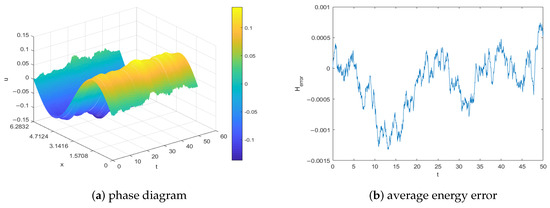
Figure 1.
Phase diagram and conservative property of the LDG method for Example 1.
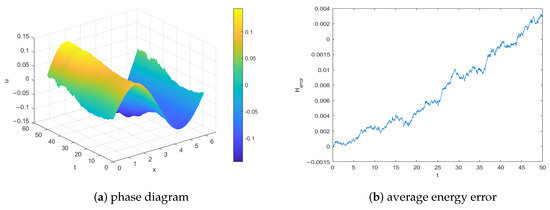
Figure 2.
Phase diagram and conservative properties of the Galerkin spectral element method for Example 1.
Secondly, the spatial error of the LDG method is estimated as the mean-square sample error over 1000 different discretized sample paths, being displayed in a log–log plot in Figure 3 and in Table 1. For each numerical sample path, the LDG method is applied with four different spatial step sizes: , , , and . The reference solution is taken as the numerical solution with and . In this example, as we can see in Figure 3 and Table 1, the LDG method presents a spatial convergence rate of order 3.
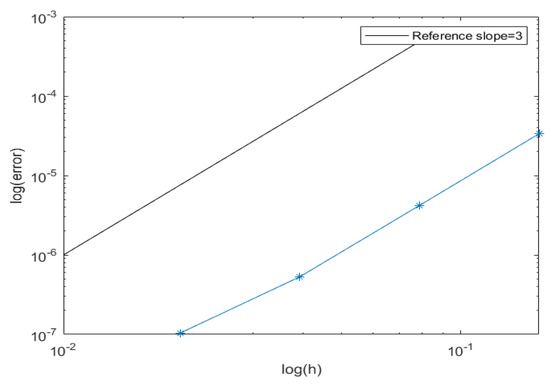
Figure 3.
Spatial convergence order curve of the LDG method for Example 1.

Table 1.
Spatial errors and convergence order of the LDG method for Example 1.
6.2. Example 2
This example is to illustrate the influence of noise intensity on the LDG method. We respectively select the the coefficients in (1) with larger and smaller noise, under which conditions and still hold. The other parameters are selected as in Example 1. Figure 4a,b displays the phase diagram and average sample energy error of the LDG method for (1) with larger noise intensity and , while Figure 4c,d shows the behaviors of the LDG method for (1) with smaller noise intensity and .
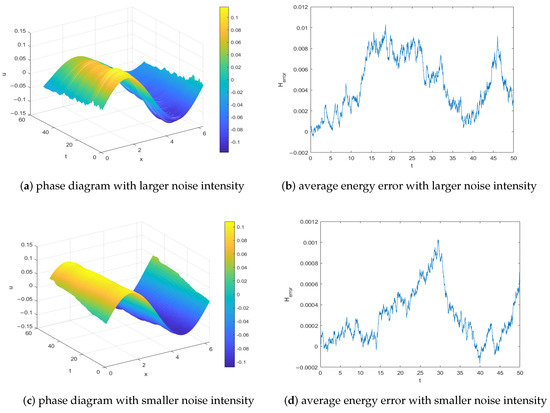
Figure 4.
Phase diagrams and conservative properties of the LDG method for Example 2.
6.3. Example 3
Set the coefficients in (1) as , , , , and . The other parameters are selected as in Example 1. In this case, and . We can see from the simulation of energy in Figure 5 that after a certain amount of time, the average energy tends to approach 0.
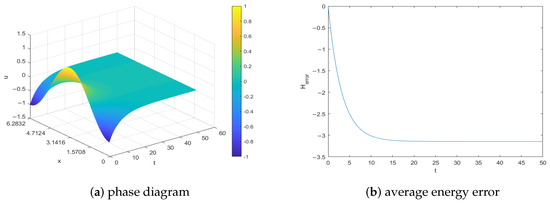
Figure 5.
Phase diagram and conservative properties of the LDG method for Example 3.
7. Conclusions
In this paper, we propose a structure-preserving LDG method for parabolic stochastic partial differential equations. We show that under certain conditions, the numerical method is stable and can also maintain energy conservation. At the same time, we also prove that the method can achieve an accuracy of in space and verify the correctness of the theoretical results through several numerical examples.
Author Contributions
Conceptualization, Z.W. and X.D.; methodology, Z.W. and M.H.; validation, Z.W.; formal analysis, M.H.; writing—original draft preparation, M.H.; writing—review and editing, Z.W.; supervision, X.D. All authors have read and agreed to the published version of the manuscript.
Funding
This research was funded by the Natural Science Foundation of Shandong Province of China (No. ZR2022QA051) and the National Natural Science Foundation of China (No. 12401519).
Data Availability Statement
No new data were created or analyzed in this study. Data sharing is not applicable to this article.
Acknowledgments
We would like to express our heartfelt gratitude to all the reviewers for their constructive advice that stimulated improvement in the presentation of this paper.
Conflicts of Interest
The authors declare no conflicts of interest.
References
- Liu, T. Porosity reconstruction based on Biot elastic model of porous media by homotopy perturbation method. Chaos Solitons Fractals 2022, 158, 112007. [Google Scholar] [CrossRef]
- Liu, T.; Li, T.; Ullah, M.Z. On five-point equidistant stencils based on Gaussian function with application in numerical multi-dimensional option pricing. Comput. Math. Appl. 2024, 176, 11. [Google Scholar] [CrossRef]
- Khattab, A.G.; Semary, M.S.; Hammad, D.A.; Fathy, A. Exploring stochastic heat equations: A numerical analysis with fast discrete Fourier transform techniques. Axioms 2024, 13, 886. [Google Scholar] [CrossRef]
- Fareed, A.F.; Semary, M.S. Stochastic improved Simpson for solving nonlinear fractional-order systems using product integration rules. Nonlinear Eng. 2025, 14, 20240070. [Google Scholar] [CrossRef]
- Fareed, A.F.; Semary, M.S.; Hassan, H.N. Two semi-analytical approaches to approximate the solution of stochastic ordinary differential equations with two enormous engineering applications. Alex. Eng. J. 2022, 61, 11935–11945. [Google Scholar] [CrossRef]
- Arif, M.S.; Abodayeh, K.; Nawaz, Y. A reliable computational scheme for stochastic reaction–diffusion nonlinear chemical model. Axioms 2023, 12, 460. [Google Scholar] [CrossRef]
- Arif, M.S.; Abodayeh, K.; Nawaz, Y. A computational scheme for stochastic non-Newtonian mixed convection nanofluid flow over oscillatory sheet. Energies 2023, 16, 2298. [Google Scholar] [CrossRef]
- Nawaz, Y.; Arif, M.S.; Nazeer, A.; Abbasi, J.N.; Abodayeh, K. A two-stage reliable computational scheme for stochastic unsteady mixed convection flow of Casson nanofluid. Int. J. Numer. Methods Fluids 2024, 96, 719–737. [Google Scholar] [CrossRef]
- Babaei, A.; Banihashemi, S.; Moghaddam, B.P.; Dabiri, A.; Galhano, A. Efficient solutions for stochastic fractional differential equations with a neutral delay using Jacobi poly-fractonomials. Mathematics 2024, 12, 3273. [Google Scholar] [CrossRef]
- Aryani, E.; Babaei, A.; Valinejad, A. A numerical technique for solving nonlinear fractional stochastic integro-differential equations with n-dimensional Wiener process. Comput. Methods Differ. Equ. 2022, 10, 61–76. [Google Scholar]
- Liu, T.; Ding, B.; Saray, B.N.; Juraev, D.A.; Elsayed, E.E. On the pseudospectral method for solving the fractional Klein–Gordon equation using Legendre cardinal functions. Fractal Fract. 2025, 9, 177. [Google Scholar] [CrossRef]
- Liu, T. Parameter estimation with the multigrid-homotopy method for a nonlinear diffusion equation. J. Comput. Appl. Math. 2022, 413, 114393. [Google Scholar] [CrossRef]
- Liu, Z.; Qiao, Z. Strong approximation of monotone stochastic partial differential equations driven by white noise. IMA J. Numer. Anal. 2020, 40, 1074–1093. [Google Scholar] [CrossRef]
- Mukam, J.D. Some Numerical Techniques for Approximating Semilinear Parabolic (Stochastic) Partial Differential Equations; Technische Universität Chemnitz: Chemnitz, Germany, 2021. [Google Scholar]
- Cui, J.; Hong, J. Strong and weak convergence rates of a spatial approximation for stochastic partial differential equation with one-sided Lipschitz coefficient. SIAM J. Numer. Anal. 2019, 57, 1815–1841. [Google Scholar] [CrossRef]
- Jin, B.; Yan, Y.; Zhou, Z. Numerical approximation of stochastic time-fractional diffusion. ESAIM Math. Model. Numer. Anal. 2019, 53, 1245–1268. [Google Scholar] [CrossRef]
- Peng, G.; Gao, Z.; Feng, X. A stabilized extremum-preserving scheme for nonlinear parabolic equation on polygonal meshes. Int. J. Numer. Methods Fluids 2019, 90, 340–356. [Google Scholar] [CrossRef]
- Yan, J.; Shu, C.W. Local discontinuous Galerkin methods for partial differential equations with higher order derivatives. J. Sci. Comput. 2002, 17, 27–47. [Google Scholar] [CrossRef]
- Chen, C.; Hong, J.; Ji, L. Mean-square convergence of a symplectic local discontinuous Galerkin method applied to stochastic linear Schrödinger equation. IMA J. Numer. Anal. 2017, 37, 1041–1065. [Google Scholar] [CrossRef]
- Li, Y. A high-order numerical method for BSPDEs with applications to mathematical finance. SIAM J. Financ. Math. 2022, 13, 147–178. [Google Scholar] [CrossRef]
- Li, Y. A high-order numerical scheme for stochastic optimal control problem. J. Comput. Appl. Math. 2023, 427, 115158. [Google Scholar] [CrossRef]
- Wang, H.; Tao, Q.; Shu, C.W.; Zhang, Q. Analysis of local discontinuous Galerkin methods with implicit-explicit time marching for linearized KdV equations. SIAM J. Numer. Anal. 2024, 62, 2222–2248. [Google Scholar] [CrossRef]
- Zhang, L.; Ji, L. Stochastic multi-symplectic Runge–Kutta methods for stochastic Hamiltonian PDEs. Appl. Numer. Math. 2019, 135, 396–406. [Google Scholar] [CrossRef]
- Zhou, Y.; Wang, Q.; Zhang, Z. Physical properties preserving numerical simulation of stochastic fractional nonlinear wave equation. Commun. Nonlinear Sci. Numer. Simul. 2021, 99, 105832. [Google Scholar] [CrossRef]
- Hou, B. Meshless structure-preserving GRBF collocation methods for stochastic Maxwell equations with multiplicative noise. Appl. Numer. Math. 2023, 192, 337–355. [Google Scholar] [CrossRef]
- Bai, G.; Hu, J.; Li, B. High-Order mass-and energy-conserving methods for the nonlinear Schrödinger equation. SIAM J. Sci. Comput. 2024, 46, A1026–A1046. [Google Scholar] [CrossRef]
- Mao, X. Stochastic Differential Equations and Their Applications; Harwood: Chichester, UK, 1997. [Google Scholar] [CrossRef]
- Kuo, H.H. Introduction to Stochastic Integration; Springer: New York, NY, USA, 2006. [Google Scholar] [CrossRef]
- He, S.W.; Wang, J.G.; Yan, J.A. Semimartingale Theory and Stochastic Calculus; Routledge: London, UK, 1992; p. 400. [Google Scholar]
Disclaimer/Publisher’s Note: The statements, opinions and data contained in all publications are solely those of the individual author(s) and contributor(s) and not of MDPI and/or the editor(s). MDPI and/or the editor(s) disclaim responsibility for any injury to people or property resulting from any ideas, methods, instructions or products referred to in the content. |
© 2025 by the authors. Licensee MDPI, Basel, Switzerland. This article is an open access article distributed under the terms and conditions of the Creative Commons Attribution (CC BY) license (https://creativecommons.org/licenses/by/4.0/).