


Abstract
Layered algebras are introduced and used to express layered graphs. Layered graphs are considered to be a highly effective abstract tool to manage the difficulty in conceptualizing and reasoning regarding complex systems related to coding in email exchange and access control in security. In the present paper, we study the varieties of several classes of lattice-based layer algebras and show that all these varieties have decidable equational theory via a finite model property.
Keywords:
layered algebras; layered graph; residuated groupoid; residuated lattice; equational theory; variety; finite model property; decidability MSC:
03G10; 06B20; 06B25; 06D30; 06D75
1. Introduction
A binary operation · on an algebra with a carrier preordered set is said to be residuated if there exist binary operations ∖ and / on A such that for any
One refers to ∖ and / by the right and the left residual of ·, respectively.
A residuated Boolean algebra (r-algebra) is an algebraic structure such that is a Boolean algebra and · is a binary operation on A, where ∖ and / are its right and left residuals, respectively. The R-algebras were first introduced by Jósson and Tsinakis [1] as generalizations for relation algebras due to A.Tarski.
The algebraic structures studied under the name of layered algebras by Collinson et al. [2] are the same as those discussed here. The non-commutative and non-associative operation · in groupoids is used to capture the feature of layering in layered graphs. Let be directed graphs. The composition of graphs is defined if , , and , where is the set of all vectors of graph () and means that is reachable from . A graph G is said to be layered if there exist such that () is a subgraph of G and . The Boolean component and residuated duals of · are used to express properties in the layered graphs.
In the literature [2,3,4], the layered graph is considered to be a highly effective abstract tool to manage the difficulty in conceptualizing and reasoning about complex systems, including transport systems, IP stacks, email exchange, and access control in security. In order to describe the subgraph relation in directed graphs, Heyting variants of layered algebras were developed by Docherty and Pym in [4]. A Heyting layered algebra is a combination of a Heyting algebra and a residuated groupoid.
Boolean and Heyting layered algebras are both residuated lattice-ordered groupoids (s). This class of algebras was introduced and developed as mathematical tools of categorical grammars for natural language processing; see [5]. A residauted lattice () with a carrier preordered set is an in which · admits the associative property, i.e., , for any . The algebras corresponding to logics for querying graphs [6] and bigraphs [7] are residuated lattices. Further, many structures that are well studied already, such as generalized Boolean algebras, Brouwerian algebras, relative Stone algebras, and ‘l-groups, are residuated lattices. The class of all residuated lattices will be denoted by . Obviously, the residuated property can be captured by equations. Thus, and are a finitely based variety.
For any algebraic structure with domain A, an assignment in A is a function :. Every assignment in A can be extended homomorphically to the term algebra. Let be the element in A. An algebraic model is a pair () where A is an algebraic structure and is an assignment in A. We say that () satisfies an equation if . We write for the inequalities , where . We say that () satisfies a quasi-equation if () satisfies whenever it satisfies . We say an equation e is true in the classes of algebra if for any and any assignment , () satisfies e. A quasi-equation is said to be true in if is true in whenever each is true in .
A variety is said to have a decidable equational theory if there is a computer algorithm that determines whether an equation is true or not in this variety in finite times. Let be any finitely based variety. If has the finite model property (FMP), then it has a decidable equational theory. If one replaces equation with quasi-equation, then has a decidable quasi-equational theory. This problem for quasi-equation is referred to as the word problem for the classes of algebras. It is known that the strong finite model property (SFMP) is equivalent to the finite embeddability property (FEP) over and , which implies the decidability of quasi-equational theory [8].
We mention some FMP and decidability results of the equational and universal theories for classes of algebras closely related to and . The and have FEP, so the equational and quasi-equantional theories of them are both decidable (see M. Farulewski [9], W. Buszkowski [5], and Z. Hanikova and R. Horcik [10]). The same holds for the and [5] (also see M. Kaminski and N. Francez [11,12] and S. Docerty and D. Pym [4]). For , the undecidability of the universal theory is proved by K. Chvalovsky in [13], whereas the equational theory is proved to be decidable in [14]. The classes of and have undecidability universal theory [15]; however, the equational theories are both decidable [14,16]. In [12], FMPs are proved for and via algebraic and relational semantics, respectively. It follows that the equational theories of the corresponding classes of algebras are decidable. The undecidability of the universal theory of (commutative) is shown by N. Galatos [17]. Not all varieties of residuated lattices have decidable equational theory. Contractions (assuming ) and have undecidable equational theories [8].
In the present paper, we consider the decision problem for equational theories of various classes of bounded and several classes of commutative and contractive . We prove that all these classes of algebras have decidable equational theories via showing they have FMPs. The FMP and decidability results are extended to the classes of fusion of associative and non-associative algebras under the same lattice-based algebras, e.g., . There are a number of reasons to investigate the equational theories of these classes of algebras. Firstly, by changing different lattices based in layer algebras, one can increase expressivity of graph properties. For example, a 4-valued and 3-valued sentence can be expressed in a layer graph when the bounded is a quasi-Boolean or Kleene algebra, respectively. Secondly, the associative and commutative multiplicative operation may help to reason about the decomposition of graphs into disjoint subgraphs [6,7]. Finally, there are also technical motivations. Although the FMP for bounded , , and follows from the FEP results, we provide direct proofs for the FMP of these classes of algebras. Further, our proofs cover some new classes of , which have not been considered before, e.g., , , and so on. Furthermore, we extend our results to several classes of commutative and contractive , including .
We conclude the introduction by summarizing the contents of the paper. In Section 2, we recall some basic definitions and results of Boolean and Heyting residuated groupoids. In Section 3, we study various s. We prove that all these classes of algebras have finite model properties (FMPs), and their equation theories are decidable. Section 4 extends the results in Section 3 to several quasi-Boolean residuated algebras (including the Boolean one) in which the fusion · admits associative, commutative, and contractive aspects, i.e., , for some a in the domain of algebras. Further, we argue that the same results hold for several classes of algebras that are fusions of some classes of algebras considered in Section 3 and Section 4. In the last section, we conclude our results and list some open problems that we hope will stimulate further research.
2. Layer Algebras
In this section, we recall the basic definitions and properties of (Heyting) layer algebras. These results are obtained from [5]. We assume familiarity with standard lattice theoretic notions, which can be found in [8,18].
Definition 1.
A magma (groupoid) (M,·) is a structure such that M is a set of elements and · is a binary operation on M; i.e., for any , . If · admits the associative property, i.e., , then is a semigroup.
Definition 2.
([2]). A layer algebra, first introduced and named residuated algebra, is a structure () such that () is a Boolean algebra and are binary operations on carrier set M satisfying that for any
- (res) iff iff
where ≤ is the lattice ordering.
The reduct of a layer algebra is a residuated groupoid. A Heyting layer algebra is a structure where () is a Heyting algebra and is a residuated groupoid with the lattice ordering ≤. Obviously, a layer algebra is a Heyting layer algebra. In the following, is used to represent an A algebra, is used to represent a class of A algebras, and is used to represent all classes of A algebras. We follow the tradition from [5] and use Boolean (Heyting) residuated groupoids for (Heyting) layer algebras, respectively.
Example 1.
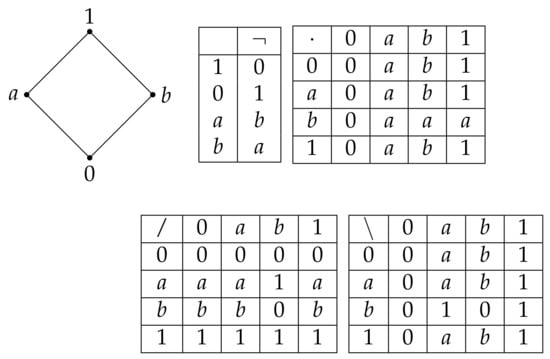
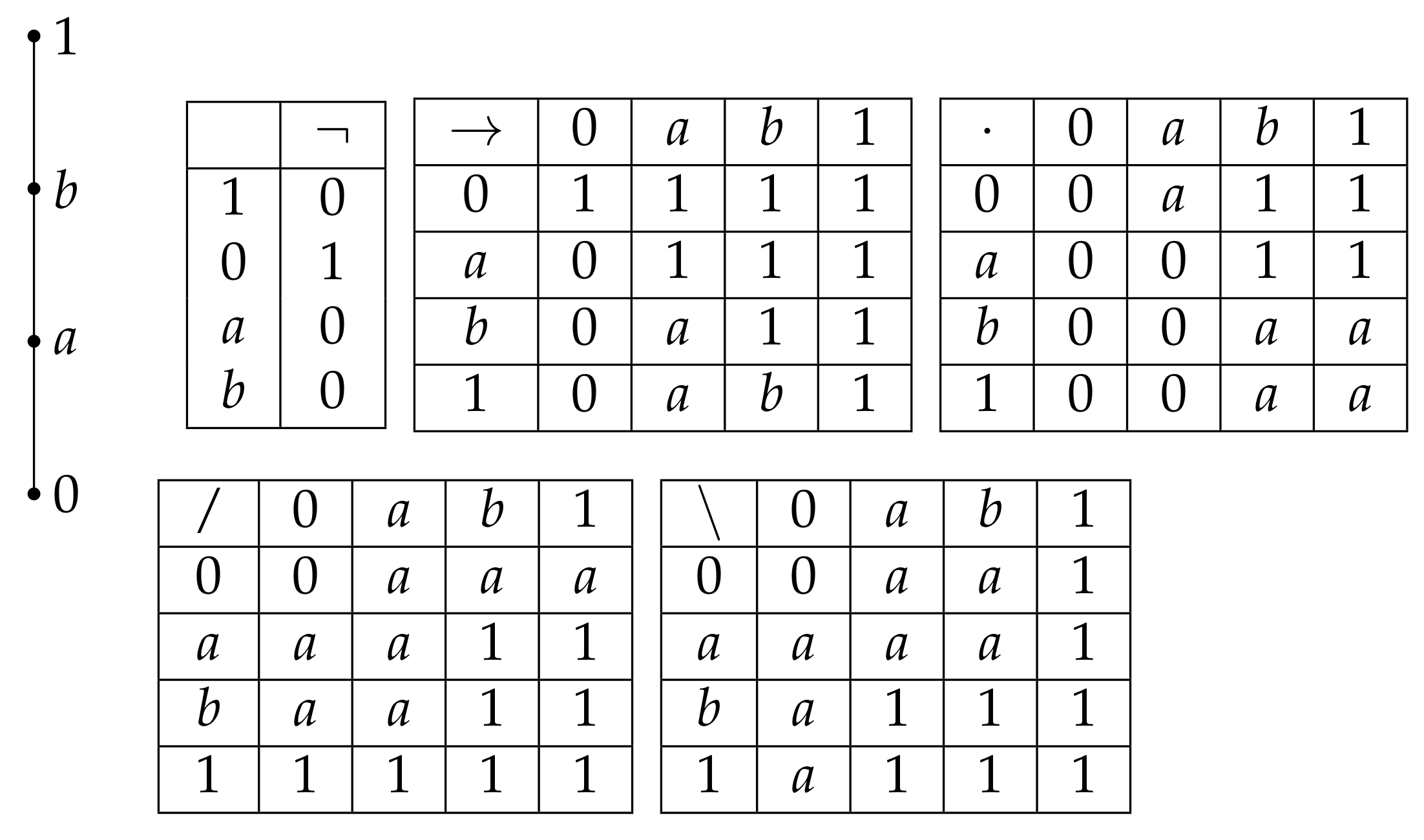
The algebra in Figure 1 is an example of .
Figure 1.
An example of .
Example 2.
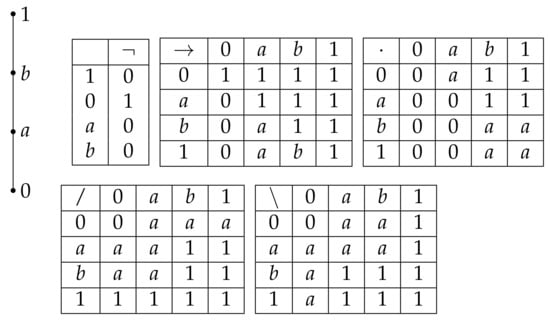
The algebra in Figure 2 is an example of . One has .
Figure 2.
An example of .
A layered magma is a structure (M, ·) with a partial binary operation · on a carrier set M. The operation is said to be contra-commutative if, for all , if is defined, then is undefined. Given a layered magma (M, ·), one constructs layered algebras by the following. Let be the power set of M and . Define
- .
- if is defined, and then .
- if is defined, and then .
A layered magma can form a layered algebra by the following way.
Lemma 1.
In a Heyting residuated groupoid , for any , if , then and .
Corollary 1.
In a Heyting residuated groupoid , for any , if and , then .
Lemma 2.
In a Heyting-residuated groupoid , let , and exist. Then, the following hold
- exits and .
- for any , and exist and , .
Recall that Boolean (Heyting) residuated groupoids NRGs (HRGs) form varieties, which are studied from logic point of view in [5]. Gentzen systems are present for the logics of BRGs and HRGs based on sequents, which are pairs of trees of formulas. Here, we describe the algebraic version of Gentzen system for BRGs and RRGs by adapting the denotation from [8]. Let be a set of countably many variables in the languages.
Definition 3.
The set of terms is defined inductively as follows:
Define .
Definition 4.
A tree over a finite set of terms is a structure such that all leaves of tree are terms in T and connected by connective ·.
Example 3.
Let . Then, and are all trees over T.
Obviously, all tree are terms. In the following, we use to denote trees when emphasized.
Definition 5.
A context is a structure generated from a tree with a designated position that can be filled with a tree. In particular, a single position is a context. Let be a tree obtained from by substituting for .
Example 4.
Let expression be a context. If we replace the tree for the position − in , then we obtain the term . If we replace the tree for the position − in , then we obtain the term .
Definition 6.
An algebraic Gentzen system is a finite set of quasi-inequalities in the following form
where are terms.
Definition 7.
We define to be the finite set of quasi-inequalities given in the following
- (refl)(dist)(g1)(l0)
- (tran)
- (·R)
- (∖L)(∖R)
- (/L)(/R)
- (∨L)(∨R)(∨R)
- (∧L)(∧L)(∧R)
- (→L)(→R)
Define .
Recall that the definitions of rooted trees and Genzten are provable.
Definition 8.
A rooted tree is a poset with a least element, called the root, and, for each element, the set of all elements below it is linearly ordered.
Definition 9.
A proof-tree in a is a finite rooted tree in which each element is an inequality, which is an instance of a member of .
Definition 10.
An inequality is said to be Gentzen-provable in denoted by if there exists a proof-tree in with this inequality as the root.
Let be the terms of algebras defined in Definition 2. Write for the term algebra of term T with variables in the set W. Let , where A is the carrier domain of an -algebra. Obviously, can be extended to a unique homomorphism .
Definition 11.
A is called sound with respect to all classes of algebra if for any inequality . If , then, for any with carrier domain A, there is a μ defined as above such that holds in .
Definition 12.
A is called complete with respect to all classes of algebra if for any inequality . If , then there is with carrier domain A and a μ defined as above such that fails in .
Theorem 1.
and are sound and complete with respect to and .
The soundness can be shown by proving that all quasi-inequalities are valid in (. The completeness follows directly from the proof of FMP in the next section. Details of proofs are included in [4,5,11,12].
Definition 13.
Let be the variety of -algebras. VA is said to have the finite model property (FMP) if for any there is an and a μ, satisfying that implies for some finite and π.
The FMP can be equivalently defined by the Genzten systems.
Definition 14.
Let be a variety of -algebras and be its corresponding Genzten system. VA is said to have finite model property if for any ; then, there is an and a μ such that does not hold in .
Theorem 2.
The varieties of and have FMPs and decidable equational theory.
3. Bounded Distributive Lattice-Ordered Residuated Groupoid and Semigroup
Definition 15.
A bounded distributive lattice-ordered residuated groupoid (DLRG) is a structure where () is a bounded distributive lattice and is a residuated groupoid with lattice ordering ≤.
Proposition 1.
The following equations are satisfied by every :
- 1
- ;
- 2
- ;
- 3
- .
The DLRG extensions are DLRGs enriched with unary operation ¬ or binary operation → satisfying some conditions in the following definition. In the following, we write DLRs and DLRs, meaning DLRGs enriched with ¬ and →, respectively.
Definition 16.
In a DLRG with carrier domain A, the following conditions are considered for any :
- implies ;
- ;
- ;
- ;
- ;
- iff .
Definition 17.
Various extensions of DLRG based on conditions in Definition 16 are listed as follows:
- QBLRG: quasi-Boolean residuated groupoid is DLR s.t. (d), (t), and (dn) hold.
- KLRG: Kleene residuated groupoid is QBLRG s.t. (k) holds (this class of algebra is considered in [19]).
- KoLRG: Kleene ordered residuated groupoid is QBLRG s.t. (ko) holds (this class of algebra is considered in [20,21]).
- BRG: Boolean residuated groupoid is DLR s.t. (b) holds.
- HRG: Heyting residuated groupoid is DLR s.t. (d) and (h) hold.
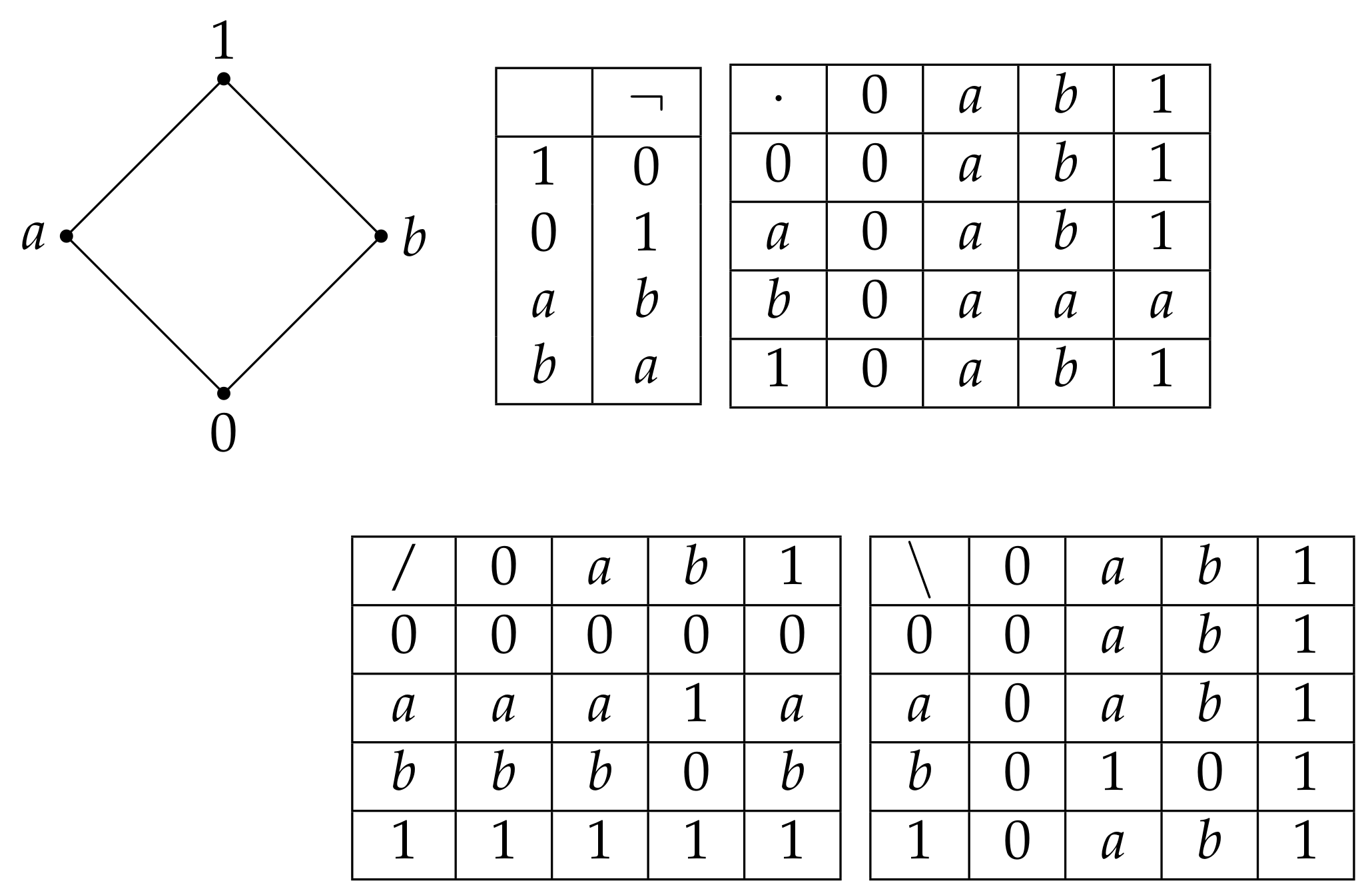
Defining similar to Examples 2 and 3 on different lattices, one obtains different examples of the corresponding algebras. Here, we present an example of QBLRG. Others can be treated similarly.
Example 5.
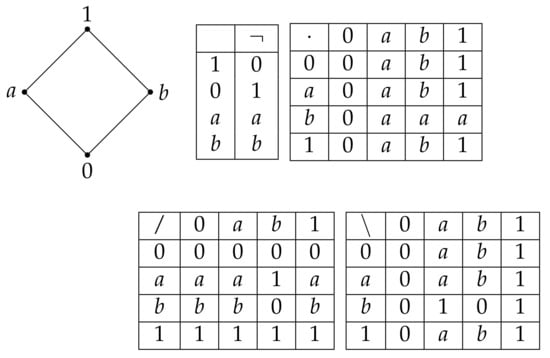
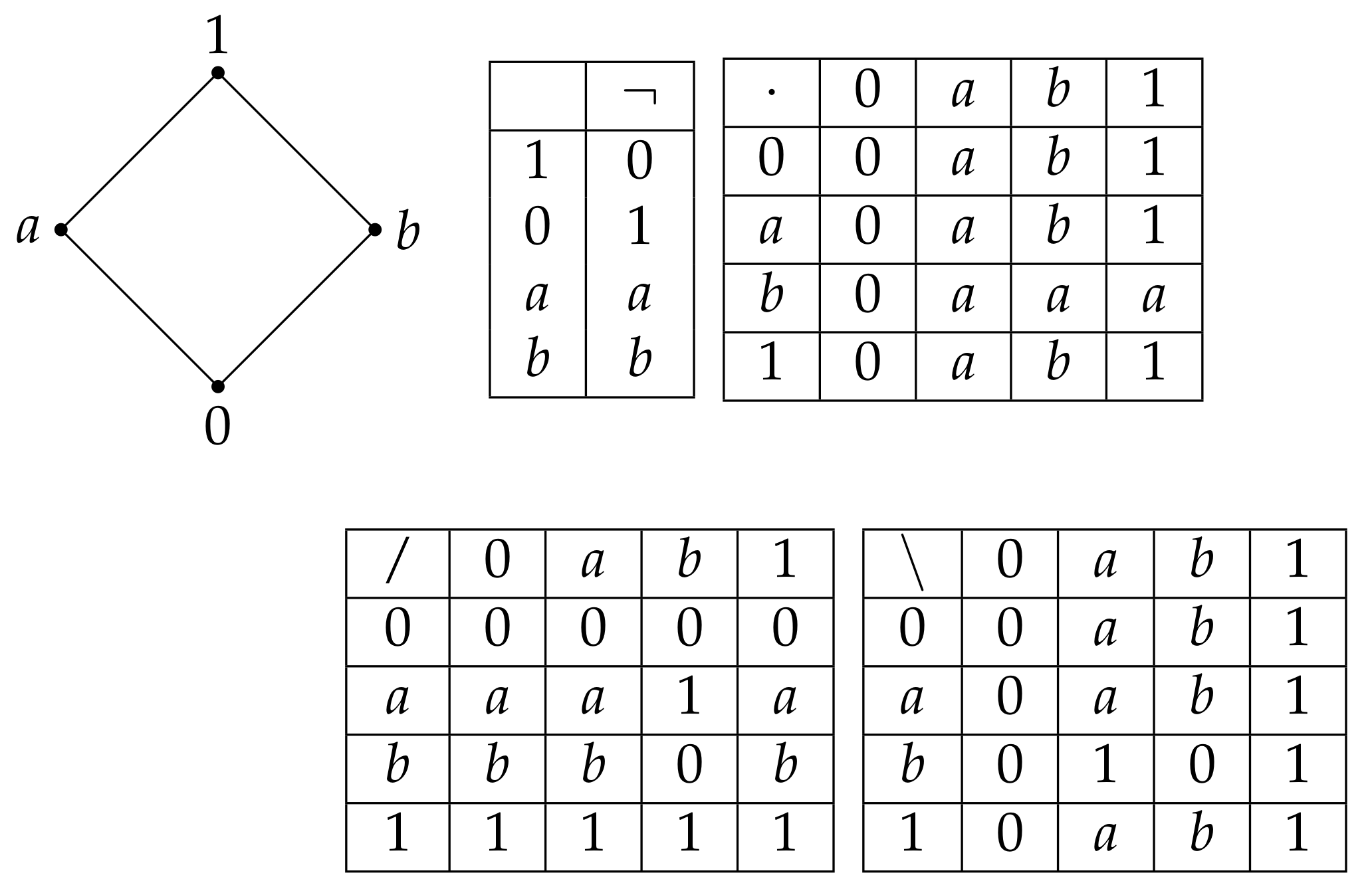
The algebra in Figure 3 is an example of QBLRG. One has , , and .
Figure 3.
An example of QBLRG.
Definition 18.
We define to be the finite set of quasi-inequalities given in the following
- (refl)(dist)(g1)(l0)
- (tran)
- (·R)
- (∖L)(∖R)
- (/L)(/R)
- (∨L)(∨R)(∨R)
- (∧L)(∧L)(∧R)
Obviously, . Define , , as follows:
- ;
- ;
- .
Definition 19.
A residuated semigroup (RSG) (G,, ≤) is a structure such that () is a semigroup and are binary operations on G satisfying (res).
Definition 20.
A commutative and contractive residuated semigroup (RSG) (G,, ≤) is an RSG such that ·, satisfying the following
- (com) ;
- (con) .
for any .
Definition 21.
An associative, commutative, and contractive residuated quasi-Boolean algebra (G,, ) such that (G,) is a quasi-Boolean algebra and (G,) is a commutative and contractive residuated semigroup where ≤ is the lattice order. If (G,) is Kleene (order) or Boolean algebra, then is an associative, commutative and contractive residuated Kleene (order) or Boolean algebra.
Proposition 2.
The following equation are satisfied by every associative, commutative, and contractive residuated quasi-Boolean algebra.
- 1
- ;
- 2
- ;
- 3
- ;
- 4
- ;
- 5
- ;
- 6
- ;
- 7
- ;
- 8
- ;
- 9
- ;
- 10
- ;
- 11
- ;
- 12
- ;
- 13
- .
The proof refers to Proposition 1.4.4 in [8] and Lemma 11.
Let , where are the classes of associative, commutative, and contractive residuated x algebras. Since the commutative holds in x, for any , in the following, we write , and we mean ∖ and /. and recall the definition of terms.
Definition 22.
The set of terms are defined inductively as follows:
Define .
Definition 23.
We define to be the finite set of quasi-inequalities s.t. and the following
- (com);
- (con);
- (ass).
Define , , and
Let , and be the classes of its corresponding algebras.
Proposition 3.
iff iff .
Theorem 3.
is sound and complete with respect to .
The soundness can be shown by proving that all quasi-inequalities are valid in . The completeness follows directly from the proof of FMP in the next section.
4. Finite Model Property and Decidability
In this section, we show the FMPs of all algebras considered in Section 2 and Section 3. Let . In the following, we always assume that T is a finite set of terms and . Define , as the closure of T and as the closure of T. Let be when . Otherwise, . Let be the set of trees over .
Definition 24.
We define on as follows: for , iff for term , if .
Let be and , and then is an equivalence relation. Let for any . Let .
Definition 25.
A term t is called a disjunction normal form with respect to the set of terms T if it is the disjunction of conjunction of some terms in .
Since distributive of lattices and the De Morgan properties are always assumed here, for any , there is a term in disjunction normal form such that . Clearly, is finite since T is finite. Due to and the number of is finite, is finite.
Lemma 3.
For any , there is a such that .
Proof.
Let . Assume that for some . Then, there is an i such that . Clearly, . Thus, . In the opposite direction, since , by (∧R), one obtains . Suppose that for some . By applying (tran) to and , one obtains . Thus, . □
Remark 1.
Note that, for any , . Thus, is not empty. Further, this set is finite. Hence, s always exists. If one considers the algebras without the greatest element 1, for instance or as in [5], then one needs more complex set of theoretic construction with the help of closure operator and interpolant proof theory, as in the result in [5].
Definition 26.
Let be the quotient algebra of , where all operations are defined as follows: for any ,
- ;
- ;
- ;
- ;
- s.t. ;
- s.t. for any ;
- s.t. for any ;
- ;
We define as .
If , then is constructured as in 26 by excluding item (8).
Definition 27.
Let be the quotient algebra of , where all operations except and are defined as in Definition 26 and is defined as follows.
- s.t. for any ;
Lemma 4.
The following conditions are equivalent for all :
- ;
- ;
Proof.
Let us show (1) implies (2). Let . By (relf), . Thus, by Definition 24, one obtains .
Let us show (2) implies (3). It suffices to prove . By Definition 26. . Assume that . Clearly, by (relf) . By (∧ R), one obtains . Obviously, . Conversely, . Thus, . Therefore, .
Let us show (3) implies (1). Assume that . Thus, . Thus, . Therefore, . Thus, . Clearly, . By (trans), . Let for some . Thus, by (trans), . Hence, . □
Lemma 5.
All the operations defined in Definition 26 are well defined.
Proof.
(or ) are well defined since is closed under these operations. We provide the proof for operation ·. Then, by the functional definition, (→) are all well defined. Let . It suffices to show . Let s.t. and s.t. . Obviously, . Then, by Definition 24, . Clearly, . Thus, by (trans), . Then, by by Definition 24, . So, by Lemma 4, . Similarly, one proves . Thus, . Similarly, Hence, · is well defined. □
Lemma 6.
For any in according to Definitions 26 and 27, iff iff .
Proof.
Let us show implies . Let and . Assume that . Then, there is a such that . Then, by (refl) and (∨R), . Thus, by Lemma 4, . Therefore, .
Let us show the opposite direction. Assume that . By Lemma 4, Thus, . So, . By (∨L), . Hence, by (trans), . Hence, . So, .
Similarly, one proves iff . □
Corollary 2.
For any in according to Definition 27, iff .
Lemma 7.
For any , the following hold
- implies if contains (QB);
- if contains (QB);
- if contains (Ko);
- if contains (K);
- if contains (B).
Proof.
We only provide the details for (1). Others can be proved similarly. Assume that . By Lemma 4, . Then, by (QB), one obtains . Again, by Lemma 4, . □
Lemma 8.
is a finite iRG where if contains (i) axioms.
Proof.
Immediately follows from Lemmas 6 and 7 and Corollary 2. □
Lemma 9.
The following conditions hold for : for any ,
- If , then .
- If , then .
- If , then .
- If , then .
Proof.
Let us show (1). Let . Then, . Thus, and . By Lemma 4, .
Let us show (2). Let . Let . By (∨L), one obtains . Thus, (∖R) . Furthermore, . Thus, there is a for some i. So, . □
Lemma 10.
Let be set of terms generated from in Definition 22. If , then there is and an assignment σ, satisfying that .
Proof.
Recall that T is the smallest set containing all the terms in . Let be defined as above. Clearly, is finitely based. Assume that . Construct as in Definition 26 or Definition 27 with respect to . Let such that . can be simply extended to satisfying that for any . Assume that . Then, . By Lemma 4 and Lemma 16, one obtains , which yields contradiction. □
Theorem 4.
(FMP and Decidability). has FMP and thus is decidable.
Proof.
Suppose By Lemma 10, there is a finite counter-algebra such that . Thus, . □
Remark 2.
The proof result can be extended to the Galois connection extensions of distributive lattices, De Morgan algebras, Heyting algebras, and Boolean algebras. The Galois operators are a pair of modal operators denoted by that usually satisfy the following properties.
- iff (gs)
A pair of Galois connection operators are essentially a unary version of fusion · and its residual duals . However, if we consider more complex algebraic structures, such as requiring the modal operators to satisfy transitivity like the 4 axiom, then the construction presented here will not hold, and more sophisticated constructions and analytical proofs will be necessary.
Let . Define T be a set of finite terms containing . Let be the closure of T. Let be the closure of and be the set of trees over .
Lemma 11.
The following hold in :
- ;
- ;
- ;
- .
Proof.
Let us show (1). Let and . By (), . By (trpo), and . By (∧R), . By (trpo) (doubn) and (trans), . Thus, , whence .
Let us show (2). Obviously, and . By (L), . Hence, . Similarly, . By (∧R), . For the other direction, clearly and . By (∧R) . Hence, .
Let us show (3). Obviously, . Then, by () twice, . By (com), one obtains . Therefore, by (R) twice, one obtains . The opposite direction can be proved similarly.
Let us show (4). Obviously, . Then, by () twice, . Then, by (con), one obtains . Then, by (), one obtains . For the opposite direction, since , by () . By (con), . By (R) twice, . □
Lemma 12.
For any and if , then there is a such that and
Proof.
We proceed the proof by induction on the derivation in . Let be the ended inequalities obtained by rule (R). Assume that is not introduced by (R). Then, the claim holds by induction hypothesis. For instance, suppose that is obtained by and by (trans). Then, by induction hypothesis, there is a s.t. and . By (trans), . Thus, w is the required term for .
Assume that is introduced by (R). If (R) is (·R), then for some . Clearly, . So, . Hence, s is the required term for . Otherwise, suppose that is obtained by and by (trans). Then, by induction hypothesis, there is a s.t. and . Hence, by (trans), . So, w is the required term for . □
According to Lemma 11, by omitting repetitions, is finite up to equivalent in when T is finite. and are defined similarly as in Definition 24 with respect to . for some ; [c(T)] and are defined naturally. Since quasi-Boolean of lattice is assumed, then closure of terms is finite up to equivalent. Thus, both and are finite.
Lemma 13.
For any , there is such that .
Let be the quotient algebra of and defined as in Definition 26.
Lemma 14.
The following conditions are equivalent for all :
- ;
- ;
The proof is quite similar to Lemma 4. Consequently, all operations in are well defined. Define .
Lemma 15.
For any in , the following hold:
- iff ;
- implies ;
- ;
- if contains (Ko);
- if contains (K);
- if contains (B);
- ;
- ;
- .
Proof.
The proof is quite similar to Lemmas 6 and 7 except (7)–(9). (8) and (9) are easy. We provide the details for (7).
Let and . Let and . Hence, and . It suffices to show .
Let . Then, . Further, . Thus, by (trans), . By (), . By Lemma, there is such that and . Then, , where . Hence, . Then, . Thus, . By (trans), . By Lemma . Similarly, . □
Lemma 16.
The following conditions hold for : for any,
- If , then ;
- If , then .
Lemma 17.
Let be set of terms generated from . If , then there is and an assignment σ that is extended to as above, satisfying .
Theorem 5
(FMP and Decidability). has FMP and is thus decidable.
Remark 3.
In the finiteness proof delineated above, Lemma 11 is contingent on the properties of contraction and commutativity. The demonstration of Lemma 12, which serves as the cornerstone for constructing finite-quotient algebras, inherently relies on the validity of Lemma 11. Consequently, our proof does not extend to scenarios where fusion · fails to satisfy contraction and commutativity but still adheres to associativity.
Moreover, this method does not work for the cases such that fusion · only admits associativity and weakening property too.
5. Conclusions
In this paper, we considered different lattice variants of layered algebras. We defined new graph-theoretical operations on layered graphs, thereby enhancing their expressivity. We demonstrated that any class of algebras belonging to o o has FMP and decidable equational theory. We extended the results in [5] to more classes of algebras. We restricted the classes of algebras considered here to be bounded, which leads to a more simple proof. Moreover, by using special interpolation properties (Lemma 12), we expanded the FMP and decidability results to some classes of associative, commutative, and contractive algebras successfully.
Layered graph algebras offer a novel approach to analyzing complex systems that are prevalent in these fields. Specifically, they enable more rigorous verification of key properties, such as security and error resilience. In cryptography, this framework can be used to analyze and identify weaknesses in cryptographic systems that rely on layered security measures. In coding theory, it can help to design new error-correcting codes that are better suited for environments with limited resources or prone to communication disruptions. Essentially, this framework bridges algebraic theory with real-world problems to ensure secure and reliable data transmission.
For further research, we are also interested in the complexity problems closely related to the results presented in this paper. In [22], it is shown that the bounded distributive residuated groupoid (denoted here) has an EXPTIME-complete quasi-equational theory and thus the EXPTIME upper bound for the equational theory of . The same complexity results for quasi-equational theory are proved in [23], while has a PSPACE-complete equational theory [24]. Lastly, the complexity of the equational theories of other algebras considered here, to the best of our knowledge, has not been settled.
Moreover, we are interested in exploring extended questions of the finite model property for layered graph algebras over non-distributive lattices. Utilizing logical methods, we can demonstrate the cut-elimination property for the sequent calculus system corresponding to the considered algebra. Based on this result, by proving that the derivation tree is finite, we can establish the decidability of the corresponding logic. Consequently, this allows us to address the decidability problem of equations for the corresponding non-distributive layered graph algebras. However, proving the finite model property is considerably more challenging. In [8], the most basic non-distributive layered graph algebras (under the name non-distributive lattice-ordered residuated groupoid) and some of their negation extensions were shown to possess the finite model property. Nevertheless, the finite model property for many extensions remains an open problem, such as non-distributive layered graph algebras with De Morgan negation, Boolean negation extensions, and others.
The strong finite model property is another issue that we intend to focus on in the future. It is known that this problem is closely related to the word problem for classes of algebras, a topic that has been extensively studied. Moreover, since the classes of algebras we investigate are varieties, they all satisfy the HSP (homomorphic image, subalgebra, and product) property. As indicated in [8], for a class of algebras satisfying this property, the strong finite model property implies that the class has the finite embeddability property. Therefore, the strong finite model property is also a subject of our forthcoming research endeavors.
Author Contributions
Conceptualization, Z.L., F.L. and Z.Y.; methodology, Z.L.; validation, Z.L., F.L. and Z.Y.; formal analysis, Z.L.; investigation, Z.L.; writing—original draft preparation, Z.L., H.Z., Z.Y. and Y.W.; writing—review and editing, Z.L., F.L., Z.Y., H.Z. and Y.W.; supervision, Z.L. and F.L.; project administration, Z.L. and Z.Y.; funding acquisition, Z.Y., F.L. and H.Z. All authors have read and agreed to the published version of the manuscript.
Funding
The research was funded by the Key Project of Chinese Ministry of Education (22JJD720021) and the Chinese Ministry of Education of Humanities and Social Science Project (23YJC72040003).
Data Availability Statement
Data is contained within the article.
Conflicts of Interest
The authors declare no conflicts of interest.
References
- Jónsson, B.; Tsinakis, C. Relation algebras as residuated Boolean algebras. Algebra Universalis 1993, 30, 469–478. [Google Scholar] [CrossRef]
- Collinson, M.; McDonald, K.; Pym, D. A substructural logic for layered graphs. J. Log. Comput. 2014, 24, 953–988. [Google Scholar] [CrossRef]
- Collinson, M.; McDonald, K.; Pym, D. Layered graph logic as an assertion language for access control policy models. J. Log. Comput. 2017, 27, 41–80. [Google Scholar] [CrossRef]
- Docherty, S.; Pym, D. Intuitionistic layered graph logic: Semantics and proof theory. Log. Methods Comput. Sci. 2018, 14. [Google Scholar] [CrossRef]
- Buszkowski, W. Interpolation and FEP for logics of residuated algebras. Log. J. IGPL 2011, 19, 437–454. [Google Scholar] [CrossRef]
- Cardelli, L.; Gardner, P.; Ghelli, G. A spatial logic for querying graphs. In Automata, Languages and Programming: 29th International Colloquium, ICALP 2002 Málaga, Spain, 8–13 July 2002; Springer: Berlin/Heidelberg, Germany, 2002; pp. 597–610. [Google Scholar]
- Conforti, G.; Macedonio, D.; Sassone, V. Spatial logics for bigraphs. In Proceeding ICAP ’05, LNCS 3580; Springer: Berlin/Heidelberg, Germany, 2005; pp. 766–778. [Google Scholar]
- Galatos, N.; Jipsen, P.; Kowalski, T.; Ono, H. Residuated Lattices: An Algebraic Glimpse at Substructural Logics; Studies in Logic and The Foundations of Mathematics 151; Elsevier: Amsterdam, The Netherlands, 2007. [Google Scholar]
- Farulewski, M. Finite Embeddabilty Property for Residuated Groupoids. Rep. Math. Log. 2008, 43, 25–42. [Google Scholar]
- Hanikova, Z.; Horcık, R. The finite embeddability property for residuated groupoids. Algebra Universalis 2014, 72, 1–13. [Google Scholar]
- Kaminski, M.; Francez, N. Relational semantics of the Lambek calculus extended with classical propositional logic. Stud. Log. 2014, 102, 479–497. [Google Scholar]
- Kaminski, M.; Francez, N. The Lambek calculus extended with intuitionistic propositional logic. Stud. Log. 2016, 104, 1051–1082. [Google Scholar] [CrossRef]
- Chvalovsk’y, K. Undecidability of the consequence relation in full nonassociative Lambek Calculus. J. Symb. Log. 2015, 80, 567–586. [Google Scholar] [CrossRef]
- Girard, J.Y. Linear logic. Theor. Comp. Sci. 1987, 50, 1–101. [Google Scholar] [CrossRef]
- Buszkowski, W. Some decision problems in the theory of syntactic categories. Math. Log. Q. 1982, 28, 539–548. [Google Scholar]
- Lambek, J. The Mathematics of Sentence Structure. Am. Math. Mon. 1958, 65, 154–170. [Google Scholar] [CrossRef]
- Galatos, N. The undecidability of the word problem for distributive residuated lattices. In Ordered Algebraic Structures; Martínez, J., Ed.; Kluwer Academic Publishers: Dordrecht, The Netherlands, 2002; pp. 231–243. [Google Scholar]
- Metcalfe, G.; Paoli, F.; Tsinakis, C. Residuated Structures in Algebra and Logic; American Mathematical Society: Providence, RI, USA, 2023; Volume 277. [Google Scholar]
- Kleene, S.C. Introduction to Metamathematics; Literary Licensing, LLC: Whitefish, MT, USA, 1952. [Google Scholar]
- Dunn, J.M. A Kripke-style semantics for R-mingle using a binary accessibility relation. Stud. Log. 1976, 35, 163–172. [Google Scholar] [CrossRef]
- Rivieccio, U. An infinity of super-Belnap logics. J. Appl. Non-Class. Logics 2012, 22, 319–335. [Google Scholar]
- Shkatov, D.; Van Alten, C.J. Complexity of the universal theory of bounded residuated distributive lattice-ordered groupoids. Algebra Univers. 2019, 80, 36. [Google Scholar]
- Placzek, P. Complexity of Nonassociative Lambek Calculus with classical logic. Electron. Proc. Theor. Comput. Sci. 2024, 415, 150–164. [Google Scholar]
- Lin, Z.; Ma, M. On the complexity of the equational theory of residuated boolean algebras. In Logic, Language, Information, and Computation; Väänänen, J., Hirvonen, Å., de Queiroz, R., Eds.; Lecture Notes in Computer Science; Springer: Berlin/Heidelberg, Germany, 2016; pp. 265–278. [Google Scholar]
Disclaimer/Publisher’s Note: The statements, opinions and data contained in all publications are solely those of the individual author(s) and contributor(s) and not of MDPI and/or the editor(s). MDPI and/or the editor(s) disclaim responsibility for any injury to people or property resulting from any ideas, methods, instructions or products referred to in the content. |
© 2025 by the authors. Licensee MDPI, Basel, Switzerland. This article is an open access article distributed under the terms and conditions of the Creative Commons Attribution (CC BY) license (https://creativecommons.org/licenses/by/4.0/).