


Abstract
In this work, we use the monophonic eccentric open neighborhood system and the upper approximation neighborhood system to construct a new class of topologies in the theory of undirected simple graphs. We study some fundamental topological properties of this class and characterize the graphs that induce the indiscrete or discrete topology. Next, we present the openness, the connectedness and the continuity properties with isomorphic maps of graphs. Some applications concerning the topological discrete and connectedness properties for some corresponding graphs of the COVID-19 form and its diffusion are introduced.
MSC:
05C99; 18F60; 05C20
1. Introduction
Graph theory and general topology are important topics in the mathematical field. Several researchers studied the relation between general topology and graph theory by constructing some topologies on the vertex set of graphs and on the edge set for undirected simple graphs or directed graphs. The subject of constructing topologies by using graph theory has recently become a subject of interest to mathematical researchers, which is considered as one of the relationships between graph theory and general topology. This construction is on the vertex set of graphs and on the edge set in directed graphs or undirected graphs, which depends on the neighborhood system used. Many mathematical researchers studied this construction on vertex sets in the theory of undirected simple graphs. The construction of any neighborhood system depends mainly on the type of relations used between the vertices or edges for graphs. Most studies were on the theory of undirected simple graphs and in particular on the vertex sets. Jafarian et al. [1] constructed the graphic topological space of undirected simple graphs as a pair , where is a topology on induced by the class of open neighbourhoods of vertices in . Nada et al. [2] introduced a relation on graphs to generate new types of topological structures. In 2018, Abdu and Kiliçman [3] introduced a construction of topologies, with an incidence topology on for simple graphs without isolated vertices, which has a sub-basis as the family of end-sets that contain only end points of every edge. Kiliçman and Abdu [4] used the graphs to introduce two constructions of topologies on the set , called compatible edge topology and incompatible edge topology. In 2019, Nianga and Canoy [5] constructed a topology in simple graphs by using the notions of unary and binary operations; in [6], they introduced some topologies on the vertex set in the theory of simple graphs by using the hop neighborhoods of the graphs. For simple graphs without isolated vertices , in 2020, Sari and Kopuzlu [7] generated a topology on the vertex set induced by the same basis, which is defined by Amiri et al. [1], and studied the continuity of functions. The discrete property of topologies for special graphs and the minimal neighborhood system of vertices are studied, such as complete graphs , cycle graphs and complete bipartite graphs . Zomam et al. [8] in 2021 used graphic topological spaces, which were introduced by Amiri et al. [1], to satisfy the Alexandroff property by giving some conditions such as a locally finite property. The notion of pathless topological spaces on the vertex set in the theory of directed graphs was introduced by Othman et al. [9] in 2022 and they presented the relation between pathless topological spaces and the relative topologies and E-generated subgraphs and studied the role of pathless topology in the blood circulation of the heart of the human body. The notion of topological spaces is introduced by Othman et al. [10] via the open neighborhood C-set system. In 2023, Abu-Gdairi et al. [11] explained the role of topological visualization in the medical field through graph analysis and rough sets by using neighbourhood systems. In the theory of approximating a neighborhood system, Yao [12] introduced the notions of upper and lower approximations of any nonempty set as a generalized rough set by using a binary relation. Next, by using graph theory, Atik et al. [13] introduced a new type of rough approximation model using j-neighborhood systems. Guler [14] generated different approximations and compared these approximations by using the notion of an ideal collection, for more details see [15,16,17,18]. Dammag et al. [19] used monophonic paths in the theory of directed graphs to construct a new topology, called the out mondirected topology. They introduced the important role of out mondirected topological spaces in satisfying the connectedness and discrete properties of the nervous system of the human body. Here, we are going to give some preliminaries on our paper applications concerning COVID-19. Davahli et al. [20] used graph theory to introduce a quantitative assessment by comparing the pandemic spreading of COVID-19 in Kyoto city in Japan and Kentucky state in the USA. Ashokkumar et al. [21] used graph theory to introduce a proposed algorithm for scheduling the timing of the relief funds that helped the Indian government to combat the spread of COVID-19. Bhapkar et al. [22] used graph theory to introduce four representations of COVID-19 types.
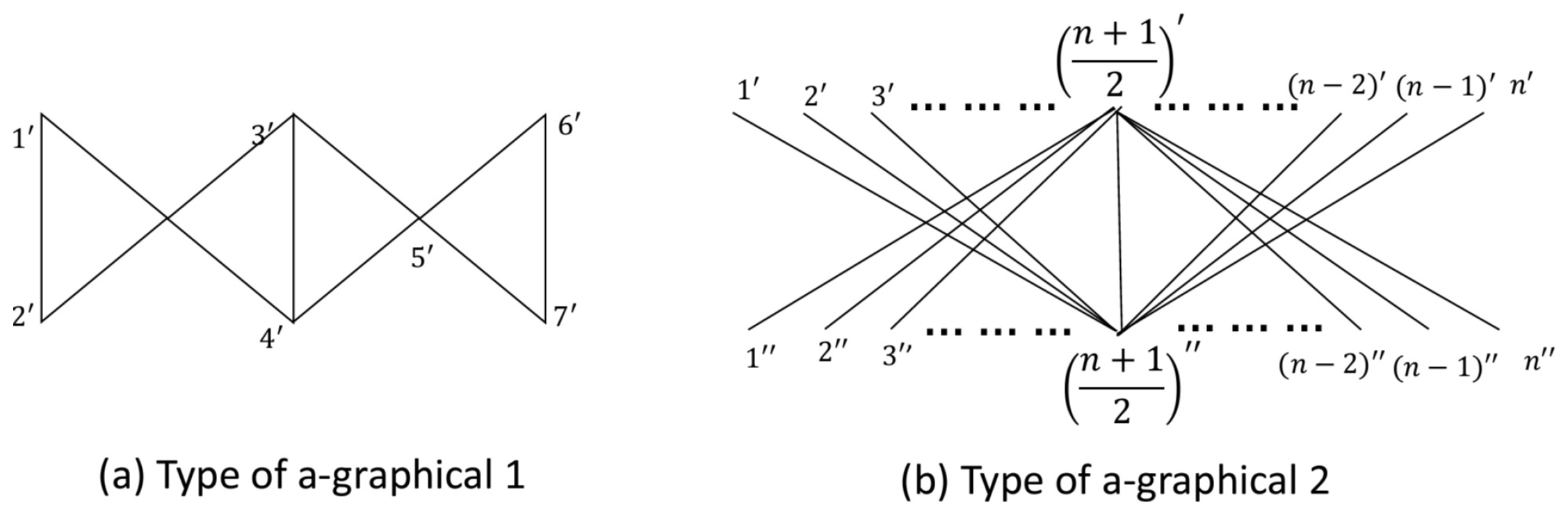
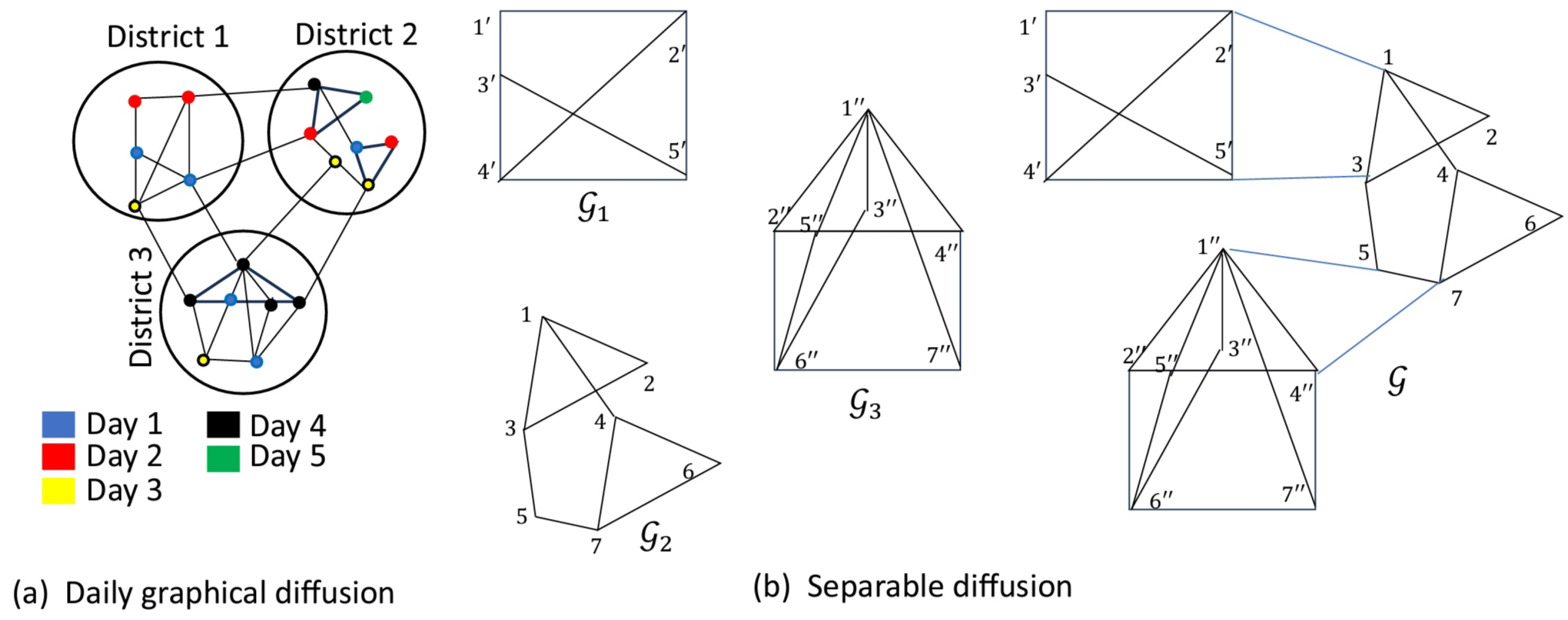
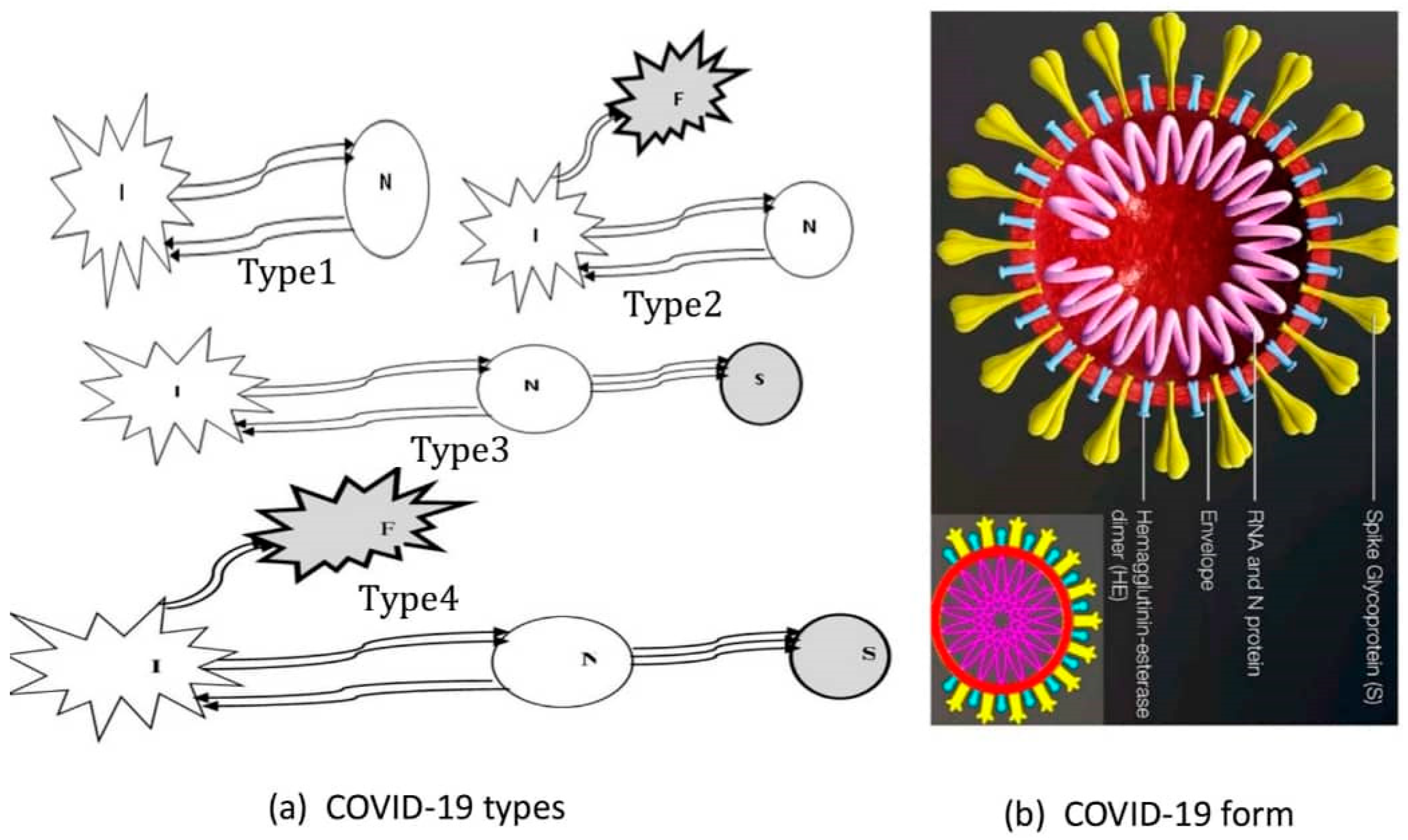
In this paper, using the idea of a monophonic eccentric open neighborhood system [23] and an upper approximation neighbourhood system [13] of undirected simple graphs , we introduce a new class of topologies on a vertex set , called an upper a-graphical topology. In Section 2, we first give the operator and next we use the operator together with a monophonic eccentric open neighborhood system [23] and an upper approximation neighbourhood system [13] to introduce the notion of an upper a-neighborhood system. Using this neighborhood system, we give the concept of an upper a-graphical topological space and we show the discrete property of path , complete graphs , cycle graphs and complete bipartite graphs . Figure 1a,b present some examples for the upper approximation neighbourhood system and upper a-Graphical Topological Spaces. In Section 3, we present some isomorphic properties such as connectedness, discreteness, compactness, ∩-upper connectedness and ∩-upper discreteness. Figure 2 presents example of compactness property. Section 4 presents the discreteness, ∩-upper connectedness and ∩-upper discreteness for upper a-graphical topological spaces for some corresponding graphs concerning the COVID-19 form and its diffusion, such as Figure 3, which presents a quantitative assessment comparing the COVID-19 pandemic spread of cities Kyoto in Japan and Kentucky in the USA, [20]. Figure 4 presents a proposed algorithm for the timing schedule of the relief funds that helped the Indian government to combat the spread of COVID-19, [21]. Figure 5 presents the four COVID-19 types, [22].
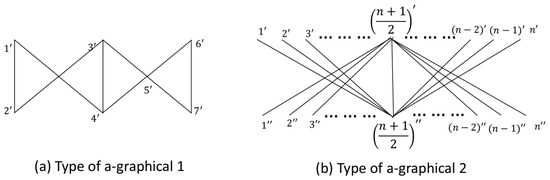
Figure 1.
Upper a-graphical topologies.
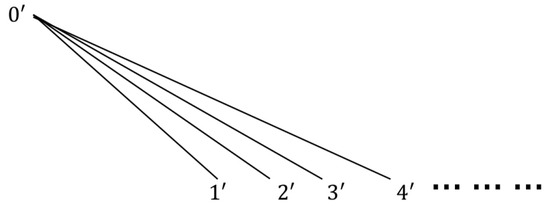
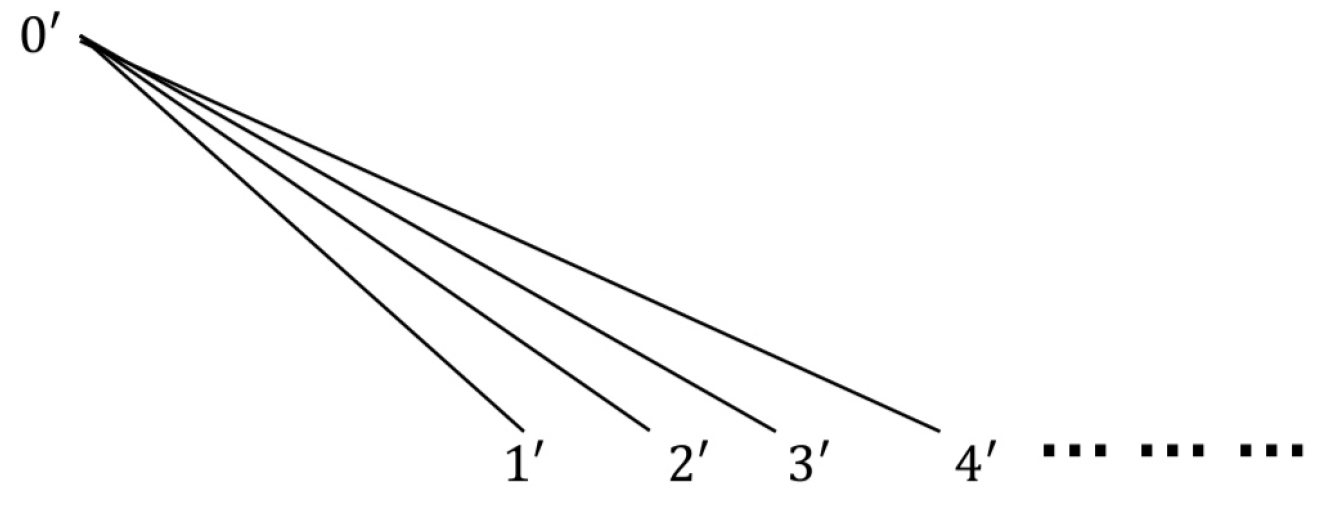
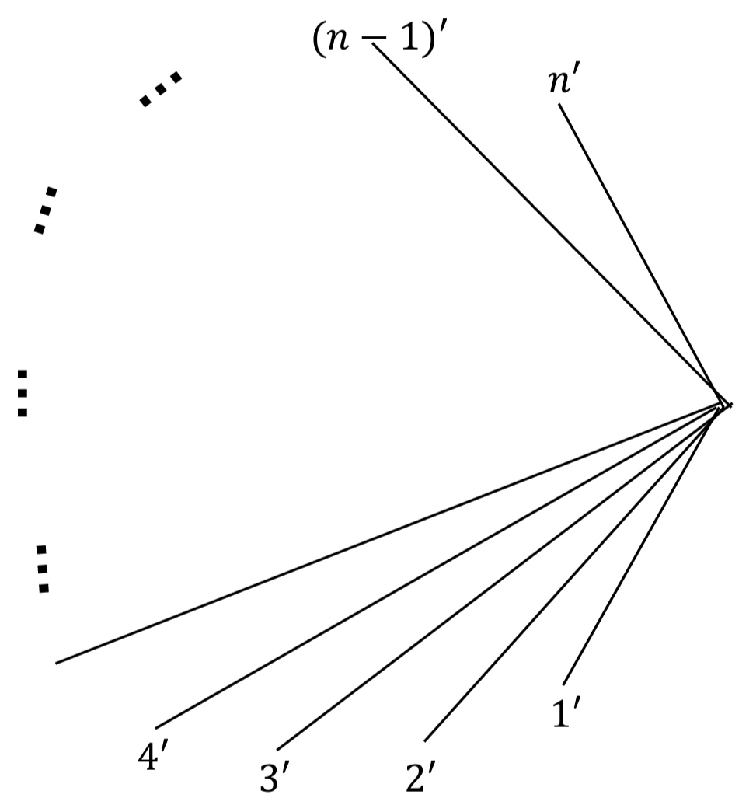
Figure 2.
Graphical form with infinite vertex set.
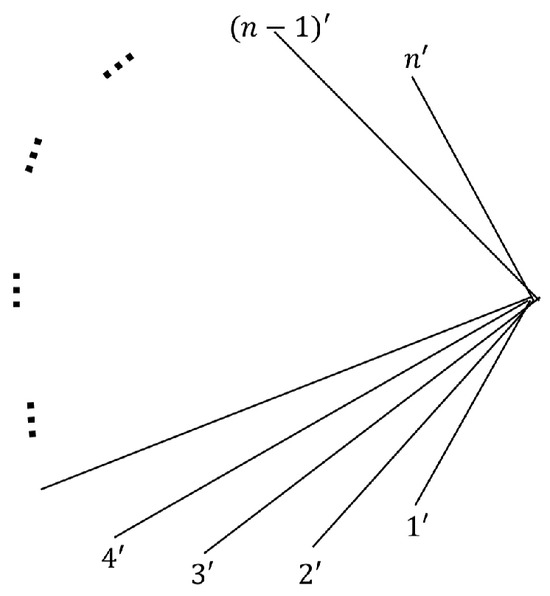
Figure 3.
COVID-19 diffusion in Kentucky state and Kyoto city.
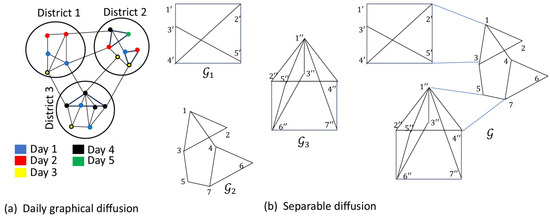
Figure 4.
Relief scheme and its graphical forms in some cities of India.
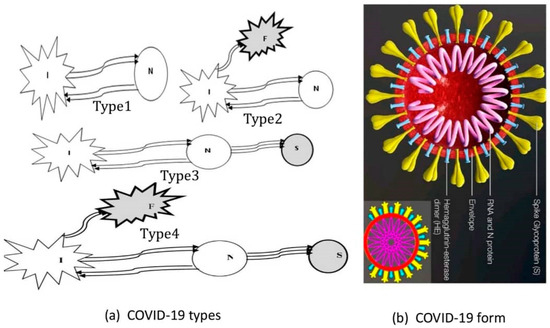
Figure 5.
COVID-19 form and its types.
For a any relation ⋊ on any set and for any , [12], the lower and upper approximations of a set A are given by and , respectively, where . By a graph , we mean the pair of a vertex set and edge set . For any subgraph of , [13] defined rough approximation j-neighborhood systems such that the lower approximations and upper approximations of are given by and , respectively, where , , , , , , , and . Throughout this paper, all graphs will be assumed to be undirected. If is any an edge in joining x and y in , then we write . For , is called the degree of x, which is defined by the number of vertices that are adjacent to x. The edge with is called a loop. For any two edges and in , if , then they are called multiple edges. A graph is said to be a simple graph if it has no loops and multiple edges. In any simple graph , if there is an edge between x and y, it will be denoted by . For the vertex , the open neighbourhood of x is the set of all adjacent vertices with x. A path P is an alternating sequence of distinct edges and distinct vertices. A path that starts and ends at the same vertex is called a closed path. A graph is called connected if we can move along the edges from any vertex to any other vertex in . A complete graph with is a simple graph with n vertices such that for all . A complete bipartite graph with is a simple graph whose vertices can be partitioned into two subsets, with n vertices and with m vertices, where there is no edge that has both endpoints in the same subset, and every possible edge that could connect vertices in different subsets is part of the graph. A cycle graph with is a simple graph with n vertices and n edges such that for all . Let P be any path in a graph and . If joins two non-adjacent vertices of a path P, then is called a chord of P. A path P is called a monophonic path if it has no chord edge. The length of the longest monophonic path that ends with vertices x and y is defined as the monophonic distance between x and y. Note that the function does not satisfy the triangle inequality in the definition of a metric function. The monophonic eccentricity is defined as . A point y in is said to be a monophonic eccentric of x in if . In our work, we define the relation ⋊ on by the monophonic eccentric relation, that is, if x is a monophonic eccentric vertex of y. So the monophonic neighborhood of a point x in is given by . The monophonic neighborhood of a subset is given by . The collection is called a monophonic neighborhood system of a graph .
2. The Upper -Neighborhood System
Let be any simple graph. We use the rough approximation j-neighborhood systems, which are introduced in [13] to structure a new neighborhood system for the elements of Define two operators by and , respectively, where is a power set of . The collection is called an upper approximated neighborhood system (shortly, upper a-neighborhood system) of a graph . For a subset , the upper a-neighborhood of G is defined by , where . That is, .
Theorem 1.
Let be any simple graph and . If , then .
Proof.
Let . Then, or . If , then for some . Since , and hence . If , then for some . Since , and hence . Hence, . □
Theorem 2.
Let be any simple graph and . Then, .
Proof.
Since , from Theorem 1, and , that is, . On the other hand, let . Then, or . If , then for some . So in this case, if , then and similarly if , then . If , then for some . If , then and if , then . Therefore, , that is, . □
Theorem 3.
Let be any simple graph and . Then, .
In the theorem above, it is no need for ; for example, if we have the path , then
If we take and , then .
Theorem 4.
Let be any simple graph without isolated vertices and denote the intersection set of all upper a-neighbourhoods containing x for all . Then, the collection forms a basis of a topology on .
Proof.
Since is a total set, it is clear that for all . That is, . Since is without isolated vertices, for all and hence for all . Then, for all . That is, . So we obtain that . Next, we prove that for any two elements , there is such that . Let and be any two elements in . If , then take to indicate that the proof is complete. Let . Then, there exists such that and . By , we obtain for all with and by we obtain that for all with . For any of the previous cases, we obtain that . Take to obtain . On the other hand, let , that is, . Hence, for some . Then, and this implies for all . So we have . Hence, and , that is, and . Hence, .Therefore, . Hence, forms a basis of a topology on . □
Remark 1.
In the class of a simple graph without isolated vertices, the topology that has the basis in Theorem 4 is called an upper a-graphical topology of a graph Ω and denoted by .
Remark 2.
In the class of a simple graph without isolated vertices, from the definitions of an upper neighbourhood system and the basis , we obtain that the family forms a sub-basis for an upper a-graphical topological space .
Example 1.
A graph , shown in Figure 1a, has an upper a-neighborhood system , which is given by
for all . So the basis
induces the upper a-graphical topology
In Figure 1b, if n is odd number greater than 3, then the graph has an upper a-neighborhood system , which is given by
and for all . So the basis
induces the upper a-graphical topology
Let be any simple graph. If is an isolated edge, then we have in the basis of the upper a-graphical topological space . If we have a graph as a path of the form , then has an upper a-neighborhood system , which is given by in the upper a-graphical topological space .
Theorem 5.
Let be a path of the form
where . If n is even, then the basis of is given by
If n is odd, then the basis of is given by
Proof.
In this case, n is even. Note that for all , and . This is similar for all , where and . So the upper a-neighborhood system is given by for all and for all . If , then
For , . For , . Hence, the basis is given by
In this case, n is odd. Note that for all , and . For all , and . At , we obtain that and . So the upper a-neighborhood system is given by for all , for all and . If , then
For , . For , . Then the basis is given by
□
For a cycle graph , the upper a-graphical topological space is indiscrete, with an upper a-neighborhood system . For a cycle graph , the upper a-graphical topological space is quasi-discrete and has an upper a-neighborhood system and . For any in the cycle graph , it is clear to see that .
Lemma 1.
The upper a-neighborhood system of a cycle graph with is given by
Proof.

Table 1.
Monophonic -neighborhood and operator of .
Table 2.
An upper a-neighborhood system of .
Theorem 6.
The upper a-graphical topological space of a cycle graph is a discrete space for all .
Proof.
From Lemma 1 and Table 3, we obtain that for all , . That is, is a discrete space. □
Table 3.
The basis of .
Theorem 7.
The upper a-graphical topological space of a complete graph is an indiscrete space for all .
Proof.
For any , and . Hence, the upper a-neighborhood system is given by
for all . That is, is an indiscrete space. □
If and , then the upper a-neighborhood system is given by for all . That is, the upper a-graphical topological space is indiscrete.
Theorem 8.
The upper a-graphical topological space of a complete bipartite graph is a quasi-discrete space for all .
Proof.
Let and be any vertex. Since , or . Let . Here, and by the notion of a complete bipartite graph , and . Similarly, if , then and . Hence, the upper a-neighborhood system is given by
for all and
for all . Hence, the upper a-graphical topological space is given by That is, is a quasi-discrete space. □
3. On Topological Properties
For compactness, note that the upper a-graphical topological space of any simple graph is a compact space if is finite, while for the infinite graph there is no need to induce a compact upper a-graphical topological space. For example, in Figure 2, the simple graph has the infinite vertex set . For , and for all . So the upper a-neighborhood system is given by for all . That is, the upper a-graphical topological space is indiscrete and hence is a compact space. Let and be two simple graphs without isolated vertices. These two graphs and are called isomorphic and we write if there is a bijective function such that if and only if for all . A function of a topological space into a topological space is called continuous if is an open set in for every open set O in . A function is called an open function if is an open set in for every open set . Recall from [24] that a function is a homeomorphism if it is a bijective, open and continuous function.
Remark 3.
From Theorem 7, since the upper a-graphical topological space of a complete graph is an indiscrete space for all , any function is continuous for any simple graph without isolated vertices. By Theorem 6, since the upper a-graphical topological space of a cycle graph is a discrete space for all , any function is continuous for any simple graph without isolated vertices.
Remark 4.
By Theorem 4, we note that for any simple graph without isolated vertices and for , is the smallest open neighborhood of a in .
Lemma 2.
Let and be two simple graphs without isolated vertices. A function is an open function if and only if for all .
Proof.
Let be an open function and be any vertex in . Since is an open set in containing x and is open, is an open set in containing . By the definition of , we obtain . Now, suppose that for all . Let O be any open set in and . Then, . Then, there is such that . Since B is an open set containing and by the definition of , . By this hypothesis, we obtain that , that is, . Since is an open set and y is arbitrary, is an open set. Hence, is an open function. □
Lemma 3.
Let and be two simple graphs without isolated vertices. A function is continuous if and only if for all .
Proof.
Let be continuous and be any vertex in . Since is an open set in containing and is continuous, is an open set in containing x. By the definition of , we obtain , that is, . Conversely, suppose that for all . We prove that is continuous. Let O be any open set in and . Then, . Then, there is such that . Since B is an open set containing and by the definition of , . By this hypothesis, we obtain that , that is, . Since is an open set, is an open set. Hence, is continuous. □
The proof of the following theorem is clear from Lemmas 4 and 2.
Theorem 9.
Let and be two simple graphs without isolated vertices. A bijective function is a homeomorphism if and only if for all .
Theorem 10.
Let and be two simple graphs without isolated vertices. If and are isomorphic, then and are homeomorphic.
Proof.
Since and are isomorphic, there is a bijective function such that if and only if for all . By Theorem 9, it is enough to prove that for all . Let be any vertex and . Since is a injective, there is only one vertex such that . Hence, for all , that is, or for all . By the condition of and being isomorphic, we obtain that or for all . That is, and hence . For the other side, let . Since is a injective, there is only one vertex such that . Hence, for all , that is, or for all . Since is a injective, there is only one vertex such that . By the condition of and being isomorphic, we obtain that or for all . That is, and hence . So we obtain . □
If we have the homeomorphic property between the upper a-graphical topological spaces, then we have no need to have the isomorphic property between their corresponding graphs. For example, in Figure 2, if we take , then the upper a-graphical topological space is still indiscrete and . From Theorem 7, the upper a-graphical topological space is discrete. So and are homeomorphic while and are not isomorphic.
For the connectedness properties of graphs and the upper a-graphical topological spaces, the following theorem shows the relationship between those of simple graphs.
Theorem 11.
Let be any simple graph that has no isolated vertices. If is a connected space, then Ω is a connected graph.
Proof.
Let be a disconnected simple graph. Hence, take as the family of all components in , where for all . Now, for all , . Then, is a proper open subset of where . Then, is also a proper open subset of . That is, is a disconnected space and this is a contradiction with the connectedness of . Hence, is a connected graph. □
The converse of the theorem above does not need to be true; for example, by Theorem 6, the upper a-graphical topological space is discrete and so disconnected, while the cycle graph is a connected graph.
Let be any simple graph. Define a subgraph of by the subgraph of with vertex set , which is given as the subset of containing all vertices x with . A simple graph is called an ∩-upper connected graph if the subgraph of is connected. If the relative topology is discrete on a set , then the upper a-graphical topological space is called ∩-upper discrete. If , then we assume is ∩-upper connected and is ∩-upper discrete. Recall from Theorem 5 that, in the path , if , then . Hence, is an ∩-upper connected graph and the upper a-graphical topological space is not ∩-upper discrete. If , then . Hence, is an ∩-upper connected graph and the upper a-graphical topological space is also ∩-upper discrete. Recall from Theorem 6 that, in the cycle graph , if or , then . Hence, is an ∩-upper connected graph and the upper a-graphical topological space is ∩-upper discrete. If , then . Hence, is an ∩-upper connected graph and the upper a-graphical topological space is not ∩-upper discrete. Recall from Theorem 6 that, in the complete graph , if , then . Hence, is an ∩-upper connected graph and the upper a-graphical topological space is not ∩-upper discrete. If , then . Hence, is an ∩-upper connected graph and the upper a-graphical topological space is ∩-upper discrete. Recall from Theorem 8 that, in the complete bipartite graph with , if and , then . Hence, is an ∩-upper connected graph and the upper a-graphical topological space is not ∩-upper discrete. If and , then . Hence, is an ∩-upper connected graph and the upper a-graphical topological space is not ∩-upper discrete. If and , then . Hence, is not an ∩-upper connected graph and the upper a-graphical topological space is not ∩-upper discrete. If , then . Hence, is an ∩-upper connected graph and the upper a-graphical topological space is ∩-upper discrete.
Lemma 4.
If two simple graphs without isolated vertices and are isomorphic by , then for all .
Proof.
Let be any vertex and . Since is a injective, there is only one vertex such that . Since , , that is, there is at least such that and . Hence, and . Since the image monophonic path in under the isomorphism is also a monophonic path in , and . Hence, and . So we obtain , that is, . Hence, . For the other side, let . Then, , that is, there is at least such that and . Hence, and . Since is a bijective, there are two vertices such that and . Since the inverse image monophonic path in under the isomorphism is also a monophonic path in , and . Hence, and . So we obtain and so . Hence, , that is, . □
Theorem 12.
In a class of simple graphs without isolated vertices, ∩-upper connectedness is an isomorphic property.
Proof.
Let and be any two simple graphs without isolated vertices, and is ∩-upper connected. We prove that is ∩-upper connected. Since , there is a bijective function such that if and only if for all . Suppose that is not ∩-upper connected. Then, the subgraph is a disconnected graph; that is, there are at least two vertices such that there is no path between them in . Since is bijective, there are such that and . Since , by Lemma 4, . Since and are not joined by a path in , and are also not joined by a path in . Hence, is a disconnected graph; that is, is not ∩-upper connected and this is a contradiction. Therefore, is ∩-upper connected. □
Theorem 13.
In a class of simple graphs without isolated vertices, ∩-upper discreteness is a topological property.
Proof.
Let and be two simple graphs without isolated vertices and be ∩-upper discrete. Let be a homeomorphism. We will prove that is ∩-upper discrete. Let be an arbitrary vertex. Since is bijective, there is such that . Since is ∩-upper discrete, is an open set in a relative topological space . Since is an open function and bijective, is an open set in a relative topological space . That is, is ∩-upper discrete. □
4. On Graphs of COVID-19 Form and Its Diffusion
The novel coronavirus 2019 (COVID-19) appeared in December 2019 in Wuhan—the capital of Hubei, China. See in [20,21] that Figure 3 and Figure 4a present the transformation of the virus in several countries in a short time. Many researchers studied the diffusion networks of COVID-19 and presented this diffusion through representation graphs and adopting the types of pandemic diffusion network dynamics, consisting of path length, local or global efficiency and clustering coefficient. In this section, we investigate and present the topological connectedness and ∩-upper discrete properties of the corresponding graphs of some diagrams concern COVID-19 diffusion networks, which are introduced in [20,21,22].
Recall [20] that some diagrams are a representation of pandemic diffusion graphs of COVID-19 in Kentucky, USA, and Kyoto, Japan. The graph in Figure 3 with the vertex set corresponds to these diagrams. The upper a-neighborhood system is given by
and for all , . So the upper a-graphical topological space is indiscrete and so connected. Since and , is ∩-upper connected and is ∩-upper discrete.
Ashokkumar et al. [21] proposed an algorithm to table the timing of relief funds by using graph theory, Figure 4a, so that the Indian government had the ability to implement its relief scheme whilst taking into account social distancing. The graph in Figure 4b with the vertex set is the corresponding graph of District(1) in the graph of Figure 4b. The upper a-neighborhood system is given by
Hence the upper a-graphical topological space is disconnected by an open–closed set . Since , is ∩-upper connected and is not ∩-upper discrete. The graph in the graph of Figure 4c with the vertex set is the corresponding graph of District(2) in Figure 4a. The upper a-neighborhood system is given by
That is, the upper a-graphical topological space is connected. Since , is ∩-upper connected and is ∩-upper discrete. The graph in the graph of Figure 4b with the vertex set is the corresponding graph of District(3) in Figure 4a. The upper a-neighborhood system is given by
That is, the upper a-graphical topological space is disconnected by an closed–open set . Since , is ∩-upper connected and is ∩-upper discrete. The total graph in the graph G of Figure 4 is the corresponding graph of all districts in Figure 4a. The upper a-neighborhood system is given by Table 4, and we obtain that the upper a-graphical topological space is disconnected by a closed–open set . Since , is ∩-upper connected and is ∩-upper discrete.
Table 4.
The basis of .
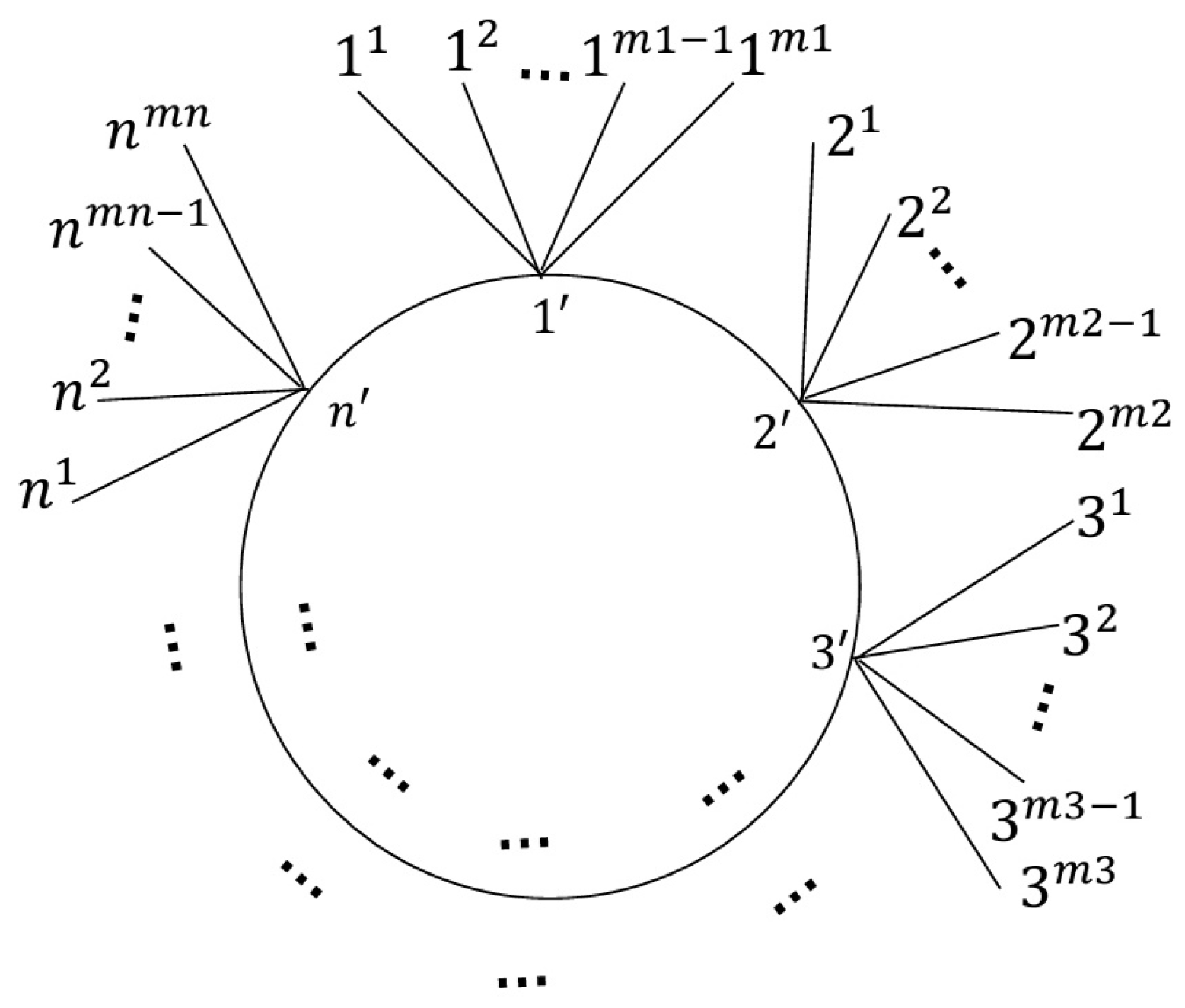
According to the type of COVID-19, there are four types of virus graphs (see Figure 5a) and by depending on these cases of virus graphs, Bhapkar et al. [22] defined the variable graphs, the variable set and their types of variable edge sets and variable vertex sets. Figure 5b represents the COVID-19 form, which is taken from [25]. Here, in Figure 6, we give the general graphical representation for COVID-19, which is in Figure 5b. Since in Figure 6, by Lemma 1, the upper a-neighborhood system of the upper a-graphical topological space is given in Table 5, where , for all and . The basis is given by for all and . That is, the upper a-graphical topological space is quasi-discrete and so disconnected. Since , is an ∩-upper connected graph and the upper a-graphical topological space is an ∩-upper discrete space.
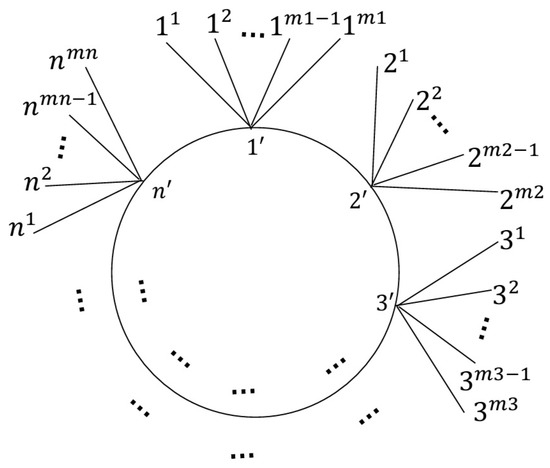
Figure 6.
General form of COVID-19.
Table 5.
An upper a-neighborhood system for Figure 6.
5. Conclusions
Note that the class of monophonic paths in the theory of undirected graphs is a subclass of the collection of paths and the concept of a rough approximation neighbourhood system in [13] of undirected simple graphs is an important concept in the theory of rough sets. Here, we used this subclass and a rough approximation neighbourhood system in the theory of simple graphs to define the operator . By using this operator, monophonic eccentric open neighborhood systems in [23] and an upper approximation neighbourhood system [13], we introduced a new neighborhood system, an upper a-neighborhood system. This neighborhood system gave us the concept of an upper a-graphical topological space and we proved the discrete property of path , complete graphs , cycle graphs and complete bipartite graphs . By this class of a-graphical topological spaces, we investigated and presented discrete, ∩-upper connectedness and ∩-upper discrete properties for some corresponding graphs concerning the COVID-19 form and its diffusion depending on some studies, such as the study of the COVID-19 pandemic spread of Kyoto city in Japan and Kentucky state in the USA, which were introduced in [20], the spread of COVID-19 in [21] and the four COVID-19 types, Ref. [22]. For future work, we suggest two cases, firstly, to study the connectedness and discrete properties for the form and diffusion of COVID-19 in the above studies by using out mondirected topological spaces, which are introduced in [19]. Secondly, we suggest studying the discrete, ∩-upper connectedness and ∩-upper discrete properties for the networks of the nervous system of the human body, which are introduced in [19].
Author Contributions
Conceptualization, F.H.D. and A.S.; methodology, F.H.D., A.K. and A.S.; validation, F.H.D., A.S., A.K. and M.B.M.; investigation, F.H.D., A.S. and A.K.; resources, F.H.D., A.K., F.A. and M.B.M.; writing—original draft, A.S., A.K., F.A. and M.B.M.; writing—review and editing, A.K. and F.A. All authors have read and agreed to the published version of the manuscript.
Funding
This research was funded by the Deanship of Scientific Research at the University of Ha’il—Saudi Arabia through project number RG-24 104.
Data Availability Statement
The original contributions presented in this study are included in the article. Further inquiries can be directed to the corresponding author.
Conflicts of Interest
The authors declare no conflicts of interest.
References
- Jafarian, A.S.; Jafarzadeh, A.; Khatibzadeh, H. An Alexandroff topology on graphs. Bull. Iran. Math. Soc. 2013, 39, 647–662. [Google Scholar]
- Nada, S.; El Atik, A.E.F.; Atef, M. New types of topological structures via graphs. Math. Method Appl. Sci. 2018, 41, 5801–5810. [Google Scholar] [CrossRef]
- Kiliçman, A.; Abdu, K.A. Topological spaces associated with simple graphs. J. Math. Anal. 2018, 9, 44–52. [Google Scholar]
- Abdu, K.A.; Kiliçman, A. Topologies on the edges set of directed graphs. J. Math. Comp. Sci. 2018, 18, 232–241. [Google Scholar] [CrossRef]
- Nianga, C.G.; Canoy, S. On topologies induced by graphs under some unary and binary operations. Eur. J. Pure Appl. Math. 2019, 12, 499–505. [Google Scholar] [CrossRef]
- Nianga, C.G.; Canoy, S. On a finite topological space induced by Hop neighbourhoods of a graph. Adv. Appl. Dis. Math. 2019, 21, 79–89. [Google Scholar]
- Sari, H.K.; Kopuzlu, A. On topological spaces generated by simple undirected graphs. AIMS Math. 2020, 5, 5541–5550. [Google Scholar] [CrossRef]
- Zomam, H.O.; Othman, H.A.; Dammak, M. Alexandroff spaces and graphic topology. Adv. Math. Sci. J. 2021, 10, 2653–2662. [Google Scholar] [CrossRef]
- Othman, A.; Ayache, A.; Saif, A. On L2-directed topological spaces in directed graphs theory. Filomat 2023, 37, 10005–10013. [Google Scholar] [CrossRef]
- Othman, A.; Al-Shamiri, M.; Saif, A.; Acharjee, S.; Lamoudan, T.; Ismail, R. Pathless directed topology in connection to the circulation of blood in the heart of human body. AIMS Math. 2022, 7, 18158–18172. [Google Scholar] [CrossRef]
- Abu-Gdairi, R.; El-Atik, A.A.; El-Bably, M.K. Topological visualization and graph analysis of rough sets via neighborhoods: A medical application using human heart data. AIMS Math. 2023, 8, 26945–26967. [Google Scholar] [CrossRef]
- Yao, Y. On generalized rough set theory, rough sets, fuzzy sets, data mining and granular computing. In Proceedings of the 9th International Conference, Chongqing, China, 26–29 May 2003; pp. 44–51. [Google Scholar]
- El Atik, A.E.; Nawar, A.; Atef, M. Rough approximation models via graphs based on neighborhood systems. Granul. Comput. 2021, 6, 1025–1035. [Google Scholar] [CrossRef] [PubMed]
- Guler, A. Different Neighbourhoods via Ideals on Graphs. J. Math. 2022, 2022, 9925564. [Google Scholar] [CrossRef]
- Bondy, J.A.; Murty, U. Graph theory, Graduate Texts in Mathematics; Springer: Berlin, Germany, 2008. [Google Scholar]
- Shokry, M.; Aly, R.E. Topological properties on graph vs medical application in human heart. Int. J. Appl. Math. 2013, 15, 1103–1109. [Google Scholar]
- Chiaselotti, G.; Ciucci, D.; Gentile, T.; Infusino, F. Rough set theory and digraphs. Fund. Inform. 2017, 153, 291–325. [Google Scholar] [CrossRef]
- Gamorez, A.; Nianga, C.G.; Canoy, S. Topologies induced by neighbourhoods of a graph under some binary operations. Eur. J. Pure Appl. Math. 2019, 12, 749–755. [Google Scholar] [CrossRef]
- Damag, F.H.; Saif, A.; Kiliçman, A.; Ali, E.E.; Mesmouli, M.B. On m-negative sets and out mondirected topologies in the human nervous system. Mathematics 2024, 12, 3763. [Google Scholar] [CrossRef]
- Reza Davahli, M.; Karwowski, W.; Fiok, K.; Murata, A.; Sapkota, N.; Farahani, F.; Awad, A.; Marek, T.; Taiar, R. The COVID-19 Infection Diffusion in the US and Japan: A Graph-Theoretical Approach. Biology 2022, 11, 125. [Google Scholar] [CrossRef] [PubMed]
- Ashokkumar, P.; Ramesh, P.; Kumar, P.; Rajadurai, H.; Maheshwari, V.; Allayear, S. Analysis on COVID-19 Infection Spread Rate during Relief Schemes Using Graph Theory and Deep Learning. Comput. Math. Methods Med. 2022, 2022, 8131193. [Google Scholar] [CrossRef]
- Bhapkar, H.R.; Mahalle, P.N.; Dhotre, P.S. Virus Graph and COVID-19 Pandemic: A Graph Theory Approach. Preprints 2022. [Google Scholar] [CrossRef]
- Anabel, E.G.; Sergio, R.C. On a topological space generated by Monophonic eccentric neighbourhoods of a graph. Eur. J. Pure App. Math. 2021, 14, 695–705. [Google Scholar]
- Dugundji, J. Topology; Allyn and Bacon, Inc.: Boston, MA, USA, 1966. [Google Scholar]
- Sina, K.; Pejman, R.; Mina, F.; Taiar, R. On-chip coronavirus shape antenna for wide band applications in terahertz band. J. Opt. 2023, 52, 860–867. [Google Scholar]
Disclaimer/Publisher’s Note: The statements, opinions and data contained in all publications are solely those of the individual author(s) and contributor(s) and not of MDPI and/or the editor(s). MDPI and/or the editor(s) disclaim responsibility for any injury to people or property resulting from any ideas, methods, instructions or products referred to in the content. |
© 2025 by the authors. Licensee MDPI, Basel, Switzerland. This article is an open access article distributed under the terms and conditions of the Creative Commons Attribution (CC BY) license (https://creativecommons.org/licenses/by/4.0/).