1. Introduction
In 1843, William Rowan Hamilton, an Irish mathematician, first introduced the concept of quaternions [
1]. Quaternions have since found numerous applications across a wide range of disciplines, including computer graphics, vision device development, animation representations, control theory, molecular dynamics, quantum theory, robot kinematics, and navigation devices. These applications have been extensively considered and documented in various sources, including references [
2,
3,
4,
5]. Quaternions have also been applied to the theory of curves and surfaces, leading to new interpretations and results. In 1987, Bharathi and Nagaraj demonstrated the use of quaternions to express the Serret–Frenet invariants of any curve [
6]. Subsequently, as well as quaternionic curves, rectifying and osculating quaternionic curves were given the attention of various researchers [
7,
8,
9,
10,
11,
12,
13]. Furthermore, modified Korteweg-de Vries equations were used to describe the motions of inextensible quaternionic curves, and these findings were presented in a research article that outlines the evolutions of inextensible quaternionic curves based on the Frenet formulae [
14].
Additionally, in 2005, Chen and Li established new correlations between quaternionic transformations and minimal surfaces, resulting in novel findings [
15]. Hoffman and Wang introduced a new technique that uses dual-quaternion multiplication to describe rigid transformations with dual quaternions, resulting in a family of rational surfaces in an affine 3-space. They specifically employed an approach to calculate all base points of the homogeneous tensor product parameterization of the resultant surfaces, together with three rational space curves [
16].
These examples highlight the versatility and utility of quaternions in diverse areas of mathematics and beyond. Ruled surfaces are structures that can be generated by moving a straight line along a curve. There have been numerous studies conducted in various spaces and frames. The concept of partner-ruled surfaces based on the Flc frame on a polynomial curve was introduced in [
17]. They investigated the requirements for two of these surfaces to be simultaneously developable and minimal. Şenyurt and Çalışkan investigated the ruled surface with the theory of quaternions and dual quaternions. They expressed integral invariants and obtained the ruled surfaces drawn by spatial quaternionic curves [
18,
19]. In [
20], the quaternionic ruled surfaces were analyzed according to the alternative frame. During this process, some noteworthy studies on quaternions and surfaces have been presented in [
21,
22,
23,
24].
In
Section 2, we present the geometric concepts regarding the basic structures of the paper mentioned in the introduction. In
Section 3, we investigate the spatial quaternionic expressions of partner-ruled surfaces. Moreover, we determine the striction curves, dralls, pitches, and angles of pitches for these surfaces.
Section 4 consists of a special example of the findings with graphical representations. The last section provides a summary of the article and highlights its main contributions and implications.
2. Preliminaries
In this section, we recall the concepts of quaternions [
1] and spatial quaternionic curves [
6]. We then explain some of the properties of spatial quaternionic ruled surfaces [
18]. Understanding these preliminary concepts is crucial for comprehending the subsequent discussions on the subject.
A real quaternion can be described as the sum of a scalar
and a vector
such that
where the components
,
,
,
are real numbers, and 1,
,
,
are quaternionic units that satisfy the multiplication rules given in
Table 1.
Here, the left column displays the left factor, and the top row displays the right factor.
The complex conjugate
is defined by
Let
Q denote the set of quaternions. The quaternion inner product is presented by the following real-valued, symmetric, and bilinear form:
For
and
, the quaternionic product is given by
where
and ∧ denote the inner product and cross-product in
. Thus, the quaternionic product satisfies
The square of the norm of a quaternion
q is
Provided that , the quaternion q is called the unit quaternion. The inverse of the quaternion q is given by where .
The space of the spatial quaternions is classified by
where
Q denotes the set of quaternions [
6].
Definition 1. A spatial quaternionic curve α is defined bywhere I is an interval in real line and is the arc-length parameter [6]. Theorem 1. Let α be a spatial quaternionic curve with the arc-length parameter s. Then, the Serret–Frenet formulae of the spatial quaternionic curve α at any point aresuch thatwhere the spatial quaternions , and B are the unit tangent, unit principal normal, and unit binormal of the spatial quaternionic curve α, respectively. Moreover, the scalar functions κ and τ are the curvature and torsion of α, respectively [6]. The spatial quaternion
is called the instantaneous Pfaffian quaternion along the motion of the Frenet frame
of a spatial quaternionic curve
[
18].
Definition 2. A spatial quaternionic ruled surface is represented bywhere α is a spatial quaternionic curve and X is a spatial quaternion [18]. Lemma 1. The drall and the striction curve of a spatial quaternionic ruled surface φ are given byandrespectively [18]. It is known that if a ruled surface satisfies for all , then the ruled surface is called closed.
Definition 3. For a given closed spatial quaternionic ruled surface, the magnitude is called the pitch of this surface [18]. Definition 4. The spatial quaternions D and V defined byandare called the Steiner rotation quaternion and Steiner translation quaternion of the closed motion of the Frenet frame of a closed spatial quaternionic curve α, respectively. Here, w is the instantaneous Pfaffian quaternion [18]. Theorem 2. The angle of pitch and the pitch of a closed spatial quaternionic ruled surface and are equal toandwhere D and V are the Steiner rotation and translation quaternions, respectively [18]. 3. Characterizations of the Spatial Quaternionic Partner-Ruled Surfaces
In this section, we examine the spatial quaternionic expressions of partner-ruled surfaces. Then, we calculate the striction curves and dralls of these surfaces. Finally, our investigation focuses on closed quaternionic ruled surfaces. We analyze their pitches and pitch angles and interpret these properties. Additionally, we use quaternionic formulas to calculate the integral invariants of these surfaces.
3.1. -Spatial Quaternionic Partner-Ruled Surfaces
Definition 5. Consider a differentiable spatial quaternionic curve that moves with a unit speed for its parameter s, and let denote the Frenet frame of this curve. The two spatial quaternionic ruled surfaces defined byare called -spatial quaternionic partner-ruled surfaces. Theorem 3. Let and be the striction curves of any -spatial quaternionic partner-ruled surfaces and . Then, the position vector of the striction curve on surface is equal to the tangent of the curve, and the position vector of the striction curve on surface is equal to the principal normal of the spatial quaternionic curve .
Proof. Let
be a unit-speed spatial quaternionic curve with the Frenet frame
. If we consider Equation (
3) and employ the quaternionic inner product, we find the equation of the striction curve of a spatial quaternionic ruled surface
as follows:
By taking the complex conjugate of a quaternion and applying Equation (
1), we arrive at
If we take the quaternionic product of the spatial quaternions, we obtain that the position vector of the striction curve corresponds to the tangent of the curve .
Again, we calculate the position vector of the striction curve
By a similar method, the striction curve of is found to be equal to the principal normal vector of the curve , and this completes the proof. □
Theorem 4. Let and be -spatial quaternionic partner-ruled surfaces; then, the dralls of the closed spatial quaternionic partner-ruled surfaces and arerespectively. Proof. Assuming
is a unit-speed spatial quaternionic curve with the Frenet frame
, the drall of the closed spatial quaternionic ruled surface
can be obtained by considering Equation (
2) and utilizing the quaternionic inner product. Specifically, the drall can be expressed as
We obtain the drall of the surface
by utilizing the quaternionic product of the spatial quaternions and the Frenet invariants. The computation is carried out as follows:
In a similar way, the drall of the surface
is determined by
□
Corollary 1. Let and be -spatial quaternionic partner-ruled surfaces; then, the -spatial quaternionic partner-ruled surfaces are developable surfaces if and only if the spatial quaternionic curve is planar.
Proof. The proof is obvious by the fact that the necessary and sufficient condition for a ruled surface to be developable is having a vanishing drall at each point of the surface, and the necessary and sufficient condition for a curve to be planar is having vanishing torsion at each point of the curve. □
Theorem 5. Let and be -spatial quaternionic partner-ruled surfaces; then, the angles of the pitch of the closed spatial quaternionic partner-ruled surfaces arerespectively. Proof. Assume
is a unit-speed spatial quaternionic curve with the Frenet frame
. By taking into consideration Equation (
6), we can express the angle of the pitch of the closed spatial quaternionic ruled surface
as
Using the quaternionic product of the spatial quaternions and Equation (
4), we calculate the angle of the pitch as follows:
On the other hand, the angle of the pitch
of the ruled surface
is maintained:
□
Theorem 6. Let and be -spatial quaternionic partner-ruled surfaces; then, the pitches of the closed spatial quaternionic partner-ruled surfaces and arerespectively. Proof. Assume that
is a unit-speed spatial quaternionic curve with the Frenet frame
. From Equation (
5) we obtain
, and from Equation (
7), the pitch
of the closed spatial quaternionic ruled surface
is written by
By referring to the definition of the quaternion inner product, we find
Hence, using the quaternionic product and the conjugate of a quaternion, we obtain
By making similar calculations, the pitch
of the closed spatial quaternionic ruled surface
is found:
□
3.2. -Spatial Quaternionic Partner-Ruled Surfaces
Definition 6. Consider a spatial quaternionic curve that is differentiable and moves at a unit speed for its parameter s, and let be the Frenet frame of the curve. The two spatial quaternionic ruled surfaces defined byare called -spatial quaternionic partner-ruled surfaces. Theorem 7. Let the surfaces and be spatial quaternionic partner-ruled surfaces; then, the striction curves and of the surfaces and arewhere and , respectively. Proof. Let
be a unit-speed spatial quaternionic curve with the Frenet frame
. By referring to Equation (
3) and using the quaternionic inner product, the striction curve of the spatial quaternionic ruled surface
can be written by
Using the complex conjugate of a quaternion and Equation (
1), we arrive at
Considering the quaternionic product of the spatial quaternions, the striction curve of
is
Similarly, from the equation
, one can easily find that the striction curve of
is
□
Theorem 8. Let and be any -spatial quaternionic partner-ruled surfaces; then, the dralls of the closed spatial quaternionic partner-ruled surfaces and arerespectively. Proof. Let
be a unit-speed spatial quaternionic curve with the Frenet frame
. The drall of the closed spatial quaternionic ruled surface
can be obtained by considering Equation (
2) and utilizing the quaternionic inner product. Specifically, the drall is expressed as
We compute the drall of the surface
by utilizing the quaternionic product of the spatial quaternions and the Frenet invariants. The computation is carried out as follows:
In a similar way, the drall of the surface
is determined by
□
Corollary 2. Let and be any -spatial quaternionic partner-ruled surfaces; then, the -spatial quaternionic partner-ruled surfaces are developable surfaces.
Proof. The proof is obvious by virtue that the necessary and sufficient condition for a ruled surface to be developable is having zero drall at each point of the surface. □
Theorem 9. Let and be any -spatial quaternionic partner-ruled surfaces; the angles of the pitch of the closed spatial quaternionic partner-ruled surfaces arerespectively. Proof. Assume
is a unit-speed spatial quaternionic curve with the Frenet frame
. Taking into consideration Equation (
6), the angle of pitch of the closed spatial quaternionic ruled surface
is written by
By referring to Equation (
4) and the definition of the quaternion inner product, we obtain
In a similar manner, the angle of the pitch
of the closed spatial quaternionic ruled surface
is calculated
□
Theorem 10. Let and be -spatial quaternionic partner-ruled surfaces; then, the pitches of the closed spatial quaternionic partner-ruled surfaces and arerespectively. Proof. Let
be a unit-speed spatial quaternionic curve with the Frenet frame
. From Equation (
5),
is found, and from Equation (
7), the pitch
of the closed spatial quaternionic ruled surface
is written by
From the definition of the quaternion inner product, it is found as
So, using the cross-product and the conjugate of a quaternion, we obtain
By making similar calculations, the pitch
of the closed spatial quaternionic ruled surface
is determined as
where
. □
Corollary 3. Let and be any -spatial quaternionic partner-ruled surfaces. The -spatial quaternionic partner-ruled surfaces represent cones.
Proof. The proof is obvious by virtue that the necessary and sufficient condition for a developable ruled surface to be a cone is having zero pitch at each point of the surface. □
3.3. -Spatial Quaternionic Partner-Ruled Surfaces
Definition 7. Consider a spatial quaternionic curve that is differentiable and moves at a unit speed for its parameter s, and let be Frenet frame of the curve. The two spatial quaternionic ruled surfaces defined byare called -spatial quaternionic partner-ruled surfaces. Theorem 11. Let the surfaces and be spatial quaternionic partner-ruled surfaces; then, the striction curves and of the surfaces and arerespectively. Proof. Let
be a unit-speed spatial quaternionic curve with the Frenet frame
. By considering Equation (
3) and using the quaternionic inner product, the striction curve of the spatial quaternionic ruled surface
can be written by
If we consider Equations (
1) and (
3), we can prove using similar methods of Theorem 3. □
Theorem 12. Let and be -spatial quaternionic partner-ruled surfaces; then, the dralls of the closed spatial quaternionic partner-ruled surfaces and are and , respectively.
Proof. By considering Equation (
2), the proof is completed in a similar way to the proof of Theorem 4. □
Corollary 4. Let and be any -spatial quaternionic partner-ruled surfaces; then, the spatial quaternionic partner-ruled surfaces are developable surfaces if and only if the spatial quaternionic curve is a straight line.
Proof. The necessary and sufficient condition for a ruled surface to be developable is having zero drall at each point of the surface, and the necessary and sufficient condition for a curve to be a straight line is having zero curvature at each point of the curve. These prove the corollary. □
Theorem 13. Let and be any -spatial quaternionic partner-ruled surfaces; then, the angles of the pitch of the closed spatial quaternionic partner-ruled surfaces are and respectively.
Proof. By considering Equations (
4) and (
6), the proof is completed similarly to the proof of Theorem 5. □
Theorem 14. Let and be -spatial quaternionic partner-ruled surfaces; then, the pitches of the closed spatial quaternionic partner-ruled surfaces and are respectively.
Proof. By considering Equations (
5) and (
7), the proof is completed similarly to the proof of Theorem 6. □
Corollary 5. Let and be -spatial quaternionic partner-ruled surfaces. Then, the following expressions are satisfied:
- i.
The surface is a cone if and only if the curve is a straight line.
- ii.
The surface is a cone if and only if the curve is a planar curve.
Proof. The necessary and sufficient condition for a developable ruled surface to be a cone is having zero pitch at each point of the surface, and the necessary and sufficient condition a curve to be a straight line (planar) is having zero curvature (torsion) at each point of the curve. These prove the corollary. □
4. A Particular Example for Spatial Quaternionic Partner-Ruled Surfaces
Let us consider a spatial quaternionic curve given by the parametric equation
The Frenet elements of the spatial quaternionic curves
are
and the
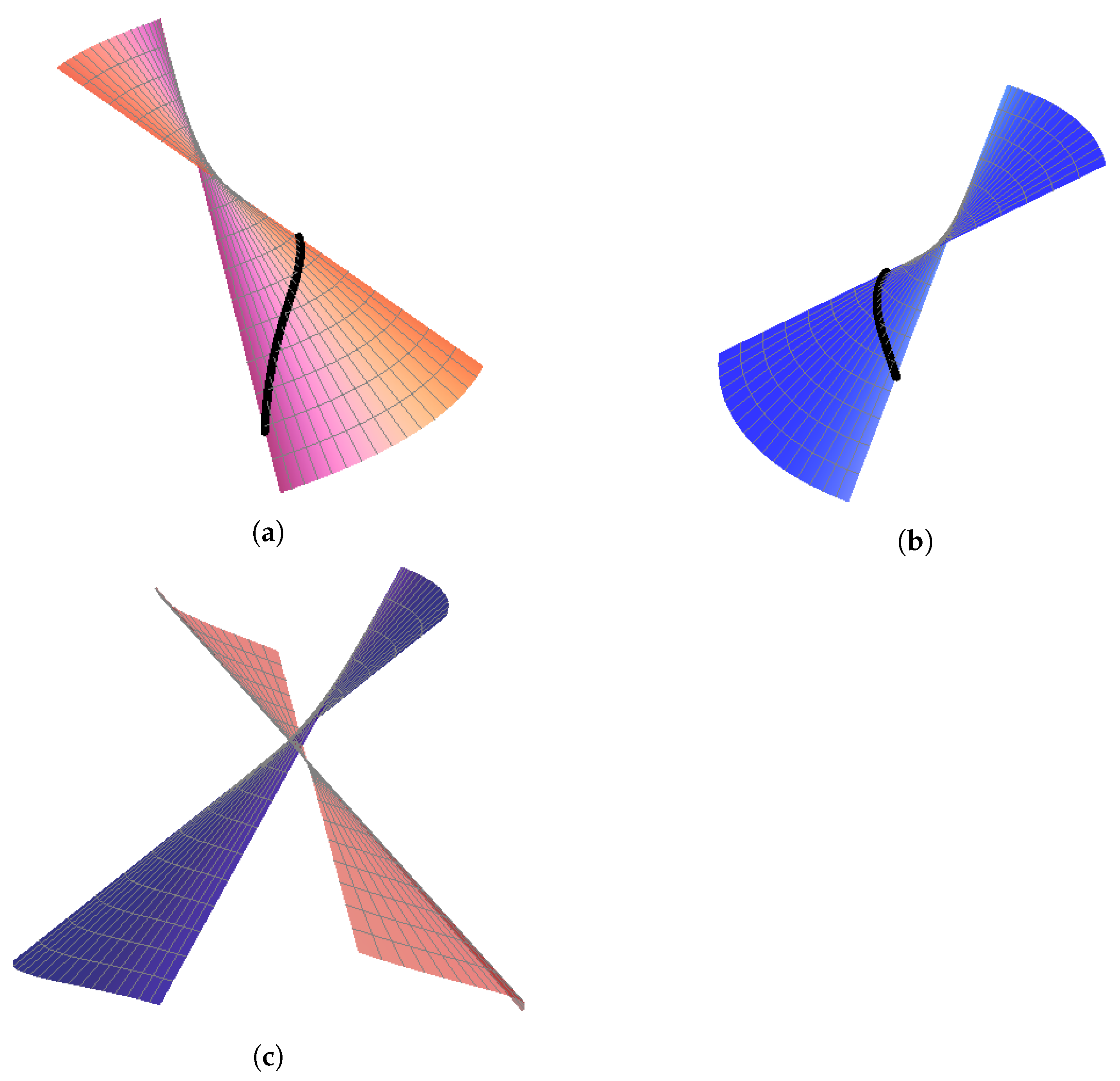
-spatial quaternionic partner-ruled surfaces are found as
Obviously, the striction curves of these
-spatial quaternionic partner-ruled surfaces are
respectively; see
Figure 1.
In a similar manner, the parametric forms of the
-spatial quaternionic partner-ruled surfaces and their striction curves are found as
respectively; see
Figure 2.
Similarly, the parametric forms for the
-spatial quaternionic partner-ruled surfaces and their striction curves are found as
respectively; see
Figure 3.
5. Conclusions
In this paper, we derived the spatial quaternionic partner-ruled surfaces formed by spatial quaternions, which are Frenet elements of a spatial quaternionic base curve. Then, we determined the striction curves and dralls of these surfaces. Additionally, the conditions of these partner-ruled surfaces to be developable were investigated. Under consideration, the quaternionic partner-ruled surfaces were closed, and the pitches and angles of pitches of them were found. The integral invariants of these partner surfaces were calculated by using quaternionic products.
Author Contributions
Conceptualization, K.E.; formal analysis, S.E., K.E. and A.Ç.; investigation, S.E., K.E. and A.Ç.; methodology, S.E., K.E. and A.Ç.; supervision, S.E.; writing—original draft, K.E.; writing—review and editing, S.E., K.E. and A.Ç. All authors have read and agreed to the published version of the manuscript.
Funding
This work was funded by Sakarya University.
Data Availability Statement
The original contributions presented in the study are included in the article; further inquiries can be directed to the corresponding author.
Conflicts of Interest
Author Kemal Eren was employed by the Sakarya University Technology Developing Zones Manager Company. The remaining authors declare that the research was conducted in the absence of any commercial or financial relationships that could be construed as a potential conflict of interest.
References
- Hamilton, W.R. Elements of Quaternions, 3rd ed.; Chelsea Publishing Co.: New York, NY, USA, 1969; Volume I–II. [Google Scholar]
- Girard, P.R. The quaternion group and modern physics. Eur. J. Phys. 1984, 5, 25–32. [Google Scholar] [CrossRef]
- Hanson, J.A.; Ma, H. Quaternion frame approach to streamline visualization. IEEE Trans. Vis. Comput. Graph. 1984, 1, 164–173. [Google Scholar] [CrossRef]
- Kou, K.I.; Xia, Y.H. Linear quaternion differential equations: Basic theory and fundamental results. Stud. Appl. Math. 2018, 141, 3–45. [Google Scholar] [CrossRef]
- Shoemake, K. Animating rotation with quaternionic curves. ACM SIGGRAPH Comput. Graph. 1985, 9, 245–253. [Google Scholar] [CrossRef]
- Bharathi, K.; Nagaraj, M. Quaternion valued function of a real Serret-Frenet formulae. Indian J. Pure Appl. Math. 1985, 16, 741–756. [Google Scholar]
- Soyfidan, T.; Parlatıcı, H.; Güngör, M.A. On the quaternionic curves according to parallel transport frame. TWMS J. Pure Appl. Math. 2013, 4, 194–203. [Google Scholar]
- Erişir, T.; Güngör, M.A. Some characterizations of quaternionic rectifying curves in the semi-Euclidean space . Honam Math. J. 2014, 36, 67–83. [Google Scholar] [CrossRef]
- Güngör, M.A.; Erişir, T. On the quaternionic curves in the semi-Euclidean space . Casp. J. Math. Sci. 2018, 7, 36–45. [Google Scholar] [CrossRef]
- Giardino, S. A primer on the differential geometry of quaternionic curves. Math. Methods Appl. Sci. 2021, 44, 14428–14436. [Google Scholar] [CrossRef]
- Giardino, S. Winding number and homotopy for quaternionic curves. Int. J. Geom. Methods Mod. Phys. 2022, 19, 2250087. [Google Scholar] [CrossRef]
- Gök, İ.; Okuyucu, Z.; Kahraman, F.; Hacısalihoğlu, H.H. On the quaternionic B2-slant helices in the Euclidean space E4. Adv. Appl. Clifford Algebr. 2011, 21, 707–719. [Google Scholar] [CrossRef]
- Kişi, İ.; Büyükkütük, S.; Öztürk, G. Quaternionic curves which lie on the special planes in 4-dimensional Euclidean space E4. J. Math. 2024, 2024, 8. [Google Scholar] [CrossRef]
- Eren, K. Motion of inextensible quaternionic curves and modified Korteweg-de Vries equation. An. Ştiint. Univ. “Ovidius” Constanţa Ser. Mat. 2022, 30, 91–101. [Google Scholar] [CrossRef]
- Chen, J.; Li, J. Quaternionic maps and minimal surfaces. Ann. Scuola Norm. Sup. Pisa Cl. Sci. 2005, 4, 375–388. [Google Scholar] [CrossRef]
- Hoffman, J.W.; Wang, H. Special syzygies of rational surfaces generated by dual quaternions. J. Algebra Comput. Appl. 2022, 3, 100004. [Google Scholar] [CrossRef]
- Li, Y.; Eren, K.; Ayvacı, K.H.; Ersoy, S. Simultaneous characterizations of partner ruled surfaces using Flc frame. AIMS Math. 2022, 7, 20213–20229. [Google Scholar] [CrossRef]
- Şenyurt, S.; Çalışkan, A. The quaternionic expression of ruled surfaces. Filomat 2018, 32, 5753–5766. [Google Scholar] [CrossRef]
- Çalışkan, A.; Şenyurt, S. The dual spatial quaternionic expression of ruled surfaces. Therm. Sci. 2019, 23, 403–411. [Google Scholar] [CrossRef]
- Çalışkan, A. The quaternionic ruled surfaces in terms of alternative frame. Palest. J. Math. 2022, 11, 406–412. [Google Scholar]
- Gök, İ. Quaternionic approach of canal surfaces constructed by some new ideas. Adv. Appl. Clifford Algebr. 2017, 27, 1175–1190. [Google Scholar] [CrossRef]
- Aslan, S.; Yaylı, Y. Canal surfaces with quaternions. Adv. Appl. Clifford Algebr. 2016, 26, 31–38. [Google Scholar] [CrossRef]
- Çanakcı, Z.; Oğulcan, T.O.; Gök, İ.; Yaylı, Y. The construction of circular surfaces with quaternions. Asian-Eur. J. Math. 2019, 12, 1950091. [Google Scholar] [CrossRef]
- Aslan, S.; Bekar, M.; Yaylı, Y. Ruled surfaces constructed by quaternions. J. Geom. Phys. 2021, 161, 104048. [Google Scholar] [CrossRef]
| Disclaimer/Publisher’s Note: The statements, opinions and data contained in all publications are solely those of the individual author(s) and contributor(s) and not of MDPI and/or the editor(s). MDPI and/or the editor(s) disclaim responsibility for any injury to people or property resulting from any ideas, methods, instructions or products referred to in the content. |
© 2024 by the authors. Licensee MDPI, Basel, Switzerland. This article is an open access article distributed under the terms and conditions of the Creative Commons Attribution (CC BY) license (https://creativecommons.org/licenses/by/4.0/).