
Abstract
In this paper, we derive a new generic equality for the first-order differentiable functions. Through the utilization of the general identity and convex functions, we produce a family of upper bounds for numerous integral inequalities like Ostrowski’s inequality, trapezoidal inequality, midpoint inequality, Simpson’s inequality, Newton-type inequalities, and several two-point open trapezoidal inequalities. Also, we provide the numerical and visual explanation of our principal findings. Later, we provide some novel applications to the theory of means, special functions, error bounds of composite quadrature schemes, and parametric iterative schemes to find the roots of linear functions. Also, we attain several already known and new bounds for different values of and parameter .
MSC:
26A33; 26A51; 26D07; 26D10; 26D15; 26D20
1. Introduction
Among all of the fundamental functions in mathematical analysis, convexity-preserving functions exhibit numerous fascinating geometrical and analytical properties. They play a vital role in various scientific domains, including optimization, topology, functional analysis, economics, neural networking, and differential equations. However, its impact on the development of integral inequalities is unparalleled, as it provides a straightforward approach for estimating various mathematical quantities, making it particularly useful for error estimations in the form of inequalities. The theory of inequalities is extensively studied from multiple perspectives, including fractional calculus, quantum calculus, interval analysis, and functions of bounded variation. Many well-known results in inequalities are directly or indirectly linked to convex functions. Dynamic and error inequalities, such as the Hermite–Hadamard inequality, Jensen’s inequality, Jensen–Mercer inequality, Hardy inequality, Ostrowski’s inequality, and Simpson’s inequality, have been examined via convex functions. The error analysis of the quadrature rule is investigated for various purposes, often with the aim of determining tight bounds or upper bounds. One key research problem is how to find the error term for certain functions that are not sufficiently differentiable. For instance, deriving error terms for Newton–Cotes formulas when only first-order differentiable functions are available presents a challenge. To address this, several approaches have been developed using integrable kernels and other mathematical tools such as functions of bounded variation, Lipschitz continuous functions, generalized variation, Montgomery identity, and Taylor series. In 1998, Dragomir and Agarwal [1] introduced a systematic approach for developing upper bounds for the trapezoidal rule using first-order differentiable identity and convex functions. Following this approach, numerous inequalities have been explored for convex functions and their generalizations. For more details, see references [2,3,4].
Here, we revisit the famous Ostrowski’s inequality, which is explored as follows: Let be a differentiable function and . If , then
This inequality predicts the error estimates of one one-point rule and mid-point rule. Furthermore, it has a significant impact on probability theory, special functions, and numerical analysis as well. It is investigated from approaches involving bounded variation, Lipschitzian, convex, and n times differentiable functions in the frame of classical calculus, fractional calculus, and time scale calculus.
Bohner and Matthews [5] examined the Ostrwoski-like inequalities via time scale concepts. In [6], the author formulated some versions of Ostrowski’s inequalities through the mean value theorem. In 2002, Anastassiou [7] analyzed the novel Ostrowski-type inequalities and Montgomery identities for nth-order differentiable functions. For detailed information, see [8,9,10].
First, we recollect the error inequality of Simpson’s rule, which is stated as:
If is four times continuously differentiable on
then
Also, we recover the error inequality of the Simpson, s, or Newton inequality.
If is four times continuously differentiable on
then
These inequalities are explored through various approaches to find more accurate and refined bounds. In 1998, Dragomir et al. [11] initiated a new way of thinking about these inequalities for first-order differentiable functions to determine upper bounds. Following this, Liu [12] developed Simpson-like inequalities for nth order differentiable functions to generalize previous results. In 2009, Alomari et al. [13] discussed Simpson-type inequalities via generalized convex functions. Sarikaya et al. [14] derived several new estimates of Simpson’s inequality through differentiable s-convex functions. For more information, see [15,16]. In [17], the authors introduced a new technique to investigate various inequalities by generalized kernels based on parameters. In 2000, Hanna et al. [18] constructed the two-dimensional Ostrowski’s inequality over the rectangular domain. In [19], Alomari and Dragomir unified the error inequalities of two-, three-, and four-point quadrature rules via a new generic kernel involving three parameters. In 2022, Iftikhar et al. [20] established a fresh two-dimensional lemma and computed new coordinated Newton-like inequalities associated with convex functions. In [21], the authors utilized quantum calculus to evaluate both kinds of Simpson’s inequality. Moreover, in [22], Butt and colleagues proved the majorized Simpson- and Newton-type inequalities with applications. In 2023, Meftah [23] studied Maclaurin-like inequalities incorporated with convex functions in the setting of multiplicative calculus. In 2023, Peng and Du [24] constructed some multiplicative analogues of Maclaurin’s inequality involving a p class of functions. Furthermore, In the same year, Hezenci [25] studied the conformable fraction analogues of corrected Euler–Maclaurin-like inequalities through convexity. In 2013, Alomari [26] for the first time estimated the bounds for Milne’s quadrature rule by lowering the derivative and using convex functions. Budak et al. [27] established the fractional counterparts of Milne’s schemes via convex functions. Bin-Mohsin et al. [28] utilized the Mercer approach and quantum calculus to derive the bounds for Milne’s inequality. In [29], Tseng et al. computed the Bullen-type inequalities by taking into account Lipschitzian function and presented some applications. In [30], Cakmak developed Bullen-type inequalities by making use of conformable fractional operators. The conformable operators satisfy several properties that other operators do not satisfy. In [31], Du and Cao established the fractional general family of Bullen’s inequality with implications. Cortez et al. [32] investigated the Bullen–Mercer-type inequalities and explored their efficacy by presenting novel applications to the iterative method. In 2012, Xi and Qi [33] investigated a unified governing equation for first-order differentiable function and deduced several new and interesting inequalities. Nwaeze and Tameru [34] investigated the blended form of inequalities through -quasi convexity in the quantum setting. For further details, see [35,36,37].
This paper will establish a new general class of error bounds incorporated with convex functions. To achieve our goal, we distribute our study into four major parts: We initiate our study by revisiting the essential facts and previous work to discuss the problem’s background. In the next section, we build a new parametric equality, which plays a vital role in the further proceedings. Due to the generic nature of this identity, several new and known identities can be achieved to deduce bounds for numerical quadrature strategies. Then, we will construct unified bounds of error inequalities by considering the key auxiliary result, well-known inequalities, and convexity of first-order differentiable functions. Also, we will deliver several new and known consequences of the primary findings. Next, we will present numerous graphical visualisations of the main results. Finally, we will deliver the implementations of primary findings in terms of numerical integration, modified Bessel functions, theory of means, and novel iterative scheme as well as its convergence analysis.
2. Main Results
In the subsequent part, we derive the new unified error boundaries of both open and closed Newton–Cotes integration schemes through convex functions. Here, represents the space of all integral functions.
2.1. Auxiliary Result
We now prove a new unified identity for first-order differentiable functions depending on parameter .
Lemma 1.
Let be a differentiable function and ; then
where and , satisfying the condition .
Proof.
From the right-hand side of (1), we have
where
Also,
And
Adding , and , we achieve our desired result. □
Now, we report some novel consequences of Lemma 1:
- Choosing in (1), we obtain
- Choosing and in (1),
- Choosing and , we then obtain the trapezium equation established in [1].
- Choosing and in (1), we then obtain the Simpson’s equality established in [13].
- Choosing and in (1), we then obtain the Newton’s equality established in [39].
2.2. Bounds for Several Error Inequalities Involving Convex Functions
Theorem 1.
Presume that all conditions of Lemma 1 are fulfilled. If is a convex function, then
where
Proof.
Through Lemma 1 and implementing the convexity of , we have
Some simple computations yield the required result. □
Now, we discuss some consequences of Theorem 1.
Corollary 1
([38]). By selecting and , we have
Corollary 2.
By selecting and , we have
Corollary 3.
By selecting and , we have
Corollary 4.
By selecting , we have
where
and and are defined in Theorem 1.
Corollary 5.
By selecting and , we have
Corollary 6.
By selecting and , we have
Corollary 7.
By selecting and , we have
Corollary 8.
By selecting and , we have
Corollary 9.
By selecting and , we have
Theorem 2.
Presume that all conditions of Lemma 1 are fulfilled. If is a convex function, then
where (–) are proved in Theorem 1 and
Proof.
Through Lemma 1, using power mean inequality and implementing the convexity of , we have
Some simple computations determine the required result. □
Now we discuss some consequences of Theorem 2.
Corollary 10
([38]). By selecting and , we have
Corollary 11.
By selecting and , we have
Corollary 12.
By selecting and , we have
Corollary 13.
By selecting , we have
where
where , and are defined in Corollary 36, and and are defined in Theorem 1.
Corollary 14.
By selecting and , we have
Corollary 15.
By selecting and , we have
Corollary 16.
By selecting and , we have
Corollary 17.
By selecting and , we have
Corollary 18.
By selecting and , we have
Theorem 3.
Presume that all conditions of Lemma 1 are fulfilled. If is a convex function, then
where
Proof.
Through Lemma 1, using Hölder’s inequality and implementing the convexity of , we have
Some simple computations provide the required result. □
Now, we discuss some consequences of Theorem 3.
Corollary 19
([38]). By selecting and , we have
Corollary 20.
By selecting and , we have
Corollary 21.
By selecting and , we have
Corollary 22.
By selecting , we have
where
Corollary 23.
By selecting and , we have
Corollary 24.
By selecting and , we have
Corollary 25.
By selecting and , we have
Corollary 26.
By selecting and , we have
Corollary 27.
By selecting and , we have
Theorem 4.
Presume that all conditions of Lemma 1 are fulfilled. If is a convex function, then
where , and are obtained in Theorem 3.
Proof.
Through Lemma 1, using Young’s inequality and implementing the convexity of , we have
Some simple computations provide the required result. □
Now, we discuss some consequences of Theorem 4.
Corollary 28.
By selecting and , we have
Corollary 29.
By selecting , we have
where , and are defined in Corollary 22.
Corollary 30.
By selecting and , we have
Corollary 31.
By selecting and , we have
Corollary 32.
By selecting and , we have
Theorem 5.
Presume that all conditions of Lemma 1 are fulfilled. If is a convex function and such that , then
Proof.
The proof is contained for curious readers. □
Now, we discuss some consequences of Theorem 5.
Corollary 33.
By selecting and , we have
Corollary 34.
By selecting and , we have
Corollary 35.
By selecting and , we have
Corollary 36.
By selecting , we have
Corollary 37.
By selecting and , we have
Corollary 38.
By selecting and , we have
Corollary 39.
By selecting and , we have
Corollary 40.
By selecting and , we have
Corollary 41.
By selecting and , we have
Remark 1.
By different choices of ξ and corresponding γ in Theorems 1–5, we can generate several novel error boundaries for Newton–Cotes schemes.
3. Visual Analysis
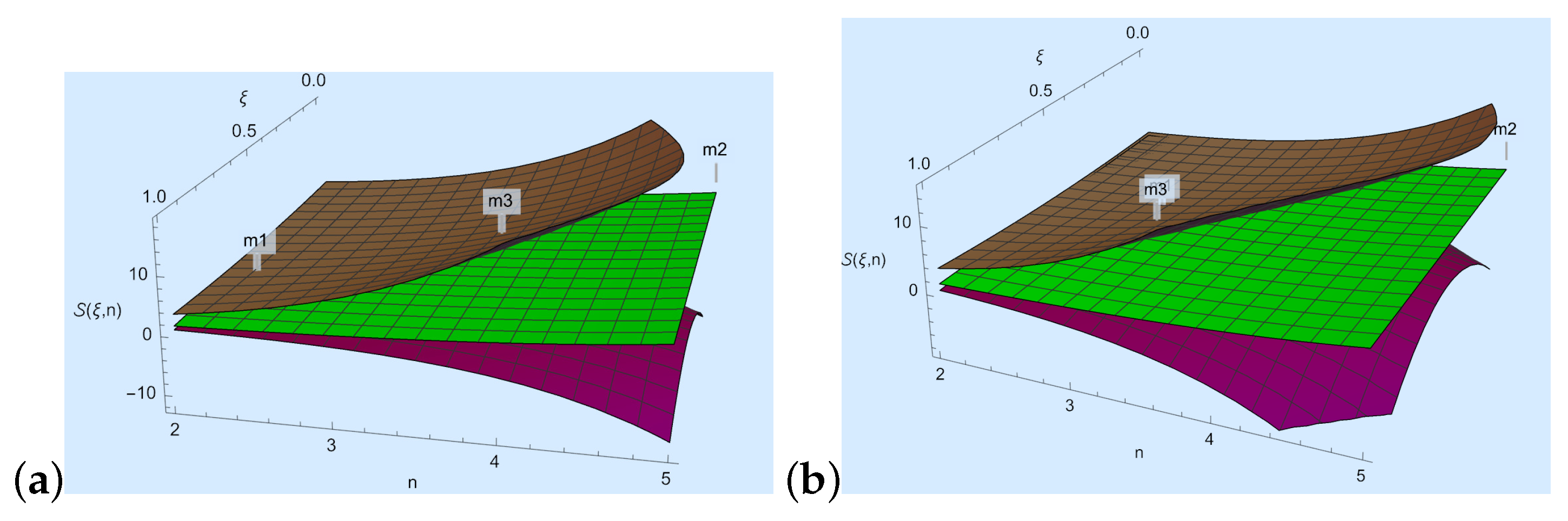
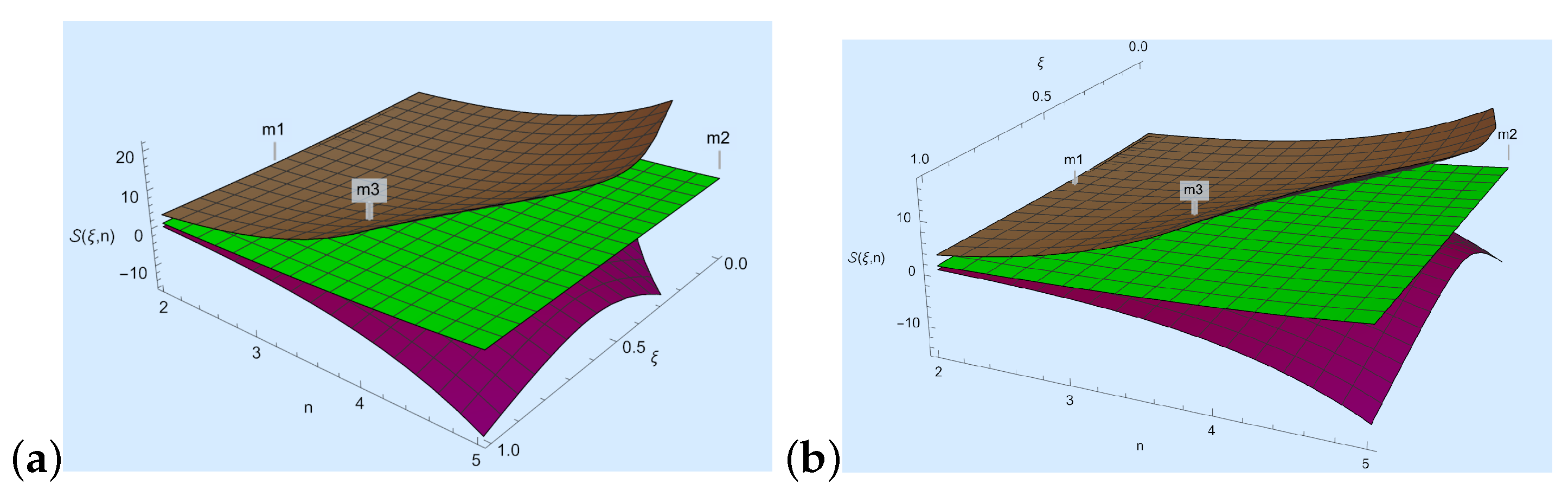
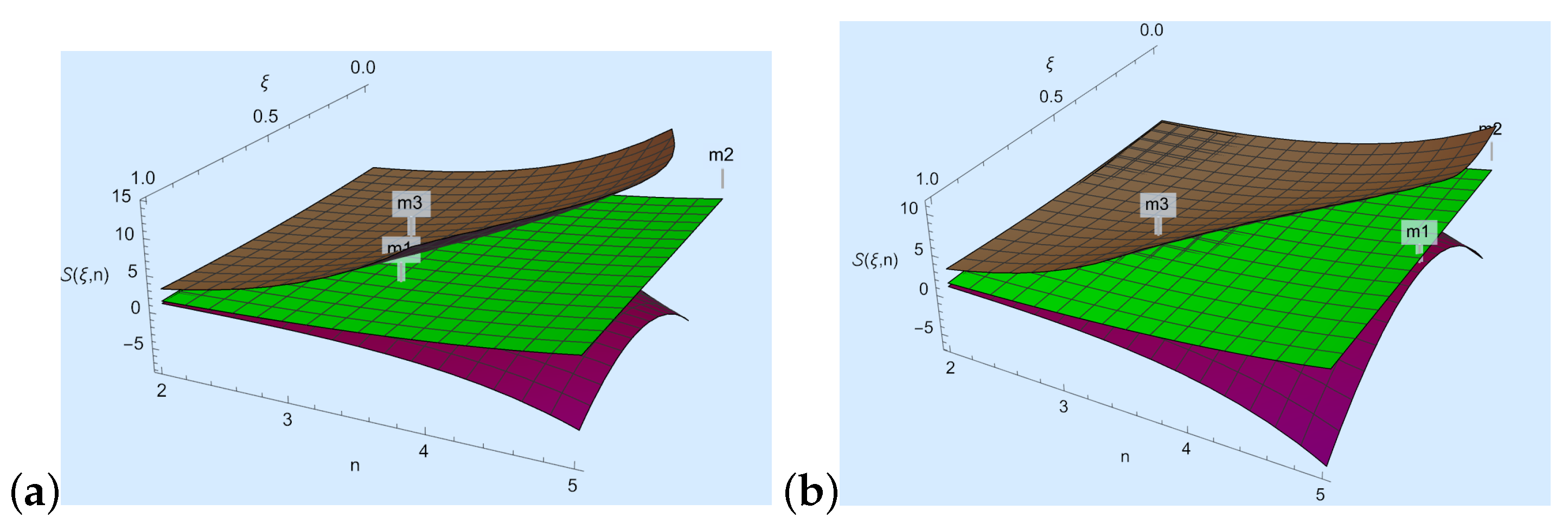
In the current portion of the study, we showcase the correctness of our primary findings aided with convex functions. First, we discuss Theorem 1.
- We take , , , and in Theorem 1; then, , where
- For Figure 1a, we choose and n to develop a visual explanation of Theorem 1 at .
Figure 1. Here, the purple, green, and brown colors represent , and , respectively. - For Figure 1b, we choose and n to a develop visual explanation of Theorem 1 at .
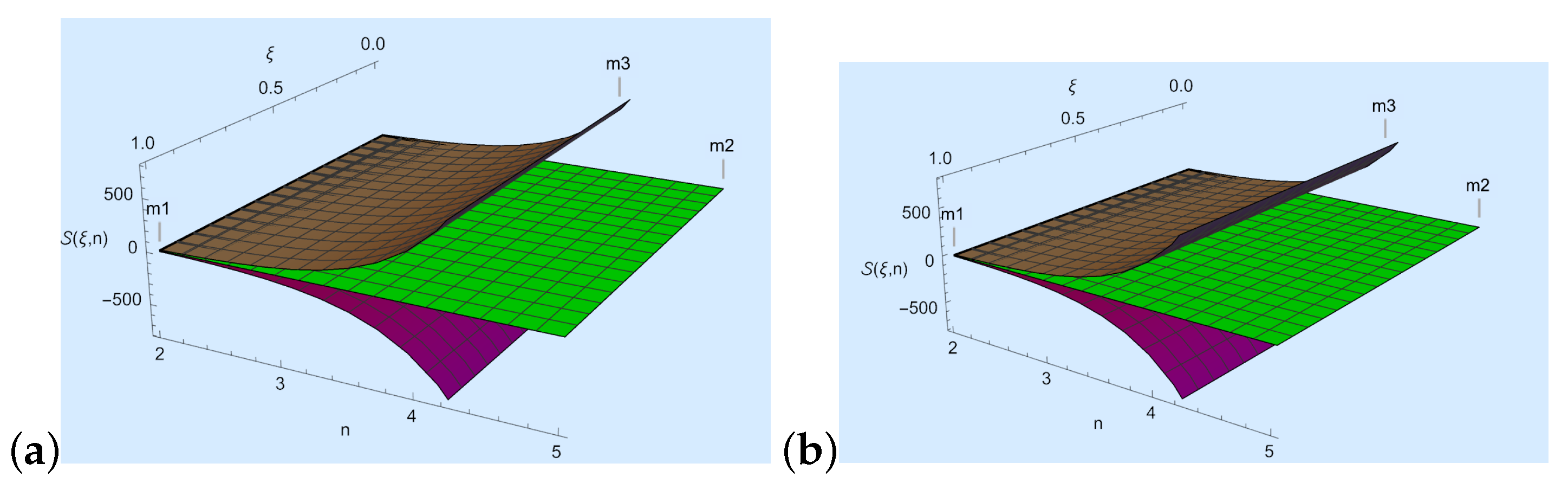
Now, we discuss Theorem 2.
- We take , , , and in Theorem 2; then, , where
- For Figure 2a, we choose and n to develop a visual explanation of Theorem 2 at .
Figure 2. Here, the purple, green and brown colors represent , and , respectively. - For Figure 2b, we choose and n to develop a visual explanation of Theorem 2 at .
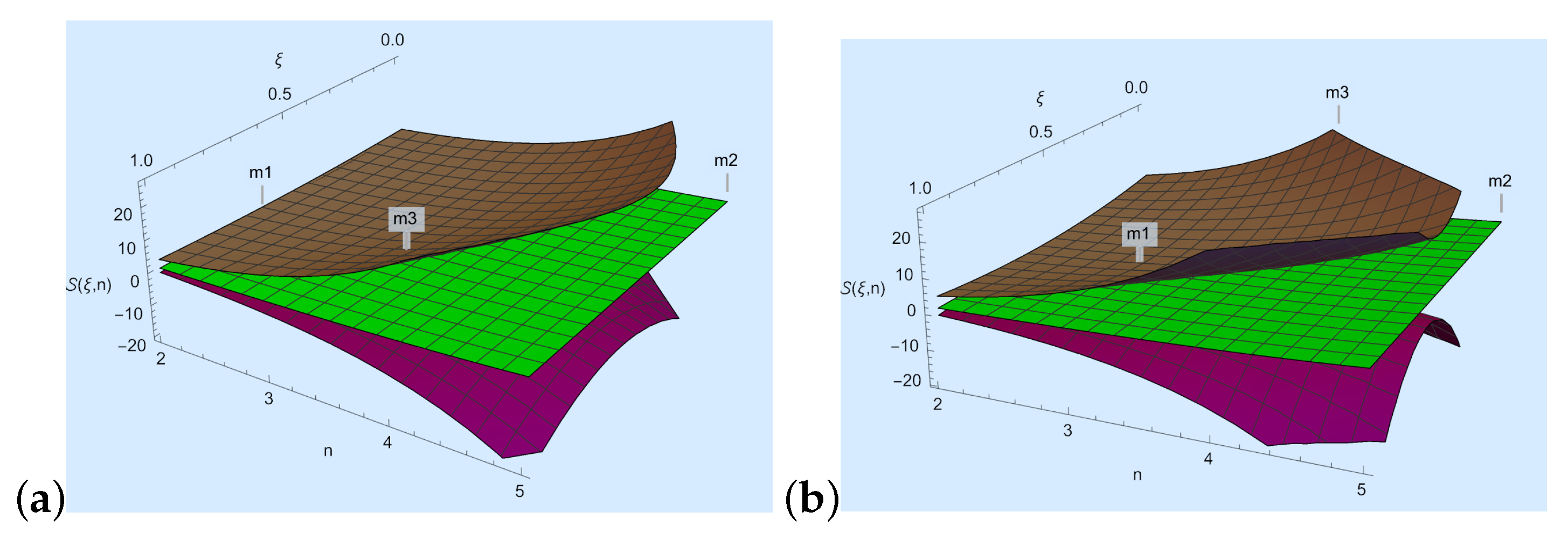
Now, we discuss Theorem 3.
- We take , , , , and in Theorem 3; then, , where
- For Figure 3a, we choose and n to develop a visual explanation of Theorem 3 at .
Figure 3. Here the purple, green, and brown colors represent , and , respectively. - For Figure 3b, we choose and n to develop a visual explanation of Theorem 3 at .
Now, we discuss Theorem 4.
- We take , , , , and in Theorem 4; then, , where
- We take , , , and in Theorem 4, then , where
- For Figure 4a, we choose and n to develop a visual explanation of Theorem 4 at .
Figure 4. Here, the purple, green, and brown colors represent , and , respectively. - For Figure 4b, we choose and n to develop a visual explanation of Theorem 4 at .
Now, we discuss Theorem 5.
- We take , , , , and in Theorem 4; then, , where
- We take , , , , and in Theorem 5; then, , where
4. Applications
Finally, we address some novel applications of our produced results to the theory of means, error inequalities of composite quadrature rules, special functions, and generalized iterative schemes.
4.1. Error Boundaries of Composite Newton–Cotes Schemes
Let be a partition of and ; then, using the unified composite Newton–Cotes formula,
satisfying the conditions . Also,
Proposition 1.
From Theorem 1, we have
where
Proof.
Employ Theorem 1 on such that and take the sum from to . □
Proposition 2.
From Theorem 1, we have
Proof.
Employ Theorem 4 on such that , and then take the sum from to . □
Remark 2.
For different choices of ξ and , we can obtain various known and new error inequalities for composite closed- and open-type Newton–Cotes formulas. For example, by choosing and , we obtain the error estimate of the midpoint inequality and open trapezoidal-type inequalities, respectively. Furthermore, for and , we acquire the error bound of the composite Simpson’s inequality, Newton-type inequality, and Bullen’s inequality, respectively.
4.2. Applications for the Linear Combination of Means
In the subsequent part, we explore the impact of our study on the theory of means. To accomplish our goal, first we recapture the well-known binary means of positive real numbers.
- .
Proposition 3.
From Theorem 3, we have
Also
where , and are defined in Theorem 3.
Proof.
Applying the convex function , and on Theorem 3, we achieve our desired relations. □
Proposition 4.
From Theorem 4, we have
Also
where , and are defined in Theorem 3.
Proof.
Applying the convex function , and on Theorem 4, we achieve our desired relations. □
4.3. Application for Special Functions
Let be defined by
For this, we retrospect the representation of modified Bessel functions, which is given as detailed in [40]:
The first and nth-order derivative formula’s , which are given as detailed in [41]:
where is a hypergeometric function, and its integral and summation representation are given as:
Proposition 5.
For any and , then
where (–) are defined in Theorem 1.
Proof.
To attain the final outcome, we implement in Theorem 1. □
4.4. Family of Iterative Methods to Find the Roots of Non-Linear Equations
Now, we provide another significant implication of the proposed results to evaluate the roots of non-linear equations.
Consider
It is a very interesting research topic in the realm of numerical analysis to derive the roots of non-linear equations. In the following context, various approaches have been deployed to construct new methodologies like quadrature formulae, interpolating polynomials, Taylor’s series, and decomposition procedures. Methods like Newton’s, Halley’s, and Householder’s are the best classical methods, which still served as a base point for further proceedings. Now, we construct a novel family of iterative methods by using the general error bounds obtained in Theorem 5.
Proposition 6.
For any such that is a non-linear equation, then
where
Remark 3.
- By taking in Proposition 6, we then have the following iterative schemewhere is already defined in Proposition 6.
- By taking in Proposition 6, we have the following iterative schemewhere is already defined in Proposition 6.
- By taking in Proposition 6, we then have the following iterative schemewhere is already defined in Proposition 6.
- It is worth noting that for different choices of γ and ξ in Theorem 5, we can generate a family of iterative methods, as well as by making use of another method in place of Newton’s method as corrector methods.
Now, we investigate the convergence analysis of (4).
Theorem 6.
Let be a simple zero of sufficiently differentiable function on . If is sufficiently close to r, then Equation (4) has a third order of convergence for any .
4.5. Examples and Visual Analysis of Equation (4)
Initially, we explore some physical examples in light of Equation (4).
- In our first example, we consider the problem related to the plug flow of Casson fluids of blood in the rheology and fractional non-linear equations model [42]. The fall in flow rate can be estimated through the following equationhere, we choose , and by selecting the initial guess of , Equation (4) with results in the required root in the third iteration.
- Now, we consider the problem related to permeability in Biogels [42]. The dependence of pressure and velocity is demonstrated by the following equation:where , , and as the initial guess. Then, Equation (4) with predicts the desired solution in 13 iterations.
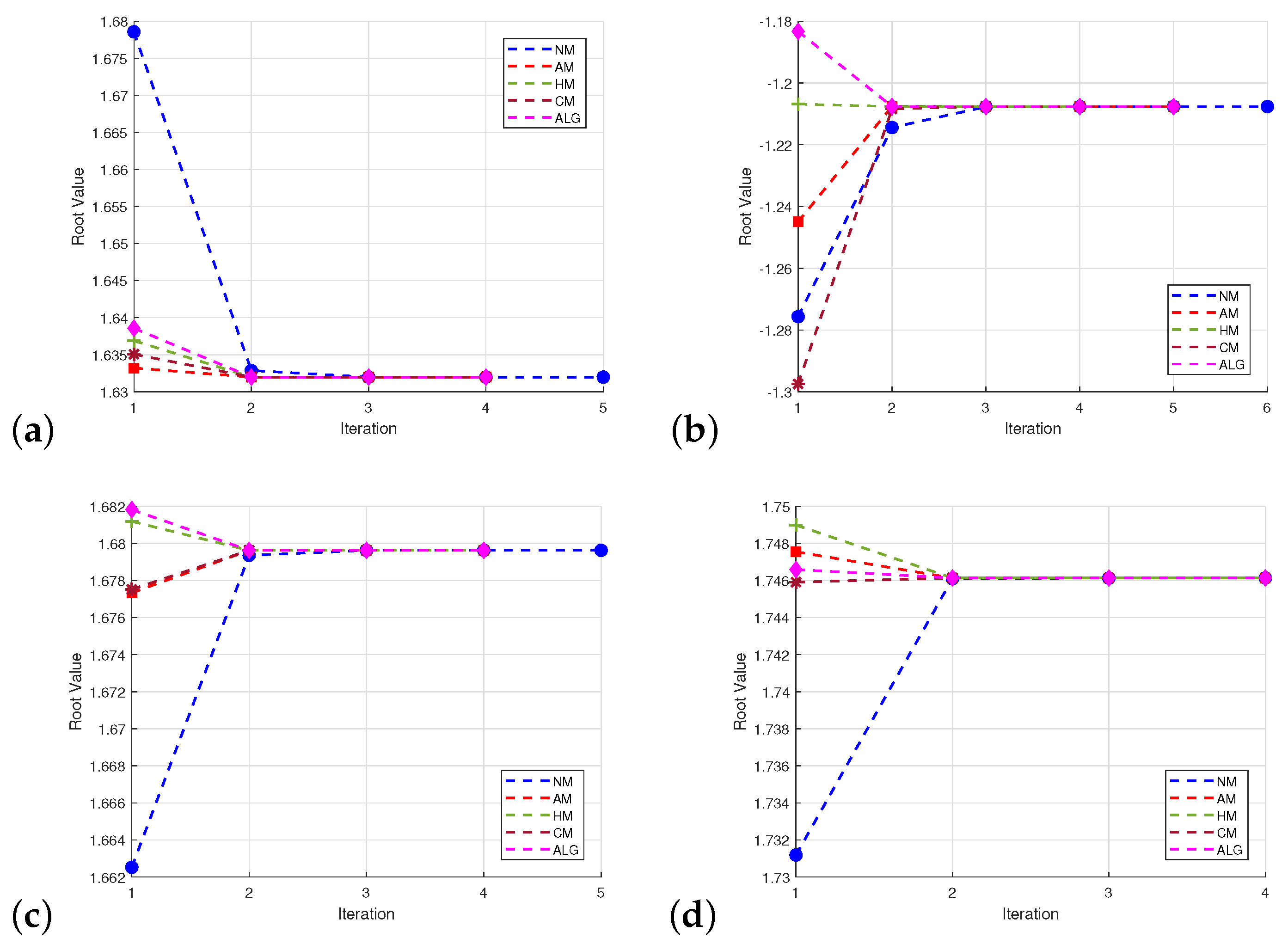
To showcase the efficiency of our proposed scheme, we offer the comparative study with classical methods such as Newton’s method (NM) [43], Abbasbandy’s method (AM) [44], Halley’s method (HM) [43], and Chun’s method (CM) [45]. To proceed further, we consider the following non-linear equations:
- ,
- ,
- ,
- .
We fix the tolerance of and
- ,
- .
The numerical results were performed on an Intel(R) Core(TM) i5 processor with 1.60 GHz and 16 GB of RAM. Maple 2018 was considered for coding, while the visual display was processed by Matlab 2021.
After performing the numerical tests on the software, we present tabular as well as visual illustrations of Equation (4) for the above-mentioned examples.
| Methods | IT | ||||
| 2 | 5 | 0 | |||
| 2 | 4 | 0 | 0 | ||
| 2 | 4 | 0 | 0 | ||
| 2 | 4 | 0 | 0 | ||
| 2 | 4 | 0 | 0 |
| Methods | IT | ||||
| 6 | |||||
| 5 | 0 | ||||
| 4 | 0 | ||||
| 5 | 0 | ||||
| 5 | 0 |
| Methods | IT | ||||
| 5 | |||||
| 4 | |||||
| 4 | 0 | ||||
| 4 | 0 | ||||
| 4 | 0 |
| Methods | IT | ||||
| 2 | 4 | ||||
| 2 | 4 | ||||
| 2 | 4 | ||||
| 2 | 3 | ||||
| 2 | 4 |
- Figure 6a describe the comparative study of our proposed Algorithm with classical schemes with respect to number of iterations and root values for .
Figure 6. Graphical visuals of nonlinear equations. - Figure 6b describe the comparative study of our proposed Algorithm with classical schemes with respect to number of iterations and root values for .
- Figure 6c describe the comparative study of our proposed Algorithm with classical schemes with respect to number of iterations and root values for .
- Figure 6d describe the comparative study of our proposed Algorithm with classical schemes with respect to number of iterations and root values for .
4.6. Basin of Attraction
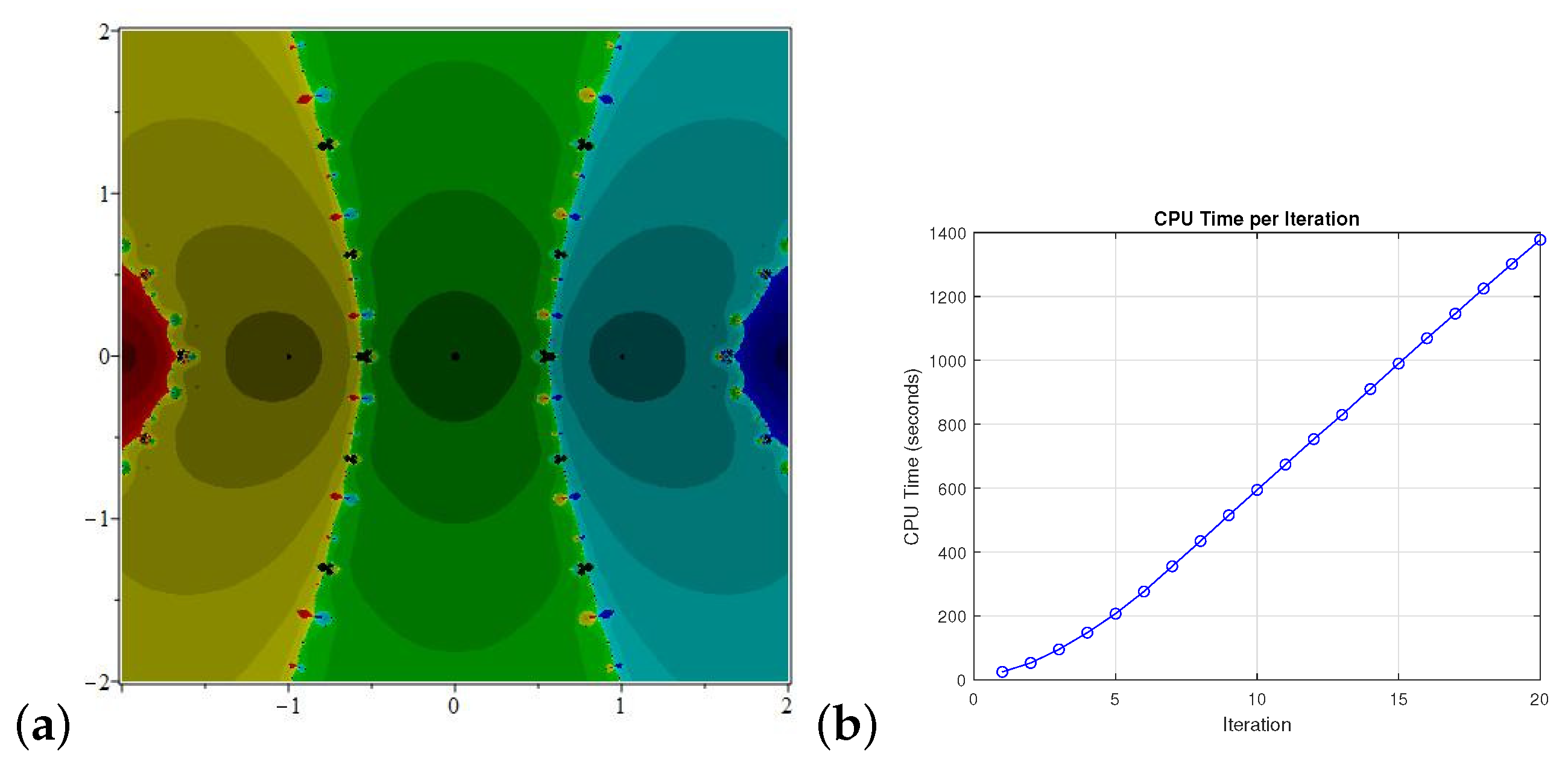
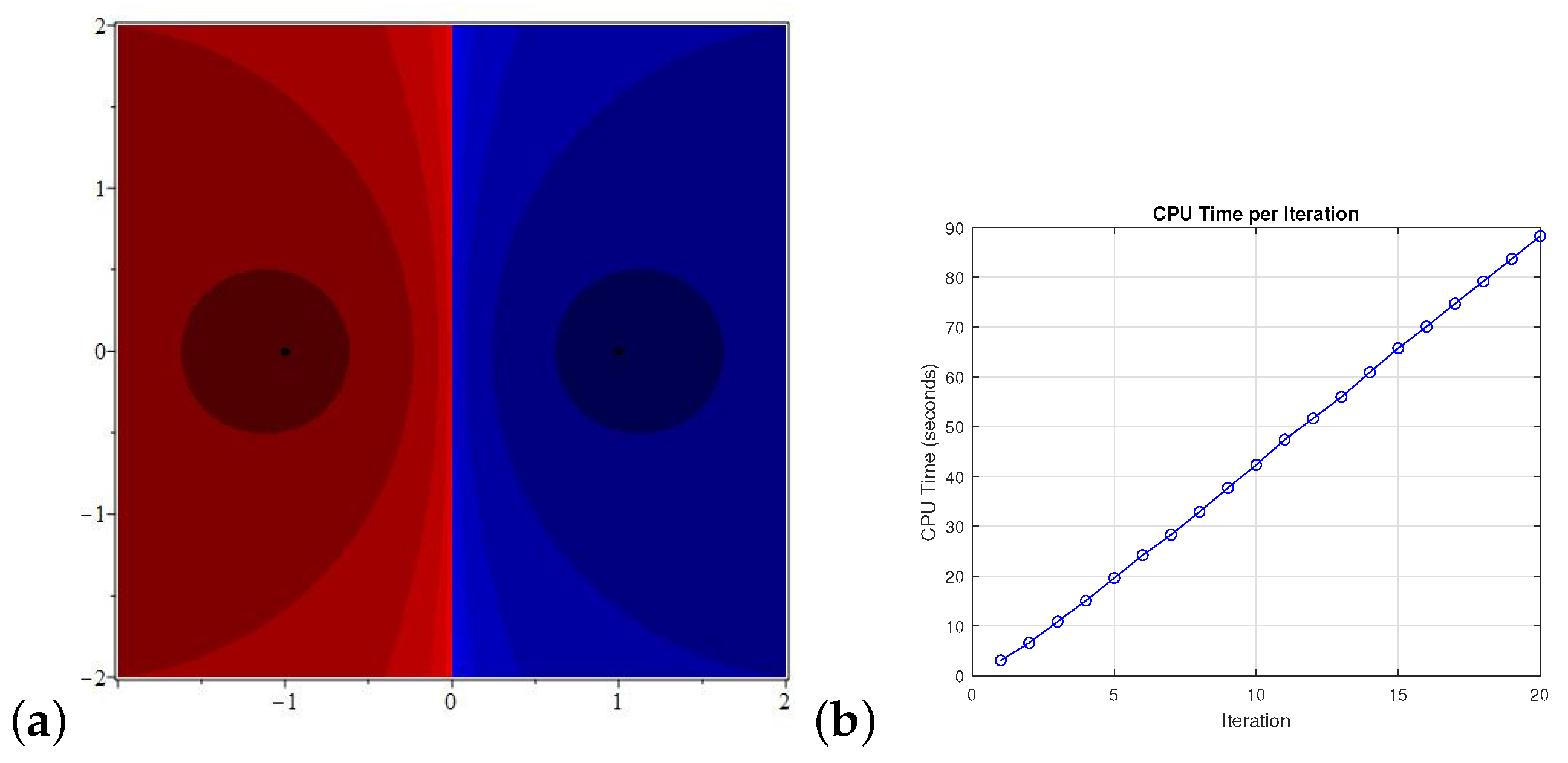
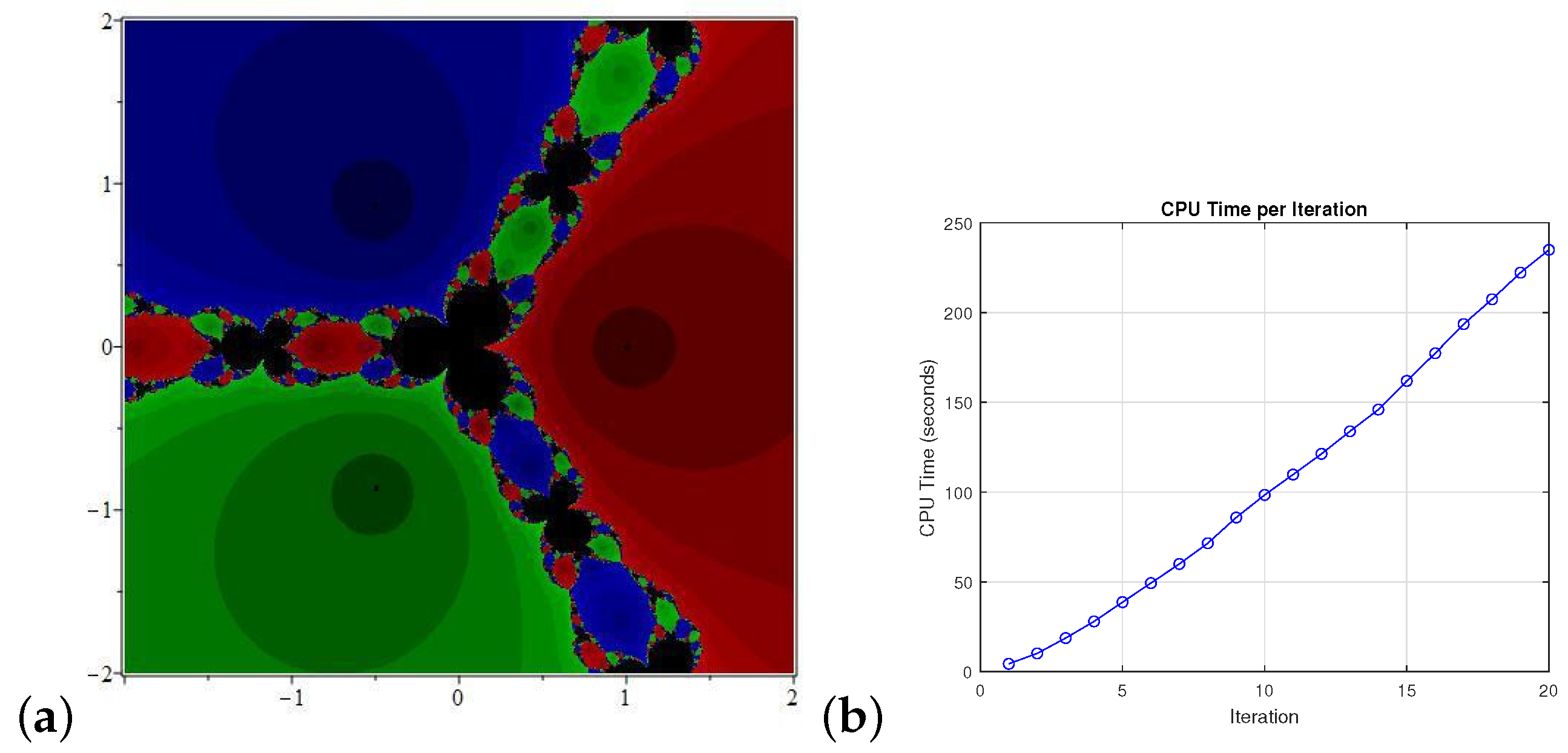
Here, we briefly describe Equation (4) through the basin of attraction and some illustrations corresponding to CPU time to generate the basin of attractions (Figure 7, Figure 8 and Figure 9). We deploy our proposed Algorithm on with a points grid by fixing the tolerance , and the maximum number of iterations is 20. For this purpose, we consider the extensively known problem . We take only .
Figure 7.
(a) is the basin of attraction for and (b) illustrates the CPU time to produce the basin of attraction.
Figure 8.
(a) is the basin of attraction for and (b) illustrates the CPU time to produce the basin of attraction.
Figure 9.
(a) is the basin of attraction for and (b) illustrates the CPU time to produce the basin of attraction.
5. Conclusions
In recent years, multiple approaches such as fractional calculus, quantum calculus, different generalizations of convexity, and majorization theory have been deployed to establish the error inequalities of numerical quadrature schemes. In this article, we have derived the parametric integral inequalities via convex functions. The benefit of our study is that we can generate a blend of integral inequalities by choosing the different values of and . It is evident that our results reduce to Ostrowski’s, midpoint, trapezoidal, Simpson’s, Newton’s, Bullen’s, and other two-point open integral inequalities for certain values of parameters. To ensure the correctness of our findings, we have presented various graphical visuals. Furthermore, to enhance the significance of results, we have reported an abundant amount of applications to linear combinations of means, composite quadrature formulas, modified Bessel functions, and novel parametric iterative schemes having cubic order of convergence. Also, we have investigated the iterative scheme through physical examples. Most importantly, the results obtained in this article are beneficial to compute the bounds of several other special functions, such as gamma function, beta function, and hypergeometric functions. In the future, we will try to extend the idea for non-convex functions, quantum and symmetric calculus, fractional calculus, and fuzzy valued functions as well. By employing a similar procedure, we investigate two-dimensional unified inequalities and their applications. One of the important research questions is to unify Milne’s and Maclaurin’s and correct Euler-type inequalities by developing a new identity. We hope this will be an effective contribution to the literature and will pave a new way of thinking.
Author Contributions
Conceptualization, M.Z.J. and M.U.A.; methodology, M.Z.J., M.U.A., B.B.-M., H.B. and S.S.D.; software, M.Z.J.; validation, M.Z.J., M.U.A. and H.B.; formal analysis, M.Z.J., M.U.A. and B.B.-M.; investigation, M.Z.J., M.U.A., B.B.-M., H.B. and S.S.D.; writing—original draft preparation, M.Z.J., M.U.A., B.B.-M., H.B. and S.S.D.; writing—review and editing, M.Z.J., M.U.A., B.B.-M., H.B. and S.S.D.; visualization, M.Z.J., M.U.A., B.B.-M. and H.B.; supervision, M.U.A. All authors have read and agreed to the published version of the manuscript.
Funding
This paper is supported by Researchers Supporting Project number (RSP2024R158), King Saud University, Riyadh, Saudi Arabia.
Data Availability Statement
Data are contained within the article.
Acknowledgments
This paper is supported by Researchers Supporting Project number (RSP2024R158), King Saud University, Riyadh, Saudi Arabia. The authors are thankful to the editor and the anonymous reviewers for their valuable comments and suggestions.
Conflicts of Interest
The authors declare no conflict of interest.
References
- Dragomir, S.S.; Agarwal, R. Two inequalities for differentiable mappings and applications to special means of real numbers and to trapezoidal formula. Appl. Math. Lett. 1998, 11, 91–95. [Google Scholar] [CrossRef]
- Latif, M.A. On some inequalities for h-convex functions. Int. J. Math. Anal. 2010, 4, 1473–1482. [Google Scholar]
- Ozdemir, M.E.; Gurbuz, M.; Kavurmaci, H. Hermite-Hadamard-type inequalities for (g, ϕ, h)-convex dominated functions. J. Inequalities Appl. 2013, 2013, 184. [Google Scholar] [CrossRef]
- Abramovich, S. On superquadracity. J. Math. Inequalities 2009, 3, 329–339. [Google Scholar] [CrossRef]
- Bohner, M.; Matthews, T. Ostrowski inequalities on time scales. J. Inequalities Pure Appl. Math. 2008, 9, 8. [Google Scholar]
- Popa, E. An inequality of Ostrowski type via a mean value theorem. Gen. Math. 2007, 15, 93–100. [Google Scholar]
- Anastassiou, G.A. Univariate Ostrowski inequalities, revisited. Monatshefte Math. 2002, 135, 175–189. [Google Scholar] [CrossRef]
- Awan, M.U.; Javed, M.Z.; Budak, H.; Hamed, Y.S.; Ro, J.S. A study of new quantum Montgomery identities and general Ostrowski like inequalities. Ain Shams Eng. J. 2024, 15, 102683. [Google Scholar] [CrossRef]
- Vivas-Cortez, M.; Awan, M.U.; Asif, U.; Javed, M.Z.; Budak, H. Advances in Ostrowski-Mercer Like Inequalities within Fractal Space. Fractal Fract. 2023, 7, 689. [Google Scholar] [CrossRef]
- Dragomir, S.S.; Rassias, T.M. (Eds.) Ostrowski Type Inequalities and Applications in Numerical Integration; Kluwer Academic: Dordrecht, The Netherlands, 2002. [Google Scholar]
- Dragomir, S.S.; Agarwal, R.P.; Cerone, P. On Simpson’s inequality and applications. J. Inequalities Appl. 2000, 5, 533–579. [Google Scholar] [CrossRef]
- Liu, Z. An inequality of Simpson type. Proc. R. Soc. A Math. Phys. Eng. Sci. 2005, 461, 2155–2158. [Google Scholar] [CrossRef]
- Alomari, M.; Darus, M.; Dragomir, S.S. New inequalities of Simpson’s type for s-convex functions with applications. RGMIA Res. Rep. Collect. 2009, 4, 12. [Google Scholar]
- Sarikaya, M.Z.; Set, E.; Ozdemir, M.E. On new inequalities of Simpson’s type for s-convex functions. Comput. Math. Appl. 2010, 60, 2191–2199. [Google Scholar] [CrossRef]
- Li, Y.; Du, T. Some Simpson type integral inequalities for functions whose third derivatives are (a, m)-GA-convex functions. J. Egypt. Math. Soc. 2016, 24, 175–180. [Google Scholar] [CrossRef]
- Kashuri, A.; Mohammed, P.O.; Abdeljawad, T.; Hamasalh, F.; Chu, Y. New Simpson type integral inequalities for s-convex functions and their applications. Math. Probl. Eng. 2020, 2020, 8871988. [Google Scholar] [CrossRef]
- Fedotov, I.; Dragomir, S.S. An inequality of Ostrowski type and its applications for Simpson’s rule and special means. RGMIA Res. Rep. Collect. 1999, 2, 491–499. [Google Scholar] [CrossRef]
- Hanna, G.; Cerone, P.; Roumeliotis, J. An Ostrowski type inequality in two dimensions using the three point rule. ANZIAM J. 2000, 42, C671–C689. [Google Scholar] [CrossRef]
- Alomari, M.W.; Dragomir, S.S. Various error estimations for several Newton-Cotes quadrature formulae in terms of at most first derivative and applications in numerical integration. Jordan J. Math. Stat. 2014, 7, 89–108. [Google Scholar]
- Iftikhar, S.; Erden, S.; Ali, M.A.; Baili, J.; Ahmad, H. Simpson’s second-type inequalities for co-ordinated convex functions and applications for cubature formulas. Fractal Fract. 2022, 6, 33. [Google Scholar] [CrossRef]
- Budak, H.; Erden, S.; Ali, M.A. Simpson and Newton type inequalities for convex functions via newly defined quantum integrals. Math. Methods Appl. Sci. 2021, 44, 378–390. [Google Scholar] [CrossRef]
- Butt, S.I.; Javed, I.; Agarwal, P.; Nieto, J.J. Newton-Simpson-type inequalities via majorization. J. Inequalities Appl. 2023, 2023, 16. [Google Scholar] [CrossRef]
- Meftah, B. Maclaurin type inequalities for multiplicatively convex functions. Proc. Am. Math. Soc. 2023, 151, 2115–2125. [Google Scholar] [CrossRef]
- Peng, Y.; Du, T. Fractional Maclaurin-type inequalities for multiplicatively convex functions and multiplicatively P-functions. Filomat 2023, 37, 9497–9509. [Google Scholar] [CrossRef]
- Hezenci, H. Fractional inequalities of corrected Euler-Maclaurin-type for twice-differentiable functions. Comput. Appl. Math. 2023, 42, 92. [Google Scholar] [CrossRef]
- Alomari, M. New error estimations for the Milne’s quadrature formula in terms of at most first derivatives. Konuralp J. Math. 2013, 1, 17–23. [Google Scholar]
- Budak, H.; Kosem, P.; Kara, H. On new Milne-type inequalities for fractional integrals. J. Inequalities Appl. 2023, 2023, 10. [Google Scholar] [CrossRef]
- Bin-Mohsin, B.; Javed, M.Z.; Awan, M.U.; Khan, A.G.; Cesarano, C.; Noor, M.A. Exploration of Quantum Milne-Mercer-Type Inequalities with Applications. Symmetry 2023, 15, 1096. [Google Scholar] [CrossRef]
- Tseng, K.L.; Hwang, S.R.; Hsu, K.C. Hadamard-type and Bullen-type inequalities for Lipschitzian functions and their applications. Comput. Math. Appl. 2012, 64, 651–660. [Google Scholar] [CrossRef]
- Cakmak, M. On some Bullen-type inequalities via conformable fractional integrals. J. Sci. Perspect. 2019, 3, 285–298. [Google Scholar]
- Du, T.; Luo, C.; Cao, Z. On the Bullen-type inequalities via generalized fractional integrals and their applications. Fractals 2021, 29, 2150188. [Google Scholar] [CrossRef]
- Vivas-Cortez, M.; Javed, M.Z.; Awan, M.U.; Noor, M.A.; Dragomir, S.S. Bullen-Mercer type inequalities with applications in numerical analysis. Alex. Eng. J. 2024, 96, 15–33. [Google Scholar] [CrossRef]
- Xi, B.Y.; Qi, F. Some Integral Inequalities of Hermite-Hadamard Type for Convex Functions with Applications to Means. J. Funct. Spaces 2012, 2012, 980438. [Google Scholar] [CrossRef]
- Nwaeze, E.R.; Tameru, A.M. New parameterized quantum integral inequalities via η-quasiconvexity. Adv. Differ. Equ. 2019, 2019, 425. [Google Scholar] [CrossRef]
- Du, T.; Yuan, X. On the parameterized fractal integral inequalities and related applications. Chaos Solitons Fractals 2023, 170, 113375. [Google Scholar] [CrossRef]
- Yu, Y.; Liu, J.; Du, T. Certain error bounds on the parameterized integral inequalities in the sense of fractal sets. Chaos Solitons Fractals 2022, 161, 112328. [Google Scholar] [CrossRef]
- Nonlaopon, K.; Awan, M.U.; Talib, S.; Budak, H. Parametric generalized (p, q)-integral inequalities and applications. AIMS Math. 2022, 7, 12437–12457. [Google Scholar] [CrossRef]
- Kirmaci, U.S. Inequalities for differentiable mappings and applications to special means of real numbers and to midpoint formula. Appl. Math. Comput. 2004, 147, 137–146. [Google Scholar] [CrossRef]
- Raees, M.; Anwar, M.; Vivas-Cortez, M.; Kashuri, A.; Samraiz, M.; Rahman, G. New simpson’s type estimates for two newly defined quantum integrals. Symmetry 2022, 14, 548. [Google Scholar] [CrossRef]
- Watson, G.N. A Treatise on the Theory of Bessel Functions; Cambridge University Press: Cambridge, UK, 1922; Volume 2. [Google Scholar]
- Luke, Y.L. (Ed.) Special Functions and Their Approximations; Academic Press: Cambridge, MA, USA, 1969. [Google Scholar]
- Fournier, R.L. Basic Transport Phenomena in Biomedical Engineering; CRC Press: Boca Raton, FL, USA, 2017. [Google Scholar]
- Burden, R.K.; Faires, J.D. Numerical Analysis, 9th ed.; Brooks/Cole; Cengage Learning: Boston, MA, USA, 2011. [Google Scholar]
- Abbasbandy, S. Improving Newton-Raphson method for nonlinear equations by modified Adomian decomposition method. Appl. Math. Comput. 2003, 145, 887–893. [Google Scholar] [CrossRef]
- Chun, C. Iterative methods improving Newton’s method by the decomposition method. Comput. Math. Appl. 2005, 50, 1559–1568. [Google Scholar] [CrossRef]
Disclaimer/Publisher’s Note: The statements, opinions and data contained in all publications are solely those of the individual author(s) and contributor(s) and not of MDPI and/or the editor(s). MDPI and/or the editor(s) disclaim responsibility for any injury to people or property resulting from any ideas, methods, instructions or products referred to in the content. |
© 2024 by the authors. Licensee MDPI, Basel, Switzerland. This article is an open access article distributed under the terms and conditions of the Creative Commons Attribution (CC BY) license (https://creativecommons.org/licenses/by/4.0/).