1. Introduction
Let be a triangle in the Euclidean plane, and denote the complex coordinates of the vertices A, B, and C by a, b, and c, respectively. We examine some geometric properties of the equilateral triangles whose vertices are located on the support sides of , that is, , , and .
The problem studied in this paper is related to a known general topological property. The polygon
is said to be inscribed in the Jordan curve
(not necessarily contained in the interior of
) if all the vertices of
are located on
[
1]. While Jordan curves can be complicated, they satisfy certain regular properties in this respect. For example, Meyerson [
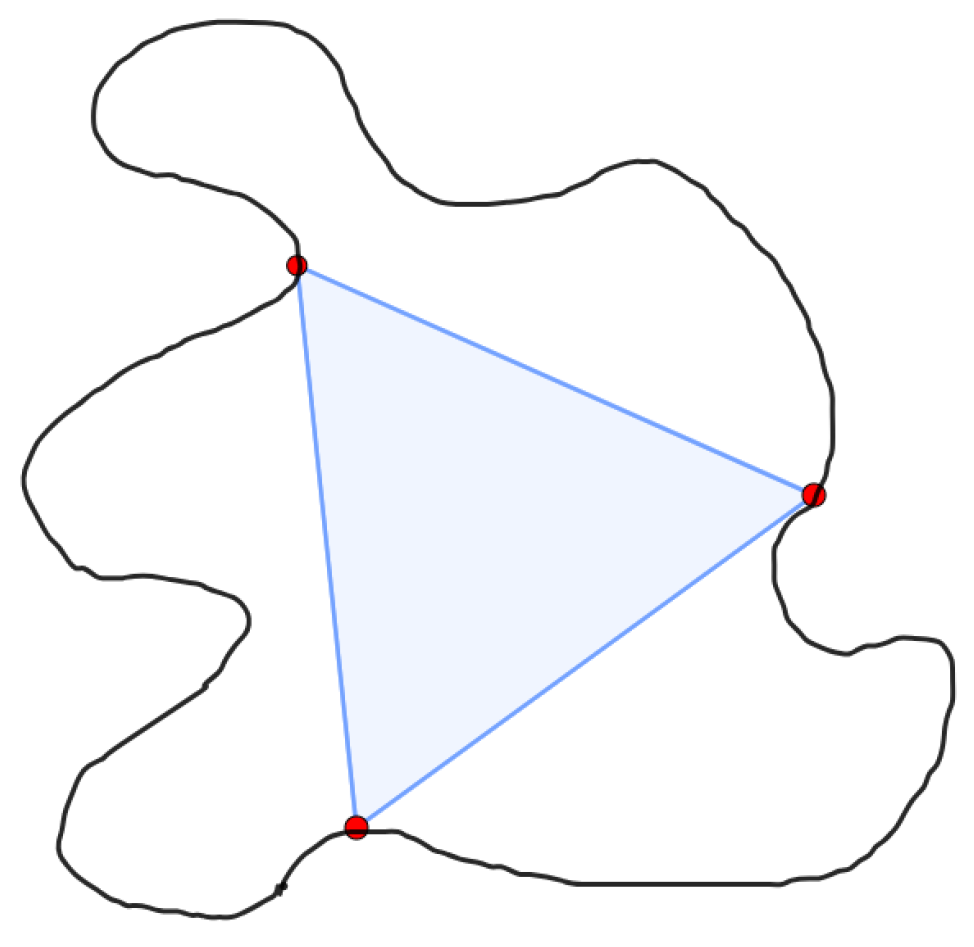
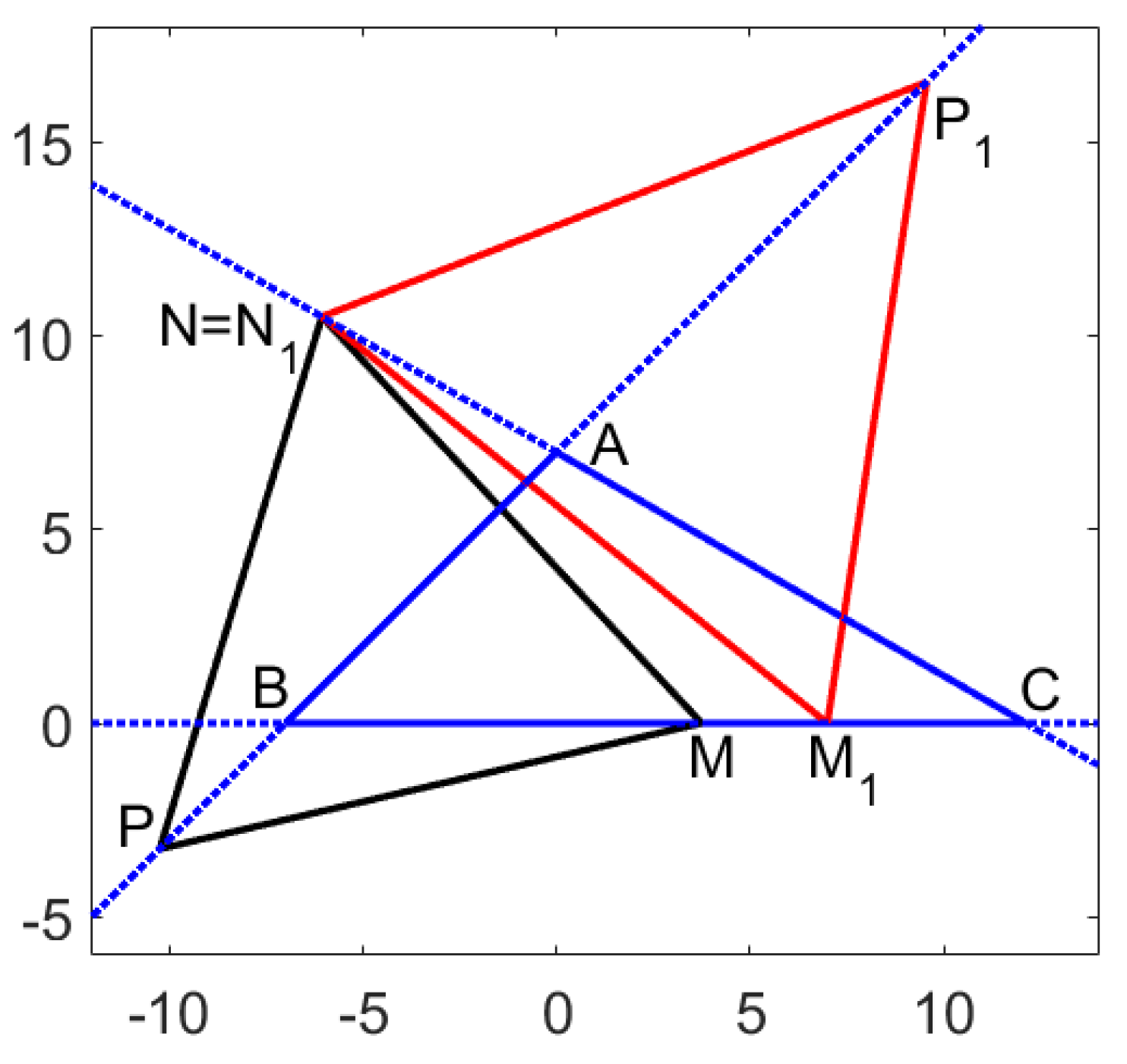
2] showed that an equilateral triangle can be inscribed in every Jordan curve, as illustrated in
Figure 1. Later on, Nielsen proved the following result ([
3], [Theorem 1.1]):
Let be a Jordan curve and let Δ be any triangle. Then infinitely many triangles similar to Δ can be inscribed in γ. Similar results exist for Jordan curves in
[
4]. Interestingly, Toeplitz’s statement from 1911 that
every Jordan curve admits an inscribed square is still a conjecture in the general case. Just recently, it was proved for convex or piecewise smooth curves, while extensions exist for rectangles, curves, and Klein bottles (see, e.g., [
5,
6]).
The triangle is the simplest example of a non-smooth and piecewise linear Jordan curve; while the equilateral triangle appears to be a simple configuration, it can generate very interesting properties and applications [
7]. In the sense of the above definition for polygons, an equilateral triangle
inscribed in a given triangle
can have two vertices on the same side, a situation that does not present much interest from the geometric point of view. This is why in the present paper we consider the case
,
, and
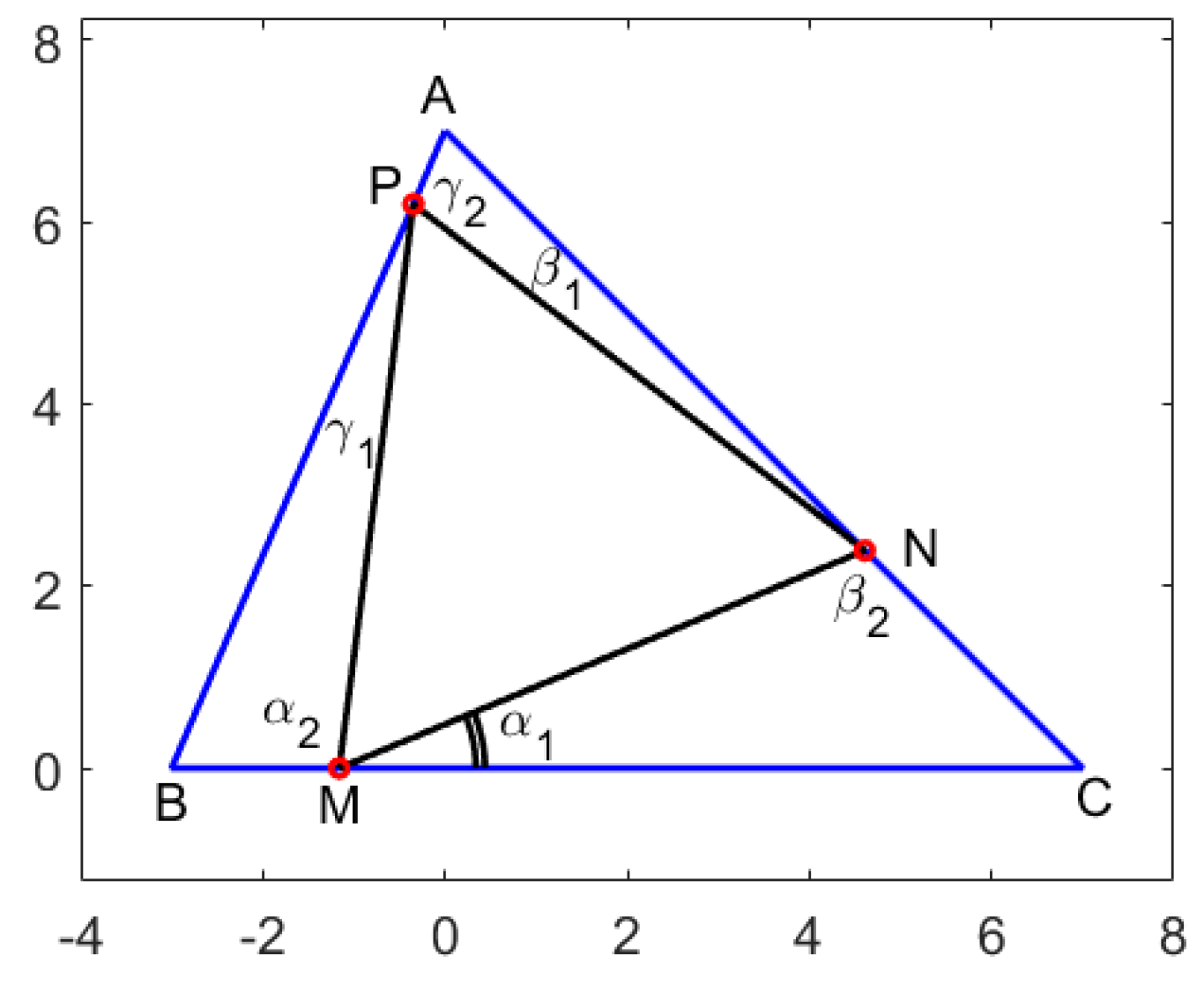
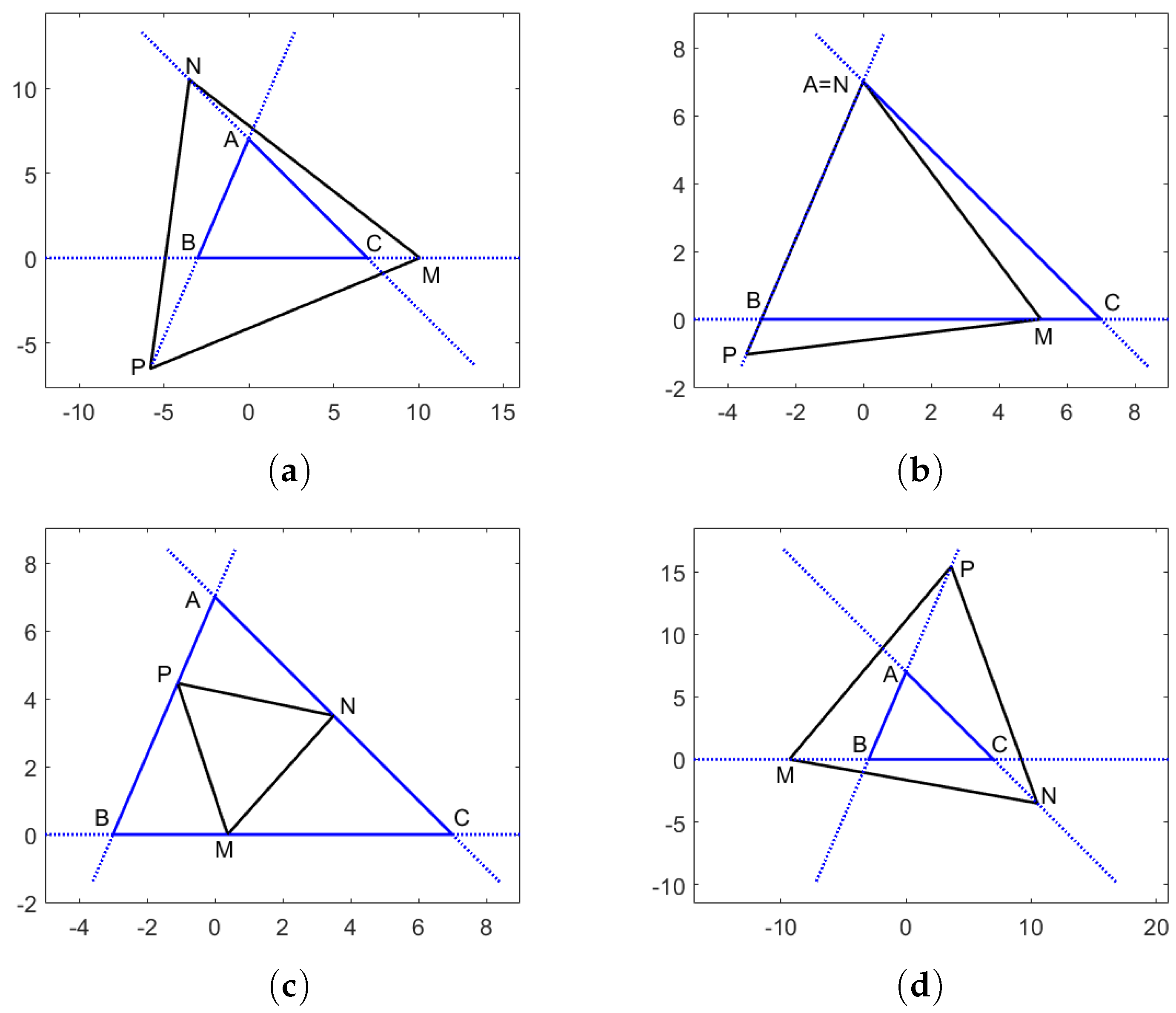
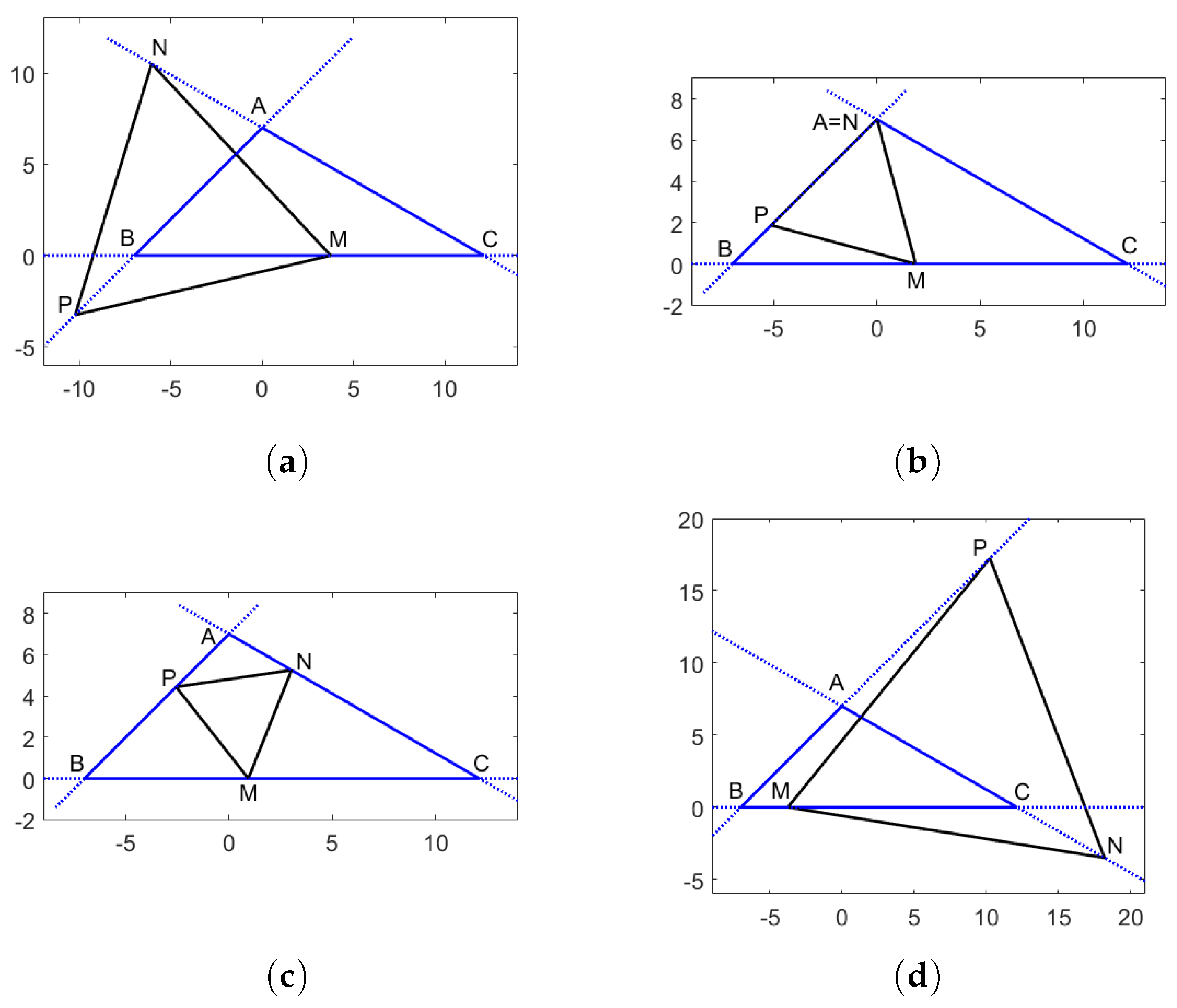
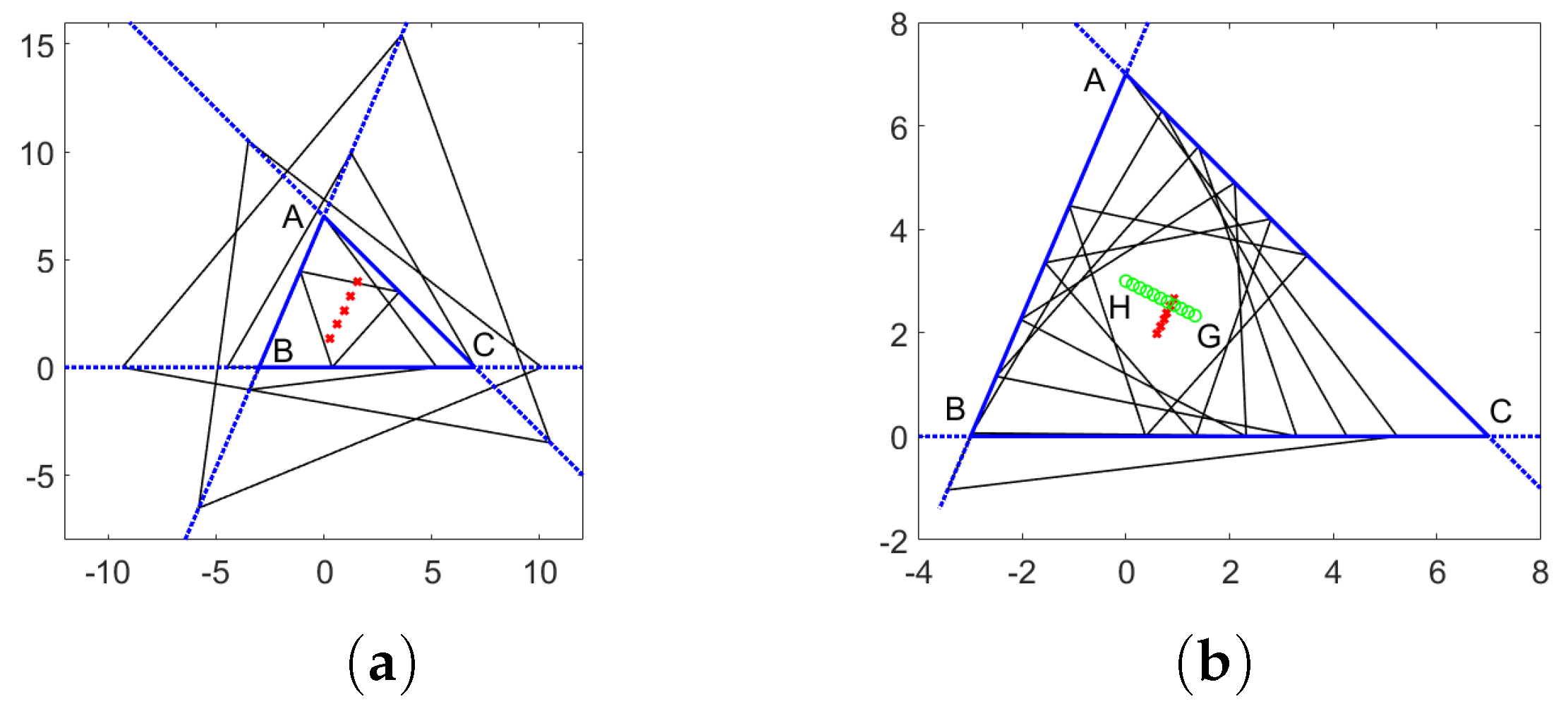
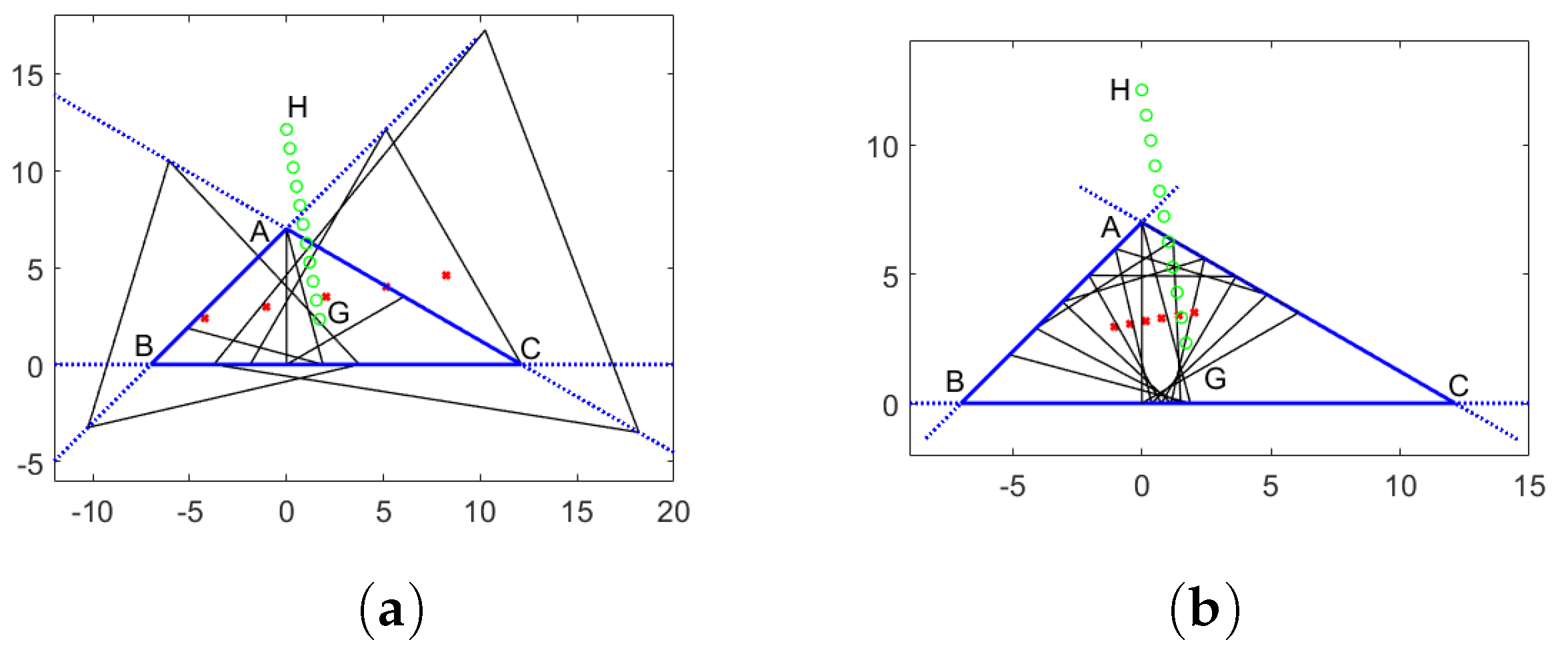
, as seen in
Figure 2 and
Figure 3 for an acute triangle
and in
Figure 4 for an obtuse triangle, respectively. Similar to Nielsen’s result, there are infinitely many such triangles, generating interesting properties in the triangle geometry [
8,
9,
10,
11]. Recently, in [
12], we studied the equilateral triangles inscribed in the interior of arbitrary triangles, describing them by a single parameter and examining some extremal properties (e.g., the angles for which the minimum inscribed equilateral triangles are obtained). A summary of the results obtained in [
12] is presented in
Section 2.
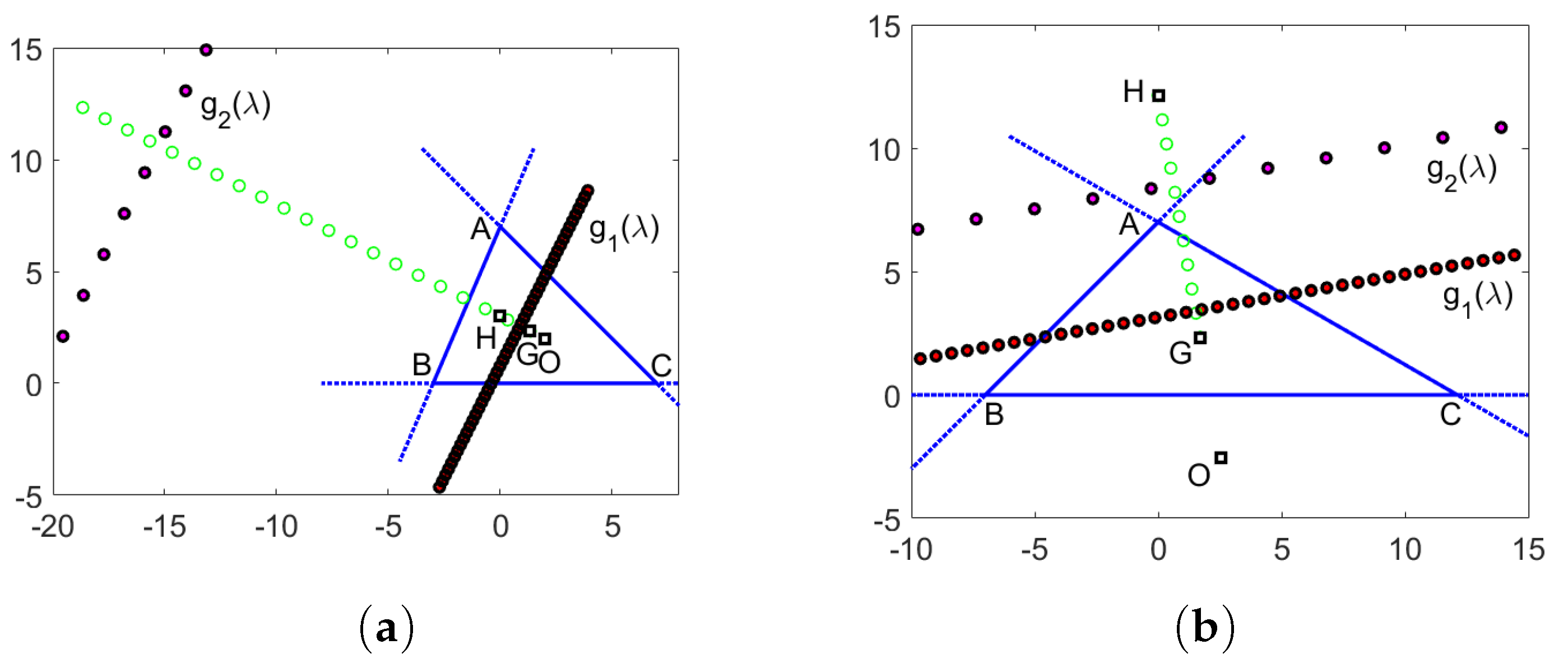
In this paper, we explore the equilateral triangles whose vertices are located on the support lines of the sides of an arbitrary triangle. While this configuration does not represent a Jordan curve, this presents interesting geometric properties. We prove that the centers of these triangles are situated on two parallel lines, which are perpendicular to the Euler’s line of the original triangle.
The structure of this paper is as follows. In
Section 2, we review some results obtained in [
12], devoted to exact formulas for the lengths of the sides of inscribed equilateral triangles as a function of a unique parameter and to extremal properties of the side length. In
Section 3, we obtain the complex coordinates of the centroids of the equilateral triangles having vertices on the support lines of a given triangle. The main result concerning the locus of these centroids is presented in
Section 4. Furthermore, in
Section 5 we prove that the locus of centroids consists of two parallel lines perpendicular to the Euler’s line of the original triangle. Alternative derivations and particular cases are provided in
Section 6, while conclusions are formulated in
Section 7.
The adoption of complex coordinates instead of Cartesian coordinates considerably simplifies the computations.
2. Inscribed Equilateral Triangles
The particular case when the inscribed equilateral triangle
is nested, i.e.,
,
, and
, was studied in [
12] by a trigonometric approach. Related investigations by other means can be consulted in [
8,
10,
11,
13].
Let
be a triangle in the Euclidean plane, and denote by
A,
B, and
C the measures of the angles from vertices
A,
B, and
C, respectively. Without loss of generality, one may assume that
; therefore,
. In the notation of
Figure 2, one obtains the system
The system can be written in matrix form as
By simple calculation, one can show that the system (
2) is compatible and it has infinitely many solutions. Moreover, since the rank of the matrix is 5, the solutions are fully determined by a single variable chosen as the parameter. From the first three equations, one can substitute
,
, and
into the last three and obtain the reduced system
which can be written in matrix form as
Fixing the parameter
, the system (
3) has the solution
From the conditions
one obtains
. The geometric constraints illustrated in
Figure 2
show that there are infinitely many possible configurations.
In our recent paper [
12], we obtained the following explicit formula for the side length of the inscribed equilateral triangle as a function of the parameter
:
where
R is the circumradius of triangle
. Denote
as the area of triangle
, and from the relation
and the Law of Sines, one obtains
Furthermore, we showed in [
12] that the minimal triangle
is obtained for
Numerous illustrative examples are also provided in [
12].
3. Coordinates of the Centroids of the Triangle MNP
The complex coordinates of the vertices of
are denoted by
m,
n, and
p. As seen in
Figure 3 for an acute triangle and in
Figure 4 for an obtuse triangle, such triangles can be constructed starting from the points
N on
and
P on the side
, with the condition that the third point
M on
is obtained by a rotation of angle
, which in complex numbers can be performed by multiplying with (see, for example, [
14]):
Clearly, if
and
, there exist the scalars
and
such that
In this notation, note that, as seen in
Figure 3, we have
If , then ;
If , then ;
If
, then
(the case presented in
Section 2);
If , then ;
If , then .
Then, the point M of the equilateral triangle is obtained by rotating segment around point N through an angle of , clockwise or anticlockwise.
3.1. First Orientation of Triangle MNP: Anticlockwise Rotation
For anticlockwise rotation, we obtain the complex coordinate
where we use the relation
. Since
, one must have
, hence
. From here it follows that
This condition can be written as
which reduces to
where
x,
y, and
z are given by
Clearly, this shows that the coordinates
m,
n,
p depend linearly on
, as
where the values
k and
l are real numbers obtained from (
7) and (
8), as
which are ratios of purely imaginary numbers.
3.2. Second Orientation of Triangle MNP: Clockwise Rotation
An alternative configuration is obtained when the rotation of
P around
N is taken with an angle of
clockwise. Similar to
Section 3.1, we obtain
where we use the fact that
. Imposing the condition
, for
, the coordinates of the vertices of
can be written explicitly
The coefficients are related through the formula
where
,
, and
are obtained from
Using (
11) and (
12), the values
and
are the real numbers given by
These formulas allow a convenient calculation for the coordinates of the centroids.
For a given point
, the possible equilateral triangles are shown in
Figure 5.
5. Perpendicularity and Intersection with Euler’s Line
The following auxiliary result is useful in proving the main results of this section.
Lemma 1. Let , , , and be complex numbers and consider the lines and given in parametric form by , and , , respectively. The following properties hold:
- (1)
If , then and are perpendicular.
- (2)
If , then and intersect at the point
Proof. Let us consider the points
and
on
and the points
and
on
. The lines are perpendicular if and only if
which reduces to
. Therefore,
from where the conclusion follows.
If the point of coordinate
Z is located on both lines, it means that there exist real numbers
t and
s such that
. By conjugation, one obtains
, from where we can solve for
t and
s the system
The system (
17) has the solution
and by substitution, one obtains
which after simplifications recovers formula (
16). □
A special case is when passes through the origin.
Recall that in every triangle
, the circumcenter
O, the centroid
G, and the orthocenter
H are collinear on the Euler line of the triangle. Without loss of generality, we can choose the circumcenter
O of
as the origin of the complex plane. Under this assumption, we obtain the coordinates
,
, and
; hence, Euler’s line is defined by the formula
,
. Furthermore, the circumradius of the triangle
can be set to 1, in which case we have
, or
5.1. The First Line of Centroids
For the first centroid line, by substituting, we obtain
Substituting in (
7), we obtain
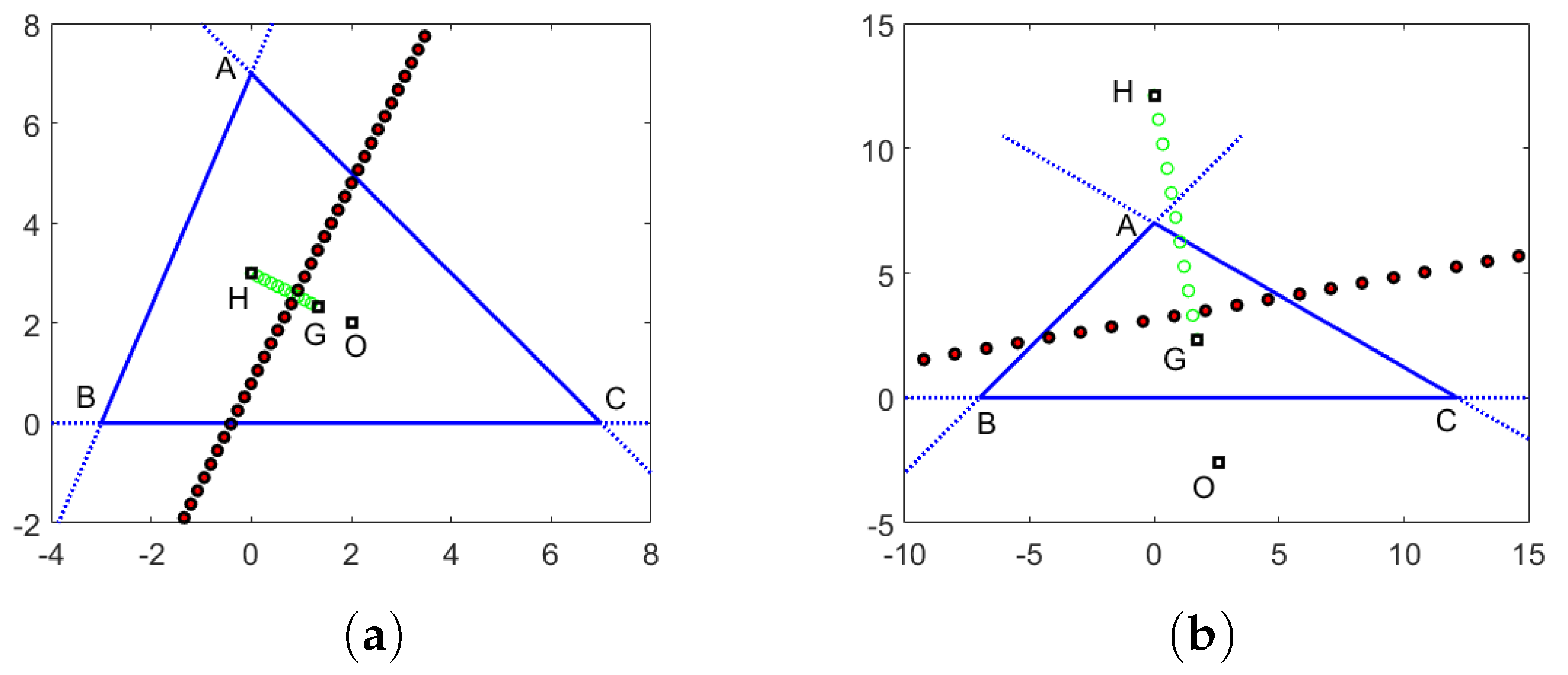
Therefore, the first line of centroids depicted in
Figure 8 has the equation
while Euler’s line is given by
By Formulas (
20) and (
21) for the line of centroids and Euler’s line, we obtain
where
is given by (19). First, notice that
By Lemma 1, we obtain the following result.
Theorem 1. The first line of centroids is perpendicular to Euler’s line.
The intersection point between the line , and Euler’s line iswhere denotes the real part of the complex number z. Proof. Substituting (
22) in Lemma 1
, one obtains
Since
, the formula (
16) reduces to
After simplifications, one obtains
This ends the proof. □
5.2. The Second Line of Centroids
For the second centroid line, similar calculations show that
from where, through (
11), we have
The second line of centroids has the equation
where the coefficients are
where
is given by (27). Again, one may notice that
so by Lemma 1, the perpendicularity follows from the relation
The two parallel lines of centroids
and
are shown in
Figure 9.
The coordinates of this intersection point are given by
We have an analogous result to Theorem 1, for the second line of centroids.
Theorem 2. The second line of centroids is perpendicular to Euler’s line.
The intersection point between the line , and Euler’s line is