


Abstract
Convolution plays a pivotal role in the domains of signal processing and optics. This paper primarily focuses on studying the weighted convolution for quaternion linear canonical cosine transform (QLCcT) and its application in multiplicative filter analysis. Firstly, we propose QLCcT by combining quaternion algebra with linear canonical cosine transform (LCcT), which extends LCcT to Hamiltonian quaternion algebra. Secondly, we introduce weighted convolution and correlation operations for QLCcT, accompanied by their corresponding theorems. We also explore the properties of QLCcT. Thirdly, we utilize these proposed convolution structures to analyze multiplicative filter models that offer lower computational complexity compared to existing methods based on quaternion linear canonical transform (QLCT). Additionally, we discuss the rationale behind studying such transforms using quaternion functions as an illustrative example.
MSC:
11R52; 42B10; 44A35; 94A12
1. Introduction
The linear canonical transform (LCT) [1,2] is an important integral transform that enables the manipulation of signals through scaling, rotation, and reflection. It exhibits unique advantages, strong flexibility, and processing ability when dealing with non-stationary and non-Gaussian signals. Significant progress has been made in signal sampling and filtering [3,4], discrete algorithms [5,6], convolution theory [7,8,9], time-frequency analysis [10,11,12], parameter estimation [13,14], uncertainty principles [11,15,16], image encryption [17,18], etc. The linear canonical cosine transform (LCcT) is widely recognized for its excellent orthogonal properties that enable efficient compression of energy distribution. When processing signals, LCcT offers a significant advantage by requiring only half the number of real number multiplications compared to LCT [19], applicable to both even and odd signals. This feature makes LCcT highly valuable in digital signal processing applications. In recent years, researchers have increasingly focused on studying various properties of LCcT, such as duality, sampling, multiplication, convolution, and correlation [20,21,22,23,24]. These studies not only enhance our understanding of the working principles behind LCct but also broaden its range of applications in digital signal processing.
Quaternions are a crucial mathematical tool that play an important role in representing and handling complex mathematical operations, including rotations and transformations. They have wide applications in mathematics, physics, engineering, and computer graphics, providing an efficient mathematical method for solving various complex problems [25,26]. In recent years, with the continuous progress of mathematical theory, researchers have begun to extend the concept of integral transforms to the field of quaternion algebra. This extension has led to new theoretical frameworks, such as the quaternion Fourier transform (QFT) [27,28], the quaternion fractional Fourier transform (QFRFT) [29,30], the quaternion linear canonical transform (QLCT) [31,32,33,34], and the quaternion offset linear canonical transform (QOLCT) [7,35,36]. These theoretical frameworks provide new methods and tools for processing and analyzing quaternion signals. Despite remarkable progress in the study of quaternion integral transforms, the extension of the important LCcT transform to the quaternion domain remains an under-explored area. Therefore, the study of the quaternion linear canonical cosine transform (QLCcT) can provide us with more convenient, efficient, accurate, and stable methods for rotation representation and calculation, as well as important mathematical tools and solutions for complex problems in various fields.
Motivated by the significance of QLCcT in mathematics and signal processing, we will investigate its properties and applications. The central goal of this article is to define right-side QLCcT, establish an essential weighted convolution theorem, and design a multiplicative filter using the given convolution.
The main research findings of this article are reflected in the following three aspects: (1) The right-side QLCcT is defined. By exploring the relationship between the right-side and left-side QLCcT, we have discovered that the right-side QLCcT can be simply transformed into its left-side counterpart. This discovery implies that all research findings applicable to the right-side QLCcT are also applicable to its left-side counterpart. We also illustrate the relationships of right-side QLCcT with QFcT, and derive various fundamental properties, including linearity, shift, modulation, scale property, differential property, inversion formula, and Plancherel formula for right-side QLCcT. (2) We propose weighted convolution structures and establish a corresponding weighted convolution theorem for the QLCcT domain, which states that the convolution of two functions can be simplified to a multiplication operation in the QLCcT domain. These structures are particularly suitable and easily applied for constructing filter models. (3) We apply a novel convolution specifically designed for the analysis of multiplicative filter models. These models are particularly advantageous due to their reduced computational complexity when compared to traditional methods employed in the QLCT domain. Additionally, the quaternion function is utilized as an example to provide insights into the rationale and potential applications of such a transformation.
This paper is structured as follows: Section 2 presents a comprehensive overview of the basic concepts necessary for understanding the subsequent discussions. Section 3 considers the definition of right-side QLCcT, along with some properties, and the relationships between QLCcT and other transformations is studied. In Section 4, three types of weighted convolutions for QLCcT are presented, and corresponding convolution theorems are derived. The relationship between the proposed convolutions is also discussed. Section 5 provides an example and demonstrates application of QLCcT. Finally, this article concludes in Section 6.
2. Preliminaries
In this section, we present a review of fundamental concepts related to quaternion algebra and provide a concise overview of the QLCT.
2.1. Quaternion Algebra
Within the field of mathematics, there exist different types of numbers, each having unique properties and applications. One such fundamental construct is quaternions, an intricate mathematical entity comprising four distinct components, together forming a comprehensive mathematical structure. The invention of the quaternion is attributed to the renowned mathematician Hamilton in 1843 [25], and is denoted by the symbol . Within the framework of quaternion algebra, each element is represented by a specific form as follows:
and are imaginary units that follow the multiplication rules [25,26]
For , where and represent the scalar and the pure part of q, respectively. Let and .
If and , their product is defined as follows:
where “×” denote the cross-product.
The conjugate and modulus of q are defined, respectively, as follows:
The following identities can be easily verified:
Any can be represented by
where .
A quaternion function f defined on the real domain can be represented as
where are all real functions, and , .
The inner product of the f and g, belonging to the space , , is defined as follows:
The norm of is defined as:
The convolution operator ∗ and the correlation operator ⊙ for are defined according to [27]:
and
respectively.
2.2. Linear Canonical Integral Transform
We will review several integral transformations pertaining to LCT [1,2] and the QLCT [31,32].
Definition 1.
(Linear canonical transform) For , and , Det , then, the linear canonical transform (LCT) of f is defined as:
where the kernel is as follows:
when , the LCT is equivalent to the fractional Fourier transform (FRFT) [37,38]. Additionally, when , the LCT is equivalent to the Fourier transform (FT).
The inverse formula with is expressed as follows:
Definition 2.
The linear canonical cosine transform (LCcT) and the linear canonical sine transform (LCsT) of are given by:
and
respectively. The kernels of LCcT and of LCsT are defined as follows:
and
when , the LCcT corresponds to the Fourier cosine transform (FCT) while the LCsT corresponds to the Fourier sine transform (FST), respectively. When , the LCcT corresponds to the fractional cosine transform (FRCT) while the LCsT reduces to the fractional sine transform (FRST), respectively.
Definition 3.
(Quaternion linear canonical transform) For , the right-side QLCT is defined as follows:
the kernel of QLCT is as follows:
where . To obtain the left-side variant of QLCT, shift the kernel to the left side of f in Equation (14). When parameter is used, the QLCT can be simplified to a quaternion fractional Fourier transform (QFRFT). Similarly, when is chosen as a parameter value for QLCT in Equation (14), it simplifies to a quaternion Fourier transform (QFT).
The inverse for QLCT is given as,
3. Quaternion Linear Canonical Cosine and Sine Transform
In this section, the QLCcT and the QLCsT are introduced. Subsequently, a comprehensive investigation is conducted to explore the fundamental properties of the QLCcT and the QLCsT in depth. Additionally, precise definitions for the convolution and correlation operations of both the QLCcT and the QLCsT are provided, accompanied by the derivation of their respective convolution and correlation theorems.
3.1. Definition of QLCcT and QLCsT
In this subsection, QLCcT and QLCsT are proposed, along with the relationship between these two transforms and the quaternion Fourier cosine transform (QFcT) as well as the quaternion Fourier sine transform (QFsT).
Definition 4.
The definition of the right side of QLCcT and QLCsT for is as follows:
and
kernels of QLcCT and of QLcST are defined as follows:
and
respectively. Where , such that and Det . The right side of QLCcT and QLCsT for the quaternion function f are denoted as and , respectively. The left side of QLCcT and QLCsT are denoted as and , which are defined by shifting the kernels in Equation (17) and in Equation (18) to the left side of .
Remark 1.
(1) When , the QLCcT and QLCsT can be simplified to the new transforms called the fractional quaternion cosine transform (QFRcT) and the fractional quaternion sine transform (QFRsT),
and
respectively. Where and are defined as follows:
(2) If , then, the QLCcT and QLCsT can be simplified to the novel transform called the Fourier quaternion cosine transform (QFcT) and the Fourier quaternion sine transform (QFsT)
and
respectively.
In the following, we will investigate the relationship between QLCcT, QLCsT, QFcT, and QFsT.
Theorem 1.
Let be any quaternion function; the relationship between the right side and left side of QLCcT is as follows:
Proof.
Applying the conjugate properties of a quaternion f, we have
Similar to Theorem 1, the similar results for QLCsT can be obtained as follows:
□
Theorem 2.
The right-side QLCcT of can be seen as the right-side QFcT given by Equation (22) as follows:
Proof.
From the definition of right-side QLCcT, we have
□
Remark 2.
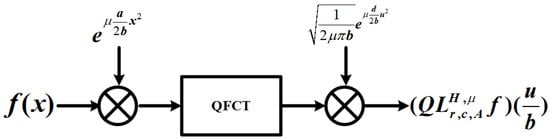
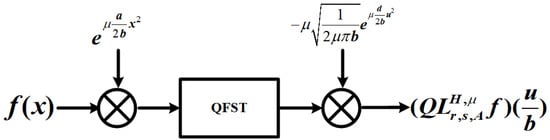
Similar to Theorem 2, we can obtain the relationship between the right-side QLCsT and the right-side QFsT as follows:
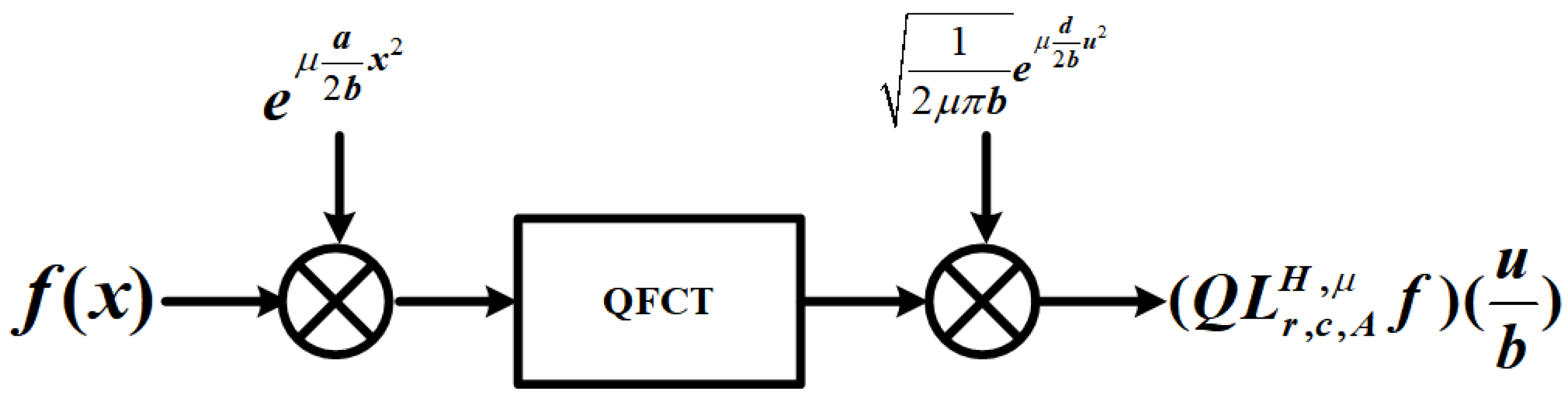
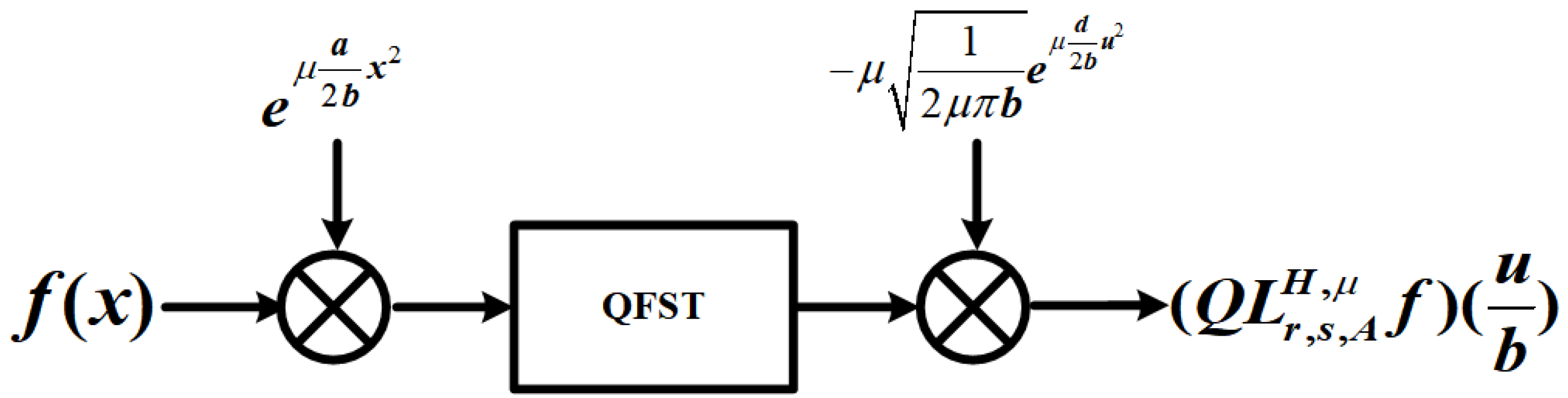
From the above discussion, by combining Equations (27) and (29), we can calculate the right-side QLCcT and QLCsT using the corresponding right-side QFcT and QFsT, respectively (see Figure 1 and Figure 2).
Figure 1.
The process of calculating QLCcT.
Figure 2.
The process of calculating QLCsT.
3.2. Properties for QLCcT
In the following subsection, the inverse and Plancherel theorem for the right-side QLCcT will be investigated. Other properties are shown in Table 1.

Table 1.
Some properties of the right-side QLCcT.
Theorem 3.
(Inversion theorem) The inverse of the right-side QLCcT of is provided
Proof.
Applying the right-side QLCcT of , we have
From the definition of the right-side QLCcT with the parameter , we have
the proof is thereby concluded. □
Remark 3.
Similar to Theorem 3, we can obtain the inverse of the right-side QLCsT for as follows:
Theorem 4.
(Plancherel theorem) Let and be the right-side QLCcT for , respectively. Then, we obtain
4. Convolution and Correlation for QLCcT
Quaternion convolution is an operation based on the definition of quaternions, which are used to describe the interaction between quaternion signals. By utilizing quaternion convolution operations, signal filtering and feature extraction can be achieved, which is highly significant for processing multi-dimensional and rotating signals. Quaternion correlation operations are employed to depict the similarity and correlation between quaternion signals. Through these operations, signal matching and similarity comparison can be performed, providing essential tools and methods for signal processing and analysis. Quaternion convolution and correlation operations find wide applications in image processing, video processing, attitude estimation, and other fields as they assist in effectively handling complex signals, extracting valuable information, and accomplishing various signal processing tasks. Therefore, understanding and applying quaternion convolution and correlation operations play a crucial role in enhancing the performance and efficiency of signal processing algorithms.
4.1. Convolution for QLCcT
In this subsection, we introduce the quaternion weighted convolution for the right-side QLCcT, and establish its corresponding convolution theorem. For the purpose of discussion, we confine the right-side QLCcT to a half-interval.
Definition 5.
The weighted convolution operator of in for the right-side QLCcT is defined as follows:
where , . When , and (i denotes an imaginary unit), . Then, the weighted convolution can be simplified to the convolution for FCT [38].
Definition 6.
Let , ; the weighted convolution operator of ∈ for the right-side QLCcT is defined as
where the weighted convolution operator is defined in Definition 5.
Definition 7.
Let , ; the convolution operator of ∈ for the right-side QLCcT is defined as
where the weighted convolution operator is defined in Definition 5.
The subsequent step entails deriving the convolution theorem for the right-side QLCcT.
Theorem 5.
Let and be the right-side QLCcT of f and h∈, respectively. Then, we have
Proof.
Using Equation (16), we obtain
the utilization of the product and difference formulas of trigonometric functions, we have
From Equations (40) and (41), we have
From the calculation of integration, we can obtain
and
From Equations (43) and (45), we can obtain
Similarly, from Equations (44) and (46), we can obtain
Combined with Equations (40), (47) and (48), we can obtain
From Definition 4 and Equation (49), we obtain
the proof is thereby concluded. □
Theorem 6.
Let , , and are the right-side QLCcT of f and h∈, respectively. Then, we have
Proof.
By substituting into the weighted convolution operation in Definition 5, we obtain
By using Theorem 5 and the linear properties of the right-side QLCcT, we can derive Theorem 6, and the proof is complete. □
Theorem 7.
Let , , and of ∈ are the right-side QLCcT of f and h, respectively. Then, we have
4.2. Correlation for QLCcT
The present subsection introduces a correlation for the QLCcT and explores the associated correlation theorem.
Definition 8.
Let ∈; the correlation for the QLCcT is defined as
where is a conjugate of , , , .
When , and (i is an imaginary unit), , then the weighted correlation operator reduces to the classical correlation for FCT.
The correlation theorem for the QLCcT will be derived next.
Theorem 8.
Let ∈; and are the QLCcT of f, h, respectively. The QLCcT of the correlation for f, h is given by
Proof.
Based on Equations (36), (37), and (41), and Equation (56), we can conclude
through direct calculation, we can obtain
and
From Equations (59) and (60), we can obtain
Similarly, from Equations (61) and (62), we can obtain
Combined with Equations (58), (63) and (64) and Definition 8, we can obtain
this completes the proof. □
Remark 4.
(1) If , Theorem 8 can be simplified to a version of the correlation theorem for QFRcT.
(2) If , Theorem 8 can be simplified to a version of the correlation theorem for QFcT.
5. Example and Application for QLCcT
In this section, the proposed right-side QLCcT will be demonstrated through an illustrative example. Subsequently, the application of QLCcT to investigate multiplicative filters will be discussed.
5.1. Example and Simulations for QLCcT
We consider the following quaternion-valued signal:
The right-side QLCcT of can be calculated as follows:
For the sake of computational convenience, we opt for , , , and employ the imaginary unit , , and . and k represent imaginary units according to Hamilton’s multiplication rules. Hence, from Equation (66), we obtain
where , , .
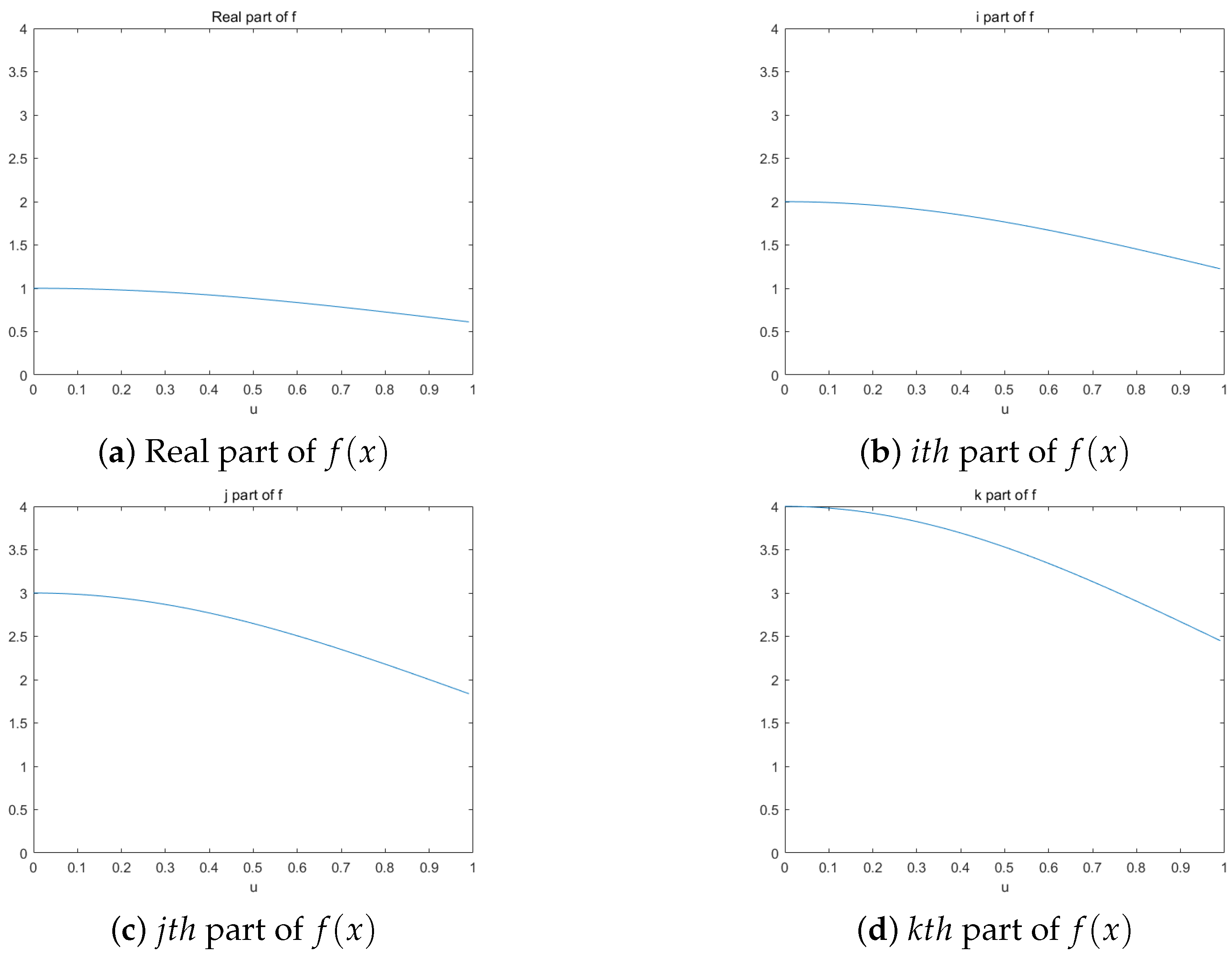
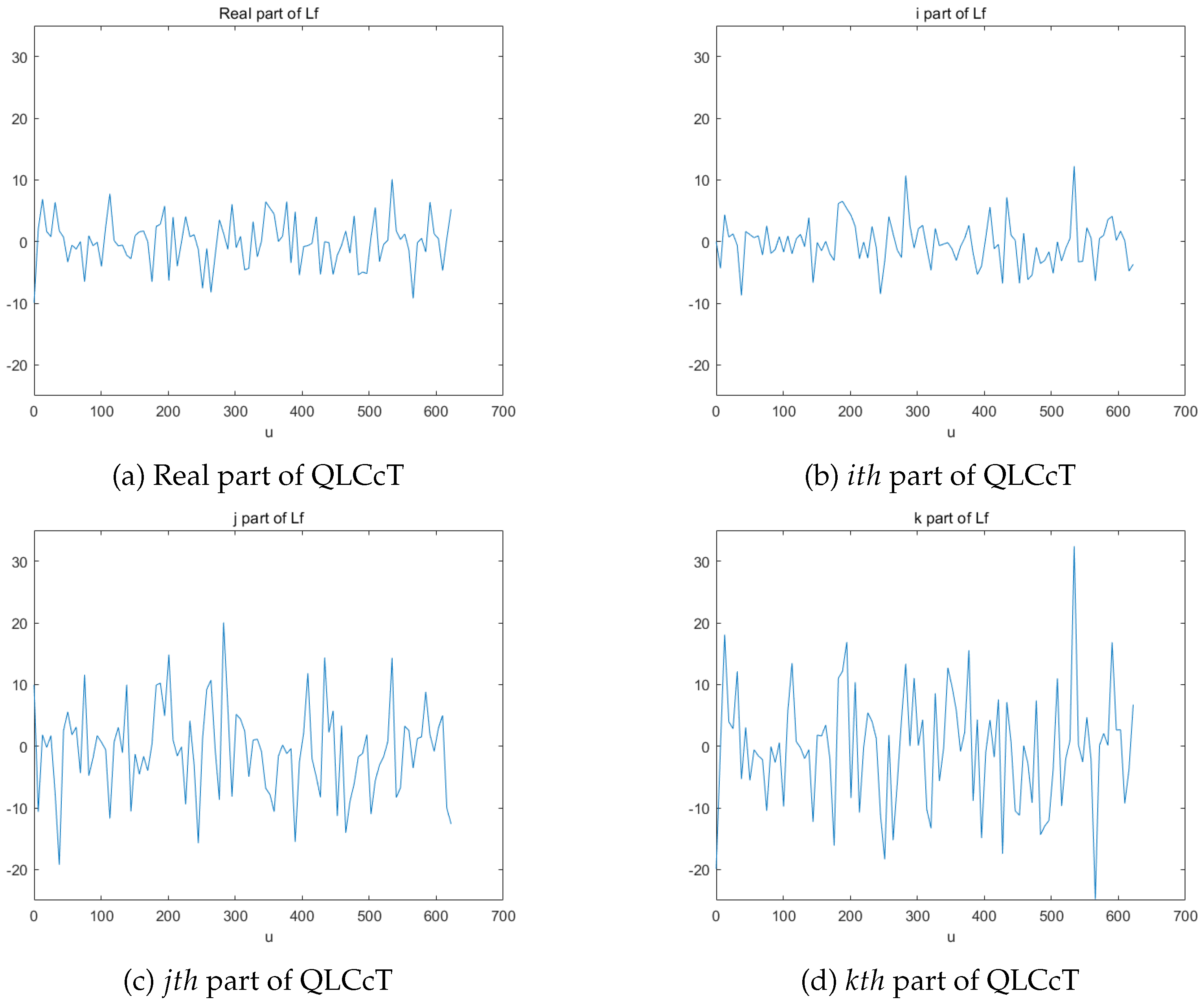
The visual representation of the provided quaternion signal is plotted in Figure 3, where , . On the other hand, its QLCcT of a signal is depicted in Figure 4 with . From Figure 4, we can observe that the quaternion linear canonical cosine transform has better spectral resolution and energy concentration. It can effectively describe the frequency domain characteristics of signals.
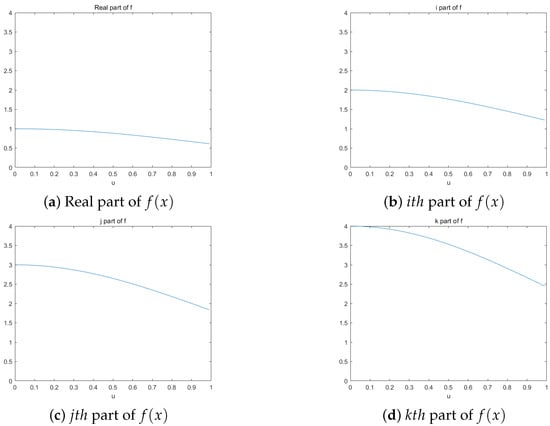
Figure 3.
Different components of quaternion signal .
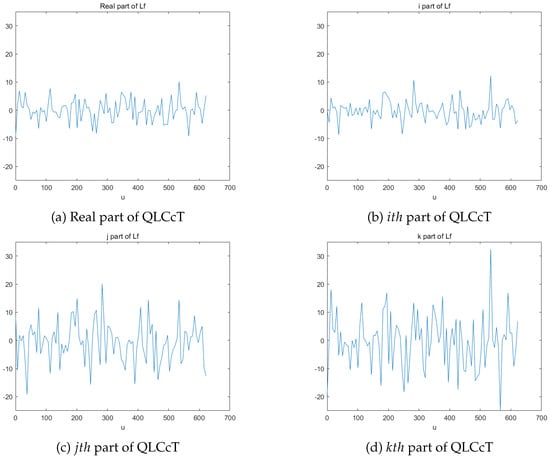
Figure 4.
Right-side QLCcT of .
5.2. Application of QLCcT
Multiplicative filtering is a signal processing method in the frequency domain that is used to denoise and enhance signals. It can modify the amplitude and spectrum of the signal while preserving its relative position, effectively improving signal quality and analysis accuracy. Therefore, it holds great significance in communication and image processing fields.
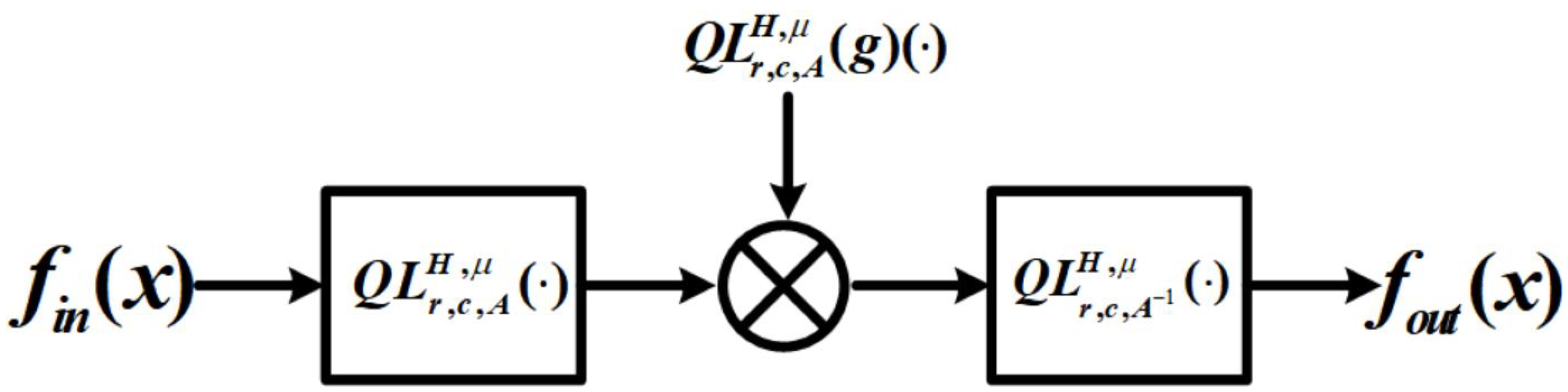
In this subsection, a multiplicative filter is designed in the QLCcT domain according to Theorem 7, and its model is depicted in Figure 5.
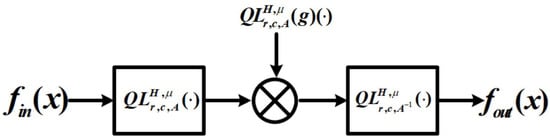
Figure 5.
Multiplication filter in the QLCcT domain.
Therefore, the design expression can be formulated as follows:
Let
be the transformed function; we choose the function:
as the lowpass filter for QLCcT with passband over . Combining Equation (69) and the reversibility property of the QLCcT, we can obtain the quaternion function as follows:
In the next analysis, we explore the computational complexity of a specific method when applied to signals of varying sizes. For the purpose of discussion, let us consider a signal with a size denoted by N; the traditional complex FT requires real-number multiplications [39]. According to Theorem 2, the QLCcT can be represented in terms of the QFcT, with the added benefit of the QFcT’s complexity being merely half that of the QFT. The computational complexity of the QFT is equivalent to that of the traditional complex FT, which is . Therefore, based on Definition 1 and Equations (69)–(71), we can deduce that the computational complexity of the multiplicative filter is .
6. Conclusions
This paper introduces QLCcT, which can be regarded as a generalization of classical QFRcT and QFcT. It also presents the key properties associated with it. Additionally, novel convolution operators for QLCcT are proposed, along with an accompanying correlation operator. Moreover, by utilizing the newly introduced convolution operators, we derive the corresponding weighted convolution and correlation theorems. Finally, an illustrative example is provided to demonstrate the application of right-side QLCcT. As an application for QLCcT, we deal with multiplicative filter design to show that this QLCcT and its properties allow signal reconstruction.
Author Contributions
Conceptualization, R.W. and Q.F.; methodology, R.W. and Q.F.; software, Q.F.; validation, R.W. and Q.F.; formal analysis, R.W. and Q.F.; writing—original draft, R.W.; writing—review and editing, R.W. and Q.F. All authors have read and agreed to the published version of the manuscript.
Funding
This work was supported by the National Natural Science Foundation of China (No. 62261055, 61861044), the project of Natural Science Foundation of Shaanxi Province (2022JM-400, 2023-JC-YB-085). The APC was funded by the National Natural Science Foundation of China.
Institutional Review Board Statement
Not applicable.
Informed Consent Statement
Not applicable.
Data Availability Statement
Data are contained within the article.
Acknowledgments
The authors thank the anonymous referees for their insightful remarks that helped to improve this article.
Conflicts of Interest
The authors declare no conflicts of interest.
References
- Moshinsky, M.; Quesne, C. Linear canonical transformations and their unitary representations. J. Math. Phys. 1971, 12, 1772–1780. [Google Scholar] [CrossRef]
- Feng, Q.; Li, B.Z. Convolution and correlation theorems for the two-dimensional linear canonical transform and its applications. IET Signal Process. 2016, 10, 125–132. [Google Scholar] [CrossRef]
- Xin, H.C.; Li, B.Z.; Bai, X. A Novel Sub-Nyquist FRI Sampling and Reconstruction Method in Linear Canonical Transform Domain. Circuits Syst. Signal Process. 2021, 40, 6173–6192. [Google Scholar] [CrossRef]
- Zhang, Z.C. Jittered Sampling in Linear Canonical Domain. IEEE Commun. Lett. 2020, 24, 1529–1533. [Google Scholar] [CrossRef]
- Chen, J.Y.; Li, B.Z. Fast numerical calculation of the offset linear canonical transform. J. Opt. Soc. Am. A—Opt. Image Sci. Vis. 2023, 40, 427–442. [Google Scholar] [CrossRef]
- Koç, A.; Bartan, B.; Ozaktas, H.M. Discrete Linear Canonical Transform Based on Hyperdifferential Operators. IEEE Trans. Signal Process. 2019, 67, 2237–2248. [Google Scholar] [CrossRef]
- Urynbassarova, D.; Teali, A.A. Convolution, Correlation, and uncertainty principles for the quaternion offset linear canonical transform. Mathematics 2023, 11, 2201. [Google Scholar] [CrossRef]
- Kundu, M.; Prasad, A.; Verma, R.K. Multidimensional linear canonical transform and convolution. J. Ramanujan Math. Soc. 2022, 37, 159–171. [Google Scholar]
- Wei, D.Y.; Li, Y.M. Convolution and Multichannel Sampling for the Offset Linear Canonical Transform and Their Applications. IEEE Trans. Signal Process. 2019, 67, 6009–6024. [Google Scholar] [CrossRef]
- Bhat, M.Y.; Dar, A.H. Multiresolution analysis for linear canonical S transform. Adv. Oper. Theory 2021, 6, 68. [Google Scholar] [CrossRef]
- Feng, Q.; Li, B.Z.; Rassias, J.M. Weighted Heisenberg-Pauli-Weyl uncertainty principles for the linear canonical transform. Signal Process. 2019, 165, 209–221. [Google Scholar] [CrossRef]
- Bruni, V.; Cardinali, M.L.; Vitulano, D. An MDL-Based Wavelet Scattering Features Selection for Signal Classification. Axioms 2022, 11, 376. [Google Scholar] [CrossRef]
- Miao, H.X. Generalized spectrum analysis of Chirp Cyclostationary signals associate with linear canonical transform. Signal Process. 2024, 218, 109385. [Google Scholar] [CrossRef]
- Xin, H.C.; Li, B.Z. On a new Wigner-Ville distribution associated with linear canonical transform. EURASIP J. Adv. Signal Process. 2021, 2021, 56. [Google Scholar] [CrossRef]
- Li, Z.W.; Gao, W.B. Inequalities for the Windowed Linear Canonical Transform of Complex Functions. Axioms 2023, 12, 554. [Google Scholar] [CrossRef]
- Bahri, M.; Karim, S.A.A. Novel Uncertainty Principles Concerning Linear Canonical Wavelet Transform. Mathematics 2022, 10, 3502. [Google Scholar] [CrossRef]
- Li, Y.M.; Jiang, M.J.; Wei, D.; Deng, Y. Novel Image Encryption Algorithm Based on Compressive Sensing and a Two-Dimensional Linear Canonical Transform. Fractal Fract. 2024, 8, 92. [Google Scholar] [CrossRef]
- Qasim, I.M.; Mohammed, E.A. Optical image encryption based on linear canonical transform with sparse representation. Opt. Commun. 2023, 533, 129262. [Google Scholar] [CrossRef]
- Pei, S.C.; Ding, J.J. Fractional cosine, sine, and Hartley transforms. IEEE Trans. Signal Process. 2002, 50, 1661–1680. [Google Scholar]
- Wang, R.B.; Feng, Q.; Ji, J.Y. The discrete convolution for fractional cosine-sine series and its application in convolution equations. AIMS Math. 2024, 9, 2641–2656. [Google Scholar] [CrossRef]
- Xiang, Y.; Yuan, S.; Feng, Q. Fractional Fourier cosine and sine Laplace weighted convolution and its application. IET Signal Process. 2023, 17, e12170. [Google Scholar] [CrossRef]
- Chen, B.J.; Yu, M.; Su, Q.T. Fractional quaternion cosine transform and its application in color image copy-move forgery detection. Multimed. Tools Appl. 2019, 78, 8057–8073. [Google Scholar] [CrossRef]
- Feng, Q.; Li, B.Z. Convolution theorem for fractional cosine-sine transform and its application. Math. Meth. Appl. Sci. 2017, 40, 3651–3665. [Google Scholar] [CrossRef]
- Pei, S.C.; Yeh, M.H. The discrete fractional cosine and sine transforms. IEEE Trans. Signal Process. 2001, 49, 1198–1207. [Google Scholar]
- Hamilton, W.R. Elements of Quaternions; Longmans Green: London, UK, 1866. [Google Scholar]
- Kantor, I.L.; Solodovnikov, A.S. Hypercomplex Number: An Elementary Introduction to Algebras; Springer: New York, NY, USA, 1989. [Google Scholar]
- Bujack, R.N.; Bie, H.D. Convolution products for hypercomplex Fourier transforms. J. Math. Imaging Vis. 2014, 48, 606–624. [Google Scholar] [CrossRef]
- Brahim, K.; Tefjeni, E. Uncertainty principle for the two sided quaternion windowed Fourier transform. J. Pseudo-Differ. Oper. 2020, 11, 159–185. [Google Scholar] [CrossRef]
- Xu, G.L.; Wang, X.T.; Xu, X.G. Fractional quaternion Fourier transform, convolution and correlation. Signal Process. 2008, 88, 2511–2517. [Google Scholar]
- Mei, Y.Y.; Feng, Q.; Gao, X.X.; Zhao, Y.B. Convolution theorem associated with the QWFRFT. Chin. J. Electron. 2023, 32, 485–492. [Google Scholar] [CrossRef]
- Bahri, M.; Ashino, R.; Makis, V. Two-dimensional quaternion linear canonical transform: Properties, convolution, correlation and uncertainty principle. J. Math. 2019, 2019, 1062979. [Google Scholar] [CrossRef]
- Hu, X.X.; Cheng, D.; Kou, K.I. Convolution theorem associated with quaternion linear canonical transforms and applications. Signal Process. 2023, 201, 108743. [Google Scholar] [CrossRef]
- Gao, W.B.; Li, B.Z. Quaternion windowed linear canonical transform of two-dimensional signals. Adv. Appl. Clifford Algebr. 2020, 30, 16. [Google Scholar] [CrossRef]
- Yang, H.H.; Feng, Q.; Wang, X.X.; Urynbassarova, D.; Teali, A.A. Reduced Biquaternion Windowed Linear Canonical Transform: Properties and Applications. Mathematics 2024, 12, 743. [Google Scholar] [CrossRef]
- Urynbassarova, D.; El Haoui, Y.; Zhang, F. Uncertainty Principles for Wigner-Ville Distribution Associated with the Quaternion Offset Linear Canonical Transform. Circuits Syst. Signal Process. 2023, 42, 385–404. [Google Scholar] [CrossRef]
- Bhat, M.Y.; Almanjahie, I.M.; Dar, A.H. Wigner-Ville distribution and ambiguity function associated with the quaternion offset linear canonical transform. Demonstr. Math. 2022, 55, 786–797. [Google Scholar] [CrossRef]
- Zayed, A. A convolution and product theorem for the fractional Fourier transform. IEEE Signal Process. Lett. 1998, 5, 101–103. [Google Scholar] [CrossRef]
- Bhandari, A.; Zayed, A. Convolution and product theorems for the special affine Fourier transform. In Frontiers in Orthogonal Polynomials and q-Series; World Scientific Publishers: New York, NY, USA, 2018; pp. 119–137. [Google Scholar]
- Nussbaumer, H.J. Fast Fourier Transform and Convolution Algorithms; Springer: New York, NY, USA, 1981. [Google Scholar]
Disclaimer/Publisher’s Note: The statements, opinions and data contained in all publications are solely those of the individual author(s) and contributor(s) and not of MDPI and/or the editor(s). MDPI and/or the editor(s) disclaim responsibility for any injury to people or property resulting from any ideas, methods, instructions or products referred to in the content. |
© 2024 by the authors. Licensee MDPI, Basel, Switzerland. This article is an open access article distributed under the terms and conditions of the Creative Commons Attribution (CC BY) license (https://creativecommons.org/licenses/by/4.0/).