


Abstract
In this paper, we study the complete quadrangle. We started this investigation in a few of our previous papers. In those papers and here, the rectangular coordinates are used to enable us to prove the properties of the rich geometry of a quadrangle using the same method. Now, we are focused on the isoptic point of the complete quadrangle , which is the inverse point to and with respect to circumscribed circles of the triangles , , , and , respectively, where and are isogonal points to and D with respect to these triangles. In studying the properties of the quadrangle regarding its isoptic point, some new results are obtained as well.
MSC:
51N20
1. Introduction
The geometry of a complete quadrangle is very rich and interesting, but all of its properties are proved in different ways. Our aim was to find a simple analytical tool with which it is possible to prove all of its properties using the same method. We have published several papers in this regard [1,2,3], where we present a unique method using rectangular coordinates that enables us to prove several properties of the complete quadrangle in a uniform way. This is the fourth work in the series of such papers, and it considers the isoptic point of the complete quadrangle. In the second section, we provide an overview of the previously mentioned method and important points and circles, which were all introduced in previous papers [1,2,3]. In the third section, we present numerous results on the isoptic point of the complete quadrangle proved using our new method. We end this paper with a Discussion section, where we distinguish our new original results and present the plan for our future work.
2. Materials and Methods
In [1], we introduced the choice of a suitable coordinate system and placed a complete quadrangle in such a system. First, we will mention important definitions and statements proved in [1,2].
The complete quadrangle is formed by four vertices, and D, and six lines, , , , , , and , representing the sides of the quadrangle. The opposite sides with no common vertex are , , and . In all four papers, we set in rectangular coordinates using four parameters: . In [1], we proved the following important fact: each quadrangle with no perpendicular opposite sides has a circumscribed rectangular hyperbola.
In the mentioned coordinate system, we obtain the following equation for this circumscribed hyperbola :
The center of this hyperbola is the point O, and we call it the center of the quadrangle as well. The asymptotes of are the axes of the quadrangle .
The vertices of are
and the sides are
The elementary symmetric functions in four variables— and d—are very useful in our study [1]:
There are many important points, lines, and circles related to the complete quadrangle, as introduced and proved in [1,2]. Here, we point out some of them that are important for further study in this paper.
The Euler’s circles of the triangles , , , and are as follows:
The centers of these circles are
Denoting the orthocenters of the triangles , , , and by and , respectively, we obtain their forms:
The circumscribed circles of the triangles , , , and are given by
with the centers
and the radii
respectively, and we use the following abbreviations
The diagonal triangle of the quadrangle is given by the vertices
and the sides
The vertices can be expressed as
where and stand for
The orthocenter of the diagonal triangle is of the form
The line
is Wallace’s line of the center O with respect to the triangle .
The points and stand for the points isogonal to and D with respect to the triangles , , , and , respectively. They are given by
Moreover, the points and D are centers of the circles , , , and . And the following relations are also valid:
where and are given in (11). The formula for two lines and with slopes and and their oriented angle ,
is also of our interest.
3. Results
The line given by
is incident to the points and given in (9) and (17); so, it is the line . However, the line passes through the point
as well. By analogy, the point T is incident to lines and too. We will call this point an isoptic point of the quadrangle . The property described in Theorem 9 justifies this name.
Two points, and , are conjugate points with respect to the circle in (8) if the equality
is valid.
For points and T from (17) and (20), we obtain
and as the equality
is fulfilled, these points are conjugate points with respect to the circle . They are inverse points with respect to this circle as well because they are collinear to its center . Hence, the following theorem, from [4], is valid:
Theorem 1.
Let be a complete quadrangle with the isoptic point T and let the and points be isogonal to the points and D with respect to the triangles , , , and , respectively. The point T is the inverse point to and with respect to the circumcircles of , , , and , respectively.
In [4], the isogonal point T is called the tangential point of the quadrangle .
The perpendicular from the point T to the line has the equation because is valid. This line is incident to the point , which is incident as well to the line with equation . Hence, the point is the foot of the perpendicular from T to the line .
Let us study the point
The points and have the differences of coordinates and . As is valid, then holds. Based on the symmetry of this result on and c, it follows that the point is the center of the pedal circle of the point T with respect to the triangle and that this circle has the radius . Similarly, the pedal circles of the point T with respect to the triangles , , and have the radii , , and , respectively. Comparing with (10), we can see that these radii are inversely proportional to the radii of the circles , , , and . However, the equality , i.e., , holds, which leads to the following theorem.
Theorem 2.
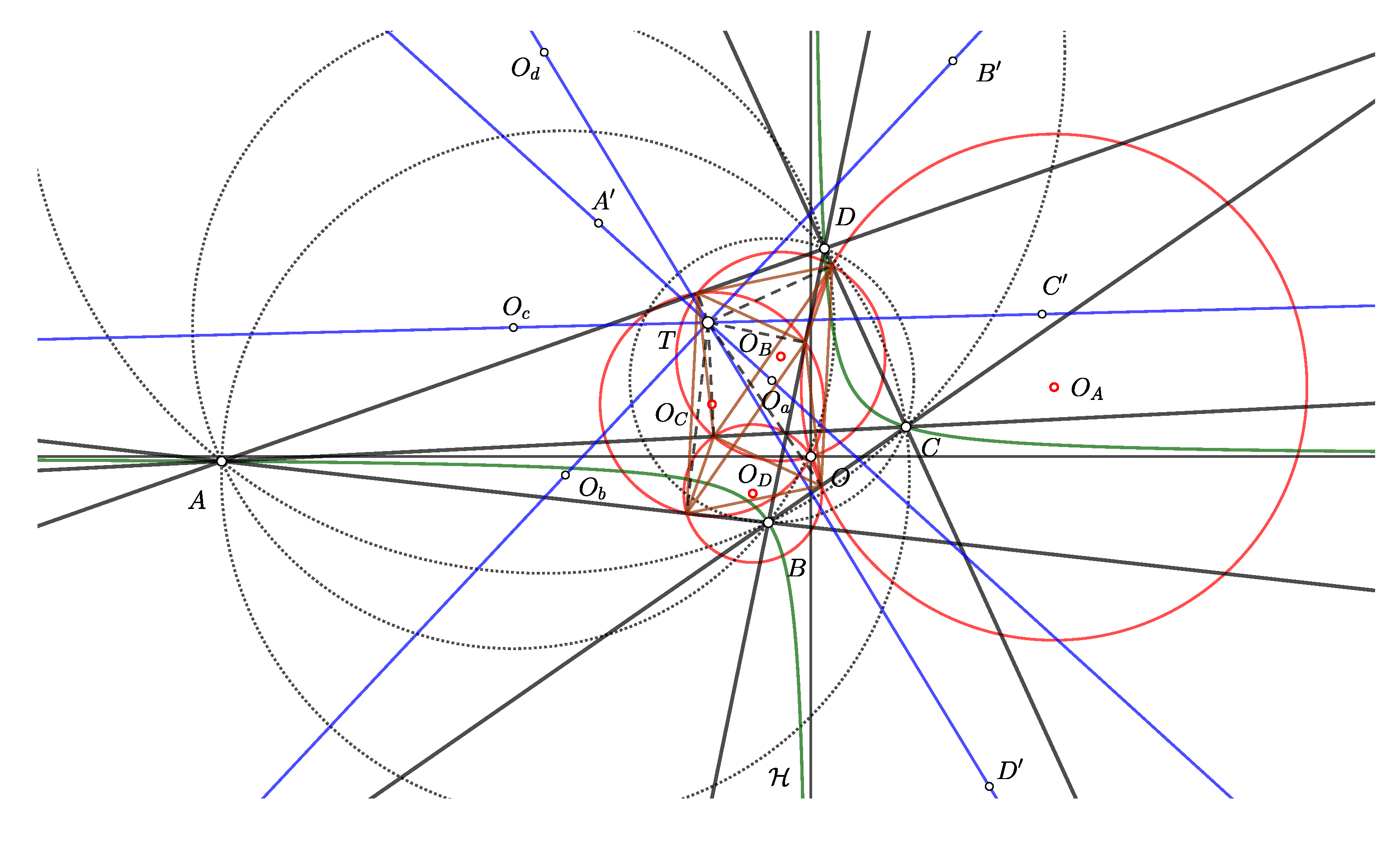
Let be a complete quadrangle with the center O and isoptic point T. The pedal circles of the point T with respect the triangles , , , and , respectively, are incident to the center O.
This is our an original statement; see the visualization of the theorem in Figure 1.
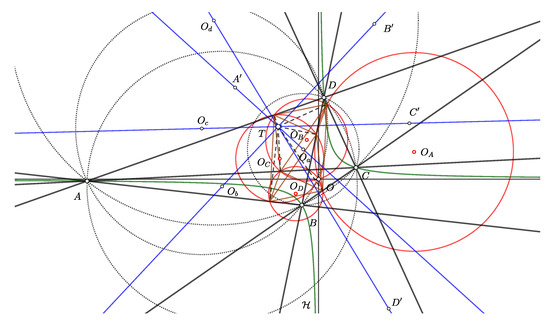
Figure 1.
Visualization of Theorem 2.
Let and be the points symmetric to T with respect to the lines , , , , , and . Then, we have, e.g., the equality , out of which the first equality from the two follows:
The second equality follows from the first by substituting pairs and . We can write it better in the form
Analogously, we have
where and are given in (14). We have proved the next result:
Theorem 3.
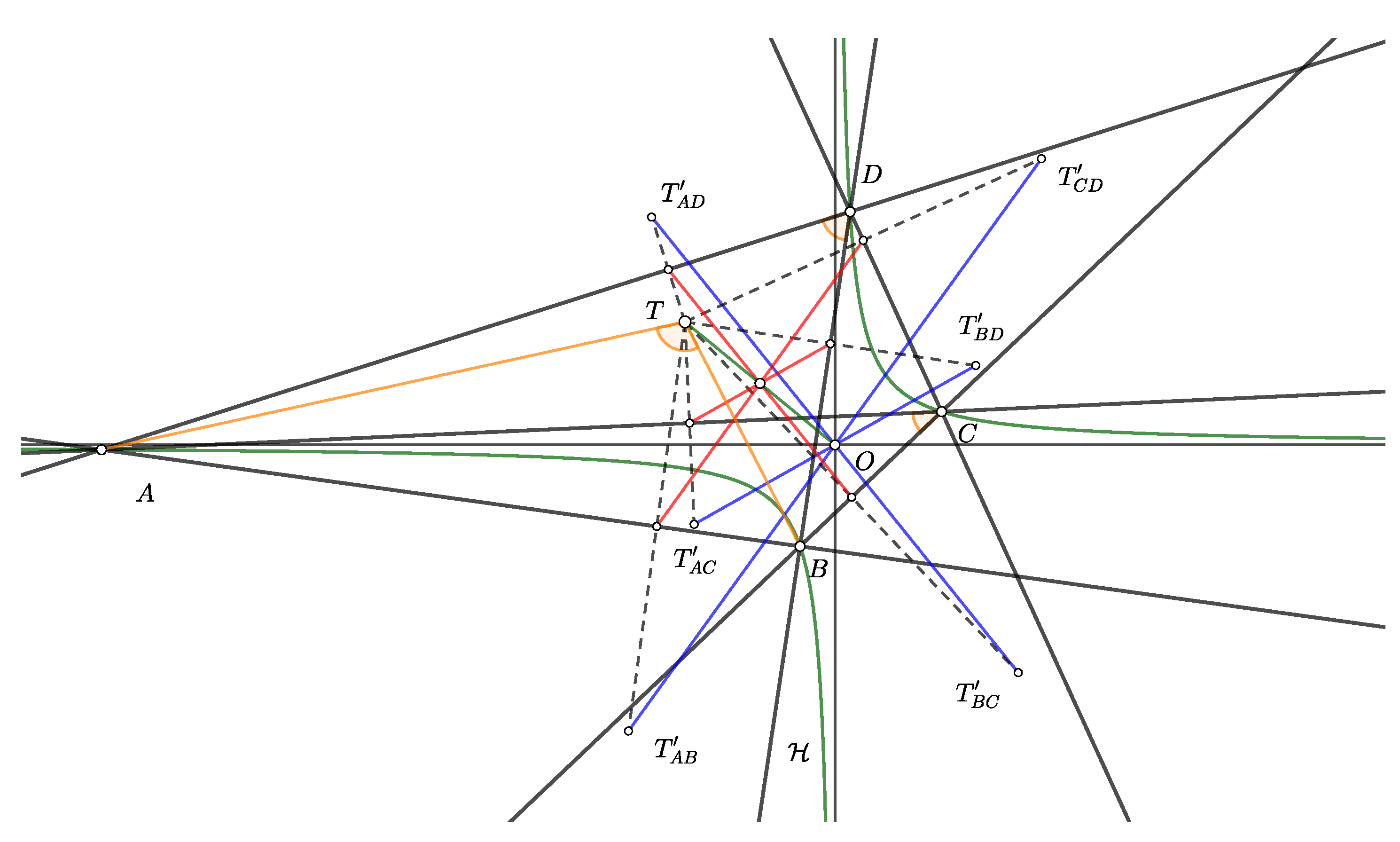
Let be a complete quadrangle with the center O and isoptic point T. Points symmetric to T with respect to the sides of form a hexagon symmetric with respect to the center O, and the feet of the perpendiculars from T to the sides of form a hexagon symmetric with respect to the midpoint of T and O.
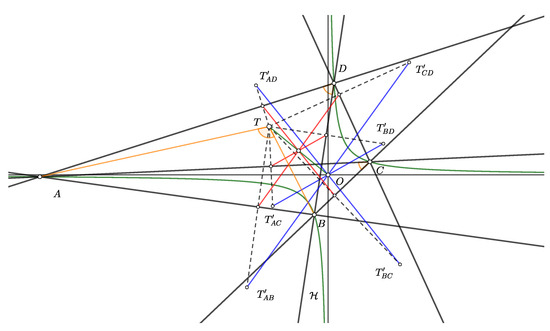
Figure 2.
Hexagons from Theorem 3.
The line has the slope , and the line has the slope , so due to (19),
is valid. The line has the slope , and the line has the slope , and due to the same formula,
holds. The numerator in (21), because of valid equality , is equal to
while because of
the denominator is equal to
Thus, finally, we obtain
We have just proved the following statement.
Theorem 4.
Let be a complete quadrangle with the center O and isoptic point T. The lines connecting O and T with a diagonal point of the quadrangle are isogonal with respect to the pair of its opposite sides intersecting in this diagonal point.
For the numerator and denominator, we obtain the forms
Hence,
Lines and have the slopes and , so due to (19), we obtain the first out of the two analogous equalities:
out of which
easily follows. Hence, we have proved the first of six analogous statements.
Theorem 5.
Let be a complete quadrangle and T its isoptic point. The following statements are valid:
The same result can be found in [4,6], where the result is attributed to T. McHugh, and in [7]. See Figure 2.
Hence, we have proved the following.
Theorem 6.
Let be a complete quadrangle with the isoptic point T and and points isogonal to the points and D with respect to the triangles , , , and , respectively. The pairs of lines ; ; ; and have the same bisectors. Lines and have the same cross ratio as the lines , , , and .
The first statement from the previous theorem was reached in [8,9], and the second, in [10].
Let be a point on the hyperbola diametrically opposite to the point D, i.e., . Then, the slope of the line is . As the line has the slope , then due to (19), the equality is obtained. As the line has the slope , and the line has the slope , according to (19), we obtain the equality
Analogous equalities are valid for points B and C; hence, we have proved the following theorem.
Theorem 7.
Let be a complete quadrangle with the isoptic point T and circumscribed hyperbola . Let and be points on the hyperbola diametrically opposite to the points and D, respectively. The point T is an isogonal point to and with respect to the triangles and , respectively.
This result is in [8,9,10,11,12]. There is one more result regarding the fact that an isogonal image with respect to the triangle of any circumscribed conic is a line.
Theorem 8.
Let be a complete quadrangle and be its circumscribed hyperbola. The lines that are isogonal images of with respect to the triangles , , , and are intersected at the point T, which is an isogonal point of the points and with respect to these triangles.
Specifically, the points and are incident to . A previous result can be found in [10].
For the distance of the point from (9) and T from (20), we obtain the equality
and then, after some computing, we also obtain
This means that is valid. Together with (10), the last equality in the series is obtained:
And the rest is valid by analogy. This actually leads to the following theorem.
Theorem 9.
Let be a complete quadrangle and let its isoptic point T lie in the exterior of the circles and . These circles are seen from T under equal angels.
The result from the previous theorem can be found in [12], where it is attributed to G.T. Bennett. But also, the same result is in [4,7,11] as well.
The locus of points for which the ratio of distances to the centers of two given circles is equal to the ratio of the radii of these circles is a circle. This circle is called the circle of similitude. Let us note the following: if two given circles have the common point, then the point is incident to their circle of similitude. So, the circle of similitude for the circles and with the centers and and radii and is the locus of the point P such that is valid, and this circle is incident to C and D. Out of (24), it follows that the isoptic point T is incident to this circle of similitude. Hence, we have proved the following theorem.
Theorem 10.
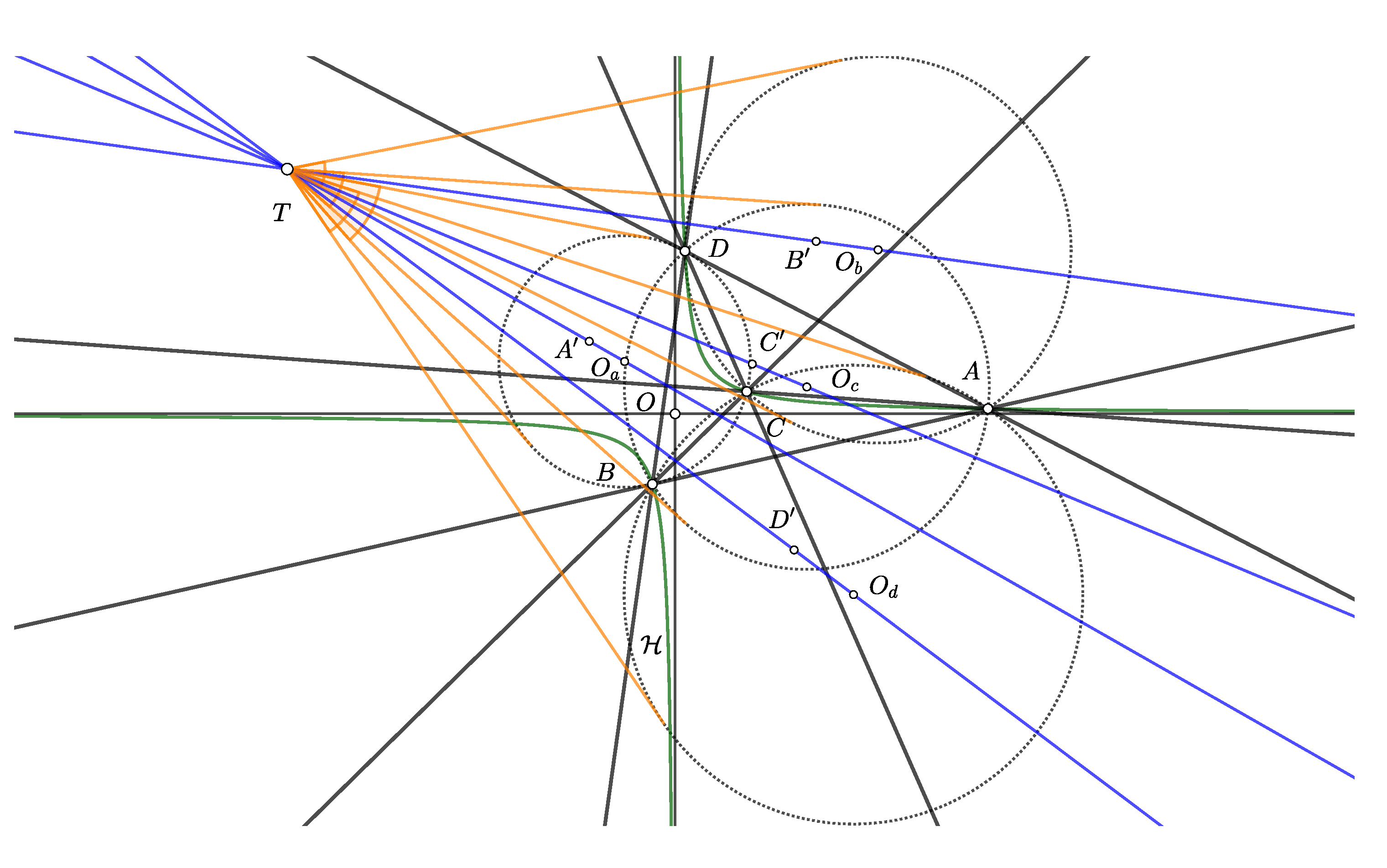
Let be a complete quadrangle. Its isoptic point T is the common point of the six circles of similitude of the pairs of the four circumcircles of the triangles , , , and .
This result can be found in [7,10,11,12], which is attributed to G.T. Bennett. See this result in Figure 3 as well.
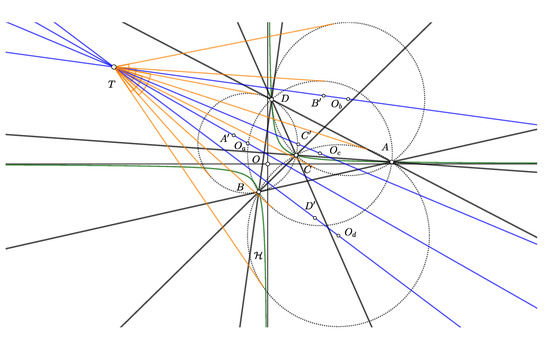
Figure 3.
The circles of similarity in Theorem 10.
For the point and the point T from (20), we obtain
and after some computing, we also obtain
i.e., we have the last four analogous equalities:
Because of in (10), it follows that . Along with three more analogues equalities, we obtain
and on the other side, from (27), we have
As is valid, then from the first formula from (23), we easily obtain the first of two analogous equalities,
for the sines of angels under which the side of the quadrangle is seen from C and D. There are ten more analogous equalities for the remaining five sides of the quadrangle. From the last two equalities and the last two equalities in (26), the equality follows, i.e., we finally have
along with five more analogous statements. We can find them in [4].
For the power of the point T with respect to the circle from (8), we obtain
and then, after some calculations follows, i.e., the last equality is proved as follows:
where and are powers of the point T with respect to the circles , , and . If , i.e., the quadrangle is convex, then these powers of the point T are negative and the point T lies in the interior of each circle and , and if , i.e., one of points and D is placed into the area of the triangle formed by the remaining three points, then the mentioned powers of the point T are positive and T is outside of the circles and . Out of (30), it follows that . Because of (25), we have the equality , so is valid. We have just proved the following theorem.
Theorem 11.
Let be a complete quadrangle and T be its isoptic point. and are denoted powers of the point T with respect to the circumscribed circles of the triangles and . Then, the following statement is valid"
The same result was proved in [4] in another way.
For the square of a distance between T and U, the equality is fulfilled. As
then
So, we reach the first out of three analogous equalities in the next theorem.
Theorem 12.
Let be a complete quadrangle; , its diagonal triangle; and T, the isoptic point. For the distances , , and , the following equalities are valid:
This result was reached in [4] as well.
From the first equality in (10), the equality is obtained. Together with the first equality from (30), it gives . Hence, we have the following theorem.
Theorem 13.
Let be a complete quadrangle and T be its isoptic point. The powers of the point T with respect to the circumscribed circles , , , and are proportional to the squares of the radii of these circles. The distances of the point T to each vertex of are reversely proportional to the radii of the circumscribed circle passing through the other three vertices.
The second statement in the previous theorem follows from (27). Both results can be found in [7].
For points in (17) and T in (20), we obtain
and together with the last equality from (26), the equality , i.e., is obtained. Along with three more analogous equalities, we obtain the following theorem.
Theorem 14.
Let be a complete quadrangle; T, its isoptic point; and , , , and , points isogonal to and D with respect to the triangles , , , and . Then,
The previous result was proved in [8,9] as well. Together with the first statement in Theorem 6, our original statement is proved.
Theorem 15.
Let be a complete quadrangle; T, its isoptic point; and , , , and , points isogonal to and D with respect to the triangles , , , and . The complete quadrangle is mapped into the complete quadrangle through the composition of a reflection with respect to the line through T and an inversion with the center in T.
Along with already proved equality, , it follows that . Out of (10), follows, so the following statement is valid.
Theorem 16.
Let be a complete quadrangle and T be its isoptic point, and let and be points isogonal to the points and D with respect to the triangles , , , and . The following equalities are valid:
where and and and stand for the centers and radii of the circumcircles of , , , and , respectively.
The same result is in [8,9].
The points T and are isogonal with respect to the triangle . It is well known from the geometry of a triangle that there is a conic with foci T and for which the square of the semi-minor axis is equal to the product of the distances of these foci to any side of the triangle. If we take into consideration that the studied conic is an ellipse or hyperbola and that we are calculating with oriented distances, then, for the point T from (20), the point , and the line with equation , we obtain
The distance between points T and is given by
The linear eccentricity of the studied conic is . If is its semi-major axis, then is valid. Hence, through a little bit of computing,
follow because of (25). And because of this, , so we have proved the following theorem.
Theorem 17.
Let be a complete quadrangle and T be its isoptic point. The major axis of the inscribed conics of the triangles and with one focus in T is equal to the distance of this focus and the points and D, respectively.
Let us denote the centers of the circles , , , and by and . The points and are incident to the bisector of the line segment , so the bisector of the line segment is parallel to the line . Because the line has the slope and it is incident to the midpoint of and , it is easy to see that its equation is the first one of the next two:
And the second one is the equation of the bisector of the line segment . From these two equations, for the coordinates x and y of the point , we obtain
Because of this, the point can be written in the form , so , and furthermore, . Thus, homothety with center T and factor maps points and D into points and , respectively. The following result is proved.
Theorem 18.
Let be a complete quadrangle; T, its isoptic point; , , , and , the centers of the circles and , respectively; and and , the centers of circles , , , and . The quadrangles and are similar.
This result was reached in [4] as well.
It is easy to check the equalities
meaning that for the points , , and T, the equality is fulfilled, and therefore, . Hence, homothety with center T and factor maps the point into the point , and by analogy, the points and are mapped into and , respectively. Therefore, the same homothety maps the quadrangle into the quadrangle , and the quadrangle into the quadrangle . We obtained the isoptic point T of the quadrangle as the common point of the connecting lines of the corresponding vertices of quadrangles and . As the roles that has for and the quadrangle for the quadrangle are the same, and as the connecting lines of the corresponding vertices of quadrangles and are incident to the point T, we have proved the following original statement.
Theorem 19.
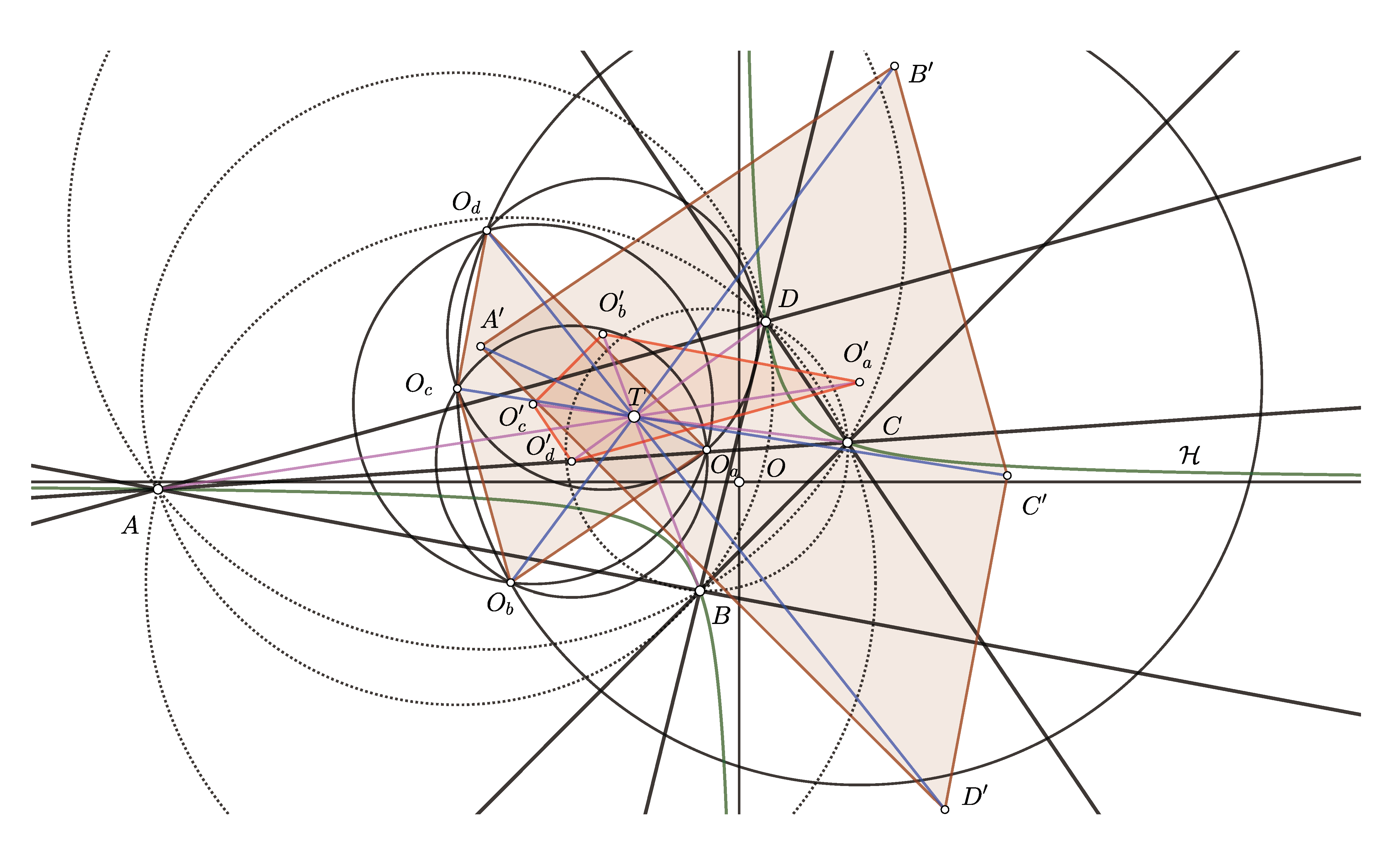
Let be a complete quadrangle and let and be points isogonal to the points and D with respect to the triangles , , , and . The complete quadrangle and the complete quadrangle have the same isoptic point.
Quadrangles and have the same mutual relationship as well as relation to the point T as the quadrangles and . So, as the point T is the inverse point to the points and with respect to the circles and , we have the following theorem.
Theorem 20.
Let be a complete quadrangle and T be its isoptic point. The point T is an inverse point to the points and D with respect to the circles , , , and , where and are the centers of the circumscribed circles , , , and , respectively.
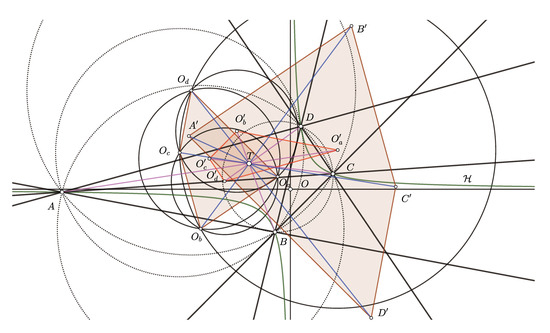
Figure 4.
The quadrangles and have the same isoptic point.
The equalities in (24) mean that the distances of the point T and each center of the circles , , , and are proportional to the radii of these circles.
Theorem 21.
Let be a complete quadrangle and T be its isoptic point. The distances of the point T and the points and D are proportional to the radii of circles , , , and , where and stand for points that are isogonal to the points and D with respect to the triangles , , , and .
Again, the result can be found in [8,9].
For quadrangles , , and , we write them down in the form , , and , and then the quadrangle can be written in the form . If we continue with this sequence in both directions, then for each , the points and are the centers of the circumscribed circles , , , and , and points and are isogonal to the points and with respect to the triangles , , , and , respectively. Toward infinity for both sides of the sequence of the quadrangles, all the quadrangles have the same isoptic point T, where the same homothety with the center T maps the quadrangle into for each . Hence, all the quadrangles on the even places in the sequence are mutually homothetic, and the same fact is valid for the quadrangles on the odd places. However, two quadrangles in two adjacent places in the sequence do not have to be homothetic. This result can be found in several places [4,7,10]. The fact that the quadrangles and are similar was found in [15,16], and the fact that they are homothetic as well was found in [7,17], where the part of the point T being an inverse point to each vertex of the quadrangle with respect to the circumscribed circles of the corresponding triangles of the quadrangle was especially emphasized.
The normal of A to the line with the slope has the equation , and analogously, the normal of B to the line has the equation . The intersection point of these lines is the point
which is a vertex of the antipedal triangle of D with respect to the triangle . Analogously,
The bisector of the line segment is parallel to the line and has the equation
It can be checked that the point
passes through the line (31), so because of symmetry on and c, it follows that is the circumcenter of the triangle . With the help of the forms of D and T in (20), the point can be written in the form , where for the oriented line segments, the ratio is valid. Because of symmetry on and d, we have the following theorem.
Theorem 22.
Let be a complete quadrangle. The quadrangles and are homothetic, where and are circumcenters of the antipedal triangles of the points and D with respect to the triangles , , , and .
There was the same resut in [4] as well. In addition, we obtained the center of the homothety T, which is the isoptic point, and the factor of homothety is .
The symmetric functions in (14) of the values and can be expressed by values and p, and the following identities are valid:
where . Because of these, the point from (15) has the form
and the line (16) has an equation of the form
As
is valid, then the line has the slope
which is equal to the slope of the line (33). Hence, we have the following.
Theorem 23.
Let be a complete quadrangle and be its diagonal quadrangle. The Wallace line of the center O with respect to the diagonal triangle is parallel to the line , where T is the isoptic point of , and is the orthocenter of .
4. Discussion
Using rectangular coordinates for the complete quadrangle provides a new approach for the extensive geometry of complete quadrangles. It is possible to gather all of its properties and prove them in the same way. Here, we gathered the properties of the isoptic point of a quadrangle. Theorems 2, 15, and 19 are our original results, and we did not find these statements in the literature available to us. We have also studied the geometry of the complete quadrangle in the isotropic plane. Hence, we are planning to check and prove the results presented in this paper to see if they hold in the isotropic plane as well.
Author Contributions
Conceptualization, E.J., M.Š.H. and V.V.; methodology, E.J., M.Š.H. and V.V.; software, E.J. and M.Š.H.; validation, E.J., M.Š.H. and V.V.; formal analysis, E.J., M.Š.H. and V.V.; investigation, E.J., M.Š.H. and V.V.; resources, V.V.; data curation, E.J., M.Š.H. and V.V.; writing—original draft preparation, E.J. and M.Š.H.; writing—review and editing, E.J. and M.Š.H.; visualization, E.J.; supervision, V.V. All authors have read and agreed to the published version of the manuscript.
Funding
This research was funded by University of Zagreb Faculty of Architecture.
Data Availability Statement
Data is contained within the article.
Conflicts of Interest
The authors declare no conflicts of interest.
Abbreviations
The following abbreviations are used in this manuscript:
| MDPI | Multidisciplinary Digital Publishing Institute; |
| DOAJ | Directory of open access journals; |
| TLA | Three-letter acronym; |
| LD | Linear dichroism. |
References
- Volenec, V.; Jurkin, E.; Šimić Horvath, M. On Quadruples of Orthopoles. J. Geom. 2023, 114, 29. [Google Scholar] [CrossRef]
- Volenec, V.; Šimić Horvath, M.; Jurkin, E. On some properties of a complete quadrangle. AppliedMath 2024, 4, 250–260. [Google Scholar] [CrossRef]
- Volenec, V.; Jurkin, E.; Šimić Horvath, M. Circles Related to a Complete Quadrangle. KoG 2023, 27, 51–59. [Google Scholar] [CrossRef]
- Baumgartner, D.; Stärk, R. Ein merkwürdiger Punkt des Viereceks. Praxis Math. 2002, 44, 19–27. [Google Scholar]
- Schmidt, E. Miquel-Poncelet und Bennett Punkt Eines Vierecks. Available online: http://eckartschmidt.de (accessed on 21 April 2024).
- Mallison, H.V. Pedal circles and the quadrangle. Math. Gaz. 1958, 42, 17–20. [Google Scholar] [CrossRef]
- Radko, O.; Tsukerman, E. The perpendicular bisector construction, isoptic point and Simson line. Forum Geom. 2012, 12, 161–189. [Google Scholar]
- Bouvaist, R. Question 3319. Mathesis 1947, 56, 63. [Google Scholar]
- Durieu, M. Solution on Question 3319. Mathesis 1947, 56, 177–178. [Google Scholar]
- de Majo, A. Sur un point remarquable du quadrangle. Mathesis 1954, 63, 236–240. [Google Scholar]
- Cundy, H.M.; Parry, C.F. Geometrical properties of some Euler and circular cubics. J. Geom. 1999, 66, 72–103. [Google Scholar] [CrossRef]
- Wood, P.W. Points isogonally conjugate with respect to a triangle. Math. Gaz. 1941, 25, 266–272. [Google Scholar] [CrossRef]
- Longuet-Higgins, M.S. Reflections on reflections. Math. Gaz. 1974, 58, 257–263. [Google Scholar] [CrossRef]
- Parry, C.F.; Longuet-Higgins, M.S. (Reflections)3. Math. Gaz. 1975, 59, 181–183. [Google Scholar] [CrossRef]
- Langr, J. Problem E1085. Amer. Math. Mon. 1953, 60, 551. Available online: https://www.jstor.org/stable/2306853?origin=crossref (accessed on 21 May 2024).
- Thomas, M. E1085. Amer. Math. Mon. 1973, 80, 808. [Google Scholar]
- Shepard, G.C. The perpendicular bisector construction. Geom. Ded. 1995, 56, 75–84. [Google Scholar] [CrossRef]
Disclaimer/Publisher’s Note: The statements, opinions and data contained in all publications are solely those of the individual author(s) and contributor(s) and not of MDPI and/or the editor(s). MDPI and/or the editor(s) disclaim responsibility for any injury to people or property resulting from any ideas, methods, instructions or products referred to in the content. |
© 2024 by the authors. Licensee MDPI, Basel, Switzerland. This article is an open access article distributed under the terms and conditions of the Creative Commons Attribution (CC BY) license (https://creativecommons.org/licenses/by/4.0/).