


Abstract
Let G be a graph with n vertices and m edges. and I denote, respectively, the adjacency matrix of G and an n by n identity matrix. For a graph G, the permanent of matrix is called the permanental sum of G. In this paper, we give a relation between the Hosoya index and the permanental sum of G. This implies that the computational complexity of the permanental sum is -complete. Furthermore, we characterize the graphs with the minimum permanental sum among all graphs of n vertices and m edges, where .
MSC:
15A15; 05C31; 05E16
1. Introduction
The permanent of an n square matrix with is defined as
where denotes a symmetry group of order n. The computational complexity of the permanent of a matrix is #P-complete [1].
Let G be a graph on n vertices and m edges. Let and I denote the adjacency matrix of G and an n by n identity matrix, respectively. The permanental polynomial of G is defined as
where denotes the kth coefficient of . In particular, . The permanental polynomials of graphs were first introduced in mathematics [2] and chemistry [3]. For more and additional information, see [4,5] and the references therein.
A Sachs graph G is a graph wherein each component is a single edge or a cycle. For a given an integer , is the collection of all Sachs subgraphs of order k in G, and let be the number of cycles in H. Merris et al. [2] gave a Sachs type result closely related to the coefficients of the permanental polynomial of G as below:
The permanental sum of G, written as , is the sum of the absolute values of all coefficients of , i.e.,
Specifically, if G is an empty graph. Wu and So [6] give an explicit formula for permanental sums as follows:
which implies that calculating the permanental sum is #P-complete. The permanental sum of a graph was first considered by Tong [7]. In [8], Xie et al. captured a labile fullerene . Tong computed all 271 fullerenes in . In his study, Tong found that the permanental sum of achieves the minimum among all 271 fullerenes in . He pointed out that the permanental sum will be closely related to the stability of molecular graphs. For more information about permanental sums, see [9,10,11,12].
A k-matching in G is a set of k independent edges, and the number of k-matching is denoted by . The matching number of G, denoted by , is the maximum size of a matching in G. The Hosoya index is defined as the total number of matchings of G, i.e.,
In 1971, the chemist Hosoya firstly introduced as a chemical application to describe the thermodynamic properties of saturated hydrocarbons. Later, the computational complexity of was proved to be NP-complete [13,14]. Next, we introduce a relationship between the Hosoya index and the permanent below.
Theorem 1.
Let G be a graph with n vertices, and let be the collection for which elements are disjoint unions of cycles in G. Then
Proof.
By (1), we have
Denote by a Sachs subgraph of G with k vertices such that each component is a single edge. Similarly, denote by a Sachs subgraph of G with k vertices such that at least one component is a cycle. Set and , where if k is odd. Obviously, . Furthermore, we know that for . Thus
Assume that is disjoint cycles with i vertices, and . For an integer k, the number is equal to . Thus,
Combining the arguments as above, we have
□
By Theorem 1 and Jerrum’s result [13], we have:
Corollary 1.
The computation of is -Complete.
Recently, some results on permanental sums were published. Let be a collection of connected simple graphs of order n and size m. Furthermore, if graph and , then G is called a tree, unicyclic graph, bicyclic graph, tricyclic graph, tetracyclic graph, ⋯, k-cyclic graph, where . In particular, every k-cyclic graph contains at least k cycles. Wu and Lai [15] determined the smaller bound of permanental sums of all unicyclic graphs in . And the corresponding extremal graphs were determined, where the graph of can be seen in Figure 1. Wu and Das [16] determined the lower bound of permanental sums of all bicyclic graphs in . And the corresponding extremal graphs were determined, where graph of can be seen in Figure 1. So et al. [6] characterized the lower bounds of the permanental sums of all tricyclic graphs in . And the corresponding extremal graphs were determined, where the graph of can be seen in Figure 1. According to the above results, So et al. [6] proposed a conjecture as follows.
Conjecture 1.
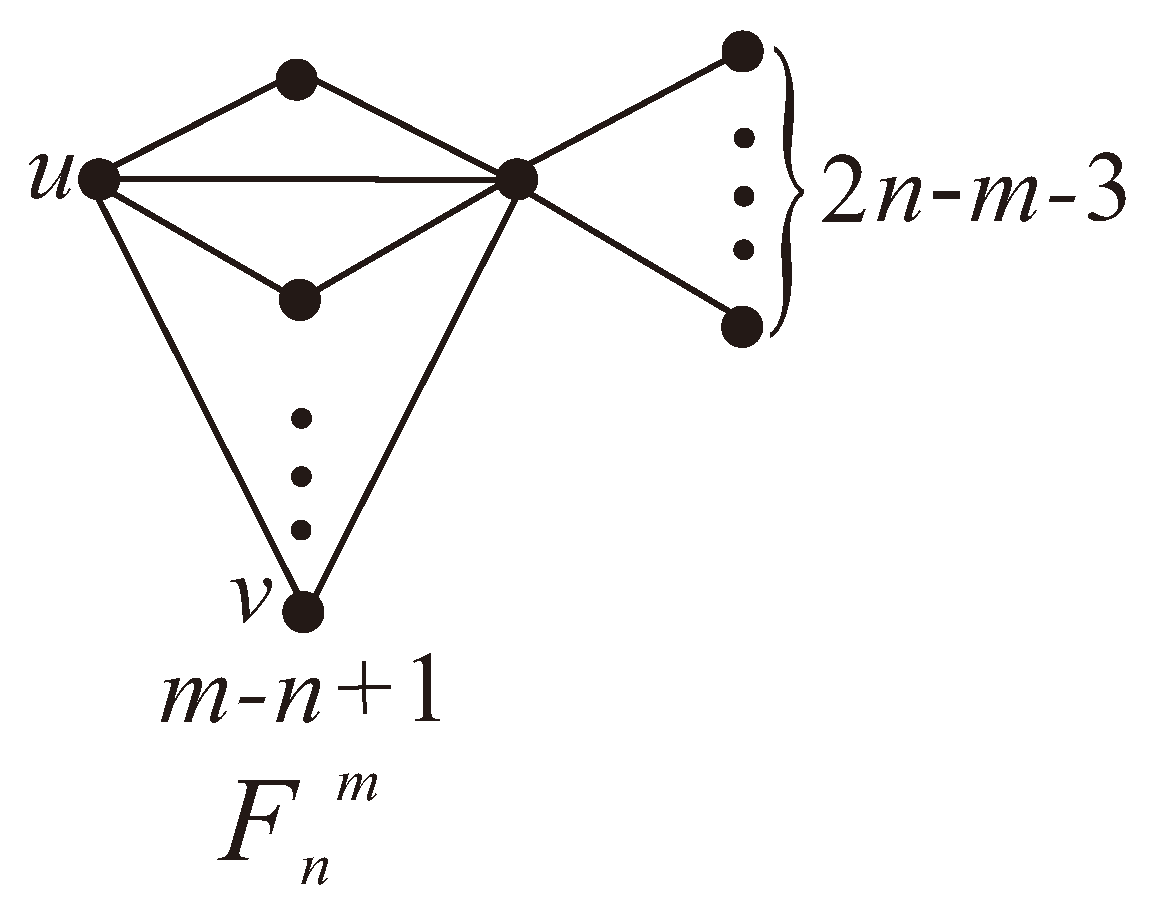
For with , , and the equality holds if and only if . The graph of can be seen in Figure 1.
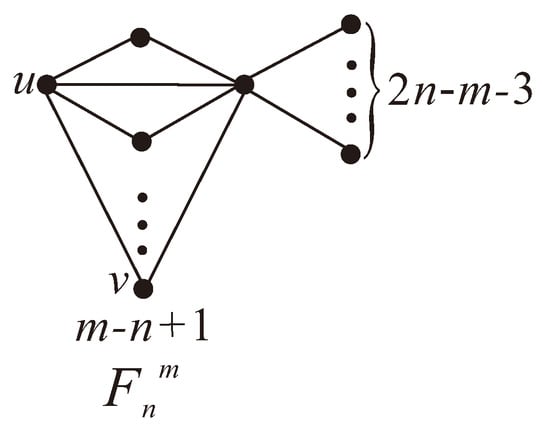
Figure 1.
Graph of .
Figure 1.
Graph of .
In this paper, we focus on Conjecture 1, and we give a solution as follows.
Theorem 2.
Let . If , then , where the equality holds if and only if .
The rest of this paper is organized as follows. In Section 2, we present some definitions and properties of permanental sums of graphs. In Section 3, we first present some graph operations that can be considered to be graph transformations, and show we that the transformed graph, generally, will have a smaller permanental sum than the original graph. Furthermore, we give the proof of Theorem 2. In the final section, we give a summary of this paper, and some new problems regarding permanent sums are introduced.
2. Preliminaries
All graphs considered in this work are undirected, finite, and simple graphs. For notation and terminology not defined here, see [17].
Let G be a graph with vertex set and edge set . The degree of a vertex is denoted by . The neighborhood of vertex , denoted by , is the set of vertices adjacent to v. For a subgraph H of G, let (respectively, ) denote the subgraph obtained from G by deleting the vertices and edges (respectively, deleting the edges) of H. In particular, if H is a vertex v (or an edge e), then (or ) is written as (or ). The path, cycle, and star of order n are denoted by , , and , respectively. Let denote the union of two vertex disjoint graphs G and H. For any positive integer l, denotes the union of l disjoint copies of G.
Now we present some properties of permanental sums of graphs.
Lemma 1
([15]). The permanental sum of a graph satisfies the following identities:
- (i)
- Let G and H be two graphs. Then
- (ii)
- Let be an edge of graph G, and is the set of cycles containing . Then
- (iii)
- Let v be a vertex of graph G, be the set of neighbors of v, and be the set of cycles containing v. Then
Lemma 2
([18]). Let G be a connected simple graph with n vertices. Then . The left equality holds if and only if , and the right equality holds if and only if .
Lemma 3
([6]). Let . Then , where the equality holds if and only if .
Lemma 4
([19]). Suppose that , where , and all cut edges are pendent edges incident with the same vertex. Then there exists an edge in G such that the subgraphs and are still connected.
3. Proof of Theorem 2
Before we prove Theorem 2, we introduce three graph operations that can be considered to be graph transformations, and we show that, generally, the transformed graph will have smaller permanental sum than the original graph.
Definition 1.
Let u be a vertex of graph . Denote by the graph obtained from and a tree T by attaching u to a vertex v of T. Denote by the graph obtained from and a star by attaching u to the center of . We designate the transformation from to as type I.
Lemma 5
([15]). Suppose that and are two graphs as defined by Definition 1. Then , and the equality holds if and only if T is a star and v is the center of T.
Definition 2.
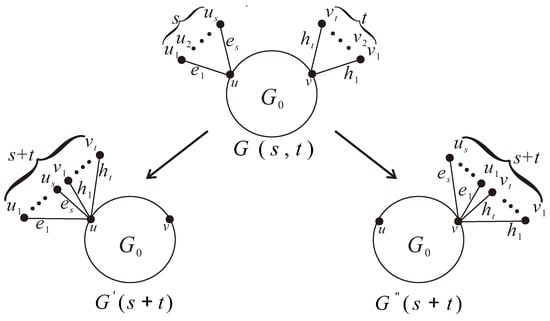
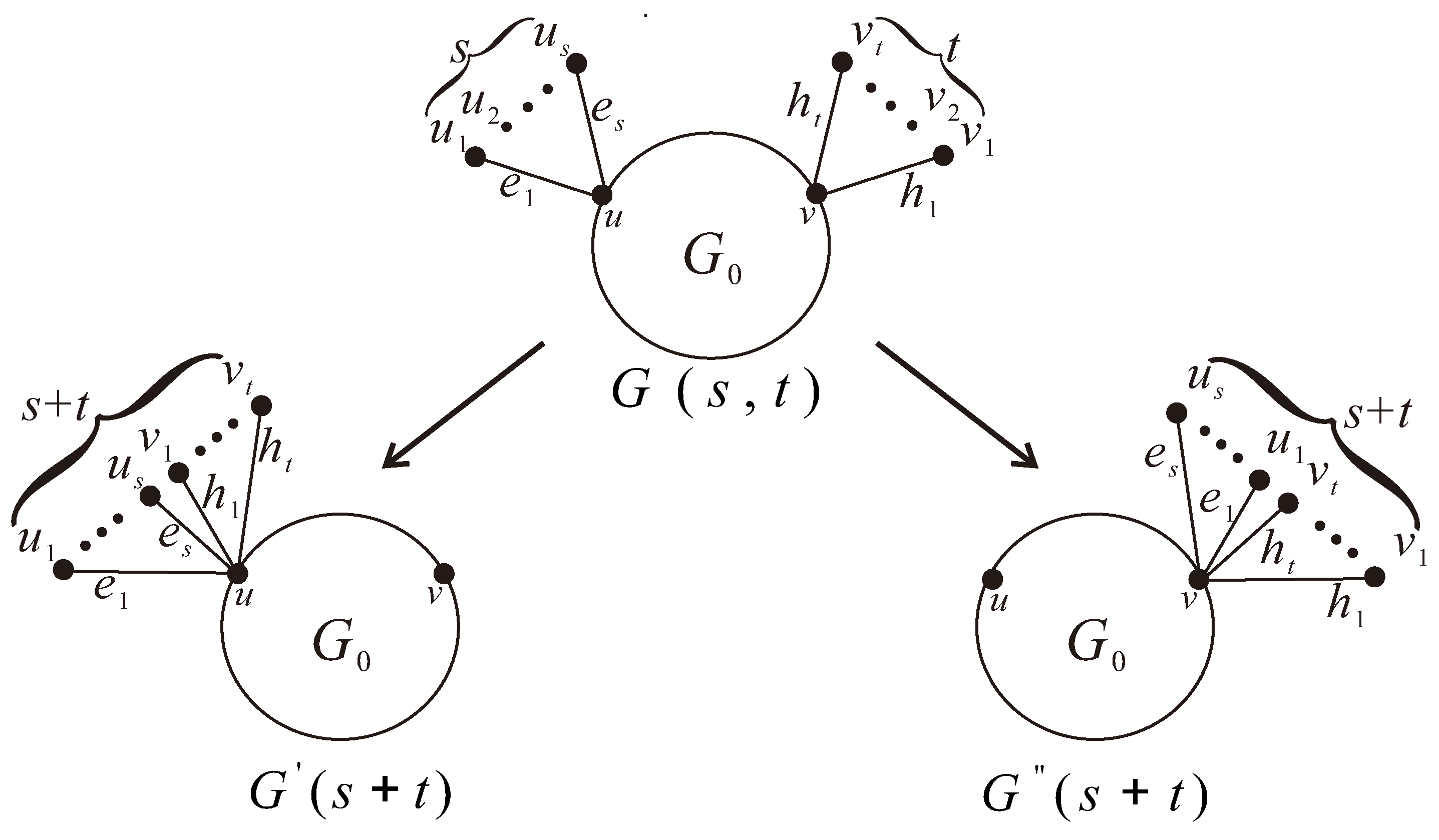
Let be a graph of order of at least 2, and let . Denote by the graph obtained from by attaching and pendant vertices to u and v, respectively. Denote by the graph obtained from by attaching pendant vertices to u, and denote by the graph obtained from by attaching pendant vertices to v. The resulting graphs , , and are displayed in Figure 2. We designate the transformation from to or as type .
Figure 2.
Graphs , , and .
Lemma 6.
Suppose that , , and are three graphs defined as in Definition 2. Then or .
Proof.
By Lemma 1, deleting one by one in , we get that
Similarly, by Lemma 1, deleting one by one in , we obtain that
By the symmetry of the calculation of , it is easy to obtain that
Direct calculation yields
If , then , and so + . Thus,
If , , and so + . Hence,
So or □
Definition 3.
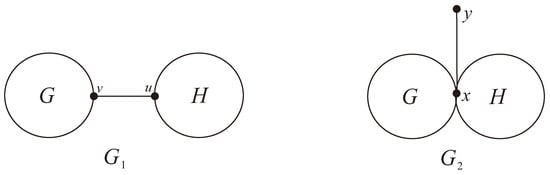
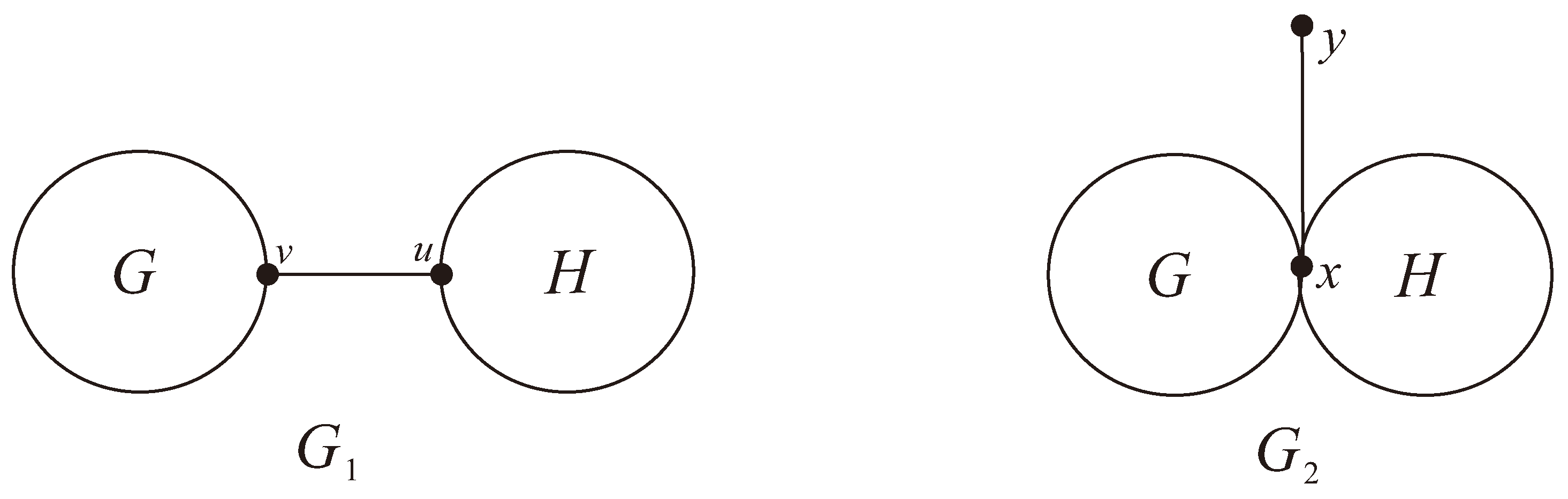
Let G and H be two disjoint connected graphs of order of at least 2 with and . Denote by the graph obtained from the union of G and H by adding a new edge . Let denote the graph obtained from by deleting the edge and identifying u with v to form a new vertex x and attaching a pendent vertex y to x. The resulting graphs and are displayed in Figure 3. We designate the transformation from to as type .
Figure 3.
Graphs and .
Lemma 7.
Let and be two graphs as defined by Definition 3. Then .
Proof.
By Lemma 1, we have
Similarly, by Definition 3, , , and by Lemma 1, we get that
Thus
□
Remark 1.
For topological indices of graphs, they have similar graph operations as above. For example, the Hosoya index [19], Wiener index [20,21], etc.
Proof of Theorem 2.
Suppose that when . By repeatedly applying the transformations I, , and and by Lemmas 5–7, we can obtain a graph from G such that all bridges are pendent edges incident with the same vertex and , where the equality holds if and only if . Additionally, by Lemma 4, there exists an edge in such that both and are connected.
We use induction on m. Assume that , i.e., is a tetracyclic graph. On the one hand,
On the other hand, since contains at least 4 cycles, , and is a connected graph of order , then
where the last inequality is derived from Lemmas 2 and 3. In order for the equalities to hold, all the inequalities above should be equalities. Then and . So it is not hard to verify that .
Suppose now that the statement holds for . We will prove this for m as follows. We have
Note that consists of at least cycles. It follows that , and is a connected graph of order .
where the last inequality is derived from the induction hypothesis and Lemma 2. Similarly, to make the equalities hold, all of the inequalities above should be equalities. Then , , and . Therefore, it is not hard to verify that . Hence, the assertion holds for m. Consequently, it holds for all .
This completes the proof.
□
4. Summary
In this paper, we prove that the computational complexity of a permanental sum is -complete. In particular, we determine the minimum value of permanental sums of all graphs with given n vertices and edges. This result promotes the study of permanental sums. It raises a lot of interesting questions, such as those related to determining the sharp bound of a permanental sum of all graphs in if and questions regarding characterizing the bound of permanental sums of all graphs in if , etc.
A permanent is a generalized matrix function that has important applications in chemistry [22,23,24]. A permanental sum is a derivative of a permanent, and it is a topological index proposed to explain special chemical phenomena from a mathematical point of view. The result in Theorem 2 is interesting for chemistry. In [25], the authors pointed out that every graph with a maximum degree that is no more than 4 has a chemical molecule corresponding to it. The result in Theorem 2 implies that the smaller bound of permanental sums of all chemical molecules is determined. And an interesting problem arises, i.e., characterizing the sharp bound of permanental sums of chemical molecules.
In conclusion, the above problems will guide us to continue our research.
Author Contributions
All authors contributed equally to this work. All authors have read and agreed to the published version of the manuscript.
Funding
Supported by the National Natural Science Foundation of China (No. 12261071) and Natural Science Foundation of Qinghai Province (No. 2020-ZJ-920).
Data Availability Statement
No data were used to support this study.
Acknowledgments
We would like to thank the anonymous referees for their comments, which helped us make several improvements to this paper.
Conflicts of Interest
The authors declare no conflicts of interest.
References
- Valiant, L.G. The complexity of computing the permanent. Theoret. Comput. Sci. 1979, 8, 189–201. [Google Scholar] [CrossRef]
- Merris, R.; Rebman, K.R.; Watkins, W. Permanental polynomials of graphs. Linear Algebra Appl. 1981, 38, 273–288. [Google Scholar] [CrossRef]
- Kasum, D.; Trinajstić, N.; Gutman, I. Chemical graph theory. III. On permanental polynomial. Croat. Chem. Acta 1981, 54, 321–328. [Google Scholar]
- Shi, Y.; Dehmer, M.; Li, X.; Gutman, I. Graph Polynomials; CRC Press: Boca Raton, FL, USA, 2016. [Google Scholar]
- Dehmer, M.; Frank, E.; Hu, B.; Shi, Y.; Stefu, M.; Tripathi, S. Highly unique network descriptors based on the roots of the permanental polynomial. Inform. Sci. 2017, 408, 176–181. [Google Scholar] [CrossRef]
- So, W.; Wu, T.; Lü, H. Sharp bounds on the permanental sum of a graph. Graphs Combin. 2021, 37, 2423–2437. [Google Scholar] [CrossRef]
- Tong, H. Parallel Algorithms for Computing Permanents and Permanental Polynomials of Sparse Matrices. Ph.D. Thesis, Tsinghua University, Beijing, China, 2006. [Google Scholar]
- Xie, S.; Gao, F.; Lu, X.; Huang, R.; Wang, C.; Zhang, X.; Liu, M.; Deng, S.; Zheng, L. Capturing the labile Fullerene[50] as C50Cl10. Science 2004, 304, 699. [Google Scholar] [CrossRef] [PubMed]
- Li, W.; Qin, Z.; Zhang, H. Extremal hexagonal chains with respect to the coefficients sum of the permanental polynomial. Appl. Math. Comput. 2016, 291, 30–38. [Google Scholar] [CrossRef]
- Li, S.; Wei, W. Extremal octagonal chains with respect to the coefficients sum of the permanental polynomial. Appl. Math. Comput. 2018, 328, 45–57. [Google Scholar] [CrossRef]
- Li, W.; Qin, Z.; Wang, Y. Enumeration of permanental sums of lattice graphs. Appl. Math. Comput. 2020, 370, 124–914. [Google Scholar] [CrossRef]
- Wei, W.; Li, S. Extremal phenylene chains with respect to the coefficients sum of the permanentalematics polynomial, the spectral radius, the Hosoya index and the Merrifield–Simmons index. Discret. Appl. Math. 2019, 271, 205–217. [Google Scholar] [CrossRef]
- Jerrum, M. Two-dimensional monomer-dimer systems are computationally intractable. J. Stat. Phys. 1987, 48, 121–134. [Google Scholar] [CrossRef]
- Yan, W.; Yeh, Y. On the number of matchings of graphs formed by agraph operation. Sci. China Ser. A 2006, 49, 1383–1391. [Google Scholar] [CrossRef]
- Wu, T.; Lai, H. On the permanental sum of graphs. Appl. Math. Comput. 2018, 331, 334–340. [Google Scholar] [CrossRef]
- Wu, T.; Das, K. On the permanental sum of bicyclic graphs. Comput. Appl. Math. 2020, 39, 72–81. [Google Scholar] [CrossRef]
- Bollobás, B. Modern Graph Theory; Springer: Berlin/Heidelberg, Germany, 1998. [Google Scholar]
- Wu, T.; So, W. Permanental sums of graphs of extreme sizes. Discrete Math. 2021, 344, 112353. [Google Scholar] [CrossRef]
- Pan, X.; Sun, Z. The (n,m)-graphs of minimum Hosoya index. Match. Comput. Chem. 2010, 64, 811–820. [Google Scholar]
- Hua, H. Wiener and Schultz molecular topological Indices of graphs with specified cut edges. MATCH Commun. Math. Comput. Chem. 2009, 61, 643–651. [Google Scholar]
- Šparlspa, P.; Žerovnik, J. Graphs with given number of cut-edges and minimal value of Wiener number. Int. J. Chem. Mod. 2011, 3, 131–137. [Google Scholar]
- Minc, H. Permanents; Addision-Wesley: London, UK, 1978. [Google Scholar]
- Trinajstić, N. Chemcial Graph Theory, 2nd ed.; CRC Press: Boca Raton, FL, USA, 1992. [Google Scholar]
- Liang, H.; Tong, H.; Bai, F. Computing the permanental polynomial of C60 in parallel, MATCH Commun. Math. Comput. Chem. 2008, 60, 349–358. [Google Scholar]
- Gutman, I.; Polansky, O.E. Mathematical Concepts in Organic Chemistry; Springer: Berlin/Heidelberg, Germany, 1986. [Google Scholar]
Disclaimer/Publisher’s Note: The statements, opinions and data contained in all publications are solely those of the individual author(s) and contributor(s) and not of MDPI and/or the editor(s). MDPI and/or the editor(s) disclaim responsibility for any injury to people or property resulting from any ideas, methods, instructions or products referred to in the content. |
© 2024 by the authors. Licensee MDPI, Basel, Switzerland. This article is an open access article distributed under the terms and conditions of the Creative Commons Attribution (CC BY) license (https://creativecommons.org/licenses/by/4.0/).