


Abstract
This work explores the geometric properties of the Turanian of the modified Bessel function of the first kind (TMBF). Using the properties of the digamma function, we establish conditions under which the normalized TMBF satisfies starlikeness, convexity, k-starlikeness, k-uniform convexity, pre-starlikeness, lemniscate starlikeness, and convexity, and under which exponential starlikeness and convexity are obtained. By combining methods from complex analysis, inequalities, and functional analysis, the article advances the theory of Bessel functions and hypergeometric functions. The established results could be useful in approximation theory and bounding the behavior of functions.
Keywords:
analytic function; univalent function; starlike function; convex function; Bessel function MSC:
30C45; 33B15; 33C10
1. Introduction
Bessel functions hold significant importance across multiple domains, including mathematical physics and engineering, quantum mechanics, signal processing, fluid dynamics, electromagnetism, acoustics, and heat conduction. Specifically, the Bessel functions appear everywhere in problems admitting cylindrical symmetry, such as pipes, tubes, cylindrical wave guides, beams, etc. In [1], Baricz et al. introduced conditions for normalized Bessel function to exhibit convexity and starlikeness within the unit disk, resolving an open problem and presenting a novel inequality for the Euler function. Sufficient conditions for the univalence of the generalized Bessel functions in the unit disk are established by Prajapat in [2]. In [3], Mondal and Swaminathan explored the geometric properties of generalized Bessel functions, yielding various conditions for close-to-convexity, starlikeness, and convexity. Conditions for close-to-convexity of some special functions, including the Bessel functions, are deduced by Baricz and Szasin [4], utilizing results on transcendental entire functions and Pólya’s Theorem. In [5], Aktas et al. obtained tight bounds for the radii of starlikeness of normalized Bessel, Struve, and Lommel functions of the first kind. The geometric properties of generalized Struve functions were derived by Sarkar, Das, and Mondal in their work [6]. Aktas, Baricz, and Singh explored various geometric properties of normalized hyper-Bessel functions in [7]. In [8,9], they obtained tight lower and upper bounds for the radii of starlikeness and convexity of Jackson’s second and third q-Bessel functions, respectively. Additionally, Zayed and Bulboaca studied the normalization of generalized Bessel functions in [10], establishing sufficient conditions for their starlikeness, convexity, and close-to-convexity in the open unit disk. Furthermore, in [11], Mehrez, Das, and Kumar examined some geometric properties of products of modified Bessel functions, including starlikeness, convexity, and close-to-convexity.
The modified Bessel function of the first kind, denoted as [12], is a special function satisfying the differential equation:
where is a real parameter. It can also be expressed through its infinite series representation:
Furthermore, the Bessel I and J functions are closely related to the generalized hypergeometric (GHG) functions.
where and denote rising factorials and . In particular,
Since Szegö’s work on the Turán inequality for classical Legendre polynomials in 1948 [13], numerous authors have extended similar results to classical orthogonal polynomials and special functions. Turán-type inequalities have seen successful applications in information theory, economic theory, and biophysics. For series representation of the Turánian of (see [14], Theorem 5) is given by
From the above presentation we see that the series in Equation (2) can be represented by a GHG function as
Let , where and . We consider the class containing the analytic functions f defined on and satisfying . A function is considered starlike in the disk if it is univalent and its image forms a starlike domain centered around the origin [15]. Analytically,
Moreover,
where . The class of starlike functions of order in , denoted by , simplifies to when .
Also, a function is convex in if it is univalent in and its image is a convex domain [15].
Analytically,
Moreover,
where .
The collection of convex functions of order in , denoted by , simplifies to when .
Kanas and Wiśniowska [16] defined k-uniformly convex functions as functions that map circular arcs in centered at points with to convex curves. They also provided a one-variable characterization for this class. Let and then
According to [17], and .
A similar class, , related to starlike functions, was also defined by Kanas and Wi’sniowska in [18] known as k starlike functions.
When , the class reduces to the well-known class of starlike functions, . For , the class is identical to the class , introduced by Rønning [19]. Geometrically, a function , () if the image of under the mapping , is contained within the conic region . This domain is defined by the condition and is bounded by the curve
Several renowned subclasses of starlike and convex functions associated with various domains that exhibit symmetry across the real axis include lemniscate starlike functions and exponential starlike functions. Lemniscate starlike functions, introduced by Sokól and Stankiewicz [20], are characterized by the image of the unit disk under the mapping being contained within the region bounded by the right half of the Bernoulli lemniscate . Similarly, is lemniscate convex if contained inside L. The classes and denote the lemniscate starlike and lemniscate convex functions, respectively. The starlike and convex functions associated with the exponential function, introduced by Mendiratta et al. [21] are denoted by and , respectively. These classes are defined as follows:
where .
Here, we will establish various geometrical properties of the TMBF. To achieve this, we adopt the following normalization approach.
where
Outline
The subsequent sections of this paper are structured as follows. The paper presents the Lemmas utilized to support its main findings in Section 2. Section 3 elaborates on results concerning starlikeness of order , k-starlikeness, and starlikeness on , accompanied by conditions for lemniscate and exponential starlikeness of the function . In Section 4, the analysis extends to the derivation of conditions for , encompassing convexity of order , k-uniform convexity, convexity on , as well as conditions for lemniscate and exponential convexity of the function . Concluding remarks are provided in Section 5.
2. Lemmas
The following lemmas will be used to prove the main results.
Lemma 1
([22]). Let and for each , then f is univalent and starlike in .
Lemma 2
([23]). Let and for each , then f is convex in .
Lemma 3
([21], Lemma 2.2). The exponential function , satisfies
Lemma 4
([18]). Assume that with . If
then .
Lemma 5
([16]). Let and with . If
then .
Lemma 6
([24]). Let , then the following inequality for the digamma function holds:
where γ denotes the Euler–Mascheroni constant.
3. Starlikeness of
This section investigates several properties of starlikeness for . We establish criteria for the starlikeness of order of and present several corollaries and examples for particular instances.
Theorem 1.
Assume that . Suppose that the following criteria are satisfied:
- (i)
- (ii)
then is a starlike function of order δ in .
Proof.
To prove the desired result, it is enough to show that
Now, from (4), we have
where
Now consider the function as:
Therefore,
where is given by
From Lemma 6, we obtain
which leads to
Since is decreasing on and , we have for . This implies that is a decreasing. Now from Equation (5), we have
Also,
Combining Equations (10) and (11), we obtain
From the condition (ii) it follows that
□
Corollary 1.
Assume that . If the following conditions are satisfied:
- (i)
- (ii)
then is a starlike function in .
We will next derive the conditions for starlikeness within the disk .
Theorem 2.
Consider . If the following holds:
- (i)
- (ii)
then is starlike in .
Proof.
A straightforward calculation yields the following result:
where is given by (6). By assuming and using similar arguments as the proof of Theorem 1, we can conclude that is a decreasing.
Next, we will examine the k-starlikeness of .
Theorem 3.
Assume that . If the following holds:
- (i)
- (ii)
then .
Proof.
According to Lemma 4, it is enough to demonstrate that the inequality mentioned below is valid under the specified conditions:
Let
We now define the function as follows:
Therefore,
where
Applying Lemma 6, we obtain
for . Thus, we have,
Since is decreasing on and by hypothesis (i), it follows that for all . Combining this with Equations (17) and (18), we conclude that is decreasing. Therefore, is decreasing. Therefore,
By hypothesis (ii), the inequality (15) holds. This completes the proof of the theorem. □
For the cases and in Theorem 3, we have the following corollaries:
Corollary 2.
Assume that . If the following holds:
- (i)
- (ii)
then .
Corollary 3.
Assume that . If the following holds:
- (i)
- (ii)
then .
Next, in Theorems 4 and 5, We examine the starlikeness of related to the exponential function and the Bernoulli lemniscate, respectively.
Theorem 4.
Assume that . If the following holds:
- (ii)
- (ii)
then in .
Proof.
It is enough to show that
Based on the hypotheses (i) and (ii), we can conclude the following:
which completes the proof. □
Theorem 5.
Assume that . Suppose that the following holds:
- (i)
- (ii)
then is a lemniscate starlike function.
Proof.
To demonstrate the result, it suffices to show the following:
From simple computation, we have
where
Now consider the function,
Taking logarithmic differentiation,
where
By use of Lemma 6, we obtain
Since,
and , therefore, eventually we obtain that is decreasing and thus is decreasing. Therefore from (23) we have:
Combining (10), (11) and (26), we obtain
Combining hypothesis (ii) with (27) yields (22), which completes the proof. □
Another significant class of functions, known as pre-starlike functions, is the class introduced by Ruscheweyh [25]. This class is defined as follows:
where and denotes the Hadamard product. By generalizing the class to in [26], the concept of pre-starlikeness is extended. The class is defined as follows:
where . The conditions for to be in the class are derived in the following theorem.
Theorem 6.
Assume that and . If the following holds:
- (i)
- (ii)
- .
then in .
Proof.
To prove the result, we use that by showing the following inequality:
The Hadamard product is represented by the following expression.
From (29), we have
where,
Let,
Differentiating logarithmically,
where
Using Lemma 6, the following inequality holds:
where . Differentiating , we obtain
Since is decreasing on the interval and as per (i), it follows from inequalities (32) and (31) that is also decreasing on the interval . Therefore, the sequence is decreasing. Thus, from (30),
By similar arguments, we have
Combining (33) and (34), we have
Applying condition (ii) to (35) yields (28), which completes the proof of the theorem. □
4. Convexity of
In this section, the convexity properties of are obtained. The following theorem addresses the conditions necessary for convexity of order .
Theorem 7.
Assume that . If the following holds:
- (i)
- (ii)
then is a convex function of order δ in .
Proof.
Clearly, the proof is complete if we can show that
Now,
where
Now consider the function as:
Therefore,
where is given by
From Lemma 6 we obtain
for , which leads to
This implies that is decreasing on . Under the given hypothesis (i), we have . Consequently, it follows that for . Consequently, is decreasing sequence. From inequality (36), we can conclude that:
Now,
Through similar arguments, we have
Combining (39) and (40) we have
The desired result can finally be proved using the provided hypothesis (ii). □
Corollary 4.
Assume that . If the following holds:
- (i)
- (ii)
then .
Theorem 8.
Assume that . If the following holds:
- (i)
- (ii)
then is convex in .
Proof.
In this proof, Lemma 2 is used. Direct computation gives
Applying arguments analogous to the proof of Theorem 7, we conclude that the sequence is decreasing. Therefore, from (42), we have
Taking into account condition (ii), we have finished proving this theorem. □
Theorem 9.
Assume that . If the following holds:
- (i)
- (ii)
then is a k-uniformly convex function.
Proof.
The corollaries below provide the convexity and properties for , derived from Theorem 3, for the cases and , respectively.
Corollary 5.
Assume that . Suppose that the following holds:
- (i)
- (ii)
Then .
Corollary 6.
Assume that . If the following holds:
- (i)
- (ii)
then .
Theorem 10.
Assume that . If the following holds:
- (i)
- (ii)
then in .
Theorem 11.
Assume that . If the following holds:
- (i)
- (ii)
then is a lemniscate convex function.
Proof.
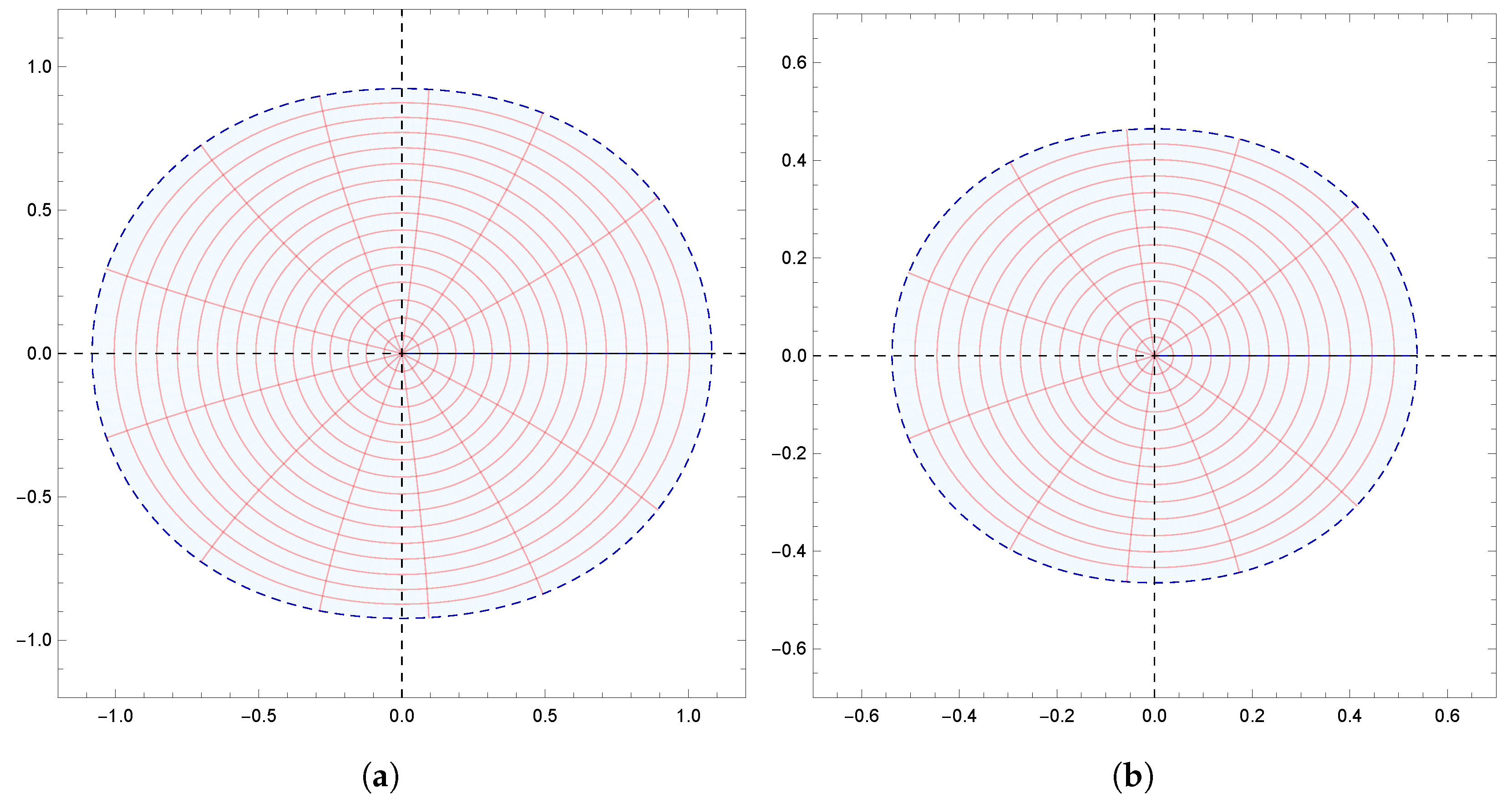
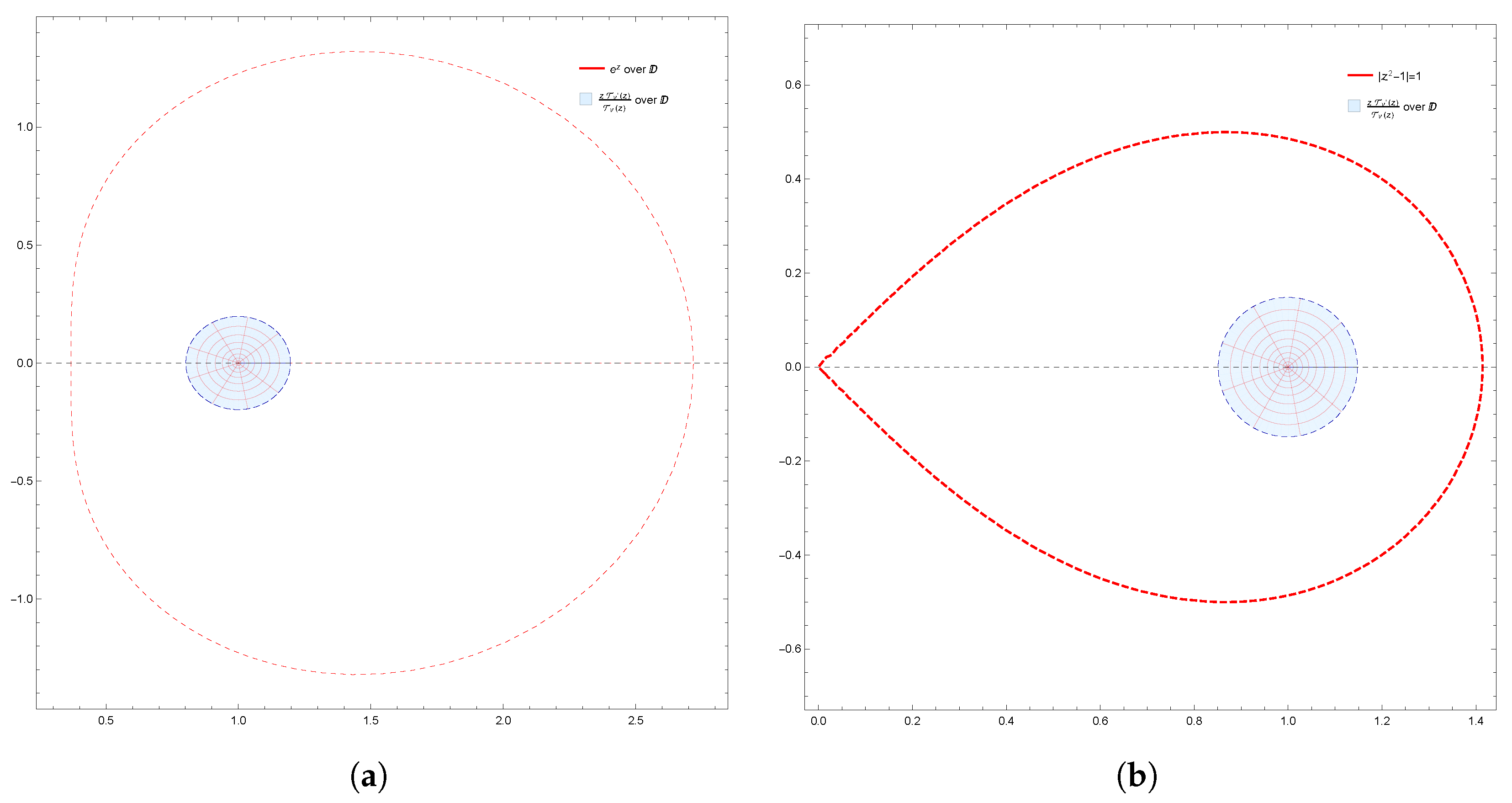
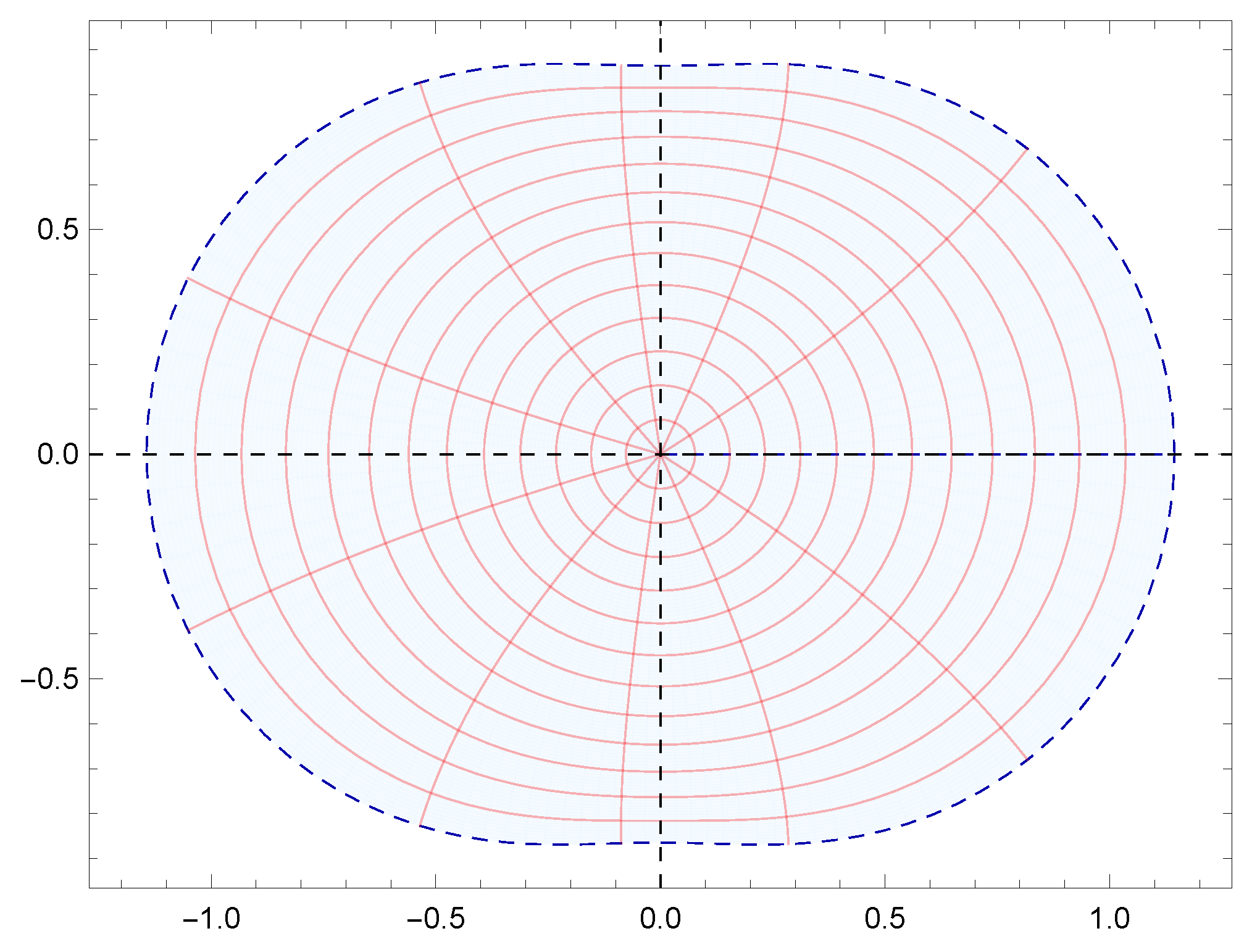
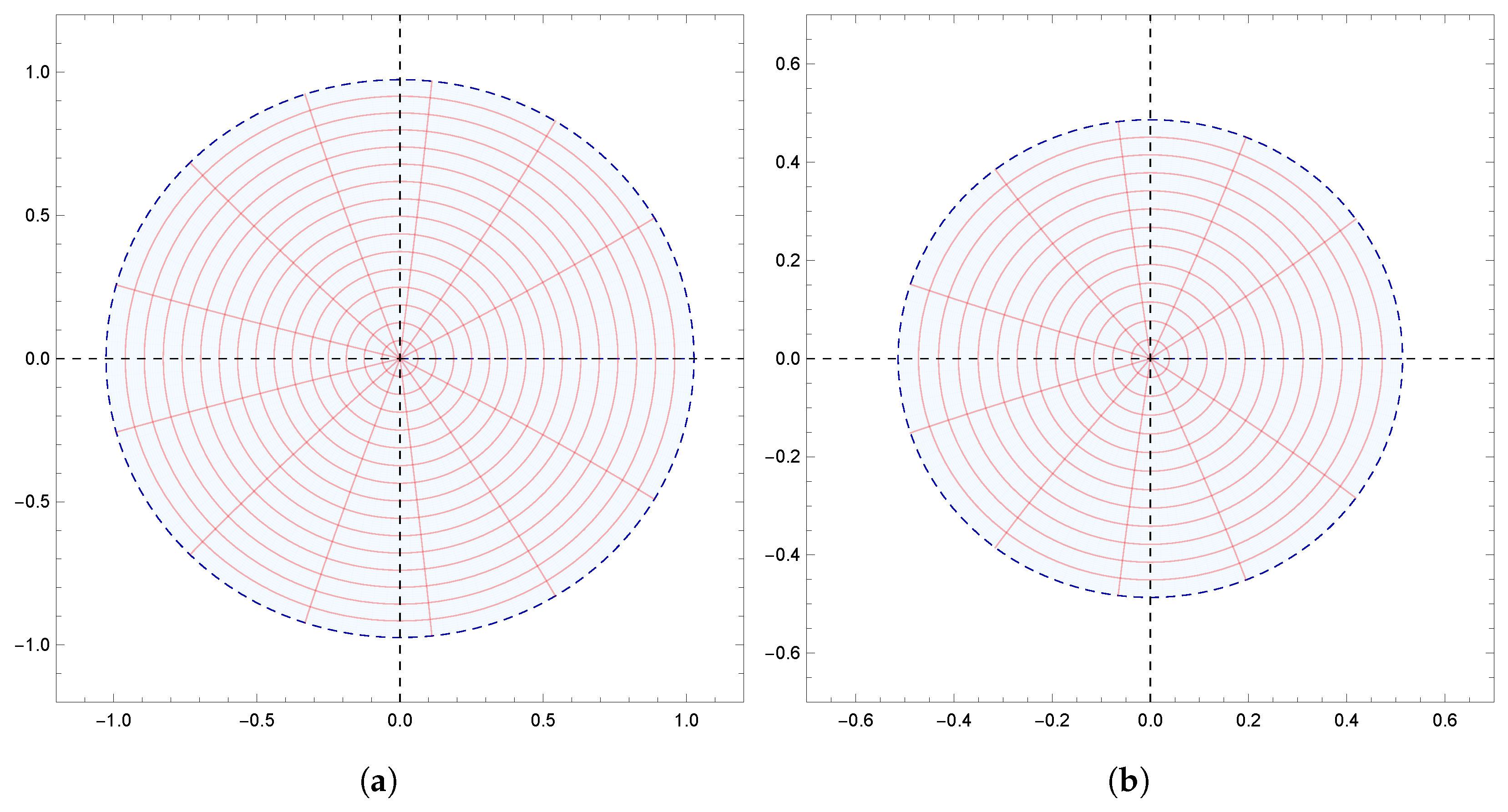
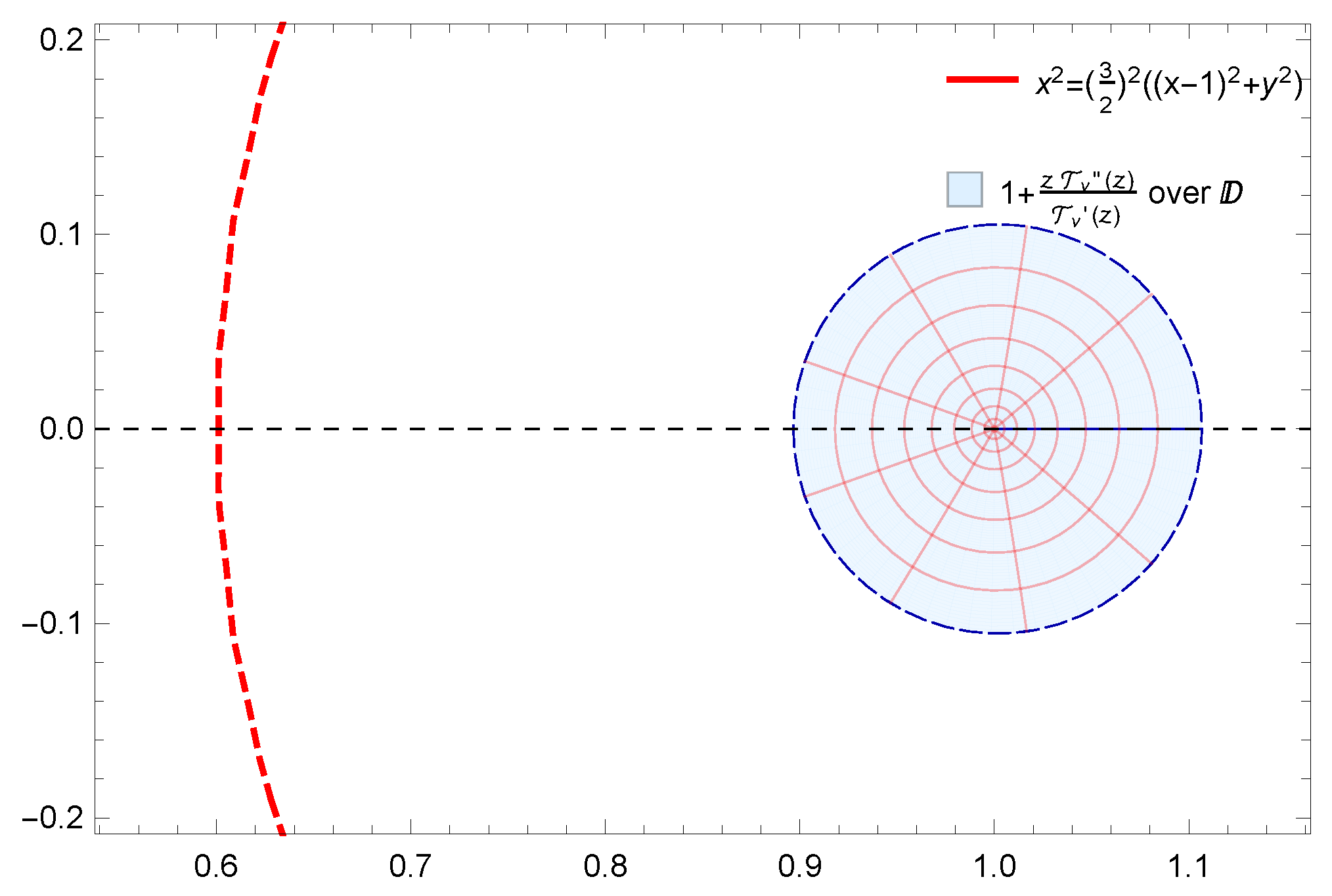
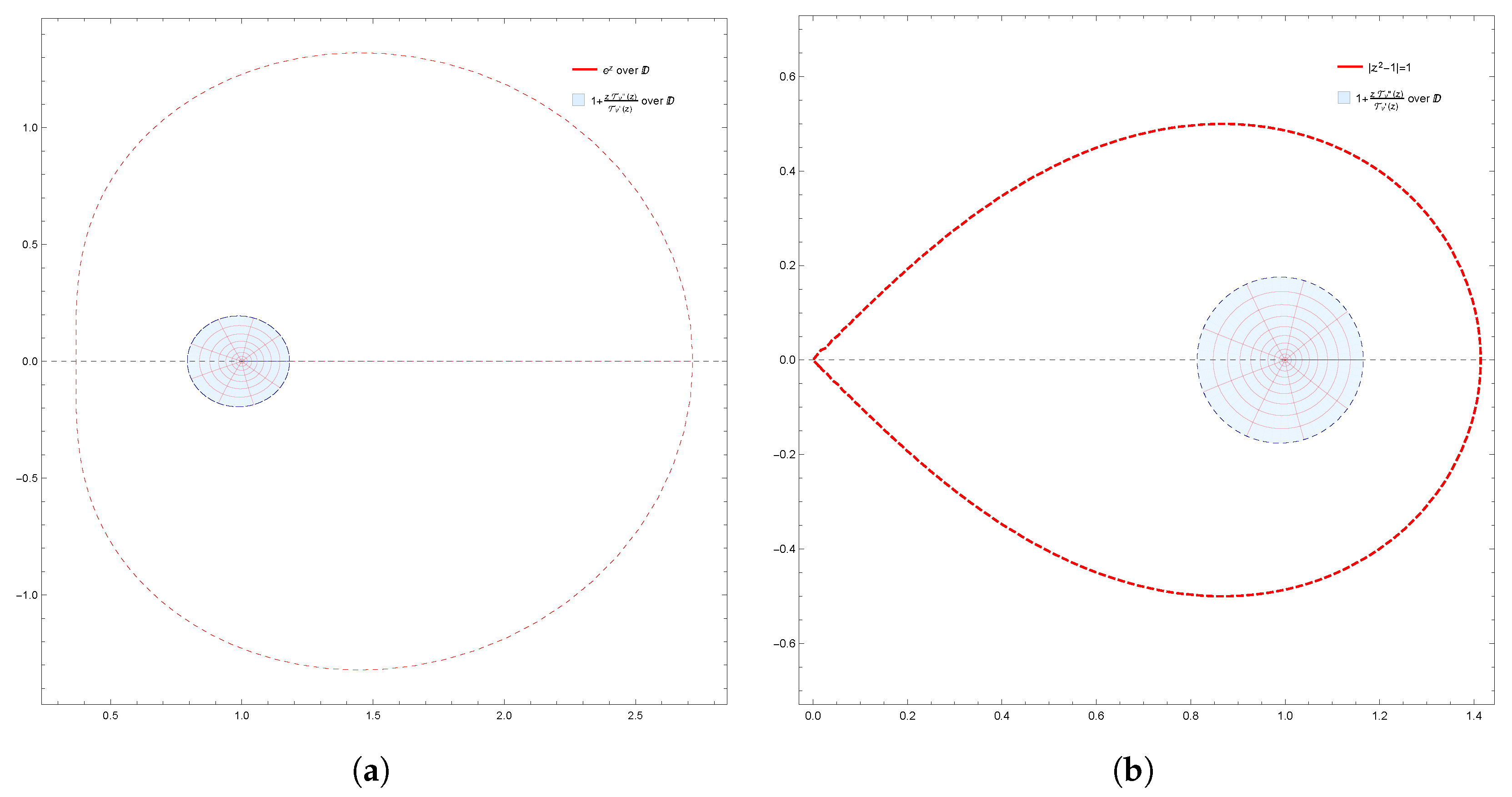
Furthermore, Figure 1, Figure 2, Figure 3, Figure 4, Figure 5, Figure 6 and Figure 7 illustrate obtained results.
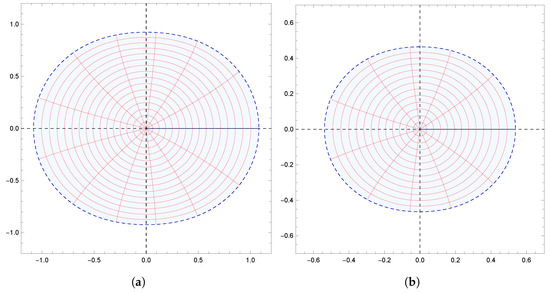
Figure 1.
(a) Image of under for ; (b) Image of under for .
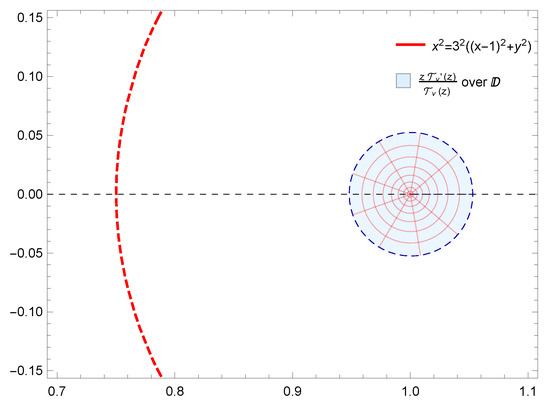
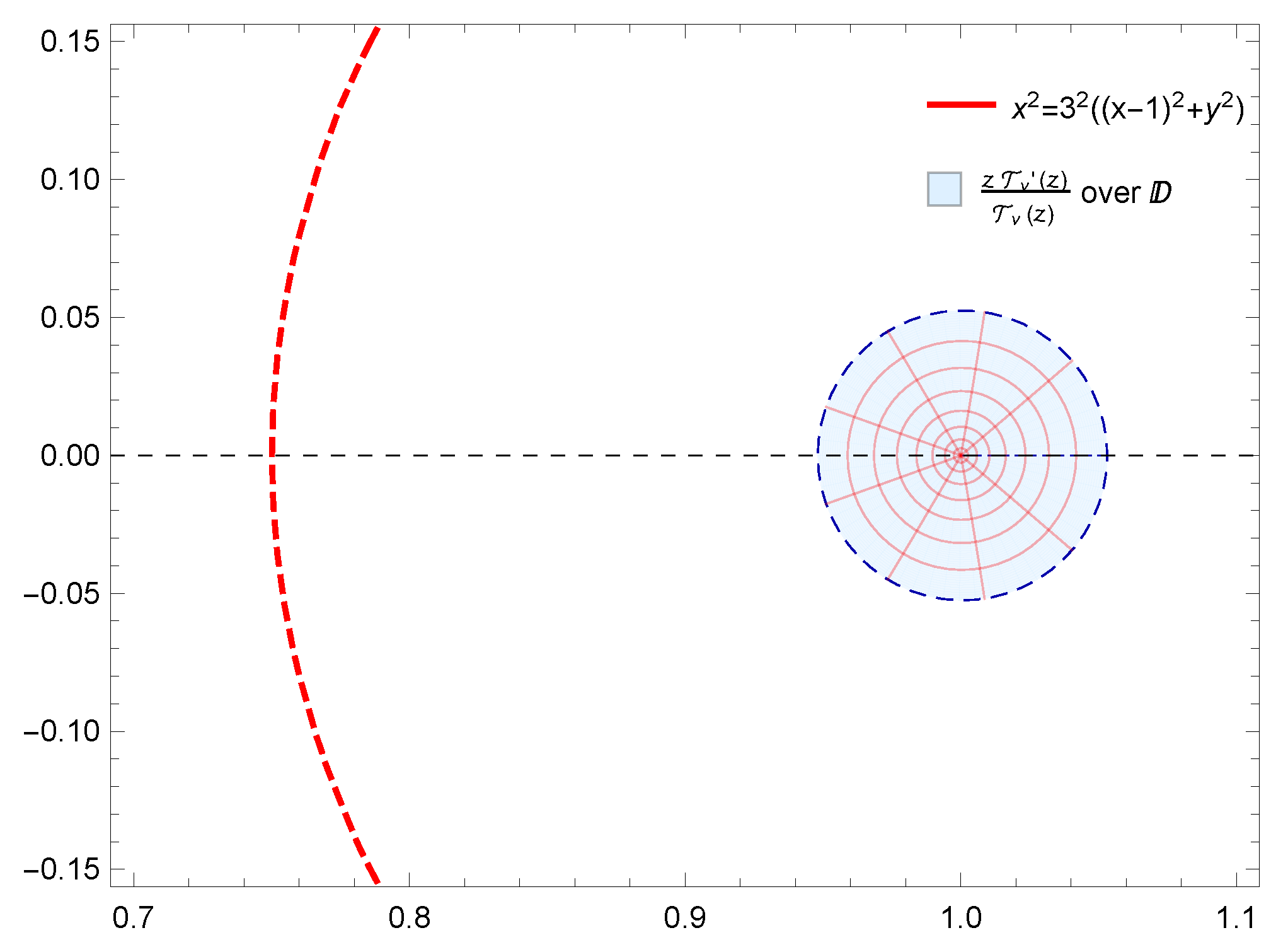
Figure 2.
Image of under for .
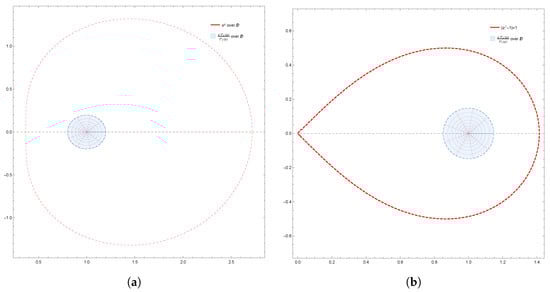
Figure 3.
(a) Image of under for ; (b) Image of under for .
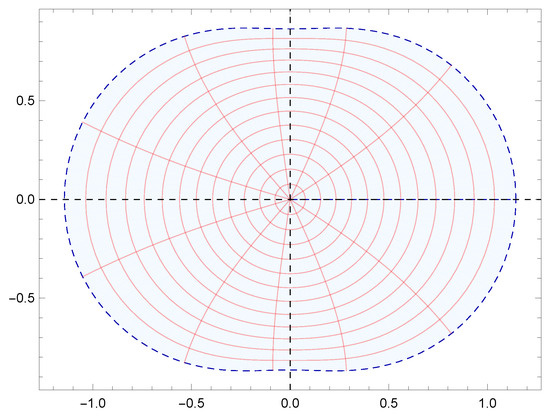
Figure 4.
Image of under for , and .

Figure 5.
(a) Image of under for ; (b) Image of under for .
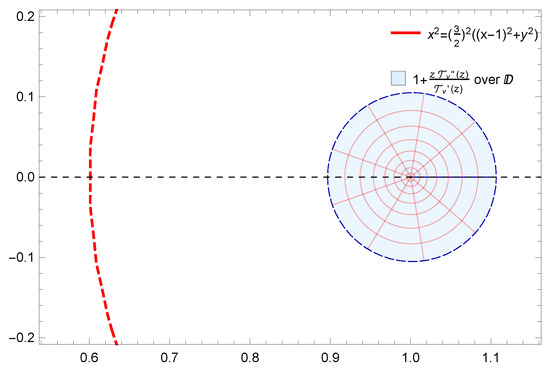
Figure 6.
Image of under for .
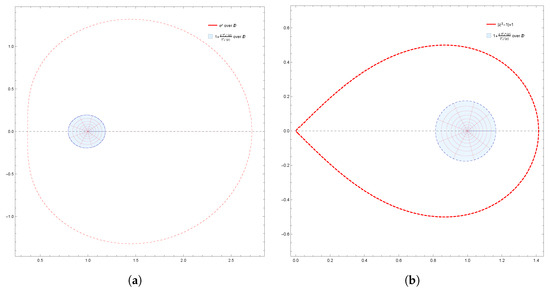
Figure 7.
(a) Image of under for ; (b) Image of under for .
5. Conclusions
The paper has systematically examined the geometrical properties of the TMBF. Through rigorous analysis, we have derived significant results on the function , unveiling insightful sufficient conditions for starlikeness of order , Convexity of order , starlikeness on , convexity on , k-starlikeness, k-uniform convexity, starlikeness associated with exponential function and Bernoulli lemniscate, Pre-starlikeness, and convexity associated with exponential function and Bernoulli’s lemniscate. The study’s findings were further illustrated by graphical representations (Figure 1, Figure 2, Figure 3, Figure 4, Figure 5, Figure 6 and Figure 7).
In addition to the derived results, several corollaries are presented as special cases, offering concise interpretations of the findings within specific contexts. These corollaries serve to highlight notable instances where the main results can be applied directly, providing immediate insights into the geometrical properties of the TMBF, . Both Corollaries 1 and 2 offer viable criteria for determining the starlikeness of . However, the conditions given in Corollary 1 provide a more precise lower bound for . Similarly, Corollaries 4 and 5 propose alternative sets of criteria for assessing the convexity of . Yet, through comparison of numerical values, the conditions outlined in Corollary 4 yield a more refined lower bound for .
Moreover, the results obtained were also supported by graphical representations generated using Mathematica 12.0. These images effectively depicted the fulfillment of conditions derived from the results, demonstrating the corresponding geometric properties of . Specifically, Figure 1a,b demonstrate the starlikeness of on and , respectively. Figure 2 showcases the k-starlikeness of on . Moreover, Figure 3a,b exhibit the starlikeness of associated with the exponential function and the Bernoulli lemniscate on , respectively. The pre-starlikeness of can be observed in Figure 4. Furthermore, Figure 5a,b illustrate the convexity of on and , respectively. Figure 6 presents the k-uniform convexity of on . Additionally, Figure 7a,b display the convexity of associated with the exponential function and the Bernoulli lemniscate on , respectively. These graphical representations provided a comprehensive visualization of the studied properties.
Author Contributions
Conceptualization, S.S. and S.D.; methodology, S.S., A.K. and S.D.; software, S.S.; validation, S.S., D.P., A.K. and S.D.; formal analysis, S.S., A.K., D.P. and S.D.; investigation, S.S., A.K., D.P. and S.D.; resources, D.P.; writing—original draft preparation, S.S. and S.D.; writing—review and editing, S.S., A.K., D.P. and S.D.; visualization, S.D.; supervision, S.D. All authors have read and agreed to the published version of the manuscript.
Funding
D.P. is funded by Horizon Europe’s project VIBraTE, Grant No. 101086815.
Institutional Review Board Statement
Not applicable.
Informed Consent Statement
Not applicable.
Data Availability Statement
Data are contained within the article.
Acknowledgments
The authors wish to thank the reviewers for suggestions and comments that helped to improve the manuscript.
Conflicts of Interest
The authors declare no conflicts of interest.
References
- Baricz, Á.; Ponnusamy, S. Starlikeness and convexity of generalized Bessel functions. Integral Transform. Spec. Funct. 2010, 21, 641–653. [Google Scholar] [CrossRef]
- Prajapat, J.K. Certain geometric properties of normalized Bessel functions. Appl. Math. Lett. 2011, 24, 2133–2139. [Google Scholar] [CrossRef]
- Mondal, S.R.; Swaminathan, A. Geometric Properties of Generalized Bessel Functions. Bull. Malays. Math. Sci. Soc. 2012, 35, 179–194. [Google Scholar]
- Baricz, Á.; Szász, R. Close-to-convexity of some special functions and their derivatives. Bull. Malays. Math. Sci. Soc. 2016, 39, 427–437. [Google Scholar] [CrossRef]
- Aktaş, İ.; Baricz, Á.; Orhan, H. Bounds for radii of starlikeness and convexity of some special functions. Turk. J. Math. 2018, 42, 211–226. [Google Scholar] [CrossRef]
- Sarkar, S.; Das, S.; Mondal, S.R. Geometric Properties of Normalized Galué Type Struve Function. Symmetry 2024, 16, 211. [Google Scholar] [CrossRef]
- Aktaş, İ.; Baricz, Á.; Singh, S. Geometric and monotonic properties of hyper-Bessel functions. Ramanujan J. 2020, 51, 275–295. [Google Scholar] [CrossRef]
- Aktaş, İ.; Baricz, Á. Bounds for radii of starlikeness of some q-Bessel functions. Results Math. 2017, 72, 947–963. [Google Scholar] [CrossRef]
- Aktas, I.; Orhan, H. Bounds for radii of convexity of some q-Bessel functions. Bull. Korean Math. Soc. 2020, 57, 355–369. [Google Scholar]
- Zayed, H.M.; Bulboacă, T. Normalized generalized Bessel function and its geometric properties. J. Inequalities Appl. 2022, 2022, 158. [Google Scholar] [CrossRef]
- Mehrez, K.; Das, S.; Kumar, A. Geometric properties of the products of modified Bessel functions of the first kind. Bull. Malays. Math. Sci. Soc. 2021, 44, 2715–2733. [Google Scholar] [CrossRef]
- Arfken, G.; Weber, H.J. Mathematical Methods for Physicists; Academic Press: San Diego, CA, USA, 1985. [Google Scholar]
- Szegö, G. On an inequality of P. Turán concerning Legendre polynomials. Bull. Am. Math. Soc. 1948, 54, 401–405. [Google Scholar] [CrossRef]
- Mezo, I.; Baricz, A. Properties of the Turánian of modified Bessel functions. Math. Inequalities Appl. 2017, 20, 991–1001. [Google Scholar] [CrossRef]
- Duren, P.L. Univalent functions. In Grundlehren der Mathematischen Wissenschaften [Fundamental Principles of Mathematical Sciences]; Springer: New York, NY, USA, 1983; Volume 259. [Google Scholar]
- Kanas, S.A.; Wisniowska, A. Conic regions and k-uniform convexity. J. Comput. Appl. Math. 1999, 105, 327–336. [Google Scholar] [CrossRef]
- Goodman, A.W. On uniformly convex functions. Ann. Polon. Math. 1991, 56, 87–92. [Google Scholar] [CrossRef]
- Kanas, S.A.; Wiśniowska, A. Conic domains and starlike functions. Rev. Roum. Math. Pures Appl. 2000, 45, 647–657. [Google Scholar]
- Ronning, F. Uniformly convex functions and a corresponding class of starlike functions. Proc. Am. Math. Soc. 1993, 118, 189–196. [Google Scholar] [CrossRef]
- Sokół, J.; Stankiewicz, J. Radius of convexity of some subclasses of strongly starlike functions. Zesz. Nauk. Politech. Rzesz. Mat 1996, 19, 101–105. [Google Scholar]
- Mendiratta, R.; Nagpal, S.; Ravichandran, V. On a subclass of strongly starlike functions associated with exponential function. Bull. Malays. Math. Sci. Soc. 2015, 38, 365–386. [Google Scholar] [CrossRef]
- MacGregor, T.H. The radius of univalence of certain analytic functions. Proc. Am. Math. Soc. 1963, 14, 514–520. [Google Scholar] [CrossRef]
- MacGregor, T.H. A class of univalent functions. Proc. Am. Math. Soc. 1964, 15, 311–317. [Google Scholar] [CrossRef]
- Mehrez, K.; Das, S. Logarithmically completely monotonic functions related to the q-gamma function and its applications. Anal. Math. Phys. 2022, 12, 65. [Google Scholar] [CrossRef]
- Ruscheweyh, S. Convolutions in geometric function theory. In Séminaire de Mathématiques Supérieures [Seminar on Higher Mathematics]; Fundamental Theories of Physics; Presses de l’Université de Montréal: Montreal, QC, Canada, 1982; Volume 83, p. 168. [Google Scholar]
- Sheil-Small, T.; Silverman, H.; Silvia, E. Convolution multipliers and starlike functions. J. D’Anal. Math. 1982, 41, 181–192. [Google Scholar] [CrossRef]
Disclaimer/Publisher’s Note: The statements, opinions and data contained in all publications are solely those of the individual author(s) and contributor(s) and not of MDPI and/or the editor(s). MDPI and/or the editor(s) disclaim responsibility for any injury to people or property resulting from any ideas, methods, instructions or products referred to in the content. |
© 2024 by the authors. Licensee MDPI, Basel, Switzerland. This article is an open access article distributed under the terms and conditions of the Creative Commons Attribution (CC BY) license (https://creativecommons.org/licenses/by/4.0/).