


Abstract
: In this study, we introduce a novel class of generalized neutrosophic open sets, referred to as neutrosophic strongly preopen sets. Building on this foundation, we propose a new type of continuity and several new types of mappings. These concepts aim to inspire future research in the scientific community and are rooted in this newly defined class. Additionally, we explore the properties and characteristics of these concepts within neutrosophic spaces. Furthermore, this study investigates the connections between the newly introduced types of mappings and those defined in earlier research, thereby establishing relationships that can serve as a foundation for further scientific exploration.
Keywords:
neutrosophic strongly preopen set; neutrosophic strong precontinuity; neutrosophic strongly preopen function; neutrosophic strongly preclosed function MSC:
54A05; 54C10; 54D30; 54D101
1. Introduction
When considering the most significant concepts in general topology, it is evident that the classical notion of open sets has consistently been at the forefront. This concept has long been a cornerstone of topology, as it plays a critical role in nearly every subfield. However, over time, the need arose for new types of open sets that differ from the classical ones in general topology. In response, researchers began exploring alternative forms of open clusters. Among the most notable developments in this area is the concept of semi-open sets, introduced by Levine [1] in 1963. Additionally, the concepts of preopen sets and strongly semiopen sets, introduced by Mashour [2] and Njastad [3] in 1965, respectively, have also made significant contributions to the field. These newly defined open set concepts have become foundational elements of numerous studies, extending beyond general topological spaces to other specialized topological frameworks, as highlighted in [4,5,6,7,8]. As expected, the evolution of topology has not ceased; new concepts continue to emerge, with some adapted to address practical applications, as seen in [9].
First, we present the concept of neutrosophic strongly preopen sets, defined within the framework of neutrosophic topological spaces established by Salama and Alblowi in 2012. These areas offer untapped potential for scientific exploration, akin to fertile ground for innovation. We investigate the properties of this new class of open sets and explore their relationships with other established classes. Using this novel concept and its properties serving as the centerpiece of our study, we redefine key topological notions such as connectivity, continuity, and functions within neutrosophic spaces, providing fresh perspectives on these foundational topics in general topology.
2. Preliminaries
In this section, we present basic definitions related to neutrosophic set theory.
Definition 1
([10]). A neutrosophic set U on a universal set W is defined as follows:
where M, N, and .
In a scientific context, the membership, indeterminacy, and non-membership functions of a neutrosophic set take values from real standard or non-standard subsets of . However, these subsets can be impractical for use in real-world applications such as economic or engineering problems. To address this issue, we consider neutrosophic sets where the membership, indeterminacy, and non-membership functions take their values from subsets of .
Definition 2
([11]). Let W be a nonempty set. If p, q, and r are real standard or non-standard subsets of , then the neutrosophic set is referred to as a neutrosophic point in W, defined as follows:
For , it is referred to as the support of , where p represents the degree of membership, q represents the degree of indeterminacy, and r represents the degree of non-membership of .
Definition 3
([12]). Let U be a neutrosophic set on the universal set W. The complement of U, denoted as , is defined as follows:
.
It is clear that .
Definition 4
([12]). Let U and V be two neutrosophic sets on the universal set W. U is considered a neutrosophic subset of V if and , for every . This relationship is denoted as . Additionally, U is said to be neutrosophically equal to V if and . It is denoted by .
Definition 5
([12]). Let and be two neutrosophic sets on the universal set W. Their union, denoted as , is defined as follows:
where
Definition 6
([12]). Let and be two neutrosophic sets on the universal set W. Their intersection, denoted by , is defined as follows:
where
Definition 7
([12]). A neutrosophic set S on the universal set W is called a null neutrosophic set if , , for every . It is represented as .
Definition 8
([12]). A neutrosophic set S on the universal set W is referred to as an absolute neutrosophic set if , , and , for every . It is represented as .
Obviously, and .
Definition 9
([12]). Let represent the collection of all neutrosophic sets over the universal set W, and let τ be a subset of . The subset τ is termed a neutrosophic topology on W if the following criteria are met:
- 1.
- Both and are included in τ.
- 2.
- The union of any collection of neutrosophic sets from τ is also an element of τ.
- 3.
- The intersection of a finite number of neutrosophic sets within τ is contained in τ.
Under these conditions, the pair is referred to as a neutrosophic topological space on W, and the elements of τ are called neutrosophic open sets.
Definition 10
([12]). Let be a neutrosophic topological space over W and S be a neutrosophic set on W. Then, S is said to be a neutrosophic closed set if and only if its complement is a neutrosophic open set.
Definition 11
([13]). A neutrosophic point is considered to be neutrosophic quasi-coincident (or neutrosophic q-coincident for short) with C, denoted as q C, if and only if is not a subset of . If is not neutrosophic quasi-coincident with C, it is expressed as C.
Definition 12
([13]). A neutrosophic set S in a neutrosophic topological space is said to be a neutrosophic q-neighborhood of a neutrosophic point if and only if there exists a neutrosophic open set C such that q C is contained within S.
Definition 13
([13]). A neutrosophic set C is said to be neutrosophic quasi-coincident (or neutrosophic q-coincident for short) with S, denoted as C q S, if and only if C is not a subset of . If C is not neutrosophic quasi-coincident with S, it is denoted by C S.
Definition 14
([14]). A neutrosophic point is called a neutrosophic interior point of a neutrosophic set S if and only if there exists a neutrosophic open q-neighborhood C of such that C is contained within S. The collection of all neutrosophic interior points of S is referred to as the neutrosophic interior of S, denoted by .
Definition 15
([13]). A neutrosophic point is called a neutrosophic cluster point of a neutrosophic set S if and only if every neutrosophic open q-neighborhood C of is q-coincident with S. The set of all neutrosophic cluster points of S is referred to as the neutrosophic closure of S, denoted by .
Definition 16
([13]). Let h be a mapping from W to Z, and let V be a neutrosophic set in Z with membership mapping , indeterminacy function , and non-membership mapping . The inverse image of V under h, denoted by , is a neutrosophic subset of W. The membership, indeterminacy, and non-membership mappings of are defined as follows: , , and , for every z in W, respectively.
Conversely, consider U as a neutrosophic set in W, characterized by the membership function , indeterminacy mapping , and non-membership function . The image of U under h, represented as , forms a neutrosophic subset of Z, with its membership, indeterminacy, and non-membership mappings defined as follows:
for all y in Z, where , respectively.
3. Some Definitions
This section presents new definitions that lay the groundwork for the upcoming sections.
Definition 17.
In a neutrosophic topological space , a neutrosophic set S is described as
- (a)
- [15] Neutrosophic semiopen if and only if ;
- (b)
- [15] Neutrosophic preopen if and only if ;
- (c)
- Neutrosophic strongly semiopen if and only if .
Definition 18.
In a neutrosophic topological space , a neutrosophic set S is described as
- (a)
- Neutrosophic semiclosed if and only if is neutrosophic semiopen in ;
- (b)
- Neutrosophic preclosed if and only if is neutrosophic preopen in ;
- (c)
- Neutrosophic strongly semiclosed if and only if is neutrosophic strongly semiopen in .
It is clear that every neutrosophic strongly semiopen set is a neutrosophic semiopen set, and every neutrosophic semiopen set implies a neutrosophic preopen set.
Definition 19.
If S is a neutrosophic set in a neutrosophic topological space , then (resp. ) is referred to as the neutrosophic preclosure of S (respectively, the neutrosophic preinterior of S).
Definition 20.
If S is a neutrosophic set in neutrosophic topological space , then (resp., ) is called a neutrosophic strong semiclosure of S (resp., the neutrosophic strong semi-interior of S).
Theorem 1.
Let S be a neutrosophic set in a neutrosophic topological space , then
- (a)
- ;
- (b)
- .
Proof.
(a) Since is a neutrosophic preclosed set, we have . Thus, ;
(b) Since is a neutrosophic preopen set, we have . Thus, .
In ordinary topology, we have the relation , so .The following example demonstrates that equality may not hold in neutrosophic topology. □
As demonstrated in Example 1, the converse statements of the statements in Theorem 1 do not always hold true.
Example 1.
Let and be neutrosophic sets of W defined as below: ,
,
Let . By easy verification, it can be seen that and .
The theorem presented above provides the basis for introducing the class that will be explored further.
Lemma 1.
Let S be a neutrosophic set in a neutrosophic topological space . Then.
(a) ;
(b) .
Proof.
(a) Consider any neutrosophic set . In that case, . So, . Since is neutrosophic preclosed, .
On the other hand, and is neutrosophic preclosed. From here, . Since is neutrosophic preopen, . So, . Therefore, .
(b) Consider any neutrosophic set . Then, . So, . Since is neutrosophic preopen, .
On the other hand, and is neutrosophic preopen. In that case, . Since is neutrosophic preclosed, . So, . We get result that . □
Lemma 2.
Let be a mapping from a neutrosophic topological space to a neutrosophic topological space . For neutrosophic sets T and D in and , respectively, the following statements are true:
(a) ;
(b) ;
(c) ;
(d) ;
(e) If h is one-to-one, it follows that ;
(f) If h is onto, it follows that ;
(g) If h is both one-to-one and onto, it follows that .
Proof.
The proof is left out because it closely resembles its equivalent in general topology. □
Definition 21.
Let be a mapping that maps a neutrosophic topological space to a neutrosophic topological space . In this case,
- (a) A mapping h is termed neutrosophic continuous if, for every , the inverse image is a neutrosophic open set in W.
- (b) A mapping h is termed neutrosophic semicontinuous if, for every , the inverse image is a neutrosophic semiopen set in W.
- (c) A mapping h is termed neutrosophic precontinuous, if, for every , the inverse image is a neutrosophic preopen set in W.
- (d) A mapping h is termed neutrosophic strongly semicontinuous if, for every , the inverse image is a neutrosophic strongly semiopen set in W.
- (e) A mapping h is termed neutrosophic open(closed) if, for every , the image is a neutrosophic open (neutrosophic closed) set in Z.
- (f) A mapping h is termed neutrosophic semiopen (semiclosed) if, for every , the image is a neutrosophic semiopen (neutrosophic semiclosed) set in Z.
- (g) A mapping h is termed neutrosophic preopen (preclosed) if, for every , the image is a neutrosophic preopen (neutrosophic preclosed) set in Z.
- (h) A mapping h is termed neutrosophic strongly semiopen (semiclosed) if, for every , the image is a neutrosophic strongly semiopen (neutrosophic strongly semiclosed) set in Z.
Definition 22.
Let and be two neutrosophic topological spaces, and let T and D be arbitrary neutrosophic sets in and , respectively , such that if and , then , where and . If there exists and such that , , and , then, in that case, is said to be product-related to .
Lemma 3.
Let and be neutrosophic topological spaces, where is product-related to . In that case, for neutrosophic sets T in W and D in Z,
(a) ;
(b) .
Proof.
(a) Consider I and J as any two index sets and for any and .
=
=
On the other hand, since and are neutrosophic closed sets in and , respectively, is neoutrosophic closed in product space and . This implies . Therefore, .
(b) Since and , (a) implies that . □
Remark 1.
The relation is valid for all neutrosophic topological spaces and , and is not limited to cases where the spaces are associated with the products.
Lemma 4.
Let represent the graph of the mapping . If T is a neutrosophic set in and D is a neutrosophic set in , then the inverse image is equal to the intersection of T and , that is, .
Proof.
Given any , , . This implies that . □
4. Neutrosophic Strongly Preopen Sets and Neutrosophic Strongly Preclosed Sets
In this section, we begin by presenting the definitions of strongly preopen and strongly preclosed sets, which are central to our investigation. We also examine the properties of these specific types of open and closed sets. Next, we demonstrate how these sets relate to other types of open sets through various examples. Additionally, by introducing this new category of open sets, we define a new concept of connectedness and provide details regarding its properties.
Definition 23.
In a neutrosophic topological space , a neutrosophic set S is defined as neutrosophic strongly preopen if and only if .
The collection of all neutrosophic strongly preopen sets in the neutrosophic topological space is represented by .
Lemma 5.
Consider S as a neutrosophic set within the neutrosophic topological space . The following characteristics are satisfied:
(a) ;
(b) .
Proof.
(a) For any neutrosophic set S in W, the inclusion naturally holds.
(b) As a consequence of Theorem 1, we can deduce this claim. □
Theorem 2.
Consider a neutrosophic topological space . The following assertions are valid:
(a) Any neutrosophic open set qualifies as a neutrosophic strongly preopen set;
(b) Each neutrosophic strongly semiopen set is also a neutrosophic strongly preopen set;
(c) Every neutrosophic strongly preopen set is inherently a neutrosophic preopen set.
Proof.
This is a direct consequence of Lemma 5. □
As demonstrated in Example 2, the reverse implications of the assertions in Theorem 2 do not necessarily hold true in all cases.
Example 2.
Take the neutrosophic topological space and the neutrosophic set T as described in Example 1. In this case, T qualifies as a neutrosophic strongly preopen set, but it fails to be a neutrosophic strongly semiopen set. If we set , then E becomes a neutrosophic preopen set that is not neutrosophic strongly preopen.
Remark 2.
It is demonstrated by the example that a neutrosophic preopen set is not necessarily considered a neutrosophic strongly preopen set. Similarly, it is not always the case that a neutrosophic strongly preopen set is a neutrosophic strongly semiopen set. Furthermore, neutrosophic strongly preopen sets and neutrosophic semiopen sets are regarded as distinct and independent concepts.
Definition 24.
In a neutrosophic topological space , a set S is termed neutrosophic strongly preclosed iff its complement is a neutrosophic strongly preopen set in . The collection of all such sets in is represented as .
Theorem 3.
If S is a neutrosophic set within the neutrosophic topological space , then S qualifies as a neutrosophic strongly preclosed set if and only if the condition is satisfied.
Proof.
If S is a neutrosophic strongly preclosed set, then its complement is a neutrosophic strongly preopen set. From the relation , we can conclude that .
Conversely, if S is a neutrosophic set such that , then using the relation , it follows that is a neutrosophic strongly preopen set. Therefore, S is a neutrosophic strongly preclosed set. □
Lemma 6.
Let be a collection of neutrosophic sets in a neutrosophic topological space . In that case, it holds that .
Proof.
Since , for each , the conclusion follows. □
Theorem 4.
(a) The combination of any collection of neutrosophic strongly preopen sets will always be a neutrosophic strongly preopen set.
(b) The intersection of a finite set of neutrosophic strongly preclosed sets will always form a neutrosophic strongly preclosed set.
Proof.
(a) Let represent a collection of neutrosophic strongly preopen sets. For every , we have . As a result, from Lemma 6, it follows that .
(b) Now, let denote a collection of neutrosophic strongly preclosed sets. This implies that forms a set of neutrosophic strongly preopen sets. According to part (a), we can conclude that is a neutrosophic strongly preopen set. By using the relation , we arrive at the final result. □
Remark 3.
The combination or overlap of two neutrosophic strongly preopen (or preclosed) sets is not necessarily followed by the formation of another neutrosophic strongly preopen (or preclosed) set. Additionally, when a neutrosophic strongly preopen (or preclosed) set is paired with a neutrosophic open (or closed) set, the resulting set might not be a neutrosophic strongly preopen (or preclosed) set. This is demonstrated through the neutrosophic topological space , as illustrated in Example 1. Here, the neutrosophic set is a neutrosophic strongly preopen set, but the intersection does not form a neutrosophic strongly preopen set in . Similarly, the union of the complements is not a neutrosophic strongly preclosed set in .
Definition 25.
Let S be a neutrosophic set within the neutrosophic topological space .
- (a) The neutrosophic strong preinterior of S, symbolized as , is the union of all neutrosophic strongly preopen sets that are contained within S.
- (b) The neutrosophic strong preclosure of S, represented as , is the intersection of all neutrosophic strongly preclosed sets that contain S.
Theorem 5.
Consider S and T as neutrosophic sets within the neutrosophic topological space . In this case, the following statements are valid:
(a) and ;
(b) and ;
(c) if and only if, and if and only if ;
(d) implies that and implies that ;
(e) and ;
(f) and ;
(g) and ,
(h) .
Proof.
Based on Definition 25 and Theorem 4, Theorem 5 can be proven. □
Theorem 6.
(a) A neutrosophic set D in a neutrosophic topological space is neutrosophic strongly preopen if and only if there exists a neutrosophic set T in a neutrosophic topological space such that .
- (b) A neutrosophic set D in a neutrosophic topological space is a neutrosophic strongly preclosed set if and only if there exists a neutrosophic set T in a neutrosophic topological space such that
Proof.
(a) Consider D as a neutrosophic set within the neutrosophic topological space . If a neutrosophic set T exists in such that , then it follows that . This implies that D is a neutrosophic strongly preopen set.
On the other hand, if D is a fuzzy strongly preopen set, the result holds when .
(b) Omitted.
□
The connection between the mappings of neutrosophic strong preinterior and neutrosophic strong preclosure is clarified by the following statement.
Theorem 7.
Consider T as a neutrosophic set within the neutrosophic topological space . Then,
(a) ;
(b) .
Proof.
(a) .
(b)
□
Theorem 8.
Consider T as a neutrosophic set within the neutrosophic topological space . Then,
.
Proof.
This theorem can be deduced from the definitions of the related operators. □
Theorem 9.
Consider T as a neutrosophic set within the neutrosophic topological space .
(a) If T is a neutrosophic strongly preopen set, it holds that
(b) If T is a neutrosophic strongly preclosed set, it holds that .
Proof.
(a) Assume T is a neutrosophic strongly preopen set. From , we obtain . Combining this relation with the obvious inclusion , we reach the desired conclusion.
(b) Omitted.
□
The next theorem explores the actions of neutrosophic strong preinterior and neutrosophic strong preclosure, establishing connections with other actions.
Theorem 10.
Consider T as a neutrosophic set within the neutrosophic topological space .
(a) ;
(b) .
Proof.
(a) Since , we have . This relation together with the evident relation leads to the result.
(b) Omitted.
□
Building upon the idea of a neutrosophic extremely disconnected space, the notion of a neutrosophic -extremely disconnected space is developed.
Definition 26.
Consider the neutrosophic topological space . This space is termed neutrosophic -extremely disconnected if and only if for every neutrosophic strongly preopen set T in , the set is also a neutrosophic strongly preopen set.
The next statement provides an intriguing characterization of these types of spaces.
Theorem 11.
Consider the neutrosophic topological space . In that case, the conditions listed below are congruent:
- (a) is neutrosophic -extremely disconnected;
- (b) Given any neutrosophic strongly preclosed set T in , is a neutrosophic strongly preclosed set;
- (c) , for each neutrosophic strongly preopen set T in ;
- (d) For every combination of neutrosophic strongly preopen sets T and D in , if , then .
Proof.
. Consider T as a neutrosophic strongly preclosed set in . It follows that is a neutrosophic strongly preopen set. From this assumption, is also a neutrosophic strongly preopen set, and consequently, is a neutrosophic strongly preclosed set within .
- . Assume that T is a neutrosophic strongly preopen set. Then, . Based on this assumption, is a neutrosophic strongly preclosed set, leading to .
- . Let T and H be neutrosophic strongly preopen sets in such that . From the assumption, we have
- . Let T be a neutrosophic strongly preopen set in . We have From the assumption, we obtain that , so Hence, Thus, is a neutrosophic strongly preopen set in .
□
Theorem 12.
Consider the neutrosophic topological spaces and , where is product-related to . In this case, the product of a neutrosophic strongly preopen set T in and a neutrosophic strongly preopen set D in is a neutrosophic preopen set in the neutrosophic Cartesian time–space .
Proof.
Since T and D are neutrosophic strongly preopen sets, and . From Lemma 3 and Theorem 9, we obtain , which shows that is a neutrosophic preopen set. □
5. Neutrosophic Strong Precontinuity
We present a new type of continuity in this section with the help of the strongly preopen set concept, which we introduced and examined in the previous section. After showing the relationships between this new type of continuity and other types of continuity with the help of a diagram, we prove with reverse examples that the converse of implications is not always true. Then, we examine the characteristics of this new type of continuity.
Definition 27.
A function from a neutrosophic topological space into a neutrosophic topological space is called neutrosophic strong precontinuous if for each .
The relationships represented in the diagram below are valid.
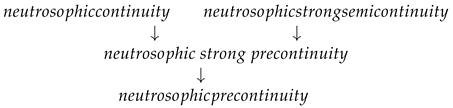
The following example shows that reverse may not be true.
Example 3.
Let and suppose and G are neutrosophic sets of W defined as below: :
,
,
.
, and . In this case, the identity mapping is neutrosophic strongly precontinuous, but h is not neutrosophic continuous and also not neutrosophic strongly semicontinuous.
Theorem 13.
Let be a mapping from a neutrosophic topological space into a neutrosophic topological space . Then, the following statements are equivalent:
- (a) h is a neutrosophic strong precontinuous mapping;
- (b) Given any neutrosophic closed set D in , is a neutrosophic strongly preclosed set in ;
- (c) Given any neutrosophic set T in , ;
- (d) Given any neutrosophic set D in , ;
- (e) Given any neutrosophic set D in , ;
- (f) Given any , there exists a base α such that is a neutrosophic strongly preopen set in the neutrosophic topological space ;
- (g) Given any , there exists a base α such that is a neutrosophic strongly preclosed set in the neutrosophic topological space .
Proof.
This proof is excluded due to its resemblance to its counterpart in general topology. □
Theorem 14.
Let be a mapping from a neutrosophic topological space into a neutrosophic topological space . Then, the following statements are equivalent:
(a) h is a neutrosophic strong precontinuous mapping;
(b) Given any neutrosophic closed set , ;
(c) Given any neutrosophic set , .
Proof.
This proof is omitted due to its similarity to its counterpart in general topology. □
Theorem 15.
Let be a bijective mapping from a neutrosophic topological space to a neutrosophic topological space . The mapping h is neutrosophic strong precontinuous if and only if , for each neutrosophic set T in .
Proof.
Let it be assumed that h is considered neutrosophic strong precontinuous. For any neutrosophic set T in , the set is identified as a neutrosophic strongly preopen set. By applying Theorem 13 and utilizing the fact that h is injective, it is established that . Furthermore, since h is surjective, the following is concluded: .
On the other hand, let D be defined as a neutrosophic open set in . By definition, . Based on the stated assumption, . This implies that . Since h is injective, we obtain . Hence, , so is a neutrosophic strongly preopen set. Thus, h is neutrosophic strong precontinuous. □
Theorem 16.
Let and be mappings, where , and are neutrosophic topological spaces. If h is neutrosophic strong precontinuous and r is neutrosophic continuous, in this case, is neutrosophic strong precontinuous.
Proof.
The proof can be derived from the relation , when considering each neutrosophic set D in . □
Corollary 1.
Let , be neutrosophic topological spaces and , be projections of onto Z and R. If is neutrosophic strong precontinuous, then and are also neutrosophic strong precontinuous mappings.
Proof.
The proof follows from the fact that and are neutrosophic continuous functions. □
Theorem 17.
Consider , and as neutrosophic topological spaces, with being product-related to . The product mapping , formed from the neutrosophic strong precontinuous mappings and , is identified as a neutrosophic precontinuous mapping.
Proof.
Let , where and are neutrosophic open sets of and , respectively. From , it can be concluded that is a neutrosophic preopen set, represented as the union of products of neutrosophic strongly preopen sets. □
Theorem 18.
Consider a mapping from a neutrosophic topological space to a neutrosophic topological space . If the graph of h is neutrosophic strong precontinuous, it can be concluded that h is neutrosophic strong precontinuous.
Proof.
According to Lemma 4, for any neutrosophic open set D in , . Since r is neutrosophic strong precontinuous and is a neutrosophic open set in , is a neutrosophic strongly preopen set in , which implies that h is neutrosophic strong precontinuous. □
6. Decomposition of Neutrosophic Continuity
In this section, we first introduce the concept of neutrosophic and give one of its properties, then we introduce neutrosophic , whose basis is formed by this new type of set, and present a property of this new type of continuity.
Definition 28.
A neutrosophic set T in a neutrosophic topological space is called P if and only if , where and D is a neutrosophic preclosed set in .
Theorem 19.
A neutrosophic set T in a neutrosophic topological space is open if and only if it is both a neutrosophic strongly preopen set and a P-set.
Proof.
Let T be a neutrosophic open set in a neutrosophic topological space . Then, from , it follows that T is a neutrosophic P-set. Also, T is a neutrosophic strongly preopen set by Theorem 2(a).
Conversely, let T be both a neutrosophic P-set and a neutrosophic strongly preopen set. Then, and , where and D is a neutrosophic preclosed set in . Therefore, . Hence, Noticing that , we obtain ; thus, is a neutrosophic open set. □
Definition 29.
A mapping is called neutrosophic P-continuous and is a neutrosophic P-set for each .
Based on Theorem 19, the decomposition of continuity is derived as follows.
Theorem 20.
A mapping is neutrosophic continuous if and only if it is both neutrosophic strong precontinuous and neutrosophic P-continuous.
Proof.
Let be a neutrosophic continuous mapping and . Then, is neutrosophic open in . From Theorem 2, is neutrosophic strongly preopen. So, is neutrosophic strongly precontinuous. On the other hand, , where is neutrosophic open in and is neutrosophic preclosed in . This implies that is a neutrosophic P-set and is neutrosophic P-continuous.
Let be a neutrosophic P-continuous and a neutrosophic strongly precontinuous mapping. Then, is neutrosophic strongly preopen and a neutrosophic P-set for any . From Theorem 19, is open. So, is neutrosophic continuous. □
7. Neutrosophic Strongly Preopen and Neutrosophic Strongly Preclosed Mappings
In this last subheading of our study, we first introduce two new mapping types and show their relationships with other mapping types with the help of a diagram. Also, we give some inverse examples of this diagram. We then examine the properties of these new types of mappings.
Definition 30.
A mapping is called
(a) Neutrosophic strongly preopen iff for each ;
(b) Neutrosophic strongly preclosed iff for each .
The diagram illustrating the implications is presented as follows:

The following example shows that reverse may not be true.
Example 4.
Let and be neutrosophic sets of X defined as below:
,
,
.
Let , , and . Then, the identity mapping is neutrosophic strongly preopen (preclosed) but h is not neutrosophic strongly semiopen (semiclosed). Additionally, is neutrosophic preopen (preclosed), but it is not neutrosophic strongly preopen (preclosed).
Theorem 21.
Let be a mapping from a neutrosophic topological space into a neutrosophic topological space . Then, the following statements are equivalent:
- (a) h is a neutrosophic strongly preopen mapping;
- (b) , for each neutrosophic set T in ;
- (c) , for each neutrosophic set D in ;
- (d) , for each neutrosophic set D in ;
- (e) A neutrosophic base δ exists for τ such that is neutrosophic strongly preopen set in for each .
Proof.
Omitted. □
Theorem 22.
A mapping that is a mapping from a neutrosophic topological space into a neutrosophic topological space is neutrosophic strongly preclosed if and only if for each neutrosophic set T in .
Proof.
Let be a neutrosophic strongly preclosed mapping and . Then, is neutrosophic closed in and is neutrosophic strongly preclosed in . Since , .
Let be a neutrosophic and for any neutrosophic set T in . Let T be a closed set in . Then, and . So, . Then, it is obvious that . This implies that and is neutrosophic strongly preclosed. Therefore, is a neutrosophic strongly preclosed mapping. □
Theorem 23.
Let be a bijective mapping from a neutrosophic topological space into a neutrosophic topological space . Then, h is neutrosophic strongly preopen if and only if, it is neutrosophic strongly preclosed.
Proof.
The theorem follows from Lemma 2. □
Corollary 2.
Let be a bijective mapping from a neutrosophic topological space to a neutrosophic topological space . Then, h is neutrosophic strongly preopen if and only if for each neutrosophic set T in .
Corollary 3.
Let be a bijective mapping from a neutrosophic topological space into a neutrosophic topological space . Then, the following statements are equivalent:
- (a) h is a neutrosophic strongly preclosed mapping;
- (b) , for each neutrosophic set T in ;
- (c) , for each neutrosophic set H in ;
- (d) , for each neutrosophic set D in ;
- (e) A neutrosophic base δ exists for τ such that is neutrosophic strongly preclosed set in for each .
Theorem 24.
A mapping from a neutrosophic topological space into a neutrosophic topological space is neutrosophic strongly preopen if and only if , for each neutrosophic set T in .
Proof.
Suppose that h is a neutrosophic strongly preopen mapping. For any neutrosophic T in , is a neutrosophic strongly preopen set of Z. Thus, .
Conversely, let T be a neutrosophic open set in . From , we conclude that h is a neutrosophic strongly preopen mapping. □
Theorem 25.
A mapping h: from a neutrosophic topological space into a neutrosophic topological space is neutrosophic strongly preclosed if and only if , for each neutrosophic T in .
Proof.
The theorem can be proved in a similar manner as Theorem 24. □
Theorem 26.
Let h: be a mapping from a neutrosophic topological space to a neutrosophic topological space .
- (a) If , for each neutrosophic open set T in , then h is a neutrosophic strongly preopen mapping.
- (b) If , for each neutrosophic closed set T in , then h is a neutrosophic strongly preclosed mapping.
Proof.
(a) Let T be any neutrosophic open set in . Then, . According to the assumption , so is a neutrosophic strongly preopen in .
(b) Omitted.
□
Theorem 27.
Let be a mapping from a neutrosophic topological space to a neutrosophic topological space . Then, h is neutrosophic strongly preopen if and only if, for each neutrosophic set H in and each neutrosophic closed set T in , , there exists a neutrosophic strongly preclosed set D in such that and .
Proof.
Let D be any neutrosophic set in and T be a neutrosophic closed set in such that . Then, , or . Since is a neutrosophic open set, is a neutrosophic strongly preopen set, so . Hence, Thus, The result follows that .
Conversely, let V be a neutrosophic open set in . We show that is a neutrosophic strongly preopen set. From , it follows that , where is a neutrosophic closed set in . Hence, there is a neutrosophic strongly preclosed set D in such that and . From , it follows that , so . From , we obtain , so . Hence, . Thus, is a neutrosophic strongly preopen set, so h is a neutrosophic strong preopen mapping. □
Corollary 4.
If is a neutrosophic strongly preopen mapping, then the following hold:
(a) , for each neutrosophic set H in ;
(b) , for each neutrosophic preopen set D in .
Proof.
(a) Let D be a neutrosophic set in . Then, is a neutrosophic closed set in containing . According to Theorem 27, there exists a neutrosophic strongly preclosed set D in , such that . Thus, .
(b) This claim follows immediately from (a).
□
Theorem 28.
Let be a mapping from a neutrosophic topological space into a neutrosophic topological space . Then, h is neutrosophic strongly preclosed if and only if, for each neutrosophic set H in and each neutrosophic open set G in , when , there exists a neutrosophic strongly preopen set D in such that and .
Proof.
The theorem can be proved in a similar manner as Theorem 27. □
Theorem 29.
Let and be mappings, where , , and are neutrosophic topological spaces. If r is neutrosophic strongly preopen (preclosed) and h is neutrosophic open (closed), then is neutrosophic strongly preopen (preclosed).
Proof.
For any neutrosophic open (closed) set T in , the following holds: . Since h is a neutrosophic open (closed) mapping and r is neutrosophic strongly preopen (preclosed), we obtain that is a neutrosophic storngly preopen (preclosed) set in . □
8. Conclusions
In this research, a new category of open set was introduced to the scientific community. Moreover, novel forms of continuity and mappings were established based on this new open set concept. The connections between these newly proposed types of continuity and mappings, previously unexplored, were illustrated through diagrams. To address any potential doubts for readers, examples were included. It is anticipated that this research will significantly impact other scientific disciplines, helping to meet the evolving demands of human life. Additionally, it is expected that this research will serve as an inspiration for future mathematical investigations and encourage researchers to pursue new directions in the field.
Author Contributions
The authors contributed equally to this work. All authors have read and agreed to the published version of the manuscript.
Funding
This research received no external funding.
Data Availability Statement
Data are contained within the article.
Conflicts of Interest
The authors declare no conflicts of interest.
References
- Levine, N. Semi-open sets and semi-continuity in topological spaces. Am. Math. Mon. 1963, 70, 34–41. [Google Scholar] [CrossRef]
- Mashour, A.S.; Abd El-Monsef, M.E.; El-Deep, S.N. On precontinuous and weak precontinuous mappings. Proc. Math. Phys. Soc. Egypt. 1982, 53, 47–53. [Google Scholar]
- Njastad, O. On some classes of nearly open sets. Pacific J. Math. 1965, 15, 961–970. [Google Scholar] [CrossRef]
- Al-shami, T.M.; Hosny, R.A.; Abu-Gdairi, R.; Arar, M. A novel approach to study soft preopen sets inspired by classical topologies. J. Int. Fuzzy Syst. 2023, 45, 1–12. [Google Scholar] [CrossRef]
- Azad, K.K. On fuzzy precontinuity, fuzzy almost continuity and fuzzy weakly continuity. J. Math. Anal. Appl. 1981, 82, 14–32. [Google Scholar] [CrossRef]
- Krsteska, B. Fuzzy Strongly Preopen Sets and Fuzzy Strong Precontinuity. Mat. Vesnik 1998, 50, 111–123. [Google Scholar]
- Singal, M.K.; Prakash, N. Fuzzy preopen sets and fuzzy preseparation axioms. Fuzzy Sets Syst. 1991, 44, 273–281. [Google Scholar] [CrossRef]
- Zhong, B.S. Fuzzy strongly preopen sets and fuzzy strong precontinuity. Fuzzy Sets Syst. 1992, 52, 345–351. [Google Scholar] [CrossRef]
- Al-shami, T.M. Improvement of the approximations and accuracy measure of a rough set using somewhere dense sets. Soft Comput. 2021, 25, 14449–14460. [Google Scholar] [CrossRef]
- Smarandache, F. Neutrosophic set, a generalisation of the intuitionistic fuzzy sets. Int. J. Pure Appl. Math. 2005, 24, 287–297. [Google Scholar]
- Dhavaseelan, R.; Jafari, S.; Ozel, C.; Al-Shumrani, M.A. Generalized neutrosophic contra-continuity. In Infinite Study; 2017; Volume II, pp. 365–380. Available online: https://www.researchgate.net/signup.SignUp.html (accessed on 1 December 2024).
- Salama, A.A.; Alblowi, S.A. Neutrosophic set and neutrosophic topological spaces. IOSR J. Math. 2012, 3, 31–35. [Google Scholar] [CrossRef]
- Acikgoz, A.; Cakalli, H.; Esenbel, F.; Kocinac, L.D. A quest of G-continuity in neutrosophic spaces. Math. Meth. Appl. Sci. 2021, 44, 7834–7844. [Google Scholar] [CrossRef]
- Acikgoz, A.; Esenbel, F. Neutrosophic Connected topological spaces. Fasc. Math. 2023, 66, 5–22. [Google Scholar]
- Acikgoz, A.; Esenbel, F. On A Weak Form of Semi-Open Function By Neutrosophication. Maltepe J. Math. 2024, VI, 79–89. [Google Scholar]
Disclaimer/Publisher’s Note: The statements, opinions and data contained in all publications are solely those of the individual author(s) and contributor(s) and not of MDPI and/or the editor(s). MDPI and/or the editor(s) disclaim responsibility for any injury to people or property resulting from any ideas, methods, instructions or products referred to in the content. |
© 2024 by the authors. Licensee MDPI, Basel, Switzerland. This article is an open access article distributed under the terms and conditions of the Creative Commons Attribution (CC BY) license (https://creativecommons.org/licenses/by/4.0/).