Abstract
For the constructive analysis of locally Lipschitzian system of non-linear differential equations with mixed periodic and two-point non-linear boundary conditions, a numerical-analytic approach is developed, which allows one to study the solvability and construct approximations to the solution. The values of the unknown solution at the two extreme points of the given interval are considered as vector parameters whose dimension is the same as the dimension of the given differential equation. The original problem can be reduced to two auxiliary ones, with simple separable boundary conditions. To study these problems, we introduce two different types of parametrized successive approximations in analytic form. To prove the uniform convergence of these series, we use the appropriate technique to see that they form Cauchy sequences in the corresponding Banach spaces. The two parametrized limit functions and the given boundary conditions generate a system of algebraic equations of suitable dimensions, the so-called system of determining equations, which give the numerical values of the introduced unknown parameters. We prove that the system of determining equations define all possible solutions of the given boundary value problems in the domain of definition. We established also the existence of the solution based on the approximate determining system, which can always be produced in practice. The theory was presented in detail in the case of a system of differential equations consisting of two equations and having two different solutions.
Keywords:
non-linear differential systems; mixed boundary conditions; periodic and non-linear two-point boundary conditions; parametrization technique; successive approximations MSC:
34B15
1. Introduction and Subsidary Statements
For the investigation of solutions of different types of periodic and nonlinear boundary value problems for ordinary differential equations side by side with numerical methods, is often are used an approximate techniques based upon some types of successive approximations constructed in analytic form. See, e.g., [1,2,3,4,5,6,7,8,9,10,11,12,13,14,15,16,17,18,19].
We study the following non -linear differential system with mixed, partly periodic and general two-point boundary conditions on the given compact interval
Here we suppose that are continuous functions defined on bounded sets , and , (the domains , , and will be concretized later, see (17), (19) and (21)). Moreover, the functions , , B are Lipschitzian in the following form:
for any , and
for all , , where , , , , , are non-negative constant matrices respectively of dimensions , , , , ,
By a solution of problem (1)–(3) we understand a pair of a continuously differentiable functions and satisfying Equation (1) on the interval and conditions (2) and (3).
Here and below, the absolute value sign and inequalities between vectors are understood componentwise. A similar convention is adopted for the operations “”, “max”, “min”. The symbol stands for the unit matrix of dimension n, denotes a spectral radius of a square matrix
On the base of matrices let us introduce the dimensional square matrix
Moreover, we suppose that for the maximal in modulus eigenvalue of matrix
holds
If and is a vector with non-negative components, stands for the componentwise -neighbourhood of
Similarly, for a given bounded connected set we define its -neighbourhood by putting
We will use the following statements.
Lemma 1
([20]). Let be a closed bounded set and be a continuous function. Then, for an arbitrary , the componentwise inequality
holds, where
Lemma 2
([21]). Let the sequence of continuous functions be defined by the recurrence relation
Then the following estimates hold for :
2. Parametrization and Convergence of Successive Approximations
The idea that we are going to employ is based on the reduction of the given problem to a family of simple auxiliary boundary value problems [22]. Let us fix certain compact convex sets and , For given bounded connected sets define the sets
In practice, it is convenient to choose sets , as parallelepipeds.
The following notations will be required below
where the domain according to (11) is a componentwise -neighbourhood of the set defined in (17)
with such that
and is the componentwise -neighbourhood of the set
with such that
We use an approach that was used also in [23,24] in the case of a different type of boundary value problems. Namely, we introduce the vectors of parameters
by formally putting
Instead of boundary value problem (1)–(3) we will consider the following two boundary value problems with periodic and two-point linear separated parametrized conditions at a and b:
and
We focus on the continuously differentiable solutions and of problem (1)–(3) with values and
As will be seen from statements below, one can then go back to the original problem by choosing the values of the introduced parameters and appropriately.
Let us connect for problem (25) with the periodic parametrized boundary conditions the sequences of functions
and for the investigation of auxiliary problem (27) we introduce the sequence of functions
satisfying the periodic conditions (25b) and two-point parametrized conditions (26b) for arbitrary , and where
Theorem 1.
- 1.
- The functions of the sequence (27) belonging to the domain are continuosly differentiable on the interval , and satisfy the two-point periodic boundary conditions (25b) and converges uniformly as with respect to the domain to the limit functionwhich satisfies the periodic boundary conditions (25b).
- 2.
- 3.
- The limit functions for all are the unique continuously differentiable solutions of the parametrized integral equationsor, equivalently, of the Cauchy problems for the modified system of integro-differential equations:where and are the mappings given by the formulas
- 4.
Proof.
We will prove that for and the values of the functions (27) and (28) belong to the domains and respectively and they create the Cauchy sequences in the Banach spaces and respectively. Indeed, using the estimate (12) of Lemma 1, relations (13), (14), (27) for imply that
which means, according to (20), that whenever
By induction, we obtain
and
which means according to (20) and (22) that all the values of functions (27) are contained in domain for all and , and all the values of functions (28) belong to
Consider now the difference of functions
and
In view of Lemma 1, Lemma 2 and conditions (4), (5) and estimates (40) from (41) and (42) we obtain
Let us rewrite estimates (43) and (44) in the matrix-vector form
Direct computations give
and
where and denotes the and components of the vector in
By induction using estimate (46), we can establish that
Using estimate (16) of Lemma 2, from (47) we obtain
Let us set
Therefore, in view of (48) from inequalities
on the base of (9) we have
and
Since, due to (9), the maximum eigenvalue of the matrix Q is less than 1, we have
Therefore, we conclude from (49) and (50) that, according to Cauchy convergence test, the sequence of the form (27) uniformly converges in the domain to the limit function and the sequence of the form (28) uniformly converges in the domain to the limit function . Since all functions of the sequences (27) and (28) satisfy correspondingly the periodic parametrized conditions (25b) and conditions (26b) for all values of the introduced parameters , , the limit functions , also satisfies these conditions. Passing to the limit as in equalities (27), (28) we show that the limit function satisfies both the integral Equation (33) and the Cauchy problem (34).
Passing to the limit as in (49) we get the estimates (36). □
3. Connection of the Limit Functions , to the Solution of the Original Problem
Theorem 2.
Proof.
The proof can be carried out similarly as in [21,22]. □
Remark 1.
The next statement proves that the system of determining Equations (52)–(54) defines all possible solutions of the original non-linear boundary value problem (1)–(3) having values in domains .
Theorem 3.
Let the assumptions of Theorem 1 hold. Furthermore, assume there exists some triplet of vectors which sytisfy the system of determining Equations (52)–(54).
Then:
Proof.
The proof can be carried out similarly as in [21,22]. □
4. Solvability Analysis Based on the Approximate Determining System
Although Theorem 2 provides a theoretical answer to the question on the construction of a solution of the original non-linear boundary value problem (1)–(3), its application faces certain difficulties due to the fact that the explicit form of the limit functions , and consequently the explicit form of the functions
in (52)–(54) is usually unknown. This complication can be overcome by using the so-called approximate determining equations:
for a fixed
Lemma 3.
Proof.
Based on both exact and approximate determining systems (52)–(54) and (58)–(60) let us introduce the mappings and by setting
where
We see from Theorem 2 that the critical points of the vector field H of the form (65) determine solutions of the non-linear problem (1)–(3). The next statement establishes a similar result based upon properties of vector field explicity known from (66).
Theorem 4.
Let the assumptions of Theorem 1 hold. Moreover, one can specify an and a set
where are certain bounded open sets such that the mapping satisfies the relations
and
on the boundary of the set Ω. If, in addition
then there exists for which the function
is a solution of the non-linear boundary value problem (1)–(3).
In (67) the binary relation is defined in [21] as a kind of strict inequality for vector functions and it means that, at every point on the boundary , at least one of the components of the vector is greater than the corresponding component of the vector at the right-hand side. The degree in (68) is the Brouwer degree because all the vectors fields are finite-dimensional. Likewise, all the terms in the right-hand side of (67) are computed explicitly e.g., by using computer algebra systems.
Proof.
The proof can be carried out similarly as in Theorem 4 from [23]. □
5. Conclusions
The method is numerical-analytic in the sense that its realization consists of two stages. First we give an explicit construction of certain parametrized approximations in analytic form, then a system of non-linear algebraic equations is obtained for the introduced parameters, which can be solved numerically. The values of the unknown solution at the two extreme points of the given interval are considered as vector parameters whose dimension is the same as the dimension of the given differential equation. The original problem can be reduced to two auxiliary ones, with simple separable boundary conditions. To study these problems, we introduce two different types of successive approximations in analytic form. It can be noticed that in order to solve the given mixed boundary value problem, it was necessary to introduce two parametrized sequence of functions , in different ways, and to prove their uniform convergence. Theorem 3 proves that our method determines all possible approximate solutions in the given domain. Theorem 4 gives a new constructive answer for the existence of an exact solution based on a certain approximation. In the example, we determine two distinct solutions. The dimension of the determining algebraic system of equations is , where p is the number of periodic and q is the number of non-periodic components.
The theoretical basis for robustness, as stated in Remark 1, is that, in our approach, an infinite-dimensional original boundary value problem (1)–(3) is reduced to a finite dimensional system of algebraic or transcendental equations. The method thus consists of two parts, namely, the analytic part, when the integral Equation (33) are dealt with by using the method of successive approximations (27), (28) and the numerical one, which consists in finding values of the unknown parameters from Equations (52)–(54) (in practice, from systems (58)–(60)).
To solve nonlinear systems of Equations (58)–(60), efficient methods available in symbolic computation packages can be used. We have used Maple 14. The reliability of our approach is also facilitated by its constructiveness, because all the theoretical conditions in the theorems can be verified in practice. In the example, we have carried out this check in detail.
Our parameterization technique can be used with conditions of a general form, for example with integral restrictions. Method can be easily applied also to examine the solutions of differential equations with argument deviations. The determination of successive approximations can be complicated by integration. To eliminate this, the polynomial approximation proposed in our paper [24] can be used baseed on parameterized Lagrangian polynomials. We note that, in the example, we have already applied this.
6. Example
Let us apply the approach desribed above to the system of differential equations
considered under periodic and two-point non-linear boundary conditions
Let us consider the following choice of subsets, where one looks for the values and and ,
This choice of these sets is motivated by the fact that the zeroth approximate determining system (i.e., (58)–(60) with ) has roots lying in these sets (73), see the second row in Table 1. Recall that, in order to obtain it, only functions (29) and (30) are used, and no iteration is yet carried out. We see that this piecewise linear function provides quite reasonable approximate values of the parameters. In this case, according to (17), we have
For and involved in (20) and (22), we choose the vectors
Then, in view of (73)–(75), the sets (19), (21) take the form
We can compute the Lipschitz constants in (4)–(6) for the domains (76)
Therefore direct computations give
and hence inequalities (20) and (22) hold.
Table 1.
Values of parameters for approximations of the exact solution.
We thus see that all the conditions of Theorem 1 are fulfilled, and the sequences of functions (27) and (28) for this example are uniformly convergent.
In the case of the given non-linear boundary value problems it is more appropriate to use a scheme with polynomial interpolation [24], when instead of (27), (28) we use the sequence of vector polynomials of degree () and the sequence of vector polynomials of degree () on
where
is the Lagrange interpolation polynomial of degree N which corresponds to the term in (70) over the Chebyshev nodes translated from to the interval . Similarly,
where
is the Lagrange interpolation Chebyshev polynomials of degree N on the Chebyshev nodes translated from to the interval , corresponding to the Nemytskii operator defined by the term in (71). Note that the coefficients of the interpolation polynomials depend on the parameters z, ,
The justification of this polynomial approach can be found in [24].
6.1. Approximations for the Exact Solution
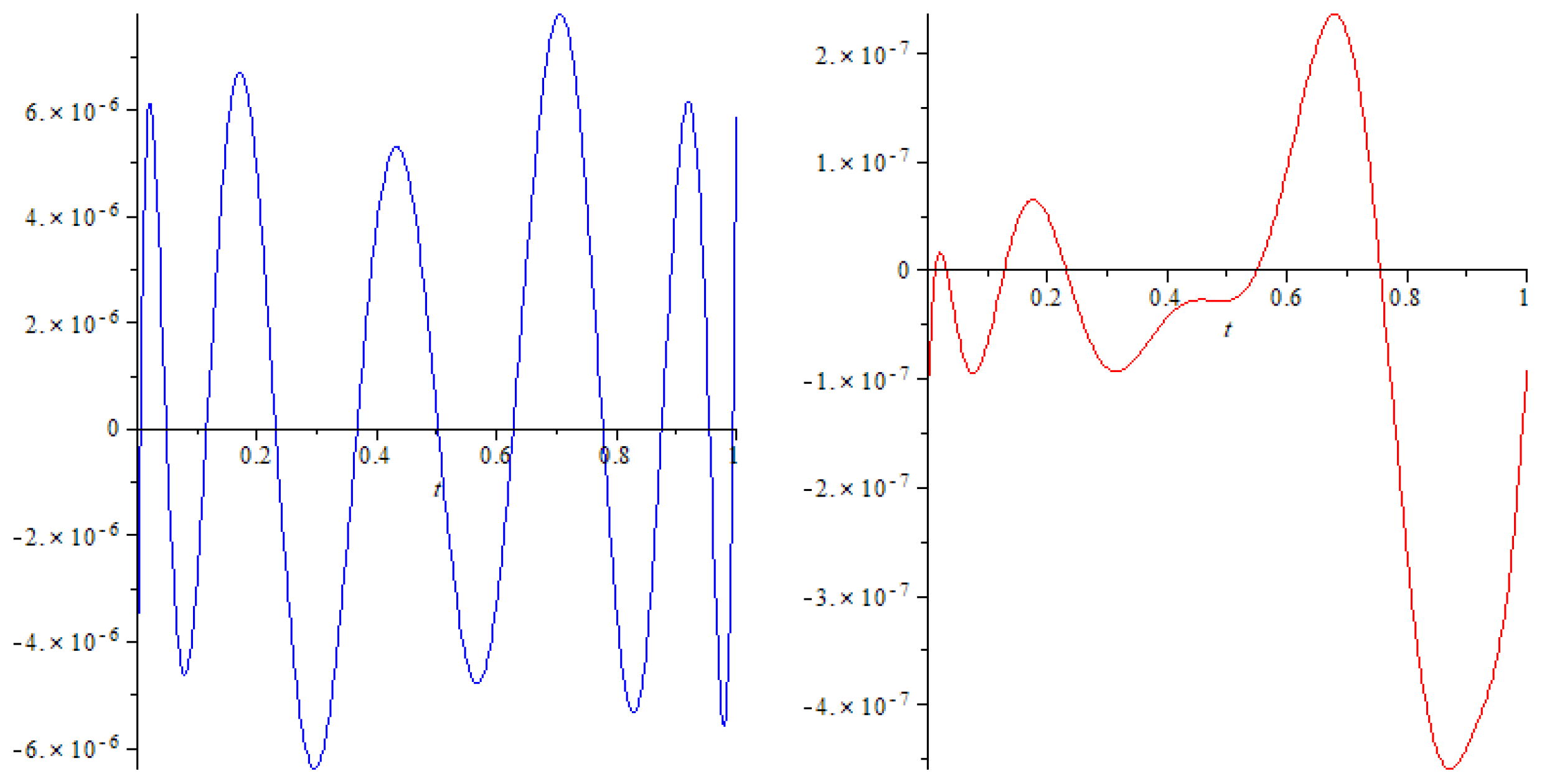
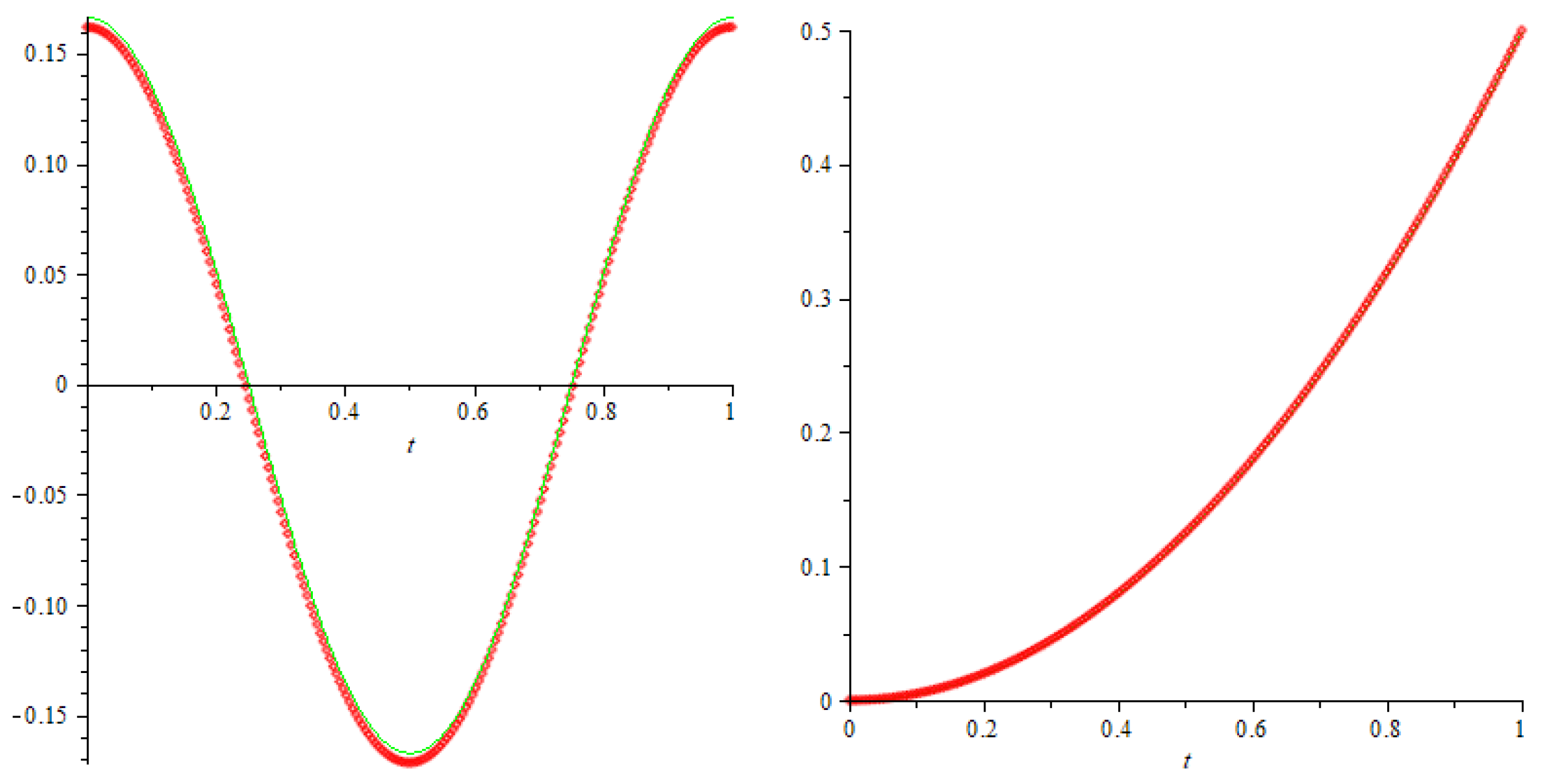
One can check that the pair of functions , is one of the solutions of the given boundary value problem. Using (78), (79) and applying Maple 14 for different values of m to implement the approximations , and solving the approximate determining system (80), we find the values of introduced parameters with the degree of the approximating polynomials and These values are presented in Table 1 for different m. The graphs of approximations and residuals are shown on Figure 1 and Figure 2.
Figure 1.
The graphs of the exact (solid line) and approximate solution (points) for for the x and y components.
6.2. Approximations for the Second Solution
Carrying out computations, we see that the approximate determining system (80) along with the solution given in Table 1, has another solution in set (73), which is presented in Table 2.
Table 2.
Values of parameters for approximations of the exact solution.
With the help of the Maple program package, the second solution is obtained at the 9th iteration in the form of the 11th degree polynomials below
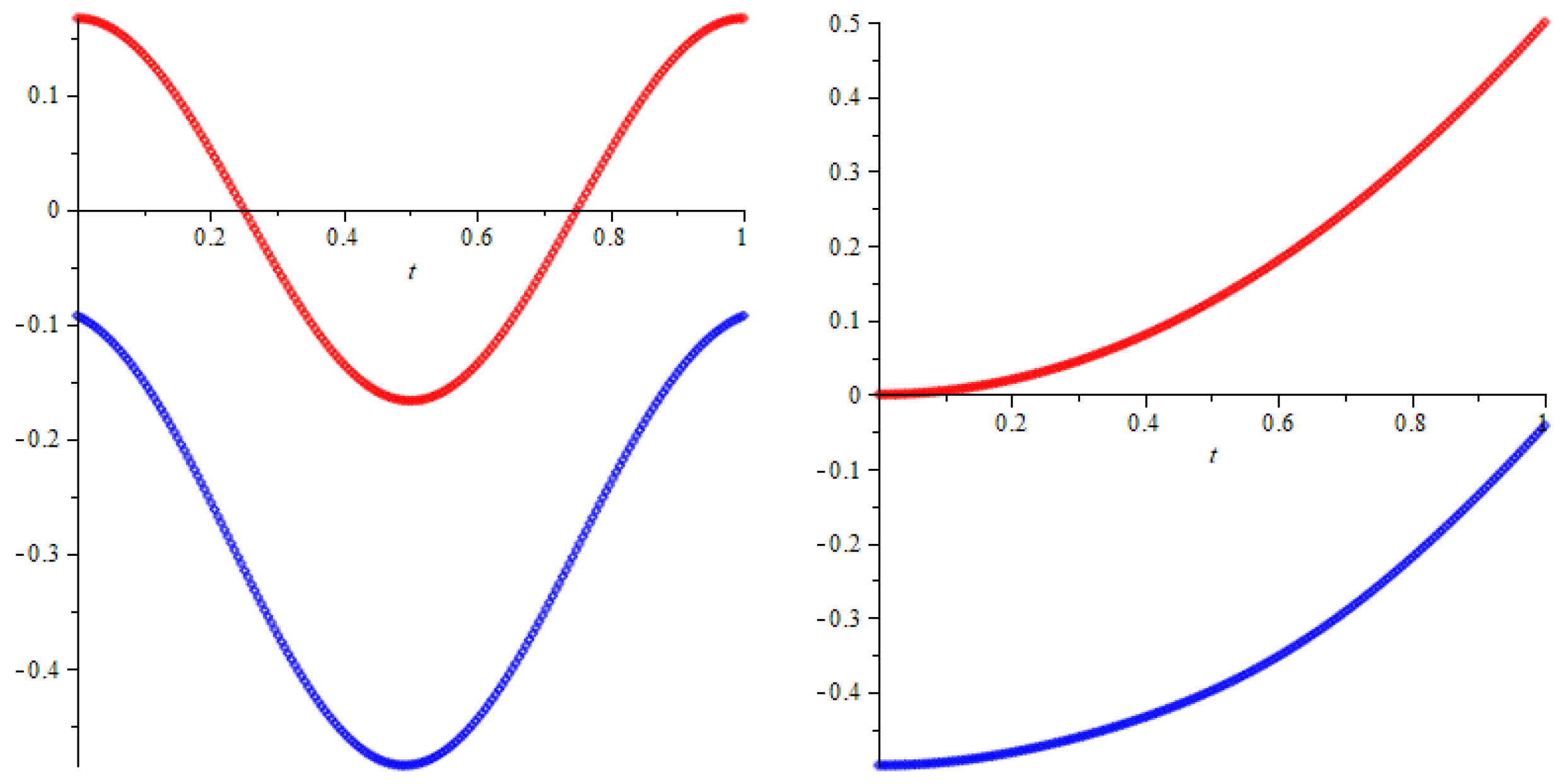
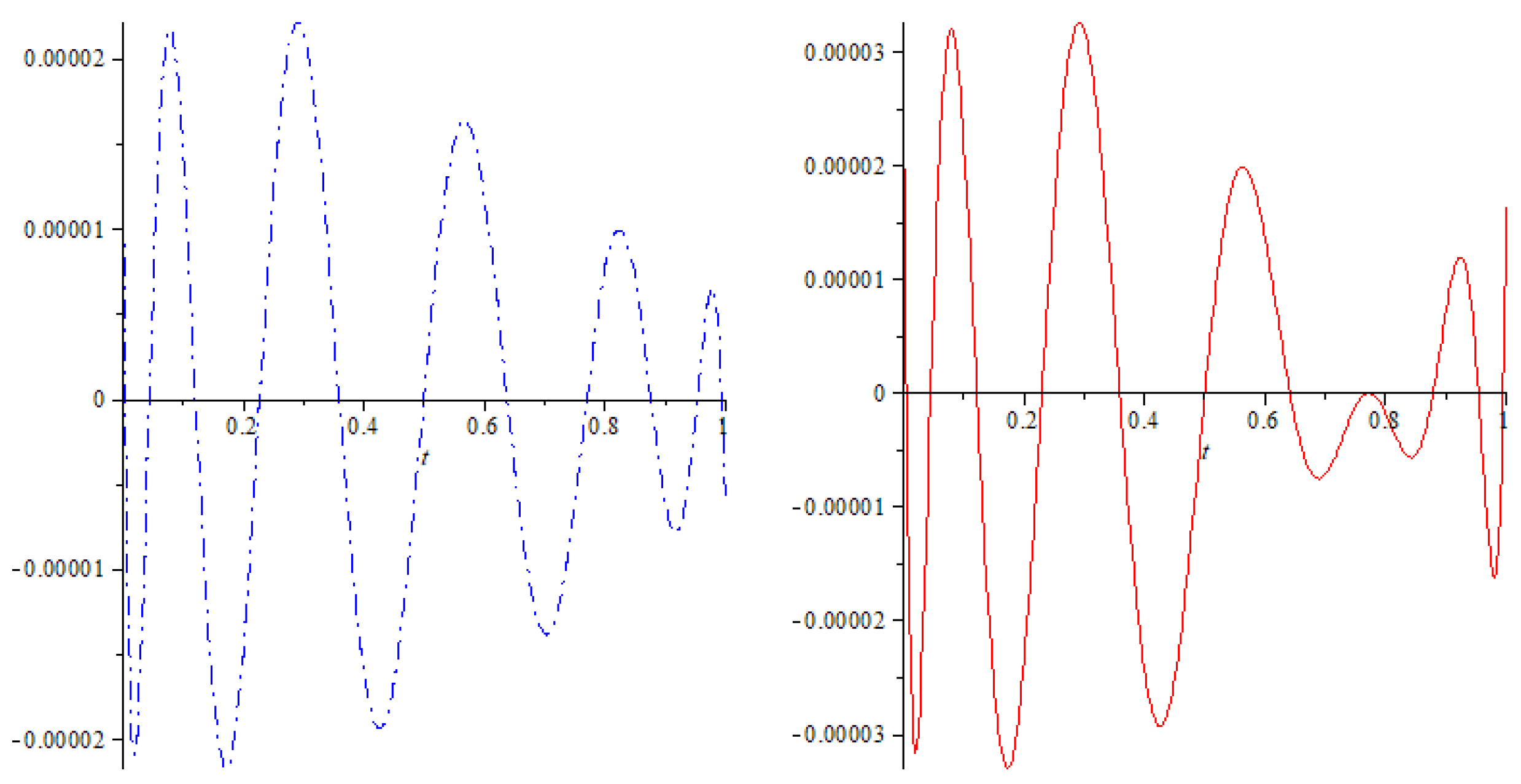
Figure 3 shows that the two solutions found look identical in appearance along the x and y coordinates, but they are shifted vertically. Figure 4 shows the residual.
Figure 3.
The graphs of the exact (red) and approximate second solutions (blue) for , for the x and y components.
Figure 4.
The residual of the ninth approximation for the second solution for for the x and y components.
Funding
This research received no external funding.
Data Availability Statement
Data is contained within the article.
Conflicts of Interest
The author declares no conflicts of interest.
References
- Samoilenko, A.M. Numerical-analytic method for the investigation of periodic systems of ordinary differential equations. I. Ukr. Math. Zhurnal 1965, 17, 82–93. [Google Scholar]
- Samoilenko, A.M. Numerical-analytic method for the investigation of periodic systems of ordinary differential equations. II. Ukr. Math. Zhurnal 1966, 18, 50–59. [Google Scholar]
- Samoilenko, A.M. On periodic solutions of nonlinear second -order equations. Differ. Uravn. 1967, 3, 1903–1913. [Google Scholar]
- Rontó, A.; Rontóová, N. On constuction of solutions of linear differential systems with argument deviations of mixed type. Symmetry 2019, 12, 1740. [Google Scholar] [CrossRef]
- Samoilenko, A.M.; Laptinsky, V.N. On estimates of periodic solutions of differential equations. Dokl. Akad. Nauk. Ukr. SSR Ser. A 1982, 30–32. (In Russian) [Google Scholar]
- Samoilenko, A.M.; Ronto, V.A. Numerical-analytic method for solving boundary-value problems for ordinary differential equations. Ukr. Math. J. 1981, 33, 356–362. [Google Scholar] [CrossRef]
- Evkhuta, N.A.; Zabreiko, P.P. On the convergence of the Samoilenko method of successive approximations for finding periodic solutions. Dokl. Akad. Nauk. Belarus. SSR 1985, 29, 15–18. (In Russian) [Google Scholar]
- Evkhuta, N.A.; Zabreiko, P.P. On the Samoilenko method for finding periodic solutions of quasilinear differential equations in a Banach space. Ukr. Math. Zhurnal 1985, 37, 162–168. (In Russian) [Google Scholar]
- Evkhuta, N.A.; Zabreiko, P.P. The Poincare method and Samoilenko method for the construction of periodic solutions to ordinary differential equations. Math. Nachrichten 1991, 153, 85–99. [Google Scholar] [CrossRef]
- Pylypenko, V.; Rontó, A. A singular problem for functional differential equations with decreasing non-linearities. Math. Methods Appl. Sci. 2021, 44, 11076–11088. [Google Scholar] [CrossRef]
- Samoilenko, A.M.; Le Lyong, T. A method for studing boundary value problems with nonlinear boundary conditions. Ukr. Math. Zhurnal 1991, 42, 844–850. [Google Scholar] [CrossRef]
- Augustynovicz, A.; Kwapisz, M. On numerical-analytic method of solving of boundary value problems for functional-differential equation of neutral type. Math. Nachrichten 1990, 145, 255–269. [Google Scholar] [CrossRef]
- Kwapisz, M. Some remarks on integral equations arising in applications of the numerical- analytic method for the solution of boundary- value problems. Ukr. Math. Zhurnal 1992, 44, 128–132. [Google Scholar]
- Kwapisz, M. On modification of the integral equation of A.M. Samoilenko’s method. Math. Nachrichten 1992, 157, 125–135. [Google Scholar] [CrossRef]
- Samoilenko, A.M. On a convergence of polynomials and the radius of convergence of its Abel-Poisson sum. Ukr. Math. J. 2003, 55, 1119–1130. [Google Scholar] [CrossRef]
- Trofimchuk, E.P. Integral operators of the method of periodic successive approximations. Mat. Fiz. Nelin. Mekh. 1990, 13, 31–36. (In Russian) [Google Scholar]
- Mawhin, J. Topological Degree Methods in Nonlinear Boundary-Value Problems, CBMS Regional Conference Series in Mathematics; American Mathematical Society: Providence, RI, USA, 1979; Volume 40. [Google Scholar]
- Jankowski, T. Numerical-analytic methods for differential-algebraic systems. Acta Math. Hung. 2002, 95, 243–252. [Google Scholar] [CrossRef]
- Jankowski, T. Numerical-analytic methods for implicit differential equations. Math. Notes 2001, 2, 137–144. [Google Scholar] [CrossRef]
- Rontó, A.; Rontó, M.; Shchobak, N. On periodic solutions of systems of linear differential equations with argument deviations. J. Math. Sci. 2022, 263, 282–298. [Google Scholar] [CrossRef]
- Rontó, A.; Rontó, M. Successive Approximation Techniques in Non-Linear Boundary Value Problems for Ordinary Differential Equations. In Handbook of Differential Equations, Ordinary Differential Equations; Batelli, F., Feckan, M., Eds.; Elsevier B.V.: Amsterdam, The Netherlands, 2008; Volume IV, pp. 441–592. [Google Scholar]
- Rontó, A.; Rontó, M.; Varha, J. A new approach to non-local boundary value problems for ordinary differential systems. Appl. Math. Comput. 2015, 250, 689–700. [Google Scholar] [CrossRef]
- Rontó, M.; Varha, Y. Constructive existence analysis of solutions of non-linear integral boundary value problems. Miskolc Math. Notes 2014, 15, 725–742. [Google Scholar] [CrossRef]
- Rontó, A.; Rontó, M.; Shchobak, N. Parametrisation for boundary value problems with transcendental non-linearities using polynomial interpolation. Electron. J. Qual. Theory Differ. Equ. 2018, 59, 1–22. [Google Scholar] [CrossRef]
Disclaimer/Publisher’s Note: The statements, opinions and data contained in all publications are solely those of the individual author(s) and contributor(s) and not of MDPI and/or the editor(s). MDPI and/or the editor(s) disclaim responsibility for any injury to people or property resulting from any ideas, methods, instructions or products referred to in the content. |
© 2024 by the author. Licensee MDPI, Basel, Switzerland. This article is an open access article distributed under the terms and conditions of the Creative Commons Attribution (CC BY) license (https://creativecommons.org/licenses/by/4.0/).