


Abstract
In this article, we delve into delayed fractional differential equations with Riemann–Stieltjes integral boundary conditions and fractional impulses. By using differential inequality techniques and some fixed-point theorems, some novel sufficient assessments for convenient verification have been devised to ensure the existence and uniqueness of solutions. We further employ the nonlinear analysis to reveal that this problem is Ulam–Hyers (UH) stable. Finally, some examples and numerical simulations are presented to illustrate the reliability and validity of our main results.
MSC:
34B37; 34D20; 34K37
1. Introduction
Fractional calculus is a generalization of the traditional integer-order calculus to an arbitrary real order. The earliest exploration of fractional derivatives dates back to a correspondence between L’Hospital and Leibnitz in 1695. In the 1970s, it was discovered that fractal geometry, the memory process, the power-law phenomenon and the genetic phenomenon are closely related to fractional derivatives. Fractional derivatives are excellent instruments for memory and genetic processes. Concurrently, due to the widespread application of fractional differential equations in disciplines such as physics, chemistry, aerodynamics, complex dielectric electrodynamics, polymer rheology, capacitor theory, circuits, biology and control theory (see [1,2,3,4,5,6]), they have received increasing attention and focus. As a consequence, many articles on fractional-order differential equations have been published to explore the existence, uniqueness and multiplicity of solutions by using Green’s function and related fixed-point theorems. One can see [7,8,9,10,11,12,13,14,15,16,17] and references therein.
Since the last century, some researchers have begun to apply impulsive differential equations to depict sudden events such as diseases, food shortages, natural disasters, etc., in population dynamics systems. Recently, impulsive fractional differential equations have been widely applied in physics and social sciences. The impulsive effect makes the study of fractional differential systems more complex and challenging. Specifically, the impulsive term has affected the dynamic behavior of the system (see [17,18,19]). Meanwhile, the integral boundary value problem (IBVP) for fractional differential systems has been widely used in modern scientific and technological applications such as groundwater flow, chemical engineering, thermoelasticity, population dynamics, etc. Many scholars have studied the IBVP for fractional differential systems and obtained many excellent conclusions (see [7,8,9,20]).
In the process of information transmission between different nodes in brain neural networks, internet and information networks, due to the influence of transmission speed, transmission medium and other factors, the information cannot arrive in time, and there is always a certain time delay which is inevitable. In many cases, a small time delay can lead to great changes in the dynamic behavior of the system [7,8,21]. So, we need to consider the effect of time delay on fractional differential models. In addition, stability is crucial for a differential system with practical application settings. Many definitions of stability have been proposed based on actual needs. In 1940s, Hyers and Ulam [22,23] defined a new type of stability i.e., Ulam–Hyers (UH) stability. Subsequently, this concept of stability was promoted as a generalized UH-type, Ulam–Hyers–Rassias (UHR)-type and generalized UHR-type. Some scholars have conducted systematic research on UH-type stability and published corresponding survey papers and monographs (see [24,25,26,27,28]). In the past decade, the UH-type stability of fractional-order systems has been heavily researched, and many excellent results have been obtained (see [29,30,31,32,33,34,35,36]). Nevertheless, the UH-type stability of delayed fractional differential systems with fractional impulses has been rarely studied, as it is much more difficult to investigate than fractional differential equations with integer-order impulses. Accordingly, it is interesting and challenging to explore the Riemann–Stieltjes IBVP for delayed fractional differential systems with fractional impulses.
Motivated by the above arguments, this article emphasizes the following Riemann–Stieltjes IBVP for a delayed fractional-order system with fractional pulses
subject to the initial function
where , and , . , and express -order Caputo derivatives. , , , . Both the left and right limits and exist, and . indicates the increasing bounded variation. denotes the Riemann–Stieltjes integrals. , . means the constant lag, ( defined as Section 3), , , .
The main objective of the article is to consider the existence and UH stability for IBVPs (1) and (2). The contribution of this article is mainly reflected in three aspects. (a) Since there are few studies on the Riemann–Stieltjes IBVP for the delayed fractional system with fractional pulses, this study of IBVPs (1) and (2) is the first to fill this gap. (b) We derive the existence, uniqueness and UH stability of IBVPs (1) and (2). (c) We use the appropriate ODE toolbox in MATLAB to obtain the numerical solution and simulation of IBVPs (1) and (2).
The remaining parts of this paper are organized as follows. Section 2 mainly introduces some essential notions, lemmas and the properties of the integral function. Section 3 presents the existence and uniqueness of the solution for IBVPs (1) and (2) by applying differential inequality techniques and some fixed-point theorems. The UH stability of IBVPs (1) and (2) are assessed in Section 4. Some interesting examples and simulations are presented to illustrate the correctness and availability of the main findings in Section 5. A brief summary is provided in Section 6.
2. Preliminaries
In this section, we introduce some necessary definitions and lemmas, which can be found in [37,38,39].
Definition 1
([37]). The Riemann–Liouville fractional integral of order of a function is given by
provided that the right-hand side is point-wise defined on .
Definition 2
([37]). If and , then the Caputo fractional derivative of order α is defined as
where , provided that the right-hand side is point-wise defined on .
Lemma 1
([38]). Assume that with a Caputo fractional derivative of order that belongs to , then
for some , where n satisfies .
Lemma 2
([38]). If , and , then
Lemma 3
([39]). Let be a Banach space and Ω be a closed convex subset of . If the operator is completely continuous, then the operator has at least one fixed point .
Lemma 4
([39]). Given a Banach space , let be a closed subset of . If the operator is contractive, then there is a unique such that .
Consider the following fractional-order impulsive boundary value problem and impulsive integral equation:
and
where
and
Proof.
When , from Lemma 1 and system (3), we obtain
It follows from (7) that , and
From (8), we derive that and , which implies that .
In the light of the integral boundary value condition of system (3), we have
When , we similarly have
In view of the continuity of at , we obtain
From (13), we have
Similarly, when , , we obtain
and
Next, let . When , one derives that
Similarly,
and
So,
and
From (9), we obtain
Therefore, , , one obtains
The proof ends. □
Lemma 6.
Let , and . Then, defined by (6) is continuous and differentiable, and satisfies the following properties
- (i)
- , .
- (ii)
- , .
- (iii)
- , .
Proof.
From the expression of , we obtain
and
By simple calculation, we have
and
The proof ends. □
3. Existence Results
This portion focuses on the solvability of IBVPs (1) and (2). To this end, we need to introduce some useful Banach spaces.
For , a Banach space is defined as and its norm as
Let . Then, the set composed of all continuous functions and the supremum norm form a Banach space.
The function space is defined by
and the norm
then, it is obvious that is a real Banach space.
According to Lemma 5, we define an operator as follows:
Then, the system (1) has a solution if and only if the operator defined by (32) exists at one fixed point.
Theorem 1.
If the following assumptions (H1)–(H4) are fulfilled,
- (H1)
- , , s.t.
- (H2)
- , , s.t.
- (H3)
- , , s.t.
- (H4)
- , and , whereand
Proof.
Denote , ,
For , we choose the following nonempty closed convex subset and operator denoted by (32)
Next, we apply Lemma 3 to prove that the mapping admits one fixed point. To this end, this is carried out in two steps.
Step 1. , when , it is obvious that . When , , from Lemma 5 and (H1)–(H4), we have
and
Step 2. We show that is equicontinuous. Indeed, the fact that f and G are continuous means that is continuous. Therefore, there exist some constants such that . For all , with , there appear three cases.
Case 1. When , form Lemma 6, we have
and
Case 2. When , is small enough, namely, as means that and . Thus, we derive that
and
Case 3. When , we have
By Cases 1–3, we derive that, (small enough), , , s.t. , whenever , namely, is equicontinuous. Together with the Arzela–Ascoli theorem and Steps 1 and 2, one derives the complete continuity of . By Lemma 3, one asserts that admits at least one fixed point , which meets with IBVPs (1) and (2). This ends the proof. □
Theorem 2.
Proof.
We define a mapping as (32). To prove the existence and uniqueness of the solution of system (1) and (2) using Lemma 4, it suffices to verify that is contractive. Actually, for all , when , , it is similar to (34)–(36) that
and
When , , then
Theorem 3.
Provided that the following (H5)–(H7) are fulfilled,
- (H5)
- , , and s.t. , where stands for the -Lebesgue measurable function space with the norm .
- (H6)
- , , s.t. , .
- (H7)
- , , s.t. , .
Proof.
Let . A constant is chosen , where
4. UH Stability
This portion adopts direct analysis methods to explore the UH-stability of IBVPs (1) and (2). For , consider the following inequality:
where , , , .
Definition 3.
Remark 1.
is a solution of inequality (41) iff there exists a function and a sequence such that
- (1)
- , , and , ;
- (2)
- , , ;
- (3)
- , ;
- (4)
- , ;
- (5)
- ,
5. Examples and Simulations
Example 1.
Consider the following Riemann–Stieltjes IBVP:
where , , , , , , , , , , , . By simple computation, we have , , , , , , ,
and
Thus, the conditions (H1)–(H4) are true. According to Theorem 1, we claim that system (52) has at least a solution on .
Example 2.
Consider the Riemann–Stieltjes IBVP as follows:
where , , , , , , , , , , . By simple computation, we have , , , , , , ,
and
So the conditions - hold. One knows from Theorems 2 and 4 that IBVP (53) admits a UH-stable unique solution on .
Example 3.
Consider the Riemann–Stieltjes IBVP for a delayed fractional differential equation with fractional-order impulses as follows:
where , , , , , , , , , . Clearly, , , , . By calculating, we obtain
and
Thus, all the conditions of Theorem 3 are satisfied. According to Theorem 3, we claim that system (54) has at least a solution on .
To complete the numerical simulation of systems (52)–(54), a concise algorithm of (1) is outlined below:
Step 1: Let and , then (1) transforms into the impulsive integral nonlinear equations:
Step 2: To take the derivative of system (55), one obtains the following nonlinear differential system (56). Next, numerical simulations can be conducted by applying ODE toolboxes in MATLAB.
In line with the above algorithm, we have completed numerical simulations for three examples by ODE113 in MATLAB R2018b. The numerical simulation of system (52) is shown as Figure 1, Figure 2 and Figure 3. The numerical simulation and UH stability of system (53) are shown as Figure 4, Figure 5, Figure 6 and Figure 7. The numerical simulation of system (54) is shown as Figure 8. From Figure 1, Figure 2, Figure 3, Figure 4, Figure 5 and Figure 6, it can be seen that the solutions of systems (53) and (54) are oscillatory because the systems contain periodic terms and . However, the solutions of system (52) do not oscillate.
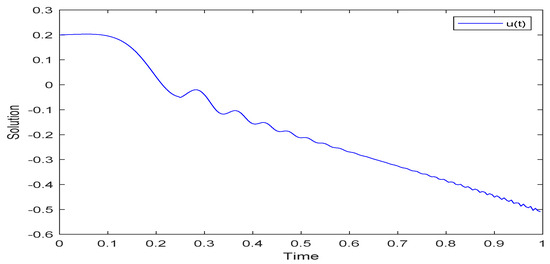
Figure 1.
Simulation of solution for system (52).
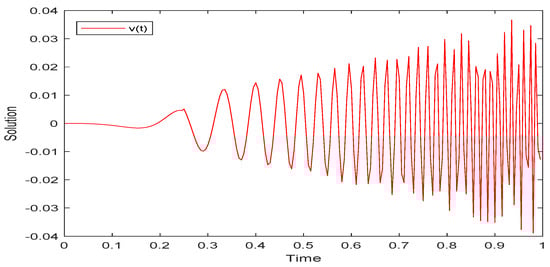
Figure 2.
Simulation of solution for system (52).
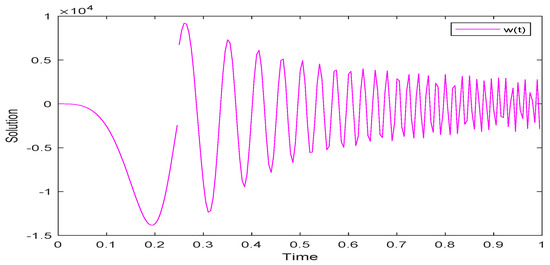
Figure 3.
Simulation of solution for system (52).
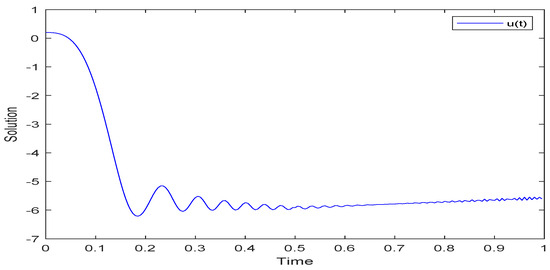
Figure 4.
Simulation of solution for system (53).
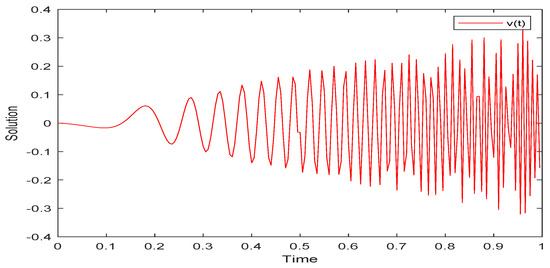
Figure 5.
Simulation of solution for system (53).
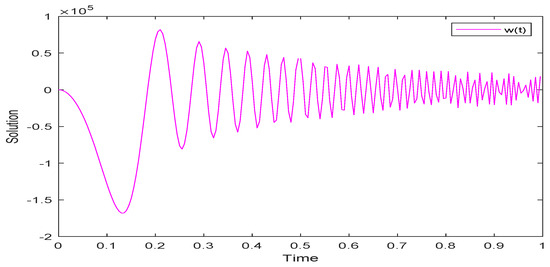
Figure 6.
Simulation of solution for system (53).
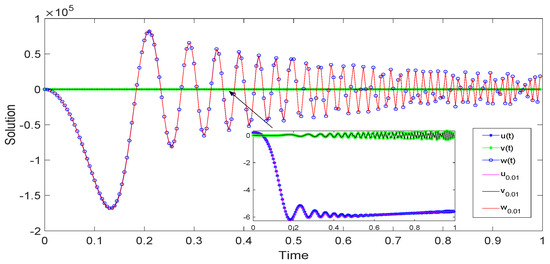
Figure 7.
Evolution of UH-stability with = 0.01 for system (53).
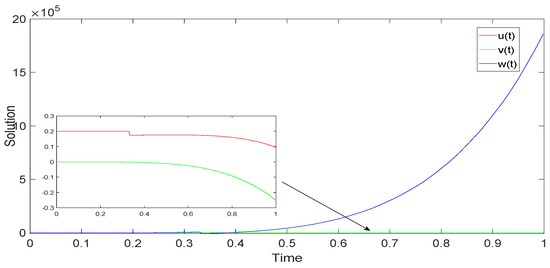
Figure 8.
Evolution of dynamic behaviors for system (54).
6. Conclusions
In the manuscript, a delayed fractional system (1) and (2) with fractional-order impulses is studied. Compared with some previous studies, our system is a more complex functional differential equation that combines delay effects, fractional-order impulses, and Riemann–Stieltjes IBVPs. The system optimizes the nonlinear fractional differential system in reference [9]. By using differential inequality techniques and some fixed-point theorems, the existence and uniqueness of solutions are obtained. Meanwhile, we apply mathematical analysis to discuss the UH-stability of the system. Finally, we provide an algorithm and conduct numerical simulations on three examples to demonstrate the correctness and availability of our main results. In addition, there are two topics that need further study in the future. One is the general higher-order delayed fractional differential equation with different types of boundary value conditions and impulses. The other is the delayed coupled fractional differential system with different types of boundary value conditions and impulses.
Author Contributions
X.L., conceptualization, methodology, investigation, writing—original draft, and writing—review and editing; K.Z., conceptualization, methodology, investigation and formal analysis; H.X., conceptualization, methodology, investigation and project administration. All authors have read and agreed to the published version of the manuscript.
Funding
This work was supported by the talent introduction and research initiation fund of Applied Technology College of Soochow University and the research start-up funds for high-level talents of Taizhou University.
Data Availability Statement
No data were used to support this study.
Acknowledgments
The authors sincerely thank the editors and reviewers for their help and useful suggestions to improve the quality of the paper.
Conflicts of Interest
The authors declare that they have no competing interests.
References
- Atangana, A.; Alkahtani, B. Extension of the resistance, inductance, capacitance electrical circuit to fractional derivative without singular kernel. Adv. Mech. Eng. 2015, 7, 1–6. [Google Scholar] [CrossRef]
- Alizadeh, S.; Baleanu, D.; Rezapour, S. Analyzing transient response of the parallel RCL circuit by using the Caputo-Fabrizio fractional derivative. Adv. Differ. Equ. 2020, 2020, 55. [Google Scholar] [CrossRef]
- Baleanu, D.; Jajarmi, A.; Mohammadi, H.; Rezapour, S. A new study on the mathematical modelling of human liver with Caputo-Fabrizio fractional derivative. Chaos Soliton. Fract. 2020, 134, 109705. [Google Scholar] [CrossRef]
- Rahman, M.; Ahmad, S.; Matoog, R.; Alshehri, N.; Khan, T. Study on the mathematical modelling of COVID-19 with Caputo-Fabrizio operator. Chaos Soliton. Fract. 2021, 150, 111121. [Google Scholar] [CrossRef] [PubMed]
- Javidi, M.; Ahmad, B. Dynamic analysis of time fractional order phytoplankton-toxic phytoplankton-zooplankton system. Ecol. Model. 2015, 318, 8–18. [Google Scholar] [CrossRef]
- Chatterjee, A.; Ahmad, B. A fractional-order differential equation model of COVID-19 infection of epithelial cells. Chaos Soliton. Fract. 2021, 147, 110952. [Google Scholar] [CrossRef]
- Zhao, K. Stability of a nonlinear ML-nonsingular kernel fractional Langevin system with distributed lags and integral control. Axioms 2022, 11, 350. [Google Scholar] [CrossRef]
- Zhao, K. Stability of a nonlinear Langevin system of ML-type fractional derivative affected by time-varying delays and differential feedback control. Fractal Fract. 2022, 6, 725. [Google Scholar] [CrossRef]
- Li, M.; Sun, J.; Zhao, Y. Existence of positive solution for BVP of nonlinear fractional differential equation with integral boundary conditions. Adv. Differ. Equ. 2020, 2020, 177. [Google Scholar] [CrossRef]
- Zhang, X.; Liu, L.; Wu, Y. Multiple positive solutions of a singular fractional differential equation with negatively perturbed term. Math. Comput. Model. 2012, 55, 1263–1274. [Google Scholar] [CrossRef]
- Zhao, Y.; Sun, S.; Han, Z.; Zhang, M. Positive solutions for boundary value problems of nonlinear fractional differential equations. Appl. Math. Comput. 2011, 217, 6950–6958. [Google Scholar]
- Zhang, S. Positive solutions to singular boundary value problem for nonlinear fractional differential equation. Comput. Math. Appl. 2010, 59, 1300–1309. [Google Scholar] [CrossRef]
- Wang, Y.; Liu, L.; Wu, Y. Positive solutions for a class of fractional boundary value problem with changing sign nonlinearity. Nonlinear Anal.-Theor. 2011, 74, 6434–6441. [Google Scholar] [CrossRef]
- Liu, Y. Solvability of anti-periodic BVPs for impulsive fractional differential systems involving Caputo and Riemann-Liouville fractional derivatives. Int. J. Nonlinear Sci. Numer. Simul. 2018, 19, 125–152. [Google Scholar] [CrossRef]
- Jiang, D.; Yuan, C. The positive properties of the green function for Dirichlet-type boundary value problems of nonlinear fractional differential equations and its application. Nonlinear Anal. TMA 2010, 72, 710–719. [Google Scholar] [CrossRef]
- Wang, Y.; Liu, L. Positive properties of the green function for two-term fractional differential equations and its application. J. Nonlinear Sci. Appl. 2017, 10, 2094–2102. [Google Scholar] [CrossRef]
- Cao, J.; Chen, H. Impulsive fractional differential equations with nonlinear boundary conditions. Math. Comput. Model. 2012, 55, 303–311. [Google Scholar] [CrossRef]
- Bai, C. Impulsive periodic boundary value problems for fractional differential equation involving Riemann-Liouville sequential fractional derivative. J. Math. Anal. Appl. 2011, 384, 211–231. [Google Scholar] [CrossRef]
- Wang, G.; Ahmad, B.; Zhang, L. Impulsive anti-periodic boundary value problem for nonlinear differential equations of fractional order. Nonlinear Anal.-Theor. 2011, 74, 792–804. [Google Scholar] [CrossRef]
- Zhao, K. Existence and UH-stability of integral boundary problem for a class of nonlinear higher-order Hadamard fractional Langevin equation via Mittag-Leffler functions. Filomat 2023, 37, 1053–1063. [Google Scholar] [CrossRef]
- Ahmad, B.; Alghanmi, M.; Ntouyas, S.; Alsaedi, A. Fractional differential equations involving generalized derivative with Stieltjes and fractional integral boundary conditions. Appl. Math. Lett. 2018, 84, 111–117. [Google Scholar] [CrossRef]
- Ulam, S. A Collection of Mathematical Problems. Interscience Tracts in Pure and Applied Mathmatics; Interscience: New York, NY, USA, 1906. [Google Scholar]
- Hyers, D. On the stability of the linear functional equation. Proc. Natl. Acad. Sci. USA 1941, 27, 2222–2240. [Google Scholar] [CrossRef] [PubMed]
- Forti, G. Hyers-Ulam stability of functional equations in several variables. Aeq. Math. 1995, 50, 143–190. [Google Scholar] [CrossRef]
- Brzdek, J.; Popa, D.; Raşa, I.; Xu, B. Ulam Stability of Operators; Academic Press: London, UK, 2018. [Google Scholar]
- Hyers, D.; Isac, G.; Rassias, T. Stability of Functional Equations in Several Variables; Birkhäuser: Boston, MA, USA, 1998. [Google Scholar]
- Czerwik, S. Functional Equations and Inequalities in Several Variables; World Scientific: Singapore, 2002. [Google Scholar]
- Aderyani, S.; Saadati, R.; Li, C.; Allahviranloo, T. Towards Ulam Type Multi Stability Analysis; Springer: Cham, Switzerland, 2024. [Google Scholar]
- Zhao, K. Solvability, Approximation and Stability of Periodic Boundary Value Problem for a Nonlinear Hadamard Fractional Differential Equation with p-Laplacian. Axioms 2023, 12, 733. [Google Scholar] [CrossRef]
- Zhao, K.; Liu, J.; Lv, X. A Unified Approach to Solvability and Stability of Multipoint BVPs for Langevin and Sturm-Liouville Equations with CH-Fractional Derivatives and Impulses via Coincidence Theory. Fractal Fract. 2024, 8, 111. [Google Scholar] [CrossRef]
- Rezaei, H.; Jung, S.; Rassias, T. Laplace transform and Hyers-Ulam stability of linear differential equations. J. Math. Anal. Appl. 2013, 403, 244–251. [Google Scholar] [CrossRef]
- Lv, X.; Zhao, K.; Xie, H. Stability and Numerical Simulation of a Nonlinear Hadamard Fractional Coupling Laplacian System with Symmetric Periodic Boundary Conditions. Symmetry 2024, 16, 774. [Google Scholar] [CrossRef]
- Zhao, K. Study on the stability and its simulation algorithm of a nonlinear impulsive ABC-fractional coupled system with a Laplacian operator via F-contractive mapping. Adv. Contin. Discret. Model. 2024, 2024, 5. [Google Scholar] [CrossRef]
- Wang, C.; Xu, T. Hyers-Ulam stability of fractional linear differential equations involving Caputo fractional derivatives. Appl. Math. Comput. 2015, 60, 383–393. [Google Scholar] [CrossRef]
- Wang, J.; Li, X. Ulam-Hyers stability of fractional Langevin equations. Appl. Math. Comput. 2015, 258, 72–83. [Google Scholar] [CrossRef]
- Zhao, K. Existence, stability and simulation of a class of nonlinear fractional Langevin equations involving nonsingular Mittag-Leffler kernel. Fractal Fract. 2022, 6, 469. [Google Scholar] [CrossRef]
- Podlubny, I. Fractional Differential Equations; Academic Press: New York, NY, USA, 1993. [Google Scholar]
- Klbas, A.; Srivastava, H.; Trujillo, J. Theory and Applications of Fractional Differential Equation; Elsevier: Amsterdam, The Netherlands, 2006. [Google Scholar]
- Guo, D.; Lakshmikantham, V. Nonlinear Problems in Abstract Cone; Academic Press: Orlando, FL, USA, 1988. [Google Scholar]
Disclaimer/Publisher’s Note: The statements, opinions and data contained in all publications are solely those of the individual author(s) and contributor(s) and not of MDPI and/or the editor(s). MDPI and/or the editor(s) disclaim responsibility for any injury to people or property resulting from any ideas, methods, instructions or products referred to in the content. |
© 2024 by the authors. Licensee MDPI, Basel, Switzerland. This article is an open access article distributed under the terms and conditions of the Creative Commons Attribution (CC BY) license (https://creativecommons.org/licenses/by/4.0/).