


Abstract
Survey sampling has a wide range of applications in biomedical, meteorological, stock exchange, marketing, and agricultural research based on data collected through sample surveys or experimentation. The collected set of information may have a fuzzy nature, be indeterminate, and be summarized by a fuzzy number rather than a crisp value. The neutrosophic statistics, a generalization of fuzzy statistics and classical statistics, deals with the data that have some degree of indeterminacy, imprecision, and fuzziness. In this article, we introduce a fuzzy decision-making approach for deciding a sample size under a fuzzy measurement cost modeled by an intuitionistic fuzzy cost function. Our research introduces neutrosophic ratio-type estimators for estimating the population mean of the neutrosophic study variable utilizing all the indeterminate values of the neutrosophic auxiliary variable rather than only the extreme values and . Three simulation studies are carried out to explain the proposed methods of parameter estimation, sample size determination, and efficiency comparison. The results reveal that the proposed neutrosophic class of estimators produces more accurate and precise estimates of the neutrosophic population mean than the existing neutrosophic estimators in simple random sampling, which is the ultimate goal of inferential statistics.
Keywords:
survey sampling; fuzzy cost function; neutrosophic statistics; sample size; mean estimation MSC:
62D05; 62B86; 62C86
1. Introduction
Survey sampling is the most practical and cost-effective approach for collecting data for research or estimating population means for making decisions. The validity and practicality of these judgments are dependent on the accuracy and precision of estimates, which are significantly affected by two important decisions made during the planning stage of a simple random sampling scheme. The first is determining a sample size under cost constraints, and the second is selecting an efficient estimator of the population mean. Refs. [1,2,3] explained the utilization of a survey budget to the per-unit measurement cost and modeled it as a classical linear cost function of sample size. Many researchers like [4,5,6,7,8,9,10,11,12], etc., used different transformation techniques to develop efficient ratio-type estimators of the population mean by utilizing auxiliary information. These classical ratio-type estimators produce a crisp value as an estimate of the population mean in a deterministic sampling environment
However, different types of uncertainties exist in the real world, in science, and in everyday life due to variation, incomplete information, fuzziness, imprecision, and indeterminacy. The classical sampling theory is unable to deal with the determination of sample size and the estimation of parameters of interest under these nonrandom uncertainties. Many theories have been developed to model these uncertainties in real-life problems. Refs. [13,14,15] developed the fuzzy sets theory to deal with decision-making problems under fuzzy uncertainty. Ref. [16] discussed the uncertainty modeling and sensitivity analysis of the different techniques of survey sampling. Refs. [17,18] proposed fuzzy assessment methods to aggregate the fuzzy responses. Ref. [19] provided a comparative survey of fuzzy data set measures of central tendency and examined the robustness of fuzzy sample statistics. Ref. [20] developed the sampling framework to classify and model the random and nonrandom uncertainties that affect the public strategy for making decisions about environmental changes. Ref. [21] suggested the fuzzy importance of sampling methods for estimating the possibility of failure by increasing the efficiency of classical fuzzy simulation. Ref. [22] presented the notion of random sampling with fuzzy replacement, with the fuzzification parameter taking a value in the range [0, 1].
But in many studies, the information collected through survey sampling or experimentation can be expressed in the interval form rather than as a single value due to impression and indeterminacy. For example, the daily temperature of a city, the daily share price of a company, the daily blood pressure of a person, the daily cholesterol level of a person, etc., are presented in an interval linked with a linguistic fuzzy variable. The indeterminate collected information can be summarized as a neutrosophic number. In 2013, Samarandache introduced the statistical methods to be used for finding descriptive neutrosophic measures such as the mean, variance, coefficient of skewness, coefficient of kurtosis, etc., to determine the relationship between two neutrosophic variables; connected probability logic with neutrosophic logic; and introduced the concepts of neutrosophic probability theory [23,24]. The neutrosophic statistics summarized the data that have some degree of uncertainty due to fuzziness, imprecision, and indeterminacy. The neutrosophic estimation methods are equivalent to the classical methods if this degree of uncertainty is zero. Ref. [24] proposed a sample neutrosophic estimator for the neutrosophic population mean in simple random sampling. Ref. [25] developed a new sampling strategy for considering neutrosophic process loss. Ref. [26] proposed neutrosophic ratio and exponential ratio estimators for the estimation of the neutrosophic population mean in simple random sampling under the given sample size. Ref. [27] suggested the neutrosophic exponential-type estimator of the population mean in simple random sampling. Ref. [28] suggested neutrosophic estimators for the estimation of a finite neutrosophic population mean using underrank set sampling and compared the efficiency of the proposed estimators using solar energy data. Ref. [27] proposed the neutrosophic exponential-type estimator for estimating the population mean. Ref. [29] suggested the robust neutrosophic ratio estimator for estimating the average stock prices of pharmaceutical companies. Ref. [30] proposed a ratio and an exponential-type estimator to estimate the imprecise population parameter and compared the efficiency of the proposed estimator with that of existing neutrosophic estimators. Ref. [31] proposed robust Hartley–Ross-type estimators for estimating the population mean of sensitive and non-sensitive variables under simple random sampling.
1.1. Research Gap
All the existing neutrosophic estimators are based on the extreme values of the neutrosophic study variable and the neutrosophic auxiliary variable. These neutrosophic estimators always produce biased and imprecise estimates, which lead to misleading inferences about unknown parameters of the neutrosophic variable of interest. Moreover, the accuracy and precision of the estimate are directly proportional to the sample size that is determined under the given budget of the survey. The classical linear cost function in survey sampling relies on an estimate of the per-unit measurement cost that occurred in a pilot survey but does not take into account expert knowledge, the historical survey cost, the inflation factor, or fuzzy uncertainty in the per-unit measurement cost.
1.2. Scope of the Study
Fuzzy sampling theory has the flexibility of modeling the cost of a sample survey, the decision of sample size, and the estimation of the parameters of interest in a nonrandom, uncertain environment. These uncertainties are studied in the domains of fuzzy set theory and neutrosophic theory. This study has two main objectives, given as follows:
- To decide the sample size under a nonrandom, uncertain measurement cost.
- To propose a more efficient neutrosophic estimator for estimating the population mean of the neutrosophic study variable, utilizing all indeterminate values of the neutrosophic auxiliary variable.
This article presents fresh research on the estimation of the mean utilizing all values of the neutrosophic auxiliary variable rather than extreme indeterminate points. The fuzzy decision-making approach for deciding the per-unit measurement cost, considering the expert opinion, the cost incurred in pilot surveys, prior surveys, and fuzzy uncertainty is suggested. In this approach, the utilization of the survey budget is modeled as an intuitionistic fuzzy cost function, taking into account the per-unit measurement cost as an intuitionistic fuzzy number and suggesting the sample size estimation procedure. We propose the neutrosophic ratio class of estimator, the neutrosophic exponential class of estimator, and the neutrosophic ratio–exponential class of estimator, which utilizes all indeterminate values by introducing the function of the neutrosophic auxiliary variable. The intuitionistic fuzzy cost function and procedure for determining the sample size are explained in Section 2. Section 3 includes the theoretical formulation and mathematical properties of the proposed neutrosophic estimators. The mathematical expression for a theoretical efficiency comparison with existing neutrosophic ratio-type estimators and the criteria for an empirical efficiency comparison are given in Section 4. To explain the numerical computations and efficiency comparisons, a simulation study is presented in Section 5. The discussion and conclusion are presented in Section 6 and Section 7, respectively.
2. Intuitionistic Fuzzy Cost Function
Resource constraints (cost, trained staff, time, etc.) are the main reasons for conducting a study based on data collected through survey sampling instead of a census. The determination of sample size is an important part of planning survey sampling as well as estimation procedures. The required precision and available resources are key parameters for deciding the sample size. Considering the fixed cost , per-unit measurement cost c, and budget available for survey B, the sample size n under the classical linear cost function in simple random sampling is defined as
As we know, the accuracy of an estimate is directly proportional to the sample size n. But and . The decision on per-unit measurement cost c is based on its values from previous surveys, pilot surveys, estimated costs, etc. Mathematically, the cost c is selected from the universal set of costs D:
The classical or crisp value of is defined by the characteristic function:
The selected value of c by this indicator function, used in the classical linear cost function, may be either true or false, i.e., . But in this time of rapidly changing inflation, it is a difficult decision to select a sharply defined value of c and ignore the expert’s judgment. The decision-maker is facing uncertainty in selecting the true single value of c from set D. The intuitionistic fuzzy decision-making approach has the adaptability and flexibility to include a subset of set D in a decision on the per-unit measurement cost. This approach covers fuzzy uncertainty and expert knowledge and is a generalization of the classical approach. Under this approach, the per-unit measurement cost is determined by mapping c in the interval rather than being bound to the bi-valued set . The intuitionistic fuzzy set (IFS) of the measurement unit cost is defined as a triplet:
where is the degree of expert satisfaction regarding the cost to set and is the degree of expert dissatisfaction regarding the cost to set such that . The intuitionistic fuzzy measurement cost set is called the intuitionistic fuzzy number if satisfies the normality, convexity, and continuity condition of IFS. The intuitionistic fuzzy cost function in simple random sampling is defined as follows:
Let be the linear triangular intuitionistic fuzzy cost and be defined by , given as follows:
where , , , and . Let , , , and be the inverse functions of , and , respectively. Let and be the inverse functions of and , respectively, defined as
Now, the centriod point of the triangular intuitionistic fuzzy cost is calculated as follows:
The rank function for the single crisp value of the TrIF cost is defined as
3. Neutrosophic Estimators of Population Mean
The neutrosophic population consists of data that have some degree of indeterminacy and imprecision and is presented in interval form rather than as an information object summarized by a precise value. The classical estimator can be transformed into a neutrosophic form that depends on the extreme points in the neutrosophic data set. The neutrosophic estimator provides a nonrandom interval value as an estimate of an imprecise parameter of interest. Let Y be the determinate part and be the indeterminate part of a quantitative neutrosophic study variable which can be written as or more precisely presented in interval form as . Let X be the determinate part and be the indeterminate part of a quantitative neutrosophic auxiliary variable which can be written as or more precisely presented in interval form as . Let and be the neutrosophic values of and observed from the unit of a population containing M units. Let be the sample mean and be the population mean of . Let be the sample mean and be the population mean of . Let and be the neutrosophic population variances, and let and , respectively, be the neutrosophic population coefficients of variation of and . Let be the coefficient of skewness and the coefficient of kurtosis of the neutrosophic auxiliary variable. Let be the neutrosophic population population correlation coefficient.
3.1. Existing Neutrosophic Estimators
Ref. [26] proposed the neutrosophic ratio estimators for the estimation of the neutrosophic population mean given in (9), (11), (13), and (15) below.
The bias and mean square error of are defined as
where ,
The bias and MSE of are given as
where
The bias and MSE of are given as:
where
The bias and MSE of are given as
where
Ref. [26] proposed the neutrosophic exponential estimators for the estimation of the neutrosophic population mean, given in (17) and (19) below:
The bias and MSE of are given as
The bias and MSE of are given as
where
The proposed neutrosophic ratio–exponential estimator by [30] is given as
The mathematical expression for the bias of is given as
The mathematical expression for the minimum MSE of is given as
where
3.2. Proposed Generalized Neutrosophic Ratio-Type Estimators Using Neutrosophic Subsidiary Information
Let contain K values. We introduce two variates and , defined as
Let be the population mean, be the population variance, be the population coefficient of variation, be the coefficient of skewness, and be the coefficient of kurtosis of variable . Let be the neutrosophic population correlation coefficient between and . Let , , , , , , , , , and , . Let and represent the parametric values of variables and or . Let , .
3.2.1. Neutrosophic Ratio Class of Estimator
The proposed generalized neutrosophic ratio (GNR) class of estimators is defined as
and we have
The bias of up to the first-order approximation is given as
The MSE of up to the first-order approximation is given as
Some members of the proposed GNR class of estimator are given in Table 1.

Table 1.
Some members of proposed GNR, GNE, and GNRE classes of estimator.
3.2.2. Neutrosophic Exponential Class of Estimator
The proposed generalized neutrosophic exponential (GNE) class of estimators is defined as
From Equation (28), we have
The mathematical expression for the bias of is given as
The mathematical expression for the mean square error of is given as
Some members of the proposed GNE class of estimator are given in Table 1.
3.2.3. Neutrosophic Ratio–Exponential Class of Estimator
The proposed generalized neutrosophic generalized ratio–exponential (GNRE) class of estimator is defined as follows:
Equation (32) can be written as follows:
Expanding Equation (33) up to first-order approximation and subtracting from both sides, we have
Using Equation (34), the mathematical expression for the bias of is given as
Using Equation (34) and taking terms up to the first-order approximation, the mathematical expression for the MSE of is given as
where
The real-valued constants and are selected that minimize . Differentiating Equation (36) with respect to and , we obtain
The resultant minimum is
Some members of the generalized neutrosophic ratio–exponential (GNRE) class of estimators are presented in Table 1. It is mentioned that the existing neutrosophic estimators of the population mean are special cases of our proposed generalized neutrosophic estimator presented in Table 1.
4. Efficiency Comparison
The mathematical expression has been derived for the efficiency of the proposed neutrosophic class of estimators to its corresponding existing neutrosophic estimators.
Using Equations (10) and (27), the GNR class of estimator is more efficient than if
Using Equations (12) and (27), the GNR class of estimator is more efficient than if
Using Equations (14) and (27), the GNR class of estimator is more efficient than if
Using Equations (16) and (27), the GNR class of estimator is more efficient than if
Using Equations (18) and (31), the GNE class of estimator is more efficient than if
For the empirical efficiency comparison, let and be two neutrosophic estimators of the neutrosophic population mean having mean square errors and We used two criteria for the efficiency comparison between and . The neutrosophic percentage relative efficiency (NPRE) criteria is defined as
The percentage relative efficiency total (PRET) criteria is defined as
where ,
5. Simulation Study
Three simulated neutrosophic data sets are used for validating the theoretical and numerical efficiency comparisons of a proposed generalized class of neutrosophic estimators with existing neutrosophic estimators. The algorithm for the neutrosophic simulated data set has two steps. First, a bi-variate neutrosophic data set is generated from the bi-variate neutrosophic normal distribution of the study variable and auxiliary variable . That is, , where is the neutrosophic mean vector and is the neutrosophic var-covariance matrix given as
where , , and Second, the K = 100 uniformly distributed values are generated from and find the value of and .
- The first neutrosophic data set, containing 3000 values, is generated from with and
- The second neutrosophic data set, containing 3000 values, is generated from with and
- The third neutrosophic data set, containing 3000 values, is generated from with and
The statistical summaries of the above three simulated data sets are presented in Table 2, Table 3 and Table 4, respectively.
Table 2.
Data summary of simulated population 1.
Table 3.
Data summary of simulated population 2.
Table 4.
Data summary of simulated population 3.
Let , , and . The intuitionistic fuzzy cost function of is written as
The intuitionistic fuzzy measurement cost is a linear triangular intuitionistic fuzzy number defined mathematically by Equation (39) and graphically by Figure 1:
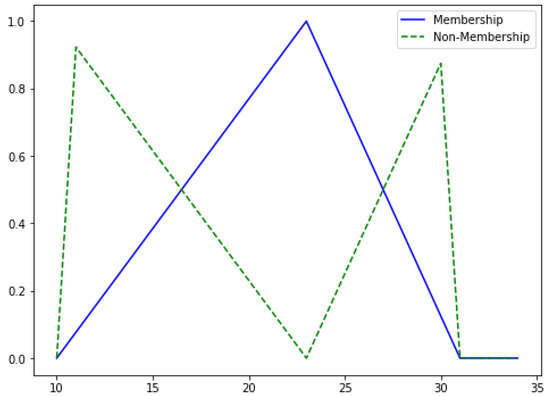
Figure 1.
Triangular intuitionistic fuzzy measurement cost.
Using Equation (6), the intuitionistic fuzzy cost function given in Equation (38) can be converted into the classical form as
Data Summary and Results
This section includes the statistical summary of three simulated data sets and the results of the estimation methods.
6. Discussion
The neutrosophic statistical approach is best for estimating the parameters of interest for uncertain and indeterminate data. Under such circumstances, the neutrosophic estimators of the population mean are more flexible and produce more efficient estimates. We proposed the GNR class of estimator , GNE class of estimator , and GNRE class of estimator for the population mean in simple random sampling. The mathematical properties of the proposed estimators , , and are derived up to the first-order approximation. The mathematical conditions have been derived for a theoretical efficiency comparison. The proposed neutrosophic estimators will perform better than neutrosophic estimators if these conditions are satisfied. The intuitionistic fuzzy set theory is the best alternative to classical set theory for making decisions in uncertain and fuzzy environments. The intuitionistic fuzzy cost function is introduced for decision making about per-unit measurement cost and sample size n under the fuzzy uncertain environment of simple random sampling. This cost function takes into account all possible values of the per-unit measurement cost collected through different sources like historical surveys, similar studies, pilot surveys, predicted costs, etc., and expert knowledge. The sample of 21 units is selected by the traditional linear cost function using an indicator function for deciding the per-unit measurement cost from (10, 23, 31) in the numerical study. The decided sample size under the classical approach is smaller than the proposed intuitionistic fuzzy approach. Because the precision of estimates is directly proportional to the sample size, the classical approach for deciding sample size under uncertain measurement costs will therefore produce smaller precision estimates. Table 2, Table 3 and Table 4 represent the statistical summary of the three simulated neutrosophic populations, 1, 2, and 3, respectively, with different levels of indeterminacy and correlation. The MSE and MSET of the existing neutrosophic ratio estimators , , and and the proposed GNR class of estimators are given in Table 5. Table 6 shows the MSE and MSET of the existing neutrosophic ratio estimators and and the proposed GNE class of estimators . Table 7 shows the MSE and MSET of the existing neutrosophic ratio–exponential estimator and proposes the GNRE class of estimators . We compared the efficiency of the existing neutrosophic estimators and the proposed GNR class of estimators, GNE class of estimators, and GNRE class of estimators with the neutrosophic estimator and the results are presented in Table 8, Table 9 and Table 10, respectively. Using PRET given in Table 8, it is noted that all members of the GNR class of estimators outperformed the existing neutrosophic estimator. produced the most efficient results for simulated population 1 and simulated population 3, and produced the most precise estimate of the neutrosophic mean for simulated population 2. From Table 9, the proposed GNE class of estimators have higher efficiency than the existing exponential neutrosophic estimators and for all three simulated populations. Among , the estimator produced the most efficient result for simulated population 1, the estimator produced the most precise estimate for simulated population 2, and the estimator produced the most efficient estimate for simulated population 3 based on the PRET. The proposed GNRE class of estimators is more efficient than the existing estimator based on the NPRE and PRET as shown in Table 9. It can be observed that the estimator is most efficient for simulated population 1, the estimator produced the most precise estimate for the neutrosophic mean of simulation population 2, and the estimator produced the most efficient results for simulated population 3. All the proposed neutrosophic class estimators performed better than the existing respective neutrosophic estimators for all three simulated populations. The utilization of all the indeterminate values of the neutrosophic auxiliary variables in the proposed neutrosophic class of estimators is the main reason for producing more efficient results as compared to the respective existing neutrosophic estimators based only on extreme indeterminate values.
Table 5.
MSE of generalized neutrosophic ratio class of estimators.
Table 6.
MSE of generalized neutrosophic exponential class of estimators.
Table 7.
MSE of generalized neutrosophic ratio–exponential class of estimators.
Table 8.
NPRE and PRET of generalized neutrosophic ratio class of estimators.
Table 9.
NPRE and PRET of generalized neutrosophic exponential class of estimators.
Table 10.
NPRE and PRET of neutrosophic generalized ratio–exponential class of estimators.
7. Conclusions
The classical approach to decision making on the per-unit measurement cost in survey sampling is based on bi-valiant logic and modeled by a classical cost function. This approach may not deal with the uncertain, fuzzy nature of measurement costs and expert knowledge. The proposed intuitionistic fuzzy cost function models the fuzzy uncertainty in the measurement cost, taking into account all possible values and expert knowledge, by using a membership function. The estimation of the sample size under the proposed cost function is also more flexible and a generalization of the classical method. Moreover, the existing neutrosophic estimators of the population mean in simple random sampling are unable to utilize all the indeterminate and imprecise parts of the set of information collected through a sample survey or experimentation. These estimators are based on only extreme values in the neutrosophic data set. Utilizing the parametric value of the proposed function of the neutrosophic auxiliary variable, the proposed generalized neutrosophic ratio-type estimators are based on all indeterminate values and consequently produce more accurate and precise estimates of the indeterminate parameter of interest. The proposed neutrosophic methods of the estimation of the mean and sample size determination under fuzzy uncertainty can be potentially extended to other sampling designs.
Author Contributions
Conceptualization, A.U. and J.S.; methodology, A.U.; software, A.U.; validation, A.U., J.S. and A.M.A.; formal analysis, A.U.; investigation, A.U. and M.A.A.; resources, A.M.A. and M.A.A.; data curation, A.U.; writing original draft preparation, A.U.; review J.S.; editing, A.U.; visualization, A.M.A.; supervision, J.S.; project administration, J.S. and M.A.A.; funding acquisition, A.M.A. and M.A.A. All authors have read and agreed to the published version of the manuscript.
Funding
This work was supported by the Deanship of Scientific Research, Vice Presidency for Graduate Studies and Scientific Research, King Faisal University, Saudi Arabia [Grant No. 4235].
Data Availability Statement
All the relevent data information is given within the article.
Conflicts of Interest
The authors declare no conflict of interest.
References
- Cochran, W.G. Sampling Techniques; John Wiley & Sons: Hoboken, NJ, USA, 1977. [Google Scholar]
- Singh, S. Advanced Sampling Theory with Applications: How Michael “Selected" Amy; Springer Science & Business Media: Berlin/Heidelberg, Germany, 2003; Volume 2. [Google Scholar]
- Singh, R.; Mangat, N.S. Elements of Survey Sampling; Springer Science & Business Media: Berlin/Heidelberg, Germany, 2013; Volume 15. [Google Scholar]
- Bahl, S.; Tuteja, R. Ratio and product type exponential estimators. J. Inf. Optim. Sci. 1991, 12, 159–164. [Google Scholar] [CrossRef]
- Kadilar, C.; Cingi, H. Improvement in estimating the population mean in simple random sampling. Appl. Math. Lett. 2006, 19, 75–79. [Google Scholar] [CrossRef]
- Singh, R.; Chauhan, P.; Sawan, N.; Smarandache, F. Auxiliary Information and a priori Values in Construction of Improved Estimators; Infinite Study, 2007; p. 33. [Google Scholar]
- Gupta, S.; Shabbir, J. On improvement in estimating the population mean in simple random sampling. J. Appl. Stat. 2008, 35, 559–566. [Google Scholar] [CrossRef]
- Al-Omari, A.I.; Jemain, A.A.; Ibrahim, K. New ratio estimators of the mean using simple random sampling and ranked set sampling methods. Investig. Oper. 2009, 30. [Google Scholar]
- Upadhyaya, L.N.; Singh, H.P.; Chatterjee, S.; Yadav, R. Improved ratio and product exponential type estimators. J. Stat. Theory Pract. 2011, 5, 285–302. [Google Scholar] [CrossRef]
- Haq, A.; Shabbir, J. Improved family of ratio estimators in simple and stratified random sampling. Commun. Stat. Theory Methods 2013, 42, 782–799. [Google Scholar] [CrossRef]
- Shabbir, J.; Haq, A.; Gupta, S. A new difference-cum-exponential type estimator of finite population mean in simple random sampling. Rev. Colomb. EstadÍStica 2014, 37, 199–211. [Google Scholar] [CrossRef]
- Yadav, R.; Upadhyaya, L.N.; Singh, H.P.; Chatterjee, S. Improved ratio and product exponential type estimators for finite population mean in stratified random sampling. Commun. Stat. Theory Methods 2014, 43, 3269–3285. [Google Scholar] [CrossRef]
- Zadeh, L.A. Fuzzy sets. Inf. Control 1965, 8, 338–353. [Google Scholar] [CrossRef]
- Zadeh, L.A. The concept of a linguistic variable and its application to approximate reasoning—I. Inf. Sci. 1975, 8, 199–249. [Google Scholar] [CrossRef]
- Zadeh, L.A. The concept of a linguistic variable and its application to approximate reasoning—II. Inf. Sci. 1975, 8, 301–357. [Google Scholar] [CrossRef]
- Helton, J.C.; Johnson, J.D.; Sallaberry, C.J.; Storlie, C.B. Survey of sampling-based methods for uncertainty and sensitivity analysis. Reliab. Eng. Syst. Safety 2006, 91, 1175–1209. [Google Scholar] [CrossRef]
- Lin, L.; Lee, H.M. Fuzzy assessment method on sampling survey analysis. Expert Syst. Appl. 2009, 36, 5955–5961. [Google Scholar] [CrossRef]
- Lin, L.; Lee, H.M. Fuzzy assessment for sampling survey defuzzification by signed distance method. Expert Syst. Appl. 2010, 37, 7852–7857. [Google Scholar] [CrossRef]
- Sinova, B.; Rosa De Sáa, S.D.L.; Lubiano, M.A.; Gil, M.Á. An overview on the statistical central tendency for fuzzy data sets. Int. J. Uncertain. Fuzziness Knowl. Based Syst. 2015, 23 (Suppl. S1), 105–132. [Google Scholar] [CrossRef]
- Galesic, M.; Kause, A.; Gaissmaier, W. A sampling framework for uncertainty in individual environmental decisions. Top. Cogn. Sci. 2016, 8, 242–258. [Google Scholar] [CrossRef] [PubMed]
- Feng, K.; Lu, Z.; Ling, C.; Wang, L. Fuzzy importance sampling method for estimating failure possibility. Fuzzy Sets Syst. 2021, 424, 170–184. [Google Scholar] [CrossRef]
- Kesemen, O.; Tiryaki, B.K.; Tezel, Ö.; Özkul, E.; Naz, E. Random sampling with fuzzy replacement. Expert Syst. Appl. 2021, 185, 115602. [Google Scholar] [CrossRef]
- Smarandache, F. Introduction to Neutrosophic Measure, Neutrosophic Integral, and Neutrosophic Probability; Sitech & Education Publishing: Columbus, OH, USA, 2013. [Google Scholar]
- Smarandache, F. Introduction to Neutrosophic Statistics; Sitech & Education Publishing: Columbus, OH, USA, 2014. [Google Scholar]
- Aslam, M. A new sampling plan using neutrosophic process loss consideration. Symmetry 2018, 10, 132. [Google Scholar] [CrossRef]
- Tahir, Z.; Khan, H.; Aslam, M.; Shabbir, J.; Mahmood, Y.; Smarandache, F. Neutrosophic ratio-type estimators for estimating the population mean. Complex Intell. Syst. 2021, 7, 2991–3001. [Google Scholar] [CrossRef]
- Kumar, S.; Kour, S.; Choudhary, M.; Sharma, V. Determination of Population Mean Using Neutrosophic, Exponential-Type Estimator. Lobachevskii J. Math. 2022, 43, 3359–3367. [Google Scholar] [CrossRef]
- Vishwakarma, G.K.; Singh, A. Generalized estimator for computation of population mean under neutrosophic ranked set technique: An application to solar energy data. Comput. Appl. Math. 2022, 41, 144. [Google Scholar] [CrossRef]
- Singh, R.; Smarandache, F.; Mishra, R. Generalized robust-type neutrosophic ratio estimators of pharmaceutical daily stock prices. In Cognitive Intelligence with Neutrosophic Statistics in Bioinformatics; Elsevier: Amsterdam, The Netherlands, 2023; pp. 417–429. [Google Scholar]
- Yadav, S.K.; Smarandache, F. Generalized Neutrosophic Sampling Strategy for Elevated estimation of Population Mean. Neutrosophic Sets Syst. 2023, 53, 14. [Google Scholar]
- Alomair, A.M.; Shahzad, U. Neutrosophic Mean Estimation of Sensitive and Non-Sensitive Variables with Robust Hartley–Ross-Type Estimators. Axioms 2023, 12, 578. [Google Scholar] [CrossRef]
Disclaimer/Publisher’s Note: The statements, opinions and data contained in all publications are solely those of the individual author(s) and contributor(s) and not of MDPI and/or the editor(s). MDPI and/or the editor(s) disclaim responsibility for any injury to people or property resulting from any ideas, methods, instructions or products referred to in the content. |
© 2023 by the authors. Licensee MDPI, Basel, Switzerland. This article is an open access article distributed under the terms and conditions of the Creative Commons Attribution (CC BY) license (https://creativecommons.org/licenses/by/4.0/).