


Abstract
A strong edge coloring of a graph G is a proper coloring of edges in G such that any two edges of distance at most 2 are colored with distinct colors. The strong chromatic index is the smallest integer l such that G admits a strong edge coloring using l colors. A -minor free graph is a graph that does not contain as a contraction subgraph, where is obtained from a by subdividing edges exactly times. The paper shows that every -minor free graph with maximum degree has for which generalizes some known results on -minor free graphs by Batenburg, Joannis de Verclos, Kang, Pirot in 2022 and Wang, Wang, and Wang in 2018. These upper bounds are sharp.
MSC:
05C15
1. Introduction
In the whole paper, every considered graph is simple, which means an undirected graph without loops or multiple edges. The vertex set, the edge set and the maximum degree of a graph G are represented by , and (short for ), respectively. If the degree of a vertex v in G is k, then v is called a k-vertex. We call J a minor contained in G, denoted by , if J is obtained from a subgraph of G by contracting edges. If G does not contain J as a minor, then G is called a J-minor free graph. Subdividing an edge means removing edge e and adding a new vertex w with . For a positive integer , define to be a family of all isomorphic graphs obtained from by subdividing edges exactly times. From the definition above, it is clear that the collection of -minor free graphs is a subset of the collection of -minor free graphs.
For a graph G, let denote the distance of two edges in G. If and are adjacent in G, then . If two non-adjacent edges and have a common adjacent edge in G, then . For an edge set and a non-negative integer l, define to be a mapping satisfying whenever for arbitrary two edges . Let be the subgraph of G induced by edge set A. Such a mapping above is called a partial strong edge coloring of . The smallest non-negative integer l such that has a partial strong edge coloring is denoted by . A partial strong edge coloring of is called a strong edge coloring of a graph G by taking . The smallest non-negative integer l for admitting a strong edge coloring of G with l colors is called the strong chromatic index of a graph G, denoted by .
Erdos and Nešetřil [1] proposed an outstanding conjecture for the strong chromatic index as follows.
Conjecture 1
(Erdos and Nešetřil, [1]). Let G be a graph with maximum degree Δ. Then
Andersen [2] proved that the strong chromatic index of cubic graphs is at most 10 for ; Cranston [3] obtained an upper bound 22 for , which was further improved to 21 recently in [4] by Huang, Santatna and Yu. Mahdian [5] presented for any -free graph G, and Hurley, Joannis de Verclos, and Kang [6] recently proved that when is sufficently large.
This problem has also been intensively studied for many sparse graph classes. Wang [7] showed that for any k-degenerate graph G with maximum degree . When , it was proved to by Choi, Kim, Kostochka, and Raspaud [8], and improved to when for any in [9]. Basavarjn and Francis [10] proved that for any chordless graph G with maximum degree . Wang, Song, Wang, and Wang [11] showed that the strong chromatic index of any 1-planar graph is at most . More results can be found in [12,13,14,15].
Let be a graph class. If for any and we have , then this graph class is called minor closed. In the studies of many graph properties, minor closed graph classes inherit some nice fundamental structures and have drawn extensive attention. As one of the most famous minor closed graph classes, the class of planar graphs is characterized by forbidding both -minors and -minors. Faudree, Gyárfás, Schelp, and Tuza [16] obtained the following upper bound of the strong chromatic index for planar graphs.
Theorem 1
(Faudree et al. [16]). For a planar graph G, .
The proof of Theorem 1 is a combination of the famous Four Color Theorem (every planar graph is 4-colorable) and Vizing’s Theorem (every simple graph with maximum degree is -edge colorable). We can obtain the following general theorem with a similar argument.
Theorem 2.
Let be a minor closed graph class. Assume that, for some integer k, every graph is k-colorable. Then for any .
Proof.
By Vizing’s Theorem, we have an edge coloring of the graph H with colors, where is partitioned into color classes, denoted by , …, . For , obtain a graph from H by contracting the edges in . Then by assumption, has a k-coloring . Note that, for any edge , its corresponding contracted vertex in receives a color . Now, we define an edge coloring by setting for each , where . Then it is straightforward to check that is a strong edge coloring of H, since any two edges of distance at most two receive distinct colors by the definition of . □
In view of Theorem 2, the strong edge coloring problem is closely related to the following well-known Hadwiger conjecture proposed in 1943.
Conjecture 2
(Hadwiger, [17]). Every -minor free graph is -colorable.
Wagner [18] proved that the Four Color Theorem is equivalent to a slightly stronger statement that every -minor-free graph is 4-colorable. Robertson, Seymour, and Thomas [19] showed that every -minor-free graph is 5-colorable. Albar and Gonçalves [20] proved that any -minor free graph is 8-colorable. Delcourt and Postle [21] showed that every -minor free graph is -colorable, which is the best general result for Hadwiger conjecture currently. Considering Theorem 2, we immediately have results below.
Theorem 3.
If the Hadwiger conjecture is true, then every -minor free graph has strong chromatic index at most . Moreover, each of the following statements holds.
- (1)
- When t is sufficiently large, every -minor free graph G satisfies .
- (2)
- When , every -minor free graph G satisfies .
- (3)
- When , every -minor free graph G satisfies , and every -minor free graph G satisfies .
However, improving the constant terms in Theorems 1 and 3 seems to be very difficult, as their proofs involve the usage of the Four Color Theorem. Note that Theorem 1 remains the best general upper bound for more than three decades, although this can be improved for some subclasses of planar graphs. For a smaller minor closed graph class, the class of -minor free graphs, some improvements are known by Batenburg, Kang, Joannis de Verclos, Pirot [22] and Wang, Wang, and Wang [23] as follows.
Theorem 4
(Batenburg et al. [22]). Every -minor free graph G with maximum degree Δ satisfies .
Theorem 5
(Wang et al. [23]). For a -minor free graph G with maximum degree , .
In this study, we push further to get improvement for some wider graph classes, known as -minor free graphs for . In particular, the case of our results also provides some supporting evidence for the corresponding case of the Hadwiger conjecture.
Theorem 6.
For , if G is a -minor free graph with maximum degree Δ, then .
We actually prove a stronger result to obtain Theorem 6 as follows, where Theorem 6 is contained as a special case when .
Theorem 7.
If G is a -minor free graph where , then for any edge set .
Note that, the upper bound in the theorem above is tight, where the graph G can be obtained from by adding some new vertices with degree 1 connecting each vertex of .
In Section 2, we will first introduce the structure of 2-connected -minor free graphs for characterized by Chen et al. in [24]. In Section 3, Theorem 7 will be proved for in Section 3.2, Section 3.3, Section 3.4 respectively, by the validity of a list lemmas presented in Section 3.1.
2. Decompositions of -Minor Free Graphs
Recall that is a family of all isomorphic graphs obtained from by subdividing edges exactly times. In this section, we introduce the equivalent conditions for 2-connected -minor free graphs proved by Chen, Fan, Lai, Song, and Xu [24], where . First, we introduce some notations.
Let be vertex disjoint simple graphs. We define two operations below.
(OP1) Suppose that and . Let be a simple graph gained from by identifying with to obtain a new vertex (again denoted by ) and with to obtain a new vertex (again denoted by ).
(OP2) Suppose that and -vertices . Let be a graph gained from by identifying x with to obtain a new vertex and y with to obtain a new vertex.
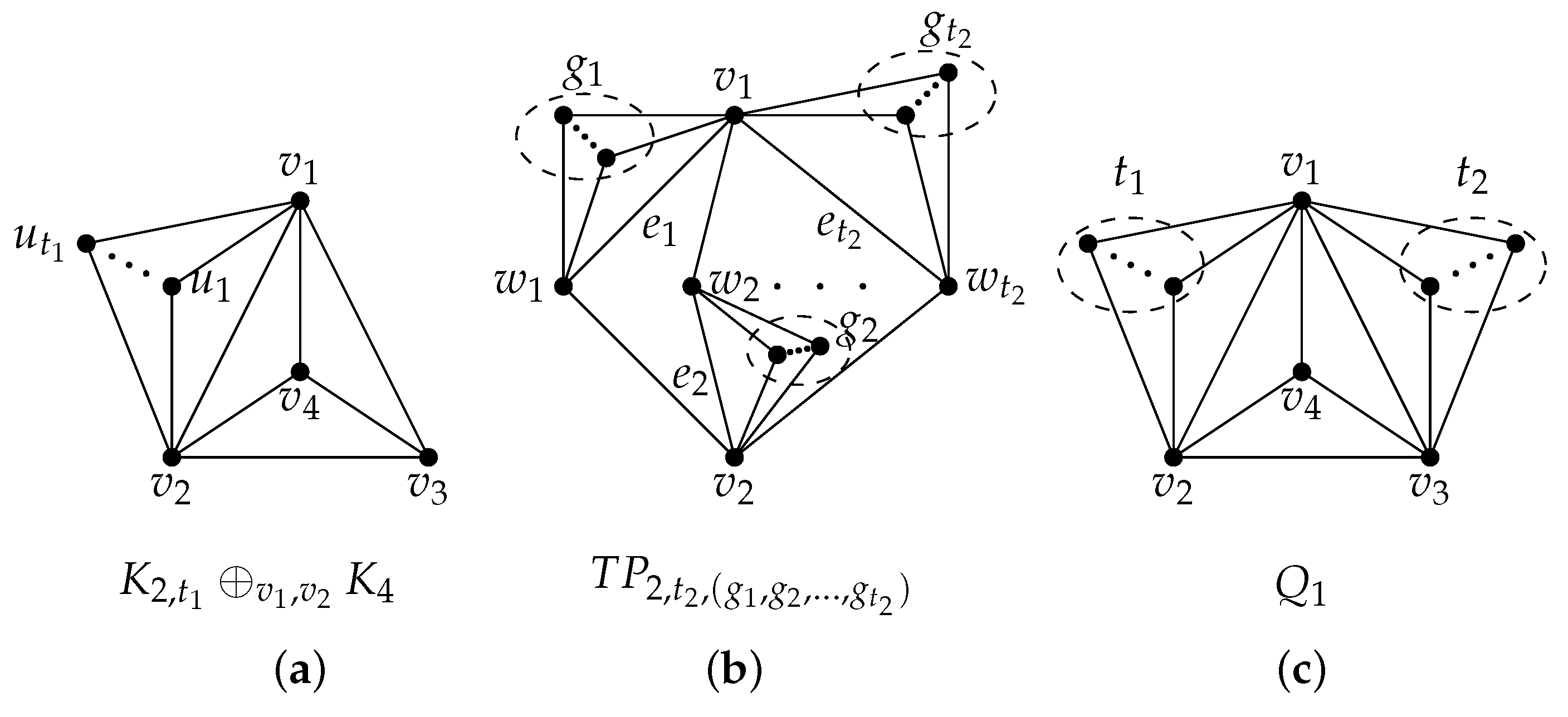
For a positive integer , let be a complete bipartite graph, where and . Define to be a graph gained from by adding one edge connecting and for each odd number i such that . Let be the vertex set of complete graph . By operation (OP1), is defined and depicted in Figure 1a.
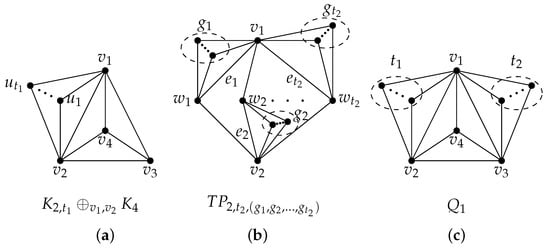
Figure 1.
Graphs in (OP1) and (OP2).
Let and be non-negative integers. Choose one edge either or in as for each i such that . Let
be a graph gained from and by successively applying operation (OP2) once for each such that . The graph is depicted in Figure 1b.
Let be a collection of subgraphs of H and . Chen et al. proved the following results in [24].
Proposition 1
(Chen et al. [24]). Every 2-connected graph G is -minor free if and only if G is a -minor free graph or .
Proposition 2
(Chen et al. [24]). Every 2-connected graph G is -minor free if and only if G is contained in the set or G is a -minor free graph or G is contained in the set .
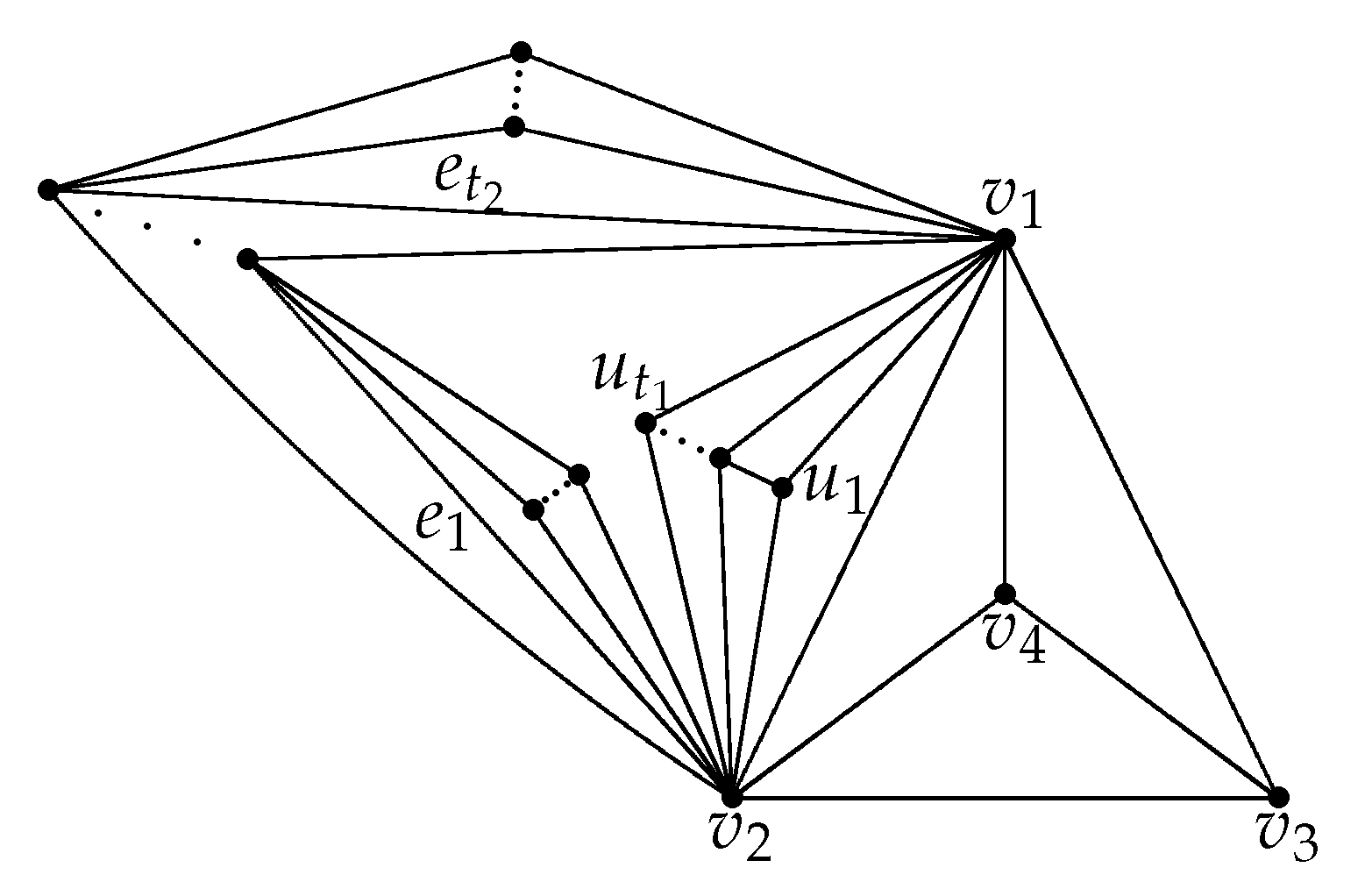
Let be a graph obtained from and by applying operation (OP2) once for the edge in , where . When , the graph is depicted in Figure 1c. Let be a graph gained from and by applying operation (OP1) once on vertices . The graph is depicted in Figure 2.
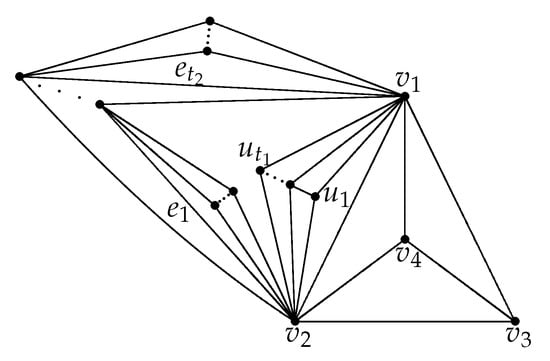
Figure 2.
The graph .
Proposition 3
(Chen et al. [24]). Every 2-connected graph G is -minor free if and only if G is in the set or G is a -minor free graph or in the set where
- (1)
- , where and .
- (2)
- , where
- (3)
- , where .
3. Strong Edge Coloring
In this section, we prove our main result Theorem 7. For a graph G, define a core to be a graph gained from G by internally deleting 1-vertices so that . We first consider block decomposition of and give general lemmas for every -minor free graph whenever in Section 3.1. Next, we prove Theorem 7 when in Section 3.2, Section 3.3 and Section 3.4, respectively.
Take G as a minimal counterexample for Theorem 7 with minimized and subject to this condition we choose minimized. Choose an arbitrary edge set
3.1. Block Decomposition of and General Lemmas
A leaf block in a graph G is a maximal 2-connected subgraph of G containing exactly one cut vertex of G. Let be a leaf block of . We use to denote the cut vertex of connecting and the remaining part in . We call e an interior edge in if e is not incident with . We call v an interior vertex in if . For any , let denote the tree generated by the vertices and edges deleted from G starting from vertex x so that is obtained.
For , let and and be the order of . For , let denote the edges incident with x in , where . Denote and . Especially, let if either or .
Lemma 1.
Let be an edge in . Then at least one of the following conditions does not hold.
- (1)
- ;
- (2)
- for .
Proof.
By contradiction, assume that we have one edge satisfying conditions and . Let , where . Thus for any as G is minimized. We choose an arbitrary . If , then we take , and so by , contrary to the assumption of G. Next, we assume and let . Now we have and . Let be a partial strong edge coloring of with colors. Since , any two edges in A satisfying and are colored distinct in coloring . Especially, when , either or . By , we would choose one available color for edge e. Thus, has a partial strong edge coloring with colors which implies that , a contradiction. This proves the lemma. □
Lemma 2.
Let x be an interior vertex in . Then is a star graph.
Proof.
Arguing by contradiction, assume that is not a star graph. Pick an edge such that is the outermost edge of with . Delete the edge e and let . By , we obtain and , a contradiction to Lemma 1. □
Lemma 3.
Let v be an interior vertex in with for . Then .
Proof.
By contradiction, assume which implies . By Lemma 2, we have is a star graph and choose . Delete the edge e and let . By , we obtain and , which is a contradiction to Lemma 1. □
Lemma 4.
Let v be an interior vertex contained in with , where . Then .
Proof.
By contradiction, assume which implies . By Lemma 2, we have as a star graph and pick an edge . Let . By the minimized counterexample property, for any .
Choose an arbitrary edge set . When , choose , and then . Thus, for any , a contradiction. Otherwise , let and we have . Thus, we obtain and by , which is a contradiction to Lemma 1. □
Lemma 5.
For an interior edge contained in with , we have , where and .
Proof.
By contradiction, assume that there exists an interior edge such that . Let . By the minimized counterexample property, for any set .
Pick an arbitrary edge set . When , take , and then by for any . If , let and we have . Thus we obtain by Lemma 4 and It is a contradiction to by Lemma 1. □
Corollary 1.
Every leaf block is not isomorphic to for .
Proof.
Suppose and choose an interior edge . Let . We have by the definition of , which is a contradiction to Lemma 5. □
Lemma 6.
For any interior vertex x contained in , .
Proof.
By contradiction, suppose that there exists an interior vertex x with . By Lemma 3, we have and the vertex x has exactly two neighbours . We characterize the graph obtained from G by deleting x and adding and as follows: adding a 1-vertex and an edge for ; adding an edge if does not exist in .
Consider the core of , represented by . As , by the minimality of counterexample, for arbitrary . To show for arbitrary , let be the set gained from by replacing with , if exists in A for . Let be a desired coloring of with colors.
If , then it implies . If , let and then If either or , then and Let be a new coloring of A defined as follows.
Thus is a desired coloring of with for any , a contradiction to the assumption of G.
If then by definition. Note that and . If , then and If either or , then and . In each case, is obtained. Let be a coloring of defined as below.
Thus is a desired coloring of and for any , which is a contradiction. □
Note that all lemmas above in Section 3.1 are valid for the minimal counterexample G whenever . Next we apply these lemmas and characterize graph structures to prove Theorem 7 for each below in Section 3.2, Section 3.3 and Section 3.4, respectively.
3.2. Proof of Strong Edge Coloring of -Minor Free Graphs
To get a useful result below, we need to introduce the definition of 2-tree. A 2-tree refers to a graph obtained from by sequentially adding a new vertex and connecting it to two adjacent vertices. It is well-known that -minor free graphs are exactly subgraphs of 2-trees.
Lemma 7.
For any 2-connected -minor free graph G with , there exist at least two non-adjacent 2-vertices in G.
Proof.
Since G is a subgraph of some 2-tree H, it is enough to prove this statement for all 2-trees. Note that for arbitrary vertex v in G. Now we are to prove that any 2-tree H with contains at least two non-adjacent 2-vertices by induction on . By definition of 2-tree, the conclusion is clear when . Assume that the conclusion is true when . When , by the construction of a 2-tree, H can be obtained from a 2-tree with by adding one new 2-vertex v and connecting v with two distinct vertices in where . Since H destroys at most one 2-vertex contained in and one new 2-vertex v is added to H, we conclude that H contains at least two non-adjacent 2-vertices as required. □
For a -minor free graph G, we need to prove for any . By Proposition 1 and Corollary 1, is a 2-connected -minor free graph. By Lemma 7, contains at least one 2-vertex as interior vertex, which is a contradiction to Lemma 6. Thus we have for any .
3.3. Proof of Strong Edge Coloring of -Minor Free Graphs
For a -minor free graph G, we need to prove for any edge set . First, we give the following useful lemma for a -minor free graph
Lemma 8.
Let be an interior edge contained in with . Let . For any as a neighbour of where , if either or holds, then
Proof.
Without loss of generality, assume that Since and , we have either or and . By the arbitrariness of , . □
By Proposition 3, we get or is a -minor free graph or . We analyze the leaf block case by case.
Case 1. .
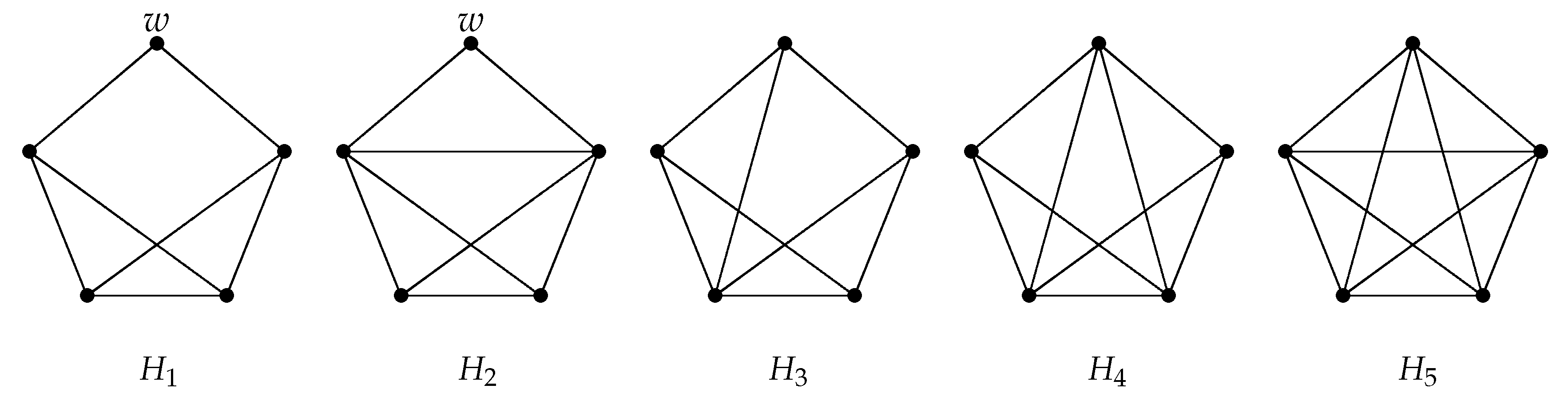
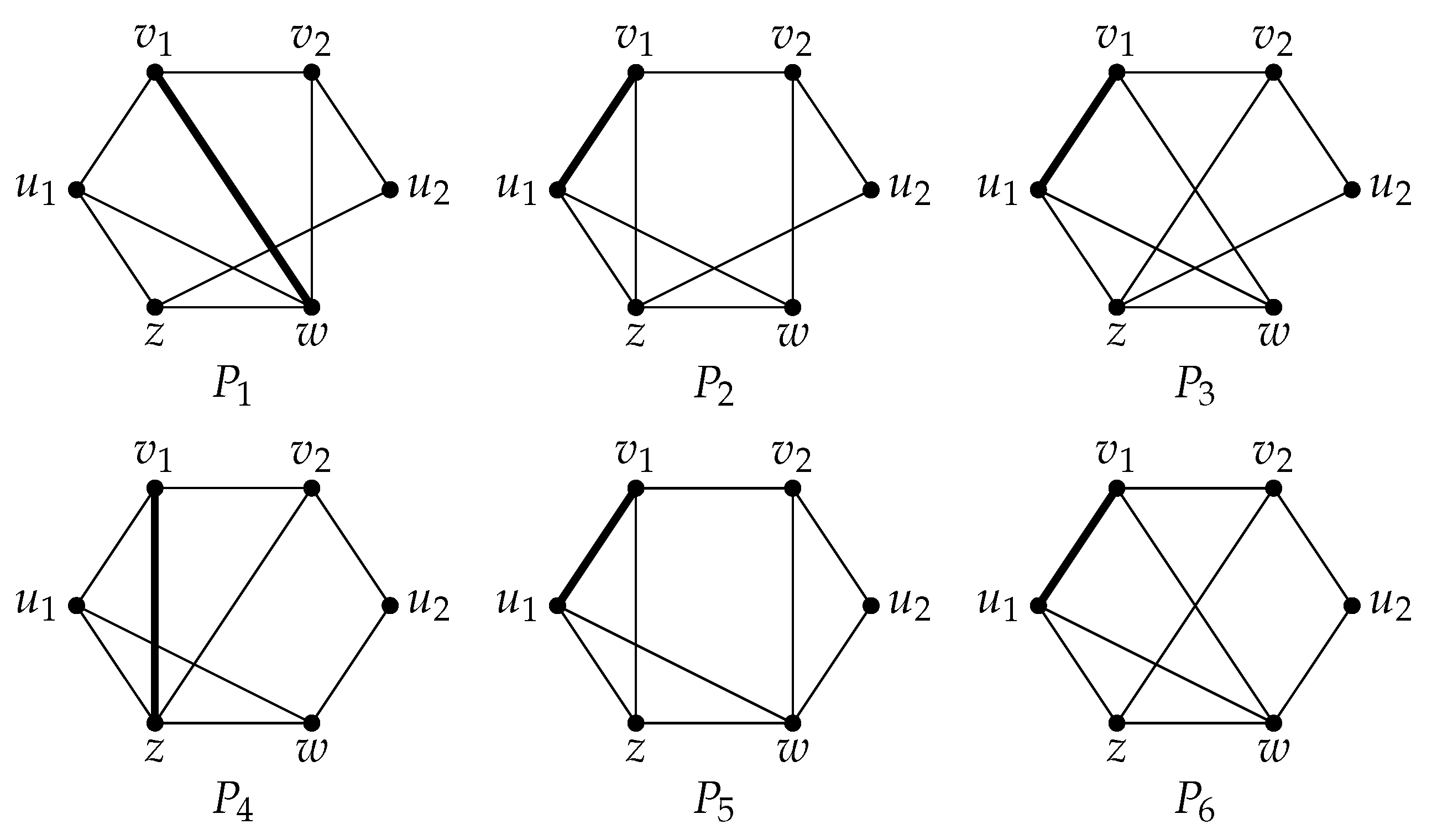
The class of graphs can be characterized in (see Figure 3). For , we obtain for by Lemma 6. Choose an interior edge and let By simple computation, we have , which is a contradiction to Lemma 5.
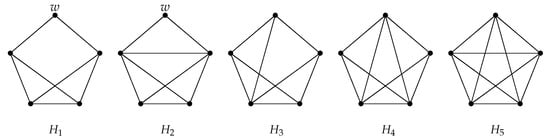
Figure 3.
All graphs of .
By Corollary 1, we have . Take an interior edge and let . As for any , is obtained by Lemma 8. By Lemma 5, we have for any
Case 2. .
If , then we gain , and by Lemma 6. If , then we obtain , and by Lemma 6. In these two conditions, by Case 1, the desired result is achieved.
Case 3. is a 2-connected -minor free graph.
By Proposition 1 and Corollary 1, is a -minor free graph. By Lemma 7, contains at least one 2-vertex as interior vertex, contradicting Lemma 6.
3.4. Proof of Strong Edge Coloring of -Minor Free Graphs
For a -minor free graph G, we need to prove for any . By Proposition 3, we obtain or () or is a -minor free graph. We prove the statement based on the following three cases.
Case 1. .
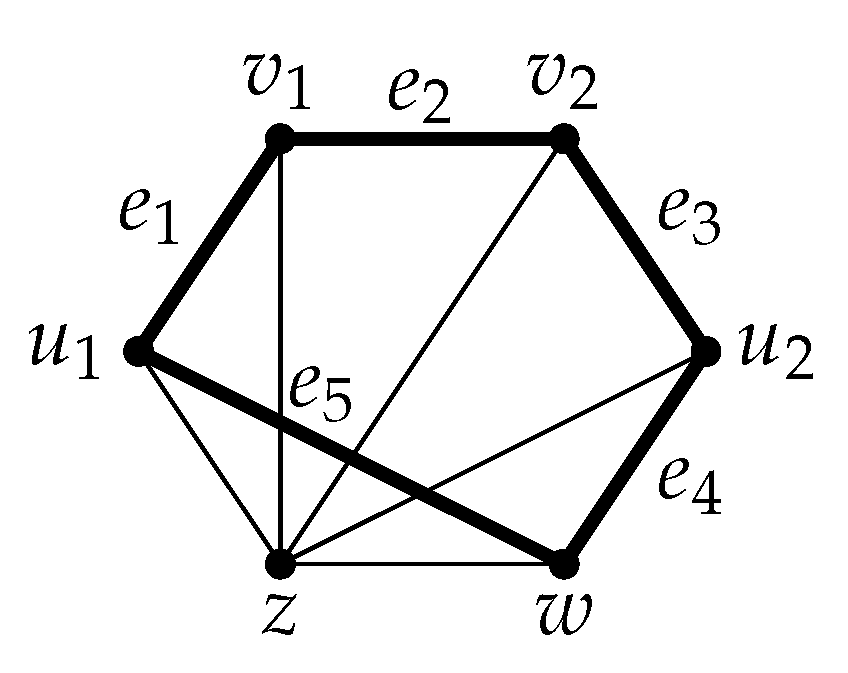
For any , we have by Lemma 6. Let be an arbitrary interior edge contained in leaf block and let . By Lemma 5, does not hold. Thus there exist and satisfying By simple computation, we enumerate the following results.
- Fact A:
- (1)
- , when .
- (2)
- and .
- (3)
- for any
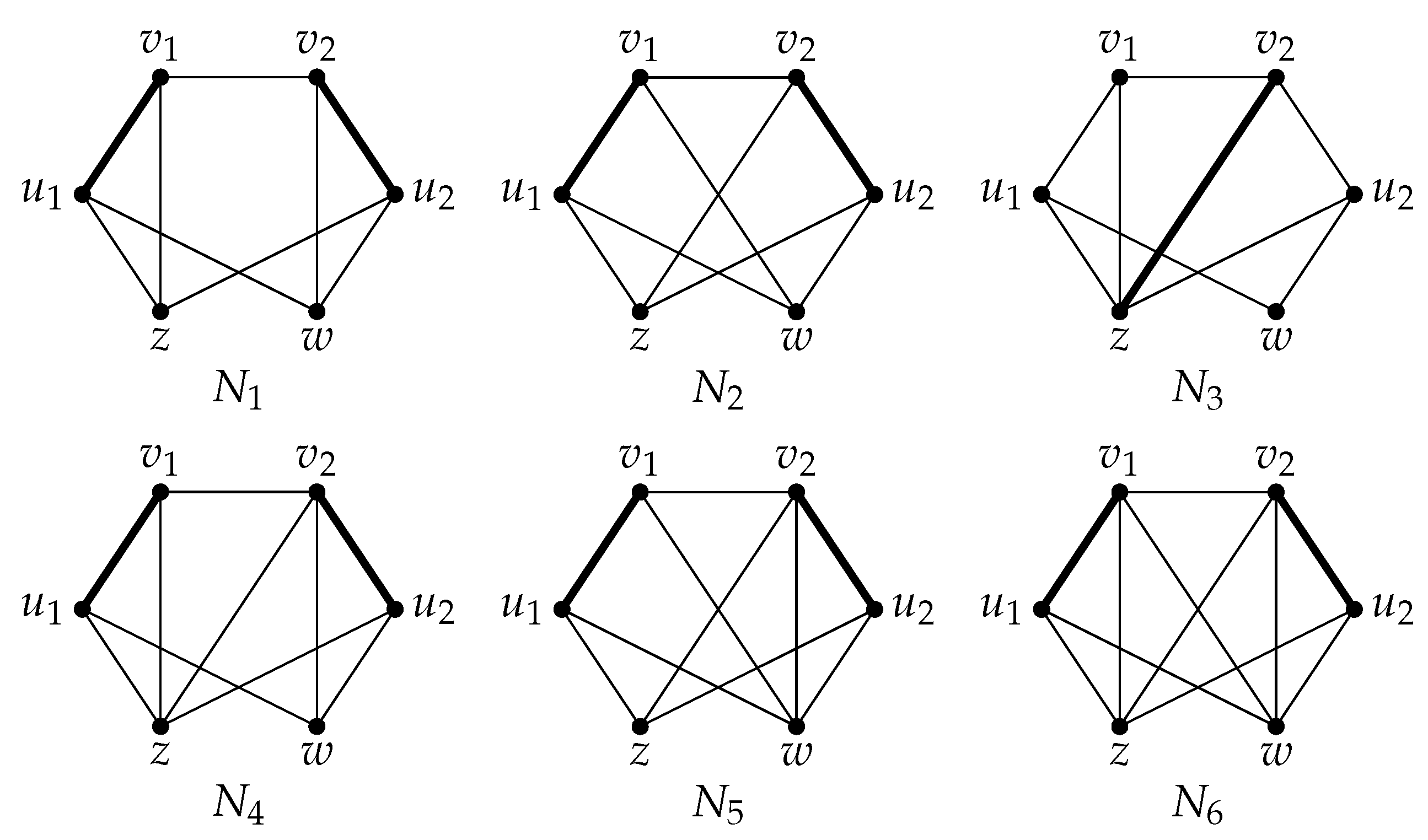
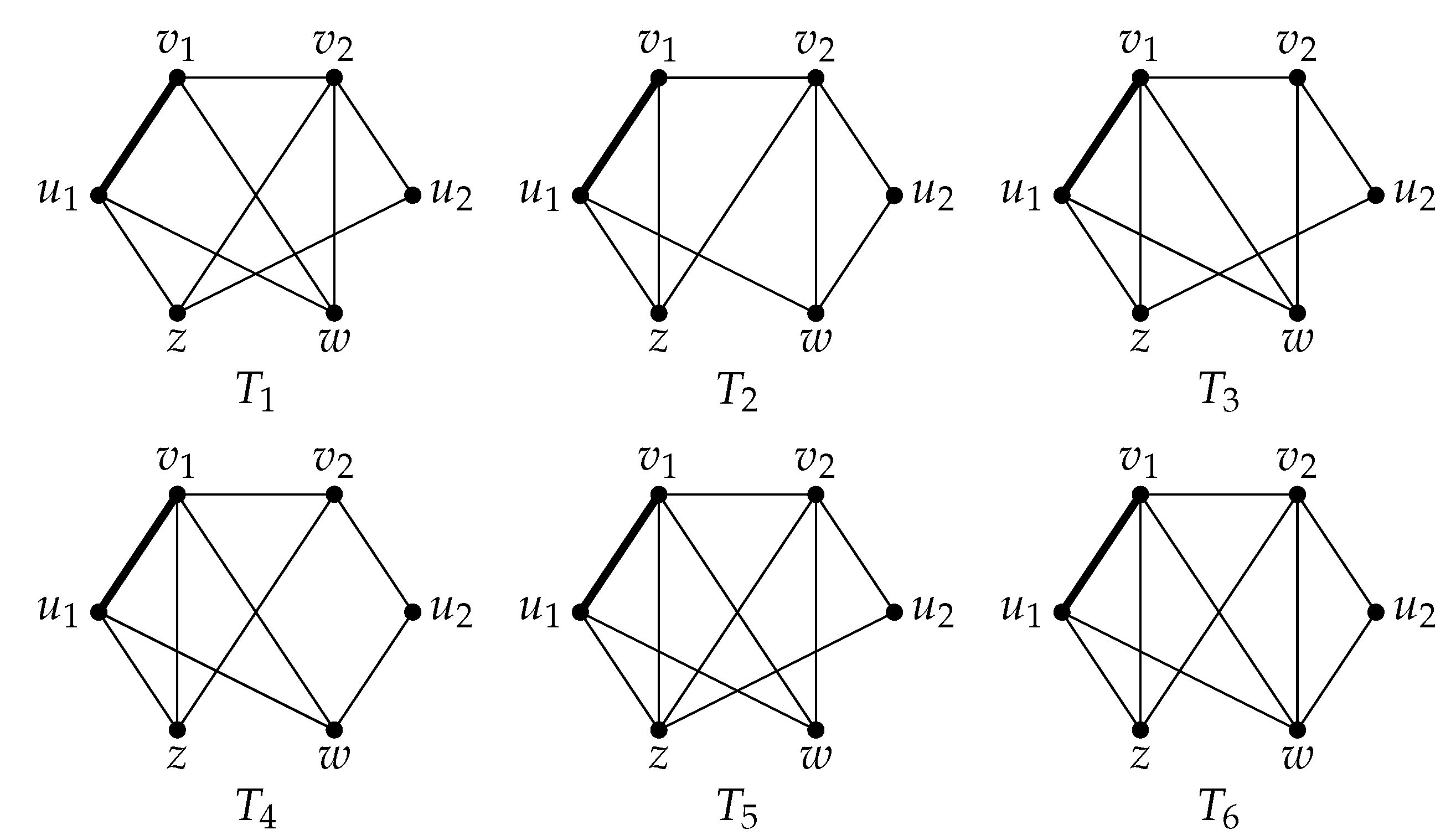
By symmetry and Lemma 6, we have either or for Fact A(2). If and , then we characterize all possible graphs for in Figure 4. If , then and take . Let and we have , which is a contraction to Lemma 5. If , then choose a thick edge marked in Figure 4 such that e is an interior edge contained in . Let and we have by simple computation for some , which is a contraction to Lemma 5.
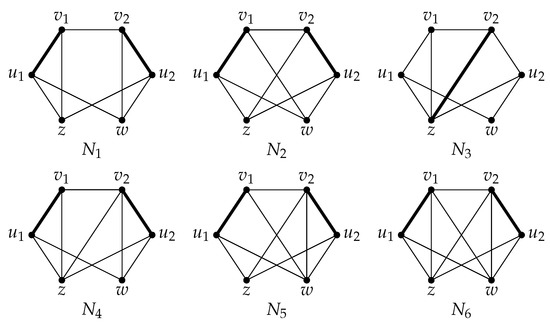
Figure 4.
All graphs satisfied and .
Let for . If and , then for some . If either where or (see Figure 5) and , then we can do the same analysis as where . If and , then we can first pick a cycle . Then delete C and let , by the minimized counterexample property, for arbitrary . Choose an arbitrary , then we consider the following two subcases.
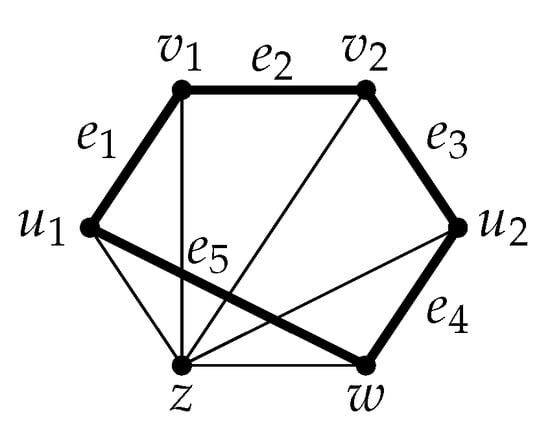
Figure 5.
The graph .
Subcase 1.1 for .
Let . Then . We can get for any , a contradiction.
Subcase 1.2 and .
Let . Then . Take as a partial strong edge coloring of graph with colors. Choose different colors from colors to assign distinct edges in so that those colors are different from any , where . Therefore, we gain an desired coloring of with for any , a contradiction.
If and , then we have for some by Lemma 6. We characterize all possible graphs for in Figure 6 corresponding to by Fact A. If and , then we have all possible graphs for in the Figure 7 when .
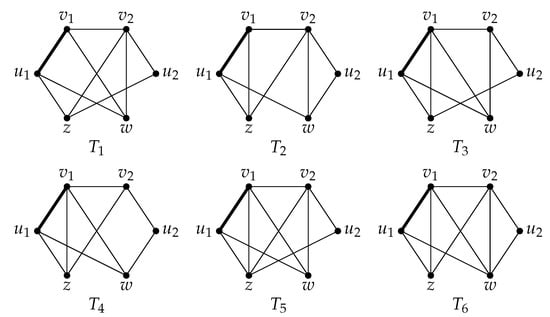
Figure 6.
All graphs satisfied and .
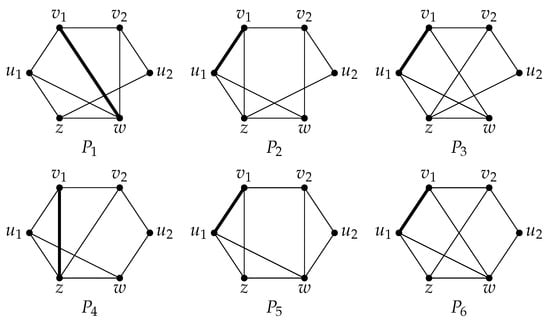
Figure 7.
All graphs satisfied and .
For each of the graphs in Figure 6 and Figure 7, we know that in each graph by Lemma 6. We would gain a new graph by deleting the thick edge . We have by simple computation, which is a contradiction to Lemma 5. When , and , we get the desired result as since contains as a subgraph for some .
Case 2. .
Recall that and . By construction of and , there is at least one 2-vertex as interior vertex in , which is a contradiction to Lemma 6.
Case 3. .
Recall with . For an arbitrary , there is at most one 2-vertex in by Lemma 6. We discuss it in the following four subcases.
Subcase 3.1 and .
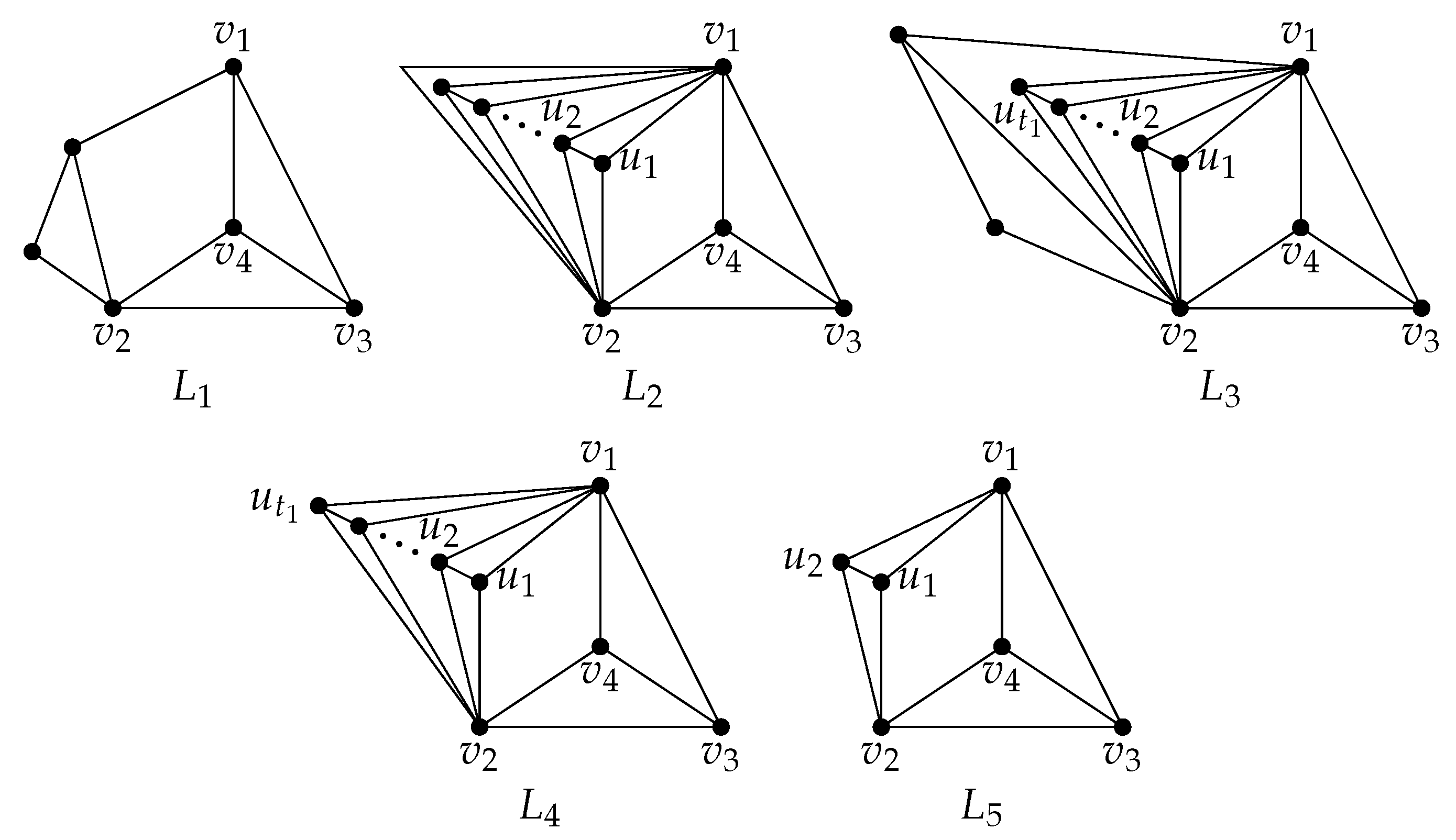
The possible graphs are either or shown in the Figure 8. By Lemma 6, is the 2-vertex. We choose an edge .
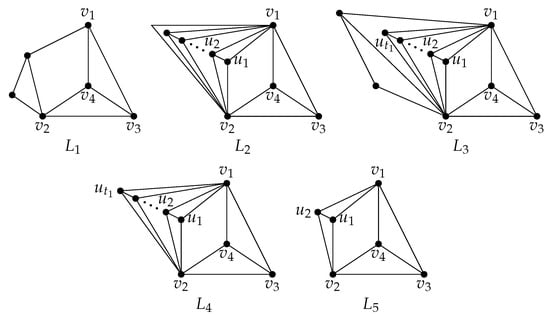
Figure 8.
Possible graphs of Case 3.
Subcase 3.2 and .
The possible graphs are either or shown in the Figure 8. By Lemma 6, is the 2-vertex. We choose an edge .
Subcase 3.3 and .
The possible graphs are either or shown in the Figure 8. We choose an edge either or which is not associated with .
Subcase 3.4 and .
The possible graphs are either or shown in the Figure 8. We choose if it is an interior edge; otherwise, we choose .
For each subcase, we pick the appropriate edge as discussed above. Let . By the minimized counterexample property, for any . By Lemma 3 and simple computation, we know and . Thus, by Lemma 1, for any , a contradiction.
Case 4. .
Recall that . For an arbitrary . By Lemma 6, we obtain and Applying Lemma 4, we have for arbitrary Choose an interior edge and let Thus we gain . By Lemma 5, is obtained for any , a contradiction.
Case 5. is a 2-connected -minor free graph.
By Proposition 3, if , we obtain for any by Case 1 in Section 3.3. If , by Case 2 in Section 3.3, we have for any . If is a 2-connected -minor free graph, by Case 3 in Section 3.3, we have for any , and the proof is completed.
Based on the proof in Section 3.2–Section 3.4, we prove Theorem 7 when , respectively and complete the proof of Theorem 7.
4. Conclusions
In this paper, we have proved in Theorem 7 that for every -minor free graph with maximum degree , for . Moreover, these bounds are sharp. This result indicates that the bounds obtained by Batenburg et al. and Wang et al. in [22,23] can be extended to some larger families of graphs. A natural open question is whether similar upper bounds of strong chromaic index exists for -minor free graphs whenever . Note that when t goes to infinity, the families of all -minor free graphs would include all graphs.
Author Contributions
Writing—original draft, H.Y.; Methodology, M.H.; Writing—review and editing, H.Y., M.H. and M.X. All authors have read and agreed to the published version of the manuscript.
Funding
Research partially supported by National Natural Science Foundation of China (No. 11901434) and the Talent Fund Project of Tianjin Normal University, China (No. 5RL159).
Data Availability Statement
All relevant data are within the paper.
Acknowledgments
The authors are grateful to the referees for their careful reading of the manuscript and valuable comments. The authors thank the help from the editor too.
Conflicts of Interest
The authors declare no conflict of interest.
References
- Erdős, P. Problems and results in combinatorial analysis and graph theory. Discret. Math. 1988, 72, 81–92. [Google Scholar] [CrossRef]
- Andersen, L.D. The strong chromatic index of a cubic graph is at most 10. Discret. Math. 1992, 108, 231–252. [Google Scholar] [CrossRef]
- Cranston, D.W. Strong edge-colouring of graphs with maximum degree 4 using 22 colors. Discret. Math. 2006, 306, 2772–2778. [Google Scholar] [CrossRef]
- Huang, M.; Santana, M.; Yu, G. Strong chromatic index of graphs with maximum degree four. Electron. J. Combin. 2018, 25, #3.31. [Google Scholar] [CrossRef] [PubMed]
- Mahdian, M. The strong chromatic index of C4-free graphs. Random Struct. Algorithms 2000, 17, 357–375. [Google Scholar] [CrossRef]
- Hurley, E.; Joannis de Verclos, R.; Kang, R.J. An improved procedure for colouring graphs of bounded local density. Adv. Comb. 2022, 7–33. [Google Scholar] [CrossRef]
- Wang, T. Strong chromatic index of k-degenerate graphs. Discret. Math. 2014, 330, 17–19. [Google Scholar] [CrossRef]
- Choi, I.; Kim, J.; Kostochka, A.V.; Raspaud, A. Strong edge-colorings of sparse graphs with large maximum degree. Eur. J. Comb. 2018, 67, 21–39. [Google Scholar] [CrossRef]
- Yu, G.; Yu, R. Strong edge-coloring of 2-degenerate graphs. Discret. Appl. Math. 2023, 336, 11–14. [Google Scholar] [CrossRef]
- Basavaraju, M.; Francis, M.C. Strong chromatic index of chordless graphs. J. Graph Theory 2015, 80, 58–68. [Google Scholar] [CrossRef]
- Wang, Y.; Song, N.; Wang, J.; Wang, W. The strong chromatic index of 1-planar graphs. arXiv 2022, arXiv:2205.14680. [Google Scholar]
- Cranston, D.W. Coloring, List Coloring, and Painting Squares of Graphs (and other related problems). arXiv 2022, arXiv:2210.05915. [Google Scholar] [CrossRef]
- Dȩbski, M.; Szaniawski, K.J.; Nowak, M.Ś. Strong chromatic index of K1,t-free graphs. Discret. Appl. Math. 2020, 284, 53–60. [Google Scholar] [CrossRef]
- Hocquard, H.; Montassier, M.; Raspaud, A.; Valicov, P. On strong-edge colouring of subcubic graphs. Discret. Appl. Math. 2013, 161, 2467–2479. [Google Scholar] [CrossRef]
- Wang, Y.; Wang, Y.; Wang, W.; Cui, S. Strong chromatic index of outerplanar graphs. Axioms 2022, 11, 168. [Google Scholar] [CrossRef]
- Faudree, R.J.; Gyárfás, A.; Schelp, R.H.; Tuza, Z. The strong chromatic index of graphs. Ars Comb. 1990, 29, 205–211. [Google Scholar]
- Hadwiger, H. Über eine Klassifikation der Streckenkomplexe. Vierteljschr. Naturforsch. Ges. Zür. 1943, 88, 133–142. [Google Scholar]
- Wagner, K. Über eine Eigenschaft der ebenen Komplexe. Math. Ann. 1937, 114, 570–590. [Google Scholar] [CrossRef]
- Robertson, N.; Seymour, P.; Thomas, R. Hadwiger’s conjecture for K6-free graphs. Combinatorica 1993, 13, 279–361. [Google Scholar] [CrossRef]
- Albar, B.; Gonçalves, D. On triangles in Kr-minor free graphs. J. Graph Theory 2018, 88, 154–173. [Google Scholar] [CrossRef]
- Delcourt, M.; Postle, L. Reducing linear Hadwiger’s conjecture to coloring small graphs. arXiv 2021, arXiv:2108.01633. [Google Scholar]
- Batenburg, W.C.; Joannis de Verclos, R.; Kang, R.J.; Pirot, F. Strong chromatic index and hadwiger number. J. Graph Theory 2022, 100, 435–457. [Google Scholar] [CrossRef]
- Wang, Y.; Wang, P.; Wang, W. Strong chromatic index of K4-minor free graphs. Inform. Process. Lett. 2018, 129, 53–56. [Google Scholar] [CrossRef]
- Chen, Y.; Fan, S.; Lai, H.; Song, H.; Xu, M. Decomposition and r-hued coloring of K4(7)-minor free graphs. Appl. Math. Comput. 2020, 38, 125206. [Google Scholar] [CrossRef]
Disclaimer/Publisher’s Note: The statements, opinions and data contained in all publications are solely those of the individual author(s) and contributor(s) and not of MDPI and/or the editor(s). MDPI and/or the editor(s) disclaim responsibility for any injury to people or property resulting from any ideas, methods, instructions or products referred to in the content. |
© 2023 by the authors. Licensee MDPI, Basel, Switzerland. This article is an open access article distributed under the terms and conditions of the Creative Commons Attribution (CC BY) license (https://creativecommons.org/licenses/by/4.0/).