


Abstract
The Ayala-Gilpin (AG) kinetics system is one of the famous mathematical models of ecosystem. This model has been widely concerned and studied since it was proposed. This paper stresses on a nonlinear distributed delayed periodic AG-ecosystem with competition on time scales. In the sense of time scale, our model unifies and generalizes the discrete and continuous cases. Firstly, with the aid of the auxiliary function having only two zeros in the real number field, we apply inequality technique and coincidence degree theory to obtain some sufficient criteria which ensure that this model has periodic solutions on time scales. Meanwhile, the global asymptotic stability of the periodic solution is founded by employing stability theory in the sense of Lyapunov. Eventually, we provide an illustrative example and conduct numerical simulation by means of MATLAB tools.
MSC:
34K13; 34D23; 34N05
1. Introduction
This paper mainly deals with the following nonlinear competitive periodic Ayala-Gilpin ecosystem with distributed lags on time scale
where is a time scale, is the delta (or Hilger) derivative on , and are the quantity densities of two vying species at moment , stands for the intrinsic birth rate, and are the intraspecific competition rates, and are the interspecific competition rates, the kernel function of distributed-lags is given by , is the distributed-lag function, is the manual control term, the constants measures the nonlinear interferences within species, is the initial function, .
The proposal of the model is related to the famous experimental study of Drosophila competition. Combined with the experimental study of Drosophila competition, Ayala, Gilpin and Eherenfeld [1] put forward the following nonlinear dynamic model in 1973.
where represents inherent growth ratios. stands for the maximum capacity of environment to species. The constant measures the nonlinear interferences within species. and mean the vying rate among species.
The nonlinear interferences within species are measured by constants and . and are the measures of competition between species.
When , (2) becomes the below Lotka-Volterra competitive model
Therefore, the Ayala-Gilpin model is a generalization of Lotka-Volterra model. The parameters and can take any positive real number. Therefore, Ayala-Gilpin model has been widely favored since it was proposed. The kinetics properties of Ayala-Gilpin model have been extensively explored. In [2,3,4,5,6,7], the authors dealt with the persistence, extinction and attraction of AG-system. Amdouni et al. [8] investigated the existence and global exponential stability of pseudo almost periodic solutions for a generalized competitive AG-model. Korobenko et al. [9] handled the evolutionary stability of a diffusion AG-model. Zhao [10,11] studied the multiplicity of almost periodic solution and local exponential stability for two AG-systems with harvest term. If the time-lag, impulse and random effects are considered in the AG-system, many excellent results have been achieved (see [12,13,14,15,16,17,18,19,20]). with the exception of the classical AG-system, some extended AG-systems have also been studied (see [4,6,8,9,14,16,20,21,22]).
Moreover, the model (1) is more suitable for the actual situation of ecosystem. For example, the predation process is not instantaneous, but takes a period of time to complete. At the same time, the number of predators can not be increased immediately after predators prey. Therefore, time lag is common in the whole process of predation and transformation. As we all know, the environment of the ecosystem often presents certain periodic changes over time. For the harmonious coexistence of people and ecosystem, sometimes it is necessary to protect and intervene the ecosystem manually.
From the perspective of mathematical theory, it is also of great value to study model (1). According to the definition of time scale, the model (1) contains difference case and differential case. Indeed, when , the model (1) becomes the following difference equation
When , let , then the model (1) becomes the following differential equation
In addition, a complex number set like is also a time scale. In 1988, Hilger first raised the time scale theory in his Ph.D. thesis [23], aiming at unifying difference and differential. For further study of time scale theory, please refer to the monographs [24,25] To the best my knowledge, no one has studied the periodic solution and stability of AG-system on time scales. Consequently, it is worthwhile to study the periodic dynamic behavior of (1).
The highlights of our work and the differences from previous published works are mainly manifested in two aspects. (i) We study the dynamic properties of AG-system in the sense of time scales, which can unify the differential and difference forms of AG-systems within the same framework. However, most previous studies on AG-systems have focused on the case of continuous differential equations (see some of them [6,7,8,9,10,11,12,13,14,15,16,22]). Previous papers dealing with pure difference AG-systems are rare. some of their papers involved discrete AG-systems containing impulsive terms (see [2,17,21]). (ii) Our model (1) is the closest to classical model (2). The model (1) only adds control harvest terms and distribution lags based on classical model (2). Compared to model (1), some previous papers on generalized AG-systems have made many modifications to classical model (2). For example, Wang et al. [4] added random terms and multiple species to their model. In [6,14,16], the authors not only added multiple species to their models, but also added nonlinear measures to the inter species competition term. In [20,21], the authors added Lévy and Markovian jumps to their models.
The surplus framework of the manuscript is arranged as follows. We mainly introduce the basic concepts and results of time scales, important assumptions and necessary propositions in Section 2. Section 3 focuses on finding the sufficient conditions for the existence of periodic solutions to system (1). In Section 4, the Lyapunov functional is applied to discuss the global asymptotic stability of system (1). Section 5 provides an example and numerical simulation to verify our main results. In the last Section 6, we made a brief conclusion and outlook.
2. Preliminaries
This section first concisely reviews the elementary knowledge of calculus on time scale. The following statements are taken from Refs. [24,25].
is called a time scale if is closed. Define some operators as follows:
then, we call that is jumping forward, is jumping backward, and is the graininess.
For , if and ( and ), then we call that is left-dense (right-dense). If (), then we call that is left-scattered (right-scattered). In addition, we have
and
For , we call that a time scale is -periodic, provided that . Obviously, if is -periodic, then is unbounded above.
Definition 1.
We call that is regulated iff and all exist (finite), .
Definition 2.
We call that is -continuous iff, for all right-dense point. , we have , and for all left-dense point , we have that exists (finite). We denote the collection of all -continuous functions as .
Definition 3.
Let and . We call that a number (if exists) is the Δ-derivative of u at ς iff, for a given , there has such that
The collection of first-order Δ-differentiable functions is denoted by
According to the above definitions, one easily knows that u is -differentiable is continuous is -continuous is regulated.
Lemma 1.
If u is regulated, then there is a Δ-differentiable function U with differentiable region D that contents
Definition 4.
Assume that is regulated, then we have the following concepts.
- We call that any function U as in Lemma 1 is a Δ-antiderivative of u.
- We define the Δ-indefinite integral of u aswhere an arbitrary constant c is a Δ-integral constant.
- We define the Δ-definite integral as
Lemma 2.
Let , , , then we have the followings
- .
- , .
- , .
Lemma 3
([26]). For two Banach spaces , , and nonempty bounded open subset , define some operators , , and . Assume that is zero index Fredholm type, is -compact, is projected, and is homotopy. Further suppose that
- For all , if x is a solution of , then ;
- If , then ;
- .
Then there has at least a meeting with .
Lemma 4
([11]). Let , . Assume that . Then we have the followings
- There exists a unique such thatand for all , when , when .
- There are only two with such that .
Now let’s introduce some symbols.
where , . The whole paper needs the following basic assumptions.
- Assume that , , , , , , , , , , , , , are all -periodic, and satisfy , , where .
3. Existence of Periodic Solution on Time Scales
In the portion, we shall put to use Lemma 3 to argue that system (1) has a periodic solution. Set , where ,
equipped with the norm
In the manner of Ref. [27], it is easy to prove Lemmas 5–8. So, we omit their proofs.
Lemma 5.
is the Banach space with the norm defined as (6).
Lemma 6.
defined by
then is zero index Fredholm type.
Lemma 7.
For all , , and are defined by
Then is -compact on .
Lemma 8.
Let be an ϖ-periodic time scale. Suppose be an ϖ-periodic function which is rd-continuous, then
- Suppose that all inequalities hold as follows:
Theorem 1.
Assume that and are true, then there has at least an ϖ-periodic solution satisfies model (1) on periodic time scale such that and , where and can be solved by the below equations
Proof.
Let be same as Lemma 5, and be same as Lemmas 6 and 7. In what follows, we shall prove that model (1) has an -periodic solution based on Lemma 3.
First of all, we find the existence region of solution. Assume that an -periodic solution solves the operator equation , then we obtain
Integrating at both sides of (7) yields
In view of periodicity of and , there exist , , and satisfying , , , . The first equation in (7) and (8) leads
By the first equation of (8) and (9) together with Lemma 8, we have
which implies that
We derive from Lemma 4 that there has unique such that
where From and Lemma 4, one knows that , and has only two roots and satisfying
By (11) and Lemma 4, the Inequality (10) is solved by
It follows from Lemma 8 and (12) that
Similarly, the second equation of (7) gives
which indicates that
From Lemma 4, one knows that there has unique such that
where It follows from and Lemma 4 that , and has two roots and satisfying
By (15) and Lemma 4, the solution of Inequality (14) is read as
From Lemma 8 and (16), we have
We next adopt the reduction to absurdity to prove that Lemma 3 hold, i.e., implies . Indeed, assume that the conclusion is opposite, then there has a constant vector with that fulfills
A discussion for (18) analogue to (8)–(17) yields , this is contrary to . So the Lemma 3 holds.
We choose the identity operator and calculate it directly
which means that Lemma 3 holds. Thus, one concludes from Lemma 3 that there has at least an -periodic function satisfying model (1). The proof is completed. □
4. Global Asymptotic Stability
The portion concentrates on the global asymptotic stability of model (1). To this end, we need the following definitions.
Definition 5.
Definition 6
([28]). Let be a neighborhood of ς, , and , is called the Dini derivative of V iff, , there has a right neighborhood of ς satisfying
If is continuous at right-scattered ς, then
By Theorem 1, we know that there has an -periodic function satisfying model (1). Let , , then one has and . Thus the system (1) becomes
Similarly, there exists an -periodic positive function that solves system (19), here
Choose the constants and such that
We further assume that
- The followings are true:
Taking variable substitution and , then we have
and
Consequently, system (19) changes into
Clearly, system (20) has an -periodic positive solution within , where
From Theorem 1 and , we have
Theorem 2.
Assume that – hold, then a unique ϖ-periodic solution of (1) is globally asymptotically stable.
Proof.
Assume that the -periodic function satisfying (1) is globally asymptotically stable, then is attractive, that is, for each function satisfying (1), we have , . If the system (1) has another -periodic solution with , without loss of generality, assume that , then we obtain , as , which is an obvious fallacy. Thus, we prove that the -periodic function satisfying model (1) is unique provided that is globally asymptotically stable. In addition, since the global asymptotical stability of -periodic function satisfying (1) and satisfying (20) is equivalent, we just need to show that the -periodic function satisfying (20) is globally asymptotically stable. Indeed, it follows from , and Theorem 1 that system (20) has an positive -periodic solution . For each positive solution of (20), build a Lyapunov functional here
Obviously, and . By (21), a direct -derivation along (20) gives
and
Since when and is monotonically increasing, and , it follows from (21), (24)–(27) and that
Thus, from (22), (23) and (28), one concludes that is positive definite and , . Therefore, one draws a conclusion that the -periodic solution of system (20) has global asymptotic stability based on Lyapunov stability theory. The proof is completed. □
5. Numerical Simulation
The portion considers the following nonlinear Ayala-Gilpin competitive ecosystem having distributed lags on time scale
where , , , , , , , , , , , . Take the initial functions , , , here .
Obviously, , , , , , , , , , , , , and are all positive periodic functions with period . So the conditions holds. A direct computation gives , , , , , , , , , , , , , , , , , , . To solve the following algebraic equation
we find that , . From the algebraic equation
we have , . Thus we get
The condition is verified as
By now, and have been verified. From Theorem 1, one knows that (29) exists at least an -periodic positive solutions .
Next, we prove periodic positive solution to be globally asymptotically stable. Indeed, take , , we get
and
Thus the condition holds. From Theorem 2, one knows that the periodic solution is globally asymptotically stable. We have carried out numerical simulation for example (29) as shown in Figure 1.
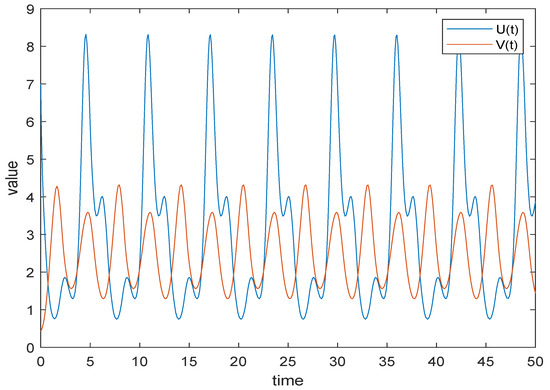
Figure 1.
Existence and global asymptotic stability of solution to (29).
6. Summaries and Outlooks
The Ayala-Gilpin dfferential equation model is one of the successful patterns of applying mathematical theories and methods to study ecosystems. Its dynamic behavior has received significant attention and study from mathematicians and ecologists. In this work, we mainly investigate the existence and global asymptotic stability of periodic solutions for a class of nonlinear distributed-lag Ayala-Gilpin vying system (1) in the sense of time scales. By making use of Mawhin’s coincidence degree theorem, we first gain some sufficient criteria for the existence of periodic solutions of model (1). Next, we construct an appropriate Lyapunov functional to demonstrate that model (1) is globally asymptotically stable. Subsequently, we examined the validity and applicability of our essential findings through theoretical analysis and numerical simulation of an example. Our conclusion reveals the existence of periodic oscillations in AG-ecosystem under certain conditions from a mathematical perspective. However, the long-term behavior of AG-ecosystem is globally asymptotically stable. As stated in studies [10,11], an ecosystem may have multiple stable states for different initial values, which means that the ecosystem has multiple positive solutions and is stable in their respective regions. Therefore, we can study the existence and local stability of multiple positive periodic solutions for model (1) in future works. In addition, some scholars have found that using fractional or partial differential models to study some practical problems is more accurate than using integer order differential models. Awaken by some recent papers [29,30,31,32,33,34,35,36,37,38,39,40,41], we plan to apply fractional calculus and PDE theory to further study the AG-ecosystem in the future, in order to explore more dynamic characteristics.
Funding
The APC was funded by research start-up funds for high-level talents of Taizhou University.
Institutional Review Board Statement
Not applicable.
Informed Consent Statement
Not applicable.
Data Availability Statement
Not applicable.
Acknowledgments
The author would like to express his heartfelt gratitude to the editors and reviewers for their constructive comments.
Conflicts of Interest
The author declares no conflict of interest.
References
- Ayala, F.; Gilpin, M.; Eherenfeld, J. Competition between species: Theoretical models and experimental tests. Theor. Popul. Biol. 1973, 4, 331–356. [Google Scholar] [CrossRef] [PubMed]
- He, M.; Li, Z.; Chen, F. Permanence, extinction and global attractivity of the periodic Gilpin-Ayala competition system with impulses. Nonlinear Anal. Real World Appl. 2010, 11, 1537–1551. [Google Scholar] [CrossRef]
- Vasilova, M.; Jovanović, M. Stochastic Gilpin-Ayala competition model with infinite delay. Appl. Math. Comput. 2011, 217, 4944–4959. [Google Scholar] [CrossRef]
- Wang, J.; Shi, K.; Huang, Q.; Zhong, S.; Zhang, D. Stochastic switched sampled-data control for synchronization of delayed chaotic neural networks with packet dropout. Appl. Math. Comput. 2018, 335, 211–230. [Google Scholar] [CrossRef]
- Settati, A.; Lahrouz, A. On stochastic Gilpin-Ayala population model with Markovian switching. Biosystems 2015, 130, 17–27. [Google Scholar] [CrossRef]
- Chen, F. Some new results on the permanence and extinction of nonautonomous Gilpin-Ayala type competition model with delays. Nonlinear Anal. Real World Appl. 2006, 7, 1205–1222. [Google Scholar] [CrossRef]
- Lu, H.; Yu, G. Permanence of a Gilpin-Ayala predator-prey system with time-dependent delay. Adv. Differ. Equ. 2015, 1, 109. [Google Scholar] [CrossRef]
- Amdouni, M.; Chérif, F.; Alzabut, J. Pseudo almost periodic solutions and global exponential stability of a new class of nonlinear generalized Gilpin-Ayala competitive model with feedback control with delays. Comput. Appl. Math. 2021, 40, 91. [Google Scholar] [CrossRef]
- Korobenko, L.; Braverman, E. On evolutionary stability of carrying capacity driven dispersal in competition with regularly diffusing populations. J. Math. Biol. 2014, 69, 1181–1206. [Google Scholar] [CrossRef]
- Zhao, K. Local exponential stability of four almost–periodic positive solutions for a classic Ayala-Gilpin competitive ecosystem provided with varying-lags and control terms. Int. J. Control 2022, in press. [Google Scholar] [CrossRef]
- Zhao, K. Local exponential stability of several almost periodic positive solutions for a classical controlled GA-predation ecosystem possessed distributed delays. Appl. Math. Comput. 2023, 437, 127540. [Google Scholar] [CrossRef]
- Tunç, C.; Wang, Y.; Tunç, O.; Yao, J. New and improved criteria on fundamental properties of solutions of integro-delay differential equations with constant delay. Mathematics 2021, 9, 3317. [Google Scholar] [CrossRef]
- Tunç, C. Qualitative properties in nonlinear Volterra integro-differential equations with delay. J. Taibah Univ. Sci. 2017, 11, 309–314. [Google Scholar] [CrossRef]
- Zhao, K. Global exponential stability of positive periodic solutions for a class of multiple species Gilpin-Ayala system with infinite distributed time delays. Int. J. Control 2021, 94, 521–533. [Google Scholar] [CrossRef]
- Zhao, K.; Ren, Y. Existence of positive periodic solutions for a class of Gilpin-Ayala ecological models with discrete and distributed time delays. Adv. Differ. Equ. 2017, 1, 331. [Google Scholar] [CrossRef]
- Zhao, K. Global exponential stability of positive periodic solution of the n-species impulsive Gilpin-Ayala competition model with discrete and distributed time delays. J. Biol. Dyn. 2018, 12, 433–454. [Google Scholar] [CrossRef]
- Zhao, K. Positive periodic solutions of Lotka-Volterra-like impulsive functional differential equations with infinite distributed time delays on time scales. Adv. Differ. Equ. 2017, 1, 328. [Google Scholar] [CrossRef]
- Ai, A.; Sun, Y. An optimal stopping problem in the stochastic Gilpin-Ayala population model. Adv. Differ. Equ. 2012, 1, 210. [Google Scholar] [CrossRef]
- Lian, B.; Hu, S. Asymptotic behaviour of the stochastic Gilpin-Ayala competition models. J. Math. Anal. Appl. 2008, 339, 419–428. [Google Scholar] [CrossRef]
- Liu, Q. Asymptotic properties of a stochastic n-species Gilpin-Ayala competitive model with Lévy jumps and Markovian switching. Commun. Nonlinear Sci. Numer. Simul. 2015, 26, 1–10. [Google Scholar] [CrossRef]
- Wu, R.; Zou, X.; Wang, K. Asymptotic properties of stochastic hybrid Gilpin-Ayala system with jumps. Appl. Math. Comput. 2014, 249, 53–66. [Google Scholar] [CrossRef]
- Wang, D. Dynamic behaviors of an obligate Gilpin-Ayala system. Adv. Differ. Equ. 2016, 1, 270. [Google Scholar] [CrossRef]
- Hilger, S. Analysis on measure chains-a unified approach to continuous and discrete calculus. Results Math. 1990, 18, 18–56. [Google Scholar] [CrossRef]
- Bohner, M.; Peterson, A. Dynamic Equations on Time Scales: An Introduction with Applications; Birkhäuser: Boston, MA, USA, 2001. [Google Scholar]
- Bohner, M.; Peterson, A. Advances in Dynamic Equations on Time Scales; Birkhäuser: Boston, MA, USA, 2003. [Google Scholar]
- Gaines, R.; Mawhin, J. Coincidence Degree and Nonlinear Differetial Equitions; Lecture Notes in Mathematics Series; Springer: Berlin/Heidelberg, Germay, 1977; Volume 568. [Google Scholar]
- Zhao, K.; Ding, L.; Yang, F. Existence of multiple periodic solutions to Lotka-Volterra network- like food-chain system with delays and impulses on time scales. Int. J. Biomath. 2014, 7, 1450003. [Google Scholar] [CrossRef]
- Lakshmikantham, V.; Vatsala, A. Hybrid system on time scales. J. Comput. Appl. Math. 2002, 141, 227–235. [Google Scholar] [CrossRef]
- Zhao, K. Stability of a nonlinear ML-nonsingular kernel fractional Langevin system with distributed lags and integral control. Axioms 2022, 11, 350. [Google Scholar] [CrossRef]
- Zhao, K. Existence, stability and simulation of a class of nonlinear fractional Langevin equations involving nonsingular Mittag-Leffler kernel. Fractal Fract. 2022, 6, 469. [Google Scholar] [CrossRef]
- Zhao, K. Stability of a nonlinear fractional Langevin system with nonsingular exponential kernel and delay control. Discret. Dyn. Nat. Soc. 2022, 2022, 9169185. [Google Scholar] [CrossRef]
- Zhao, K. Stability of a nonlinear Langevin system of ML-type fractional derivative affected by time-varying delays and differential feedback control. Fractal Fract. 2022, 6, 725. [Google Scholar] [CrossRef]
- Huang, H.; Zhao, K.; Liu, X. On solvability of BVP for a coupled Hadamard fractional systems involving fractional derivative impulses. AIMS Math. 2022, 7, 19221–19236. [Google Scholar] [CrossRef]
- Zhao, K. Existence and UH-stability of integral boundary problem for a class of nonlinear higher-order Hadamard fractional Langevin equation via Mittag-Leffler functions. Filomat 2023, 37, 1053–1063. [Google Scholar]
- Zhao, K. Global stability of a novel nonlinear diffusion online game addiction model with unsustainable control. AIMS Math. 2022, 7, 20752–20766. [Google Scholar] [CrossRef]
- Zhao, K. Probing the oscillatory behavior of internet game addiction via diffusion PDE model. Axioms 2022, 11, 649. [Google Scholar] [CrossRef]
- Zhao, K. Coincidence theory of a nonlinear periodic Sturm-Liouville system and its applications. Axioms 2022, 11, 726. [Google Scholar] [CrossRef]
- Zhao, K. Attractor of a nonlinear hybrid reaction-diffusion model of neuroendocrine transdifferentiation of mankind prostate cancer cells with time-lags. AIMS Math. 2023. accepted. [Google Scholar]
- Zhang, T.; Li, Y. Exponential Euler scheme of multi-delay Caputo-Fabrizio fractional-order differential equations. Appl. Math. Lett. 2022, 124, 107709. [Google Scholar] [CrossRef]
- Zhang, T.; Li, Y. Global exponential stability of discrete-time almost automorphic Caputo-Fabrizio BAM fuzzy neural networks via exponential Euler technique. Knowl. Based Syst. 2022, 246, 108675. [Google Scholar] [CrossRef]
- Zhang, T.; Zhou, J.; Liao, Y. Exponentially stable periodic oscillation and Mittag-Leffler stabilization for fractional-order impulsive control neural networks with piecewise Caputo derivatives. IEEE Trans. Cybern. 2022, 52, 9670–9683. [Google Scholar] [CrossRef]
Disclaimer/Publisher’s Note: The statements, opinions and data contained in all publications are solely those of the individual author(s) and contributor(s) and not of MDPI and/or the editor(s). MDPI and/or the editor(s) disclaim responsibility for any injury to people or property resulting from any ideas, methods, instructions or products referred to in the content. |
© 2023 by the author. Licensee MDPI, Basel, Switzerland. This article is an open access article distributed under the terms and conditions of the Creative Commons Attribution (CC BY) license (https://creativecommons.org/licenses/by/4.0/).