


Abstract
The sensitivity reanalysis technique is an important tool for selecting the search direction in structural optimization design. Based on the decomposition perturbation of the flexibility matrix, a fast and exact structural displacement sensitivity reanalysis method is proposed in this work. For this purpose, the direct formulas for computing the first-order and second-order sensitivities of structural displacements are derived. The algorithm can be applied to a variety of the modifications in optimal design, including the low-rank modifications, high-rank modifications, small modifications and large modifications. Two numerical examples are given to verify the effectiveness of the proposed approach. The results show that the presented algorithm is exact and effective. Compared with the existing two reanalysis methods, this method has obvious advantages in calculation accuracy and efficiency. This new algorithm is very useful for calculating displacement sensitivity in engineering problems such as structure optimization, model correction and defect detection.
1. Introduction
Sensitivity analysis is often used in structural optimization design, vibration control, and damage identification. In general, sensitivity refers to the first derivative of structural response parameters to its physical parameters [1,2]. In engineering design, it is often necessary to modify the structure repeatedly. As a result, the computational cost for sensitivity analysis will be very expensive. To reduce the computational burden, reanalysis and sensitivity reanalysis techniques have been studied continuously in the past decades [3,4,5,6,7,8]. Sensitivity reanalysis uses the original response of the structure and its sensitivity to find the response sensitivity coefficients of the modified structure, whose calculation cost is far lower than the cost required for the complete analysis. For a structure under a given load vector , the displacement vector in the initial design can be computed by the static equilibrium equation as
in which is the structural stiffness matrix of dimension in the initial finite element model (FEM). From Equation (1), the displacement and its sensitivity of the initial design can be calculated from the complete analysis as
where is a design variable such as geometry size, elastic modulus, and so on. The matrix is called the structural flexibility matrix, that is, . Correspondingly, the static balance equation of the modified structure can be expressed as
in which is the modified stiffness matrix, is the stiffness change caused by the optimal design, and is the modified displacement vector. From Equation (4), and its sensitivity can also be computed by the complete analysis as
in which is the modified flexibility matrix, i.e., . As mentioned earlier, when the half-bandwidth of the stiffness matrix is large, the complete analysis based on Equations (6) and (7) is very inefficient and time-consuming. For solving this problem, many reanalysis algorithms have been presented to calculate and its sensitivity more effectively. The existing sensitivity reanalysis methods can be divided into two types: finite-difference method [9,10,11,12] and direct (analytic) method [13,14,15,16]. Most of the existing reanalysis methods can only obtain the approximate solution of displacement sensitivity. Moreover, these methods may be inefficient for large modifications or high-rank modifications. The high-rank modification refers to the design changes in many components of the structure. In view of this, an exact sensitivity reanalysis approach using flexibility disassembly perturbation (FDP) [17,18,19] is developed in this work for computing the displacement sensitivity. The presented algorithm is accurate and efficient, and it can be used for many types of modifications in design, such as the low-rank, high-rank, small and large modifications. Numerical examples show that the results obtained by the presented sensitivity reanalysis algorithm are the same as those obtained by the complete analysis. In addition, this approach has higher computing efficiency than the existing sensitivity reanalysis methods.
2. Sensitivity Reanalysis Using FDP
Reference [19] presented a static reanalysis method using the FDP technique for quickly and exactly calculating the displacement vector after structural modification. In addition to the displacement vector, the displacement sensitivity is another quantity that needs to be repeatedly calculated in structural optimization design, which indicates the direction of optimization design. So, in this work, FDP is used again to exactly compute the displacement sensitivity after structural modification. The research content of this work can be seen as an extension of reference [19]. From Equation (7), the modified displacement sensitivity can be easily calculated by the modified flexibility matrix . Thus, the reanalysis problem of displacement sensitivity can be transformed into the reanalysis problem of structural flexibility matrix after modification. According to references [17,18,19], the modified flexibility matrix can be fast computed using FDP. The core idea of FDP is to decompose the flexibility matrix into a connected matrix reflecting the topological relationship between the degrees of freedom (DOFs) and the diagonal matrix reflecting the material and geometric information. The formulas of FDP are briefly derived as follows. According to the FEM theory, structural stiffness matrix is the sum of all elementary stiffness matrices (), that is
in which is the number of all elements in FEM. Performing the spectral decomposition on yields
In Equation (9), the non-zero eigenvalues are purely functions of the material and geometric properties such as elastic modulus , cross-sectional area and moment of inertia . The eigenvectors reflect the topological relationship between degrees of freedom. For instance, the spectral decomposition on a plane beam element gives [20]:
in which denotes the beam element length. Thus, are also called the elementary stiffness coefficients and are called the topological connection vectors. From Equations (8) and (9), the stiffness disassembly formula can be obtained as
in which is a dimension matrix, and is a dimension matrix. is a full-rank matrix with because of . For the statically determinate system, is a square matrix of . For the statically indeterminate system, is a rectangular matrix of . Commonly, structural modifications such as the section correction or material correction only lead to the change of stiffness coefficients . This means that only is changed in the structural modifications. As a result, the disassembly of the stiffness matrix after modification can be derived as
where () denotes the modification ratio of the stiffness parameter . As stated before, is a full-rank square matrix for the statically determinate system. Thus, the flexibility matrix can be fast computed from Equation (15) by as
It should be pointed out that the computational burden of the flexibility matrix reanalysis is only focused on the diagonal matrix , which only requires simple division operation when the modification ratios are given. The computation of the matrix should be attributed to the initial analysis, since is unchanged in each modification. For the statically indeterminate structure, the flexibility disassembly as in Equation (17) is nonexistent, since is a rectangular matrix with . In this case, the flexible disassembly can be realized by converting the statically indeterminate system into a statically determinate substructure and the redundant constraints. Correspondingly, the stiffness disassembly of the statically indeterminate system can be expressed from Equation (15) by
where and are associated with the statically determinate substructure, while and are associated with the redundant constraints. The dimensions of and are both . The dimensions of and are and , respectively. From Equation (20), the flexibility disassembly can be derived by with the help of Sherman–Morrison–Woodbury formulas [21,22] as
where is the identity matrix, while and are the corrections corresponding to the statically determinate subsystem and the redundant constraints. Equation (21) is the flexibility reanalysis formula for the statically indeterminate system with the given and .
According to the above theory and derivation, the modified displacement sensitivity can be fast computed using Equation (7) with determined by Equation (17) or (21). It is clear that Equation (17) is an exceptional case of Equation (21). The step-by-step summary for the proposed sensitivity reanalysis approach is as follows. Step 1: Perform the stiffness disassembly of the initial structure using Equations (8)–(14) to obtain the matrices , or and . Step 2: Compute the matrix or by Equation (18) or (22). Step 3: Calculate the modified flexibility matrix by Equation (17) or (21) with the given modifications , or and . Step 4: Compute the displacement sensitivity of the modified structure using Equation (7). Note that the calculations in steps 1 and 2 should be attributed to the initial analysis. The computational burden of the sensitivity reanalysis algorithm is the focus of steps 3 and 4. Another virtue of this algorithm is that it can be readily extended to calculate the second-order sensitivity of static displacement. Differentiating Equation (4) with respect to twice and rearranging gives the second-order sensitivity as
Apparently, the second-order sensitivity of static displacement can also be fast calculated by Equation (24) using the proposed method for the modified structure.
3. Numerical Examples
3.1. Statically Determinate Structure
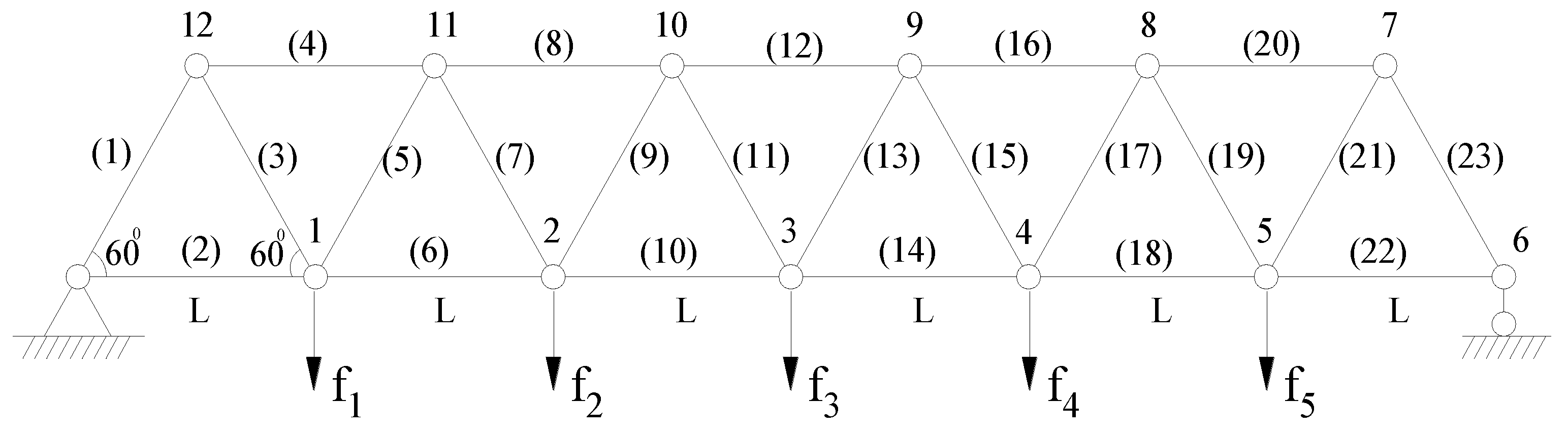
As presented in Figure 1, a statically determinate system of a 23-bar truss is used firstly to demonstrate the proposed approach. The values of the concentrated loads applied to the structure shown in Figure 1 are f1 = f2 = f3 = f4 = f5 = 10 kN. Assuming the change rate of cross-sectional area is the correction factor , Table 1 gives several modification cases including the low-rank, high-rank, small and large corrections. Table 2 and Table 3 present the first-order sensitivity and second-order sensitivity using the proposed method and complete analysis for these modification cases. It is found from Table 2 and Table 3 that the reanalysis results of the presented algorithm are the same as the complete analysis results. This shows that the proposed method is an exact algorithm for displacement sensitivity reanalysis.
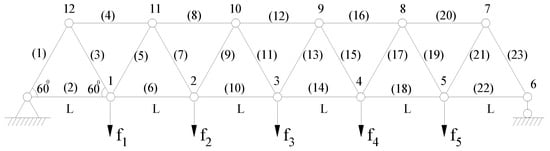
Figure 1.
An initial structure of a 23-bar truss. Material parameters: Elastic modulus is 200 GPa, density is 7800 kg/m3, L = 1 m, and initial cross-sectional area of each bar is 175.9 mm2.

Table 1.
Different correction cases of a 23-bar truss.
Table 2.
The first-order sensitivities of displacements for modified structures (×10−3).
Table 3.
The second-order sensitivities of displacements for modified structures (×10−3).
3.2. Statically Indeterminate Structure
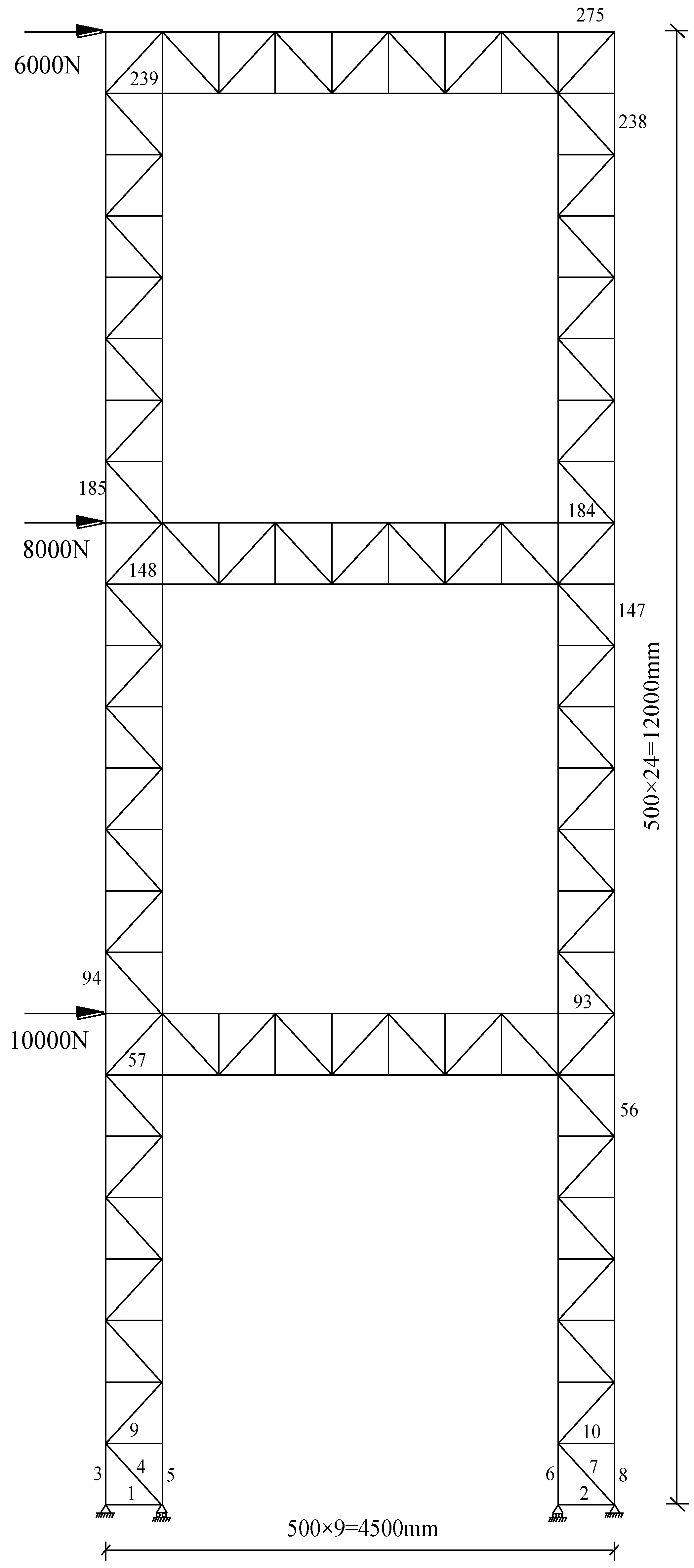
As presented in Figure 2, a statically indeterminate system of a 275-bar truss is used to conduct the comparison study on the computation efficiency between this method and two existing sensitivity reanalysis approaches. The first existing technique is the combined approximate (CA) method proposed by Kirsch in reference [10]. The second existing technique is the method proposed by Zuo et al. in reference [16], which combines Taylor series expansion and the CA method. Table 4 gives three types of corrections for this example. As shown in Figure 2, the modified bars of the three types of corrections are: bars 1~10, bars 1~93 (the first story), and all bars (1~275) of the system, respectively. For each correction, 200 modifications are performed, and the total calculation times of displacement sensitivities using the complete analysis, the CA method, Zuo’s method, and the proposed method are given in Table 5. Note that the correction coefficient increases with the modification number (). This means that the early stage corresponds to small modifications and the later stage corresponds to large modifications. Table 6, Table 7, Table 8, Table 9, Table 10 and Table 11 show the displacement sensitivity data of some DOFs for each correction scenario with , , and , respectively. From Table 5, one can see that the presented algorithm has the highest calculation efficiency among the four sensitivity reanalysis methods. For type 1 (10 bars are modified), the calculation times of the four methods are: = 0.262 s (the complete analysis), = 0.166 s (CA method), = 0.161 s (Zuo’s method) and = 0.083 s (the presented algorithm), respectively. For type 2 (93 bars are modified), the calculation times of the four methods are: = 0.254 s (the complete analysis), = 0.191 s (CA method), = 0.174 s (Zuo’s method) and = 0.097 s (the presented algorithm), respectively. For the third type (all bars are modified), the calculation times of the four methods are: = 0.292 s (the complete analysis), = 0.232 s (CA method), = 0.217 s (Zuo’s method) and = 0.140 s (the presented algorithm), respectively. Overall, the calculation time of the presented algorithm is about 30~40% of that of the complete analysis method, and it is about 50~60% of that of CA or Zuo’s method. This means that whether the number of correction bars is small or large, the presented algorithm always has the high computation efficiency. According to Table 6, Table 7, Table 8, Table 9, Table 10 and Table 11, it can be seen that the results achieved by the presented approach and the complete analysis method are exactly the same. One can also find that the results obtained by CA and Zuo’s methods have some errors compared with the exact results. These results show that the presented approach is an exact algorithm for displacement sensitivity reanalysis, and the CA and Zuo’s methods are approximate methods.
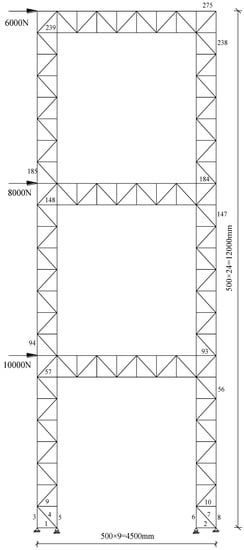
Figure 2.
An initial structure of a 275-bar truss. Material parameters: Elastic modulus is 200 GPa, density is 7800 kg/m3, L = 0.5 m, and initial cross-sectional area of each bar is 314 mm2.
Table 4.
Types of corrections in the 275-bar truss system.
Table 5.
Computation times of the four algorithms for the three types of modifications.
Table 6.
Displacement sensitivities for modification type 1 when and (×10−5).
Table 7.
Displacement sensitivities for modification type 1 when and (×10−5).
Table 8.
Displacement sensitivities for modification type 2 when and (×10−5).
Table 9.
Displacement sensitivities for modification type 2 when and (×10−5).
Table 10.
Displacement sensitivities for modification type 3 when and (×10−5).
Table 11.
Displacement sensitivities for modification type 3 when and (×10−5).
4. Conclusions
In this paper, an exact algorithm for the reanalysis of static displacement sensitivity based on flexibility disassembly perturbation is proposed. The presented algorithm is exact and efficient, and it can be used in many types of corrections in structural optimal design, including the low-rank, high-rank, small and large corrections. Numerical examples show that the presented approach can achieve the same results as the complete analysis method with less computational time. Compared with CA and Zuo’s techniques, this algorithm has obvious advantages in computational efficiency and accuracy. It has been shown that the proposed algorithm has great application potential in structural optimization design based on gradient.
Author Contributions
Methodology, Q.Y.; Software, X.P. All authors have read and agreed to the published version of the manuscript.
Funding
This research was funded by the Ningbo natural science foundation (202003N4169), Zhejiang public welfare project (LGF22E080021), Natural Science Foundation of China (52008215), Zhejiang Province Natural Science Foundation (LQ20E080013), and the project of Ningbo science and technology innovation 2025 (2019B10076).
Data Availability Statement
The data generated and/or analyzed during the current study are not publicly available for legal/ethical reasons but are available from the corresponding author on reasonable request.
Conflicts of Interest
The authors declare no conflict of interest.
References
- Lin, R.; Mottershead, J.; Ng, T. A state-of-the-art review on theory and engineering applications of eigenvalue and eigenvector derivatives. Mech. Syst. Signal Process. 2020, 138, 106536. [Google Scholar] [CrossRef]
- Yang, Q.; Peng, X. An Exact Method for Calculating the Eigenvector Sensitivities. Appl. Sci. 2020, 10, 2577. [Google Scholar] [CrossRef]
- Kirsch, U. Reanalysis of Structures; Springer: Dordrecht, The Netherlands, 2008. [Google Scholar]
- Yang, Q.W.; Peng, X. A highly efficient method for structural model reduction. Int. J. Numer. Methods Eng. 2023, 124, 513–533. [Google Scholar] [CrossRef]
- Cheikh, M.; Loredo, A. Static reanalysis of discrete elastic structures with reflexive inverse. Appl. Math. Model. 2002, 26, 877–891. [Google Scholar] [CrossRef]
- Chen, S.H.; Yang, Z.J. A universal method for structural static reanalysis of topological modifications. Int. J. Numer. Methods Eng. 2004, 61, 673–686. [Google Scholar] [CrossRef]
- Wu, B.; Li, Z. Static reanalysis of structures with added degrees of freedom. Commun. Numer. Methods Eng. 2006, 22, 269–281. [Google Scholar] [CrossRef]
- Zuo, W.; Yu, Z.; Zhao, S.; Zhang, W. A hybrid Fox and Kirsch’s reduced basis method for structural static reanalysis. Struct. Multidiscip. Optim. 2012, 46, 261–272. [Google Scholar] [CrossRef]
- Adelman, H.M.; Haftka, R.T. Sensitivity analysis of discrete structural systems. AIAA J. 1986, 24, 823–832. [Google Scholar] [CrossRef]
- Kirsch, U. Reanalysis and sensitivity reanalysis by combined approximations. Struct. Multidiscip. Optim. 2009, 40, 1–15. [Google Scholar] [CrossRef]
- Kirsch, U.; Bogomolni, M.; Sheinman, I. Efficient structural optimization using reanalysis and sensitivity reanalysis. Eng. Comput. 2007, 23, 229–239. [Google Scholar]
- Zuo, W.; Huang, K.; Bai, J.; Guo, G. Sensitivity reanalysis of vibration problem using combined approximations method. Struct. Multidiscip. Optim. 2017, 55, 1399–1405. [Google Scholar] [CrossRef]
- Chen, W.; Zuo, W. Component sensitivity analysis of conceptual vehicle body for lightweight design under static and dynamic stiffness demands. Int. J. Veh. Des. 2014, 66, 107–123. [Google Scholar] [CrossRef]
- Thomas, H.; Zhou, M. Issues of commercial optimization software development. Struct. Multidiscip. Optim. 2002, 23, 97–110. [Google Scholar] [CrossRef]
- Liu, J.; Wang, H. Fast sensitivity reanalysis methods assisted by Independent Coefficients and Indirect Factorization Updating strategies. Adv. Eng. Softw. 2018, 119, 93–102. [Google Scholar] [CrossRef]
- Zuo, W.; Bai, J.; Yu, J. Sensitivity reanalysis of static displacement using Taylor series expansion and combined approximate method. Struct. Multidiscip. Optim. 2016, 53, 953–959. [Google Scholar]
- Yang, Q. A new damage identification method based on structural flexibility disassembly. J. Vib. Control 2011, 17, 1000–1008. [Google Scholar] [CrossRef]
- Yang, Q.; Sun, B. Structural damage localization and quantification using static test data. Struct. Health Monit. 2011, 10, 381–389. [Google Scholar] [CrossRef]
- Yang, Q.W. Fast and Exact Algorithm for Structural Static Reanalysis Based on Flexibility Disassembly Perturbation. AIAA J. 2019, 57, 3599–3607. [Google Scholar] [CrossRef]
- Di, W.; Law, S. Eigen-parameter decomposition of element matrices for structural damage detection. Eng. Struct. 2007, 29, 519–528. [Google Scholar] [CrossRef]
- Akgün, M.A.; Garcelon, J.H.; Haftka, R.T. Fast exact linear and non-linear structural reanalysis and the Sherman-Morrison-Woodbury formulas. Int. J. Numer. Methods Eng. 2001, 50, 1587–1606. [Google Scholar] [CrossRef]
- Ren, J.; Zhang, Q. Structural Reanalysis Based on FRFs Using Sherman–Morrison–Woodbury Formula. Shock Vib. 2020, 3, 8212730. [Google Scholar]
Disclaimer/Publisher’s Note: The statements, opinions and data contained in all publications are solely those of the individual author(s) and contributor(s) and not of MDPI and/or the editor(s). MDPI and/or the editor(s) disclaim responsibility for any injury to people or property resulting from any ideas, methods, instructions or products referred to in the content. |
© 2023 by the authors. Licensee MDPI, Basel, Switzerland. This article is an open access article distributed under the terms and conditions of the Creative Commons Attribution (CC BY) license (https://creativecommons.org/licenses/by/4.0/).