


Abstract
This study aims to investigate the asymptotic behavior of a class of third-order delay differential equations. Here, we consider an equation with a middle term and several delays. We obtain an iterative relationship between the positive solution of the studied equation and the corresponding function. Using this new relationship, we derive new criteria that ensure that all non-oscillatory solutions converge to zero. The new findings are an extension and expansion of relevant findings in the literature. We apply our results to a special case of the equation under study to clarify the importance of the new criteria.
Keywords:
delay differential equations; third-order; asymptotic behavior; middle term; nonlinear DDEs; multi-delay equation MSC:
34C10; 34K11
1. Introduction
The core of the qualitative theory of delay differential equations (DDE) is the investigation of qualitative behavior such as oscillation, stability, periodicity, and others. One of the subfields of qualitative theory is oscillation theory, which focuses on the analysis of solutions’ asymptotic and oscillatory behavior. The study of the oscillation theory of the DDEs began by linking the oscillatory behavior of the equations to the absence of any real solutions to the characteristic equation. The odd-order differential equations did not receive the same attention as the even-order equations. This is due to the fact that the behavior of positive solutions of odd-order differential equations is richer in possibilities than even-order equations. In addition, the characteristic equation of odd-order ordinary differential equations must have real solutions.
Functional differential equations of the sort known as DDEs account for the memory of phenomena. DDEs have numerous physical and engineering uses; for examples, see [1,2]. These uses include soil settlement, elasticity problems, and structure deflection in electrical networks with lossless transmission lines. To comprehend and analyze the behavior of these solutions, a study of the oscillatory behavior of DDE solutions needs to be developed. Half-linear equations have various applications in the study of p-Laplace equations, non-Newtonian fluid theory, porous media, and other domains; see [3,4,5]. In addition to the great development in the study of the qualitative aspect of solutions of differential equations, the numerical studies of solutions of differential equations have developed greatly; see, for example, [6,7,8].
In this study, we investigate the oscillatory behavior of third-order DDE of neutral type
where is a ratio of odd integer numbers, j is a positive integer number, , and . Throughout this work, we assume that a is differentiable positive real-valued function, h and are continuous real-valued functions on , and are nonnegative for , , and
where
By a solution of (1), we mean a function , which has the property , and satisfies (1) on . We only focus on solutions of (1) that exist on and satisfy
A solution of (1) is said to be oscillatory if it has arbitrary large zeros, that is, there exists a sequence of zeros (i.e., ) of v such that . We say that (1) is almost oscillatory if any solution is either oscillatory or satisfies . During the paper, we will need the next class:
Recently, researchers have shown an interest in the oscillatory features of DDEs. For example, it is easy to find many interesting results and improved techniques in [9,10,11,12], which focused on establishing oscillation parameters for delay and advanced equations. On the other hand, works [13,14,15,16] were concerned with extending the results of the delay equations to the neutral equations. On the other hand, the great development in the study of the asymptotic and oscillatory behavior of the solutions of difference and dynamic equations can be noted; see, for example, [17,18,19].
For third-order DDEs, Baculikova and Dzurina [20] presented the oscillation condition for DDE
where , and , and proved that, if
then . Baculikova and Dzurina [21] tested the oscillatory properties of (3), and it was shown that, if the first-order DDE
is oscillatory, then . Moreover, for (3), Thandapani and Li [22] proved that , if
where , and .
The oscillatory behavior of DDE
was discussed in a number of studies; see, for example, [23,24,25]. Moaaz et al. [26] evaluated the oscillation of the more general third-order DDE
The asymptotic properties of the solutions to DDEs with odd-order were addressed by Moaaz et al. [27] in several ways.
In this work, the asymptotic properties of solutions to the DDEs of third-order are investigated. We create conditions that ensure that all non-oscillatory solutions of the studied equation tend to zero. We use more than one approach to establish new criteria of an iterative nature that enables us to apply the results more than once while the previous relevant results fail.
2. Main Results
For brevity, we define
and
where and n is an odd positive integer.
Lemma 1.
([28]). Let , and for and . Then, for all , and for where is sufficiently large.
Lemma 2.
Let ν be a positive solution of (1). Then, and are positive, is nonnegative, and is of one sign, for where is sufficiently large.
Proof.
Assume that is a positive solution of (1) on . It is easy to deduce that
which converts Equation (1) into the form
Hence,
Thus, is of one sign for , where . Hence, or for
If then there is a such that
Integrating this inequality from to l, we obtain
Letting and using (2), we obtain . Thus, eventually. However, and eventually imply for , a contradiction. Then, . □
Lemma 3.
Assume that . Then,
for is an odd and , and , where large enough.
Proof.
Let . From the definition of , we have
By continuing this process, we obtain
for all where is sufficiently large. Since and for all inequality (6) becomes
Using Lemma 1 with and , we obtain that for all and . By integrating this inequality from to l, we obtain
for all . Thus, inequality (7) implies
The proof is now complete. □
2.1. Nonexistence of Solutions in
Below, we use the Riccati substitution technique to obtain a condition that guarantees no solutions in class .
Theorem 1.
If there exists a function such that
for some , then .
Proof.
Assume the contrary that . Now, it follows from (1) that
From Lemma 3, we arrive at (5). Combining (1) and (4), we find
Now, we define
Clearly, for all and
Using Lemma 1 with and , we obtain that for all and . By integrating this inequality from to l, we obtain
Since we obtain
Combining (10)–(13), we obtain
Set
We see that
Thus, attains its maximum value on at and
Then, (14) becomes
By integrating this inequality from , we find
which contradicts (8). □
Next, we derive a condition that ensures there are no solutions in class using the comparison principle.
Theorem 2.
If the DDE
is oscillatory, then
Proof.
Assume the contrary that . As in the proof of Theorem 1, we obtain that (10) and (13) hold for all . Integrating (13) from to l, we have
which with (10) gives
Now, if we set , then we note that is a solution of
Therefore, from [29], Equation (15) also has a positive solution, which is a contradiction. □
Corollary 1.
If
then
Proof.
From Theorem 2 in [30], condition (16) guarantee that (15) is oscillatory.
□
In the following theorem, by finding a condition of Hille and Nehari type, we guarantees that .
Theorem 3.
If
for some , then
Proof.
Assume the contrary that . As in the proof of Theorem 1, we obtain that (10) holds for all . Now, we define
Clearly, for all and
which with (10) gives
Using the monotonic properties of the derivatives of , we obtain, from the mean value theorem that
and
From (19), there exists a such that
for all . From (20) and (21), we obtain
Using Lemma 1 with and , we obtain that for all , which with (22) implies
for all . Therefore, from (18), we arrive at
This implies that
and so
Integrating this inequality, we find
Then, as . In addition, we define
Then, for any , there is a such that
for all . By integrating (23) from l to ∞, we conclude that
and so
Using (25) and the fact that , we arrive at
Taking , we obtain
Using the inequality
with , and , we obtain
which contradicts (17). □
Example 1.
Consider the DDE
where , , and . It is easy to verify that for and
By choosing and , condition (8) reduces to
Moreover, conditions (16) and (17) reduce to
and
respectively. Using the results in this section, any of conditions (27)–(29) guarantee that .
Remark 1.
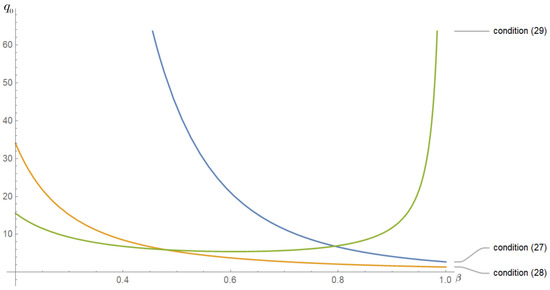
Consider the special case of (26) when . Figure 1 shows the lower bounds of the values of parameter for conditions (27)–(29). We note that these conditions are different from each other, and one of them cannot include the other along .
Figure 1.
The minimum values of for which conditions (27)–(29) are satisfied.
2.2. Asymptotic Behavior
Theorem 4.
Let ν be an eventually positive solution of (1) and . If
then ν converges to zero.
Proof.
Suppose that is an eventually positive solution of (1) and . Now, since is positive and decreasing, we obtain that .
Assume that . Then, for , there is such that , for all . Taking Hence, we have
where . From (1) and (31), we obtain
Integrating this inequality from l to ∞, we obtain
and
Integrating (32) from l to ∞ and integrating the resulting inequality from to ∞, we obtain
From Lemma 2, we have for . Since is a negative increasing function, we find that . Hence, (33) becomes
Therefore,
which contradicts (30). This implies , and so . □
Theorem 5.
If condition (30) and one of conditions (8), (16), or (17) are satisfied, then Equation (1) is almost oscillatory.
Proof.
Assume that is an eventually positive solution of (1) on . It follows from Lemma 2 that or , for . However, any of conditions (8), (16), or (17) guarantee that , and thus the possibility of is ruled out. On the other hand, condition (30) ensures that every eventually positive solution of (1) converges to zero. □
3. Conclusions
Our interest in this work is to study the asymptotic behavior of solutions of third-order differential equations that include a middle term and several delays. The study of odd-order differential equations did not obtain the same attention as the even-order differential equations. This is due to the many analytical difficulties and the many possibilities of derivatives of solutions.
After classifying the positive solutions of the studied equation, we obtained some relationships that link the derivatives of these solutions. Then, we employed these relationships to obtain an iterative relationship between the solution and its corresponding function. Using this relationship, we obtained different forms of criteria that ensure that there are no solutions in class Q. Finally, we set new conditions that ensure that all non-oscillatory solutions to Equation (1) converge to zero.
To find criteria that ensure the oscillation of all solutions of the studied equation, we need a criterion that excludes the so-called Kenser solutions, which are those that have a corresponding function whose sign differs from the sign of its first derivative. It would be interesting to find criteria that ensure that all solutions of Equation (1) oscillate. In addition, it is also interesting to obtain new oscillation criteria for the studied differential equation in the noncanonical case, that is, when
Author Contributions
Conceptualization, B.A., O.M., M.A. and B.Q.; methodology, B.A., O.M., M.A. and B.Q.; investigation, B.A., O.M., M.A. and B.Q.; writing—original draft preparation, B.A. and M.A.; writing—review and editing, O.M. and B.Q. All authors have read and agreed to the published version of the manuscript.
Funding
Princess Nourah bint Abdulrahman University Researchers Supporting Project number (PNURSP2023R216), Princess Nourah bint Abdulrahman University, Riyadh, Saudi Arabia.
Data Availability Statement
Not applicable.
Acknowledgments
We are grateful for the insightful comments offered by the anonymous reviewers. We also thank the Princess Nourah bint Abdulrahman University Researchers Supporting Project number (PNURSP2023R216), Princess Nourah bint Abdulrahman University, Riyadh, Saudi Arabia.
Conflicts of Interest
The authors declare no conflict of interest.
References
- Hale, J.K. Functional Differential Equations, Oxford Applied Mathematical Sciences; Springer: New York, NY, USA, 1971; Volume 3. [Google Scholar]
- Rihan, F.A. Delay Differential Equations and Applications to Biology; Springer Nature Singapore Pte Ltd.: Singapore, 2021. [Google Scholar]
- Li, T.; Baculíková, B.; Džurina, J.; Zhang, C. Oscillation of fourth-order neutral differential equations with p-Laplacian like operators. Bound. Value Probl. 2014, 2014, 56. [Google Scholar] [CrossRef]
- Liu, Q.; Bohner, M.; Grace, S.R.; Li, T. Asymptotic behavior of even-order damped differential equations with p-Laplacian like operators and deviating arguments. J. Inequal. Appl. 2016, 2016, 321. [Google Scholar] [CrossRef]
- Zhang, C.; Agarwal, R.P.; Li, T. Oscillation and asymptotic behavior of higher-order delay differential equations with p-Laplacian like operators. J. Math. Anal. Appl. 2014, 409, 1093–1106. [Google Scholar] [CrossRef]
- Ferreira, J.M.; Ford, N.J.; Malique, M.A.; Pinelas, S.; Yan, Y. Analytical and numerical treatment of oscillatory mixed differential equations with differentiable delays and advances. J. Comput. Appl. Math. 2011, 235, 5112–5130. [Google Scholar] [CrossRef]
- Lima, P.M.; Teodoro, M.F.; Ford, N.J.; Lumb, P.M. Finite element solution of a linear mixed-type functional differential equation. Numer. Algorithms 2010, 55, 301–320. [Google Scholar] [CrossRef]
- Lima, P.M.; Ford, N.J.; Lumb, P.M. Computational methods for a mathematical model of propagation of nerve impulses in myelinated axons. Appl. Numer. Math. 2014, 85, 38–53. [Google Scholar] [CrossRef]
- Baculíková, B. Oscillatory behavior of the second order noncanonical differential equations. Electron. J. Qual. Theory Differ. Equ. 2019, 89, 1–11. [Google Scholar] [CrossRef]
- Baculíková, B. Oscillation of second-order nonlinear noncanonical differential equations with deviating argument. Appl. Math. Lett. 2019, 91, 68–75. [Google Scholar] [CrossRef]
- Džrina, J.; Jadlovská, I. A note on oscillation of second-order delay differential equations. Appl. Math. Lett. 2017, 69, 126–132. [Google Scholar] [CrossRef]
- Chatzarakis, G.E.; Moaaz, O.; Li, T.; Qaraad, B. Some oscillation theorems for nonlinear second-order differential equations with an advanced argument. Adv. Differ. Equ. 2020, 2020, 160. [Google Scholar] [CrossRef]
- Bohner, M.; Grace, S.R.; Jadlovská, I. Sharp oscillation criteria for second-order neutral delay differential equations. Math. Meth. Appl. Sci. 2020, 43, 10041–10053. [Google Scholar] [CrossRef]
- Grace, S.R.; Dzurina, J.; Jadlovská, I.; Li, T. An improved approach for studying oscillation of second-order neutral delay differential equations. J. Inequal. Appl. 2018, 2018, 193. [Google Scholar] [CrossRef] [PubMed]
- Moaaz, O.; Elabbasy, E.M.; Qaraad, B. An improved approach for studying oscillation of generalized Emden–Fowler neutral differential equation. J. Inequal. Appl. 2020, 2020, 69. [Google Scholar] [CrossRef]
- Moaaz, O.; Anis, M.; Baleanu, D.; Muhib, A. More effective criteria for oscillation of second-order differential equations with neutral arguments. Mathematics 2020, 8, 986. [Google Scholar] [CrossRef]
- Selvarangam, S.; Madhan, M.; Thandapani, E.; Pinelas, S. Improved oscillation conditions for third-order neutral type difference equations. Electron. J. Diff. Equ. 2017, 2017, 1–13. [Google Scholar]
- Yeniçerioğlu, A.F.; Pinelas, S.; Yan, Y. On the behavior of the solutions for linear autonomous mixed type difference equation. Rend. Del Circ. Mat. Palermo Ser. 2 2020, 69, 787–801. [Google Scholar] [CrossRef]
- Vidhyaa, K.S.; Dharuman, C.; Thandapani, E.; Pinelas, S. Oscillation theorems for third order nonlinear delay difference equations. Math. Bohem. 2019, 144, 25–37. [Google Scholar] [CrossRef]
- Baculíková, B.; Džurina, J. Oscillation of third-order neutral differential equations. Math. Comp. Modell. 2010, 52, 215–226. [Google Scholar] [CrossRef]
- Baculíková, B.; Džurina, J. On the asymptotic behavior of a class of third order nonlinear neutral differential equations. Open Math. 2010, 8, 1091–1103. [Google Scholar] [CrossRef]
- Thandapani, E.; Li, T. On the oscillation of third-order quasi-linear neutral functional differential equations. Arch. Math. 2011, 47, 181–199. [Google Scholar]
- Aktas, M.F.; Tiryaki, A.; Zafer, A. Oscillation criteria for third-order nonlinear functional differential equations. Appl. Math. Lett. 2010, 23, 756–762. [Google Scholar] [CrossRef]
- Grace, S.R. Oscillation criteria for third-order nonlinear delay differential equations with damping. Opusc. Math. 2015, 35, 485–497. [Google Scholar] [CrossRef]
- Tiryaki, A.; Aktas, M.F. Oscillation criteria of a certain class of third-order nonlinear delay differential equations with damping. J. Math. Anal. Appl. 2007, 325, 54–68. [Google Scholar] [CrossRef]
- Moaaz, O.; Elabbasy, E.M.; Shaaban, E. Oscillation criteria for a class of third order damped differential equations. Arab J. Math. Sci. 2018, 24, 16–30. [Google Scholar] [CrossRef]
- Moaaz, O.; Baleanu, D.; Muhib, A. New aspects for non-existence of kneser solutions of neutral differential equations with odd-order. Mathematics 2020, 8, 494. [Google Scholar] [CrossRef]
- Kiguradze, I.; Chanturia, T. Asymptotic Properties of Solutions of Nonautonomous Ordinary Differential Equations; Kluwer Acad. Publ.: Drodrcht, The Netherlands, 1993. [Google Scholar]
- Philos, C.G. On the existence of nonoscillatory solutions tending to zero at ∞ for dif ferential equations with positive delays. Arch. Math. 1981, 36, 168–178. [Google Scholar] [CrossRef]
- Kitamura, Y.; Kusano, T. Oscillation of first-order nonlinear differential equations with deviating arguments. Proc. Am. Math. Soc. 1980, 78, 64–68. [Google Scholar] [CrossRef]
Disclaimer/Publisher’s Note: The statements, opinions and data contained in all publications are solely those of the individual author(s) and contributor(s) and not of MDPI and/or the editor(s). MDPI and/or the editor(s) disclaim responsibility for any injury to people or property resulting from any ideas, methods, instructions or products referred to in the content. |
© 2023 by the authors. Licensee MDPI, Basel, Switzerland. This article is an open access article distributed under the terms and conditions of the Creative Commons Attribution (CC BY) license (https://creativecommons.org/licenses/by/4.0/).