
Abstract
In the context of uniformly convex Banach space, this paper focuses on examining the strong convergence of the iterative algorithm to the fixed point of a strongly pseudocontractive mapping. Furthermore, we demonstrate through numerical methods that the iterative algorithm converges strongly and faster than other current iterative schemes in the literature and extends to the fixed point of a strong pseudocontractive mapping. Finally, under a nonlinear quadratic Volterra integral equation, the application of our findings is shown.
Keywords:
strong pseudocontractive mappings; strong convergence; F* algorithm; nonlinear quadratic Volterra integral equations; fixed point MSC:
45D05; 65E10
1. Introduction
Throughout this work, Z will be a real Banach space and X a uniformly convex set. H is considered to be a self-map, is the domain of the map H, and is the set of fixed points of the map H.
A self-mapping H is said to be
- L-Lipschitizian if there exists such that for allif , then H is called nonexpansive, while H is called a contraction if .
- k-strongly pseudocontractive if there exists a constant such that
- Accretive if such that
Remark 1.
From [1], (2) and (3) above are equivalent.
Remark 2.
From inequality (2) above, ref. [2] obtained the following inequalities:
and
Then, the mapping H is considered to be strongly pseudocontractive if
Remark 3.
A strongly pseudocontractive mapping is said to be a strongly ϕ-pseudocontractive mapping, given ϕ defined as for where the converse is not needed to be true.
- 4.
- A mapping H is said to be strongly -pseudocontractive if and having a strictly increasing function with such that
Remark 4.
A strongly ϕ-pseudocontractive mapping is said to be generalized strongly Φ-pseudocontractive mapping with defined by where the converse is not needed to be true.
- 5.
- A mapping H is said to be generalized strongly -pseudocontractive ∀, having and a strictly increasing function with such that
Picard iteration: In 1890 [3], Picard discovered an iterative scheme called Picard iteration which was used to estimate fixed points of nonexpansive mappings:
The Mann iterative approach was developed in [4] to estimate fixed points of nonexpansive mappings:
Also, it was known that the Mann iterative scheme fails to converge to a fixed point of pseudocontractive mapping. The author in [5] established a two-step Mann (Ishikawa) iterative scheme which was firstly used to estimate fixed points of pseudocontractive mappings. The iterative scheme was later used on nonexpansive mappings without any assumption on the convexity of the Banach space:
S iteration: A two-step iterative scheme called an S iterative scheme was initiated in [6] and was applied for nearly asymptotically nonexpansive mapping:
Normal-S iteration: Sahu established in [2] an iterative scheme called the normal-S iterative scheme for nonexpansive mapping, defined as
iteration: To determine the fixed points of weak contractions in Banach spaces, the authors in [7] developed a novel two-step iterative approach known as iteration. It was demonstrated that the built-in method firmly converges to the fixed point of weak contractions. Additionally, it was demonstrated that the iterative scheme converged to a fixed point more quickly than the Picard, Mann, Ishikawa, S, normal-S, and Varat iterative schemes:
However, the iteration produced a data-dependent result. Additionally, numerical illustrations were provided to corroborate their findings. Their findings were also applied to estimate the solution of the Volterra integral equation that is both nonlinear and quadratic. Finally, in the researchers’ work there arose an open question: “Can the sequence generated by the iterative scheme converge to a fixed point of nonexpansive or pseudocontractive mappings?”
In response to this, our research is motivated by employing pseudocontractive mappings for the convergence of the sequence generated by iteration to a fixed point. To achieve the desired result, certain existing inequalities in convex Banach spaces were utilized following the assumption of the existence of a fixed point. Other necessary conditions for convergence of the sequence generated by the algorithm to the fixed point of strong pseudocontractive mapping were also obtained.
1.1. Various Results on Convergence
In [8], the following iteration method was considered:
where , for all and
Given a sequence in Z satisfying (1), for all and for all and the real sequence , satisfying
- (c1)
- ;
- (c2)
- ;
- (c3)
- ;
- (c4)
If are bounded sets, then converges strongly to and is a singleton.
In [9], the author proposed a new iterative scheme which was used in investigating the estimations of fixed points for nonexpansive mappings. The proposed iterative scheme generalized both Mann [4] and Ishikawa [5] iterative schemes, which have been studied rigorously by many researchers for estimating fixed points solutions of nonlinear mapping in Banach spaces. Stevic, in [8], examined the convergence of the iterative scheme given in (1) for strongly pseudocontractive mappings and a class of difference inequalities was examined which frequently appears in the investigation of the proposed iterative scheme. The newly introduced iterative scheme was later used in [8] to examine the convergence for strongly pseudocontractive mappings.
Theorem 1
([10]). Given that Z is a real Banach space with a uniformly convex dual space and D is a bounded closed convex subset of Z. If is a single-valued Lipschitz strongly pseudocontractive mapping, then the Ishikawa iterative scheme of H converges strongly to a unique fixed point of H.
Theorem 2.
Assume that Z is a real uniformly smooth Banach space and D is a bounded closed convex and nonempty subset of Z. Given that is a strongly pseudocontractive map such that for some . Setting , to be real sequences satisfying the following conditions:
- (a.)
- , ∀;
- (b.)
- ; ;
- (c.)
- .
So, for arbitrary , the sequence given in the iterative form by
converges strongly to . However, is unique.
Theorem 3
([11]). Given that Z is a real Banach space with a uniformly convex dual , D is a nonempty closed convex bounded subset of Z, and is a continuous strongly pseudocontractive mapping. So, the Ishikawa iterative sequence defined in [5] converges strongly to the unique fixed point of H.
Theorem 4.
Let be an arbitrary point in Z. Suppose is a sequence in Z which satisfies the recursive Formula (1), is a sequence in Z such that
where is a set of sequences in a real Banach space Z and such that are k real sequences in satisfying under the following conditions:
- (c1.)
- ;
- (c2.)
- , ;
- (c3.)
- , ;
- (c4.)
- .
Then,
- (i)
- the sequence is almost H-stable;
- (ii)
- implies .
1.2. Nonlinear Quadratic Volterra Integral Equation
The authors in [12] investigated the monotonicity properties of the superposition operator and its applications. It was stated that an application of the monotonicity properties directly examines the solvability of a quadratic Volterra integral equation given in the form
where x and g are elements of a Frechet space J, f is a linear continuous map from , and u is a nonlinear map from such that
Several problems in science, physics, engineering and related disciplines lead to linear and nonlinear Volterra integral equations of both the first and second kind. These equations are often difficult to solve analytically but an approximated solution can be provided using numerical techniques (see [13,14,15,16,17,18]).
1.3. Useful Lemmas
The lemmas below will be helpful in showing our main results.
Lemma 1
([19]). Suppose is a normalized duality mapping; then,
for all where
Lemma 2
([11]). Given that is a set of non-negative real sequences satisfying
where , and Then, as
2. Main Results
In this section, we will prove the strong convergence theorem for the iterative method for a strongly pseudocontractive mapping in uniformly convex Banach space.
Theorem 5.
Let Z be a real Banach space with a uniformly convex dual D be a nonempty closed convex bounded subset of Z and be a continuous strongly pseudocontractive mapping. Then, the iterative sequence defined by
where and converges strongly to the unique fixed point of H.
Proof.
The existence of a fixed point follows from [20].
Let p be a unique fixed point of H. Since is strongly pseudocontractive, is strongly accretive, where I is the identity operator and for every
Recall that implies , which gives the inequality below
where
Now, we shall show as . We observed that is bounded; then, to show as , it suffices to show
Truly, since is uniformly convex, j is uniformly continuous on any bounded subset of X. Noting that
so we see that
where
We choose a large positive integer N such that for all , then
Thus, the above inequality yields
Setting and . Then,
with
and
By Lemma 2, (6) yields as . □
3. Application to Nonlinear Quadratic Volterra Integral Equation
In this section, the solution estimated by the iterative process for a nonlinear quadratic Volterra integral problem will be discussed. So, we look at Equation (2) for the nonlinear quadratic Volterra integral, taking into account that the following claims are true:
- (D1)
- and g is non-negative and nondecreasing on
- (D2)
- The function such that the following restrictions hold:
- (i)
- f on the set is continuous;
- (ii)
- For , both fixed, the functions and are increasing on J and K, respectively, and is Lipschitz with respect to x, given that . However, f is positive on the set since is not bounded and .
- (D3)
- An increasing function :, for any and ∀.
- (D4)
- A function is continuous, such that , for arbitrarily fixed and and the function is increasing on J.
- (D5)
- A nondecreasing map for and
- (D6)
- There is a positive solution for the inequalitywhere . Moreover, .
Now, the existence result follows as proved in [12] and which was later used in [7].
Theorem 6.
Under the assertions –, Equation (2) has a minimum of a solution that is increasing and positive on the interval There follow some assertions for the estimation of the result of the integral Equation (2). Let for ⊂ and , where comes from assertion , is nonempty since is a closed bounded convex subset of .
If the Lipschitz condition with respect to x holds, i.e., for and for , then ∃:
in assertion satisfies the following inequality:
So, we define an operator H on the set by
According to the proof provided in [12], H transforms the set into itself as well as P. Additionally, H has at least one fixed point in and is continuous on .
Now, we show that the operator H is strongly pseudocontraction on , and then, for , we have
By assumption , we have that
Let and by , we have
Thus, operator S is a pseudocontraction which satisfies the inequality below:
Taking , , and H as in Equation (7), we obtain our desired result.
As stated in Theorem 2, we consider that is the fixed point of So, we show that as . Substituting the iterative scheme , Equation , and conditions –, we have
Substituting (8) into (9), we have
therefore,
Substituting (10) into (11):
Applying assumption :
which implies also that
then, we have Equation (12) as
Thus, it follows by induction that we have
Since for all , using assumption gives
Accepting the fact that , ∀, where Equation can be written as
taking the of both sides, it yields , implying
Hence, the sequence generated by iterative scheme (5) converges strongly to the unique solution of integral Equation (7).
4. Numerical Examples
Example 1.
Let be a Banach space with usual norm and . Let . The map is a self-mapping defined by
for all . We can easily verify that H is a strongly pseudocontractive mapping and has a fixed point . Now, we choose and with the initial guess .
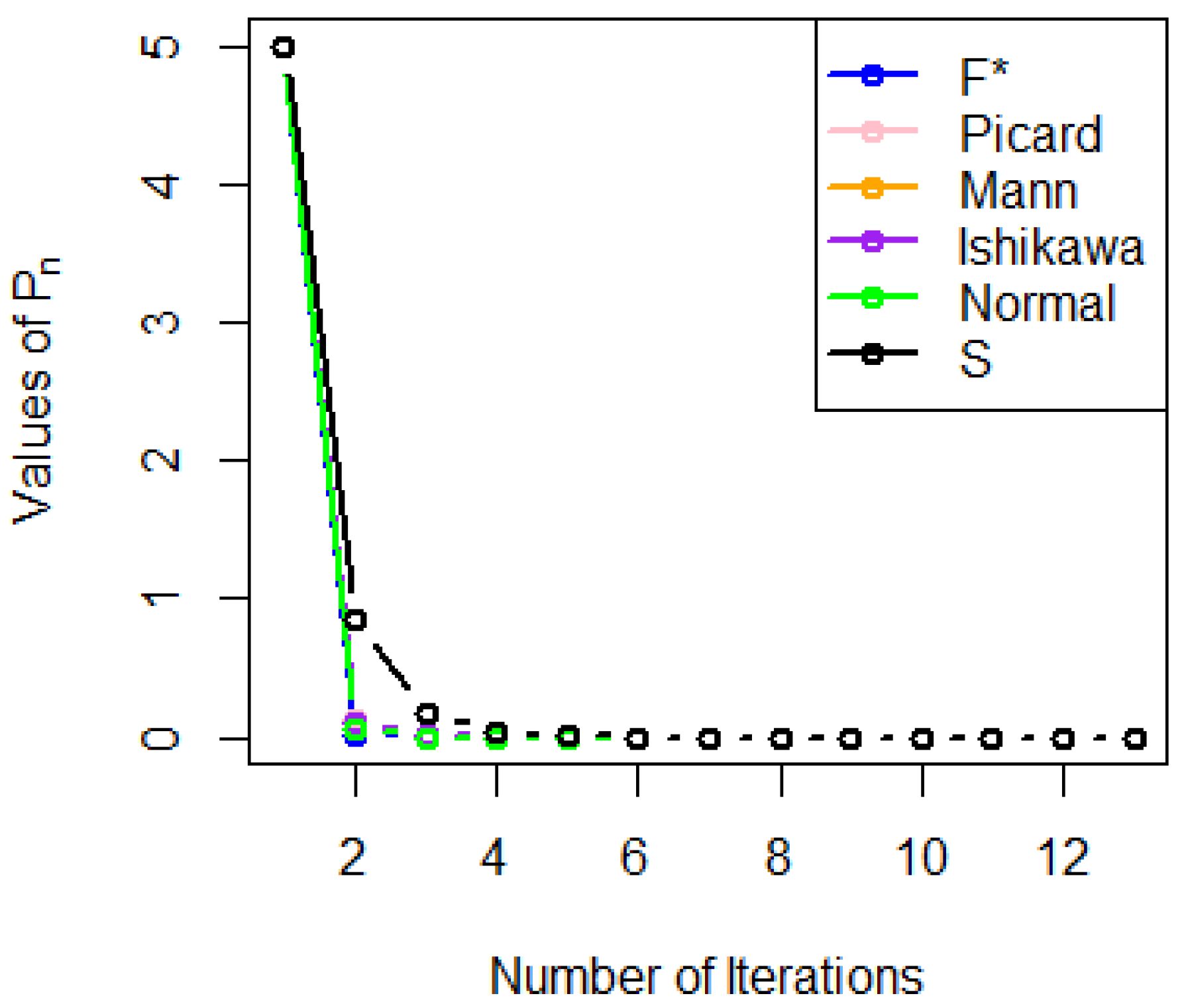
From Table 1, we observe that the numerical results for iterative scheme (5) converge strongly and faster to zero at the sixth iteration when compared to the normal-S iterative scheme, which is the closest and converges among the other iterative schemes presented for the Volterra integral equation. Hence, the iterative scheme converges faster and better than the other iterative schemes existing in the literature. We present a graphical representation of our result in Figure 1.
Table 1.
Comparison of different iterative schemes for Example 1.
Figure 1.
Figure to compare different iterative schemes for Example 1. are the values obtained during the iteration as n increases.
Example 2.
Let be a Banach space with usual norm and . Let . The map is a self-mapping defined by
for all . We can easily verify that H is a strongly pseudocontractive mapping and has a fixed point . Now, we choose and , with the initial guess .
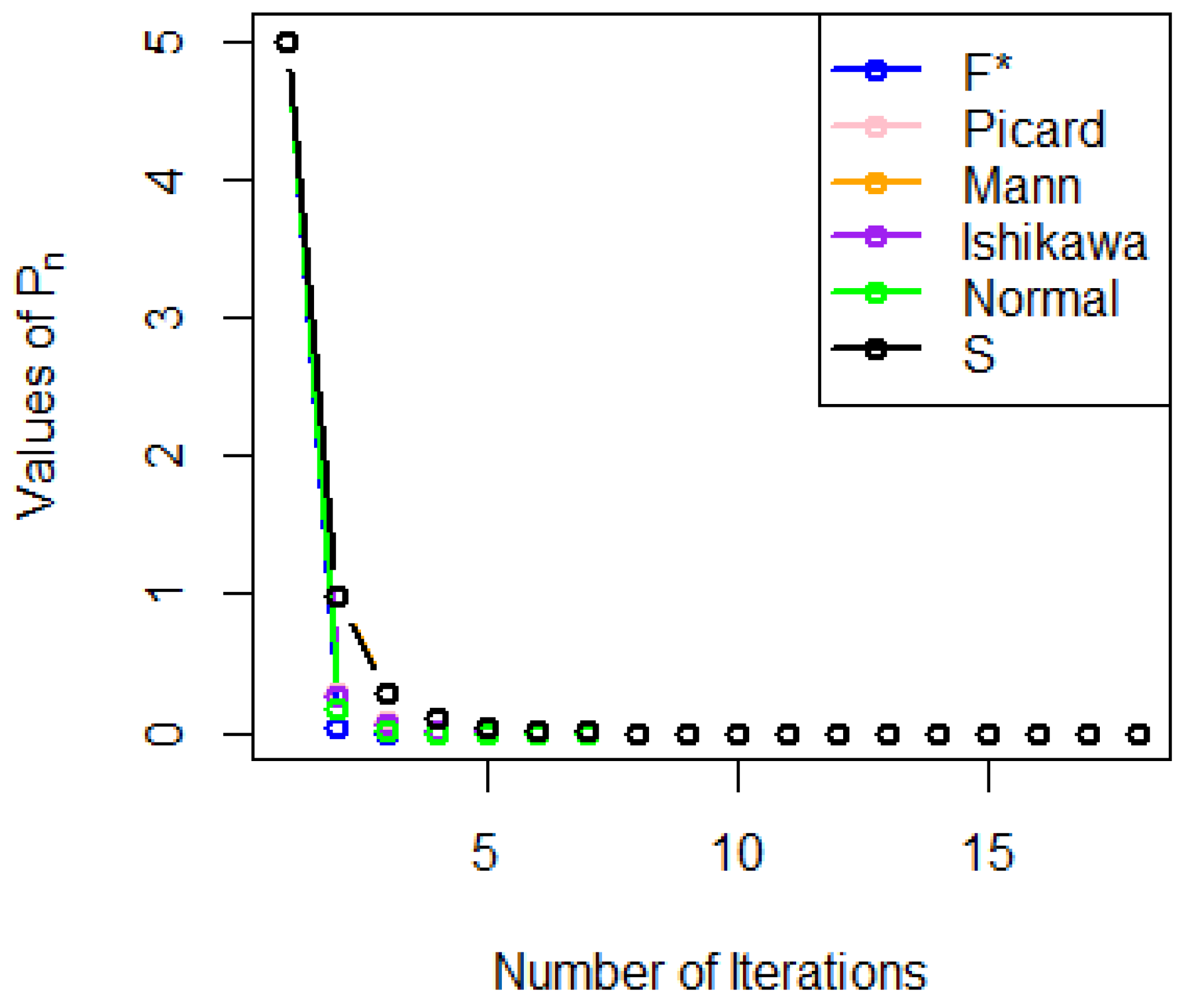
From Table 2, we observe that the numerical results for iterative scheme (5) converge strongly and faster to zero at the fourth iteration when compared to the normal-S iterative scheme, which converges at the seventh iteration and is the closest to our algorithm among the other iterative schemes in the literature. We present a graphical representation of our result in Figure 2.
Table 2.
Comparison of different iterative schemes for Example 2.
Figure 2.
Figure to compare different iterative schemes for Example 2. are the values obtained during the iteration as n increases.
5. Conclusions
The historical development and application of pseudocontractive mapping with fixed point theory were extensively discussed in [21] and are a major subject of this work. In this paper, we investigated the convergence of an iterative scheme for a strongly pseudocontractive mapping on a uniformly convex Banach space. Using numerical examples, it has been found that the approach converges more quickly than the Picard, Mann, Ishikawa, S, normal-S iterative schemes for a strongly pseudocontractive mapping. This research work has studied the use of all of the generalized classes of strongly pseudocontractive mappings.
Author Contributions
Conceptualization, F.D.A., F.M.N., H.J. and T.P.F.; methodology, F.D.A., F.M.N., H.J. and T.P.F.; software, F.D.A., F.M.N., H.J. and T.P.F.; validation, F.D.A., F.M.N., H.J. and T.P.F.; formal analysis, F.D.A., F.M.N., H.J. and T.P.F.; investigation, F.D.A., F.M.N., H.J. and T.P.F.; resources, K.O.; writing—original draft, F.D.A., F.M.N., H.J. and T.P.F.; writing—review and editing, F.D.A., F.M.N., H.J., T.P.F. and K.O.; visualization, F.M.N., H.J. and T.P.F.; supervision, F.M.N. and K.O.; project administration, F.M.N. and K.O.; funding acquisition, K.O. All authors have read and agreed to the published version of the manuscript.
Funding
This research received no external funding.
Data Availability Statement
Data are contained within the article.
Acknowledgments
The authors would like to express their heartfelt gratitude to the reviewers for their attentive reading, helpful criticism, and insightful recommendations that significantly enhanced the manuscript. The authors would like to appreciate the Black in Mathematics Association (BMA) for providing the collaborative platform to carry out this research.
Conflicts of Interest
The authors declare no conflict of interest.
References
- Kato, T. Nonlinear semigroup and evolution equations. J. Math. Soc. Jpn. 1967, 19, 508–520. [Google Scholar] [CrossRef]
- Bogin, J. On Strict Pseudocontractive and a Fixed Point Theorem; Technion Preprint Series No. MT-219; Israel Institute of Technology: Haifa, Israel, 1974. [Google Scholar]
- Cracium, C.; Serban, M.A. A nonlinear integral equation via Picard operators. Fixed Point Theory 2011, 12, 57–70. [Google Scholar]
- Mann, W.R. Mean value methods in iteration. Proc. Am. Math. Soc. 1953, 4, 506–510. [Google Scholar] [CrossRef]
- Ishikawa, S. Fixed points by a new iteration method. Proc. Am. Math. Soc. 1974, 44, 147–150. [Google Scholar] [CrossRef]
- Agrawal, R.P.; O’Regan, D.; Sahu, D.R. Iterative construction of fixed points of nearly asymtotically nonexpansive mappings. J. Nonlinear. Convex. Anal. 2007, 8, 61–79. [Google Scholar]
- Ali, F.; Ali, J. Convergence, stability, and data dependence of a new iterative algorithm with an application. J. Comp. Appl. Math. 2020, 39, 267. [Google Scholar] [CrossRef]
- Stevic, S. Approximating fixed points of strongly pseudocontractive mappings by a new iteration method. Appl. Anal. 2000, 84, 89–102. [Google Scholar] [CrossRef]
- Stevic, S. Approximating fixed points of nonexpansive mappings by a new iteration method. Bull. Inst. Math. Acad. Sin. (New Ser.) 2006, 1, 437–450. [Google Scholar]
- Chidume, C.E. Approximation of fixed points of strongly pseudocontractive mappings. Proc. Am. Math. Soc. 1994, 120, 545–551. [Google Scholar] [CrossRef]
- Zhou, H.Y.; Jia, Y. Approximation of fixed points of strongly pseudocontractive maps without lipschitz assumptions. Proc. Am. Soc. 1997, 125, 1705–1709. [Google Scholar]
- Banas, J.; Sadarangani, K. Properties of the superposition operator and their applications. J. Math. Anal. Appl. 2008, 340, 1385–1394. [Google Scholar] [CrossRef]
- Brunner, H.; van der Houwen, P.J. The Numerical Solution of Volterra Equations; CWI Monographs: Amsterdam, The Netherlands, 1986; Volume 3. [Google Scholar]
- Delves, L.M.; Mohamed, J.L. Computational Methods for Integral Equation; Cambridge University Press: Cambridge, MA, USA, 1985. [Google Scholar]
- Grossman, S.I. Existence and stability of a class of nonlinear Volterra integral equation. Trans. Am. Math. Soc. 1970, 150, 541–556. [Google Scholar] [CrossRef]
- Maryam, G.A.; Faizan, A.K.; Ali, F. An iterative algorithm to approximate fixed points of nonlinear operators with application. Mathematics 2022, 10, 1132. [Google Scholar]
- Gursoy, F. Application of normal S-iterative method to a nonlinear integral equation. Sci. World J. 2014, 2014, 943127. [Google Scholar] [CrossRef] [PubMed][Green Version]
- Ali, F.; Ali, J.; Rodriguez-Lopez, R. Approximation of fixed points and the solution of a nonlinear integral equation. Nonlinear Funct. Anal. Appl. 2021, 26, 869–885. [Google Scholar]
- Xu, H.K. Inequality in Banach spaces with applications. Nonlinear Anal. 1991, 16, 1127–1138. [Google Scholar] [CrossRef]
- Deimling, K. Zeros of accretive operators. Manuscripts Math. 1975, 13, 399–414. [Google Scholar] [CrossRef]
- Sahu, C.K.; Srivastava, S.C.; Biswas, S. History, development and application of pseudocontractive mapping with fixed point theory. Int. J. Math. Trends Technol. 2020, 66, 2231–5373. [Google Scholar] [CrossRef]
Disclaimer/Publisher’s Note: The statements, opinions and data contained in all publications are solely those of the individual author(s) and contributor(s) and not of MDPI and/or the editor(s). MDPI and/or the editor(s) disclaim responsibility for any injury to people or property resulting from any ideas, methods, instructions or products referred to in the content. |
© 2023 by the authors. Licensee MDPI, Basel, Switzerland. This article is an open access article distributed under the terms and conditions of the Creative Commons Attribution (CC BY) license (https://creativecommons.org/licenses/by/4.0/).