


Abstract
Let R be a finite ring. In this paper, we mainly explore the conditions to ensure the graph defined by a system of equations to be a Cayley graph or a Hamiltonian graph. More precisely, we prove that is a Cayley graph with a group of dihedral type if and only if the system is Cayley graphic of dihedral type in R. As an application, the well-known Lovsz Conjecture, which states that any finite connected Cayley graph has a Hamilton cycle, holds for the connected defined by Cayley graphic system of dihedral type in the field .
MSC:
05C25; 05C45; 17B67
1. Introduction
The graph defined by a system of equations over a finite ring R have been extensively studied and used since the 1990s. The construction of graph is motivated by the problems from extremal graph theory (see [1,2] for details), and the concrete construction was originally due to [3]. The construction of the graphs by systems of equations provides a useful tool to study graph theory, for instance, constructing the graphs and , to approximate the structure and behavior of incidence graphs of regular generalized polygons [4], establishing the lower bound of the Ramsey numbers of graphs associated to generalized Kac–Moody algebras of rank two [5] and hypergraphs [6], and constructing certain graphs with given properties [1,7,8]. In addition, Lazebnik and Woldar [3] established some important properties including regularity and bi-regularity, existence of special vertex colorings, and existence of covering maps of . Additional properties of can be found in the survey [9] and the references therein. Moreover, the girth [8,10,11,12] and the classification up to isomorphisms [13] of graph are further considered recently.
It is natural to study other properties of graph . For example, Lazebnik et al. [14] explored the condition to ensure the graphs to be semisymmetric or connected. They proved that is semisymmetric if is a finite field for any and . Moreover, some open problems of were raised up in [3] including when is a Cayley graph or Hamiltonian graph. Cayley graphs are those graphs whose vertices are identified with elements of groups and adjacency relations are defined by subsets of the groups.
The present paper aims to study the question of when is a Cayley graph. To be more precise, we consider a class of function systems and we call them Cayley graphic function systems of dihedral type, which ensures to be a Cayley graph. The main theorem is as follows.
Theorem 1.
The graphis a Cayley graph on some groupof dihedral type withand A uniform if and only if the function systemis Cayley graphic of dihedral type (see Definition 5) in R.
Cayley graphs are widely studied together with Hamiltonian graphs (see [15,16] for example), where Hamiltonian graphs are those graphs having a cycle visiting every vertex exactly once. A variant of the well-known Lovsz Conjecture on Hamiltonian paths states that every finite connected Cayley graph has a Hamilton cycle. Many people focus on discussing the special case of the above conjecture (see [15,17,18,19,20]). We pay attention to these results and then study the Hamiltonicity of graph .
Furthermore, we consider the Hamiltonicity of this class of graphs and we have two following theorems; note that Theorem 3 supports the Lovsz Conjecture.
Theorem 2.
Let R be a finite ring withan even positive integer, andbe a connected graph detemined by the function system, which is Cayley graphic of dihedral type. Thenis Hamilton-laceable, i.e., for any vertices u and v from two distinct parts in the bipartite graph, there is a Hamilton path whose terminal vertices are u and v.
Theorem 3.
Letbe a field, for some prime p. Ifis Cayley graphic of dihedral type in R andconnected, thenhas a Hamilton cycle.
The paper is organized as follows: in Section 2, we recall the definition and some properties of the graph . We prove our main theorem in Section 3, i.e., the function system is Cayley graphic of dihedral type in R if and only if is a Cayley graph with the group is of dihedral type with A satisfying so-called uniform condition (see Definition 4). The last section of this paper mainly study the Hamiltonicity of graph .
2. The Graphs Defined by Systems of Equations
In this section, we will recall the definition of the graph defined by systems of equations.
Throughout this paper, for a graph , we always denote by the vertex set and by the edge set. The element of connecting two vertices will be written as .
Definition 1.
([3], Section 2.1) Let be an arbitrary function, . We define the bipartite graph as follows. The set of vertices is the disjoint union of two copies of , one denoted by and the other by . Elements of will be called points and those of lines. In order to distinguish points from lines we introduce the use of parentheses and brackets: if , then and . We define edges of by declaring point and line to be adjacent if and only if the following relations on their coordinates hold:
For a function , we define by the rule . We call symmetric if the functions and coincide.
Evidently, if the order of R is , then the number of vertices of graph is , i.e., .
There is another fundamental family of graphs as follows if all functions are symmetric.
Definition 2.
([3], Section 2.2) Let be symmetric for all . We define to be the graph with vertex set , where distinct vertices (vectors) and are adjacent if and only if the following relations on their coordinates hold:
Let be a graph. We say that has a loop at vertex v provided that there is an edge connecting v and itself. The following proposition can be deduced directly by the definition, see [3,9] for details and more properties of and .
Proposition 1.
([3], Proposition 2) If , has a loop at vertex if and only if
for all .
Now we recall the definitions related to the automorphism group.
Definition 3.
([21], Section 15) An automorphism of a simple graph is a bijection such that vertex u is adjacent to v is an edge of if and only if is adjacent to is an edge of .
The group consisting of all automorphisms of is called the automorphism group of , and we denote it by .
The following example appears in Section 3.5 of paper [9].
Example 1.
For any , the map is an automorphism of , where
for any .
For convenience, we denote by (resp. ) the k-th coordinate of (resp. ), and by the sequence of variables for any , where and .
Definition 4.
An automorphism is uniform if
- (1)
- maps points to points and lines to lines, i.e., ;
- (2)
- and for all if there is some such that for all , and ;
- (3)
- for all , and , we havewhere .
Moreover, a subset is called to be uniform if S consists of uniform automorphisms.
Remark 1.
In the above definition,
- (1)
- for the second condition, k and x are not necessary to be unique and we can take the identity automorphism for example;
- (2)
- the third condition can be seem as a generalization of automorphism of graph , as any automorphism of graph satisfies that both the left side and the right side of Equation (1) equal to 0 for two adjacent points and .
Now we introduce Cayley graphic functions of dihedral type.
Definition 5.
We call the function system to be Cayley graphic of dihedral type in R, if there is a uniform subset and lies in , such that
- (1)
- and ;
- (2)
- and for all ;
- (3)
- for all .
We have a property for Cayley graphic functions of dihedral type in R.
Proposition 2.
Let the function system be Cayley graphic of dihedral type in R. Then there is a uniform subset , such that
- (1)
- and for all ;
- (2)
- for all ;
- (3)
- when , the sum of all odd functions (i.e. ) in the additive terms of is 0.
Proof of Proposition 2.
Evidently, is uniform if and are uniform (by a straightforward check). When , if the sum of all odd functions in the additive terms of is , which is nonzero, we replace the automorphism with . Repeating the replacement finitely many steps, we obtain the automorphisms as required. □
In what follows, for Cayley graphic function system of dihedral type, we always take uniform automorphisms in the previous proposition.
We further explain the definition and introduce the functions and , associated to .
Remark 2.
By Proposition 1 in [3], if are symmetric then is an automorphism. Moreover, if and only if for . Now we set
for all . Let and for all . Since is uniform, by Definition 4 (3) follows
for all and .
For convenience, we write and for short unless stated otherwise. Note that the existence of functions and is equivalent to the existence of .
Example 2.
If , , then
Set . It is straightforward to check that is Cayley graphic of dihedral type in R.
By Definition 5, Proposition 2, and Remark 2, we obtain the uniqueness of and for Cayley graphic functions of dihedral type in R.
Proposition 3.
If is Cayley graphic of dihedral type in R, then (in terms of the above notations)
- (1)
- the functions and are unique;
- (2)
- we have ;
- (3)
- for the case , the functions and are additive, i.e., if and are functions associated to in another function system that is Cayley graphic of dihedral type, then and are functions associated to ;
- (4)
- the system is Cayley graphic of dihedral type for .
Proof of Proposition 3.
(1) Let us assume the opposite and let and be the functions associated to , respectively. Now we set
By Remark 2,
for all and . We have
Then there is an odd function such that
By Proposition 2 (3), we have
Now we prove the uniqueness of and by induction on i. Suppose that it holds for all , i.e., , , it suffice to prove it for the case i. Similarly, we have
where . Then
Then, there is an odd function such that
By Proposition 2 (3), we have
(2) Since
we have . If , we let
thus by (1).
We have
then . If , we let
By induction on i and (1), we have .
(3) We have
Sum them up, and we have
.
By (1), then and are functions associated to Cayley graphic of dihedral type .
(4) The unique functions and are functions associated to Cayley graphic function system of dihedral type, for . □
3. A Condition for Graphs to Be Cayley Graphs
In this section, we provide a condition to ensure a graph to be a Cayley graph. We first recall the definition of Cayley graph.
Definition 6.
([16], Section 1) Let G be a group and S be a subset of G. A digraph is a Cayley graph with vertex set G and two vertices are adjacent if and only if . Moreover, if for any element , the inverse also lies in S, then the adjacency is symmetric and thus the Cayley graph may be viewed as an undirected graph.
Obviously, the subset S contains the identity of G if and only if the Cayley graph contains a loop at every vertex.
Definition 7.
Let be a graph and H be a subgroup of . H is regular on if
- (1)
- H is transitive on set ,
- (2)
- if satisfies that for any , then is the identity automorphism.
The following properties provides us a criterion to judge whether a graph is a Cayley graph, and we give a complete proof here for the convenience of readers.
Proposition 4.
(([21], Lemma 16.3) ([16], Proposition 1.1)) A graph is a Cayley graph of a group G if and only if contains a subgroup isomorphic to G that is regular on .
Proof of Proposition 4.
Supposed that is a Cayley graph . For any , we define the assignment
It is clear that is a is a permutation on . Note that if and only if and thus . Let , then and . For any two vertices , there exists a unique element maps u to v, and thus acts transitively on . The uniqueness of implies that is a regular subgroup of .
Conversely, we assume that G is a subgroup of and regular on . We will show that is a Cayley graph of G. Let , then G has a unique element such that since G is regular. Set
Now we define a map sending to . Then is adjacent to in if and only if is adjacent to , if and only if is adjacent to , if and only if , and, finally, if and only if is adjacent to in . So f is an isomorphism. □
Let be a finite field and q be the power of odd prime numbers. By Definition 4 of uniform isomorphism in Section 2, it is straightforward to check that without uniform automorphism (except identity automorphism) but is an automorphism.
Lemma 1.
Let be a finite field and q be the power of odd prime numbers. Then is not a Cayley graph.
Proof of Lemma 1.
For any , we consider the 3-path in : . There are at least q paths between two points and . Suppose is a Cayley graph, then it is a vertex transitive graph by Proposition 4. Then there is such that . We get 3-path: , where and . Then and the number of 3-paths between and is strictly less than q, which contradicts that is an automorphism. □
We recall the definition of group of dihedral type.
Definition 8.
([15], Definition 2.21) A group G is of dihedral type if it has an abelian subgroup A of index 2, and an element of order 2, such that for all .
In this case, we write . Note that if A is the cyclic subgroup of order n, then G is precisely the dihedral group .
Lemma 2.
Let . If is Cayley graphic of dihedral type in R, then the automorphism group of admits a subgroup is of dihedral type with elements.
Proof of Lemma 2.
For the graph , we have the automorphism , and the following automorphisms
where and .
Next, we will prove that is an abelian group. We first show the commutativity of these generators, i.e., for any and .
Let and . We denote , , , for the i-th component of , , , respectively, for .
It is straightforward to verify that and for . For the case , suppose that
By induction on i, we have
Let the sum of all odd functions in the additive terms of be (). If , by Definition 5 and Proposition 2, we have for all . Moreover, set for all , and
We have , which contradicts Proposition 3 (1) where
We have . Similarly, let the sum of all odd functions in the additive terms of be , then . With a similar discussion as in the proof of Proposition 3, we have for any .
By Proposition 3 (1)(2), we have and . By a straightforward check, we have , and is an abelian group, and thus is of dihedral type. Moreover, it is clear that , and for any , has r elements. By the commutativity and , the abelian group A has automorphisms and thus is a subgroup of is of dihedral type with elements. □
Now we are ready to prove our main theorem.
Theorem 4.
The function system is Cayley graphic of dihedral type in R if and only if is a Cayley graph on some group of dihedral type with lies in and A uniform.
Proof of Theorem 1.
By Lemma 2 and Proposition 4, we can verify that G is regular on . We have is a Cayley graph where is of dihedral type and A is uniform.
If is a Cayley graph , by Definition 4, then there is , such that
Since , we have
By Proposition 2 and 3 (1), we have and then the theorem follows. □
By Lemma 1, there is a family of non-Cayley graphs with q the power of odd prime number that have no uniform automorphism (except identity automorphism) but satisfy ; therefore the above conditions in Definition 5 are necessary. By the previous theorem, we have two corollaries as follows.
Corollary 1.
The graph is a Cayley graph in the following cases
- (1)
- , where the constants and integers ;
- (2)
- and with constants , where R is a commutative ring;
- (3)
- and with constant , where R is a commutative ring of characteristic p with odd and ;
- (4)
- and with constants , where R is a commutative ring and is an integer;
- (5)
- and with constants , where R is a commutative ring of characteristic p with odd and an integer;
- (6)
- , andfor , where R is a commutative ring of characteristic p with odd, the constants , and integers.
Proof of Corollary 1.
(1) Take , and the statement follows.
(2) Define
Then is Cayley graphic of dihedral type, and is a Cayley graph.
(3) Define
Then is Cayley graphic of dihedral type, and is a Cayley graph.
(4) and (5) follow by (1), (2), (3), and Proposition 3 (3).
(6) Set
and for . Then is a Cayley graph. □
Corollary 2.
Let R be a finite ring of characteristic 2 and be a Cayley graphic function system of dihedral type in R. If ha a loop at each vertex or no-loop at all vertices, then is a Cayley graph with A an abelian group.
Proof of Corollary 2.
By Definition 5 and Proposition 2, associated to is Cayley graphic of dihedral type in R.
For any and , we define
The proof is similar to Lemma 2 and Theorem 4. □
We conclude this section with two concrete examples.
Example 3.
Assume and the function system , we set
Then for anyor 2 and , we have
Thus is a Cayley graph.
If , by Proposition 1, has loop at all vertices, we have is a Cayley graph.
Example 4.
Let , and R be a commutative ring with , take
For any or 2 and , we have
Then is a Cayley graph.
4. The Hamiltonicity of Graph
Based on the previous section, this section is devoted to considering the Hamiltonicity of graph .
We recall two definitions related to the Hamiltonicity of graphs.
Definition 9.
([22], Section 4.2) A path that contains every vertex of graph is called a Hamilton path of ; similarly, a Hamilton cycle of is a cycle that contains every vertex of . A graph is a Hamiltonian graph or Hamiltonian if it contains a Hamilton cycle.
Definition 10.
([23,24]) A bipartite graph with parts A and B is Hamilton-laceable if, for all vertices and , there is a Hamilton path whose terminal vertices are u and v.
The following two lemmas, originally from [17,25], study the group on which the Cayley graph is Hamiltonian.
Lemma 3.
([17], Corollary 2) If G is a abelian group, then every connected Cayley graph on G has a Hamilton cycle.
Lemma 4.
([25], Theorem 6.1) If G is p-group, then every connected Cayley graph on G has a Hamilton cycle.
As a generalization of Lemma 4, the proof of the following lemma can be reduced to Lemma 4.
Lemma 5.
([19], Corollary 3.3) Let G be a finite group with S a subset of G. If, moreover,
- (1)
- S is a generating set of G,
- (2)
- A is a normal p-subgroup of G, for some prime p, and
- (3)
- , for all ,
then has a Hamilton cycle.
The following lemma is useful to our discussion on the Hamiltion-laceablity of the graph.
Lemma 6.
([23], Theorem 1.7) Let G be a finite group of dihedral type and Cayley graph Γ on group G be connected bipartite. If the order of G is divisible by 4 and Γ of valency at least 3, then Γ is Hamilton-laceable.
Based on our discussion in the previous section, we establish two Hamiltonian properties about graph as follows.
Theorem 5.
Let R be a finite ring with an even positive integer, and be a connected graph detemined by the function system , which is Cayley graphic of dihedral type. Then is Hamilton-laceable.
Proof of Theorem 2.
If , the graph is a cycle since is a 2-regular graph and connected. For other cases of r, by Lemma 2 and Theorem 4, the graph is Cayley graph on group G of dihedral type with order . Since is an even integer, the order of G can be divided by 4 and the valency of is at least 3. Thus is Hamilton-laceable by Lemma 6. □
Theorem 6.
Let be a field, for some prime p. If is Cayley graphic of dihedral type in R and is connected, then has a Hamilton cycle.
Proof of Theorem 3.
Note that the graph is Cayley graph on group G of dihedral type by Theorem 4. To prove the theorem, it suffices to check the conditions in Lemma 5 one by one.
(1) Note that S is a generating set of G if and only if is connected.
(2) By Lemma 2, we have , is of dihedral type, and . Hence, A is a normal p-subgroup of G.
(3) By Proposition 4 and is a bipartite graph. According to the structure of S and G, we have the element in S is or , where . Hence, for all . □
A variant of the well-known Lovsz Conjecture on Hamiltonian paths states that every finite connected Cayley graph has a Hamilton cycle. Note that both Theorem 6 and the following two corollaries support this conjecture.
The following example shows that is a Hamiltonian graph and Cayley graph where A is an abelian group.
Example 5.
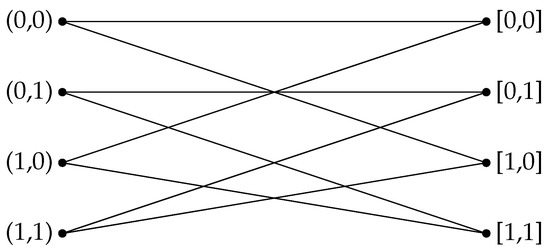
Let be a field. Then is a Cayley graph and has a Hamilton cycle (see Figure 1).
Figure 1.
The graph .
Note that is precisely a Cayley graph with A is a cyclic group generated by the permutation and .
By Theorem 2.1 (3) in [14], if is a finite field with q a prime power, then is connected. The following corollary implies that graph is Hamiltonian where q is an odd prime power, which supports the conjecture that Wenger graph has pancyclicity in [26].
Corollary 3.
Let p be an odd prime and be a finite field. Then graphs and have a Hamilton cycle.
Proof of Corollary 3.
The graph has a Hamilton cycle by Figure 1. If p is an odd prime, by Corollary 1, is a Cayley graph. To prove the connectivity, we need to find out the connection set S of Cayley graph . Indeed, we have since for all . Take and we have . Therefore and lie in , which implies and for all . Since the equation has a solution for any z in , the automorphism can be written as the composition of and in , thus , which implies , and then is connected, so has a Hamilton cycle by Theorem 6. □
For the graph , we have the following corollary.
Corollary 4.
Let R be a finite ring of characteristic 2 and be a connected graph. If is Cayley graphic of dihedral type and has loop or no-loop at all vertices, then has a Hamilton cycle.
Proof of Corollary 4.
It follows directly by Corollary 2 and Lemma 3. □
5. Conclusions
In Theorem 4 of this paper, under the conditions (see Definition 5) proposed in this paper, we obtain the necessary and sufficient condition that the graph is Cayley graph on some group of dihedral type with lies in and A uniform. Moreover in this case, we discuss the Hamiltonicity of . However, it has not been completely described when is a Cayley graph or Hamiltonian graph. It will be interesting to consider the pancyclicity of a Wenger graph for our future work (see [26]).
Author Contributions
Writing—original draft preparation, F.Y. and C.Z.; writing—review and editing, Q.S. and H.Z. All authors have read and agreed to the published version of the manuscript.
Funding
This work is supported by National Natural Science Foundation of China (Grant No.11971196, 11961007) and Science Technology Foundation of Guizhou Province (Grant No. [2020]1Y405).
Institutional Review Board Statement
Not applicable.
Informed Consent Statement
Not applicable.
Data Availability Statement
No data were reported in the study.
Acknowledgments
The authors thank Zhang Shunzhe for his advices on this paper. Moreover, the authors are grateful to the referees for many helpful comments.
Conflicts of Interest
The authors declare no conflict of interest.
References
- Lazebnik, F.; Ustimenko, V.A. New examples of graphs without small cycles and of large size. Eur. J. Comb. 1993, 14, 445–460. [Google Scholar] [CrossRef]
- Lazebnik, F.; Ustimenko, V.A.; Woldar, A.J. Polarities and 2k-cycle-free graphs. Discret. Math. 1999, 197, 503–513. [Google Scholar] [CrossRef]
- Lazebnik, F.; Woldar, A.J. General properties of some families of graphs defined by systems of equations. J. Graph Theory 2001, 38, 65–86. [Google Scholar] [CrossRef]
- Woldar, A.J. On generalizing generalized polygons. Innov. Incid. Geom. Algebr. Topol. Comb. 2010, 10, 147–170. [Google Scholar] [CrossRef]
- Terlep, T.A.; Williford, J. Graphs from Generalized Kac-Moody Algebras. Siam J. Discret. Math. 2012, 26, 1112–1120. [Google Scholar] [CrossRef][Green Version]
- Lazebnik, F.; Mubayi, D. New lower bounds for Ramsey numbers of graphs and hypergraphs. Adv. Appl. Math. 2002, 28, 544–559. [Google Scholar] [CrossRef]
- Lazebnik, F.; Ustimenko, V.A.; Woldar, A.J. New constructions of bipartite graphs on m, n vertices with many edges and without small cycles. J. Comb. Theory Ser. B 1994, 61, 111–117. [Google Scholar] [CrossRef][Green Version]
- Lazebnik, F.; Ustimenko, V.A. Explicit construction of graphs with an arbitrary large girth and of large size. Discret. Appl. Math. 1995, 60, 275–284. [Google Scholar] [CrossRef]
- Lazebnik, F.; Sun, S.; Wang, Y. Some families of graphs, hypergraphs and digraphs defined by systems of equations: A survey. Lect. Notes Semin. Interdiscip. Mat. 2017, 14, 105–142. [Google Scholar]
- Cheng, X.; Chen, W.; Tang, Y. On the girth of the bipartite graph D(k,q). Discret. Math. 2014, 335, 25–34. [Google Scholar] [CrossRef]
- Cheng, X.; Chen, W.; Tang, Y. On the conjecture for the girth of the bipartite graph D(k,q). Discret. Math. 2016, 339, 2384–2392. [Google Scholar] [CrossRef]
- Ustimenko, V.A.; Woldar, A.J. Extremal properties of regular and affine generalized polygons as tactical configurations. Eur. J. Comb. 2003, 23, 99–111. [Google Scholar] [CrossRef][Green Version]
- Hou, X.; Lappano, S.D.; Lazebnik, F. Proof of a conjecture on monomial graphs. Finite Fields Their Appl. 2017, 43, 42–68. [Google Scholar] [CrossRef]
- Lazebnik, F.; Viglione, R. An infinite series of regular edge-but not vertex-transitive graphs. J. Graph Theory 2002, 41, 249–258. [Google Scholar] [CrossRef][Green Version]
- Kutnar, K.; Marusic, D.; Morris, D.W.; Morris, J.; Sparl, P. Hamiltonian cycles in Cayley graphs whose order has few prime factors. ARS Math. Cont. 2012, 5, 27–71. [Google Scholar] [CrossRef]
- Li, C.H. On isomorphisms of finite Cayley graphs—A survey. Discret. Math. 2002, 256, 301–334. [Google Scholar] [CrossRef]
- Chen, C.C.; Quimpo, N.F. On strongly hamiltonian abelian group graphs. In Combinatorial Mathematics VIII; Springer: Berlin/Heidelberg, Germany, 1981; pp. 23–34. [Google Scholar]
- Curran, S.J.; Gallian, J.A. Hamiltonian cycles and paths in Cayley graphs and digraphs-a survey. Discret. Math. 1996, 156, 1–18. [Google Scholar] [CrossRef]
- Morris, D.W. 2-generated cayley digraphs on nilpotent groups have hamiltonian paths. Contri. Discret. Math. 2012, 7, 41–47. [Google Scholar]
- Montellano-Ballesteros, J.J.; Arguello, A.S. Hamiltonian normal Cayley graphs. Discuss. Math. Graph Theory 2019, 39, 731–740. [Google Scholar]
- Biggs, N. Algebraic Graph Theory; Cambridge University Press: New York, NY, USA, 1992. [Google Scholar]
- Bondy, J.A.; Murty, U.S.R. Graph Theory with Applications; Macmillan: London, UK, 1976. [Google Scholar]
- Alspach, B.; Chen, C.C.; Dean, M. Hamilton paths in Cayley graphs on generalized dihedral groups. ARS Math. Cont. 2010, 3, 29–47. [Google Scholar] [CrossRef][Green Version]
- Hsieh, S.Y.; Kuo, C.N. Hamiltonian-connectivity and strongly Hamiltonian-laceability of folded hypercubes. Comput. Math. Appl. 2007, 53, 1040–1044. [Google Scholar] [CrossRef]
- Witte, D. Cayley digraphs of prime-power order are hamiltonian. J. Comb. Theory Ser. B 1986, 40, 107–112. [Google Scholar] [CrossRef]
- Wang, Y.; Lazebnik, F.; Thomason, A. On some cycles in Wenger Graphs. Acta Math. Appl. Sin. Engl. Ser. 2020, 36, 492–502. [Google Scholar] [CrossRef]
Publisher’s Note: MDPI stays neutral with regard to jurisdictional claims in published maps and institutional affiliations. |
© 2022 by the authors. Licensee MDPI, Basel, Switzerland. This article is an open access article distributed under the terms and conditions of the Creative Commons Attribution (CC BY) license (https://creativecommons.org/licenses/by/4.0/).