


Additional Affiliation
In the published publication [1], there was an error regarding the affiliation for Muhammad Yaseen. In addition to affiliations 2 and 3, the updated affiliations should include 1, 2, and 3.
Text Correction
There was an error in the original publication. The authors asked to correct the name of the array within the SSIP approach, while the concept remains the same.
A correction has been made to Section 5: Methodology, Data Acquisition, Paragraph number 1:
“Power is first supplied to A10B10, A30B30, followed by A850B850, and so forth” has been corrected to: “Power is first supplied to (−10 m, 10 m), (−50 m, 50 m), followed by (−1010 m, 1010 m), and so forth”.
“The construction approach employed for this project involved measuring the depth of pole-dipole using spread spectrum-induced polarization” has been corrected to: “The construction approach employed for this project involved measuring the depth of the nonconventional gradient array using spread spectrum-induced polarization”.
Figures and Missing Citation Correction
Following the update to the name of the array, Figure 4 and Figure 5 and the caption for Figure 4 have been updated accordingly. The corrected versions of Figure 4 and Figure 5 appear below.
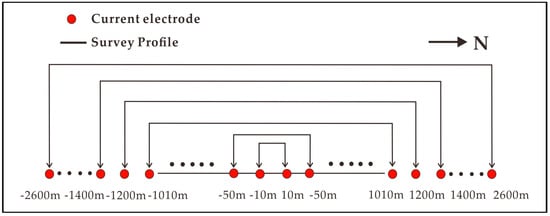
Figure 4.
The nonconventional gradient array protocol for the SSIP survey profile, utilizing 34 current electrodes with a maximum spacing of 5200 m and a minimum spacing of 20 m. The 2000 m line features potential electrodes spaced 20 m apart, modified based on Liu et al. (2017) [21].
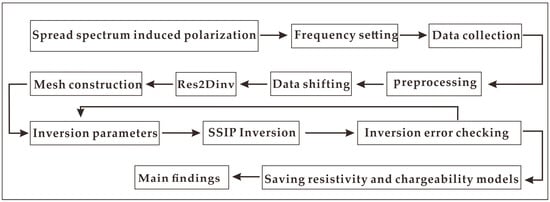
Figure 5.
Showing the overall data collection and inversion parameter steps for the resistivity and chargeability model of SSIP.
Reference
- Ahmad, J.; Chen, R.; Ahmed, I.; Yaseen, M.; Shah, S.A.; Rahim, O.A.; Ullah, F.; Fahad, S.; Rui, L. Spread Spectrum Induced Polarization (SSIP) Survey for the Qiushuwan Copper–Molybdenum Deposits in Southern Henan Province, China. Minerals 2024, 14, 934. [Google Scholar] [CrossRef]
Disclaimer/Publisher’s Note: The statements, opinions and data contained in all publications are solely those of the individual author(s) and contributor(s) and not of MDPI and/or the editor(s). MDPI and/or the editor(s) disclaim responsibility for any injury to people or property resulting from any ideas, methods, instructions or products referred to in the content. |
© 2025 by the authors. Licensee MDPI, Basel, Switzerland. This article is an open access article distributed under the terms and conditions of the Creative Commons Attribution (CC BY) license (https://creativecommons.org/licenses/by/4.0/).